Anticoagulation Stewardship Program in the DOAC Era


Abstract
1. Introduction
2. Bleeding Risk Profile of Direct Oral Anticoagulants (DOACs)
3. Perioperative Management of Anticoagulation
- CHEST recommends discontinuing DOAC 1–2 and 3–4 days before low/moderate bleeding risk and high bleeding risk surgeries respectively. Dabigatran should be discontinued earlier (3–4 days) if renal function is impaired, because of its renal elimination. This allows time for the anticoagulant effect to diminish before the planned procedure. No heparin bridging is recommended for DOACs, as bridging does not improve outcomes but increases bleeding risk. The guideline recommends re-initiating DOACs approximately 24 h post-op for low/moderate bleeding-risk procedures, and 48–72 h post-op for high bleeding-risk procedures. The early re-initiation is to limit time off anticoagulation, once sufficient hemostasis is established.
4. Reversal Agents: Current and Emerging
5. Implications for Anticoagulant Selection in High-Risk Patients
6. Laboratory and Workflow Considerations in Reversal
- Dabigatran prolongs aPTT and thrombin time significantly if levels are high. A normal thrombin time likely indicates an insignificant level of dabigatran.
- Factor-Xa inhibitors cause a dose-dependent prolongation of PT, especially rivaroxaban, but a normal PT does not exclude their presence. While an anti-Xa assay calibrated for specific DOACs is the best indicator, the long turnaround time renders it impractical to wait for drug levels before reversal in an emergency.
- If a DOAC level is low (<30 ng/mL), emergency procedures may proceed without reversal; a mild bleed may not require the administration of an antidote.
- If levels are high, it supports the approach for an aggressive reversal.
7. Anticoagulation Stewardship Services
8. Current Implementation Models
- Policy and guideline development: Devising institutional protocols for anticoagulation therapy including dosing, monitoring and reversal [41].
- Transition of care coordination: Ensuring that patients are given appropriate follow-ups when discharged with anticoagulants, especially warfarin. This reduces the risk of readmissions due to thrombotic events or bleeding complications resulting from non-adherence or incorrect medication administration after discharge [33].
- Perioperative case management: Many ASPs provide perioperative anticoagulation management service, where they receive referrals for patients on anticoagulants listed for surgeries and provide an appropriate perioperative management plan for the anticoagulation therapy. This ensures consistency and reduces unnecessary variability or last-minute cancellations due to lack of coordination regarding anticoagulation management plans pre-op [33].
- Monitoring outcomes and quality improvement: TJC mandates that ASPs track data on adverse events such as the number of heparin-induced thrombocytopenia cases, incidence of supratherapeutic INRs resulting in bleeds, or serious DOAC-associated bleeding events and their management. These cases are evaluated for adherence to protocols and identify key areas for improvements [40].
- Technology and alerts: The IT team can be involved to roll out electronic health records (EHR) alerts, such as an alert that triggers correction when a DOAC is prescribed at a wrong dose for a specific renal function. They can also assist in the integration of clinical decision support, such as default order sets that include appropriate reversal orders if required [33].
9. Future Directions
- Develop unified reversal algorithm: A single algorithm that outlines the strategy to any anticoagulant-related bleeding will be developed. Having a single, unified algorithm will help to reduce confusion and delays during bleeding emergencies. A unified anticoagulation reversal toolkit may be implemented, such as a checklist in an EHR order set.
- Monitoring and feedback: Data analytics will be increasingly utilized to identify patterns. For example, tracking reversal agent usage patterns and clinical outcomes and providing targeted feedback to clinicians who deviate from best practices or institution protocols.
- Performance metrics alignment: Hospitals may establish measurable targets, such as “For any anticoagulated patient with ICH, reversal agent administration within 60 min in >90% of cases” or “100% of warfarin patients with critical INR > 10 get Vitamin K within X time”. These can be implemented as quality improvement metrics, advanced by stewardship.
- Extension to antithrombotic stewardship: Many patients are on multiple antithrombotic drugs (including both anticoagulants and antiplatelets). The deprescribing of aspirin in a patient on warfarin for atrial fibrillation with no additional indication for aspirin, can reduce bleeding without an increase in thrombotic events. This comprehensive approach examines all blood-thinning therapies a patient is on, optimizing the combination.
- Patient education and engagement: A greater emphasis on patient involvement will be part of the future of ASP. This includes education on the importance of compliance to therapy, identification of bleeding and thrombotic symptoms early, and when to seek immediate medical attention. TJC mandates patient education on anticoagulation. ASPs develop education materials and teach-back methods to ensure good understanding of therapy in patients.
10. Practical Recommendations
- Establish a multidisciplinary ASP: Hospitals should convene an anticoagulation safety committee (including cardiology, neurology, hematology, pharmacy, surgery/anesthesia, and quality officers) to devise and oversee the adherence to protocols. This program should be empowered to implement guidelines (e.g., CHEST, ESC) into institutional practice and ensure compliance with TJC NPSG requirements. This will involve regular multidisciplinary meetings to evaluate anticoagulant-related adverse events and updating of protocols.
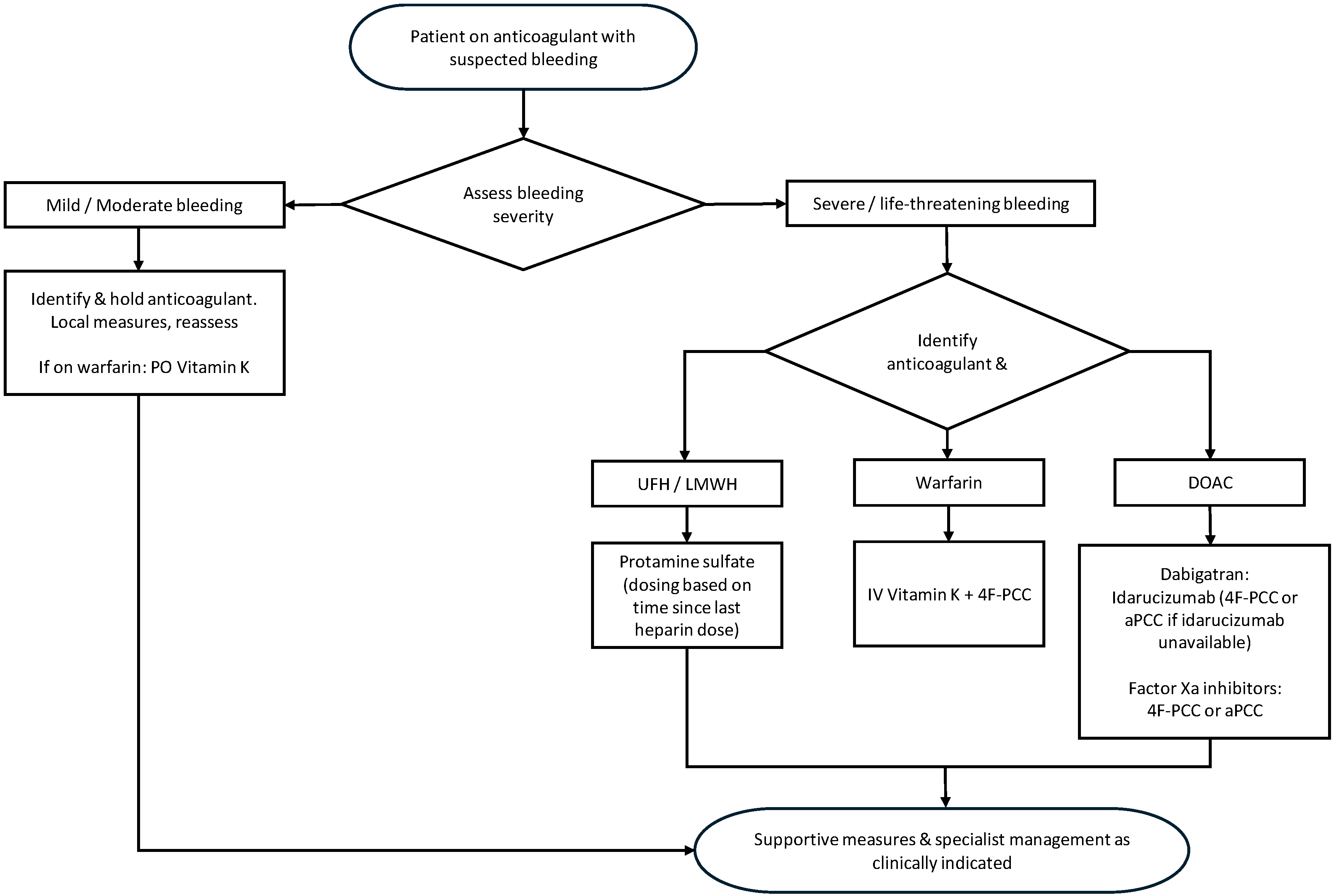
- Develop unified reversal algorithm: A single, easy-to-follow algorithm covering all anticoagulants (warfarin, heparins, DOACs) for managing anticoagulant-associated bleeds should be developed. This should be stratified by severity and include dosing recommendations. The protocol should then be distributed widely, such as posting on intranet, emergency departments, and even as an EHR order set. A “code hemorrhage” checklist based on the algorithm can guide acute responses. An example of our institution’s guide is in Supplementary File S1.
- Stock and strategically deploy reversal agents: Approved specific antidotes such as idarucizumab should be made available in areas likely to require them (emergency departments, intensive care units, pharmacy after-hours kit) to minimize drug turn-around time. If cost or resource constraints limit usage, the criteria for use should be clearly defined to avoid hesitation or confusion.
- Utilize laboratory support effectively: Laboratories should validate and offer assays that assist in the evaluation of anticoagulation, including DOAC-calibrated anti-Xa levels and thrombin time or ecarin clotting time for dabigatran. The capability to measure drug levels within 60 min can guide cases (e.g., late-presenting bleeds or uncertain adherence) even if treatment should not be withheld for these results in emergencies. Point-of-care tests should be utilized if available, such as using a DOAC urine dipstick in the emergency department to swiftly assess the anticoagulation status of stroke patients. Baseline coagulation labs (e.g., International Normalized Ratio INR, activated partial thromboplastin time aPTT) should be taken for all bleeding patients and resulted immediately to guide management by identifying an unsuspected coagulopathy or combined antiplatelet use.
- Protocolize perioperative anticoagulation management: These institutional protocols that guide clinicians on the perioperative anticoagulation management should be built on current evidence-based guidelines, and pre-operative holding intervals should be standardized for each DOAC customized to renal function and surgical bleed risk and be included in pre-operative checklists or order sets. Post-operative reinitiation protocols should be given equal importance to mitigate thrombotic risk after sufficient hemostasis has been achieved. Heparin bridging should be reserved for truly high-risk patients (e.g., mechanical valves, recent venous thromboembolism) and should involve the stewardship service or thrombosis specialist to coordinate timing and provide reversal if required. This limits variability and prevents both bleeding and thrombotic events. Our institution’s peri-operative anticoagulation protocol is in Supplementary File S2.
- Monitor outcomes and adverse events: A system to track and evaluate anticoagulation-related outcomes such as the frequency of major bleeds, reversal agent use, thrombotic events after reversal, and perioperative thromboembolism should be implemented. These reviews can help to improve current processes and improve quality of care. Appropriate prescribing, such as correct DOAC dosing based on patient factors, should be evaluated. These findings should be delivered to hospital quality committees and if applicable, on public quality dashboards.
- Align with performance and safety metrics: Established metrics should be adopted to measure the impact of ASP. Patient-centered outcomes such as reduced in-hospital mortality for anticoagulated trauma patients after implementing rapid reversal protocols should be monitored.
- Educate clinicians and patients continuously: Frontline clinicians (emergency physicians, surgeons, neurologists, etc.) can be reminded of the reversal protocols and guideline updates. Mock drills for critical scenarios such as a DOAC patient with ICH to reinforce steps. Quick reference guides can be disseminated or integrated into information buttons in the EHR for guidance. It is also important to ensure that patients possess good understanding of their anticoagulant therapy and the importance of communicating it in emergencies. Patients can be empowered with wallet cards or medical alert identification cards indicating their anticoagulant, which can save precious time in an emergency if they are unable to provide history.
11. Conclusions
Supplementary Materials
Author Contributions
Funding
Institutional Review Board Statement
Informed Consent Statement
Data Availability Statement
Conflicts of Interest
References
- Van Gelder, I.C.; Rienstra, M.; Bunting, K.V.; Casado-Arroyo, R.; Caso, V.; Crijns, H.; De Potter, T.J.R.; Dwight, J.; Guasti, L.; Hanke, T.; et al. 2024 ESC Guidelines for the management of atrial fibrillation developed in collaboration with the European Association for Cardio-Thoracic Surgery (EACTS). Eur. Heart J. 2024, 45, 3314–3414. [Google Scholar] [CrossRef]
- Chang, H.Y.; Zhou, M.; Tang, W.; Alexander, G.C.; Singh, S. Risk of gastrointestinal bleeding associated with oral anticoagulants: Population based retrospective cohort study. BMJ 2015, 350, h1585. [Google Scholar] [CrossRef] [PubMed]
- Praz, F.; Borger, M.A.; Lanz, J.; Marin-Cuartas, M.; Abreu, A.; Adamo, M.; Marsan, A.J.; Barili, F.; Bonaros, N.; Cosyns, B.; et al. 2025 ESC/EACTS Guidelines for the management of valvular heart disease. Eur. J. Cardiothorac. Surg. 2025, 67. [Google Scholar] [CrossRef]
- Connolly, S.J.; Ezekowitz, M.D.; Yusuf, S.; Eikelboom, J.; Oldgren, J.; Parekh, A.; Pogue, J.; Reilly, P.A.; Themeles, E.; Varrone, J.; et al. Dabigatran versus warfarin in patients with atrial fibrillation. N. Engl. J. Med. 2009, 361, 1139–1151. [Google Scholar] [CrossRef] [PubMed]
- Giugliano, R.P.; Ruff, C.T.; Braunwald, E.; Murphy, S.A.; Wiviott, S.D.; Halperin, J.L.; Waldo, A.L.; Ezekowitz, M.D.; Weitz, J.I.; Špinar, J.; et al. Edoxaban versus warfarin in patients with atrial fibrillation. N. Engl. J. Med. 2013, 369, 2093–2104. [Google Scholar] [CrossRef]
- Granger, C.B.; Alexander, J.H.; McMurray, J.J.; Lopes, R.D.; Hylek, E.M.; Hanna, M.; Al-Khalidi, H.R.; Ansell, J.; Atar, D.; Ave-zum, A.; et al. Apixaban versus warfarin in patients with atrial fibrillation. N. Engl. J. Med. 2011, 365, 981–992. [Google Scholar] [CrossRef] [PubMed]
- Patel, M.R.; Mahaffey, K.W.; Garg, J.; Pan, G.; Singer, D.E.; Hacke, W.; Breithardt, G.; Halperin, J.L.; Hankey, G.J.; Piccini, J.P.; et al. Rivaroxaban versus warfarin in nonvalvular atrial fibrillation. N. Engl. J. Med. 2011, 365, 883–891. [Google Scholar] [CrossRef]
- Majeed, A.; Hwang, H.G.; Connolly, S.J.; Eikelboom, J.W.; Ezekowitz, M.D.; Wallentin, L.; Brueckmann, M.; Fraessdorf, M.; Yusuf, S.; Schulman, S. Management and outcomes of major bleeding during treatment with dabigatran or warfarin. Circulation 2013, 128, 2325–2332. [Google Scholar] [CrossRef]
- Coyle, M.; Lynch, A.; Higgins, M.; Costello, M.; Judge, C.; O’Donnell, M.; Reddin, C. Risk of Intracranial Hemorrhage Associated With Direct Oral Anticoagulation vs Antiplatelet Therapy: A Systematic Review and Meta-Analysis. JAMA Netw. Open 2024, 7, e2449017. [Google Scholar] [CrossRef]
- Douketis, J.D.; Spyropoulos, A.C.; Murad, M.H.; Arcelus, J.I.; Dager, W.E.; Dunn, A.S.; Fargo, R.A.; Levy, J.H.; Samama, C.M.; Shah, S.H.; et al. Perioperative Management of Antithrombotic Therapy: An American College of Chest Physicians Clinical Practice Guideline. Chest 2022, 162, e207–e243. [Google Scholar] [CrossRef]
- Rudd, K.; Winans, A.; Triller, D. Standardizing periprocedural anticoagulation management: A stewardship initiative. J. Thromb. Thrombolysis 2023, 56, 361–367. [Google Scholar] [CrossRef]
- Pollack, C.V.; Reilly, P.A., Jr.; van Ryn, J.; Eikelboom, J.W.; Glund, S.; Bernstein, R.A.; Dubiel, R.; Huisman, M.V.; Hylek, E.M.; Kam, C.-W.; et al. Idarucizumab for Dabigatran Reversal—Full Cohort Analysis. N. Engl. J. Med. 2017, 377, 431–441. [Google Scholar] [CrossRef]
- Connolly, S.J.; Crowther, M.; Eikelboom, J.W.; Gibson, C.M.; Curnutte, J.T.; Lawrence, J.H.; Yue, P.; Bronson, M.D.; Lu, G.; Conley, P.B.; et al. Full Study Report of Andexanet Alfa for Bleeding Associated with Factor Xa Inhibitors. N. Engl. J. Med. 2019, 380, 1326–1335. [Google Scholar] [CrossRef]
- Siegal, D.M.; Curnutte, J.T.; Connolly, S.J.; Lu, G.; Conley, P.B.; Wiens, B.L.; Mathur, V.S.; Castillo, J.; Bronson, M.D.; Leeds, J.M.; et al. Andexanet Alfa for the Reversal of Factor Xa Inhibitor Activity. N. Engl. J. Med. 2015, 373, 2413–2424. [Google Scholar] [CrossRef] [PubMed]
- Connolly, S.J.; Sharma, M.; Cohen, A.T.; Demchuk, A.M.; Czlonkowska, A.; Lindgren, A.G.; Molina, C.A.; Bereczki, D.; Toni, D.; Seiffge, D.J.; et al. Andexanet for Factor Xa Inhibitor-Associated Acute Intracerebral Hemorrhage. N. Engl. J. Med. 2024, 390, 1745–1755. [Google Scholar] [CrossRef]
- Food, U.S.; Drug, A. Update on the Safety of Andexxa by AstraZeneca: FDA Safety Communication; Food and Drug Administration: Silver Spring, MD, USA, 2025.
- Ansell, J.; Laulicht, B.E.; Bakhru, S.H.; Burnett, A.; Jiang, X.; Chen, L.; Baker, C.; Villano, S.; Steiner, S. Ciraparantag, an anticoagulant reversal drug: Mechanism of action, pharmacokinetics, and reversal of anticoagulants. Blood 2021, 137, 115–125. [Google Scholar] [CrossRef] [PubMed]
- Ansell, J.E.; Bakhru, S.H.; Laulicht, B.E.; Steiner, S.S.; Grosso, M.A.; Brown, K.; Dishy, V.; Lanz, H.J.; Mercuri, M.F.; Noveck, R.J.; et al. Single-dose ciraparantag safely and completely reverses anticoagulant effects of edoxaban. Thromb. Haemost. 2017, 117, 238–245. [Google Scholar] [CrossRef]
- van Es, N.; De Caterina, R.; Weitz, J.I. Reversal agents for current and forthcoming direct oral anticoagulants. Eur. Heart J. 2023, 44, 1795–1806. [Google Scholar] [CrossRef]
- Levy, J.H.; Shaw, J.R.; Castellucci, L.A.; Connors, J.M.; Douketis, J.; Lindhoff-Last, E.; Rocca, B.; Samama, C.M.; Siegal, D.; Weitz, J.I. Reversal of direct oral anticoagulants: Guidance from the SSC of the ISTH. J. Thromb. Haemost. 2024, 22, 2889–2899. [Google Scholar] [CrossRef] [PubMed]
- Sarode, R.; Welsby, I.J.; Hoffman, M. Clinical Relevance of Preclinical and Clinical Studies of Four-Factor Prothrombin Complex Concentrate for Treatment of Bleeding Related to Direct Oral Anticoagulants. Ann. Emerg. Med. 2023, 82, 341–361. [Google Scholar] [CrossRef] [PubMed]
- Shamiea, M.; Kashua, A.; Natour, A.E.; Butnik, Y.; Ifrach, N.; Avnery, O.; Itchaki, G.; Osnis, A.; Rabina, E.; Kabaha, N.; et al. Prothrombin complex concentrate for reversal of factor Xa inhibitor-associated acute major gastrointestinal bleeding. Am. J. Med. 2026; in press. [CrossRef] [PubMed]
- Takeda Manufacturing Austria, A.G. FEIBA (Factor VIII Inhibitor Bypassing Activity) Prescribing Information; Takeda Manufacturing Austria, A.G.: Vienna, Austria, 2024. [Google Scholar]
- Crawley, R.M.; Sheikh-Taha, M. Comparison of activated and 4-factor prothrombin complex concentrates for reversal of apixaban- and rivaroxaban-associated major bleeding. J. Thromb. Thrombolysis 2026. [Google Scholar] [CrossRef]
- Harenberg, J.; Beyer-Westendorf, J.; Crowther, M.; Douxfils, J.; Elalamy, I.; Verhamme, P.; Bauersachs, R.; Hetjens, S.; Weiss, C.; Working Group Members. Accuracy of a Rapid Diagnostic Test for the Presence of Direct Oral Factor Xa or Thrombin Inhibitors in Urine-A Multicenter Trial. Thromb. Haemost. 2020, 120, 132–140. [Google Scholar] [CrossRef]
- Merrelaar, A.A.-O.; Bögl, M.S.; Buchtele, N.; Merrelaar, M.; Herkner, H.; Schoergenhofer, C.; Harenberg, J.; Douxfils, J.; Siriez, R.; Jilma, B.; et al. Performance of a Qualitative Point-of-Care Strip Test to Detect DOAC Exposure at the Emergency Department: A Cohort-Type Cross-Sectional Diagnostic Accuracy Study. Thromb. Haemost. 2022, 122, 1723–1731. [Google Scholar] [CrossRef]
- Callaly, E.P.; Tan, P.S.; Schembri, E.; Borosak, M.; Dewey, H.; Choi, P. Evaluating DOAC dipstick testing in the management of acute stroke: Protocol for a multicentre, prospective, observational registry study. BMJ Open 2025, 15, e102092. [Google Scholar] [CrossRef]
- Harenberg, J.; Gosselin, R.C.; Cuker, A.; Becattini, C.; Pabinger, I.; Poli, S.; Weitz, J.; Ageno, W.; Bauersachs, R.; Celap, I.; et al. Algorithm for Rapid Exclusion of Clinically Relevant Plasma Levels of Direct Oral Anticoagulants in Patients Using the DOAC Dipstick: An Expert Consensus Paper. Thromb. Haemost. 2024, 124, 770–777. [Google Scholar]
- Bakhru, S.H.; Jiang, X.; Chen, L.; Osmani, D.; Kronen, K.; Mootoo, D.; Zappe, S.; Ansell, J. Validation of a whole blood coagulometer sensitive to the direct oral anticoagulants. Sci. Rep. 2025, 15, 7355. [Google Scholar] [CrossRef]
- Sedghi, A.; Heubner, L.; Klimova, A.; Tiebel, O.; Pietsch, J.; Mirus, M.; Barlinn, K.; Minx, T.; Beyer-Westendorf, J.; Puetz, V.; et al. Point-of-Care Assessment of Direct Oral Anticoagulation in Acute Ischemic Stroke: Protocol for a Prospective Observational Diagnostic Accuracy Study. Thromb. Haemost. 2022, 122, 1954–1962. [Google Scholar] [CrossRef]
- Fanikos, J.; Tawfik, Y.; Almheiri, D.; Sylvester, K.; Buckley, L.F.; Dew, C.; Dell’ORfano, H.; Armero, A.; Bejjani, A.; Bikdeli, B.; et al. Anticoagulation-Associated Adverse Drug Events in Hospitalized Patients Across Two Time Periods. Am. J. Med. 2023, 136, 927–936.e3. [Google Scholar] [CrossRef] [PubMed]
- Rowily, A.A.; Jalal, Z.; Paudyal, V. Contributory factors and patient harm including deaths associated direct acting oral anticoagulants (DOACs) medication incidents: Evaluation of real world data reported to the National Reporting and Learning System. Expert Opin. Drug Saf. 2023, 22, 1113–1125. [Google Scholar] [CrossRef] [PubMed]
- Porres-Aguilar, M.; Ansell, J.; Mukherjee, D.; Cota-Rangel, X.; Martinez-Zubieta, R.; Carrillo-Esper, R.; Burnett, A.E. Impact of Hospital-based Multidisciplinary Anticoagulation Stewardship Programs. Arch. Med. Res. 2023, 54, 1–6. [Google Scholar] [CrossRef]
- Wan, T.; Garland, S.J.; Drury, C.T.; Lambert, J.; Yoon, J.; Chan, M. Anticoagulation stewardship: Improving adherence to clinical guidelines and reducing overuse of venous thromboembolism prophylaxis in hospitalized medical patients. Thromb. Res. 2024, 239, 109036. [Google Scholar] [CrossRef]
- Zhang, Z.X.; Schroeder-Tanka, J.; Stooker, W.; Wissen, S.; Khorsand, N. Management of combined oral antithrombotic therapy by an antithrombotic stewardship program: A prospective study. Br. J. Clin. Pharmacol. 2022, 88, 4092–4099. [Google Scholar] [CrossRef] [PubMed]
- Burnett, A.; Rudd, K.M.; Triller, D. Advancing anticoagulation stewardship: A call to action for stewardship from the US-based anticoagulation forum. Thromb. Update 2022, 9, 100125. [Google Scholar] [CrossRef]
- Foss, M.T.; Schoch, P.H.; Sintek, C.D. Efficient operation of a high-volume anticoagulation clinic. Am. J. Health Syst. Pharm. 1999, 56, 443–449. [Google Scholar] [CrossRef] [PubMed]
- Budnitz, D.S.; Shehab, N.; Lovegrove, M.C.; Geller, A.I.; Lind, J.N.; Pollock, D.A. US Emergency Department Visits Attributed to Medication Harms, 2017–2019. JAMA 2021, 326, 1299–1309. [Google Scholar] [CrossRef]
- The Joint Commission. R3 Report: Requirement, Rationale, Reference. Joint Commission, R3 Report, Issue 19. 2025. Available online: https://digitalassets.jointcommission.org/api/public/content/581930967d6c49108d671fca10bddff4?v=0fb0e955 (accessed on 9 January 2026).
- The Joint Commission. National Performance Goals™ Effective January 2026 for the Hospital Program. 2026. Available online: https://www.jointcommission.org/en-us/standards/national-performance-goals (accessed on 10 January 2026).
- Gosselin, R.C.; Roberts, A.J.; Dager, W.E. The Joint Commission National Patient Safety Goals (NPSG) directing anticoagulation safety in the United States. Ann. Blood 2019, 4, 21. [Google Scholar] [CrossRef]
- Dreijer, A.R.; Kruip, M.; Diepstraten, J.; Polinder, S.; Brouwer, R.; Mol, P.G.M.; Croles, F.N.; Kragten, E.; Leebeek, F.W.G.; van den Bemt, P.M.L.A. Effect of antithrombotic stewardship on the efficacy and safety of antithrombotic therapy during and after hospitalization. PLoS ONE 2020, 15, e0235048. [Google Scholar] [CrossRef]
- Lui, P.L.; Tan, S.C.; Goh, P.W.; Mohankumar, B.; Tun Ye, P.M.; Tin, K.C.; Yap, E.S.; Teo, W.Z.Y. Improving the safety of heparin usage by standardisation of practice. BMJ Open Qual. 2025, 14, e002952. [Google Scholar] [CrossRef]
- May, J.E.; Allen, A.L.; Samuelson Bannow, B.T.; O’Connor, C.; Sylvester, K.W.; Kaatz, S. Safe and effective anticoagulation use: Case studies in anticoagulation stewardship. J. Thromb. Haemost. 2025, 23, 779–789. [Google Scholar] [CrossRef]
- Quintens, C.A.-O.; Verhamme, P.; Vanassche, T.; Vandenbriele, C.; Van den Bosch, B.; Peetermans, W.E.; Van der Linden, L.; Spriet, I. Improving appropriate use of anticoagulants in hospitalised patients: A pharmacist-led Check of Medication Appropriateness intervention. Br. J. Clin. Pharmacol. 2021, 88, 2959–2968. [Google Scholar] [CrossRef] [PubMed]
- Sosyal, D.; Bektay, M.A.-O.; Acikgoz, N.; Izzettin, F.A.-O. Evaluation of clinical pharmacy services in patients receiving antithrombotic treatment in a randomized controlled trial. Sci. Rep. 2025, 15, 41692. [Google Scholar] [CrossRef] [PubMed]


| Anticoagulant | Laboratory Detection | Specific Antidote | Non-Specific Reversal | Adjunctive Therapy |
|---|---|---|---|---|
| Warfarin | PT/INR (therapeutic: 2.0–3.0) | Vitamin K (IV 5–10 mg) | 4F-PCC (25–50 U/kg) | FFP if PCC unavailable |
| Unfractionated heparin | aPTT, anti-Xa activity | Protamine sulfate (1 mg per 100 U heparin) | N/A | N/A |
| Low molecular weight heparin | Anti-Xa activity (LMWH-calibrated) | Protamine (partial reversal, 1 mg per 1 mg enoxaparin) | N/A | N/A |
| Dabigatran | aPTT, TT, ECT, dilute TT | Idarucizumab 5 g IV | 4F-PCC (50 U/kg) or aPCC (50–80 U/kg) | Hemodialysis (removes ~60%) Consider:
|
| Apixaban | PT (variable), anti-Xa (specific) | None (andexanet withdrawn) | 4F-PCC (25–50 U/kg) or aPCC (50–80 U/kg) | Consider:
|
| Rivaroxaban | PT (prolonged), anti-Xa (specific) | None (andexanet withdrawn) | 4F-PCC (25–50 U/kg) or aPCC (50–80 U/kg) | Consider:
|
| Edoxaban | PT, anti-Xa (specific) | None | 4F-PCC (25–50 U/kg) or aPCC (50–80 U/kg) | Consider:
|
Disclaimer/Publisher’s Note: The statements, opinions and data contained in all publications are solely those of the individual author(s) and contributor(s) and not of MDPI and/or the editor(s). MDPI and/or the editor(s) disclaim responsibility for any injury to people or property resulting from any ideas, methods, instructions or products referred to in the content. |
© 2026 by the authors. Licensee MDPI, Basel, Switzerland. This article is an open access article distributed under the terms and conditions of the Creative Commons Attribution (CC BY) license.
Share and Cite
Ng, J.X.; Tan, S.C.; Koh, P.L.; Yap, E.S. Anticoagulation Stewardship Program in the DOAC Era. J. Clin. Med. 2026, 15, 2597. https://doi.org/10.3390/jcm15072597
Ng JX, Tan SC, Koh PL, Yap ES. Anticoagulation Stewardship Program in the DOAC Era. Journal of Clinical Medicine. 2026; 15(7):2597. https://doi.org/10.3390/jcm15072597
Chicago/Turabian StyleNg, Jian Xiong, Su Ching Tan, Pei Lin Koh, and Eng Soo Yap. 2026. "Anticoagulation Stewardship Program in the DOAC Era" Journal of Clinical Medicine 15, no. 7: 2597. https://doi.org/10.3390/jcm15072597
APA StyleNg, J. X., Tan, S. C., Koh, P. L., & Yap, E. S. (2026). Anticoagulation Stewardship Program in the DOAC Era. Journal of Clinical Medicine, 15(7), 2597. https://doi.org/10.3390/jcm15072597