Differences in Assessing Loneliness Among Japanese Older Adults: A Comparison of Family Physicians and Nurses


Abstract
1. Introduction
2. Methods
2.1. Survey 1:
2.1.1. Study Design and Participants
2.1.2. Questionnaire Format and Administration
2.1.3. Survey Items
2.1.4. Survey Procedure and Participant Flow
2.1.5. Analysis
2.2. Survey 2:
2.2.1. Study Design and Participants
2.2.2. Analysis
3. Results
3.1. Survey 1:
3.1.1. Patient Characteristics
3.1.2. Family Physicians’ and Nurses’ Ratings of Patient Loneliness
3.2. Survey 2:
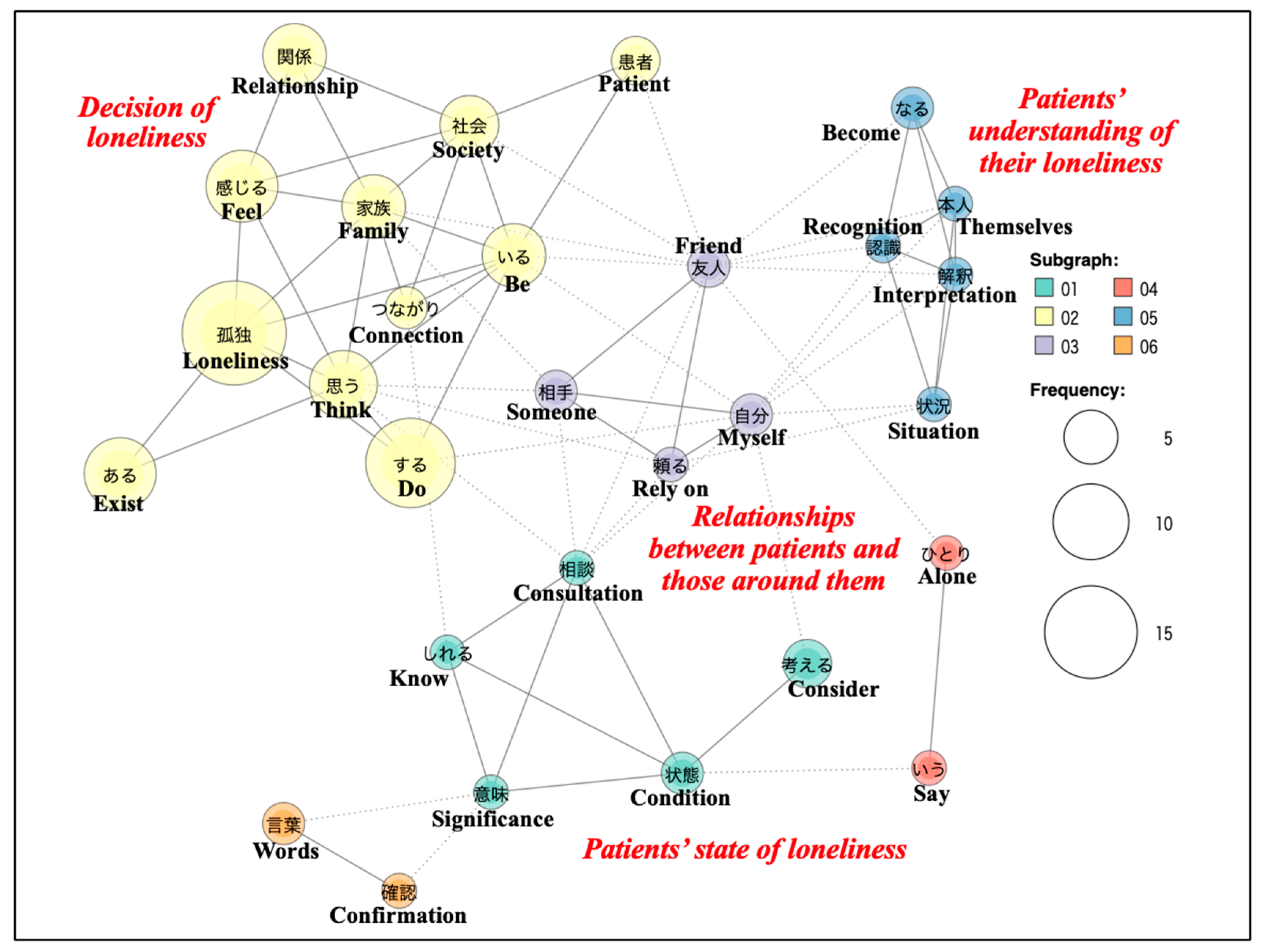
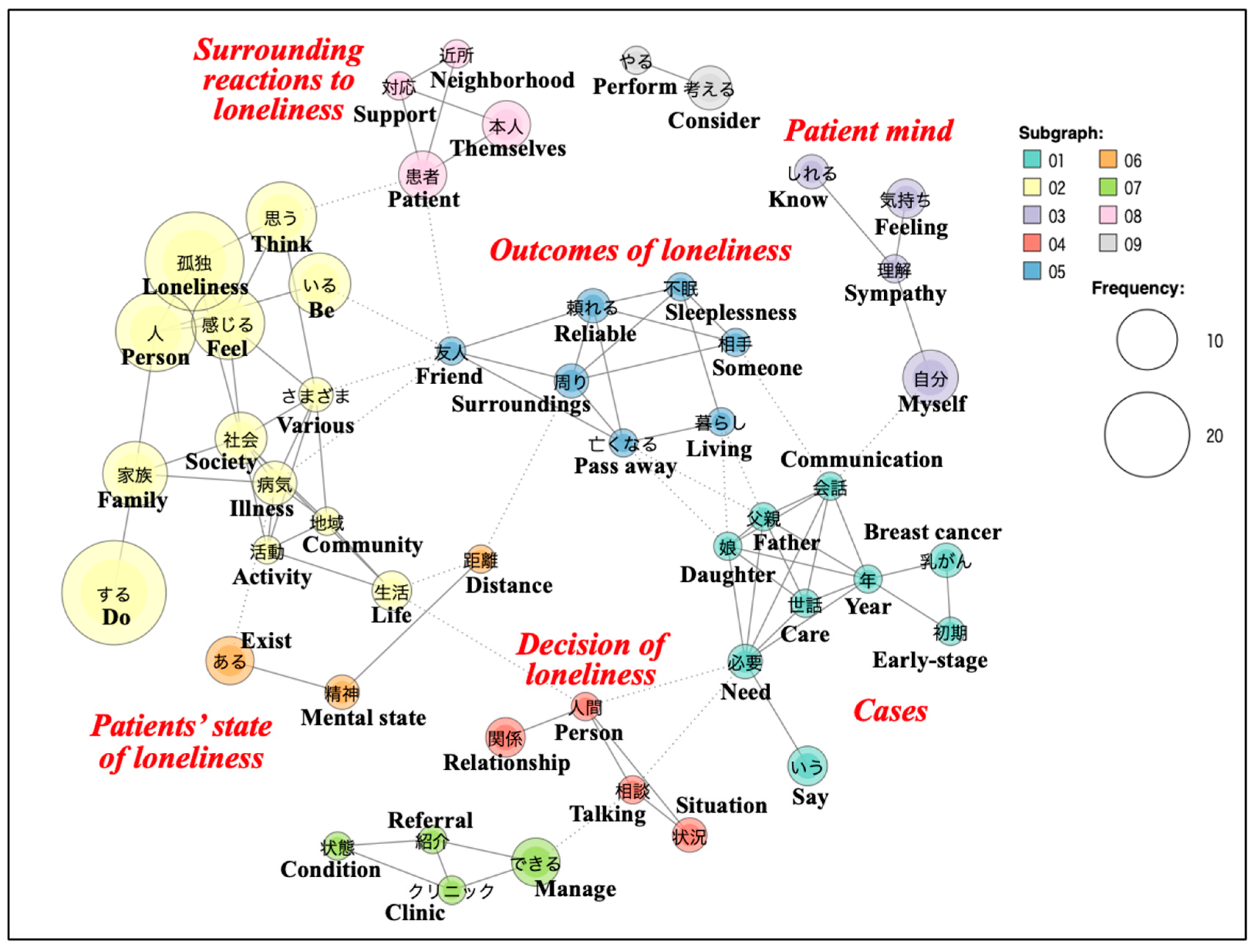
3.2.1. Frequently Used Words by Family Physicians and Nurses
- Family (家族), relationship (関係) (7 occurrences each),
- Society (社会) (6 occurrences),
- Patient (患者) (4 occurrences).
- Person (人) (17 occurrences),
- Family (家族) (11 occurrences),
- Society (社会) (7 occurrences),
- Patient (患者) (6 occurrences).
3.2.2. Subgraph Analysis of Co-Occurrence Networks by Family Physicians and Nurses
4. Discussion
5. Conclusions
Author Contributions
Funding
Institutional Review Board Statement
Informed Consent Statement
Data Availability Statement
Acknowledgments
Conflicts of Interest
References
- Okamoto, J. The Loneliest Japanese Old Man in the World; Kadokawa: Tokyo, Japan, 2016; pp. 10, 71–73. (In Japanese) [Google Scholar]
- Cabinet Office, Japan. Joint Message from Loneliness Ministers’ Meeting; Cabinet Office: Tokyo, Japan, 2021. Available online: https://www.cao.go.jp/kodoku_koritsu/index-e.html (accessed on 10 January 2026).
- Cabinet Office, Japan. National Survey on Loneliness and Social Isolation; Cabinet Office: Tokyo, Japan, 2021–2023. Available online: https://www.cao.go.jp/kodoku_koritsu/torikumi/zenkokuchousa.html (accessed on 10 January 2026). (In Japanese)
- Department for Culture, Media & Sport (UK). Community Life Survey 2023/24: Loneliness and Support Networks; DCMS: London, UK, 2024. Available online: https://www.gov.uk/government/statistics/community-life-survey-202324-annual-publication/community-life-survey-202324-loneliness-and-support-networks--2 (accessed on 10 January 2026).
- Murthy, V.H. Together: The Healing Power of Human Connection in a Sometimes Lonely World; Harper Collins: New York, NY, USA, 2020; pp. 27–29, 41–44. [Google Scholar]
- Kung, C.S.J.; Kunz, J.S.; Shields, M.A. Economic aspects of loneliness in Australia. Aust. Econ. Rev. 2021, 54, 147–163. [Google Scholar] [CrossRef]
- United States Public Health Service, Office of the Surgeon General. Our Epidemic of Loneliness and Isolation: The U.S. Surgeon General’s Advisory on the Healing Effects of Social Connection and Community; U.S. Department of Health & Human Services: Washington, DC, USA, 2023. Available online: https://www.hhs.gov/sites/default/files/surgeon-general-social-connection-advisory.pdf (accessed on 10 January 2026).
- Sheftel, M.G.; Margolis, R.; Verdery, A.M. Loneliness trajectories worldwide. J. Gerontol. B 2024, 79, gbae098. [Google Scholar] [CrossRef]
- van Staden, W.C.; Coetzee, K. Conceptual relations between loneliness and culture. Curr. Opin. Psychiatry 2010, 23, 524–529. [Google Scholar] [CrossRef]
- National Academies of Sciences, Engineering, and Medicine. Social Isolation and Loneliness in Older Adults: Opportunities for the Health Care System; National Academies Press: Washington, DC, USA, 2020; pp. 42–43, 49–62, 107–121. [Google Scholar] [CrossRef]
- Hong, J.H.; Nakamura, J.S.; Berkman, L.F.; Chen, F.S.; Shiba, K.; Chen, Y.; Kim, E.S.; VanderWeele, T.J. Are loneliness and social isolation equal threats to health and well-being? SSM Popul. Health 2023, 23, 101459. [Google Scholar] [CrossRef]
- World Health Organization. From Loneliness to Social Connection: Charting a Path to Healthier Societies: Report of the WHO Commission on Social Connection; World Health Organization: Geneva, Switzerland, 2025; Available online: https://iris.who.int/handle/10665/381746 (accessed on 20 February 2026).
- Mullen, R.A.; Tong, S.T.; Lum, H.D.; Stephens, K.A.; Krist, A.H. The Role of Primary Care in the Social Isolation and Loneliness Epidemic. Ann. Fam. Med. 2024, 22, 244–246. [Google Scholar] [CrossRef]
- Manchanda, R. The Upstream Doctors: Medical Innovators Track Sickness to Its Source; HealthBegins: Pasadena, CA, USA, 2021; pp. 9–13. [Google Scholar]
- Yoshida, K.; Honda, K.; Goto, A.; Kawachi, I. Collateral health effects of loneliness care. Health Serv. Res. Manag. Epidemiol. 2024, 11, 23333928241240970. [Google Scholar] [CrossRef] [PubMed]
- Yoshida, K.; Nakamura, K.; Hoshi, G.; Kanke, S.; Goto, A.; Kassai, R. Primary health care practitioners’ perception of patient loneliness in Japanese older adults: A cross-sectional study. SSM Popul. Health 2022, 19, 101143. [Google Scholar] [CrossRef] [PubMed]
- Wooldridge, A.N.; Arató, N.; Sen, A.; Amenomori, M.; Fetters, M.D. Truth or fallacy? Three hour wait for three minutes with the doctor. Asia Pac. Fam. Med. 2010, 9, 11. [Google Scholar] [CrossRef]
- Irving, G.; Neves, A.L.; Dambha-Miller, H.; Oishi, A.; Tagashira, H.; Verho, A.; Holden, J. International variations in primary care physician consultation time. BMJ Open 2017, 7, e017902. [Google Scholar] [CrossRef]
- Easton, G. The Appointment: What Your Doctor Really Thinks During Your Ten-Minute Consultation; Constable & Robinson: London, UK, 2018; pp. 238–259. [Google Scholar]
- Kajikawa, N.; Yokoya, S.; Ozone, S. Japanese family physicians’ attitudes, difficulties, and perceived significance in managing mental health problems: A qualitative study. J. Gen. Fam. Med. 2024, 26, 37–44. [Google Scholar] [CrossRef]
- Hutt, P. Family medicine in Japan. Br. J. Gen. Pract. 2009, 59, 699–701. [Google Scholar] [CrossRef]
- Freeman, T.R. McWhinney’s Textbook of Family Medicine, 4th ed.; Oxford University Press: Oxford, UK, 2016; pp. 17–20, 28–32. [Google Scholar]
- Ohta, R.; Sano, C. Implementation of the Principles of Family Medicine in Modern Family Medicine Education Needing System-Specific Approaches. Cureus 2022, 14, e31177. [Google Scholar] [CrossRef] [PubMed]
- Stewart, M.; Brown, J.B.; Weston, W.W.; Freeman, T.; Ryan, B.L.; McWilliam, C.L.; McWhinney, I.R. Patient-Centered Medicine, 4th ed.; CRC Press: Boca Raton, FL, USA, 2024; pp. 4–5, 39–40. [Google Scholar]
- Kawaguchi, Y.; Ito, Y. Redefining nurses’ professionalism. AHFE Open Access 2023, 108, 171–179. [Google Scholar] [CrossRef]
- Aoki, M.; Yokota, S.; Kagawa, R.; Shinohara, E.; Imai, T.; Ohe, K. Automatic classification of electronic nursing narrative records based on Japanese standard terminology for nursing. Comput. Inform. Nurs. 2021, 39, 828–834. [Google Scholar] [CrossRef]
- Russell, D.W. UCLA Loneliness Scale (Version 3): Reliability, Validity, and Factor Structure. J. Pers. Assess. 1996, 66, 20–40. [Google Scholar] [CrossRef] [PubMed]
- Masuda, Y.; Tadaka, E.; Dai, Y. Reliability and validity of the Japanese UCLA Loneliness Scale Version 3. J. Jpn. Acad. Community Health Nurs. 2012, 15, 25–32. (In Japanese) [Google Scholar]
- Toyoshima, A.; Sato, S. Social support, loneliness, and mental health. Jpn. J. Gerontol. 2013, 35, 29–38. (In Japanese) [Google Scholar]
- Donahue, K.E.; Ashkin, E.; Pathman, D.E. Length of patient-physician relationship and patients’ satisfaction and preventive service use in the rural south: A cross-sectional telephone study. BMC Fam. Pract. 2005, 6, 40. [Google Scholar] [CrossRef]
- Pons, P.; Latapy, M. Computing communities using random walks. arXiv 2005, arXiv:physics/0512106. [Google Scholar] [CrossRef]
- Ofei-Dodoo, S.; Ebberwein, C.; Kellerman, R. Assessing Loneliness and Other Types of Emotional Distress among Practicing Physicians. Kansas J. Med. 2020, 13, 1–5. [Google Scholar] [CrossRef]
- Mitchell, A.J.; Kakkadasam, V. Ability of nurses to identify depression in primary care, secondary care and nursing homes—A meta-analysis of routine clinical accuracy. Int. J. Nurs. Stud. 2011, 48, 359–368. [Google Scholar] [CrossRef]
- Leeflang, M.M.; Deeks, J.J.; Rutjes, A.W.; Reitsma, J.B.; Bossuyt, P.M. Predictive values of diagnostic tests. J. Clin. Epidemiol. 2012, 65, 1088–1097. [Google Scholar] [CrossRef] [PubMed]
- Šimundić, A.-M. Measures of diagnostic accuracy. EJIFCC 2009, 19, 203–211. [Google Scholar] [PubMed]
- Baeyens, J.P.; Serrien, B.; Goossens, M.; Clijsen, R. Questioning the “SPIN and SNOUT” rule in clinical testing. Arch. Physiother. 2019, 9, 4. [Google Scholar] [CrossRef]
- Perlman, D.; Peplau, L.A. Toward a social psychology of loneliness. In Personal Relationships in Disorder; Duck, S.W., Gilmour, R., Eds.; Academic Press: London, UK, 1981; pp. 31–56. [Google Scholar]
- Cacioppo, J.T.; Patrick, W. Loneliness: Human Nature and the Need for Social Connection; W.W. Norton & Company: New York, NY, USA, 2008; pp. 3–8, 12–14, 75–77. [Google Scholar]
- Cacioppo, J.T.; Hawkley, L.C. Perceived social isolation and cognition. Trends Cogn. Sci. 2009, 13, 447–454. [Google Scholar] [CrossRef] [PubMed]
- Holt-Lunstad, J. Social connection as a public health issue: The evidence and a systemic framework for prioritizing the “social” in social determinants of health. Annu. Rev. Public Health 2022, 43, 193–213. [Google Scholar] [CrossRef]
- Matthews, T.; Bryan, B.T.; Danese, A.; Meehan, A.J.; Poulton, R.; Arseneault, L. Using a loneliness measure to screen for risk of mental health problems: A replication in two nationally representative cohorts. Int. J. Environ. Res. Public Health 2022, 19, 1641. [Google Scholar] [CrossRef]
- National Health Service England. Social Prescribing; NHS England: Leeds, UK, 2022. Available online: https://www.england.nhs.uk/personalisedcare/social-prescribing/ (accessed on 10 January 2026).
- Ministry of Health, Labour and Welfare, Japan. Collection of Model Project Initiatives; MHLW: Tokyo, Japan, 2023. Available online: https://www.mhlw.go.jp/stf/newpage_30921.html (accessed on 10 January 2026). (In Japanese)
- Yoshida, K.; Honda, K.; Goto, A. Loneliness and family uncertainty among older adults: Confirmation of the 3-item short version of the UCLA Loneliness Scale and creation of a new 3-item short version of the MUIS-FM-J. J. Seizon Life Sci. 2023, 34, 159–166. (In Japanese) [Google Scholar]



| UCLA Loneliness Scale (Version 3) | ||||||
|---|---|---|---|---|---|---|
| n (%) | ||||||
| n | % | Loneliness (≥44) | No Loneliness (<44) | p-Value a | ||
| Site | Site 1 | 265 | 56.4 | 109 (60.9) | 156 (53.6) | 0.122 |
| Site 2 | 205 | 43.6 | 70 (39.1) | 135 (46.4) | ||
| Basic characteristics | ||||||
| Age (years) | ≥65 | 342 | 72.8 | 122 (68.2) | 220 (75.6) | 0.078 |
| <65 | 128 | 27.2 | 57 (31.8) | 71 (24.4) | ||
| Gender | Male | 244 | 51.9 | 98 (54.8) | 146 (50.2) | 0.335 |
| Female | 226 | 48.1 | 81 (45.2) | 145 (49.8) | ||
| Education | Junior high school and below | 123 | 26.3 | 56 (31.6) | 67 (23.1) | 0.042 |
| High school or above | 344 | 73.7 | 121 (68.4) | 223 (76.9) | ||
| Employment | Employee | 218 | 47.2 | 80 (45.5) | 138 (48.3) | 0.559 |
| Non-employee | 244 | 52.8 | 96 (54.5) | 148 (51.7) | ||
| Marital status | Married | 326 | 70.6 | 107 (60.8) | 219 (76.6) | <0.001 |
| Unmarried, divorced or bereaved | 136 | 29.4 | 69 (39.2) | 67 (23.4) | ||
| Living conditions and social network | ||||||
| Housing | Your own home | 457 | 98.1 | 171 (96.6) | 286 (99.0) | 0.073 |
| Nursing homes and other institutions | 9 | 1.9 | 6 (3.4) | 3 (1.0) | ||
| Living conditions | Cohabiting | 405 | 87.1 | 145 (81.5) | 260 (90.6) | 0.004 |
| Living alone | 60 | 12.9 | 33 (18.5) | 27 (9.4) | ||
| Community activities † | Participating | 235 | 50.9 | 71 (40.6) | 164 (57.1) | 0.001 |
| Not participating | 227 | 49.1 | 104 (59.4) | 123 (42.9) | ||
| Lifestyle behaviors | ||||||
| Smoking | No | 344 | 73.5 | 122 (68.5) | 222 (76.6) | 0.154 |
| Yes | 64 | 13.7 | 28 (15.7) | 36 (12.4) | ||
| Former smoker | 60 | 12.8 | 28 (15.7) | 32 (11.0) | ||
| Drinking | No | 227 | 49.1 | 95 (54.3) | 132 (46.0) | 0.224 |
| Sometimes | 123 | 26.6 | 42 (24.0) | 81 (28.2) | ||
| Every day | 112 | 24.2 | 38 (21.7) | 74 (25.8) | ||
| Current medical conditions | ||||||
| Hypertension | Yes | 292 | 62.1 | 75 (41.9) | 103 (35.4) | 0.158 |
| No | 178 | 37.9 | 104 (58.1) | 188 (64.6) | ||
| Dyslipidemia | Yes | 168 | 35.8 | 120 (67.0) | 181 (62.4) | 0.310 |
| No | 301 | 64.2 | 59 (33.0) | 109 (37.6) | ||
| Diabetes mellites | Yes | 99 | 21.1 | 139 (77.6) | 232 (79.7) | 0.593 |
| No | 371 | 78.9 | 40 (22.4) | 59 (20.3) | ||
| Cerebrovascular disease | Yes | 16 | 3.4 | 172 (96.1) | 282 (96.9) | 0.635 |
| No | 454 | 96.6 | 7 (3.9) | 9 (3.1) | ||
| Cardiovascular disease | Yes | 45 | 9.6 | 159 (88.8) | 266 (91.4) | 0.356 |
| No | 425 | 90.4 | 20 (11.2) | 25 (8.6) | ||
| Depression | Yes | 17 | 3.6 | 171 (95.5) | 282 (96.9) | 0.438 |
| No | 453 | 96.4 | 8 (4.5) | 9 (3.1) | ||
| Medical services | ||||||
| Period of clinic visit (years) | <5 | 167 | 35.7 | 70 (39.3) | 97 (33.5) | 0.198 |
| ≥5 | 301 | 64.3 | 108 (60.7) | 193 (66.5) | ||
| Long-term care insurance | Using | 25 | 5.7 | 13 (7.9) | 12 (4.4) | 0.125 |
| Not using | 414 | 94.3 | 152 (92.1) | 262 (95.6) | ||
| Physical disability certificate | Using | 18 | 15.5 | 7 (16.3) | 11 (15.1) | 0.862 |
| Not using | 98 | 84.5 | 36 (83.7) | 62 (84.9) | ||
| UCLA Loneliness Scale (Version 3) | Total | * Kappa Coefficient | p-Value | Sensitivity | Specificity | † PPV | †† NPV | |||
|---|---|---|---|---|---|---|---|---|---|---|
| Loneliness (≥44) | No Loneliness (<44) | |||||||||
| 179 | 291 | 470 | ||||||||
| (38%) | (62%) | (100%) | ||||||||
| Family physician assessment of patient loneliness | Yes | 81 (17.2%) | 95 (20.2%) | 0.13 | 0.003 | 45.3% | 67.4% | 46.0% | 66.7% | |
| No | 98 (20.9%) | 196 (41.7%) | ||||||||
| Discrepancy between the family physician and the nurse | 0.27 | <0.001 | ||||||||
| UCLA Loneliness Scale (Version 3) | Total | * Kappa Coefficient | p-Value | Sensitivity | Specificity | † PPV | †† NPV | |||
|---|---|---|---|---|---|---|---|---|---|---|
| Loneliness (≥44) | No Loneliness (<44) | |||||||||
| 179 | 291 | 470 | ||||||||
| (38%) | (62%) | (100%) | ||||||||
| Nurse assessment of patient loneliness | Yes | 39 (8.3%) | 45 (9.6%) | 0.07 | 0.04 | 21.8% | 84.5% | 46.4% | 63.7% | |
| No | 140 (29.8%) | 246 (52.3%) | ||||||||
| Discrepancy between the family physician and the nurse | 0.27 | <0.001 | ||||||||
Disclaimer/Publisher’s Note: The statements, opinions and data contained in all publications are solely those of the individual author(s) and contributor(s) and not of MDPI and/or the editor(s). MDPI and/or the editor(s) disclaim responsibility for any injury to people or property resulting from any ideas, methods, instructions or products referred to in the content. |
© 2026 by the authors. Licensee MDPI, Basel, Switzerland. This article is an open access article distributed under the terms and conditions of the Creative Commons Attribution (CC BY) license.
Share and Cite
Yoshida, K.; Goto, A.; Kawachi, I. Differences in Assessing Loneliness Among Japanese Older Adults: A Comparison of Family Physicians and Nurses. J. Clin. Med. 2026, 15, 2255. https://doi.org/10.3390/jcm15062255
Yoshida K, Goto A, Kawachi I. Differences in Assessing Loneliness Among Japanese Older Adults: A Comparison of Family Physicians and Nurses. Journal of Clinical Medicine. 2026; 15(6):2255. https://doi.org/10.3390/jcm15062255
Chicago/Turabian StyleYoshida, Kazutaka, Aya Goto, and Ichiro Kawachi. 2026. "Differences in Assessing Loneliness Among Japanese Older Adults: A Comparison of Family Physicians and Nurses" Journal of Clinical Medicine 15, no. 6: 2255. https://doi.org/10.3390/jcm15062255
APA StyleYoshida, K., Goto, A., & Kawachi, I. (2026). Differences in Assessing Loneliness Among Japanese Older Adults: A Comparison of Family Physicians and Nurses. Journal of Clinical Medicine, 15(6), 2255. https://doi.org/10.3390/jcm15062255