Evidence-Based Practice for Comprehensive Management of Pemphigus Skin Lesions: An Evidence Synthesis Review
Abstract
1. Introduction
2. Materials and Methods
2.1. Establish Evidence-Based Questions
2.2. Evidence Retrieval
2.3. Inclusion and Exclusion Criteria for Literature
2.4. Literature Quality Assessment Criteria and Process
2.5. Evidence Extraction and Synthesis
3. Results
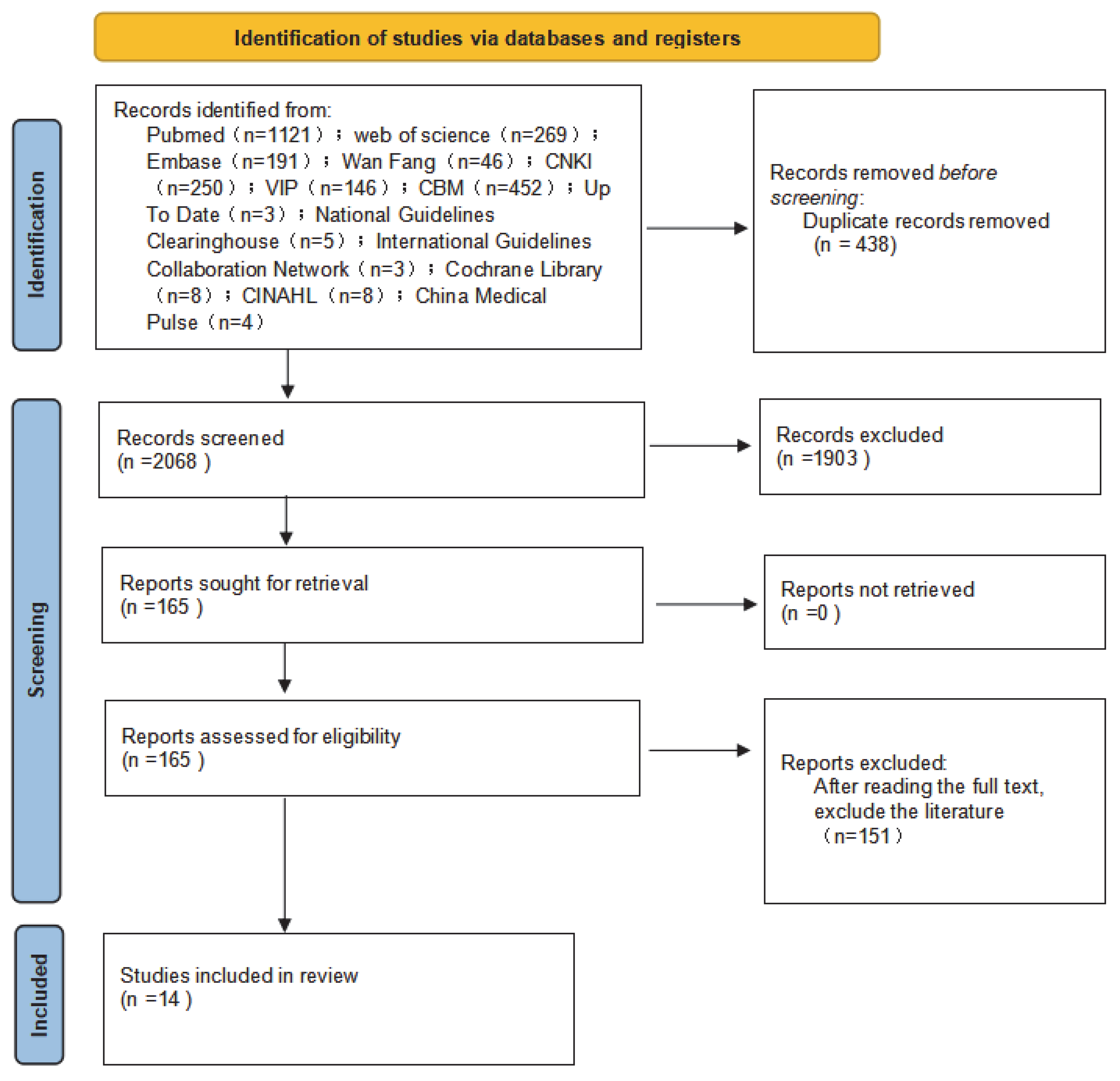
3.1. Literature Search Results and General Characteristics of Included Studies
3.2. Quality Assessment Results of Included Studies
3.2.1. Quality Assessment Results for Clinical Decision-Making
3.2.2. Quality Assessment Results for Guidelines
3.2.3. Quality Assessment Results of Expert Consensus Statements
3.2.4. Quality Assessment Results of Systematic Reviews
3.3. Evidence Synthesis
4. Discussion
4.1. Implementing a Multidisciplinary Collaborative Management Model to Strengthen Early Comprehensive Assessment
4.2. Systematic Skin Lesion Assessment Provides Objective Basis for Nursing Practice
4.3. Early Wound Protection and Comprehensive Care Accelerate Skin Lesion Healing
4.4. Early Identification of Complication Risks and Implementation of Comprehensive Health Education
4.5. Long-Term Regular Follow-Up Is Key to Improving Patient Outcomes
4.6. Research Limitations and Future Directions
5. Conclusions
Author Contributions
Funding
Data Availability Statement
Acknowledgments
Conflicts of Interest
References
- Kridin, K. Pemphigus group: Overview, epidemiology, mortality, and comorbidities. Immunol. Res. 2018, 66, 255–270. [Google Scholar] [CrossRef]
- Schmidt, E.; Kasperkiewicz, M.; Joly, P. Pemphigus. Lancet 2019, 394, 882–894. [Google Scholar] [CrossRef]
- Porro, A.M.; Seque, C.A.; Ferreira, M.C.C.; Enokihara, M. Pemphigus vulgaris. An. Bras. Dermatol. 2019, 94, 264–278. [Google Scholar] [CrossRef]
- Malik, A.M.; Tupchong, S.; Huang, S.; Are, A.; Hsu, S.; Motaparthi, K. An Updated Review of Pemphigus Diseases. Medicina 2021, 57, 1080. [Google Scholar] [CrossRef]
- Gregoriou, S.; Efthymiou, O.; Stefanaki, C.; Rigopoulos, D. Management of pemphigus vulgaris: Challenges and solutions. Clin. Cosmet. Investig. Dermatol. 2015, 8, 521–527. [Google Scholar] [CrossRef]
- Hammers, C.M.; Stanley, J.R. Mechanisms of Disease: Pemphigus and Bullous Pemphigoid. Annu. Rev. Pathol. 2016, 11, 175–197. [Google Scholar] [CrossRef]
- Chirinos-Saldana, P.; Navas, A.; Ramirez-Miranda, A.; Jimenez-Martinez, M.C.; Graue-Hernandez, E.O. Pemphigus: An Ophthalmological Review. Eye Contact Lens 2016, 42, 91–98. [Google Scholar] [CrossRef] [PubMed]
- Kianfar, N.; Daneshpazhooh, M.; Lehman, J.S. Pemphigus Vulgaris. Mayo Clin. Proc. 2024, 99, 607–609. [Google Scholar] [CrossRef] [PubMed]
- Zhu, Z.; Hu, Y.; Zhou, Y.F.; Gu, Y.; Xing, W.J.; Chen, Y.; Zhang, X.J. Advancing Evidence-to-Clinical Practice Translation (III): Research Topic Selection and Problem Formulation. J. Nurse Contin. Educ. 2020, 35, 796–799. [Google Scholar] [CrossRef]
- Alper, B.S.; Haynes, R.B. EBHC pyramid 5.0 for accessing preappraised evidence and guidance. Evid. Based Med. 2016, 21, 123–125. [Google Scholar] [CrossRef]
- Zhou, F.; Hao, Y.F.; Cong, X.; Yao, X.M. Supplementary Explanations and Reflections on the AGREE II Guideline Development and Evaluation Tool and Its Domain Scores. Chin. J. Nurs. 2018, 25, 56–58. [Google Scholar] [CrossRef]
- Gu, Y.; Zhang, H.W.; Zhou, Y.F.; Hu, Y.; Xing, W.J. Quality Assessment Tools for Different Types of Research from the JBI Center for Evidence-Based Healthcare: Quality Assessment of Analytical Studies (Part II). J. Adv. Nurs. 2018, 33, 513–516. [Google Scholar] [CrossRef]
- Foster, M.J.; Shurtz, S. Making the Critical Appraisal for Summaries of Evidence (CASE) for evidence-based medicine (EBM): Critical appraisal of summaries of evidence. J. Med. Libr. Assoc. 2013, 101, 192–198. [Google Scholar] [CrossRef]
- China Dermatologist Association; State Key Laboratory of Complex Severe and Rare Diseases; National Clinical Research Center for Dermatologic and Immunologic Diseases. Consensus on health education of patients with pemphigus (2023). Chin. J. Dermatol. 2023, e20230123. Available online: http://www.pifukezazhi.com/CN/Y2023/V0/I4/20230123 (accessed on 1 January 2025).
- Chinese Dermatology AssociationTherapeutic Group of Dermatology and Venereology Branch of the Chinese Medical Association; Dermatology Branch of China Association for International Exchange of Medical and Health Care; National Clinical Research Center for Skin and Immunological Diseases; Dermatology Rare Disease Committee of China Rare Disease Alliance. Chinese Guidelines for the Diagnosis and Treatment of Pemphigus (2024 Edition). Chin. J. Dermatol. 2024, 57, 873–886. [Google Scholar] [CrossRef]
- Schmidt, E.; Sticherling, M.; Sardy, M.; Eming, R.; Goebeler, M.; Hertl, M.; Hofmann, S.C.; Hunzelmann, N.; Kern, J.S.; Kramer, H.; et al. S2k guidelines for the treatment of pemphigus vulgaris/foliaceus and bullous pemphigoid: 2019 update. J. Dtsch. Dermatol. Ges. 2020, 18, 516–526. [Google Scholar] [CrossRef] [PubMed]
- Chu, C.Y.; Lee, C.H.; Lee, H.E.; Cho, Y.T.; Hsu, C.K.; Chan, T.C.; Hsieh, S.C.; Wei, K.C. Taiwanese dermatological association (TDA) consensus for the management of pemphigus. J. Formos. Med. Assoc. 2023, 122, 540–548. [Google Scholar] [CrossRef] [PubMed]
- Joly, P.; Horvath, B.; Patsatsi, A.; Uzun, S.; Bech, R.; Beissert, S.; Bergman, R.; Bernard, P.; Borradori, L.; Caproni, M.; et al. Updated S2K guidelines on the management of pemphigus vulgaris and foliaceus initiated by the european academy of dermatology and venereology (EADV). J. Eur. Acad. Dermatol. Venereol. 2020, 34, 1900–1913. [Google Scholar] [CrossRef]
- Wang, C.Q.; Hu, Y. JBI Evidence Pre-classification and Evidence Recommendation Level System (2014 Edition). J. Nurs. Educ. 2015, 30, 964–967. [Google Scholar] [CrossRef]
- Geller, M.H.S. Initial Management of Pemphigus Vulgaris and Pemphigus Foliaceus [EB/OL]. Available online: https://www.uptodate.cn/contents/zh-Hans/initial-management-of-pemphigus-vulgaris-and-pemphigus-foliaceus (accessed on 1 April 2025).
- De, D.; Mehta, H.; Shah, S.; Ajithkumar, K.; Barua, S.; Chandrashekar, L.; Chatterjee, M.; Gupta, V.; Khandpur, S.; Khullar, G.; et al. Consensus Based Indian Guidelines for the Management of Pemphigus Vulgaris and Pemphigus Foliaceous. Indian. Dermatol. Online J. 2025, 16, 3–24. [Google Scholar] [CrossRef]
- Harman, K.E.; Brown, D.; Exton, L.S.; Groves, R.W.; Hampton, P.J.; Mohd Mustapa, M.F.; Setterfield, J.F.; Yesudian, P.D. British Association of Dermatologists’ guidelines for the management of pemphigus vulgaris 2017. Br. J. Dermatol. 2017, 177, 1170–1201. [Google Scholar] [CrossRef]
- Committee for Guidelines for the Management of Pemphigus; Amagai, M.; Tanikawa, A.; Shimizu, T.; Hashimoto, T.; Ikeda, S.; Kurosawa, M.; Niizeki, H.; Aoyama, Y.; Iwatsuki, K.; et al. Japanese guidelines for the management of pemphigus. J. Dermatol. 2014, 41, 471–486. [Google Scholar] [CrossRef]
- Murrell, D.F.; Pena, S.; Joly, P.; Marinovic, B.; Hashimoto, T.; Diaz, L.A.; Sinha, A.A.; Payne, A.S.; Daneshpazhooh, M.; Eming, R.; et al. Diagnosis and management of pemphigus: Recommendations of an international panel of experts. J. Am. Acad. Dermatol. 2020, 82, 575–585.e1. [Google Scholar] [CrossRef] [PubMed]
- Dermatology Branch of China International Exchange and Promotion Association for Medical and Healthcare. Diagnosis and treatment of pemphigus vulgaris: An expert proposal (2020). Chin. J. Dermatol. 2020, 53, 1–7. [Google Scholar] [CrossRef]
- China Dermatologist Association; Treatment Group; Chinese Society of Dermatology; Dermatology Branch of China International Exchange and Promotive Association for Medical and Health Care; National Clinical Research Center for Dermatologic and Immunologic Diseases; Rare Skin Diseases Committee; China Alliance for Rare Diseases. Diagnosis and treatment of bullous pemphigoid: An expert consensus statement (2025 edition). Chin. J. Dermatol. 2025, 58, 405–415. [Google Scholar] [CrossRef]
- Morais, H.G.F.; Costa, C.S.O.; Medeiros, M.R.S.; Carlan, L.M.; Gonzaga, A.K.G.; Freitas, R.A.; da Silveira, E.J.D.; de Oliveira, P.T. Pemphigus vulgaris and mucous membrane pemphigoid: A systematic review of clinical manifestations, diagnosis, and treatment. J. Stomatol. Oral Maxillofac. Surg. 2024, 125, 101960. [Google Scholar] [CrossRef]
- Bilgic, A.; Murrell, D.F. What is novel in the clinical management of pemphigus. Expert Rev. Clin. Pharmacol. 2019, 12, 973–980. [Google Scholar] [CrossRef]
- Endo, H.; Rees, T.D.; Matsue, M.; Kuyama, K.; Nakadai, M.; Yamamoto, H. Early detection and successful management of oral pemphigus vulgaris: A case report. J. Periodontol. 2005, 76, 154–160. [Google Scholar] [CrossRef]
- Jiang, M.C.; Zhong, L.N.; You, S.Y.; Zhang, Y.S.; Chen, C.J. Effects of Multidisciplinary Rehabilitation Nursing Led by Specialist Nurses on Wound Healing and Scar Scoring in Patients with Extensive Burns. Chin. J. Med. Aesthet. 2025, 15, 107–110. [Google Scholar] [CrossRef]
- Rosenbach, M.; Murrell, D.F.; Bystryn, J.C.; Dulay, S.; Dick, S.; Fakharzadeh, S.; Hall, R.; Korman, N.J.; Lin, J.; Okawa, J.; et al. Reliability and convergent validity of two outcome instruments for pemphigus. J. Investig. Dermatol. 2009, 129, 2404–2410. [Google Scholar] [CrossRef]
- Tanriover, M.D.; Akar, S.; Turkcapar, N.; Karadag, O.; Ertenli, I.; Kiraz, S. Vaccination recommendations for adult patients with rheumatic diseases. Eur. J. Rheumatol. 2016, 3, 29–35. [Google Scholar] [CrossRef]
- Kridin, K.; Sagi, S.Z.; Bergman, R. Mortality and Cause of Death in Patients with Pemphigus. Acta Derm. Venereol. 2017, 97, 607–611. [Google Scholar] [CrossRef]
- Lim, W.; Le Gal, G.; Bates, S.M.; Righini, M.; Haramati, L.B.; Lang, E.; Kline, J.A.; Chasteen, S.; Snyder, M.; Patel, P.; et al. American Society of Hematology 2018 guidelines for management of venous thromboembolism: Diagnosis of venous thromboembolism. Blood Adv. 2018, 2, 3226–3256. [Google Scholar] [CrossRef]
- Ruocco, V.; Brenner, S.; Ruocco, E. Pemphigus and diet: Does a link exist? Int. J. Dermatol. 2001, 40, 161–163. [Google Scholar] [CrossRef] [PubMed]
- Ruocco, E.; Aurilia, A.; Ruocco, V. Precautions and suggestions for pemphigus patients. Dermatology 2001, 203, 201–207. [Google Scholar] [CrossRef] [PubMed]
- Matthews, R.; Ali, Z. Comorbid mental health issues in patients with pemphigus vulgaris and pemphigus foliaceus. Clin. Exp. Dermatol. 2022, 47, 24–29. [Google Scholar] [CrossRef] [PubMed]


| Included in the Literature | Publication Year (Year) | Evidence Type | Evidence Source | Literature Topic |
|---|---|---|---|---|
| Michael et al. [20] | 2024 | Clinical Decision Support | Up to Date | Treatment of Common Pemphigus and Leaf-Falling Pemphigus |
| De et al. [21] | 2025 | Guideline | PubMed | Pemphigus Monitoring, Treatment, and Comprehensive Management |
| Chinese Medical Doctor Association Dermatology Branch [15] | 2024 | Guideline | Yimaotong Guideline Network | Chinese Guidelines for the Diagnosis and Treatment of Pemphigus |
| Schmidt et al. [16] | 2020 | Guideline | Web of Science | Systemic Maintenance Therapy for Pemphigus Patients |
| Masayuki et al. [23] | 2014 | Guideline | Embase | Management of Pemphigus Treatment and Monitoring |
| Joly et al. [18] | 2020 | Guideline | Guideline Network | Management of Pemphigus |
| Harman et al. [22] | 2017 | Guideline | PubMed | Assessment, Prevention, and Management of Pemphigus |
| Murrell et al. [24] | 2020 | Expert Consensus | PubMed | Definite Diagnostic Methods and Management of Pemphigus |
| Porro et al. [3] | 2019 | Expert Consensus | Web of Science | Treatment Recommendations and Prognosis for Common Pemphigus |
| Chinese Medical Doctor Association Dermatology Branch [14] | 2023 | Expert Consensus | Chinese Medical Association Dermatology and Venereology Branch | Health Education Consensus for Pemphigus Patients |
| Chu CY et al. [17] | 2023 | Expert Consensus | CINAHL | Comprehensive Management of Pemphigus Patients |
| Chinese Association for International Exchange of Medical and Health Care, Dermatology Branch [25] | 2020 | Expert Consensus | Wanfang Database | Diagnosis, Treatment, and Recurrence Management of Pemphigus |
| Chinese Medical Doctor Association Dermatology Branch [26] | 2025 | Expert Consensus | Wanfang Database | Management Recommendations for Bullous Pemphigoid |
| Morais et al. [27] | 2024 | Systematic Review | PubMed | Oral Care for Pemphigus |
| Included in Guidelines | Standardized Percentage Score for Each Region (%) | Number of Domains ≥ 60% | Number of Domains ≥ 30% | Recommendation Level (Level) | |||||
|---|---|---|---|---|---|---|---|---|---|
| Scope and Purpose | Participants | Rigor of Development | Clarity of Guidelines | Applicability of Guidelines | Independence of Compilation | ||||
| Schmidt et al. [16] | 88.88 | 80.55 | 71.13 | 88.88 | 47.90 | 100 | 5 | 6 | B |
| Harman et al. [22] | 75.00 | 66.66 | 79.38 | 88.88 | 54.16 | 75 | 5 | 6 | B |
| Chinese Medical Doctor Association Dermatology Branch [15] | 75.00 | 83.33 | 78.35 | 91.66 | 41.66 | 95.83 | 5 | 6 | B |
| Masayuki et al. [23] | 66.66 | 63.88 | 56.7 | 91.66 | 47.91 | 96.42 | 4 | 6 | B |
| Joly et al. [18] | 91.66 | 61.11 | 52.57 | 91.66 | 58.33 | 75 | 4 | 6 | B |
| De et al. [21] | 91.66 | 77.77 | 43.29 | 83.33 | 58.33 | 95.83 | 4 | 6 | B |
| Expert Consensus | ① | ② | ③ | ④ | ⑤ | ⑥ |
|---|---|---|---|---|---|---|
| Murrell et al. [24] | Yes | Yes | Yes | Yes | Yes | unclear |
| Porro et al. [3] | Yes | Yes | Yes | Yes | Yes | unclear |
| Chinese Medical Doctor Association Dermatology Branch [14] | Yes | Yes | Yes | Yes | Yes | Yes |
| Chu CY et al. [17] | Yes | Yes | Yes | Yes | Yes | Yes |
| Chinese Association for International Exchange of Medical and Health Care, Dermatology Branch [25] | Yes | Yes | Yes | Yes | Yes | Yes |
| Chinese Medical Doctor Association Dermatology Branch [26] | Yes | Yes | Yes | Yes | Yes | Yes |
| Evidence Type | Evidence Content | Evidence Level (Grade) |
|---|---|---|
| Management Principles | 1. It is recommended to establish a multidisciplinary team led by dermatologists, with participation from psychologists, nutritionists, and specialized nurses in treatment and care. This team should provide scientifically standardized management based on the severity of the patient’s condition and any complications [3,22]. | 5 |
| 2. Management principles for Pemphigus focus on controlling skin and mucosal lesions, reducing adverse reactions, promoting lesion healing, and improving quality of life [3,15,18,20,21,24]. | 2 | |
| 3. The management phases of Pemphigus comprise induction, maintenance, and remission. Disease control is achieved first, followed by gradual dose reduction to sustain remission. Nurses provide standardized care and continuously monitor the condition to minimize adverse effects [3,18,21,22]. | 5 | |
| Assessment of Skin Lesions | 4. Effective assessment of skin lesions involves first conducting a comprehensive medical history, followed by selecting valuable evaluation criteria based on clinical manifestations such as the location, size, morphology, color, and presence of infection signs of the lesions [3,15]. | 5 |
| 5. Assessment tools employing the Pemphigus Disease Area Index (PDAI), Autoimmune Bullous Skin Disease Intensity Score (ABSIS), and Enzyme-Linked Immunosorbent Assay (ELISA) serve as indicators for evaluating the severity and activity of skin lesions [15,18,20,21,22,23,24]. | 2 | |
| Skin Lesion Care | 6. Pemphigus can cause skin ulceration and erosion. It is recommended that dermatology healthcare professionals manage and care for skin lesions to promote wound healing [22]. | 5 |
| 7. For extensive skin damage, use antiseptics such as chlorhexidine for antimicrobial skin treatment. Perform the procedure gently to avoid friction [2,18,21,22,25]. | 5 | |
| 8. Select appropriate wound dressings based on lesion size and exudate volume. Small erosive areas may undergo daily debridement and dressing changes. For larger erosive areas, use non-adherent dressings, secure them properly, and change regularly to minimize pain and prevent secondary infection [26]. | 5 | |
| 9. If blisters rupture, avoid peeling off the epidermis. First, puncture the blister with a sterile needle to relieve pressure, then gently press with sterile gauze until fluid drains. Apply an antibacterial solution or cream as a wet dressing, keep the wound dry, and record the number and location of blisters daily [14,15,21,22]. | 5 | |
| 10. For oral lesions, perform oral care using saline-soaked cotton balls and monitor the condition of the oral mucosa [18,25,27]. | 5 | |
| 11. During wound care, promptly identify signs of infection at lesion sites and provide nutritional support and pain management based on lesion severity [14,18,20,21,22]. | 5 | |
| 12. For patients at risk of pressure ulcers, nurses are advised to implement position management using pressure-relieving mattresses during care [18]. | 5 | |
| Health Education Guidance | 13. Patients are advised to use soft-bristled toothbrushes, mild toothpaste, and antibacterial mouthwash. Maintaining oral hygiene can alleviate pain and ulceration associated with oral lesions [18,25,27]. | 5 |
| 14. Recommend oral corticosteroids or seasonal influenza and pneumococcal vaccination for patients; prohibit live vaccines [17,18,24]. | 4 | |
| 15. Nurses should emphasize the importance of regular ophthalmic evaluations, particularly for patients on long-term steroid therapy, to assess cataract risk [18,24]. | 4 | |
| 16. Recommend thromboprophylaxis for bedridden patients, monitor lower limb skin color and temperature, instruct patients on compression stocking use to prevent VTE [18,21,24]. | 5 | |
| 17. Educate patients to maintain a healthy mindset, follow a balanced diet, supplement with adequate calcium and vitamin D, avoid scratching the skin or vigorous scrubbing, and refrain from using irritants on affected areas [14,15]. | 4 | |
| 18. Inform patients and their families about the disease, prognosis, and potential adverse events related to care during treatment. Remind them to be aware of potential recurrence factors [14,16,17,18,22,24]. | 5 | |
| 19. Recommend that patients seek reliable sources of information and support groups to gain more disease knowledge and experience, promoting overall disease management [14,18,21,22,24]. | 5 | |
| 20. Recommend providing psychological support to patients while monitoring for potential depression [15,18,21,24]. | 5 | |
| 21. Inform patients that immunosuppressive therapy carries risks of liver/kidney disease, bone marrow suppression, and infection, requiring prompt intervention if symptoms arise [17,18,23]. | 5 | |
| 22. Inform patients that initial treatment achieves disease control when no new blisters appear within 2 weeks, 80% of existing rashes heal, or monthly new lesions do not exceed 3 and heal within 1 week. This allows maintenance of the dose reduction phase with monitoring to prevent recurrence and adverse reactions [15,16,17,21,22,24]. | 5 | |
| Recurrence and Follow-up | 23. If a patient’s antibody titer increases, indicating potential disease recurrence or exacerbation, nurses should intensify observation of skin lesion changes and monitoring of systemic symptoms. If recurrence occurs, patients should be advised to adjust their treatment regimen as directed by their physician, accompanied by targeted nursing interventions [15,18,22]. | 4 |
| 24. Long-term, regular follow-up is recommended for Pemphigus patients to monitor lesion healing and self-care adherence, thereby enhancing disease management [14,16,17,18,21,22,24,25]. | 5 |
Disclaimer/Publisher’s Note: The statements, opinions and data contained in all publications are solely those of the individual author(s) and contributor(s) and not of MDPI and/or the editor(s). MDPI and/or the editor(s) disclaim responsibility for any injury to people or property resulting from any ideas, methods, instructions or products referred to in the content. |
© 2026 by the authors. Licensee MDPI, Basel, Switzerland. This article is an open access article distributed under the terms and conditions of the Creative Commons Attribution (CC BY) license.
Share and Cite
Gao, L.; Zhang, X.; Yan, H.; Dong, S.; Li, X. Evidence-Based Practice for Comprehensive Management of Pemphigus Skin Lesions: An Evidence Synthesis Review. J. Clin. Med. 2026, 15, 1965. https://doi.org/10.3390/jcm15051965
Gao L, Zhang X, Yan H, Dong S, Li X. Evidence-Based Practice for Comprehensive Management of Pemphigus Skin Lesions: An Evidence Synthesis Review. Journal of Clinical Medicine. 2026; 15(5):1965. https://doi.org/10.3390/jcm15051965
Chicago/Turabian StyleGao, Lingjie, Xinyue Zhang, Hongwei Yan, Shiyao Dong, and Xiaobo Li. 2026. "Evidence-Based Practice for Comprehensive Management of Pemphigus Skin Lesions: An Evidence Synthesis Review" Journal of Clinical Medicine 15, no. 5: 1965. https://doi.org/10.3390/jcm15051965
APA StyleGao, L., Zhang, X., Yan, H., Dong, S., & Li, X. (2026). Evidence-Based Practice for Comprehensive Management of Pemphigus Skin Lesions: An Evidence Synthesis Review. Journal of Clinical Medicine, 15(5), 1965. https://doi.org/10.3390/jcm15051965