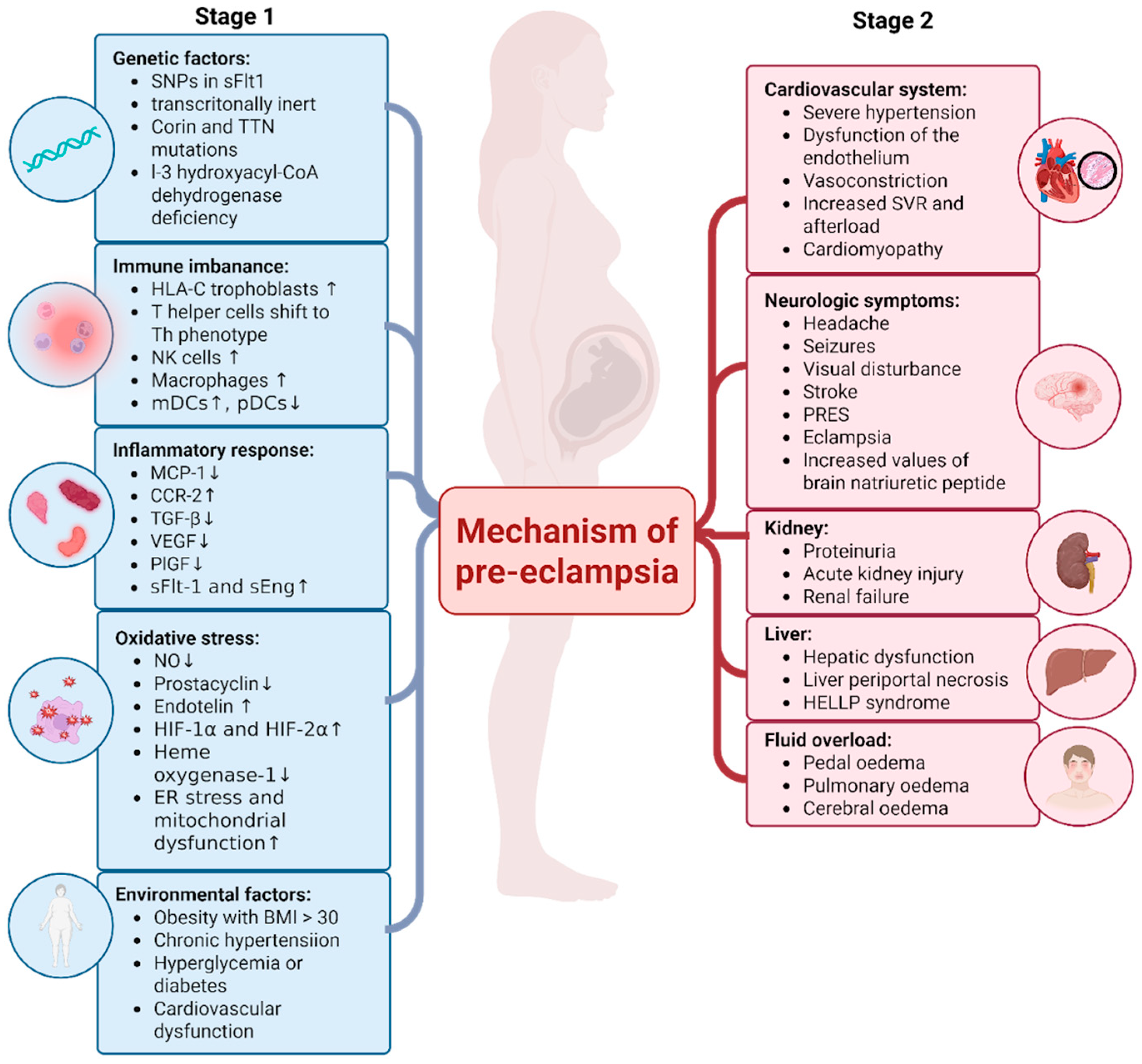

Preeclampsia: Contemporary Concepts in Pathophysiology, Risk Stratification, Prevention and Monitoring
 , ,
, ,
Abstract
1. Introduction
2. Definition and Risk Factors
3. Pathophysiology
4. Models of Preeclampsia Prediction
5. Diagnosis of Preeclampsia
- Proteinuria
- Role of sFlt-1/PlGF ratio
6. Prevention Strategies
6.1. Lifestyle and Dietary Interventions
- Physical Activity: A 2023 systematic review and meta-analysis of randomized controlled trials found that exercise interventions during pregnancy were associated with a lower relative risk of preeclampsia (RR 0.65; 95% CI 0.42–1.03) compared with no exercise, with greater reductions observed in subgroup analyses of low-intensity or mind–body exercise modalities, although the overall effect did not reach conventional statistical significance [41].
- Dietary Patterns: Observational studies suggest that adherence to healthy dietary patterns, such as the Mediterranean or DASH diets, may reduce preeclampsia risk. The Mediterranean diet—rich in fruits, vegetables, whole grains, fish, and olive oil—was associated with 20–28% lower odds of PE in large cohorts. Likely mechanisms include improved endothelial function, reduced inflammation, and better metabolic and blood pressure profiles. While most evidence is observational, such diets are recommended for women at higher risk of PE [42,43,44].
- Fruit and Vegetable Intake:
- Consuming at least 300–400 g of fruits and vegetables daily provides antioxidants, fiber, potassium, and polyphenols, which help modulate blood pressure and oxidative stress, further reducing PE risk [43].
- Limiting simple sugars, saturated fats, processed meats, and excessive sodium is important for maintaining metabolic and cardiovascular health. High intake of these components is associated with insulin resistance, systemic inflammation, elevated blood pressure, and endothelial dysfunction—all contributors to PE. Combining these restrictions with increased consumption of plant-based foods and unsaturated fats aligns with protective dietary patterns and is linked to lower incidence of preeclampsia [42].
6.2. Micronutrient and Vitamin Supplementation
- Selenium: Low-maternal-selenium status has been associated with increased oxidative stress and a higher risk of preeclampsia (PE) in observational studies. However, randomized trial evidence is limited, and routine selenium supplementation is not currently recommended solely for PE prevention [43].
- B-Vitamins (B9 and B12): Folate and vitamin B12 regulate homocysteine metabolism, and elevated homocysteine levels have been linked to endothelial dysfunction. Although adequate levels are essential in pregnancy, additional supplementation beyond standard prenatal recommendations has not consistently been shown to reduce PE risk [43].
- Magnesium: Magnesium plays a role in vascular tone regulation, but evidence supporting routine oral supplementation for PE prevention is inconclusive. Magnesium sulfate remains standard therapy for seizure prevention in severe PE, not for primary prevention [43].
6.3. Pharmacological Prophylaxis
- Aspirin:
- Cost-effectiveness analysis demonstrated that universal low-dose aspirin prophylaxis is associated with a reduced incidence of preeclampsia and lower overall costs compared with no aspirin use and with aspirin administration based on serum, ultrasound, or clinical risk assessment [47].

| Organization | Recommendation |
|---|---|
| FMF (Fetal Medicine Foundation) | 150 mg ASA at bedtime from 11–14 weeks until 36 weeks |
| ACOG (American College of Obstetricians and Gynecologists) | 81 mg ASA daily until delivery or at least until 36 weeks |
| NICE (UK) | 75–150 mg ASA daily from 12 weeks until birth |
| PTGiP (Poland) | 100–150 mg ASA at bedtime, initiated before 20 weeks, until 36 weeks |
| WHO | 75 mg ASA initiated before 20 weeks of pregnancy [48] |
| RANZOG | 100–150 mg daily, ideally starting before 16 weeks’ gestation and continuing until birth [48] |
- Low-Molecular-Weight Heparin (LMWH):
6.4. Emerging Therapies
7. Monitoring and Surveillance of Women with Preeclampsia
8. Timing and Mode of Delivery in Women with Established Preeclampsia
9. Conclusions
Author Contributions
Funding
Institutional Review Board Statement
Informed Consent Statement
Data Availability Statement
Conflicts of Interest
References
- Poon, L.C.; Shennan, A.; Hyett, J.A.; Kapur, A.; Hadar, E.; Divakar, H.; McAuliffe, F.; da Silva Costa, F.; von Dadelszen, P.; McIntyre, H.D.; et al. The International Federation of Gynecology and Obstetrics (FIGO) initiative on pre-eclampsia: A pragmatic guide for first-trimester screening and prevention. Int. J. Gynaecol. Obstet. 2019, 145, 1–33. [Google Scholar] [CrossRef]
- Ronsmans, C.; Graham, W.J. Lancet Maternal Survival Series steering group. Maternal mortality: Who, when, where, and why. Lancet 2006, 368, 1189–1200. [Google Scholar]
- Magee, L.A.; Brown, M.A.; Hall, D.R.; Gupte, S.; Hennessy, A.; Karumanchi, S.A.; Kenny, L.C.; McCarthy, F.; Myers, J.; Poon, L.C.; et al. The 2021 International Society for the Study of Hypertension in Pregnancy classification, diagnosis & management recommendations for international practice. Pregnancy Hypertens. 2022, 27, 148–169. [Google Scholar] [CrossRef] [PubMed]
- Lai, J.; Syngelaki, A.; Nicolaides, K.H.; von Dadelszen, P.; Magee, L.A. Impact of new definitions of preeclampsia at term on identification of adverse maternal and perinatal outcomes. Am. J. Obstet. Gynecol. 2021, 224, 518.e1–518.e11. [Google Scholar] [CrossRef] [PubMed]
- Haram, K.; Svendsen, E.; Abildgaard, U. The HELLP syndrome: Clinical issues and management. A Review. BMC Pregnancy Childbirth 2009, 9, 8. [Google Scholar] [CrossRef]
- van Lieshout, L.C.E.W.; Koek, G.H.; Spaanderman, M.A.; van Runnard, H.e.i.m.e.l.P.J. Placenta derived factors involved in the pathogenesis of the liver in the syndrome of haemolysis, elevated liver enzymes and low platelets (HELLP): A review. Pregnancy Hypertens. 2019, 18, 42–48. [Google Scholar] [CrossRef]
- Tomimatsu, T.; Mimura, K.; Endo, M.; Kumasawa, K.; Kimura, T. Pathophysiology of preeclampsia: An angiogenic imbalance and long-lasting systemic vascular dysfunction. Hypertens. Res. Off. J. Jpn. Soc. Hypertens. 2017, 40, 305–310. [Google Scholar] [CrossRef]
- Li, J.; Huang, L.; Wang, S.; Zhang, Z. The prevalence of regulatory T and dendritic cells is altered in peripheral blood of women with pre-eclampsia. Pregnancy Hypertens. 2019, 17, 233–240. [Google Scholar] [CrossRef]
- Cui, Y.; Wu, S.; Liu, K.; Zhao, H.; Ma, B.; Gong, L.; Zhou, Q.; Li, X. Extra villous trophoblast-derived PDL1 can ameliorate macrophage inflammation and promote immune adaptation associated with preeclampsia. J. Reprod. Immunol. 2024, 161, 104186. [Google Scholar] [CrossRef]
- Tomaszewicz, M.; Stefańska, K.; Dębska-Zielkowska, J.; Zamkowska, D.; Piekarska, K.; Tymoniuk, B.; Adamski, P.; Jassem-Bobowicz, J.; Madej, D.; Trzonkowski, P.; et al. PD1+ T Regulatory Cells Are Not Sufficient to Protect from Gestational Hypertension. Int. J. Mol. Sci. 2025, 26, 2860. [Google Scholar] [CrossRef]
- Zhou, W.; Chen, Y.; Zheng, Y.; Bai, Y.; Yin, J.; Wu, X.-X.; Hong, M.; Liang, Y.; Zhang, J.; Gao, Y.; et al. Characterizing immune variation and diagnostic indicators of preeclampsia by single-cell RNA sequencing and machine learning. Commun. Biol. 2024, 7, 32. [Google Scholar] [CrossRef]
- Liu, J.; Zhao, M.; Zhang, S.; Shi, Y. HIF-1α-mediated inhibition of the sFlt-1/sENG/TNF-α pathway promotes angiogenesis to ameliorate pre-eclampsia. J. Mol. Histol. 2025, 56, 290. [Google Scholar] [CrossRef]
- Zheng, L.; Huang, J.; Su, Y.; Wang, F.; Kong, H.; Xin, H. Vitexin ameliorates preeclampsia phenotypes by inhibiting TFPI-2 and HIF-1α/VEGF in a l-NAME induced rat model. Drug Dev. Res. 2019, 80, 1120–1127. [Google Scholar] [CrossRef]
- Zhou, J.; Yan, P.; Ma, W.; Li, J. 2025 Cytokine modulation and immunoregulation of uterine NK cells in pregnancy disorders. Cytokine Growth Factor Rev. 2025, 81, 40–53. [Google Scholar] [CrossRef] [PubMed]
- Cheng, S.; Norris, W.; Kalkunte, S.; Jash, S.; Richardson, L.R.; Sharma, S. Evidence for Complement Activation in Preeclampsia Placenta and Its Presence in Circulation. Am. J. Reprod. Immunol. 2025, 93, e70076. [Google Scholar] [CrossRef] [PubMed]
- Sugulle, M.; Fiskå, B.S.; Jacobsen, D.P.; Fjeldstad, H.E.; Staff, A.C. Placental Senescence and the Two-Stage Model of Preeclampsia. Am. J. Reprod. Immunol. 2024, 92, e13904. [Google Scholar] [CrossRef] [PubMed]
- Ives, C.W.; Sinkey, R.; Rajapreyar, I.; Tita, A.T.N.; Oparil, S. Preeclampsia-Pathophysiology and Clinical Presentations: JACC State-of-the-Art Review. J. Am. Coll. Cardiol. 2020, 76, 1690–1702. [Google Scholar] [CrossRef]
- Lian, R.; Zhu, B.-S.; Zeng, X. An Update Review of the Pathogenesis Hypothesis in Preeclampsia. Clin. Exp. Obstet. Gynecol. 2022, 49, 170. [Google Scholar] [CrossRef]
- Qi, J.; Wu, B.; Chen, X.; Wei, W.; Yao, X. Diagnostic biomolecules and combination therapy for pre-eclampsia. Reprod. Biol. Endocrinol. 2022, 20, 136. [Google Scholar] [CrossRef]
- Shanmugalingam, R.; Hennessy, A.; Makris, A. Aspirin in the prevention of preeclampsia: The conundrum of how, who and when. J. Hum. Hypertens. 2019, 33, 1–9. [Google Scholar] [CrossRef]
- Mazer Zumaeta, A.; Wright, A.; Syngelaki, A.; Maritsa, V.A.; Da Silva, A.B.; Nicolaides, K.H. Screening for pre-eclampsia at 11–13 weeks’ gestation: Use of pregnancy-associated plasma protein-A, placental growth factor or both. Ultrasound Obstet. Gynecol. 2020, 56, 400–407. [Google Scholar] [CrossRef]
- Chaemsaithong, P.; Sahota, D.S.; Poon, L.C. First trimester preeclampsia screening and prediction. Am. J. Obstet. Gynecol. 2022, 226, S1071–S1097.e2. [Google Scholar] [CrossRef]
- Wright, D.; Tan, M.Y.; O’Gorman, N.; Syngelaki, A.; Nicolaides, K.H. Serum PlGF compared with PAPP-A in first trimester screening for preterm pre-eclampsia: Adjusting for the effect of aspirin treatment. BJOG Int. J. Obstet. Gynaecol. 2022, 129, 1308–1317. [Google Scholar] [CrossRef]
- Sato, M.; Iino, K.; Ozaki, T.; Hashimoto, T.; Osawa, Y.; Hashimoto, R.; Tando, T.; Takeda, A.; Takahashi, S.; Taniguchi, R.; et al. Characteristics of eclampsia not preceded by hypertensive disorders of pregnancy: A case control study. BMC Pregnancy Childbirth 2025, 25, 774. [Google Scholar] [CrossRef]
- Michal, F.B.; Lindheimer, M.D.; Sibai, B.M. Proteinuria during pregnancy: Definition, pathophysiology, methodology, and clinical significance. Am. J. Obstet. Gynecol. 2022, 226, S819–S834. [Google Scholar] [CrossRef]
- Chadha, A.; Tayade, S. Urinary Protein-to-Creatinine Ratio: An Indicator of Adverse Clinical Outcomes in Preeclampsia with Proteinuria. Cureus 2022, 14, e23341. [Google Scholar] [CrossRef] [PubMed]
- Higby, K.; Suiter, C.R.; Phelps, J.Y.; Siler-Khodr, T.; Langer, O. Normal values of urinary albumin and total protein excretion during pregnancy. Am. J. Obstet. Gynecol. 1994, 171, 984–989. [Google Scholar] [CrossRef]
- Davison, J.M. The effect of pregnancy on kidney function in renal allograft recipients. Kidney Int. 1985, 27, 74–79. [Google Scholar] [CrossRef]
- Dunlop, W.; Davison, J.M. Renal haemodynamics and tubular function in human pregnancy. Bailliere’s Clin. Obstet. Gynaecol. 1987, 1, 769–787. [Google Scholar] [CrossRef] [PubMed]
- Odutayo, A.; Hladunewich, M. Obstetric nephrology: Renal hemodynamic and metabolic physiology in normal pregnancy. Clin. J. Am. Soc. Nephrol. CJASN 2012, 7, 2073–2080. [Google Scholar] [CrossRef] [PubMed]
- Verlohren, S.; Brennecke, S.P.; Galindo, A.; Karumanchi, S.A.; Mirkovic, L.B.; Schlembach, D.; Stepan, H.; Vatish, M.; Zeisler, H.; Rana, S. Clinical interpretation and implementation of the sFlt-1/PlGF ratio in the prediction, diagnosis and management of preeclampsia. Pregnancy Hypertens. 2022, 27, 42–50. [Google Scholar] [CrossRef]
- Stepan, H.; Herraiz, I.; Schlembach, D.; Verlohren, S.; Brennecke, S.; Chantraine, F.; Klein, E.; Lapaire, O.; Llurba, E.; Ramoni, A.; et al. Implementation of the sFlt-1/PlGF ratio for prediction and diagnosis of pre-eclampsia in singleton pregnancy: Implications for clinical practice. Ultrasound Obstet. Gynecol. 2015, 45, 241–246. [Google Scholar] [CrossRef]
- Bian, X.; Biswas, A.; Huang, X.; Lee, K.J.; Li, T.K.; Masuyama, H.; Ohkuchi, A.; Park, J.S.; Saito, S.; Tan, K.H.; et al. Short-Term Prediction of Adverse Outcomes Using the sFlt-1 (Soluble fms-Like Tyrosine Kinase 1)/PlGF (Placental Growth Factor) Ratio in Asian Women with Suspected Preeclampsia. Hypertension 2019, 74, 164–172. [Google Scholar] [CrossRef]
- Rana, S.; Powe, C.E.; Salahuddin, S.; Verlohren, S.; Perschel, F.H.; Levine, R.J.; Lim, K.H.; Wenger, J.B.; Thadhani, R.; Karumanchi, S.A. Angiogenic factors and the risk of adverse outcomes in women with suspected preeclampsia. Circulation 2012, 125, 911–919. [Google Scholar] [CrossRef] [PubMed]
- Zeisler, H.; Llurba, E.; Chantraine, F.; Vatish, M.; Staff, A.C.; Sennström, M.; Olovsson, M.; Brennecke, S.P.; Stepan, H.; Allegranza, D.; et al. Predictive Value of the sFlt-1:PlGF Ratio in Women with Suspected Preeclampsia. N. Engl. J. Med. 2016, 374, 13–22. [Google Scholar] [CrossRef] [PubMed]
- Huhn, E.A.; Kreienbühl, A.; Hoffmann, I.; Schoetzau, A.; Lange, S.; Martinez de Tejada, B.; Hund, M.; Hoesli, I.; Lapaire, O. Diagnostic Accuracy of Different Soluble fms-Like Tyrosine Kinase 1 and Placental Growth Factor Cut-Off Values in the Assessment of Preterm and Term Preeclampsia: A Gestational Age Matched Case-Control Study. Front. Med. 2018, 5, 325. [Google Scholar] [CrossRef] [PubMed]
- Soto, E.; Romero, R.; Kusanovic, J.P.; Ogge, G.; Hussein, Y.; Yeo, L.; Hassan, S.S.; Kim, C.J.; Chaiworapongsa, T. Late-onset preeclampsia is associated with an imbalance of angiogenic and anti-angiogenic factors in patients with and without placental lesions consistent with maternal underperfusion. J. Matern. Fetal Neonatal Med. 2012, 25, 498–507. [Google Scholar] [CrossRef]
- Hurrell, A.; Webster, L.; Sparkes, J.; Battersby, C.; Brockbank, A.; Clark, K.; Duhig, K.E.; Gill, C.; Green, M.; Hunter, R.M.; et al. Repeat placental growth factor-based testing in women with suspected preterm pre-eclampsia (PARROT-2): A multicentre, parallel-group, superiority, randomised controlled trial. Lancet 2024, 403, 619–631. [Google Scholar] [CrossRef]
- Lorenz-Meyer, L.; Scherfeld, V.; Hackelöer, M.; Nonn, O.; Henrich, W.; Verlohren, S. Prediction of preeclampsia-related outcomes with the sFlt-1 (soluble Fms-like tyrosine kinase-1)/PlGF (placental growth factor)-ratio in the routine in twin pregnancies. Pregnancy Hypertens. 2025, 42, 101393. [Google Scholar] [CrossRef]
- Narang, K.; Szymanski, L.M. Multiple Gestations and Hypertensive Disorders of Pregnancy: What Do We Know? Curr. Hypertens. Rep. 2020, 23, 1. [Google Scholar] [CrossRef]
- Paulsen, C.P.; Bandak, E.; Edemann-Callesen, H.; Juhl, C.B.; Händel, M.N. The Effects of Exercise during Pregnancy on Gestational Diabetes Mellitus, Preeclampsia, and Spontaneous Abortion among Healthy Women-A Systematic Review and Meta-Analysis. Int. J. Environ. Res. Public Health 2023, 20, 6069. [Google Scholar] [CrossRef] [PubMed]
- Minhas, A.S.; Hong, X.; Wang, G.; Rhee, D.K.; Liu, T.; Zhang, M.; Michos, E.D.; Wang, X.; Mueller, N.T. Mediterranean-Style Diet and Risk of Preeclampsia by Race in the Boston Birth Cohort. J. Am. Heart Assoc. 2022, 11, e022589. [Google Scholar] [CrossRef] [PubMed]
- Nadeem, M.; Javed, K.; Abid, H.M.R.; Hussain, A.; Khalid, N. A Review of Dietary and Lifestyle Management of Pre-Eclampsia and Postpartum Eclampsia. Prev. Nutr. Food Sci. 2025, 30, 1–20. [Google Scholar] [CrossRef]
- Brownfoot, F.; Rolnik, D.L. Prevention of preeclampsia. Best Pract. Res. Clin. Obstet. Gynaecol. 2024, 93, 102481. [Google Scholar] [CrossRef]
- Tan, M.Y.; Syngelaki, A.; Poon, L.C.; Rolnik, D.L.; O’Gorman, N.; Delgado, J.L.; Akolekar, R.; Konstantinidou, L.; Tsavdaridou, M.; Galeva, S.; et al. Screening for pre-eclampsia by maternal factors and biomarkers at 11–13 weeks’ gestation. Ultrasound Obstet. Gynecol. 2018, 52, 186–195. [Google Scholar] [CrossRef]
- Rolnik, D.L.; Nicolaides, K.H.; Poon, L.C. Prevention of preeclampsia with aspirin. Am. J. Obstet. Gynecol. 2022, 226, S1108–S1119. [Google Scholar] [CrossRef]
- Mallampati, D.; Grobman, W.; Rouse, D.J.; Werner, E.F. Strategies for Prescribing Aspirin to Prevent Preeclampsia: A Cost-Effectiveness Analysis. Obstet. Gynecol. 2019, 134, 537–544. [Google Scholar] [CrossRef]
- WHO. WHO Recommendations for Prevention and Treatment of Pre-Eclampsia and Eclampsia; World Health Organization: Geneva, Switzerland, 2021; pp. 13–15. [Google Scholar]
- Pathiraja, P.D.M.; Alrub, N.A.; Sunanda, G. Indications for commencing aspirin for the prevention of pregnancy-induced hypertension and pre-eclampsia spectrum disorders. Aust. J. Gen. Pract. 2022, 51, 767–768. [Google Scholar] [CrossRef] [PubMed]
- Mendoza, M.; Bonacina, E.; Garcia-Manau, P.; López, M.; Caamiña, S.; Vives, À.; Lopez-Quesada, E.; Ricart, M.; Maroto, A.; de Mingo, L.; et al. Aspirin Discontinuation at 24 to 28 Weeks’ Gestation in Pregnancies at High Risk of Preterm Preeclampsia: A Randomized Clinical Trial. JAMA 2023, 329, 542–550. [Google Scholar] [CrossRef]

Preeclampsia (de novo) is gestational hypertension accompanied by one or more of the following new-onset conditions at ≥20 weeks’ gestation:
|
| Domain | ISSHP | ACOG | NICE |
|---|---|---|---|
| Proteinuria | Not required | Not required | Still emphasized |
| Placental dysfunction | Included | Not included | Partially considered |
| Biomarkers (PlGF, sFlt-1) | Supported | Not Recommended | Selective use |
| Scope | Broadest | Narrowest | Intermediate |
| High-Risk Factors | Moderate-Risk Factors |
|---|---|
| Prior history of preeclampsia, chronic hypertension, pre-gestational diabetes mellitus, chronic kidney disease, systemic lupus erythematosus, antiphospholipid syndrome, multifetal pregnancy. | Nulliparity, advanced maternal age (commonly defined as ≥35 years in ACOG and ≥40 years in some classifications), maternal obesity (e.g., body mass index thresholds ≥30 kg/m2 or ≥35 kg/m2), long interpregnancy interval (e.g., >10 years). |
| Criterion | USPSTF (USA) | NICE (UK) | ACOG (USA) | ISSHP (International) |
|---|---|---|---|---|
| Primary approach | Risk factor-based prevention | Risk factor-based prevention | Prevention and diagnostic support | Prevention and advanced diagnostics |
| Eligibility criteria | ≥1 high-risk or ≥2 moderate-risk factors | ≥1 high-risk or ≥2 moderate-risk factors | ≥1 high-risk or ≥2 moderate-risk factors | Individualized risk assessment |
| First-trimester prediction models | Not recommended | Limited application | Limited application | Recommended |
| MAP | Not recommended | Not recommended | Not recommended | Recommended |
| UtA-PI | Not recommended | Not recommended | Not recommended | Recommended |
| Personalized medicine | Low | Low | Moderate | High |
| Low Risk | Moderate Risk | High Risk |
|---|---|---|
| <38 | 38–85 | >85 |
| The Indications for Immediate Delivery |
|---|
| Eclampsia, HELLP syndrome, pulmonary edema, uncontrolled severe hypertension, non-reassuring fetal status. |
Disclaimer/Publisher’s Note: The statements, opinions and data contained in all publications are solely those of the individual author(s) and contributor(s) and not of MDPI and/or the editor(s). MDPI and/or the editor(s) disclaim responsibility for any injury to people or property resulting from any ideas, methods, instructions or products referred to in the content. |
© 2026 by the authors. Licensee MDPI, Basel, Switzerland. This article is an open access article distributed under the terms and conditions of the Creative Commons Attribution (CC BY) license.
Share and Cite
Witkowski, P.; Dzieński, B.; Stefańska, K.; Tomaszewicz, M.; Zabielska-Kaczorowska, M.; Wydra, D. Preeclampsia: Contemporary Concepts in Pathophysiology, Risk Stratification, Prevention and Monitoring. J. Clin. Med. 2026, 15, 1944. https://doi.org/10.3390/jcm15051944
Witkowski P, Dzieński B, Stefańska K, Tomaszewicz M, Zabielska-Kaczorowska M, Wydra D. Preeclampsia: Contemporary Concepts in Pathophysiology, Risk Stratification, Prevention and Monitoring. Journal of Clinical Medicine. 2026; 15(5):1944. https://doi.org/10.3390/jcm15051944
Chicago/Turabian StyleWitkowski, Piotr, Bartosz Dzieński, Katarzyna Stefańska, Martyna Tomaszewicz, Magdalena Zabielska-Kaczorowska, and Dariusz Wydra. 2026. "Preeclampsia: Contemporary Concepts in Pathophysiology, Risk Stratification, Prevention and Monitoring" Journal of Clinical Medicine 15, no. 5: 1944. https://doi.org/10.3390/jcm15051944
APA StyleWitkowski, P., Dzieński, B., Stefańska, K., Tomaszewicz, M., Zabielska-Kaczorowska, M., & Wydra, D. (2026). Preeclampsia: Contemporary Concepts in Pathophysiology, Risk Stratification, Prevention and Monitoring. Journal of Clinical Medicine, 15(5), 1944. https://doi.org/10.3390/jcm15051944