Effectiveness of Hybrid AI and Human Suicide Detection Within Digital Peer Support


Abstract
1. Introduction
1.1. Suicidality and Emotional Health
1.2. Digital Peer Support
1.3. Hybrid Artificial Intelligence and Human Moderation
1.4. The Present Study
2. Materials and Methods
2.1. Supportiv Service Solution
2.2. Study Design and User Classification
2.3. Identification and Verification of Suicidality
2.4. N-Gram Linguistic Analysis
2.5. Sentiment Scoring and Emotional Outcomes
2.6. Emotional Outcome Analysis
2.6.1. Group Comparisons
2.6.2. Statistical Analyses
3. Results
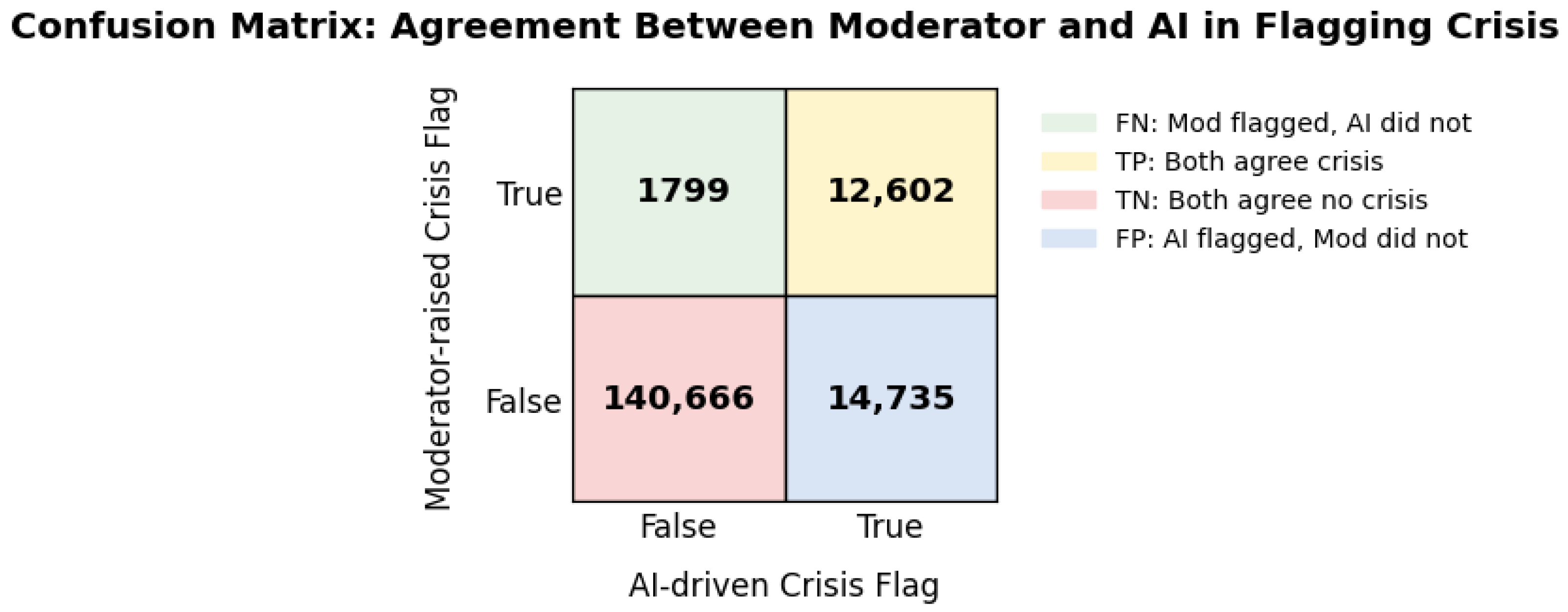
3.1. Crisis Model Evaluation for SI Detection
- Sensitivity = true positives/(true positives + false negatives) = 87.51%.
- Specificity = true negatives/(true negatives + false positives) = 90.52%.
- Precision = true positives/(true positives + false positives) = 46.10%.
- Negative predictive value = true negative/(true negatives + false negatives) = 98.74%.
- Accuracy = (true positives + true negatives)/(all total detections) = 90.26%.
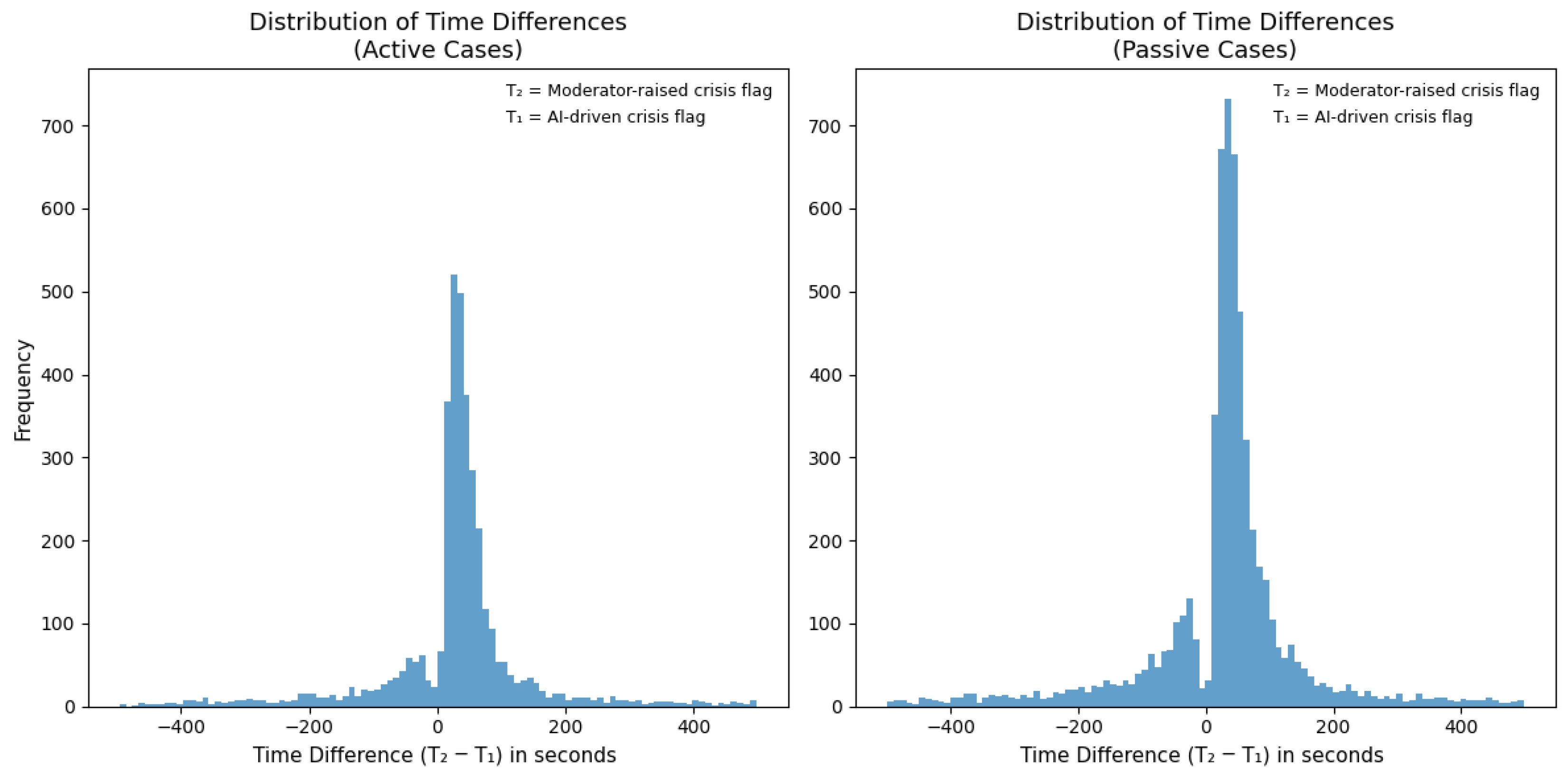
3.2. Timeliness of Crisis Referral
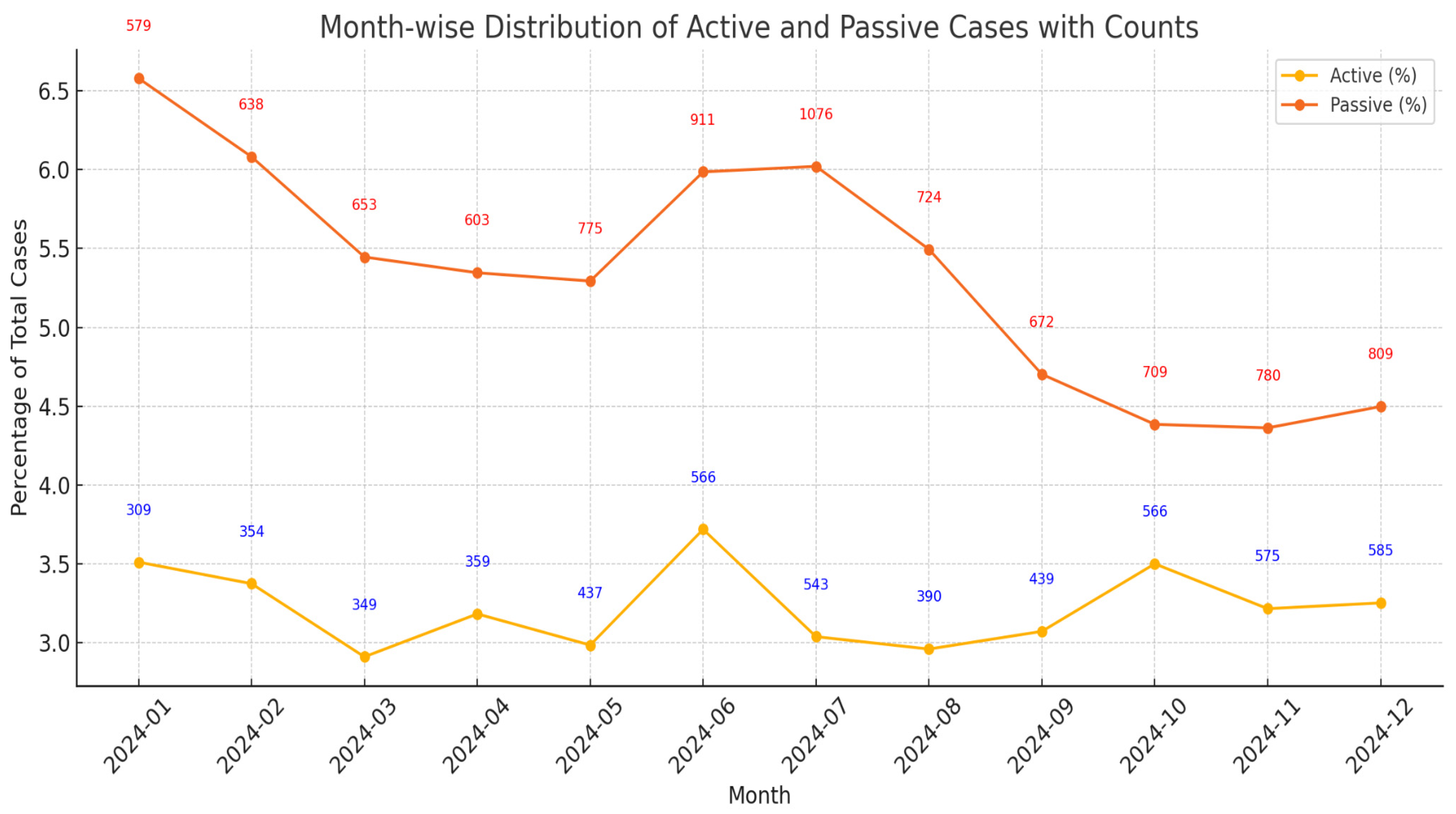
3.3. Distribution of Suicidality Cases
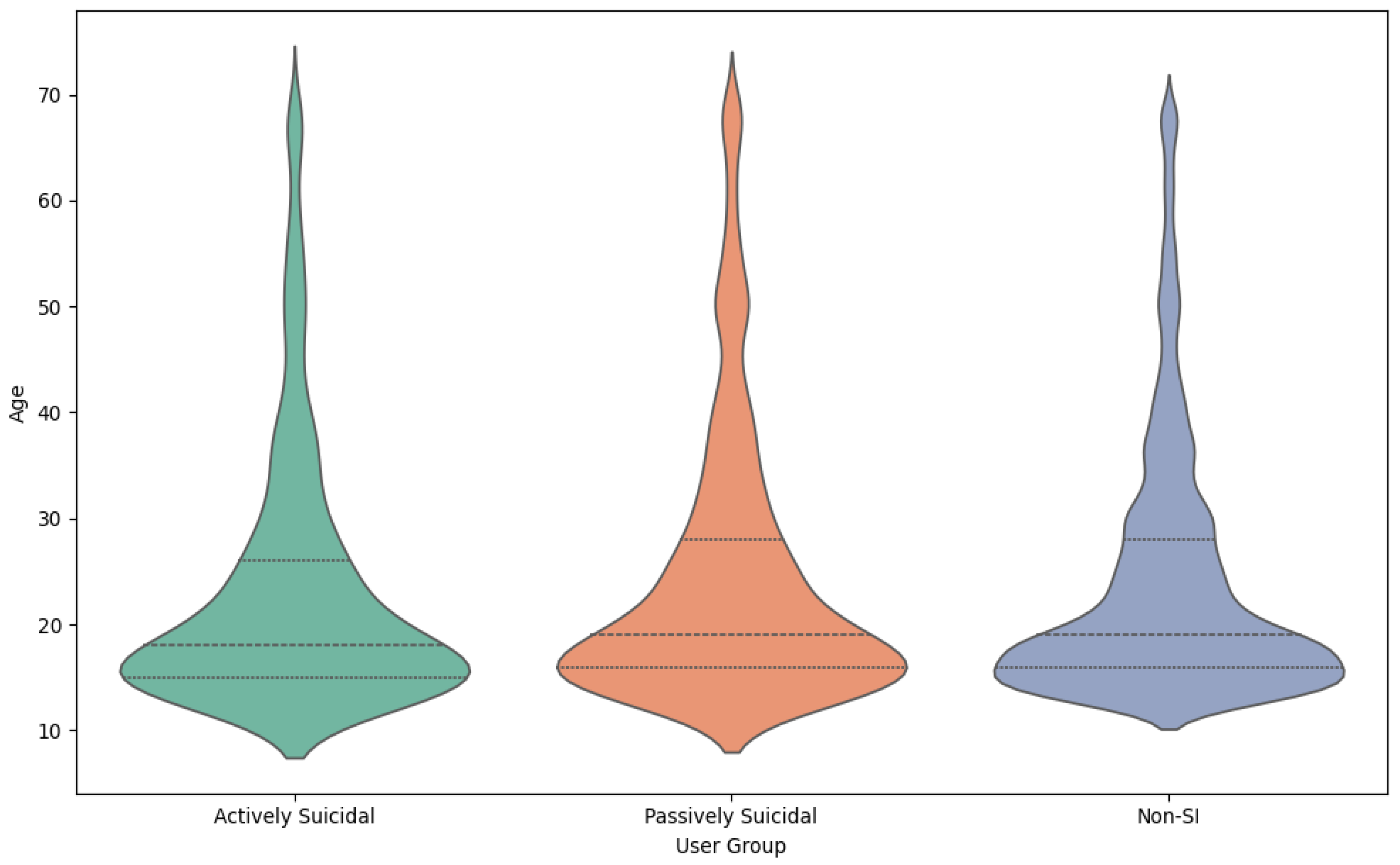
3.4. Demographic Distribution of Users
3.5. Linguistic Differences Between Active and Passive Users
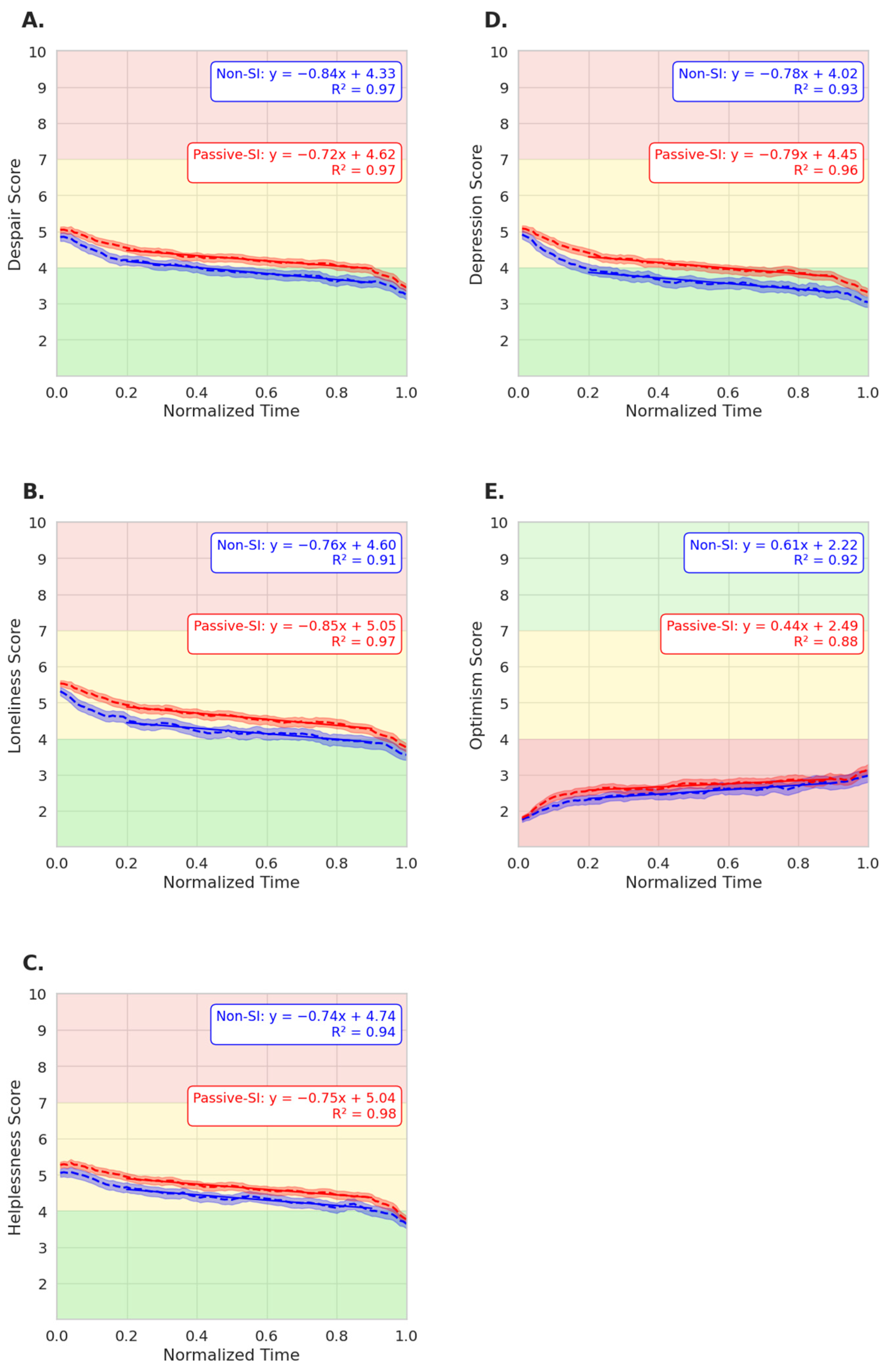
3.6. Comparison of Emotional Trajectories in Passive SI and Non-SI Users
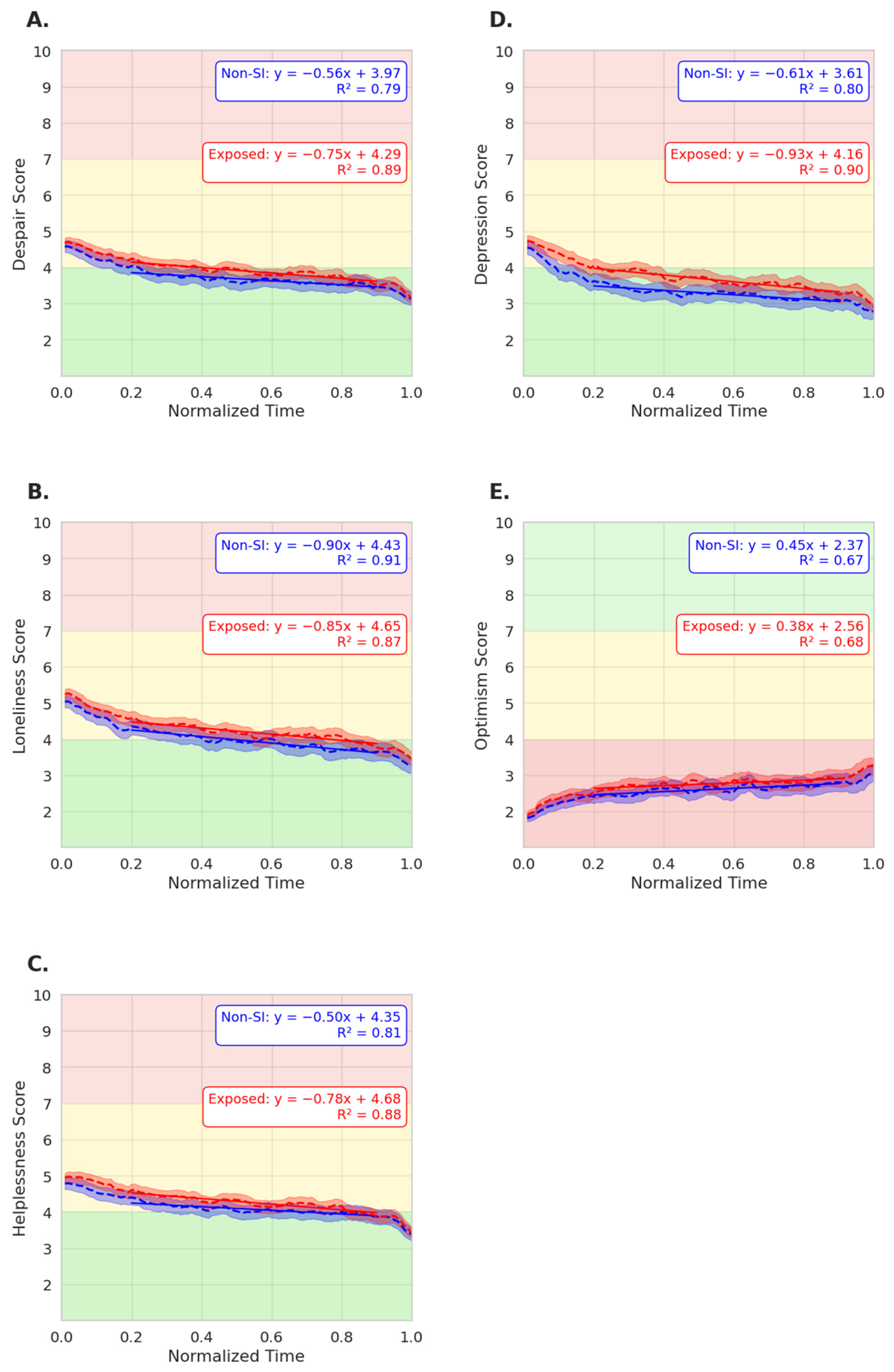
3.7. Comparison of Emotional Trajectories Due to SI Exposure in Peers
4. Discussion
4.1. Principal Findings
4.2. Limitations and Future Directions
5. Conclusions
Author Contributions
Funding
Institutional Review Board Statement
Informed Consent Statement
Data Availability Statement
Acknowledgments
Conflicts of Interest
Abbreviations
| AI | Artificial intelligence |
| ANCOVA | Analysis of Covariance |
| CCPA | California Consumer Privacy Act |
| CDC | Centers of Disease Control and Prevention |
| DPS | Digital peer support |
| GDPR | General Data Protection Regulation |
| HIPAA | Health Insurance Portability and Accountability Act |
| IRB | Institutional Review Board |
| LLM | Large Language Model |
| NLP | Natural Language Processing |
| PHI | Personal Health Information |
| PII | Personally identifying information |
| RoBERTa | Robustly Optimized BERT Pretraining Approach |
| SD | Standard deviation |
| SI | Suicidal ideation |
Appendix A
- A.
- Active SI
- I feel worthless. I’m genuinely fed up with everything all the time. I can’t see my life ever getting better.
- Honestly, I’m ready to call it a life and end it all.
- Thoughts are overtaking me.
- I don’t want to be here anymore. I’ve had enough.
- B.
- Passive SI
- Life makes me feel lost.
- I don’t know. I don’t want to die because I don’t really have a bad life compared to others, but I just want to be gone. I don’t really know how to explain it. I just don’t want to feel anything or talk to anyone. I just don’t want anything really.
- I hate my life.
- I have a desire to die but I wouldn’t ever do anything to myself.
Appendix B
- Despair
- Loneliness
- Helplessness
- Depression
- Optimism
References
- World Health Organization. Suicide. 2025. Available online: https://www.who.int/news-room/fact-sheets/detail/suicide (accessed on 1 October 2025).
- Ilic, M.; Ilic, I. Worldwide suicide mortality trends (2000–2019): A joinpoint regression analysis. World J. Psychiatry 2022, 12, 1044–1060. [Google Scholar] [CrossRef]
- Center for Disease Control. Suicide Rate Disparities. 2023. Available online: https://www.cdc.gov/suicide/facts/data.html#:~:text=Many%20adults%20think%20about%20suicide,1.5%20million%20attempted%20suicide (accessed on 1 October 2025).
- Satiani, A.; Niedermier, J.; Satiani, B.; Svendsen, D.P. Projected Workforce of Psychiatrists in the United States: A Population Analysis. Psychiatr. Serv. 2018, 69, 710–713. [Google Scholar] [CrossRef] [PubMed]
- American Psychological Association. Psychologists Struggle to Meet Demand amid Mental Health Crisis: 2022 COVID-19 Practitioner Impact Survey. Available online: https://www.apa.org/pubs/reports/practitioner/2022-covid-psychologist-workload (accessed on 1 October 2025).
- Kaiser Family Foundation. Mental Health Care Health Professional Shortage Areas (HPSAs). Available online: https://www.kff.org/other/state-indicator/mental-health-care-health-professional-shortage-areas-hpsas/?currentTimeframe=0&sortModel=%7B%22colId%22:%22Location%22,%22sort%22:%22asc%22%7D (accessed on 1 October 2025).
- Ku, B.S.; Li, J.; Lally, C.; Compton, M.T.; Druss, B.G. Associations between mental health shortage areas and county-level suicide rates among adults aged 25 and older in the USA, 2010 to 2018. Gen Hosp Psychiatry 2021, 70, 44–50. [Google Scholar] [CrossRef] [PubMed]
- Han, B.; Crosby, A.E.; Ortega, L.A.G.; Parks, S.E.; Compton, W.M.; Gfroerer, J. Suicidal ideation, suicide attempt, and occupations among employed adults aged 18–64years in the United States. Compr. Psychiatry 2016, 66, 176–186. [Google Scholar] [CrossRef]
- Harmer, B.; Lee, S.; Rizvi, A.; Saadabadi, A. Suicidal Ideation. In StatPearls; StatPearls Publishing: Treasure Island, FL, USA, 2024. Available online: https://www.ncbi.nlm.nih.gov/books/NBK565877/ (accessed on 1 October 2025).
- Wastler, H.M.; Khazem, L.R.; Ammendola, E.; Baker, J.C.; Bauder, C.R.; Tabares, J.; Bryan, A.O.; Szeto, E.; Bryan, C.J. An empirical investigation of the distinction between passive and active ideation: Understanding the latent structure of suicidal thought content. Suicide Life Threat. Behav. 2023, 53, 219–226. [Google Scholar] [CrossRef] [PubMed]
- Olgiati, P.; Luca, M.; Luca, A.; Ferri, R.; Serretti, A. Passive suicide ideation in major depressive disorder: Prognostic role and effect of antidepressant treatment. J. Psychiatr. Res. 2025, 189, 445–454. [Google Scholar] [CrossRef]
- Koh, Y.S.; Shahwan, S.; Jeyagurunathan, A.; Abdin, E.; Vaingankar, J.A.; Chow, W.L.; Chong, S.A.; Subramaniam, M. Prevalence and correlates of suicide planning and attempt among individuals with suicidal ideation: Results from a nationwide cross-sectional survey. J. Affect. Disord. 2023, 328, 87–94. [Google Scholar] [CrossRef]
- Howarth, E.J.; O’Connor, D.B.; Panagioti, M.; Hodkinson, A.; Wilding, S.; Johnson, J. Are stressful life events prospectively associated with increased suicidal ideation and behaviour? A systematic review and meta-analysis. J. Affect. Disord. 2020, 266, 731–742. [Google Scholar] [CrossRef]
- Chesney, E.; Goodwin, G.M.; Fazel, S. Risks of all-cause and suicide mortality in mental disorders: A meta-review. World Psychiatry 2014, 13, 153–160. [Google Scholar] [CrossRef]
- Lester, D.; Walker, R.L. Hopelessness, Helplessness, and Haplessness as Predictors of Suicidal Ideation. OMEGA—J. Death Dying 2007, 55, 321–324. [Google Scholar] [CrossRef]
- Copeland, W.E.; Gaydosh, L.; Hill, S.N.; Godwin, J.; Harris, K.M.; Costello, E.J.; Shanahan, L. Associations of Despair With Suicidality and Substance Misuse Among Young Adults. JAMA Netw. Open 2020, 3, e208627. [Google Scholar] [CrossRef]
- Shoib, S.; Amanda, T.W.; Saeed, F.; Ransing, R.; Bhandari, S.S.; Armiya’u, A.Y.U.; Gürcan, A.; Chandradasa, M. Association Between Loneliness and Suicidal Behaviour: A Scoping Review. Turk. J. Psychiatry 2023, 34, 125–132. [Google Scholar] [CrossRef]
- Marchetti, I. Hopelessness: A Network Analysis. Cogn. Ther. Res. 2019, 43, 611–619. [Google Scholar] [CrossRef]
- Greer, J.G.; Wethered, C.E. Learned Helplessness: A Piece of the Burnout Puzzle. Except. Child. 1984, 50, 524–530. [Google Scholar] [CrossRef]
- Ernst, M.; Klein, E.M.; Beutel, M.E.; Brähler, E. Gender-specific associations of loneliness and suicidal ideation in a representative population sample: Young, lonely men are particularly at risk. J. Affect. Disord. 2021, 294, 63–70. [Google Scholar] [CrossRef] [PubMed]
- Maier, S.F.; Seligman, M.E. Learned helplessness: Theory and evidence. J. Exp. Psychol. Gen. 1976, 105, 3–46. [Google Scholar] [CrossRef]
- Gençöz, F.; Vatan, S.; Walker, R.L.; Lester, D. Hopelessness and Suicidality in Turkish and American Respondents. OMEGA—J. Death Dying 2007, 55, 311–319. [Google Scholar] [CrossRef] [PubMed]
- Brunstein, J.C. Personal goals and subjective well-being: A longitudinal study. J. Pers. Soc. Psychol. 1993, 65, 1061–1070. [Google Scholar] [CrossRef]
- Ponsoni, A.; Branco, L.D.; Cotrena, C.; Shansis, F.M.; Grassi-Oliveira, R.; Fonseca, R.P. Self-reported inhibition predicts history of suicide attempts in bipolar disorder and major depression. Compr. Psychiatry 2018, 82, 89–94. [Google Scholar] [CrossRef]
- Hawton, K.; Van Heeringen, K. Suicide. Lancet 2009, 373, 1372–1381. [Google Scholar] [CrossRef]
- Coryell, W.; Young, E.A. Clinical Predictors of Suicide in Primary Major Depressive Disorder. J. Clin. Psychiatry 2005, 66, 412–417. [Google Scholar] [CrossRef] [PubMed]
- Joiner, T. Why People Die by Suicide. 2007. Available online: https://www.hup.harvard.edu/books/9780674025493 (accessed on 1 October 2025).
- Chan, J.K.N.; Solmi, M.; Lo, H.K.Y.; Chan, M.W.Y.; Choo, L.L.T.; Lai, E.T.H.; Wong, C.S.M.; Correll, C.U.; Chang, W.C. All-cause and cause-specific mortality in people with depression: A large-scale systematic review and meta-analysis of relative risk and aggravating or attenuating factors, including antidepressant treatment. World Psychiatry 2025, 24, 404–421. [Google Scholar] [CrossRef]
- Pointon-Haas, J.; Waqar, L.; Upsher, R.; Foster, J.; Byrom, N.; Oates, J. A systematic review of peer support interventions for student mental health and well-being in higher education. BJPsych Open 2024, 10, e12. [Google Scholar] [CrossRef]
- Conversano, C.; Rotondo, A.; Lensi, E.; Della Vista, O.; Arpone, F.; Reda, M.A. Optimism and Its Impact on Mental and Physical Well-Being. Clin. Pract. Epidemiol. Ment. Health 2010, 6, 25–29. [Google Scholar] [CrossRef]
- Carver, C.S.; Scheier, M.F. On the Self-Regulation of Behavior, 1st ed.; Cambridge University Press: Cambridge, UK, 1998. [Google Scholar] [CrossRef]
- Hirsch, J.K.; Conner, K.R.; Duberstein, P.R. Optimism and Suicide Ideation Among Young Adult College Students. Arch. Suicide Res. 2007, 11, 177–185. [Google Scholar] [CrossRef]
- Bowersox, N.W.; Jagusch, J.; Garlick, J.; Chen, J.I.; Pfeiffer, P.N. Peer-based interventions targeting suicide prevention: A scoping review. Am. J. Community Psychol. 2021, 68, 232–248. [Google Scholar] [CrossRef] [PubMed]
- Gibson, M.; Moreau, N.; Balzamo, E.; Crompton, D. Peer Intervention following Suicide-Related Emergency Department Presentation: Evaluation of the PAUSE Pilot Program. Int. J. Environ. Res. Public. Health 2023, 20, 3763. [Google Scholar] [CrossRef]
- Darvishi, N.; Poorolajal, J.; Azmi-Naei, B.; Farhadi, M. The Role of Social Support in Preventing Suicidal Ideations and Behaviors: A Systematic Review and Meta-Analysis. J. Res. Health Sci. 2024, 24, e00609. [Google Scholar] [CrossRef]
- Van Orden, K.A.; Witte, T.K.; Cukrowicz, K.C.; Braithwaite, S.R.; Selby, E.A.; Joiner, T.E. The interpersonal theory of suicide. Psychol. Rev. 2010, 117, 575–600. [Google Scholar] [CrossRef]
- Pfeiffer, P.N.; Heisler, M.; Piette, J.D.; Rogers, M.A.M.; Valenstein, M. Efficacy of peer support interventions for depression: A meta-analysis. Gen. Hosp. Psychiatry 2011, 33, 29–36. [Google Scholar] [CrossRef] [PubMed]
- Smit, D.; Miguel, C.; Vrijsen, J.N.; Groeneweg, B.; Spijker, J.; Cuijpers, P. The effectiveness of peer support for individuals with mental illness: Systematic review and meta-analysis. Psychol. Med. 2023, 53, 5332–5341. [Google Scholar] [CrossRef]
- Larsen, M.E.; Nicholas, J.; Christensen, H. A Systematic Assessment of Smartphone Tools for Suicide Prevention. PLoS ONE 2016, 11, e0152285. [Google Scholar] [CrossRef] [PubMed]
- Gould, M.S.; Pisani, A.; Gallo, C.; Ertefaie, A.; Harrington, D.; Kelberman, C.; Green, S. Crisis text-line interventions: Evaluation of texters’ perceptions of effectiveness. Suicide Life Threat. Behav. 2022, 52, 583–595. [Google Scholar] [CrossRef] [PubMed]
- Sherekar, P.; Mehta, M. Harnessing technology for hope: A systematic review of digital suicide prevention tools. Discov. Ment. Health 2025, 5, 101. [Google Scholar] [CrossRef] [PubMed]
- Lattie, E.G.; Adkins, E.C.; Winquist, N.; Stiles-Shields, C.; Wafford, Q.E.; Graham, A.K. Digital Mental Health Interventions for Depression, Anxiety, and Enhancement of Psychological Well-Being Among College Students: Systematic Review. J. Med. Internet Res. 2019, 21, e12869. [Google Scholar] [CrossRef]
- Kalin, N.H. Anxiety, Depression, and Suicide in Youth. Am. J. Psychiatry 2021, 178, 275–279. [Google Scholar] [CrossRef]
- Torok, M.; Han, J.; Baker, S.; Werner-Seidler, A.; Wong, I.; E Larsen, M.; Christensen, H. Suicide prevention using self-guided digital interventions: A systematic review and meta-analysis of randomised controlled trials. Lancet Digit. Health 2020, 2, e25–e36. [Google Scholar] [CrossRef]
- Yeo, G.; Loo, G.; Oon, M.; Pang, R.; Ho, D. A digital peer support platform to translate online peer support for emerging adult mental well-being: Randomized controlled trial. JMIR Ment. Health 2023, 10, e43956. [Google Scholar] [CrossRef]
- Yeo, G.; Fortuna, K.L.; Lansford, J.E.; Rudolph, K.D. The effects of digital peer support interventions on physical and mental health: A review and meta-analysis. Epidemiology Psychiatr. Sci. 2025, 34, e9. [Google Scholar] [CrossRef]
- Fortuna, K.L.; A Naslund, J.; LaCroix, J.M.; Bianco, C.L.; Brooks, J.M.; Zisman-Ilani, Y.; Muralidharan, A.; Deegan, P. Digital Peer Support Mental Health Interventions for People With a Lived Experience of a Serious Mental Illness: Systematic Review. JMIR Ment. Health 2020, 7, e16460. [Google Scholar] [CrossRef]
- Wadden, D.; August, T.; Li, Q.; Althoff, T. The Effect of Moderation on Online Mental Health Conversations. Proc. Int. AAAI Conf. Web Soc. Media 2021, 15, 751–763. [Google Scholar] [CrossRef]
- An Evidence-Based Model for Digital Peer Support. Whitepaper. Available online: https://togetherall.com/en-ca/wp-content/uploads/sites/3/2023/07/Togetherall_GLOBAL_An_evidence-based_model_for_digital_peer_support_2023.pdf? (accessed on 1 October 2025).
- Shimgekar, S.R.; Rodriguez, V.J.; Bloom, P.A.; Yoo, D.W.; Saha, K. Interpersonal Theory of Suicide as a Lens to Examine Suicidal Ideation in Online Spaces. arXiv 2025, arXiv:2504.13277. [Google Scholar] [CrossRef]
- Vossen, H.G.M.; Valkenburg, P.M. Do social media foster or curtail adolescents’ empathy? A longitudinal study. Comput. Hum. Behav. 2016, 63, 118–124. [Google Scholar] [CrossRef]
- Brinberg, M.; Jones, S.M.; Birnbaum, M.L.; Bodie, G.D.; Ram, N.; Solomon, D.H. How are Conversations via an On-Demand Peer-To-Peer Emotional Well-Being App Associated with Emotional Improvement? Health Commun. 2024, 40, 654–667. [Google Scholar] [CrossRef] [PubMed]
- Clement, S.; Schauman, O.; Graham, T.; Maggioni, F.; Evans-Lacko, S.; Bezborodovs, N.; Morgan, C.; Rüsch, N.; Brown, J.S.L.; Thornicroft, G. What is the impact of mental health-related stigma on help-seeking? A systematic review of quantitative and qualitative studies. Psychol. Med. 2015, 45, 11–27. [Google Scholar] [CrossRef]
- Patel, V.; Flisher, A.J.; Hetrick, S.; McGorry, P. Mental health of young people: A global public-health challenge. Lancet 2007, 369, 1302–1313. [Google Scholar] [CrossRef]
- Obschonka, M.; Schmitt-Rodermund, E.; Silbereisen, R.K.; Gosling, S.D.; Potter, J. The regional distribution and correlates of an entrepreneurship-prone personality profile in the United States, Germany, and the United Kingdom: A socioecological perspective. J. Pers. Soc. Psychol. 2013, 105, 104–122. [Google Scholar] [CrossRef] [PubMed]
- Bailey, E.; Robinson, J.; Alvarez-Jimenez, M.; Nedeljkovic, M.; Valentine, L.; Bendall, S.; D’Alfonso, S.; Gilbertson, T.; McKechnie, B.; Rice, S. Moderated Online Social Therapy for Young People With Active Suicidal Ideation: Qualitative Study. J. Med. Internet Res. 2021, 23, e24260. [Google Scholar] [CrossRef]
- Li, T.; Yang, S.; Wu, J.; Wei, J.; Hu, L.; Li, M.; Wong, D.F.; Oltmanns, J.R.; Wang, D. Can Large Language Models Identify Implicit Suicidal Ideation? An Empirical Evaluation. arXiv 2025, arXiv:2502.17899. [Google Scholar] [CrossRef]
- Coppersmith, G.; Leary, R.; Crutchley, P.; Fine, A. Natural Language Processing of Social Media as Screening for Suicide Risk. Biomed. Inform. Insights 2018, 10, 1178222618792860. [Google Scholar] [CrossRef]
- Lejeune, A.; Le Glaz, A.; Perron, P.A.; Sebti, J.; Baca-Garcia, E.; Walter, M.; Lemey, C.; Berrouiguet, S. Artificial intelligence and suicide prevention: A systematic review. Eur. Psychiatry 2022, 65, e19. [Google Scholar] [CrossRef]
- Diniz, E.J.S.; Fontenele, J.E.; de Oliveira, A.C.; Bastos, V.H.; Teixeira, S.; Rabêlo, R.L.; Calçada, D.B.; dos Santos, R.M.; de Oliveira, A.K.; Teles, A.S. Boamente: A Natural Language Processing-Based Digital Phenotyping Tool for Smart Monitoring of Suicidal Ideation. Healthcare 2022, 10, 698. [Google Scholar] [CrossRef]
- Reece, A.G.; Reagan, A.J.; Lix, K.L.M.; Dodds, P.S.; Danforth, C.M.; Langer, E.J. Forecasting the onset and course of mental illness with Twitter data. Sci. Rep. 2017, 7, 13006. [Google Scholar] [CrossRef]
- Liu, J.; Chen, J.; Perrone-Bizzozero, N.I.; Turner, J.A.; Calhoun, V.D. Regional enrichment analyses on genetic profiles for schizophrenia and bipolar disorder. Schizophr. Res. 2018, 192, 240–246. [Google Scholar] [CrossRef]
- Wilimitis, D.; Turer, R.W.; Ripperger, M.; McCoy, A.B.; Sperry, S.H.; Fielstein, E.M.; Kurz, T.; Walsh, C.G. Integration of Face-to-Face Screening With Real-time Machine Learning to Predict Risk of Suicide Among Adults. JAMA Netw. Open 2022, 5, e2212095. [Google Scholar] [CrossRef]
- Haroz, E.E.; Kitchen, C.; Nestadt, P.S.; Wilcox, H.C.; DeVylder, J.E.; Kharrazi, H. Comparing the predictive value of screening to the use of electronic health record data for detecting future suicidal thoughts and behavior in an urban pediatric emergency department: A preliminary analysis. Suicide Life Threat. Behav. 2021, 51, 1189–1202. [Google Scholar] [CrossRef] [PubMed]
- Elyoseph, Z.; Levkovich, I. Beyond human expertise: The promise and limitations of ChatGPT in suicide risk assessment. Front. Psychiatry 2023, 14, 1213141. [Google Scholar] [CrossRef] [PubMed]
- Gutierrez, G.; Stephenson, C.; Eadie, J.; Asadpour, K.; Alavi, N. Examining the role of AI technology in online mental healthcare: Opportunities, challenges, and implications, a mixed-methods review. Front. Psychiatry 2024, 15, 1356773. [Google Scholar] [CrossRef]
- A Teen Was Suicidal. ChatGPT Was the Friend He Confided. The New York Times. Available online: https://www.nytimes.com/2025/08/26/technology/chatgpt-openai-suicide.html (accessed on 13 January 2026).
- An AI Companion Suggested He Kill His Parents. Now His Mom is Suing. Wash Post. Available online: https://www.washingtonpost.com/technology/2024/12/10/character-ai-lawsuit-teen-kill-parents-texas/ (accessed on 13 January 2026).
- Can, A.I. Be Blamed for a Teen’s Suicide? The New York Times. Available online: https://www.nytimes.com/2024/10/23/technology/characterai-lawsuit-teen-suicide.html (accessed on 13 January 2026).
- Man Ends His Life After an AI Chatbot “Encouraged” Him to Sacrifice Himself to Stop Climate Change. Euro News. Available online: https://www.euronews.com/next/2023/03/31/man-ends-his-life-after-an-ai-chatbot-encouraged-him-to-sacrifice-himself-to-stop-climate- (accessed on 13 January 2026).
- ‘You’re Not Rushing. You’re Just Ready:’ Parents Say ChatGPT Encouraged Son to Kill Himself. CNN. Available online: https://edition.cnn.com/2025/11/06/us/openai-chatgpt-suicide-lawsuit-invs-vis (accessed on 13 January 2026).
- Instagram’s Chatbot Helped Teen Accounts Plan Suicide—And Parents Can’t Disable it. The Washington Post, 28 August 2025. Available online: https://www.washingtonpost.com/technology/2025/08/28/meta-ai-chatbot-safety-teens/ (accessed on 13 January 2026).
- Yeung, J.A.; Dalmasso, J.; Foschini, L.; Dobson, R.J.; Kraljevic, Z. The Psychogenic Machine: Simulating AI Psychosis, Delusion Reinforcement and Harm Enablement in Large Language Models. arXiv 2025, arXiv:2509.10970. [Google Scholar] [CrossRef]
- Holmes, G.; Tang, B.; Gupta, S.; Venkatesh, S.; Christensen, H.; Whitton, A. Applications of Large Language Models in the Field of Suicide Prevention: Scoping Review. J. Med. Internet Res. 2025, 27, e63126. [Google Scholar] [CrossRef] [PubMed]
- Naddaf, M. AI chatbots are sycophants—Researchers say it’s harming science. Nature 2025, 647, 13–14. [Google Scholar] [CrossRef] [PubMed]
- Cheng, Q.; Xu, B.; Ng, M.S.N.; Duan, Y.; So, W.K.W. Effectiveness of psychoeducational interventions among caregivers of patients with cancer: A systematic review and meta-analysis. Int. J. Nurs. Stud. 2022, 127, 104162. [Google Scholar] [CrossRef]
- Moore, J.; Grabb, D.; Agnew, W.; Klyman, K.; Chancellor, S.; Ong, D.C.; Haber, N. Expressing stigma and inappropriate responses prevents LLMs from safely replacing mental health providers. arXiv 2025, arXiv:2504.18412. [Google Scholar] [CrossRef]
- OpenAI. Expanding on What We Missed with Sycophancy. 2025. Available online: https://openai.com/index/expanding-on-sycophancy/ (accessed on 13 January 2026).
- OpenAI. Strengthening ChatGPT’s Responses in Sensitive Conversations. Available online: https://openai.com/index/strengthening-chatgpt-responses-in-sensitive-conversations/ (accessed on 13 January 2026).
- McBain, R.K.; Cantor, J.H.; Zhang, L.A.; Baker, O.; Zhang, F.; Burnett, A.; Kofner, A.; Breslau, J.; Stein, B.D.; Mehrotra, A.; et al. Evaluation of Alignment Between Large Language Models and Expert Clinicians in Suicide Risk Assessment. Psychiatr. Serv. 2025, 76, 944–950. [Google Scholar] [CrossRef]
- Torous, J.; Firth, J.; Goldberg, S.B. Digital Mental Health’s Unstable Dichotomy—Wellness and Health. JAMA Psychiatry 2024, 81, 539. [Google Scholar] [CrossRef]
- Kirtley, O.J.; Van Mens, K.; Hoogendoorn, M.; Kapur, N.; De Beurs, D. Translating promise into practice: A review of machine learning in suicide research and prevention. Lancet Psychiatry 2022, 9, 243–252. [Google Scholar] [CrossRef]
- Topol, E.J. High-performance medicine: The convergence of human and artificial intelligence. Nat. Med. 2019, 25, 44–56. [Google Scholar] [CrossRef]
- Thakkar, A.; Gupta, A.; De Sousa, A. Artificial intelligence in positive mental health: A narrative review. Front. Digit. Health 2024, 6, 1280235. [Google Scholar] [CrossRef] [PubMed]
- Rubin, M.; Li, J.Z.; Zimmerman, F.; Ong, D.C.; Goldenberg, A.; Perry, A. Comparing the value of perceived human versus AI-generated empathy. Nat. Hum. Behav. 2025, 9, 2345–2359. [Google Scholar] [CrossRef]
- Montemayor, C.; Halpern, J.; Fairweather, A. In principle obstacles for empathic AI: Why we can’t replace human empathy in healthcare. AI Soc. 2022, 37, 1353–1359. [Google Scholar] [CrossRef] [PubMed]
- Windler, C.; Clair, M.; Long, C.; Boyle, L.; Radovic, A. Role of Moderators on Engagement of Adolescents With Depression or Anxiety in a Social Media Intervention: Content Analysis of Web-Based Interactions. JMIR Ment. Health 2019, 6, e13467. [Google Scholar] [CrossRef]
- Perry, A.; Pyle, D.; Lamont-Mills, A.; Du Plessis, C.; Du Preez, J. Suicidal behaviours and moderator support in online health communities: A scoping review. BMJ Open 2021, 11, e047905. [Google Scholar] [CrossRef]
- Dana, Z.; Nagra, H.; Kilby, K. Role of Synchronous, Moderated, and Anonymous Peer Support Chats on Reducing Momentary Loneliness in Older Adults: Retrospective Observational Study. JMIR Form. Res. 2024, 8, e59501. [Google Scholar] [CrossRef]
- Liu, Y.; Ott, M.; Goyal, N.; Du, J.; Joshi, M.; Chen, D.; Levy, O.; Lewis, M.; Zettlemoyer, L.; Stoyanov, V. RoBERTa: A Robustly Optimized BERT Pretraining Approach. arXiv 2019, arXiv:1907.11692. [Google Scholar] [CrossRef]
- Posner, K.; Brent, D.; Lucas, C.; Gould, M.; Stanley, B.; Brown, G.; Fisher, P.; Zelazny, J.; Burke, A.; Oquendo, M.J.N.Y.; et al. Columbia-Suicide Severity Rating Scale (C-SSRS); Columbia University Medical Center: New York, NY, USA, 2008; Available online: https://capp.ucsf.edu/sites/g/files/tkssra6871/f/FULL%20SCALE%20C-SSRS%20-Lifetime-Recent.pdf (accessed on 1 October 2025).
- Brown, T.; Mann, B.; Ryder, N.; Subbiah, M.; Kaplan, J.D.; Dhariwal, P.; Neelakantan, A.; Shyam, P.; Sastry, G.; Askell, A.; et al. Language Models are Few-Shot Learners. arXiv 2020. [Google Scholar] [CrossRef]
- Shing, H.C.; Nair, S.; Zirikly, A.; Friedenberg, M.; Daumé, H., III; Resnik, P. Expert, Crowdsourced, and Machine Assessment of Suicide Risk via Online Postings. In Proceedings of the Fifth Workshop on Computational Linguistics and Clinical Psychology: From Keyboard to Clinic; Association for Computational Linguistics: Stroudsburg, PA, USA, 2018; pp. 25–36. [Google Scholar] [CrossRef]
- To, S.; Messias, E.; Burch, L.; Chibnall, J. Seasonal variation in suicide: Age group and summer effects in the United States (2015–2020). BMC Psychiatry 2024, 24, 856. [Google Scholar] [CrossRef] [PubMed]
- National Institute of Mental Health. Seasonal Affective Disorder. 2023. Available online: https://www.nimh.nih.gov/health/publications/seasonal-affective-disorder (accessed on 1 October 2025).
- Husky, M.M.; Olfson, M.; He, J.P.; Nock, M.K.; Swanson, S.A.; Merikangas, K.R. Twelve-Month Suicidal Symptoms and Use of Services Among Adolescents: Results From the National Comorbidity Survey. Psychiatr. Serv. 2012, 63, 989–996. [Google Scholar] [CrossRef] [PubMed]
- Nagra, H.; Mines, R.A.; Dana, Z. Exploring the Impact of Digital Peer Support Services on Meeting Unmet Needs Within an Employee Assistance Program: Retrospective Cohort Study. JMIR Hum. Factors 2025, 12, e68221. [Google Scholar] [CrossRef]
- Mahmud Shuvo, S.; Novely, N.; Faruk, M.d.F.; Srizon, A.Y.; Hasan, S.M.M. Early Detection of Suicidal Ideation Using Bidirectional GRU and Language Models. In Proceedings of the 3rd International Conference on Computing Advancements; ACM: New York, NY, USA, 2024; pp. 482–490. [Google Scholar] [CrossRef]
- Yang, Z.; Leonard, R.; Tran, H.; Driscoll, R.; Davis, C. Detection of Suicidal Risk on Social Media: A Hybrid Model. arXiv 2025, arXiv:2505.23797. [Google Scholar] [CrossRef]
- Machová, K.; Szabóova, M.; Paralič, J.; Mičko, J. Detection of emotion by text analysis using machine learning. Front. Psychol. 2023, 14, 1190326. [Google Scholar] [CrossRef]
- Abbas, Q.; Jeong, W.; Lee, S.W. Explainable AI in Clinical Decision Support Systems: A Meta-Analysis of Methods, Applications, and Usability Challenges. Healthcare 2025, 13, 2154. [Google Scholar] [CrossRef]
- Huynh, A.L.; Roy, T.J.; Jackson, K.N.; Lee, A.G.; Liaw, W.; Hossain, M.M. Applications of artificial intelligence-based conversational agents in healthcare: A systematic umbrella review. Int. J. Med. Inf. 2026, 207, 106204. [Google Scholar] [CrossRef] [PubMed]



| (A) | |
| Active Risk N-Gram | Frequency |
| Just wanna die | 261 |
| Feel like dying | 135 |
| Don’t want life | 91 |
| Want kill self | 70 |
| feel like failure | 64 |
| I’m better dead | 29 |
| Want end life | 48 |
| (B) | |
| Passive Risk N-Gram | Frequency |
| Just feel lonely | 428 |
| Just wanna disappear | 193 |
| Feel like running away | 186 |
| Just feel worthless | 151 |
| I’m really scared | 137 |
| Just hate life | 122 |
| Think autism social anxiety | 83 |
| I’m said I’m ugly | 69 |
| Despair | Loneliness | Helplessness | Depression | Optimism | |
|---|---|---|---|---|---|
| Passive SI | 6.82/3.45 (SD = 1.39/2.26) | 7.14/4.34 (SD = 1.40/2.32) | 7.02/4.20 (SD = 1.40/2.28) | 6.74/3.74 (SD = 1.33/2.19) | 2.12/4.09 (SD = 0.57/2.28) |
| Non-SI | 6.34/3.17 (SD = 1.23/1.99) | 6.60/4.00 (SD = 1.26/2.11) | 6.48/3.87 (SD = 1.22/2.06) | 6.23/3.29 (SD = 1.17/1.92) | 2.17/4.02 (SD = 0.59/2.23) |
| Differences between groups (p-value) | p < 0.001 | p < 0.001 | p < 0.001 | p < 0.001 | p < 0.001 |
| Despair | Loneliness | Helplessness | Depression | Optimism | |
|---|---|---|---|---|---|
| Exposed to passive SI | 6.63/3.15 (SD = 1.38/2.05) | 7.02/4.02 (SD = 1.40/2.15) | 6.89/3.91 (SD = 1.38/2.15) | 6.57/3.27 (SD = 1.29/1.93) | 2.17/4.25 (SD = 0.55/2.32) |
| Non-exposed | 6.32/3.09 (SD = 1.18/2.00) | 6.65/4.03 (SD = 1.27/2.10) | 6.49/3.78 (SD = 1.21/2.04) | 6.22/3.15 (SD = 1.11/1.86) | 2.22/4.29 (SD = 0.58/2.20) |
| Differences between groups (p-value) | p < 0.001 | p < 0.001 | p < 0.001 | p < 0.001 | p < 0.001 |
Disclaimer/Publisher’s Note: The statements, opinions and data contained in all publications are solely those of the individual author(s) and contributor(s) and not of MDPI and/or the editor(s). MDPI and/or the editor(s) disclaim responsibility for any injury to people or property resulting from any ideas, methods, instructions or products referred to in the content. |
© 2026 by the authors. Licensee MDPI, Basel, Switzerland. This article is an open access article distributed under the terms and conditions of the Creative Commons Attribution (CC BY) license.
Share and Cite
Shukla, S.; Balaji, P.; Ozsan McMillan, I.; Arévalo Avalos, M.R.; Nagra, H.; Dana, Z. Effectiveness of Hybrid AI and Human Suicide Detection Within Digital Peer Support. J. Clin. Med. 2026, 15, 1929. https://doi.org/10.3390/jcm15051929
Shukla S, Balaji P, Ozsan McMillan I, Arévalo Avalos MR, Nagra H, Dana Z. Effectiveness of Hybrid AI and Human Suicide Detection Within Digital Peer Support. Journal of Clinical Medicine. 2026; 15(5):1929. https://doi.org/10.3390/jcm15051929
Chicago/Turabian StyleShukla, Siddharth, Prachet Balaji, Ilayda Ozsan McMillan, Marvyn R. Arévalo Avalos, Harpreet Nagra, and Zara Dana. 2026. "Effectiveness of Hybrid AI and Human Suicide Detection Within Digital Peer Support" Journal of Clinical Medicine 15, no. 5: 1929. https://doi.org/10.3390/jcm15051929
APA StyleShukla, S., Balaji, P., Ozsan McMillan, I., Arévalo Avalos, M. R., Nagra, H., & Dana, Z. (2026). Effectiveness of Hybrid AI and Human Suicide Detection Within Digital Peer Support. Journal of Clinical Medicine, 15(5), 1929. https://doi.org/10.3390/jcm15051929