The Efficacy of High-Flow Nasal Cannula (HFNC) Treatment in Patients with Chronic Type II Respiratory Failure Secondary to COPD
 , , , ,
  ,
,  ,
,
Abstract
1. Introduction
2. Materials and Methods
2.1. Inclusion Criteria
2.2. Exclusion Criteria
2.3. HFNC Intervention and Follow-Up
2.4. Ethics
2.5. Endpoint
2.6. Statistical Analysis
3. Results
4. Discussion
5. Conclusions
Author Contributions
Funding
Institutional Review Board Statement
Informed Consent Statement
Data Availability Statement
Acknowledgments
Conflicts of Interest
References
- Agustí, A.; Celli, B.R.; Criner, G.J.; Halpin, D.; Anzueto, A.; Barnes, P.; Bourbeau, J.; Han, M.K.; Martinez, F.J.; De Oca, M.M.; et al. Global Initiative for Chronic Obstructive Lung Disease 2023 Report: GOLD Executive Summary. Am. J. Respir. Crit. Care Med. 2023, 207, 819–837, Reprint in Eur. Respir. J. 2023, 61, 2300239. https://doi.org/10.1183/13993003.00239-2023. [Google Scholar] [CrossRef] [PubMed]
- Pagliaro, R.; Scialò, F.; Schiattarella, A.; Cianci, R.; Campbell, S.F.M.; Perrotta, F.; Bianco, A.; Castaldo, G. Mechanisms of Lung Cancer Development in Cystic Fibrosis Patients: The Role of Inflammation, Oxidative Stress, and Lung Microbiome Dysbiosis. Biomolecules 2025, 15, 828. [Google Scholar] [CrossRef] [PubMed]
- Burgel, P.R. Chronic cough and sputum production: A clinical COPD phenotype? Eur. Respir. J. 2012, 40, 4–6. [Google Scholar] [CrossRef] [PubMed]
- Mariniello, D.F.; D’Agnano, V.; Cennamo, D.; Conte, S.; Quarcio, G.; Notizia, L.; Pagliaro, R.; Schiattarella, A.; Salvi, R.; Bianco, A.; et al. Comorbidities in COPD: Current and Future Treatment Challenges. J. Clin. Med. 2024, 13, 743. [Google Scholar] [CrossRef]
- Negewo, N.A.; Gibson, P.G.; McDonald, V.M. COPD and its comorbidities: Impact, measurement and mechanisms. Respirology 2015, 20, 1160–1171. [Google Scholar] [CrossRef]
- Mariniello, D.F.; Aronne, L.; Vitale, M.; Schiattarella, A.; Pagliaro, R.; Komici, K. Current challenges and perspectives in lung cancer care during COVID-19 waves. Curr. Opin. Pulm. Med. 2023, 29, 239–247. [Google Scholar] [CrossRef]
- Steer, J.; Gibson, G.J.; Bourke, S.C. Predicting outcomes following hospitalization for acute exacerbations of COPD. QJM Int. J. Med. 2010, 103, 817–829. [Google Scholar] [CrossRef]
- Bianco, A.; Pagliaro, R.; Schiattarella, A.; Mariniello, D.F.; D’Agnano, V.; Cianci, R.; Nigro, E.; Daniele, A.; Scialò, F.; Perrotta, F. Muscle Wasting and Treatment of Dyslipidemia in COPD: Implications for Patient Management. Biomedicines 2025, 13, 1817. [Google Scholar] [CrossRef]
- Pagliaro, R.; Vitiello, F.; Gilli, M.; d’Orologio, A.; Borgese, L.; Campbell, S.F.; Medusa, P.M.; Signoriello, G.; Perrotta, F.; Rocco, D.; et al. Effectiveness of Atezolizumab in Addition to Chemotherapy in ES-SCLC: A Retrospective Real-World Monocentric Study. Cancers 2025, 17, 3298. [Google Scholar] [CrossRef]
- Nucera, F.; Bianco, A.; David, T.; Salvato, I.; Adcock, I.M.; Caramori, G. Treatable traits in COPD patients. Minerva Medica 2022, 113, 449–459. [Google Scholar] [CrossRef]
- Balbirsingh, V.; Mohammed, A.S.; Turner, A.M.; Newnham, M. Cardiovascular disease in chronic obstructive pulmonary disease: A narrative review. Thorax 2022, 77, 939–945. [Google Scholar] [CrossRef]
- Pagliaro, R.; Scalfi, L.; Di Fiore, I.; Leoni, A.; Masi, U.; D’Agnano, V.; Picone, C.; Scialò, F.; Perrotta, F.; Bianco, A. Controlling Nutritional Status (CONUT) Score as a Predictor of Prognosis in Non-Small Cell Lung Cancer. Nutrients 2025, 17, 3416. [Google Scholar] [CrossRef] [PubMed]
- MacIntyre, N.; Yuh, C.H. Acute exacerbations and respiratory failure in chronic obstructive pulmonary disease. Proc. Am. Thorac. Soc. 2008, 5, 530–535. [Google Scholar] [CrossRef] [PubMed]
- Pisani, L.; Astuto, M.; Prediletto, I.; Longhini, F. High flow through nasal cannula in exacerbated COPD patients: A systematic review. Pulmonology 2019, 25, 348–354. [Google Scholar] [CrossRef] [PubMed]
- Calverley, P.M.A. Respiratory failure in chronic obstructive pulmonary disease. Eur. Respir. J. 2003, 22, 26s–30s. [Google Scholar] [CrossRef]
- Putcha, N.; Wise, R.A. Medication regimens for managing copd exacerbations. Respir Care 2018, 63, 773–782. [Google Scholar] [CrossRef]
- MacIntyre, N.R. Acute Hypercapnic Respiratory Failure in C.O.P.D. Respir. Care 2023, 68, 973–982. [Google Scholar] [CrossRef]
- Budweiser, S.; Jörres, R.A.; Pfeifer, M. Treatment of respiratory failure in COPD. Int. J. COPD 2008, 3, 605–618. [Google Scholar] [CrossRef]
- COPD Working Group. Long-Term Oxygen Therapy for Patients with Chronic Obstructive Pulmonary Disease (COPD): An Evidence-Based Analysis. Ont. Health Technol. Assess. Ser. 2012, 12, 1–64. [Google Scholar]
- Carron, M.; Freo, U.; BaHammam, A.S.; Dellweg, D.; Guarracino, F.; Cosentini, R.; Feltracco, P.; Vianello, A.; Ori, C.; Esquinas, A. Complications of non-invasive ventilation techniques: A comprehensive qualitative review of randomized trials. Br. J. Anaesth. 2013, 110, 896–914. [Google Scholar] [CrossRef]
- Nishimura, M. High-flow nasal cannula oxygen therapy devices. Respir Care 2019, 64, 735–742. [Google Scholar] [CrossRef] [PubMed]
- Nolasco, S.; Manti, S.; Leonardi, S.; Vancheri, C.; Spicuzza, L. High-Flow Nasal Cannula Oxygen Therapy: Physiological Mechanisms and Clinical Applications in Children. Front. Med. 2022, 9, 920549. [Google Scholar] [CrossRef] [PubMed]
- Sztrymf, B.; Messika, J.; Bertrand, F.; Hurel, D.; Leon, R.; Dreyfuss, D.; Ricard, J.-D. Beneficial effects of humidified high flow nasal oxygen in critical care patients: A prospective pilot study. Intensive Care Med. 2011, 37, 1780–1786. [Google Scholar] [CrossRef]
- Du, Y.; Zhang, H.; Ma, Z.; Liu, J.; Wang, Z.; Lin, M.; Ni, F.; Li, X.; Tan, H.; Tan, S.; et al. High-Flow Nasal Oxygen versus Noninvasive Ventilation in Acute Exacerbation of Chronic Obstructive Pulmonary Disease Patients: A Meta-Analysis of Randomized Controlled Trials. Can. Respir. J. 2023, 2023, 7707010. [Google Scholar] [CrossRef] [PubMed]
- Pitre, T.; Abbasi, S.; Su, J.; Mah, J.; Zeraatkar, D. Home high flow nasal cannula for chronic hypercapnic respiratory failure in COPD: A systematic review and meta-analysis. Respir. Med. 2023, 219, 107420. [Google Scholar] [CrossRef]
- Nagata, K.; Horie, T.; Chohnabayashi, N.; Jinta, T.; Tsugitomi, R.; Shiraki, A.; Tokioka, F.; Kadowaki, T.; Watanabe, A.; Fukui, M.; et al. Home High-Flow Nasal Cannula Oxygen Therapy for Stable Hypercapnic COPD: A Randomized Clinical Trial. Am. J. Respir. Crit. Care Med. 2022, 206, 1326–1335. [Google Scholar] [CrossRef]
- Weinreich, U.M. Domiciliary high-flow treatment in patients with COPD and chronic hypoxic failure: In whom can we reduce exacerbations and hospitalizations? PLoS ONE 2019, 14, e0227221. [Google Scholar] [CrossRef]
- Rochwerg, B.; Einav, S.; Chaudhuri, D.; Mancebo, J.; Mauri, T.; Helviz, Y.; Goligher, E.C.; Jaber, S.; Ricard, J.-D.; Rittayamai, N.; et al. The role for high flow nasal cannula as a respiratory support strategy in adults: A clinical practice guideline. Intensive Care Med. 2020, 46, 2226–2237. [Google Scholar] [CrossRef]
- Chang, Y.; Baek, M.S.; Kim, S.W.; Lee, S.H.; Kim, J.S.; Park, S.Y.; Kim, J.W.; Cho, J.H.; Park, S. Home High-Flow Nasal Cannula in Patients with Chronic Respiratory Failure: A Literature Review and Suggestions for Clinical Practice. Tuberc. Respir. Dis. 2025, 88, 264–277. [Google Scholar] [CrossRef]
- Spicuzza, L.; Schisano, M. High-flow nasal cannula oxygen therapy as an emerging option for respiratory failure: The present and the future. Ther. Adv. Chronic Dis. 2020, 11, 2040622320920106. [Google Scholar] [CrossRef]
- Nagata, K.; Kikuchi, T.; Horie, T.; Shiraki, A.; Kitajima, T.; Kadowaki, T.; Tokioka, F.; Chohnabayashi, N.; Watanabe, A.; Sato, S.; et al. Domiciliary high-flow nasal cannula oxygen therapy for patients with stable hypercapnic chronic obstructive pulmonary disease a multicenter randomized crossover trial. Ann. Am. Thorac. Soc. 2018, 15, 432–439. [Google Scholar] [CrossRef]
- Kim, V.; Aaron, S.D. What is a COPD exacerbation? Current definitions, pitfalls, challenges and opportunities for improvement. Eur. Respir. J. 2018, 52, 1801261. [Google Scholar] [CrossRef]
- Xing, X.; Wang, C. GOLD-2023’s new exacerbation of chronic obstructive pulmonary disease severity grading is inconsistent with severity for assessing the risk of future exacerbations. J. Thorac. Dis. 2024, 16, 4084–4085. [Google Scholar] [CrossRef]
- Pagliaro, R.; Aronne, L.; Fomez, R.; Ferri, V.; Montella, A.; Sanduzzi Zamparelli, S.; Bianco, A.; Perrotta, F. High-Flow Nasal Cannula System in Respiratory Failure Associated with Interstitial Lung Diseases: A Systematic Review and Narrative Synthesis. J. Clin. Med. 2024, 13, 2956. [Google Scholar] [CrossRef] [PubMed]
- Theunisse, C.; de Graaf, N.T.C.; Braam, A.W.E.; Vonk, G.C.; Baart, S.J.; Ponssen, H.H.; Cheung, D. The Effects of Home High-Flow Nasal Cannula Oxygen Therapy on Clinical Outcomes in Patients with Severe COPD and Frequent Exacerbations. J. Clin. Med. 2025, 14, 868. [Google Scholar] [CrossRef] [PubMed]
- Yang, H.; Huang, D.; Luo, J.; Liang, Z.; Li, J. The use of high-flow nasal cannula in patients with chronic obstructive pulmonary disease under exacerbation and stable phases: A systematic review and meta-analysis. Heart Lung 2023, 60, 116–126. [Google Scholar] [CrossRef] [PubMed]
- Vega Pittao, M.L.; Schifino, G.; Pisani, L.; Nava, S. Home High-Flow Therapy in Patients with Chronic Respiratory Diseases: Physiological Rationale and Clinical Results. J. Clin. Med. 2023, 12, 2663. [Google Scholar] [CrossRef]
- Bonnevie, T.; Elkins, M.; Paumier, C.; Medrinal, C.; Combret, Y.; Patout, M.; Muir, J.-F.; Cuvelier, A.; Gravier, F.-E.; Prieur, G. Nasal High Flow for Stable Patients with Chronic Obstructive Pulmonary Disease: A Systematic Review and Meta-Analysis. COPD J. Chronic Obstr. Pulm. Dis. 2019, 16, 368–377. [Google Scholar] [CrossRef]
- Zantah, M.; Pandya, A.; Jacobs, M.R.; Criner, G.J. The mechanisms of benefit of high-flow nasal therapy in stable copd. J. Clin. Med. 2020, 9, 3832. [Google Scholar] [CrossRef]
- Bruni, A.; Garofalo, E.; Procopio, D.; Corrado, S.; Caroleo, A.; Biamonte, E.; Pelaia, C.; Longhini, F. Current Practice of High Flow through Nasal Cannula in Exacerbated COPD Patients. Healthcare 2022, 10, 536. [Google Scholar] [CrossRef]
- Guglielmo, R.D.; Hotz, J.C.; Ross, P.A.; Deakers, T.W.; Diep, J.E.L.; Newth, C.J.L.; Khemani, R.G. High-Flow Nasal Cannula Reduces Effort of Breathing But Not Consistently via Positive End-Expiratory Pressure. Chest 2022, 162, 861–871. [Google Scholar] [CrossRef]
- Storgaard, L.H.; Hockey, H.U.; Laursen, B.S.; Weinreich, U.M. Long-term effects of oxygen-enriched high-flow nasal cannula treatment in copd patients with chronic hypoxemic respiratory failure. Int. J. COPD 2018, 13, 1195–1205. [Google Scholar] [CrossRef]
- McKinstry, S.; Singer, J.; Baarsma, J.P.; Weatherall, M.; Beasley, R.; Fingleton, J. Nasal high-flow therapy compared with non-invasive ventilation in COPD patients with chronic respiratory failure: A randomized controlled cross-over trial. Respirology 2019, 24, 1081–1087. [Google Scholar] [CrossRef] [PubMed]
- Fraser, J.F.; Spooner, A.J.; Dunster, K.R.; Anstey, C.M.; Corley, A. Nasal high flow oxygen therapy in patients with COPD reduces respiratory rate and tissue carbon dioxide while increasing tidal and end-expiratory lung volumes: A randomised crossover trial. Thorax 2016, 71, 759–761. [Google Scholar] [CrossRef] [PubMed]
- Möller, W.; Feng, S.; Domanski, U.; Franke, K.J.; Celik, G.; Bartenstein, P.; Becker, S.; Meyer, G.; Schmid, O.; Eickelberg, O.; et al. Nasal high flow reduces dead space. J. Appl. Physiol. 2017, 122, 191–197. [Google Scholar] [CrossRef] [PubMed]
- Rea, H.; McAuley, S.; Jayaram, L.; Garrett, J.; Hockey, H.; Storey, L.; O’DOnnell, G.; Haru, L.; Payton, M.; O’DOnnell, K. The clinical utility of long-term humidification therapy in chronic airway disease. Respir. Med. 2010, 104, 525–533. [Google Scholar] [CrossRef]
- Sun, Y.H.; Dai, B.; Peng, Y.; Tan, W.; Zhao, H.W. Factors affecting FiO2 and PEEP during high-flow nasal cannula oxygen therapy: A bench study. Clin. Respir. J. 2019, 13, 758–764. [Google Scholar] [CrossRef]
- Parke, R.; McGuinness, S.; Eccleston, M. Nasal high-flow therapy delivers low level positive airway pressure. Br. J. Anaesth. 2009, 103, 886–890. [Google Scholar] [CrossRef]
- Rittayamai, N.; Phuangchoei, P.; Tscheikuna, J.; Praphruetkit, N.; Brochard, L. Effects of high-flow nasal cannula and non-invasive ventilation on inspiratory effort in hypercapnic patients with chronic obstructive pulmonary disease: A preliminary study. Ann. Intensive Care 2019, 9, 122. [Google Scholar] [CrossRef]
- Scialò, F.; Pagliaro, R.; Gelzo, M.; Matera, M.G.; D’Agnano, V.; Zamparelli, S.S.; Castaldo, G.; Cazzola, M.; Bianco, A.; Perrotta, F. Fatty Acids Dysregulation Correlates with Lung Function in Idiopathic Pulmonary Fibrosis. Lung 2025, 203, 99. [Google Scholar] [CrossRef]
- D’Agnano, V.; Mariniello, D.F.; Pagliaro, R.; Far, M.S.; Schiattarella, A.; Scialò, F.; Stella, G.; Matera, M.G.; Cazzola, M.; Bianco, A.; et al. Sirtuins and Cellular Senescence in Patients with Idiopathic Pulmonary Fibrosis and Systemic Autoimmune Disorders. Drugs 2024, 84, 491–501. [Google Scholar] [CrossRef]
- Lee, Y.L.; Heriyanto, D.S.; Yuliani, F.S.; Laiman, V.; Choridah, L.; Lee, K.Y.; Chang, J.-H.; Chung, K.F.; Chang, L.-T.; Chang, T.-Y.; et al. Eosinophilic inflammation: A key player in COPD pathogenesis and progression. Ann. Med. 2024, 56, 2408466. [Google Scholar] [CrossRef]
- Colaianni-Alfonso, N.; Castro, I.; Cáceres, V.; Montiel, G.; Maggiore, S.M.; Vetrugno, L. Effect of high-flow nasal cannula at different flow rates on diaphragmatic function in subjects recovering from an acute exacerbation of COPD: A physiological prospective pilot study. J. Anesth. Analg. Crit. Care 2024, 4, 37. [Google Scholar] [CrossRef]
- Petrovic, M.; Reiter, M.; Zipko, H.; Pohl, W.; Wanke, T. Effects of inspiratory muscle training on dynamic hyperinflation in patients with COPD. Int. J. COPD 2012, 7, 797–805. [Google Scholar] [CrossRef]
- Petersson, J.; Glenny, R.W. Gas exchange and ventilation-perfusion relationships in the lung. Eur. Respir. J. 2014, 44, 1023–1041. [Google Scholar] [CrossRef]
- Cesanelli, L.; Cesanelli, F.; Degens, H.; Satkunskiene, D. Obesity-related reduced spirometry and altered breathing pattern are associated with mechanical disadvantage of the diaphragm. Respir. Physiol. Neurobiol. 2024, 325, 104267. [Google Scholar] [CrossRef]
- Li, J.; Albuainain, F.A.; Tan, W.; Scott, J.B.; Roca, O.; Mauri, T. The effects of flow settings during high-flow nasal cannula support for adult subjects: A systematic review. Crit. Care 2023, 27, 78. [Google Scholar] [CrossRef]


| Characteristic T0 | n = 40 | |
|---|---|---|
| Arterial Blood Gas (ABG) | pH | |
| 7.35–7.39 | 27 (68%) | |
| 7.40–7.43 | 13 (33.5%) | |
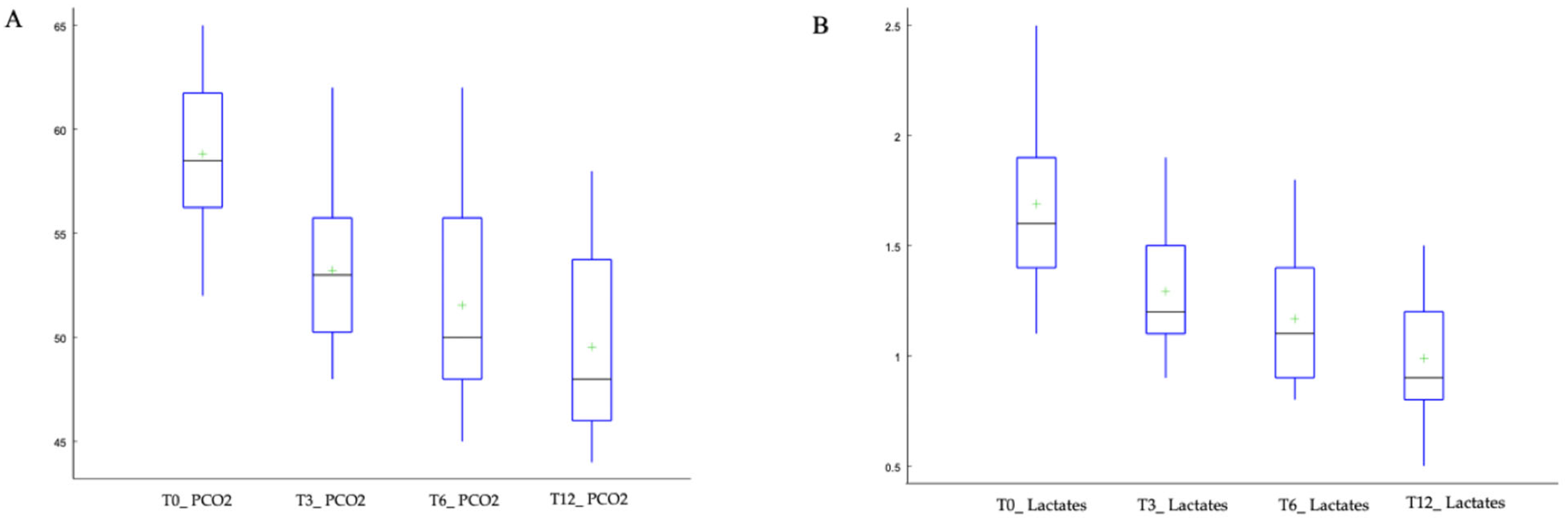
| pCO2 | 58.5 (56.5, 61.5) | |
| PO2 | 53.00 (51.50, 55.00) | |
| HCO3− | 34.50 (32.00, 37.00) | |
| Lactates | 1.60 (1.40, 1.90) | |
| P/F | 252 (245, 261) | |
| Baseline Pulmonary Function Test | FEV1 | 0.73 (0.56, 1.02) |
| FEV1% | 42 (28, 51) | |
| FVC | 2.06 (1.42, 2.61) | |
| FVC% | 70 (60, 78) | |
| FEV1/FVC | 40 (32, 49) | |
| TLC | 6.13 (5.38, 6.85) | |
| TLC% | 111 (102, 125) | |
| RV | 3.90 (3.35, 4.65) | |
| RV% | 182 (169, 200) | |
| DLCO | 3.63 (2.71, 4.00) | |
| DLCO% | 53 (43, 58) | |
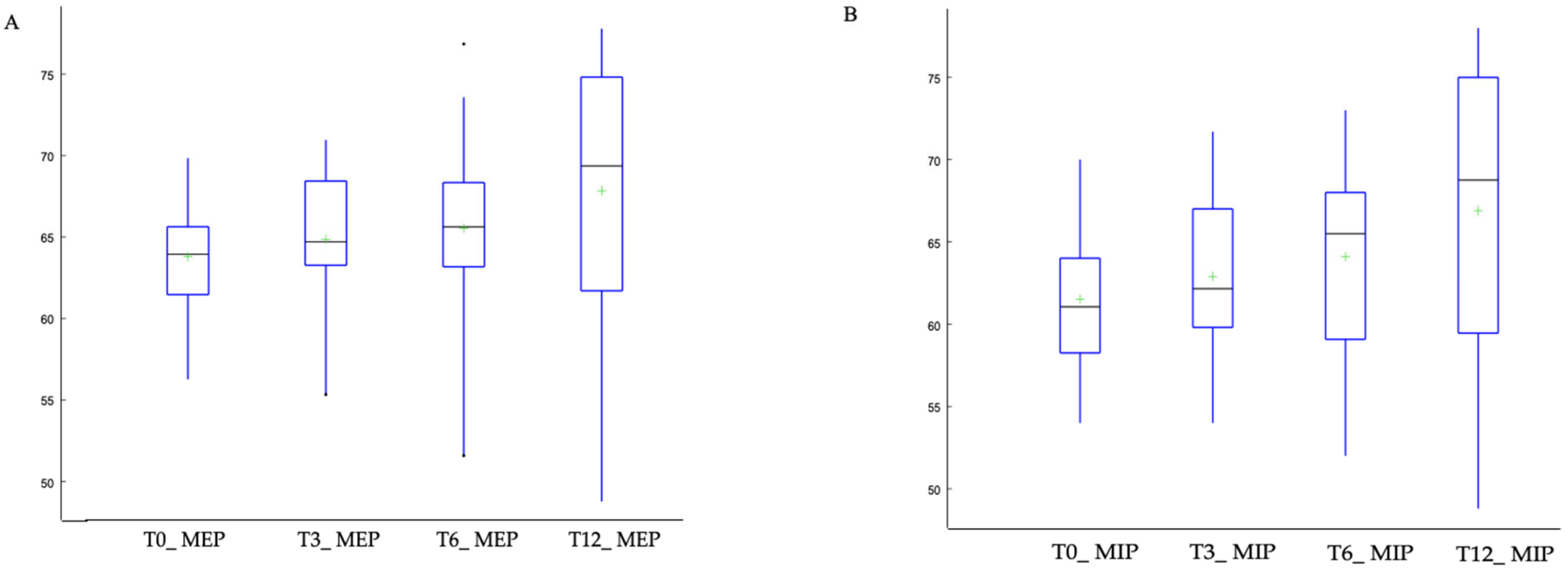
| MIP | 4.82 (3.37, 5.21) | |
| MIP% | 61.1 (58.5, 64.0) | |
| MEP | 6.90 (5.24, 9.64) | |
| MEP% | 74.2 (71.7, 76.0) | |
| High-Flow Nasal Cannula (HFNC) settings | HFNC—Temperature | |
| 31 | 15 (38%) | |
| 34 | 17 (43%) | |
| 37 | 8 (20%) | |
| HFNC—Flow | ||
| <40 L/min | 12 (31%) | |
| 41–49 L/min | 1 (2.5%) | |
| >50 L/min | 22 (68%) | |
| HFNC—FiO2 | 26.50 (25.00, 29.00) | |
| Exacerbation in one year | Moderate–Severe | |
| 0 | 0 (0%)–20 (50%) | |
| 1 | 6 (15%)–14 (35%) | |
| 2 | 19 (48%)–5 (13%) | |
| 3 | 13 (33%)–1 (2.5%) | |
| 4 | 2 (5%)–0 (0%) |
| Variables | T0 vs. T3 | T0 vs. T6 | T0 vs. T12 |
|---|---|---|---|
| pCO2 | <0.001 | <0.001 | <0.001 |
| Lactates | <0.001 | <0.001 | <0.001 |
| pH | 0.002 | 0.017 | <0.001 |
| HCO3− | 0.002 | <0.001 | <0.001 |
| MIP% | 0.008 | 0.004 | <0.001 |
| MEP% | 0.042 | 0.017 | 0.001 |
| Variables | Coefficient | Standard Error | t-Ratio | p-Value |
|---|---|---|---|---|
| T12_pCO2 | 0.541757 | 0.116248 | 4.6603 | <0.0001 |
| T12_LACTATES | −5.43013 | 2.80304 | −1.9372 | 0.0608 |
| T12_FEV1 | 0.0895282 | 0.0368479 | 2.4297 | 0.0204 |
| T12_MIP | 0.100244 | 0.131398 | 0.7629 | 0.4506 |
| T12_MEP | −0.0621883 | 0.124223 | −0.5006 | 0.6198 |
| Coefficient | Standard Error | t-Ratio | p-Value | |
|---|---|---|---|---|
| T12_pCO2 | −0.103389 | 0.057057 | −1.8120 | 0.0486 |
| T12_LACTATES | −1.56128 | 1.37579 | −1.1348 | 0.2642 |
| T12_FEV1 | −0.0106254 | 0.0180857 | −0.5875 | 0.5606 |
| T12_MIP | 0.171079 | 0.0644929 | 2.6527 | 0.0119 |
| T12_MEP | 0.0563721 | 0.0609711 | 0.9246 | 0.3615 |
| EXACERBATION | 3 | 1.66224 | 1.8048 | 0.0488 |
| Coefficient | Standard Error | t-Ratio | p-Value | |
|---|---|---|---|---|
| T12_LACTATES | 4.51951 | 1.99058 | 2.2704 | 0.0301 |
| T12_FEV1 | −0.0492924 | 0.0265987 | −1.8532 | 0.0491 |
| T12_MIP | 0.11602 | 0.104833 | 1.1067 | 0.2767 |
| T12_MEP | −0.132716 | 0.105866 | −1.2536 | 0.2191 |
| T12_HOURSE OF USE | −0.843203 | 0.330452 | −2.5517 | 0.0157 |
| T12_RV | 0.0116039 | 0.0154765 | 0.7498 | 0.4589 |
| FLOW | 0.0566292 | 0.108287 | 2.5230 | 0.0046 |
Disclaimer/Publisher’s Note: The statements, opinions and data contained in all publications are solely those of the individual author(s) and contributor(s) and not of MDPI and/or the editor(s). MDPI and/or the editor(s) disclaim responsibility for any injury to people or property resulting from any ideas, methods, instructions or products referred to in the content. |
© 2026 by the authors. Licensee MDPI, Basel, Switzerland. This article is an open access article distributed under the terms and conditions of the Creative Commons Attribution (CC BY) license.
Share and Cite
Pagliaro, R.; Simeon, V.; Notizia, L.; Arena, S.; Mariniello, D.F.; Stella, G.M.; Bianco, A.; Perrotta, F.; Aronne, L. The Efficacy of High-Flow Nasal Cannula (HFNC) Treatment in Patients with Chronic Type II Respiratory Failure Secondary to COPD. J. Clin. Med. 2026, 15, 1924. https://doi.org/10.3390/jcm15051924
Pagliaro R, Simeon V, Notizia L, Arena S, Mariniello DF, Stella GM, Bianco A, Perrotta F, Aronne L. The Efficacy of High-Flow Nasal Cannula (HFNC) Treatment in Patients with Chronic Type II Respiratory Failure Secondary to COPD. Journal of Clinical Medicine. 2026; 15(5):1924. https://doi.org/10.3390/jcm15051924
Chicago/Turabian StylePagliaro, Raffaella, Vittorio Simeon, Luca Notizia, Stefania Arena, Domenica Francesca Mariniello, Giulia Maria Stella, Andrea Bianco, Fabio Perrotta, and Luigi Aronne. 2026. "The Efficacy of High-Flow Nasal Cannula (HFNC) Treatment in Patients with Chronic Type II Respiratory Failure Secondary to COPD" Journal of Clinical Medicine 15, no. 5: 1924. https://doi.org/10.3390/jcm15051924
APA StylePagliaro, R., Simeon, V., Notizia, L., Arena, S., Mariniello, D. F., Stella, G. M., Bianco, A., Perrotta, F., & Aronne, L. (2026). The Efficacy of High-Flow Nasal Cannula (HFNC) Treatment in Patients with Chronic Type II Respiratory Failure Secondary to COPD. Journal of Clinical Medicine, 15(5), 1924. https://doi.org/10.3390/jcm15051924