Impact of HER2-Low Expression on Clinical Outcomes in Metastatic Breast Cancer Treated with CDK4/6 Inhibitors

 , , , , and
Abstract
1. Introduction
2. Materials and Methods
2.1. Study Design and Patient Selection
2.2. Biomarker Assessment (ER, PR, and HER2)
2.3. Inclusion and Exclusion Criteria
- Histopathologically confirmed hormone receptor-positive (ER ≥10%) and HER2-negative (IHC 0, 1+, or 2+/ISH−) metastatic breast cancer.
- Receipt of combination therapy with a CDK4/6 inhibitor (palbociclib or ribociclib) and endocrine therapy.
- Presence of either de novo metastatic disease or secondary (acquired) endocrine resistance.
- Availability of consistent clinical and radiological follow-up data throughout treatment.
- A minimum follow-up duration of at least 6 months from the initiation of therapy.
- Patients with HER2 amplification or overexpression (IHC 3+ or ISH positive).
- Individuals diagnosed with triple-negative breast cancer.
- Patients who previously received chemotherapy in the metastatic setting.
- Evidence of primary endocrine resistance.
- Cases with incomplete or insufficient pathology or follow-up data.
2.4. Data Collection
2.5. Follow-Up and Survival Analysis
2.6. Statistical Analysis
2.7. Ethical Approval
3. Results
3.1. Patient Characteristics
3.2. Treatment Characteristics and Response Rates
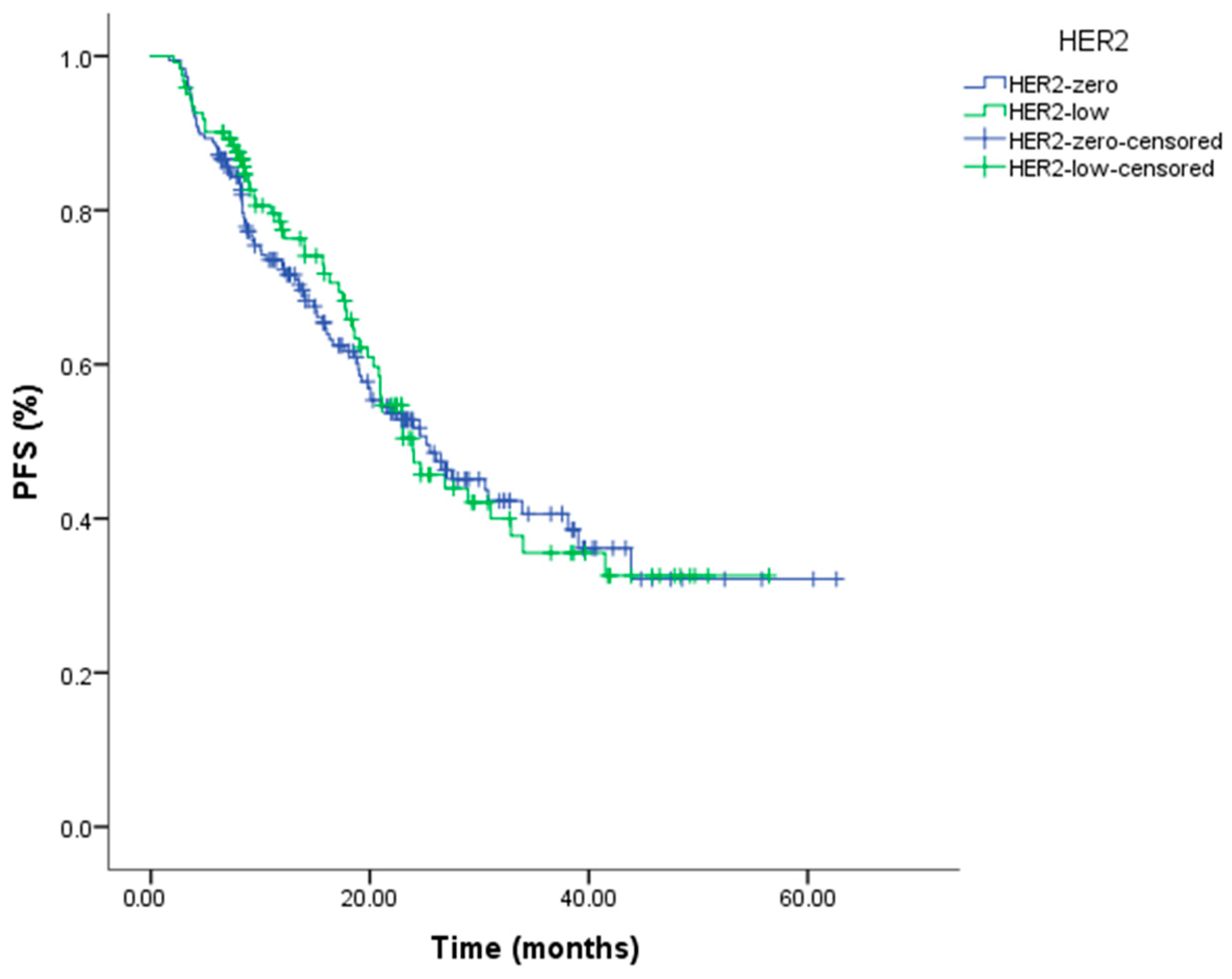
3.3. Progression-Free Survival (PFS)
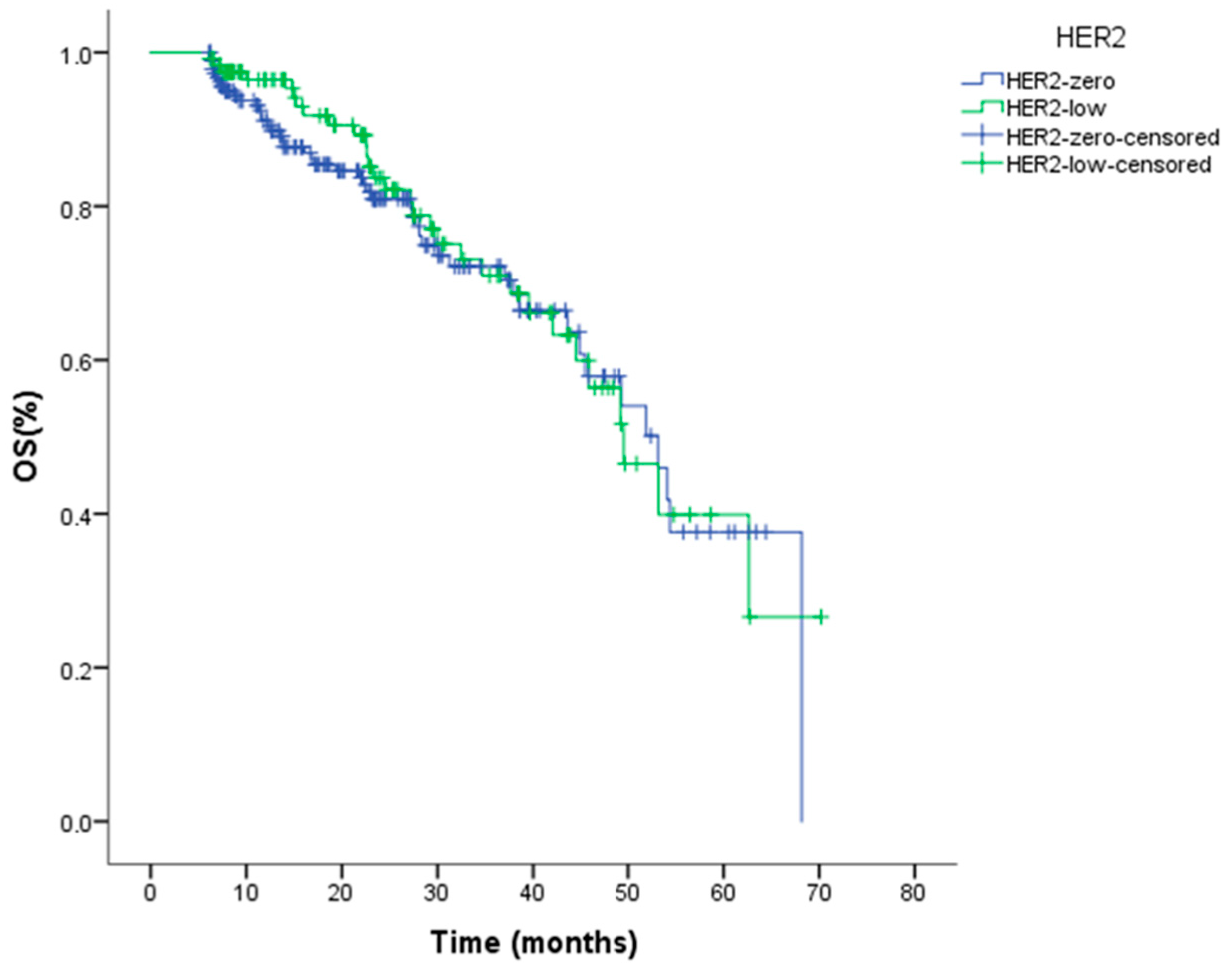
3.4. Overall Survival (OS)
3.5. Subgroup Analysis
4. Discussion
5. Strengths and Limitations
6. Conclusions
Author Contributions
Funding
Institutional Review Board Statement
Informed Consent Statement
Data Availability Statement
Conflicts of Interest
References
- World Cancer Research Fund International. Breast Cancer Statistics. Available online: https://www.wcrf.org/cancer-trends/breast-cancer-statistics/ (accessed on 25 July 2023).
- Perou, C.M.; Sørlie, T.; Eisen, M.B.; van de Rijn, M.; Jeffrey, S.S.; Rees, C.A.; Pollack, J.R.; Ross, D.T.; Johnsen, H.; Akslen, L.A.; et al. Molecular portraits of human breast tumours. Nature 2000, 406, 747–752. [Google Scholar] [CrossRef]
- Surveillance, Epidemiology, and End Results Program; National Cancer Institute. Cancer Stat Facts: Female Breast Cancer. Available online: https://seer.cancer.gov/statfacts/html/breast.html (accessed on 5 October 2021).
- Morgan, E.; O’Neill, C.; Shah, R.; Langselius, O.; Su, Y.; Frick, C.; Fink, H.; Bardot, A.; Walsh, P.M.; Woods, R.R.; et al. Metastatic recurrence in women diagnosed with non-metastatic breast cancer: A systematic review and meta-analysis. Breast Cancer Res. 2024, 26, 171. [Google Scholar] [CrossRef] [PubMed]
- McAndrew, N.P.; Finn, R.S. Clinical review on the management of hormone receptor-positive metastatic breast cancer. JCO Oncol. Pract. 2022, 18, 319–327. [Google Scholar] [CrossRef] [PubMed]
- Asghar, U.S.; Kanani, R.; Roylance, R.; Mittnacht, S. Systematic Review of Molecular Biomarkers Predictive of Resistance to CDK4/6Inhibition in Metastatic Breast Cancer. JCO Precis. Oncol. 2022, 6, e2100002. [Google Scholar] [CrossRef]
- Tarantino, P.; Hamilton, E.; Tolaney, S.M.; Cortes, J.; Morganti, S.; Ferraro, E.; Marra, A.; Viale, G.; Trapani, D.; Cardoso, F.; et al. HER2-Low Breast Cancer: Pathological and Clinical Landscape. J. Clin. Oncol. 2020, 38, 1951–1962. [Google Scholar] [CrossRef] [PubMed]
- Marchiò, C.; Annaratone, L.; Marques, A.; Casorzo, L.; Berrino, E.; Sapino, A. Evolving concepts in HER2 evaluation in breast cancer: Heterogeneity, HER2-low carcinomas and beyond. Semin. Cancer Biol. 2021, 72, 123–135. [Google Scholar] [CrossRef]
- Modi, S.; Jacot, W.; Yamashita, T.; Sohn, J.; Vidal, M.; Tokunaga, E.; Tsurutani, J.; Ueno, N.T.; Prat, A.; Chae, Y.S.; et al. Trastuzumab deruxtecan in previously treated HER2-low advanced breast cancer. N. Engl. J. Med. 2022, 387, 9–20. [Google Scholar] [CrossRef]
- Giuliano, M.; Trivedi, M.V.; Schiff, R. Bidirectional Crosstalk between the Estrogen Receptor and Human Epidermal Growth Factor Receptor 2 Signaling Pathways in Breast Cancer: Molecular Basis and Clinical Implications. Breast Care 2013, 8, 256–262. [Google Scholar] [CrossRef]
- Allison, K.H.; Hammond, M.E.H.; Dowsett, M.; McKernin, S.E.; Carey, L.A.; Fitzgibbons, P.L.; Hayes, D.F.; Lakhani, S.R.; Chavez-MacGregor, M.; Perlmutter, J.; et al. Estrogen and Progesterone Receptor Testing in Breast Cancer: ASCO/CAP Guideline Update. J. Clin. Oncol. 2020, 38, 1346–1366. [Google Scholar] [CrossRef]
- Wolff, A.C.; Hammond, M.E.H.; Allison, K.H.; Harvey, B.E.; Mangu, P.B.; Bartlett, J.M.S.; Bilous, M.; Ellis, I.O.; Fitzgibbons, P.; Hanna, W.; et al. Human Epidermal Growth Factor Receptor 2 Testing in Breast Cancer: American Society of Clinical Oncology/College of American Pathologists Clinical Practice Guideline Focused Update. Arch. Pathol. Lab. Med. 2018, 142, 1364–1382. [Google Scholar] [CrossRef]
- World Medical Association. World Medical Association Declaration of Helsinki: Ethical principles for medical research involving human subjects. JAMA 2013, 310, 2191–2194. [Google Scholar] [CrossRef]
- Modi, S.; Park, H.; Murthy, R.K.; Iwata, H.; Tamura, K.; Tsurutani, J.; Moreno-Aspitia, A.; Doi, T.; Sagara, Y.; Redfern, C.; et al. Antitumor activity and safety of trastuzumab deruxtecan in patients with HER2 Low-Expressing advanced breast cancer: Results from a phase ib study. J. Clin. Oncol. 2020, 38, 1887–1896. [Google Scholar] [CrossRef]
- Denkert, C.; Seither, F.; Schneeweiss, A.; Link, T.; Blohmer, J.U.; Just, M.; Wimberger, P.; Forberger, A.; Tesch, H.; Jackisch, C.; et al. Clinical and molecular characteristics of HER2-low-positive breast cancer: Pooled analysis of individual patient data from four prospective, neoadjuvant clinical trials. Lancet Oncol. 2021, 22, 1151–1161. [Google Scholar] [CrossRef]
- Agostinetto, E.; Rediti, M.; Fimereli, D.; Debien, V.; Piccart, M.; Aftimos, P.; Sotiriou, C.; de Azambuja, E. Her2-low breast cancer: Molecular characteristics and prognosis. Cancers 2021, 13, 2824. [Google Scholar] [CrossRef]
- Won, H.S.; Ahn, J.; Kim, Y.; Kim, J.S.; Song, J.Y.; Kim, H.K.; Lee, J.; Park, H.K.; Kim, Y.S. Clinical significance of HER2-low expression in early breast cancer: A nationwide study from the Korean Breast Cancer Society. Breast Cancer Res. 2022, 24, 22. [Google Scholar] [CrossRef] [PubMed]
- Horisawa, N.; Adachi, Y.; Takatsuka, D.; Nozawa, K.; Endo, Y.; Ozaki, Y.; Sugino, K.; Kataoka, A.; Kotani, H.; Yoshimura, A.; et al. The frequency of low HER2 expression in breast cancer and a comparison of prognosis between patients with HER2-low and HER2-negative breast cancer by HR status. Breast Cancer 2022, 29, 234–241. [Google Scholar] [CrossRef] [PubMed]
- Shao, Y.; Luo, Z.; Yu, Y.; Chen, Q.; He, Y.; Liu, C.; Nie, B.; Zhu, F.; Liu, H. HER2-low expression does not affect the clinical outcomes of metastatic breast cancer treated with CDK4/6 inhibitor: A real-world study. Front. Endocrinol. 2022, 13, 1000704. [Google Scholar] [CrossRef] [PubMed]
- Caliskan Yildirim, E.; Atag, E.; Coban, E.; Umit Unal, O.; Celebi, A.; Keser, M.; Uzun, M.; Keskinkilic, M.; Tanrikulu Simsek, E.; Sari, M.; et al. The effect of low HER2 expression on treatment outcomes in metastatic hormone receptor positive breast cancer patients treated with a combination of a CDK4/6 inhibitor and endocrine therapy: A multicentric retrospective study. Breast 2023, 70, 56–62. [Google Scholar] [CrossRef]
- Sharaf, B.; Abu-Fares, H.; Tamimi, F.; Al-Sawajneh, S.; Salama, O.; Daoud, R.; Alhajahjeh, A.; Al-Lababidi, S.; Abdel-Razeq, H. Differences in Treatment Outcomes Between Patients with HER2-Low versus HER2-Zero, Hormone Receptor-Positive Advanced-Stage Breast Cancer Treated with Ribociclib. Breast Cancer Targets Ther. 2023, 15, 541–548. [Google Scholar] [CrossRef]
- Tarantino, P.; Gandini, S.; Nicolò, E.; Trillo, P.; Giugliano, F.; Zagami, P.; Vivanet, G.; Bellerba, F.; Trapani, D.; Marra, A.; et al. Evolution of low HER2 expression between early and advanced-stage breast cancer. Eur. J. Cancer 2022, 163, 35–43. [Google Scholar] [CrossRef]
- Zattarin, E.; Presti, D.; Mariani, L.; Sposetti, C.; Leporati, R.; Menichetti, A.; Corti, C.; Benvenuti, C.; Fucà, G.; Lobefaro, R.; et al. Prognostic significance of HER2-low status in HR-positive/HER2-negative advanced breast cancer treated with CDK4/6 inhibitors. npj Breast Cancer 2023, 9, 27. [Google Scholar] [CrossRef] [PubMed]
- Carlino, F.; Diana, A.; Ventriglia, A.; Piccolo, A.; Mocerino, C.; Riccardi, F.; Bilancia, D.; Giotta, F.; Antoniol, G.; Famiglietti, V.; et al. HER2-Low Status Does Not Affect Survival Outcomes of Patients with Metastatic Breast Cancer (MBC) Undergoing First-Line Treatment with Endocrine Therapy plus Palbociclib: Results of a Multicenter, Retrospective Cohort Study. Cancers 2022, 14, 4981. [Google Scholar] [CrossRef] [PubMed]
- Wu, Y.; Mo, H.; Xu, H.; Wang, Y.; Wang, J.; Ma, F.; Xu, B. Impact of HER2-low expression on the efficacy of endocrine therapy with or without CDK4/6 inhibitor in HR-positive/HER2-negative metastatic breast cancer: A prospective study. Thorac. Cancer 2024, 15, 965–973. [Google Scholar] [CrossRef]
- Sottotetti, F.; Tagliaferri, B.; Rizzo, G.; Palumbo, R.; Chessa, G.; Raso, C.; Perrone, L.; Malovini, A.; Tibollo, V.; Locati, L.D.; et al. Patterns of treatment and outcomes of patients with metastatic HER2-low breast cancer treated with CDK4/6 inhibitors and hormone therapy. Drugs Context 2025, 14, 2024-12-1. [Google Scholar] [CrossRef] [PubMed]
- Vanni, S.; Caputo, T.M.; Cusano, A.M.; De Vita, A.; Cusano, A.; Cocchi, C.; Mulè, C.; Principe, S.; Liverani, C.; Celetti, G.; et al. Engineered anti-HER2 drug delivery nanosystems for the treatment of breast cancer. Nanoscale 2025, 17, 9436. [Google Scholar] [CrossRef]



| Characteristic | HER2-Zero (n = 187), n (%) | HER2-Low (n = 122), n(%) | p Value |
|---|---|---|---|
| Age, years, median (range) | 53 (26–86) | 53 (27–90) | 0.918 |
| Age group | 0.458 | ||
| <65 | 139 (74.3) | 86 (70.5) | |
| ≥65 | 48 (25.7) | 36 (29.5) | |
| Menopausal status | 0.670 | ||
| Premenopausal | 54 (28.9) | 38 (31.1) | |
| Postmenopausal | 133 (71.1) | 84 (68.9) | |
| Histology | 0.761 | ||
| Ductal | 135 (72.2) | 90 (73.8) | |
| Others | 52 (27.8) | 32 (26.2) | |
| Estrogen receptor | 0.405 | ||
| High > 50 | 170 (91) | 114 (93.5) | |
| Low ≤ 50 | 17 (9) | 8 (6.5) | |
| Progesteron receptor | 0.295 | ||
| High ≥ 20 | 137 (73.3) | 96 (78.7) | |
| Low < 20 | 50 (26.7) | 26 (21.3) | |
| Ki67 index % | 0.076 | ||
| High ≥ 20 | 125 (66.8) | 94 (77) | |
| Low < 20 | 62 (33.2) | 28 (23) | |
| Disease status | 0.436 | ||
| De novo metastatic | 115 (61.5) | 73 (59.8) | |
| Recurrent metastatic | 72 (38.5) | 49 (40.2) | |
| Site of metastasis | 0.413 | ||
| Visceral | 65 (34.8) | 48 (39.4) | |
| Nonvisceral | 122 (65.2) | 74 (60.6) |
| Parameter | HER2-Low (%) | HER2-0 (%) | Odds Ratio (95% CI) | p-Value |
|---|---|---|---|---|
| Objective Response Rate (ORR) | (75.4%) | (72.7%) | 1.182 (0.790–1.769) | 0.415 |
| Disease Control Rate (DCR) | (91%) | (88.8%) | 1.290 (0.580–2.871) | 0.532 |
| Parameter | HER2-Low Months (95% CI) | HER2-0 Months (95% CI) | p-Value |
|---|---|---|---|
| Progression-Free Survival (PFS) | 23.91 (18.71–29.12) | 25.16 (17.64–32.68) | 0.785 |
| Overall Survival (OS) | 49.54 (41.82–57.26) | 53.12 (44.69–61.55) | 0.649 |
| Univariate Analysis | Multivariate Analysis | |||
|---|---|---|---|---|
| Variables | HR (95% CI for HR) | p Value | HR (95% CI for HR) | p Value |
| HER2-0 vs. HER2-low | 1.04 (0.74–1.46) | 0.785 | ||
| Age ≥ 65 years vs. <65 years | 1.02 (0.71–1.48) | 0.887 | ||
| De novo vs. recurrent metastatic | 1.46 (1.05–2.02) | 0.023 | 1.32 (0.94–1.87) | 0.103 |
| ER > 50% vs. ER ≤ 50% | 1.59 (0.93–2.71) | 0.09 | ||
| PR ≥ 20% vs. PR < 20% | 1.69 (1.19–2.42) | 0.003 | 1.58 (1.09–2.30) | 0.016 |
| Ki67 < 20% vs. Ki67 ≥ 20% | 1.98 (1.29–3.04) | 0.002 | 1.73 (1.11–2.68) | 0.015 |
| Non-visceral vs. Visceral disease | 1.59 (1.14–2.22) | 0.006 | 1.62 (1.15–2.28) | 0.006 |
| Univariate Analysis | Multivariate Analysis | |||
|---|---|---|---|---|
| Variables | HR (95% CI for HR) | p Value | HR (95% CI for HR) | p Value |
| HER2-0 vs. HER2-low | 1.11 (0.70–1.76) | 0.649 | ||
| Age ≥ 65 years vs. <65 years | 1.56 (0.97–2.50) | 0.064 | 1.57 (0.98–2.51) | 0.06 |
| De novo vs. recurrent metastatic | 1.12 (0.71–1.77) | 0.607 | ||
| ER > 50% vs. ER ≤ 50% | 1.61 (0.79–3.29) | 0.183 | ||
| PR ≥ 20% vs. PR < 20% | 1.51 (0.93–2.46) | 0.094 | ||
| Ki67 < 20% vs. Ki67 ≥ 20% | 1.59 (0.91–2.77) | 0.103 | ||
| Non-visceral vs. visceral disease | 1.74 (1.10–2.74) | 0.017 | 1.74 (1.10–2.75) | 0.017 |
Disclaimer/Publisher’s Note: The statements, opinions and data contained in all publications are solely those of the individual author(s) and contributor(s) and not of MDPI and/or the editor(s). MDPI and/or the editor(s) disclaim responsibility for any injury to people or property resulting from any ideas, methods, instructions or products referred to in the content. |
© 2026 by the authors. Licensee MDPI, Basel, Switzerland. This article is an open access article distributed under the terms and conditions of the Creative Commons Attribution (CC BY) license.
Share and Cite
Bedir, Ş.; Kapagan, T.; Çakan Demirel, B.; Tokocin, M.; Yıldırım, Ç.; Taş, S.; Bozkaya, Y.; Oyman, A.; Bulut, N.; Erdem, G.U. Impact of HER2-Low Expression on Clinical Outcomes in Metastatic Breast Cancer Treated with CDK4/6 Inhibitors. J. Clin. Med. 2026, 15, 1898. https://doi.org/10.3390/jcm15051898
Bedir Ş, Kapagan T, Çakan Demirel B, Tokocin M, Yıldırım Ç, Taş S, Bozkaya Y, Oyman A, Bulut N, Erdem GU. Impact of HER2-Low Expression on Clinical Outcomes in Metastatic Breast Cancer Treated with CDK4/6 Inhibitors. Journal of Clinical Medicine. 2026; 15(5):1898. https://doi.org/10.3390/jcm15051898
Chicago/Turabian StyleBedir, Şahin, Tanju Kapagan, Burçin Çakan Demirel, Merve Tokocin, Çiğdem Yıldırım, Semra Taş, Yakup Bozkaya, Abdilkerim Oyman, Nilufer Bulut, and Gökmen Umut Erdem. 2026. "Impact of HER2-Low Expression on Clinical Outcomes in Metastatic Breast Cancer Treated with CDK4/6 Inhibitors" Journal of Clinical Medicine 15, no. 5: 1898. https://doi.org/10.3390/jcm15051898
APA StyleBedir, Ş., Kapagan, T., Çakan Demirel, B., Tokocin, M., Yıldırım, Ç., Taş, S., Bozkaya, Y., Oyman, A., Bulut, N., & Erdem, G. U. (2026). Impact of HER2-Low Expression on Clinical Outcomes in Metastatic Breast Cancer Treated with CDK4/6 Inhibitors. Journal of Clinical Medicine, 15(5), 1898. https://doi.org/10.3390/jcm15051898