1. Introduction
Night-shift work is associated with circadian misalignment, reduced sleep duration, and impaired physiological recovery, with potential consequences for health, safety, and work performance [
1,
2,
3]. Disruption of the sleep–wake cycle has been linked to metabolic, cardiovascular, and neurocognitive dysfunction and represents an important occupational health concern in modern work environments [
1,
2].
Professional drivers constitute a safety-critical occupational group in whom sleep disturbances may have immediate implications for public safety. Excessive daytime sleepiness and untreated obstructive sleep apnea (OSA) are well-established risk factors for traffic accidents and near-miss incidents [
4]. OSA prevalence is particularly high in this workforce and is strongly associated with demographic and anthropometric characteristics such as male sex and increased body mass index [
5,
6].
In contrast, information technology (IT) workers are typically exposed to prolonged screen use, high cognitive workload, and irregular schedules, factors that are strongly associated with poor sleep quality and insomnia symptoms [
7,
8,
9]. Evening exposure to light-emitting devices and cognitive hyperarousal may further exacerbate sleep disturbances in this occupational group [
7,
8].
Despite increasing recognition that sleep-related problems differ across occupational settings, direct comparisons between distinct occupational groups exposed to night work remain limited [
10,
11,
12,
13]. In particular, few studies have simultaneously examined subjective sleep quality, insomnia symptoms, daytime sleepiness, and OSA risk in safety-critical versus cognitively demanding professions.
These considerations highlight the importance of evaluating sleep-related outcomes within their specific occupational context, including among workers exposed to night-shift schedules.
2. Materials and Methods
This study was designed as an original cross-sectional observational study conducted among professional drivers and IT workers. Written informed consent was obtained before enrolment.
2.1. Participants and Study Design
Data were collected from working adults employed as professional drivers or IT specialists between October 2023 and December 2025. The present analysis is based on primary data collected specifically for this study. Participants were recruited through occupational health assessment and workplace screening programmes. Eligibility criteria included being aged 18 years or older and having current employment as a professional driver or IT worker. Exclusion criteria included severe psychiatric or neurological disorder, known untreated sleep disorders subject to driving or occupational restrictions, and incomplete questionnaire data.
Night-shift work was defined in accordance with Article 125 of the Romanian Labour Code, which considers work performed between 10 p.m. and 6 a.m. to be night work [
14]. Under this regulation, an employee is classified as a night worker if they perform at least three hours of work during this timeframe on a single working day, or if at least 30% of their monthly working hours fall within this period. Night work in Romania is subject to special regulatory protections, including limitations on daily working time and entitlement to compensatory rest or pay supplements.
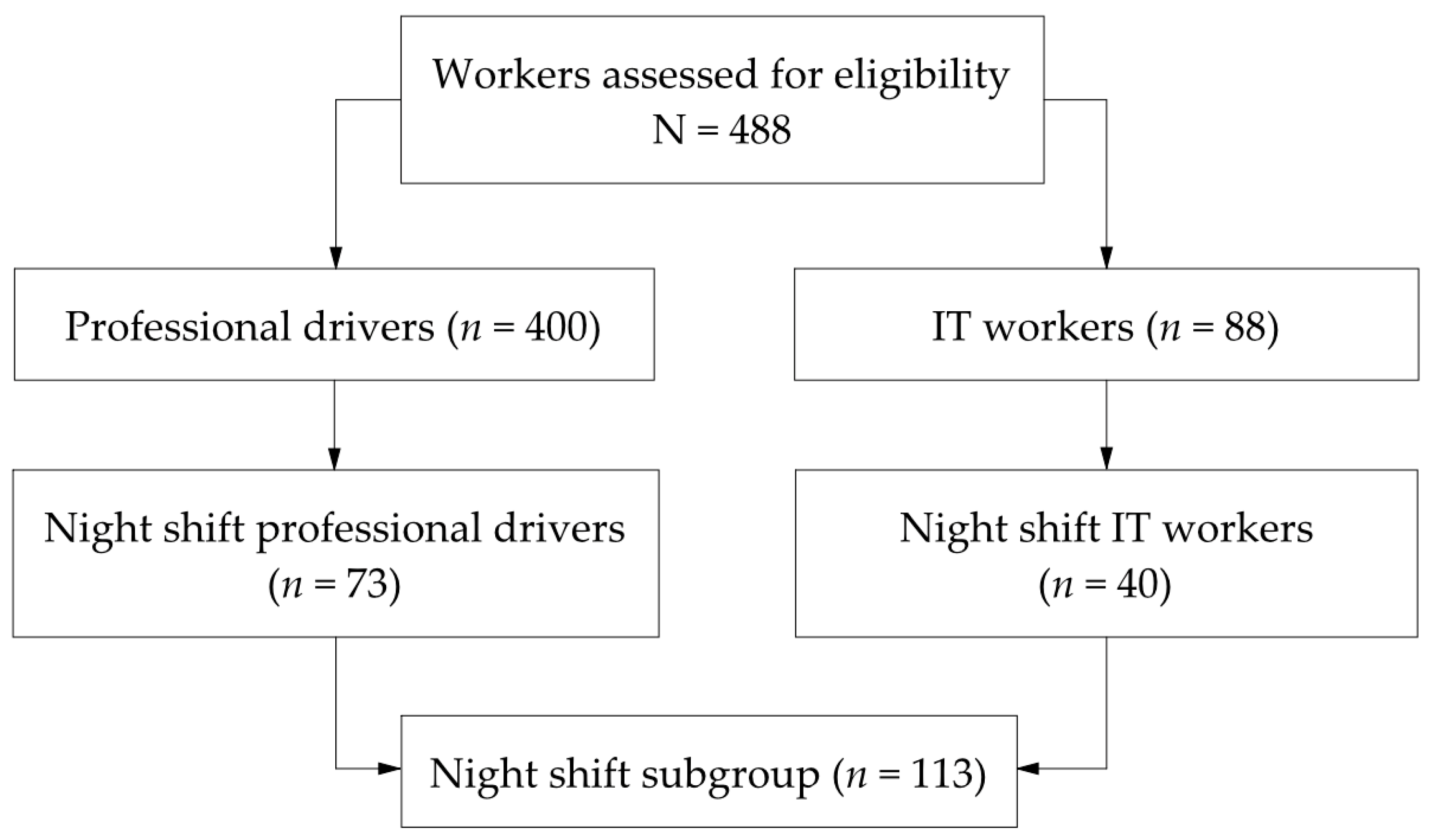
A total of 488 participants (400 professional drivers and 88 IT workers) were included in the overall sample. A predefined subgroup analysis was conducted among participants engaging exclusively in night-shift work, resulting in a subsample of 113 workers (73 professional drivers and 40 IT workers).
2.2. Measures
All data were obtained using a standardized, self-administered questionnaire, which was completed either during the occupational health consultation or online, and in both cases, anonymously. The demographic and occupational characteristics included age, sex, BMI and total work experience (in years). The total work experience was used as an indicator of lifetime occupational exposure rather than tenure in the current role. Employees were classified as either professional drivers or IT workers. Work schedule data were used to identify employees who work night shifts.
Sleep quality was assessed using the Pittsburgh Sleep Quality Index (PSQI), which is a validated measure of perceived sleep quality over the previous month. Global scores range from 0 to 21, with higher scores indicating lower sleep quality. For categorical analyses, a PSQI global score of ≥10 was considered to indicate clinically significant poor sleep quality.
Daytime sleepiness was assessed using the Epworth Sleepiness Scale (ESS), which measures the likelihood of dozing off in everyday situations (scoring from 0 to 24). A score of ≥11 on the ESS was used to define excessive daytime sleepiness. Participants, particularly professional drivers, were informed that their responses would be kept confidential and would not be disclosed to employers or licensing authorities.
Insomnia symptoms were assessed using the Athens Insomnia Scale (AIS). Total scores (range from 0 to 24) were analyzed both continuously and categorically. Based on standard criteria, scores of 0–5 were categorized as no insomnia, 6–9 as mild insomnia, 10–15 as moderate insomnia, and 16 or above as severe insomnia. For the primary analysis, a cut-off point of AIS ≥ 6 was used to define clinical insomnia.
The risk of OSA was estimated using the STOP-Bang questionnaire, which incorporates symptoms such as snoring and daytime tiredness, as well as hypertension and anthropometric risk factors. Scores were categorized as low, intermediate, or high OSA risk. For the regression analyses, a binary variable representing a high risk of OSA was also computed, defined as a STOP-Bang score of 3 points or higher.
2.3. Statistical Analysis
Statistical analyses were performed to address the predefined study objectives using Jamovi software (version 2.6; The Jamovi Project, Sydney, Australia) [
15].
Continuous variables were inspected for distributional properties and summarized as mean ± standard deviation, while categorical variables were presented as frequencies and percentages. Group differences between professional drivers and IT workers were examined using independent sample t-tests for continuous variables and chi-squared tests for categorical variables. Effect sizes were reported as Cohen’s d and Cramer’s V, respectively.
The primary analyses focused on sleep quality (PSQI), insomnia severity (AIS), EDS, and OSA risk (STOP-Bang), which were examined as both continuous variables and binary outcomes using clinically established thresholds. Additional subgroup analyses were performed among participants engaged exclusively in night shift work.
Binary logistic regression analyses were conducted to identify the independent predictors of poor sleep quality (PSQI ≥ 10), clinical insomnia (AIS ≥ 6) and high OSA risk (STOP-Bang ≥ 3). Binary predictors were coded as sex (female = 0, male = 1) and occupation (driver = 0, IT worker = 1). Continuous predictors included age (years), BMI (kg/m2) and total work experience (years). The results are reported as odds ratios (OR) with 95% confidence intervals (CIs). An OR greater than 1 indicates a higher risk among males compared with females, and among IT workers compared with drivers. Model fit was evaluated using deviance statistics and pseudo-R2 indices. A two-tailed p-value of less than 0.05 was considered statistically significant.
3. Results
A total of 488 workers were included in the final analysis, comprising 400 professional drivers and 88 IT workers. A predefined subgroup analysis was conducted among participants engaged exclusively in night-shift work (
n = 113; 73 professional drivers and 40 IT workers) as illustrated in
Figure 1.
3.1. Participant Characteristics
Of the 488 participants, 400 (82%) were professional drivers, while 88 (18%) were IT workers. The mean age of the entire sample was 46.7 ± 11.9 years. Drivers were significantly older than IT workers (51.3 ± 8.6 vs. 32.5 ± 6.8 years;
p < 0.001). The majority of drivers were male, whereas the IT group included a higher proportion of females (see
Table 1). Drivers have a significantly higher body mass index and demonstrated a greater prevalence of overweight and obesity than IT workers. Total work experience was substantially higher among drivers, reflecting their older age distribution. A predefined subgroup analysis was conducted among 113 participants who reported regular night shift work, consisting of 73 drivers and 40 IT workers. Poor sleep quality was significantly more prevalent among IT workers than drivers (65.9% vs. 22.0%; χ
2 = 66.3;
p < 0.001, Cramer’s V = 0.37). Professional drivers exhibited a higher prevalence of intermediate to high STOP-Bang risk than IT workers (52.0% vs. 26.1%; χ
2 = 19.8;
p < 0.001; Cramer’s V = 0.20). Clinically significant insomnia symptoms were more prevalent among IT workers (54.5% vs. 10.7%; χ
2 = 101;
p < 0.001; Cramer’s V = 0.46). Overall, ESS remained uncommon, but was more prevalent among IT workers (8.0% vs. 2.5%; χ
2 = 6.38;
p = 0.012).
3.2. Sleep Quality (PSQI)
There were significant differences in sleep quality between occupational groups. The mean PSQI score was higher among IT workers than among drivers (10.9 ± 3.9 vs. 8.3 ± 3.6; p < 0.001). Using the PSQI clinical cut-off score of 10, 70% of IT workers and 30% of drivers met the criteria of poor sleep quality that is considered clinically relevant (χ2 = 32.4; p < 0.001; Cramer’s V = 0.536), representing a large effect size. This pattern remained consistent in the night-shift-only subgroup.
3.3. Insomnia Symptoms (AIS)
Insomnia severity followed a similar pattern. IT workers recorded significantly higher AIS scores than Drivers. Clinical insomnia (AIS ≥ 6) was observed in 44.3% of IT workers, compared to 14.5% of drivers. This corresponds to a prevalence of insomnia-related symptoms that is more than three times higher in IT workers (χ
2 = 31.1;
p < 0.001; Cramer’s V = 0.524). Again, the difference remained evident in the night-shift-only subgroup (see
Table 2).
3.4. Risk of OSA (STOP-Bang)
Unlike subjective sleep disturbance, the risk of OSA was significantly higher among professional drivers. A STOP-Bang score of at least 3 was identified in 79.5% of drivers and 20.5% of IT workers (χ2 = 7.04; p = 0.008, Cramer’s V = 0.250). This difference remained consistent after adjusting for age and BMI in regression analyses.
3.5. Daytime Sleepiness (EDS)
Excessive daytime sleepiness was uncommon in the overall sample.
EDS was identified in 3.5% of the total sample. Within the full cohort, ESS scores of 11 or above were more prevalent among IT workers than among professional drivers (8% vs. 2.5%;
p = 0.012). However, within the night-shift-only subgroup, the overall prevalence was 7.1%, with no significant difference observed between the IT and professional driver groups (7.5% vs. 6.8%;
p = 0.897) (
Table 2).
3.6. Multivariable Regression Analysis
Binary logistic regression analysis showed that occupational group (IT work) was an independent predictor for both poor sleep quality (PSQI ≥ 10) and insomnia (AIS ≥ 6), even after adjusting for age, sex, BMI and total work experience (
Table 3A). Male sex was also found to be an independent predictor of PSQI scores of 10 or more. However, age and BMI were found to be the strongest predictors of increased OSA risk, while occupational group was not independently associated with a high-risk STOP-Bang classification once these factors were considered. No predictors were independently associated with excessive daytime sleepiness (
Table 3B).
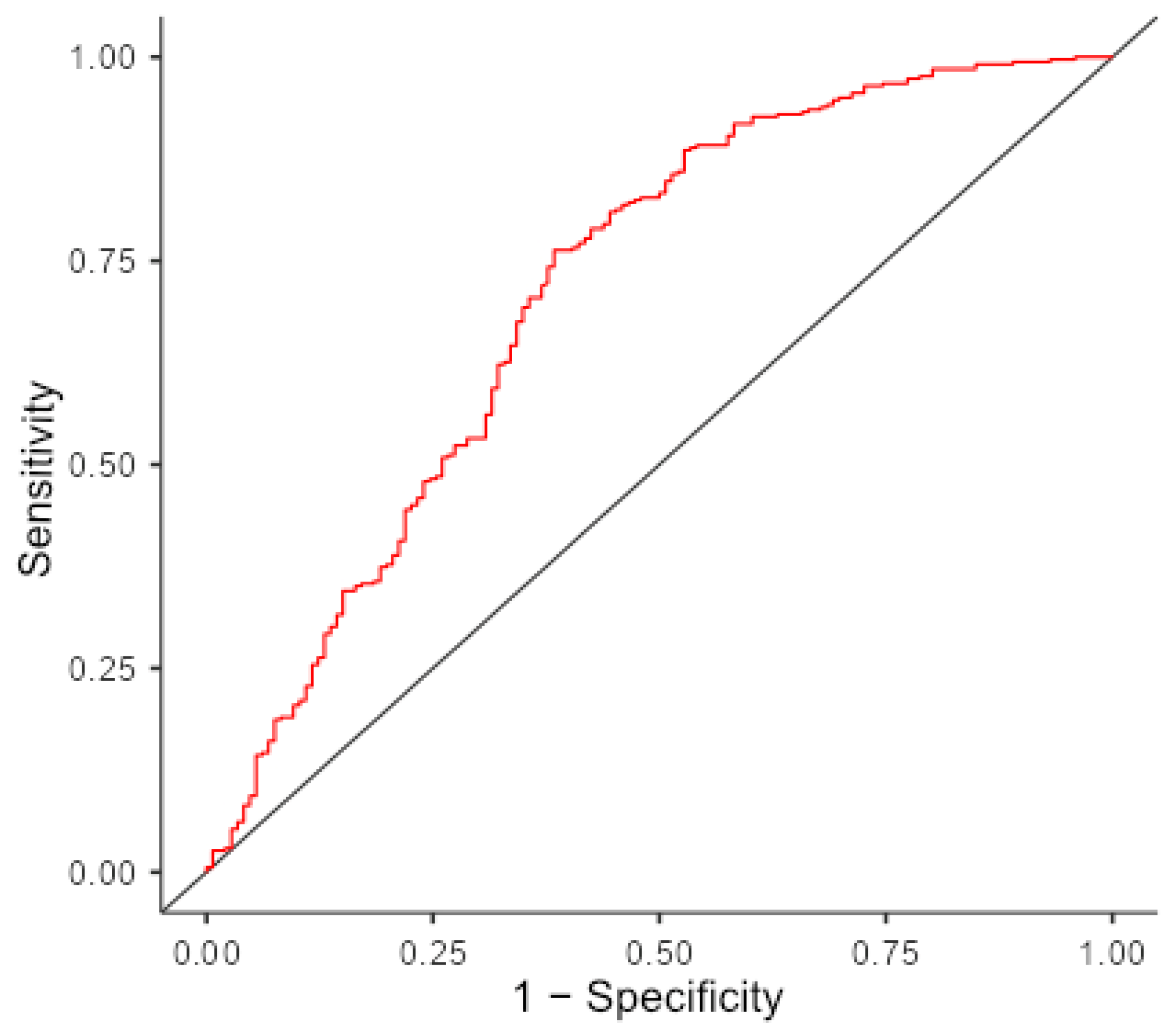
The multivariable model predicting PSQI ≥ 10 showed acceptable discriminatory ability, with an area under the ROC curve of 0.713 (
Figure 2). Model diagnostics indicated an acceptable fit and stability across analyses.
4. Discussion
4.1. Principal Findings
This study compared sleep quality, insomnia symptoms, daytime sleepiness, and OSA risk between professional drivers and IT workers. It also examined a predefined subgroup of employees engaged in night shift work. The main finding was that IT workers reported significantly lower subjective sleep quality and higher insomnia severity than drivers. However, professional drivers demonstrated a substantially greater risk profile for OSA. These results suggest that the occupational context in which sleep disturbance occurs may influence its manifestations, even among populations exposed to similar circadian disruption through night work.
The high prevalence of OSA risk observed among drivers in this study is consistent with recent data showing that professional truck drivers have a substantially higher prevalence of OSA than the general population. Prevalence estimates range from 28–40%, with screening-based high-risk rates reaching 70% in some cohorts [
16,
17]. This excess risk is largely driven by the typical demographic and anthropometric features of this workforce, such as being middle-aged, male and having an elevated BMI.
Untreated OSA and related sleep debt have been consistently linked to impaired attention and vigilance deficits, as well as an increased risk of crashes in safety-critical occupation such as transport [
4]. These findings reinforce the importance of systematic OSA screening and treatment among driver fitness-to-work programmes, particularly as many affected individuals remain undiagnosed in routine occupational practice.
In contrast, IT workers demonstrated significantly higher levels of subjective sleep disturbance and insomnia symptoms. These findings align with existing evidence indicating a high prevalence of poor sleep quality among IT professionals, which has been associated with occupational factors such as cognitive workload, screen exposure, and work-related stress. For instance, recent cross-sectional studies have reported that a significant portion of IT professionals exhibit poor sleep quality, as measured by the PSQI, and have identified substantial associations between sleep disturbance, caffeine consumption, workstation characteristics and work demands in this group [
18,
19].
Experimental evidence demonstrates that evening exposure to light-emitting screens suppresses melatonin secretion and delays circadian timing, leading to prolonged sleep-onset latency and reduced total sleep duration [
7]. These mechanisms are particularly relevant for occupations characterized by prolonged screen use, such as IT workers.
In addition, cognitive hyperarousal and persistent pre-sleep rumination are recognized as core mechanisms in the pathophysiology of insomnia, particularly in individuals exposed to high cognitive demands and a sustained mental workload [
8]. These processes may be particularly pertinent to younger professional groups engaged in cognitively intense work, such as IT workers, and may partly account for the higher prevalence of insomnia-type sleep disturbances observed in this group.
Interestingly, the prevalence of EDS was relatively low overall. Among drivers, reported sleepiness was lower than expected given the observed OSA risk profile. Previous studies have shown that subjective sleepiness measures alone may underestimate the true burden of fatigue in commercial drivers [
4]. This discrepancy may reflect symptom under-reporting in safety-critical occupations where excessive sleepiness has legal or occupational consequences. In contrast, IT workers, who are not subject to licensing restrictions, may be more open about their symptoms. These findings emphasize the limitation of relying exclusively on self-reported daytime sleepiness measures in occupational screening.
OSA is more prevalent among professional drivers and has been consistently linked to an increased risk of crashes and adverse safety outcomes when appropriate screening and treatment are lacking [
20].
4.2. Clinical and Occupational Implications
From an occupational health perspective, the findings suggest the need for tailored sleep health strategies. For professional drivers, the focus should be on the early identification and treatment of OSA and associated cardiometabolic risk. This should be supported by systems that do not penalize the reporting of symptoms, to reduce fear-driven under-disclosure. For IT workers, behavioral sleep interventions, digital hygiene education and access to cognitive therapy for insomnia may be particularly appropriate given their younger age distribution and insomnia-dominant symptom profile.
4.3. Strengths and Limitations
The marked numerical and demographic differences between professional drivers and IT workers represent an important limitation of this study. Although multivariable analyses were adjusted for age, sex, body mass index, and work experience, residual confounding related to group imbalance cannot be fully excluded. Therefore, the observed differences should be interpreted as occupation-related patterns rather than direct causal effects.
Sex distribution differed substantially between groups, with a higher proportion of women among IT workers. Given that female sex has been consistently associated with higher rates of insomnia and poorer subjective sleep quality, sex represents an important potential confounder. Although sex was included as a covariate in multivariable analyses, its influence on subjective sleep outcomes should be considered when interpreting the findings.
A major limitation of this study relates to the reliance on self-reported sleepiness measures among professional drivers. Given the legal and occupational consequences associated with excessive daytime sleepiness in this group, under-reporting of symptoms—particularly on the Epworth Sleepiness Scale—cannot be excluded. The combination of a high risk of OSA and relatively low reported daytime sleepiness among drivers supports this concern and suggests that subjective sleepiness questionnaires may underestimate true functional impairment in safety-critical occupations.
Additional limitations should be acknowledged. Seasonal variation in natural light exposure, which may influence circadian entrainment and sleep outcomes, was not systematically accounted for. Chronotype and social jet lag—important modifiers of individual tolerance to shift work—were not assessed, as chronobiological questionnaires were not included in the original study protocol. In addition, information regarding prior SARS-CoV-2 infection was not available, although emerging evidence suggests potential long-term effects on sleep and circadian regulation. These factors should be considered in future studies aiming to further refine occupational sleep risk assessment.
The strengths of this study include two distinct occupational groups undergoing real-world screening, the use of validated sleep questionnaires, and the analysis of a predefined night-shift subgroup. Nevertheless, the cross-sectional design precludes causal inference, and objective sleep assessments were not available for the entire study population. Although respiratory polygraphy was performed on a subset of professional drivers as part of their routine occupational health evaluation, objective sleep recordings were not systematically collected for all participants and were therefore not included in the present analyses.
4.4. Overall Interpretation
Overall, this study shows that sleep vulnerability varies depending on the occupation, rather than being uniform across night-shift workers. Professional drivers appear to be particularly vulnerable to OSA-related risk, whereas IT workers demonstrate a higher burden of insomnia-related disturbance. It is essential to recognize the heterogeneity when designing targeted prevention and intervention strategies.
5. Conclusions
This study demonstrates that sleep disturbance across occupational groups is not uniform, including among workers exposed to night-shift schedules, and varies according to occupational context. Professional drivers were substantially more likely to meet the criteria for elevated OSA risk, whereas IT workers experienced disproportionately higher rates of poor subjective sleep quality and insomnia symptoms, despite being younger and having a lower BMI. These findings suggest that different patterns of sleep disturbances may be present across occupational groups. The observed risk profile among drivers is consistent with mechanisms commonly associated with OSA. Among IT workers, however, the predominance of insomnia-type symptoms may reflect circadian and behavioral factors.
These findings underscore the value of directly comparing distinct occupational groups and support the use of occupation-specific approaches when evaluating sleep-related outcomes, including in night-shift workers.
From an occupational health perspective, these results highlight the importance of occupation-specific sleep screening and prevention strategies, rather than uniform approaches applied across diverse occupational groups.
Overall, the results support moving away from the generic concept of shift work sleep problems towards occupational-specific prevention and management approaches. However, future longitudinal studies incorporating objective sleep measures are needed to clarify causality and long-term clinical outcomes.
Author Contributions
Conceptualization, A.R. and G.R.L.N.; methodology: G.R.L.N.; resources, A.R.; writing—original draft preparation, G.R.L.N. and A.B.N.; writing—review and editing, G.R.L.N., A.R. and A.B.N.; visualization: G.R.L.N. All authors have read and agreed to the published version of the manuscript.
Funding
This research received no external funding.
Institutional Review Board Statement
The study was conducted in accordance with the Declaration of Helsinki, and approved by the Ethics Committee for Scientific Research, Carol Davila University of Medicine and Pharmacy, Bucharest, Romania 31757, 24 October 2023.
Informed Consent Statement
Informed consent was obtained from all subjects involved in the study.
Data Availability Statement
The data presented in this study are available on reasonable request from the corresponding author due to privacy and ethical restrictions.
Acknowledgments
The authors would like to thank all participants for their time and cooperation, as well as the occupational health teams involved in facilitating data collection.
Conflicts of Interest
The authors declare no conflicts of interest.
References
- Kecklund, G.; Axelsson, J. Health Consequences of Shift Work and Insufficient Sleep. BMJ 2016, 355, i5210. [Google Scholar] [CrossRef] [Scilit] [PubMed]
- Sixth European Working Conditions Survey—Overview Report (2017 Update); Publications Office of the European Union: Luxembourg, 2017; Available online: https://www.eurofound.europa.eu/publications/report/2017/sixth-european-working-conditions-survey-overview-report-2017-update (accessed on 14 January 2026).
- Scheer, F.A.J.L.; Hilton, M.F.; Mantzoros, C.S.; Shea, S.A. Adverse Metabolic and Cardiovascular Consequences of Circadian Misalignment. Proc. Natl. Acad. Sci. USA 2009, 106, 4453–4458. [Google Scholar] [CrossRef] [Scilit] [PubMed]
- Garbarino, S.; Durando, P.; Guglielmi, O.; Dini, G.; Bersi, F.; Fornarino, S.; Toletone, A.; Chiorri, C.; Magnavita, N. Sleep Apnea, Sleep Debt and Daytime Sleepiness Are Independently Associated with Road Accidents: A Cross-Sectional Study on Truck Drivers. PLoS ONE 2016, 11, e0166262. [Google Scholar] [CrossRef] [Scilit] [PubMed]
- Xie, W.; Chakrabarty, S.; Levine, R.; Johnson, R.; Talmage, J.B. Factors Associated with Obstructive Sleep Apnea among Commercial Motor Vehicle Drivers. J. Occup. Environ. Med. 2011, 53, 169–173. [Google Scholar] [CrossRef] [Scilit] [PubMed]
- Commission Directive 2014/85/EU of 1 July 2014 Amending Directive 2006/126/EC of the European Parliament and of the Council on Driving Licences (Text with EEA Relevance). 2014. Available online: https://eur-lex.europa.eu/legal-content/EN/TXT/?uri=CELEX:32014L0085 (accessed on 14 January 2026).
- Chang, A.M.; Aeschbach, D.; Duffy, J.F.; Czeisler, C.A. Evening Use of Light-Emitting eReaders Negatively Affects Sleep, Circadian Timing, and Next-Morning Alertness. Proc. Natl. Acad. Sci. USA 2015, 112, 1232–1237. [Google Scholar] [CrossRef] [Scilit] [PubMed]
- Morin, C.M.; Drake, C.L.; Harvey, A.G.; Krystal, A.D.; Manber, R.; Riemann, D.; Spiegelhalder, K. Insomnia Disorder. Nat. Rev. Dis. Primers 2015, 1, 15026. [Google Scholar] [CrossRef] [Scilit]
- Raju, A.; Nithiya, D.R.; Tipandjan, A. Relationship between Burnout, Effort–Reward Imbalance, and Insomnia among Information Technology Professionals. J. Educ. Health Promot. 2022, 11, 296. [Google Scholar] [CrossRef] [Scilit]
- Mao, Y.; Raju, G.; Zabidi, M.A. Association between Occupational Stress and Sleep Quality: A Systematic Review. Nat. Sci. Sleep 2023, 15, 931–947. [Google Scholar] [CrossRef] [Scilit]
- Benton, J.S.; Lee, C.L.; Long, H.A.; Sugavanam, T.; Holmes, L.; Keane, A.; French, D.P. Shift Workers’ Experiences and Views of Sleep Disturbance, Fatigue, and Healthy Behaviors: A Systematic Review and Qualitative Evidence Synthesis. Scand. J. Work Environ. Health 2025, 51, 282–297. [Google Scholar] [CrossRef] [Scilit]
- Lim, Y.C.; Hoe, V.C.W.; Darus, A.; Bhoo-Pathy, N. Association between Night-Shift Work, Sleep Quality, and Health-Related Quality of Life: A Cross-Sectional Study among Manufacturing Workers in a Middle-Income Setting. BMJ Open 2020, 10, e034455. [Google Scholar] [CrossRef] [Scilit]
- Jeon, B.M.; Kim, S.H. Associations of Extended Work, Higher Workloads, and Emotional Work Demands with Sleep Disturbance among Night-Shift Workers. BMC Public Health 2022, 22, 2138. [Google Scholar] [CrossRef] [Scilit] [PubMed]
- Law No. 53/2003 of 24 January 2003 (The Labour Code of Romania). Official Gazette of Romania 2021, 345. Available online: https://dialogsocial.gov.ro/wp-content/uploads/2020/09/Law-no-53-2003-Labor-Code.pdf (accessed on 14 January 2026).
- The jamovi Project. jamovi (Version 2.6) [Computer Software]. 2024. Available online: https://www.jamovi.org (accessed on 14 January 2026).
- Huhta, R.; Hirvonen, K.; Partinen, M. Prevalence of Sleep Apnea and Daytime Sleepiness in Professional Truck Drivers. Sleep Med. 2021, 81, 136–143. [Google Scholar] [CrossRef] [Scilit] [PubMed]
- Argel, M.; Cunha, Â.; Conceição, M.; Abrantes, T.; Torres, A.S. Screening for Obstructive Sleep Apnea in Truck Drivers. Cien. Saude Colet. 2023, 28, 1863–1872. [Google Scholar] [CrossRef] [Scilit] [PubMed]
- Raju, A.; Chandran, M.; Fredrick, J. Excessive Daytime Sleepiness, Poor Sleep Quality, and Their Association with Caffeine Consumption among Young Information Technology Professionals. Ind. Psychiatry J. 2025, 34, 191–195. [Google Scholar] [CrossRef] [Scilit] [PubMed]
- Joshi, R.; Patil, K.A. Exploring Sleep Quality, Its Determinants, and the Role of Workstation in the Analysis of Cognitive and Physical Parameters in IT Professionals. Clin. Epidemiol. Glob. Health 2025, 34, 102081. [Google Scholar] [CrossRef] [Scilit]
- Colvin, L.J.; Collop, N.A. Commercial Motor Vehicle Driver Obstructive Sleep Apnea Screening and Treatment in the United States: An Update and Recommendation Overview. J. Clin. Sleep Med. 2016, 12, 113–125. [Google Scholar] [CrossRef] [Scilit] [PubMed]
| Disclaimer/Publisher’s Note: The statements, opinions and data contained in all publications are solely those of the individual author(s) and contributor(s) and not of MDPI and/or the editor(s). MDPI and/or the editor(s) disclaim responsibility for any injury to people or property resulting from any ideas, methods, instructions or products referred to in the content. |