Study Protocol

The Role of Family and Peer Influence in Shaping Teen Smoking Attitudes in Romania

by
Ana-Luiza Iorga
1,
Ioana Munteanu
1,2,
Maria Beatrice Catrangiu
1,
Andrei Șerban Zanfirescu
3,
Mihai Octavian Dan
4,
Florin-Dumitru Mihălțan
4,5,
Dragoș Băiceanu
1,
Antonela Dragomir
1,4,*,
Simona Pârvu
4,6,
Ioana-Mădălina Moşteanu
1,7,
Alexandra Paraschiv
1,
Raluca Bobocea
4,
Mara Amalia Bălteanu
1,2,
Oana-Andreea Parliţeanu
1,2,*,
Daniel Radu
2,8,
Alina Croitoru
1,4,
Viorel Jinga
4 and
Beatrice Mahler
1,4
1
“Marius Nasta” Institute of Pneumology, 050159 Bucharest, Romania
2
Faculty of Medicine, Titu Maiorescu University, 040051 Bucharest, Romania
3
Department of Psychology and Cognitive Science, Faculty of Psychology and Educational Sciences, 050663 Bucharest, Romania
4
Faculty of Medicine, “Carol Davila” University of Medicine and Pharmacy, 050474 Bucharest, Romania
5
European Network for Smoking and Tobacco Prevention, 1050 Brussels, Belgium
6
National Institute of Public Health, 050463 Bucharest, Romania
7
Doctoral School, University of Medicine and Pharmacy Craiova, 200349 Craiova, Romania
8
Ilfov County Emergency Clinical Hospital, 022104 Bucharest, Romania
*
Authors to whom correspondence should be addressed.
J. Clin. Med. 2026, 15(5), 1819; https://doi.org/10.3390/jcm15051819
Submission received: 13 January 2026 / Revised: 24 February 2026 / Accepted: 26 February 2026 / Published: 27 February 2026

Abstract

Background: Despite a decline observed in smoking rates amongst adults in many high-income countries, tobacco usage among adolescents remains a significant concern, particularly in Central and Eastern Europe, Romania being no exception. This cross-sectional study aims to assess the prevalence of smoking among teenagers enrolled in several public schools in Bucharest and the surrounding county, Ilfov, while also exploring their attitudes, perceptions, and experiences regarding tobacco. Methods: A public health campaign, conducted in collaboration with multiple institutions between September 2023 and March 2024, sought to provide secondary school students with updated information on smoking and its implications through presentations at schools. Following these presentations, students voluntarily completed anonymous on-paper questionnaires consisting of 10 multiple-choice questions designed to gauge their knowledge and attitudes towards smoking, conceptually inspired by internationally validated instruments such as the Global Youth Tobacco Survey. Results: A total of 945 teenagers participated in our study, with a median age of 13.04 years (standard deviation of ±1.08). Results indicate that 22.85% (n = 216) of teenagers had attempted smoking at the time of the investigation. Additionally, 57.88% (n = 547) of respondents reported exposure to second-hand smoke at home, and 40.42% (n = 382) had been invited to smoke previously. Conclusions: Various factors influence smoking behaviors among teenagers, with peer pressure and familial background playing significant roles in shaping their attitudes toward smoking. Our study highlights the vulnerability of the young Romanian population to these influences, emphasizing the need for initiatives aimed at mitigating tobacco use and fostering a healthier future environment. Nonetheless, these findings shall serve as an instrument for the development of school-based prevention programs and stricter tobacco usage policies.

1. Introduction

Smoking is one of the leading risk factors for preventable diseases, particularly affecting cardiovascular and respiratory health. It has also been linked to mental disorders such as major depressive disorder, anxiety, and suicide attempts [1]. Today, smoking remains a global public health threat, with over 8 million deaths annually attributed to tobacco use, including those caused by second-hand smoke exposure. Although smoking prevalence remains high worldwide, developing countries report a greater number of smokers compared to higher-income nations [2].
In Romania, which has only recently been classified as a developed country by the World Bank, the Global Adult Tobacco Survey—a project supported by the World Health Organization (WHO)—indicates that in 2018, 30.7% of Romanian adults were classified as active smokers, a notable increase from 26.8% in 2011 [3]. The relatively permissive legislative framework regarding smoking, coupled with extensive marketing campaigns, contributes to an environment that appears accepting of smokers. Over the past few decades, Romania has implemented measures such as banning smoking in enclosed public spaces (Law no. 15/2016) and requiring graphic health warnings on tobacco packaging to address this issue [4,5,6]. However, public focus has increasingly shifted toward heated tobacco products, which have been heavily marketed in recent years and remain exempt from indoor smoking bans [7,8].
According to the U.S. Centers for Disease Control and Prevention (CDC), nearly 90% of current adult smokers first tried smoking during their teenage years, making this demographic a critical target for anti-smoking initiatives. For instance, in the United States, 12.6% of high school students currently use tobacco products [9]. Teenagers are particularly susceptible to peer influence and aggressive marketing strategies, necessitating further government action to foster a healthier society. Adolescents are at a developmental stage characterized by heightened sensitivity to social acceptance and belonging, making them more vulnerable to peer pressure.
Social cognitive theories, such as Bandura’s Social Learning Theory, underscore the influence of peers in shaping adolescent smoking behaviors. The appeal of smoking is often intensified by its portrayal in media and marketing aimed at youth, which resonates with adolescents’ desires for autonomy and identity formation. Additionally, factors such as personality traits, coping strategies, and emotional regulation significantly influence adolescent smoking behavior. For example, individuals with lower self-esteem or higher impulsivity levels may turn to smoking as a coping mechanism for stress or emotional regulation. Furthermore, adverse childhood experiences, such as parental substance use or exposure to trauma, can heighten the likelihood of engaging in risky behaviors like smoking during adolescence [10].
Peer smoking status, alongside peer group norms, emerges as a consistent predictor of adolescent smoking attempts’ initiation, as well as smoking behavior modeling, a feature reported by multiple studies. For instance, a 2017 meta-analysis comprising 75 studies revealed a nearly double likelihood of initiating and continuing smoking in adolescents with smoking friends [11]. Peer networks further explain the way adolescents influence and are influenced by entourage in smoking behaviors [12]. Additionally, parental smoking and family environment may contribute to adolescent smoking risk, yet evidence suggests a rather indirect influence than direct imitation of parent behaviors [13,14].
This cross-sectional study aims to assess the attitudes of Romanian teenagers aged 11–16 toward smoking and explore how their backgrounds influence their social beliefs on the topic. Additionally, it seeks to determine the prevalence of both first-hand and second-hand smoking within this age group.

2. Materials and Methods

Study Design: A public health campaign aimed at providing children aged 11–16 with updated information about smoking and its health risks was conducted by the “Marius Nasta” Institute of Pneumology in partnership with several organizations, including the “Carol Davila” University of Medicine and Pharmacy, the Romanian Ministry of Education, the Faculty of Psychology and Education Sciences at the University of Bucharest, the European Network for Smoking and Tobacco Prevention, the National Institute of Public Health, the Association for Education in Respiratory Disease, and the Medical Students’ Society of Bucharest. The campaign took place from September 2023 to March 2024, targeting 70 secondary schools in Bucharest and the surrounding County Ilfov. Teams of doctors, psychologists, and medical students visited each school to deliver interactive presentations designed to educate students about the risks associated with smoking. Following these presentations, students voluntarily completed anonymous on-paper questionnaires consisting of 10 multiple-choice questions aimed at assessing their social knowledge and attitudes toward smoking. The questionnaire was inspired by internationally validated instruments such as the Global Youth Tobacco Survey—GYTS [15]. However, it does not represent a validated adaptation of any existing standardized tool. The rationale of utilizing this questionnaire was to adapt the survey’s content to scholars’ level of understanding, as well as to respond to the original campaign objectives. The complete structure of the questionnaire is available in Appendix A.
Inclusion criteria: The study included only students physically present at the presentations held in schools, whose parents/guardians had previously signed an informed consent agreement in order for project enrollment. All completed questionnaires were subsequently included for data analysis.
Data retrieval and analysis: Responses were collected from the on-paper forms distributed to students in ten participating schools. The data were subsequently digitized and organized in a Microsoft Excel spreadsheet database, with no exclusion criteria applied during data collection. Statistical analysis was conducted using Microsoft Excel version 16.66.1 (2022 Microsoft). The chi-squared test (two-tailed) was used for quantitative variables, and a p value of <0.05 was considered statistically significant. Given the exploratory nature of the study, coupled with the use of a non-validated questionnaire, the analysis was limited to descriptive, univariate methods.

3. Results

3.1. Cohort Demographics

A total of 945 teenagers voluntarily participated in this cross-sectional study, with a median age of 13.04 years (standard deviation of ±1.08 years). Among the participants, 49.31% were female (n = 466), 44.97% were male (n = 425), and 54 respondents preferred not/omitted to disclose their gender.

3.2. Responders’ Background Regarding Smoking

The majority (57.88%, n = 547) of respondents reported living with an active smoker at the time of questionnaire completion. Additionally, 40.42% (n = 382) of teenagers indicated having been invited to try smoking in the past, with a slightly higher proportion among those living with an active smoker (46.07%, n = 252 versus 32.66%, n = 130 amongst children not exposed to smoking at home, p < 0.05). Regarding smoking attempts, 22.85% (n = 216) of respondents admitted to having tried smoking, showing minimal, not statistically significant variation by gender (20.00%, n = 85 among males vs. 23.60%, n = 110 among females, p = 0.22).
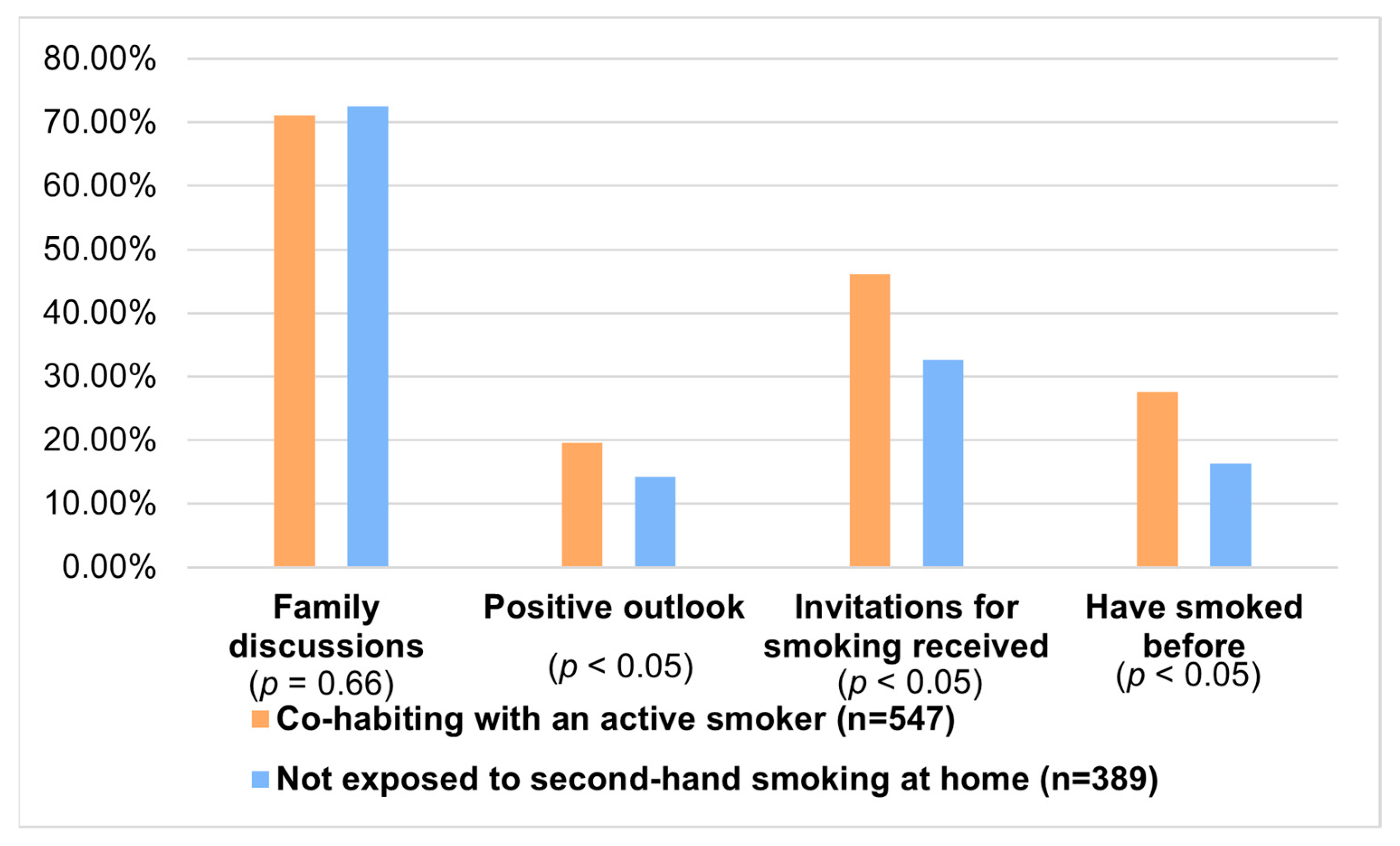
Family discussions about smoking behaviors were reported by 71.85% (n = 679) of respondents, with little difference between those living with active smokers (71.11%, n = 389) and those in smoker-free homes (72.61%, n = 289) (p-value = 0.66). Notably, 13.75% (n = 130) believed their families would support them if they decided to smoke, with higher percentages among those who had discussed the topic with their families (14.13%, n = 96 vs. 12.78%, n = 34, p = 0.66) and those living with active smokers (16.45%, n = 90 vs. 9.82%, n = 39, p = 0.004). Figure 1 presents a comparison between the subgroup cohabiting with an active smoker and children not exposed to second-hand smoking at home, regarding family discussions, smoking perception, and previous experience with smoking.

3.3. Perceptions and Attitudes Towards Smoking

Most of the respondents (85.29%, n = 806) reported feeling uncomfortable in a smoking environment, with 22.85% (n = 216) stating they were completely bothered by second-hand smoke. Some differences were noted between those living with smokers and those in smoker-free homes; 18.28% (n = 100) of the former group expressed a positive or neutral feeling in a smoking environment, compared to only 9.82% (n = 39) in the latter group, p < 0.05.
Additionally, 17.35% (n = 164) of respondents believed that smoking positively influences others’ perceptions of a person, with a slightly higher rate among those living in smoker households (19.56%, n = 107 compared to 14.32%, n = 57, p = 0.04) and those who discussed smoking with their families (19.14%, n = 130 vs. 12.78%, n = 34, p = 0.02). However, only 12.27% (n = 116) thought that smoking behaviors enhance one’s self-esteem.
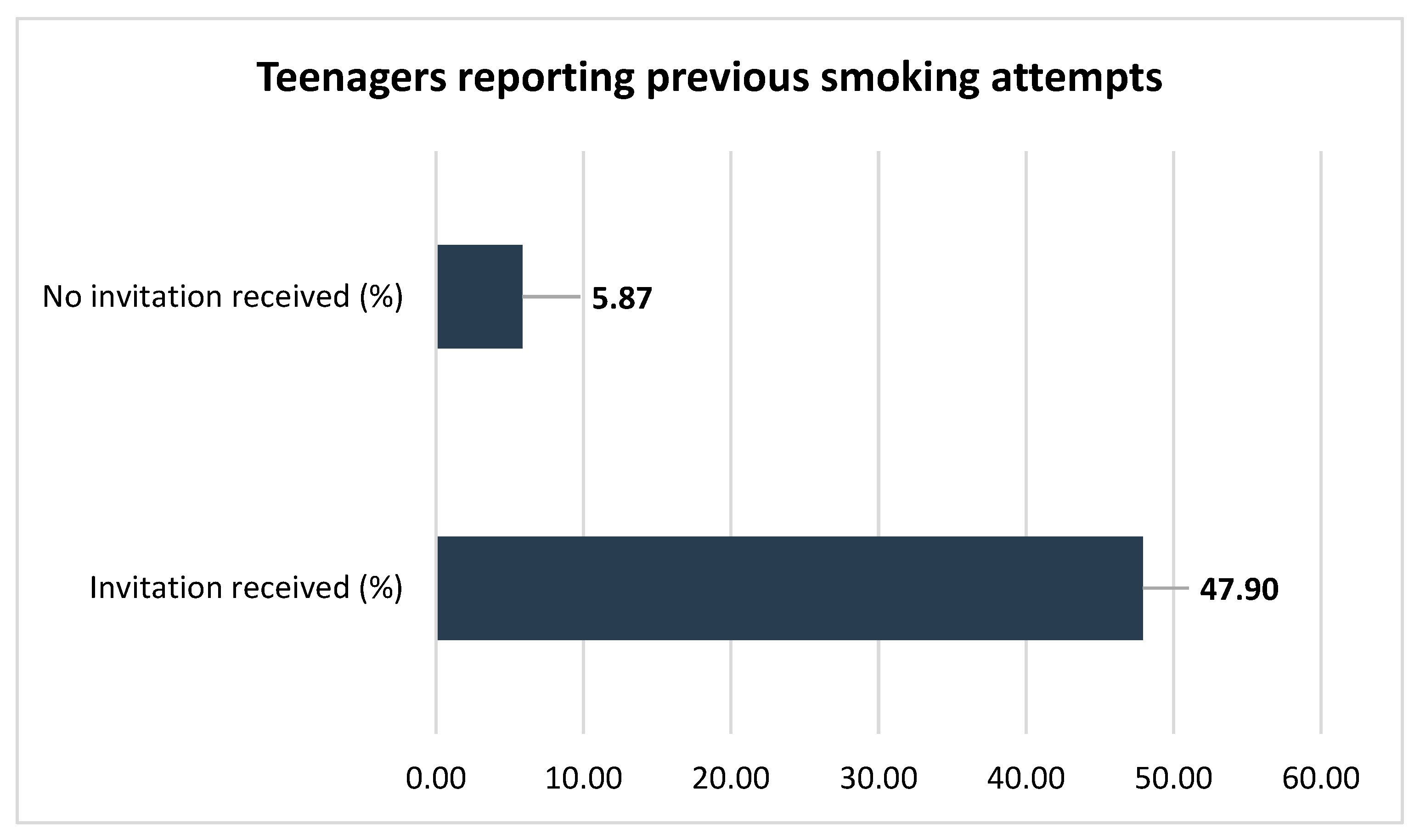
Peer pressure emerges as a critical factor in teenagers’ attempts to smoke, with 47.91% (n = 183) responding positively to smoking invitations, compared to only 5.86% (n = 33) of their counterparts who denied having been invited to smoke (Figure 2), p < 0.05. This observation showcases first-time smoking attempts not as purely individual pursuits, but rather as socially influenced first tries.
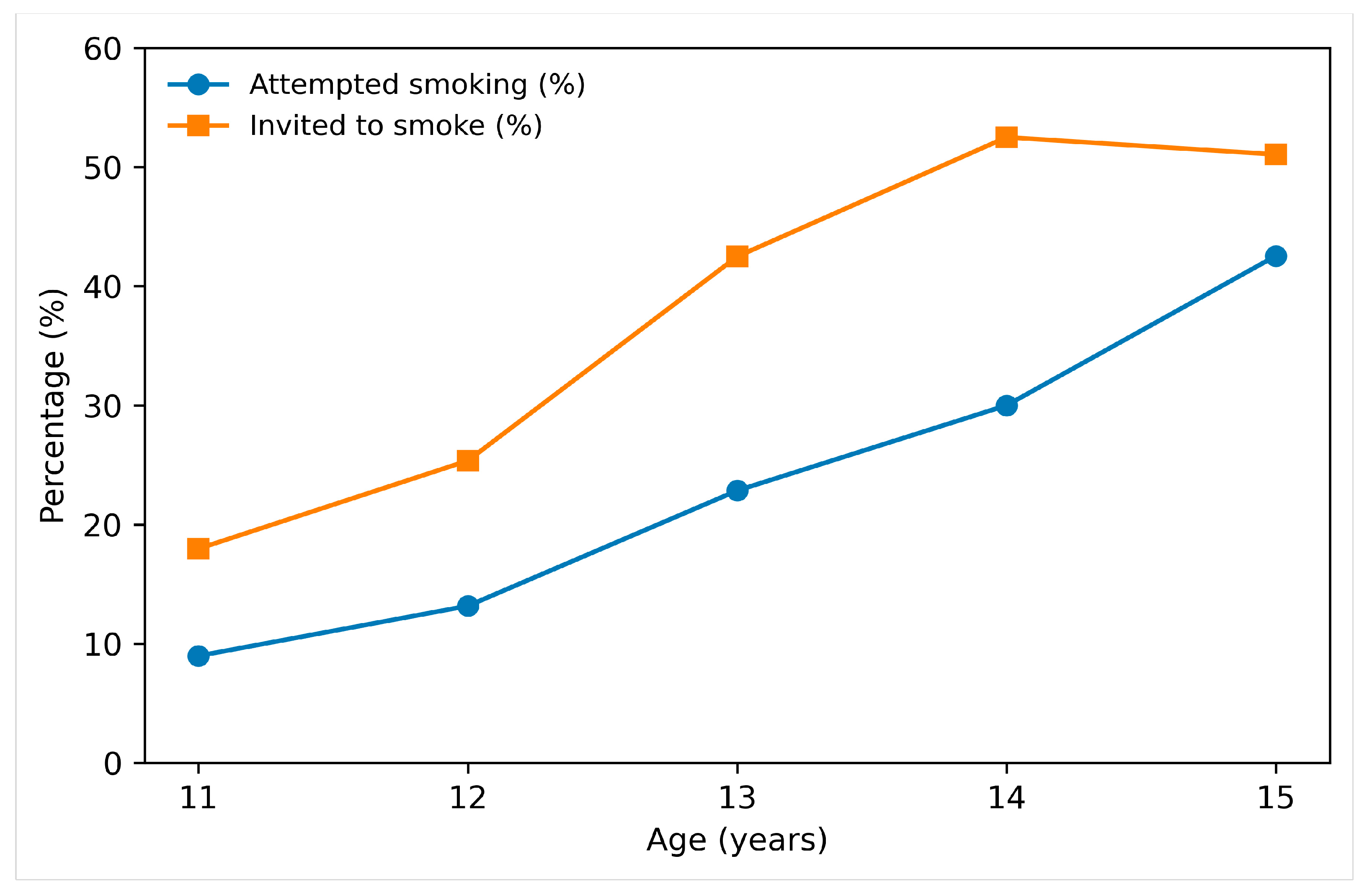
Upon dividing our results by age group, a clear connection emerged between older teenagers and smoking attempts. While multiple factors contribute to this trend, teenagers reporting peer invitations were more likely to respond positively to smoking attempts. A concerning finding, however, is that 17.97% of 11-year-olds have already received invitations to smoke, with the figure rising dramatically to 52.50% among 14-year-olds. A visual representation of the patterns of smoking invitations and attempts across age groups can be found in Figure 3.
A summary of information retrieved from the questionnaires and a more comprehensive comparison of results by gender, exposure to second-hand smoking at home, and partaking in family discussions are available in the appendix of this paper (Appendix B, Table A2 and Table A3).

4. Discussion

Various factors shape individuals’ perceptions of smoking behaviors and their implications, particularly among teenagers. Our study indicates that, while there is little variation in smoking behaviors between genders, factors such as the presence of an active smoker in the household and open discussions about smoking within the family significantly influence adolescents’ perceptions. These findings align with existing literature on the topic [10,16,17,18].
Similar to findings from other studies, the overall prevalence of smoking attempts among teenagers in our cohort was notably high at 22.85% (n = 216), with a slightly higher incidence among female respondents [16,19]. However, this is significantly lower than those reported in studies focusing on lower-income populations, suggesting that living conditions and median income may also influence smoking patterns among different groups [20].
Legislative measures at the government level are essential for discouraging smoking, particularly among younger populations, along with mitigating the healthcare burdens associated with this widespread phenomenon [21,22]. Research indicates that interventions such as increasing tobacco taxes can significantly reduce smoking-related hospitalizations, especially for respiratory diseases. However, effective population-level smoking reduction efforts require collaboration among governmental authorities, healthcare professionals, patient associations, and non-governmental organizations. These partnerships can enhance the impact of public health campaigns aimed at targeted populations [23].
It is crucial to examine how a legislative framework addressing heated tobacco products can be established in Romania. These products have garnered significant interest among younger individuals, who are susceptible to extensive marketing campaigns that emphasize appealing product characteristics, such as various flavors [24,25,26]. Furthermore, the current legal framework permits the use of heated tobacco products indoors, creating a regulatory gap that must be addressed by restrictive measures, such as the complete ban of indoor use or the creation of designated heated tobacco smoking areas.
Several theoretical frameworks help explain smoking behavior. Bandura’s Social Learning Theory posits that smoking behavior can be learned through observing significant others, suggesting that attitudes and values related to smoking are partly shaped by these observations [27]. Consistent with this theory, previous studies have identified parental, sibling, and peer smoking as significant risk factors for adolescent smoking uptake. Additionally, Self-Determination Theory suggests that behavior is influenced by the fulfillment of three basic psychological needs: autonomy, competence, and relatedness [28]. For instance, individuals who feel pressured to smoke by social norms may experience conflict with their need for autonomy, thereby impacting their smoking behavior [29].
The chemical substances in tobacco promote an inflammatory process that can severely exacerbate conditions such as community-acquired pneumonia. Community models implemented in other countries illustrate the importance of tobacco-free policies enacted by decision-makers [30].
Future research should include more comprehensive longitudinal studies, employing multi-center designs in order to provide further descriptions and correlations between psychosocial and environmental determinants of smoker identities among Romanian adolescents. Peer influence, family habits, and novel marketing and social media campaigns shall represent the central focus in order to facilitate designing evidence-based prevention strategies, along with targeted public health interventions [31,32].
To address this issue effectively, compliance with existing regulations must prioritize limiting access to tobacco, especially in public spaces, alongside educational initiatives supported by the Romanian government. Tobacco regulations should be continuously updated to align with emerging needs, consistent with WHO guidelines for tobacco control [33].
Limitations: This study presents several limitations that should be acknowledged. Firstly, although the study included a large number of participants, this sample size is only a small fraction of school-aged children in the Bucharest Metropolitan Area, which may lead to limited generalizability on a population level. Moreover, the study included only school-enrolled adolescents, while it is well-reported that smoking rates tend to be higher in adolescents not attending educational forms, thus leading to a possible underestimation of actual figures. Additionally, our sample consists solely of students from metropolitan areas; participating schools may thus not be a valid representation of Romanian scholars as a whole. Research indicates that non-metropolitan adolescents are more likely than their metropolitan counterparts to report lifetime smoking, initiate smoking at younger ages, and experience greater acceptance of smoking behaviors from friends and parents, as highlighted by a 2018 study [34]. Moreover, we have used an adapted, non-internationally validated questionnaire, which may limit reproducibility, alongside the absence of multivariate modeling. A final limitation to consider is the reliance on self-reported data, which is susceptible to bias, as the findings are based entirely on the responses of the participating teenagers, which may be influenced by the honesty of their answers. Despite the challenges in generalizability due to potential selection bias and sampling limitations, cross-sectional studies like this one can serve as valuable starting points for further research.

5. Conclusions

Smoking is a phenomenon characterized by considerable variability among populations, yet background factors, social influences, and exposure play critical roles in shaping teenagers’ smoking behaviors. This study suggests that the young population in Romania is particularly susceptible to these influences, with family and environmental factors significantly impacting adolescents’ perceptions and behaviors regarding smoking. Interventions aimed at adolescents should enhance their decision-making skills, coping strategies, and resistance to peer pressure. Many adolescents perceive smoking as a means of asserting independence or gaining acceptance within peer groups, highlighting the need for interventions that address the underlying psychological motivations for smoking initiation. Educational programs should not only inform about the health risks of smoking but also equip adolescents with the skills necessary to resist social pressures and make informed choices regarding tobacco use.

Author Contributions

A.-L.I.: conceptualization, project administration, supervision, validation, writing—review and editing; I.M.: investigation, methodology, data curation; M.B.C.: investigation, software, validation, visualization, writing—original draft, writing—review and editing; A.Ș.Z.: investigation, writing—review and editing; M.O.D.: data curation, methodology, resources, software, writing—original draft; F.-D.M.: supervision, validation, project administration; D.B.: validation, software, methodology; A.D.: investigation, data curation, writing—review and editing; D.R.: data curation, methodology, visualization; S.P.: project administration, validation, visualization; I.-M.M.: investigation, methodology, data curation; A.P.: data curation, writing—original draft, investigation, resources, software; R.B.: investigation, data curation; M.A.B.: investigation, data curation, supervision; O.-A.P.: writing—review and editing, validation, supervision; A.C.: conceptualization, project administration, supervision, validation; V.J.: project administration, supervision; B.M.: conceptualization, formal analysis, project administration, supervision, validation, writing—original draft, writing—review and editing. All authors have read and agreed to the published version of the manuscript.

Funding

This research received no external funding.

Institutional Review Board Statement

The study has been conducted in accordance with the Declaration of Helsinki and was approved by the Ethics Committee of the ‘Marius Nasta’ Institute of Pneumology, being registered 17406/1 August 2023.

Informed Consent Statement

Informed consent was obtained from the parents/legal guardians of all subjects in the study, via written agreements compelled by the schools involved in the project.

Data Availability Statement

The data presented in this study are available upon reasonable request from the corresponding author.

Conflicts of Interest

The authors declare no conflicts of interest.

Appendix A

Complete questionnaire structure
Table A1. Questionnaire structure.
Question NumberQuestionPossible Answer 1Possible Answer 2Possible Answer 3
1What is your age? 1
2What is your gender?MaleFemaleI prefer not to declare
3How do you feel in a place where people smoke? 2PleasantUnpleasantStrongly bothered by the smoke inhaled
4Do you live with a smoker?YesNo-
5Have you talked about smoking with your family?YesNo-
6Do you think your family would support you if you become a smoker?YesNo-
7Do you think smoking positively influences other people’s perception of you?YesNo-
8Does smoking improve self-esteem?YesNo-
9Have you ever been invited to smoke?YesNo-
10Have you ever tried smoking?YesNo-
1 First question is an open-answer question. 2 Question no.3 allows more than one answer.

Appendix B

Table A2. Summary of answers retrieved from the questionnaire.
Total Cohort: N = 945 (100%)
FeatureAnswer 1—% (n=)Answer 2—% (n=)Answer 3—% (n=)
GenderMale—44.97% (n = 425) Female—49.31% (n = 466)Prefer not to mention—5.71% (n = 54)
How they feel in a smoking environmentPleasant—14.70% (n = 139)Unpleasant—85.29%, (n = 806)Completely deranged by the smoke inhaled—22.85% (n = 216)
Co-inhabitants with a smokerYes—57.88% (n = 547)No—42.11% (n = 398)Not answered—0.001% (n = 1)
Discussions in the family regarding smokingYes—71.85% (n = 679)No—28.14% (n = 266)
Family support if taking up smokingYes—13.75% (n = 130)No—86.24% (n = 815)
Smoking positively influences others’ outlook on a personYes—17.35 (n = 164)No—82.64% (n = 781)
Smoking enhances a person’s self esteemYes—12.27% (n = 116)No—87.51% (n = 827)Not answered—0.002% (n = 2)
Invited to smokeYes—40.42% (n = 382)No—59.47% (n = 562)Not answered—0.001% (n = 1)
Attempted smokingYes—22.85% (n = 216)No—77.03% (n = 728)Not answered—0.001% (n = 1)
Table A3. Complete comparison of answers among gender, second-hand smoking at home, and teenagers who took part in family discussions regarding smoking.
FeatureMen
n = 425
44.97%
Women
n = 466
49.31%
Exposed to Second-Hand Smoking at Home
n = 547
57.88%
Not Exposed to Second-Hand Smoking at Home
n = 398
42.11%
Took Part in Family Discussions Regarding Smoking
n = 679
71.85%
Have not Taken Part in Family Discussions Regarding Smoking
n = 266
28.14%
How they feel in a smoking environmentPleasant—9.41%, n = 40
Unpleasant—90.58%, n = 385
Completely deranged by the smoke inhaled—24.70%, n = 105
Pleasant—17.38%, n = 81
Unpleasant—82.61%, n = 385
Completely deranged by the smoke inhaled—22.53%, n = 105
Pleasant—18.28%, n = 100
Unpleasant—81.71%, n = 447
Completely deranged by the smoke inhaled—19.56%, n = 107
Pleasant—9.79%, n = 39
Unpleasant—90.20%, n = 359
Completely deranged by the smoke inhaled—27.13%, n = 108
Pleasant—15.75%, n = 107
Unpleasant—84.24%, n = 572
Completely deranged by the smoke inhaled—23.26%, n = 158
Pleasant—12.03%, n = 32
Unpleasant—87.96%, n = 234
Completely deranged by the smoke inhaled—21.42%, n = 57
Have discussed the subject with the familyYes—68.47%, n = 291
No—31.52%, n = 134
Yes—75.32%, n = 351
No—24.67%, n = 115
Yes—71.11%, n = 389
No—28.88%, n = 158
Yes—72.61%, n = 289
No—27.38%, n = 109
XX
Family support if taking up smokingYes—11.76%, n = 50
No—88.23%, n = 375
Yes—14.59%, n = 68
No—85.4%, n = 398
Yes—16.45%, n = 90
No—83.54%, n = 457
Yes—9.79%, n = 39
No—90.20%, n = 359
Yes—14.13%, n = 96
No—85.86%, n = 583
Yes—12.78%, n = 34
No—87.21%, n = 232
Smoking positively influences others’ outlook on a personYes—17.41%, n = 74
No—82.58%, n = 351
Yes—17.59%, n = 82
No—82.40%, n = 384
Yes—19.56%, n = 107
No—80.43%, n = 440
Yes—14.32%, n = 57
No—85.67%, n = 341
Yes—19.14%, n = 130
No—80.85%, n = 549
Yes—12.78%, n = 34
No—87.21%, n = 232
Smoking enhances a person’s self esteemYes—9.88%, n = 42
No—89.88%, n = 382
Yes—13.3%, n = 62
No—86.48%, n = 403
Yes—14.99%, n = 82
No—84.82%, n = 464
Yes—8.54%, n = 34
No—91.20%, n = 363
Yes—12.81%, n = 87
No—87.18%, n = 592
Yes—10.90%, n = 29
No—88.34%, n = 235
Invited smokingYes—34.58%, n = 147
No—65.17%, n = 277
Yes—43.56%, n = 203
No—56.43%, n = 263
Yes—46.06%, n = 252
No—53.93%, n = 295
Yes—32.66%, n = 130
No—67.33%, n = 268
Yes—42.56%, n = 289
No—57.43%, n = 390
Yes—34.96%, n = 93
No—64.66%, n = 172
Attempted smokingYes—20.00%, n = 85
No—79.76%, n = 339
Yes—23.60%, n = 110
No—76.39%, n = 356
Yes—27.60%, n = 151
No—72.39%, n = 396
Yes—16.33%, n = 65
No—83.41%, n = 332
Yes—24.30%, n = 165
No—75.69%, n = 514
Yes—19.17%, n = 51
No—80.45%, n = 214
Note: Lack of answer was also taken into account when calculating percentages.

References

  1. Yuan, S.; Yao, H.; Larsson, S.C. Associations of cigarette smoking with psychiatric disorders: Evidence from a two-sample Mendelian randomization study. Sci. Rep. 2020, 10, 13807. [Google Scholar] [CrossRef] [PubMed]
  2. Tobacco. Available online: https://www.who.int/news-room/fact-sheets/detail/tobacco (accessed on 8 October 2025).
  3. Noncommunicable Diseases Romania 2018 Country Profile. Available online: https://www.who.int/publications/m/item/noncommunicable-diseases-rou-country-profile-2018 (accessed on 8 October 2025).
  4. LEGE 15 29/01/2016—Portal Legislativ. Available online: https://legislatie.just.ro/Public/DetaliiDocument/175441 (accessed on 8 October 2025).
  5. LEGE 349 06/06/2002—Portal Legislativ. Available online: https://legislatie.just.ro/Public/DetaliiDocumentAfis/36778 (accessed on 8 October 2025).
  6. Fu, M.; Castellano, Y.; Tigova, O.; Mons, U.; Agar, T.; Kyriakos, C.N.; Quah, A.C.; Fong, G.T.; Trofor, A.C.; Przewoźniak, K.; et al. Correlates of the support for smoke-free policies among smokers: A cross-sectional study in six European countries of the EUREST-PLUS ITC EUROPE SURVEYS. Tob. Induc. Dis. 2019, 16, A17. [Google Scholar] [CrossRef]
  7. OECD European Observatory on Health Systems and Policies. Romania: Country Health Profile 2023; OECD: Paris, France, 2023. [Google Scholar] [CrossRef]
  8. Chirila, S.; Antohe, A.; Isar, C.; Panaitescu, C.; Malpass, A. Romanian young adult perceptions on using heated tobacco products following exposure to direct marketing methods. npj Prim. Care Respir. Med. 2023, 33, 8. [Google Scholar] [CrossRef]
  9. CDC. Youth and Tobacco Use. Smoking and Tobacco Use. 2025. Available online: https://www.cdc.gov/tobacco/php/data-statistics/youth-data-tobacco/index.html (accessed on 8 October 2025).
  10. Tombor, I.; Shahab, L.; Herbec, A.; Neale, J.; Michie, S.; West, R. Smoker identity and its potential role in young adults’ smoking behavior: A meta-ethnography. Health Psychol. 2015, 34, 992–1003. [Google Scholar] [CrossRef]
  11. Liu, J.; Zhao, S.; Chen, X.; Falk, E.; Albarracín, D. The influence of peer behavior as a function of social and cultural closeness: A meta-analysis of normative influence on adolescent smoking initiation and continuation. Psychol. Bull. 2017, 143, 1082–1115. [Google Scholar] [CrossRef]
  12. Adolescent Smoking: Recent Findings on Peer Group Influences—Page 9. Medscape. 2010. Available online: https://www.medscape.com/viewarticle/731441 (accessed on 9 February 2026).
  13. Scalici, F.; Schulz, P.J. Parents’ and peers’ normative influence on adolescents’ smoking: Results from a Swiss-Italian sample of middle schools students. Subst. Abus. Treat. Prev. Policy 2017, 12, 5. [Google Scholar] [CrossRef]
  14. Simons-Morton, B.G. Prospective analysis of peer and parent influences on smoking initiation among early adolescents. Prev. Sci. 2002, 3, 275–283. [Google Scholar] [CrossRef] [PubMed]
  15. Questionnaire. Available online: https://www.who.int/teams/noncommunicable-diseases/surveillance/systems-tools/global-youth-tobacco-survey/questionnaire (accessed on 8 October 2025).
  16. Xiong, P.S.; Xiong, M.J.; Liu, Z.X.; Liu, Y. Prevalence of smoking among adolescents in China: An updated systematic review and meta-analysis. Public Health 2020, 182, 26–31. [Google Scholar] [CrossRef]
  17. Lorand, F.I.; Zoltan, A.; Lorand, S.; Peter, B.; Foley, K.L. Tobacco use among children in Romanian foster care homes. Eur. J. Public. Health 2016, 26, 822–826. [Google Scholar] [CrossRef]
  18. Albert-Lőrincz, E.; Paulik, E.; Szabo, B.; Foley, K.; Gasparik, A.I. Adolescent smoking and the social capital of local communities in three counties in Romania. Gac. Sanit. 2019, 33, 547–553. [Google Scholar] [CrossRef] [PubMed]
  19. Stafylis, C.; Rachiotis, G.; Katsioulis, A.; Mouchtouri, V.; Hadjichristodoulou, C. Prevalence and determinants of smoking and secondhand smoke exposure in a rural population of central Greece: A cross-sectional study. RRH 2018, 18, 1–22. [Google Scholar] [CrossRef]
  20. Mallol, J.; Urrutia-Pereira, M.; Mallol-Simmonds, M.J.; Calderón-Rodríguez, L.; Osses-Vergara, F.; Matamala-Bezmalinovic, A. Prevalence and determinants of tobacco smoking among low-income urban adolescents. Pediatr. Allergy Immunol. Pulmonol. 2021, 34, 60–67. [Google Scholar] [CrossRef] [PubMed]
  21. Ciobanu, M.; Iosif, I.; Calomfirescu, C.; Brinduse, L.; Stuckler, D.; Reeves, A.; Snell, A.; Mauer-Stender, K.; Mikkelsen, B.; Cucu, A. Variation across Romania in the health impact of increasing tobacco taxation. Eur. J. Public Health 2018, 28, 10–13. [Google Scholar] [CrossRef]
  22. Ionescu, M.D.; Popescu, N.A.; Stănescu, D.; Enculescu, A.; Bălgrădean, M.; Căpitănescu, G.M.; Bumbăcea, D. The challenging diagnosis of interstitial lung disease in children—One case report and literature review. J. Clin. Med. 2022, 11, 6736. [Google Scholar] [CrossRef] [PubMed]
  23. Eremia, M.; Radu-Loghin, C.; Lotrean, L.M. The role of non-governmental organizations in tobacco control in Romania. Tob. Induc. Dis. 2018, 16, A614. [Google Scholar] [CrossRef]
  24. Lee, J.; Thompson, L.; Salloum, R. Heated tobacco product use among us adolescents in 2019: The new tobacco risk. Tob. Prev. Cessat. 2021, 7, 01. [Google Scholar] [CrossRef]
  25. Gottschlich, A.; Mus, S.; Monzon, J.C.; Thrasher, J.F.; Barnoya, J. Cross-sectional study on the awareness, susceptibility and use of heated tobacco products among adolescents in Guatemala City, Guatemala. BMJ Open 2020, 10, e039792. [Google Scholar] [CrossRef]
  26. Kang, S.Y.; Lee, S.; Cho, H.J. Prevalence and predictors of heated tobacco product use and its relationship with attempts to quit cigarette smoking among Korean adolescents. Tob. Control 2021, 30, 192–198. [Google Scholar] [CrossRef]
  27. Bandura, A. Social foundations of thought and action. In The Health Psychology Reader; SAGE Publications Ltd.: London, UK, 2002; pp. 94–106. [Google Scholar] [CrossRef]
  28. Leonardi-Bee, J.; Jere, M.L.; Britton, J. Exposure to parental and sibling smoking and the risk of smoking uptake in childhood and adolescence: A systematic review and meta-analysis. Thorax 2011, 66, 847–855. [Google Scholar] [CrossRef]
  29. Deci, E.L.; Ryan, R.M. The “what” and “why” of goal pursuits: Human needs and the self-determination of behavior. Psychol. Inq. 2000, 11, 227–268. [Google Scholar] [CrossRef]
  30. Taraș, R.; Mahler, B.; Bălgrădean, M.; Derewicz, D.; Lazăr, M.I.; Vidlescu, R.; Berghea, F. The role of mannose-binding lectin and inflammatory markers in establishing the course and prognosis of community-acquired pneumonia in children. Children 2023, 10, 1744. [Google Scholar] [CrossRef] [PubMed]
  31. Lui, C.K.; Trieu, S.L.; Gomes, A.M.; Moose, K.; Dao, L.; Tehrani, S.H.; Tong, E.K.; Mulia, N. Navigating threats of wildfires and individual rights to adopt 100% tobacco-free policy in rural california community colleges. J. Community Health 2024, 49, 1017–1025. [Google Scholar] [CrossRef]
  32. Mahler, B.; Băiceanu, D.; Panciu, T.C.; Florea, R.M.; Iorga, A.L.; Gnat, M.; German, C.F.; Pârvu, S.; Paraschiv, D.; Manea, D.; et al. Air pollutants and their impact on chronic diseases—A retrospective study in bucharest, romania. Atmosphere 2023, 14, 867. [Google Scholar] [CrossRef]
  33. WHO Clinical Treatment Guideline for Tobacco Cessation in Adults. Available online: https://www.who.int/publications/i/item/9789240096431 (accessed on 8 October 2025).
  34. Bernat, D.H.; Choi, K. Differences in cigarette use and the tobacco environment among youth living in metropolitan and nonmetropolitan areas. J. Rural Health 2018, 34, 80–87. [Google Scholar] [CrossRef] [PubMed]
Figure 1. Comparisons regarding family discussions, perspective about smoking, and previous smoking experience between the two subgroups in terms of second-hand smoking exposure at home. The complete data are available in the appendix of this paper.
Jcm 15 01819 g001
Figure 2. Comparison of smoking attempts between teenagers invited and not invited to smoke (p < 0.05).
Jcm 15 01819 g002
Figure 3. Diagram showing the ascending trend in smoking invites and attempts among teenagers in our cohort.
Jcm 15 01819 g003
Disclaimer/Publisher’s Note: The statements, opinions and data contained in all publications are solely those of the individual author(s) and contributor(s) and not of MDPI and/or the editor(s). MDPI and/or the editor(s) disclaim responsibility for any injury to people or property resulting from any ideas, methods, instructions or products referred to in the content.