Pancreatic Cystic Lesions and Endoscopic Ultrasound Diagnostic Equipment: A Literature Review

 ,
,  and
and
Abstract
1. Introduction
2. Methods
3. Conventional Diagnostic Techniques for PCLs
3.1. Conventional B-Mode and EUS Morphology
3.2. Contrast-Enhanced EUS and Contrast-Enhanced Harmonic EUS
3.3. EUS Elastography
- (a)
- Strain Elastography: This technique is based on the principle that certain pathologies, including cancer, induce changes in the stiffness of the affected organ [13] and on small deformations caused by compression in B-mode, followed by software analysis of the deformation degree. The analysis is performed in real time and produces a color-coded stiffness map, where harder tissues, moderately hard tissues, intermediate tissues, medium-soft tissues, and soft tissues are represented in dark blue, cyan, green, yellow, and red, respectively [14]. This evaluation can be further improved with the use of the strain ratio, as it allows the operator to select two regions of interest (ROIs) [14].
- (b)
- Shear Wave Elastography: It is a non-invasive method used to assess tissue stiffness and elasticity. This technique measures the speed of waves generated by acoustic radiation force within the tissue, as the speed of wave propagation is directly related to tissue elasticity [15].
3.4. Detective Flow Imaging and E-FLOW EUS
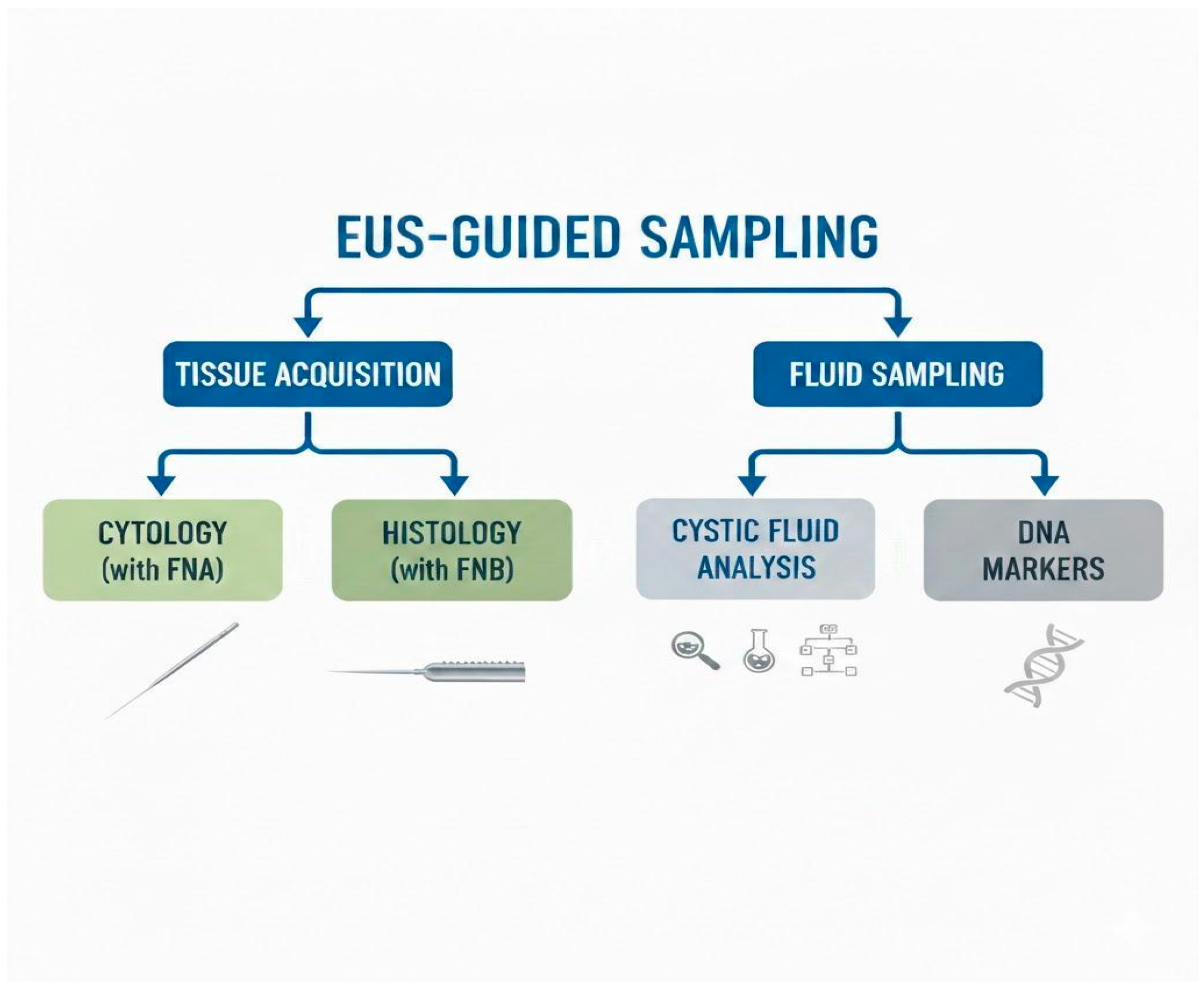
3.5. EUS-Guided Sampling
3.5.1. Tissue Acquisition
- (a)
- Lancet needle tips with sizes of 19G, 22G, and 25G: They are easily introduced and safe but may occasionally result in insufficient tissue acquisition and blood contamination.
- (b)
- Menghini needle tips that are flexible for easier insertion or echogenic tips with usual diameters of 22G or 25G: They are easy to maneuver and have a lower risk of complications. However, they are limited by inadequate material for advanced cytology studies.
- (a)
- Franseen needles: They are characterized by a triangular, three-edged tip, which facilitates penetration and retrieval of well-preserved tissue cylinders, making them excellent for pancreatic and lymph node biopsies due to a maximization of EUS-TA and a reduction in sample destruction.
- (b)
- Fork-tip needles: They have a fork tip with six cutting-edge surfaces (“shark” form), making them ideal for obtaining samples for histological analysis, as well as molecular and immunohistochemical analyses.
- (a)
- Cellularity, which is often limited: The presence of mucinous epithelial cells suggests mucinous cysts (IPMNs or MCNs).
- (b)
- Atypical/neoplastic cells, which indicate suspicion of malignancy.
- (c)
- Mucin, where the presence of extracellular mucin is a key marker for mucinous cysts.
- (d)
- Serous cells, which are typical cuboidal cells of SCA and usually non-mucinous.
3.5.2. Fluid Sampling and Cystic Fluid Analysis
- (a)
- CEA: Elevated intracystic CEA levels may allow us to distinguish mucinous (IPMN or MCN) from non-mucinous cysts but not malignant from benign cysts [37]. The cut-off value varies from 20 ng/mL to 800 ng/mL in different studies, with higher sensitivity for low cut-offs and higher specificity for higher cut-offs. However, the most frequently used cut-off comes from a prospective study by Brugge et al. [38] on 112 patients undergoing surgery. Their study determined that a level ≥ 192 ng/mL had a diagnostic sensitivity of 75%, a specificity of 84%, and an accuracy of 79% in differentiating between mucinous and non-mucinous cysts. However, CEA values significantly differ according to individual assays, with various optimal cut-offs reported in the literature for non-mucinous cysts. A recent comparative study [39] proposed a strategy to identify differences in thresholds by analyzing the optimal CEA cut-off value for pancreatic cysts from two different tests (Beckman Dxl (BD) or Siemens Centaur XP (SC)). The optimal CEA cut-off value for all samples at the study’s institution was 45.9 ng/mL [area under the curve (AUC) = 86, sensitivity = 85.7%, and specificity = 73.8%]. Based on the sub-analysis of the CEA assay, the cut-off values were 45.9 ng/mL (AUC = 84.27, sensitivity = 89.7%, and specificity = 71.4%) for BD and 24.4 ng/mL (AUC = 77, sensitivity = 81.8%, and specificity = 75%) for SC (p = 0.48) [39].
- (b)
- Intracystic glucose assay: Glucose is also useful in the differential diagnosis between mucinous and non-mucinous lesions. A multicenter study involving 93 patients indicated that intracystic glucose was superior to CEA for mucinous cystidentification when determined at a glucose threshold of 50 ng/mL (AUC = 0.81) [40]. Low levels of intracystic glucose (<50 ng/mL) are indicative of mucinous pancreatic cysts. Moreover, combining tests did not enhance the diagnostic precision compared to the glucose test alone. Further benefits of glucose measurement include the capability for real-time analysis in the examination room using a glucometer, as well as the requirement of only a small volume of fluid. Thus, assessing intracystic glucose may hold potential diagnostic relevance for indeterminate cysts, where CEA levels range from 5 to 192 ng/mL, though this fact requires additional investigation. Considering the enhanced sensitivity and diagnostic precision of pancreatic cyst fluid glucose over CEA by itself, the authors of a meta-analysis [41] explored the efficacy of combined testing with both methods, and the findings that indicated low glucose levels or high CEA were noted in four studies (348 lesions), with a pooled sensitivity and specificity of 97% (95% CI, 90–99) and 72% (95% CI, 47–88), respectively. The diagnostic accuracy for combination testing reached 97% (95% CI). However, although the sensitivity and diagnostic accuracy of combining both the glucose and CEA tests showed substantial superiority compared to CEA alone (p < 0.001), combination testing did not yield better testing results than pancreatic cyst fluid glucose sampling alone.
- (c)
- Amylase: Amylase levels in pancreatic cystic fluid are assessed to elucidate potential communication between the cyst and the pancreatic duct or secondary ducts. High amylase levels (>250 UI/L) confirm communication with the MPD (as in IPMNs and pseudocysts). MCNs very rarely exhibit macroscopic communication with the pancreatic duct, so the expected level of amylase is usually low, as observed in SCA. However, several studies [42,43,44] have shown that amylase levels in different MCNs can be elevated, with no particular differences between IPMNs and MCNs, most likely due to microcommunication between the cyst and the ductal system. A summary of cyst fluid analysis according to PCL type is reported in Table 2.
3.5.3. Molecular Markers
4. Ancillary Techniques for PCNs
4.1. Through-the-Needle Biopsy (TTNB)
4.2. Confocal Laser Endomicroscopy (CLE-Cellvizio)
4.3. Artificial Intelligence
5. Conclusions
Author Contributions
Funding
Institutional Review Board Statement
Informed Consent Statement
Data Availability Statement
Conflicts of Interest
References
- van Huijgevoort, N.C.M.; Del Chiaro, M.; Wolfgang, C.L.; van Hooft, J.E.; Besselink, M.G. Diagnosis and management of pancreatic cystic neoplasms: Current evidence and guidelines. Gastroenterol. Hepatol. 2019, 16, 676–689. [Google Scholar]
- Rodrigues, J.P.; Fernandes, S.; Proença, L.; Carvalho, J. Fish-Eye Ampulla: A Rare Pathognomonic Sign. GE Port. J. Gastroenterol. 2019, 26, 375–377. [Google Scholar]
- Del Chiaro, M.; Besselink, M.G.; Scholten, L.; Bruno, M.J.; Cahen, D.L.; Gress, T.M.; van Hooft, J.E.; Lerch, M.M.; Mayerle, J.; Hackert, T.; et al. European evidence-based guidelines on pancreatic cystic neoplasms. Gut 2018, 67, 789–804. [Google Scholar] [CrossRef]
- Tanaka, M.; Fernández-Del Castillo, C.; Kamisawa, T.; Jang, J.Y.; Levy, P.; Ohtsuka, T.; Salvia, R.; Shimizu, Y.; Tada, M.; Wolfgang, C.L. Revisions of international consensus Fukuoka guidelines for the management of IPMN of the pancreas. Pancreatology 2017, 17, 738–753. [Google Scholar] [CrossRef]
- Ohtsuka, T.; Castillo, C.F.D.; Furukawa, T.; Hijioka, S.; Jang, J.-Y.; Lennon, A.M.; Miyasaka, Y.; Ohno, E.; Salvia, R.; Wolfgang, C.L.; et al. International evidence-based Kyoto guidelines for the management of intraductal papillary mucinous neoplasm of the pancreas. Pancreatology 2024, 24, 255–270. [Google Scholar] [CrossRef]
- Vege, S.S.; Ziring, B.; Jain, R.; Moayyedi, P.; Adams, M.A.; Dorn, S.D.; Dudley-Brown, S.L.; Flamm, S.L.; Gellad, Z.F.; Gruss, C.B.; et al. American gastroenterological association institute guideline on the diagnosis and management of asymptomatic neoplastic pancreatic cysts. Gastroenterology 2015, 148, 819–822. [Google Scholar] [CrossRef] [PubMed]
- Gonda, T.A.; Cahen, D.L.; Farrell, J.J. Pancreatic Cysts. N. Engl. J. Med. 2024, 391, 832–843. [Google Scholar] [CrossRef] [PubMed]
- Adimoolam, V.; Sanchez, M.J.; Siddiqui, U.D.; Yu, S.; Dzuira, J.D.; Padda, M.S.; Aslanian, H.R. Endoscopic ultrasound identifies synchronous pancreas cystic lesions not seen on initial cross-sectional imaging. Pancreas 2011, 40, 1070–1072. [Google Scholar] [CrossRef] [PubMed]
- Spadaccini, M.; Franchellucci, G.; Andreozzi, M.; Terrin, M.; Tacelli, M.; Zaccari, P.; Petrone, M.C.; Lauri, G.; Colombo, M.; Poletti, V.; et al. Contrast-Enhanced Harmonic Endoscopic Ultrasonography for Prediction of Aggressiveness and Treatment Response in Patients with PancreaticLesions. Cancers 2025, 17, 2545. [Google Scholar] [CrossRef]
- Lisotti, A.; Napoleon, B.; Facciorusso, A.; Cominardi, A.; Crinò, S.F.; Brighi, N.; Gincul, R.; Kitano, M.; Yamashita, Y.; Marchegiani, G.; et al. Contrast-enhanced EUS for the characterization of mural nodules within pancreatic cystic neoplasms: Systematic review and meta-analysis. Gastrointest. Endosc. 2021, 94, 881–889. [Google Scholar] [CrossRef]
- Alvarez- Sánchez, M.V.; Napoléon, B. Contrast- enhanced harmonic endoscopic ultrasound imaging: Basic principles, present situation and future perspectives. World J. Gastroenterol. 2014, 20, 15549–15563. [Google Scholar] [CrossRef]
- Kamata, K.; Takenaka, M.; Omoto, S.; Miyata, T.; Minaga, K.; Yamao, K.; Imai, H.; Sakurai, T.; Nishida, N.; Chikugo, T.; et al. Impact of avascular areas, as measured by contrast-enhanced harmonic EUS, on the accuracy of FNA for pancreatic adenocarcinoma. Gastrointest. Endosc. 2018, 87, 158–163. [Google Scholar] [CrossRef]
- Dietrich, C.F.; Bibby, E.; Jenssen, C.; Saftoiu, A.; Iglesias-Garcia, J.; Havre, R.F. EUS elastography: How to do it? Endosc. Ultrasound 2018, 7, 20–28. [Google Scholar]
- Iglesias-García, J.; Lariño-Noia, J.; Domínguez-Muñoz, J.E. New Imaging Techniques: Endoscopic Ultrasound-Guided Elastography. Gastrointest. Endosc. Clin. N. Am. 2017, 27, 551–567. [Google Scholar] [CrossRef]
- Ferraioli, G.; Barr, R.G.; Farrokh, A.; Radzina, M.; Cui, X.W.; Dong, Y.; Rocher, L.; Cantisani, V.; Polito, E.; D’Onofrio, M.; et al. How to perform shear wave elastography. Part II. Med Ultrason. 2022, 24, 196–210. [Google Scholar] [CrossRef] [PubMed]
- Giovannini, M.; Hookey, L.C.; Bories, E.; Pesenti, C.; Monges, G.; Delpero, J.R. Endoscopic ultrasound elastography: The first step towards virtual biopsy? Preliminary results in 49 patients. Endoscopy 2006, 38, 344–348. [Google Scholar] [CrossRef] [PubMed]
- Iglesias-Garcia, J.; Larino-Noia, J.; Abdulkader, I.; Forteza, J.; Dominguez-Munoz, J.E. EUS elastography for the characterization of solid pancreatic masses. Gastrointest. Endosc. 2009, 70, 1101–1108. [Google Scholar] [CrossRef]
- Jafri, M.; Sachdev, A.H.; Khanna, L.; Gress, F.G. The Role of Real Time Endoscopic Ultrasound Guided Elastography for Targeting EUS-FNA of Suspicious Pancreatic Masses: A Review of the Literature and A Single Center Experience. JOP 2016, 17, 516–524. [Google Scholar]
- Facciorusso, A.; Martina, M.; Buccino, R.V.; Nacchiero, M.C.; Muscatiello, N. Diagnostic accuracy of fine-needle aspiration of solid pancreatic lesions guided by endoscopic ultrasound elastography. Ann. Gastroenterol. 2018, 31, 513–518. [Google Scholar] [CrossRef]
- Lee, T.H.; Cha, S.W.; Cho, Y.D. EUS Elastography: Advances in Diagnostic EUS of the Pancreas. Korean J. Radiol. 2012, 13, 12–16. [Google Scholar] [CrossRef]
- Kawada, N.; Tanaka, S. Elastography for the pancreas: Current status and future perspective. World J. Gastroenterol. 2016, 22, 3712–3724. [Google Scholar] [CrossRef]
- Das, K.; Kudo, M.; Kitano, M.; Sakamoto, H.; Komaki, T.; Takagi, T.; Yamao, K. Diagnostic value of endoscopic ultrasound-guided directional eFLOW in solid pancreatic lesions. J. Med. Ultrason. 2013, 40, 211–218. [Google Scholar] [CrossRef]
- Yamashita, Y.; Yoshikawa, T.; Kawaji, Y.; Tamura, T.; Hatamaru, K.; Itonaga, M.; Ida, Y.; Maekita, T.; Iguchi, M.; Murata, S.; et al. Novel endoscopic ultrasonography imaging technique for visualizing microcirculation without contrast enhancement in subepithelial lesions: Prospective study. Dig. Endosc. 2021, 33, 955–961. [Google Scholar] [CrossRef]
- Yamashita, Y.; Yoshikawa, T.; Yamazaki, H.; Kawaji, Y.; Tamura, T.; Hatamaru, K.; Itonaga, M.; Ashida, R.; Ida, Y.; Maekita, T.; et al. A Novel Endoscopic Ultrasonography Imaging Technique for Depicting Microcirculation in Pancreatobiliary Lesions without the Need for Contrast-Enhancement: A Prospective Exploratory Study. Diagnostics 2021, 11, 2018. [Google Scholar] [CrossRef] [PubMed]
- Endo, K.; Miwa, H.; Sugimori, K.; Shibasaki, K.; Yonei, S.; Ishino, Y.; Tsunoda, S.; Yoshimura, H.; Funaoka, A.; Tsuchiya, H.; et al. Diagnostic Accuracy of Detective Flow Imaging Endoscopic Ultrasonography for Evaluating Blood Flow Within Mural Nodules of Intraductal Papillary Mucinous Neoplasms. Diagnostics 2025, 15, 196. [Google Scholar] [CrossRef] [PubMed]
- Isayama, H.; Nakai, Y.; Matsuda, K.; Kanno, Y.; Hara, K.; Ogura, T.; Abe, N.; Katanuma, A.; Kitano, M.; Yasuda, I.; et al. Subcommittee for Terminology of Interventional EUS of Japan Gastroenterological Endoscopy Society. Proposal of classification and terminology of interventional endoscopic ultrasonography/endosonography. Dig. Endosc. 2025, 37, 5–17. [Google Scholar] [CrossRef] [PubMed]
- Dhar, J.; Samanta, J.; Nabi, Z.; Aggarwal, M.; Conti Bellocchi, M.C.; Facciorusso, A.; Frulloni, L.; Crinò, S.F. Endoscopic Ultrasound-Guided Pancreatic Tissue Sampling: Lesion Assessment, Needles, and Techniques. Medicine 2024, 60, 2021. [Google Scholar] [CrossRef]
- Párniczky, A.; Mikó, A.; Uc, A.; Singh, A.N.; Elhence, A.; Saluja, A.; Masamune, A.; Abu Dayyeh, B.A.; Davidson, B.; Wilcox, C.M.; et al. International Association of Pancreatology Revised Guidelines on Acute Pancreatitis 2025: Supported and Endorsed by the American Pancreatic Association, European Pancreatic Club, Indian Pancreas Club, and Japan Pancreas Society. Pancreatology 2025, 25, 770–814. [Google Scholar] [CrossRef]
- ASGE Standards of Practice Committee; Machicado, J.D.; Sheth, S.G.; Chalhoub, J.M.; Forbes, N.; Desai, M.; Ngamruengphong, S.; Papachristou, G.I.; Sahai, V.; Nassour, I.; et al. American Society for Gastrointestinal Endoscopy guideline on role of endoscopy in the diagnosis and management of solid pancreatic masses: Methodology and review of evidence. Gastrointest. Endosc. 2024, 100, 786–796. [Google Scholar] [CrossRef]
- de Jong, K.; Poley, J.W.; van Hooft, J.E.; Visser, M.; Bruno, M.J.; Fockens, P. Endoscopic ultrasound-guided fine-needle aspiration of pancreatic cystic lesions provides inadequate material for cytology and laboratory analysis: Initial results from a prospective study. Endoscopy 2011, 43, 585–590. [Google Scholar] [CrossRef]
- Thornton, G.D.; McPhail, M.J.; Nayagam, S.; Hewitt, M.J.; Vlavianos, P.; Monahan, K.J. Endoscopic ultrasound guided fine needle aspiration for the diagnosis of pancreatic cystic neoplasms: A meta-analysis. Pancreatology 2013, 13, 48–57. [Google Scholar] [CrossRef] [PubMed]
- Tanaka, M.; Heckler, M.; Liu, B.; Heger, U.; Hackert, T.; Michalski, C.W. Cytologic Analysis of Pancreatic Juice Increases Specificity of Detection of Malignant IPMN-A Systematic Review. Clin. Gastroenterol. Hepatol. 2019, 17, 2199–2211. [Google Scholar] [CrossRef]
- Pitman, M.B.; Lewandrowski, K.; Shen, J.; Sahani, D.; Brugge, W.; Fernandez-del Castillo, C. Pancreatic cysts: Preoperative diagnosis and clinical management. Cancer Cytopathol. 2010, 118, 1–13. [Google Scholar] [CrossRef]
- Sbeit, W.; Kadah, A.; Shahin, A.; Khoury, T. The Yield of String Sign in Differentiating Mucinous from Non-Mucinous Pancreatic Cysts: A Retrospective Cross-Sectional Study. Medicina 2021, 57, 716. [Google Scholar] [CrossRef] [PubMed]
- Tada, M.; Kawabe, T.; Arizumi, M.; Togawa, O.; Matsubara, S.; Yamamoto, N.; Nakai, Y.; Sasahira, N.; Hirano, K.; Tsujino, T.; et al. Pancreatic cancer in patients with pancreatic cystic lesions: A prospective study in 197 patients. Clin. Gastroenterol. Hepatol. 2006, 4, 1265–1270. [Google Scholar] [CrossRef] [PubMed]
- Oyama, H.; Tada, M.; Takagi, K.; Tateishi, K.; Hamada, T.; Nakai, Y.; Hakuta, R.; Ijichi, H.; Ishigaki, K.; Kanai, S.; et al. Long-term Risk of Malignancy in Branch-Duct Intraductal Papillary Mucinous Neoplasms. Gastroenterology 2020, 158, 226–237. [Google Scholar] [CrossRef]
- Cizginer, S.; Turner, B.G.; Bilge, A.R.; Karaca, C.; Pitman, M.B.; Brugge, W.R. Cyst fluid carcinoembryonic antigen is an accurate diagnostic marker of pancreatic mucinous cysts. Pancreas 2011, 40, 1024–1028. [Google Scholar] [CrossRef]
- Brugge, W.R.; Lewandrowski, K.; Lee-Lewandrowski, E.; Centeno, B.A.; Szydlo, T.; Regan, S.; del Castillo, C.F.; Warshaw, A.L. Diagnosis of pancreatic cystic neoplasms: A report of the cooperative pancreatic cyst study. Gastroenterology 2004, 126, 1330–1336. [Google Scholar] [CrossRef]
- Kim, D.; Margolskee, E.; Goyal, A.; Siddiqui, M.T.; Heymann, J.J.; Rao, R.; Hayden, J. Optimal carcinoembryonic antigen (CEA) cutoff values in the diagnosis of neoplastic mucinous pancreatic cysts differ among assays. J. Clin. Pathol. 2024, 77, 848–852. [Google Scholar] [CrossRef]
- Smith, Z.L.; Satyavada, S.; Simons-Linares, R.; Mok, S.R.S.; Martinez Moreno, B.; Aparicio, J.R.; Chahal, P. Intracystic Glucose and Carcinoembryonic Antigen in Differentiating Histologically Confirmed Pancreatic Mucinous Neoplastic Cysts. Am. J. Gastroenterol. 2022, 117, 478–485. [Google Scholar] [CrossRef]
- McCarty, T.R.; Garg, R.; Rustagi, T. Pancreatic cyst fluid glucose in differentiating mucinous from nonmucinous pancreatic cysts: A systematic review and meta-analysis. Gastrointest. Endosc. 2021, 94, 698–712. [Google Scholar] [CrossRef]
- van der Waaij, L.A.; van Dullemen, H.M.; Porte, R.J. Cyst fluid analysis in the differential diagnosis of pancreatic cystic lesions: A pooled analysis. Gastrointest. Endosc. 2005, 62, 383–389. [Google Scholar] [CrossRef] [PubMed]
- Bhavani Moparty, M.B.P.; Brugge, W.R. Pancreatic Cyst Fluid Amylase Is Not a Marker to Differentiate IPMN from MCN. Gastrointest. Endosc. 2007, 65, 5. [Google Scholar] [CrossRef]
- Oh, H.C.; Kang, H.; Brugge, W.R. Cyst fluid amy- lase and CEA levels in the differential diagnosis of pancreatic cysts: A single-center experience with histologically proven cysts. Dig. Dis. Sci. 2014, 59, 3111–3116. [Google Scholar] [CrossRef]
- Singhi, A.D.; McGrath, K.; Brand, R.E.; Khalid, A.; Zeh, H.J.; Chennat, J.S.; Fasanella, K.E.; Papachristou, G.I.; Slivka, A.; Bartlett, D.L.; et al. Preoperative next-generation sequencing of pancreatic cyst fluid is highly accurate in cyst classification and detection of advanced neoplasia. Gut 2018, 67, 2131–2141. [Google Scholar] [CrossRef]
- Maher, M.H.; Treekitkarnmongkol, W.; Ghatak, S.; Dai, J.; Liu, S.; Nguyen, T.; Duose, D.Y.; Kim, M.P.; Hu, T.Y.; Hurd, M.W.; et al. An integrated multi-omics biomarker approach using molecular profiling and microRNAs for evaluation of pancreatic cyst fluid. Cancer Cytopathol. 2025, 133, e70008. [Google Scholar] [CrossRef]
- Paniccia, A.; Polanco, P.M.; Boone, B.A.; Wald, A.I.; McGrath, K.; Brand, R.E.; Khalid, A.; Kubiliun, N.; O’BRoin-Lennon, A.M.; Park, W.G.; et al. Prospective, Multi-Institutional, Real-Time Next-Generation Sequencing of Pancreatic Cyst Fluid Reveals Diverse Genomic Alterations That Improve the Clinical Management of Pancreatic Cysts. Gastroenterology 2023, 164, 117–133. [Google Scholar] [CrossRef]
- Facciorusso, A.; Del Prete, V.; Antonino, M.; Buccino, V.R.; Wani, S. Diagnostic yield of EUS-guided through-the-needle biopsy in pancreatic cysts: A meta-analysis. Gastrointest. Endosc. 2020, 92, 1–8. [Google Scholar] [CrossRef] [PubMed]
- Yang, D.; Trindade, A.J.; Yachimski, P.; Benias, P.; Nieto, J.; Manvar, A.; Ho, S.; Esnakula, A.; Gamboa, A.; Sethi, A.; et al. Histologic Analysis of Endoscopic Ultrasound-Guided Through the Needle Microforceps Biopsies Accurately Identifies Mucinous Pancreas Cysts. Clin. Gastroenterol. Hepatol. 2019, 17, 1587–1596. [Google Scholar] [CrossRef]
- Kovacevic, B.; Klausen, P.; Rift, C.V.; Toxværd, A.; Grossjohann, H.; Karstensen, J.G.; Brink, L.; Hassan, H.; Kalaitzakis, E.; Storkholm, J.; et al. Clinical impact of endoscopic ultrasound-guided through-the-needle microbiopsy in patients with pancreatic cysts. Endoscopy 2021, 53, 44–52. [Google Scholar] [CrossRef] [PubMed]
- Crinò, S.F.; Bernardoni, L.; Brozzi, L.; Barresi, L.; Malleo, G.; Salvia, R.; Frulloni, L.; Sina, S.; Parisi, A.; Remo, A.; et al. Association between macroscopically visible tissue samples and diagnostic accuracy of EUS-guided through-the-needle microforceps biopsy sampling of pancreatic cystic lesions. Gastrointest. Endosc. 2019, 90, 933–943. [Google Scholar] [CrossRef]
- Crinò, S.F.; Bernardoni, L.; Gabbrielli, A.; Capelli, P.; Salvia, R.; Rusev, B.C.; Scarpa, A.; Manfrin, E. Beyond Pancreatic Cyst Epithelium: Evidence of Ovarian-Like Stroma in EUS-Guided Through-the-Needle Micro-Forceps Biopsy Specimens. Am. J. Gastroenterol. 2018, 113, 1059–1060. [Google Scholar] [CrossRef]
- Stigliano, S.; Covotta, F.; Di Matteo, F.M. A new micro-forceps for endoscopic ultrasound-guided through-the-needle biopsy in the diagnosis of pancreatic cystic lesions: Single center experience. JGH Open 2021, 5, 1004–1008. [Google Scholar] [CrossRef]
- Vilas-Boas, F.; Ribeiro, T.; Costa-Moreira, P.; Barroca, H.; Lopes, J.; Martins, D.; Moutinho-Ribeiro, P.; Macedo, G. Endoscopic Ultrasound Through-The-Needle Biopsy of Pancreatic Cysts: Toward Procedure Standardization. Dig. Dis. 2023, 41, 154–163. [Google Scholar] [CrossRef]
- Kovacevic, B.; Klausen, P.; Hasselby, J.P.; Karstensen, J.G.; Rift, C.V.; Kalaitzakis, E.; Toxværd, A.; Hansen, C.P.; Storkholm, J.; Hassan, H.; et al. A novel endoscopic ultrasound-guided through-the-needle microbiopsy procedure improves diagnosis of pancreatic cystic lesions. Endoscopy 2018, 50, 1105–1111. [Google Scholar] [CrossRef] [PubMed]
- Megibow, A.J. Pancreatic Cysts: Radiology. Gastrointest. Endosc. Clin. N. Am. 2023, 33, 519–531. [Google Scholar] [CrossRef]
- de Pretis, N.; Mukewar, S.; Aryal-Khanal, A.; Bi, Y.; Takahashi, N.; Chari, S. Pancreatic cysts: Diagnostic accuracy and risk of inappropriate resections. Pancreatology 2017, 17, 267–272. [Google Scholar] [CrossRef]
- Wang, Q.X.; Xiao, J.; Orange, M.; Zhang, H.; Zhu, Y.Q. EUS-Guided FNA for Diagnosis of Pancreatic Cystic Lesions: A Meta-Analysis. Cell. Physiol. Biochem. 2015, 36, 1197–1209. [Google Scholar] [CrossRef] [PubMed]
- Westerveld, D.R.; Ponniah, S.A.; Draganov, P.V.; Yang, D. Diagnostic yield of EUS-guided through-the-needle microforceps biopsy versus EUS-FNA of pancreatic cystic lesions: A systematic review and meta-analysis. Endosc. Int. Open 2020, 8, E656–E667. [Google Scholar] [CrossRef] [PubMed]
- Kovacevic, B.; Kalaitzakis, E.; Klausen, P.; Brink, L.; Hassan, H.; Karstensen, J.G.; Vilmann, P. EUS-guided through-the-needle microbiopsy of pancreatic cysts: Technical aspects (with video). Endosc. Ultrasound 2020, 9, 220–224. [Google Scholar] [CrossRef]
- Vestrup Rift, C.; Melchior, L.C.; Kovacevic, B.; Toxvaerd, A.; Klausen, P.; Karstensen, J.G.; Kalaitzakis, E.; Storkholm, J.; Hansen, C.P.; Vilmann, P.; et al. Next-generation sequencing of endoscopic ultrasound guided microbiopsies from pancreatic cystic neoplasms. Histopathology 2019, 75, 767–771. [Google Scholar] [CrossRef] [PubMed]
- Rift, C.V.; Melchior, L.C.; Kovacevic, B.; Klausen, P.; Toxværd, A.; Grossjohann, H.; Karstensen, J.G.; Brink, L.; Hassan, H.; Kalaitzakis, E.; et al. Targeted next-generation sequencing of EUS-guided through-the-needle-biopsy sampling from pancreatic cystic lesions. Gastrointest. Endosc. 2023, 97, 50–58. [Google Scholar] [CrossRef]
- Facciorusso, A.; Kovacevic, B.; Yang, D.; Vilas-Boas, F.; Martínez-Moreno, B.; Stigliano, S.; Rizzatti, G.; Sacco, M.; Arevalo-Mora, M.; Villarreal-Sanchez, L.; et al. Predictors of adverse events after endoscopic ultrasound-guided through-the-needle biopsy of pancreatic cysts: A recursive partitioning analysis. Endoscopy 2022, 54, 1158–1168. [Google Scholar] [CrossRef] [PubMed]
- Crinò, S.F. Through-the-needle microforceps biopsy: A powerful tool but for selected patients. Endoscopy 2021, 53, 53–54. [Google Scholar] [CrossRef]
- McCarty, T.; Rustagi, T. Endoscopic ultrasound-guided through-the-needle microforceps biopsy improves diagnostic yield for pancreatic cystic lesions: A systematic review and meta-analysis. Endosc. Int. 2020, 8, E1280–E1290. [Google Scholar]
- Rift, C.V.; Scheie, D.; Toxværd, A.; Kovacevic, B.; Klausen, P.; Vilmann, P.; Hansen, C.P.; Lund, E.L.; Hasselby, J.P. Diagnostic accuracy of EUS-guided through-the-needle-biopsies and simultaneously obtained fine needle aspiration for cytology from pancreatic cysts: A systematic review and meta-analysis. Pathol. Res. Pract. 2021, 220, 153368. [Google Scholar] [CrossRef]
- Facciorusso, A.; Mohan, B.P.; Tacelli, M.; Crinò, S.F.; Antonini, F.; Fantin, A.; Barresi, L. Use of antibiotic prophylaxis is not needed for endoscopic ultrasound-guided fine-needle aspiration of pancreatic cysts: A meta-analysis. Expert. Rev. Gastroenterol. Hepatol. 2020, 14, 999–1005. [Google Scholar] [CrossRef] [PubMed]
- Facciorusso, A.; Arevalo-Mora, M.; Conti Bellocchi, M.C.; Bernardoni, L.; Ramai, D.; Gkolfakis, P.; Loizzi, D.; Muscatiello, N.; Ambrosi, A.; Tartaglia, N.; et al. Impact of Antibiotic Prophylaxis on Infection Rate after Endoscopic Ultrasound Through-the-Needle Biopsy of Pancreatic Cysts: A Propensity Score-Matched Study. Diagnostics 2022, 12, 211. [Google Scholar] [CrossRef]
- Cheesman, A.R.; Zhu, H.; Liao, X.; Szporn, A.H.; Kumta, N.A.; Nagula, S.; DiMaio, C.J. Impact of EUS-guided microforceps biopsy sampling and needle-based confocal laser endomicroscopy on the diagnostic yield and clinical management of pancreatic cystic lesions. Gastrointest. Endosc. 2020, 91, 1095–1104. [Google Scholar] [CrossRef]
- Barresi, L.; Tacelli, M.; Ligresti, D.; Traina, M.; Tarantino, I. Tissue acquisition in pancreatic cystic lesions. Dig. Liver Dis. 2019, 51, 286–292. [Google Scholar] [CrossRef]
- Kovacevic, B.; Antonelli, G.; Klausen, P.; Hassan, C.; Larghi, A.; Vilmann, P.; Karstensen, J.G. EUS-guided biopsy versus confocal laser endomicroscopy in patients with pancreatic cystic lesions: A systematic review and meta-analysis. Endosc. Ultrasound 2021, 10, 270–279. [Google Scholar] [CrossRef]
- Facciorusso, A.; Buccino, V.R.; Sacco, R. Needle-based confocal laser endomicroscopy in pancreatic cysts: A meta-analysis. Eur. J. Gastroenterol. Hepatol. 2020, 32, 1084–1090. [Google Scholar] [CrossRef]
- Pilonis, N.D.; Januszewicz, W.; di Pietro, M. Confocal laser endomicroscopy in gastro-intestinal endoscopy: Technical aspects and clinical applications. Transl. Gastroenterol. Hepatol. 2022, 7, 7. [Google Scholar] [CrossRef]
- Neumann, H.; Kiesslich, R.; Wallace, M.B.; Neurath, M.F. Confocal laser endomicroscopy: Technical advances and clinical applications. Gastroenterol 2010, 139, 388–392. [Google Scholar] [CrossRef] [PubMed]
- Giovannini, M.; Caillol, F.; Monges, G.; Poizat, F.; Lemaistre, A.I.; Pujol, B.; Lucidarme, D.; Palazzo, L.; Napoléon, B. Endoscopic ultrasound-guided needle-based confocal laser endomicroscopy in solid pancreatic masses. Endoscopy 2016, 48, 892–898. [Google Scholar] [CrossRef]
- Kadayifci, A.; Atar, M.; Basar, O.; Forcione, D.G.; Brugge, W.R. Needle-Based Confocal Laser Endomicroscopy for Evaluation of Cystic Neoplasms of the Pancreas. Dig. Dis. Sci. 2017, 62, 1346–1353. [Google Scholar] [CrossRef]
- Krishna, S.G.; Brugge, W.R.; Dewitt, J.M.; Kongkam, P.; Napoleon, B.; Robles-Medranda, C.; Tan, D.; El-Dika, S.; McCarthy, S.; Walker, J.; et al. Needle-based confocal laser endomicroscopy for the diagnosis of pancreatic cystic lesions: An international external interobserver and intraobserver study (with videos). Gastrointest. Endosc. 2017, 86, 644–654. [Google Scholar] [CrossRef]
- Napoleon, B.; Palazzo, M.; Lemaistre, A.I.; Caillol, F.; Palazzo, L.; Aubert, A.; Buscail, L.; Maire, F.; Morellon, B.M.; Pujol, B.; et al. Needle-based confocal laser endomicroscopy of pancreatic cystic lesions: A prospective multicenter validation study in patients with definite diagnosis. Endoscopy 2019, 51, 825–835. [Google Scholar] [CrossRef] [PubMed]
- Robles-Medranda, C.; Olmos, J.I.; Puga-Tejada, M.; Oleas, R.; Baquerizo-Burgos, J.; Arevalo-Mora, M.; Zavala, R.D.V.; Nebel, J.A.; Loffredo, D.C.; Pitanga-Lukashok, H. Endoscopic ultrasound-guided through-the-needle microforceps biopsy and needle-based confocal laser-endomicroscopy increase detection of potentially malignant pancreatic cystic lesions: A single-center study. World J. Gastrointest. Endosc. 2022, 14, 129–141. [Google Scholar] [CrossRef] [PubMed]
- Hamet, P.; Tremblay, J. Artificial intelligence in medicine. Metabolism 2017, 69, 36–40. [Google Scholar] [CrossRef]
- Ali, H.; Muzammil, M.A.; Dahiya, D.S.; Ali, F.; Yasin, S.; Hanif, W.; Gangwani, M.K.; Aziz, M.; Khalaf, M.; Basuli, D.; et al. Artificial intelligence in gastrointestinal endoscopy: A comprehensive review. Ann. Gastroenterol. 2024, 37, 133–141. [Google Scholar] [CrossRef]
- Choi, R.Y.; Coyner, A.S.; Kalpathy-Cramer, J.; Chiang, M.F.; Campbell, J.P. Introduction to Machine Learning, Neural Networks, and Deep Learning. Transl. Vis. Sci. Technol. 2020, 9, 14. [Google Scholar] [PubMed]
- Jiang, J.; Chao, W.L.; Culp, S.; Krishna, S.G. Artificial Intelligence in the Diagnosis and Treatment of Pancreatic Cystic Lesions and Adenocarcinoma. Cancers 2023, 15, 2410. [Google Scholar] [CrossRef] [PubMed]
- Laino, M.E.; Ammirabile, A.; Lofino, L.; Mannelli, L.; Fiz, F.; Francone, M.; Chiti, A.; Saba, L.; Orlandi, M.A.; Savevski, V. Artificial Intelligence Applied to Pancreatic Imaging: A Narrative Review. Healthcare 2022, 10, 1511. [Google Scholar] [CrossRef]
- Zhao, G.; Chen, X.; Zhu, M.; Liu, Y.; Wang, Y. Exploring the application and future outlook of Artificial intelligence in pancreatic cancer. Front. Oncol. 2024, 14, 1345810. [Google Scholar] [CrossRef]
- Zhang, J.; Zhu, L.; Yao, L.; Ding, X.; Chen, D.; Wu, H.; Lu, Z.; Zhou, W.; Zhang, L.; An, P.; et al. Deep learning-based pancreas segmentation and station recognition system in EUS: Development and validation of a useful training tool (with video). Gastrointest. Endosc. 2020, 92, 874–885. [Google Scholar] [CrossRef]
- Wu, H.L.; Yao, L.W.; Shi, H.Y.; Wu, L.L.; Li, X.; Zhang, C.X.; Chen, B.R.; Zhang, J.; Tan, W.; Cui, N.; et al. Validation of a real-time biliopancreatic endoscopic ultrasonography analytical device in China: A prospective, single-centre, randomised, controlled trial. Lancet Digit. Health 2023, 5, 812–820. [Google Scholar] [CrossRef]
- Yao, L.; Zhang, J.; Liu, J.; Zhu, L.; Ding, X.; Chen, D.; Wu, H.; Lu, Z.; Zhou, W.; Zhang, L.; et al. A deep learning-based system for bile duct annotation and station recognition in linear endoscopic ultrasound. EBioMedicin 2021, 73, 103650. [Google Scholar] [CrossRef]
- Kuwahara, T.; Hara, K.; Mizuno, N.; Okuno, N.; Matsumoto, S.; Obata, M.; Kurita, Y.; Koda, H.; Toriyama, K.; Onishi, S.; et al. Usefulness of Deep Learning Analysis for the Diagnosis of Malignancy in Intraductal Papillary Mucinous Neoplasms of the Pancreas. Clin. Transl. Gastroenterol. 2019, 10, e00045. [Google Scholar] [CrossRef] [PubMed]
- Nguon, L.S.; Seo, K.; Lim, J.H.; Song, T.J.; Cho, S.H.; Park, J.S.; Park, S. Deep Learning-Based Differentiation between Mucinous Cystic Neoplasm and Serous Cystic Neoplasm in the Pancreas Using Endoscopic Ultrasonography. Diagnostics 2021, 11, 1052. [Google Scholar] [CrossRef]
- Vilas-Boas, F.; Ribeiro, T.; Afonso, J.; Cardoso, H.; Lopes, S.; Moutinho-Ribeiro, P.; Ferreira, J.; Mascarenhas-Saraiva, M.; Macedo, G. Deep Learning for Automatic Differentiation of Mucinous versus Non-Mucinous Pancreatic Cystic Lesions: A Pilot Study. Diagnostics 2022, 12, 2041. [Google Scholar] [CrossRef] [PubMed]
- Dahiya, D.S.; Al-Haddad, M.; Chandan, S.; Gangwani, M.K.; Aziz, M.; Mohan, B.P.; Ramai, D.; Canakis, A.; Bapaye, J.; Sharma, N. Artificial Intelligence in Endoscopic Ultrasound for Pancreatic Cancer: Where Are We Now and What Does the Future Entail? J. Clin. Med. 2022, 11, 7476. [Google Scholar] [CrossRef] [PubMed]



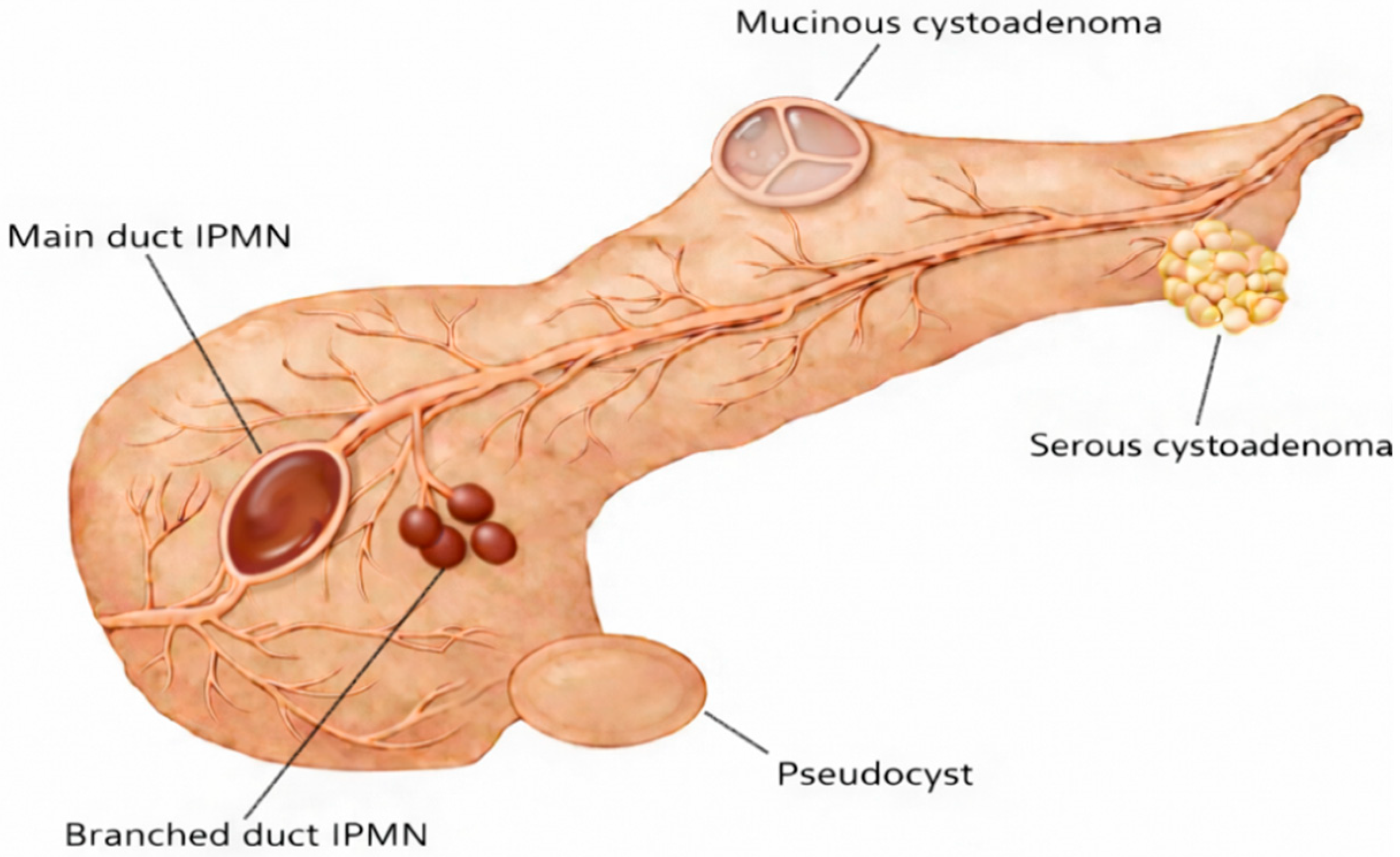
| Cyst Type | Typical Demographics | Clinical Presentation | Location | Imaging Features | Duct Communication/MPD | Cyst Fluid/Biology [5] | Multifocality | Malignant Potential [7] |
|---|---|---|---|---|---|---|---|---|
| Pseudocyst | ♂ predominance (<25% female) 4th–5th decade | History of acute or chronic pancreatitis | Variable | Unilocular or multilocular, thin wall, and homogeneous fluid | May communicate with MPD; MPD may be irregular or contain stones. | Non-mucinous, very high amylase, and low CEA | Rare | 0% |
| Serous cystic cystadenoma (SCA) | ♀ ~70% 6th–7th decade | Mostly asymptomatic | Any | Microcystic or mixed micro/macro-cystic, central stellate scar ± calcification, and honeycomb appearance | No communication; MPD normal or deviated | Serous fluid, very low CEA, VHL mutation, and wild-type KRAS/GNAS | ~50% | ~0% |
| Branch-duct IPMN (BD-IPMN) | Equal sex distribution 6th–7th decade | Often asymptomatic; may cause pancreatitis. | Head > body/tail | Cystic lesions with ductal communication, grape-like clusters, and multiplicity | Yes; MPD usually normal or mildly dilated | Mucinous fluid, low glucose, high CEA, KRAS and/or GNAS mutations | 20–40% | 1–38% |
| Main-duct IPMN (MD-IPMN) | Equal sex distribution 6th–7th decade | Often symptomatic | Diffuse | MPD dilation >5–10 mm, “fish-mouth” papilla, and intraductal filling defects | Yes; marked MPD dilation | Mucinous fluid, low glucose high CEA, KRAS, and/or GNAS mutations | Common | 33–85% |
| Mucinous cystic neoplasm (MCN) | ♀> 90% 4th–6th decade | Mostly asymptomatic | Body/tail (≈95%) | Unilocular or oligolocular, thick wall, septations, and peripheral “eggshell” calcifications | No; MPD normal or deviated | Mucinous fluid, low glucose, high CEA, KRAS mutation, and wild-type GNAS | No | 10–34% |
| Solid pseudopapillary neoplasm (SPN) | ♀ ~ 90% 2nd–3rd decade | Often incidental | Tail > head | Heterogeneous solid-cystic lesion, hemorrhagic components, calcifications | No | Variable; β-catenin mutation | No | 10–15% |
| Cystic neuroendocrine tumor (cNET) | Variable age/sex | Mostly asymptomatic; ~10% functional | Any | Thickened enhancing wall or solid component and hypervascular | No | Low CEA; may show NET markers. | Rare | 5–10% |
| Pseudocyst | SCA | MCN | IPMN | SPN | |
|---|---|---|---|---|---|
| Mucin |  | | |||
| CEA (a) |  | |  | | |
| Amylase (b) | | | | | |
| Glucose (c) | | | |
Disclaimer/Publisher’s Note: The statements, opinions and data contained in all publications are solely those of the individual author(s) and contributor(s) and not of MDPI and/or the editor(s). MDPI and/or the editor(s) disclaim responsibility for any injury to people or property resulting from any ideas, methods, instructions or products referred to in the content. |
© 2026 by the authors. Licensee MDPI, Basel, Switzerland. This article is an open access article distributed under the terms and conditions of the Creative Commons Attribution (CC BY) license.
Share and Cite
Gesualdo, M.; Savino, F.; Pedote, M.; Affatato, V.; Castellano, F.; Iannone, A.; Mezzapesa, M.; Contaldo, A.; Losurdo, G.; Principi, M. Pancreatic Cystic Lesions and Endoscopic Ultrasound Diagnostic Equipment: A Literature Review. J. Clin. Med. 2026, 15, 1765. https://doi.org/10.3390/jcm15051765
Gesualdo M, Savino F, Pedote M, Affatato V, Castellano F, Iannone A, Mezzapesa M, Contaldo A, Losurdo G, Principi M. Pancreatic Cystic Lesions and Endoscopic Ultrasound Diagnostic Equipment: A Literature Review. Journal of Clinical Medicine. 2026; 15(5):1765. https://doi.org/10.3390/jcm15051765
Chicago/Turabian StyleGesualdo, Marcantonio, Francesco Savino, Marco Pedote, Vito Affatato, Fabio Castellano, Andrea Iannone, Martino Mezzapesa, Antonella Contaldo, Giuseppe Losurdo, and Mariabeatrice Principi. 2026. "Pancreatic Cystic Lesions and Endoscopic Ultrasound Diagnostic Equipment: A Literature Review" Journal of Clinical Medicine 15, no. 5: 1765. https://doi.org/10.3390/jcm15051765
APA StyleGesualdo, M., Savino, F., Pedote, M., Affatato, V., Castellano, F., Iannone, A., Mezzapesa, M., Contaldo, A., Losurdo, G., & Principi, M. (2026). Pancreatic Cystic Lesions and Endoscopic Ultrasound Diagnostic Equipment: A Literature Review. Journal of Clinical Medicine, 15(5), 1765. https://doi.org/10.3390/jcm15051765