Targeting VEGF, PARP, and FRα Pathways in Ovarian Cancer: Clinical Advances with Bevacizumab, Rucaparib, and Mirvetuximab Soravtansine

Abstract
1. Introduction
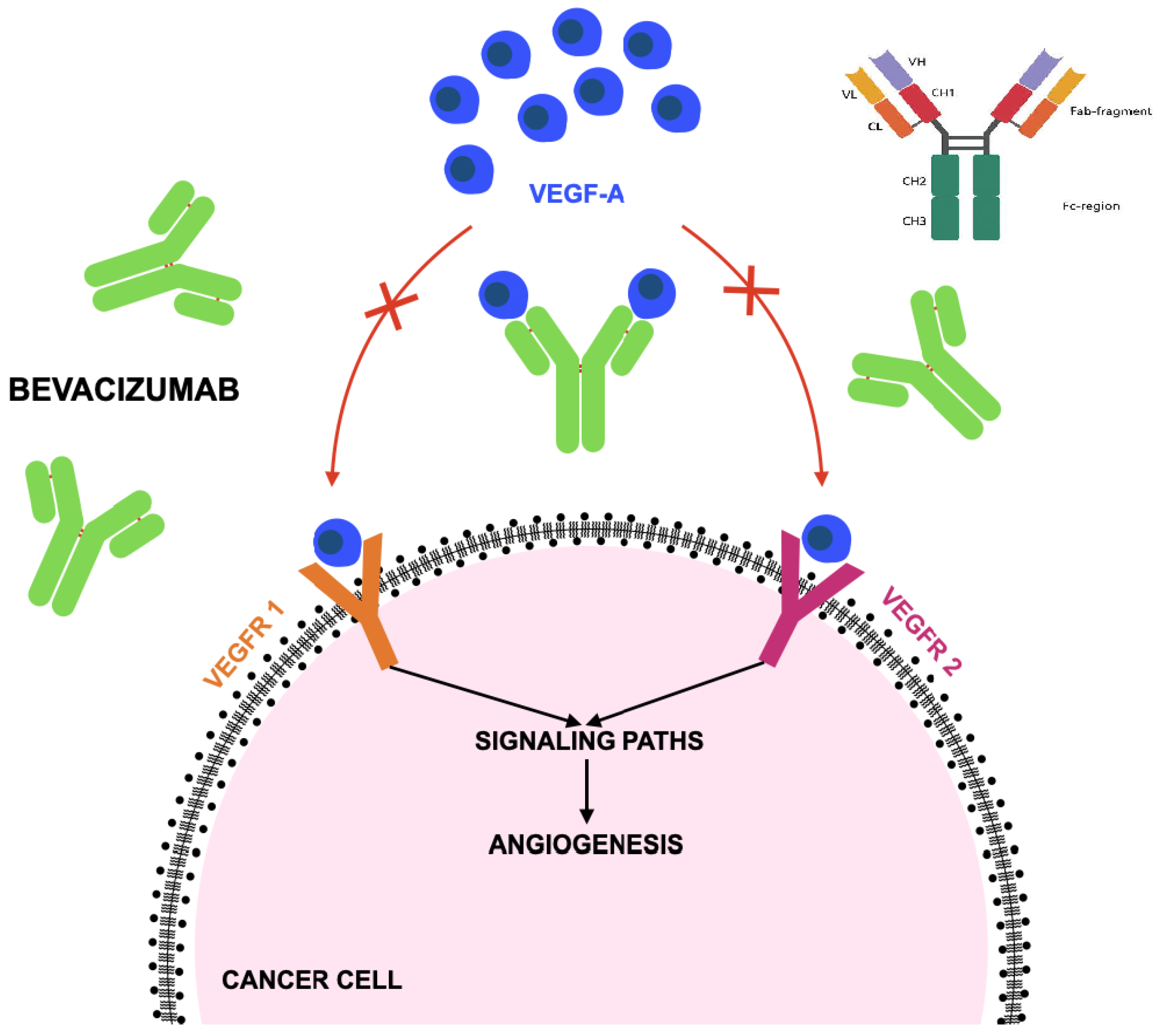
2. Bevacizumab—VEGF Inhibitor
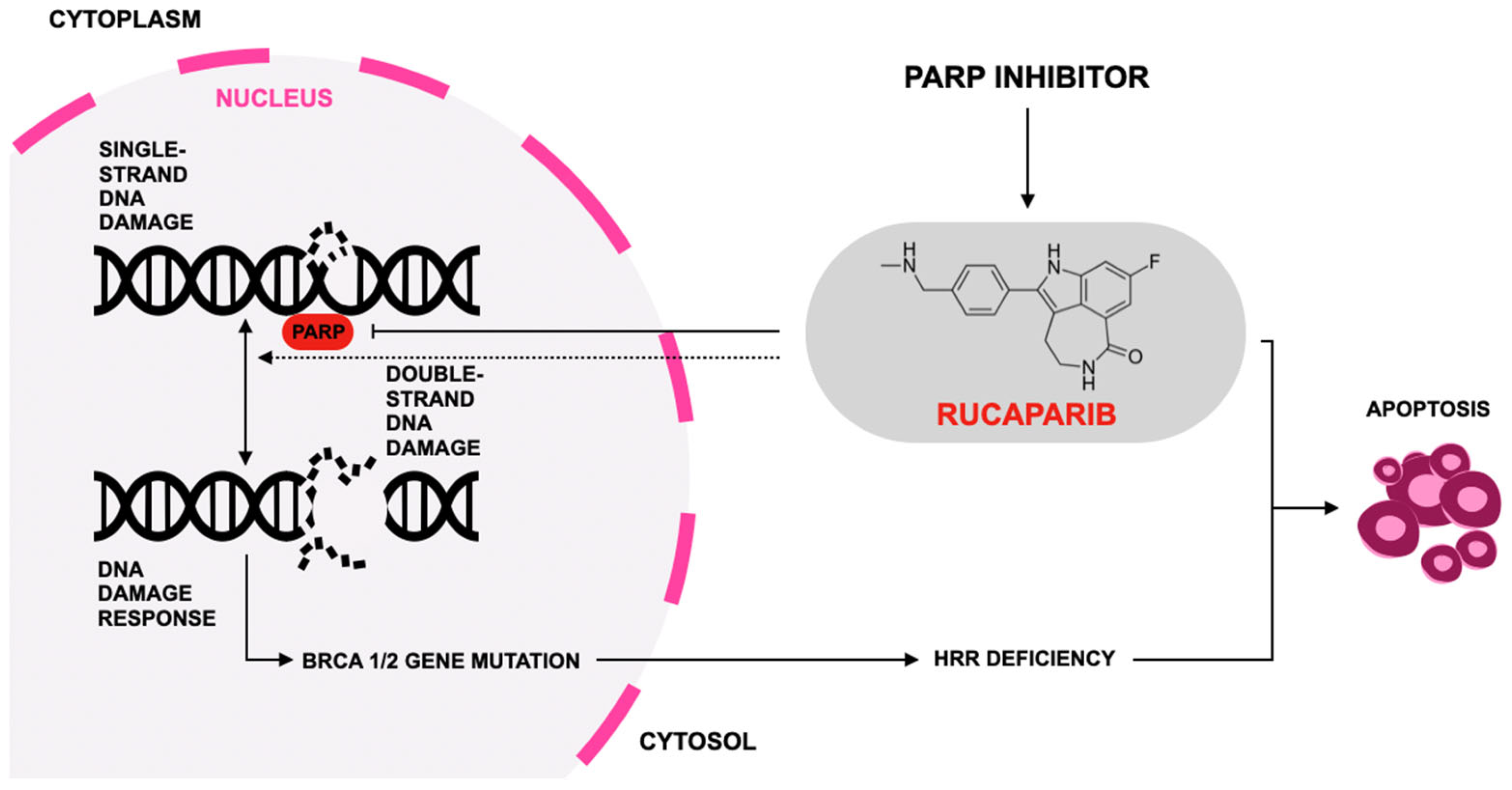
3. Rucaparib—PARP Inhibitor
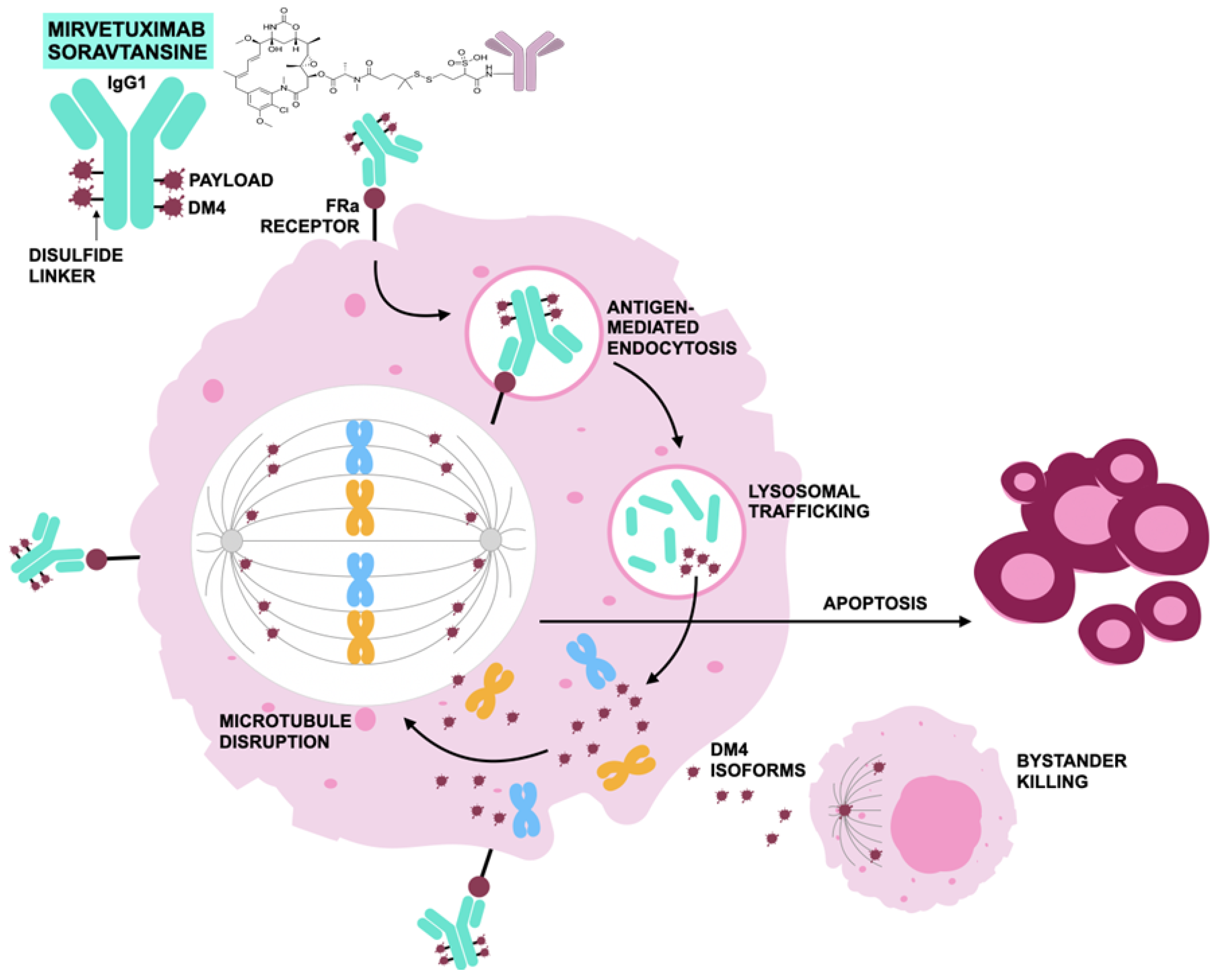
4. Mirvetuximab Soravtansine—FRα Pathway Inhibitor
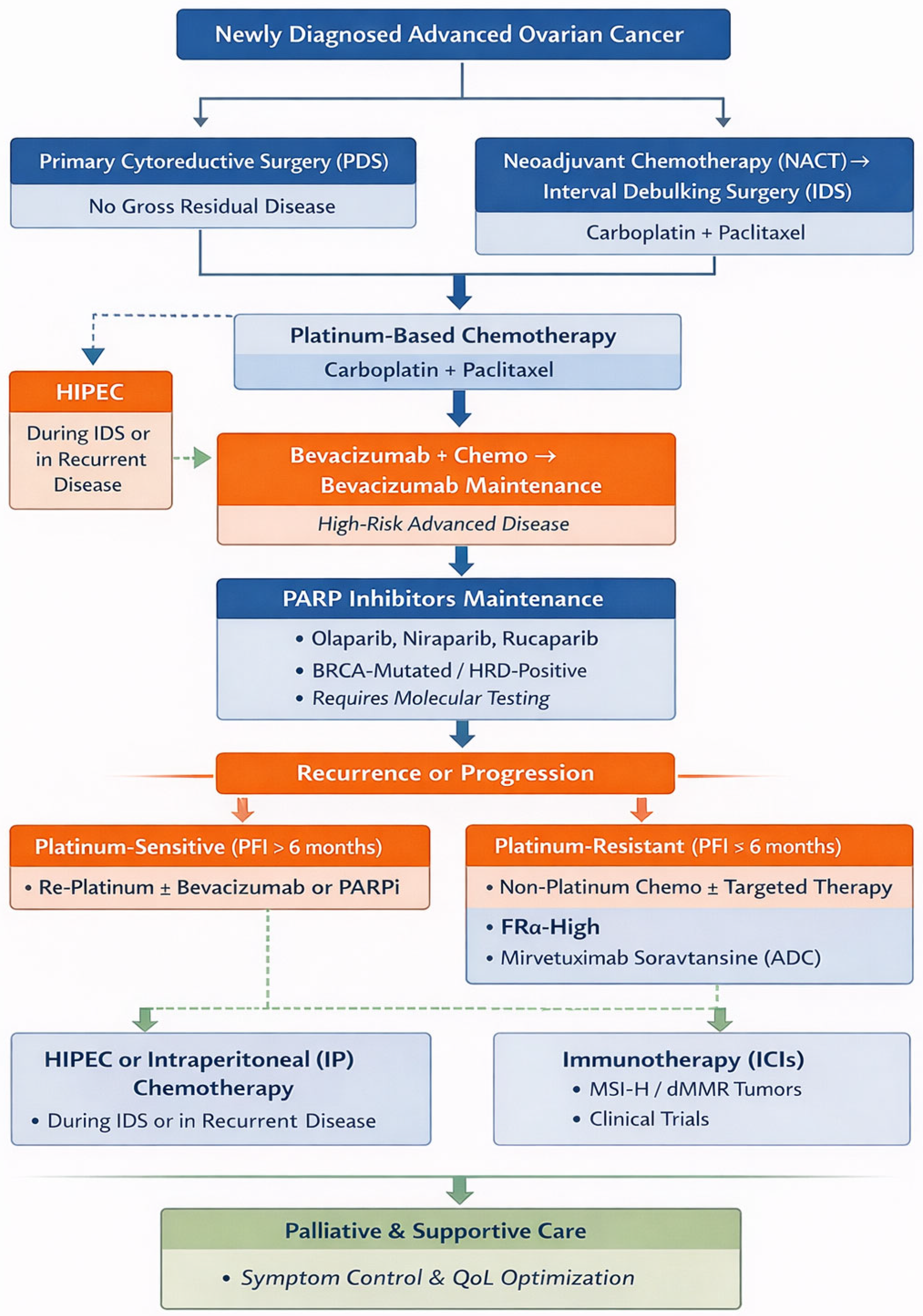
5. Prospective Developments and Implications for Clinical Practice
6. Conclusions
Author Contributions
Funding
Institutional Review Board Statement
Informed Consent Statement
Data Availability Statement
Conflicts of Interest
Abbreviations
| 2L | Second-Line |
| 5-HT3 | 5-Hydroxytryptamine Type 3 Receptor |
| ACE | Angiotensin-Converting Enzyme |
| ADC | Antibody–Drug Conjugate |
| AIBW | Adjusted Ideal Body Weight |
| ALT | Alanine Aminotransferase |
| AR | Androgen Receptor |
| ASCO | American Society of Clinical Oncology |
| AST | Aspartate Aminotransferase |
| ATE | Arterial Thromboembolic Event |
| ATHENA-MONO | ATHENA Trial Rucaparib Monotherapy Arm |
| ATHENA-COMBO | ATHENA Trial Rucaparib + Nivolumab Arm |
| AUC | Area Under the Concentration–Time Curve |
| AURELIA | Platinum-Resistant Ovarian Cancer Trial |
| BID | Twice Daily |
| BP | Blood Pressure |
| BRCA | Breast Cancer Susceptibility Gene (BRCA1/BRCA2) |
| CA-125 | Cancer Antigen 125 |
| Carbo | Carboplatin |
| CBC | Complete Blood Count |
| CCB | Calcium Channel Blocker |
| CNS | Central Nervous System |
| CP | Carboplatin/Paclitaxel |
| CR | Complete Response |
| CT | Computed Tomography |
| CTCAE | Common Terminology Criteria for Adverse Events |
| DM4 | N2′-Deacetyl-N2′-(3-Mercapto-1-Oxopropyl)-Maytansine |
| dMMR | Deficient Mismatch Repair |
| DoR/DOR | Duration of Response |
| DVT | Deep Vein Thrombosis |
| EC | Endometrial Cancer |
| ECOG | Eastern Cooperative Oncology Group |
| ENGOT | European Network of Gynaecological Oncological Trial Groups |
| EOC | Epithelial Ovarian Cancer |
| FDA | U.S. Food and Drug Administration |
| FIGO | International Federation of Gynecology and Obstetrics |
| FRα | Folate Receptor Alpha |
| Folate Receptor Alpha | Fallopian Tube |
| G2–M | G2 to M Phase Cell-Cycle Transition |
| GBM | Glioblastoma |
| G-CSF | Granulocyte–Colony Stimulating Factor |
| Gem | Gemcitabine |
| GI | Gastrointestinal |
| GLORIOSA | MIRV Maintenance Study |
| GOG | Gynecologic Oncology Group |
| GOG-0213 | Platinum-Sensitive Recurrent Ovarian Cancer Trial |
| GOG-0218 | Frontline Bevacizumab Trial in Ovarian Cancer |
| HCC | Hepatocellular Carcinoma |
| HE4 | Human Epididymis Protein 4 |
| HGSOC | High-Grade Serous Ovarian Cancer |
| HIPEC | Hyperthermic Intraperitoneal Chemotherapy |
| HR | Hazard Ratio |
| HRD | Homologous Recombination Deficiency |
| HRR | Homologous Recombination Repair |
| HTN | Hypertension |
| ICI | Immune Checkpoint Inhibitor |
| ICON(7) | International Collaboration on Ovarian Neoplasms (Trial 7) |
| IDS | Interval Debulking Surgery |
| IFL | Irinotecan, 5-Fluorouracil, Leucovorin |
| IFN-α | Interferon Alpha |
| IHC | Immunohistochemistry |
| IO | Immunotherapy/Immuno-Oncology |
| IP | Intraperitoneal (Chemotherapy) |
| ITT | Intention-to-Treat |
| IV | Intravenous |
| KPS | Karnofsky Performance Status |
| LFT | Liver Function Test |
| LGSC | Low-Grade Serous Carcinoma |
| LOH | Loss of Heterozygosity |
| MaNGO | Mario Negri Gynecologic Oncology Group |
| MAMOC/NOGGO Ov-42 | Rucaparib Maintenance After Bevacizumab First-Line Therapy Study |
| MAVOC 7V-FA | PARP Inhibitor Maintenance After Prior Bevacizumab Study |
| mCRPC | Metastatic Castration-Resistant Prostate Cancer |
| MDS/AML | Myelodysplastic Syndrome/Acute Myeloid Leukemia |
| MI | Myocardial Infarction |
| MIRASOL | MIRV vs Chemotherapy in FRα-High Platinum-Resistant Ovarian Cancer |
| MIRV | Mirvetuximab Soravtansine |
| MITO | Multicenter Italian Trials in Ovarian Cancer |
| MITO16B | Italian Multicenter Trial in Platinum-Sensitive Recurrence |
| Mo | Months |
| MSI-H | Microsatellite Instability–High |
| MTD | Maximum Tolerated Dose |
| NACT | Neoadjuvant Chemotherapy |
| NOGGO | North-Eastern German Society of Gynecological Oncology |
| NSCLC | Non–Small-Cell Lung Cancer |
| OC | Ovarian Cancer |
| OCEANS | Platinum-Sensitive Recurrent Ovarian Cancer Trial |
| ORR | Objective Response Rate |
| OS | Overall Survival |
| Pac | Paclitaxel |
| PAOLA-1 | Olaparib + Bevacizumab First-Line Maintenance Study |
| PARP(i) | Poly(ADP-Ribose) Polymerase (Inhibitor) |
| PD-1 | Programmed Death Protein 1 |
| PDS | Primary Debulking Surgery (Primary Cytoreductive Surgery) |
| PE | Pulmonary Embolism |
| PFI | Platinum-Free Interval |
| PFS | Progression-Free Survival |
| PK | Pharmacokinetics |
| PLD | Pegylated Liposomal Doxorubicin |
| PR | Partial Response |
| PRIMA | Niraparib First-Line Maintenance Study |
| PROC | Platinum-Resistant Ovarian Cancer |
| PS | Performance Status |
| QoL | Quality of Life |
| RCC | Renal Cell Carcinoma |
| RECIST | Response Evaluation Criteria in Solid Tumors |
| RT | Radiotherapy |
| SD | Stable Disease |
| SGO | Society of Gynecologic Oncology |
| SOLO-1 | Study of Olaparib in First-Line Maintenance |
| SORAYA | MIRV in FRα-High Platinum-Resistant Ovarian Cancer |
| TEAE | Treatment-Emergent Adverse Event |
| TMZ | Temozolomide |
| VEGF | Vascular Endothelial Growth Factor |
References
- Sung, H.; Ferlay, J.; Siegel, R.L.; Laversanne, M.; Soerjomataram, I.; Jemal, A.; Bray, F. Global Cancer Statistics 2020: GLOBOCAN Estimates of Incidence and Mortality Worldwide for 36 Cancers in 185 Countries. CA Cancer J. Clin. 2021, 71, 209–249. [Google Scholar] [CrossRef]
- Torre, L.A.; Trabert, B.; DeSantis, C.E.; Miller, K.D.; Samimi, G.; Runowicz, C.D.; Gaudet, M.M.; Jemal, A.; Siegel, R.L. Ovarian Cancer Statistics, 2018. CA Cancer J. Clin. 2018, 68, 284–296. [Google Scholar] [CrossRef] [PubMed]
- Morand, S.; Devanaboyina, M.; Staats, H.; Stanbery, L.; Nemunaitis, J. Ovarian cancer immunotherapy and personalized medicine. Int. J. Mol. Sci. 2021, 22, 6532. [Google Scholar] [CrossRef] [PubMed]
- De Benedictis, D.; Bibi, A.; Palese, L.L.; Cormio, A.; Musicco, C.; Loizzi, V.; Cormio, G.; Abdelhameed, A.; De Rasmo, D.; Signorile, A. Cellular cAMP content and mitochondrial profile define different subtypes of ovarian cancer cells. Int. J. Mol. Sci. 2025, 26, 10474. [Google Scholar] [CrossRef] [PubMed]
- Sambasivan, S. Epithelial Ovarian Cancer: Review Article. Cancer Treat. Res. Commun. 2022, 33, 100629. [Google Scholar] [CrossRef]
- Caruso, G.; Weroha, S.J.; Cliby, W. Ovarian Cancer: A Review. JAMA 2025, 334, 1278–1291. [Google Scholar] [CrossRef]
- Kuroki, L.; Guntupalli, S.R. Treatment of epithelial ovarian cancer. BMJ 2020, 371, m3773. [Google Scholar] [CrossRef]
- Colombo, N.; Sessa, C.; du Bois, A.; Ledermann, J.; McCluggage, W.G.; McNeish, I.; Morice, P.; Pignata, S.; Ray-Coquard, I.; Vergote, I.; et al. ESMO-ESGO Ovarian Cancer Consensus Conference Working Group. ESMO-ESGO Consensus Conference Recommendations on Ovarian Cancer: Pathology and Molecular Biology, Early and Advanced Stages, Borderline Tumours and Recurrent Disease. Ann. Oncol. 2019, 30, 672–705. [Google Scholar] [CrossRef]
- Lheureux, S.; Braunstein, M.; Oza, A.M. Epithelial ovarian cancer: Evolution of management in the era of precision medicine. CA Cancer J. Clin. 2019, 69, 280–304. [Google Scholar] [CrossRef]
- Yang, N.; Yun, W.J.; Cui, Z.G.; Zheng, H.C. The oncogenic roles of GPR176 in ovarian cancer: A molecular target for aggressiveness and gene therapy. J. Obstet. Gynaecol. 2024, 44, 2347430. [Google Scholar] [CrossRef]
- Schmitt, J.; Matei, D. Targeting Angiogenesis in Ovarian Cancer. Cancer Treat. Rev. 2012, 38, 272–283. [Google Scholar] [CrossRef]
- Bhatia, T.; Doshi, G.; Godad, A. PARP Inhibitors in Ovarian Cancer: Mechanisms, Resistance, and the Promise of Combination Therapy. Pathol. Res. Pract. 2024, 263, 155617. [Google Scholar] [CrossRef] [PubMed]
- Ponti, G.; De Angelis, C.; Ponti, R.; Pongetti, L.; Losi, L.; Sticchi, A.; Tomasi, A.; Ozben, T. Hereditary breast and ovarian cancer: From genes to molecular targeted therapies. Crit. Rev. Clin. Lab. Sci. 2023, 60, 640–650. [Google Scholar] [CrossRef] [PubMed]
- Ke, L.; Zhang, Y. Therapeutic targeting of post-translational modifications in ovarian cancer: Mechanisms and clinical applications. J. Ovarian Res. 2025, 18, 251. [Google Scholar] [CrossRef] [PubMed]
- Ghalehbandi, S.; Yuzugulen, J.; Pranjol, M.Z.I.; Pourgholami, M.H. The Role of VEGF in Cancer-Induced Angiogenesis and Research Progress of Drugs Targeting VEGF. Eur. J. Pharmacol. 2023, 949, 175586. [Google Scholar] [CrossRef]
- Syed, Y.Y. Rucaparib: First Global Approval. Drugs 2017, 77, 585–592. [Google Scholar] [CrossRef]
- Zannoni, G.F.; Santoro, A.; d’Amati, A.; D’Alessandris, N.; Scaglione, G.; Padial Urtueta, B.; Valente, M.; Narducci, N.; Addante, F.; Spadola, S.; et al. Folate Receptor Alpha in Advanced Epithelial Ovarian Cancer: Diagnostic Role and Therapeutic Implications of a Clinically Validated Biomarker. Int. J. Mol. Sci. 2025, 26, 5222. [Google Scholar] [CrossRef]
- Burger, R.A.; Brady, M.F.; Bookman, M.A.; Fleming, G.F.; Monk, B.J.; Huang, H.; Mannel, R.S.; Homesley, H.D.; Fowler, J.; Greer, B.E.; et al. Incorporation of bevacizumab in the primary treatment of ovarian cancer. N. Engl. J. Med. 2011, 365, 2473–2483. [Google Scholar] [CrossRef]
- Perren, T.J.; Swart, A.M.; Pfisterer, J.; Ledermann, J.A.; Pujade-Lauraine, E.; Kristensen, G.; Carey, M.S.; Beale, P.; Cervantes, A.; Kurzeder, C.; et al. A phase 3 trial of bevacizumab in ovarian cancer. N. Engl. J. Med. 2011, 365, 2484–2496. [Google Scholar] [CrossRef]
- Paik, J. Olaparib: A Review as First-Line Maintenance Therapy in Advanced Ovarian Cancer. Target. Oncol. 2021, 16, 847–856. [Google Scholar] [CrossRef]
- Mirza, M.R.; Monk, B.J.; Herrstedt, J.; Oza, A.M.; Mahner, S.; Redondo, A.; Fabbro, M.; Ledermann, J.A.; Lorusso, D.; Vergote, I.; et al. Niraparib Maintenance Therapy in Platinum-Sensitive, Recurrent Ovarian Cancer. N. Engl. J. Med. 2016, 375, 2154–2164. [Google Scholar] [CrossRef]
- Kawczak, P.; Baczek, T. Emerging Therapeutic Strategies in Prostate Cancer: Targeted Approaches Using PARP Inhibition, PSMA-Directed Therapy, and Androgen Receptor Blockade with Olaparib, Lutetium (177Lu) Vipivotide Tetraxetan, and Abiraterone. J. Clin. Med. 2026, 15, 685. [Google Scholar] [CrossRef] [PubMed]
- Bryant, H.E.; Schultz, N.; Thomas, H.D.; Parker, K.M.; Flower, D.; Lopez, E.; Kyle, S.; Meuth, M.; Curtin, N.J.; Helleday, T. Specific killing of BRCA2-deficient tumours with inhibitors of poly(ADP-ribose) polymerase. Nature 2005, 434, 913–917. [Google Scholar] [CrossRef] [PubMed]
- Lord, C.J.; Ashworth, A. PARP inhibitors: Synthetic lethality in the clinic. Science 2017, 355, 1152–1158. [Google Scholar] [CrossRef] [PubMed]
- Murai, J.; Huang, S.Y.; Das, B.B.; Renaud, A.; Zhang, Y.; Doroshow, J.H.; Ji, J.; Takeda, S.; Pommier, Y. Trapping of PARP1 and PARP2 by clinical PARP inhibitors. Cancer Res. 2012, 72, 5588–5599. [Google Scholar] [CrossRef]
- Moore, K.; Colombo, N.; Scambia, G.; Kim, B.G.; Oaknin, A.; Friedlander, M.; Lisyanskaya, A.; Floquet, A.; Leary, A.; Sonke, G.S.; et al. Maintenance olaparib in patients with newly diagnosed advanced ovarian cancer. N. Engl. J. Med. 2018, 379, 2495–2505. [Google Scholar] [CrossRef]
- Ray-Coquard, I.; Leary, A.; Pignata, S.; Cropet, C.; González-Martín, A.; Marth, C.; Nagao, S.; Vergote, I.; Colombo, N.; Mäenpää, J.; et al. Olaparib plus bevacizumab first-line maintenance in ovarian cancer: Final overall survival results from the PAOLA-1/ENGOT-ov25 trial. Ann. Oncol. 2023, 34, 681–692. [Google Scholar] [CrossRef]
- González-Martín, A.; Pothuri, B.; Vergote, I.; DePont Christensen, R.; Graybill, W.; Mirza, M.R.; McCormick, C.; Lorusso, D.; Hoskins, P.; Freyer, G.; et al. Niraparib in patients with newly diagnosed advanced ovarian cancer. N. Engl. J. Med. 2019, 381, 2391–2402. [Google Scholar] [CrossRef]
- Swisher, E.M.; Lin, K.K.; Oza, A.M.; Scott, C.L.; Giordano, H.; Sun, J.; Konecny, G.E.; Coleman, R.L.; Tinker, A.V.; O’Malley, D.M.; et al. Rucaparib in relapsed, platinum-sensitive high-grade ovarian carcinoma (ARIEL2 Part 1): An international, multicentre, open-label, phase 2 trial. Lancet Oncol. 2017, 18, 75–87. [Google Scholar] [CrossRef]
- Ledermann, J.A.; Oza, A.M.; Lorusso, D.; Aghajanian, C.; Oaknin, A.; Dean, A.; Colombo, N.; Weberpals, J.I.; Clamp, A.R.; Scambia, G.; et al. Rucaparib for maintenance treatment of platinum-sensitive, recurrent ovarian carcinoma: Final results of the phase 3, randomized, placebo-controlled ARIEL3 trial. Eur. J. Cancer 2025, 225, 115584. [Google Scholar] [CrossRef]
- Coleman, R.L.; Oza, A.M.; Lorusso, D.; Aghajanian, C.; Oaknin, A.; Dean, A.; Colombo, N.; Weberpals, J.I.; Clamp, A.; Scambia, G.; et al. Rucaparib maintenance treatment for recurrent ovarian carcinoma after response to platinum therapy (ARIEL3): A randomised, double-blind, placebo-controlled, phase 3 trial. Lancet 2017, 390, 1949–1961. [Google Scholar] [CrossRef] [PubMed]
- Lord, C.J.; Ashworth, A. Mechanisms of resistance to therapies targeting BRCA-mutant cancers. Nat. Med. 2013, 19, 1381–1388. [Google Scholar] [CrossRef] [PubMed]
- Matulonis, U.A.; Lorusso, D.; Oaknin, A.; Pignata, S.; Dean, A.; Denys, H.; Colombo, N.; Van Gorp, T.; Konner, J.A.; Marin, M.R.; et al. Efficacy and Safety of Mirvetuximab Soravtansine in Patients With Platinum-Resistant Ovarian Cancer With High Folate Receptor Alpha Expression: Results From the SORAYA Study. J. Clin. Oncol. 2023, 41, 2436–2445. [Google Scholar] [CrossRef] [PubMed]
- Van Gorp, T.; Moore, K.N.; Konecny, G.E.; Leary, A.; García-García, Y.; Banerjee, S.; Lorusso, D.; Lee, J.Y.; Moroney, J.W.; Caruso, G.; et al. Patient-reported outcomes from the MIRASOL trial evaluating mirvetuximab soravtansine versus chemotherapy in patients with folate receptor α-positive, platinum-resistant ovarian cancer: A randomised, open-label, phase 3 trial. Lancet Oncol. 2025, 26, 503–515. [Google Scholar] [CrossRef]
- Wang, G.; Yang, H.; Wang, Y.; Qin, J. Ovarian cancer targeted therapy: Current landscape and future challenges. Front. Oncol. 2025, 15, 1535235. [Google Scholar] [CrossRef]
- Ettorre, V.M.; AlAshqar, A.; Sethi, N.; Santin, A.D. Personalized Treatment in Ovarian Cancer: A Review of Disease Monitoring, Biomarker Expression, and Targeted Treatments for Advanced, Recurrent Ovarian Cancers. Cancers 2025, 17, 1822. [Google Scholar] [CrossRef]
- Song, M.; Cui, M.; Liu, K. Therapeutic strategies to overcome cisplatin resistance in ovarian cancer. Eur. J. Med. Chem. 2022, 232, 114205. [Google Scholar] [CrossRef]
- Alvarez Secord, A.; O’Malley, D.M.; Sood, A.K.; Westin, S.N.; Liu, J.F. Rationale for combination PARP inhibitor and antiangiogenic treatment in advanced epithelial ovarian cancer: A review. Gynecol. Oncol. 2021, 162, 482–495. [Google Scholar] [CrossRef]
- Ferrara, N.; Hillan, K.J.; Gerber, H.P.; Novotny, W. Discovery and development of bevacizumab, an anti-VEGF antibody for treating cancer. Nat. Rev. Drug Discov. 2004, 3, 391–400. [Google Scholar] [CrossRef]
- Kim, K.J.; Li, B.; Winer, J.; Armanini, M.; Gillett, N.; Phillips, H.S.; Ferrara, N. Inhibition of vascular endothelial growth factor-induced angiogenesis suppresses tumour growth in vivo. Nature 1993, 362, 841–844. [Google Scholar] [CrossRef]
- Ferrara, N. VEGF and the quest for tumour angiogenesis factors. Nat. Rev. Cancer 2002, 2, 795–803. [Google Scholar] [CrossRef] [PubMed]
- Bayraktar, E.; Rodriguez-Aguayo, C.; Stur, E.; Kumar, S.; Mangala, L.S.; Jennings, N.B.; Bayram, N.N.; Corvigno, S.; Asare, A.; Ivan, C.; et al. Epigenetic modulation of BARD1 to enhance anti-VEGF therapy. Cell Rep. Med. 2025, 6, 102329. [Google Scholar] [CrossRef] [PubMed]
- Jain, R.K. Normalization of tumor vasculature: An emerging concept in antiangiogenic therapy. Science 2005, 307, 58–62. [Google Scholar] [CrossRef] [PubMed]
- Bergers, G.; Hanahan, D. Modes of resistance to anti-angiogenic therapy. Nat. Rev. Cancer 2008, 8, 592–603. [Google Scholar] [CrossRef]
- Chai, Y.; Liu, J.L.; Zhang, S.; Li, N.; Xu, D.Q.; Liu, W.J.; Fu, R.J.; Tang, Y.P. The effective combination therapies with irinotecan for colorectal cancer. Front. Pharmacol. 2024, 15, 1356708. [Google Scholar] [CrossRef]
- Folkman, J. Tumor angiogenesis: Therapeutic implications. N. Engl. J. Med. 1971, 285, 1182–1186. [Google Scholar] [CrossRef]
- Midgley, R.; Kerr, D. Bevacizumab—Current status and future directions. Ann. Oncol. 2005, 16, 999–1004. [Google Scholar] [CrossRef]
- Hurwitz, H.; Fehrenbacher, L.; Novotny, W.; Cartwright, T.; Hainsworth, J.; Heim, W.; Ber-lin, J.; Baron, A.; Griffing, S.; Holmgren, E.; et al. Bevacizumab plus irinotecan, fluorouracil, and leucovorin for metastatic colorectal cancer. N. Engl. J. Med. 2004, 350, 2335–2342. [Google Scholar] [CrossRef]
- Aghajanian, C.; Blank, S.V.; Goff, B.A.; Judson, P.L.; Teneriello, M.G.; Husain, A.; Sovak, M.A.; Yi, J.; Nycum, L.R. OCEANS: A Randomized, Double-Blind, Placebo-Controlled Phase III Trial of Chemotherapy with or without Bevacizumab in Platinum-Sensitive Recurrent Epithelial Ovarian Cancer. J. Clin. Oncol. 2012, 30, 2039–2045. [Google Scholar] [CrossRef]
- Pujade-Lauraine, E.; Hilpert, F.; Weber, B.; Reuss, A.; Poveda, A.; Kristensen, G.; Sorio, R.; Vergote, I.; Witteveen, P.; Bamias, A.; et al. Bevacizumab Combined with Chemotherapy for Platinum-Resistant Recurrent Ovarian Cancer: The AURELIA Open-Label Randomized Phase III Trial. J. Clin. Oncol. 2014, 32, 1302–1308. [Google Scholar] [CrossRef]
- Coleman, R.L.; Brady, M.F.; Herzog, T.J.; Sabbatini, P.; Armstrong, D.K.; Walker, J.L.; Kim, B.G.; Fujiwara, K.; Tewari, K.S.; O’Malley, D.M.; et al. Bevacizumab and Paclitaxel–Carboplatin Chemotherapy and Secondary Cytoreduction in Recurrent, Platinum-Sensitive Ovarian Cancer (GOG-0213): A Multicentre, Open-Label, Randomised, Phase 3 Trial. Lancet Oncol. 2017, 18, 779–791. [Google Scholar] [CrossRef] [PubMed]
- Pignata, S.; Lorusso, D.; Joly, F.; Gallo, C.; Colombo, N.; Sessa, C.; Bamias, A.; Salutari, V.; Selle, F.; Frezzini, S.; et al. Carboplatin-Based Doublet Plus Bevacizumab beyond Progression versus Carboplatin-Based Doublet Alone in Patients with Platinum-Sensitive Ovarian Cancer: A Randomised, Phase 3 Trial. Lancet Oncol. 2021, 22, 267–276. [Google Scholar] [CrossRef] [PubMed]
- Ranpura, V.; Pulipati, B.; Chu, D.; Zhu, X.; Wu, S. Increased risk of high-grade hypertension with bevacizumab in cancer patients: A meta-analysis. Am. J. Hypertens. 2010, 23, 460–468. [Google Scholar] [CrossRef] [PubMed]
- Schutz, F.A.B.; Je, Y.; Azzi, G.R.; Nguyen, P.L.; Choueiri, T.K. Bevacizumab increases the risk of arterial ischemia: A large study in cancer patients with a focus on different sub-group outcomes. Ann. Oncol. 2011, 22, 1404–1412. [Google Scholar] [CrossRef]
- Hayman, S.R.; Leung, N.; Grande, J.P.; Garovic, V.D. VEGF inhibition, hypertension, and renal toxicity. Curr. Oncol. Rep. 2012, 14, 285–294. [Google Scholar] [CrossRef]
- Ranpura, V.; Hapani, S.; Wu, S. Treatment-related mortality with bevacizumab in cancer patients: A meta-analysis. JAMA 2011, 305, 487–494. [Google Scholar] [CrossRef]
- Hapani, S.; Chu, D.; Wu, S. Risk of gastrointestinal perforation in patients with cancer treated with bevacizumab: A meta-analysis. Lancet Oncol. 2009, 10, 559–568. [Google Scholar] [CrossRef]
- Tebbutt, N.C.; Murphy, F.; Zannino, D.; Wilson, K.; Cummins, M.M.; Abdi, E.; Strickland, A.H.; Lowenthal, R.M.; Marx, G.; Karapetis, C.; et al. Risk of arterial thromboembolic events in patients with advanced colorectal cancer receiving bevacizumab. Ann. Oncol. 2011, 22, 1834–1838. [Google Scholar] [CrossRef]
- Van Cutsem, E.; Tabernero, J.; Lakomy, R.; Prenen, H.; Prausová, J.; Macarulla, T.; Ruff, P.; van Hazel, G.A.; Moiseyenko, V.; Ferry, D.; et al. Addition of aflibercept to fluorouracil, leucovorin, and irinotecan improves survival in a phase III randomized trial in patients with metastatic colorectal cancer previously treated with an oxaliplatin-based regimen. J. Clin. Oncol. 2012, 30, 3499–3506. [Google Scholar] [CrossRef]
- Nalluri, S.R.; Chu, D.; Keresztes, R.; Zhu, X.; Wu, S. Risk of venous thromboembolism with the angiogenesis inhibitor bevacizumab in cancer patients: A meta-analysis. JAMA 2008, 300, 2277–2285. [Google Scholar] [CrossRef]
- Casanovas, O.; Hicklin, D.J.; Bergers, G.; Hanahan, D. Drug resistance by evasion of antiangiogenic targeting of VEGF signaling in late-stage pancreatic islet tumors. Cancer Cell 2005, 8, 299–309. [Google Scholar] [CrossRef]
- Rankin, E.B.; Giaccia, A.J. Hypoxic control of metastasis. Science 2016, 352, 175–180. [Google Scholar] [CrossRef] [PubMed]
- Haibe, Y.; Kreidieh, M.; El Hajj, H.; Khalifeh, I.; Mukherji, D.; Temraz, S.; Shamseddine, A. Resistance Mechanisms to Anti-angiogenic Therapies in Cancer. Front. Oncol. 2020, 10, 221. [Google Scholar] [CrossRef] [PubMed]
- Bhatt, A.; Mehta, S.; Glehen, O. Do all patients that undergo a ‘complete’ secondary cytoreductive surgery for platinum-sensitive recurrent ovarian cancer benefit from it? Pleura Peritoneum 2024, 9, 93–105. [Google Scholar] [CrossRef] [PubMed]
- Kurtz, J.E.; Pujade-Lauraine, E.; Oaknin, A.; Belin, L.; Leitner, K.; Cibula, D.; Denys, H.; Rosengarten, O.; Rodrigues, M.; de Gregorio, N.; et al. Atezolizumab combined with bevacizumab and platinum-based therapy for platinum-sensitive ovarian cancer: Placebo-controlled randomized phase III ATALANTE/ENGOT-ov29 trial. J. Clin. Oncol. 2023, 41, 4768–4778. [Google Scholar] [CrossRef]
- Bindra, R.S.; Gibson, S.L.; Meng, A.; Westermark, U.; Jasin, M.; Pierce, A.J.; Bristow, R.G.; Classon, M.K.; Glazer, P.M. Hypoxia-induced down-regulation of BRCA1 expression by E2Fs. Cancer Res. 2005, 65, 11597–11604. [Google Scholar] [CrossRef]
- Bindra, R.S.; Schaffer, P.J.; Meng, A.; Woo, J.; Måseide, K.; Roth, M.E.; Lizardi, P.; Hedley, D.W.; Bristow, R.G.; Glazer, P.M. Down-regulation of Rad51 and decreased homologous recombination in hypoxic cancer cells. Mol. Cell. Biol. 2004, 24, 8504–8518. [Google Scholar] [CrossRef]
- Liu, J.F.; Barry, W.T.; Birrer, M.; Lee, J.M.; Buckanovich, R.J.; Fleming, G.F.; Rimel, B.; Buss, M.K.; Nattam, S.; Hurteau, J.; et al. Combination cediranib and olaparib versus olaparib alone for women with recurrent platinum-sensitive ovarian cancer: A randomised phase 2 study. Lancet Oncol. 2014, 15, 1207–1214. [Google Scholar] [CrossRef]
- Mirza, M.R.; Åvall Lundqvist, E.; Birrer, M.J.; dePont Christensen, R.; Nyvang, G.B.; Malander, S.; Anttila, M.; Werner, T.L.; Lund, B.; Lindahl, G.; et al. Niraparib plus bevacizumab versus niraparib alone for platinum-sensitive recurrent ovarian cancer (NSGO-AVANOVA2/ENGOT-ov24): A randomised, phase 2, superiority trial. Lancet Oncol. 2019, 20, 1409–1419. [Google Scholar] [CrossRef]
- Gilbert, L.; Oaknin, A.; Matulonis, U.A.; Mantia-Smaldone, G.M.; Lim, P.C.; Castro, C.M.; Provencher, D.; Memarzadeh, S.; Method, M.; Wang, J.; et al. Safety and efficacy of mirvetuximab soravtansine, a folate receptor alpha (FRalpha)-targeting antibody–drug conjugate (ADC), in combination with bevacizumab in patients with platinum-resistant ovarian cancer. Gynecol. Oncol. 2023, 170, 241–247. [Google Scholar] [CrossRef]
- Gabrilovich, D.I.; Chen, H.L.; Girgis, K.R.; Cunningham, H.T.; Meny, G.M.; Nadaf, S.; Kavanaugh, D.; Carbone, D.P. Production of vascular endothelial growth factor by human tumors inhibits the functional maturation of dendritic cells. Nat. Med. 1996, 2, 1096–1103. [Google Scholar] [CrossRef]
- Voron, T.; Colussi, O.; Marcheteau, E.; Pernot, S.; Nizard, M.; Pointet, A.L.; Latreche, S.; Bergaya, S.; Benhamouda, N.; Tanchot, C.; et al. VEGF-A modulates expression of inhibitory checkpoints on CD8+ T cells in tumors. J. Exp. Med. 2015, 212, 139–148. [Google Scholar] [CrossRef]
- Huang, Y.; Goel, S.; Duda, D.G.; Fukumura, D.; Jain, R.K. Vascular normalization as an emerging strategy to enhance cancer immunotherapy. Cancer Res. 2013, 73, 2943–2948. [Google Scholar] [CrossRef] [PubMed]
- Hodi, F.S.; Lawrence, D.; Lezcano, C.; Wu, X.; Zhou, J.; Sasada, T.; Zeng, W.; Giobbie-Hurder, A.; Atkins, M.B.; Ibrahim, N.; et al. Bevacizumab plus ipilimumab in patients with metastatic melanoma. Cancer Immunol. Res. 2014, 2, 632–642. [Google Scholar] [CrossRef] [PubMed]
- Terme, M.; Pernot, S.; Marcheteau, E.; Sandoval, F.; Benhamouda, N.; Colussi, O.; Dubreuil, O.; Carpentier, A.F.; Tartour, E.; Taieb, J. VEGFA-VEGFR pathway blockade inhibits tumor-induced regulatory T-cell proliferation in colorectal cancer. Cancer Res. 2013, 73, 539–549. [Google Scholar] [CrossRef] [PubMed]
- Jayson, G.C.; Kerbel, R.; Ellis, L.M.; Harris, A.L. Antiangiogenic therapy in oncology: Cur-rent status and future directions. Lancet 2016, 388, 518–529. [Google Scholar] [CrossRef]
- Miao, D.; Matulonis, U.A.; Porter, R.L. Ovarian cancer therapy. Cold Spring Harb. Perspect. Med. 2025, 16, a038232. [Google Scholar] [CrossRef]
- Richardson, D.L.; Eskander, R.N.; O’Malley, D.M. Advances in ovarian cancer care and unmet treatment needs for patients with platinum resistance: A narrative review. JAMA Oncol. 2023, 9, 851–859. [Google Scholar] [CrossRef]
- Yay, F.; Yıldırım, H.Ç. HERC2 as a potential biomarker for prognosis and response to bevacizumab in ovarian cancer: A bioinformatics approach. Reprod. Sci. 2025, 32, 3567–3586. [Google Scholar] [CrossRef]
- Leman, R.; Cherifi, F.; Leheurteur, M.; Theret, P.; Pasquesoone, C.; Saint-Ghislain, M.; Bresson, L.; Denoyelle, C.; Vigneron, N.; Poulain, L.; et al. Homologous recombination deficiency (HRD) tests for ovarian cancer: A multicenter French phase II study (HERO). BMC Cancer 2025, 25, 1075. [Google Scholar] [CrossRef]
- Eremina, V.; Jefferson, J.A.; Kowalewska, J.; Hochster, H.; Haas, M.; Weisstuch, J.; Richardson, C.; Kopp, J.B.; Kabir, M.G.; Backx, P.H.; et al. VEGF Inhibition and Renal Thrombotic Microangiopathy. N. Engl. J. Med. 2008, 358, 1129–1136. [Google Scholar] [CrossRef]
- Hapani, S.; Sher, A.; Chu, D.; Wu, S. Increased Risk of Serious Hemorrhage with Bevacizumab in Cancer Patients: A Meta-Analysis. Oncology 2010, 79, 27–38. [Google Scholar] [CrossRef]
- Gordon, M.S.; Cunningham, D. Managing Patients Treated with Bevacizumab Combination Therapy. Oncology 2005, 69, 25–33. [Google Scholar] [CrossRef] [PubMed]
- Scappaticci, F.A.; Fehrenbacher, L.; Cartwright, T.; Hainsworth, J.D.; Heim, W.; Berlin, J.; Kabbinavar, F.; Novotny, W.; Sarkar, S.; Hurwitz, H.; et al. Surgical Wound Healing Complications in Metastatic Colorectal Cancer Patients Treated with Bevacizumab. J. Surg. Oncol. 2005, 91, 173–180. [Google Scholar] [CrossRef] [PubMed]
- Scappaticci, F.A.; Skillings, J.R.; Holden, S.N.; Gerber, H.P.; Miller, K.; Kabbinavar, F.; Bergsland, E.; Ngai, J.; Holmgren, E.; Wang, J.; et al. Arterial Thromboembolic Events in Patients with Metastatic Carcinoma Treated with Chemotherapy and Bevacizumab. J. Natl. Cancer Inst. 2007, 99, 1232–1239. [Google Scholar] [CrossRef] [PubMed]
- Kristeleit, R.; Shapiro, G.I.; Burris, H.A.; Oza, A.M.; LoRusso, P.; Patel, M.R.; Domchek, S.M.; Balmaña, J.; Drew, Y.; Chen, L.M.; et al. A Phase I–II Study of the Oral PARP Inhibitor Rucaparib in Patients with Germline BRCA1/2-Mutated Ovarian Carcinoma or Other Solid Tumors. Clin. Cancer Res. 2017, 23, 4095–4106. [Google Scholar] [CrossRef]
- Dockery, L.E.; Gunderson, C.C.; Moore, K.N. Rucaparib: The past, present, and future. Onco Targets Ther. 2017, 10, 3029–3037. [Google Scholar] [CrossRef]
- Della Corte, L.; Foreste, V.; Di Filippo, C.; Giampaolino, P.; Bifulco, G. PARP as a target for epithelial ovarian cancer treatment. Expert Opin. Investig. Drugs 2021, 30, 543–554. [Google Scholar] [CrossRef]
- Zeng, Y.; Arisa, O.; Peer, C.J.; Fojo, A.; Figg, W.D. PARP inhibitors: A review of the pharmacology, pharmacokinetics, and pharmacogenetics. Semin. Oncol. 2024, 51, 19–24. [Google Scholar] [CrossRef]
- Slade, D. PARP and PARG inhibitors in cancer treatment. Genes Dev. 2020, 34, 360–394. [Google Scholar] [CrossRef]
- Shirley, M. Rucaparib: A Review in Ovarian Cancer. Target. Oncol. 2019, 14, 237–246. [Google Scholar] [CrossRef]
- Rahman, M.; Akter, K.; Ahmed, K.R.; Fahim, M.M.H.; Aktary, N.; Park, M.N.; Shin, S.W.; Kim, B. Synergistic strategies for castration-resistant prostate cancer: Targeting AR-V7, exploring natural compounds, and optimizing FDA-approved therapies. Cancers 2024, 16, 2777. [Google Scholar] [CrossRef] [PubMed]
- Saravi, S.; Alizzi, Z.; Tosi, S.; Hall, M.; Karteris, E. Preclinical Studies on the Effect of Rucaparib in Ovarian Cancer: Impact of BRCA2 Status. Cells 2021, 10, 2434. [Google Scholar] [CrossRef] [PubMed]
- Pietragalla, A.; Ciccarone, F.; Nero, C.; Scambia, G.; Lorusso, D.; Daniele, G. Integration of PARP-inhibitors in ovarian cancer therapy. Explor. Target. Antitumor Ther. 2020, 1, 171–182. [Google Scholar] [CrossRef] [PubMed]
- Plummer, R.; Jones, C.; Middleton, M.; Wilson, R.; Evans, J.; Olsen, A.; Curtin, N.; Boddy, A.; McHugh, P.; Newell, D.; et al. Phase I study of the poly(ADP-ribose) polymerase inhibitor, AG014699, in combination with temozolomide in patients with advanced solid tumors. Clin. Cancer Res. 2008, 14, 7917–7923. [Google Scholar] [CrossRef]
- Curtin, N.J. PARP inhibitors for cancer therapy. Expert Rev. Mol. Med. 2005, 7, 1–20. [Google Scholar] [CrossRef]
- Wilson, R.H.; Evans, T.J.; Middleton, M.R.; Molife, L.R.; Spicer, J.; Dieras, V.; Roxburgh, P.; Giordano, H.; Jaw-Tsai, S.; Goble, S.; et al. A Phase I Study of Intravenous and Oral Rucaparib in Combination with Chemotherapy in Patients with Advanced Solid Tumours. Br. J. Cancer 2017, 116, 884–892. [Google Scholar] [CrossRef]
- Chen, Y.; Du, H. The promising PARP inhibitors in ovarian cancer therapy: From Olaparib to others. Biomed. Pharmacother. 2018, 99, 552–560. [Google Scholar] [CrossRef]
- Colomba, E.; Pautier, P.; Pommeret, F.; Leary, A. Rucaparib in the landscape of PARP inhibition in ovarian cancer. Expert Rev. Anticancer. Ther. 2019, 19, 437–446. [Google Scholar] [CrossRef]
- Kristeleit, R.S.; Drew, Y.; Oza, A.M.; Domchek, S.M.; Banerjee, S.; Glasspool, R.M.; Balmaña, J.; Chen, L.M.; Patel, M.R.; Burris, H.A.; et al. Efficacy and Safety of Rucaparib Treatment in Patients with BRCA-Mutated, Relapsed Ovarian Cancer: Final Results from Study 10. Br. J. Cancer 2023, 128, 255–265. [Google Scholar] [CrossRef]
- Monk, B.J.; Parkinson, C.; Lim, M.C.; O’Malley, D.M.; Oaknin, A.; Wilson, M.K.; Coleman, R.L.; Lorusso, D.; Bessette, P.; Ghamande, S.; et al. A randomized, phase III trial to evaluate rucaparib monotherapy as maintenance treatment in patients with newly diagnosed ovarian cancer (ATHENA-MONO/GOG-3020/ENGOT-ov45). J. Clin. Oncol. 2022, 40, 3952–3964. [Google Scholar] [CrossRef]
- Monk, B.J.; Coleman, R.L.; Fujiwara, K.; Wilson, M.K.; Oza, A.M.; Oaknin, A.; O’Malley, D.M.; Lorusso, D.; Westin, S.N.; Safra, T.; et al. ATHENA (GOG-3020/ENGOT-ov45): A randomized, phase III trial to evaluate rucaparib as monotherapy (ATHENA-MONO) and rucaparib in combination with nivolumab (ATHENA-COMBO) as maintenance treatment following frontline platinum-based chemotherapy in ovarian cancer. Int. J. Gynecol. Cancer 2021, 31, 1589–1594. [Google Scholar] [CrossRef] [PubMed]
- Malhan, D.; Hesse, J.; Nelson, N.; Stankov, K.; Nguyen, J.; Aboumanify, O.; Garmshausen, J.; Rogmans, G.; Czogalla, B.; Gerber, J.; et al. Circadian rhythm disruption by PARP inhibitors correlates with treatment toxicity in patients with ovarian cancer and is a predictor of side effects. EBioMedicine 2025, 117, 105764. [Google Scholar] [CrossRef] [PubMed]
- Ruscito, I.; Bellati, F.; Ray-Coquard, I.; Mirza, M.R.; du Bois, A.; Gasparri, M.L.; Costanzi, F.; De Marco, M.P.; Nuti, M.; Caserta, D.; et al. Incorporating PARP inhibitors in primary and recurrent ovarian cancer: A meta-analysis of 12 phase II/III randomized controlled trials. Cancer Treat. Rev. 2020, 87, 102040. [Google Scholar] [CrossRef] [PubMed]
- Pearre, D.C.; Tewari, K.S. Targeted treatment of advanced ovarian cancer: Spotlight on rucaparib. Ther. Clin. Risk Manag. 2018, 14, 2189–2201. [Google Scholar] [CrossRef]
- Tan, J.Z.C.; Zhang, Z.; Goh, H.X.; Ngeow, J. BRCA and Beyond: Impact on Therapeutic Choices Across Cancer. Cancers 2024, 17, 8. [Google Scholar] [CrossRef]
- Salutari, V.; Giudice, E.; Lorusso, D. Maintenance therapy for newly and recurrent epithelial ovarian cancer. Curr. Opin. Obstet. Gynecol. 2024, 36, 9–17. [Google Scholar] [CrossRef]
- Kim, J.Y.; Cho, C.H.; Song, H.S. Targeted therapy of ovarian cancer including immune check point inhibitor. Korean J. Intern. Med. 2017, 32, 798–804. [Google Scholar] [CrossRef]
- Emons, J.; Gocke, J.; Schulmeyer, C.; Stübs, F.A.; Krückel, A.; Amann, N.; Beckmann, M.W.; Hörner, M.; Pöschke, P. Update Gynecologic Malignancies 2025—Expert Opinion on Systemic Therapy for Early and Advanced Gynecological Cancers. Geburtshilfe Frauenheilkd. 2025, 85, 736–745. [Google Scholar] [CrossRef]
- Gupta, S.; Nag, S.; Aggarwal, S.; Rauthan, A.; Warrier, N. Maintenance therapy for recurrent epithelial ovarian cancer: Current therapies and future perspectives. J. Ovarian Res. 2019, 12, 103. [Google Scholar] [CrossRef]
- Edwards, S.L.; Brough, R.; Lord, C.J.; Natrajan, R.; Vatcheva, R.; Levine, D.A.; Boyd, J.; Reis-Filho, J.S.; Ashworth, A. Resistance to therapy caused by intragenic deletion in BRCA2. Nature 2008, 451, 1111–1115. [Google Scholar] [CrossRef]
- Norquist, B.; Wurz, K.A.; Pennil, C.C.; Garcia, R.; Gross, J.; Sakai, W.; Karlan, B.Y.; Taniguchi, T.; Swisher, E.M. Secondary somatic mutations restoring BRCA1/2 predict chemotherapy resistance in hereditary ovarian carcinomas. J. Clin. Oncol. 2011, 29, 3008–3015. [Google Scholar] [CrossRef]
- Rottenberg, S.; Jaspers, J.E.; Kersbergen, A.; van der Burg, E.; Nygren, A.O.; Zander, S.A.; Derksen, P.W.; de Bruin, M.; Zevenhoven, J.; Lau, A.; et al. High sensitivity of BRCA1-deficient mammary tumors to the PARP inhibitor AZD2281 alone and in combination with platinum drugs. Proc. Natl. Acad. Sci. USA 2008, 105, 17079–17084. [Google Scholar] [CrossRef] [PubMed]
- Walsh, C. Targeted therapy for ovarian cancer: The rapidly evolving landscape of PARP inhibitor use. Minerva Ginecol. 2018, 70, 150–170. [Google Scholar] [CrossRef] [PubMed]
- König, P.; Bade, L.; Eichhorn, J.M.; Skalski, H.; Cinatl, J.; Michaelis, M.; Bendas, G. Increased efficacy of PARP inhibitors against cisplatin-sensitive and -resistant ovarian cancer cells mediated via ATR and ATM inhibition. Cell Death Discov. 2025, 11, 438. [Google Scholar] [CrossRef] [PubMed]
- Jha, A.N.; Gaikwad, V.R.; Gupta, A.K.; Mulla, T.; Drashti, D.; Dodiya, R.; Singh, S. Redefining Risk, Biomarkers, and Precision Therapy for Hereditary Ovarian Cancer: A Review. ACS Omega 2025, 10, 36890–36903. [Google Scholar] [CrossRef]
- Kulkarni, S.; Seneviratne, N.; Tosun, Ç.; Madhusudan, S. PARP inhibitors in ovarian cancer: Mechanisms of resistance and implications to therapy. DNA Repair 2025, 149, 103830. [Google Scholar] [CrossRef]
- Jenner, Z.B.; Sood, A.K.; Coleman, R.L. Evaluation of rucaparib and companion diagnostics in the PARP inhibitor landscape. Future Oncol. 2016, 12, 1439–1456. [Google Scholar] [CrossRef]
- Lin, K.K.; Harrell, M.I.; Oza, A.M.; Oaknin, A.; Ray-Coquard, I.; Tinker, A.V.; Helman, E.; Radke, M.R.; Say, C.; Vo, L.T.; et al. BRCA reversion mutations predict resistance to the PARP inhibitor rucaparib. Cancer Discov. 2019, 9, 210–219. [Google Scholar] [CrossRef]
- Hage Chehade, C.; Gebrael, G.; Sayegh, N.; Ozay, Z.I.; Narang, A.; Crispino, T.; Golan, T.; Litton, J.K.; Swami, U.; Moore, K.N.; et al. A pan-tumor review of the role of poly(adenosine diphosphate ribose) polymerase inhibitors. CA Cancer J. Clin. 2025, 75, 141–167. [Google Scholar] [CrossRef]
- Adrianto, N.; Mangkuliguna, G.; Tandiono, E.J.; Sibarani, C.N.R. Efficacy and safety of rucaparib in recurrent high-grade ovarian carcinoma: A systematic review and meta-analysis. Taiwan J. Obstet. Gynecol. 2024, 63, 601–609. [Google Scholar] [CrossRef] [PubMed]
- Kristeleit, R.; Leary, A.; Oaknin, A.; Redondo, A.; George, A.; Chui, S.; Seiller, A.; Liste-Hermoso, M.; Willis, J.; Shemesh, C.S.; et al. PARP inhibition with rucaparib alone followed by atezolizumab (COUPLET study). Br. J. Cancer 2024, 131, 820–831. [Google Scholar] [CrossRef] [PubMed]
- Smith, H.L.; Willmore, E.; Prendergast, L.; Curtin, N.J. ATR, CHK1 and WEE1 inhibitors cause homologous recombination repair deficiency to induce synthetic lethality with PARP inhibitors. Br. J. Cancer 2024, 131, 905–917. [Google Scholar] [CrossRef] [PubMed]
- Mv, C.; Agarwala, V.; Choudhary, N.; Sharma, A.; Roy, M.; Mandal, K.; Basu, M.; Sen, N.; Sarkar, P.K.; Kumar, S. Unlocking the Potential of Rucaparib: A Case Series on Its Impact in Metastatic Breast Cancer With Mutations. Cureus 2024, 16, e60963. [Google Scholar] [CrossRef]
- Yubero, A.; Barquín, A.; Estévez, P.; Pajares, B.; Sánchez, L.; Reche, P.; Alarcón, J.; Calzas, J.; Gaba, L.; Fuentes, J.; et al. Rucaparib in recurrent ovarian cancer: Real-world experience from the Spanish early access programme. BMC Cancer 2022, 22, 1150. [Google Scholar] [CrossRef]
- Konstantinopoulos, P.A.; Kim, J.W.; Freyer, G.; Lee, J.Y.; Gaba, L.; Grisham, R.N.; Colombo, N.; Wu, X.; Sehouli, J.; Cruz, F.; et al. EPIK-O/ENGOT-ov61: Alpelisib plus olaparib versus chemotherapy in platinum-resistant ovarian cancer. J. Clin. Oncol. 2025, 43, 2908–2917. [Google Scholar] [CrossRef]
- Kristeleit, R.S.; Oaknin, A.; Ray-Coquard, I.; Leary, A.; Balmaña, J.; Drew, Y.; Oza, A.M.; Shapira-Frommer, R.; Domchek, S.M.; Cameron, T.; et al. Antitumor Activity of the Poly(ADP-Ribose) Polymerase Inhibitor Rucaparib as Monotherapy in Patients with Platinum-Sensitive, Relapsed, BRCA-Mutated, High-Grade Ovarian Cancer, and an Update on Safety. Int. J. Gynecol. Cancer 2019, 29, 1396–1404. [Google Scholar] [CrossRef]
- Oza, A.M.; Tinker, A.V.; Oaknin, A.; Shapira-Frommer, R.; McNeish, I.A.; Swisher, E.M.; Ray-Coquard, I.; Bell-McGuinn, K.; Coleman, R.L.; O’Malley, D.M.; et al. Antitumor Activity and Safety of the PARP Inhibitor Rucaparib in Patients with High-Grade Ovarian Carcinoma and a Germline or Somatic BRCA1 or BRCA2 Mutation: Integrated Analysis of Data from Study 10 and ARIEL2. Gynecol. Oncol. 2017, 147, 267–275. [Google Scholar] [CrossRef]
- Martin, L.P.; Konner, J.A.; Moore, K.N.; Seward, S.M.; Matulonis, U.A.; Perez, R.P.; Su, Y.; Berkenblit, A.; Ruiz-Soto, R.; Birrer, M.J. Characterization of Folate Receptor Alpha Expression. Gynecol. Oncol. 2017, 147, 402–407. [Google Scholar] [CrossRef]
- Karpel, H.C.; Powell, S.S.; Pothuri, B. Antibody-Drug Conjugates in Gynecologic Cancer. Am. Soc. Clin. Oncol. Educ. Book 2023, 43, e390772. [Google Scholar] [CrossRef]
- Bogani, G.; Coleman, R.L.; Vergote, I.; van Gorp, T.; Ray-Coquard, I.; Oaknin, A.; Matulonis, U.; O’Malley, D.; Raspagliesi, F.; Scambia, G.; et al. Mirvetuximab Soravtansine-Gynx: First Antibody/Antigen-Drug Conjugate (ADC) in Advanced or Recurrent Ovarian Cancer. Int. J. Gynecol. Cancer 2024, 34, 469–477. [Google Scholar] [CrossRef] [PubMed]
- Zheng, R.; Zhang, J.; Zhou, J.; Zhang, Z.; Niu, M.; Fei, J.; Wu, K.; Yi, M.; Li, T. Development and Application of Antibody-Drug Conjugates in Gynecological Cancers. Sci. China Life Sci. 2025, 69, 331–352. [Google Scholar] [CrossRef] [PubMed]
- Towner, M.; Marcus, J. Antibody-Drug Conjugates for the Treatment of Gynecologic Cancer. Hematol. Oncol. Clin. N. Am. 2025, 39, 1087–1099. [Google Scholar] [CrossRef] [PubMed]
- Kokori, E.; Olatunji, G.; Komolafe, R.; Abraham, I.C.; Ukoaka, B.; Samuel, O.; Ayodeji, A.; Ogunbowale, I.; Ezenwoba, C.; Aderinto, N. Mirvetuximab Soravtansine: A Breakthrough in Targeted Therapy for Platinum-Resistant Ovarian Cancer. Medicine 2024, 103, e38132. [Google Scholar] [CrossRef]
- Ponte, J.F.; Ab, O.; Lanieri, L.; Lee, J.; Coccia, J.; Bartle, L.M.; Themeles, M.; Zhou, Y.; Pinkas, J.; Ruiz-Soto, R. Mirvetuximab Soravtansine (IMGN853), a Folate Receptor Alpha-Targeting Antibody-Drug Conjugate, Potentiates the Activity of Standard-of-Care Therapeutics in Ovarian Cancer Models. Neoplasia 2016, 18, 775–784. [Google Scholar] [CrossRef]
- Moore, K.N.; Lorusso, D.; Oaknin, A.; Oza, A.; Colombo, N.; Van Gorp, T.; O’Malley, D.M.; Banerjee, S.; Murphy, C.G.; Harter, P.; et al. Safety and Tolerability of Mirvetuximab Soravtansine Monotherapy for Folate Receptor Alpha-Expressing Recurrent Ovarian Cancer: An Integrated Safety Summary. Gynecol. Oncol. 2024, 191, 249–258. [Google Scholar] [CrossRef]
- Richardson, D.L.; Moore, K.N.; Vergote, I.; Gilbert, L.; Martin, L.P.; Mantia-Smaldone, G.M.; Castro, C.M.; Provencher, D.; Matulonis, U.A.; Stec, J.; et al. Phase 1b Study of Mirvetuximab Soravtansine in Platinum-Sensitive Ovarian Cancer. Gynecol. Oncol. 2024, 185, 186–193. [Google Scholar] [CrossRef]
- He, J.; Chen, M.; Jia, L.; Wang, Y. Antibody-Drug Conjugates in Gynecologic Cancer. Int. J. Gynecol. Cancer 2025, 35, 101978. [Google Scholar] [CrossRef]
- Li, F.; Emmerton, K.K.; Jonas, M.; Zhang, X.; Miyamoto, J.B.; Setter, J.R.; Nicholas, N.D.; Okeley, N.M.; Lyon, R.P.; Benjamin, D.R.; et al. Intracellular released payload influences potency and bystander-killing effects of antibody-drug conjugates in preclinical models. Cancer Res. 2016, 76, 2710–2719. [Google Scholar] [CrossRef]
- Tu, Y.P.; Lagraauw, H.M.; Method, M.; Wang, Y.; Hanze, E.; Li, L.; Parrott, T.; Sloss, C.M.; Westin, E.H. Exposure-Response Relationships of Mirvetuximab Soravtansine in Patients with Folate Receptor-α-Positive Ovarian Cancer: Justification of Therapeutic Dose Regimen. Br. J. Clin. Pharmacol. 2025, 91, 220–231. [Google Scholar] [CrossRef]
- Dilawari, A.; Shah, M.; Ison, G.; Gittleman, H.; Fiero, M.H.; Shah, A.; Hamed, S.S.; Qiu, J.; Yu, J.; Manheng, W.; et al. FDA Approval Summary: Mirvetuximab Soravtansine-Gynx for FRα-Positive, Platinum-Resistant Ovarian Cancer. Clin. Cancer Res. 2023, 29, 3835–3840. [Google Scholar] [CrossRef] [PubMed]
- Silverstein, J.; Smick, A.; Johnson, B.; Konecny, G.E. Mirvetuximab Soravtansine for the Treatment of Epithelial Ovarian, Fallopian Tube, or Primary Peritoneal Cancer. Future Oncol. 2025, 21, 2143–2153. [Google Scholar] [CrossRef] [PubMed]
- Gonzalez-Ochoa, E.; Veneziani, A.C.; Oza, A.M. Mirvetuximab soravtansine in platinum-resistant ovarian cancer. Clin. Med. Insights Oncol. 2023, 17, 11795549231187264. [Google Scholar] [CrossRef] [PubMed]
- Moore, K.N.; Oza, A.M.; Colombo, N.; Oaknin, A.; Scambia, G.; Lorusso, D.; Konecny, G.E.; Banerjee, S.; Murphy, C.G.; Tanyi, J.L.; et al. Phase III, Randomized Trial of Mirvetuximab Soravtansine versus Chemotherapy in Patients with Platinum-Resistant Ovarian Cancer: Primary Analysis of FORWARD I. Ann. Oncol. 2021, 32, 757–765. [Google Scholar] [CrossRef]
- Anastasio, M.K.; Shuey, S.; Davidson, B.A. Antibody-Drug Conjugates in Gynecologic Cancers. Curr. Treat. Options Oncol. 2024, 25, 1–19. [Google Scholar] [CrossRef]
- Ciliberti, E.A.; Calleja-Holgado, F.J.; Lheureux, S.; Van Gorp, T.; Colombo, I.; Madariaga, A. Safety of Antibody-Drug Conjugates in Gynecologic Cancers: Current Evidence and Management Approaches. Int. J. Gynecol. Cancer 2025, 35, 102117. [Google Scholar] [CrossRef]
- Rehim, S.; Yuan, S.; Wang, H. Mirvetuximab Soravtansine in Solid Tumors: A Systematic Review and Meta-Analysis. PLoS ONE 2024, 19, e0310736. [Google Scholar] [CrossRef]
- O’Malley, D.M.; Matulonis, U.A.; Birrer, M.J.; Castro, C.M.; Gilbert, L.; Vergote, I.; Martin, L.P.; Mantia-Smaldone, G.M.; Martin, A.G.; Bratos, R.; et al. Phase Ib Study of Mirvetuximab Soravtansine, a Folate Receptor Alpha (FRα)-Targeting Antibody-Drug Conju-gate (ADC), in Combination with Bevacizumab in Patients with Platinum-Resistant Ovarian Cancer. Gynecol. Oncol. 2020, 157, 379–385. [Google Scholar] [CrossRef]
- Smith, J.A.; Medina, P.; Miao, M.; Moore, K.N. A Review of Mirvetuximab Soravtansine-Gynx in Folate Receptor Alpha-Expressing Platinum-Resistant Ovarian Can-cer. Am. J. Health Syst. Pharm. 2025, 82, 522–536. [Google Scholar] [CrossRef]
- O’Malley, D.M.; Myers, T.; Wimberger, P.; Van Gorp, T.; Redondo, A.; Cibula, D.; Nicum, S.; Rodrigues, M.; Backes, F.J.; Barlin, J.N.; et al. Maintenance with Mirvetuximab Soravtansine plus Bevacizumab vs Bevacizumab in FRα-High Platinum-Sensitive Ovari-an Cancer. Future Oncol. 2024, 20, 2423–2436. [Google Scholar] [CrossRef]
- Peng, J.; Tetali, A.; Malik, A.; Kelly, R. Comprehensive Review of the Ocular Toxicities Associated with Antibody-Drug Conjugates Used to Treat Gynecological Cancers. Cureus 2025, 17, e87453. [Google Scholar] [CrossRef] [PubMed]
- Scandurra, G.; Marano, F.; Gebbia, V.; Valerio, M.R.; Sambataro, D.; Lombardo, V.; Angelico, G.; Scollo, P.; Scibilia, G.; Pizzo, A. Management of Ocular Toxicity in Patients Receiving Novel ADCs. Clin. Transl. Oncol. 2025, 28, 746–756. [Google Scholar] [CrossRef] [PubMed]
- Moore, K.N.; Angelergues, A.; Konecny, G.E.; García, Y.; Banerjee, S.; Lorusso, D.; Lee, J.Y.; Moroney, J.W.; Colombo, N.; Roszak, A.; et al. Mirvetuximab soravtansine in FRα-positive, platinum-resistant ovarian cancer. N. Engl. J. Med. 2023, 389, 2162–2174. [Google Scholar] [CrossRef] [PubMed]
- Beck, A.; Goetsch, L.; Dumontet, C.; Corvaïa, N. Strategies and challenges for the next generation of antibody-drug conjugates. Nat. Rev. Drug Discov. 2017, 16, 315–337. [Google Scholar] [CrossRef]
- Robey, R.W.; Pluchino, K.M.; Hall, M.D.; Fojo, A.T.; Bates, S.E.; Gottesman, M.M. Revisiting the role of ABC transporters in multidrug-resistant cancer. Nat. Rev. Cancer 2018, 18, 452–464. [Google Scholar] [CrossRef]
- Moore, K.N.; Liu, J.F.; Lorusso, D. State of the Art: Therapies Now and Around the Corner for Gynecologic Cancers. Am. Soc. Clin. Oncol. Educ. Book 2025, 45, e473114. [Google Scholar] [CrossRef]
- Porter, J.M.; Jin, C.; Churchman, M.; Croy, I.; Gourley, C.M.; Glyn-Wright, O.; Stewart, M.; Brownsell, E.; Monks, B.; Sanderson, P.; et al. Antibody drug conjugate targets are highly differentially expressed across the major types of ovarian cancer. Eur. J. Cancer 2025, 224, 115522. [Google Scholar] [CrossRef]
- Moore, K.N.; Martin, L.P.; O’Malley, D.M.; Matulonis, U.A.; Konner, J.A.; Perez, R.P.; Bauer, T.M.; Ruiz-Soto, R.; Birrer, M.J. Safety and Activity of Mirvetuximab Soravtansine (IMGN853). J. Clin. Oncol. 2017, 35, 1112–1118. [Google Scholar] [CrossRef]
- Shen, K.; Yuan, S.; Su, N.; Tang, F.; Rehim, S.; Wang, H.; Guo, H.; Zhang, Y.; Wu, Y.; Wang, H. Monotherapy and combination therapy using antibody-drug conjugates for platinum-resistant ovarian cancer. Oncol. Rep. 2025, 53, 68. [Google Scholar] [CrossRef]
- Leung, Y.Y.; Llaurado-Fernandez, M.; Cameron, A.; Da-Anoy, A.; Cook, L.C.; Hoenisch, J.; Ghesquiere, C.; Gaillard, S.; Schmid, J.; Dawson, A.; et al. FOLR1 as a Therapeutic Target. J. Gynecol. Oncol. 2025, 36, e74. [Google Scholar] [CrossRef]
- Johannet, P.; Flint, M.; Chui, M.H.; Konner, J.; Friedman, C.; Green, A.K.; Guo, R.; Hensley, M.L.; Kyi, C.; Liu, Y.; et al. Patient Outcomes with Anti-FOLR1 ADC. Gynecol. Oncol. 2025, 195, 173–179. [Google Scholar] [CrossRef] [PubMed]
- Matulonis, U.A.; Vergote, I.; Moore, K.N.; Martin, L.P.; Castro, C.M.; Gilbert, L.; Xia, Y.; Method, M.; Stec, J.; Birrer, M.J.; et al. Safety and Efficacy of Mirvetuximab Soravtansine, a Folate Receptor Alpha (FRα)-Targeting Antibody-Drug Conjugate (ADC), in Combina-tion with Pembrolizumab in Patients with Platinum-Resistant Ovarian Cancer. Gynecol. Oncol. 2025, 200, 96–104. [Google Scholar] [CrossRef] [PubMed]
- Alvarez Secord, A.; Lewin, S.N.; Murphy, C.G.; Cecere, S.C.; Barquín, A.; Gálvez-Montosa, F.; Mathews, C.A.; Konecny, G.E.; Ray-Coquard, I.; Oaknin, A.; et al. The Efficacy and Safety of Mirvetuximab Soravtansine in FRα-Positive, Third-Line and Later, Recurrent Platinum-Sensitive Ovarian Cancer: The Single-Arm Phase II PICCOLO. Trial. Ann. Oncol. 2025, 36, 321–330. [Google Scholar] [CrossRef] [PubMed]
- Wu, Y.; Yang, Y.; Lv, X.; Gao, M.; Gong, X.; Yao, Q.; Liu, Y. Nanoparticle-based combination therapy for ovarian cancer. Int. J. Nanomed. 2023, 18, 1965–1987. [Google Scholar] [CrossRef]
- Parola, S.; Colombo, I. Bispecific antibodies in the treatment of epithelial ovarian, endometrial, and cervical cancer: Current applications, challenges, and emerging opportunities. Explor. Target. Antitumor Ther. 2025, 6, 1002345. [Google Scholar] [CrossRef]
- Papageorgiou, D.; Liouta, G.; Pliakou, E.; Zachariou, E.; Sapantzoglou, I.; Prokopakis, I.; Kontomanolis, E.N. Management of advanced ovarian cancer: Current clinical practice and future perspectives. Biomedicines 2025, 13, 1525. [Google Scholar] [CrossRef]
- Li, C.; Chen, W.; Zhang, Z.; Qiu, F.; Jiang, R.; Fang, X.; Zhang, S.; Li, L.; Liao, G.; Shen, Y.; et al. In Vivo SELEX: A Strategy for Identifying Ovarian Cancer-Specific Aptamers. ACS Appl. Mater. Interfaces 2025, 17, 63162–63171. [Google Scholar] [CrossRef]
- Garcia, J.; Hurwitz, H.I.; Sandler, A.B.; Miles, D.; Coleman, R.L.; Deurloo, R.; Chinot, O.L. Bevacizumab (Avastin) in cancer treatment: A review of 15 years of clinical experience and future outlook. Cancer Treat. Rev. 2020, 86, 102017. [Google Scholar] [CrossRef]
- Lamia, M.R.; Perri, E.; Baldassarre, G.; Pignata, S.; D’Alessio, C.; Limongello, D.; Basso-Valentina, F. Bevacizumab in ovarian cancer: Clinical data and predictive and prognostic biomarkers. Clin. Transl. Med. 2026, 16, e70591. [Google Scholar] [CrossRef]
- Webb, P.M.; Jordan, S.J. Global Epidemiology of Epithelial Ovarian Cancer. Nat. Rev. Clin. Oncol. 2024, 21, 389–400. [Google Scholar] [CrossRef]
- Garg, V.; Oza, A.M. Treatment of Ovarian Cancer Beyond PARP Inhibition: Current and Future Options. Drugs 2023, 83, 1365–1385. [Google Scholar] [CrossRef] [PubMed]
- Banerjee, S.; Kaye, S.B. New Strategies in the Treatment of Ovarian Cancer: Current Clinical Perspectives and Future Potential. Clin. Cancer Res. 2013, 19, 961–968. [Google Scholar] [CrossRef] [PubMed]
- Beretta, G.L.; Costantino, M.; Mirra, L.; Pettinari, P.; Perego, P. Deubiquitinases in Ovarian Cancer: Role in Drug Resistance and Tumor Aggressiveness. Int. J. Biol. Sci. 2024, 20, 5208–5222. [Google Scholar] [CrossRef] [PubMed]
- National Comprehensive Cancer Network (NCCN). NCCN Guidelines. Ovarian Cancer/Fallopian Tube Cancer/Primary Peritoneal Cancer. Available online: https://www.nccn.org/guidelines/guidelines-detail?category=1&id=1453 (accessed on 15 February 2026).
- Konstantinopoulos, P.A.; Norquist, B.; Lacchetti, C.; Armstrong, D.; Grisham, R.N.; Goodfellow, P.J.; Kohn, E.C.; Levine, D.A.; Liu, J.F.; Lu, K.H.; et al. Germline and somatic tumor testing in epithelial ovarian cancer: ASCO guideline. J. Clin. Oncol. 2020, 38, 1222–1245. [Google Scholar] [CrossRef]
- Timms, K.M.; Abkevich, V.; Hughes, E.; Neff, C.; Reid, J.; Morris, B.; Kalva, S.; Potter, J.; Tran, T.V.; Chen, J.; et al. Association of BRCA1/2 defects with genomic scores predictive of DNA damage repair deficiency among breast cancer subtypes. Breast Cancer Res. 2014, 16, 475. [Google Scholar] [CrossRef]
- Moore, K.N.; Martin, L.P.; O’Malley, D.M.; Matulonis, U.A.; Konner, J.A.; Vergote, I.; Ponte, J.F.; Birrer, M.J. A review of mirvetuximab soravtansine in the treatment of platinum-resistant ovarian cancer. Future Oncol. 2018, 14, 123–136. [Google Scholar] [CrossRef]
- Rose, P.G. Ovarian cancer recurrence: Is the definition of platinum sensitivity modified by PARPi, bevacizumab or other intervening treatments? A clinical perspective. Cancer Drug Resist. 2022, 5, 415–423. [Google Scholar] [CrossRef]
- Yang, S.; Yang, X.; Hou, Z.; Zhu, L.; Yao, Z.; Zhang, Y.; Chen, Y.; Teng, J.; Fang, C.; Chen, S.; et al. Rationale for immune checkpoint inhibitors plus targeted therapy for advanced renal cell carcinoma. Heliyon 2024, 10, e29215. [Google Scholar] [CrossRef]
- O’Malley, D.M.; Krivak, T.C.; Kabil, N.; Munley, J.; Moore, K.N. PARP inhibitors in ovarian cancer: A review. Target. Oncol. 2023, 18, 471–503. [Google Scholar] [CrossRef]
- Yang, C.; Xia, B.R.; Zhang, Z.C.; Zhang, Y.J.; Lou, G.; Jin, W.L. Immunotherapy for ovarian cancer: Adjuvant, combination, and neoadjuvant. Front. Immunol. 2020, 11, 577869. [Google Scholar] [CrossRef]
- Baci, D.; Bosi, A.; Gallazzi, M.; Rizzi, M.; Noonan, D.M.; Poggi, A.; Bruno, A.; Mortara, L. The ovarian cancer tumor immune microenvironment (TIME) as target for therapy: A focus on innate immunity cells as therapeutic effectors. Int. J. Mol. Sci. 2020, 21, 3125. [Google Scholar] [CrossRef]
- Ledermann, J.; Harter, P.; Gourley, C.; Friedlander, M.; Vergote, I.; Rustin, G.; Scott, C.; Meier, W.; Shapira-Frommer, R.; Safra, T.; et al. Olaparib maintenance therapy in platinum-sensitive relapsed ovarian cancer. N. Engl. J. Med. 2012, 366, 1382–1392. [Google Scholar] [CrossRef] [PubMed]
- Kristeleit, R.S.; Ghamande, S.; Lisyanskaya, A.; Oaknin, A.; Prendergast, E.; Kim, Y.B.; Fuentes Pradera, J.; Littell, R.D.; Gao, B.; Valabrega, G.; et al. Rucaparib maintenance for newly diagnosed advanced ovarian cancer: Interim overall survival, progression-free survival, and safety at 5 years of follow-up from the phase III ATHENA-MONO/GOG-3020/ENGOT-ov45 study. Ann. Oncol. 2025, 37, 217–228. [Google Scholar] [CrossRef] [PubMed]
- Pappas, K.; Ferrari, M.; Smith, P.; Nandakumar, S.; Khan, Z.; Young, S.B.; LaClair, J.; Russo, M.V.; Huang-Hobbs, E.; Schultz, N.; et al. BRCA2 reversion mutation-independent resistance to PARP inhibition through impaired DNA prereplication complex function. Proc. Natl. Acad. Sci. USA 2025, 122, e2426743122. [Google Scholar] [CrossRef] [PubMed]
- D’Andrea, A.D. Mechanisms of PARP inhibitor sensitivity and resistance. DNA Repair 2018, 71, 172–176. [Google Scholar] [CrossRef]
- Gupta, N.; Huang, T.T.; Horibata, S.; Lee, J.M. Cell cycle checkpoints and beyond: Exploiting the ATR/CHK1/WEE1 pathway for the treatment of PARP inhibitor-resistant cancer. Pharmacol. Res. 2022, 178, 106162. [Google Scholar] [CrossRef]
- Lee, S.G.; Kim, J.; Jeong, E.; Myung, K. DNA damage response inhibitors in cancer therapy: Mechanisms, clinical development, and combination strategies. DNA Repair 2025, 153, 103887. [Google Scholar] [CrossRef]
- Musacchio, L.; Cicala, C.M.; Camarda, F.; Ghizzoni, V.; Giudice, E.; Carbone, M.V.; Ricci, C.; Perri, M.T.; Tronconi, F.; Gentile, M.; et al. Combining PARP inhibition and immune checkpoint blockade in ovarian cancer patients: A new perspective on the horizon? ESMO Open 2022, 7, 100536. [Google Scholar] [CrossRef]
- Asante, D.B.; Tierno, D.; Grassi, G.; Scaggiante, B. Circulating tumour DNA for ovarian cancer diagnosis and treatment monitoring: What perspectives for clinical use? Int. J. Mol. Sci. 2025, 26, 1889. [Google Scholar] [CrossRef]
- Lien, J.-Y.; Hii, L.-A.; Su, P.-H.; Chen, L.-Y.; Wen, K.-C.; Lai, H.-C.; Wang, Y.-C. Exploring Potential Methylation Markers for Ovarian Cancer from Cervical Scraping Samples. Hum. Genom. 2025, 19, 56. [Google Scholar] [CrossRef]
- Scaranti, M.; Cojocaru, E.; Banerjee, S.; Banerji, U. Exploiting the Folate Receptor α in Oncology. Nat. Rev. Clin. Oncol. 2020, 17, 349–359. [Google Scholar] [CrossRef] [PubMed]
- Mai, J.; Wu, L.; Yang, L.; Sun, T.; Liu, X.; Yin, R.; Jiang, Y.; Li, J.; Li, Q. Therapeutic Strategies Targeting Folate Receptor Alpha for Ovarian Cancer. Front. Immunol. 2023, 14, 1254532. [Google Scholar] [CrossRef] [PubMed]
- Manning-Geist, B.L.; Sullivan, M.W.; Zhou, Q.; Iasonos, A.; Selenica, P.; Stallworth, C.; Liu, Y.L.; Long Roche, K.; Gordhandas, S.; Aghajanian, C.; et al. Folate Receptor Alpha Expression in Low-Grade Serous Ovarian Cancer: Exploring New Therapeutic Possibilities. Gynecol. Oncol. 2024, 188, 52–57. [Google Scholar] [CrossRef] [PubMed]
- Grairi, M.; Le Borgne, M. Antibody–Drug Conjugates: Prospects for the Next Generation. Drug Discov. Today 2024, 29, 104241. [Google Scholar] [CrossRef]
- Avanzino, B.C.; Prabhakar, K.; Dalvi, P.; Hartstein, S.; Kehm, H.; Balasubramani, A.; Boudreau, A.A.; Buelow, B.; Chang, K.; Davison, L.M.; et al. A T-Cell Engaging Bispecific Antibody with a Tumor-Selective Bivalent Folate Receptor Alpha Binding Arm for the Treatment of Ovarian Cancer. Oncoimmunology 2022, 11, 2113697. [Google Scholar] [CrossRef]
- Booth, C.M.; Tannock, I.F. Randomised controlled trials and population-based observational research: Partners in the evolution of medical evidence. Br. J. Cancer 2014, 110, 551–555. [Google Scholar] [CrossRef]
- Hilal, T.; Gonzalez-Velez, M.; Prasad, V. Limitations in clinical trials leading to anticancer drug approvals by the US Food and Drug Administration. JAMA Intern. Med. 2020, 180, 1108–1115. [Google Scholar] [CrossRef]
- Shimokawa, M.; Kogawa, T.; Shimada, T.; Saito, T.; Kumagai, H.; Ohki, M.; Kaku, T. Overall survival and post-progression survival are potent endpoint in phase III trials of second/third-line chemotherapy for advanced or recurrent epithelial ovarian cancer. J. Cancer 2018, 9, 872–879. [Google Scholar] [CrossRef]
- Mahaki, H.; Nobari, S.; Tanzadehpanah, H.; Babaeizad, A.; Kazemzadeh, G.; Mehrabzadeh, M.; Valipour, A.; Yazdinezhad, N.; Manoochehri, H.; Yang, P.; et al. Targeting VEGF Signaling for Tumor Microenvironment Remodeling and Metastasis Inhibition: Therapeutic Strategies and Insights. Biomed. Pharmacother. 2025, 186, 118023. [Google Scholar] [CrossRef]
- Kamii, M.; Kamata, R.; Saito, H.; Yamamoto, G.; Mashima, C.; Yamauchi, T.; Nakao, T.; Sakae, Y.; Yamamori-Morita, T.; Nakai, K.; et al. PARP inhibitors elicit a cellular senescence mediated inflammatory response in homologous recombination proficient cancer cells. Sci. Rep. 2025, 15, 15458. [Google Scholar] [CrossRef]
- Chis, A.A.; Dobrea, C.M.; Arseniu, A.M.; Frum, A.; Rus, L.L.; Cormos, G.; Georgescu, C.; Morgovan, C.; Butuca, A.; Gligor, F.G.; et al. Antibody-Drug Conjugates—Evolution and Perspectives. Int. J. Mol. Sci. 2024, 25, 6969. [Google Scholar] [CrossRef] [PubMed]
- Rudolph, J.; Jung, K.; Luger, K. Inhibitors of PARP: Number crunching and structure gazing. Proc. Natl. Acad. Sci. USA 2022, 119, e2121979119. [Google Scholar] [CrossRef] [PubMed]
- Trainer, A.H.; Meiser, B.; Watts, K.; Mitchell, G.; Tucker, K.; Friedlander, M. Moving toward personalized medicine: Treatment-focused genetic testing of women newly diagnosed with ovarian cancer. Int. J. Gynecol. Cancer 2010, 20, 704–716. [Google Scholar] [CrossRef] [PubMed]
- Annunziata, C.M.; Kohn, E.C. Clinical trials in gynecologic oncology: Past, present, and future. Gynecol. Oncol. 2018, 148, 393–402. [Google Scholar] [CrossRef]
- Eisenhauer, E.A. Real-world evidence in the treatment of ovarian cancer. Ann. Oncol. 2017, 28, viii61–viii65. [Google Scholar] [CrossRef]
- De Paola, L.; Napoletano, G.; Gullo, G.; Circosta, F.; Montanari Vergallo, G.; Marinelli, S. The Era of Increasing Cancer Survivorship: Trends in Fertility Preservation, Medico-Legal Implications, and Ethical Challenges. Open Med. 2025, 20, 20251144. [Google Scholar] [CrossRef]
- Chitoran, E.; Rotaru, V.; Ionescu, S.O.; Gelal, A.; Capsa, C.M.; Bohiltea, R.E.; Mitroiu, M.N.; Serban, D.; Gullo, G.; Stefan, D.C.; et al. Bevacizumab-Based Therapies in Malignant Tumors—Real-World Data on Effectiveness, Safety, and Cost. Cancers 2024, 16, 2590. [Google Scholar] [CrossRef]
- Margioula-Siarkou, C.; Petousis, S.; Papanikolaou, A.; Gullo, G.; Margioula-Siarkou, G.; Laganà, A.S.; Dinas, K.; Guyon, F. Neoadjuvant Chemotherapy in Advanced-Stage Ovarian Cancer—State of the Art. Prz. Menopauzalny 2022, 21, 272–275. [Google Scholar] [CrossRef]
- Piergentili, R.; Marinelli, E.; De Paola, L.; Cucinella, G.; Billone, V.; Zaami, S.; Gullo, G. Epigenetics of Endometrial Cancer: The Role of Chromatin Modifications and Medicolegal Implications. Int. J. Mol. Sci. 2025, 26, 7306. [Google Scholar] [CrossRef]
- Rotaru, V.; Chitoran, E.; Gelal, A.; Gullo, G.; Stefan, D.C.; Simion, L. Living After Pelvic Exenteration: A Mixed-Methods Synthesis of Quality-of-Life Outcomes and Patient Perspectives. J. Clin. Med. 2025, 14, 6541. [Google Scholar] [CrossRef]
- Billone, V.; Gullo, G.; Conti, E.; Ganduscio, S.; Burgio, S.; Baglio, G.; Cucinella, G.; De Paola, L.; Marinelli, S. Minilaparoscopic Versus Conventional Laparoscopic Hysterectomy: Insights from a Single-Center Retrospective Cohort Study with Legal Considerations. Medicina 2025, 61, 1216. [Google Scholar] [CrossRef] [PubMed]
- Armstrong, D.K.; Alvarez, R.D.; Bakkum-Gamez, J.N.; Barroilhet, L.; Behbakht, K.; Berchuck, A.; Chen, L.M.; Cristea, M.; DeRosa, M.; Eisenhauer, E.L.; et al. Ovarian Cancer, Version 2.2020, NCCN Clinical Practice Guidelines in Oncology. J. Natl. Compr. Cancer Netw. 2021, 19, 191–226. [Google Scholar] [CrossRef] [PubMed]
- Conte, C.; Marchetti, C.; Loverro, M.; Giudice, M.T.; Rosati, A.; Gallotta, V.; Scambia, G.; Fagotti, A. Role of minimally invasive secondary cytoreduction in patients with recurrent ovarian cancer. Int. J. Gynecol. Cancer 2023, 33, 137–144. [Google Scholar] [CrossRef] [PubMed]
- Vergote, I.; Coens, C.; Nankivell, M.; Kristensen, G.B.; Parmar, M.K.B.; Ehlen, T.; Jayson, G.C.; Johnson, N.; Swart, A.M.; Verheijen, R.; et al. Neoadjuvant chemotherapy versus debulking surgery in advanced tubo-ovarian cancers: Pooled analysis of individual patient data from the EORTC 55971 and CHORUS trials. Lancet Oncol. 2018, 19, 1680–1687. [Google Scholar] [CrossRef]
- Kehoe, S.; Hook, J.; Nankivell, M.; Jayson, G.C.; Kitchener, H.; Lopes, T.; Luesley, D.; Perren, T.; Bannoo, S.; Mascarenhas, M.; et al. Primary chemotherapy versus primary surgery for newly diagnosed advanced ovarian cancer (CHORUS): An open-label, randomised, controlled, non-inferiority trial. Lancet 2015, 386, 249–257. [Google Scholar] [CrossRef]
- Ledermann, J.A.; Matias-Guiu, X.; Amant, F.; Concin, N.; Davidson, B.; Fotopoulou, C.; González-Martin, A.; Gourley, C.; Leary, A.; Lorusso, D.; et al. ESGO-ESMO-ESP consensus conference recommendations on ovarian cancer: Pathology and molecular biology and early, advanced and recurrent disease. Ann. Oncol. 2024, 35, 248–266. [Google Scholar] [CrossRef]
- Tewari, K.S.; Burger, R.A.; Enserro, D.; Norquist, B.M.; Swisher, E.M.; Brady, M.F.; Bookman, M.A.; Fleming, G.F.; Huang, H.; Homesley, H.D.; et al. Final overall survival of a randomized trial of bevacizumab for primary treatment of ovarian cancer. J. Clin. Oncol. 2019, 37, 2317–2328. [Google Scholar] [CrossRef]
- Oza, A.M.; Cook, A.D.; Pfisterer, J.; Embleton, A.; Ledermann, J.A.; Pujade-Lauraine, E.; Kristensen, G.; Carey, M.S.; Beale, P.; Cervantes, A.; et al. Standard chemotherapy with or without bevacizumab for women with newly diagnosed ovarian cancer (ICON7): Overall survival results of a phase 3 randomised trial. Lancet Oncol. 2015, 16, 928–936. [Google Scholar] [CrossRef]
- Shoji, T.; Sato, C.; Tomabechi, H.; Takatori, E.; Kaido, Y.; Nagasawa, T.; Kagabu, M.; Baba, T. Expectations and challenges of first-line maintenance therapy for advanced ovarian cancer. Medicina 2021, 57, 501. [Google Scholar] [CrossRef]
- Monk, B.J.; Barretina-Ginesta, M.P.; Pothuri, B.; Vergote, I.; Graybill, W.; Mirza, M.R.; McCormick, C.C.; Lorusso, D.; Moore, R.G.; Freyer, G.; et al. Niraparib first-line maintenance therapy in patients with newly diagnosed advanced ovarian cancer: Final overall survival results from the PRIMA/ENGOT-OV26/GOG-3012 trial. Ann. Oncol. 2024, 35, 981–992. [Google Scholar] [CrossRef]
- Coleman, R.L.; Lorusso, D.; Oaknin, A.; Cecere, S.C.; Denys, H.; Colombo, N.; van Gorp, T.; Konner, J.A.; Romeo Marin, M.; Harter, P.; et al. Mirvetuximab soravtansine in folate receptor alpha (FRα)-high platinum-resistant ovarian cancer: Final overall survival and post hoc sequence of therapy subgroup results from the SORAYA trial. Int. J. Gynecol. Cancer 2024, 34, 1119–1125. [Google Scholar] [CrossRef]
- Aronson, S.L.; Lopez-Yurda, M.; Koole, S.N.; Schagen van Leeuwen, J.H.; Schreuder, H.W.R.; Hermans, R.H.M.; de Hingh, I.H.J.T.; van Gent, M.D.J.M.; Arts, H.J.G.; van Ham, M.A.P.C.; et al. Cytoreductive surgery with or without hyperthermic intraperitoneal chemotherapy in patients with advanced ovarian cancer (OVHIPEC-1): Final survival analysis of a randomised, controlled, phase 3 trial. Lancet Oncol. 2023, 24, 1109–1118. [Google Scholar] [CrossRef]
- Foote, J.; Secord, A.A.; Liang, M.; Cohn, D.E.; Jewell, E.; Havrilesky, L.J. ASCO Value Framework highlights the relative value of treatment options in ovarian cancer. J. Oncol. Pract. 2017, 13, e1030–e1039. [Google Scholar] [CrossRef]
- Aronson, S.L.; Thijssen, B.; Lopez-Yurda, M.; Koole, S.N.; van der Leest, P.; León-Castillo, A.; Harkes, R.; Seignette, I.M.; Sanders, J.; Alkemade, M.; et al. Neo-adjuvant pembrolizumab in stage IV high-grade serous ovarian cancer: The phase II Neo-Pembro trial. Nat. Commun. 2025, 16, 3520. [Google Scholar] [CrossRef]



| TEAE | Frequency/Severity | Timing/ Clinical Features | Recommended Management |
|---|---|---|---|
| Hypertension | Common; usually grade 1–2, occasionally grade ≥3 | Typically develops within weeks of initiation; often asymptomatic; sustained BP elevation | Monitor BP before each cycle and at home; initiate antihypertensive therapy (ACE inhibitors or calcium channel blockers preferred); withhold bevacizumab for severe or uncontrolled hypertension until controlled. |
| Proteinuria | Common; mostly low grade, rare nephrotic syndrome | Often cumulative; detected on routine urinalysis; may be asymptomatic | Routine urinalysis or protein/creatinine ratio; confirm ≥2+ proteinuria with 24 h urine collection; hold therapy for nephrotic-range proteinuria; consider nephrology referral. |
| Hemorrhage (e.g., epistaxis, GI bleeding) | Minor bleeding common; major bleeding uncommon but serious | Mucocutaneous bleeding most frequent; GI or intracranial hemorrhage rare | Clinical surveillance for bleeding symptoms; supportive care for minor events; permanently discontinue bevacizumab for severe or life-threatening hemorrhage. |
| Gastrointestinal Perforation | Rare (<2%); potentially fatal | Acute abdominal pain, fever, peritonitis; often associated with bowel involvement or inflammation | Immediate discontinuation of bevacizumab; urgent surgical evaluation and supportive management required. |
| Delayed Wound Healing | Uncommon; increased perioperatively | Impaired healing or wound dehiscence following surgery | Withhold bevacizumab ≥28 days before and after major surgery; resume only after complete wound healing is confirmed. |
| Arterial Thromboembolic Events (e.g., MI, stroke) | Uncommon; higher risk in elderly patients and those with vascular comorbidities | Acute neurologic deficits or cardiac ischemic symptoms | Discontinue bevacizumab following major arterial events; manage according to standard cardiovascular or neurologic guidelines. |
| Venous Thromboembolism (e.g., DVT, PE) | Common in oncology populations; causality multifactorial | Leg swelling, chest pain, dyspnea; may occur at any treatment phase | Initiate anticoagulation per clinical guidelines; continuation of bevacizumab should be individualized based on risk–benefit assessment. |
| Infusion-Related Reactions | Uncommon; usually mild to moderate (grade 1–2), severe reactions rare | Typically occur during or shortly after infusion; symptoms may include fever, chills, flushing, headache, hypertension, or hypersensitivity reactions | Monitor patients during and after infusion; manage mild reactions with infusion interruption, antihistamines, and/or antipyretics; resume at a slower infusion rate if symptoms resolve; permanently discontinue bevacizumab for severe or life-threatening reactions (e.g., anaphylaxis). |
| Trial | Population/ Cancer Setting | Design/ Combination | Key Findings | Inclusion/ Eligibility Criteria |
|---|---|---|---|---|
| GOG-0218 (Phase III)/NCT00262847 [18] | Newly diagnosed advanced epithelial ovarian, fallopian tube, or primary peritoneal cancer | Bevacizumab + Carboplatin/Paclitaxel vs. Carboplatin/Paclitaxel | PFS improved (14.1 vs. 10.3 months) | FIGO stage III (with residual disease) or IV after primary cytoreductive surgery; GOG PS 0–2; adequate organ/coagulation function; no bowel obstruction or high GI perforation risk. |
| ICON7 (Phase III)/NCT00483782 [19] | Newly diagnosed ovarian, fallopian tube, or primary peritoneal cancer (high-risk early stage or advanced) | Bevacizumab + Carboplatin/Paclitaxel vs. Carboplatin/Paclitaxel | PFS improved (19.0 vs. 17.3 months); greatest benefit in high-risk subgroup | High-risk early stage (I–IIA) or stage IIB–IV; prior debulking surgery or biopsy; ECOG 0–2; adequate organ function. |
| OCEANS (Phase III)/NCT00434642 [49] | Recurrent platinum-sensitive ovarian cancer | Bevacizumab + Carboplatin/Gemcitabine vs. Carboplatin/Gemcitabine | PFS improved (12.4 vs. 8.4 months); OS not significantly different | Recurrent disease ≥6 months after prior platinum therapy; measurable disease; ECOG 0–1; no prior bevacizumab; adequate organ function. |
| AURELIA (Phase III)/NCT00976911 [50] | Recurrent platinum-resistant ovarian cancer | Bevacizumab + single-agent chemotherapy (paclitaxel, PLD, or topotecan) vs. chemotherapy alone | PFS improved (6.7 vs. 3.4 months); ORR ↑ | Platinum-resistant disease (<6 months since last platinum); up to two prior regimens; ECOG 0–2; no bowel obstruction or high GI perforation risk. |
| GOG-0213 (Phase III)/NCT00565851 [51] | Recurrent platinum-sensitive ovarian cancer | Carboplatin/Paclitaxel ± Bevacizumab | OS improved (42.2 vs. 37.3 months); PFS improved | First recurrence ≥6 months after platinum; candidates for platinum-based therapy; ECOG 0–2; adequate organ function. |
| MITO16B/MaNGO-OV2B (Phase III/NCT01802749 [52] | Recurrent platinum-sensitive ovarian cancer previously treated with bevacizumab | Platinum-based chemotherapy + Bevacizumab vs. chemotherapy alone | PFS improved (11.8 vs. 8.8 months) | Platinum-sensitive relapse after prior bevacizumab exposure; ECOG 0–2; adequate organ function; no contraindications to bevacizumab. |
| TEAE | Frequency/Severity | Timing/ Clinical Features | Recommended Management |
|---|---|---|---|
| Nausea and Vomiting | Very common; usually grade 1–2 | Early onset, often within first treatment cycles; typically manageable | Use prophylactic or as-needed antiemetics; dietary modifications; temporary dose interruption if persistent or severe. |
| Fatigue | Common; may be cumulative | Gradual onset during treatment; may affect daily activities | Encourage activity pacing and energy conservation; evaluate for anemia or thyroid dysfunction; dose adjustment if severe. |
| Anemia | Common; most frequent hematologic toxicity | Typically develops within first 8–12 weeks; may be symptomatic | Monitor CBC regularly; transfuse for symptomatic anemia; dose interruption or reduction for persistent grade ≥3 anemia. |
| Thrombocytopenia | Common; dose-dependent | Decline in platelet count during early or cumulative exposure | Monitor CBC routinely; hold therapy for grade ≥3 thrombocytopenia; resume at reduced dose; platelet transfusion if clinically indicated. |
| Neutropenia | Less common than anemia | Usually asymptomatic; risk of infection if severe | Monitor CBC and assess for infection or fever; hold therapy for grade ≥3 neutropenia; resume with dose reduction; consider G-CSF if indicated. |
| ALT/AST Elevation | Common; usually mild to moderate | Often early and asymptomatic; typically reversible | Monitor LFTs every 2–4 weeks initially; continue treatment for mild elevation; hold treatment for grade ≥3 and restart at reduced dose after recovery. |
| Trial | Population/Cancer Setting | Design/Combination | Key Findings | Inclusion/ Eligibility Criteria |
|---|---|---|---|---|
| Preclinical/early translational study [93] | Ovarian cancer cell lines and xenograft models | Rucaparib ± platinum agents | Synergistic cytotoxicity with DNA-damaging agents | Preclinical human ovarian cancer cell lines (BRCA-mutant and wild-type) and mouse xenograft models; not applicable to human eligibility. |
| Study 10 (Phase I/II)/NCT01482715 [86] | BRCA1/2-mutated ovarian carcinoma | Oral rucaparib 600 mg BID | ORR 59.3%; CR 10%; median duration of response ~9.7 months | Adults with high-grade ovarian carcinoma and germline or somatic BRCA1/2 mutation; ≥3 and ≤4 prior lines (BRCA cohort); ECOG PS 0–2; adequate organ function; measurable or evaluable disease. |
| ARIEL2 (Phase II)/NCT01891344 [29] | Platinum-sensitive ovarian cancer (BRCA/HRD stratified) | Oral rucaparib 600 mg BID | Median PFS: 12.8 mo (BRCA-mut), 5.7 mo (LOH-high), 5.2 mo (LOH-low) | Relapsed platinum-sensitive high-grade serous ovarian, fallopian tube, or primary peritoneal cancer; measurable disease; prior platinum response; tumor tissue available for genomic testing; ECOG 0–2. |
| ARIEL3 (Phase III)/NCT01968213 [31] | Platinum-sensitive relapsed high-grade ovarian cancer | Rucaparib 600 mg BID vs. placebo (maintenance) | PFS improved across BRCA-mutant, HRD-positive, and ITT populations | Adults with recurrent platinum-sensitive high-grade serous or endometrioid ovarian, fallopian tube, or primary peritoneal cancer responding to most recent platinum therapy; ECOG 0–2; adequate organ function; biomarker status documented. |
| ARIEL4 (Phase III, confirmatory)/NCT02855944 [100] | Relapsed BRCA-mutated ovarian cancer | Rucaparib vs standard chemotherapy | PFS benefit with rucaparib (HR 0.64) | Adults with high-grade serous or grade 2–3 endometrioid ovarian, fallopian tube, or primary peritoneal cancer; BRCA mutation; ≥2 prior chemotherapy regimens; adequate organ function; ECOG PS per protocol. |
| ATHENA-MONO (Phase III)/NCT03522246 [101] | Newly diagnosed advanced ovarian cancer | Rucaparib vs placebo (first-line maintenance) | Significant PFS improvement in HRD-positive and ITT populations; established frontline maintenance activity | Stage III–IV high-grade ovarian, fallopian tube, or primary peritoneal cancer; response (CR/PR) after first-line platinum-based chemotherapy; ECOG 0–1; no prior PARP inhibitor |
| ATHENA-COMBO (Phase III)/NCT03522246 [102] | Newly diagnosed advanced ovarian cancer | Rucaparib + nivolumab vs. rucaparib alone (first-line maintenance) | Addition of nivolumab did not significantly improve PFS over rucaparib monotherapy | Same frontline eligibility as ATHENA-MONO; adequate organ function; no prior immune checkpoint inhibitor |
| MAMOC/NOGGO Ov-42 (Phase III)/NCT04227575 [103] | Frontline ovarian cancer after bevacizumab-containing therapy | Rucaparib vs placebo (maintenance after bevacizumab) | Evaluates benefit of rucaparib following bevacizumab maintenance; results pending/ongoing in many reviews | Advanced high-grade ovarian cancer; prior carboplatin-based chemotherapy with bevacizumab; BRCA-wild-type population emphasized; response to first-line therapy; ECOG 0–1 |
| Early-phase combination studies (Phase I/II)/NCT02354131 [104] | Recurrent ovarian cancer | Rucaparib + bevacizumab (dose-finding/safety) | Demonstrated manageable safety and biological rationale for PARP–antiangiogenic combinations | Recurrent ovarian cancer; prior platinum exposure; adequate hematologic and organ function |
| TEAE | Frequency/Severity | Timing/ Clinical Features | Recommended Management |
|---|---|---|---|
| Blurred vision/visual disturbance | Very common (≈40% all grades); grade ≥3 ~5% | Median onset 5–7 weeks; blurred vision, visual acuity changes | Baseline ophthalmologic assessment; patient education; regular slit-lamp examinations; prophylactic lubricating eye drops; treatment interruption and dose reduction for ≥grade 2 events; ophthalmology referral. |
| Keratopathy/corneal epitheliopathy | Common (≈30% all grades); grade ≥3 ~5% | Median onset 5–7 weeks; corneal epithelial changes, dry eye symptoms | Baseline and periodic ophthalmologic exams; prophylactic lubrication; temporary treatment hold until improvement; topical corticosteroids if indicated under ophthalmology supervision. |
| Nausea/vomiting | Common (≈40%); grade ≥3 <5% | Early onset (days to weeks) | Antiemetic prophylaxis (5-HT3 antagonist ± dexamethasone); hydration and dietary support; dose modification for persistent or severe symptoms. |
| Diarrhea | Common (≈40%); usually low-grade | Early onset (days to weeks) | Early initiation of antidiarrheals (e.g., loperamide); maintain hydration; exclude infectious causes; temporary treatment hold for grade ≥2 events. |
| Fatigue/asthenia | Common (≈35%); grade ≥3 ~15–18% | Develops over weeks; may be cumulative | Supportive care and energy conservation; evaluate for anemia or thyroid dysfunction; dose interruption or reduction for persistent grade ≥3 fatigue. |
| Hematologic toxicities (anemia, neutropenia) | Common; anemia ≈22–28%; grade ≥3 in minority | Develops over weeks | Regular CBC monitoring; transfusion or growth-factor support as clinically indicated; dose modification per protocol for cytopenias. |
| Elevated liver enzymes (AST/ALT) | Occasional; grade ≥3 rare | Develops over weeks; usually asymptomatic | Periodic liver function monitoring; temporary dose hold for persistent elevation; evaluate for alternative hepatotoxic causes. |
| Treatment discontinuation due to TEAEs | ~12% overall | Most often related to ocular toxicity or fatigue | Individualized management based on severity and recovery; ophthalmologic follow-up for visual toxicity; permanent discontinuation if clinically indicated. |
| Trial | Population/Cancer Setting | Design/Combination | Key Findings | Inclusion/ Eligibility Criteria |
|---|---|---|---|---|
| Phase I Dose Escalation/(NCT01609556) [33] | Recurrent ovarian cancer | First-in-human MIRV monotherapy; safety, PK, MTD | Established recommended dose 6 mg/kg AIBW; manageable toxicity | Adults ≥18 with recurrent epithelial ovarian, primary peritoneal, or fallopian-tube cancer; measurable/evaluable disease (RECIST); ECOG PS 0–2; adequate hematologic, hepatic, and renal function; prior therapies allowed per cohort; informed consent. |
| FORWARD II (Phase Ib/II)/NCT02606305 [148,149] | FRα-positive ovarian cancer (platinum-resistant and platinum-sensitive) | MIRV combinations (with bevacizumab, pembrolizumab, or carboplatin); safety and ORR | Active; expansion cohorts reported; promising activity signals | Adults ≥18 with recurrent epithelial ovarian, primary peritoneal, or fallopian-tube cancer; FRα expression required (central IHC; cohort-specific cutoffs); ECOG 0–2; measurable disease; adequate organ function; prior therapies per combination arm. |
| MIRV + Pembrolizumab (Phase Ib/II)/NCT03835819 [162] | FRα-positive ovarian and endometrial cancers | MIRV plus anti-PD-1 therapy; safety and ORR | Early-phase cohorts completed; expansion ongoing | Adults ≥18 with advanced/recurrent FRα-positive ovarian cancer or advanced/recurrent endometrial cancer per protocol; measurable disease (RECIST 1.1); ECOG 0–1/2 (per cohort); adequate organ function; no active autoimmune disease requiring immunosuppression. |
| FORWARD I (Phase III)/NCT02631876 [144] | Platinum-resistant ovarian cancer (FRα medium/high) | MIRV vs investigator’s-choice chemotherapy | No overall PFS/OS benefit; PFS improvement in FRα-high subgroup (6.7 vs. 3.9 months) | Women ≥18 with epithelial ovarian, primary peritoneal, or fallopian-tube cancer; platinum-resistant disease (PFI ≤6 months); FRα medium/high by central IHC; ECOG 0–2; measurable disease; ≤3 prior regimens. |
| PICCOLO (Phase II)/NCT05041257 [163] | FRα-positive, platinum-sensitive ovarian cancer (≥3rd line) | MIRV monotherapy; safety and ORR | Enrollment complete; final analysis pending | Adults ≥18 with recurrent epithelial ovarian, primary peritoneal, or fallopian-tube cancer; FRα-positive by central IHC; platinum-sensitive relapse; ≥2 prior lines of therapy; ECOG 0–2; measurable disease; adequate organ function. |
| SORAYA (Phase II)/NCT04296890 [33] | FRα-high, platinum-resistant ovarian cancer (1–3 prior lines) | MIRV monotherapy; ORR primary endpoint | ORR 32.4%; median DOR 6.9 months; FDA accelerated approval | Women ≥18 with high-grade serous epithelial ovarian, primary peritoneal, or fallopian-tube cancer; platinum-resistant disease; FRα-high by central IHC; measurable disease; ECOG 0–1/2; no prior MIRV. |
| MIRV + Bevacizumab (Pooled Analysis) [147] | FRα-positive solid tumors (predominantly ovarian) | Pooled analysis of MIRV + bevacizumab | ORR 43%; median PFS 7.8 months; improved outcomes vs. MIRV alone | Adults with FRα-positive tumors enrolled across contributing studies; measurable disease; ECOG 0–2; adequate organ function; eligibility varied by parent trial. |
| GLORIOSA (Phase III)/NCT05445778 [150] | FRα-high platinum-sensitive ovarian cancer (maintenance after 2L platinum + bevacizumab) | MIRV + bevacizumab vs. bevacizumab alone (maintenance) | Recruiting; ongoing | Women ≥18 with high-grade epithelial ovarian, primary peritoneal, or fallopian-tube cancer; FRα-high by central IHC; response or stable disease after second-line platinum + bevacizumab; ECOG 0–1/2; no prior MIRV. |
| MIRASOL (Phase III)/NCT04209855 [34,153] | FRα-high platinum-resistant ovarian cancer | MIRV vs investigator’s-choice chemotherapy | Improved PFS (5.6 vs. 4.0 mo), ORR (42.3% vs. 15.9%), and OS (16.5 vs. 12.8 mo); met all endpoints | Adults ≥18 with high-grade epithelial ovarian, primary peritoneal, or fallopian-tube cancer; platinum-resistant disease; FRα-high by central Ventana FOLR1 RxDx assay; 1–3 prior regimens; ECOG 0–1/2; no prior MIRV. |
| Modality | Indication/ When Used | Example Regimens/ Agents | Key Evidence | Biomarkers/ Toxicity |
|---|---|---|---|---|
| Primary Cytoreductive Surgery (PDS) | Newly diagnosed advanced disease when optimal cytoreduction achievable | Maximal surgical debulking to no gross residual disease | Complete cytoreduction improves survival [213,214] | Prognosis strongly linked to residual tumor; requires specialized gynecologic oncology team |
| Neoadjuvant Chemotherapy (NACT) → Interval Debulking Surgery (IDS) | Used when PDS unlikely or patient has high surgical risk | Carboplatin + Paclitaxel (3 cycles) → IDS → further chemotherapy | NACT non-inferior to upfront PDS in selected patients [215,216] | Reduces perioperative morbidity vs. PDS in high-burden disease |
| First-line Platinum-based Chemotherapy | Standard systemic treatment after surgery or before IDS | Carboplatin (AUC 5–6) + Paclitaxel (175 mg/m2 q3w) | Standard of care per NCCN/ESMO [8,213,217] | Monitor for neuropathy, myelosuppression |
| Bevacizumab (Anti-VEGF) with Chemo ± Maintenance | Higher-risk advanced disease | Carboplatin + Paclitaxel + Bevacizumab → maintenance | Improves progression-free survival (PFS) [218,219] | Hypertension, proteinuria, thrombosis, GI perforation |
| PARP Inhibitors (Maintenance) | Platinum responders; greatest benefit in BRCA-mutated/HRD-positive tumors | Olaparib, Niraparib, Rucaparib | SOLO-1 (BRCA+) [220]; PAOLA-1 (HRD+) [27]; PRIMA (all-comers) [221]; ARIEL3 (recurrent) [30] | Requires BRCA/HRD testing; hematologic toxicity; rare MDS/AML |
| Mirvetuximab Soravtansine (ADC) | Platinum-resistant, FRα-high ovarian cancer | Mirvetuximab soravtansine monotherapy | SORAYA and MIRASOL trials demonstrated benefit [34,222] | Requires FRα expression testing; notable ocular toxicity |
| HIPEC at IDS | Selected stage III patients undergoing IDS after NACT | Cisplatin HIPEC during surgery | OVHIPEC: improved OS and PFS [223] | Use in experienced centers only; increased operative complexity |
| Intraperitoneal (IP) Chemotherapy | Selected stage III patients after optimal debulking | IP cisplatin-based regimens | Improved outcomes but high toxicity and catheter complications [224] | Declining use; highly center-specific |
| Recurrent Disease Therapy | Based on platinum-free interval | Platinum-sensitive: re-platinum ± PARPi; Platinum-resistant: PLD, weekly paclitaxel, topotecan, mirvetuximab sorvatansine | Treatment individualized by platinum sensitivity pathways [8,213] | Targeted therapy guided by BRCA/HRD/FRα |
| Immunotherapy (ICIs) | Standard only for MSI-H/dMMR tumors; otherwise trials | Pembrolizumab, nivolumab (biomarker-selected) | Limited benefit in unselected populations [225] | Test for MSI-H, dMMR, TMB-high |
| Palliative Care | Throughout disease course | Symptom control, paracentesis, pain management, psychosocial support | Improves quality of life and may prolong survival [8] | Should begin early, not limited to end-of-life |
Disclaimer/Publisher’s Note: The statements, opinions and data contained in all publications are solely those of the individual author(s) and contributor(s) and not of MDPI and/or the editor(s). MDPI and/or the editor(s) disclaim responsibility for any injury to people or property resulting from any ideas, methods, instructions or products referred to in the content. |
© 2026 by the authors. Licensee MDPI, Basel, Switzerland. This article is an open access article distributed under the terms and conditions of the Creative Commons Attribution (CC BY) license.
Share and Cite
Kawczak, P.; Bączek, T. Targeting VEGF, PARP, and FRα Pathways in Ovarian Cancer: Clinical Advances with Bevacizumab, Rucaparib, and Mirvetuximab Soravtansine. J. Clin. Med. 2026, 15, 1742. https://doi.org/10.3390/jcm15051742
Kawczak P, Bączek T. Targeting VEGF, PARP, and FRα Pathways in Ovarian Cancer: Clinical Advances with Bevacizumab, Rucaparib, and Mirvetuximab Soravtansine. Journal of Clinical Medicine. 2026; 15(5):1742. https://doi.org/10.3390/jcm15051742
Chicago/Turabian StyleKawczak, Piotr, and Tomasz Bączek. 2026. "Targeting VEGF, PARP, and FRα Pathways in Ovarian Cancer: Clinical Advances with Bevacizumab, Rucaparib, and Mirvetuximab Soravtansine" Journal of Clinical Medicine 15, no. 5: 1742. https://doi.org/10.3390/jcm15051742
APA StyleKawczak, P., & Bączek, T. (2026). Targeting VEGF, PARP, and FRα Pathways in Ovarian Cancer: Clinical Advances with Bevacizumab, Rucaparib, and Mirvetuximab Soravtansine. Journal of Clinical Medicine, 15(5), 1742. https://doi.org/10.3390/jcm15051742