Efficacy and Safety of Lebrikizumab in Adults with Moderate-to-Severe Atopic Dermatitis: A Systematic Review and Meta-Analysis

 ,
,  ,
, 
Abstract
1. Introduction
2. Materials and Methods
2.1. Study Design
2.2. Searches
2.3. Elegibility Criteria
2.4. Outcomes
2.5. Data Extraction
2.6. Risk of Bias Assessment
2.7. Data Synthesis
2.8. GRADE Quality of Evidence
3. Results
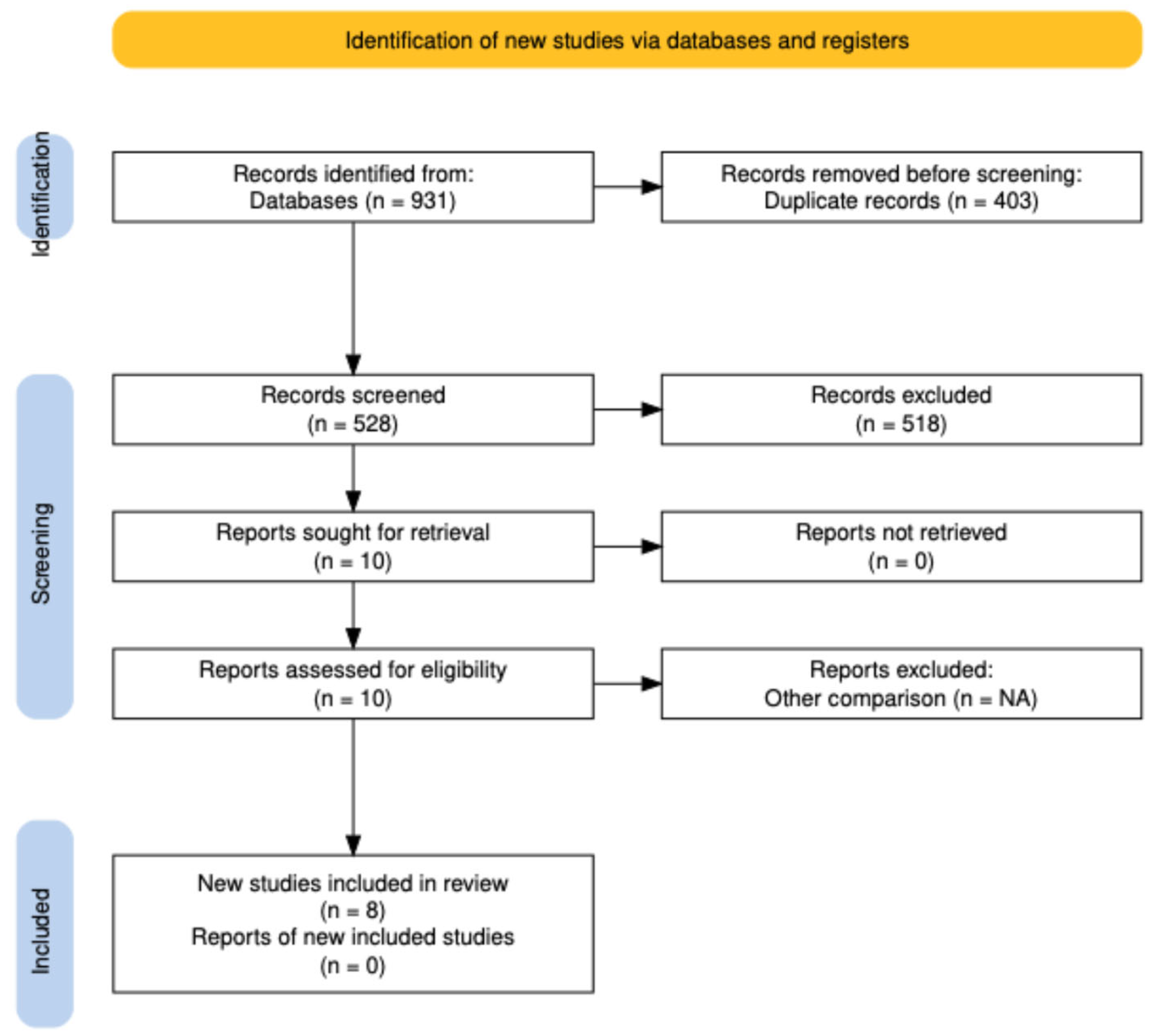
3.1. Selection of Studies
3.2. Characteristics of Included Studies
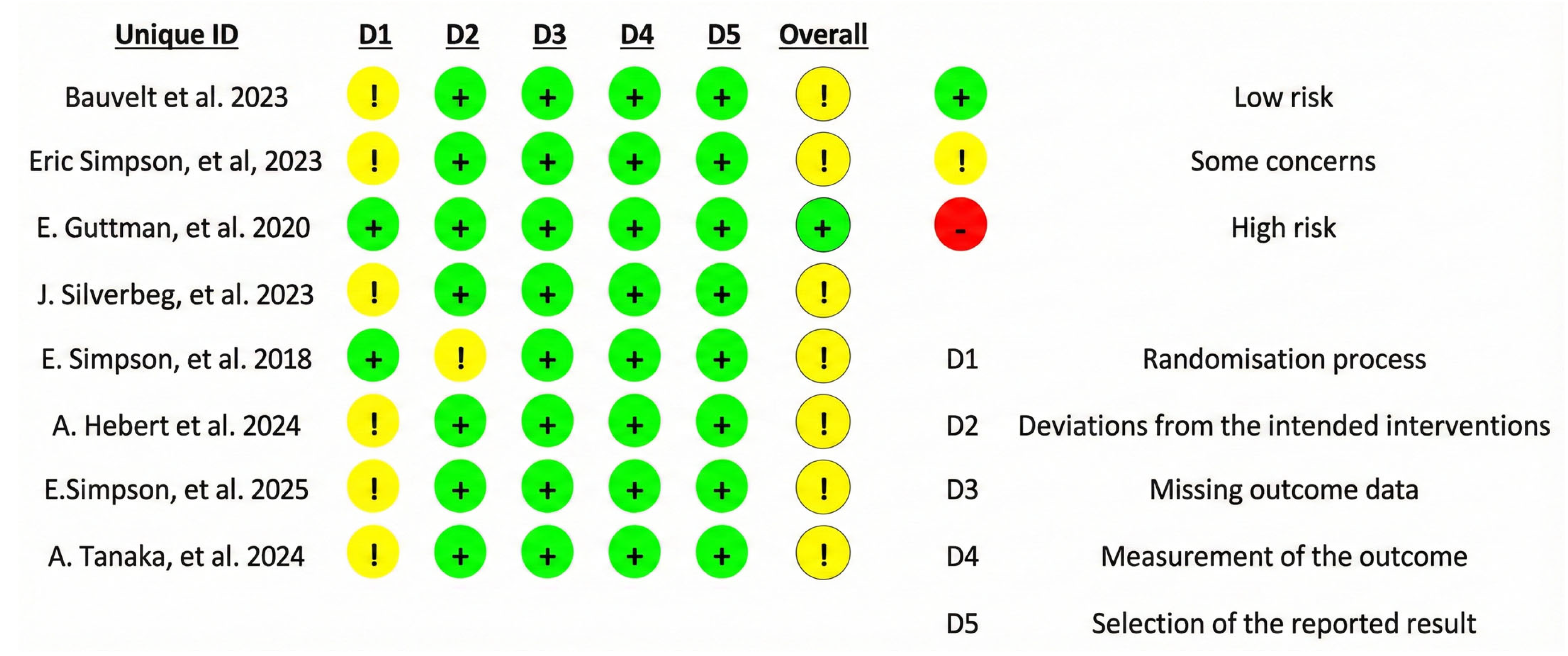
3.3. Risk of Bias
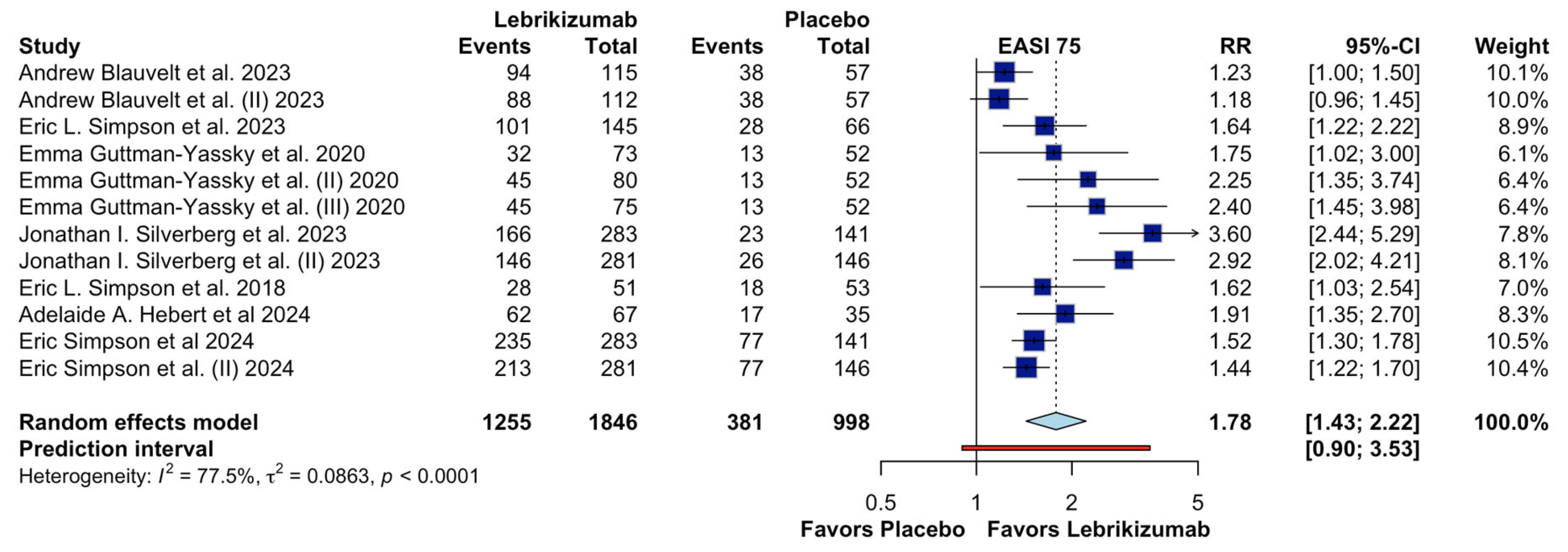
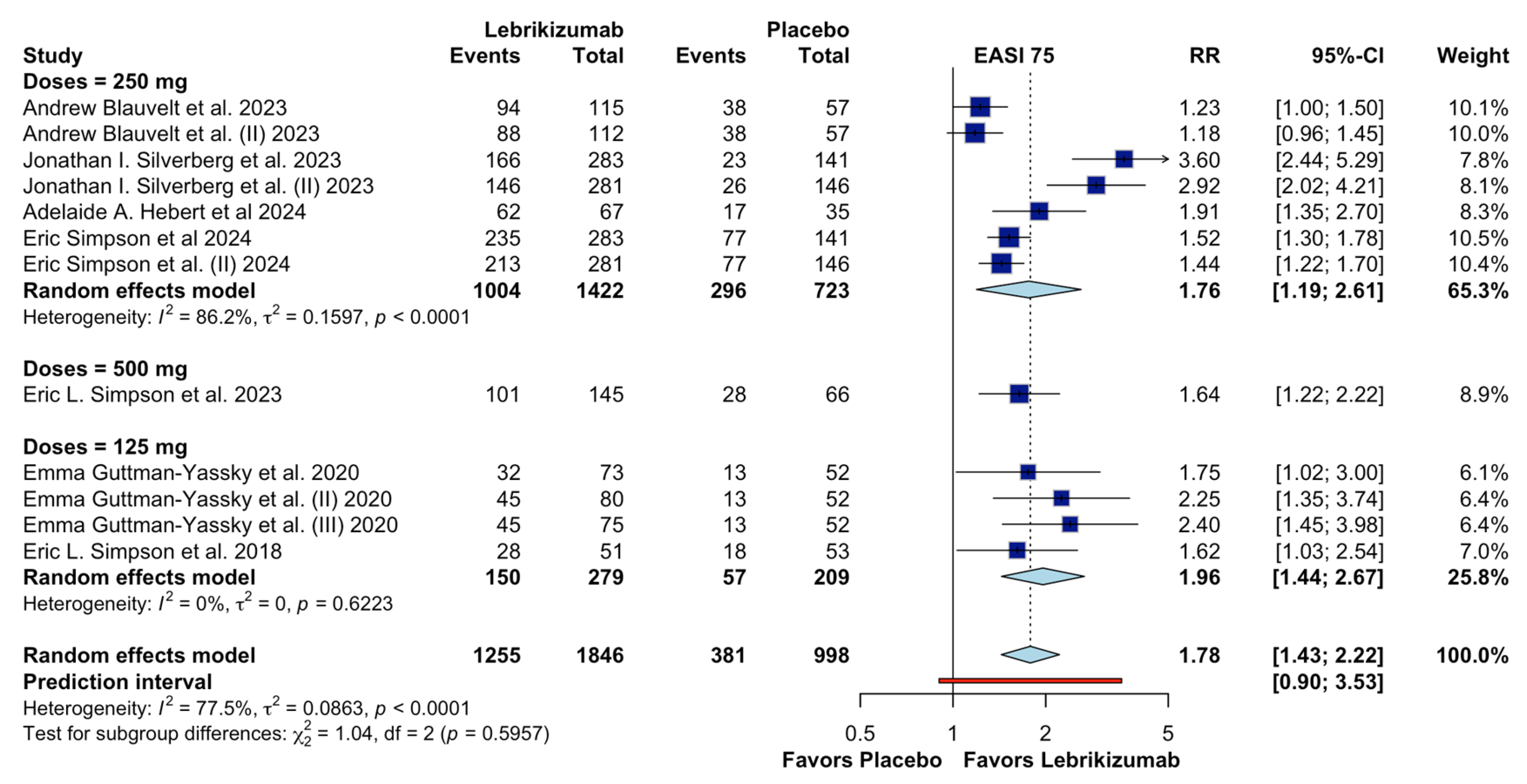
3.4. Effects of Lebrikizumab on Primary and Secondary Outcomes
3.5. GRADE Assessment
4. Discussion
Strengths and Limitations
5. Conclusions
Supplementary Materials
Author Contributions
Funding
Institutional Review Board Statement
Informed Consent Statement
Data Availability Statement
Conflicts of Interest
References
- Fuxench, Z.C.C.; Block, J.K.; Boguniewicz, M.; Boyle, J.; Fonacier, L.; Gelfand, J.M.; Grayson, M.H.; Margolis, D.J.; Mitchell, L.; Silverberg, J.I.; et al. Atopic Dermatitis in America Study: A Cross-Sectional Study Examining the Prevalence and Disease Burden of Atopic Dermatitis in the US Adult Population. J. Investig. Dermatol. 2019, 139, 583–590. [Google Scholar] [CrossRef] [PubMed]
- Barbarot, S.; Auziere, S.; Gadkari, A.; Girolomoni, G.; Puig, L.; Simpson, E.L.; Margolis, D.J.; de Bruin-Weller, M.; Eckert, L. Epidemiology of atopic dermatitis in adults: Results from an international survey. Allergy 2018, 73, 1284–1293. [Google Scholar] [CrossRef] [PubMed]
- Ständer, S. Atopic Dermatitis. N. Engl. J. Med. 2021, 384, 1136–1143. [Google Scholar] [CrossRef] [PubMed]
- Blauvelt, A.; Thyssen, J.P.; Guttman-Yassky, E.; Bieber, T.; Serra-Baldrich, E.; Simpson, E.; Rosmarin, D.; Elmaraghy, H.; Meskimen, E.; Natalie, C.R.; et al. Efficacy and safety of lebrikizumab in moderate-to-severe atopic dermatitis: 52-week results of two randomized double-blinded placebo-controlled phase III trials. Br. J. Dermatol. 2023, 188, 740–748. [Google Scholar] [CrossRef] [PubMed]
- Ratnarajah, K.; Le, M.; Muntyanu, A.; Mathieu, S.; Nigen, S.; Litvinov, I.V.; Jack, C.S.; Netchiporouk, E. Inhibition of IL-13: A New Pathway for Atopic Dermatitis. J. Cutan. Med. Surg. 2021, 25, 315–328. [Google Scholar] [CrossRef] [PubMed]
- Okragly, A.J.; Ryuzoji, A.; Wulur, I.; Daniels, M.; Van Horn, R.D.; Patel, C.N.; Benschop, R.J. Binding, Neutralization and Internalization of the Interleukin-13 Antibody, Lebrikizumab. Dermatol. Ther. 2023, 13, 1535–1547. [Google Scholar] [CrossRef] [PubMed]
- Teixeira, C.; Yilmaz, O.; Bernardo, D.; Torres, T. IL-13 inhibition in the treatment of atopic dermatitis—New and emerging biologic agents. J. Int. Med. Res. 2024, 52, 3000605241286832. [Google Scholar] [CrossRef] [PubMed]
- Page, M.J.; McKenzie, J.E.; Bossuyt, P.M.; Boutron, I.; Hoffmann, T.C.; Mulrow, C.D.; Shamseer, L.; Tetzlaff, J.M.; Akl, E.A.; Brennan, S.E.; et al. The PRISMA 2020 statement: An updated guideline for reporting systematic reviews. J. Clin. Epidemiol. 2021, 134, 178–189. [Google Scholar] [CrossRef] [PubMed]
- Simpson, E.L.; Gooderham, M.; Wollenberg, A.; Weidinger, S.; Armstrong, A.; Soung, J.; Ferrucci, S.; Lima, R.G.; Witte, M.M.; Xu, W.; et al. Efficacy and Safety of Lebrikizumab in Combination with Topical Corticosteroids in Adolescents and Adults with Moderate-to-Severe Atopic Dermatitis: A Randomized Clinical Trial (ADhere). JAMA Dermatol. 2023, 159, 182–191. [Google Scholar] [CrossRef] [PubMed]
- Rams, A.; Baldasaro, J.; Bunod, L.; Delbecque, L.; Strzok, S.; Meunier, J.; ElMaraghy, H.; Sun, L.; Pierce, E. Assessing Itch Severity: Content Validity and Psychometric Properties of a Patient-Reported Pruritus Numeric Rating Scale in Atopic Dermatitis. Adv. Ther. 2024, 41, 1512–1525. [Google Scholar] [CrossRef] [PubMed]
- Siemens, W.; Meerpohl, J.J.; Rohe, M.S.; Buroh, S.; Schwarzer, G.; Becker, G. Reevaluation of statistically significant meta-analyses in advanced cancer patients using the Hartung-Knapp method and prediction intervals-A methodological study. Res. Synth. Methods 2022, 13, 330–341. [Google Scholar] [CrossRef] [PubMed]
- Kirmayr, M.; Quilodrán, C.; Valente, B.; Loezar, C.; Garegnani, L.; Franco, J.V.A. The GRADE approach, Part 1: How to assess the certainty of the evidence. Metodología GRADE, parte 1: Cómo evaluar la certeza de la evidencia. Medwave 2021, 21, e8109. [Google Scholar] [CrossRef] [PubMed]
- Guttman-Yassky, E.; Blauvelt, A.; Eichenfield, L.F.; Paller, A.S.; Armstrong, A.W.; Drew, J.; Gopalan, R.; Simpson, E.L. Efficacy and Safety of Lebrikizumab, a High-Affinity Interleukin 13 Inhibitor, in Adults with Moderate to Severe Atopic Dermatitis: A Phase 2b Randomized Clinical Trial. JAMA Dermatol. 2020, 156, 411–420. [Google Scholar] [CrossRef] [PubMed]
- Silverberg, J.I.; Guttman-Yassky, E.; Gontijo Lima, R. Lebrikizumab for Moderate-to-Severe Atopic Dermatitis. N. Engl. J. Med. 2023, 388, 2299–2300. [Google Scholar] [CrossRef] [PubMed]
- Tanaka, A.; Igawa, K.; Takahashi, H.; Shimizu, R.; Kataoka, Y.; Torisu-Itakura, H.; Morisaki, Y.; Montmayeur, S.; Katoh, N. Lebrikizumab Combined with Topical Corticosteroids Improves Patient-reported Outcomes in Japanese Patients with Moderate-to-severe Atopic Dermatitis. Acta Derm. Venereol. 2024, 104, adv34375. [Google Scholar] [CrossRef] [PubMed]
- Simpson, E.L.; Flohr, C.; Eichenfield, L.F.; Bieber, T.; Sofen, H.; Taïeb, A.; Owen, R.; Putnam, W.; Castro, M.; DeBusk, K.; et al. Efficacy and safety of lebrikizumab (an anti-IL-13 monoclonal antibody) in adults with moderate-to-severe atopic dermatitis inadequately controlled by topical corticosteroids: A randomized, placebo-controlled phase II trial (TREBLE). J. Am. Acad. Dermatol. 2018, 78, 863–871.e11. [Google Scholar] [CrossRef] [PubMed]
- Hebert, A.A.; Flohr, C.; Hong, H.C.-H.; Irvine, A.D.; Pierce, E.; Elmaraghy, H.; Pillai, S.; Dawson, Z.; Chen, S.; Armengol, C.; et al. Efficacy of lebrikizumab in adolescent patients with moderate-to-severe atopic dermatitis: 16-week results from three randomized phase 3 clinical trials. J. Dermatol. Treat. 2024, 35, 2324833. [Google Scholar] [CrossRef] [PubMed]
- Simpson, E.; Fernández-Peñas, P.; de Bruin-Weller, M.; Lio, P.A.; Chu, C.-Y.; Ezzedine, K.; Agell, H.; Casillas, M.; Ding, Y.; Yang, F.E.; et al. Improvement Across Dimensions of Disease with Lebrikizumab Use in Atopic Dermatitis: Two Phase 3, Randomized, Double-Blind, Placebo-Controlled Monotherapy Trials (ADvocate1 and ADvocate2). Adv. Ther. 2025, 42, 132–143, Correction in Adv. Ther. 2025, 42, 144–145. https://doi.org/10.1007/s12325-024-03010-9. [Google Scholar] [CrossRef] [PubMed]
- Roy, Y.R.-L.; Ficheux, A.-S.; Misery, L.; Brenaut, E. Efficacy of topical and systemic treatments for atopic dermatitis on pruritus: A systematic literature review and meta-analysis. Front. Med. 2022, 9, 1079323. [Google Scholar] [CrossRef] [PubMed]
- Haddaway, N.R.; Page, M.J.; Pritchard, C.C.; McGuinness, L.A. PRISMA2020: An R package and Shiny app for producing PRISMA 2020-compliant flow diagrams, with interactivity for optimised digital transparency and Open Synthesis. Campbell Syst. Rev. 2022, 18, e1230. [Google Scholar] [CrossRef] [PubMed]




| Authors | Year of Publication | Country of Origin | Study Type | Study Phase | Number of Centers and Locations |
|---|---|---|---|---|---|
| Eric L. Simpson et al. [16] | 2018 | Multinational | A randomized, placebo-controlled, double-blind | Phase 2 | 62 centers |
| Emma Guttman-Yassky et al. [13] | 2020 | USA | Randomized, double-blind, placebo-controlled, dose-ranging clinical trial | Phase 2b | 57 US centers |
| Andrew Blauvelt et al. 14] | 2023 | Multinational | Randomized, double-blinded, placebo-controlled | Phase III | 171 study sites in North America, Europe, Asia-Pacific |
| Eric L. Simpson et al. [9] | 2023 | Germany, Poland, Canada, USA | Randomized, double-blind, placebo-controlled clinical trial | Phase 3 | 54 outpatient sites |
| Jonathan I. Silverberg et al. [14] | 2023 | Multinational | Randomized, double-blind, placebo-controlled, parallel-group clinical trial | Phase 3 | NR |
| Akio Tanaka et al. [15] | 2024 | Multinational | Randomized placebo-controlled clinical trial | Phase 3 | 37 centres |
| Adelaide A. Hebert et al. [17] | 2024 | US; Europe; Rest of world | Three randomized, double-blind, placebo-controlled | Phase 3 | NR |
| Eric Simpson et al. [18] | 2025 | US; Europe; Rest of world | Two randomized, double-blind, placebo-controlled | Phase 3 | 100 study sites in the United States, Canada, Europe, and the Asia–Pacific |
| Authors | Year of Publication | Sample Size (Total, by Intervention and Control Groups) | Average Age and Range | Gender Distribution | Weight and Height | Comorbidities Reported |
|---|---|---|---|---|---|---|
| Andrew Blauvelt et al. [4] | 2023 | Total: 806; Intervention (Q2W): 113; Intervention (Q4W): 118; Placebo: 60 | Mean age: 35.5 years; Range: ≥12 years | Female: 36% (withdrawal), 58.5% (Q4W), 46.9% (Q2W) | Mean weight: 72.7 kg (withdrawal), 74.6 kg (Q4W), 76.2 kg (Q2W) | Asthma and rhinitis |
| Eric L. Simpson et al. [9] | 2023 | Total: 211, LEB + TCS: 145, PBO + TCS: 66 | Mean age: 37.2 years (SD: 19.3) | Female: 48.8% | Mean weight: 74.6 kg (LEB + TCS) | None specified |
| Emma Guttman-Yassky et al. [13] | 2020 | Total: 280, Placebo: 52, Lebrikizumab groups: 228 | Mean age: 39.3 years (SD: 17.5) | Female: 59.3% | BMI mean: 29.7 (placebo), 30.1, 29.2, 28.1 (Lebrikizumab groups) | None specifically listed |
| Jonathan I. Silverberg et al. [14] | 2023 | Trial 1: lebrikizumab (283), placebo (141) Trial 2: lebrikizumab (281), placebo (146) | Trial 1: Placebo (34.2 ± 16.4) range: 12 to <18 years: 18 (12.8), ≥18 years: 123 (87.2), Lebrikizumab (36.1 ± 17.8) range: 12 to <18 years: 37 (13.1), ≥18 years: 246 (86.9) Trial 2: Placebo (35.3 ± 17.2) range: 12 to <18 years: 17 (11.6), ≥18 years: 129 (88.4), Lebrikizumab (36.6 ± 16.8) range: 12 to <18 years: 30 (10.7), ≥18 years: 251 (89.3). | Trial 1: placebo 73 (51.8), lebrikizumab 141 (49.8) Trial 2: placebo 75 (51.4), lebrikizumab 136 (48.4) | WEIGHT: Trial 1: placebo (79.0 ± 22.7), lebrikizumab (77.0 ± 19.7) Trial 2: placebo (76,0 ± 21.1), lebrikizumab (76.7 ± 20.5) | NR |
| Akio Tanaka et al. [15] | 2024 | 286 patients, including 18 adolescents, were randomized 2:2:3 to receive placebo (82 patients), lebrikizumab Q4W (81 patients), and lebrikizumab Q2W (123 patients) in combination with TCS | Placebo + TCS: 34.8 (13.6), Adults (≥18 years): 76 (92.7), Adolescents (≥12 to <18 years): 6 (7.3), Lebrikizumab Q4W + TCS: 37.8 (12.0), Adults (≥18 years): 77 (95.1) Adolescents (≥12 to <18 years): 4 (4.9), Lebrikizumab Q2W + TCS: 35.5 (12.2): Adults (≥18 years): 115 (93.5), Adolescents (≥12 to <18 years): 8 (6.5) | Female, n (%): Placebo + TCS: 24 (29.3), Lebrikizumab Q4W + TCS: 25 (30.9), Lebrikizumab Q2W + TCS: 41 (33.3) | Weight, kg, mean (SD): Placebo + TCS: 65.6 (12.5), Lebrikizumab Q4W + TCS: 66.5 (13.8), Lebrikizumab Q2W + TCS: 64.9 (11.4), <60 kg: Placebo + TCS: 29 (35.4), Lebrikizumab Q4W + TCS: 29 (35.8), Lebrikizumab Q2W + TCS: 47 (38.2), ≥60 to <100 kg: Placebo + TCS: 53 (64.6), Lebrikizumab Q4W + TCS: 51 (63.0), Lebrikizumab Q2W + TCS: 76 (61.8), ≥100 kg: Placebo + TCS: 0, Lebrikizumab Q4W+TCS: 1 (1.2), Lebrikizumab Q2W + TCS: 0 | Hand dermatitis, Facial dermatitis, Conjunctivitis, Herpes zoster, Chickenpox, Eczema herpeticum, Herpetic whitlow, Disseminated neonatal herpes simplex, Herpes labialis, Genital herpes, Asthma, Alopecia, Food allergy, Allergic rhinitis, Pollinosis |
| Eric L. Simpson et al. [16] | 2018 | Total patients: 209 patients (1) Lebrikizumab 125 mg single dose: 52 (2) Lebrikizumab 250 mg: 53 (3) Lebrikizumab 125 mg Q4W: 51 (4) Placebo: 53 | Range: 18-75 years old Mean Age: (1) Lebrikizumab 125 mg single dose: 34.9 (SD: 12.7) (2) Lebrikizumab 250 mg: 34.4 (12.3) (3) Lebrikizumab 125 mg Q4W: 36.6 (12.3) (4) Placebo: 38.7 (13.2) | Male %: (1) Lebrikizumab 125 mg single dose: 65.4% (2) Lebrikizumab 250 mg: 58.5% (3) Lebrikizumab 125 mg Q4W: 68.6% (4) Placebo: 67.9% | NR | NR |
| Adelaide A. Hebert et al. [17] | 2024 | Total patients:148 lebrikizumab (N = 67) vs. placebo (N = 35); (lebrikizumab + TCS, N = 32; placebo + TCS, N = 14 | ≥12 to <18 years weighing ≥40 kg | Female: 54.7% | ≥40 kg | NR |
| Eric Simpson et al. [18] | 2024 | Total patients: 869 LEB 250 mg Q2W, N = 564 PBO, N = 287 | adults (aged ≥18 years) and adolescents (aged 12 to <18 years and weighing ≥ 40 kg) | Female: 50.5% | ≥40 kg | NR |
| Authors | Year | Intervention Strategy | Dose and Schedule | Treatment Period | Concomitant Therapy | Follow-Up | Attrition | Adherence |
|---|---|---|---|---|---|---|---|---|
| Blauvelt et al. [4] | 2023 | Lebrikizumab vs. placebo | 250 mg Q2W or Q4W | 52 weeks (16-week induction + 36-week maintenance) | Intermittent topical corticosteroids permitted | 52 weeks | ≤12.9% across arms | High |
| Simpson et al. [9] | 2023 | Lebrikizumab + TCS vs. placebo + TCS | Loading 500 mg, then 250 mg Q2W | 16 weeks | Low–mid potency topical corticosteroids | 16 weeks | 19 patients | High |
| Guttman-Yassky et al. [13] | 2020 | Lebrikizumab vs. placebo | 125 mg or 250 mg Q2W/Q4W | 16 weeks | Rescue therapy allowed | 16 weeks (+safety) | Completion: 44.2% placebo; ~77–80% lebrikizumab | High |
| Silverberg et al. [14] | 2023 | Induction–maintenance lebrikizumab vs. placebo | Induction: 500 mg loading + 250 mg Q2W; Maintenance: Q2W or Q4W | 52 weeks | Topical corticosteroids as rescue | 36 weeks | ≤1.4% | NR |
| Tanaka et al. [15] | 2024 | Lebrikizumab + TCS vs. placebo + TCS | 250 mg Q2W or Q4W with loading dose | 68 weeks (incl. safety) | Low–mid potency TCS and/or TCI | 52 weeks | 1.4% | 98.6% completed induction |
| Simpson et al. [16] | 2018 | Lebrikizumab vs. placebo | 125 mg single dose; 250 mg; 125 mg Q4W | 12 weeks | Medium-potency TCS | 12 weeks | NR | NR |
| Hebert et al. [17] | 2024 | Lebrikizumab ± TCS vs. placebo | Loading 500 mg, then 250 mg Q2W | 16 weeks | TCS optional (tapering allowed) | NR | NR | High |
| Simpson et al. [18] | 2024 | Lebrikizumab monotherapy vs. placebo | 250 mg Q2W | 16 weeks | None | 52 weeks | NR | High |
Disclaimer/Publisher’s Note: The statements, opinions and data contained in all publications are solely those of the individual author(s) and contributor(s) and not of MDPI and/or the editor(s). MDPI and/or the editor(s) disclaim responsibility for any injury to people or property resulting from any ideas, methods, instructions or products referred to in the content. |
© 2026 by the authors. Licensee MDPI, Basel, Switzerland. This article is an open access article distributed under the terms and conditions of the Creative Commons Attribution (CC BY) license.
Share and Cite
Lopez-Mallama, O.M.; Sandoval-Ato, R.; Vega, P.R.; Keita, H.; Diaz-Gonzales, G.; Rivera-Lozada, O.; Barboza, J.J. Efficacy and Safety of Lebrikizumab in Adults with Moderate-to-Severe Atopic Dermatitis: A Systematic Review and Meta-Analysis. J. Clin. Med. 2026, 15, 1737. https://doi.org/10.3390/jcm15051737
Lopez-Mallama OM, Sandoval-Ato R, Vega PR, Keita H, Diaz-Gonzales G, Rivera-Lozada O, Barboza JJ. Efficacy and Safety of Lebrikizumab in Adults with Moderate-to-Severe Atopic Dermatitis: A Systematic Review and Meta-Analysis. Journal of Clinical Medicine. 2026; 15(5):1737. https://doi.org/10.3390/jcm15051737
Chicago/Turabian StyleLopez-Mallama, Oscar M., Raul Sandoval-Ato, Pedro Ruiz Vega, Hady Keita, Gerson Diaz-Gonzales, Oriana Rivera-Lozada, and Joshuan J. Barboza. 2026. "Efficacy and Safety of Lebrikizumab in Adults with Moderate-to-Severe Atopic Dermatitis: A Systematic Review and Meta-Analysis" Journal of Clinical Medicine 15, no. 5: 1737. https://doi.org/10.3390/jcm15051737
APA StyleLopez-Mallama, O. M., Sandoval-Ato, R., Vega, P. R., Keita, H., Diaz-Gonzales, G., Rivera-Lozada, O., & Barboza, J. J. (2026). Efficacy and Safety of Lebrikizumab in Adults with Moderate-to-Severe Atopic Dermatitis: A Systematic Review and Meta-Analysis. Journal of Clinical Medicine, 15(5), 1737. https://doi.org/10.3390/jcm15051737