Early Prediction of 90-Day Periprosthetic Joint Infection After Hip Arthroplasty for Proximal Femur Fracture Using Machine Learning: Development and Temporal Validation of a Predictive Model

 , , and
Abstract
1. Introduction
2. Materials and Methods
2.1. Study Design and Setting
2.2. Participants and Study Period
2.3. Outcome Definition and Adjudication
2.4. Candidate Predictors and Prediction Window
2.5. Risk of Reverse Causality and Information Leakage
2.6. Data Preprocessing and Missing Data
2.7. Model Development and Internal Validation
2.8. Temporal Validation
2.9. Performance Assessment, Uncertainty, Calibration, and Clinical Utility
2.10. Model Interpretability
2.11. Descriptive Comparisons and Sensitivity Analyses
2.12. Software and Reproducibility
3. Results
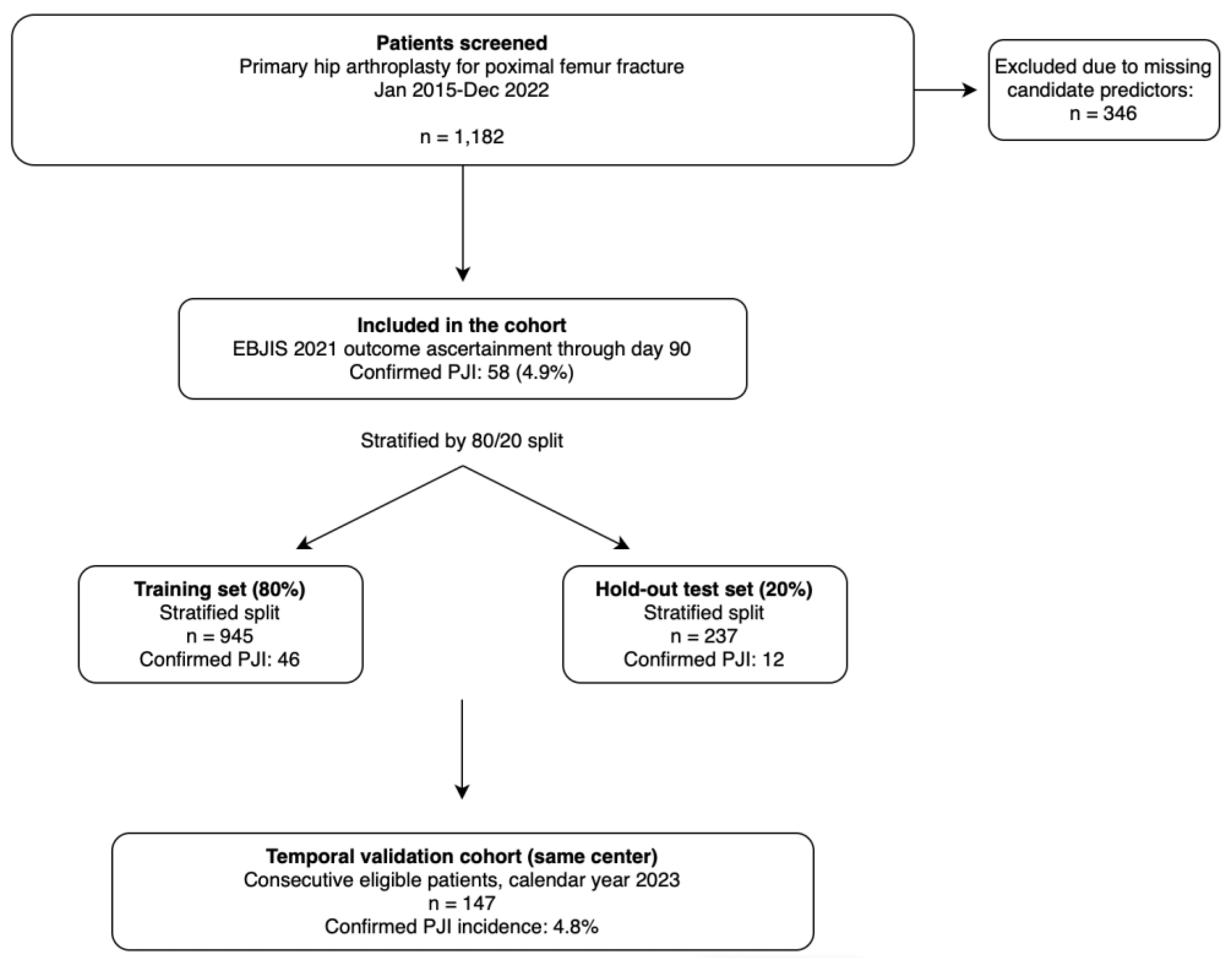
3.1. Study Population and Endpoint Frequency
3.2. Patient and Perioperative Characteristics
3.3. Model Development and Internal Evaluation
3.4. Comparative Model Discrimination and Classification Performance
3.5. Temporal Validation (Same-Center 2023 Cohort)
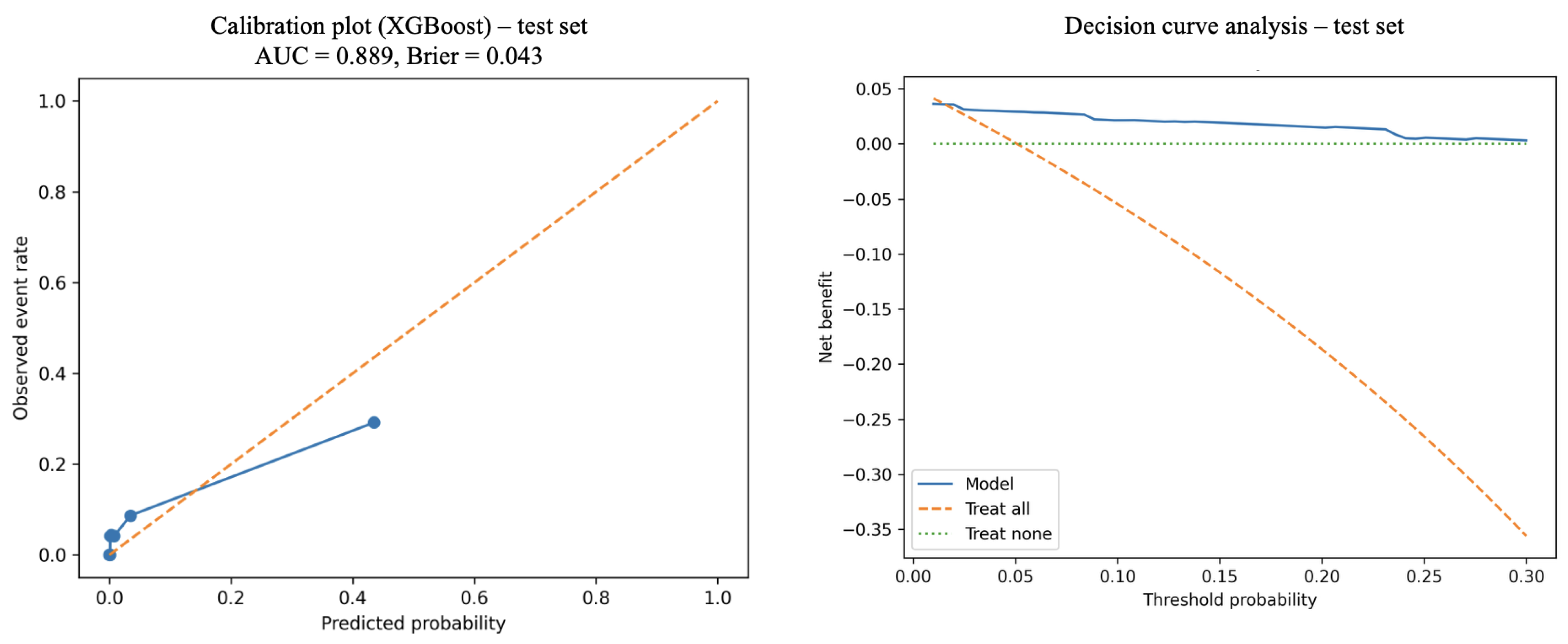
3.6. Calibration and Risk Stratification Performance
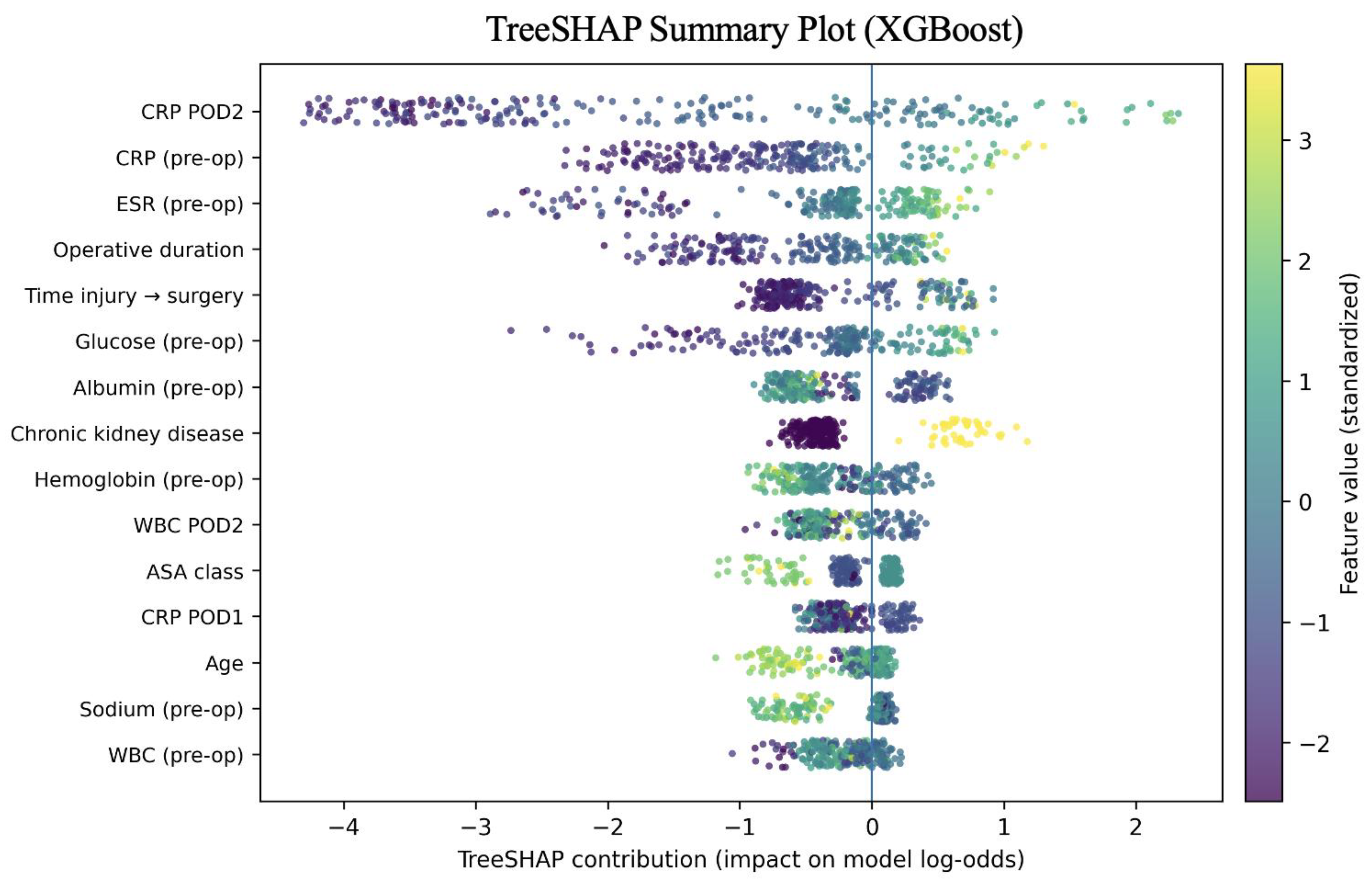
3.7. Explainability Analysis and Clinically Salient Predictors
3.8. Sensitivity Analyses
4. Discussion
5. Conclusions
Author Contributions
Funding
Institutional Review Board Statement
Informed Consent Statement
Data Availability Statement
Acknowledgments
Conflicts of Interest
References
- Parvizi, J.; Gehrke, T.; Chen, A.F. Proceedings of the International Consensus on Periprosthetic Joint Infection. Bone Jt. J. 2013, 95, 1450–1452. [Google Scholar] [CrossRef] [PubMed]
- Beam, E.; Osmon, D. Prosthetic Joint Infection Update. Infect. Dis. Clin. N. Am. 2018, 32, 843–859. [Google Scholar] [CrossRef] [PubMed]
- Lewis, D.P.; Tarrant, S.M.; Dewar, D.; Balogh, Z.J. Periprosthetic joint infection after hemiarthroplasty for hip fracture is a distinct clinical entity associated with high mortality. Bone Jt. Open 2025, 6, 1409–1415. [Google Scholar] [CrossRef] [PubMed]
- Craxford, S.; Marson, B.A.; Nightingale, J.; Ikram, A.; Agrawal, Y.; Deakin, D.; Ollivere, B. Deep infection after hip hemiarthroplasty: Risk factors for infection and outcome of treatments. Bone Jt. Open 2021, 2, 958–965. [Google Scholar] [CrossRef]
- Silas, U.; Berberich, C.; Anyimiah, P.; Szymski, D.; Rupp, M. Risk of surgical site infection after hip hemiarthroplasty of femoral neck fractures: A systematic review and meta-analysis. Arch. Orthop. Trauma Surg. 2024, 144, 3685–3695. [Google Scholar] [CrossRef]
- Yi, P.H.; Cross, M.B.; Moric, M.; Sporer, S.M.; Berger, R.A.; Della Valle, C.J. The 2013 Frank Stinchfield Award: Diagnosis of infection in the early postoperative period after total hip arthroplasty. Clin. Orthop. Relat. Res. 2014, 472, 424–429. [Google Scholar] [CrossRef]
- Zmistowski, B.; Della Valle, C.; Bauer, T.W.; Malizos, K.N.; Alavi, A.; Bedair, H.; Booth, R.E.; Choong, P.; Deirmengian, C.; Ehrlich, G.D.; et al. Diagnosis of periprosthetic joint infection. J. Arthroplast. 2013, 29, 77–83. [Google Scholar] [CrossRef]
- Sigmund, I.K.; Puchner, S.E.; Windhager, R. Serum Inflammatory Biomarkers in the Diagnosis of Periprosthetic Joint Infections. Biomedicines 2021, 9, 1128. [Google Scholar] [CrossRef]
- Imagama, T.; Seki, K.; Seki, T.; Matsuki, Y.; Yamazaki, K.; Sakai, T. Low frequency of local findings in periprosthetic hip infection caused by low-virulent bacteria compared to periprosthetic knee infection. Sci. Rep. 2021, 11, 11714. [Google Scholar] [CrossRef]
- Parvizi, J.; Tan, T.L.; Goswami, K.; Higuera, C.; Della Valle, C.; Chen, A.F.; Shohat, N. The 2018 Definition of Periprosthetic Hip and Knee Infection: An Evidence-Based and Validated Criteria. J. Arthroplast. 2018, 33, 1309–1314.e2. [Google Scholar] [CrossRef]
- McNally, M.; Sousa, R.; Wouthuyzen-Bakker, M.; Chen, A.F.; Soriano, A.; Vogely, H.C.; Clauss, M.; Higuera, C.A.; Trebše, R. The EBJIS definition of periprosthetic joint infection. Bone Jt. J. 2021, 103, 18–25. [Google Scholar] [CrossRef] [PubMed]
- Sigmund, I.K.; Luger, M.; Windhager, R.; McNally, M.A. Diagnosing periprosthetic joint infections: A comparison of infection definitions: EBJIS 2021, ICM 2018, and IDSA 2013. Bone Jt. Res. 2022, 11, 608–618. [Google Scholar] [CrossRef] [PubMed]
- Sigmund, I.K.; Ferry, T.; Sousa, R.; Soriano, A.; Metsemakers, W.J.; Clauss, M.; Trebse, R.; Wouthuyzen-Bakker, M. Debridement, antimicrobial therapy, and implant retention (DAIR) as curative strategy for acute periprosthetic hip and knee infections: A position paper of the European Bone & Joint Infection Society (EBJIS). J. Bone Jt. Infect. 2025, 10, 101–138. [Google Scholar] [CrossRef] [PubMed]
- Yoon, S.J.; Jutte, P.C.; Soriano, A.; Sousa, R.; Zijlstra, W.P.; Wouthuyzen-Bakker, M. Predicting periprosthetic joint infection: External validation of preoperative prediction models. J. Bone Jt. Infect. 2024, 9, 231–239. [Google Scholar] [CrossRef]
- Vulpe, D.E.; Anghel, C.; Scheau, C.; Dragosloveanu, S.; Săndulescu, O. Artificial Intelligence and Its Role in Predicting Periprosthetic Joint Infections. Biomedicines 2025, 13, 1855. [Google Scholar] [CrossRef]
- Li, P.; Wang, Y.; Zhao, R.; Hao, L.; Chai, W.; Jiying, C.; Feng, Z.; Ji, Q.; Zhang, G. The Application of artificial intelligence in periprosthetic joint infection. J. Adv. Res. 2026, 79, 633–659. [Google Scholar] [CrossRef]
- Flores-Balado, Á.; Castresana Méndez, C.; Herrero González, A.; Gutierrez, R.M.; de las Casas Cámara, G.; Cordero, B.V.; Arcos, J.; Pfang, B.; Martín-Ríos, M.D. Using artificial intelligence to reduce orthopedic surgical site infection surveillance workload: Algorithm design, validation, and implementation in 4 Spanish hospitals. Am. J. Infect. Control 2023, 51, 1225–1229. [Google Scholar] [CrossRef]
- Kuo, F.C.; Hu, W.H.; Hu, Y.J. Periprosthetic Joint Infection Prediction via Machine Learning: Comprehensible Personalized Decision Support for Diagnosis. J. Arthroplasty 2022, 37, 132–141. [Google Scholar] [CrossRef]
- Fu, S.; Wyles, C.C.; Osmon, D.R.; Carvour, M.L.; Sagheb, E.; Ramazanian, T.; Kremers, W.K.; Lewallen, D.G.; Berry, D.J.; Sohn, S.; et al. Automated Detection of Periprosthetic Joint Infections and Data Elements Using Natural Language Processing. J. Arthroplast. 2021, 36, 688–692. [Google Scholar] [CrossRef]
- Turhan, S.; Canbek, U.; Dubektas-Canbek, T.; Dogu, E. Predicting Prolonged Wound Drainage after Hemiarthroplasty for Hip Fractures: A Stacked Machine Learning Study. Clin. Orthop. Surg. 2023, 15, 894–901. [Google Scholar] [CrossRef]
- Collins, G.S.; Moons, K.G.M.; Dhiman, P.; Riley, R.D.; Beam, A.L.; Van Calster, B.; Ghassemi, M.; Liu, X.; Reitsma, J.B.; Van Smeden, M.; et al. TRIPOD+AI statement: Updated guidance for reporting clinical prediction models that use regression or machine learning methods. BMJ 2024, 385, e078378. [Google Scholar] [CrossRef]
- Salimy, M.S.; Buddhiraju, A.; Chen, T.L.; Mittal, A.; Xiao, P.; Kwon, Y.M. Machine learning to predict periprosthetic joint infections following primary total hip arthroplasty using a national database. Arch. Orthop. Trauma Surg. 2025, 145, 131. [Google Scholar] [CrossRef]
- Dragosloveanu, S.; Vulpe, D.E.; Andrei, C.A.; Nedelea, D.G.; Garofil, N.D.; Anghel, C.; Dragosloveanu, C.D.; Cergan, R.; Scheau, C. Predicting periprosthetic joint Infection: Evaluating supervised machine learning models for clinical application. J. Orthop. Translat. 2025, 54, 51–64. [Google Scholar] [CrossRef]
- Chen, W.; Hu, X.; Gu, C.; Zhang, Z.; Zheng, L.; Pan, B.; Wu, X.; Sun, W.; Sheng, P. A machine learning-based model for “In-time” prediction of periprosthetic joint infection. Digit. Health 2024, 10, 20552076241253531. [Google Scholar] [CrossRef]
- Du, J.; Tao, X.; Zhu, L.; Wang, H.; Qi, W.; Min, X.; Wei, S.; Zhang, X.; Liu, Q. Development of a visualized risk prediction system for sarcopenia in older adults using machine learning: A cohort study based on CHARLS. Front. Public Health 2025, 13, 1544894. [Google Scholar] [CrossRef]
- Moons, K.G.M.; Damen, J.A.A.; Kaul, T.; Hooft, L.; Navarro, C.A.; Dhiman, P.; Beam, A.L.; Van Calster, B.; Celi, L.A.; Denaxas, S.; et al. PROBAST+AI: An updated quality, risk of bias, and applicability assessment tool for prediction models using regression or artificial intelligence methods. BMJ 2025, 388, e082505. [Google Scholar] [CrossRef]



| Characteristic | Overall (n = 1182) | PJI (n = 58) | No PJI (n = 1124) | p-Value |
|---|---|---|---|---|
| Age, years median (IQR) | 84 (77–89) | 83 (78–88) | 84 (77–89) | 0.22 |
| Female sex n (%) | 839 (71.0) | 41 (70.7) | 798 (71) | 0.97 |
| BMI, kg/m2 median (IQR) | 25.1 (22.8–28.4) | 26.2 (23.9–29.8) | 25.0 (22.7–28.3) | 0.12 |
| Procedure type | ||||
| Hemiarthroplasty—n (%) | 969 (82.0) | 45 (77.6) | 924 (82.2) | 0.34 |
| Total hip arthroplasty—n (%) | 213 (18.0) | 13 (22.4) | 200 (17.8) | 0.34 |
| Operative duration, min median (IQR) | 87.5 (60–115) | 95 (75–115) | 76.5 (60–93) | <0.001 |
| Cemented fixation n (%) | 875 (74.0) | 46 (79.3) | 829 (73.8) | 0.36 |
| Perioperative transfusion n (%) | 343 (29.0) | 24 (41.4) | 319 (28.4) | 0.03 |
| Follow-up, days median (IQR) | 410 (180–640) | 400 (180–620) | 411 (182–640) | 0.61 |
| Model | AUC | 95% CI (AUC) | Sensitivity (%) | Specificity (%) | PPV (%) | NPV (%) |
|---|---|---|---|---|---|---|
| Logistic regression | 0.842 | 0.77–0.91 | 78.6 | 82.3 | 18.9 | 97.1 |
| Random forest | 0.881 | 0.81–0.94 | 85.7 | 84.1 | 22.4 | 97.8 |
| Support vector machine | 0.864 | 0.79–0.93 | 82.1 | 83.5 | 21.0 | 97.4 |
| Multilayer perceptron | 0.872 | 0.80–0.94 | 83.6 | 84.0 | 22.0 | 97.6 |
| XGBoost | 0.889 | 0.80–0.96 | 100 | 58.5 | 11.4 | 100 |
| Stacking ensemble | 0.937 | 0.89–0.98 | 92.9 | 86.9 | 28.4 | 98.4 |
| Model | AUC | 95% CI (AUC) | Sensitivity (%) | Specificity (%) | PPV (%) | NPV (%) |
|---|---|---|---|---|---|---|
| Logistic regression | 0.804 | 0.61–1.00 | 71.4 | 80.7 | 15.6 | 98.3 |
| Random forest | 0.858 | 0.68–1.00 | 85.7 | 82.9 | 20.0 | 99.1 |
| Support vector machine | 0.835 | 0.65–1.00 | 71.4 | 83.6 | 17.9 | 98.3 |
| Multilayer perceptron | 0.848 | 0.67–1.00 | 85.7 | 83.6 | 20.7 | 99.2 |
| XGBoost | 0.892 | 0.73–1.00 | 85.7 | 82.1 | 19.4 | 99.1 |
| Stacking ensemble | 0.905 | 0.75–1.00 | 85.7 | 85.7 | 23.1 | 99.2 |
Disclaimer/Publisher’s Note: The statements, opinions and data contained in all publications are solely those of the individual author(s) and contributor(s) and not of MDPI and/or the editor(s). MDPI and/or the editor(s) disclaim responsibility for any injury to people or property resulting from any ideas, methods, instructions or products referred to in the content. |
© 2026 by the authors. Licensee MDPI, Basel, Switzerland. This article is an open access article distributed under the terms and conditions of the Creative Commons Attribution (CC BY) license.
Share and Cite
Biavardi, N.G.; Pezone, F.; Morlini, F.; Alessio-Mazzola, M.; Pace, V.; Antinolfi, P.; Placella, G.; Salini, V. Early Prediction of 90-Day Periprosthetic Joint Infection After Hip Arthroplasty for Proximal Femur Fracture Using Machine Learning: Development and Temporal Validation of a Predictive Model. J. Clin. Med. 2026, 15, 1668. https://doi.org/10.3390/jcm15041668
Biavardi NG, Pezone F, Morlini F, Alessio-Mazzola M, Pace V, Antinolfi P, Placella G, Salini V. Early Prediction of 90-Day Periprosthetic Joint Infection After Hip Arthroplasty for Proximal Femur Fracture Using Machine Learning: Development and Temporal Validation of a Predictive Model. Journal of Clinical Medicine. 2026; 15(4):1668. https://doi.org/10.3390/jcm15041668
Chicago/Turabian StyleBiavardi, Nicolò Giuseppe, Francesco Pezone, Federico Morlini, Mattia Alessio-Mazzola, Valerio Pace, Pierluigi Antinolfi, Giacomo Placella, and Vincenzo Salini. 2026. "Early Prediction of 90-Day Periprosthetic Joint Infection After Hip Arthroplasty for Proximal Femur Fracture Using Machine Learning: Development and Temporal Validation of a Predictive Model" Journal of Clinical Medicine 15, no. 4: 1668. https://doi.org/10.3390/jcm15041668
APA StyleBiavardi, N. G., Pezone, F., Morlini, F., Alessio-Mazzola, M., Pace, V., Antinolfi, P., Placella, G., & Salini, V. (2026). Early Prediction of 90-Day Periprosthetic Joint Infection After Hip Arthroplasty for Proximal Femur Fracture Using Machine Learning: Development and Temporal Validation of a Predictive Model. Journal of Clinical Medicine, 15(4), 1668. https://doi.org/10.3390/jcm15041668