Integrating Psychiatric, Psychotherapeutic, and Nursing Care in Intranasal Esketamine for Treatment-Resistant Depression
 , , and
Abstract
1. Introduction
Methods
2. Esketamine in Treatment-Resistant Depression: Current Evidence and Open Questions
2.1. Evidence from Randomized Controlled Trials
2.2. Safety Profile and Regulatory Considerations
2.3. Real-World Evidence and Clinical Heterogeneity
3. The Role of Nursing Care in Esketamine Treatment Pathways
4. Psychotherapy and Psychological Integration in Esketamine Treatment
4.1. Conceptual Rationale for Integration
4.2. Timing and Feasibility in Routine Care
4.3. Therapeutic Targets and Clinical Orientation
4.4. Working with Dissociation and Altered Experiences
4.5. Interface with Nursing Care and Facility Organization
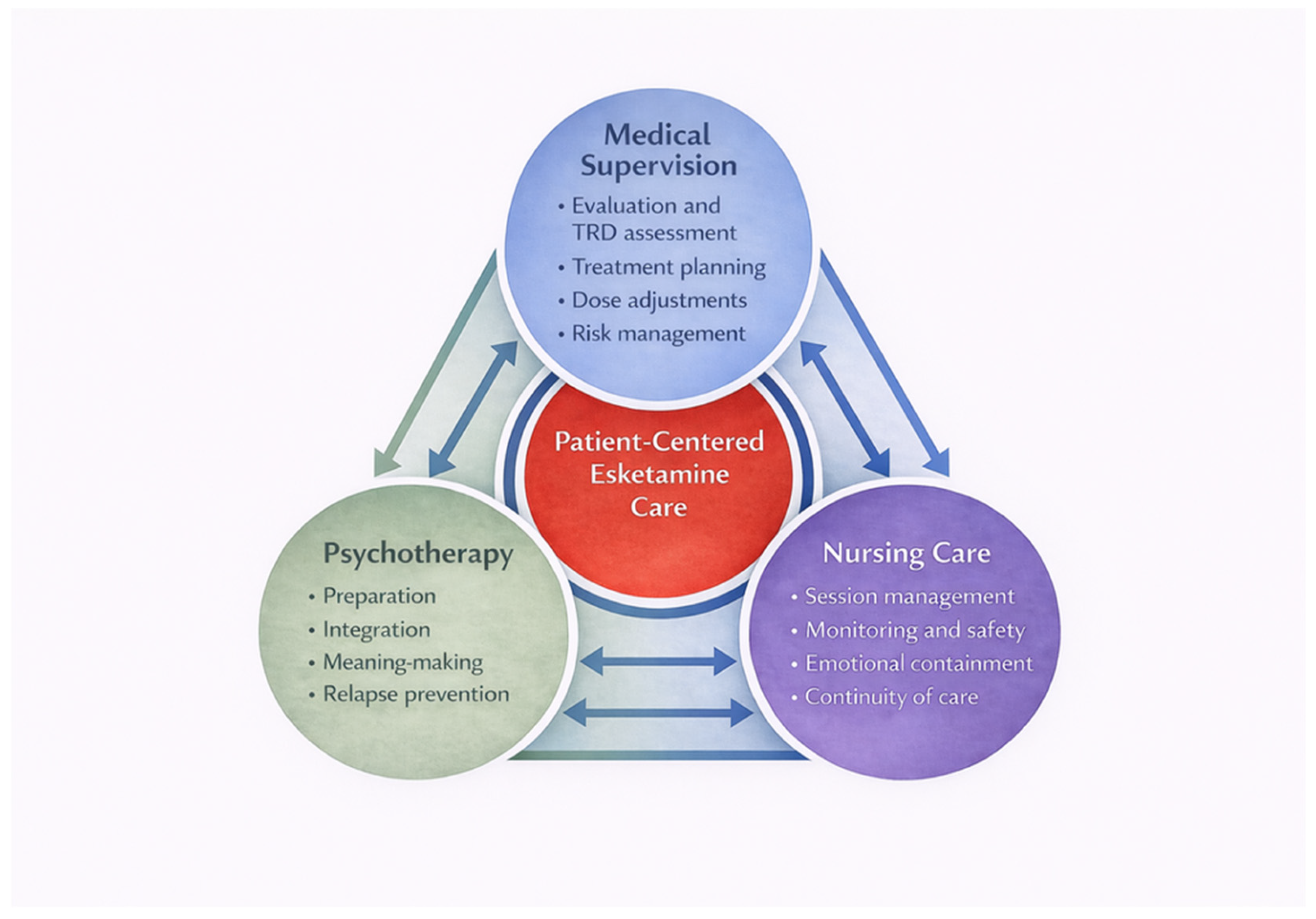
5. A Proposed Multidisciplinary Model for Esketamine Treatment
5.1. Core Principles of the Integrated Model
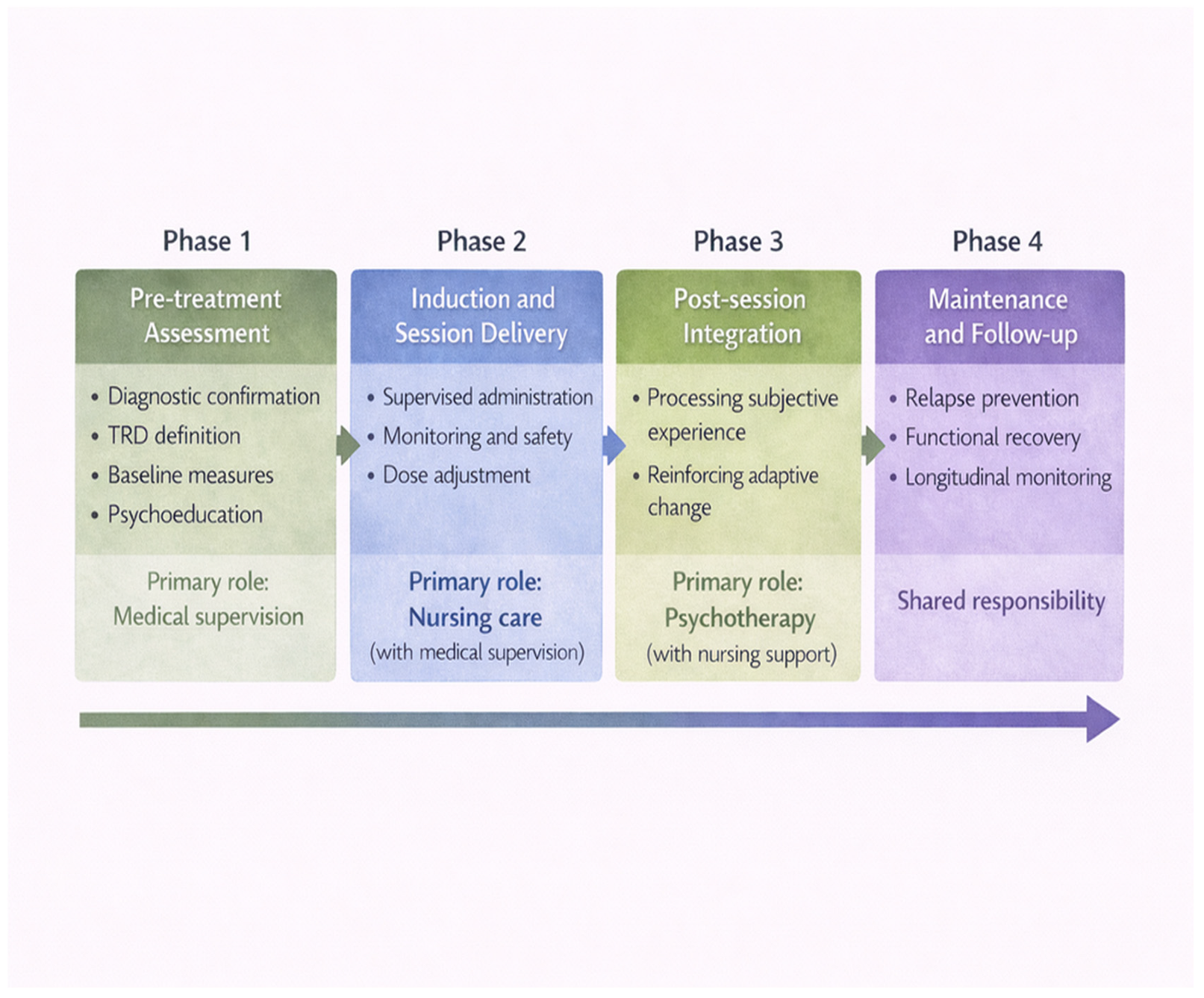
5.2. Phase 1: Pre-Treatment Assessment and Preparation
5.3. Phase 2: Induction and Session-Based Treatment Delivery
5.4. Phase 3: Post-Session Integration and Consolidation
5.5. Phase 4: Maintenance and Longitudinal Monitoring
5.6. Organizational Requirements and Scalability
5.7. Summary
6. Limitations
7. Conclusions
Author Contributions
Funding
Institutional Review Board Statement
Informed Consent Statement
Data Availability Statement
Acknowledgments
Conflicts of Interest
Abbreviations
| TRD | Treatment-resistant depression |
| NMDA | N-methyl-D-aspartate |
| RCT | Randomized controlled trials |
References
- McIntyre, R.S.; Filteau, M.-J.; Martin, L.; Patry, S.; Carvalho, A.F.; Cha, D.S.; Barakat, M.T.; Miguelez, M. Treatment-resistant depression: Definitions, review of the evidence, and an algorithmic approach. J. Affect. Disord. 2014, 156, 1–7. [Google Scholar] [CrossRef] [PubMed]
- Popova, V.; Daly, E.J.; Trivedi, M.; Cooper, K.; Lane, R.; Lim, P.; Mazzucco, C.; Hough, D.; Thase, M.E.; Shelton, R.C.; et al. Efficacy and safety of flexibly dosed esketamine nasal spray combined with a new oral antidepressant in treatment-resistant depression (TRANSFORM-2). Am. J. Psychiatry 2019, 176, 428–438. [Google Scholar] [CrossRef]
- Daly, E.J.; Trivedi, M.H.; Janik, A.; Li, H.; Zhang, Y.; Li, X.; Lane, R.; Lim, P.; Duca, A.R.; Hough, D.; et al. Efficacy and safety of intranasal esketamine adjunctive to oral antidepressant therapy in treatment-resistant depression. JAMA Psychiatry 2019, 76, 139–148. [Google Scholar] [CrossRef]
- Daly, E.J.; Trivedi, M.H.; Janik, A.; Li, H.; Zhang, Y.; Li, X.; Lane, R.; Lim, P.; Duca, A.R.; Hough, D.; et al. Maintenance of antidepressant effects of intranasal esketamine in treatment-resistant depression: A randomized clinical trial (SUSTAIN-1). JAMA Psychiatry 2019, 76, 893–903. [Google Scholar] [CrossRef]
- Fedgchin, M.; Trivedi, M.; Daly, E.J.; Melkote, R.; Lane, R.; Lim, P.; Vitagliano, D.; Blier, P.; Fava, M.; Liebowitz, M.; et al. Efficacy and safety of fixed-dose esketamine nasal spray combined with a new oral antidepressant in treatment-resistant depression (TRANSFORM-1). Int. J. Neuropsychopharmacol. 2019, 22, 616–630. [Google Scholar] [CrossRef]
- Martinotti, G.; Vita, A.; Fagiolini, A.; Di Nicola, M.; Maina, G.; Bertolino, A.; Dell’Osso, B.; Siracusano, A.; Clerici, M.; Bellomo, A.; et al. Real-world experience with esketamine in treatment-resistant depression: A multicentre safety and efficacy study. J. Affect. Disord. 2022, 319, 646–654. [Google Scholar] [CrossRef]
- D’Andrea, G.; Pettorruso, M.; Barlati, S.; Maina, G.; Fagiolini, A.; dell’Osso, B.; Di Lorenzo, G.; Di Nicola, M.; Bertolino, A.; Clerici, M.; et al. Esketamine in treatment-resistant depression: A study protocol for a retrospective, real-life, multicentric study. Evid.-Based Psychiatr. Care 2022, 8, 212–216. Available online: https://www.evidence-based-psychiatric-care.org/wp-content/uploads/2023/01/05_d_Andrea.pdf (accessed on 10 November 2025).
- Sanacora, G.; Frye, M.A.; McDonald, W.; Mathew, S.J.; Turner, M.S.; Schatzberg, A.F.; Summergrad, P.; Nemeroff, C.B.; American Psychiatric Association (APA) Council of Research Task Force on Novel Biomarkers and Treatments. A consensus statement on the use of ketamine in the treatment of mood disorders. JAMA Psychiatry 2017, 74, 399–405. [Google Scholar] [CrossRef] [PubMed]
- D’Andrea, G.; Cavallotto, C.; Pettorruso, M.; Di Lorenzo, G.; Carullo, R.; De Berardis, D.; Rosso, G.; Barlati, S.; Martiadis, V.; Tamagnini, G.; et al. Effectiveness of repeated esketamine nasal spray administration on anhedonic symptoms in treatment-resistant bipolar and unipolar depression: A secondary analysis from the REAL-ESK study group. Psychiatry Res. 2025, 352, 116655. [Google Scholar] [CrossRef]
- Di Nicola, M.; Pepe, M.; d’Andrea, G.; Marcelli, I.; Pettorruso, M.; Andriola, I.; Barlati, S.; Carminati, M.; Cattaneo, C.I.; Clerici, M.; et al. Patient experience with intranasal esketamine in treatment-resistant depression: Insights from a multicentric Italian study (REAL-ESKperience). J. Pers. Med. 2025, 15, 161. [Google Scholar] [CrossRef] [PubMed]
- Martiadis, V.; Raffone, F.; Atripaldi, D.; Testa, S.; Giunnelli, P.; Cerlino, R.; Russo, M.; Martini, A.; Pessina, E.; Cattaneo, C.I.; et al. Gender differences in suicidal and self-harming responses to esketamine: A real-world retrospective study. Curr. Neuropharmacol. 2025, in press. [Google Scholar] [CrossRef] [PubMed]
- Sarasso, P.; Billeci, M.; Ronga, I.; Raffone, F.; Martiadis, V.; Di Petta, G. Disembodiment and affective resonances in esketamine treatment of depersonalized depression subtype: Two case studies. Psychopathology 2024, 57, 480–491. [Google Scholar] [CrossRef]
- U.S. Food and Drug Administration. SPRAVATO® (Esketamine) Nasal Spray, CIII: Prescribing Information; Janssen Pharmaceuticals: Titusville, NJ, USA, 2025.
- Kasper, S.; Cubała, W.J.; Fagiolini, A.; Ramos-Quiroga, J.A.; Souery, D.; Young, A.H. Practical recommendations for the management of treatment-resistant depression with esketamine nasal spray therapy. World J. Biol. Psychiatry 2021, 22, 468–482. [Google Scholar] [CrossRef]
- Young, A.H.; Abdelghani, M.; Juruena, M.F.; Nikolova, V.L.; Nilforooshan, R. Early clinical experiences of esketamine nasal spray in adults with treatment-resistant depression. Neuropsychiatr. Dis. Treat. 2023, 19, 433–441. [Google Scholar] [CrossRef]
- Klysing, L.; Larsson, I.; Häggström Westberg, K. Person-centred care during treatment with nasal esketamine: A qualitative study. BMC Nurs. 2025, 24, 287. [Google Scholar] [CrossRef] [PubMed]
- Thornton, N.L.R.; Black, W.; Bognar, A.; Dagge, D.; Gitau, T.; Hua, B.; Joks, G.; King, J.; Lord, A.; Scott, E.M.; et al. Establishing an esketamine clinic in Australia: Practical recommendations and clinical guidance. Asia-Pac. Psychiatry 2023, 15, e12550. [Google Scholar] [CrossRef]
- van Bronswijk, S.; Moopen, N.; Beijers, L.; Ruhe, H.G.; Peeters, F. Effectiveness of psychotherapy for treatment-resistant depression: A meta-analysis and meta-regression. Psychol. Med. 2019, 49, 366–379. [Google Scholar] [CrossRef]
- Wiles, N.; Thomas, L.; Abel, A.; Ridgway, N.; Turner, N.; Campbell, J.; Garland, A.; Hollinghurst, S.; Jerrom, B.; Kessler, D.; et al. Cognitive behavioural therapy as an adjunct to pharmacotherapy for treatment-resistant depression (CoBalT). Lancet 2013, 381, 375–384. [Google Scholar] [CrossRef]
- Drozdz, S.J.; Goel, A.; McGarr, M.W.; Katz, J.; Ritvo, P.; Mattina, G.F.; Bhat, V.; Diep, C.; Ladha, K.S. Ketamine-assisted psychotherapy: A systematic narrative review. J. Pain Res. 2022, 15, 1691–1706. [Google Scholar] [CrossRef] [PubMed]
- National Institute for Health and Care Excellence (NICE). Esketamine Nasal Spray for Treatment-Resistant Depression (TA854); NICE: London, UK, 2022.
- Dore, J.; Turnipseed, B.; Dwyer, S.; Turnipseed, A.; Andries, J.; Ascani, G.; Monnette, C.; Huidekoper, A.; Strauss, N.; Wolfson, P. Ketamine-assisted psychotherapy (KAP): Patient demographics, clinical data and outcomes. J. Psychoact. Drugs 2019, 51, 189–198. [Google Scholar] [CrossRef]
- Wilkinson, S.T.; Rhee, T.G.; Joormann, J.; Webler, R.; Lopez, M.O.; Kitay, B.; Fasula, M.; Elder, C.; Fenton, L.; Sanacora, G. Cognitive behavioral therapy to sustain the antidepressant effects of ketamine in treatment-resistant depression. Psychother. Psychosom. 2021, 90, 318–327. [Google Scholar] [CrossRef] [PubMed]
- Chen, G.; Chen, L.; Zhang, Y.; Li, X.; Lane, R.; Lim, P.; Daly, E.J.; Furey, M.L.; Fedgchin, M.; Popova, V.; et al. Relationship Between Dissociation and Antidepressant Effects of Esketamine Nasal Spray in Patients with Treatment-Resistant Depression. Int. J. Neuropsychopharmacol. 2022, 25, 269–279. [Google Scholar] [CrossRef] [PubMed]
- Ramos-Quiroga, J.A.; Mora, F.; Arostegui, S.; Cardoner, N.; Etxeandia-Pradera, J.-I.; Gómez-Juanes, R.; Gómez-Revuelta, M.; Montes, J.M.; Vieta, E. Treatment-resistant depression and intranasal esketamine: Spanish clinical consensus on practical aspects. Eur. J. Psychiatry 2025, 39, 100313. [Google Scholar] [CrossRef]
- Samalin, L.; Rothärmel, M.; Mekaoui, L.; Gaudré-Wattinne, E.; Codet, M.-A.; Bouju, S.; Sauvaget, A. Esketamine nasal spray in patients with treatment-resistant depression: The real-world experience in the French cohort early-access programme. Int. J. Psychiatry Clin. Pract. 2022, 26, 352–362. [Google Scholar] [CrossRef]
- Sanacora, G.; Ahmed, M.; Brown, B.; Cabrera, P.; Doherty, T.; Himedan, M.; Kern, D.M.; Lim, L.; Lopena, O.; Naranjo, R.; et al. Real-World Safety of Esketamine Nasal Spray: A Comprehensive Analysis Almost 5 Years After First Approval. Am. J. Psychiatry 2025, 182, 913–921. [Google Scholar] [CrossRef] [PubMed]



| Study | Design/Population | Intervention | Comparator | Primary Endpoint | Key Results |
|---|---|---|---|---|---|
| TRANSFORM-1 (Fedgchin 2019) [5] | Phase 3 RCT; outpatient. Adults with TRD (nonresponse ≥ 2 antidepressants). N = 346. | ESK NS 56 or 84 mg BIW x4w + new OAD. | Placebo NS BIW x4w + new OAD. | Change in MADRS (Day 28). | 84 mg vs. placebo: LSMD −3.2; p = 0.088 (primary endpoint not met). 56 mg: nominal LSMD −4.1; nominal p = 0.027 (not formally tested by hierarchy). |
| TRANSFORM-2 (Popova 2019) [2] | Phase 3 RCT; outpatient. Adults with TRD. N = 227 randomized. | Flex-dose ESK NS 56/84 mg BIW x4w + new OAD. | Placebo NS BIW x4w + new OAD. | Change in MADRS (Day 28; MMRM). | Day 28: LSMD −4.0 (95% CI −7.31 to −0.64); p = 0.020. Discontinued due to AEs: 7.0% vs. 0.9%. |
| SUSTAIN-1 (Daly 2019) [4] | Randomized withdrawal maintenance. After 16w open-label ESK + OAD. N = 297 entered randomized maintenance. | Continue ESK NS (56/84 mg; weekly or q2w) + OAD. | Switch to placebo NS + OAD. | Time to relapse (stable remission primary). | Relapse: stable remission 26.7% vs. 45.3% (HR 0.49; p = 0.003). Stable response 25.8% vs. 57.6% (HR 0.30; p < 0.001). |
| Session Stage | Key Nursing Actions | Minimum Monitoring and Documentation | Escalation/Safety Notes |
|---|---|---|---|
| Pre-session (T0) | Confirm indication/eligibility; review recent medical changes and key contraindications; orient patient to expected transient effects; prepare a low-stimulation environment with fall-risk precautions | Record date/time, dose plan; baseline BP/HR; brief mental-status | Seek medical review if baseline BP is markedly elevated per local protocol, if there is acute intoxication/withdrawal, emergent suicidality/psychosis/mania, or other clinical instability |
| Administration | Supervise self-administration; ensure safe posture (seated/reclined) and direct observation; maintain a calm and predictable session structure | Document time of dosing, administered dose, staff present; note any immediate adverse effects and supportive measures provided | Escalate if acute agitation, severe anxiety/panic, chest pain, syncope, or other concerning symptoms occur during/soon after administration |
| Post-dose observation (0–2 h minimum) | Monitor for sedation, dissociation/distress, nausea/dizziness; provide reassurance and grounding as needed; maintain fall-risk precautions and minimize stimulation | Repeat BP/HR around ~40 min post-dose and thereafter as clinically indicated until values decrease; document sedation/dissociation/distress (scale if used, otherwise structured checklist); record AE, interventions, and resolution | Prolong observation and request psychiatric/medical review for persistent clinically significant hypertension, prolonged sedation/altered consciousness, severe agitation or psychotic-like symptoms, respiratory concerns, or emergent suicidality |
| Discharge and follow-up | Confirm clinical stability; ensure safe ambulation and orientation; provide post-visit advice; schedule next session | Document discharge criteria met (vital signs stable, mental status, adverse events resolved); reinforce no driving/operating machinery until the next day; record follow-up | Delay discharge if the patient is not clinically stable; initiate escalation pathway if safety concerns persist |
| Risk Stratum | Pragmatic Indicators (Examples) | Recommended Integration Intensity | Operational Notes |
|---|---|---|---|
| Lower clinical risk/complexity | Stable baseline functioning; no active suicidality; low anxiety; good adherence and support; no clinically significant dissociation/sedation; reliable transport/home supervision. | Minimum viable integrated pathway | Standard psychiatric oversight + nursing safety monitoring; psychoeducation and brief check-ins; escalation triggers (e.g., AE, rising risk, repeated non-adherence) prompt step-up to higher-intensity integration. |
| Moderate clinical risk/complexity | No acute suicidality; moderate symptom burden or functional impairment; manageable anxiety; mild–moderate dissociation; stable housing/support; generally adherent. | Core integrated pathway | Standard safety-focused nursing monitoring; brief preparation session(s) and targeted integration sessions; MDT review weekly during induction then every 2–4 weeks in maintenance. |
| Higher clinical risk/complexity | Active suicidal ideation or recent self-harm; severe anticipatory anxiety; prominent dissociation/panic during sessions; complex trauma or severe comorbidity; repeated missed visits or poor social support. | Full integrated pathway | Prefer 1:1 nursing observation during dosing; structured pre-treatment psychotherapy preparation; scheduled post-session integration (same day after recovery or within 24–72 h); MDT review at least weekly during induction and as needed. |
Disclaimer/Publisher’s Note: The statements, opinions and data contained in all publications are solely those of the individual author(s) and contributor(s) and not of MDPI and/or the editor(s). MDPI and/or the editor(s) disclaim responsibility for any injury to people or property resulting from any ideas, methods, instructions or products referred to in the content. |
© 2026 by the authors. Licensee MDPI, Basel, Switzerland. This article is an open access article distributed under the terms and conditions of the Creative Commons Attribution (CC BY) license.
Share and Cite
Martiadis, V.; Raffone, F.; Testa, S.; Iaccarino, C.; Giunnelli, P.; Orrico, A.; Carbone, E.; Clemente, S.; De Simone, C.; Massa, A.; et al. Integrating Psychiatric, Psychotherapeutic, and Nursing Care in Intranasal Esketamine for Treatment-Resistant Depression. J. Clin. Med. 2026, 15, 1629. https://doi.org/10.3390/jcm15041629
Martiadis V, Raffone F, Testa S, Iaccarino C, Giunnelli P, Orrico A, Carbone E, Clemente S, De Simone C, Massa A, et al. Integrating Psychiatric, Psychotherapeutic, and Nursing Care in Intranasal Esketamine for Treatment-Resistant Depression. Journal of Clinical Medicine. 2026; 15(4):1629. https://doi.org/10.3390/jcm15041629
Chicago/Turabian StyleMartiadis, Vassilis, Fabiola Raffone, Serena Testa, Concetta Iaccarino, Paolo Giunnelli, Ada Orrico, Emilia Carbone, Salvatore Clemente, Carmine De Simone, Antonietta Massa, and et al. 2026. "Integrating Psychiatric, Psychotherapeutic, and Nursing Care in Intranasal Esketamine for Treatment-Resistant Depression" Journal of Clinical Medicine 15, no. 4: 1629. https://doi.org/10.3390/jcm15041629
APA StyleMartiadis, V., Raffone, F., Testa, S., Iaccarino, C., Giunnelli, P., Orrico, A., Carbone, E., Clemente, S., De Simone, C., Massa, A., Purcaro, C., Martini, A., Pessina, E., & Cattaneo, C. I. (2026). Integrating Psychiatric, Psychotherapeutic, and Nursing Care in Intranasal Esketamine for Treatment-Resistant Depression. Journal of Clinical Medicine, 15(4), 1629. https://doi.org/10.3390/jcm15041629