Unrestricted Kinematic Alignment Is a Feasible Strategy for Lateral Compartment Osteoarthritis: Short-Term Outcomes of a Contralateral Knee-Referenced Approach




Abstract
1. Introduction
2. Materials and Methods
3. Results
4. Discussion
5. Conclusions
Author Contributions
Funding
Institutional Review Board Statement
Informed Consent Statement
Data Availability Statement
Conflicts of Interest
Abbreviations
| uKA | Unrestricted Kinematic Alignment |
| TKA | Total Knee Arthroplasty |
| OA | Osteoarthritis |
| CPAK | Coronal Plane Alignment of the Knee |
| PROs | Patient-Reported Outcomes |
| KA | Kinematic Alignment |
| MA | Mechanical Alignment |
| rKA | Restricted Kinematic Alignment |
| FA | Functional Alignment |
| FJS | Forgotten Joint Score |
| KL | Kellgren-Lawrence |
| mHKA | mechanical Hip–Knee–Ankle angle |
| MPTA | Medial Proximal Tibial Angle |
| LDFA | Lateral Distal Femoral Angle |
References
- Karasavvidis, T.; Pagan Moldenhauer, C.A.; Haddad, F.S.; Hirschmann, M.T.; Pagnano, M.W.; Vigdorchik, J.M. Current Concepts in Alignment in Total Knee Arthroplasty. J. Arthroplast. 2023, 38, S29–S37. [Google Scholar] [CrossRef] [PubMed]
- Howell, S.M.; Hull, M.L.; Nedopil, A.J.; Rivière, C. Caliper-Verified Kinematically Aligned Total Knee Arthroplasty: Rationale, Targets, Accuracy, Balancing, Implant Survival, and Outcomes. Instr. Course Lect. 2023, 72, 241–259. [Google Scholar]
- Kim, Y.D.; Lim, D.; Kwak, D.S.; Cho, N.; Koh, I.J. Kinematical alignment better restores native patellar tracking pattern than mechanical alignment. Knee Surg. Sports Traumatol. Arthrosc. 2024, 32, 3252–3260. [Google Scholar] [CrossRef]
- Lim, D.; Kwak, D.S.; Kim, M.; Kim, S.; Cho, H.J.; Choi, J.H.; Koh, I.J. Kinematically aligned total knee arthroplasty restores more native medial collateral ligament strain than mechanically aligned total knee arthroplasty. Knee Surg. Sports Traumatol. Arthrosc. 2022, 30, 2815–2823. [Google Scholar] [CrossRef] [PubMed]
- Koh, I.J.; Park, I.J.; Lin, C.C.; Patel, N.A.; Chalmers, C.E.; Maniglio, M.; McGarry, M.H.; Lee, T.Q. Kinematically aligned total knee arthroplasty reproduces native patellofemoral biomechanics during deep knee flexion. Knee Surg. Sports Traumatol. Arthrosc. 2019, 27, 1520–1528. [Google Scholar] [CrossRef]
- Borukhov, I.; Ismailidis, P.; Esposito, C.I.; LiArno, S.; Lyon, J.; McEwen, P.J. Kinematic alignment recreates femoral trochlear geometry more closely than mechanical alignment in total knee arthroplasty: A CT analysis. Bone Joint J 2024, 106-B, 817–825. [Google Scholar] [CrossRef]
- Abdel, M.P.; Carender, C.N.; Berry, D.J. Current Practice Trends in Primary Hip and Knee Arthroplasties Among Members of the American Association of Hip and Knee Surgeons. J. Arthroplast. 2023, 38, 1921–1927.e3. [Google Scholar] [CrossRef]
- Morcos, M.W.; Beckers, G.; Salvi, A.G.; Bennani, M.; Massé, V.; Vendittoli, P.A. Excellent results of restricted kinematic alignment total knee arthroplasty at a minimum of 10 years of follow-up. Knee Surg. Sports Traumatol. Arthrosc. Off. J. ESSKA 2025, 33, 654–665. [Google Scholar] [CrossRef]
- Howell, S.M.; Akhtar, M.; Nedopil, A.J.; Hull, M.L. Reoperation, Implant Survival, and Clinical Outcome After Kinematically Aligned Total Knee Arthroplasty: A Concise Clinical Follow-Up at 16 Years. J. Arthroplast. 2024, 39, 695–700. [Google Scholar] [CrossRef] [PubMed]
- Franceschetti, E.; Giurazza, G.; Campi, S.; Hirschmann, M.T.; Samuelsson, K.; Tanzilli, A.; Gregori, P.; Paciotti, M.; Zampogna, B.; Papalia, R. Unrestricted kinematic alignment in varus total knee arthroplasty outperforms mechanical alignment in CPAK I phenotype, but yields comparable outcomes in CPAK IV: A retrospective analysis from the FP-UCBM Knee Study Group. Knee Surg. Sports Traumatol. Arthrosc 2025. [Google Scholar] [CrossRef]
- Scott, C.E.; Nutton, R.W.; Biant, L.C. Lateral compartment osteoarthritis of the knee: Biomechanics and surgical management of end-stage disease. Bone Jt. J. 2013, 95-B, 436–444. [Google Scholar] [CrossRef]
- Mannino, A.; Weinberg, M.E.; Scuderi, G.R. Total Knee Arthroplasty in the Valgus Knee. J. Knee Surg. 2024, 37, 86–91. [Google Scholar] [CrossRef] [PubMed]
- Lahoti, O.; Bansal, M. Osteotomies for lateral compartment knee osteoarthritis. J. Clin. Orthop. Trauma 2022, 25, 101726. [Google Scholar] [CrossRef] [PubMed]
- Bryliński, Ł.; Brylińska, K.; Woliński, F.; Sado, J.; Smyk, M.; Komar, O.; Karpiński, R.; Prządka, M.; Baj, J. Trace Elements-Role in Joint Function and Impact on Joint Diseases. Int. J. Mol. Sci. 2025, 26, 7493. [Google Scholar] [CrossRef]
- Karpiński, R.; Prus, A.; Baj, J.; Radej, S.; Prządka, M.; Krakowski, P.; Jonak, K. Articular Cartilage: Structure, Biomechanics, and the Potential of Conventional and Advanced Diagnostics. Appl. Sci. 2025, 15, 6896. [Google Scholar] [CrossRef]
- Plancher, K.D.; Briggs, K.K.; Chinnakkannu, K.; Dotterweich, K.A.; Commaroto, S.A.; Wang, K.H.; Petterson, S.C. Isolated Lateral Tibiofemoral Compartment Osteoarthritis: Survivorship and Patient Acceptable Symptom State After Lateral Fixed-Bearing Unicompartmental Knee Arthroplasty at Mean 10-Year Follow-up. J. Bone Joint Surg. Am. 2022, 104, 1621–1628. [Google Scholar] [CrossRef] [PubMed]
- Choi, B.S.; Kim, J.M.; Han, H.S. Decision-making factors and their thresholds for total knee arthroplasty in lateral tibiofemoral osteoarthritis patients: A retrospective cohort study. Knee Surg. Relat. Res. 2022, 34, 41. [Google Scholar] [CrossRef]
- Sterneder, C.M.; Faschingbauer, M.; Haralambiev, L.; Kasparek, M.F.; Boettner, F. Why Kinematic Alignment Makes Little Sense in Valgus Osteoarthritis of the Knee: A Narrative Review. J. Clin. Med. 2024, 13, 1302. [Google Scholar] [CrossRef]
- Hunt, A.A.; Hollyer, I.; Pham, N.S.; Maloney, W.J.; Huddleston, J.I., 3rd. Residual Postoperative Valgus After Total Knee Arthroplasty for Preoperative Valgus Deformity Results in Inferior Patient-Reported Outcomes. Arthroplast. Today 2025, 32, 101660. [Google Scholar] [CrossRef]
- Luyckx, T.; Moreels, R.; Geernaert, H.; Scheys, L.; Vandenneucker, H. Valgus alignment of the femoral component is associated with higher revision rates 10 years after TKA. Knee Surg. Sports Traumatol. Arthrosc. 2023, 31, 4171–4178. [Google Scholar] [CrossRef]
- Boettner, F.; Renner, L.; Arana Narbarte, D.; Egidy, C.; Faschingbauer, M. Total knee arthroplasty for valgus osteoarthritis: The results of a standardized soft-tissue release technique. Knee Surg. Sports Traumatol. Arthrosc. 2016, 24, 2525–2531. [Google Scholar] [CrossRef]
- Howell, S.M.; Gill, M.; Shelton, T.J.; Nedopil, A.J. Reoperations are few and confined to the most valgus phenotypes 4 years after unrestricted calipered kinematically aligned TKA. Knee Surg. Sports Traumatol. Arthrosc. 2022, 30, 948–957. [Google Scholar] [CrossRef] [PubMed]
- Gregori, P.; Koutserimpas, C.; Giovanoulis, V.; Batailler, C.; Servien, E.; Lustig, S. Functional alignment in robotic-assisted total knee arthroplasty for valgus deformity achieves safe coronal alignment and excellent short-term outcomes. Knee Surg. Sports Traumatol. Arthrosc. 2025, 33, 2187–2196. [Google Scholar] [CrossRef]
- Koutserimpas, C.; Caria, C.; Gregori, P.; Andriollo, L.; Servien, E.; Batailler, C.; Lustig, S. Functional alignment in robotic total knee arthroplasty achieves comparable outcomes in varus and valgus knees despite distinct intraoperative strategies: Analysis of 355 consecutive cases. Knee Surg. Sports Traumatol. Arthrosc. 2025, 33, 3925–3934. [Google Scholar] [CrossRef]
- Shatrov, J.; Foissey, C.; Kafelov, M.; Batailler, C.; Gunst, S.; Servien, E.; Lustig, S. Functional Alignment Philosophy in Total Knee Arthroplasty-Rationale and Technique for the Valgus Morphotype Using an Image Based Robotic Platform and Individualized Planning. J. Pers. Med. 2023, 13, 212. [Google Scholar] [CrossRef]
- Nam, D.; Lin, K.M.; Howell, S.M.; Hull, M.L. Femoral bone and cartilage wear is predictable at 0 degrees and 90 degrees in the osteoarthritic knee treated with total knee arthroplasty. Knee Surg. Sports Traumatol. Arthrosc. Off. J. ESSKA 2014, 22, 2975–2981. [Google Scholar] [CrossRef]
- Shelton, T.J.; Gill, M.; Athwal, G.; Howell, S.M.; Hull, M.L. Outcomes in Patients with a Calipered Kinematically Aligned TKA That Already Had a Contralateral Mechanically Aligned TKA. J. Knee Surg. 2021, 34, 87–93. [Google Scholar] [CrossRef]
- Howell, S.M.; Shelton, T.J.; Gill, M.; Hull, M.L. A cruciate-retaining implant can treat both knees of most windswept deformities when performed with calipered kinematically aligned TKA. Knee Surg. Sports Traumatol. Arthrosc. 2021, 29, 437–445. [Google Scholar] [CrossRef] [PubMed]
- Kwak, D.S.; In, Y.; Kim, T.K.; Cho, H.S.; Koh, I.J. The pie-crusting technique using a blade knife for medial collateral ligament release is unreliable in varus total knee arthroplasty. Knee Surg. Sports Traumatol. Arthrosc. 2016, 24, 188–194. [Google Scholar] [CrossRef]
- MacDessi, S.J.; Griffiths-Jones, W.; Harris, I.A.; Bellemans, J.; Chen, D.B. Coronal Plane Alignment of the Knee (CPAK) classification. Bone Joint J. 2021, 103-B, 329–337. [Google Scholar] [CrossRef] [PubMed]
- Hsu, C.E.; Chen, C.P.; Wang, S.P.; Huang, J.T.; Tong, K.M.; Huang, K.C. Validation and modification of the Coronal Plane Alignment of the Knee classification in the Asian population. Bone Jt. Open 2022, 3, 211–217. [Google Scholar] [CrossRef]
- Yang, H.Y.; Yoon, T.W.; Kim, J.Y.; Seon, J.K. Radiologic Assessment of Knee Phenotypes Based on the Coronal Plane Alignment of the Knee Classification in a Korean Population. Clin. Orthop. Surg. 2024, 16, 422–429. [Google Scholar] [CrossRef]
- Lee, J.; Lim, S.H.; Ro, D.H.; Lee, M.C.; Han, H.S. Translation and Validation of the Korean Version of the Forgotten Joint Score. Clin. Orthop. Surg. 2021, 13, 482–490. [Google Scholar] [CrossRef]
- Migliorini, F.; Maffulli, N.; Schäfer, L.; Simeone, F.; Bell, A.; Hofmann, U.K. Minimal clinically important difference (MCID), substantial clinical benefit (SCB), and patient-acceptable symptom state (PASS) in patients who have undergone total knee arthroplasty: A systematic review. Knee Surg. Relat. Res. 2024, 36, 3. [Google Scholar] [CrossRef]
- Chang, X.; Yao, S.; Yang, Z.; Shang, L.; Xu, C.; Ma, J. Defining the Minimal Clinically Important Difference of the PainDETECT Questionnaire: Implications for Personalized Pain Management After Total Knee Arthroplasty. J. Arthroplast. 2025, 40, 3169–3175. [Google Scholar] [CrossRef]
- Rudran, B.; Magill, H.; Ponugoti, N.; Williams, A.; Ball, S. Functional outcomes in patient specific instrumentation vs. conventional instrumentation for total knee arthroplasty; a systematic review and meta-analysis of prospective studies. BMC Musculoskelet. Disord. 2022, 23, 702. [Google Scholar] [CrossRef]
- Blakeney, W.; Clément, J.; Desmeules, F.; Hagemeister, N.; Rivière, C.; Vendittoli, P.A. Kinematic alignment in total knee arthroplasty better reproduces normal gait than mechanical alignment. Knee Surg. Sports Traumatol. Arthrosc. Off. J. ESSKA 2019, 27, 1410–1417. [Google Scholar] [CrossRef]
- Maderbacher, G.; Keshmiri, A.; Krieg, B.; Greimel, F.; Grifka, J.; Baier, C. Kinematic component alignment in total knee arthroplasty leads to better restoration of natural tibiofemoral kinematics compared to mechanic alignment. Knee Surg. Sports Traumatol. Arthrosc. Off. J. ESSKA 2019, 27, 1427–1433. [Google Scholar] [CrossRef] [PubMed]
- Bar-Ziv, Y.; Beit Ner, E.; Lamykin, K.; Essa, A.; Gilat, R.; Livshits, G.; Shohat, N.; Beer, Y. Minimum 2-Year Radiographic and Clinical Outcomes of Kinematic Alignment Total Knee Arthroplasty in the Valgus Knee. J. Pers. Med. 2022, 12, 1164. [Google Scholar] [CrossRef] [PubMed]
- Sarzaeem, M.M.; Movahedinia, M.; Kouhsari, H.J.; Omrani, F.A.; Omidian, M.M.; Howell, S.M. Kinematically aligned total knee arthroplasty is as effective in severe varus deformities as in mild deformities. Knee Surg. Sports Traumatol. Arthrosc. 2025, 34, 608–617. [Google Scholar] [CrossRef] [PubMed]
- Arai, N.; Toyooka, S.; Masuda, H.; Kawano, H.; Nakagawa, T. Kinematic Alignment Achieves a More Balanced Total Knee Arthroplasty Than Mechanical Alignment among CPAK Type I Patients: A Simulation Study. J. Clin. Med. 2024, 13, 3596. [Google Scholar] [CrossRef] [PubMed]
- Corban, L.E.; van de Graaf, V.A.; Chen, D.B.; Wood, J.A.; Diwan, A.D.; MacDessi, S.J. How often do we alter constitutional limb alignment, joint line obliquity, and Coronal Plane Alignment of the Knee (CPAK) phenotype when performing mechanically aligned TKA? Bone Jt. Open 2024, 5, 109–116. [Google Scholar] [CrossRef] [PubMed]
- Beckers, G.; Kiss, M.O.; Massé, V.; Vendittoli, P.A. Valgus knee deserves personalized total knee arthroplasty. EFORT Open Rev. 2026, 11, 34–45. [Google Scholar] [CrossRef] [PubMed]
- Koh, I.J.; Cho, W.S.; Choi, N.Y.; Kim, T.K.; Kleos Korea Research, G. Causes, risk factors, and trends in failures after TKA in Korea over the past 5 years: A multicenter study. Clin. Orthop. Relat. Res. 2014, 472, 316–326. [Google Scholar] [CrossRef]
- Koh, I.J.; Kim, T.K.; Chang, C.B.; Cho, H.J.; In, Y. Trends in use of total knee arthroplasty in Korea from 2001 to 2010. Clin. Orthop. Relat. Res. 2013, 471, 1441–1450. [Google Scholar] [CrossRef]
- Ranawat, A.S.; Ranawat, C.S.; Elkus, M.; Rasquinha, V.J.; Rossi, R.; Babhulkar, S. Total knee arthroplasty for severe valgus deformity. J. Bone Jt. Surg. Am. 2005, 87 (Suppl. S1), 271–284. [Google Scholar]
- Nedopil, A.J.; Sandhar, S.; Howell, S.M.; Hull, M.L. Caliper measurements of femoral resection thickness in kinematic alignment total knee arthroplasty are accurate and reproducible. J. Exp. Orthop. 2025, 12, e70485. [Google Scholar] [CrossRef]
- Koh, I.J.; Kwak, D.S.; Kim, T.K.; Park, I.J.; In, Y. How effective is multiple needle puncturing for medial soft tissue balancing during total knee arthroplasty? A cadaveric study. J. Arthroplast. 2014, 29, 2478–2483. [Google Scholar] [CrossRef]



| Demographic Factor | (n = 40) | ||
|---|---|---|---|
| Age | 71.4 (8.3) | ||
| Gender (women) § | 32 (80) | ||
| Weight (kg) | 61.1 (9.9) | ||
| Height (cm) | 156.7 (7.1) | ||
| BMI (kg/m2) | 24.8 (3.1) | ||
| Radiographic factor | |||
| Operated | Contralateral | p-value | |
| mHKA (°) ⁋ | 7.0 (7.2) | −0.9 (2.6) | <0.01 |
| MPTA (°) | 88.1 (3.0) | 86.7 (2.0) | <0.01 |
| LDFA (°) | 84.1 (2.2) | 86.3 (1.4) | <0.01 |
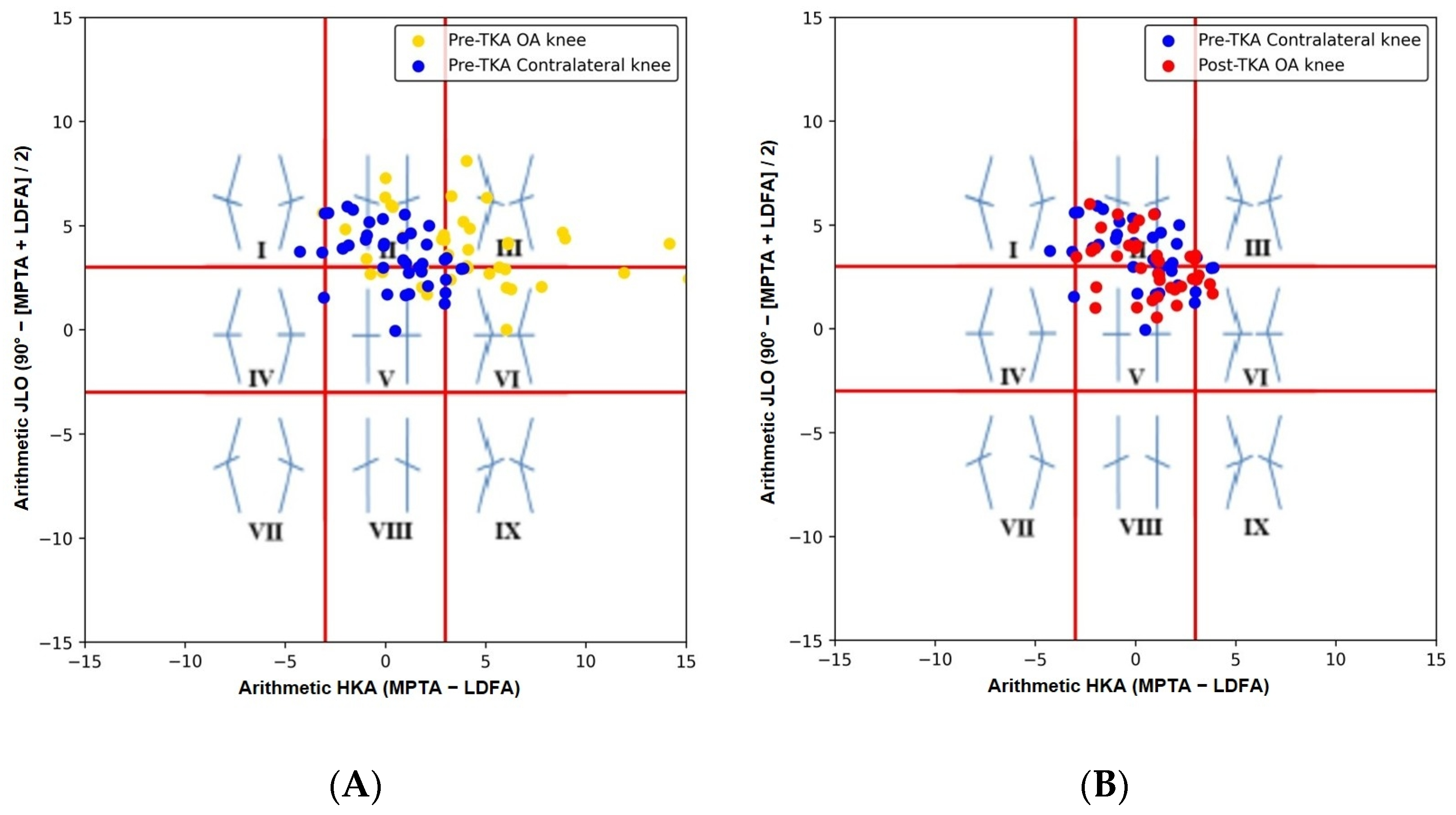
| CPAK | |||
| aHKA † | 4.0 (4.0) | 0.4 (2.1) | <0.01 |
| JLO ‡ | 3.9 (1.7) | 3.5 (1.4) | 0.041 |
| Classification § | <0.01 | ||
| I | 0 | 1 (3) | |
| II | 13 (33) | 23 (57) | |
| III | 10 (25) | 0 | |
| IV | 0 | 0 | |
| V | 6 (15) | 14 (35) | |
| VI | 11 (27) | 2 (5) | |
| Surgical Outcomes | ||||
|---|---|---|---|---|
| Medial | Lateral | p-Value | ||
| Resected osteochondral fragment (mm) | ||||
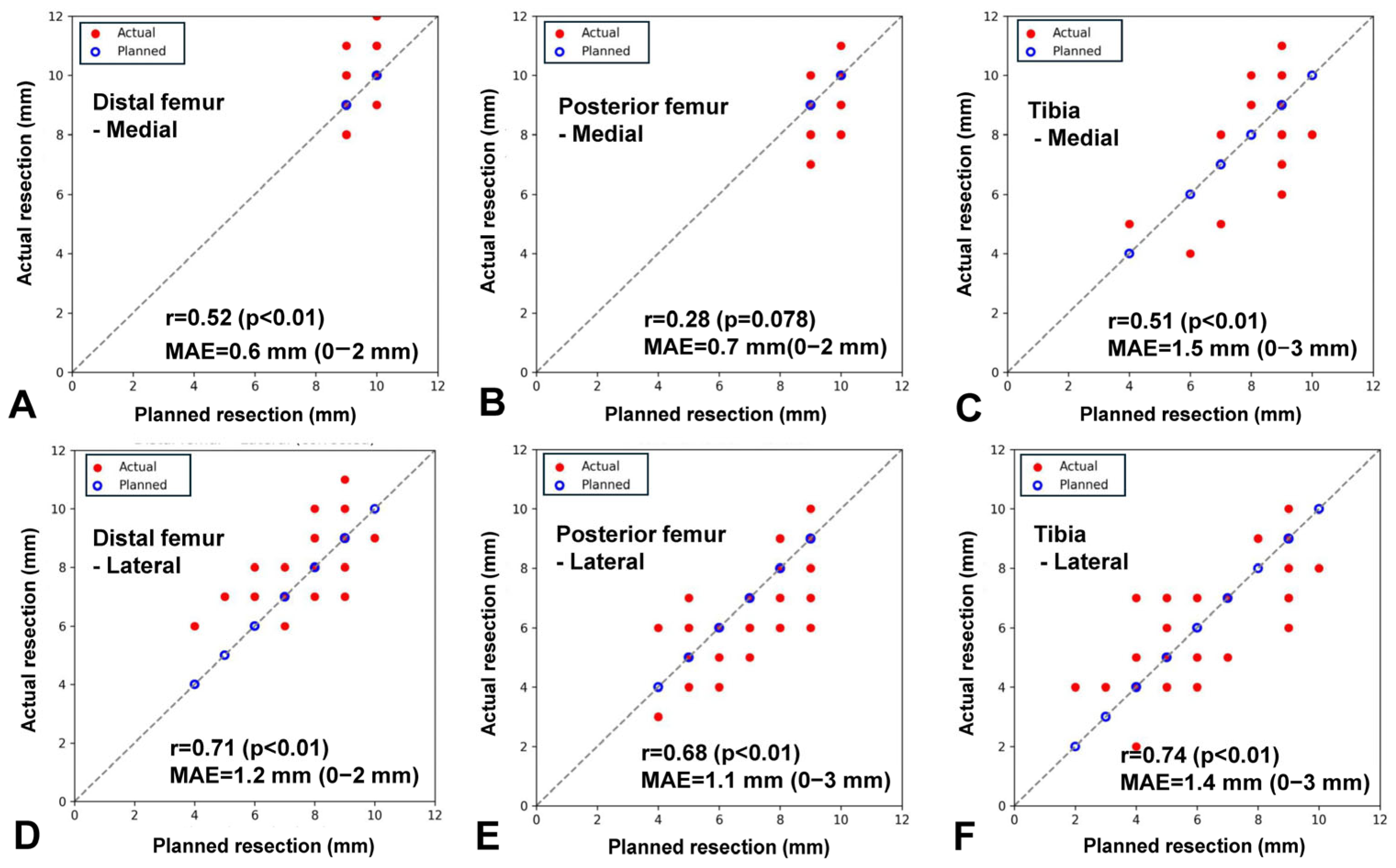
| Distal femur | 9.7 (0.9) | 7.9 (1.3) | <0.01 | |
| Posterior femur | 9.1 (0.8) | 6.3 (1.5) | <0.01 | |
| Tibia | 8.0 (1.9) | 6.0 (1.8) | <0.01 | |
| Gap (mm) | ||||
| Full extension | 11.9 (2.1) | 12.6 (2.0) | <0.01 | |
| 90° flexion | 12.8 (2.2) | 14.9 (1.9) | <0.01 | |
| Gap difference § | |Medial − Lateral| | |||
| ≤2 mm | >2 mm | |||
| Full extension | 38 (95) | 2 (5) | ||
| 90° flexion | 28 (70) | 12 (30) | ||
| Radiographic outcomes | ||||
| Operated | Contralateral | p-value | ||
| mHKA (°) † | 1.8 (2.4) | −0.9 (2.6) | <0.01 | |
| MPTA (°) | 87.3 (1.9) | 86.7 (2.0) | <0.01 | |
| LDFA (°) | 86.6 (1.4) | 86.3 (1.4) | 0.026 | |
| CPAK distribution § | 0.802 | |||
| I | 0 | 1 (3) | ||
| II | 20 (50) | 23 (57) | ||
| V | 18 (45) | 14 (35) | ||
| VI | 2 (5) | 2 (5) | ||
| n = 40 | Operated Knee | Post-TKA Status | ||||
|---|---|---|---|---|---|---|
| Preoperative | Postoperative | p-Value | Operated | Contralateral | p-Value | |
| Pain VAS | 7.3 (0.8) | 1.5 (1.6) | <0.01 | 1.5 (1.6) | 1.3 (1.6) | 0.739 |
| Satisfaction | 12.1 (4.6) | 31.2 (10.1) | <0.01 | 31.2 (10.1) | 31.4 (9.0) | 0.944 |
| EQ-5D | 9.8 (1.1) | 6.2 (1.8) | <0.01 | 6.2 (1.8) | 6.0 (1.6) | 0.719 |
| FJS | 19.7 (6.2) | 96.1 (4.3) | <0.01 | 96.1 (4.3) | 95.8 (5.1) | 0.852 |
Disclaimer/Publisher’s Note: The statements, opinions and data contained in all publications are solely those of the individual author(s) and contributor(s) and not of MDPI and/or the editor(s). MDPI and/or the editor(s) disclaim responsibility for any injury to people or property resulting from any ideas, methods, instructions or products referred to in the content. |
© 2026 by the authors. Licensee MDPI, Basel, Switzerland. This article is an open access article distributed under the terms and conditions of the Creative Commons Attribution (CC BY) license.
Share and Cite
Kim, Y.D.; Sohn, S.; Lee, S.H.; Cho, N.; Koh, I.J. Unrestricted Kinematic Alignment Is a Feasible Strategy for Lateral Compartment Osteoarthritis: Short-Term Outcomes of a Contralateral Knee-Referenced Approach. J. Clin. Med. 2026, 15, 1606. https://doi.org/10.3390/jcm15041606
Kim YD, Sohn S, Lee SH, Cho N, Koh IJ. Unrestricted Kinematic Alignment Is a Feasible Strategy for Lateral Compartment Osteoarthritis: Short-Term Outcomes of a Contralateral Knee-Referenced Approach. Journal of Clinical Medicine. 2026; 15(4):1606. https://doi.org/10.3390/jcm15041606
Chicago/Turabian StyleKim, Yong Deok, Sueen Sohn, Se Heon Lee, Nicole Cho, and In Jun Koh. 2026. "Unrestricted Kinematic Alignment Is a Feasible Strategy for Lateral Compartment Osteoarthritis: Short-Term Outcomes of a Contralateral Knee-Referenced Approach" Journal of Clinical Medicine 15, no. 4: 1606. https://doi.org/10.3390/jcm15041606
APA StyleKim, Y. D., Sohn, S., Lee, S. H., Cho, N., & Koh, I. J. (2026). Unrestricted Kinematic Alignment Is a Feasible Strategy for Lateral Compartment Osteoarthritis: Short-Term Outcomes of a Contralateral Knee-Referenced Approach. Journal of Clinical Medicine, 15(4), 1606. https://doi.org/10.3390/jcm15041606