The Concept of Psychologically Informed Heart Transplantation Care

 , , , , and
Abstract
1. Relevant Psychosocial Factors and Aspects of the Heart Transplantation Journey
- Predictors of poor post-transplant outcomes;
- Factors influencing patient knowledge, understanding, and engagement in the informed decision-making process;
- Personal, social, and environmental resources and possibilities.
2. Psychologically Informed Care
3. An Example of Practical Implementation of Psychologically Informed Transplant Care
3.1. Multidimensional Adherence Model Adapted to Heart Transplant Care
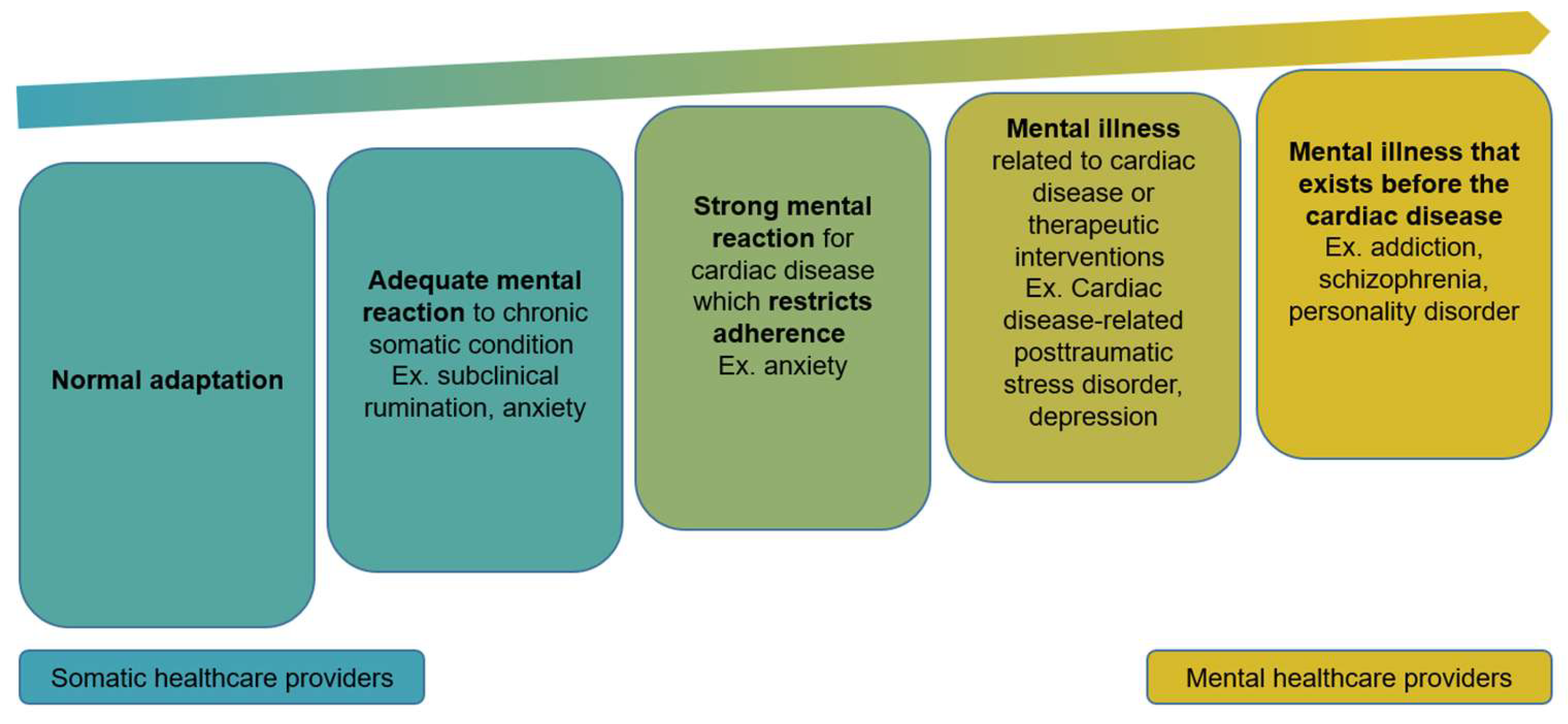
3.2. The Spectrum Approach
4. Barriers of Practical Implementation
5. Conclusions
Author Contributions
Funding
Data Availability Statement
Acknowledgments
Conflicts of Interest
Abbreviations
| LIPI | Low-Intensity Psychological Interventions |
| MAM | Multidimensional Adherence Model |
| HTX | heart transplantation |
| WHO | World Health Organization |
References
- Peled, Y.; Ducharme, A.; Kittleson, M.; Bansal, N.; Stehlik, J.; Amdani, S.; Saeed, D.; Cheng, R.; Clarke, B.; Dobbels, F.; et al. International Society for Heart and Lung Transplantation guidelines for the evaluation and care of cardiac transplant candidates—2024. J. Heart Lung Transplant. 2024, 43, 1529–1628.e54. [Google Scholar] [CrossRef] [Scilit]
- Dew, M.A.; DiMartini, A.F.; Dobbels, F.; Grady, K.L.; Jowsey-Gregoire, S.G.; Kaan, A.; Kendall, K.; Young, Q.R.; Abbey, S.E.; Butt, Z.; et al. The 2018 ISHLT/APM/AST/ICCAC/STSW Recommendations for the Psychosocial Evaluation of Adult Cardiothoracic Transplant Candidates and Candidates for Long-term Mechanical Circulatory Support. J. Heart Lung Transpl. 2018, 37, 803–823. [Google Scholar] [CrossRef] [Scilit]
- Dobbels, F.; Vanhaecke, J.; Dupont, L.; Nevens, F.; Verleden, G.; Pirenne, J.; De Geest, S. Pretransplant predictors of posttransplant adherence and clinical outcome: An evidence base for pretransplant psychosocial screening. Transplantation 2009, 87, 1497–1504. [Google Scholar] [CrossRef] [Scilit]
- Dew, M.A.; Simmons, R.G.; Roth, L.H.; Schulberg, H.C.; Thompson, M.E.; Armitage, J.M.; Griffith, B.P. Psychosocial predictors of vulnerability to distress in the year following heart transplantation. Psychol. Med. 1994, 24, 929–945. [Google Scholar] [CrossRef] [Scilit]
- Sirri, L.; Potena, L.; Masetti, M.; Tossani, E.; Magelli, C.; Grandi, S. Psychological predictors of mortality in heart transplanted patients: A prospective, 6-year follow-up study. Transplantation 2010, 89, 879–886. [Google Scholar] [CrossRef] [Scilit]
- Hammer, Y.; Gondi, K.; Larson, J.; Colvin, M.M.; Cascino, T.M.; Clarke, P.; Halben, R.; Yosef, M.; Khalatbari, S.; Aaronson, K.D. Psychosocial risk assessment for heart transplantation: Evaluating for bias and impact on posttransplant outcomes. J. Card. Fail. 2025, 32, 61–70. [Google Scholar] [CrossRef] [Scilit]
- Pennington, K.M.; Ahmed, A.; Johnson, B.K.; Yip, D.S.; Benzo, R.P.; Schneekloth, T.D.; Boilson, B.A.; Daly, R.C.; Kennedy, C.C. Emotional affect in heart transplant candidates: A multicenter longitudinal study. Front. Psychol. 2025, 16, 1608346. [Google Scholar] [CrossRef] [Scilit] [PubMed]
- Mols, R.E.; Løgstrup, B.B.; Bakos, I.; Horváth-Puhó, E.; Christensen, B.; Witt, C.T.; Schmidt, M.; Gustafsson, F.; Eiskjær, H. Individual-level socioeconomic position and long-term prognosis in Danish heart-transplant recipients. Transpl. Int. 2023, 36, 10976. [Google Scholar] [CrossRef] [Scilit] [PubMed]
- Maldonado, J.R.; Dubois, H.C.; David, E.E.; Sher, Y.; Lolak, S.; Dyal, J.; Witten, D. The Stanford Integrated Psychosocial Assessment for Transplantation (SIPAT): A new tool for the psychosocial evaluation of pre-transplant candidates. Psychosomatics 2012, 53, 123–132. [Google Scholar] [CrossRef] [Scilit] [PubMed]
- Olbrisch, M.E.; Levenson, J.L.; Hamer, R. The PACT: A rating scale for the study of clinical decision-making in psychosocial screening of organ transplant candidates. Clin. Transpl. 1989, 3, 164–169. [Google Scholar] [CrossRef] [Scilit]
- Twillman, R.K.; Manetto, C.; Wellisch, D.K.; Wolcott, D.L. The Transplant Evaluation Rating Scale. A revision of the psychosocial levels system for evaluating organ transplant candidates. Psychosomatics 1993, 34, 144–153. [Google Scholar] [CrossRef] [Scilit] [PubMed]
- Vandenbogaart, E.; Doering, L.; Chen, B.; Saltzman, A.; Chaker, T.; Creaser, J.W.; Rourke, D.; Cheng, R.W.; Fonarow, G.C.; Deng, M. Evaluation of the SIPAT instrument to assess psychosocial risk in heart transplant candidates: A retrospective single center study. Heart Lung 2017, 46, 273–279. [Google Scholar] [CrossRef] [Scilit] [PubMed]
- Kosaraju, R.; Vandenbogaart, E.; Core, E.; Creaser, J.; Livingston, N.; Moore, M.; Kamath, M.; Deng, M. Higher-risk SIPAT score predicts increased risk of long-term mortality in orthotopic heart transplant recipients. Int. J. Cardiol. 2023, 393, 131360. [Google Scholar] [CrossRef] [Scilit] [PubMed]
- Scognamiglio, P.; Tully, P.J.; Khosravi, M.; Monaco, F. Editorial: Psychometrics in psychiatry 2022: Psychological therapy and psychosomatics. Front Psychiatry 2023, 14, 1295716. [Google Scholar] [CrossRef] [Scilit]
- Stolf, N.A.G.; Sadala, M.L.A. Os significados de ter o coração transplantado: A experiência dos pacientes. Braz. J. Cardiovasc. Surg. 2006, 21, 314–323. [Google Scholar] [CrossRef] [Scilit]
- Zimbrean, P.C. Body image in transplant recipients and living organ donors. Curr. Opin. Organ. Transplant. 2015, 20, 198–210. [Google Scholar] [CrossRef] [Scilit]
- Kaba, E.; Thompson, D.R.; Burnard, P.; Edwards, D.; Theodosopoulou, E. Somebody else’s heart inside me: A descriptive study of psychological problems after a heart transplantation. Issues Ment. Health Nurs. 2005, 26, 611–625. [Google Scholar] [CrossRef] [Scilit]
- Vamos, M. Organ transplantation and magical thinking. Aust. N. Z. J. Psychiatry 2010, 44, 883–887. [Google Scholar] [CrossRef] [Scilit]
- Inspector, Y.; Kutz, I.; Daniel, D. Another person’s heart: Magical and rational thinking in the psychological adaptation to heart transplantation. Isr. J. Psychiatry 2004, 41, 161. [Google Scholar]
- Palmar-Santos, A.M.; Pedraz-Marcos, A.; Zarco-Colón, J.; Ramasco-Gutiérrez, M.; García-Perea, E.; Pulido-Fuentes, M. The life and death construct in heart transplant patients. Eur. J. Cardiovasc. Nurs. 2019, 18, 48–56. [Google Scholar] [CrossRef] [Scilit]
- Rosson, S.; Monaco, F.; Miola, A.; Cascino, G.; Stubbs, B.; Correll, C.U.; Firth, J.; Ermis, C.; Perrotti, A.; Marciello, F.; et al. Longitudinal course of depressive, anxiety, and posttraumatic stress disorder symptoms after heart surgery: A meta-analysis of 94 studies. Biopsychosoc. Sci. Med. 2021, 83, 85–93. [Google Scholar] [CrossRef] [Scilit] [PubMed]
- Tigges-Limmer, K.; Sitzer, M.; Gummert, J. Perioperative psychological interventions in heart surgery: Opportunities and clinical benefit. Dtsch. Ärzteblatt Int. 2021, 118, 339. [Google Scholar] [CrossRef] [Scilit]
- Laskowski, N.M.; Brandt, G.; Tigges-Limmer, K.; Halbeisen, G.; Paslakis, G. Donor and Donation Images (DDI)-A Scoping Review of What We Know and What We Don’t. J. Clin. Med. 2023, 12, 952. [Google Scholar] [CrossRef] [Scilit] [PubMed]
- Laskowski, N.M.; Halbeisen, G.; Wahlers, L.; Tigges-Limmer, K.; Paslakis, G. A large cross-sectional study on the prevalence and predictors of donor and donation images in patients after heart transplantation. Sci. Rep. 2025, 15, 21174. [Google Scholar] [CrossRef] [Scilit]
- Könczei, G. A (komplex) rehabilitáció alapjai. In Bevezetés a Komplex Rehabilitációba: Szöveggyűjtemény; Kullmann, L., Ed.; ELTE Bárczi Gusztáv Gyógypedagógiai Kar: Budapest, Hungary, 2009; 16p. [Google Scholar]
- Rivera, E.L.; Aponte, J.; Montes, M.C.; Adams, C.D.; Gómez-Mesa, J.E. Factors associated with return to work after heart transplantation: A systematic review of the literature. Am. J. Med. Sci. 2021, 362, 586–591. [Google Scholar] [CrossRef] [Scilit]
- Velleca, A.; Shullo, M.A.; Dhital, K.; Azeka, E.; Colvin, M.; DePasquale, E.; Farrero, M.; García-Guereta, L.; Jamero, G.; Khush, K.; et al. The International Society for Heart and Lung Transplantation (ISHLT) guidelines for the care of heart transplant recipients. J. Heart Lung. Transplant. 2023, 42, e1–e141. [Google Scholar] [CrossRef] [Scilit]
- Mejia, E.J.; Kugler, C.; Blume, E. Palliative care for the cardiothoracic transplant recipient. J. Heart Lung Transplant. 2025, 9, 100329. [Google Scholar] [CrossRef] [Scilit]
- Cajita, M.I.; Baumgartner, E.; Berben, L.; Denhaerynck, K.; Helmy, R.; Schönfeld, S.; Berger, G.; Vetter, C.; Dobbels, F.; Russell, C.L.; et al. Heart transplant centers with multidisciplinary team show a higher level of chronic illness management–Findings from the International BRIGHT Study. Heart Lung 2017, 46, 351–356. [Google Scholar] [CrossRef] [Scilit]
- Roussel, M.G.; Gorham, N.; Wilson, L.; Mangi, A.A. Improving recovery time following heart transplantation: The role of the multidisciplinary health care team. J. Multidiscip. Healthc. 2013, 6, 293–302. [Google Scholar] [CrossRef] [Scilit]
- Dekker, J.; Sears, S.F.; Åsenlöf, P.; Berry, K. Psychologically informed health care. Transl. Behav. Med. 2023, 13, 289–296. [Google Scholar] [CrossRef] [Scilit]
- Petrozzi, M.J.; Spencer, G.; Mackey, M.G. A process evaluation of the Mind Your Back trial examining psychologically informed physical treatments for chronic low back pain. Chiropr. Man. Ther. 2021, 29, 32. [Google Scholar] [CrossRef] [Scilit] [PubMed]
- Bishop, M.D.; Simon, C.B.; Huo, Y.; Wallace, M.R.; Borsa, P.A.; Fillingim, R.B.; Staud, R.; Wu, S.S.; George, S.Z. Impact of Propranolol and Psychologically Informed Intervention on Pain Sensitivity: Secondary Analysis from the Biopsychosocial Influence on Shoulder Pain Preclinical Randomized Trial. J. Pain Res. 2025, 18, 1837–1850. [Google Scholar] [CrossRef] [Scilit] [PubMed]
- Campello, M.; Ziemke, G.; Hair, L.C.; Oh, C.; Mowery, H.; Hope, T.; Weiser, S. Protocol for the implementation of psychologically informed physical therapy to prevent chronification in service members with musculoskeletal disorders. Mil. Med. 2023, 188, 503–510. [Google Scholar] [CrossRef] [Scilit] [PubMed]
- Williams, M.K.; Waite, L.; Van Wyngaarden, J.J.; Meyer, A.R.; Koppenhaver, S.L. Beyond yellow flags: The Big-Five personality traits and psychologically informed musculoskeletal rehabilitation. Musculoskelet. Care 2023, 21, 1161–1174. [Google Scholar] [CrossRef] [Scilit]
- Mumford, E.; Schlesinger, H.J.; Glass, G.V. The effect of psychological intervention on recovery from surgery and heart attacks: An analysis of the literature. Am. J. Public Health 1982, 72, 141–151. [Google Scholar] [CrossRef] [Scilit]
- Holdgaard, A.; Eckhardt-Hansen, C.; Lassen, C.F.; Kjesbu, I.E.; Dall, C.H.; Michaelsen, K.L.; Sibilitz, K.L.; Prescott, E.; Rasmusen, H.K. Cognitive-behavioural therapy reduces psychological distress in younger patients with cardiac disease: A randomized trial. Eur. Heart J. 2023, 44, 986–996. [Google Scholar] [CrossRef] [Scilit]
- Jiang, Y.; Shorey, S.; Seah, B.; Chan, W.X.; San Tam, W.W.; Wang, W. The effectiveness of psychological interventions on self-care, psychological and health outcomes in patients with chronic heart failure—A systematic review and meta-analysis. Int. J. Nurs. Stud. 2018, 78, 16–25. [Google Scholar] [CrossRef] [Scilit]
- Tyrer, H.; Tyrer, P.; Lisseman-Stones, Y.; McAllister, S.; Cooper, S.; Salkovskis, P.; Crawford, M.J.; Dupont, S.; Green, J.; Murphy, D.; et al. Therapist differences in a randomised trial of the outcome of cognitive behaviour therapy for health anxiety in medical patients. Int. J. Nurs. Stud. 2015, 52, 686–694. [Google Scholar] [CrossRef] [Scilit]
- Dekker, J.; Karchoud, J.; Braamse, A.M.J.; Buiting, H.; Konings, I.R.H.M.; van Linde, M.E.; Schuurhuizen, C.S.E.W.; Sprangers, M.A.G.; Beekman, A.T.F.; Verheul, H.M.W. Clinical management of emotions in patients with cancer: Introducing the approach “emotional support and case finding”. Transl. Behav. Med. 2020, 10, 1399–1405. [Google Scholar] [CrossRef] [Scilit]
- Karchoud, J.F.; de Kruif, A.J.T.C.M.; Lamers, F.; van Linde, M.E.; van Dodewaard-de Jong, J.M.; Braamse, A.M.J.; Sprangers, M.A.G.; Beekman, A.T.F.; Verheul, H.M.W.; Dekker, J. Clinical judgment of the need for professional mental health care in patients with cancer: A qualitative study among oncologists and nurses. J. Cancer Surviv. 2023, 17, 884–893. [Google Scholar] [CrossRef] [Scilit]
- Sabaté, E. Adherence to Long-Term Therapies: Evidence for Action; World health Organization: Geneva, Switzerland, 2003. [Google Scholar]
- Shemesh, Y.; Peles-Bortz, A.; Peled, Y.; HarZahav, Y.; Lavee, J.; Freimark, D.; Melnikov, S. Feelings of indebtedness and guilt toward donor and immunosuppressive medication adherence among heart transplant (HT x) patients, as assessed in a cross-sectional study with the Basel Assessment of Adherence to Immunosuppressive Medications Scale (BAASIS). Clin. Transplant. 2017, 31, e13053. [Google Scholar] [CrossRef] [Scilit]
- Sadala, M.L.; Stolf, N.A. Heart transplantation experiences: A phenomenological approach. J. Clin. Nurs. 2008, 17, 217–225. [Google Scholar] [CrossRef] [Scilit] [PubMed]
- Nieuwlaat, R.; Wilczynski, N.; Navarro, T.; Hobson, N.; Jeffery, R.; Keepanasseril, A.; Agoritsas, T.; Mistry, N.; Iorio, A.; Jack, S.; et al. Interventions for enhancing medication adherence. Cochrane Database Syst. Rev. 2014, 2014, CD000011. [Google Scholar] [CrossRef] [Scilit] [PubMed]
- Nunes, V.; Neilson, J.; O’Flynn, N.; Calvert, N.; Kuntze, S.; Smithson, H.; Benson, J.; Blair, J.; Bowser, A.; Clyne, W.; et al. Medicines Adherence: Involving Patients in Decisions About Prescribed Medicines and Supporting Adherence; NICE: London, UK, 2009. [Google Scholar]
- Torres-Robles, A.; Wiecek, E.; Tonin, F.S.; Benrimoj, S.I.; Fernandez-Llimos, F.; Garcia-Cardenas, V. Comparison of interventions to improve long-term medication adherence across different clinical conditions: A systematic review with network meta-analysis. Front. Pharmacol. 2018, 9, 1454. [Google Scholar] [CrossRef] [Scilit] [PubMed]
- Reach, G. The Mental Mechanisms of Patient Adherence to Long-Term Therapies. In Philosophy and Medicine; Springer: Cham, Switzerland, 2015. [Google Scholar]
- Horne, R.; Cooper, V.; Wileman, V.; Chan, A. Supporting adherence to medicines for long-term conditions. Eur. Psychol. 2019, 24, 82–96. [Google Scholar] [CrossRef] [Scilit]
- McCarthy, C.P.; Bruno, R.M.; McEvoy, J.W.; Touyz, R.M. 2024 ESC Guidelines for the Management of Elevated Blood Pressure and Hypertension: What Is New in Pharmacotherapy? Oxford University Press: Oxford, UK, 2025. [Google Scholar]
- Springfield-Trice, S.; Reddy, G.; Joyce, C.; Garcia, B.M.; Shah, P.; Agbor-Enoh, S.; Valantine, H. Barriers to Immunosuppressant Medication Adherence in Thoracic Transplant Recipients: Initial Findings. Int. J. Environ. Res. Public Health 2025, 22, 1090. [Google Scholar] [CrossRef] [Scilit]
- Al-Saleh, S.; Conley, S.; Pace, T.; Insel, K.C. A Cross-Sectional Study of Cognitive Function, Illness Perceptions, and Immunosuppression Medication Adherence After Heart Transplantation. West. J. Nurs. Res. 2024, 46, 164–171. [Google Scholar] [CrossRef] [Scilit]
- Saglam Aksut, R.; Yavuz, B.; Aksut, M.; Gunay, D.; Kirali, M.K. Symptoms Experienced at Home and Self-Care Requisites of Patients After Heart Transplantation: A Retrospective Study. Home Health Care Manag. Pract. 2024, 36, 54–60. [Google Scholar] [CrossRef] [Scilit]
- Heilmann, C.; Kuijpers, N.; Beyersdorf, F.; Berchtold-Herz, M.; Trummer, G.; Stroh, A.L.; Schlensak, C.; Fritzsche, K. Supportive psychotherapy for patients with heart transplantation or ventricular assist devices. Eur. J. Cardio-Thorac. Surg. 2011, 39, e44–e50. [Google Scholar] [CrossRef] [Scilit]
- Jindal, R.M.; Neff, R.T.; Abbott, K.C.; Hurst, F.P.; Elster, E.A.; Falta, E.M.; Patel, P.; Cukor, D. Association between depression and nonadherence in recipients of kidney transplants: Analysis of the United States renal data system. Transplant Proc. 2009, 41, 3662–3666. [Google Scholar] [CrossRef] [Scilit]
- Doesch, A.O.; Müller, S.; Konstandin, M.; Celik, S.; Erbel, C.; Kristen, A.; Frankenstein, L.; Koch, A.; Dengler, T.J.; Ehlermann, P.; et al. Increased adherence after switch from twice daily calcineurin inhibitor based treatment to once daily modified released tacrolimus in heart transplantation: A pre-experimental study. Transplant. Proc. 2010, 42, 4238–4242. [Google Scholar] [CrossRef] [Scilit]
- Dobbels, F.; De Bleser, L.; Berben, L.; Kristanto, P.; Dupont, L.; Nevens, F.; Vanhaecke, J.; Verleden, G.; De Geest, S. Efficacy of a medication adherence enhancing intervention in transplantation: The MAESTRO-Tx trial. J. Heart Lung Transplant. 2017, 36, 499–508. [Google Scholar] [CrossRef] [Scilit] [PubMed]
- Prom, A.; Ricciuti, D.; Walter, K.; Newman, J.; Doligalski, C. Impact of a clinical pharmacist in an outpatient heart transplant clinic. J. Am. Coll. Clin. Pharm. 2021, 4, 1511–1515. [Google Scholar] [CrossRef] [Scilit]
- Schneider, M.P.; Krummenacher, I.; Figueiredo, H.; Marquis, J.; Bugnon, O. Adherence: A review of education, research, practice and policy in Switzerland. Pharm. Pract. 2009, 7, 63. [Google Scholar] [CrossRef] [Scilit] [PubMed]
- Stadarts, I. ISHLT Guidelines for the Care of Heart Transplant Recipients; University of Alabama at Birmingham Division of Cardiothoracic surgery: Birmingham, AL, USA, 2012. [Google Scholar]
- Grossi, A.A. Shared Decision-Making in Solid Organ Transplantation: A Review. Transplantology 2025, 6, 1. [Google Scholar] [CrossRef] [Scilit]
- Dennison Himmelfarb, C.R.; Beckie, T.M.; Allen, L.A.; Commodore-Mensah, Y.; Davidson, P.M.; Lin, G.; Lutz, B.; Spatz, E.S. Shared decision-making and cardiovascular health: A scientific statement from the American Heart Association. Circulation 2023, 148, 912–931. [Google Scholar] [CrossRef] [Scilit]
- Simonenko, M.; Hansen, D.; Niebauer, J.; Volterrani, M.; Adamopoulos, S.; Amarelli, C.; Ambrosetti, M.; Anker, S.D.; Bayes-Genis, A.; Ben Gal, T.; et al. Prevention and rehabilitation after heart transplantation: A clinical consensus statement of the European Association of Preventive Cardiology, Heart Failure Association of the ESC, and the European Cardio Thoracic Transplant Association, a section of ESOT. Eur. J. Prev. Cardiol. 2024, 31, 1385–1399. [Google Scholar] [CrossRef] [Scilit]
- Denhaerynck, K.; Berger Wermuth, G.; Dobbels, F.; Berben, L.; Russell, C.L.; De Geest, S. International Variability of Barriers to Adherence to Immunosuppressive Medication in Adult Heart Transplant Recipients. A Secondary Data Analysis of the BRIGHT Study. Transpl. Int. 2024, 37, 12874. [Google Scholar] [CrossRef] [Scilit]
- Assabiny, A.; Otohal, J.; Ocsovszky, Z.; Nagy, A.F.; Papp-Zipernovszky, O.; Dénes, F.; Becker, D.; Merkely, B.; Pethesné Dávid, B.; Sax, B. Peer mentor programs in adult heart transplant population. Orvosi Hetil. 2024, 165, 379–384. [Google Scholar] [CrossRef] [Scilit]
- Suszycki, L.H.; Midelfort, J.; Gibson, J.; Lysandrou, S. Social workers’ responsibilities in heart transplantation programs. Prog. Cardiovasc. Dis. 1990, 33, 35–48. [Google Scholar] [CrossRef] [Scilit]
- De Ridder, D.; Geenen, R.; Kuijer, R.; Van Middendorp, H. Psychological adjustment to chronic disease. Lancet 2008, 372, 246–255. [Google Scholar] [CrossRef] [Scilit] [PubMed]
- Schulz, K.-H.; Kroencke, S. Psychosocial challenges before and after organ transplantation. Transpl. Res. Risk Manag. 2015, 7, 45–58. [Google Scholar] [CrossRef] [Scilit]
- Paris, W.; White-Williams, C. Social adaptation after cardiothoracic transplantation: A review of the literature. J. Cardiovasc. Nurs. 2005, 20, S67–S73. [Google Scholar] [CrossRef] [Scilit] [PubMed]
- Giovannico, L.; Ladisa, V.; De Santis, S.; Fischetti, G.; Parigino, D.; Savino, L.; Mazzone, F.; Di Bari, N.; Padalino, M.; Bottio, T. Mental Health Support for Heart Transplant Recipients and Candidates: Nurturing Well-Being Beyond Surgery. Transplantology 2025, 6, 22. [Google Scholar] [CrossRef] [Scilit]
- Jiakponna, E.C.; Agbomola, J.O.; Ipede, O.; Karakitie, L.; Ogunsina, A.; Adebayo, K.; Tinuoye, M.O. Psychosocial factors in chronic disease management: Implications for health psychology. Int. J. Sci. Res. Arch. 2024, 12, 117–128. [Google Scholar] [CrossRef] [Scilit]
- Pfeifer, P.M.; Ruschel, P.P.; Bordignon, S. Coping strategies after heart transplantation: Psychological implications. Braz. J. Cardiovasc. Surg. 2013, 28, 61–68. [Google Scholar] [CrossRef] [Scilit]
- Mierzyńska, A.; Kokoszka, A.; Jerzak-Wodzyńska, G.; Sobieszczańska-Małek, M.; Zieliński, T.; Piotrowicz, R. Involvement in health behavior after heart transplantation: The role of personal resources and health status. Single-center observational study. Front. Psychol. 2021, 12, 710870. [Google Scholar] [CrossRef] [Scilit]
- Tulloch, H.; Greenman, P.S.; Tassé, V. Post-Traumatic Stress Disorder among Cardiac Patients: Prevalence, Risk Factors, and Considerations for Assessment and Treatment. Behav. Sci. 2015, 5, 27–40. [Google Scholar] [CrossRef] [Scilit]
- Favaro, A.; Gerosa, G.; Caforio, A.L.; Volpe, B.; Rupolo, G.; Zarneri, D.; Boscolo, S.; Pavan, C.; Tenconi, E.; d’Agostino, C.; et al. Posttraumatic stress disorder and depression in heart transplantation recipients: The relationship with outcome and adherence to medical treatment. Gen. Hosp. Psychiatry 2011, 33, 1–7. [Google Scholar] [CrossRef] [Scilit]
- Götzmann, L.; Schnyder, U. Posttraumatic stress disorder (PTSD) after heart transplant: The influence of earlier loss experiences on posttransplant flashbacks. Am. J. Psychother. 2002, 56, 562–567. [Google Scholar] [CrossRef] [Scilit]
- Alzhrani, O.; Agarwal, K.; Fida, N. Management of Heart Failure in Older Adults with Dementia. Dementia and Chronic Disease: Management of Comorbid Medical Conditions; Springer: Berlin/Heidelberg, Germany, 2020; pp. 53–76. [Google Scholar]
- Heckman, G.A.; Patterson, C.J.; Demers, C.; St Onge, J.; Turpie, I.D.; McKelvie, R.S. Heart failure and cognitive impairment: Challenges and opportunities. Clin. Interv. Aging 2007, 2, 209–218. [Google Scholar]
- Bürker, B.S.; Gude, E.; Gullestad, L.; Grov, I.; Relbo Authen, A.; Andreassen, A.K.; Havik, O.E.; Dew, M.A.; Fiane, A.E.; Haraldsen, I.R. Cognitive function among long-term survivors of heart transplantation. Clin. Transplant. 2017, 31, e13143. [Google Scholar] [CrossRef] [Scilit]
- Nishimura, M.; Bhatia, H.; Ma, J.; Dickson, S.D.; Alshawabkeh, L.; Adler, E.; Maisel, A.; Criqui, M.H.; Greenberg, B.; Thomas, I.C. The impact of substance abuse on heart failure hospitalizations. Am. J. Med. 2020, 133, 207–213.e1. [Google Scholar] [CrossRef] [Scilit]
- Grubb, A.F.; Greene, S.J.; Fudim, M.; Dewald, T.; Mentz, R.J. Drugs of Abuse and Heart Failure. J. Card. Fail. 2021, 27, 1260–1275. [Google Scholar] [CrossRef] [Scilit] [PubMed]
- Hanrahan, J.S.; Eberly, C.; Mohanty, P.K. Substance abuse in heart transplant recipients: A 10-year follow-up study. Prog. Transplant. 2001, 11, 285–290. [Google Scholar] [CrossRef] [Scilit] [PubMed]
- Grzyb, C.; Du, D.; Mahesh, B.; Nair, N. Mental health and substance use disorders in transplant waitlist, VAD, and heart transplant patients: A TriNetX database analysis. J. Clin. Med. 2024, 13, 3151. [Google Scholar] [CrossRef] [Scilit] [PubMed]
- Tully, P.J.; Selkow, T. Personality disorders in heart failure patients requiring psychiatric management: Comorbidity detections from a routine depression and anxiety screening protocol. Psychiatry Res. 2014, 220, 954–959. [Google Scholar] [CrossRef] [Scilit]
- Kuntz, K.K.; Engel, K.L. Personality Disorders in Transplant Candidates and Recipients. In Transplant Psychiatry: A Case-Based Approach to Clinical Challenges; Springer: Cham, Switzerland, 2023; pp. 59–64. [Google Scholar]
- Dobbels, F.; Put, C.; Vanhaecke, J. Personality disorders: A challenge for transplantation. Prog. Transplant. 2000, 10, 226–232. [Google Scholar] [CrossRef] [Scilit]
- Wakefield, S.; Kellett, S.; Simmonds-Buckley, M.; Stockton, D.; Bradbury, A.; Delgadillo, J. Improving Access to Psychological Therapies (IAPT) in the United Kingdom: A systematic review and meta-analysis of 10-years of practice-based evidence. Br. J. Clin. Psychol. 2021, 60, 1–37. [Google Scholar] [CrossRef] [Scilit]
- Bower, P.; Kontopantelis, E.; Sutton, A.; Kendrick, T.; Richards, D.A.; Gilbody, S.; Knowles, S.; Cuijpers, P.; Andersson, G.; Christensen, H.; et al. Influence of initial severity of depression on effectiveness of low intensity interventions: Meta-analysis of individual patient data. BMJ 2013, 346, f540. [Google Scholar] [CrossRef] [Scilit]
- Dawson, K.S.; Bryant, R.A.; Harper, M.; Tay, A.K.; Rahman, A.; Schafer, A.; van Ommeren, M. Problem Management Plus (PM+): A WHO transdiagnostic psychological intervention for common mental health problems. World Psychiatry 2015, 14, 354. [Google Scholar] [CrossRef] [Scilit] [PubMed]
- WHO. WHO Menu of Cost-Effective Interventions for Mental Health; World Health Organization: Geneva, Switzerland, 2021. [Google Scholar]
- Rajasree Katta, M.; Prasad, S.; Tiwari, A.; Abdelgawad Abouzid, M.R.; Mitra, S. The effectiveness of cognitive-behavioral therapy for heart failure patients: A narrative review. J. Int. Med. Res. 2023, 51, 03000605231198371. [Google Scholar] [CrossRef] [Scilit]
- Nuraeni, A.; Suryani, S.; Trisyani, Y.; Sofiatin, Y. Efficacy of cognitive behavior therapy in reducing depression among patients with coronary heart disease: An updated systematic review and meta-analysis of RCTs. Healthcare 2023, 11, 943. [Google Scholar] [CrossRef] [Scilit]
- Huffman, J.C.; Adams, C.N.; Celano, C.M. Collaborative Care and Related Interventions in Patients with Heart Disease: An Update and New Directions. Psychosomatics 2018, 59, 1–18. [Google Scholar] [CrossRef] [Scilit]
- Nilsen, P. Making sense of implementation theories, models and frameworks. Implement. Sci. 2015, 10, 53. [Google Scholar] [CrossRef] [Scilit] [PubMed] [PubMed Central]
- Grol, R.; Wensing, M. What drives change? Barriers to and incentives for achieving evidence-based practice. Med. J. Aust. 2004, 180, S57–S60. [Google Scholar] [CrossRef] [Scilit] [PubMed]


| MAM Dimension | Factor- Related Content | HTX Specificity | Potential Barriers to Adherence | Evidence-Based Interventions |
|---|---|---|---|---|
| Patient-related | Gender, Age, Attitudes, Knowledge [42] | misbeliefs of the donated heart: donor and donation images; psychological acceptance of the new heart; emotional connection with the donor (feeling of guilt); recovered patient phenomena; misbeliefs and misinformation about medications; HTX-specific patient education; cognitive status; psychological conditions, psychiatric comorbidities [4,43,44,45,46,47,48,49,50] | Lack of motivation or self-efficacy; beliefs and concerns; cognitive impairments; depression, anxiety [4,43,44,45,46,47,48,49,50] | Motivational interviewing, problem-solving training, digital reminders, combined education and behavior change counseling, psychological support [4,43,44,45,46,47,48,49,50] |
| Condition-related | Symptom severity, Comorbidity [42] | progression of rehabilitation–increase in physical capacity; body and visceral sensations connected to the new heart; affective status connected to somatic experiences; post-transplant affective and anxiety disorders, recognizing the signs of rejection or other malformations that can cause rejection; [50,51,52,53,54,55] | Asymptomatic chronic conditions → low risk perception; comorbidities; disease fluctuation, post-transplant depression, and its effect on cognitive function [50,51,52,53,54,55] | Self-monitoring (e.g., home blood pressure/glucose); regular feedback; condition-specific education; psychological check-ups, parallel to medical check-ups; and supportive therapy [50,51,52,53,54,55] |
| Treatment-related | Complexity of Medication, Dose, Frequency [42] | life-long immunosuppression; deep understanding of medications; HTX-specific diet and rules; medication flavor and dosage; type of formulations, frequency of administration, product-related considerations; multimorbidity caused by medication side effects [56,57,58,59] | Polypharmacy; complex dosing regimen; side effects; parenteral/compound formulations [56,57,58,59] | Regimen simplification (once daily; fixed-dose combinations); packaged dosing; reminders; side effect management; pharmacist review, clinical pharmacist in HTX care team [56,57,58,59] |
| Healthcare team/system- related | Patient–provider relationship [42] | lack of HTX-specific training; lack of HTX-specific research evidence; lack of HTX-specific training material and protocols; poor physician–patient relationship, lack of continuity in medical practice and availability of the medical team; lack of time for healthcare providers to inform patients [60,61,62] | Fragmented care, access difficulties, poor doctor–patient communication, non-standardized processes [60,61,62] | Team-based care, pharmaceutical care, standardized protocols, simplified appointment scheduling, and shared decision making [60,61,62] |
| Social/economic factors | Education, Ethnicity, Financial status, Social support [42] | high ratio of heart muscle damage leading to HTX is linked to socioeconomic status; high ratio of HTX in vulnerable groups; cultural aspects of illness; poor living conditions; low level of health literacy; culture of empathy and providing support; misbeliefs on HTX overprotection as a barrier to reintegration [8,30,63,64,65,66] | Low income, low health literacy, weak social support, and logistical or cost barriers [8,30,63,64,65,66] | Family/peer support programs, cost reduction (generic and subsidized drugs), a social worker on the team, health literacy intervention [8,30,63,64,65,66] |
Disclaimer/Publisher’s Note: The statements, opinions and data contained in all publications are solely those of the individual author(s) and contributor(s) and not of MDPI and/or the editor(s). MDPI and/or the editor(s) disclaim responsibility for any injury to people or property resulting from any ideas, methods, instructions or products referred to in the content. |
© 2026 by the authors. Licensee MDPI, Basel, Switzerland. This article is an open access article distributed under the terms and conditions of the Creative Commons Attribution (CC BY) license.
Share and Cite
Assabiny, A.; Ocsovszky, Z.; Ehrenberger, B.; Otohal, J.; Papp-Zipernovszky, O.; Merkely, B.; Sax, B.; Purebl, G. The Concept of Psychologically Informed Heart Transplantation Care. J. Clin. Med. 2026, 15, 1592. https://doi.org/10.3390/jcm15041592
Assabiny A, Ocsovszky Z, Ehrenberger B, Otohal J, Papp-Zipernovszky O, Merkely B, Sax B, Purebl G. The Concept of Psychologically Informed Heart Transplantation Care. Journal of Clinical Medicine. 2026; 15(4):1592. https://doi.org/10.3390/jcm15041592
Chicago/Turabian StyleAssabiny, Alexandra, Zsófia Ocsovszky, Blanka Ehrenberger, József Otohal, Orsolya Papp-Zipernovszky, Béla Merkely, Balázs Sax, and György Purebl. 2026. "The Concept of Psychologically Informed Heart Transplantation Care" Journal of Clinical Medicine 15, no. 4: 1592. https://doi.org/10.3390/jcm15041592
APA StyleAssabiny, A., Ocsovszky, Z., Ehrenberger, B., Otohal, J., Papp-Zipernovszky, O., Merkely, B., Sax, B., & Purebl, G. (2026). The Concept of Psychologically Informed Heart Transplantation Care. Journal of Clinical Medicine, 15(4), 1592. https://doi.org/10.3390/jcm15041592