Artificial Intelligence in Rhinoplasty Recovery: Linguistic Intelligence and Machine Learning-Driven Insights
 , , , , ,
Abstract
1. Introduction
2. Materials and Methods
2.1. Study Design and Objective
2.2. ChatGPT-4 Response Generation
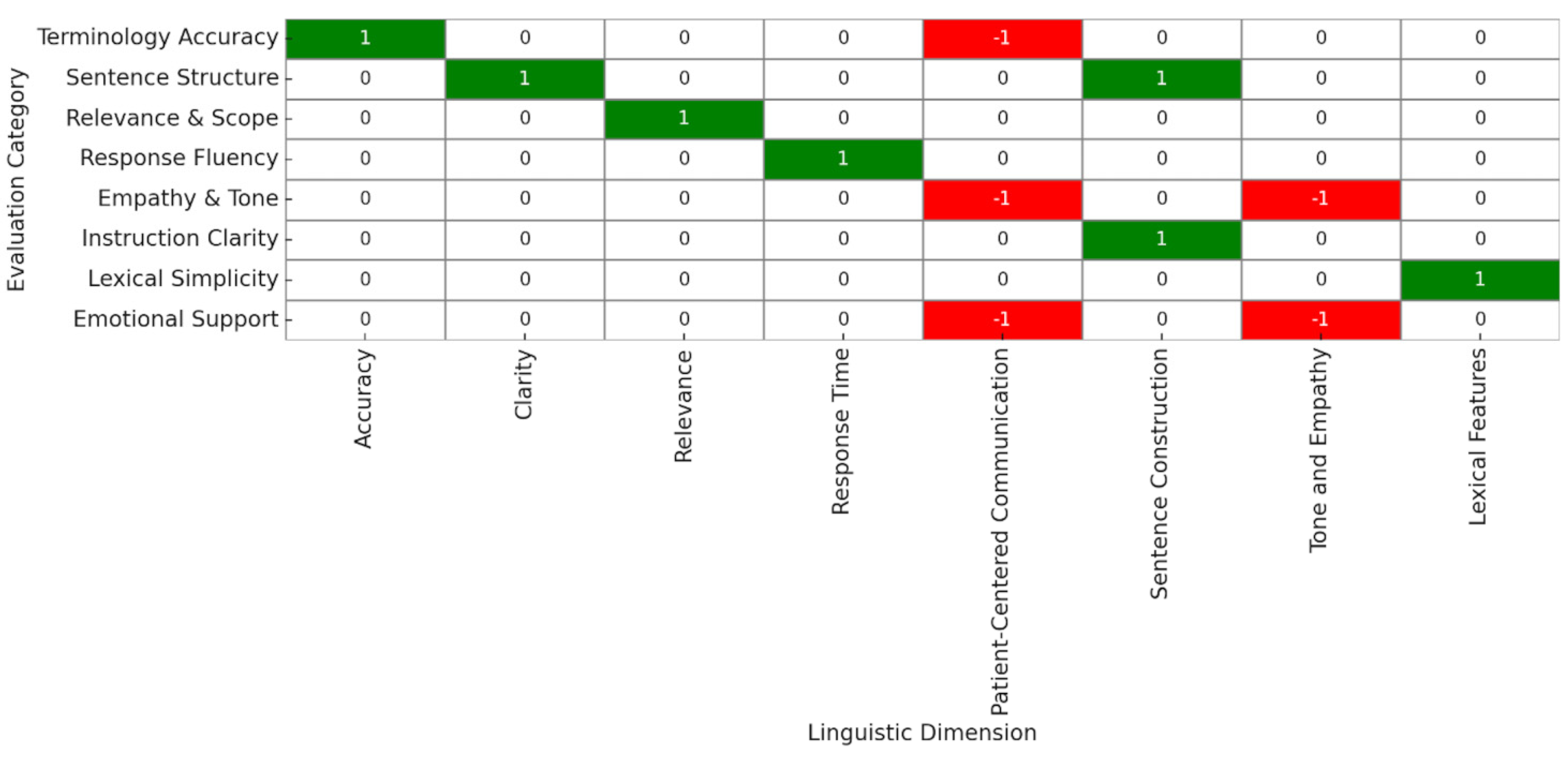
2.3. Linguistic and Domain-Specific Evaluation
- Accuracy—alignment with evidence-based clinical standards.
- Response Time—rapidity of answer generation.
- Clarity and Understandability—linguistic simplicity and readability for non-specialist audiences.
- Relevance—alignment with the core postoperative concern in question.
- Patient-Centered Communication—empathy, supportive tone, and suitability for patient engagement.
2.4. AIPI Framework for Structured Clinical Scoring
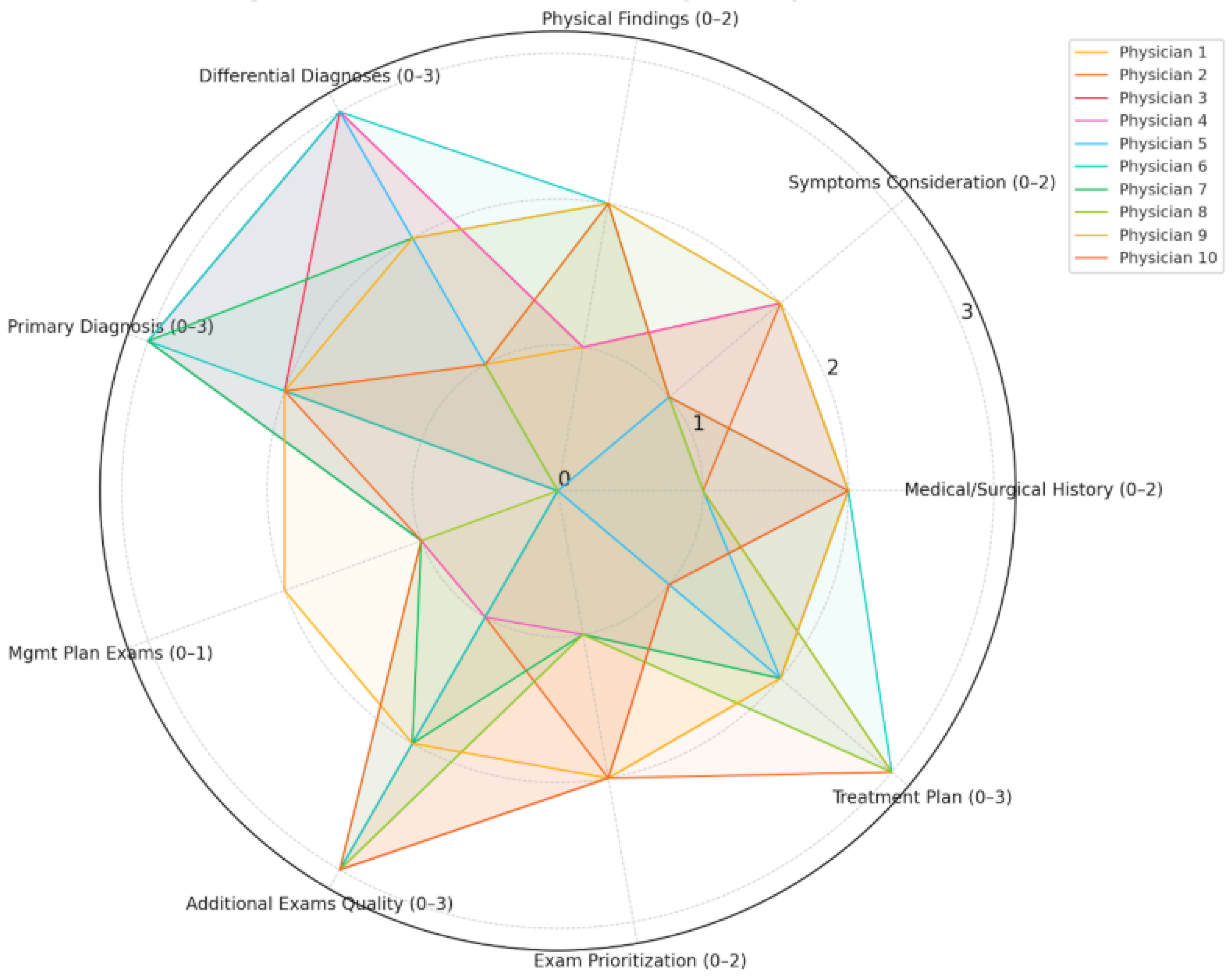
- Medical/Surgical History Consideration (0–2).
- Symptom Consideration (0–2).
- Physical Findings Interpretation (0–2).
- Differential Diagnosis (0–3).
- Primary Diagnosis Formulation (0–3).
2.5. Machine Learning Analysis
- Preprocessing and Normalization: All numerical features (Likert scores, AIPI subdomains, and linguistic metrics such as word count and sentiment polarity) were standardized using a Z-score transformation.
- Dimensionality Reduction: PCA was employed to reduce feature dimensionality while preserving variance.
- Unsupervised Clustering: K-Means and t-SNE clustering techniques were used to identify subgroup patterns in evaluator scoring.
- Predictive Modeling: A Random Forest classifier was trained to classify AIPI outcomes using a combination of linguistic and clinical features.
- Feature Importance: SHAP values and permutation importance analyses identified key variables influencing AIPI score predictions.
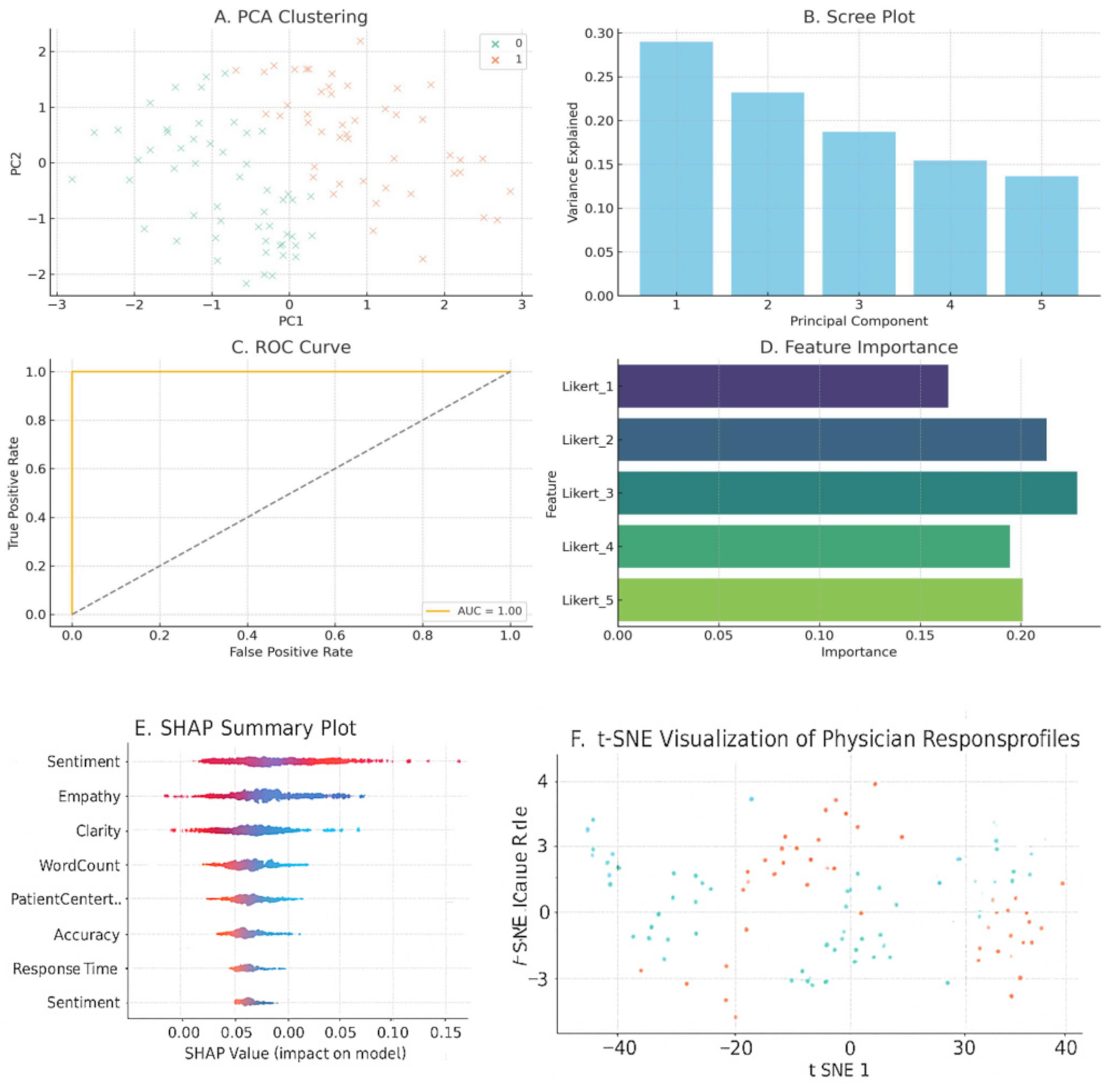
- Visualization: The results were summarized in a composite, which showcased PCA variance, clustering, model performance (ROC curve), and predictor ranking.
3. Statistical Analysis
4. Results
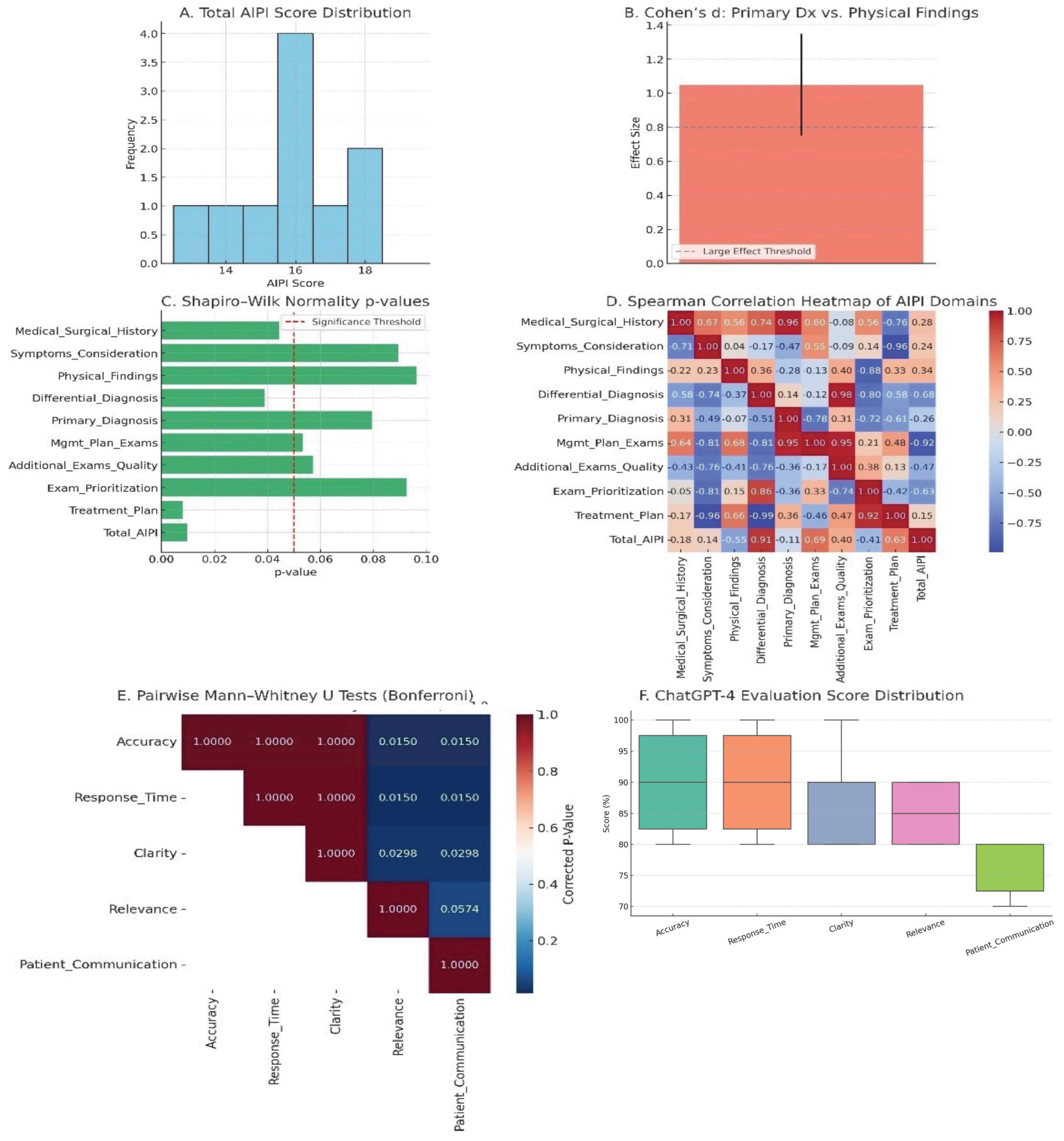
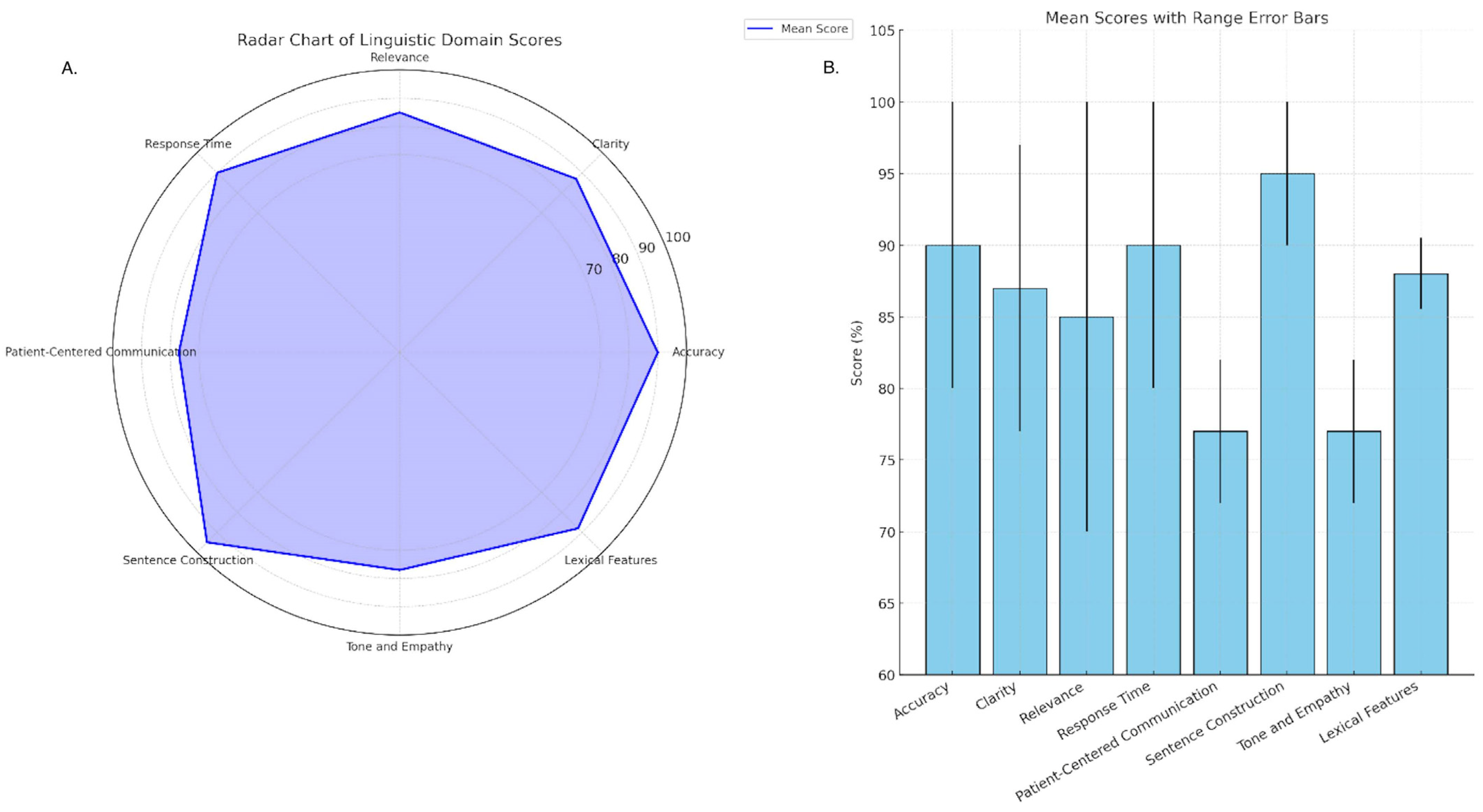
- Accuracy: 90.0% (CI: 84.94%–95.06%).
- Clarity: 87.0% (CI: 82.82%–91.18%).
- Relevance: 85.0% (CI: 81.73%–88.27%).
- Accuracy vs. Patient-Centered Communication (p = 0.015).
- Response Time vs. Patient-Centered Communication (p = 0.015).
- Clarity vs. Patient-Centered Communication (p = 0.030).
4.1. Linguistic Analysis of ChatGPT-4 Answers
4.2. AIPI Stratification and Evaluator Response Patterns
4.3. Machine Learning Analysis Results
5. Discussion
6. Conclusions
Supplementary Materials
Author Contributions
Funding
Institutional Review Board Statement
Informed Consent Statement
Data Availability Statement
Conflicts of Interest
Abbreviations
| AI | Artificial Intelligence |
| AIPI | Artificial Intelligence Performance Instrument |
| API | Application Programming Interface |
| CNN | Convolutional Neural Network |
| ENT | Ear, Nose, and Throat |
| ML | Machine Learning |
| PCA | Principal Component Analysis |
| SHAP | Shapley Additive Explanations |
| t-SNE | t-distributed Stochastic Neighbor Embedding |
| ROC | Receiver Operating Characteristic |
References
- Mandavia, R.; Parmar, D.; Ahmed, M.N.; Berber, V.; Sanz, D.; Paulucci, B.; D’Souza, A.R. EAFPS Rhinoplasty Research Network. An Overview of Rhinoplasty Practices: European Academy of Facial Plastic Surgery, Collaborative Cross-Sectional Study. Facial Plast. Surg. 2024, 40, 31–35. [Google Scholar] [CrossRef] [PubMed]
- Morisada, M.V.; Humphrey, C.D.; Kriet, J.D. Structural rhinoplasty for the persistently twisted nose. Plast. Aesthetic Res. 2024, 11, 35. [Google Scholar] [CrossRef]
- Villarroel, P.P.; Langdon, C.; Arancibia-Tagle, D. Improving Postsurgical Management of Rhinoplasty: A Comprehensive Review of Existing Literature. Facial Plast. Surg. 2025, 41, 850–855. [Google Scholar] [CrossRef]
- Apaydin, F. Oblique split technique: A game changer in costal cartilage sculpting. Plast. Aesthetic Res. 2019, 6, 9. [Google Scholar] [CrossRef]
- Rohrich, R.J.; Savetsky, I.L.; Avashia, Y.J. Why primary rhinoplasty fails. Plast. Reconstr. Surg. 2021, 148, 1021–1027. [Google Scholar] [CrossRef]
- Meretsky, C.R.; Polychronis, A.; Clark, D.; Liovas, D.; Schiuma, A.T. Advantages and disadvantages of reconstructive and preservation rhinoplasty: Surgical techniques, outcomes, and future directions. Cureus 2024, 16, e69002. [Google Scholar] [CrossRef]
- Shorey, S.; Mattar, C.; Pereira, T.L.; Choolani, M. A scoping review of ChatGPT’s role in healthcare education and research. Nurse Educ. Today 2024, 135, 106121. [Google Scholar] [CrossRef]
- Aliyeva, A.; Muradova, A.; Hashimli, R.; Müderris, T. Multi-model Artificial Intelligence Evaluation in Sudden Sensorineural Hearing Loss. Otolaryngol. Head Neck Surg. 2026. [Google Scholar] [CrossRef]
- Sallam, M. ChatGPT Utility in Healthcare Education, Research, and Practice: Systematic Review on the Promising Perspectives and Valid Concerns. Healthcare 2023, 11, 887. [Google Scholar] [CrossRef]
- Tangsrivimol, J.A.; Darzidehkalani, E.; Virk, H.U.H.; Wang, Z.; Egger, J.; Wang, M.; Hacking, S.; Glicksberg, B.S.; Strauss, M.; Krittanawong, C. Benefits, limits, and risks of ChatGPT in medicine. Front. Artif. Intell. 2025, 8, 1518049. [Google Scholar] [CrossRef]
- Alaskarov, E.; Aliyeva, A. Artificial intelligence-assisted tinnitus support with ChatGPT-4. Eur. Arch. Oto-Rhino-Laryngol. 2025. [Google Scholar] [CrossRef]
- Younis, H.A.; Eisa, T.A.E.; Nasser, M.; Sahib, T.M.; Noor, A.A.; Alyasiri, O.M.; Salisu, S.; Hayder, I.M.; Younis, H.A. A systematic review and meta-analysis of artificial intelligence tools in medicine and healthcare: Applications, considerations, limitations, motivation, and challenges. Diagnostics 2024, 14, 109. [Google Scholar] [CrossRef]
- Aliyeva, A.; Alaskarov, E.; Sari, E. Postoperative Management of Tympanoplasty with ChatGPT-4.0. J. Int. Adv. Otol. 2025, 21, 1–6. [Google Scholar] [CrossRef]
- Hacking, S. ChatGPT and medicine: Together we embrace the AI renaissance. JMIR Bioinform. Biotechnol. 2024, 5, e52700. [Google Scholar] [CrossRef]
- Aliyeva, A. “Bot or not”: Turing problem in otolaryngology. Cureus 2023, 15, e48170. [Google Scholar] [CrossRef] [PubMed]
- Balch, J.A.; Ruppert, M.M.; Loftus, T.J.; Guan, Z.; Ren, Y.; Upchurch, G.R.; Ozrazgat-Baslanti, T.; Rashidi, P.; Bihorac, A. Machine learning–enabled clinical information systems using fast healthcare interoperability resources data standards: Scoping review. JMIR Med. Inform. 2023, 11, e48297. [Google Scholar] [CrossRef] [PubMed]
- Dorfman, R.; Chang, I.; Saadat, S.; Roostaeian, J. Making the subjective objective: Machine learning and rhinoplasty. Aesthet. Surg. J. 2020, 40, 493–498. [Google Scholar] [CrossRef]
- Borsting, E.; DeSimone, R.; Ascha, M.; Ascha, M. Applied deep learning in plastic surgery: Classifying rhinoplasty with a mobile app. J. Craniofac. Surg. 2020, 31, 102–106. [Google Scholar] [CrossRef]
- Lechien, J.R.; Maniaci, A.; Gengler, I.; Hans, S.; Chiesa-Estomba, C.M.; Vaira, L.A. Validity and reliability of an instrument evaluating the performance of intelligent chatbot: The Artificial Intelligence Performance Instrument (AIPI). Eur. Arch. Oto-Rhino-Laryngol. 2024, 281, 2063–2079. [Google Scholar] [CrossRef]
- Landolsi, M.Y.; Hlaoua, L.; Ben Romdhane, L. Information extraction from electronic medical documents: State of the art and future research directions. Knowl. Inf. Syst. 2023, 65, 463–516. [Google Scholar] [CrossRef] [PubMed]
- Nasirov, R. The role of Claude 3.5 Sonet and ChatGPT-4 in posterior cervical fusion patient guidance. World Neurosurg. 2025, 197, 123889. [Google Scholar] [CrossRef]
- Singh, P.; Chan, K.; Dhar, S.; Ashby, I.; Krumhuber, E.; Mosahebi, A.; Ponniah, A. Patient-reported outcome measures in a facial reconstruction case series following the implementation of an integrated craniofacial multidisciplinary team clinic, three-dimensional photography, and computer modeling. Aesthet. Surg. J. Open Forum. 2023, 5, ojad082. [Google Scholar] [CrossRef]
- Jurayj, A.; Nerys-Figueroa, J.; Espinal, E.; Gaudiani, M.A.; Baes, T.; Mahylis, J.; Muh, S. Evaluating if ChatGPT can answer common patient questions compared with OrthoInfo regarding rotator cuff tears. J. Am. Acad. Orthop. Surg. Glob. Res. Rev. 2025, 9, e24.00289. [Google Scholar] [CrossRef] [PubMed]
- Aliyeva, A.; Alaskarov, E. AI at the Helm: Evaluating Claude 3.5 Sonet and ChatGPT-4.0 in Tympanoplasty Management. Otol Neurotol. 2026. [Google Scholar] [CrossRef]
- Turan, E.I.; Baydemir, A.E.; Şahin, A.S.; Özcan, F.G. Effectiveness of ChatGPT-4 in predicting the human decision to send patients to the postoperative intensive care unit: A prospective multicentric study. Minerva Anestesiol. 2025, 91, 259–267. [Google Scholar] [CrossRef]
- Capelleras, M.; Soto-Galindo, G.A.; Cruellas, M.; Apaydin, F. ChatGPT and rhinoplasty recovery: An exploration of AI’s role in postoperative guidance. Facial Plast. Surg. 2024, 40, 628–631. [Google Scholar] [CrossRef]
- Najafali, D.; Galbraith, L.G.; Camacho, J.M.; Arnold, S.H.; Alperovich, M.; King, T.W.; Cohen, M.S.; Morrison, S.D.; Dorafshar, A.H. Addressing the rhino in the room: ChatGPT creates “novel” patent ideas for rhinoplasty. Eplasty 2024, 24, e13. [Google Scholar]
- Mu, Y.; He, D. The potential applications and challenges of ChatGPT in the medical field. Int. J. Gen. Med. 2024, 17, 817–826. [Google Scholar] [CrossRef]
- Bekbolatova, M.; Mayer, J.; Ong, C.W.; Toma, M. Transformative potential of AI in healthcare: Definitions, applications, and navigating the ethical landscape and public perspectives. Healthcare 2024, 12, 125. [Google Scholar] [CrossRef] [PubMed]
- Guo, C.; He, Y.; Shi, Z.; Wang, L. Artificial intelligence in surgical medicine: A brief review. Ann. Med. Surg. 2025, 87, 2180–2186. [Google Scholar] [CrossRef] [PubMed]
- Baumgartner, C. The potential impact of ChatGPT in clinical and translational medicine. Clin. Transl. Med. 2023, 13, e1206. [Google Scholar] [CrossRef]
- Xie, Y.; Seth, I.; Hunter-Smith, D.J.; Rozen, W.M.; Ross, R.; Lee, M. Aesthetic surgery advice and counseling from artificial intelligence: A rhinoplasty consultation with ChatGPT. Aesthetic Plast. Surg. 2023, 47, 1985–1993. [Google Scholar] [CrossRef]
- Ghasemi, S.; Dashti, M. Artificial intelligence and deep learning in preservation rhinoplasty: A review. Am. J. Cosmet. Surg. 2024, 41, 225–229. [Google Scholar] [CrossRef]
- Durairaj, K.K.; Baker, O.; Bertossi, D.; Dayan, S.; Karimi, K.; Kim, R.; Most, S.; Robotti, E.; Rosengaus, F. Artificial intelligence versus expert plastic surgeon: Comparative study shows ChatGPT “wins” rhinoplasty consultations—Should we be worried? Facial Plast. Surg. Aesthet. Med. 2024, 26, 270–275. [Google Scholar] [CrossRef] [PubMed]
- Fortune-Ely, M.; Achanta, M.; Song, M.S.H. The future of artificial intelligence in facial plastic surgery. JPRAS Open 2023, 39, 89–92. [Google Scholar] [CrossRef]
- Alowais, S.A.; Alghamdi, S.S.; Alsuhebany, N.; Alqahtani, T.; Alshaya, A.I.; Almohareb, S.N.; Aldairem, A.; Alrashed, M.; Bin Saleh, K.; Badreldin, H.A.; et al. Revolutionizing healthcare: The role of artificial intelligence in clinical practice. BMC Med. Educ. 2023, 23, 689. [Google Scholar] [CrossRef] [PubMed]
- Nascimento, I.J.B.D.; Abdulazeem, H.; Vasanthan, L.T.; Martinez, E.Z.; Zucoloto, M.L.; Østengaard, L.; Azzopardi-Muscat, N.; Zapata, T.; Novillo-Ortiz, D. Barriers and facilitators to utilizing digital health technologies by healthcare professionals. npj Digit. Med. 2023, 6, 161. [Google Scholar] [CrossRef]
- Rasool, A.; Shahzad, M.I.; Aslam, H.; Chan, V.; Arshad, M.A. Emotion-Aware Embedding Fusion in Large Language Models (Flan-T5, Llama 2, DeepSeek-R1, and ChatGPT 4) for Intelligent Response Generation. AI 2025, 6, 56. [Google Scholar] [CrossRef]
- Levites, H.A.; Thomas, A.B.; Levites, J.B.; Zenn, M.R. The use of emotional artificial intelligence in plastic surgery. Plast. Reconstr. Surg. 2019, 144, 499–504. [Google Scholar] [CrossRef]
- Kiwan, O.; Al-Kalbani, M.; Rafie, A.; Hijazi, Y. Artificial intelligence in plastic surgery: Where do we stand? JPRAS Open 2024, 42, 234–243. [Google Scholar] [CrossRef]
- Duong, T.V.; Vy, V.P.T.; Hung, T.N.K. Artificial intelligence in plastic surgery: Advancements, applications, and future. Cosmetics 2024, 11, 109. [Google Scholar] [CrossRef]
- Afroogh, S.; Akbari, A.; Malone, E.; Kargar, M.; Alambeigi, H. Trust in AI: Progress, challenges, and future directions. Humanit. Soc. Sci. Commun. 2024, 11, 1568. [Google Scholar] [CrossRef]
- Johnson, D.; Goodman, R.; Patrinely, J.; Stone, C.; Zimmerman, E.; Donald, R.; Chang, S.; Berkowitz, S.; Finn, A.; Jahangir, E.; et al. Assessing the accuracy and reliability of AI-generated medical responses: An evaluation of the ChatGPT model. Res Sq. 2023, rs.3.rs-2566942. [Google Scholar] [CrossRef]
- Gallifant, J.; Afshar, M.; Ameen, S.; Aphinyanaphongs, Y.; Chen, S.; Cacciamani, G.; Demner-Fushman, D.; Dligach, D.; Daneshjou, R.; Fernandes, C.; et al. The TRIPOD-LLM reporting guideline for studies using large language models. Nature Med. 2025, 31, 60–69. [Google Scholar] [CrossRef] [PubMed]
- Committeri, U.; Monarchi, G.; Gilli, M.; Caso, A.R.; Sacchi, F.; Abbate, V.; Troise, S.; Consorti, G.; Giovacchini, F.; Mitro, V.; et al. Artificial Intelligence in the Surgery-First Approach: Harnessing Deep Learning for Enhanced Condylar Reshaping Analysis: A Retrospective Study. Life 2025, 15, 134. [Google Scholar] [CrossRef] [PubMed]




| AIPI Item | 1 | 2 | 3 | 4 | 5 | 6 | 7 | 8 | 9 | 10 | Mean | SD | Min | Max |
|---|---|---|---|---|---|---|---|---|---|---|---|---|---|---|
| Medical/Surgical History | 2 | 1 | 2 | 2 | 1 | 2 | 2 | 1 | 2 | 2 | 1.7 | 0.48 | 1 | 2 |
| Symptoms Consideration | 2 | 2 | 2 | 2 | 1 | 2 | 1 | 1 | 2 | 1 | 1.6 | 0.52 | 1 | 2 |
| Physical Findings | 1 | 1 | 1 | 1 | 0 | 2 | 2 | 2 | 2 | 2 | 1.4 | 0.70 | 0 | 2 |
| Differential Diagnoses | 1 | 3 | 3 | 3 | 3 | 3 | 2 | 1 | 2 | 1 | 2.2 | 0.92 | 1 | 3 |
| Primary Diagnosis | 2 | 3 | 2 | 3 | 3 | 3 | 3 | 0 | 2 | 2 | 2.3 | 0.95 | 0 | 3 |
| Mgmt Plan Exams | 0 | 1 | 0 | 1 | 1 | 0 | 1 | 1 | 2 | 1 | 0.8 | 0.63 | 0 | 2 |
| Additional Exams Quality | 3 | 1 | 3 | 1 | 3 | 3 | 2 | 3 | 2 | 3 | 2.4 | 0.84 | 1 | 3 |
| Exam Prioritization | 2 | 2 | 2 | 1 | 0 | 1 | 1 | 1 | 2 | 2 | 1.4 | 0.70 | 0 | 2 |
| Treatment Plan | 2 | 3 | 1 | 2 | 2 | 3 | 2 | 3 | 2 | 1 | 2.1 | 0.74 | 1 | 3 |
| Total AIPI Score/20 | 15 | 17 | 16 | 16 | 14 | 19 | 16 | 13 | 18 | 15 | 15.9 | 1.79 | 13 | 19 |
| Extended Combined Statistical Summary of AIPI and Evaluation Metrics | ||||||||||||||
| Statistical Domain | Statistical Method/Test | Key Insight/Outcome | ||||||||||||
| AIPI Score Analysis | Descriptive statistics (Mean, SD, Min–Max) | High median AIPI scores with a right-skewed distribution | ||||||||||||
| Inter-Rater Reliability | Fleiss’ Kappa or Intraclass Correlation Coefficient (ICC) | Moderate-to-high inter-rater agreement across all AIPI domains | ||||||||||||
| Cross-Domain Correlation | Spearman correlation with Likert-based metrics | Significant positive associations (e.g., Empathy ↔ AIPI Total Score) | ||||||||||||
| Normality Testing | Shapiro–Wilk test (AIPI and Likert scales) | Most domains were non-normal, justifying use of nonparametric tests | ||||||||||||
| Variance Homogeneity | Levene’s Test (optional) | Optional check to validate assumption for ANOVA-type comparisons | ||||||||||||
| Evaluation Metric Correlation | Pearson or Spearman correlation matrix | Strong associations among accuracy, clarity, relevance, and empathy domains | ||||||||||||
| Effect Size Reporting | Cohen’s d with 95% Confidence Intervals | Large effect sizes confirm performance gaps across specific domains (e.g., Dx vs. Findings) | ||||||||||||
| Step | Who/What | Action | Output | Safety Control/Escalation |
|---|---|---|---|---|
| 1 | Patient | Submits postoperative question (mapped to standardized domains Q1–Q10) | Structured query | Interface limits input to postop scope; prompts patient to include timing and severity |
| 2 | System | Applies scope constraints (postop rhinoplasty only) + clinic-approved guidance framing | Guard-railed prompt | Blocks non-postop/diagnostic requests; adds “does not replace clinician” disclaimer |
| 3 | LLM | Generates draft response consistent with scope constraints | Draft patient-facing guidance | No medication prescribing; avoids individualized decisions without clinician input |
| 4 | Safety triage layer | Screens for red-flag terms/symptoms (e.g., severe bleeding, fever, breathing difficulty) aligned with Q1/Q6 domains | Risk label (routine vs. urgent) | If urgent → bypass automated reply and trigger clinician contact pathway |
| 5 | Clinician review | Reviews flagged responses and provided final instruction | Clinician-approved response | High-risk questions require human review; clinician can recommend visit/ED |
| 6 | Patient delivery | Sends response to patient | Delivered guidance | Routine replies include clear escalation advice and surgeon-specific follow-up reminder |
| 7 | Documentation | Logs question type, timestamp, model access window, and response | Audit trail | Supports accountability and periodic quality checks (reproducibility monitoring) |
| 8 | Quality assurance | Periodic clinician audit of a sample of routine responses + updates clinic-approved constraints | Updated guidance set | Detects drift, fixes unsafe patterns, ensures alignment with local postop protocols |
Disclaimer/Publisher’s Note: The statements, opinions and data contained in all publications are solely those of the individual author(s) and contributor(s) and not of MDPI and/or the editor(s). MDPI and/or the editor(s) disclaim responsibility for any injury to people or property resulting from any ideas, methods, instructions or products referred to in the content. |
© 2026 by the authors. Licensee MDPI, Basel, Switzerland. This article is an open access article distributed under the terms and conditions of the Creative Commons Attribution (CC BY) license.
Share and Cite
Aliyeva, A.; Azizli, E.; Snyder, V.; Muradova, A.; Ahmadov, N.; Muderris, T.; Hashimli, R.; Erbek, S.S.; Hepkarsi, S.; Dalgic, A. Artificial Intelligence in Rhinoplasty Recovery: Linguistic Intelligence and Machine Learning-Driven Insights. J. Clin. Med. 2026, 15, 1590. https://doi.org/10.3390/jcm15041590
Aliyeva A, Azizli E, Snyder V, Muradova A, Ahmadov N, Muderris T, Hashimli R, Erbek SS, Hepkarsi S, Dalgic A. Artificial Intelligence in Rhinoplasty Recovery: Linguistic Intelligence and Machine Learning-Driven Insights. Journal of Clinical Medicine. 2026; 15(4):1590. https://doi.org/10.3390/jcm15041590
Chicago/Turabian StyleAliyeva, Aynur, Elad Azizli, Vusala Snyder, Antiga Muradova, Natig Ahmadov, Togay Muderris, Ramil Hashimli, Selim S. Erbek, Sevinc Hepkarsi, and Abdullah Dalgic. 2026. "Artificial Intelligence in Rhinoplasty Recovery: Linguistic Intelligence and Machine Learning-Driven Insights" Journal of Clinical Medicine 15, no. 4: 1590. https://doi.org/10.3390/jcm15041590
APA StyleAliyeva, A., Azizli, E., Snyder, V., Muradova, A., Ahmadov, N., Muderris, T., Hashimli, R., Erbek, S. S., Hepkarsi, S., & Dalgic, A. (2026). Artificial Intelligence in Rhinoplasty Recovery: Linguistic Intelligence and Machine Learning-Driven Insights. Journal of Clinical Medicine, 15(4), 1590. https://doi.org/10.3390/jcm15041590