1. Introduction
Artificial intelligence (AI) technologies are rapidly transforming healthcare and service industries, offering innovative tools to enhance efficiency, personalization, and user experience. Conversational agents, service robots, and intelligent devices have gained prominence for their capacity to simulate human interaction, support decision-making, and provide guidance in diverse contexts such as education, tourism, and clinical care [
1,
2].
In healthcare, the integration of AI-based technologies is particularly relevant due to the growing demand for accessible, patient-centered services and the parallel need to optimize clinical resources. From medical service robots assisting in outpatient consultation to AI chatbots supporting patient communication, these technologies promise to improve diagnostic, therapeutic, and organizational processes [
3]. However, their successful implementation depends not only on technical performance but also on user acceptance, particularly from patients and end-users directly involved in interactions with such systems [
4].
The study of technology acceptance has a long tradition. The Technology Acceptance Model (TAM) and the Unified Theory of Acceptance and Use of Technology (UTAUT) have been widely applied to explain adoption processes, emphasizing constructs such as perceived usefulness, ease of use, and social influence [
5,
6]. While these frameworks have provided valuable insights, they were originally developed for non-intelligent technologies and often overlook the specific characteristics of AI, such as anthropomorphism, emotions, and the coexistence of acceptance and rejection [
7].
To address these limitations, several AI-oriented extensions of classical technology acceptance theories have been proposed in recent years, including the Artificial Intelligence Technology Acceptance Model (AI-TAM) [
8]. These models extend technology acceptance theories by incorporating constructs such as trust in AI, perceived intelligence, transparency, and service-related contextual factors to better explain adoption in organizational and commercial setting. However, they mainly focus on cognitive evaluations and contextual determinants, providing limited coverage of users’ emotional responses and perceptions of human-likeness during AI interactions. Gursoy and colleagues [
1] developed the Artificially Intelligent Device Use Acceptance (AIDUA) to explicitly address these dimensions. This model conceptualizes acceptance as a three-stage psychological process—primary appraisal, secondary appraisal, and outcome—shaped by six antecedents: social influence, hedonic motivation, anthropomorphism, performance expectancy, effort expectancy, and emotion. The AIDUA model has been applied in various domains, including service industries, chatbots, and healthcare robotics [
2,
9,
10]. Compared with other AI-oriented models, AIDUA explicitly integrates both cognitive determinants and affective components [
1]. This theoretical structure may be particularly relevant in healthcare contexts, where emotional responses, perceived empathy, and human-likeness of AI systems can influence trust, engagement, and intention to use [
4,
9].
In Italy, AI technologies are progressively being introduced across both public services and healthcare. Within the framework of the National Recovery and Resilience Plan (PNRR), the National Agency for Regional Health Services (AGENAS) is implementing an AI infrastructure for primary care and territorial assistance, designed to support clinical decision-making [
11]. Similarly, the 2025 Ministry of Health guidelines explicitly call for the integration of AI into national data systems, monitoring frameworks, and governance tools within the healthcare sector [
12]. At the operational level, the use of AI in clinical practice is already observable—for instance, a study conducted in Lombardy explored the implementation of AI solutions in regional healthcare organizations [
13]. The Istituto Superiore di Sanità (ISS) has emphasized that acceptance is a key determinant of patients’ adherence and long-term engagement, underscoring the need for validated tools to assess user perspectives before large-scale adoption [
14]. Despite these initiatives, empirical evidence on how Italian users—including patients, citizens, and healthcare professionals—perceive and accept AI solutions remains limited. No validated instruments are currently available in Italian to capture such perceptions, underscoring the need for a culturally adapted version of the AIDUA questionnaire. This study aimed to translate, adapt and validate the AIDUA questionnaire into Italian, assessing content, face, structural, and construct validity and reliability, according to the Consensus-based Standards for Selection of Health Status Measurement Instruments (COSMIN) framework [
15].
2. Materials and Methods
2.1. Study Design
A cross-sectional psychometric validation study was conducted in two phases.
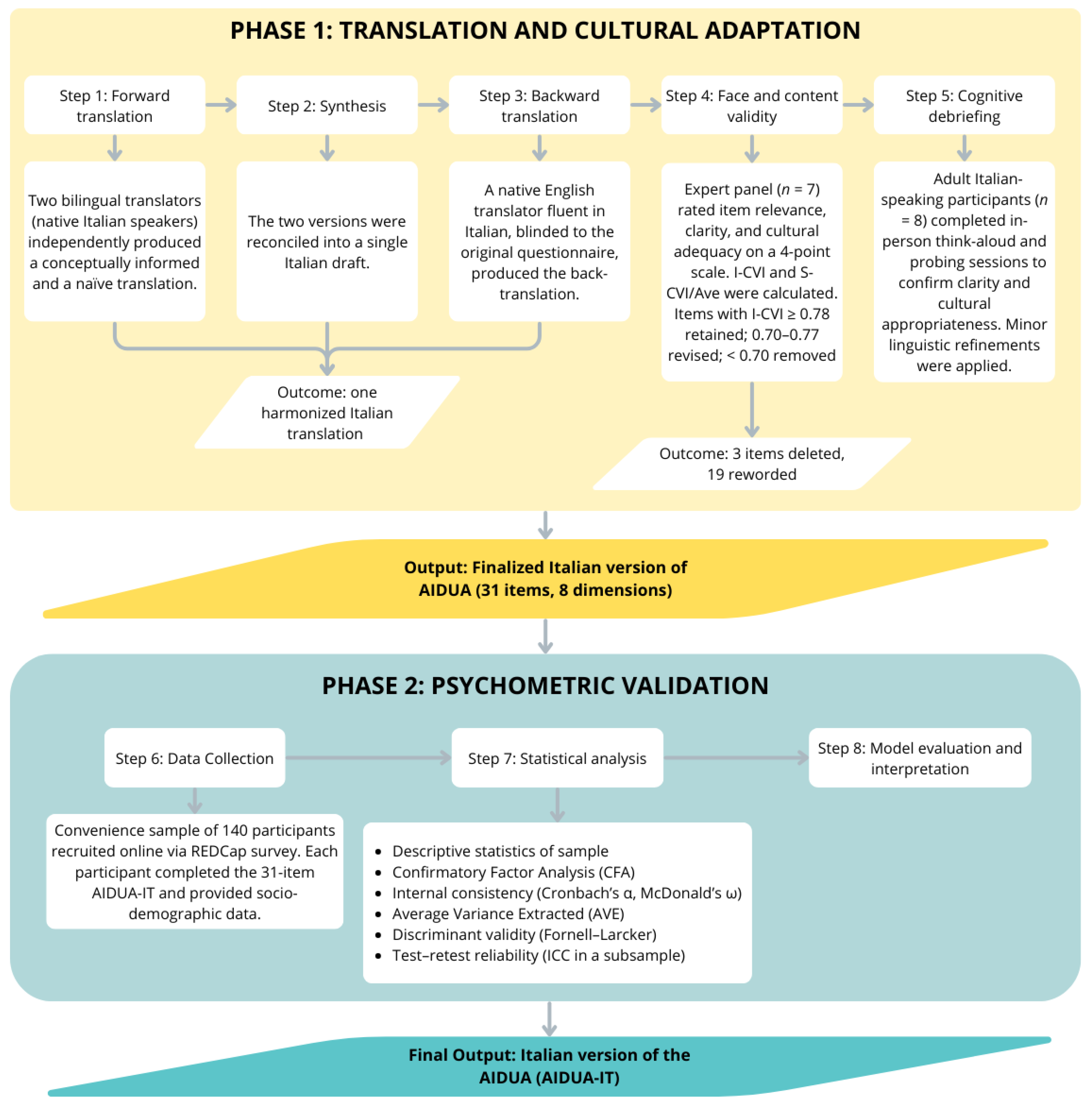
The first phase involved the translation and cultural adaptation of the AIDUA, including the assessment of its face and content validity (conducted by a panel of experts) and a pre-testing phase (conducted through cognitive debriefing with eight participants representative of the target population). The second phase aimed to evaluate the psychometric properties of the Italian version (structural validity, internal consistency, convergent and discriminant validity, and test–retest reliability).
Figure 1 shows all the steps conducted in this study. This study is reported following Strengthening the Reporting of Observational Studies in Epidemiology (STROBE) recommendations for cross-sectional studies [
16].
2.2. Participants and Data Collection
The study involved three distinct participant groups. The first group consisted of seven multidisciplinary experts in healthcare, linguistics, psychology, service management and artificial intelligence who in June 2025 assessed the face and content validity.
The second group comprised eight Italian-speaking adults representing diverse ages and educational backgrounds, who participated in July 2025 in individual, in-person sessions, corresponding to the cognitive debriefing phase.
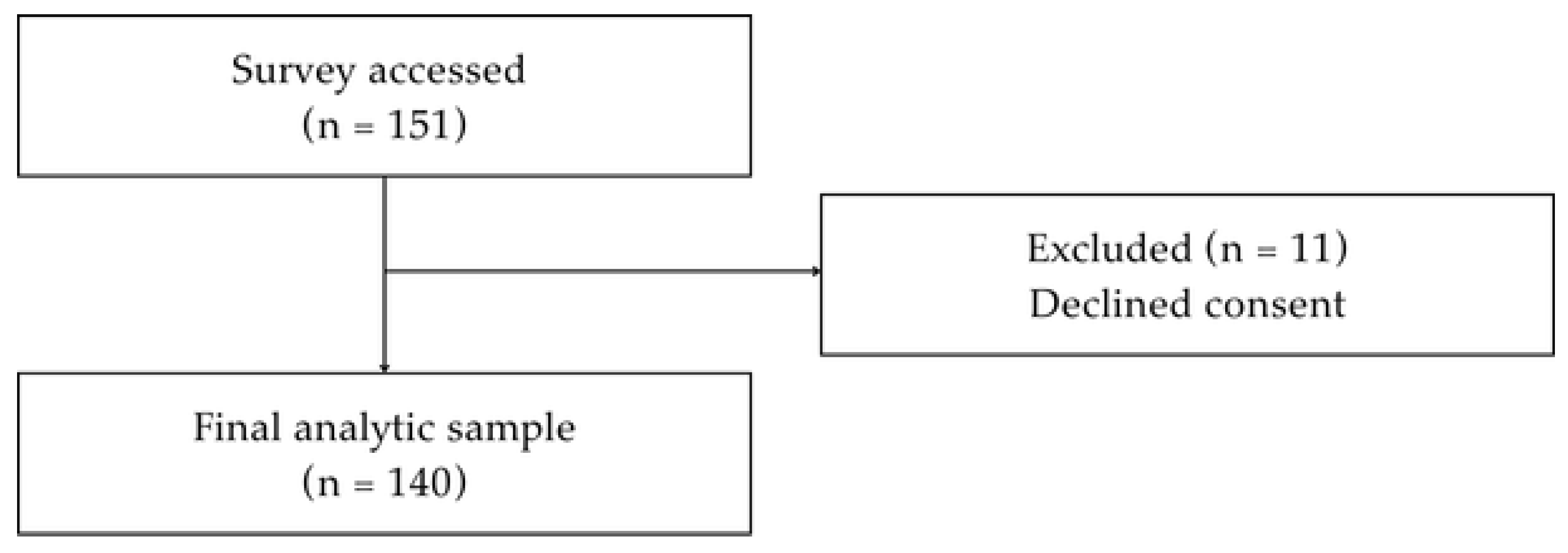
The third group represents the main sample, recruited between August and September 2025 for the psychometric validation. All participants were Italian-speaking adults (≥18 years) who provided informed consent and completed the questionnaire voluntarily. Data were collected through a single online survey administered via Research Electronic Data Capture (REDCap, version 11.1.15; Vanderbilt University, Nashville, TN, USA), hosted at Unit of Biostatistics, Epidemiology and Public Health, University of Padova, a secure, web-based platform designed to support validated data capture for research studies [
17,
18]. All phases of data collection were completed before the psychometric analyses were conducted. Each construct was measured using the Italian version of the AIDUA questionnaire (AIDUA-IT), consisting of 31 Likert-type items scored from 1 (“strongly disagree”) to 5 (“strongly agree”), except for the Emotion dimension, which employed five-point bipolar adjective pairs (e.g., bored–relaxed). Socio-demographic data were also collected, including age, gender, education, occupational status, and digital familiarity, as recommended [
14]. Data comparability was ensured through uniform online administration and identical Italian-language instructions across all participants. The recruitment link to the questionnaire was disseminated via social media platforms (WhatsApp, Instagram, and Facebook) using a snowball sampling approach [
19], allowing participants to share the link within their personal and professional networks. As commonly observed in digitally mediated recruitment strategies, this procedure may have favored individuals with higher digital literacy and more frequent use of online technologies, potentially limiting representativeness with respect to less digitally experienced populations [
20]. For test–retest reliability assessment, a voluntary subsample of 32 respondents was recruited using the same procedures and inclusion criteria as the main psychometric validation sample and completed the AIDUA-IT twice over a two-week interval.
2.3. Original Instrument
The AIDUA questionnaire comprises 34 items measuring eight latent constructs: Social Influence (SI, 6 items), Hedonic Motivation (HM, 5 items), Anthropomorphism (A, 4 items), Performance Expectancy (PE, 4 items), Effort Expectancy (EE, 3 items), Emotion (E, 5 items), Intention/Willingness to Use (I, 3 items), Objection to Use (O, 4 items) [
1]. All items are rated on 5-point Likert scales, except Emotion, which uses 5-point bipolar adjective pairs (e.g., bored–relaxed). Formal permission to use and translate the questionnaire was obtained from the original authors on 26 May 2025. The study variables were organized according to the AIDUA theoretical framework, which conceptualizes user acceptance as a multidimensional construct. The outcomes are Intention/Willingness (I) and Objection (O) represented the behavioral outcomes of AI acceptance. Exposures and predictors are represented by the six latent predictors: Social Influence (SI), Hedonic Motivation (HM), Anthropomorphism (A), Performance Expectancy (PE), Effort Expectancy (EE), and Emotion (E). Socio-demographic characteristics (age, gender, education level, professional category) and digital familiarity (hours of use, self-rated computer skills) were treated as contextual variables potentially influencing acceptance scores. No diagnostic or clinical criteria were applicable, as the study population comprised general adult respondents.
2.4. Translation and Cultural Adaptation Process
The translation and cultural adaptation of the AIDUA followed established cross-cultural adaptation guidelines, as illustrated in
Figure 1 [
21,
22]. Two bilingual translators, both native Italian speakers, produced independent forward translations (one conceptually informed and one naïve to the construct) which were synthesized into a single draft and back-translated into English by a native English translator blinded to the original version. Face and content validity were then evaluated by the multidisciplinary panel, who independently rated the relevance, clarity and cultural adequacy of each item on a four-point Likert scale, and Content Validity Indices (I-CVI and S-CVI/Ave) were computed [
22]. Items with I-CVI ≥ 0.78 were retained, 0.70–0.77 were revised, and <0.70 were considered for deletion. A cognitive debriefing was subsequently conducted with a small sample of eight participants. The main socio-demographic characteristics and digital familiarity of the participants involved in this phase are reported in the
Supplementary Materials (File S1, Table S4). Participants were selected to represent heterogeneous age groups, educational levels, and degrees of familiarity with digital technologies. Using a think-aloud and verbal-probing approach, participants paraphrased each item in their own words and provided additional feedback on clarity and cultural appropriateness. Their input informed minor linguistic and semantic adjustments, resulting in the finalized 31-item AIDUA-IT for psychometric validation [
23,
24]. For example, item 31 describing AI as processing information “in a non-human way” was considered conceptually vague during cognitive debriefing. It was therefore reformulated to explicitly refer to emotional coldness and impersonality, improving semantic clarity.
2.5. Statistical Analysis
All items were treated as ordinal variables (Likert-type 1–5). Analyses followed COSMIN and psychometric best-practice guidelines [
15].
In order to describe the participants’ characteristics, age was summarized using median and interquartile range (Q1–Q3), and categorical variables were reported as frequencies and percentages. Professional roles were grouped into six macro-categories (front-line, technical, managerial, administrative, student/unemployed, other) based on functional roles and technological exposure, following the UTAUT2 framework [
25]. AIDUA model was tested using Confirmatory Factor Analysis (CFA) with a robust Diagonally Weighted Least Squares/Weighted Least Squares Mean and Variance Adjusted (DWLS/WLSMV) estimator, which is recommended for ordered categorical indicators. This approach is particularly appropriate for Likert-type items and moderate sample sizes, as it is based on polychoric correlations and provides more accurate parameter estimates and standard errors under non-normal data distributions [
26]. For CFA, cases with missing data on modeled indicators were removed listwise; descriptive statistics and reliability outside the CFA used pairwise deletion where appropriate. Model fit was evaluated using scaled indices: Comparative Fit Index (CFI), Tucker–Lewis Index (TLI), Root Mean Square Error of Approximation (RMSEA) (90% confidence interval [CI],
p-close) and Standardized Root Mean Square Residual (SRMR). We adopted conventional cut-offs (CFI/TLI ≥ 0.95; RMSEA ≤ 0.06; SRMR ≤ 0.08) [
27]. Reliability and validity were assessed through Cronbach’s α, McDonald’s ω, Average Variance Extracted (AVE) and the Fornell–Larcker criterion. Intraclass correlation coefficients (ICC) were calculated using a two-way random-effects model with absolute agreement for single measures [ICC (2,1)], as recommended [
28]. For each subscale mean values were computed at Time 1 and Time 2. ICC values were interpreted as poor (<0.50), moderate (0.50–0.75), good (0.75–0.90), and excellent (>0.90) according to the thresholds recommended [
28].
Data were analyzed using jamovi (version 2.6.44; The jamovi Project, Sydney, Australia) and Microsoft Excel (version 2024; Microsoft Corporation, Redmond, WA, USA). Jamovi was employed for descriptive, reliability, and confirmatory analyses, while Excel supported data management and preliminary calculations. Statistical significance was set at p < 0.05.
2.6. Ethical Considerations
The study involved adult volunteers (≥18 years) and did not include patients, clinical data, or any form of intervention. Participation was voluntary and fully anonymous, and no personal data enabling participant identification were collected, in compliance with the European Union (EU) General Data Protection Regulation (GDPR 2016/679). No IP addresses or other potentially identifying metadata were stored, preventing any form of re-identification. Prior to accessing the questionnaire, all respondents provided electronic informed consent, which included information on the study purpose, data protection, and the voluntary nature of participation. In accordance with the Declaration of Helsinki and current Italian and EU regulations on anonymous, non-interventional surveys, ethics committee approval was not required.
4. Discussion
This study provides the first cross-cultural adaptation and psychometric evaluation of the AIDUA scale for Italian-speaking users. Overall, the results indicate that the AIDUA-IT demonstrates good structural validity, internal consistency, convergent and discriminant validity and short-term temporal stability, supporting its use for the preliminary assessment of acceptance of AI-enabled services in Italy.
The CFA results showed excellent model fit, with all eight latent constructs loading strongly and consistently on their respective dimensions. This finding replicates the theoretical structure proposed in the original AIDUA model [
1] and confirms that the multidimensional nature of AI acceptance holds in the Italian context. The strong loadings observed across constructs such as hedonic motivation, emotion, performance expectancy, and effort expectancy are consistent with the patterns reported in previous applications of AIDUA and related models across different populations [
2,
9,
25]. Importantly, the removal of three items during the adaptation phase did not compromise factorial integrity, indicating that the Italian version preserves the conceptual coverage of the original instrument, in line with recommendations for cross-cultural scale adaptation [
21,
22]. From a theoretical perspective, the removal of item HM5 (“entertaining”) slightly refines the interpretation of the Hedonic Motivation construct in the Italian context. Whereas the original AIDUA model includes both enjoyment and fun-oriented aspects, the retained items emphasize interest, engagement, and intrinsic involvement in AI interactions. This suggests that, in the Italian sample, hedonic motivation is more closely related to cognitive–affective engagement than to entertainment or playful enjoyment, possibly reflecting cultural differences in how AI technologies are perceived in functional contexts.
Consistently, Hedonic Motivation showed a strong association with Intention to Use (r > 0.60), indicating that affective and experiential factors play a central role in AI acceptance among Italian users. Adoption therefore appears to depend not only on instrumental considerations such as usefulness or efficiency, but also on the extent to which AI interactions are perceived as engaging and emotionally meaningful.
From an applied perspective, this finding has important implications for AI implementation in Italian healthcare or service settings. Systems that are technically accurate but emotionally neutral or impersonal may face resistance. These results highlight the importance of integrating affective design principles and user experience considerations into healthcare AI development. Convergent and discriminant validity findings indicate that the Italian version successfully preserves the conceptual distinctiveness of the eight AIDUA constructs while ensuring that each dimension captures its intended theoretical domain. Rather than simply meeting statistical thresholds, these results suggest that the affective, cognitive, and motivational components underlying AI acceptance remain meaningfully separable in the Italian context. The high internal consistency observed across subscales further reflects the coherence of item content within each domain, supporting the adequacy of the adaptation process. Moreover, the good stability over two weeks indicates that users’ evaluations of AI-related beliefs and attitudes are relatively consistent over short periods, reinforcing the instrument’s suitability for cross-sectional assessments in research and implementation settings.
These results have relevant implications for the Italian context, in which AI-enabled solutions are rapidly expanding in both healthcare and public services. National initiatives such as the AGENAS AI infrastructure program within the PNRR and recent Ministry of Health guidelines highlight the need for robust tools to assess user perspectives prior to large-scale deployment [
11]. The availability of a culturally adapted and psychometrically sound instrument offers researchers, developers, and public institutions a standardized way to evaluate user readiness, perceived usability and potential barriers during the design and implementation of intelligent systems. By capturing multiple antecedents and behavioral outcomes, the AIDUA-IT can support user-centered and evidence-informed integration of AI technologies in healthcare and services.
Nonetheless, these findings should be interpreted as preliminary. While the AIDUA-IT shows strong initial performance, further work is required to complete the validation process. Future studies should employ larger and more heterogeneous samples to improve parameter precision, evaluate measurement invariance across demographic and professional groups and test predictive validity in real-world interactions with AI-enabled systems. Longitudinal designs may also clarify how acceptance evolves as exposure to intelligent technologies increases. Such efforts will strengthen the instrument’s applicability and contribute to a more comprehensive, context-sensitive validation program.
Several limitations should be considered. The analytic sample (
N = 138) resulted in a subject-to-item ratio of approximately 4.5:1, which is below commonly recommended thresholds for confirmatory factor analysis, particularly for complex models with multiple latent dimensions [
30,
31]. Although this sample size met minimum requirements for a preliminary CFA, larger and more heterogeneous samples are needed to improve the stability and precision of parameter estimates and to support advanced procedures such as multi-group measurement invariance testing. Moreover, the sample showed a male predominance (63.8%), which may have influenced acceptance-related constructs and limits the generalizability of the findings. Previous research indicates that men tend to engage more frequently with generative AI chatbots across a broader spectrum of applications and show greater interest in their relevance to future career prospects, whereas women tend to use such tools primarily for text-related tasks and express greater concerns about critical and independent thinking [
32]. Although the present sample size did not allow for reliable multi-group confirmatory factor analysis to formally test measurement invariance across genders, these findings highlight the importance of including gender-balanced samples in future validation studies and formally assessing potential measurement differences across genders. The use of a non-probability, digitally mediated recruitment strategy, likely introduced selection bias by oversampling individuals with higher digital familiarity. This sampling characteristic may have inflated acceptance-related constructs, particularly Effort Expectancy and Performance Expectancy, as digitally skilled participants may perceive AI-enabled systems as easier to use and more useful than the general population (particularly the elderly or clinical populations) [
20]. Future studies should incorporate offline recruitment pathways (e.g.,community settings, outpatient clinics, paper surveys) to ensure broader population coverage. In addition, measurement invariance across key subgroups (e.g., age, gender, and professional background) was not examined in the present study. Future research should explicitly test configural, metric, and scalar invariance to ensure that the AIDUA-IT measures the same constructs equivalently across different demographic and professional groups and to support meaningful comparisons between populations. The two-week test–retest reliability analysis was based on a small subsample (
n = 32), resulting in relatively wide confidence intervals around ICC estimates. This limits the precision of reliability estimates and warrants confirmation in larger samples. Finally, the study relied on self-reported data collected in a single session, which may introduce information bias and common-method variance. Participation was voluntary and anonymous, helping to reduce—but not eliminate—the potential for social desirability effects given the prominence of AI in current public discourse.