Insomnia Among Adolescents in Northern Peru: Associations with Psychosocial, Health-Related, and Educational Factors in a Cross-Sectional Study Across Five Schools

 , , , , ,
Abstract
1. Introduction
2. Materials and Methods
2.1. Study Design
2.2. Population and Sample
2.3. Procedures
2.3.1. Variables and Instruments
2.3.2. Insomnia (ISI)
2.3.3. Family Dysfunction (Family APGAR)
2.3.4. Self-Esteem (Rosemberg)
2.3.5. Eating Disorder (SCOFF)
2.3.6. Facial Acne (Spanish Acne Severity Scale)
2.3.7. Resilience (Abbreviated CD-RISC)
2.3.8. Bullying (European Bullying Intervention Project Questionnaire)
2.3.9. Quality of Life (DLQI Instrument)
2.4. Statistical Analysis Plan
2.5. Ethical Aspects
3. Results
3.1. Socio-Educational Characteristics of Adolescents
3.2. Insomnia in Adolescents
3.3. Factors Associated with Insomnia, in Bivariate Analysis
3.4. Factors Associated with Insomnia, in Simple and Multiple Regression Analysis
4. Discussion
4.1. Prevalence of Insomnia
4.2. Factors Associated with Insomnia
4.3. Relevance of Findings in Mental Health
4.4. Limitations and Strengths
5. Conclusions
Author Contributions
Funding
Institutional Review Board Statement
Informed Consent Statement
Data Availability Statement
Conflicts of Interest
Abbreviations
| BMI | Body Mass Index |
| CD-RISC | Connor–Davidson Resilience Scale (abbreviated version) |
| CI | Confidence Interval |
| CIs | Confidence Intervals |
| COVID-19 | Coronavirus Disease 2019 |
| DLQI | Dermatology Life Quality Index |
| EBIPQ | European Bullying Intervention Project Questionnaire |
| ED | Eating Disorder |
| GLM | Generalized Linear Model |
| IRR | Incidence Rate Ratio |
| ISI | Insomnia Severity Index |
| OR | Odds Ratio |
| PR | Prevalence Ratio |
| SCOFF | Sick, Control, One stone, Fat, Food (screening questionnaire for eating disorders) |
References
- Sacasqui Miranda, J.R. Prevalencia y Factores Asociados a Trastornos del Sueño en Personal Técnico de Enfermería del Hospital Goyeneche, Arequipa 2018. Bachelor’s Thesis, Universidad Nacional de San Agustín de Arequipa, Arequipa, Peru, 2018. Available online: http://repositorio.unsa.edu.pe/handle/UNSA/5774 (accessed on 30 September 2023).
- Sarrais, F.; de Castro Manglano, P. El insomnio. An. Sist. Sanit. Navar. 2007, 30, 121–134. [Google Scholar] [CrossRef] [PubMed]
- Hysing, M.; Pallesen, S.; Stormark, K.M.; Lundervold, A.J.; Sivertsen, B. Sleep patterns and insomnia among adolescents: A population-based study. J. Sleep Res. 2013, 22, 549–556. [Google Scholar] [CrossRef]
- Dewald-Kaufmann, J.; de Bruin, E.; Michael, G. Cognitive Behavioral Therapy for Insomnia (CBT-i) in School-Aged Children and Adolescents. Sleep Med. Clin. 2019, 14, 155–165. [Google Scholar] [CrossRef] [PubMed]
- Amaral, M.O.; de Figueiredo Pereira, C.M.; Silva Martins, D.I.; de Serpa Cdo, R.; Sakellarides, C.T. Prevalence and risk factors for insomnia among Portuguese adolescents. Eur. J. Pediatr. 2013, 172, 1305–1311. [Google Scholar] [CrossRef] [PubMed]
- Ramón Arbués, E.; Martínez Abadía, B.; Granada López, J.M.; Echániz Serrano, E.; Pellicer García, B.; Juárez Vela, R.; Portillo, S.G.; Guinoa, M.S. Conducta alimentaria y su relación con el estrés, la ansiedad, la depresión y el insomnio en estudiantes universitarios. Nutr. Hosp. 2019, 36, 1339–1345. [Google Scholar]
- Liang, M.; Guo, L.; Huo, J.; Zhou, G. Prevalence of sleep disturbances in Chinese adolescents: A systematic review and meta-analysis. PLoS ONE 2021, 16, e0247333. [Google Scholar] [CrossRef]
- Tulk, J.; Garland, S.N.; Howden, K.; Glidden, C.; Scott, I.; Chalifour, K.; Eaton, G.; Mahar, A.; Oberoi, S. Prevalence and factors associated with insomnia symptoms in adolescents and young adults with cancer during the COVID-19 pandemic. Sleep Health 2022, 8, 410–416. [Google Scholar] [CrossRef]
- Coloma, F.; Diaz, C.; Espinoza, C.; Flores, F.; Godoy, G.; Guelfand, S.; Leyton, C.; Mérida, F.; del Mar Mora, M. Estudio de prevalencia de insomnio en 151 pacientes hospitalizados en servicio médico quirúrgico de un hospital público de la Región Metropolitana. Rev. Confluencia 2020, 2, 74–78. [Google Scholar] [CrossRef]
- Cadena, V.N.A.; Taramuel, K.F.L. Uso de internet y su relación con depresión, insomnio y autoestima en estudiantes de bachillerato, Quito. Más Vita 2022, 4, 160–177. [Google Scholar] [CrossRef]
- González Quiñones, J.C.; Acevedo Ramírez, G.; Alarcón Carvajal, P.D.; Casas Vargas, Á.M.; Ardila, G.; Bernal Angee, J.D.; Avella Rodríguez, J.L.; Pinzón Ramírez, J. Prevalencia de trastornos del sueño en niños y adolescentes. Carta Comunitaria 2018, 26, 11–18. [Google Scholar] [CrossRef]
- dos Reis, D.C.; de Almeida, T.A.C.; Miranda, M.M.; Alves, R.H.; Madeira, A.M.F. Vulnerabilidades a la salud en la adolescencia: Condiciones socioeconómicas, redes sociales, drogas y violencia. Rev. Lat. Am. Enfermagem 2013, 21, 586–594. [Google Scholar] [PubMed]
- Iriarte Bennetts, M.T.; Estévez Ramos, R.A.; Basset Machado, I.; Sánchez González, A.; Flores Villegas, J. Estado de salud mental de adolescentes que cursan la educación media superior. Rev. Iberoam. Cienc. Salud RICS 2018, 7, 100–124. [Google Scholar]
- Ibañez Esquerre, J.S. Violencia Domestica Como Factor Asociado a Insomnio en Adolescentes de Educación Secundaria de la Institución Educativa 80040 Divino Maestro en el Periodo Julio–Agosto 2020. Bachelor’s Thesis, Universidad Privada Antenor Orrego, Trujillo, Peru, 2021. Available online: https://repositorio.upao.edu.pe/handle/20.500.12759/7175 (accessed on 30 September 2023).
- Perez-Oyola, J.C.; Walter-Chavez, D.M.; Zila-Velasque, J.P.; Pereira-Victorio, C.J.; Failoc-Rojas, V.E.; Vera-Ponce, V.J.; Valladares-Garrido, D.; Valladares-Garrido, M.J. Internet addiction and mental health disorders in high school students in a Peruvian region: A cross-sectional study. BMC Psychiatry 2023, 23, 408. [Google Scholar] [CrossRef] [PubMed]
- Huamaní, C.; Rey de Castro, J. Somnolencia y características del sueño en escolares de un distrito urbano de Lima, Perú. Arch. Argent. Pediatr. 2014, 112, 239–241. [Google Scholar]
- Aquino Chipana, P.I. Prevalencia de Depresión e Ideación Suicida en Estudiantes del Centro Preuniversitario de la Universidad Nacional del Centro del Perú del Ciclo Intensivo Diciembre 2015–Marzo. Bachelor’s Thesis, Universidad Nacional del Centro del Perú, Huancayo, Peru, 2016. Available online: http://repositorio.uncp.edu.pe/handle/20.500.12894/458 (accessed on 13 October 2023).
- Huang, L.; Liang, K.; Jiang, W.; Huang, Q.; Gong, N.; Chi, X. Prevalence and correlates of mental health problems among Chinese adolescents with frequent peer victimization experiences. Children 2021, 8, 403. [Google Scholar] [CrossRef]
- Owens, J. Classification and epidemiology of childhood sleep disorders. Prim. Care 2008, 35, 533–546. [Google Scholar] [CrossRef]
- National Heart, Lung, and Blood Institute. Insomnio: Causas y Factores de Riesgo. Available online: https://www.nhlbi.nih.gov/es/salud/insomnio/causas (accessed on 30 September 2023).
- Solari, B.F. Trastornos del sueño en la adolescencia. Rev. Méd. Clín. Las Condes 2015, 26, 60–65. [Google Scholar] [CrossRef][Green Version]
- Alcaraz, V.O. Estudio correlacional: Evitación experiencial, insomnio y rumiación en adolescentes. MLS Psychol. Res. 2021, 4, 99–115. [Google Scholar] [CrossRef]
- Mesa, L.T.; Masalam, A.P.; Sequeida, Y.J.; González, R.R. Alteraciones y hábitos de sueño en una muestra de escolares chilenos. Rev. Soc. Psiquiatr. Neurol. Infanc. Adolesc. 2005, 16, 5–10. [Google Scholar]
- Kawabe, K.; Horiuchi, F.; Ochi, M.; Nishimoto, K.; Ueno, S.-I.; Oka, Y. Suvorexant for the Treatment of Insomnia in Adolescents. J. Child Adolesc. Psychopharmacol. 2017, 27, 792–795. [Google Scholar] [CrossRef]
- Portuondo Alacán, O.; Fernández Rivero, C.G.; Cabrera Amigo, P. Trastornos del sueño en adolescentes. Rev. Cuba Pediatr. 2000, 72, 10–14. [Google Scholar]
- Álvarez-García, H.B.; Lugo-González, I.V.; González Betanzos, F. Propiedades psicométricas del Índice de Severidad de Insomnio (ISI) en adultos mexicanos. Interacciones 2023, 9, e311. [Google Scholar]
- Lobos-Rivera, M.E.; Flores-Monterrosa, A.N.; Gutiérrez-Quintanilla, J.R.; Flamenco-Cortez, M. Propiedades psicométricas de la Escala Atenas de Insomnio en una muestra de adultos salvadoreños. Entorno 2022, 1, 45–56. [Google Scholar] [CrossRef]
- Suarez Cuba, M.A.; Alcalá Espinoza, M. APGAR FAMILIAR: Una herramienta para detectar disfunción familiar. Rev. Méd. Paz 2014, 20, 53–57. [Google Scholar]
- Forero Ariza, L.M.; Avendaño Durán, M.C.; Duarte Cubillos, Z.J.; Campo-Arias, A. Consistencia interna y análisis de factores de la escala APGAR para evaluar el funcionamiento familiar en estudiantes de básica secundaria. Rev. Colomb. Psiquiatr. 2006, 35, 23–29. [Google Scholar]
- Jaimes-Grimaldos, J.A. Confiabilidad y Validez del APGAR Familiar Como Instrumento de Evaluación de la Funcionalidad Familiar en Usuarios de Atención Primaria en Bucaramanga. Specialization Thesis, Universidad de Santander, Bucaramanga, Colombia, 2023. Available online: https://repositorio.udes.edu.co/entities/publication/8485673c-62a5-4244-98fb-0b2e25de5fb0 (accessed on 27 October 2023).
- Rojas-Torres, I.L.; Ahmad, M.; Martín Álvarez, J.M.; Golpe, A.A.; Gil Herrera, R.J. Mental health, suicide attempt, and family function for adolescents’ primary health care during the COVID-19 pandemic. F1000Research 2022, 11, 529. [Google Scholar] [CrossRef]
- Giuliana, B.M.F.; Briyi, C.H.B. Relación Entre Niveles de Ansiedad, Depresión y Funcionalidad Familiar en Adolescentes de 12 a 17 Años Durante la Restricción Social por el Estado de Emergencia—Arequipa 2021. Bachelor’s Thesis, Universidad Católica Santa María, Arequipa, Peru, 2022. Available online: https://repositorio.ucsm.edu.pe/handle/20.500.12920/11636 (accessed on 27 October 2023).
- Rojas-Barahona, C.A.; Zegers, P.B.; Förster, M.C.E. La escala de autoestima de Rosenberg: Validación para Chile en una muestra de jóvenes adultos, adultos y adultos mayores. Rev. Méd. Chile 2009, 137, 791–800. [Google Scholar] [CrossRef]
- Bueno-Pacheco, A.; Lima-Castro, S.; Arias-Medina, P.; Peña-Contreras, E.; Aguilar-Sizer, M.; Cabrera-Vélez, M. Estructura factorial, invarianza y propiedades psicométricas de la escala de autoestima de Rosenberg en el contexto ecuatoriano. Rev. Iberoam. Diagn. Eval. 2020, 56, 87–100. [Google Scholar] [CrossRef]
- Vilca Munarriz, K.X. Cyberbullying y Autoestima en Adolescentes de Instituciones Educativas de la Ciudad de Huancavelica, en Contexto de COVID-19, 2021. Bachelor’s Thesis, Universidad César Vallejo, Huancavelica, Peru, 2021. Available online: https://repositorio.ucv.edu.pe/handle/20.500.12692/72413 (accessed on 29 October 2023).
- Farías, Á.D.R.; Urra, R.G. Funcionalidad familiar y autoestima en adolescentes durante la pandemia por COVID-19. Rev. PSIDIAL Psicol. Diálogo Saberes 2022, 1, 1–18. [Google Scholar]
- Jáuregui Lobera, I.; Romero Candau, J.; Bolaños Ríos, P.; Montes Berriatúa, C.; Díaz Jaramillo, R.; Montaña González, M.T.; Millán, M.T.M.; Lozano, P.L.; Martín, L.A.; Villalobos, I.J.; et al. Conducta alimentaria e imagen corporal en una muestra de adolescentes de Sevilla. Nutr. Hosp. 2009, 24, 568–573. [Google Scholar]
- Campo-Arias, A.; Díaz-Martínez, L.A.; Rueda-Jaimes, G.E.; Martínez-Mantilla, J.A.; Amaya-Naranjo, W.; Campillo, H.A. Consistencia interna y análisis factorial del cuestionario SCOFF para tamizaje de trastorno de conducta alimentaria en adolescentes estudiantes: Una comparación por género. Univ. Psychol. 2006, 5, 295–304. [Google Scholar]
- Rueda Jaimes, G.E.; Díaz Martínez, L.A.; Ortiz Barajas, D.P.; Pinzón Plata, C.; Rodríguez Martínez, J.; Cadena Afanador, L.P. Validación del cuestionario SCOFF para el cribado de los trastornos del comportamiento alimentario en adolescentes escolarizadas. Aten. Primaria 2005, 35, 89–94. [Google Scholar] [CrossRef]
- Rueda, G.E.; Díaz, L.A.; Campo, A.; Barros, J.A.; Ávila, G.C.; Oróstegui, L.T.; Osorio, B.C.; Cadena, L.D.P. Validación de la encuesta SCOFF para tamizaje de trastornos de la conducta alimentaria en mujeres universitarias. Biomédica 2005, 25, 196–202. [Google Scholar] [CrossRef]
- Sánchez Fernández, C. Ansiedad y Desempeño Académico en los Estudiantes del Último Grado de Preparatoria. Master’s Thesis, Tecnológico de Monterrey, Monterrey, Mexico, 2022. Available online: https://repositorio.tec.mx/handle/11285/648714 (accessed on 29 October 2023).
- Vega Botina, D. Riesgo de Trastornos de Conducta Alimentaria en Relación al uso de las Redes Sociales en Adolescentes. Bachelor’s Thesis, Universidad de Valladolid, Valladolid, Spain, 2023. Available online: https://uvadoc.uva.es/handle/10324/61068 (accessed on 29 October 2023).
- Vásquez Vásquez, N.L.; Zorrilla Pereyra, T.K. Frecuencia de Acné Vulgar y Características Clínico-Epidemiológicas en Estudiantes de la Universidad Nacional Pedro Ruíz Gallo, Lambayeque 2021. Bachelor’s Thesis, Universidad Nacional Pedro Ruiz Gallo, Lambayeque, Peru, 2022. Available online: https://repositorio.unprg.edu.pe/handle/20.500.12893/10208 (accessed on 29 October 2023).
- Rojas Muro, M.A.; Silva Gutiérrez, A.E. Factores Asociados a Depresión y Ansiedad en Adolescentes Con Acné del Distrito de Lambayeque, Abril–Noviembre 2019. Bachelor’s Thesis, Universidad Nacional Pedro Ruiz Gallo, Lambayeque, Peru, 2020. Available online: https://repositorio.unprg.edu.pe/handle/20.500.12893/8497 (accessed on 29 October 2023).
- Torres Mayanga, C.L. Asociación Entre Severidad del acné Vulgar y Nivel de Autoestima en Alumnos de un Colegio del Distrito de José Leonardo Ortiz, 2021. Bachelor’s Thesis, Universidad Nacional Pedro Ruiz Gallo, Lambayeque, Peru, 2021. Available online: http://repositorio.unprg.edu.pe/handle/20.500.12893/9224 (accessed on 29 October 2023).
- Alvarez Tello, D.A.; Damián Siesquen, G.B. Asociación: Dieta con Alta Carga Glicémica—Severidad de Acné en Estudiantes Entre 15–25 Años de Academia Preuniversitaria. Chiclayo, 2020. Bachelor’s Thesis, Universidad Nacional Pedro Ruiz Gallo, Lambayeque, Peru, 2020. Available online: https://repositorio.unprg.edu.pe/handle/20.500.12893/8475 (accessed on 29 October 2023).
- Bernaola Ugarte, A.D.; Garcia Garcia, M.; Martinez Campos, N.; Ocampos Madrid, M.; Livia, J. Validez y confiabilidad de la Escala Breve de Resiliencia Connor-Davidson (CD-RISC 10) en estudiantes universitarios de Lima Metropolitana. Cienc. Psicol. 2022, 16, e-2545. [Google Scholar] [CrossRef]
- Morales, A.P.; Retana, D.M.; Atancuri, J.P.; Pawlowski, J. Escala de resiliencia en estudiantes universitarios en la época de COVID-19. PsicoInnova 2020, 4, 1–24. [Google Scholar] [CrossRef]
- Bustamante Diaz, J.M.; Sevilla Nakazaki, D.K. Factores Asociados a Resiliencia en Estudiantes de Medicina en Una Universidad Privada de Chiclayo Durante Semestre Académico 2022-I. Bachelor’s Thesis, Universidad de San Martín de Porres, Chiclayo, Peru, 2023. Available online: https://repositorio.usmp.edu.pe/handle/20.500.12727/11879 (accessed on 25 February 2024).
- Álvarez-Marín, I.; Pérez-Albéniz, A.; Lucas-Molina, B.; Martínez-Valderrey, V.; Fonseca-Pedrero, E. Development and validation of a brief version of the European Bullying and Cyberbullying Intervention Project Questionnaires (EBIP-Q and ECIP-Q). Psicothema 2022, 34, 571–581. [Google Scholar] [CrossRef]
- Jimbo, A.C.J.; de Lourdes Huiracocha Tutivén, M.; Guartambel, X.M.B. Relación entre bullying y malnutrición en niños y adolescentes. Rev. Fac. Cienc. Méd. Univ. Cuenca 2021, 39, 39–46. [Google Scholar] [CrossRef]
- Ato, R.H.S.; Alvarado, J.A.C. Asociación entre bullying-ciberbullying y conducta suicida en adolescentes de colegios públicos y privados de la ciudad de Piura. PUEBLO Cont. 2019, 30, 253–258. [Google Scholar]
- Flores Figairas, C.P. Ciberbullying y Autoestima en Adolescentes de un Centro Educativo Privado de Chosica. Bachelor’s Thesis, Universidad Autónoma del Perú, Lima, Peru, 2023. Available online: https://repositorio.autonoma.edu.pe/handle/20.500.13067/2544 (accessed on 25 February 2024).
- Gómez León, M.I. Disminución de la ansiedad en las víctimas del bullying durante el confinamiento por el COVID-19. Rev. Educ. Distancia (RED) 2021, 21, 65. [Google Scholar] [CrossRef]
- Restrepo, C.; Escobar Valencia, C.; Mejía Giraldo, A.M.; Tamayo Arango, S.; García García, H.I.; Lugo Agudelo, L.H.; Mesa, G.S. Instrumentos de evaluación de la calidad de vida en dermatología. Iatreia 2013, 26, 467–475. [Google Scholar] [CrossRef]
- García Sánchez, L.; Montiel Jarquín, A.J.; Vázquez Cruz, E.; May Salazar, A.; Gutiérrez Gabriel, I.; Loría Castellanos, J. Calidad de vida en el paciente con psoriasis. Gac. Med. Mex. 2017, 153, 185–189. [Google Scholar] [PubMed]
- Sanchez Fernandez, R.O. Prevalencia y Factores Asociados a Depresión en Adolescentes con Acné Vulgar en dos Hospitales MINSA Cusco, 2023. Bachelor’s Thesis, Universidad Nacional de San Antonio Abad del Cusco, Cusco, Peru, 2024. Available online: https://repositorio.unsaac.edu.pe/handle/20.500.12918/8243 (accessed on 25 February 2024).
- Richter, F.; Strauß, B.; Berger, U. Deutschsprachige Kurzskalen zur Erfassung auffälligen Essverhaltens [Brief Instruments in German for the Assessment of Disordered Eating]. Psychother. Psychosom. Med. Psychol. 2018, 68, 99–108. [Google Scholar] [CrossRef]
- Sevilla-Cermeño, L.; Rautio, D.; Andrén, P.; Hillborg, M.; Silverberg-Morse, M.; Lahera, G.; Mataix-Cols, D.; de la Cruz, L.F. Prevalence and impact of insomnia in children and adolescents with body dysmorphic disorder undergoing multimodal specialist treatment. Eur. Child Adolesc. Psychiatry 2020, 29, 1289–1299. [Google Scholar] [CrossRef] [PubMed]
- Cruz Aquino, L.M.; Placencia Medina, M.D.; Saavedra Leveau, C.A.; Tipula Mamani, M.A. Somnolencia diurna y calidad de sueño en el rendimiento escolar de adolescentes de una institución educativa estatal. An. Fac. Med. 2021, 82, 309–313. [Google Scholar] [CrossRef]
- Meherali, S.; Punjani, N.; Louie-Poon, S.; Abdul Rahim, K.; Das, J.K.; Salam, R.A.; Lassi, Z.S. Mental health of children and adolescents amidst COVID-19 and past pandemics: A rapid systematic review. Int. J. Environ. Res. Public Health 2021, 18, 3432. [Google Scholar] [CrossRef]
- Ding, X.; Yao, J. Peer education intervention on adolescents’ anxiety, depression, and sleep disorder during the COVID-19 pandemic. Psychiatr. Danub. 2020, 32, 527–535. [Google Scholar] [CrossRef]
- Ma, L.; Mazidi, M.; Li, K.; Li, Y.; Chen, S.; Kirwan, R.; Zhou, H.; Yan, N.; Rahman, A.; Wang, W.; et al. Prevalence of mental health problems among children and adolescents during the COVID-19 pandemic: A systematic review and meta-analysis. J. Affect. Disord. 2021, 293, 78–89. [Google Scholar] [CrossRef]
- Palacio-Ortiz, J.D.; Londoño-Herrera, J.P.; Nanclares-Márquez, A.; Robledo-Rengifo, P.; Quintero-Cadavid, C.P. Trastornos psiquiátricos en los niños y adolescentes en tiempo de la pandemia por COVID-19. Rev. Colomb. Psiquiatr. 2020, 49, 279–288. [Google Scholar] [CrossRef]
- Zheng, W.; Luo, X.-N.; Li, H.-Y.; Ke, X.-Y.; Dai, Q.; Zhang, C.-J.; Zhang, X.-Y.; Ning, Y.-P. Regional differences in the risk of insomnia symptoms among patients from general hospital outpatient clinics. Neuropsychiatr. Dis. Treat. 2018, 14, 3307–3315. [Google Scholar] [CrossRef]
- Guerrero Zúñiga, S.; Gaona, B.; Cuevas Nasu, L.; Torre Bouscoulet, L.; Reyes Zúñiga, M.; Shamah-Levy, T.; Perez-Padilla, R. Prevalencia de síntomas de sueño y riesgo de apnea obstructiva del sueño en México. Salud Pública Méx. 2018, 60, 347–355. [Google Scholar] [CrossRef]
- Herrera Escobar, J.; Zapata Garcia, D.A. Frecuencia de Insomnio y Somnolencia en Estudiantes de Medicina de la Universidad Nacional Pedro Ruiz Gallo Durante las Clases no Presenciales 2021. Bachelor’s Thesis, Universidad Nacional Pedro Ruiz Gallo, Lambayeque, Peru, 2023. Available online: https://repositorio.unprg.edu.pe/handle/20.500.12893/11327?show=full (accessed on 31 May 2023).
- Mena, G.E.; Martinez, P.P.; Mahmud, A.S.; Marquet, P.A.; Buckee, C.O.; Santillana, M. Socioeconomic status determines COVID-19 incidence and related mortality in Santiago, Chile. Science 2021, 372, eabg5298. [Google Scholar] [CrossRef] [PubMed]
- Sousa-Filho, J.F.; Silva, U.M.; Lima, L.L.; Paiva, A.S.S.; Santos, G.F.; Andrade, R.F.S.; Gouveia, N.; Silveira, I.H.; Friche, A.A.d.L.; Barreto, M.L.; et al. Association of urban inequality and income segregation with COVID-19 mortality in Brazil. PLoS ONE 2022, 17, e0277441. [Google Scholar] [CrossRef]
- Billings, M.E.; Hale, L.; Johnson, D.A. Physical and social environment relationship with sleep health and disorders. Chest 2020, 157, 1304–1312. [Google Scholar] [CrossRef]
- Galina, S.D.; Souza, J.C.; Valdez, P.; Azevedo, C.V.M. Daily light exposure, sleep-wake cycle and attention in adolescents from different urban contexts. Sleep Med. 2021, 81, 410–417. [Google Scholar] [CrossRef]
- Anjum, A.; Hossain, S.; Hasan, M.T.; Alin, S.I.; Uddin, M.E.; Sikder, M.T. Depressive symptom and associated factors among school adolescents of urban, semi-urban and rural areas in Bangladesh: A scenario prior to COVID-19. Front. Psychiatry 2021, 12, 708909. [Google Scholar] [CrossRef]
- Kerkadi, A.; Al Mannai, H.; Saad, D.; Yakti, F.A.Z.; Attieh, G.; Bawadi, H. Clustering of lifestyle risk factors among Algerian adolescents: Comparison between urban and rural areas: GSHS data. Int. J. Environ. Res. Public Health 2021, 18, 7072. [Google Scholar] [CrossRef]
- Cai, Z.; Zhang, Z.; Zeng, M.; Xian, J.; Lei, X.; Zhao, Y. Differences in lifestyle behaviours of students between inner urban and peri-urban high schools: A cross-sectional study in Chongqing, China. Int. J. Environ. Res. Public Health 2020, 17, 2282. [Google Scholar] [CrossRef]
- Martins, L.C.G.; Lopes, M.V.O.; Diniz, C.M.; Guedes, N.G. The factors related to a sedentary lifestyle: A meta-analysis review. J. Adv. Nurs. 2021, 77, 1188–1205. [Google Scholar] [CrossRef]
- Ge, R.; Whittle, S.; Khor, S.P.H.; Yap, M.B.H.; Bei, B.; Cropley, V. Modifiable Parental Factors and Adolescent Sleep During Early Adolescence. JAMA Netw. Open 2025, 8, e2531333. [Google Scholar] [CrossRef]
- Li, S.H.; Graham, B.M.; Werner-Seidler, A. Gender Differences in Adolescent Sleep Disturbance and Treatment Response to Smartphone App–Delivered Cognitive Behavioral Therapy for Insomnia: Exploratory Study. JMIR Form. Res. 2021, 5, e22498. [Google Scholar] [CrossRef] [PubMed]
- Liu, S.; Zhang, D.; Tian, Y.; Xu, B.; Wu, X. Gender Differences in Symptom Structure of Adolescent Problematic Internet Use: A Network Analysis. Child Adolesc. Psychiatry Ment. Health 2023, 17, 49. [Google Scholar] [CrossRef] [PubMed]
- Fergason, K.; Rowatt, W.; Scullin, M.K. Sleep health across religions: A consideration of bidirectional processes. Sleep 2020, 43, A76. [Google Scholar] [CrossRef]
- Rocha, F.L.; Guerra, H.L.; Lima-Costa, M.F.F. Prevalence of insomnia and associated socio-demographic factors in a Brazilian community: The Bambuí study. Sleep Med. 2002, 3, 121–126. [Google Scholar] [CrossRef]
- Schnabel, L.; Schieman, S. Religion protected mental health but constrained crisis response during crucial early days of the COVID-19 pandemic. J. Sci. Study Relig. 2022, 61, 530–543. [Google Scholar] [CrossRef]
- Sen, H.E.; Colucci, L.; Browne, D.T. Keeping the faith: Religion, positive coping, and mental health of caregivers during COVID-19. Front. Psychol. 2021, 12, 805019. [Google Scholar] [CrossRef]
- Hart, C.W.; Koenig, H.G. Religion and health during the COVID-19 pandemic. J. Relig. Health 2020, 59, 1141–1143. [Google Scholar] [CrossRef]
- Kasielska-Trojan, A.; Dzierżak, J.; Antoszewski, B. The influence of faith and religion on family interactions and interest in health issues during the COVID-19 pandemic—A study among Polish adolescents. Int. J. Environ. Res. Public Health 2022, 19, 6462. [Google Scholar] [CrossRef]
- Kowalczyk, O.; Roszkowski, K.; Montane, X.; Pawliszak, W.; Tylkowski, B.; Bajek, A. Religion and faith perception in a pandemic of COVID-19. J. Relig. Health 2020, 59, 2671–2677. [Google Scholar] [CrossRef]
- Hsieh, Y.-P.; Lu, W.-H.; Yen, C.-F. Psychosocial determinants of insomnia in adolescents: Roles of mental health, behavioral health, and social environment. Front. Neurosci. 2019, 13, 848. [Google Scholar] [CrossRef] [PubMed]
- Farfán García, I. Factores Asociados a Insomnio en Estudiantes de Medicina de la Universidad Nacional de Piura Durante el 2021. Bachelor’s Thesis, Universidad Nacional de Piura, Piura, Peru, 2021. Available online: https://alicia.concytec.gob.pe/vufind/Record/RUMP_5dff588f562654969accc6f46cd42796 (accessed on 31 May 2023).
- Coico-Lama, A.H.; Diaz-Chingay, L.L.; Castro-Diaz, S.D.; Céspedes-Ramirez, S.T.; Segura-Chavez, L.F.; Soriano-Moreno, A.N. Asociación entre alteraciones en el sueño y problemas de salud mental en los estudiantes de medicina durante la pandemia de la COVID-19. Educ. Méd. 2022, 23, 100744. [Google Scholar] [CrossRef]
- Zachrisson, H.D.; Rödje, K.; Mykletun, A. Utilization of health services in relation to mental health problems in adolescents: A population-based survey. BMC Public Health 2006, 6, 34. [Google Scholar] [CrossRef] [PubMed]
- Essau, C.A. Frequency and patterns of mental health services utilization among adolescents with anxiety and depressive disorders. Depress. Anxiety 2005, 22, 130–137. [Google Scholar] [CrossRef] [PubMed]
- Rusca-Jordán, F.; Cortez Vergara, C.; Tirado Hurtado, C.; Strobbe-Barbat, M. Una aproximación a la salud mental de los niños, adolescentes y cuidadores en el contexto de la COVID-19 en el Perú. Acta Méd. Peru. 2020, 37, 556–558. [Google Scholar] [CrossRef]
- Hidalgo-Padilla, L.; Vilela-Estrada, A.L.; Toyama, M.; Flores, S.; Ramirez-Meneses, D.; Steffen, M.; Heritage, P.; Fung, C.; Priebe, S.; Diez-Canseco, F. Using arts-based methodologies to understand adolescent and youth manifestations, representations, and potential causes of depression and anxiety in low-income urban settings in Peru. Int. J. Environ. Res. Public Health 2022, 19, 15517. [Google Scholar] [CrossRef]
- Dopheide, J.A. Insomnia overview: Epidemiology, pathophysiology, diagnosis and monitoring, and nonpharmacologic therapy. Am. J. Manag. Care 2020, 26, S76–S84. [Google Scholar]
- Perlis, M.L.; Posner, D.; Riemann, D.; Bastien, C.H.; Teel, J.; Thase, M. Insomnia. Lancet 2022, 400, 1047–1060. [Google Scholar] [CrossRef]
- Woods, H.C.; Scott, H. #Sleepyteens: Social media use in adolescence is associated with poor sleep quality, anxiety, depression and low self-esteem. J. Adolesc. 2016, 51, 41–49. [Google Scholar]
- Ozgun, N.; Sonmez, F.M.; Topbas, M.; Can, G.; Goker, Z. Insomnia, parasomnia, and predisposing factors in Turkish school children. Pediatr. Int. 2016, 58, 1014–1022. [Google Scholar] [CrossRef]
- Ticona Flores, S.R.; Cornejo Canaza, J.E. Uso de Redes Sociales y Calidad del Sueño en Adolescentes de una Institución Educativa—Arequipa 2021. Bachelor’s Thesis, Universidad Nacional de San Agustín de Arequipa, Arequipa, Peru, 2022. Available online: http://hdl.handle.net/20.500.12773/14494 (accessed on 31 May 2023).
- Nursalam, N.; Octavia, M.; Tristiana, R.D.; Efendi, F. Association between insomnia and social network site use in Indonesian adolescents. Nurs. Forum 2019, 54, 149–156. [Google Scholar] [CrossRef]
- Nesi, J. The impact of social media on youth mental health: Challenges and opportunities. N. C. Med. J. 2020, 81, 116–121. [Google Scholar] [CrossRef] [PubMed]
- O’Reilly, M.; Dogra, N.; Whiteman, N.; Hughes, J.; Eruyar, S.; Reilly, P. Is social media bad for mental health and wellbeing? Exploring the perspectives of adolescents. Clin. Child Psychol. Psychiatry 2018, 23, 601–613. [Google Scholar] [CrossRef]
- Brown, L.A.; Zhu, Y.; Hamlett, G.E.; Moore, T.M.; DiDomenico, G.E.; Visoki, E.; Greenberg, D.M.; Gur, R.C.; Gur, R.E.; Barzilay, R. COVID-19 worries and insomnia: A follow-up study. Int. J. Environ. Res. Public Health 2023, 20, 4568. [Google Scholar] [CrossRef]
- Yuan, K.; Zheng, Y.B.; Wang, Y.J.; Sun, Y.K.; Gong, Y.M.; Huang, Y.T.; Chen, X.; Liu, X.X.; Zhong, Y.; Su, S.Z.; et al. A systematic review and meta-analysis on prevalence of and risk factors associated with depression, anxiety and insomnia in infectious diseases, including COVID-19: A call to action. Mol. Psychiatry 2022, 27, 3214–3222. [Google Scholar] [CrossRef]
- Flores-Ruiz, C.C.; Cuba-Llanos, T.L.; Cubas, W.S. Pandemia por COVID y el síndrome de duelo: ¿un enemigo reemergente en la salud mental? Rev. Neuro-Psiquiatr. 2021, 84, 247–248. [Google Scholar] [CrossRef]
- Larrotta-Castillo, R.; Méndez-Ferreira, A.F.; Mora-Jaimes, C.; Córdoba-Castañeda, M.C.; Duque-Moreno, J. Pérdida, duelo y salud mental en tiempos de pandemia. Rev. Univ. Ind. Santander Salud 2020, 52, 179–180. [Google Scholar]
- Weinstock, L.; Dunda, D.; Harrington, H.; Nelson, H. It’s complicated—Adolescent grief in the time of COVID-19. Front. Psychiatry 2021, 12, 638940. [Google Scholar] [CrossRef]
- Kater, M.J.; Werner, A.; Schlarb, A.A.; Lohaus, A. Sleep reactivity and related factors in adolescence: An increased risk for insomnia? A longitudinal assessment. Nat. Sci. Sleep 2023, 15, 207–216. [Google Scholar] [CrossRef]
- Vasquez-Chacon, M.; Cabrejos-Llontop, S.; Yrigoin-Perez, Y.; Robles-Alfaro, R.; Toro-Huamanchumo, C.J. Adicción a internet y calidad de sueño en estudiantes de medicina de una universidad peruana, 2016. Rev. Haban. Cienc. Méd. 2019, 18, 817–830. [Google Scholar]
- Wong, H.Y.; Mo, H.Y.; Potenza, M.N.; Chan, M.N.M.; Lau, W.M.; Chui, T.K.; Pakpour, A.H.; Lin, C.Y. Relationships between severity of internet gaming disorder, severity of problematic social media use, sleep quality and psychological distress. Int. J. Environ. Res. Public Health 2020, 17, 1879. [Google Scholar] [CrossRef]
- Bhandari, P.M.; Neupane, D.; Rijal, S.; Thapa, K.; Mishra, S.R.; Poudyal, A.K. Sleep quality, internet addiction and depressive symptoms among undergraduate students in Nepal. BMC Psychiatry 2017, 17, 106. [Google Scholar] [CrossRef] [PubMed]
- Rathore, F.A.; Farooq, F. Information overload and infodemic in the COVID-19 pandemic. J. Pak. Med. Assoc. 2020, 70, S162–S165. [Google Scholar] [CrossRef] [PubMed]
- Nathiya, P.; Meenakshi, S.V. A Study on a Psychological Perspective of the Relationship between Screen Time and Adolescent Emotional Regulation. Int. Res. J. Adv. Eng. Manag. 2024, 2, 11. [Google Scholar] [CrossRef]
- Favini, A.; Gerbino, M.; Pastorelli, C.; Di Giunta, L.; Iselin, A.-M.R.; Lansford, J.E.; Eisenberg, N.; Uribe Tirado, L.M.; Bacchini, D.; Lunetti, C.; et al. Emotion-Related Self-Regulation Profiles in Early Adolescence: A Cross-National Study. Pers. Individ. Differ. 2023, 213, 112298. [Google Scholar] [CrossRef] [PubMed]
- Yang, C.-C.; Llamas-Díaz, D.; Alvarez Bahena, Y.; Cabello, R.; Dahl, R.E.; Magis-Weinberg, L. Emotion Regulation Difficulties and Sleep Quality in Adolescence during the Early Stages of the COVID-19 Lockdown. J. Affect. Disord. 2023, 338, 92–99. [Google Scholar] [CrossRef]
- Ahmed, G.K.; Abdalla, A.A.; Mohamed, A.M.; Mohamed, L.A.; Shamaa, H.A. Relationship between Time Spent Playing Internet Gaming Apps and Behavioral Problems, Sleep Problems, Alexithymia, and Emotion Dysregulation in Children: A Multicentre Study. Child Adolesc. Psychiatry Ment. Health 2022, 16, 67. [Google Scholar] [CrossRef]
- Lima Santos, J.P.; Pachgade, M.; Soehner, A.M. Slow Wave Sleep and Emotion Regulation in Adolescents with Depressive Symptoms: An Experimental Pilot Study. J. Sleep Res. 2025, 34, e70038. [Google Scholar] [CrossRef]
- Limone, P.; Toto, G.A. Psychological and Emotional Effects of Digital Technology on Digitods (14–18 Years): A Systematic Review. Front. Psychol. 2022, 13, 938965. [Google Scholar] [CrossRef]
- Twenge, J.M.; Martin, G.N. Gender Differences in Associations between Digital Media Use and Psychological Well-Being: Evidence from Three Large Datasets. J. Adolesc. 2020, 79, 91–102. [Google Scholar] [CrossRef]
- Villanueva-Blasco, V.J.; García-Guerra, M.; Rial-Boubeta, A. Relationship between Problematic Internet Use and Emotional Variables in Childhood and Adolescence: Systematic Review of Longitudinal Evidence. Addict. Behav. 2026, 173, 108561. [Google Scholar] [CrossRef]
- Correa-Iriarte, S.; Hidalgo-Fuentes, S.; Martí-Vilar, M. Relationship between Problematic Smartphone Use, Sleep Quality and Bedtime Procrastination: A Mediation Analysis. Behav. Sci. 2023, 13, 839. [Google Scholar] [CrossRef]
- Cao, F.; Li, J.; Xin, W.; Cai, N. Impact of Social Support on the Resilience of Youth: Mediating Effects of Coping Styles. Front. Public Health 2024, 12, 1331813. [Google Scholar] [CrossRef]
- Chang, L.Y.; Wu, C.C.; Yen, L.L.; Chang, H.Y. The effects of family dysfunction trajectories during childhood and early adolescence on sleep quality during late adolescence: Resilience as a mediator. Soc. Sci. Med. 2019, 222, 162–170. [Google Scholar] [CrossRef]
- Brodar, K.E.; La Greca, A.M.; Hysing, M.; Llabre, M.M. Stressors, repetitive negative thinking, and insomnia symptoms in adolescents beginning high school. J. Pediatr. Psychol. 2020, 45, 1027–1038. [Google Scholar] [CrossRef]
- Wang, Y.; Yip, T. Sleep facilitates coping: Moderated mediation of daily sleep, ethnic/racial discrimination, stress responses, and adolescent well-being. Child Dev. 2020, 91, e833–e852. [Google Scholar] [CrossRef]
- Serna-Arbeláez, D.; Terán-Cortés, C.Y.; Vanegas-Villegas, A.M.; Medina-Pérez, Ó.A.; Blandón-Cuesta, O.M.; Cardona-Duque, D.V. Depresión y funcionamiento familiar en adolescentes de un municipio de Quindío, Colombia. Rev. Haban. Cienc. Méd. 2020, 19. Available online: http://scielo.sld.cu/scielo.php?script=sci_arttext&pid=S1729-519X2020000600016 (accessed on 4 December 2025).
- Olivera, A.N.; Rivera, E.G.; Gutiérrez-Trevejo, M.; Méndez, J. Funcionalidad familiar en la depresión de adolescentes de la Institución Educativa Particular «Gran Amauta de Motupe» Lima, 2018. Rev. Estomatol. Hered. 2019, 29, 189–195. [Google Scholar] [CrossRef]
- Hedin, G.; Norell-Clarke, A.; Tønnesen, H.; Westergren, A.; Garmy, P. Contributory factors for teen insomnia symptoms: A prospective cohort study in Sweden. Front. Neurosci. 2022, 16, 904974. [Google Scholar] [CrossRef]
- Maratia, F.; Bacaro, V.; Crocetti, E. Sleep is a family affair: A systematic review and meta-analysis of longitudinal studies on the interplay between adolescents’ sleep and family factors. Int. J. Environ. Res. Public Health 2023, 20, 4572. [Google Scholar] [CrossRef]
- El-Sheikh, M.; Kelly, R.J. Family functioning and children’s sleep. Child Dev. Perspect. 2017, 11, 264–269. [Google Scholar] [CrossRef]
- Heitun, G.F.; Toft, K. A Prospective Study of Insomnia in Adolescents with ADHD and the Association with Self-Perception and Psychosocial Function Three Years Later. Master’s Thesis, Norwegian University of Science and Technology (NTNU), Trondheim, Norway, 2020. Available online: https://ntnuopen.ntnu.no/ntnu-xmlui/handle/11250/2775955 (accessed on 31 May 2023).
- Naranjo, C.R.; González, A.C. Autoestima en la adolescencia: Análisis y estrategias de intervención. Int. J. Psychol. Psychol. Ther. 2012, 12, 389–403. [Google Scholar]
- Nagata, J.M.; Thurston, I.B.; Karazsia, B.T.; Woolridge, D.; Buckelew, S.M.; Murray, S.B.; Calzo, J.P. Self-reported eating disorders and sleep disturbances in young adults: A prospective cohort study. Eat. Weight Disord. 2021, 26, 695–702. [Google Scholar] [CrossRef]
- Reyna Culquitante, F.B. Asociación Entre Insomnio y Riesgo de Trastorno de Conducta Alimentaria en Estudiantes Universitarios de la Facultad de Medicina Humana de la Universidad Privada Antenor Orrego. Bachelor’s Thesis, Universidad Privada Antenor Orrego, Trujillo, Peru, 2020. Available online: https://repositorio.upao.edu.pe/handle/20.500.12759/6839 (accessed on 31 May 2023).
- Beigrezaei, S.; Mazidi, M.; Davies, I.G.; Salehi-Abargouei, A.; Ghayour-Mobarhan, M.; Khayyatzadeh, S.S. The association between dietary behaviors and insomnia among adolescent girls in Iran. Sleep Health 2022, 8, 195–199. [Google Scholar] [CrossRef]
- Allison, K.C.; Spaeth, A.; Hopkins, C.M. Sleep and eating disorders. Curr. Psychiatry Rep. 2016, 18, 92. [Google Scholar] [CrossRef]
- Cooper, A.R.; Loeb, K.L.; McGlinchey, E.L. Sleep and eating disorders: Current research and future directions. Curr. Opin. Psychol. 2020, 34, 89–94. [Google Scholar] [CrossRef]
- Schrom, K.P.; Ahsanuddin, S.; Baechtold, M.; Tripathi, R.; Ramser, A.; Baron, E. Acne severity and sleep quality in adults. Clocks Sleep 2019, 1, 510–516. [Google Scholar] [CrossRef]
- Harlim, A.; Gloria Stephanie Tesalonika, S. The relationship between sleep quality and students’ acne vulgaris severity at Medical Faculty Universitas Kristen Indonesia. J. Adv. Res. Dyn. Control Syst. 2020, 12, 186–191. [Google Scholar]
- Lim, T.H.; Badaruddin, N.S.F.; Foo, S.Y.; Bujang, M.A.; Muniandy, P. Prevalence and psychosocial impact of acne vulgaris among high school and university students in Sarawak, Malaysia. Med. J. Malaysia 2022, 77, 446–453. [Google Scholar]
- Gallitano, S.M.; Berson, D.S. How acne bumps cause the blues: The influence of acne vulgaris on self-esteem. Int. J. Womens Dermatol. 2018, 4, 12–17. [Google Scholar] [CrossRef]
- Samuels, D.V.; Rosenthal, R.; Lin, R.; Chaudhari, S.; Natsuaki, M.N. Acne vulgaris and risk of depression and anxiety: A meta-analytic review. J. Am. Acad. Dermatol. 2020, 83, 532–541. [Google Scholar] [CrossRef]
- Li, Y.; Zhang, X.; Wang, Z.; Liu, R.; Chen, Y.; Zhou, H. Status and risk factors for depression, anxiety, and insomnia symptoms among adolescents in the post-pandemic era. BMC Public Health 2025, 25, 21650. [Google Scholar] [CrossRef]
- Moreno-Padilla, M.; Salinas-Rodríguez, A.; Rivera-Almaraz, A.; Hernández-Briones, A.; Rojas-Martínez, R. Problematic Use of Smartphones and Social Media on Sleep Quality of High School Students in Mexico City. Int. J. Environ. Res. Public Health 2024, 21, 1177. [Google Scholar] [CrossRef]
- Herber, C.L.; Breuninger, C.; Tuschen-Caffier, B. Psychophysiological stress response, emotion dysregulation and sleep parameters as predictors of psychopathology in adolescents and young adults. J. Affect. Disord. 2025, 375, 331–341. [Google Scholar] [CrossRef]
- Sanders, R.A. Adolescent psychosocial, social, and cognitive development. Pediatr. Rev. 2013, 34, 354–358. [Google Scholar] [CrossRef]
- Marques, A.; Loureiro, N.; Avelar-Rosa, B.; Naia, A.; Matos, M.G. Adolescents’ healthy lifestyle. J. Pediatr. (Rio J.) 2020, 96, 217–224. [Google Scholar] [CrossRef]
- Tarokh, L.; Saletin, J.M.; Carskadon, M.A. Sleep in adolescence: Physiology, cognition and mental health. Neurosci. Biobehav. Rev. 2016, 70, 182–188. [Google Scholar] [CrossRef]
- Owens, J.A.; Weiss, M.R. Insufficient sleep in adolescents: Causes and consequences. Minerva Pediatr. 2017, 69, 326–336. [Google Scholar] [CrossRef]
- Scott, A.J.; Webb, T.L.; Martyn-St James, M.; Rowse, G.; Weich, S. Improving sleep quality leads to better mental health: A meta-analysis of randomised controlled trials. Sleep Med. Rev. 2021, 60, 101556. [Google Scholar] [CrossRef]
- Masalán, A.M.P.; Sequeida, Y.J.; Ortiz, C.M. Sueño en escolares y adolescentes, su importancia y promoción a través de programas educativos: Education and behavioral approach programs. Rev. Chil. Pediatr. 2013, 84, 554–564. [Google Scholar] [CrossRef]
- Duque, F.; Santos, D.; Pinto, D.; Almeida, I.; Vidinha, T.; Veríssimo, C.; Cardoso, D.; Cardoso, A.; Rodrigues, R. Effectiveness of School-Based Sleep Promotion Programs for Adolescents: A Systematic Review. In Proceedings of the Global Evidence Summit (Prague), Prague, Czech Republic, 10–13 September 2024. [Google Scholar]
- Ahmed, O.; Walsh, E.I.; Dawel, A.; Alateeq, K.; Espinoza Oyarce, D.A.; Cherbuin, N. Social Media Use, Mental Health and Sleep: A Systematic Review with Meta-Analyses. J. Affect. Disord. 2024, 367, 701–712. [Google Scholar] [CrossRef]
- Scott, H.; Biello, S.M.; Woods, H.C. Social Media Use and Adolescent Sleep Patterns: Cross-Sectional Findings from the UK Millennium Cohort Study. BMJ Open 2019, 9, e031161. [Google Scholar] [CrossRef]
- Gadam, S.; Pattinson, C.L.; Rossa, K.R.; Soleimanloo, S.S.; Moore, J.; Begum, T.; Srinivasan, A.G.; Smith, S.S. Interventions to Increase Sleep Duration in Young People: A Systematic Review. Sleep Med. Rev. 2023, 70, 101807. [Google Scholar] [CrossRef]



| Characteristics | n (%) |
|---|---|
| Age (years) * | 14.6 ± 1.40 |
| Adolescent, according to stage | |
| Early | 299 (22.8) |
| Average | 908 (69.2) |
| Late | 106 (8.1) |
| Sex | |
| Female | 600 (45.7) |
| Male | 713 (54.3) |
| Type of institution | |
| National | 857 (65.3) |
| Particular | 456 (34.7) |
| Place of residence | |
| Rural | 186 (14.2) |
| Urban | 1092 (83.2) |
| Marginal urban | 35 (2.7) |
| Number of members in your family (categorized) | |
| 1 to 5 | 788 (60.0) |
| 6 to 10 | 476 (36.3) |
| 11 to 15 | 49 (3.7) |
| Religion | |
| Any | 308 (23.5) |
| Catholic | 741 (56.4) |
| Not Catholic | 264 (20.1) |
| Family mental history | |
| No | 1121 (85.4) |
| Yes | 192 (14.6) |
| Categorized BMI | |
| Underweight | 277 (21.1) |
| Normal | 826 (62.9) |
| Overweight | 169 (12.9) |
| Obesity | 41 (3.1) |
| Getting closer to friends | |
| Infrequent | 315 (24.0) |
| Frequent | 616 (46.9) |
| Very common | 382 (29.1) |
| Approach with relatives | |
| Infrequent | 408 (31.1) |
| Frequent | 593 (45.2) |
| Very common | 312 (23.8) |
| Failed course during school stage | |
| No | 714 (54.4) |
| Yes | 599 (45.6) |
| In love | |
| No | 492 (37.5) |
| Yes | 821 (62.5) |
| Alcohol consumption | |
| Never | 1027 (78.2) |
| Monthly or less | 164 (12.5) |
| 2 to 4 times a month | 83 (6.3) |
| 2 to 3 times a week | 25 (1.9) |
| 4 or more times a week | 14 (1.1) |
| Cigarette smoking | |
| Never | 1233 (93.9) |
| <10 cigarettes/day | 42 (3.2) |
| 11 to 20 cigarettes/day | 23 (1.8) |
| 21 to 30 cigarettes/day | 6 (0.5) |
| 31 or more cigarettes/day | 9 (0.7) |
| Seek mental health support | |
| No | 1038 (79.1) |
| Yes | 275 (20.9) |
| Frequency of social media use during the COVID-19 pandemic | |
| Never | 115 (8.8) |
| A bit | 288 (21.9) |
| Moderate | 363 (27.7) |
| A lot | 429 (32.7) |
| Extreme | 118 (9.0) |
| Frequency of daily internet use | |
| 1 to 5 | 810 (61.7) |
| 6 to 10 | 299 (22.8) |
| 11 to 15 | 204 (15.5) |
| Frequency of daily television use | |
| 1 to 5 | 1213 (92.4) |
| 6 to 10 | 71 (5.4) |
| 11 to 15 | 29 (2.2) |
| Family member died from COVID-19 | |
| No | 734 (55.9) |
| Yes | 579 (44.1) |
| Acne on face | |
| No | 669 (51.0) |
| Grade 1 | 559 (42.6) |
| Grade 2 | 60 (4.6) |
| Grade 3 | 7 (0.5) |
| Grade 4 | 18 (1.4) |
| Family dysfunction ** | |
| No | 493 (40.4) |
| Mild | 241 (19.8) |
| Moderate | 122 (10.0) |
| Severe | 363 (29.8) |
| Resilience ** | |
| Low | 1080 (82.8) |
| High | 225 (17.2) |
| Victim of Bullying | |
| No | 851 (64.8) |
| Yes | 462 (35.2) |
| Quality of life due to acne ** | |
| It doesn’t affect anything-small | 1053 (84.2) |
| Moderate-extreme effect | 198 (15.8) |
| Eating disorder ** | |
| No | 752 (60.8) |
| Yes | 485 (39.2) |
| Self-esteem | |
| High/Medium | 726 (55.3) |
| Low | 587 (44.7) |
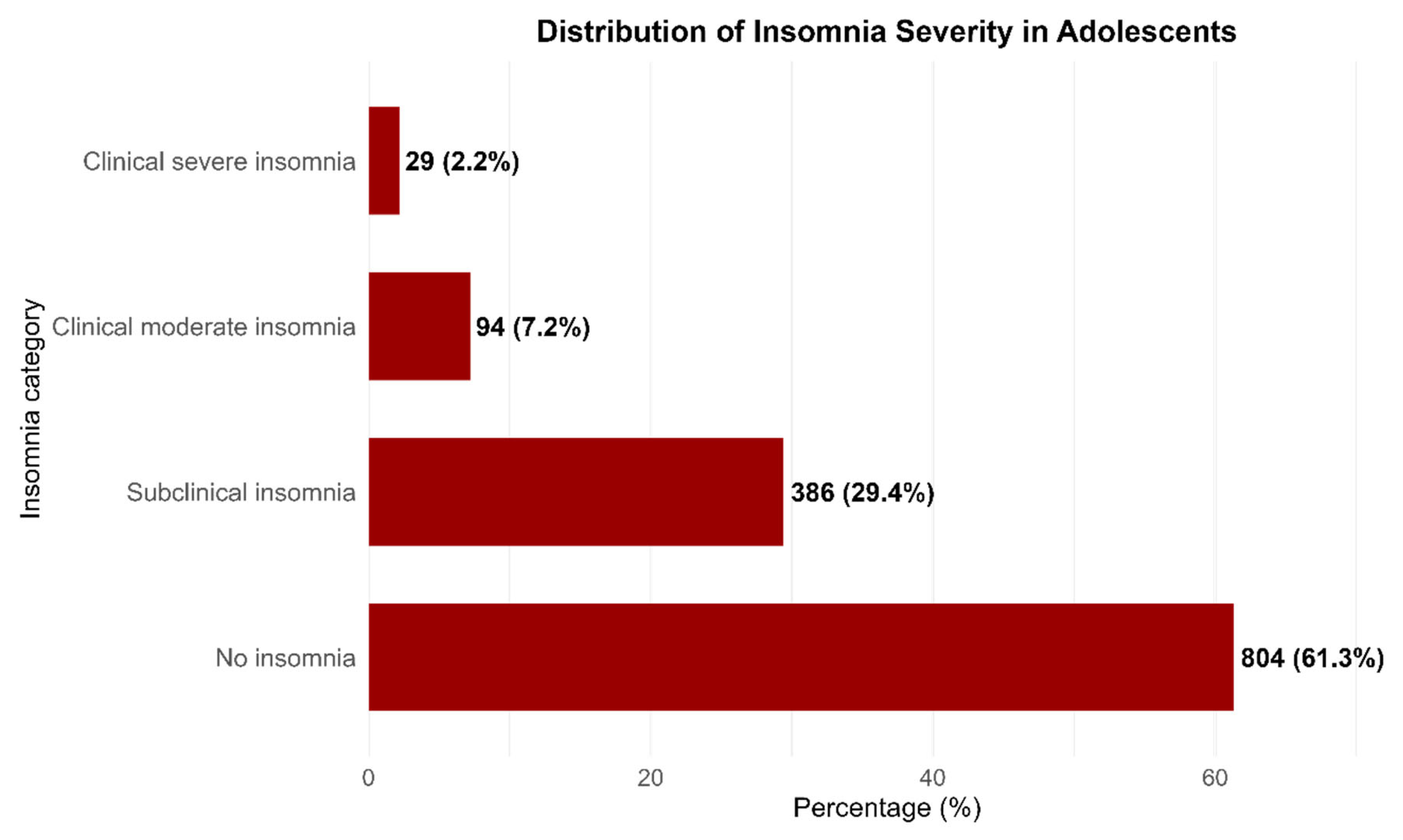
| Insomnia | |
| No | 804 (61.3) |
| Subclinical | 386 (29.4) |
| Moderate clinical | 94 (7.2) |
| Clinically severe | 29 (2.2) |
| Variables | Insomnia | p * | |
|---|---|---|---|
| No (n = 804) | Yes (n = 509) | ||
| n (%) | n (%) | ||
| Adolescent, according to stage | 0.603 | ||
| Early | 186 (62.2) | 113 (37.8) | |
| Average | 549 (60.5) | 359 (39.5) | |
| Late | 69 (65.1) | 37 (34.9) | |
| Sex | <0.001 | ||
| Female | 327 (54.5) | 273 (45.5) | |
| Male | 477 (66.9) | 236 (33.1) | |
| Type of institution | 0.833 | ||
| National | 523 (61.0) | 334 (39.0) | |
| Particular | 281 (61.6) | 175 (38.4) | |
| Place of residence | 0.317 | ||
| Rural | 121 (65.1) | 65 (35.0) | |
| Urban | 659 (60.4) | 433 (39.7) | |
| Marginal urban | 24 (68.6) | 11 (31.4) | |
| Number of members in your family (categorized) | 0.635 | ||
| 1 to 5 | 490 (62.2) | 298 (37.9) | |
| 6 to 10 | 286 (60.1) | 190 (39.9) | |
| 11 to 15 | 28 (57.1) | 21 (42.9) | |
| Religion | 0.118 | ||
| Any | 204 (66.2) | 104 (33.4) | |
| Catholic | 441 (59.5) | 300 (40.5) | |
| Not Catholic | 159 (60.2) | 105 (39.8) | |
| Family mental history | <0.001 | ||
| No | 716 (63.9) | 405 (36.1) | |
| Yes | 88 (45.8) | 104 (54.2) | |
| Categorized BMI | 0.895 | ||
| Underweight | 167 (60.3) | 110 (39.7) | |
| Normal | 512 (62.0) | 314 (38.1) | |
| Overweight | 100 (59.2) | 69 (40.8) | |
| Obesity | 25 (61.0) | 16 (39.0) | |
| Getting closer to friends | 0.293 | ||
| Infrequent | 187 (59.4) | 126 (40.6) | |
| Frequent | 391 (63.5) | 225 (36.5) | |
| Very common | 226 (59.2) | 156 (40.8) | |
| Approach with relatives | <0.001 | ||
| Infrequent | 210 (51.5) | 198 (48.5) | |
| Frequent | 373 (62.9) | 220 (37.1) | |
| Very common | 221 (70.8) | 91 (29.2) | |
| Failed course during school stage | <0.001 | ||
| No | 469 (65.7) | 245 (34.3) | |
| Yes | 335 (56.0) | 264 (44.1) | |
| In love | 0.005 | ||
| No | 325 (66.1) | 167 (33.9) | |
| Yes | 479 (58.3) | 342 (41.7) | |
| Alcohol consumption | 0.001 | ||
| Never | 658 (64.1) | 369 (35.9) | |
| Monthly or less | 83 (50.6) | 81 (49.4) | |
| 2 to 4 times a month | 42 (50.6) | 41 (49.4) | |
| 2 to 3 times a week | 16 (64.0) | 9 (36.0) | |
| 4 or more times a week | 5 (35.7) | 9 (64.3) | |
| Cigarette smoking | 0.056 | ||
| Never | 764 (62.0) | 469 (38.0) | |
| <10 cigarettes/day | 17 (40.5) | 25 (59.5) | |
| 11 to 20 cigarettes/day | 15 (65.2) | 8 (34.8) | |
| 21 to 30 cigarettes/day | 4 (66.7) | 2 (33.3) | |
| 31 or more cigarettes/day | 4 (44.4) | 5 (55.6) | |
| Seek mental health support | <0.001 | ||
| No | 678 (65.3) | 360 (34.7) | |
| Yes | 126 (45.8) | 149 (54.2) | |
| Frequency of social media use during the COVID-19 pandemic | <0.001 | ||
| Never | 89 (77.4) | 26 (22.6) | |
| A bit | 189 (66.6) | 99 (34.4) | |
| Moderate | 242 (66.7) | 121 (33.3) | |
| A lot | 244 (56.9) | 185 (43.1) | |
| Extreme | 40 (33.9) | 78 (66.1) | |
| Frequency of daily internet use | <0.001 | ||
| 1 to 5 | 532 (65.7) | 278 (34.3) | |
| 6 to 10 | 153 (51.2) | 146 (48.8) | |
| 11 to 15 | 119 (58.3) | 85 (41.7) | |
| Frequency of daily television use | 0.561 | ||
| 1 to 5 | 746 (61.5) | 467 (38.5) | |
| 6 to 10 | 43 (60.6) | 28 (39.4) | |
| 11 to 15 | 15 (51.7) | 14 (48.3) | |
| Family member died from COVID-19 | <0.001 | ||
| No | 481 (65.5) | 253 (34.5) | |
| Yes | 323 (55.8) | 256 (44.2) | |
| Acne on face | <0.001 | ||
| No | 433 (64.7) | 236 (35.3) | |
| Grade 1 | 336 (60.1) | 223 (39.9) | |
| Grade 2 | 25 (41.7) | 35 (58.3) | |
| Grade 3 | 1 (14.3) | 6 (85.7) | |
| Grade 4 | 9 (50.0) | 9 (50.0) | |
| Family dysfunction | <0.001 | ||
| No | 337 (68.4) | 156 (31.6) | |
| Mild | 138 (57.3) | 103 (42.7) | |
| Moderate | 52 (42.6) | 70 (57.4) | |
| Severe | 217 (59.8) | 146 (40.2) | |
| Resilience | 0.150 | ||
| Low | 650 (60.2) | 430 (39.8) | |
| High | 147 (65.3) | 78 (34.7) | |
| Victim of Bullying | 0.896 | ||
| No | 520 (61.1) | 331 (38.9) | |
| Yes | 284 (61.5) | 178 (38.5) | |
| Quality of life due to acne | 0.003 | ||
| It doesn’t affect anything-small | 660 (62.7) | 393 (37.3) | |
| Moderate-extreme effect | 102 (51.5) | 96 (48.5) | |
| Eating disorder | <0.001 | ||
| No | 548 (72.9) | 204 (27.1) | |
| Yes | 205 (42.3) | 280 (57.7) | |
| Self-esteem | <0.001 | ||
| High/Medium | 500 (68.9) | 226 (31.1) | |
| Low | 304 (51.8) | 283 (48.2) | |
| Characteristics | Insomnia | |||||
|---|---|---|---|---|---|---|
| Simple Regression | Multiple Regression * | |||||
| PR | IC 95% | p ** | PR | IC 95% | p ** | |
| Categorized age (years) | ||||||
| Early | Ref. | |||||
| Average | 1.04 | 0.85–1.28 | 0.692 | |||
| Late | 0.93 | 0.81–1.08 | 0.346 | |||
| Sex | ||||||
| Female | Ref. | Ref. | ||||
| Male | 0.73 | 0.67–0.80 | <0.001 | 0.92 | 0.78–1.10 | 0.374 |
| Type of institution | ||||||
| National | 0.99 | 0.87–1.12 | 0.836 | |||
| Particular | ||||||
| Place of residence | ||||||
| Rural | Ref. | Ref. | ||||
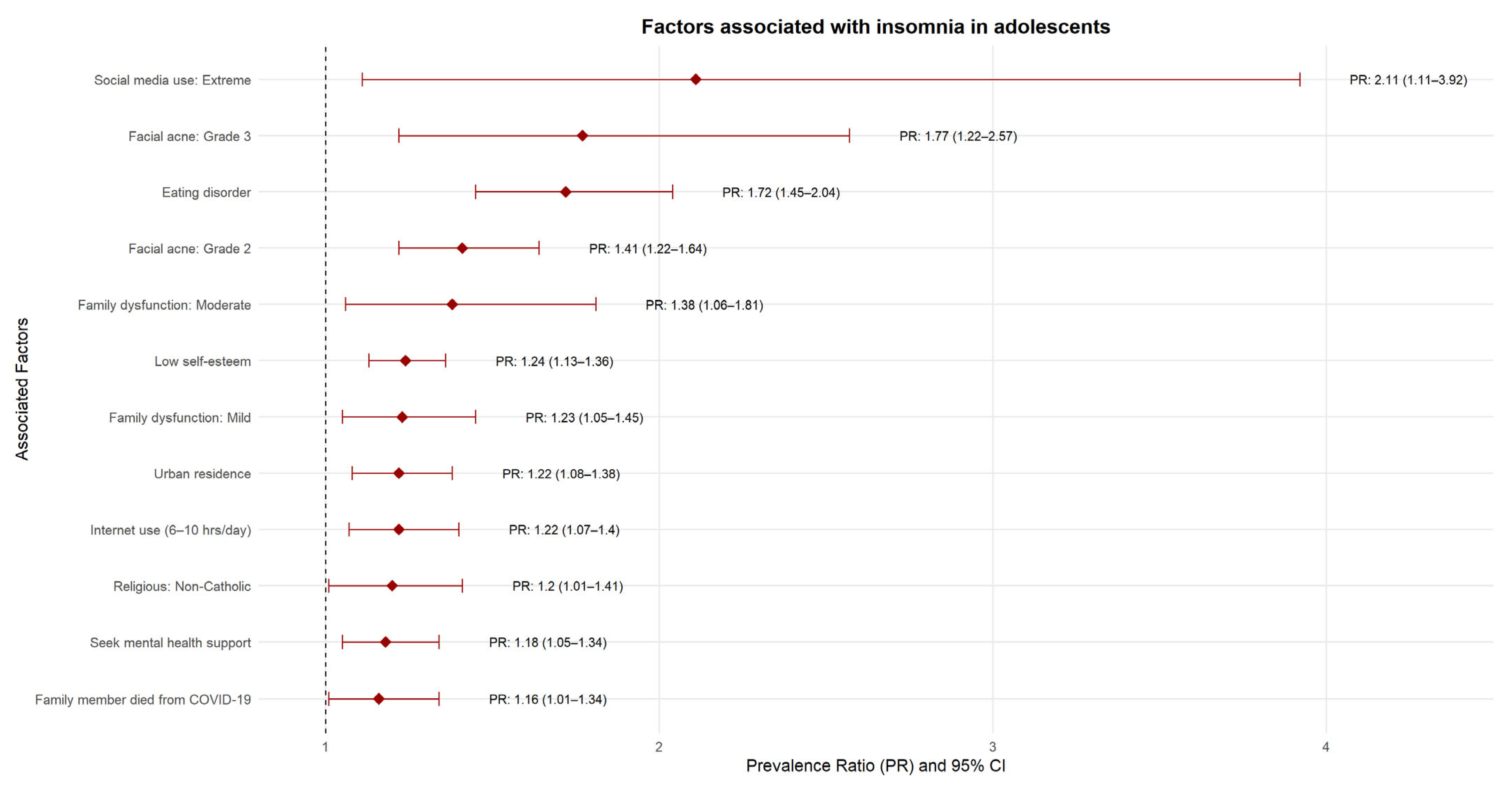
| Urban | 1.13 | 0.99–1.27 | 0.044 | 1.22 | 1.08–1.38 | 0.001 |
| Marginal urban | 0.89 | 0.52–1.53 | 0.683 | 1.13 | 0.63–2.02 | 0.679 |
| Number of members in your family (categorized) | ||||||
| 1 to 5 | Ref. | |||||
| 6 to 10 | 1.05 | 0.95–1.16 | 0.359 | |||
| 11 to 15 | 1.13 | 0.85–1.50 | 0.388 | |||
| Religion | ||||||
| Any | Ref. | Ref. | ||||
| Catholic | 1.21 | 1.05–1.40 | 0.009 | 1.20 | 0.93–1.54 | 0.162 |
| Not Catholic | 1.19 | 1.04–1.36 | 0.012 | 1.20 | 1.01–1.41 | 0.040 |
| Family mental history | ||||||
| No | Ref. | Ref. | ||||
| Yes | 1.50 | 1.25–1.81 | <0.001 | 1.07 | 0.90–1.26 | 0.436 |
| Categorized BMI | ||||||
| Underweight | Ref. | |||||
| Normal | 0.96 | 0.90–1.02 | 0.144 | |||
| Overweight | 1.03 | 0.91–1.17 | 0.653 | |||
| Obesity | 0.98 | 0.78–1.25 | 0.897 | |||
| Getting closer to friends | ||||||
| Infrequent | Ref. | |||||
| Frequent | 0.91 | 0.80–1.04 | 0.156 | |||
| Very common | 1.01 | 0.92–1.12 | 0.773 | |||
| Approach with relatives | ||||||
| Infrequent | Ref. | Ref. | ||||
| Frequent | 0.77 | 0.70–0.84 | <0.001 | 0.96 | 0.79–1.17 | 0.686 |
| Very common | 0.60 | 0.40–0.90 | 0.013 | 0.78 | 0.56–1.08 | 0.137 |
| Failed course during school stage | ||||||
| No | Ref. | Ref. | ||||
| Yes | 1.28 | 1.07–1.55 | 0.009 | 1.13 | 0.97–1.31 | 0.115 |
| In love | ||||||
| No | Ref. | Ref. | ||||
| Yes | 1.23 | 1.11–1.38 | <0.001 | 1.04 | 0.99–1.09 | 0.164 |
| Alcohol consumption | ||||||
| Never | Ref. | Ref. | ||||
| Monthly or less | 1.38 | 1.17–1.62 | <0.001 | 1.06 | 0.84–1.34 | 0.633 |
| 2 to 4 times a month | 1.38 | 1.01–1.88 | 0.042 | 0.92 | 0.70–1.22 | 0.575 |
| 2 to 3 times a week | 1.00 | 0.30–3.40 | 0.994 | 0.80 | 0.30–2.17 | 0.666 |
| 4 or more times a week | 1.79 | 0.85–3.78 | 0.125 | 0.96 | 0.25–3.65 | 0.952 |
| Cigarette smoking | ||||||
| Never | Ref. | Ref. | ||||
| <10 cigarettes/day | 1.57 | 1.29–1.91 | <0.001 | 1.20 | 0.95–1.52 | 0.127 |
| 11 to 20 cigarettes/day | 0.92 | 0.57–1.47 | 0.716 | 0.78 | 0.57–1.05 | 0.105 |
| 21 to 30 cigarettes/day | 0.88 | 0.35–2.22 | 0.783 | 0.84 | 0.52–1.37 | 0.493 |
| 31 or more cigarettes/day | 1.46 | 1.15–1.86 | 0.002 | 0.90 | 0.53–1.52 | 0.693 |
| Seek mental health support | ||||||
| No | Ref. | Ref. | ||||
| Yes | 1.57 | 1.42–1.73 | <0.001 | 1.18 | 1.05–1.34 | 0.007 |
| Frequency of social media use during the COVID-19 pandemic | ||||||
| Never | Ref. | Ref. | ||||
| A bit | 1.49 | 0.98–2.26 | 0.062 | 1.41 | 0.85–2.34 | 0.182 |
| Moderate | 1.46 | 0.78–2.73 | 0.233 | 1.39 | 0.66–2.95 | 0.384 |
| A lot | 1.89 | 1.19–3.02 | 0.008 | 1.62 | 0.91–2.90 | 0.102 |
| Extreme | 2.89 | 1.68–4.99 | <0.001 | 2.11 | 1.11–3.92 | 0.018 |
| Frequency of daily internet use | ||||||
| 1 to 5 | Ref. | Ref. | ||||
| 6 to 10 | 1.43 | 1.24–1.64 | <0.001 | 1.22 | 1.07–1.40 | 0.003 |
| 11 to 15 | 1.22 | 1.02–1.46 | 0.032 | 1.04 | 0.87–1.24 | 0.675 |
| Frequency of daily television use | ||||||
| 1 to 5 | Ref. | |||||
| 6 to 10 | 1.03 | 0.79–1.33 | 0.846 | |||
| 11 to 15 | 1.26 | 0.99–1.60 | 0.064 | |||
| Family member died from COVID-19 | ||||||
| No | Ref. | Ref. | ||||
| Yes | 1.29 | 1.04–1.59 | 0.019 | 1.16 | 1.01–1.34 | 0.035 |
| Acne on face | ||||||
| No | Ref. | Ref. | ||||
| Grade 1 | 1.14 | 0.97–1.34 | 0.115 | 1.09 | 0.93–1.28 | 0.266 |
| Grade 2 | 1.66 | 1.37–2.02 | <0.001 | 1.41 | 1.22–1.64 | <0.001 |
| Grade 3 | 2.44 | 2.05–2.91 | <0.001 | 1.77 | 1.22–2.57 | 0.002 |
| Grade 4 | 1.43 | 1.25–1.62 | <0.001 | 1.19 | 0.86–1.65 | 0.294 |
| Family dysfunction | ||||||
| No | Ref. | Ref. | ||||
| Mild | 1.35 | 1.12–1.63 | 0.002 | 1.23 | 1.05–1.45 | 0.012 |
| Moderate | 1.80 | 1.33–2.42 | <0.001 | 1.38 | 1.06–1.81 | 0.017 |
| Severe | 1.26 | 0.96–1.67 | 0.098 | 1.17 | 0.95–1.44 | 0.138 |
| Resilience | ||||||
| Low | Ref. | |||||
| High | 0.87 | 0.72–1.05 | 0.154 | |||
| Victim of Bullying | Ref. | |||||
| No | 0.98 | 0.84–1.15 | 0.824 | |||
| Yes | ||||||
| Quality of life due to acne | ||||||
| It doesn’t affect anything-small | Ref. | Ref. | ||||
| Moderate-extreme effect | 1.30 | 1.05–1.62 | 0.016 | 0.99 | 0.79–1.24 | 0.938 |
| Eating disorder | ||||||
| No | Ref. | Ref. | ||||
| Yes | 2.12 | 1.82–2.46 | <0.001 | 1.72 | 1.45–2.04 | <0.001 |
| Self-esteem | ||||||
| High/Medium | Ref. | Ref. | ||||
| Low | 1.55 | 1.31–1.82 | <0.001 | 1.24 | 1.13–1.36 | <0.001 |
Disclaimer/Publisher’s Note: The statements, opinions and data contained in all publications are solely those of the individual author(s) and contributor(s) and not of MDPI and/or the editor(s). MDPI and/or the editor(s) disclaim responsibility for any injury to people or property resulting from any ideas, methods, instructions or products referred to in the content. |
© 2026 by the authors. Licensee MDPI, Basel, Switzerland. This article is an open access article distributed under the terms and conditions of the Creative Commons Attribution (CC BY) license.
Share and Cite
Valladares-Garrido, M.J.; Hernández-Yépez, P.J.; Morocho Alburqueque, A.G.; Aguilar-Manay, L.A.; Santin Vásquez, J.; Acosta-Porzoliz, R.; Valladares-Garrido, D.; León-Figueroa, D.A.; Pereira-Victorio, C.J.; Villegas-Chiroque, M.; et al. Insomnia Among Adolescents in Northern Peru: Associations with Psychosocial, Health-Related, and Educational Factors in a Cross-Sectional Study Across Five Schools. J. Clin. Med. 2026, 15, 1505. https://doi.org/10.3390/jcm15041505
Valladares-Garrido MJ, Hernández-Yépez PJ, Morocho Alburqueque AG, Aguilar-Manay LA, Santin Vásquez J, Acosta-Porzoliz R, Valladares-Garrido D, León-Figueroa DA, Pereira-Victorio CJ, Villegas-Chiroque M, et al. Insomnia Among Adolescents in Northern Peru: Associations with Psychosocial, Health-Related, and Educational Factors in a Cross-Sectional Study Across Five Schools. Journal of Clinical Medicine. 2026; 15(4):1505. https://doi.org/10.3390/jcm15041505
Chicago/Turabian StyleValladares-Garrido, Mario J., Palmer J. Hernández-Yépez, Angie Giselle Morocho Alburqueque, Luz A. Aguilar-Manay, Jassmin Santin Vásquez, Renzo Acosta-Porzoliz, Danai Valladares-Garrido, Darwin A. León-Figueroa, César J. Pereira-Victorio, Miguel Villegas-Chiroque, and et al. 2026. "Insomnia Among Adolescents in Northern Peru: Associations with Psychosocial, Health-Related, and Educational Factors in a Cross-Sectional Study Across Five Schools" Journal of Clinical Medicine 15, no. 4: 1505. https://doi.org/10.3390/jcm15041505
APA StyleValladares-Garrido, M. J., Hernández-Yépez, P. J., Morocho Alburqueque, A. G., Aguilar-Manay, L. A., Santin Vásquez, J., Acosta-Porzoliz, R., Valladares-Garrido, D., León-Figueroa, D. A., Pereira-Victorio, C. J., Villegas-Chiroque, M., Vera-Ponce, V. J., Rivera-Lozada, O., & Zila-Velasque, J. P. (2026). Insomnia Among Adolescents in Northern Peru: Associations with Psychosocial, Health-Related, and Educational Factors in a Cross-Sectional Study Across Five Schools. Journal of Clinical Medicine, 15(4), 1505. https://doi.org/10.3390/jcm15041505