Prevalence of Polypoidal Choroidal Vasculopathy Beyond Recalcitrant Macular Neovasculopathies in a European AMD Cohort and Therapeutic Response to Brolucizumab


Abstract
1. Introduction
2. Materials and Methods
2.1. Inclusion Criteria
2.2. Exclusion Criteria
2.3. Non-ICGA-Based Imaging Criteria Applied Here for PCV Diagnosis
2.4. Statistical Analysis
3. Results
4. Discussion
5. Conclusions
Supplementary Materials
Author Contributions
Funding
Institutional Review Board Statement
Informed Consent Statement
Data Availability Statement
Acknowledgments
Conflicts of Interest
References
- Fenner, B.J.; Cheung, C.M.G.; Sim, S.S.; Lee, W.K.; Staurenghi, G.; Lai, T.Y.; Ruamviboonsuk, P.; Kokame, G.; Yanagi, Y.; Teo, K.Y. Evolving treatment paradigms for PCV. Eye 2022, 36, 257–265. [Google Scholar] [CrossRef]
- Pan, Y.; Fu, Y.; Baird, P.N.; Guymer, R.H.; Das, T.; Iwata, T. Exploring the contribution of ARMS2 and HTRA1 genetic risk factors in age-related macular degeneration. Prog. Retin. Eye Res. 2023, 97, 101159. [Google Scholar] [CrossRef]
- Laude, A.; Cackett, P.D.; Vithana, E.N.; Yeo, I.Y.; Wong, D.; Koh, A.H.; Wong, T.Y.; Aung, T. Polypoidal choroidal vasculopathy and neovascular age-related macular degeneration: Same or different disease? Prog. Retin. Eye Res. 2010, 29, 19–29. [Google Scholar] [CrossRef]
- Cho, M.; Barbazetto, I.A.; Freund, K.B. Refractory neovascular age-related macular degeneration secondary to polypoidal choroidal vasculopathy. Am. J. Ophthalmol. 2009, 148, 70–78.e71. [Google Scholar] [CrossRef]
- Hatz, K.; Prünte, C. Polypoidal choroidal vasculopathy in Caucasian patients with presumed neovascular age-related macular degeneration and poor ranibizumab response. Br. J. Ophthalmol. 2014, 98, 188–194. [Google Scholar] [CrossRef]
- Yamashiro, K.; Tomita, K.; Tsujikawa, A.; Nakata, I.; Akagi-Kurashige, Y.; Miyake, M.; Ooto, S.; Tamura, H.; Yoshimura, N. Factors associated with the response of age-related macular degeneration to intravitreal ranibizumab treatment. Am. J. Ophthalmol. 2012, 154, 125–136. [Google Scholar] [CrossRef]
- Kawashima, Y.; Oishi, A.; Tsujikawa, A.; Yamashiro, K.; Miyake, M.; Ueda-Arakawa, N.; Yoshikawa, M.; Takahashi, A.; Yoshimura, N. Effects of aflibercept for ranibizumab-resistant neovascular age-related macular degeneration and polypoidal choroidal vasculopathy. Graefe’s Arch. Clin. Exp. Ophthalmol. 2015, 253, 1471–1477. [Google Scholar] [CrossRef]
- Ishikawa, K.; Kannan, R.; Hinton, D.R. Molecular mechanisms of subretinal fibrosis in age-related macular degeneration. Exp. Eye Res. 2016, 142, 19–25. [Google Scholar] [CrossRef]
- Wang, L.; Liu, S.; He, T.; Liu, C.; Duan, J. Efficacy of Intravitreal Anti-VEGF Agents in Neovascular Age-Related Macular Degeneration Patients with or without Polypoidal Choroidal Vasculopathy: A Meta-Analysis. Br. J. Hosp. Med. 2025, 86, 1–22. [Google Scholar] [CrossRef]
- Cho, S.C.; Park, K.H.; Park, S.J.; Joo, K.; Woo, S.J. Discontinuation of treatment and retreatment of neovascular age-related macular degeneration in the real-world: Bundang AMD cohort study report 5. Front. Med. 2023, 10, 1204026. [Google Scholar] [CrossRef]
- Garweg, J.G.; Gerhardt, C. Disease stability and extended dosing under anti-VEGF treatment of exudative age-related macular degeneration (AMD)—A meta-analysis. Graefe’s Arch. Clin. Exp. Ophthalmol. 2021, 259, 2181–2192. [Google Scholar] [CrossRef]
- Cheung, C.M.G.; Lai, T.Y.; Teo, K.; Ruamviboonsuk, P.; Chen, S.J.; Kim, J.E.; Gomi, F.; Koh, A.H.; Kokame, G.; Jordan-Yu, J.M.; et al. Polypoidal Choroidal Vasculopathy: Consensus Nomenclature and Non-Indocyanine Green Angiograph Diagnostic Criteria from the Asia-Pacific Ocular Imaging Society PCV Workgroup. Ophthalmology 2021, 128, 443–452. [Google Scholar] [CrossRef]
- Hänsli, C.; Schild, C.; Pfister, I.; Garweg, J.G. Brolucizumab in Pretreated Neovascular Age-Related Macular Degeneration: Case Series, Systematic Review, and Meta-Analysis. Life 2023, 13, 814. [Google Scholar] [CrossRef] [PubMed]
- Chronopoulos, A.; Huynh, E.; Ashurov, A.; Schutz, J.S.; Jonas, J.B.; Hattenbach, L.O. Brolucizumab for recalcitrant macular neovascularization in age-related macular degeneration with pigment epithelial detachment. Eur. J. Ophthalmol. 2024, 34, 487–496. [Google Scholar] [CrossRef]
- Fukuda, Y.; Sakurada, Y.; Matsubara, M.; Hasebe, Y.; Sugiyama, A.; Kikushima, W.; Kashiwagi, K. Comparison of Outcomes between 3 Monthly Brolucizumab and Aflibercept Injections for Polypoidal Choroidal Vasculopathy. Biomedicines 2021, 9, 1164. [Google Scholar] [CrossRef] [PubMed]
- Ito, A.; Maruyama-Inoue, M.; Kitajima, Y.; Ikeda, S.; Inoue, T.; Kadonosono, K. One-year outcomes of intravitreal brolucizumab injections in patients with polypoidal choroidal vasculopathy. Sci. Rep. 2022, 12, 7987. [Google Scholar] [CrossRef] [PubMed]
- Fukuda, Y.; Sakurada, Y.; Matsubara, M.; Kotoda, Y.; Kasai, Y.; Sugiyama, A.; Kashiwagi, K. Comparison of one-year outcomes between as-needed brolucizumab and aflibercept for polypoidal choroidal vasculopathy. Jpn. J. Ophthalmol. 2023, 67, 402–409. [Google Scholar] [CrossRef]
- Ogura, Y.; Jaffe, G.J.; Cheung, C.M.G.; Kokame, G.T.; Iida, T.; Takahashi, K.; Lee, W.K.; Chang, A.A.; Monés, J.; D’Souza, D.; et al. Efficacy and safety of brolucizumab versus aflibercept in eyes with polypoidal choroidal vasculopathy in Japanese participants of HAWK. Br. J. Ophthalmol. 2022, 106, 994–999. [Google Scholar] [CrossRef]
- Ueda-Consolvo, T.; Tanigichi, A.; Numata, A.; Oiwake, T.; Nakamura, T.; Ishida, M.; Yanagisawa, S.; Hayashi, A. Switching to brolucizumab from aflibercept in age-related macular degeneration with type 1 macular neovascularization and polypoidal choroidal vasculopathy: An 18-month follow-up study. Graefe’s Arch. Clin. Exp. Ophthalmol. 2023, 261, 345–352. [Google Scholar] [CrossRef]
- Matsumoto, H.; Hoshino, J.; Mukai, R.; Nakamura, K.; Akiyama, H. Short-term outcomes of intravitreal brolucizumab for treatment-naïve neovascular age-related macular degeneration with type 1 choroidal neovascularization including polypoidal choroidal vasculopathy. Sci. Rep. 2021, 11, 6759. [Google Scholar] [CrossRef]
- Cho, H.J.; Kang, K.H.; Yoon, W.; Lee, J.; Kim, C.G.; Kim, J.W. Intravitreal Brolucizumab and Aflibercept for Polypoidal Choroidal Vasculopathy. J. Ocul. Pharmacol. Ther. 2023, 39, 653–660. [Google Scholar] [CrossRef]
- Garweg, J.G.; Keiper, J.; Pfister, I.B.; Schild, C. Functional Outcomes of Brolucizumab-Induced Intraocular Inflammation Involving the Posterior Segment-A Meta-Analysis and Systematic Review. J. Clin. Med. 2023, 12, 4671. [Google Scholar] [CrossRef]
- Chakraborty, D.; Maiti, A.; Sengupta, S.; Mondal, S.; Nandi, K.; Chakraborty, S. Initial experience in treating polypoidal choroidal vasculopathy with brolucizumab in Indian eyes—A multicenter retrospective study. Indian J. Ophthalmol. 2022, 70, 1295–1299. [Google Scholar] [CrossRef]
- Chaikitmongkol, V.; Ozimek, M.; Srisomboon, T.; Patikulsila, D.; Fraser-Bell, S.; Chhablani, J.; Choovuthayakorn, J.; Watanachai, N.; Kunavisarut, P.; Rodríguez-Valdés, P.J.; et al. Polypoidal Choroidal Vasculopathy Based on Non-ICGA Criteria in White Patients With Neovascular Age-Related Macular Degeneration. Am. J. Ophthalmol. 2022, 244, 58–67. [Google Scholar] [CrossRef] [PubMed]
- Lafaut, B.A.; Leys, A.M.; Snyers, B.; Rasquin, F.; De Laey, J.J. Polypoidal choroidal vasculopathy in Caucasians. Graefe’s Arch. Clin. Exp. Ophthalmol. 2000, 238, 752–759. [Google Scholar] [CrossRef]
- Grewal, D.S.; Gill, M.K.; Sarezky, D.; Lyon, A.T.; Mirza, R.G. Visual and anatomical outcomes following intravitreal aflibercept in eyes with recalcitrant neovascular age-related macular degeneration: 12-month results. Eye 2014, 28, 895–899. [Google Scholar] [CrossRef] [PubMed]
- Hoshino, J.; Matsumoto, H.; Nakamura, K.; Akiyama, H. Predicting treatment outcomes of intravitreal brolucizumab for polypoidal choroidal vasculopathy through noninvasive assessment of polypoidal lesion blood flow with optical coherence tomography angiography. Sci. Rep. 2024, 14, 961. [Google Scholar] [CrossRef] [PubMed]
- Bulirsch, L.M.; Saßmannshausen, M.; Nadal, J.; Liegl, R.; Thiele, S. Short-term real-world outcomes following intravitreal brolucizumab for neovascular AMD: SHIFT study. Br. J. Ophthalmol. 2022, 106, 1288–1294. [Google Scholar] [CrossRef]
- van Dijk, E.H.; Holtz, J.K.; Sirks, M.J.; Larsson, J.M.; Diederen, R.M.; Schlingemann, R.O.; Boon, C.J.; Subhi, Y. European Prevalence of Polypoidal Choroidal Vasculopathy: A Systematic Review, Meta-Analysis, and Forecasting Study. J. Clin. Med. 2022, 11, 4766. [Google Scholar] [CrossRef]
- Lorentzen, T.D.; Subhi, Y.; Sørensen, T.L. Presenting characteristics and prevalence of polypoidal choroidal vasculopathy in Scandinavian patients with treatment-naïve exudative age-related macular degeneration. Acta Ophthalmol. 2018, 96, 475–480. [Google Scholar] [CrossRef]
- De Salvo, G.; Thulasidharan, S.; Barbara, R.; Penwarden, A.; Aggarwal, N.; Frisina, R. Real world treatment outcomes in polypoidal choroidal vasculopathy in a Caucasian population of British ethnicity. Eye 2024, 38, 3072–3076. [Google Scholar] [CrossRef]
- Wolff, B.; Vasseur, V.; Cahuzac, A.; Coscas, F.; Castelnovo, L.; Favard, C.; Michel, G.; Français, C.; Salomon, L.; Mauget-Faÿsse, M. Aflibercept Treatment in Polypoidal Choroidal Vasculopathy: Results of a Prospective Study in a Caucasian Population. Ophthalmologica 2018, 240, 208–212. [Google Scholar] [CrossRef]
- Chaikitmongkol, V.; Tadadoltip, W.; Patikulsila, D.; Srisomboon, T.; Narongchai, C.; Choovuthayakorn, J.; Watanachai, N.; Kunavisarut, P.; Sangkaew, A.; Upaphong, P.; et al. Recurrent polypoidal lesions after achieving inactive polypoidal choroidal vasculopathy following 1-year fixed-dosing aflibercept treatments. Asia Pac. J. Ophthalmol. 2025, 14, 100176. [Google Scholar] [CrossRef] [PubMed]
- Kimura, M.; Sakurada, Y. Association of Polyp Regression after Loading Phase with 12-Month Outcomes of Eyes with Polypoidal Choroidal Vasculopathy. Pharmaceuticals 2024, 17, 687. [Google Scholar] [CrossRef]
- Nguyen, Q.D.; Das, A.; Do, D.V.; Dugel, P.U.; Gomes, A.; Holz, F.G.; Koh, A.; Pan, C.K.; Sepah, Y.J.; Patel, N.; et al. Brolucizumab: Evolution through Preclinical and Clinical Studies and the Implications for the Management of Neovascular Age-Related Macular Degeneration. Ophthalmology 2020, 127, 963–976. [Google Scholar] [CrossRef] [PubMed]
- Rossi, S.; Gesualdo, C.; Marano, E.; Perrotta, R.; Trotta, M.C.; Del Giudice, A.; Simonelli, F. Treatment of neovascular age-related macular degeneration: One year real-life results with intravitreal Brolucizumab. Front. Med. 2024, 11, 1467160. [Google Scholar] [CrossRef]
- Dugel, P.U.; Jaffe, G.J.; Sallstig, P.; Warburton, J.; Weichselberger, A.; Wieland, M.; Singerman, L. Brolucizumab Versus Aflibercept in Participants with Neovascular Age-Related Macular Degeneration: A Randomized Trial. Ophthalmology 2017, 124, 1296–1304. [Google Scholar] [CrossRef]
- Bilgic, A.; Kodjikian, L.; De Ribot, F.M.; Spitzer, M.S.; Vasavada, V.; Gonzalez-Cortes, J.H.; Sudhalkar, A.; Chakraborty, S.; Mathis, T. Real-world experience with brolucizumab in neovascular age-related macular degeneration over 2 years: The REBA extension study. Graefe’s Arch. Clin. Exp. Ophthalmol. 2024, 262, 1161–1167. [Google Scholar] [CrossRef] [PubMed]
- Nam, S.W.; Byun, Z.; Ham, D.I.; Kong, M. Response to brolucizumab treatment for refractory serous pigment epithelial detachment secondary to polypoidal choroidal vasculopathy. BMC Ophthalmol. 2022, 22, 485. [Google Scholar] [CrossRef]
- Permadi, A.C.; Djatikusumo, A.; Adriono, G.A. Optical coherence tomography in diagnosing polypoidal choroidal vasculopathy. Looking into the future: A systematic review and meta-analysis. Int. J. Retin. Vitr. 2022, 8, 14. [Google Scholar] [CrossRef]
- Jiang, Y.; Qi, S. Diagnostic Value of Spectral-Domain Optical Coherence Tomography for Polypoidal Choroidal Vasculopathy: A Systematic Review and Meta-Analysis. Front. Med. 2022, 9, 878946. [Google Scholar] [CrossRef]
- Liew, G.; Hyun-Jin, H.D.; Hooper, C.; Chia, E.M.; Mitchell, P.; Ong, S.; Ho, I.V. Prevalence of polypoidal choroidal vasculopathy in Caucasian patients as estimated from optical coherence tomography signs. Eye 2021, 35, 1011–1012. [Google Scholar] [CrossRef]
- Yoshikawa, Y.; Sakaki, Y.; Shinoda, K.; Kataoka, K. Safety and Effectiveness of Intravitreal Brolucizumab Injection in Combination With Sub-Tenon’s Capsule Triamcinolone Acetonide Injection for Polypoidal Choroidal Vasculopathy During the Loading Phase. Cureus 2024, 16, e59481. [Google Scholar] [CrossRef] [PubMed]
- Kamao, H.; Goto, K.; Mizukawa, K.; Hiraki, R.; Miki, A.; Kimura, S. Punctate Hyperfluorescence as a Favorable Predictive Factor for Treatment Response Following a Switch to Brolucizumab for Patients with Aflibercept-Refractory Neovascular Age-Related Macular Degeneration. J. Clin. Med. 2025, 14, 5141. [Google Scholar] [CrossRef] [PubMed]
- Allehyani, M.H.; Alsaeedi, A.K.; Alqthmi, R.O.; Saleh, R.E.; Alsamli, R.S.; Almalki, H.A.; Alshehri, A.F.; Felimban, S.A.; Kambiji, G.J.; Almatrafi, M.I.; et al. Comparative Efficacy of Brolucizumab and Aflibercept in Polypoidal Choroidal Vasculopathy: A Systematic Review and Meta-Analysis. Cureus 2025, 17, e77073. [Google Scholar] [CrossRef] [PubMed]



| Baseline Characteristics | Typical nAMD | PCV | Pooled | p-Value, Effect Size, 95% Confidence Interval (Typical nAMD vs. PCV) |
|---|---|---|---|---|
| Participants (=number of eyes), n (%) | 16 (59.3) | 11 (40.7) | 27 (100) | |
| Females, n (%) | 5 (31.3) | 7 (63.6) | 12 (44.4) | 0.13 OR: 0.80 CI: 0.16–4.02 |
| Age at baseline, (years (SD)) | 81.4 (5.7) | 74.7 (7.7) | 78.7 (7.2) | 0.016 dCohen = 0.76 CI: −1.83–−0.21 |
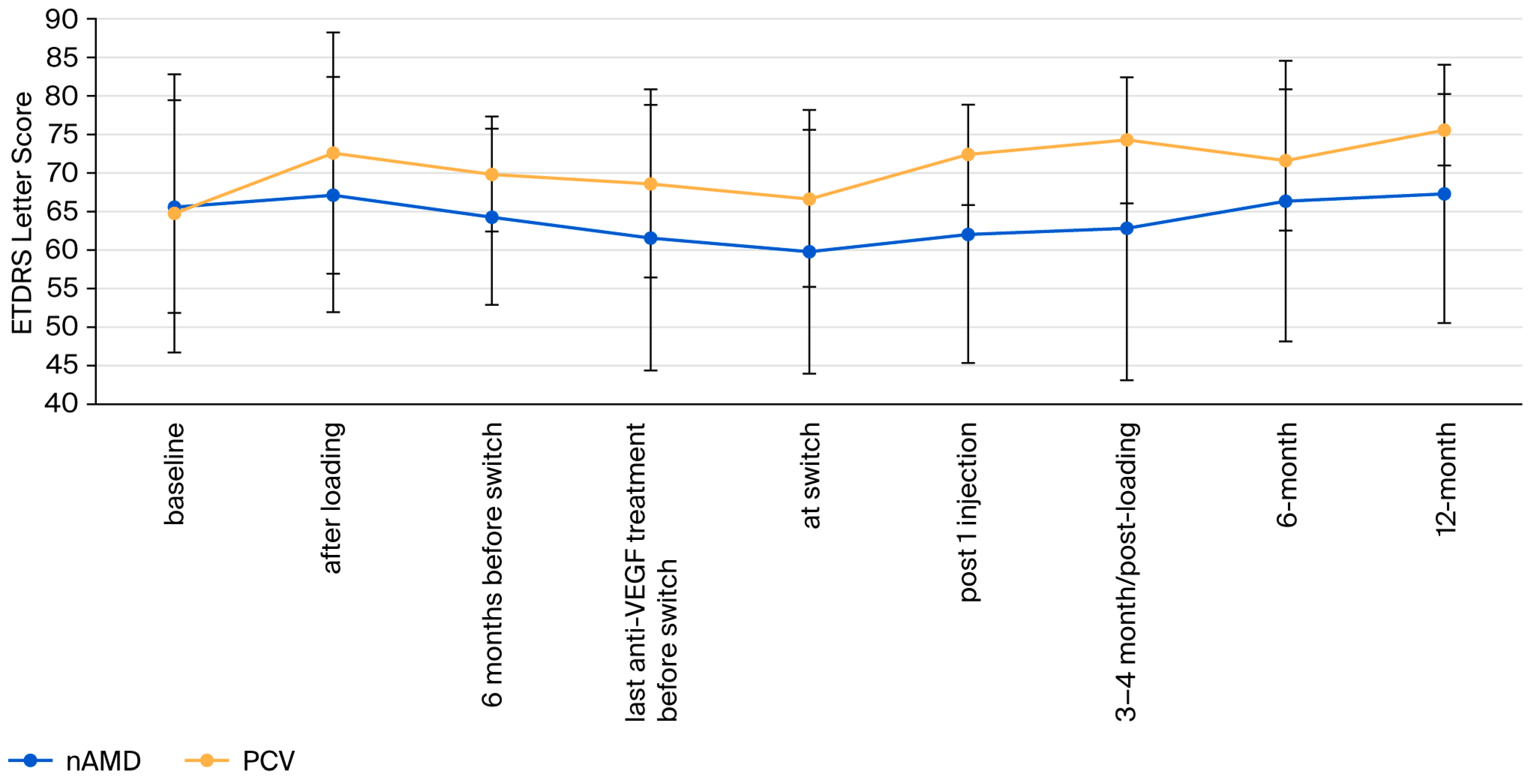
| Best-corrected visual acuity (ETDRS letters (SD)) | 65.7 (13.8) | 64.8 (18.0) | 65.3 (15.2) | 1.0 dCohen = 0.52 CI: −0.83–0.71 |
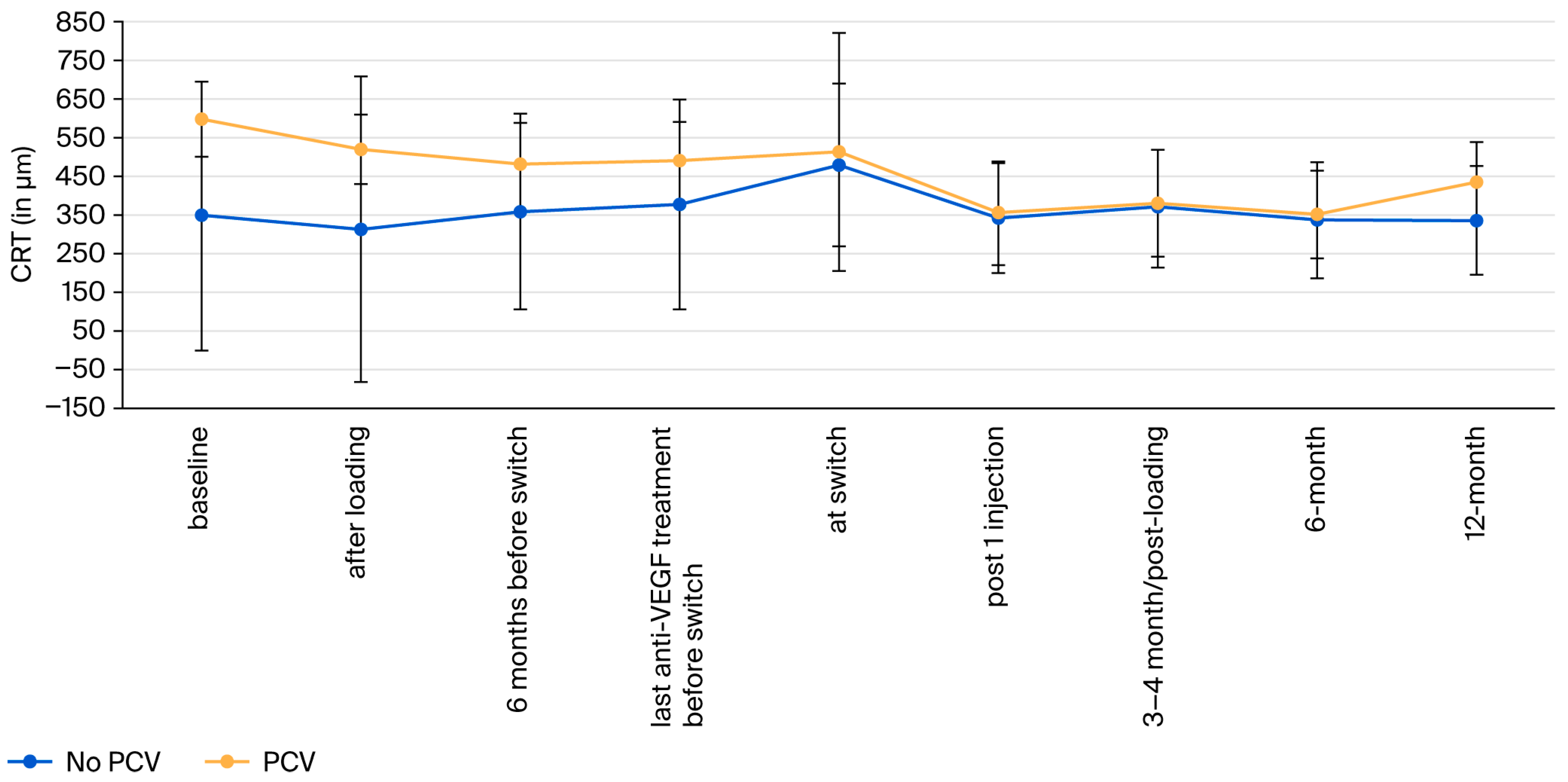
| Central retinal thickness (μm (SD)) | 349.3 (95.3) | 597.1 (348.4) | 435.5 (242.8) | 0.005 dCohen = 0.78 CI: 0.25–1.89 |
| Central subfield thickness, (μm (SD)) | 384.5 (78.9) | 569.6 (326.8) | 448.9 (214.7) | 0.12 dCohen = 0.73 CI: 0.06–1.66 |
| Typical nAMD | PCV | Pooled | p-Value, Effect Size, 95% Confidence Interval (Typical nAMD vs. PCV) | |
|---|---|---|---|---|
| Best-corrected visual acuity (ETDRS letters (SD)) | ||||
| Baseline (diagnosis) | 65.7 (13.8) | 64.8 (18.0) | 65.3 (15.2) | 1.0, dCohen = 0.52, CI: −0.83–0.71 |
| End of loading | 67.2 (15.3) | 72.6 (15.6) | 69.1 (15.2) | 0.31, dCohen = 0.60, CI: −0.58–1.28 |
| Switch to bro | 59.9 (15.8) | 66.8 (11.5) | 62.7 (14.4) | 0.23, dCohen = 0.63, CI: −0.29–1.26 |
| 12 months after switch | 67.4 (16.8) | 75.7 (4.7) | 71.5 (12.7) | 0.57, dCohen = 0.68, CI: −0.33–1.68 |
| p-value (longitudinal) | ||||
| Baseline—end of loading | 0.14 dRM = 0.34 CI: 0.21–1.76 | 0.046 dRM = 1.37 CI: 3.01–5.40 | 0.012 dRM = 0.63 CI: 0.93–2.20 | 0.08, dCohen = 0.73, CI: −0.09–1.83 |
| Baseline—switch to bro | 0.10 dRM = −0.67 CI: −1.72–−0.20 | 0.80 dRM = 0.30 CI: −0.48–1.63 | 0.17 dRM = −0.26 CI: −0.99–0.16 | 0.14, dCohen = 0.70, CI: −0.20–1.51 |
| Switch—12 months | 0.89 dRM = 0.90 CI: 0.86–2.41 | 0.07 dRM = 0.91 CI: 0.11–2.17 | 0.23 dRM = 0.88 CI: 0.61–2.06 | 0.15, dCohen = 0.71, CI: −0.25–1.78 |
| Central retinal thickness, μm (SD) | ||||
| Baseline (diagnosis) | 349.3 (95.3) | 597.1 (348.4) | 435.5 (242.8) | 0.005, dCohen = 0.79, CI: 0.23–2.07 |
| End of loading | 314.8 (89.1) | 520.3 (393.9) | 383.3 (248.1) | 0.13, dCohen = 0.73, CI: −0.07–1.83 |
| Switch to bro | 479.5 (306.6) | 512.6 (209.7) | 493.0 (267.2) | 0.27, dCohen = 0.53, CI: −0.65–0.89 |
| 12 Months after switch | 336.9 (105.6) | 433.9 (140.1) | 388.2 (131.1) | 0.11, dCohen = 0.71, −0.21–1.76 |
| p-value (longitudinal) | ||||
| Baseline—end of loading | 0.30 dRM = −0.33 CI: −1.04–0.45 | 0.60 dRM = −0.78 CI: −3.48–−1.30 | 0.052 dRM = −0.51 CI: −1.8–−0.57 | 0.27, dCohen = 0.64, CI: −1.44–0.4 |
| Baseline—switch to bro | 0.033 dRM = 0.93 CI: −0.49–1.02 | 0.16 dRM = −0.54 CI: −2.02–−0.03 | 0.42 dRM = 0.2 CI: −0.42–0.74 | 0.12, dCohen = 0.57, CI: −0.63–1.09 |
| Switch—12 months | 0.025 dRM = −1.16 CI: −2.72–−0.61 | 0.14 dRM = −1.0 CI: −3.20–−1.24 | 0.006 dRM = −1.05 CI: −2.55–−1.12 | 0.60, dCohen = 0.57, CI: −0.70–1.22 |
| Central subfield thickness, μm (SD) | ||||
| Baseline (diagnosis) | 384.5 (78.9) | 569.6 (326.8) | 448.9 (214.7) | 0.12, dCohen = 0.75, CI: 0.03–1.83 |
| End of loading | 343.7 (71.3) | 506.4 (367.6) | 398.0 (223.7) | 0.44, dCohen = 0.70, CI: −0.18–1.69 |
| Switch to bro | 443.1 (105.5) | 539.0 (181.2) | 483.7 (147.3) | 0.15, dCohen = 0.68, CI: −0.12–1.48 |
| 12 Months after switch | 369.4 (90.3) | 442.2 (94.2) | 407.9 (97.0) | 0.17, dCohen = 0.71, CI: −0.20–1.78 |
| p-value (longitudinal) | ||||
| Baseline—end of loading | 0.10 dRM = −0.46 CI: −1.17–0.33 | 0.034 dRM = −0.80 CI: −3.56–−1.68 | 0.013 dRM = −0.37 CI: −1.16–0.058 | 0.29, dCohen = 0.63, CI: −1.38–0.45 |
| Baseline—switch to bro | 0.035 dRM = 0.65 CI: −0.26–1.21 | 0.58 dRM = −0.18 CI: −1.28–0.68 | 0.37 dRM = 0.31 CI: −0.01–1.15 | 0.13, dCohen = 0.69, CI: −1.58–0.21 |
| Switch—12 months | 0.069 dRM = −1.32 CI: −3.67–−1.50 | 0.008 dRM = −0.83 CI: −2.20–−0.27 | 0.001 dRM = −0.80 CI: −1.87–−0.67 | 0.54, dCohen = 0.65, CI: −1.53–0.41 |
| Treatment Intervals (Weeks (SD)) | N | Typical nAMD | N | PCV | N | Pooled | p-Value (Typical nAMD vs. PCV) | |||
|---|---|---|---|---|---|---|---|---|---|---|
| Last prior to switch | 15 | 5.7 | (1.8) | 10 | 5.5 | (1.9) | 25 | 5.6 | (1.8) | 0.81, dCohen = 0.53, CI: −0.91–0.69 |
| After third bro injection | 13 | 8.8 | (3.5) | 8 | 7.8 | (1.9) | 21 | 8.4 | (3.0) | 0.75, dCohen = 0.59, CI: −1.22–0.55 |
| After fifth bro injection | 8 | 10.4 | (3.2) | 8 | 7.3 | (1.2) | 16 | 8.8 | (2.8) | 0.038, dCohen = 0.82, CI: −2.36–−0.21 |
| 12 months after switch to brolucizumab | 8 | 12.6 | (5.1) | 7 | 8.0 | (1.5) | 15 | 10.5 | (4.5) | 0.040, dCohen = 0.80 CI: −2.29–−0.09 |
| p-value (longitudinal) | ||||||||||
| Last prior to switch–after third bro injection | 0.004 dRM = 1.49 CI: −0.07–1.66 | 0.035 dRM = 1.10 CI: −0.07–2.03 | <0.001 dRM = 1.33 CI: 0.19–1.44 | 0.75 dCohen = 0.59 CI: 1.22–0.56 | ||||||
| Last prior to switch–after fifth bro injection | 0.012 dRM = 3.77 CI: 1.49–4.75 | 0.11 dRM = 0.71 CI: −0.38–1.64 | 0.003 dRM = 1.83 CI: 0.55–2.20 | 0.07 dCohen = 0.79 CI: −2.17–−0.06 | ||||||
| Last prior to switch–12 months after switch to bro | 0.012 dRM = 5.53 CI: 0.39–4.70 | 0.018 dRM = 1.10 CI: −0.10–2.15 | 0.001 dRM = 3.35 CI: 0.62–2.77 | 0.054 dCohen = 0.78 CI: −2.17–0.01 | ||||||
| Number of Injections Mean (SD) Median; IQR | N | Typical nAMD | N | PCV | N | Pooled | Intergroup p-Value (Typical nAMD vs. PCV) |
|---|---|---|---|---|---|---|---|
| Prior to switch (baseline to switch to bro) | 16 | 32.6 (25.6) 28; 12–46 | 11 | 39.5 (32.4) 30; 14–78 | 27 | 35.4 (27.7) 30; 12–47 | 0.65, dCohen = 0.57, CI: −0.53–1.01 |
| 12 months prior to switch to bro | 16 | 8.9 (1.9) 9.0; (7–10) | 11 | 10.5 (2.0) 11.0; (9–12) | 27 | 9.6 (2.0) 10.0; 8–11 | 0.039, dCohen = 0.72, CI: 0.03–1.62 |
| 12 months after switch to bro | 8 | 7.3 (2.1) 7; 6–9 | 7 | 8.0 (1.2) 8; 7–9 | 15 | 7.6 (1.7) 7; 7–9 | 0.41, dCohen = 0.61, CI: −0.62–1.43 |
| p-value (longitudinal) | |||||||
| 12 months prior to switch–12 months after switch | 0.49 dRM = −0.34 CI: −1.21–0.76 | 0.027 dRM = −0.70 CI: −1.56–0.60 | 0.032 dRM = −0.73 CI: −1.32–0.16 | - |
| Patients who Discontinued Treatment Due to IOI | Pathology/ Complication | Number of Bro Injections Before IOI | BCVA Before IOI | BCVA After Completion of Anti-Inflammatory Therapy | Intraocular Pressure >21 mmHg | Treatment |
|---|---|---|---|---|---|---|
| 1 | Anterior uveitis with papillitis and vasculitis | 5 | 0.25 | 0.25 | no | Solumedrol intravenously followed by prednisone orally. Topical therapy, prednisolone acetate. |
| 2 | Severe uveitis/occlusive retinal vasculitis | 2 | 0.5 | 0.6 | no | Solumedrol intravenously followed by prednisone orally. Topical therapy: none. |
| 3 | Arteriovenous occlusion | 5 | 0.32 | 0.16 | no | Acetylsalicylate. |
Disclaimer/Publisher’s Note: The statements, opinions and data contained in all publications are solely those of the individual author(s) and contributor(s) and not of MDPI and/or the editor(s). MDPI and/or the editor(s) disclaim responsibility for any injury to people or property resulting from any ideas, methods, instructions or products referred to in the content. |
© 2026 by the authors. Licensee MDPI, Basel, Switzerland. This article is an open access article distributed under the terms and conditions of the Creative Commons Attribution (CC BY) license.
Share and Cite
Spindler, J.; Pfister, I.B.; Weinberger, A.; Garweg, J.G. Prevalence of Polypoidal Choroidal Vasculopathy Beyond Recalcitrant Macular Neovasculopathies in a European AMD Cohort and Therapeutic Response to Brolucizumab. J. Clin. Med. 2026, 15, 1492. https://doi.org/10.3390/jcm15041492
Spindler J, Pfister IB, Weinberger A, Garweg JG. Prevalence of Polypoidal Choroidal Vasculopathy Beyond Recalcitrant Macular Neovasculopathies in a European AMD Cohort and Therapeutic Response to Brolucizumab. Journal of Clinical Medicine. 2026; 15(4):1492. https://doi.org/10.3390/jcm15041492
Chicago/Turabian StyleSpindler, Jan, Isabel B. Pfister, Andreas Weinberger, and Justus G. Garweg. 2026. "Prevalence of Polypoidal Choroidal Vasculopathy Beyond Recalcitrant Macular Neovasculopathies in a European AMD Cohort and Therapeutic Response to Brolucizumab" Journal of Clinical Medicine 15, no. 4: 1492. https://doi.org/10.3390/jcm15041492
APA StyleSpindler, J., Pfister, I. B., Weinberger, A., & Garweg, J. G. (2026). Prevalence of Polypoidal Choroidal Vasculopathy Beyond Recalcitrant Macular Neovasculopathies in a European AMD Cohort and Therapeutic Response to Brolucizumab. Journal of Clinical Medicine, 15(4), 1492. https://doi.org/10.3390/jcm15041492