Artificial Intelligence in Post-Liver Transplantation: A Scoping Review of Comparative Model Performance

 , , , , , , and
Abstract
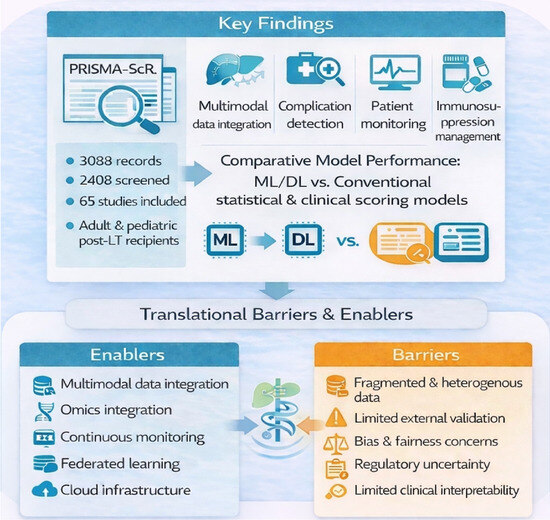
1. Introduction
2. Methods
2.1. Eligibility Criteria
2.2. Data Sources and Literature Search Approach
2.3. Study Selection and Characteristics
2.4. Data Extraction and Synthesis Procedures
3. Results
3.1. Study Selection and Overview of Included Evidence
3.2. Theme 1: Clinical Outcomes
3.2.1. Graft Survival and Rejection
Graft Survival and Failure Prediction
Prediction of Graft-Compromising Complications
Prediction of Acute Rejection
Prediction of Oncologic Recurrence
3.2.2. Mortality Prediction
3.2.3. Infection Risk
3.2.4. Multimodal or Composite Outcome Prediction
3.3. Theme 2: Operational Outcomes
3.4. Theme 3: System-Level Outcomes
3.5. Additional Evidence Mapping
4. Discussion
5. Conclusions
Supplementary Materials
Author Contributions
Funding
Data Availability Statement
Conflicts of Interest
Abbreviations
| ABIC | Age–bilirubin–INR–creatinine |
| ACLF | Acute-on-chronic liver failure |
| AdaBoost | Adaptive boosting |
| AFP | Alpha-fetoprotein |
| AI | Artificial intelligence |
| AJCC | American Joint Committee on Cancer |
| AKI | Acute kidney injury |
| ALP | Alkaline phosphatase |
| ALT | Alanine aminotransferase |
| AMAE | Average mean absolute error |
| ANN | Artificial neural network |
| APRI | Aspartate aminotransferase to platelet ratio index |
| APTT | Activated partial thromboplastin time |
| AST | Aspartate aminotransferase |
| AUC-PR | Area under the precision–recall curve |
| AUC-ROC | Area under the receiver operating characteristic curve |
| AUSCAD | Australian chronic allograft dysfunction study |
| BAR | Balance of risk |
| BCLC | Barcelona clinic liver cancer staging system |
| BiGRU | Bidirectional gated recurrent unit |
| BMI | Body mass index |
| C5.0 | Decision tree algorithm based on the C4.5 model, used for classification tasks |
| CART | Classification and regression tree |
| cDCD-NRP | Controlled donation after circulatory death under normothermic regional perfusion |
| cfDNA | Cell-free deoxyribonucleic acid |
| C-GBS | Component-wise gradient boosted survival |
| CI | Confidence interval |
| C-index | Concordance index |
| CIT | Cold ischemia time |
| CNN | Convolutional neural network |
| CoD-MTL | Cause-of-death multi-task learning |
| Cox-P | Cox model-based feature selection using p-values |
| CoxPH | Cox proportional hazards model |
| Coxnet | Cox proportional hazards model with elastic net regularization |
| CPH | Cox proportional hazards |
| CT | Computed tomography |
| DECIDE-AI | Developmental and exploratory clinical investigation of decision support systems driven by artificial intelligence |
| DeepSurv | Deep survival neural network |
| DL | Deep learning |
| DM | Diabetes mellitus |
| D-MELD | Donor age multiplied by recipient MELD score |
| DNN | Deep neural network |
| DPD | Demographic parity difference |
| DRI | Donor risk index |
| E-NET | Elastic net regression |
| EHCLT | European hepatocellular cancer liver transplant |
| EHRs | Electronic health records |
| EOD | Equalized odds difference |
| ERASL-post | European association for the study of the liver post-transplant model |
| ESLD | End-stage liver disease |
| Fair-ML | Fairness-aware machine learning |
| FERI | Fairness-enhanced risk index |
| FIB-4 | Fibrosis-4 index |
| FS-SVM | Fast survival support vector machine |
| GBDTs | Gradient boosted decision trees |
| GBS | Gradient boosted survival |
| GMS | Geometric mean of sensitivities |
| GRWR | Graft-to-recipient weight ratio |
| GST | Glutathione s-transferase |
| GVHD | Graft-versus-host disease |
| HALT-HCC | Hazard associated with liver transplantation for hepatocellular carcinoma |
| HCC | Hepatocellular carcinoma |
| INR | International normalized ratio |
| i-RAPIT | Integrated radiology and pathology for immunotherapy-based transplantation |
| KCH | King’s College Hospital |
| KNNs | K-nearest neighbors |
| LASSO | Least absolute shrinkage and selection operator |
| LDA | Linear discriminant analysis |
| LDAL | Latent Dirichlet Allocation |
| LDLT | Living donor liver transplantation |
| LightGBM | Light gradient boosting machine |
| LR | Logistic regression |
| LSTM | Long short-term memory |
| LT | Liver transplantation |
| MACEs | Major adverse cardiovascular events |
| MADRE | Model for allocation of donor and recipient using artificial intelligence |
| MAPLE | Molecular assessment of predictive liver expression |
| MELD | Model for end-stage liver disease |
| MELD-Na | Model for end-stage liver disease with serum sodium |
| MELD 3.0 | Updated model for end-stage liver disease, version 3.0 |
| MeSHs | Medical subject headings |
| MIMIC-IV | Medical information mart for intensive care, version IV |
| miRNA | Micro ribonucleic acid |
| ML | Machine learning |
| MLP | Multilayer perceptron |
| MORAL | Model of recurrence after liver transplantation |
| mRNA | Messenger ribonucleic acid |
| MPENSGA2 | Multi-objective evolutionary algorithm |
| NASH | Nonalcoholic steatohepatitis |
| NLP | Natural language processing |
| NODAT | New-onset diabetes after transplant |
| NPV | Negative predictive value |
| NRI | Net reclassification index |
| OPTN | Organ procurement and transplantation network |
| PCA | Principal component analysis |
| PND | Perioperative neurocognitive disorder |
| Post-LT | Post-liver transplantation |
| PPV | Positive predictive value |
| PRISMA-ScR | Preferred reporting items for systematic reviews and meta-analyses extension for scoping reviews |
| PROBAST-AI | Prediction model risk of bias assessment tool–artificial intelligence |
| PSC | Primary sclerosing cholangitis |
| PSSP | Patient-specific survival prediction |
| RBC | Red blood cell |
| RELAPSE | Recurrent liver cancer prediction score |
| ResNet-50 | 50-layer residual network |
| RETREAT | Risk estimation of tumor recurrence after transplant |
| RF | Random forest |
| RFE | Recursive feature elimination |
| Ridge | Regularized linear regression |
| RNA | Ribonucleic acid |
| RNN | Recurrent neural network |
| RSF | Random survival forest |
| SFM | Select from model |
| SHAPs | Shapley additive explanations |
| SOFA | Sequential organ failure assessment |
| SOFT | Survival outcomes following liver transplantation |
| SPLIT | Studies of pediatric liver transplantation |
| SpO2 | Peripheral capillary oxygen saturation |
| SRTR | Scientific registry of transplant recipients |
| STAR | Standard transplant analysis and research |
| SVM | Support vector machine |
| TabNet | Tabular neural network |
| TCGA | The cancer genome atlas |
| TCNs | Temporal convolutional networks |
| TM-GTP | Tissue microdissection–genotype tissue profiling |
| TNM | Tumor–node–metastasis staging system |
| TOP | Transferable omics prediction |
| TRIPOD-AI | Transparent reporting of a multivariable prediction model for individual prognosis or diagnosis–artificial intelligence |
| U-net | U-shaped convolutional neural network |
| UCSF | University of California San Francisco |
| UHN | University health network |
| UMHTC | US Multicenter HCC Transplant Consortium |
| UNOS | United Network for Organ Sharing |
| WBC | White blood cell |
| WIT | Warm ischemia time |
| XGBoost | Extreme gradient boosting |
References
- Devarbhavi, H.; Asrani, S.K.; Arab, J.P.; Nartey, Y.A.; Pose, E.; Kamath, P.S. Global burden of liver disease: 2023 update. J. Hepatol. 2023, 79, 516–537. [Google Scholar] [CrossRef] [PubMed]
- Ozturk, N.B.; Bartosek, N.; Toruner, M.D.; Mumtaz, A.; Simsek, C.; Dao, D.; Saberi, B.; Gurakar, A. Approach to Liver Transplantation: Is There a Difference between East and West? J. Clin. Med. 2024, 13, 1890. [Google Scholar] [CrossRef]
- Agostini, C.; Buccianti, S.; Risaliti, M.; Fortuna, L.; Tirloni, L.; Tucci, R.; Bartolini, I.; Grazi, G.L. Complications in Post-Liver Transplant Patients. J. Clin. Med. 2023, 12, 6173. [Google Scholar] [CrossRef]
- Gheorghe, G.; Diaconu, C.C.; Bungau, S.; Bacalbasa, N.; Motas, N.; Ionescu, V.A. Biliary and Vascular Complications after Liver Transplantation-From Diagnosis to Treatment. Medicina 2023, 59, 850. [Google Scholar] [CrossRef] [PubMed]
- Schenk, A.D.; Han, J.L.; Logan, A.J.; Sneddon, J.M.; Brock, G.N.; Pawlik, T.M.; Washburn, W.K. Textbook Outcome as a Quality Metric in Liver Transplantation. Transplant. Direct 2022, 8, e1322. [Google Scholar] [CrossRef] [PubMed]
- Herzer, K.; Sterneck, M.; Welker, M.W.; Nadalin, S.; Kirchner, G.; Braun, F.; Malessa, C.; Herber, A.; Pratschke, J.; Weiss, K.H.; et al. Current Challenges in the Post-Transplant Care of Liver Transplant Recipients in Germany. J. Clin. Med. 2020, 9, 3570. [Google Scholar] [CrossRef]
- Khosravi, M.; Zare, Z.; Mojtabaeian, S.M.; Izadi, R. Artificial Intelligence and Decision-Making in Healthcare: A Thematic Analysis of a Systematic Review of Reviews. Health Serv. Res. Manag. Epidemiol. 2024, 11, 23333928241234863. [Google Scholar] [CrossRef] [PubMed]
- Avramidou, E.; Todorov, D.; Katsanos, G.; Antoniadis, N.; Kofinas, A.; Vasileiadou, S.; Karakasi, K.E.; Tsoulfas, G. AI Innovations in Liver Transplantation: From Big Data to Better Outcomes. Livers 2025, 5, 14. [Google Scholar] [CrossRef]
- Andishgar, A.; Rismani, M.; Bazmi, S.; Mohammadi, Z.; Hooshmandi, S.; Kian, B.; Niakan, A.; Taheri, R.; Khalili, H.; Alizadehsani, R. Developing practical machine learning survival models to identify high-risk patients for in-hospital mortality following traumatic brain injury. Sci. Rep. 2025, 15, 5913. [Google Scholar] [CrossRef] [PubMed]
- Montgomery, A.E.; Rana, A. Current state of artificial intelligence in liver transplantation. Transplant. Rep. 2025, 10, 100173. [Google Scholar] [CrossRef]
- Bhat, M.; Rabindranath, M.; Chara, B.S.; Simonetto, D.A. Artificial intelligence, machine learning, and deep learning in liver transplantation. J. Hepatol. 2023, 78, 1216–1233. [Google Scholar] [CrossRef] [PubMed]
- Al Moussawy, M.; Lakkis, Z.S.; Ansari, Z.A.; Cherukuri, A.R.; Abou-Daya, K.I. The transformative potential of artificial intelligence in solid organ transplantation. Front. Transplant. 2024, 3, 1361491. [Google Scholar] [CrossRef]
- Tricco, A.C.; Lillie, E.; Zarin, W.; O’Brien, K.K.; Colquhoun, H.; Levac, D.; Moher, D.; Peters, M.D.J.; Horsley, T.; Weeks, L.; et al. PRISMA Extension for Scoping Reviews (PRISMA-ScR): Checklist and Explanation. Ann. Intern. Med. 2018, 169, 467–473. [Google Scholar] [CrossRef] [PubMed]
- Robertson, H.; Kim, H.J.; Li, J.; Robertson, N.; Robertson, P.; Jimenez-Vera, E.; Ameen, F.; Tran, A.; Trinh, K.; O’Connell, P.J.; et al. Decoding the hallmarks of allograft dysfunction with a comprehensive pan-organ transcriptomic atlas. Nat. Med. 2024, 30, 3748–3757. [Google Scholar] [CrossRef]
- Tusch, G. An optimization model for sequential decision-making applied to risk prediction after liver resection and transplantation. Proc. AMIA Symp. 1999, 425–429. [Google Scholar] [PubMed]
- Wadhwani, S.I.; Hsu, E.K.; Shaffer, M.L.; Anand, R.; Ng, V.L.; Bucuvalas, J.C. Predicting ideal outcome after pediatric liver transplantation: An exploratory study using machine learning analyses to leverage Studies of Pediatric Liver Transplantation Data. Pediatr. Transplant. 2019, 23, e13554. [Google Scholar] [CrossRef]
- Abdelhameed, A.; Bhangu, H.; Feng, J.; Li, F.; Hu, X.; Patel, P.; Yang, L.; Tao, C. Deep Learning-Based Prediction Modeling of Major Adverse Cardiovascular Events After Liver Transplantation. Mayo Clin. Proc. Digit. Health 2024, 2, 221–230. [Google Scholar] [CrossRef] [PubMed]
- Andishgar, A.; Bazmi, S.; Lankarani, K.B.; Taghavi, S.A.; Imanieh, M.H.; Sivandzadeh, G.; Saeian, S.; Dadashpour, N.; Shamsaeefar, A.; Ravankhah, M.; et al. Comparison of time-to-event machine learning models in predicting biliary complication and mortality rate in liver transplant patients. Sci. Rep. 2025, 15, 4768. [Google Scholar] [CrossRef] [PubMed]
- Andres, A.; Montano-Loza, A.; Greiner, R.; Uhlich, M.; Jin, P.; Hoehn, B.; Bigam, D.; Shapiro, J.A.M.; Kneteman, N.-M. A novel learning algorithm to predict individual survival after liver transplantation for primary sclerosing cholangitis. PLoS ONE 2018, 13, e0193523. [Google Scholar] [CrossRef] [PubMed]
- Azhie, A.; Sharma, D.; Sheth, P.; Qazi-Arisar, F.A.; Zaya, R.; Naghibzadeh, M.; Duan, K.; Fischer, S.; Patel, K.; Tsien, C.; et al. A deep learning framework for personalised dynamic diagnosis of graft fibrosis after liver transplantation: A retrospective, single Canadian centre, longitudinal study. Lancet Digit. Health. 2023, 5, e458–e466. [Google Scholar] [CrossRef] [PubMed]
- Bezjak, M.; Kocman, B.; Jadrijevic, S.; Filipec Kanizaj, T.; Antonijevic, M.; Dalbelo Basic, B.; Mikulic, D. Use of machine learning models for identification of predictors of survival and tumour recurrence in liver transplant recipients with hepatocellular carcinoma. Ann. Transl. Med. 2023, 11, 345. [Google Scholar] [CrossRef] [PubMed]
- Bhat, V.; Tazari, M.; Watt, K.D.; Bhat, M. New-Onset Diabetes and Preexisting Diabetes Are Associated with Comparable Reduction in Long-Term Survival After Liver Transplant: A Machine Learning Approach. Mayo Clin. Proc. 2018, 93, 1794–1802. [Google Scholar] [CrossRef] [PubMed]
- Briceño, J.; Cruz-Ramírez, M.; Prieto, M.; Navasa, M.; Ortiz de Urbina, J.; Orti, R.; Gómez-Bravo, M.Á.; Otero, A.; Varo, E.; Tomé, S.; et al. Use of artificial intelligence as an innovative donor-recipient matching model for liver transplantation: Results from a multicenter Spanish study. J. Hepatol. 2014, 61, 1020–1028. [Google Scholar] [CrossRef] [PubMed]
- Calleja, R.; Rivera, M.; Guijo-Rubio, D.; Hessheimer, A.J.; de la Rosa, G.; Gastaca, M.; Otero, A.; Ramírez, P.; Boscà-Robledo, A.; Santoyo, J.; et al. Machine Learning Algorithms in Controlled Donation After Circulatory Death Under Normothermic Regional Perfusion: A Graft Survival Prediction Model. Transplantation 2025, 109, e362–e370. [Google Scholar] [CrossRef] [PubMed]
- Cao, S.; Yu, S.; Huang, L.; Seery, S.; Xia, Y.; Zhao, Y.; Si, Z.; Zhang, X.; Zhu, J.; Lang, R.; et al. Deep learning for hepatocellular carcinoma recurrence before and after liver transplantation: A multicenter cohort study. Sci. Rep. 2025, 15, 7730. [Google Scholar] [CrossRef] [PubMed]
- Chen, X.; Tang, S.; Qin, Y.; Zhou, S.; Zhang, L.; Huang, Y.; Chen, Z. A Predictive Model of Pressure Injury in Children Undergoing Living Donor Liver Transplantation Based on Machine Learning Algorithm. J. Adv. Nurs. 2024, 81, 3003–3012. [Google Scholar] [CrossRef] [PubMed]
- Cooper, J.P.; Perkins, J.D.; Warner, P.R.; Shingina, A.; Biggins, S.W.; Abkowitz, J.L.; Reyes, J.D. Acute Graft-Versus-Host Disease After Orthotopic Liver Transplantation: Predicting This Rare Complication Using Machine Learning. Liver Transpl. 2022, 28, 407–421. [Google Scholar] [CrossRef] [PubMed]
- Cruz-Ramírez, M.; Hervás-Martínez, C.; Fernández, J.C.; Briceño, J.; de la Mata, M. Predicting patient survival after liver transplantation using evolutionary multi-objective artificial neural networks. Artif. Intell. Med. 2013, 58, 37–49. [Google Scholar] [CrossRef] [PubMed]
- Ding, Z.; Zhang, L.; Zhang, Y.; Yang, J.; Luo, Y.; Ge, M.; Yao, W.; Hei, Z.; Chen, C. A Supervised Explainable Machine Learning Model for Perioperative Neurocognitive Disorder in Liver-Transplantation Patients and External Validation on the Medical Information Mart for Intensive Care IV Database: Retrospective Study. J. Med. Internet. Res. 2025, 27, e55046. [Google Scholar] [CrossRef] [PubMed]
- Fatemi, Y.; Nikfar, M.; Oladazimi, A.; Zheng, J.; Hoy, H.; Ali, H. Machine Learning Approach for Cardiovascular Death Prediction among Nonalcoholic Steatohepatitis (NASH) Liver Transplant Recipients. Healthcare 2024, 12, 1165. [Google Scholar] [CrossRef] [PubMed]
- Ge, J.; Digitale, J.C.; Fenton, C.; McCulloch, C.E.; Lai, J.C.; Pletcher, M.J.; Gennatas, E.D. Predicting post-liver transplant outcomes in patients with acute-on-chronic liver failure using Expert-Augmented Machine Learning. Am. J. Transplant. 2023, 23, 1908–1921. [Google Scholar] [CrossRef] [PubMed]
- He, T.; Fong, J.N.; Moore, L.W.; Ezeana, C.F.; Victor, D.; Divatia, M.; Vasquez, M.; Ghobrial, R.M.; Wong, S.T.C. An imageomics and multi-network based deep learning model for risk assessment of liver transplantation for hepatocellular cancer. Comput. Med. Imaging. Graph. 2021, 89, 101894. [Google Scholar] [CrossRef] [PubMed]
- Ivanics, T.; Nelson, W.; Patel, M.S.; Claasen, M.P.A.W.; Lau, L.; Gorgen, A.; Abreu, P.; Goldenberg, A.; Erdman, L.; Sapisochin, G. The Toronto Post Liver Transplantation Hepatocellular Carcinoma Recurrence Calculator: A Machine Learning Approach. Liver Transpl. 2022, 28, 593–602. [Google Scholar] [CrossRef] [PubMed]
- Jain, V.; Bansal, A.; Radakovich, N.; Sharma, V.; Khan, M.Z.; Harris, K.; Bachour, S.; Kleb, C.; Cywinski, J.; Argalious, M.; et al. Machine Learning Models to Predict Major Adverse Cardiovascular Events After Orthotopic Liver Transplantation: A Cohort Study. J. Cardiothorac. Vasc. Anesth. 2021, 35, 2063–2069. [Google Scholar] [CrossRef] [PubMed]
- Kantidakis, G.; Putter, H.; Lancia, C.; Boer, J.; Braat, A.E.; Fiocco, M. Survival prediction models since liver transplantation—Comparisons between Cox models and machine learning techniques. BMC Med. Res. Methodol. 2020, 20, 277. [Google Scholar] [CrossRef] [PubMed]
- Kazemi, A.; Kazemi, K.; Sami, A.; Sharifian, R. Identifying Factors That Affect Patient Survival After Orthotopic Liver Transplant Using Machine-Learning Techniques. Exp. Clin. Transplant. 2019, 17, 775–783. [Google Scholar] [CrossRef] [PubMed]
- Ko, S.H.; Cao, J.; Yang, Y.K.; Xi, Z.F.; Han, H.W.; Sha, M.; Xia, Q. Development of a deep learning model for predicting recurrence of hepatocellular carcinoma after liver transplantation. Front. Med. 2024, 11, 1373005. [Google Scholar] [CrossRef]
- Lee, H.C.; Yoon, S.B.; Yang, S.M.; Kim, W.H.; Ryu, H.G.; Jung, C.W.; Suh, K.S.; Lee, K.H. Prediction of Acute Kidney Injury after Liver Transplantation: Machine Learning Approaches vs. Logistic Regression Model. J. Clin. Med. 2018, 7, 428. [Google Scholar] [CrossRef]
- Liu, C.L.; Soong, R.S.; Lee, W.C.; Jiang, G.W.; Lin, Y.C. Predicting Short-term Survival after Liver Transplantation using Machine Learning. Sci. Rep. 2020, 10, 565. [Google Scholar] [CrossRef] [PubMed]
- Liu, L.P.; Zhao, Q.Y.; Wu, J.; Luo, Y.W.; Dong, H.; Chen, Z.W.; Gui, R.; Wang, Y.J. Machine Learning for the Prediction of Red Blood Cell Transfusion in Patients During or After Liver Transplantation Surgery. Front. Med. 2021, 8, 632210. [Google Scholar] [CrossRef] [PubMed]
- Liu, Z.; Liu, Y.; Zhang, W.; Hong, Y.; Meng, J.; Wang, J.; Zheng, S.; Xu, X. Deep learning for prediction of hepatocellular carcinoma recurrence after resection or liver transplantation: A discovery and validation study. Hepatol. Int. 2022, 16, 577–589. [Google Scholar] [CrossRef]
- Loosen, S.H.; Krieg, S.; Chaudhari, S.; Upadhyaya, S.; Krieg, A.; Luedde, T.; Kostev, K.; Roderburg, C. Prediction of New-Onset Diabetes Mellitus within 12 Months after Liver Transplantation—A Machine Learning Approach. J. Clin. Med. 2023, 12, 4877. [Google Scholar] [CrossRef] [PubMed]
- Melvin, D.G.; Niranjan, M.; Prager, R.W.; Trull, A.K.; Hughes, V.F. Neuro-computing versus linear statistical techniques applied to liver transplant monitoring: A comparative study. IEEE Trans. Biomed. Eng. 2000, 47, 1036–1043. [Google Scholar] [CrossRef] [PubMed]
- Ningappa, M.; Rahman, S.A.; Higgs, B.W.; Ashokkumar, C.S.; Sahni, N.; Sindhi, R.; Das, J. A network-based approach to identify expression modules underlying rejection in pediatric liver transplantation. Cell Rep. Med. 2022, 3, 100605. [Google Scholar] [CrossRef] [PubMed]
- Nitski, O.; Azhie, A.; Qazi-Arisar, F.A.; Wang, X.; Ma, S.; Lilly, L.; Watt, K.D.; Levitsky, J.; Asrani, S.K.; Lee, D.S.; et al. Long-term mortality risk stratification of liver transplant recipients: Real-time application of deep learning algorithms on longitudinal dana. Lancet Digit. Health 2021, 3, e295–e305. [Google Scholar] [CrossRef] [PubMed]
- Piscaglia, F.; Cucchetti, A.; Benlloch, S.; Vivarelli, M.; Berenguer, J.; Bolondi, L.; Pinna, A.D.; Berenguer, M. Prediction of significant fibrosis in hepatitis C virus infected liver transplant recipients by artificial neural network analysis of clinical factors. Eur. J. Gastroenterol. Hepatol. 2006, 18, 1255–1261. [Google Scholar] [CrossRef]
- Qu, W.F.; Tian, M.X.; Lu, H.W.; Zhou, Y.F.; Liu, W.R.; Tang, Z.; Yao, Z.; Huang, R.; Zhu, G.Q.; Jiang, X.F.; et al. Development of a deep pathomics score for predicting hepatocellular carcinoma recurrence after liver transplantation. Hepatol. Int. 2023, 17, 927–941. [Google Scholar] [CrossRef]
- Raji, C.G.; Chandra, S.S.V.; Gracious, N.; Pillai, Y.R.; Sasidharan, A. Advanced prognostic modeling with deep learning: Assessing long-term outcomes in liver transplant recipients from deceased and living donors. J. Transl. Med. 2025, 23, 188. [Google Scholar] [CrossRef] [PubMed]
- Rodriguez-Luna, H.; Vargas, H.E.; Byrne, T.; Rakela, J. Artificial neural network and tissue genotyping of hepatocellular carcinoma in liver-transplant recipients: Prediction of recurrence. Transplantation 2005, 79, 1737–1740. [Google Scholar] [CrossRef]
- Tran, B.V.; Moris, D.; Markovic, D.; Zaribafzadeh, H.; Henao, R.; Lai, Q.; Florman, S.S.; Tabrizian, P.; Haydel, B.; Ruiz, R.M.; et al. Development and validation of a REcurrent Liver cAncer Prediction ScorE (RELAPSE) following liver transplantation in patients with hepatocellular carcinoma: Analysis of the US Multicenter HCC Transplant Consortium. Liver Transpl. 2023, 29, 683–697. [Google Scholar] [CrossRef] [PubMed]
- Xie, H.; Shi, B.; Fan, J.; Liu, S.; Ma, Q.; Dai, J.; Dong, S.; Liu, Y.; Meng, H.; Liu, H.; et al. A predictive model based on radiomics, clinical features, and pathologic indicators for disease-free survival after liver transplantation for hepatocellular carcinoma: A 7-year retrospective study. J. Gastrointest. Oncol. 2024, 15, 2187–2200. [Google Scholar] [CrossRef] [PubMed]
- Yasodhara, A.; Dong, V.; Azhie, A.; Goldenberg, A.; Bhat, M. Identifying Modifiable Predictors of Long-Term Survival in Liver Transplant Recipients with Diabetes Mellitus Using Machine Learning. Liver Transpl. 2021, 27, 536–547. [Google Scholar] [CrossRef] [PubMed]
- Yu, Y.D.; Lee, K.S.; Man Kim, J.; Ryu, J.H.; Lee, J.G.; Lee, K.W.; Kim, B.W.; Kim, D.S. Korean Organ Transplantation Registry Study Group. Artificial intelligence for predicting survival following deceased donor liver transplantation: Retrospective multi-center study. Int. J. Surg. 2022, 105, 106838. [Google Scholar] [CrossRef] [PubMed]
- Zabara, M.L.; Popescu, I.; Burlacu, A.; Geman, O.; Dabija, R.A.C.; Popa, I.V.; Lupascu, C. Machine Learning Model Validated to Predict Outcomes of Liver Transplantation Recipients with Hepatitis C: The Romanian National Transplant Agency Cohort Experience. Sensors 2023, 23, 2149. [Google Scholar] [CrossRef]
- Zalba Etayo, B.; Marín Araiz, L.; Montes Aranguren, M.; Lorente Pérez, S.; Palacios Gasos, P.; Pascual Bielsa, A.; Sánchez Donoso, N.; Serrano Aullo, T.; Araiz Burdio, J.J. Graft Survival in Liver Transplantation: An Artificial Neuronal Network Assisted Analysis of the Importance of Comorbidities. Exp. Clin. Transplant. 2023, 21, 338–344. [Google Scholar] [CrossRef] [PubMed]
- Zhang, Y.; Yang, D.; Liu, Z.; Chen, C.; Ge, M.; Li, X.; Luo, T.; Wu, Z.; Shi, C.; Wang, B.; et al. An explainable supervised machine learning predictor of acute kidney injury after adult deceased donor liver transplantation. J. Transl. Med. 2021, 19, 321. [Google Scholar] [CrossRef] [PubMed]
- Chen, C.; Yang, D.; Gao, S.; Zhang, Y.; Chen, L.; Wang, B.; Mo, Z.; Yang, Y.; Hei, Z.; Zhou, S. Development and performance assessment of novel machine learning models to predict pneumonia after liver transplantation. Respir. Res. 2021, 22, 94. [Google Scholar] [CrossRef]
- Chen, C.; Chen, B.; Yang, J.; Li, X.; Peng, X.; Feng, Y.; Guo, R.; Zou, F.; Zhou, S.; Hei, Z. Development and validation of a practical machine learning model to predict sepsis after liver transplantation. Ann. Med. 2023, 55, 624–633. [Google Scholar] [CrossRef] [PubMed]
- Kamaleswaran, R.; Sataphaty, S.K.; Mas, V.R.; Eason, J.D.; Maluf, D.G. Artificial Intelligence May Predict Early Sepsis After Liver Transplantation. Front. Physiol. 2021, 12, 692667. [Google Scholar] [CrossRef]
- Ding, S.; Tang, R.; Zha, D.; Zou, N.; Zhang, K.; Jiang, X.; Hu, X. Fairly Predicting Graft Failure in Liver Transplant for Organ Assigning. AMIA Annu. Symp. Proc. 2023, 2022, 415–424. [Google Scholar] [PubMed]
- Ding, S.; Tan, Q.; Chang, C.Y.; Zou, N.; Zhang, K.; Hoot, N.R.; Jiang, X.; Hu, X. Multi-Task Learning for Post-transplant Cause of Death Analysis: A Case Study on Liver Transplant. AMIA Annu. Symp. Proc. 2024, 2023, 913–922. [Google Scholar] [PubMed]
- Dorado-Moreno, M.; Pérez-Ortiz, M.; Gutiérrez, P.A.; Ciria, R.; Briceño, J.; Hervás-Martínez, C. Dynamically weighted evolutionary ordinal neural network for solving an imbalanced liver transplantation problem. Artif. Intell. Med. 2017, 77, 1–11. [Google Scholar] [CrossRef]
- Guijo-Rubio, D.; Briceño, J.; Gutiérrez, P.A.; Ayllón, M.D.; Ciria, R.; Hervás-Martínez, C. Statistical methods versus machine learning techniques for donor-recipient matching in liver transplantation. PLoS ONE 2021, 16, e0252068. [Google Scholar] [CrossRef] [PubMed]
- Li, C.; Lai, D.; Jiang, X.; Zhang, K. FERI: A Multitask-based Fairness Achieving Algorithm with Applications to Fair Organ Transplantation. AMIA Jt. Summits. Transl. Sci. Proc. 2024, 2024, 593–602. [Google Scholar] [PubMed]
- Li, C.; Jiang, X.; Zhang, K. A transformer-based deep learning approach for fairly predicting post-liver transplant risk factors. J. Biomed. Inform. 2024, 149, 104545. [Google Scholar] [CrossRef] [PubMed]
- Chongo, G.; Soldera, J. Use of machine learning models for the prognostication of liver transplantation: A systematic review. World J. Transplant. 2024, 14, 88891. [Google Scholar] [CrossRef] [PubMed]
- Pruinelli, L.; Balakrishnan, K.; Ma, S.; Li, Z.; Wall, A.; Lai, J.C.; Schold, J.D.; Pruett, T.; Simon, G. Transforming liver transplant allocation with artificial intelligence and machine learning: A systematic review. BMC Med. Inform. Decis. Mak. 2025, 25, 98. [Google Scholar] [CrossRef] [PubMed]
- Rahman, M.A.; Yilmaz, I.; Albadri, S.T.; Salem, F.E.; Dangott, B.J.; Taner, C.B.; Nassar, A.; Akkus, Z. Artificial Intelligence Advances in Transplant Pathology. Bioengineering 2023, 10, 1041. [Google Scholar] [CrossRef] [PubMed]
- Wingfield, L.R.; Ceresa, C.; Thorogood, S.; Fleuriot, J.; Knight, S. Using Artificial Intelligence for Predicting Survival of Individual Grafts in Liver Transplantation: A Systematic Review. Liver Transpl. 2020, 26, 922–934. [Google Scholar] [CrossRef] [PubMed]
- Calleja Lozano, R.; Hervás Martínez, C.; Briceño Delgado, F.J. Crossroads in Liver Transplantation: Is Artificial Intelligence the Key to Donor-Recipient Matching? Medicina 2022, 58, 1743. [Google Scholar] [CrossRef] [PubMed]
- Ferrarese, A.; Sartori, G.; Orrù, G.; Frigo, A.C.; Pelizzaro, F.; Burra, P.; Senzolo, M. Machine learning in liver transplantation: A tool for some unsolved questions? Transpl. Int. 2021, 34, 398–411. [Google Scholar] [CrossRef] [PubMed]
- Fuchs, J.; Rabaux-Eygasier, L.; Guerin, F. Artificial Intelligence in Pediatric Liver Transplantation: Opportunities and Challenges of a New Era. Children 2024, 11, 996. [Google Scholar] [CrossRef] [PubMed]
- Gulla, A.; Jakiunaite, I.; Juchneviciute, I.; Dzemyda, G. A narrative review: Predicting liver transplant graft survival using artificial intelligence modeling. Front. Transplant. 2024, 3, 1378378. [Google Scholar] [CrossRef] [PubMed]
- Ivanics, T.; Patel, M.S.; Erdman, L.; Sapisochin, G. Artificial intelligence in transplantation (machine-learning classifiers and transplant oncology). Curr. Opin. Organ. Transplant. 2020, 25, 426–434. [Google Scholar] [CrossRef] [PubMed]
- Taner, T.; Bruner, J.; Emamaullee, J.; Bonaccorsi-Riani, E.; Zarrinpar, A. New Approaches to the Diagnosis of Rejection and Prediction of Tolerance in Liver Transplantation. Transplantation 2022, 106, 1952–1962. [Google Scholar] [CrossRef] [PubMed]
- Jiang, L.; Wang, J.; Wang, Y.; Yang, H.; Kong, L.; Wu, Z.; Shen, A.; Huang, Z.; Jiang, Y. Bibliometric and LDA analysis of acute rejection in liver transplantation: Emerging trends, immunotherapy challenges, and the role of artificial intelligence. Cell Transplant. 2025, 34, 9636897251325628. [Google Scholar] [CrossRef] [PubMed]
- Khorsandi, S.E. Will deep learning change outcomes in liver transplant? Lancet Digit. Health 2023, 5, e398–e399. [Google Scholar] [CrossRef] [PubMed]



| Study Identification | Design and Methods | Population | AI Models Evaluated and Input Data | Comparative Framework | Implementation Status | Clinical Outcome Predicted and Model Performance | Post-LT Clinical Application |
|---|---|---|---|---|---|---|---|
| Abdelhameed A et al. [17] (United States, 2024) | Retrospective study using claims data from Optum Clinformatics (2007–2020); 5-fold cross-validation; external test set (20%). | n = 18,304 LT recipients. | BiGRU vs. baseline ML models; input: diagnoses, demographics, medications, procedures (3 years pre-LT). | Head-to-head comparison between BiGRU and traditional ML models. | Model development only (retrospective). | MACE at 30 days post-LT; BiGRU: AUC-ROC = 0.841 (95%CI, 0.822–0.862); AUC-PR = 0.578 (95%CI, 0.537–0.621). | Prediction of MACE. |
| Andishgar A et al. [18] (Iran, 2025) | Retrospective study using clinical data from a single transplant center (2018–2023); 5-fold cross-validation; random oversampling; hyperparameter tuning. | n = 1799 LT recipients. | Seven ML survival models (LASSO, Ridge, RSF, E-NET, GBS, C-GBS, FS-SVM); input: 40 clinical predictors (e.g., graft type, BMI, AST, creatinine, tacrolimus use). | Head-to-head comparison of survival models with three feature selection techniques: Cox-P, RSF-based selection, and LASSO. | Model development only (retrospective). | Biliary complications; RSF + Ridge: C-index = 0.699; mortality; RSF + RSF: C-index = 0.784. | Prediction of biliary complications and mortality. |
| Andres A et al. [19] (Canada, 2018) | Retrospective study using data from the SRTR (2002–2013); D-calibration and Hosmer–Lemeshow calibration. | n = 2769 adult LT recipients with PSC. | PSSP algorithm vs. Cox regression; input: patient-level clinical features. | Head-to-head comparison of calibrated survival predictions using D-calibration and single-time calibration tests. | Model development only (retrospective). | Post-LT survival in PSC; PSSP: D-calibration: p = 1.0; Hosmer–Lemeshow: p = 0.802 (0.25-year), p = 0.502 (1-year), p = 0.173 (5-year), p = 0.169 (10-year); Cox model: failed calibration at 10 years (p = 0.027). | Prediction of long-term survival in PSC. |
| Azhie A et al. [20] (Canada, 2024) | Retrospective longitudinal study using clinical and biopsy data from a single Canadian transplant center (1987–2019); subgroup validation using transient elastography. | n = 1893 adult LT recipients with ≥1 post-LT liver biopsy. | Weighted LSTM model vs. logistic regression, decision tree, AdaBoost, GBDT, XGBoost, and random forest; input: longitudinal clinical and laboratory data. | Head-to-head comparison of model performance for prediction of biopsy-confirmed fibrosis stage. | Model development only (retrospective). | Significant graft fibrosis (≥F2) post-LT; weighted LSTM: AUC-ROC = 0.798 (95%CI, 0.790–0.810); sensitivity = 0.83; specificity = 0.81. | Prediction of significant graft fibrosis (≥F2). |
| Bezjak M et al. [21] (Croatia, 2023) | Retrospective study using clinical data from a single transplant center (2013–2019); 5-fold cross-validation; cross-validated hyperparameter tuning; holdout test set. | n = 170 adult LT recipients with HCC. | RSF, survival SVM, survival gradient boosting, and Coxnet; input: 30 donor, recipient, and tumor-specific clinical parameters. | Head-to-head comparison of survival models using concordance index. | Model development only (retrospective). | Recurrence-free survival post-LT for HCC; RSF: C-index = 0.72 (highest among models). | Prediction of recurrence-free survival, overall survival, graft survival, and HCC recurrence. |
| Bhat V et al. [22] (United States, 2018) | Retrospective study using data from the SRTR (1987–2016). | n = 60,054 adult LT recipients. | Random forest, ANN, gradient boosting, and SVM; input: donor, recipient, and transplant characteristics. | Head-to-head comparison of models for prediction of NODAT; survival analysis comparing outcomes by DM status. | Model development only (retrospective). | Significant predictors of NODAT included age, sex, obesity, and sirolimus use; patients with NODAT had lower 10-year survival than those without DM (63.0% vs. 74.9%, p < 0.001). | Prediction of NODAT and long-term survival. |
| Briceño J et al. [23] (Spain, 2014) | Retrospective study using clinical data from seven Spanish LT centers (2005–2009). | n = 529 adult LT recipients. | ANN vs. logistic regression; input: 23 donor and recipient clinical variables. | Head-to-head comparison of ANN and logistic regression for graft survival prediction. | Model development only (retrospective). | 3-month graft survival post-LT; ANN: AUC-ROC = 0.76; logistic regression: AUC-ROC = 0.69; p < 0.001. | |
| Calleja R et al. [24] (Spain, 2025) | Retrospective study using clinical data from 25 Spanish transplant centers. | n = 420 adult cDCD-NRP LT recipients. | Logistic regression, ridge classifier, SVM, MLP, and random forest; input: 14 donor–recipient variables including age, MELD, CIT, and WIT. | Head-to-head comparison of five models to predict 3- and 12-month graft survival. | Model development only (retrospective). | 3-month and 12-month graft survival post-LT cDCD-NRP; ridge classifier: AUC-ROC = 0.78 (3 months); AUC-ROC = 0.72 (12 months). | Prediction of graft survival in cDCD-NRP recipients. |
| Cao S et al. [25] (China, 2025) | Retrospective study using clinical data from three transplant centers in China (2015–2021); external validation at two independent centers. | n = 466 adult LT recipients with HCC. | DeepSurv (pre- and postoperative models) vs. logistic regression, stacking, SVM, and random forest; input: clinical and clinicopathologic variables. | Head-to-head comparison of survival models and clinical criteria (Milan, UCSF, RETREAT) for recurrence prediction. | Externally validated (independent cohort). | HCC recurrence post-LT; post-DeepSurv model: C-index = 0.835 (training); 0.812 (testing); 0.839 and 0.831 (external validation). | Prediction of HCC recurrence. |
| Chen X et al. [26] (China, 2024) | Retrospective study using clinical data from a single pediatric transplant center (2021–2022); internal validation performed. | n = 438 pediatric LDLT recipients. | Decision tree, random forest, gradient boosting decision tree, and XGBoost; input: 10 perioperative and preoperative clinical variables including operation time, corticosteroid use, and skin condition. | Head-to-head comparison of four ML models for prediction of pressure injuries. | Model development only (retrospective). | Pressure injury post-LT in children; decision tree: AUC-ROC = 0.841; accuracy = 0.848; sensitivity = 0.769; specificity = 0.857. | Prediction of pressure injury. |
| Cooper JP et al. [27] (United States, 2022) | Retrospective study using clinical data from a single transplant center (1996–2019); internal validation and additional validation in a separate cohort (2019–2020). | n = 1938 adult LT recipients. | Logistic regression, C5.0, heterogeneous ensemble, generalized gradient boosting machine, and three other ML models; input: donor and recipient clinical variables. | Head-to-head comparison of seven ML models for prediction of GVHD. | Model development only (retrospective). | Acute GVHD post-LT; all models: AUC-ROC = 0.83–0.86 (test set); AUC-ROC = 0.93–0.96 (validation set). | Prediction of GVHD. |
| Cruz-Ramírez M et al. [28] (Spain, 2013) | Retrospective study using clinical data from eleven Spanish LT centers (2007–2008); 3-month post-transplant follow-up; model training with MPENSGA2 algorithm. | n = 248 adult LT recipients. | Evolutionary multi-objective radial basis function ANN trained using MPENSGA2 algorithm; input: donor, recipient, and transplant variables. | Head-to-head comparison of Pareto-optimized ANN selected for accuracy and sensitivity. | Model development only (retrospective). | 3-month graft survival post-LT; optimized ANN: AUC-ROC = 0.85; correct classification rate = 85.9%; minimum sensitivity = 85.5%. | Prediction of 3-month graft survival. |
| Ding Z et al. [29] (China, 2025) | Retrospective study using clinical data from a single transplant center (2014–2022); internal validation and external validation using the MIMIC-IV dataset. | n = 1370 adult LT recipients. | Logistic regression, SVM, random forest, LightGBM, and XGBoost; input: 49 perioperative variables including age, bilirubin, and anesthesia-related factors. | Head-to-head comparison of five models for PND prediction across internal and external cohorts. | Externally validated (independent cohort). | PND post-LT; logistic regression: AUC-ROC = 0.799 (internal); AUC-ROC = 0.826 (temporal external); AUC-ROC = 0.720 (MIMIC-IV). | Prediction of PND. |
| Fatemi Y et al. [30] (United States, 2024) | Retrospective study using SRTR (UNOS) transplant database (1987–2022); model development with 5-fold cross-validation and 100 bootstrap samples; feature selection via RFE and SFM; SHAP used for model interpretability. | n = 10,871 adult NASH LT recipients. | XGBoost, random forest, decision tree, SVM, KNN, and naïve Bayes; input: 92 pre-LT donor and recipient features. | Head-to-head comparison of six ML models across eight feature selection strategies for cardiovascular mortality prediction. | Model development only (retrospective). | Cardiovascular death post-LT in NASH; XGBoost with RFE-random forest: AUC-ROC = 0.86; accuracy = 69.1%; SHAP applied to rank predictor importance and improve interpretability. | Prediction of cardiovascular death in NASH recipients. |
| Ge J et al. [31] (United States, 2023) | Retrospective cohort study using SRTR data (2010–2020) from 129 centers; 5-fold cross-validation; model calibration and SHAP-based interpretability assessed. | n = 49,121 adult LT recipients. | DNN, logistic regression, random forest; input: 37 pre-LT clinical variables (e.g., comorbidities, MELD, albumin). | Head-to-head comparison of DNN, logistic regression, and random forest for 90-day and 1-year mortality and 90-day readmission prediction. | Model development only (retrospective). | 90-day and 1-year mortality; 90-day readmission post-LT; DNN: AUC-ROC = 0.737 (1-year mortality); AUC-ROC = 0.727 (90-day mortality); AUC-ROC = 0.651 (readmission). | Prediction of mortality and hospital readmission. |
| He T et al. [32] (United States, 2021) | Retrospective study using clinical data from a single transplant center (2008–2019); 5-fold cross-validation; model interpretability assessed. | n = 137 LT recipients with HCC. | i-RAPIT DL model; input: postoperative CT images and clinical variables (e.g., Milan criteria, tumor count). | Head-to-head comparison of i-RAPIT with logistic regression and Milan/AFP models for HCC recurrence prediction. | Model development only (retrospective). | HCC recurrence post-LT; i-RAPIT: AUC-ROC = 0.89; F1 score = 0.90; accuracy = 91.3%; precision = 0.90; recall = 0.90. | Prediction of HCC recurrence. |
| Ivanics T et al. [33] (Canada, 2022) | Retrospective study using clinical, imaging, and treatment data from LT recipients listed 2000–2016; cross-validation and held-out test set. | n = 739 LT recipients with HCC. | CoxNet, survival random forest, survival SVM, DeepSurv; input: serial imaging, AFP, locoregional therapies, treatment response. | Head-to-head comparison of survival models using concordance index; CoxNet validated against AFP, MORAL, and HALT-HCC scores. | Model development only (retrospective). | HCC recurrence post-LT; CoxNet: C-index = 0.75 (95%CI, 0.64–0.84); AFP and MORAL scores: C-index = 0.64; HALT-HCC: C-index = 0.72 (not significantly outperformed). | Prediction of HCC recurrence. |
| Jain V et al. [34] (United States, 2021) | Retrospective cohort study using clinical data from a single transplant center (2008–2019); 5-fold cross-validation. | n = 1459 LT recipients. | Logistic regression, LASSO, random forest, SVM, and XGBoost; input: pre-LT clinical variables including age, DM, creatinine, right ventricular systolic pressure, and left ventricular ejection fraction. | Head-to-head comparison of five ML models using AUC-ROC and Harrell’s C statistic. | Model development only (retrospective). | MACE: XGBoost: AUC-ROC = 0.71 (95%CI, 0.63–0.79); all-cause mortality: Harrell’s C = 0.64 (95%CI, 0.57–0.73); cardiovascular mortality: AUC-ROC = 0.72 (95%CI, 0.59–0.85). | Prediction of MACE, all-cause mortality, and cardiovascular mortality. |
| Kantidakis G et al. [35] (United Kingdom, 2020) | Retrospective study using clinical data from the SRTR (2005–2015); 10-year follow-up; internal validation performed. | n = 529 LT recipients. | Random survival forest, ANN, Cox proportional hazards; input: 23 donor and recipient variables (e.g., age, MELD, diagnosis, cold ischemia time). | Head-to-head comparison of ML models with Cox regression for graft survival prediction. | Model development only (retrospective). | Graft survival post-LT; RSF: C-index = 0.68; ANN: C-index = 0.66; Cox: C-index = 0.67. | Prediction of graft survival. |
| Kazemi A et al. [36] (Iran, 2019) | Retrospective study using clinical data from a single transplant center (2011–2014); internal validation performed. | n = 529 LT recipients. | SVM, MLP, Bayesian network, C5.0, KNN; input: 23 donor and recipient clinical variables (e.g., age, MELD, diagnosis, CIT). | Head-to-head comparison of five ML models and Cox regression for 6-month survival prediction. | Model development only (retrospective). | 6-month mortality post-LT; MLP: AUC-ROC = 0.77; accuracy = 80.0%; F1 score = 0.78; sensitivity = 0.78; specificity = 0.81; precision = 0.78. | Prediction of short-term mortality. |
| Ko SH et al. [37] (South Korea, 2024) | Retrospective study using clinical data from a single transplant center (2015–2018); internal validation performed. | n = 466 LT recipients with HCC. | TabNet; input: 35 pre- and post-LT clinical and pathologic variables. | Head-to-head comparison of TabNet vs. Milan, UCSF, and RETREAT criteria for HCC recurrence prediction. | Model development only (retrospective). | HCC recurrence post-LT; TabNet: AUC-ROC = 0.825; C-index = 0.796; accuracy = 0.841; NRI = 36.9% vs. Milan criteria; HR = 4.74 (95%CI, 2.72–8.24) for high-risk group. | Prediction of HCC recurrence. |
| Lee HC et al. [38] (South Korea, 2018) | Retrospective study using clinical data from a single transplant center (2008–2016); internal validation performed. | n = 1370 LT recipients. | Gradient boosting, random forest, decision tree, SVM, ANN; input: 49 intraoperative variables (e.g., anesthesia records, hemodynamics, laboratory). | Head-to-head comparison of five ML models for prediction of AKI post-LT. | Model development only (retrospective). | AKI post-LT; gradient boosting: AUC-ROC = 0.86; accuracy = 81.3%; p < 0.001 vs. logistic regression. | Prediction of AKI. |
| Liu CL et al. [39] (Taiwan, 2020) | Retrospective study using clinical data from a single transplant center (2004–2013); 10-fold cross-validation; temporal validation using 2013 cohort. | n = 538 LT recipients. | Random forest, XGBoost, logistic regression, decision tree; input: 8 preoperative features (e.g., BMI, INR, lymphocyte, WBC, sodium). | Head-to-head comparison of four ML models for 30-day survival prediction. | Model development only (retrospective). | 30-day survival post-LT; random forest: AUC-ROC = 0.771 (temporal); specificity = 0.815; sensitivity = 0.5; C-index = 0.85 (derivation set). | Prediction of 30-day survival. |
| Liu LP et al. [40] (China, 2021) | Retrospective study using clinical data from three transplant centers (2014–2019); 5-fold cross-validation; prospective validation performed. | n = 1193 LT recipients. | XGBoost, GBDT, random forest, AdaBoost, SVM, MLP, KNN, naïve Bayes, logistic regression; input: 24 pre-LT variables (e.g., age, hemoglobin, APTT, direct bilirubin). | Head-to-head comparison of nine models for RBC transfusion prediction. | Not reported. | RBC transfusion during or after LT; XGBoost: AUC-ROC = 0.813; sensitivity = 66.4%; specificity = 85.0%. | Prediction of RBC transfusion. |
| Liu Z et al. [41] (China, 2022) | Retrospective study using clinical data from a single transplant center (2015–2019); external validation in TCGA cohort. | n = 144 LT recipients with HCC. | MobileNetV2-based classifier; input: histological tiles with nuclear architectural features extracted by U-net. | Head-to-head comparison of model vs. clinical variables (e.g., AJCC stage, AFP, tumor number). | Externally validated (independent cohort). | HCC recurrence post-LT; MobileNetV2-based classifier: HR = 3.44 (95%CI, 2.01–5.87); model showed higher AUC-ROC and net reclassification improvement. | Prediction of HCC recurrence. |
| Loosen SH et al. [42] (Germany, 2023) | Retrospective cohort study using the Disease Analyzer database (2005–2020); internal validation performed. | n = 216 LT recipients. | Random forest, logistic regression, and XGBoost; input: diagnosis and prescription data within 12 months post-LT. | Head-to-head comparison of three ML models for NODAT prediction. | Model development only (retrospective). | NODAT within 12 months post-LT; random forest: AUC-ROC = 0.775; accuracy = 79.5%; sensitivity = 75.0%; specificity = 80.0%. | Prediction of NODAT. |
| Melvin DG et al. [43] (United Kingdom, 2000) | Retrospective study using clinical data from a single transplant center; biochemical and hematological data collected for up to 100 days post-LT; 100-fold pseudorandom training–validation splits. | n = 80 LT recipients. | MLP, logistic regression, LDA; input: liver function tests (ALT, ALP, GST, bilirubin), their gradients, and postoperative day. | Head-to-head comparison of nonlinear (MLP) vs. linear models (LDA, logistic regression) for rejection prediction. | Model development only (retrospective). | Biopsy-confirmed acute rejection; MLP: AUC-ROC up to 0.85 (validation); improved early detection vs. linear models. | Prediction of acute rejection. |
| Ningappa M et al. [44] (United States, 2022) | Retrospective study using transcriptomic data from a single pediatric transplant center; sampling included pre-LT, 0–90 days post-LT, and 2–5 years post-LT; 10-fold cross-validation; model training with LASSO regularization. | n = 185 pediatric LT recipients; n = 75 pre-LT, n = 55 early post-LT, and n = 55 late post-LT. | LASSO-based network model; input: blood transcriptomics overlaid on protein–protein interaction network. | Head-to-head comparison of network-based vs. gene-based and pathway-based models; permutation testing applied. | Model development only (retrospective). | Acute cellular rejection post-LT; LASSO model: AUC-ROC = 0.70 (pre-LT), = 0.65 (early and late post-LT); predictive gene modules identified. | Prediction of acute rejection. |
| Nitski O et al. [45] (Canada and United States, 2021) | Retrospective study using SRTR (United States, 2003–2014) and UHN (Canada, 1986–2014) datasets; SRTR: internal validation with 10% holdout; UHN: 5-fold cross-validation. | SRTR: n = 42,146; UHN: n = 3269. | Transformer, temporal convolutional network, recurrent neural network, MLP, logistic regression; input: pre- and post-LT clinical variables. | Head-to-head comparison of five models; SRTR: internal validation; UHN: external validation with transfer learning. | Externally validated (independent cohort). | Cause-specific mortality post-LT (cardiovascular, infection, cancer, graft failure); Transformer: AUC-ROC = 0.804 (1-year), 0.733 (5-year) in SRTR; 0.807 (1-year), 0.722 (5-year) in UHN; best 1-year AUC-ROC for graft failure = 0.859 (SRTR); best 5-year AUC-ROC for cancer = 0.764 (UHN). | Prediction of cause-specific mortality (cardiovascular, infection, cancer, graft failure). |
| Piscaglia F et al. [46] (Italy, 2006) | Retrospective study using clinical and laboratory data from a single transplant center (1998–2004); internal validation performed. | n = 188 adult LT recipients with recurrent HCV. | ANN vs. logistic regression; input: 7 clinical and laboratory variables (cholesterol, AST, ALP, albumin, sodium, platelet count, prothrombin time); n = 510 biopsies. | Head-to-head comparison of ANN and logistic regression for fibrosis prediction. | Model development only (retrospective). | Significant graft fibrosis (≥F3); ANN: AUC-ROC = 0.93 (95%CI, 0.86–0.97); sensitivity = 100%; specificity = 79.5%; NPV = 100%; PPV = 60.5%; p = 0.045 vs. logistic regression. | Prediction of significant graft fibrosis (≥F3). |
| Qu WF et al. [47] (China, 2023) | Retrospective study using clinical and pathological image data from a single transplant center (2005–2019); 10-fold cross-validation. | n = 380 adult LT recipients with HCC. | ResNet-50 and modified DeepSurv; input: hematoxylin and eosin-stained whole slide images classified into six tissue types (tumor, fibrous tissue, immune cells, portal area, hemorrhagic/necrotic tissue, normal liver). | Head-to-head comparison with Milan, UCSF, TNM, BCLC, ERASL-post, and RETREAT criteria for HCC recurrence prediction. | Model development only (retrospective). | HCC recurrence post-LT; DeepSurv model: C-index = 0.827 (training), 0.794 (validation); AUC-ROC at 1/2/5 years = 0.810/0.805/0.781 (training), 0.779/0.828/0.814 (validation). | Prediction of HCC recurrence. |
| Raji CG et al. [48] (India, 2025) | Retrospective cohort study using the UNOS dataset (2001–2023); 10-fold cross-validation; model training; survival analysis over 23 years. | n = 141,889 adult LT recipients; recorded deceased donor dataset: n = 135,709; recorded living donor dataset: n = 6180. | Deeplearning4j MLP vs. actual graft survival; input: 23 top-ranked attributes from UNOS dataset including donor, recipient, and transplant variables. | Head-to-head comparison of predicted vs. actual graft survival across recorded deceased and recorded living donor datasets. | Model development only (retrospective). | Graft survival post-LT; recorded living donor: accuracy = 99.91%, sensitivity = 99.9, specificity = 99.9; recorded deceased donor: accuracy = 99.86%, sensitivity = 99.7, specificity = 99.7. | Prediction of graft survival in living and deceased donor LT recipients. |
| Robertson H et al. [14] (Australia, 2024) | Retrospective meta-analysis using transcriptomics data from 150 datasets (pre-September 2022); >12,000 samples across kidney, liver, heart, and lung transplants; transfer learning models developed and validated; additional validation using AUSCAD cohort. | n = 12,970 transplant samples (kidney: 8853; liver: 1216; heart: 1160; lung: 1241); AUSCAD: n = 70 kidney/ kidney-pancreas recipients. | TOP models; input: whole blood and biopsy transcriptomic data. | Pan-organ vs. organ-specific models; external validation with AUSCAD cohort. | Externally validated (independent cohort). | Pan-organ model outperformed organ-specific and clinical models in predicting acute rejection (AUC-ROC = 0.81 vs. 0.70 vs. 0.58); fibrosis: AUC-ROC = 0.81; DGF: AUC-ROC = 0.89. | Prediction of acute rejection, delayed graft function, and fibrosis. |
| Rodriguez-Luna H et al. [49] (United States, 2005) | Retrospective study using clinical and tissue genotyping data from a single transplant center (1999–2002); follow-up = 18–72 months. | n = 19 adult LT recipients with HCC. | ANN + TM-GTP; input: histopathologic features and microsatellite mutation profiles (1p, 3p, 5q, 9p, 17p, 18q). | Head-to-head comparison of ANN alone vs. combined ANN + TM-GTP for HCC recurrence prediction. | Model development only (retrospective). | HCC recurrence post-LT; combined model: discrimination power = 89.5% (17/19); sensitivity = 100%; specificity = 100%; AUC-ROC = 1.00 (blind validation). | Prediction of HCC recurrence. |
| Tran BV et al. [50] (United States, 2023) | Retrospective study using clinical, radiologic, and pathologic data from UMHTC; external validation using EHCLT; competing risk regression and ML models (RSF, CART); external validation at 2 and 5 years. | n = 4981 LT recipients with HCC (United States); n = 1160 (Europe). | Random survival forest, classification and regression tree; input: AFP, neutrophil-lymphocyte ratio, tumor diameter, vascular invasion, differentiation, and other clinico-pathologic variables. | Head-to-head comparison of multivariable Fine-Gray model and ML-based risk scores (e.g., RSF) for recurrence prediction. | Externally validated (independent cohort). | HCC recurrence post-LT; Fine–Gray model: C-index = 0.78; RSF: C-index = 0.81; external validation AUC-ROC = 0.77 (2-year), 0.75 (5-year). | Prediction of HCC recurrence. |
| Tusch G et al. [15] (Germany, 1999) | Prospective longitudinal study using clinical data from a single transplant center (1974–1994); follow-up until July 1997; sequential decision modeling across three clinical time points; error constraints applied; comparison of linear discriminant and neural models. | n = 314 adult LT recipients with HCC. | LDA and adaptive MLP; input: 10 selected pre-, peri-, and postoperative clinical variables; missing values imputed. | Head-to-head comparison of LDA vs. adaptive MLP using constrained sequential decision framework. | Not reported. | High-risk patient classification (survival <2 years); adaptive MLP: sensitivity = 100%, specificity = 100%, AUC-ROC = 1.00 (blind validation); LDA performed comparably but with lower robustness. | Prediction of short-term mortality. |
| Wadhwani SI et al. [16] (Canada and United States, 2021) | Prospective cohort study using SPLIT registry data (2002–2006); 69 predictor variables evaluated at 1-year post-LT; random forests analysis. | n = 887 pediatric LT recipients. | Random forest; input: 69 demographic, perioperative, and 1-year post-LT clinical variables. | No explicit baseline comparator; variable importance derived from random forests. | Not reported. | Ideal outcome at 3 years; random forest; accuracy = 0.71 (95%CI, 0.68–0.74); PPV = 0.83; NPV = 0.70. | Prediction of ideal outcome at 3 years. |
| Xie H et al. [51] (China, 2024) | Retrospective study using clinical, radiomics, and pathological data from a single transplant center (2013–2018); 10-fold cross-validation. | n = 139 adult LT recipients with HCC. | Clinical model (AFP, ALP), pathological model (Ki-67, tumor number), radiomics model (Rad-score), nomogram model (NM) integrating all features; input: preoperative CT images and clinical/pathological data. | Head-to-head comparison of clinical, pathological, radiomics, and nomogram models for disease-free survival prediction. | Model development only (retrospective). | Disease-free survival post-LT in HCC patients; nomogram model: AUC-ROC = 0.882 (1-year), 0.867 (2-year), 0.882 (3-year) in training; AUC-ROC = 0.854 (1-year), 0.849 (2-year), 0.801 (3-year) in validation; C-index = 0.817 (training), 0.760 (validation). | Prediction of disease-free survival in HCC patients. |
| Yasodhara A et al. [52] (Canada and United States, 2021) | Retrospective study using SRTR dataset (1987–2019); external validation using UHN dataset (1989–2014); 5-fold cross-validation. | n = 18,058 adult LT recipients from SRTR; n = 1290 from UHN. | Cox proportional hazards, gradient boosting survival; input: pre- and post-LT clinical variables (e.g., DM status, hypertension, serum creatinine, BMI, immunosuppression). | Head-to-head comparison of CoxPH and GBS models across no DM, pre-DM, and NODAT groups using AUC-ROC, AUPR, and C-index in SRTR and UHN datasets. | Externally validated (independent cohort). | Long-term mortality post-LT; AUC-ROC = 0.60–0.72; AUPR = 0.15–0.37; C-index = 0.58–0.70 (SRTR and UHN). | Prediction of long-term mortality in LT recipients with and without DM. |
| Yu YD et al. [53] (South Korea, 2022) | Retrospective study using clinical data from the Korean Organ Transplant Registry (2014–2019); model training and validation repeated 25 times. | n = 785 adult LT recipients. | Random forest, ANN, decision tree, naïve Bayes, SVM; input: donor and recipient demographic and clinical features. | Head-to-head comparison of five ML models with Cox regression, MELD, donor MELD, and BAR scores. | Model development only (retrospective). | 1-/3-/12-month survival; random forest: AUC-ROC = 0.80/0.85/0.81; outperforming MELD, donor MELD, and BAR (all AUC-ROC < 0.70). | Prediction of short- and medium-term survival. |
| Zabara ML et al. [54] (Romania, 2023) | Retrospective study using clinical and laboratory data from two transplant centers (2000–2017); model development using clinical data from 80 LT recipients; internal validation performed using 10 additional cases. | n = 90 LT recipients with hepatitis C. | Deep learning model (sequential network with dense layers); input: 14 pre-LT clinical and laboratory parameters. | N/A | Model development only (retrospective). | Prediction of short-term postoperative complications (≤30 days); accuracy = 100% (validation); AUC-ROC = 1.0; F2 score = 1.0. | Prediction of postoperative complications in hepatitis C-positive recipients. |
| Zalba Etayo B et al. [55] (Spain, 2023) | Retrospective study using clinical data from a single transplant center (2010–2021); internal validation performed. | n = 596 adult LT recipients. | ANN (MLP); input: donor age, donor type (donation after brain death), recipient age, cause of liver disease, transplant year, hepatitis C infection, cardiovascular risk factors, antithrombotic treatment, immunosuppression, portal vein thrombosis, and HCC. | Model performance evaluated against historical data; variable importance assessed using information value. | Model development only (retrospective). | Graft survival within 1 year post-LT; ANN: C-statistic = 0.745 (95%CI, 0.692–0.798); key predictors included recipient age, donor age, antithrombotic treatment, immunosuppression, and portal thrombosis. | Prediction of 1-year graft survival. |
| Zhang Y et al. [56] (China, 2021) | Retrospective study using clinical data from a single transplant center (2015–2019); 5-fold cross-validation; 1000 bootstrap iterations for internal validation; external temporal validation (2019–2021). | n = 780 adult LT recipients. | Logistic regression, SVM, random forest, AdaBoost, gradient boosting machine; input: 14 selected preoperative and intraoperative variables. | Head-to-head comparison of five ML models and Kalisvaart’s AKI prediction score for post-LT AKI prediction. | Externally validated (independent cohort). | AKI post-LT; GBM: AUC-ROC = 0.76 (95%CI, 0.70–0.82; internal), 0.75 (95%CI, 0.67–0.81; external); F1 score = 0.73 (95%CI, 0.66–0.78); sensitivity = 0.74 (95%CI, 0.66–0.80); specificity = 0.65 (95%CI, 0.55–0.73). | Prediction of AKI. |
| Study Identification | Design and Methods | Population | AI Models Evaluated and Input Data | Comparative Framework | Implementation Status | Operational Performance and Decision-Support Impact | Post-LT Clinical Application |
|---|---|---|---|---|---|---|---|
| Chen C et al. [57] (China, 2021) | Retrospective study using clinical data from a single transplant center (2015–2019); random train/test split. | n = 591 adult LT recipients. | Logistic regression, SVM, random forest, AdaBoost, XGBoost, and gradient boosting machine; input: 14 perioperative clinical and laboratory variables. | Head-to-head comparison of six ML models for pneumonia prediction. | Model development only (retrospective). | Postoperative pneumonia prediction post-LT; XGBoost: AUC-ROC = 0.794 (95%CI, 0.735–0.84); sensitivity = 61.8%; specificity = 81.5%; pneumonia associated with increased hospitalization and lower 3-year survival (p < 0.05). | Prediction of postoperative pneumonia to support early risk stratification and intervention. |
| Chen C et al. [58] (China, 2023) | Retrospective study using clinical data from a single transplant center (2015–2020); external validation at the same center (2020–2021). | n = 677 adult LT recipients. | Random forest classifier vs. six other ML models; input: 8 pre- and intraoperative variables (e.g., blood loss, anesthesia time, and preoperative total bilirubin). | Head-to-head comparison of seven ML models for prediction of postoperative sepsis. | Deployed as calculator/tool. | Sepsis prediction within 7 days post-LT; random forest: AUC-ROC = 0.731 (internal), AUC-ROC = 0.755 (external); sensitivity = 62.1%; specificity = 76.1%; sepsis associated with increased complications, ICU/hospital stay, cost, and mortality at 30 and 90 days ( < 0.05). | Prediction of postoperative sepsis to support early identification and timely intervention. |
| Kamaleswaran R et al. [59] (United States, 2021) | Retrospective study using clinical data from a single transplant center (2017–2020); internal validation; 12 h sliding window analysis. | n = 298 LT recipients. | XGBoost; input: continuous physiological signals (heart rate, respiratory rate, blood pressure, and SpO2). | Head-to-head comparison of XGBoost vs. baseline logistic regression for early sepsis prediction. | Model development only (retrospective). | Early sepsis detection post-LT; XGBoost: AUC-ROC = 0.87; sensitivity = 85.3%; specificity = 77.1%; PPV = 83.1%; generated alerts up to 12 h before clinical recognition. | Prediction of post-LT sepsis to enable early intervention and improve monitoring. |
| Study Identification | Design and Methods | Population | AI Models Evaluated and Input Data | Comparative Framework | Implementation Status | Integration And System-Level Performance | Post-LT Clinical Application |
|---|---|---|---|---|---|---|---|
| Ding S et al. [60] (United States, 2023) | Retrospective study using the STAR dataset; 5-fold cross-validation. | n = 160,360 LT recipients. | Fair-ML model vs. logistic regression, random forest, and GBDT; input: 80 recipient and donor features. | Head-to-head comparison of ML models with and without two-step fairness debiasing. | Model development only (retrospective). | Graft failure post-LT; Fair-ML model: AUC-ROC = 0.792; DPD = 0.597; EOD = 0.662. | Prediction of graft failure to inform fair organ assignment. |
| Ding S et al. [61] (United States, 2024) | Retrospective study using clinical data from the STAR dataset (2002–2021); 5-fold cross-validation. | n = 160,460 adult LT recipients. | CoD-MTL vs. baseline tree-based models; input: 80 recipient and donor variables. | Head-to-head comparison of CoD-MTL with baseline models for multi-label classification. | Model development only (retrospective). | Post-transplant cause of death (rejection and infection); CoD-MTL: AUC-ROC = 0.83 (average); AUC-PR = 0.38; calibration slope = 1.03; intercept = −0.02; DPD = 0.61; EOD = 0.53. | Prediction of multiple causes of death using multi-task learning. |
| Dorado-Moreno M et al. [62] (Spain and United Kingdom, 2017) | Retrospective study using transplant data from 7 Spanish hospitals (2007–2008) and King’s College Hospital, United Kingdom (2002–2010); 12-month follow-up; model evaluated using 5-fold cross-validation. | n = 248 LT donor–recipient pairs | Evolutionary ordinal ANN, SVM, random forests, and gradient boosted trees; input: donor, recipient, and surgical features. | Head-to-head comparison of ordinal classifiers for graft viability prediction. | Model development only (retrospective). | Graft survival post-LT; evolutionary ordinal ANN: accuracy = 86.3%; GMS = 81.0%; AMAE = 0.29. | Prediction of graft viability to support organ allocation decisions. |
| Guijo-Rubio D et al. [63] (Spain, 2021) | Retrospective study using national LT database from 24 Spanish hospitals (from 2004); 5-fold cross-validation; 3-month to 5-year follow-up endpoints. | n = 2914 LT donor–recipient pairs. | Logistic regression, MLP, random forest, SVM, KNN, gradient boosting; input: donor and recipient clinical variables. | Head-to-head comparison of six models across 3-month to 5-year graft survival prediction tasks. | Model development only (retrospective). | Graft survival post-LT; gradient boosting: AUC-ROC = 0.76 (5-year); accuracy = 70.3%; minimum sensitivity = 67.5%; logistic regression used for interpretability; decision rules generated for allocation support. | Prediction of graft survival to guide donor–recipient matching in organ allocation. |
| Li C et al. [64] (United States, 2024) | Retrospective study using SRTR dataset (2002–2021); 5-fold cross-validation. | n = 129,917 LT recipients. | FERI, logistic regression, DeepSurv, CPH; input: 49 pre-LT features (e.g., diagnosis, MELD, functional status, waitlist time). | Head-to-head comparison of FERI with DeepSurv, CPH, and logistic regression for graft failure prediction. | Model development only (retrospective). | Graft failure post-LT; FERI: AUC-ROC = 0.765; AUC-PR = 0.392; DPD = 0.125; EOD = 0.041; fairness-accuracy trade-off addressed via loss rebalancing. | Prediction of graft failure to improve equitable risk assessment in organ allocation. |
| Li C et al. [65] (United States, 2024) | Retrospective study using OPTN/UNOS transplant records (1987–2018); 5-fold cross-validation; 20% holdout test set. | n = 160,360 LT recipients. | Multi-task TabTransformer with task balancing and fairness-achieving algorithm vs. baseline single- and multi-task models; input: 52 recipient and 65 donor pre-LT variables. | Head-to-head comparison of task-balancing and fairness-optimized multi-task models vs. baseline methods. | Model development only (retrospective). | Post-LT complications (malignancy, DM, rejection, infection, and cardiovascular); fairness-optimized TabTransformer: AUC-ROC = 0.7315 (malignancy), 0.6600 (cardiovascular); AUC-PR range = 0.0753–0.3903; DPD and EOD reduced across gender, age, and race subgroups. | Prediction of malignancy, DM, rejection, infection, and cardiovascular complications post-LT. |
| Study Identification | Study Type | AI/ML Focus | Transplant Phase | Targeted Outcome(s) | Methodological Highlights | Key Findings | Limitations/Gaps Identified |
|---|---|---|---|---|---|---|---|
| Chongo G et al. [66] (United Kingdom, 2024) | Systematic review | ML models including RF, GBM, DNN, ANN, SVM, and ensemble classifiers for mortality and complication prediction. | Pre- and post- transplant | Short- and long-term mortality, sepsis, AKI, GVHD, graft failure, and post-transplant HCC recurrence. | Comparison of RF, XGBoost, DNN, ANN, SVM, and LR model architectures across 23 studies; analysis of input features and AUC-ROC performance; benchmarking against MELD, D-MELD, BAR, SOFT, ABIC, and CLIF-based scores. | ML models consistently outperformed traditional prognostic scores across studies; RF and GBM demonstrated superior performance for 90-day mortality, sepsis, and AKI; DL models showed improved prediction for recurrence and long-term outcomes. | Predominance of retrospective designs, lack of standardization in model validation and input features, limited external validation, and underrepresentation of pediatric and low-resource settings. |
| Pruinelli L et al. [67] (United Kingdom, 2025) | Systematic review | Supervised (e.g., RF, ANN, and SVM), unsupervised (e.g., k-means and PCA), and DL models for predictive analytics, decision support, and workflow optimization. | Pre- and post- transplant | Graft survival, mortality, waitlist outcomes, rejection, infection, workflow efficiency, and decision support. | Comparison of supervised (RF, ANN, and SVM), unsupervised (k-means and PCA), and DL architectures across 68 studies; categorization of use cases (e.g., prediction, risk stratification, and clinical decision support); evaluation of model performance metrics (e.g., AUC-ROC and accuracy); thematic synthesis across clinical and operational domains. | AI applications demonstrated high predictive accuracy and potential for workflow integration; supervised learning dominated the field; growing use of multimodal data inputs and emphasis on clinical interpretability. | Heterogeneity in study designs and reporting standards; limited prospective validation; underuse of unsupervised methods; few studies addressed real-time clinical implementation. |
| Rahman MA et al. [68] (United Kingdom, 2023) | Systematic review | ML and DL models including SVM, RF, LR, CNN, LSTM, and ensemble methods for mortality and complication prediction in LT and hepatology. | Pre- and post- transplant | Graft and patient survival, liver disease progression, fibrosis staging, hospital readmission, infection, length of stay, and HCC recurrence. | Comparison of SVM, RF, LR, CNN, LSTM, and ensemble architectures; categorization of input variables (e.g., demographics, laboratory, imaging, and histopathology); evaluation of model performance using AUC-ROC, sensitivity, and specificity; integration of explainability techniques and bias mitigation approaches. | ML/DL models demonstrated superior performance over traditional statistical methods in predicting graft failure, fibrosis progression, and post-transplant complications; CNN and LSTM models showed enhanced accuracy for imaging and temporal data; studies incorporating model interpretability and fairness showed greater clinical applicability. | Limited external validation, heterogeneous input features and outcomes, low transparency of DL models, insufficient reporting of calibration, and lack of implementation studies. |
| Wingfield L et al. [69] (United Kingdom, 2020) | Systematic review | ML models including SVM, ANN, RF, decision trees, and LR for classification and prediction in solid organ transplantation. | Pre- and post- transplant | Graft survival, acute rejection, organ discard, and donor–recipient compatibility. | Analysis of ML model architectures (SVM, ANN, RF, LR, and decision trees); comparison of input features and classification tasks; discussion of model accuracy and application scope in LT. | ML models improved predictive performance for graft survival, rejection, and donor–recipient matching; ANN and SVM were most commonly used in LT studies; emphasized potential for AI integration into clinical decision-making. | Lack of transparency in model reporting, inconsistent performance metrics, low external validation, and underutilization of ML in liver transplantation compared to other solid organs. |
| Bhat M et al. [11] (Canada, 2023) | Narrative review | ANN, RF, GBM, SVM, and DL models across transplant domains. | Pre- and post- transplant | Graft and patient survival, waitlist mortality, acute rejection, HCC recurrence, fibrosis, metabolic complications (e.g., NODAT or cardiovascular disease), infection risk, and AKI. | Comparison of ANN, RF, GBM, and SVM architectures across over 60 studies; analysis of input variables (e.g., laboratory, clinical, imaging, and omics data); evaluation of model performance using metrics, such as AUC-ROC and cross-validation approaches. | AI-based models demonstrate higher discriminative performance than traditional statistical tools in predicting key outcomes; emphasis on integration of multimodal data (clinical, imaging, histologic, and omics) for improved post-LT management. | Lack of prospective validation, limited interpretability of models, underrepresentation of minority groups, incomplete data standardization, regulatory challenges, and absence of benchmarking frameworks. |
| Calleja Lozano R et al. [70] (Spain, 2022) | Narrative review | ANN and RF in donor–recipient matching and post-transplant risk stratification. | Pre- and post- transplant | Graft survival, donor–recipient compatibility, AKI, waitlist mortality, and post-transplant complications. | Comparison of ANN and RF architectures across three key studies; analysis of input variables (e.g., donor/recipient characteristics, MELD, BAR, and SOFT); external validation of MADRE model with KCH dataset and AUC-ROC performance benchmarking. | Higher predictive performance of ANN-based models (e.g., MADRE) compared to MELD, BAR, and SOFT scores in graft survival prediction; improved discrimination for donor–recipient compatibility; support for developing regionally adapted ANN frameworks to enhance transplant outcomes. | Limited generalizability, small and incomplete datasets, dependence on rules-based models, concerns related to algorithm transparency and ethical accountability. |
| Ferrarese A et al. [71] (Italy, 2021) | Narrative review | ANN, RF, Bayesian networks, SVM, classification trees, and DNN applied to survival modeling, organ allocation, and complication prediction. | Pre- and post- transplant | Waitlist mortality, post-LT survival, graft failure, HCC recurrence, AKI, acute rejection, NODAT, and early graft dysfunction. | Comparison of ANN, RF, DNN, SVM, Bayesian networks, and classification trees across multiple studies; analysis of model inputs and outputs; review of validation methods and integration into clinical workflows | ML models outperform traditional scores (e.g., MELD) in multiple outcome domains; ANN and classification trees show promise for donor–recipient matching and survival prediction. | Predominantly retrospective designs, limited external validation, insufficient standardization in model input/output, interpretability concerns, and lack of regulatory guidance. |
| Fuchs J et al. [72] (Germany, 2024) | Narrative review | ML and DL models including RF, Bayesian networks, LASSO, ridge regression, and CURATE.AI applied to pediatric LT outcomes. | Pre- and post- transplant | Waitlist mortality, acute liver failure prognosis, graft failure, rejection, ideal long-term outcomes, and tacrolimus dosing. | Comparison of RF, DL, Bayesian networks, ridge regression, LASSO, and CURATE.AI architectures across 8 pediatric LT studies; analysis of variables, including CYP3A5 genotype, GRWR, bilirubin, surgical parameters, and complications; evaluation of predictive accuracy across clinical use cases. | AI models show potential to enhance donor–recipient matching, outcome prediction, and personalized immunosuppression; RF and integrative models demonstrate promising accuracy in pediatric-specific cohorts. | Small sample sizes, retrospective designs, absence of prospective validation, low model interpretability, limited data standardization, ethical concerns, and lack of clinical implementation. |
| Gulla A et al. [73] (Lithuania, 2024) | Narrative review | ANN, RF, DNN, SVM, LR, and decision trees applied to liver graft survival prediction. | Post-transplant | Short-term and long-term graft survival. | Comparison of ANN, RF, DNN, SVM, and LR architectures across 17 studies; analysis of input variables (e.g., age, BMI, MELD, INR, and DM); AUC-ROC metrics across different model types. | RF and ANN models most frequently used; key predictive variables include recipient age, BMI, serum creatinine, INR, DM, and MELD score; AI models offer superior predictive performance over traditional scores. | Limited number of eligible studies; exclusion of HCC recurrence and donor–recipient matching models; lack of standardization in model input selection and validation metrics. |
| Ivanics T et al. [74] (Canada, 2020) | Narrative review | ML applications including ANN, RF, SVM, CART, KNN, and DL applied to transplant oncology. | Pre- and post- transplant | Post-LT HCC recurrence, overall and disease-free survival, microvascular invasion, tumour aggressiveness, and graft prioritization. | Comparison of ANN, RF, SVM, CART, KNN, and DL models across multiple studies in transplant oncology; analysis of input variables (e.g., AFP, tumour burden, genomics, radiomics, and pathology); performance metrics, including AUC-ROC, C-index, and concordance rates. | ML models demonstrated higher predictive accuracy than traditional clinical criteria (e.g., Milan, AFP, and MORAL); integration of imaging, genomic, and clinical data improved outcome prediction and organ allocation fairness. | Limited validation of most models, risk of overfitting, lack of standardization across data domains, reliance on retrospective datasets, and absence of causal inference capability. |
| Taner T et al. [75] (United States, 2022) | Narrative review | ML algorithms integrated with RNA-based and transcriptomic assays to improve rejection prediction and immunosuppression personalization. | Post-transplant | Acute cellular rejection, antibody-mediated rejection, operational tolerance, and immunosuppression modulation. | Comparison of ML-assisted transcriptomic and molecular assays across INTERLIVER and MAPLE studies; analysis of input variables (e.g., biopsy-derived RNA, blood-based biomarkers, and dual-miRNA panels); evaluation of model performance using AUC-ROC and correlation with rejection phenotypes. | ML-driven models enhance early rejection detection and support immunosuppression withdrawal strategies; AI integration improves risk stratification and immune monitoring in LT recipients. | Lack of clinical validation for composite biomarkers; limited access to high-throughput molecular assays; challenges in data harmonization, cost, and standardization. |
| Jiang L et al. [76] (China, 2025) | Methodological paper | Latent Dirichlet Allocation (LDAL)-based topic modeling and bibliometric analysis of artificial intelligence applications in acute rejection research. | Post-transplant | Acute cellular rejection, personalized immunosuppressive therapy, and molecular diagnostics. | Comparison of topic modeling and bibliometric mapping techniques across 1399 studies; analysis of input variables (e.g., miRNA, mRNA, cell-free DNA, donor-specific antibodies, and immunosuppressive strategies); implementation of VOSviewer, (v1.6.18), CiteSpace (v6.1.3) and R-bibliometrix (R v4.2.1) for cluster evolution and citation network mapping. | Transition in acute rejection research from histopathologic diagnostics to AI-integrated molecular profiling; rising emphasis on noninvasive biomarkers (e.g., donor-derived cfDNA, and miRNAs), immune tolerance, and personalized immunosuppressive strategies; identification of future hotspots including microbiome and regenerative therapies. | Reliance on publication metadata without clinical validation; underrepresentation of non-indexed studies; absence of standardized ontologies for topic classification; no patient-level data integration. |
| Khorsand SE et al. [77] (United Kingdom, 2023) | Commentary | DL (weighted LSTM networks) compared to conventional ML models (RF, SVM, logistic regression, LASSO, and ridge regression). | Post-transplant | F2 or greater graft fibrosis after LT. | Comparison of weighted LSTM with classical ML models and other DL architectures (RNN and TCN); analysis of 167,091 longitudinal data points across 1893 recipients; evaluation using Integrated Gradients, APRI, FIB-4, and transient elastography. | Weighted LSTM model outperformed traditional ML and DL models in predicting significant graft fibrosis; model captured temporal variability across follow-up intervals and showed consistent performance across disease etiologies and transplant eras. | Absence of validated reference standard for fibrosis in the transplanted liver; use of METAVIR score adapted from non-transplant biopsies; lack of prospective clinical validation and uncertainty in decision-making utility. |
Disclaimer/Publisher’s Note: The statements, opinions and data contained in all publications are solely those of the individual author(s) and contributor(s) and not of MDPI and/or the editor(s). MDPI and/or the editor(s) disclaim responsibility for any injury to people or property resulting from any ideas, methods, instructions or products referred to in the content. |
© 2026 by the authors. Licensee MDPI, Basel, Switzerland. This article is an open access article distributed under the terms and conditions of the Creative Commons Attribution (CC BY) license.
Share and Cite
Lulic, I.; Gornik, I.; Pavicic Saric, J.; Rogic, D.; Gallego, A.; Bozic, L.K.; Prpic, N.; Bacak Kocman, I.; Erceg, G.; Pegan, J.; et al. Artificial Intelligence in Post-Liver Transplantation: A Scoping Review of Comparative Model Performance. J. Clin. Med. 2026, 15, 1491. https://doi.org/10.3390/jcm15041491
Lulic I, Gornik I, Pavicic Saric J, Rogic D, Gallego A, Bozic LK, Prpic N, Bacak Kocman I, Erceg G, Pegan J, et al. Artificial Intelligence in Post-Liver Transplantation: A Scoping Review of Comparative Model Performance. Journal of Clinical Medicine. 2026; 15(4):1491. https://doi.org/10.3390/jcm15041491
Chicago/Turabian StyleLulic, Ileana, Ivan Gornik, Jadranka Pavicic Saric, Dunja Rogic, Alberto Gallego, Laura Karla Bozic, Nikola Prpic, Iva Bacak Kocman, Gorjana Erceg, Jelena Pegan, and et al. 2026. "Artificial Intelligence in Post-Liver Transplantation: A Scoping Review of Comparative Model Performance" Journal of Clinical Medicine 15, no. 4: 1491. https://doi.org/10.3390/jcm15041491
APA StyleLulic, I., Gornik, I., Pavicic Saric, J., Rogic, D., Gallego, A., Bozic, L. K., Prpic, N., Bacak Kocman, I., Erceg, G., Pegan, J., Majurec, I., Vukicevic Stironja, D., Ermacora, L., Tarnovski, L., Jadrijevic, S., Mikulic, D., Jadrijevic, F., Mihanovic, L., & Lulic, D. (2026). Artificial Intelligence in Post-Liver Transplantation: A Scoping Review of Comparative Model Performance. Journal of Clinical Medicine, 15(4), 1491. https://doi.org/10.3390/jcm15041491