1. Introduction
Although favorable clinical outcomes are commonly reported in large mandibular advancement, the mechanical stability of fixation systems remains a critical determinant of early postoperative behavior. This aspect becomes particularly relevant in cases involving large mandibular advancements, where increased functional loads and bending moments challenge the ability of fixation devices to maintain stable segment positioning [
1].
From a technical perspective, distraction osteogenesis is a well-established surgical approach for mandibular advancement in patients with mandibular retrognathia and Class II dentofacial deformities, providing favorable outcomes for both patients and surgeons [
2]. Nevertheless, internal rigid fixation remains the most employed technique in mandibular advancement and reconstructive procedures.
Rigid internal fixation using plates and screws is the most frequently employed method for bilateral sagittal split osteotomy [
3]. Over time, numerous fixation strategies have been proposed, including variations in plate geometry, thickness, number of plates, and fixation configuration [
4]. Standard straight plates continue to be widely used worldwide, largely due to their availability, cost-effectiveness, and surgical familiarity, even in clinically demanding scenarios [
3,
4].
Finite element analysis (FEA) has become an established and valuable tool for evaluating the biomechanical behavior of osteosynthesis systems under controlled conditions. This approach allows detailed assessment of stress distribution and deformation patterns within fixation devices and supporting structures, providing insights that are difficult to obtain through clinical studies alone [
5].
The need for further mechanical investigations persists. Many previously published studies focus on isolated variables or a limited number of fixation configurations, and systematic evaluations addressing the combined influence of plate design, thickness, and fixation architecture remain limited. In addition, the continuous development of modified plate designs and fixation concepts reinforces the importance of ongoing biomechanical assessment to better understand their mechanical performance [
6].
Exploration of alternative plate designs and fixation architectures is particularly relevant when aiming to improve stability in challenging clinical situations. However, the mechanical benefits of these modifications must be critically evaluated to determine whether increased structural complexity results in meaningful improvements in stability and predictability [
7].
At the same time, the increasing availability of patient-specific and customized fixation systems has introduced new options for mandibular stabilization. While such systems may offer improved anatomical adaptation, they are frequently associated with higher costs, longer production times, and limited accessibility [
8,
9]. As a result, standard fixation systems remain the primary option in most clinical settings worldwide, highlighting the importance of optimizing their design and application [
9].
In the context of large mandibular advancements [
10], where mechanical demands are particularly high, a clear understanding of how design-related variables influence fixation performance is essential. Evaluating the mechanical behavior of commonly used standard fixation systems may provide clinically relevant information to support evidence-based decision-making and assist clinicians in selecting the most appropriate fixation strategy according to specific surgical requirements.
By comparing multiple configurations of standard straight plate systems using finite element analysis, the study characterizes stress distribution and deformation patterns to determine how plate design, plate thickness, and fixation architecture influence mechanical stability and identify the strategies that provide the greatest mechanical performance. Therefore, the aim of the present study was to systematically evaluate the influence of plate design, plate thickness, and fixation architecture on the mechanical stability of mandibular advancement using finite element analysis.
2. Materials and Methods
Study design and surgical simulation
A biomechanical study based on finite element analysis (FEA) was conducted to evaluate the mechanical behavior of different mandibular fixation plate systems under simulated mandibular advancement. The aim was to compare the structural performance of straight plates with different designs, thicknesses, and fixation architectures under standardized loading conditions.
This study did not require Ethics Committee or Institutional Review Board approval because of the nature of data; it does not involve human participants, animals, biological samples, or identifiable patient data.
A three-dimensional mandibular model was generated to simulate a unilateral mandibular osteotomy associated with mandibular advancement. A 10 mm mandibular advancement was applied in all simulations, as this magnitude is frequently reported for the correction of severe deformities of the mandible and represents a clinically relevant condition. This degree of displacement additionally represents a biomechanically demanding scenario for fixation systems.
Boundary conditions were defined by constraining the bilateral condylar regions to prevent rigid body motion. A static axial load of 61 N was applied at the level of the central incisors to simulate anterior bite loading [
1]. The 10 mm gap was introduced at the osteotomy site to represent a worst-case discontinuity and evaluate fixation stability, the contact between fixation hardware and bone was modeled as bonded, while the osteotomy surfaces were defined without contact interaction [
11]. The mandible and fixation system were assumed to be homogeneous, isotropic, and linearly elastic materials. Screws were simplified as smooth cylinders without explicit threads. This model was designed to allow comparative mechanical evaluation of different fixation configurations rather than to replicate full in vivo mandibular biomechanics.
The designs of the titanium plate and screw models were performed by Evolve Implantes (São Caetano do Sul, SP, Brazil) then imported into the CAE (computer-aided engineering) environment using ANSYS® Workbench™ 12 (Ansys Inc., Canonsburg, PA, USA, EE.UU) for the finite element analysis.
For all models, a single vertical load was applied at the mandibular central incisor, simulating an anterior functional load that induces flexural forces on the distal mandibular segment and the fixation system.
The gap was intentionally introduced at the osteotomy site to eliminate any potential load transfer through bone contact or interfragmentary friction. This configuration forces the entire axial load to be transmitted exclusively through the fixation system, allowing the plates and screws to behave as a true bridging structure. This worst-case mechanical scenario amplifies differences between fixation designs and enables a direct assessment of the structural performance of each system, independent of biological support from bone contact. Therefore, the model was conceived to evaluate the intrinsic mechanical behavior of the fixation constructs rather than to replicate clinical osteotomy conditions.
Boundary conditions were kept identical across all simulations to ensure direct comparability between fixation configurations.
A total of 15 fixation configurations were analyzed, categorized according to plate design, plate thickness, and fixation architecture.
Plate design: Four straight plate designs were evaluated:
Simple straight plate.
Straight plate with reinforcement near the osteotomy site.
Reinforced straight plate with partial inferior metallic mesh extension.
Reinforced straight plate with full inferior metallic mesh extension.
Plate thickness:
Fixation architecture:
Two fixation architectures were assessed. Configurations included single-plate systems, dual LN plates, combined plate designs, and FM systems with reinforcement and inferior mesh extension.
LN (Linear model): Individual plates or combinations of independent plates.
FM (Frame model): Integrated system consisting of superior and inferior plates connected by a metallic arm, forming a unified structural frame.
Outcome variables
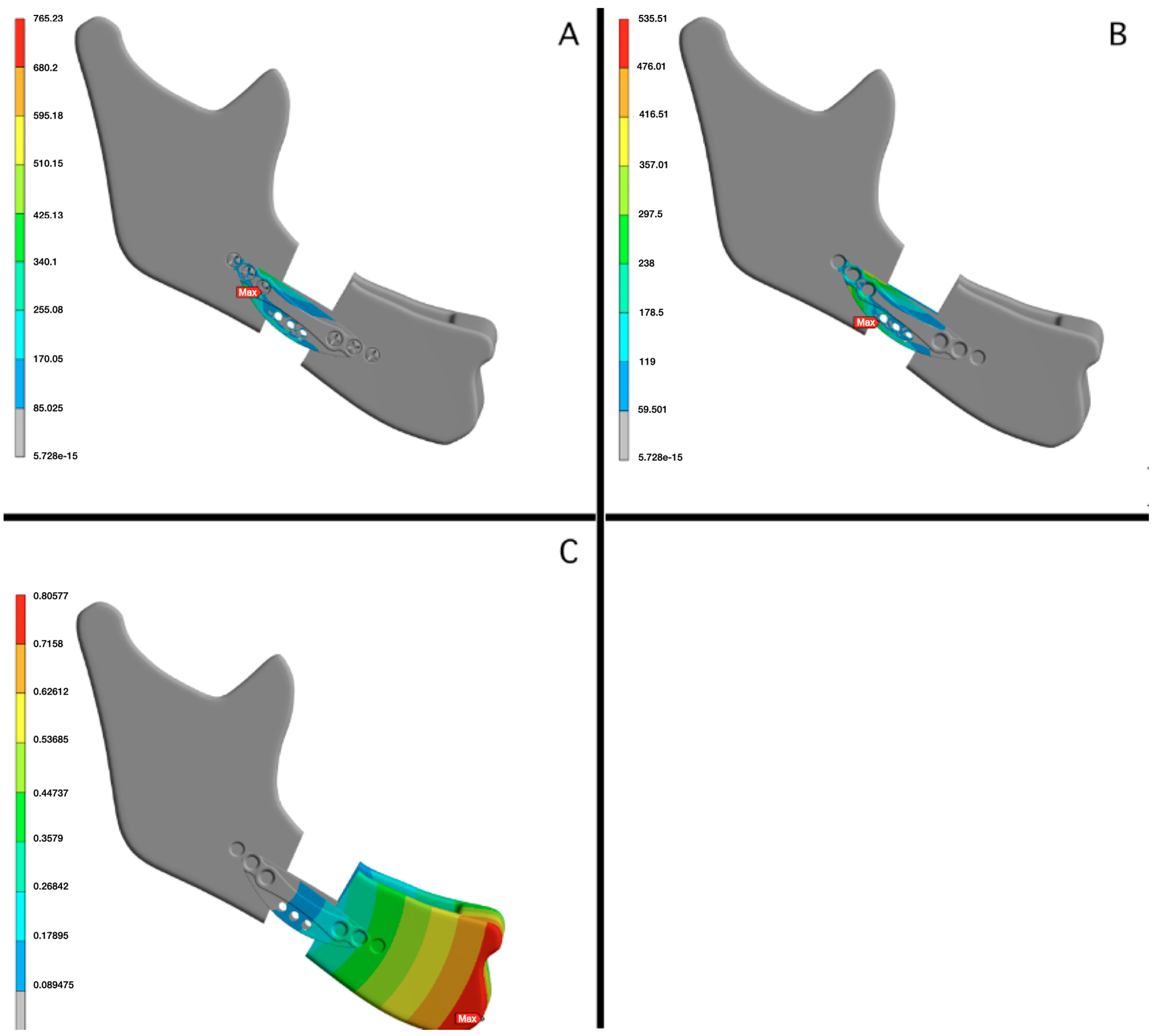
Three mechanical variables were recorded for each simulation (
Figure 1):
Global equivalent stress including screws and plate (A, MPa): maximum equivalent stress considering both screws and plate components.
Equivalent stress in the plate (B, MPa): maximum equivalent stress recorded exclusively in the fixation plate.
Global deformation of the fixation system (C, mm): maximum displacement of the fixation system, used as an indicator of structural stability under load.
These outcome variables were selected to assess load distribution, implant mechanical demand, and primary stability of the fixation systems. Results were analyzed descriptively and comparatively, focusing on: the effect of plate design, the number of plates used, LN versus FM fixation architecture, and the influence of plate thickness (0.8 mm vs. 1.0 mm).
3. Results
Finite element analysis was used as a comparative biomechanical tool to evaluate relative mechanical behavior under a static loading condition. The results reflect the response of the fixation systems under the defined simulation parameters and should be interpreted within the inherent limitations of FEA.
A total of 15 finite element simulations were performed to evaluate the mechanical behavior of different mandibular fixation systems following a 10 mm mandibular gap (
Table 1). The fixation configurations varied according to plate design, number of plates, fixation architecture (LN vs. FM), and plate thickness (0.8 mm and 1.0 mm). Three outcome variables were analyzed in all simulations: global equivalent stress including screws and plate (A), equivalent stress in the plate (B), and global deformation of the fixation system (C).
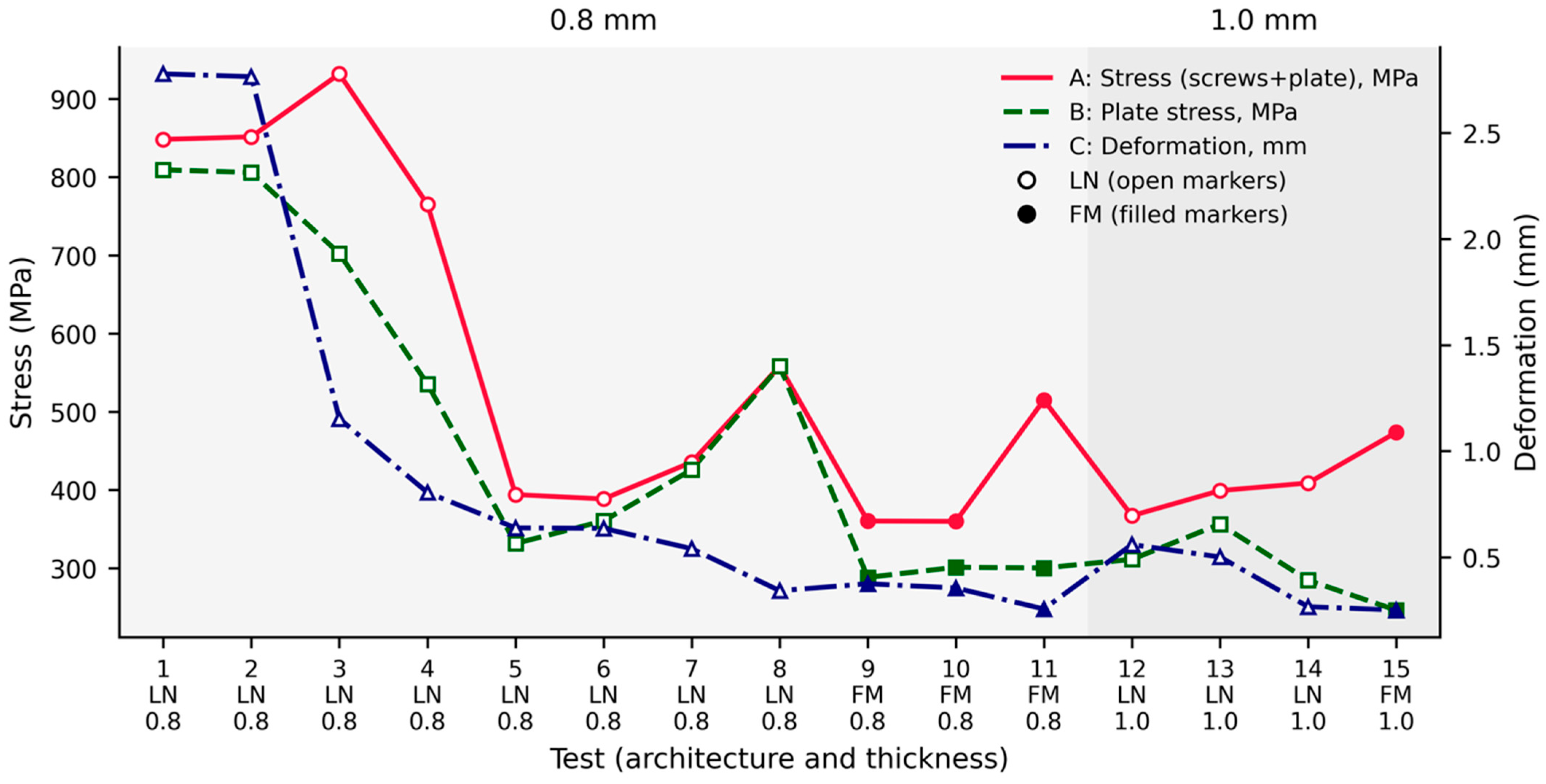
A wide range of mechanical responses was observed among the fixation configurations. Global equivalent stress values (A) averaged 435.47 ± 205.04 MPa, with a range from 360.24 MPa to 931.98 MPa, whereas equivalent stress in the plate (B) showed a mean value of 356.29 ± 194.04 MPa, ranging between 246.72 MPa and 809.38 MPa. The global deformation of the fixation system (C) varied markedly, with values ranging from 2.7773 mm in the least stable configurations to 0.25263 mm in the most stable systems.
Single LN plate configurations with 0.8 mm thickness and without reinforcement (tests 1 and 2) showed the highest deformation values (2.7773 mm and 2.7643 mm, respectively), associated with high global and plate stress values exceeding 800 MPa. These configurations demonstrated the lowest structural rigidity under the applied load.
Progressive modification of plate design resulted in a consistent reduction in system deformation. LN plates with reinforcement and partial inferior mesh extension (test 3) reduced deformation to 1.1526 mm, while the addition of a total inferior mesh extension (test 4) further reduced deformation to 0.80527 mm. These changes were accompanied by a reduction in equivalent plate stress from values above 800 MPa to 535.51 MPa.
Combined plate configurations using a simple LN plate with a reinforced LN plate showed further reductions in deformation. Test 7 exhibited a deformation of 0.54105 mm, while the configuration including a reinforced plate with total mesh extension (test 8) reduced deformation to 0.34384 mm, with corresponding global and plate stress values below 560 MPa.
Dual LN plate configurations with 0.8 mm thickness (tests 5 and 6) demonstrated a substantial reduction in deformation compared with single-plate systems, with deformation values of 0.63842 mm and 0.63641 mm, respectively. These configurations also exhibited lower global stress values (394.06 MPa and 388.45 MPa) and plate stress values between 331.6 MPa and 360.37 MPa.
FM fixation systems consistently demonstrated lower deformation values than comparable LN configurations. FM systems with 0.8 mm thickness (tests 9 and 10) showed deformation values of 0.37631 mm and 0.35677 mm, respectively, with global stress values close to 360 MPa and plate stress values below 305 MPa.
The FM system with reinforcement and total inferior mesh extension (test 11) demonstrated a further reduction in deformation to 0.25795 mm, while maintaining plate stress at 300.37 MPa.
All fixation systems using 1.0 mm-thick plates (tests 12–15) exhibited deformation values below 0.56 mm. Dual reinforced LN plates with 1.0 mm thickness (test 12) showed a deformation of 0.56032 mm, while combined reinforced LN configurations with partial and total mesh extensions (tests 13 and 14) reduced deformation to 0.50217 mm and 0.26889 mm, respectively.
The FM reinforced system with total inferior mesh extension and 1.0 mm thickness (test 15) demonstrated the lowest deformation of all configurations, with a value of 0.25263 mm, and the lowest equivalent plate stress (246.72 MPa) among all tested models.
Overall, the results demonstrated a progressive reduction in system deformation with increasing fixation complexity, incorporation of reinforcement and inferior mesh extensions, use of FM fixation architecture, and increased plate thickness (
Figure 2). The simplest fixation systems exhibited the highest stress concentrations and deformation, whereas reinforced and integrated systems showed improved mechanical stability under the simulated loading conditions.
When compared with the simplest fixation system, represented by a single non-reinforced LN plate with a deformation of approximately 2.77 mm, reinforced and integrated configurations demonstrated a pronounced reduction in deformation. Reinforced LN plates reduced deformation to values close to 0.8 mm, dual LN configurations to approximately 0.64 mm, and FM systems to values below 0.38 mm, with the most stable configuration achieving a deformation reduction greater than 90%. Regarding plate thickness, fixation systems using 1.0 mm plates consistently exhibited lower equivalent stress values than their 0.8 mm counterparts, while deformation remained similarly low in reinforced and integrated configurations, indicating that increased plate thickness primarily improved stress distribution rather than producing additional reductions in deformation.
4. Discussion
Large mandibular advancements are used in a variety of clinical conditions. From cranio-mandibular malformations to obstructive sleep apnea, these conditions can be effectively treated through mandibular advancement techniques. Several approaches have been proposed, among which distraction osteogenesis represents a viable option. Its advantages include progressive advancement that allows movements exceeding 10 mm and the simultaneous expansion of surrounding soft tissues [
12]. However, the use of more complex fixation systems, higher costs, and the need for significant patient compliance represent notable disadvantages of this method. In contrast, the use of plates and screws offers important benefits, including a single-stage procedure, lower risk, reduced costs, and simpler clinical implementation [
13].
Finite element analysis was selected as the methodological approach for this study due to its capacity to isolate mechanical variables and evaluate stress distribution and deformation under controlled and reproducible conditions. This technique has been widely applied to investigate fixation stability after sagittal split ramus osteotomy and mandibular advancement, allowing systematic comparison of fixation designs under standardized loading conditions [
4,
11]. In the context of large mandibular advancements, finite element analysis provides valuable insight into early mechanical behavior, which is a critical phase for postoperative stability. In the present model, a 10 mm gap was created to assess the performance and stability of different fixation configurations. Although this computational model does not replicate a sagittal split ramus osteotomy, it provides a valid framework for evaluating the biomechanical effectiveness of fixation systems.
Alternative methodologies, such as in vitro mechanical testing using synthetic or cadaveric mandibles, have also been employed to evaluate fixation performance [
11,
14]. Although these approaches allow physical validation, they are limited by material variability and reduced reproducibility across multiple configurations. Clinical studies, while essential for outcome validation, are influenced by biological healing and patient-related factors, making them less suitable for isolated mechanical comparison of fixation designs. Consequently, finite element analysis remains a complementary and appropriate tool for preliminary mechanical assessment and design optimization [
3].
The present finite element analysis demonstrated that plate design, plate thickness, and fixation architecture influenced the mechanical behavior of mandibular advancement fixation systems. Under a standardized 10 mm gap in mandibular osteotomy and vertical incisal loading, distinct patterns of stress distribution and deformation were observed among the evaluated configurations. Similar variability in mechanical response related to fixation design has been reported in previous finite element studies assessing mandibular advancement stability [
14,
15]. In terms of physiological bite force in healthy dentate adults, this typically ranges between 150 and 250 N, whereas maximum voluntary masticatory force in the molar region has been reported to range from 500 to 800 N, with mean values close to 600–700 N depending on sex and age [
16,
17]. In addition, under functional loading conditions, finite element analysis models indicate that equivalent stress values in the mandibular bone generally remain below 120–130 MPa, primarily concentrated in the condylar region and along the inferior border of the mandibular body. By contrast, during maximum voluntary biting, a marked increase in bone stress has been reported, with equivalent stress values reaching approximately 150–300 MPa [
18,
19]. Considering these clinical conditions, the use of a stronger configuration or reinforced plate could be an option in cases with a 10 mm or more gap between segments.
Simple straight plate configurations with reduced thickness exhibited the highest deformation values and increased stress concentration, indicating limited resistance to bending under functional loading. This behavior is consistent with prior biomechanical investigations demonstrating reduced stability of simpler fixation strategies in large mandibular advancements [
1,
11]. Large advancements have repeatedly been described as mechanically demanding scenarios, where insufficient fixation rigidity may compromise early postoperative stability [
3].
The progressive reinforcement of plate design, including the incorporation of inferior mesh extensions, resulted in a marked reduction in system deformation and a more favorable distribution of stresses within fixation components. Comparable trends have been reported in previous finite element analyses evaluating modified plate geometries, where reinforced designs improved load-sharing capacity and reduced peak stress values [
4,
15]. These findings support the rationale for exploring alternative designs aimed at enhancing stability without increasing the number of fixation elements.
The comparison between independent plate fixation systems and integrated fixation architectures revealed that integrated systems generally exhibited lower deformation and reduced plate stress. This observation aligns with biomechanical reports suggesting that connected or frame-based fixation systems enhance mechanical coupling between fixation points, improving resistance to bending and rotational forces [
20,
21]. Importantly, these advantages were achieved using standard fixation systems rather than patient-specific implants.
Plate thickness also played a relevant role in fixation performance. Configurations using thicker plates demonstrated reduced deformation compared with thinner plates, particularly when combined with reinforced designs or integrated architectures. Similar findings have been reported in previous biomechanical studies showing that increased plate thickness contributes to enhanced stiffness and load-bearing capacity in mechanically demanding situations [
22,
23].
Several limitations of this study should be acknowledged. The analysis was restricted to a single loading condition and did not account for dynamic masticatory forces, muscle activity, or biological processes such as bone healing and remodeling. Material properties were assumed to be homogeneous and isotropic, patient-specific anatomical variability was not incorporated and the virtual models are not a full example of a clinically regular sagittal mandibular split osteotomy. These limitations are inherent to finite element modeling and have been similarly described in previous biomechanical studies of mandibular fixation [
4,
11]. However, the aim to establish the mechanical performance of different fixation configurations was obtained, and when isolated from other clinical variables can aid the clinical decision in the operating room.
The model used does not account for dynamic masticatory loads or muscle activity, nor does it incorporate individual anatomical variability related to age, sex, occlusal type, or craniofacial morphology. Consequently, the data obtained cannot be considered universal and should be interpreted as deriving from an averaged model based on standardized parameters. Nevertheless, our results allow the establishment of comparative criteria for the selection of fixation systems, whereby the choice of the fixation system should be tailored to the specific clinical scenario, considering the magnitude of mandibular advancement, the expected biomechanical conditions, and the requirements for primary stability.
The reported stress values were used solely for relative comparisons among the different fixation configurations, assessing the effects of plate design, thickness, and system architecture on stress distribution and deformation. They were not directly compared to material performance or fatigue limits, as the study focused on characterizing comparative mechanical behavior under a standardized vertical load applied to the central incisor. This approach allows identification of the configurations with greater mechanical stability without directly extrapolating clinical failure predictions.
From a clinical perspective, the present findings suggest that meaningful improvements in mechanical stability can be achieved through optimization of standard fixation systems. Reinforced plate designs, increased plate thickness, and integrated fixation architectures may offer improved resistance to deformation, which could be particularly beneficial in large mandibular advancements.
Importantly, these improvements were observed using standard fixation systems that remain widely accessible and cost-effective. In clinical settings where patient-specific implants are not available or economically feasible, careful selection and optimization of standard straight plate configurations may represent a practical strategy to enhance fixation stability. The biomechanical evidence provided by this study may assist surgeons in tailoring fixation strategies according to the mechanical demands of mandibular advancement procedures.
This article presents a structural, mechanical, and mathematical evaluation of osteosynthesis plate performance in mandibular osteotomy. Such analysis is critical for determining the most appropriate fixation strategy, with direct relevance to clinical decision-making. The study identifies which osteosynthesis configuration provides greater mechanical reliability in demanding mandibular advancement conditions, where rigid internal fixation is essential to maintain short- and mid-term stability. The findings offer practical, evidence-based guidance for surgeons when selecting fixation systems in challenging advancement procedures.
5. Conclusions
Plate design, plate thickness, and fixation architecture influenced the mechanical stability of mandibular advancement in this finite element analysis. Reinforced plate designs and increased thickness reduced deformation and improved stress distribution. These results highlight that reinforced fixation configurations with an integrated architecture provide the most favorable combination of stress reduction and deformation control.
The selection of the fixation method should be based on the specific clinical scenario. Situations involving higher biomechanical demands may require fixation strategies providing greater rigidity, whereas less demanding cases may be managed with simpler configurations without compromising mechanical stability.
Author Contributions
Conceptualization, S.O., V.R. and M.P.; methodology, S.O., V.R., M.P. and H.G.G.; software, S.O., M.P. and R.S.; validation, S.O., V.R. and M.d.M.; investigation, S.O., V.R., H.G.G., R.S. and M.d.M.; resources, V.R., M.P., R.S. and M.P.; data curation, S.O. and V.R.; writing—original draft preparation, S.O., V.R. and M.d.M.; writing—review and editing, S.O., V.R., H.G.G., M.P., R.S. and M.d.M.; visualization, S.O., H.G.G., R.S. and M.d.M. All authors have read and agreed to the published version of the manuscript.
Funding
This research received no external funding.
Institutional Review Board Statement
This study did not require Ethics Committee or Institutional Review Board approval because of the nature of data; it does not involve human participants, animals, biological samples, or identifiable patient data.
Informed Consent Statement
Patient consent was waived because of the nature of data; it does not involve human participants, animals, biological samples, or identifiable patient data.
Data Availability Statement
The original contributions presented in this study are included in the article. Further inquiries can be directed to the corresponding author.
Conflicts of Interest
The authors declare no conflicts of interest.
References
- Sigua-Rodriguez, E.A.; Caldas, R.A.; Goulart, D.R.; de Moraes, P.H.; Olate, S.; de Albergaria-Barbosa, J.R. Comparative evaluation of different fixation techniques for sagittal split ramus osteotomy in 10 mm advancements. Part two: Finite element analysis. J. Craniomaxillofac. Surg. 2019, 47, 1015–1019. [Google Scholar] [CrossRef]
- Adejuyigbe, B.; Gharpure, M.; Wahle, C.F.; Kallini, J.R. Distraction Osteogenesis: A Comprehensive Review. Appl. Biosci. 2024, 3, 503–516. [Google Scholar] [CrossRef]
- Al Khatib, A.; Thor, A.; Jabbari, F. Long-term follow-up of Class II malocclusion treated with bilateral sagittal split osteotomy: A retrospective study with 6–19 years of follow-up. Int. J. Oral Maxillofac. Surg. 2025, 54, 720–726. [Google Scholar] [CrossRef]
- Kuik, K.; De Ruiter, M.H.T.; De Lange, J.; Hoekema, A. Fixation methods in sagittal split ramus osteotomy: A systematic review on in vitro biomechanical assessments. Int. J. Oral Maxillofac. Surg. 2019, 48, 56–70. [Google Scholar] [CrossRef]
- He, Y.; Zhang, H.; Qiao, J.; Fu, X.; Xu, S.; Jin, Q.; Liu, J.; Chen, Y.; Yu, B.; Niu, F. Biomechanical evaluation of seven fixation methods for sagittal split ramus osteotomy with four advancement levels by finite element analysis. Front. Surg. 2022, 9, 891747. [Google Scholar] [CrossRef] [PubMed]
- Joss, C.U.; Vassalli, I.M. Stability after bilateral sagittal split osteotomy advancement surgery with rigid internal fixation: A systematic review. J. Oral Maxillofac. Surg. 2009, 67, 301–313. [Google Scholar] [CrossRef]
- Abdelhamid, A.M.; Hassan, A.M.; El-Mohandes, W.A. Accuracy assessment of customized titanium plates compared to 3D-printed splints in Le Fort I osteotomy: A Randomized Clinical Trial evaluating clinical and radiographic outcomes. Cureus 2025, 17, e84151. [Google Scholar] [CrossRef] [PubMed]
- van der Wel, H.; Schepers, R.H.; Baan, F.; Spijkervet, F.K.L.; Jansma, J.; Kraeima, J. Maxilla-first patient-specific osteosynthesis versus mandible-first bimaxillary orthognathic surgery using splints: A randomized controlled trial. Int. J. Oral Maxillofac. Surg. 2025, 54, 720–726. [Google Scholar] [CrossRef] [PubMed]
- Wang, S.K.; Britt, M.C.; Nussbaum, L.; Resnick, C.M.; Padwa, B.L.; Green, M.A. Is patient-specific hardware for orthognathic surgery more frequently removed than stock plates? J. Oral Maxillofac. Surg. 2025, 84, 174–181. [Google Scholar] [CrossRef]
- Mordukhovich, I.; DeLeonibus, A.; Zelko, I.; Perozzo, F.A.; DeLeonibus, M.A.; Kalandar, A.; Gharb, B.B.; Papay, F.; Rampazzo, A. Surgical planning for management of obstructive sleep apnea. J. Craniofac. Surg. 2025, 10-1097. [Google Scholar] [CrossRef]
- Sigua-Rodriguez, E.A.; de Medeiros, R.C.; Goulart, D.R.; Bomfim-Azevedo, V.L.; Olate, S.; de Albergaria-Barbosa, J.R. Comparative evaluation of different fixation techniques of the sagittal split ramus osteotomy in 10 mm advancements: Mechanical testing and screw insertion torque. J. Craniomaxillofac. Surg. 2018, 46, 2082–2087. [Google Scholar] [CrossRef] [PubMed]
- Ernst, N.; Adolphs, N. Role of distraction osteogenesis in craniomaxillofacial surgery. Innov. Surg. Sci. 2016, 1, 97–103. [Google Scholar] [CrossRef]
- Ramanathan, M.; Kiruba, G.A.; Christabel, A.; Parameswaran, A.; Kapoor, S.; Sailer, H.F. Distraction Osteogenesis Versus Orthognathic Surgery: Demystifying Differences in Concepts, Techniques and Outcomes. J. Maxillofac. Oral Surg. 2020, 19, 477–489. [Google Scholar] [CrossRef]
- Chang, L.R.; Chen, C.C.; Jeng, S.F.; Chen, Y.R.; Hwang, L.C.; Lin, T.S. Investigation of a modified novel technique in bilateral sagittal splitting osteotomy fixation: Finite element analysis and in vitro biomechanical test. BioMed Res. Int. 2020, 2020, 8707389. [Google Scholar] [CrossRef]
- Silva, K.M.; Machado, L.M.R.; Leite, M.G.M.; Noritomi, P.Y.; de Jesus, G.P.; de Moura, A.L. Evaluation of two stable internal fixation techniques in mandibular ramus sagittal osteotomy: A three-dimensional finite element study. Oral Maxillofac. Surg. 2025, 29, 59. [Google Scholar] [CrossRef] [PubMed]
- Altuncu, F.; Kazan, D.; Özden, B. Comparative evaluation of the current and new design miniplate fixation techniques of the advanced sagittal split ramus osteotomy using three-dimensional finite element analysis. Med. Oral Patol. Oral Cir. Bucal 2023, 28, 553–561. [Google Scholar]
- Calderon, P.S.; Kogawa, E.M.; Lauris, J.R.; Conti, P.C. The influence of gender and bruxism on the human maximum bite force. J. Appl. Oral Sci. 2006, 14, 448–453. [Google Scholar] [CrossRef]
- Takaki, P.; Vieira, M.; Bommarito, S. Maximum bite force analysis in different age groups. Int. Arch. Otorhinolaryngol. 2014, 18, 272–276. [Google Scholar] [CrossRef]
- Daqiq, O.; Gareb, B.; Spijkervet, F.K.L.; Wubs, F.W.; Roossien, C.C.; van Minnen, B. Finite element analysis of the human mandible: A systematic review with meta-analysis of the essential input parameters. Sci. Rep. 2025, 15, 19582. [Google Scholar] [CrossRef]
- Zhong, S.; Shi, Q.; Sun, Y.; Yang, S.; Van Dessel, J.; Gu, Y.; Chen, X.; Lübbers, H.T.; Politis, C. Biomechanical comparison of locking and non-locking patient-specific mandibular reconstruction plate using finite element analysis. J. Mech. Behav. Biomed. Mater. 2021, 124, 104849. [Google Scholar] [CrossRef] [PubMed]
- Zhong, S.; Zhang, Y.; Shi, Q.; Van Dessel, J.; Geusens, J.; Coppieters, S.; Van Meerbeek, B.; Politis, C.; Yang, S.; Sun, Y. Biomechanics of manual-bent versus patient-specific mandibular implants. J. Biomech. Eng. 2025, 147, 121001. [Google Scholar] [CrossRef] [PubMed]
- Anlar, H.; Hasanoglu Erbasar, G.N.; Konarılı, F.N.; Orhan, M. Comparative evaluation of stress distribution and transverse displacement of novel designs of miniplates for sagittal split ramus osteotomy in 10 mm advancements: A finite element analysis. Br. J. Oral Maxillofac. Surg. 2022, 60, 1266–1272. [Google Scholar] [CrossRef] [PubMed]
- Khajehahmadi, S.; Shams, A.; Tahami, H.; Rahpeyma, A. Qualitative comparison of stress distribution of different fixation techniques of sagittal split ramus osteotomy in mandibular setback surgery in asymmetric cases using three-dimensional finite element analysis. World J. Plast. Surg. 2025, 14, 33–45. [Google Scholar] [CrossRef] [PubMed]
| Disclaimer/Publisher’s Note: The statements, opinions and data contained in all publications are solely those of the individual author(s) and contributor(s) and not of MDPI and/or the editor(s). MDPI and/or the editor(s) disclaim responsibility for any injury to people or property resulting from any ideas, methods, instructions or products referred to in the content. |




 ,
,