Changes in Sleep Quality and Insomnia Severity After Day Therapy in Patients with Alcohol Dependence: A Before-and-After Case Series

 , , ,
, , ,
Abstract
1. Introduction
2. Materials and Methods
2.1. Study Design
2.1.1. Setting and Ethical Consideration
2.1.2. Participants
2.1.3. Data Sources
2.1.4. Statistical Analysis
3. Results
Analysis
- Analysis of Individual PSQI Components
- Subjective sleep quality: participants rated their sleep as significantly better after completing therapy (mean score decreased from 1.52 to 0.84; p < 0.001). This change indicates an improved subjective feeling of rest and recovery after sleep.
- Sleep latency: a reduction in the time it took to fall asleep was observed (from 2.54 to 1.90; p < 0.001). This is one of the most significant improvements and is clinically significant, as prolonged sleep latency is a typical symptom of insomnia.
- Sleep duration: the average number of hours of sleep increased, as reflected in a decrease in scores from 0.86 to 0.42 (p < 0.001). This indicates an increase in sleep duration in the study group.
- Sleep efficiency: this indicator improved significantly (from 1.00 to 0.44 points; p < 0.001), meaning that patients spent more time in bed actually sleeping.
- Sleep disturbances: no significant changes were found (1.04 vs. 1.00 points). This may suggest that some sleep disturbances persist regardless of therapeutic intervention.
- Sleep medication use: no significant differences were found (0.44 vs. 0.30 points; p = 0.429). This indicates that the improved sleep quality was a result of therapeutic interventions and not increased pharmacotherapy.
- Daytime dysfunctions: this component decreased from 0.74 to 0.26 points (p = 0.001), reflecting improved daytime functioning and reduced fatigue and sleepiness.
4. Discussion
Limitations
5. Conclusions
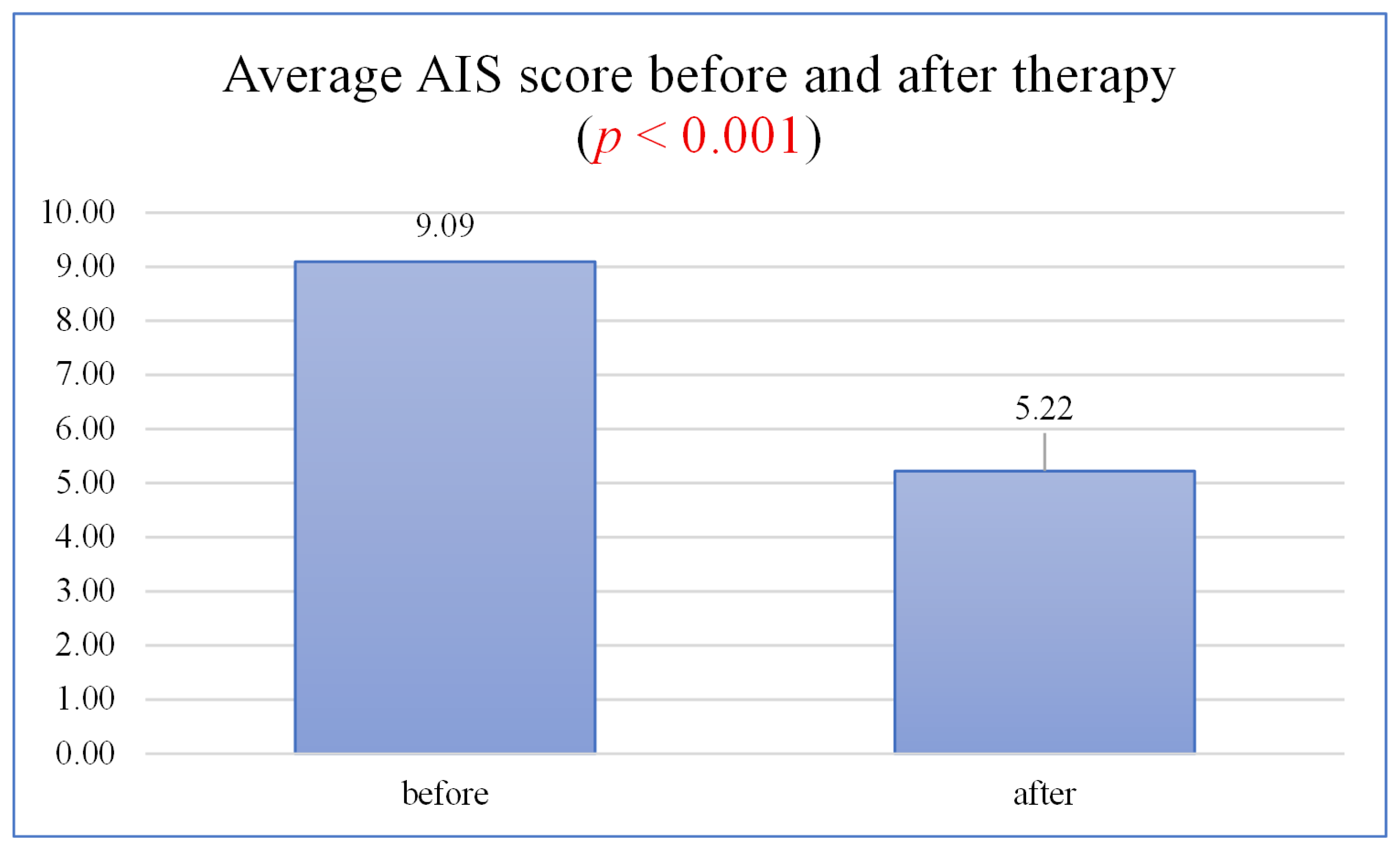
- Daytime therapy conducted over an eight-week period significantly reduces the severity of insomnia symptoms in alcohol-dependent individuals, as evidenced by a decrease in the mean AIS score of over 40%.
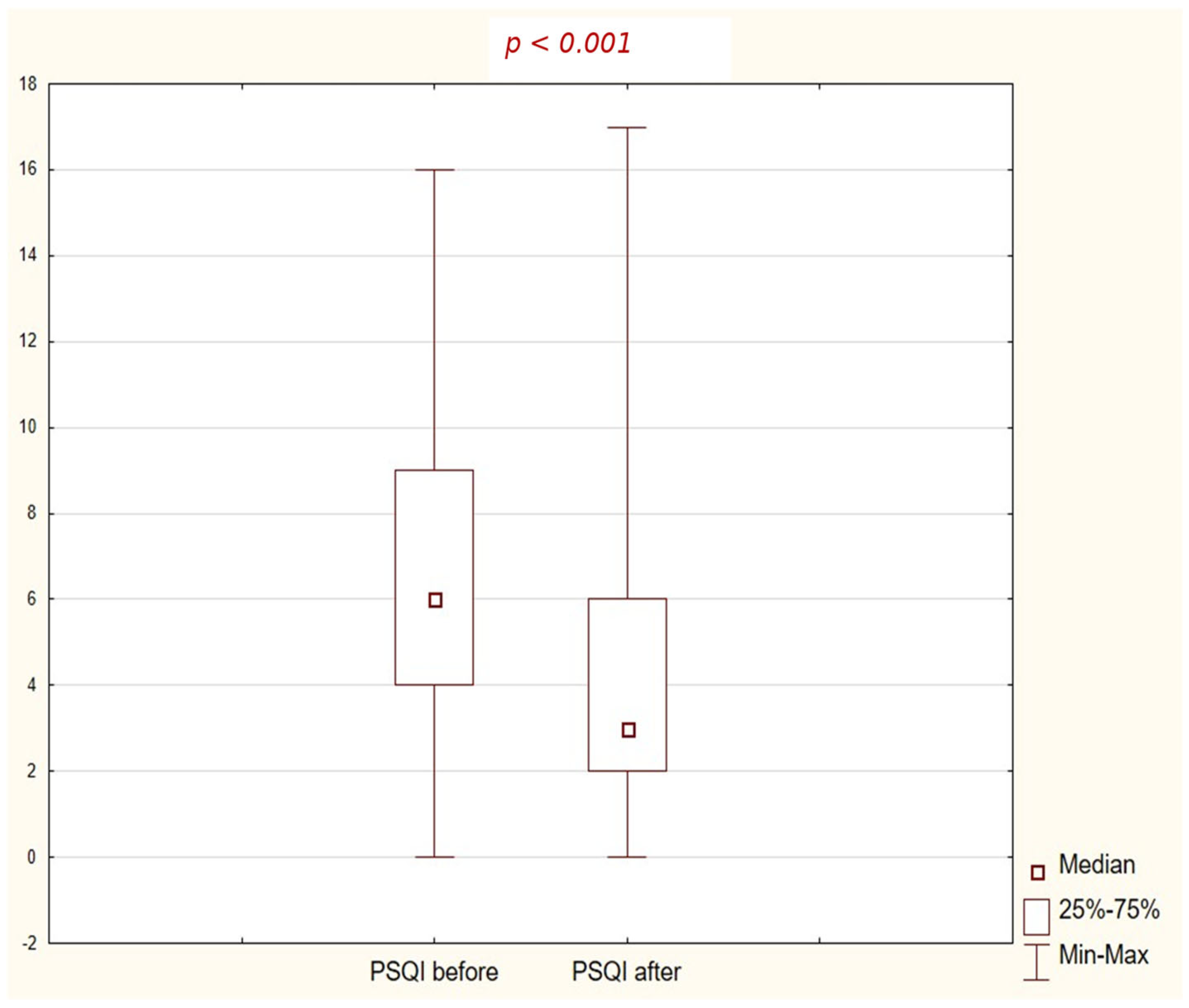
- The PSQI total score decreased significantly, from values clearly indicating “poor sleep quality” to a cutoff level, suggesting improvement in the study population.
- The greatest improvements were observed in sleep latency, subjective sleep quality, and sleep efficiency, while the use of sleep-inductive drugs and the frequency of sleep disturbances did not change significantly.
- The results confirm that therapeutic interventions, regardless of pharmacotherapy, can effectively improve sleep quality in the alcohol-dependent population.
- These results support the need to include routine assessment of sleep quality and insomnia severity in addiction treatment in day hospitals, as improved sleep may be an important indicator of early recovery and treatment engagement.
Supplementary Materials
Author Contributions
Funding
Institutional Review Board Statement
Informed Consent Statement
Data Availability Statement
Conflicts of Interest
Abbreviations
| AUD | Alcohol Use Disorders |
| AIS | Athens Insomnia Scale |
| PSQI | Pittsburgh Sleep Quality Questionnaire |
| DSM-V | Diagnostic and Statistical Manual of Mental Disorders |
| CBI-I | Cognitive-Behavioral Therapy |
| CBTI-AD | Cognitive Behavioral Therapy for Insomnia in Alcohol Dependence |
| PSQI-K | Pittsburgh Sleep Quality Index—Korean version |
| AUDIT-KR | Alcohol Use Disorders Identification Test—Korean version |
References
- GBD 2016 Alcohol Collaborators. Alcohol use and burden for 195 countries and territories, 1990–2016: A systematic analysis for the Global Burden of Disease Study 2016. Lancet 2018, 392, 1015–1035. [Google Scholar] [CrossRef] [PubMed]
- Rehm, J.; Room, R.; Graham, K.; Monteiro, M.; Gmel, G.; Sempos, C.T. The relationship of average volume of alcohol consumption and patterns of drinking to burden of disease: An overview. Addiction 2003, 98, 1209–1228. [Google Scholar] [CrossRef] [PubMed]
- American Psychiatric Association. Diagnostic and Statistical Manual of Mental Disorders, 5th ed.; American Psychiatric Publishing: Washington, DC, USA, 2013. [Google Scholar]
- Schuckit, M.A.; Smith, T.L.; Danko, G.; Tear, J.; Hennies, J.; Mendoza, L.A.; Hesselbrock, V.; Edenberg, H.J.; Hesselbrock, M.; Bucholz, K.; et al. Changes over time in endorsement of 11 DSM-IV alcohol use disorder criteria in young adults with persistent or recurrent AUD. Alcohol. Clin. Exp. Res. 2023, 47, 919–929. [Google Scholar] [CrossRef] [PubMed]
- Türkmen, C.; Schneider, C.L.; Viechtbauer, W.; Bolstad, I.; Chakravorty, S.; Miller, M.B.; Kallestad, H.; Angenete, G.W.; Johann, A.F.; Feige, B.; et al. Cognitive behavioral therapy for insomnia across the spectrum of alcohol use disorder: A systematic review and meta-analysis. Sleep Med. Rev. 2025, 80, 102049. [Google Scholar] [CrossRef]
- Guleken, Z.; Sarıbal, D.; Mırsal, H.; Cebulski, J.; Ceylan, Z.; Depciuch, J. Investigating the impact of long-term alcohol consumption on serum chemical changes: Fourier transform infrared spectroscopy for human blood serum. J. Biophotonics 2025, 18, e202400550. [Google Scholar] [CrossRef]
- Pallesen, S.; Sivertsen, B.; Nordhus, I.H.; Bjorvatn, B. A 10-year trend of insomnia prevalence in the adult Norwegian population. Sleep Med. 2014, 15, 173–179. [Google Scholar] [CrossRef]
- Brower, K.J. Insomnia, alcoholism and relapse. Sleep Med. Rev. 2003, 7, 523–539. [Google Scholar] [CrossRef]
- Lin, C.L.; Sun, J.C.; Lin, C.P.; Chung, C.H.; Chien, W.C. Risk of alcohol use disorders in patients with insomnia: A population-based retrospective cohort study. Alcohol 2020, 89, 123–128. [Google Scholar] [CrossRef]
- Bolstad, I.; Toft, H.; Lien, L.; Moe, J.S.; Rolland, B.; Bramness, J.G. Longitudinal determinants of insomnia among patients with alcohol use disorder. Alcohol 2023, 108, 10–20. [Google Scholar] [CrossRef]
- Brower, K.J.; Aldrich, M.S.; Robinson, E.A.; Zucker, R.A.; Greden, J.F. Insomnia, self-medication, and relapse to alcoholism. Am. J. Psychiatry 2001, 158, 399–404. [Google Scholar] [CrossRef]
- Brower, K.J. Assessment and treatment of insomnia in adult patients with alcohol use disorders. Alcohol 2015, 49, 417–427. [Google Scholar] [CrossRef] [PubMed]
- Geoffroy, P.A.; Lejoyeux, M.; Rolland, B. Management of insomnia in alcohol use disorder. Expert Opin. Pharmacother. 2020, 21, 297–306. [Google Scholar] [CrossRef] [PubMed]
- Wong, M.M.; Robertson, G.C.; Dyson, R.B. Prospective relationship between poor sleep and substance-related problems in a national sample of adolescents. Alcohol. Clin. Exp. Res. 2015, 39, 355–362. [Google Scholar] [CrossRef] [PubMed]
- Zhabenko, N.; Wojnar, M.; Brower, K.J. Prevalence and correlates of insomnia in a Polish sample of alcohol-dependent patients. Alcohol. Clin. Exp. Res. 2012, 36, 1600–1607. [Google Scholar] [CrossRef]
- Kolla, B.P.; Schneekloth, T.; Biernacka, J.; Mansukhani, M.; Geske, J.; Karpyak, V.; Hall-Flavin, D.; Louikianova, L.; Frye, M.A. The course of sleep disturbances in early alcohol recovery: An observational cohort study. Am. J. Addict. 2014, 23, 21–26. [Google Scholar] [CrossRef]
- Meneo, D.; Bacaro, V.; Curati, S.; Russo, P.M.; Martoni, M.; Gelfo, F.; Baglioni, C. Association between young adults’ sleep habits and substance use: A systematic review and meta-analysis. Sleep Med. Rev. 2023, 70, 101792. [Google Scholar] [CrossRef]
- Morin, C.M.; Vézina-Im, L.A.; Chen, S.J.; Ivers, H.; Carney, C.E.; Chaput, J.P.; Dang-Vu, T.T.; Davidson, J.R.; Belleville, G.; Lorrain, D.; et al. Prevalence of insomnia and use of sleep aids among adults in Canada. Sleep Med. 2024, 124, 338–345. [Google Scholar] [CrossRef]
- Hertenstein, E.; Trinca, E.; Wunderlin, M.; Schneider, C.L.; Züst, M.A.; Fehér, K.D.; Su, T.; van Straten, A.; Berger, T.; Baglioni, C.; et al. Cognitive behavioral therapy for insomnia in patients with mental disorders and comorbid insomnia: A systematic review and meta-analysis. Sleep Med. Rev. 2022, 62, 101597. [Google Scholar] [CrossRef]
- Miller, M.B.; Donahue, M.L.; Carey, K.B.; Scott-Sheldon, L.A.J. Insomnia treatment in the context of alcohol use disorder: A systematic review and meta-analysis. Drug Alcohol Depend. 2017, 181, 200–207. [Google Scholar] [CrossRef]
- Riley, D.S.; Barber, M.S.; Kienle, G.S.; Aronson, J.K.; von Schoen-Angerer, T.; Tugwell, P.; Kiene, H.; Helfand, M.; Altman, D.G.; Sox, H.; et al. CARE guidelines for case reports: Explanation and elaboration document. J. Clin. Epidemiol. 2017, 89, 218–235. [Google Scholar] [CrossRef]
- Fornal-Pawłowska, M.; Wołyńczyk-Gmaj, D.; Szelenberger, W. Walidacja Ateńskiej Skali Bezsenności. Psychiatr. Pol. 2011, 45, 211–219. [Google Scholar] [PubMed]
- Buysse, D.J.; Reynolds, C.F., III; Monk, T.H.; Berman, S.R.; Kupfer, D.J. The Pittsburgh Sleep Quality Index: A new instrument for psychiatric practice and research. Psychiatry Res. 1989, 28, 193–213. [Google Scholar] [CrossRef] [PubMed]
- De Simone, M.; De Feo, R.; Choucha, A.; Ciaglia, E.; Fezeu, F. Enhancing Sleep Quality: Assessing the Efficacy of a Fixed Combination of Linden, Hawthorn, Vitamin B1, and Melatonin. Med. Sci. 2024, 12, 2. [Google Scholar] [CrossRef] [PubMed]
- Dzierzewski, J.M.; Ravyts, S.G.; Martin, C.E.; Polak, K.M.; Nielson, S.A.; Pomm, D.; Dillon, P.; Moore, T.B.; Thacker, L.R.; Svikis, D.S. Sleep disturbance and problematic alcohol use: Examination of sex and race differences. Front. Sleep 2022, 1, 1014610. [Google Scholar] [CrossRef]
- Miller, M.B.; Carpenter, R.W.; Freeman, L.K.; Dunsiger, S.; McGeary, J.E.; Borsari, B.; McCrae, C.S.; Arnedt, J.T.; Korte, P.; Merrill, J.E. Effect of cognitive behavioral therapy for insomnia on alcohol treatment outcomes among US veterans: A randomized clinical trial. JAMA Psychiatry 2023, 80, 905–913. [Google Scholar] [CrossRef]
- Arnedt, J.T.; Cardoni, M.; Conroy, D.A.; Graham, M.; Amin, S.; Bohnert, K.M.; Krystal, A.D.; Ilgen, M.A. Telemedicine-delivered cognitive-behavioral therapy for insomnia in alcohol use disorder: Study protocol for a randomized controlled trial. Trials 2022, 23, 59. [Google Scholar] [CrossRef]
- Arnedt, J.T.; Conroy, D.A.; Armitage, R.; Brower, K.J. Cognitive-behavioral therapy for insomnia in alcohol-dependent patients: A randomized controlled pilot trial. Behav. Res. Ther. 2011, 49, 227–233. [Google Scholar] [CrossRef]
- Miller, M.B.; Deroche, C.B.; Freeman, L.K.; Park, C.J.; Hall, N.A.; Sahota, P.K.; McCrae, C.S. Cognitive behavioral therapy for insomnia among young adults who are actively drinking: A randomized pilot trial. Sleep 2021, 44, zsaa171. [Google Scholar] [CrossRef]
- Bhogaraju, A.; Kadaru, Y. Association of alexithymia, emotional regulation, and insomnia with alcohol dependence syndrome: A cross-sectional study. Telangana J. Psychiatry 2025, 11, 10–14. [Google Scholar] [CrossRef]
- He, S.; Brooks, A.T.; Kampman, K.M.; Chakravorty, S. The relationship between alcohol craving and insomnia symptoms in alcohol-dependent individuals. Alcohol Alcohol. 2019, 54, 287–294. [Google Scholar] [CrossRef]
- Park, S.Y.; Oh, M.K.; Lee, B.S.; Kim, H.G.; Lee, W.J.; Lee, J.H.; Lim, J.T.; Kim, J.Y. The effects of alcohol on quality of sleep. Korean J. Fam. Med. 2015, 36, 294–299. [Google Scholar] [CrossRef]



| Component PSQI | Before Therapy (M ± SD) | Median [Q1–Q3] | After Therapy (M ± SD) | Median [Q1–Q3] | p |
|---|---|---|---|---|---|
| Subjective sleep quality | 1.52 ± 0.89 | 2 [1–2] | 0.84 ± 0.72 | 1 [0–1] | <0.001 |
| Sleep latency | 2.54 ± 0.74 | 3 [2–3] | 1.90 ± 0.77 | 2 [1–2] | <0.001 |
| Sleep time | 0.86 ± 1.02 | 1 [0–2] | 0.42 ± 0.73 | 0 [0–1] | <0.001 |
| Sleep efficiency | 1.00 ± 1.11 | 1 [0–2] | 0.44 ± 0.68 | 0 [0–1] | <0.001 |
| Sleep disorders | 1.04 ± 0.44 | 1 [1–1] | 1.00 ± 0.44 | 1 [1–1] | - |
| Sleeping medication | 0.44 ± 1.18 | 0 [0–0] | 0.30 ± 1.11 | 0 [0–0] | 0.429 |
| Daily disfunctions | 0.74 ± 0.72 | 1 [0–1] | 0.26 ± 0.45 | 0 [0–0] | 0.001 |
Disclaimer/Publisher’s Note: The statements, opinions and data contained in all publications are solely those of the individual author(s) and contributor(s) and not of MDPI and/or the editor(s). MDPI and/or the editor(s) disclaim responsibility for any injury to people or property resulting from any ideas, methods, instructions or products referred to in the content. |
© 2026 by the authors. Licensee MDPI, Basel, Switzerland. This article is an open access article distributed under the terms and conditions of the Creative Commons Attribution (CC BY) license.
Share and Cite
Weronika, W.; Marta, G.; Aleksandra, S.; Marcin, S.; Knyszyńska, A. Changes in Sleep Quality and Insomnia Severity After Day Therapy in Patients with Alcohol Dependence: A Before-and-After Case Series. J. Clin. Med. 2026, 15, 1400. https://doi.org/10.3390/jcm15041400
Weronika W, Marta G, Aleksandra S, Marcin S, Knyszyńska A. Changes in Sleep Quality and Insomnia Severity After Day Therapy in Patients with Alcohol Dependence: A Before-and-After Case Series. Journal of Clinical Medicine. 2026; 15(4):1400. https://doi.org/10.3390/jcm15041400
Chicago/Turabian StyleWeronika, Wolińska, Giezek Marta, Szylińska Aleksandra, Scech Marcin, and Anna Knyszyńska. 2026. "Changes in Sleep Quality and Insomnia Severity After Day Therapy in Patients with Alcohol Dependence: A Before-and-After Case Series" Journal of Clinical Medicine 15, no. 4: 1400. https://doi.org/10.3390/jcm15041400
APA StyleWeronika, W., Marta, G., Aleksandra, S., Marcin, S., & Knyszyńska, A. (2026). Changes in Sleep Quality and Insomnia Severity After Day Therapy in Patients with Alcohol Dependence: A Before-and-After Case Series. Journal of Clinical Medicine, 15(4), 1400. https://doi.org/10.3390/jcm15041400