Robotic Total Knee Replacement: Single-Centre, Prospective, Non-Randomised Comparative Study Comparing Restricted Kinematic Alignment Combined with a Load Sensor Versus Functional Alignment
 , and
, and
Abstract
1. Introduction
2. Methods
2.1. Patient Selection
2.2. Surgical Technique
2.2.1. Both Treatment Groups
2.2.2. FA Group
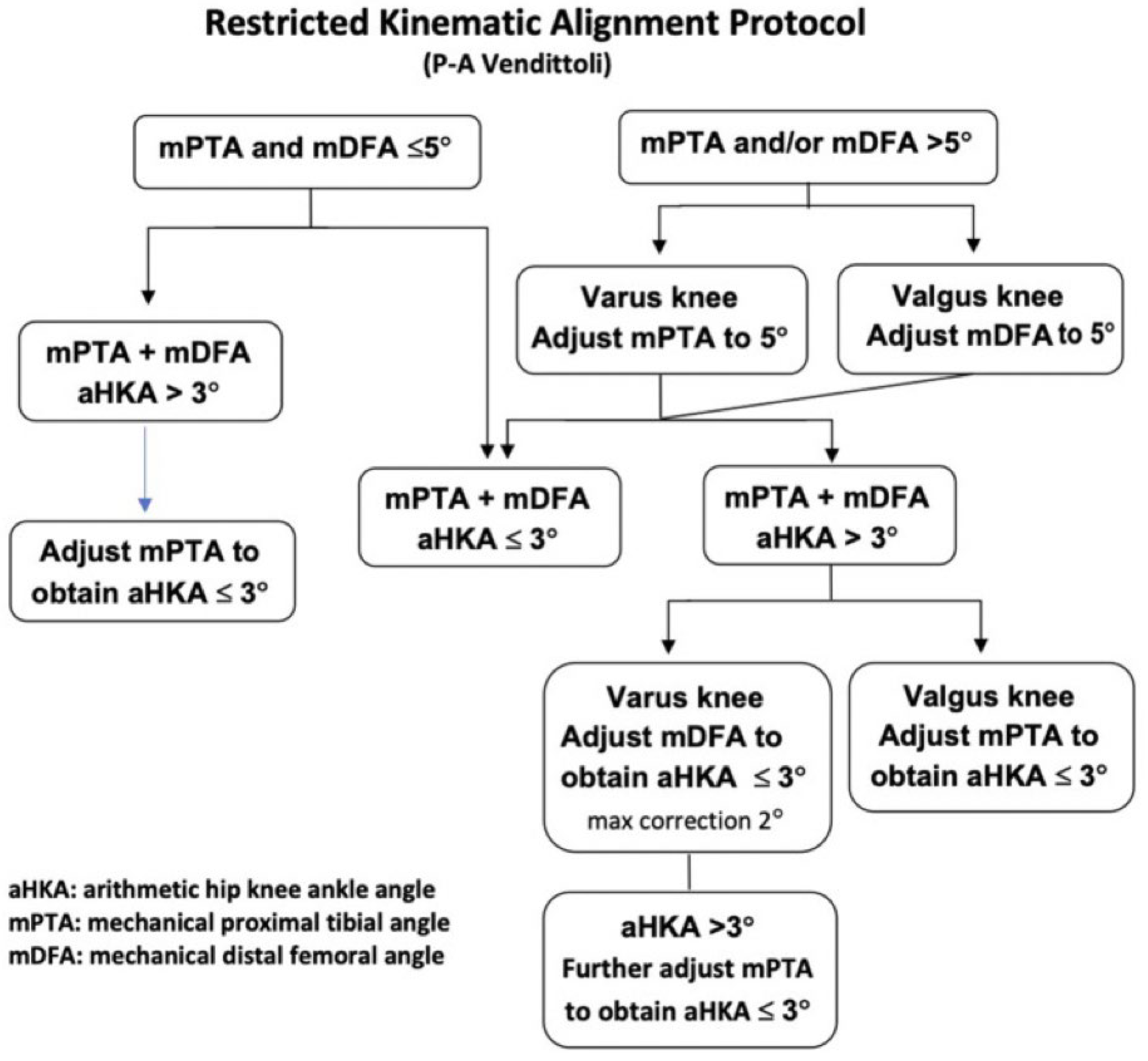
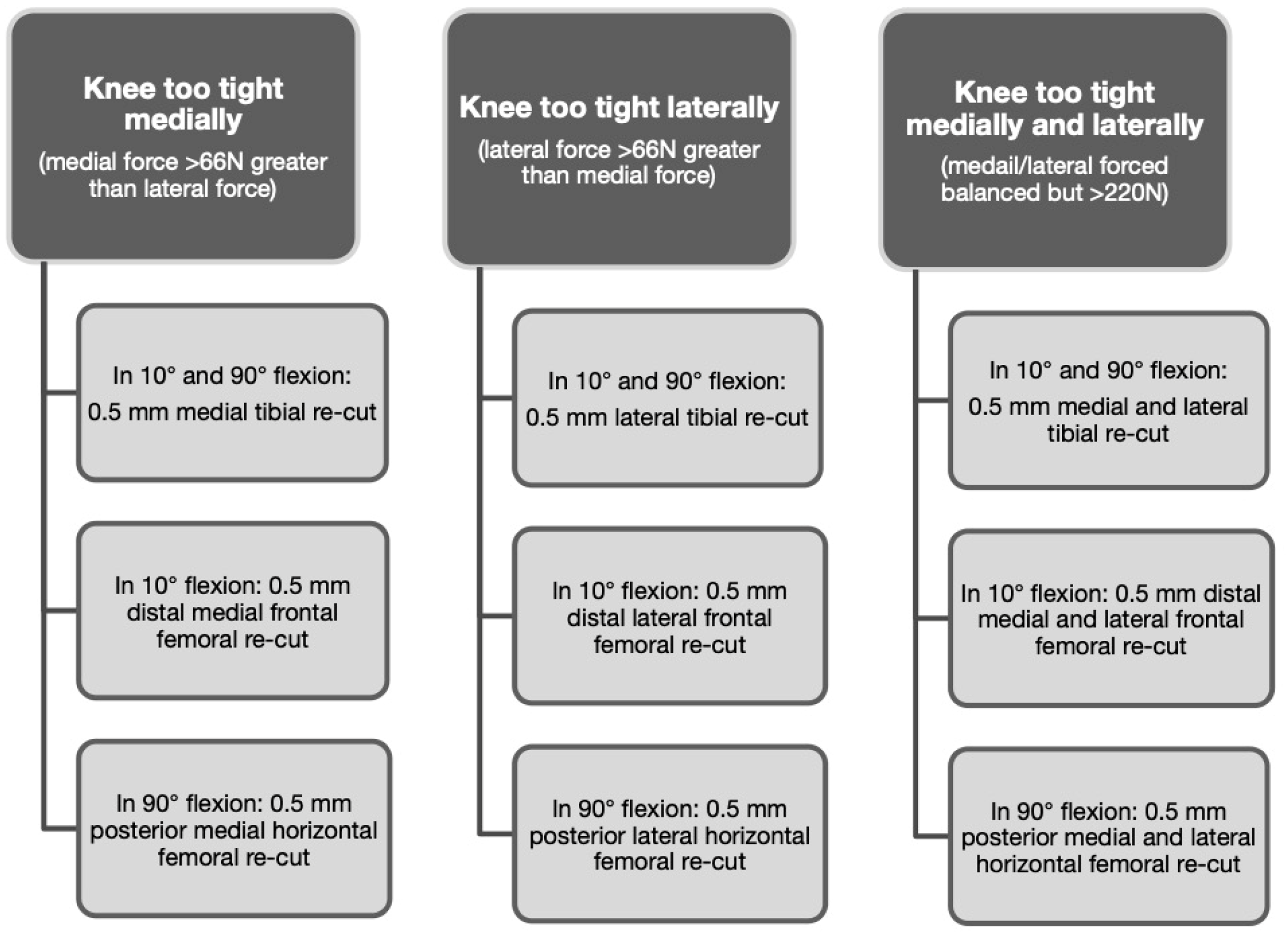
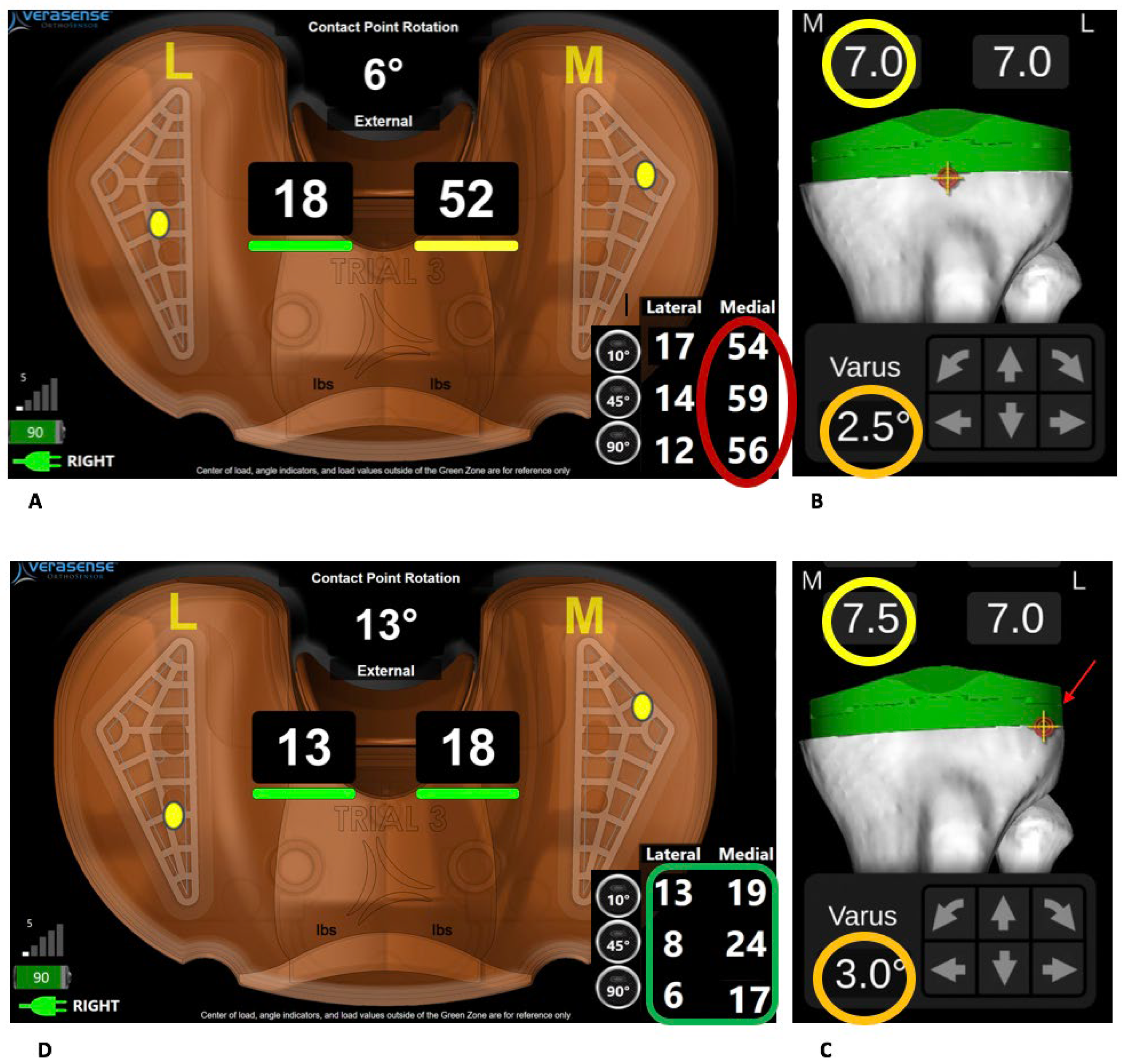
2.2.3. rKA/Load Sensor Group
2.3. Statistical Analysis
3. Results
3.1. Outcomes at the 1-Month Follow-Up
3.2. Outcomes at the 1-Year Follow-Up
4. Discussion
4.1. Alignment Strategies
4.2. Limitations
4.3. Conclusions
Author Contributions
Funding
Institutional Review Board Statement
Informed Consent Statement
Data Availability Statement
Conflicts of Interest
Abbreviations
| TKA | total knee arthroplasty |
| FA | functional alignment |
| KS | Knee Society Score |
| FJS | Forgotten Joint Score |
| rKA | restricted kinematic alignment |
| MA | mechanical alignment |
| VAS | visual analogue scale |
| ROM | range of motion |
| CS | condylar-stabilised |
| PCL | posterior cruciate ligament |
| aHKA | arithmetic hip-knee-ankle |
| TEA | trans-epicondylar axis |
References
- Bourne, R.B.; Chesworth, B.M.; Davis, A.M.; Mahomed, N.N.; Charron, K.D.J. Patient satisfaction after total knee arthroplasty: Who is satisfied and who is not? Clin. Orthop. Relat. Res. 2010, 468, 57–63. [Google Scholar] [CrossRef] [PubMed]
- Bourne, R.B.; McCalden, R.W.; MacDonald, S.J.; Mokete, L.; Guerin, J. Influence of patient factors on TKA outcomes at 5 to 11 years followup. Clin. Orthop. Relat. Res. 2007, 464, 27–31. [Google Scholar] [CrossRef] [PubMed]
- Font-Rodriguez, D.E.; Scuderi, G.R.; Insall, J.N. Survivorship of cemented total knee arthroplasty. Clin. Orthop. Relat. Res. 1997, 345, 79–86. [Google Scholar] [CrossRef]
- Rodricks, D.J.; Patil, S.; Pulido, P.; Colwell, C.W. Press-fit condylar design total knee arthroplasty. Fourteen to seventeen-year follow-up. J. Bone Jt. Surg. Am. 2007, 89, 89–95. [Google Scholar] [CrossRef]
- Nam, D.; Nunley, R.M.; Barrack, R.L. Patient dissatisfaction following total knee replacement: A growing concern? Bone Jt. J. 2014, 96, 96–100. [Google Scholar] [CrossRef]
- Baker, P.N.; van der Meulen, J.H.; Lewsey, J.; Gregg, P.J.; National Joint Registry for England and Wales. The role of pain and function in determining patient satisfaction after total knee replacement: Data from the National Joint Registry for England and Wales. J. Bone Jt. Surg. Br. 2007, 89, 893–900. [Google Scholar] [CrossRef]
- Milner, C.E. Is gait normal after total knee arthroplasty? Systematic review of the literature. J. Orthop. Sci. 2009, 14, 114–120. [Google Scholar] [CrossRef]
- Bourne, R.B.; Chesworth, B.; Davis, A.; Mahomed, N.; Charron, K. Comparing patient outcomes after THA and TKA: Is there a difference? Clin. Orthop. Relat. Res. 2010, 468, 542–546. [Google Scholar] [CrossRef]
- Bozic, K.J.; Kurtz, S.M.; Lau, E.; Ong, K.; Chiu, V.; Vail, T.P.; Rubash, H.E.; Berry, D.J. The epidemiology of revision total knee arthroplasty in the United States. Clin. Orthop. Relat. Res. 2010, 468, 45–51. [Google Scholar] [CrossRef]
- Fehring, T.K.; Odum, S.; Griffin, W.L.; Mason, J.B.; Nadaud, M. Early failures in total knee arthroplasty. Clin. Orthop. Relat. Res. 2001, 392, 315–318. [Google Scholar] [CrossRef]
- Lonner, J.H.; Siliski, J.M.; Scott, R.D. Prodromes of failure in total knee arthroplasty. J. Arthroplast. 1999, 14, 488–492. [Google Scholar] [CrossRef]
- Sharkey, P.F.; Hozack, W.J.; Rothman, R.H.; Shastri, S.; Jacoby, S.M. Insall Award paper. Why are total knee arthroplasties failing today? Clin. Orthop. Relat. Res. 2002, 404, 7–13. [Google Scholar] [CrossRef] [PubMed]
- Almaawi, A.M.; Hutt, J.R.B.; Masse, V.; Lavigne, M.; Vendittoli, P.-A. The Impact of Mechanical and Restricted Kinematic Alignment on Knee Anatomy in Total Knee Arthroplasty. J. Arthroplast. 2017, 32, 2133–2140. [Google Scholar] [CrossRef] [PubMed]
- Bellemans, J.; Colyn, W.; Vandenneucker, H.; Victor, J. The Chitranjan Ranawat award: Is neutral mechanical alignment normal for all patients? The concept of constitutional varus. Clin. Orthop. Relat. Res. 2012, 470, 45–53. [Google Scholar] [CrossRef] [PubMed]
- Cherian, J.J.; Kapadia, B.H.; Banerjee, S.; Jauregui, J.J.; Issa, K.; Mont, M.A. Mechanical, Anatomical, and Kinematic Axis in TKA: Concepts and Practical Applications. Curr. Rev. Musculoskelet. Med. 2014, 7, 89–95. [Google Scholar] [CrossRef]
- Gustke, K.A.; Golladay, G.J.; Roche, M.W.; Elson, L.C.; Anderson, C.R. A new method for defining balance: Promising short-term clinical outcomes of sensor-guided TKA. J. Arthroplast. 2014, 29, 955–960. [Google Scholar] [CrossRef]
- Wakelin, E.A.; Shalhoub, S.; Lawrence, J.M.; Keggi, J.M.; De Claire, J.H.; Randall, A.L.; Ponder, C.E.; Koenig, J.A.; Lyman, S.; Plaskos, C. Improved total knee arthroplasty pain outcome when joint gap targets are achieved throughout flexion. Knee Surg. Sports Traumatol. Arthrosc. 2021, 30, 939–947. [Google Scholar] [CrossRef]
- Hutt, J.R.B.; LeBlanc, M.-A.; Massé, V.; Lavigne, M.; Vendittoli, P.-A. Kinematic TKA using navigation: Surgical technique and initial results. Orthop. Traumatol. Surg. Res. 2016, 102, 99–104. [Google Scholar] [CrossRef]
- Shatrov, J.; Batailler, C.; Sappey-Marinier, E.; Gunst, S.; Servien, E.; Lustig, S. Kinematic alignment fails to achieve balancing in 50% of varus knees and resects more bone compared to functional alignment. Knee Surg. Sports Traumatol. Arthrosc. 2022, 30, 2991–2999. [Google Scholar] [CrossRef]
- Lee, G.-C.; Wakelin, E.; Plaskos, C. What Is the Alignment and Balance of a Total Knee Arthroplasty Performed Using a Calipered Kinematic Alignment Technique? J. Arthroplast. 2022, 37, S176–S181. [Google Scholar] [CrossRef]
- MacDessi, S.J.; Griffiths-Jones, W.; Chen, D.B.; Griffiths-Jones, S.; Wood, J.A.; Diwan, A.D.; Harris, I.A. Restoring the constitutional alignment with a restrictive kinematic protocol improves quantitative soft-tissue balance in total knee arthroplasty: A randomized controlled trial. Bone Jt. J. 2020, 102, 117–124. [Google Scholar] [CrossRef] [PubMed]
- Bardou-Jacquet, J.; Murgier, J.; Laudet, F.; Fabre, T. Combining load sensor and robotic technologies for ligament balance in total knee arthroplasty. Orthop. Traumatol. Surg. Res. 2021, 108, 102889. [Google Scholar] [CrossRef] [PubMed]
- Kayani, B.; Konan, S.; Tahmassebi, J.; Oussedik, S.; Moriarty, P.D.; Haddad, F.S. A prospective double-blinded randomised control trial comparing robotic arm-assisted functionally aligned total knee arthroplasty versus robotic arm-assisted mechanically aligned total knee arthroplasty. Trials 2020, 21, 194. [Google Scholar] [CrossRef] [PubMed]
- Chang, J.S.; Kayani, B.; Wallace, C.; Haddad, F.S. Functional alignment achieves soft-tissue balance in total knee arthroplasty as measured with quantitative sensor-guided technology. Bone Jt. J. 2021, 103, 507–514. [Google Scholar] [CrossRef]
- Singh, V.; Fiedler, B.; Huang, S.; Oh, C.; Karia, R.J.; Schwarzkopf, R. Patient Acceptable Symptom State for the Forgotten Joint Score in Primary Total Knee Arthroplasty. J. Arthroplast. 2022, 37, 1557–1561. [Google Scholar] [CrossRef]
- Hampp, E.L.; Chughtai, M.; Scholl, L.Y.; Sodhi, N.; Bhowmik-Stoker, M.; Jacofsky, D.J.; Mont, M.A. Robotic-Arm Assisted Total Knee Arthroplasty Demonstrated Greater Accuracy and Precision to Plan Compared with Manual Techniques. J. Knee Surg. 2019, 32, 239–250. [Google Scholar] [CrossRef]
- Khlopas, A.; Chughtai, M.; Hampp, E.L.; Scholl, L.Y.; Prieto, M.; Chang, T.-C.; Abbasi, A.; Bhowmik-Stoker, M.; Otto, J.; Jacofsky, D.J.; et al. Robotic-Arm Assisted Total Knee Arthroplasty Demonstrated Soft Tissue Protection. Surg. Technol. Int. 2017, 30, 441–446. [Google Scholar]
- Sires, J.D.; Wilson, C.J. CT Validation of Intraoperative Implant Position and Knee Alignment as Determined by the MAKO Total Knee Arthroplasty System. J. Knee Surg. 2021, 34, 1133–1137. [Google Scholar] [CrossRef]
- Aglietti, P.; Sensi, L.; Cuomo, P.; Ciardullo, A. Rotational position of femoral and tibial components in TKA using the femoral transepicondylar axis. Clin. Orthop. Relat. Res. 2008, 466, 2751–2755. [Google Scholar] [CrossRef]
- Akagi, M.; Oh, M.; Nonaka, T.; Tsujimoto, H.; Asano, T.; Hamanishi, C. An anteroposterior axis of the tibia for total knee arthroplasty. Clin. Orthop. Relat. Res. 2004, 420, 213–219. [Google Scholar] [CrossRef]
- Luyckx, T.; Vandenneucker, H.; Ing, L.S.; Vereecke, E.; Ing, A.V.; Victor, J. Raising the Joint Line in TKA is Associated with Mid-flexion Laxity: A Study in Cadaver Knees. Clin. Orthop. Relat. Res. 2018, 476, 601–611. [Google Scholar] [CrossRef] [PubMed]
- Stambough, J.B.; Edwards, P.K.; Mannen, E.M.; Barnes, C.L.; Mears, S.C. Flexion Instability After Total Knee Arthroplasty. J. Am. Acad Orthop. Surg. 2019, 27, 642–651. [Google Scholar] [CrossRef] [PubMed]
- Vendittoli, P.-A.; Blakeney, W. Redefining knee replacement. Orthop. Traumatol. Surg. Res. 2017, 103, 977–979. [Google Scholar] [CrossRef] [PubMed]
- Blakeney, W.; Beaulieu, Y.; Kiss, M.-O.; Rivière, C.; Vendittoli, P.-A. Less gap imbalance with restricted kinematic alignment than with mechanically aligned total knee arthroplasty: Simulations on 3-D bone models created from CT-scans. Acta Orthop. 2019, 90, 602–609. [Google Scholar] [CrossRef]
- Vendittoli, P.-A.; Martinov, S.; Blakeney, W.G. Restricted Kinematic Alignment, the Fundamentals, and Clinical Applications. Front. Surg. 2021, 8, 697020. [Google Scholar] [CrossRef]
- Bardou-Jacquet, J.; Murgier, J.; Laudet, F. Combining sensors and robotic technologies to balance TKA. In Proceedings of the European Society of Sports Traumatology, Knee Surgery & Arthroscopy (ESSKA) 20th Annual Meeting, Paris, France, 27–29 April 2022. [Google Scholar]
- Healy, W.L.; Della Valle, C.J.; Iorio, R.; Berend, K.R.; Cushner, F.D.; Dalury, D.F.; Lonner, J.H. Complications of Total Knee Arthroplasty: Standardized List and Definitions of The Knee Society. Clin. Orthop. Relat. Res. 2013, 471, 215–220. [Google Scholar] [CrossRef]
- Laforest, G.; Kostretzis, L.; Kiss, M.-O.; Vendittoli, P.-A. Restricted kinematic alignment leads to uncompromised osseointegration of cementless total knee arthroplasty. Knee Surg. Sports Traumatol. Arthrosc. 2022, 30, 705–712. [Google Scholar] [CrossRef]
- Abhari, S.; Hsing, T.M.; Malkani, M.M.; Smith, A.F.; Smith, L.S.; Mont, M.A.; Malkani, A.L. Patient satisfaction following total knee arthroplasty using restricted kinematic alignment. Bone Jt. J. 2021, 103, 59–66. [Google Scholar] [CrossRef]
- Golladay, G.J.; Bradbury, T.L.; Gordon, A.C.; Fernandez-Madrid, I.J.; Krebs, V.E.; Patel, P.D.; Suarez, J.C.; Rueda, C.A.H.; Barsoum, W.K. Are Patients More Satisfied with a Balanced Total Knee Arthroplasty? J. Arthroplast. 2019, 34, S195–S200. [Google Scholar] [CrossRef]
- Wood, T.J.; Winemaker, M.J.; Williams, D.S.; Petruccelli, D.T.; Tushinski, D.M.; de Beer Jde, V. Randomized Controlled Trial of Sensor-Guided Knee Balancing Compared to Standard Balancing Technique in Total Knee Arthroplasty. J. Arthroplast. 2021, 36, 953–957. [Google Scholar] [CrossRef]
- MacDessi, S.J.; Wood, J.A.; Diwan, A.; Harris, I.A.; on behalf of the SENSOR BALANCE Study Group. Intraoperative pressure sensors improve soft-tissue balance but not clinical outcomes in total knee arthroplasty: A multicentre randomized controlled trial. Bone Jt. J. 2022, 104, 604–612. [Google Scholar] [CrossRef] [PubMed]
- Chow, J.C.; Breslauer, L. The Use of Intraoperative Sensors Significantly Increases the Patient-Reported Rate of Improvement in Primary Total Knee Arthroplasty. Orthopedics 2017, 40, e648–e651. [Google Scholar] [CrossRef] [PubMed]
- Steer, R.; Tippett, B.; Khan, R.N.; Collopy, D.; Clark, G. A prospective randomised control trial comparing functional with mechanical axis alignment in total knee arthroplasty: Study protocol for an investigator initiated trial. Trials 2021, 22, 523. [Google Scholar] [CrossRef] [PubMed]
- Young, S.W.; Zeng, N.; Tay, M.L.; Fulker, D.; Esposito, C.; Carter, M.; Bayan, A.; Farrington, B.; Van Rooyen, R.; Walker, M. A prospective randomised controlled trial of mechanical axis with soft tissue release balancing vs functional alignment with bony resection balancing in total knee replacement—A study using Stryker Mako robotic arm-assisted technology. Trials 2022, 23, 580. [Google Scholar] [CrossRef]
- Shatrov, J.; Battelier, C.; Sappey-Marinier, E.; Gunst, S.; Servien, E.; Lustig, S. Functional Alignment Philosophy in Total Knee Arthroplasty—Rationale and technique for the varus morphotype using a CT based robotic platform and individualized planning. SICOT J. 2022, 8, 11. [Google Scholar] [CrossRef]
- Freeman Ma, R.; Pinskerova, V. The movement of the normal tibio-femoral joint. J. Biomech. 2005, 38, 197–208. [Google Scholar] [CrossRef]
- Pinskerova, V.; Samuelson, K.M.; Stammers, J.; Maruthainar, K.; Sosna, A.; Freeman Ma, R. The knee in full flexion: An anatomical study. J. Bone Jt. Surg. Br. 2009, 91, 830–834. [Google Scholar] [CrossRef]
- Rivière, C.; Dhaif, F.; Shah, H.; Ali, A.; Auvinet, E.; Aframian, A.; Cobb, J.; Howell, S.; Harris, S. Kinematic alignment of current TKA implants does not restore the native trochlear anatomy. Orthop. Traumatol. Surg. Res. 2018, 104, 983–995. [Google Scholar] [CrossRef]
- Rivière, C.; Iranpour, F.; Harris, S.; Auvinet, E.; Aframian, A.; Parratte, S.; Cobb, J. Differences in trochlear parameters between native and prosthetic kinematically or mechanically aligned knees. Orthop. Traumatol. Surg. Res. 2018, 104, 165–170. [Google Scholar] [CrossRef]



| Variables | Overall N = 90 | Groups | ||
|---|---|---|---|---|
| FA n = 43 | rKA & Sensor n = 47 | p Value | ||
| Gender, n (%) | 0.111 | |||
| Male | 54 (60%) | 30 (70%) | 24 (51%) | |
| Female | 36 (40%) | 13 (30%) | 23 (49%) | |
| Age at time of surgery, m ± SD (range) | 70.06 ± 9.31 | 70.21 ± 8.01 | 69.91 ± 10.53 | 0.882 |
| (47.00; 91.00) | (48.00; 85.00) | (47.00; 91.00) | ||
| Side, n (%) | 0.520 | |||
| Right | 46 (51%) | 24 (56%) | 22 (47%) | |
| Left | 44 (49%) | 19 (44%) | 25 (53%) | |
| BMI (kg/m2), m ± SD (range) | 28.13 ± 3.74 | 27.88 ± 2.96 | 28.36 ± 4.39 | 0.542 |
| (18.70; 39.50) | (22.80; 35.90) | (18.70; 39.50) | ||
| Lifestyle, n (%) | 1.000 | |||
| Living with a partner | 81 (90%) | 39 (91%) | 42 (89%) | |
| Living alone | 9 (10%) | 4 (9%) | 5 (11%) | |
| Walking aid, n (%) | 0.515 | |||
| None | 75 (83%) | 38 (88%) | 37 (79%) | |
| One crutch | 12 (13%) | 4 (9%) | 8 (17%) | |
| Two crutches | 3 (4%) | 1 (3%) | 2 (4%) | |
| OD (min), m ± SD (range) | 74.12 ± 12.19 | 74.74 ± 14.3 | 73.57 ± 10.25 | 0.967 |
| (50.00; 120.00) | (50.0; 120.00) | (56.00; 90.00) | ||
| Rehabilitation, n (%) | 1.000 | |||
| Ambulatory | 78 (87%) | 37 (86%) | 41 (87%) | |
| Rehabilitation centre | 12 (13%) | 6 (14%) | 6 (13%) | |
| Variables | Overall N = 90 | Groups | ||
|---|---|---|---|---|
| FA n = 43 | rKA & Sensor n = 47 | p Value | ||
| Pre-op VAS score, m ± SD (range) | 6.99 ± 1.29 | 7.14 ± 1.26 | 6.85 ± 1.32 | 0.259 |
| 0–10 none to worst | (5.00; 10.00) | (5.00; 10.00) | (5.00; 10.00) | |
| Pre-op flessum (°), m ± SD (range) | 5.37 ± 4.98 | 5.38 ± 4.66 | 5.36 ± 5.32 | 0.785 |
| (0.00; 20.00) | (0.0; 16.00) | (0.0; 20.00) | ||
| Pre-op flexion max (°), m ± SD (range) | 133.15 ± 9.27 | 129.30 ± 8.44 | 136.19 ± 8.93 | <0.001 |
| (110.00; 155.00) | (112.0; 150.00) | (110.00; 155.00) | ||
| HKA (°), m ± SD (range) | 175.49 ± 5.94 | 175.59 ± 6.28 | 175.4 ± 5.76 | 0.884 |
| (160.00–189.00) | (163.00; 189.00) | (160.00; 189.00) | ||
| Knee morphotype, n (%) | 0.299 | |||
| Neutral (180 ± 3°) | 27 (30.00%) | 14 (32%) | 13 (28%) | |
| Varus | ||||
| 3–10° | 42 (47%) | 16 (37%) | 26 (55%) | |
| >10° | 14 (15%) | 8 (19%) | 6 (13%) | |
| Valgus | ||||
| 3–10° | 7 (8%) | 5 (12%) | 2 (4%) | |
| >10° | 0 | 0 | 0 | |
| Controlateral knee state, n (%) | 0.466 | |||
| No OA | 34 (38%) | 14 (33%) | 20 (43%) | |
| OA | 36 (40.00%) | 20 (46%) | 16 (34%) | |
| Arthroplasty | 20 (22%) | 9 (21%) | 11 (23%) | |
| Pre-op clinical outcome score m ± SD (range) | ||||
| KSS | ||||
| Objective score | 47.21 ± 15.55 | 46.64 ± 16.78 | 47.72 ± 14.7 | 0.892 |
| 0–100 worst to best | (10.00; 83.00) | (10.00; 83.00) | (28.00; 82.00) | |
| Expectations score | 13.97 ± 1.65 | 13.76 ± 1.54 | 14.15 ± 1.74 | 0.450 |
| 0–15 worst to best | (6.00; 15.00) | (9.00; 15.00) | (6.0; 15.00) | |
| Satisfaction score | 13.30 ± 6.54 | 2.81 ± 5.81 | 13.74 ± 7.23 | 0.691 |
| 0–40 worst to best | (4.00; 32.00) | (0; 17.00) | (4.0; 32.00) | |
| Functional score | 41.24 ± 14.99 | 38.98 ± 12.98 | 43.26 ± 16.6 | 0.183 |
| ;0–100 worst to best | (1.00; 79.00) | (6.0; 68.00) | (1.0; 79.00) | |
| Variables | Overall N = 90 | Groups | ||
|---|---|---|---|---|
| FA n = 43 | rKA & Sensor n = 47 | p Value | ||
| VAS score, m ± SD (range) | 2.31 ± 1.56 | 2.24 ± 1.45 | 2.36 ± 1.69 | 0.986 |
| 0–10 none to worst | (0.00; 7.00) | (0.00; 5.00) | (0.00; 7.00) | |
| Flessum (°), m ± SD (range) | 1.94 ± 4.64 | 3.50 ± 5.98 | 0.45 ± 2.11 | <0.001 * |
| (0.00; 30.00) | (0.00; 30.00) | (0.00; 10.00) | ||
| ROM (°), m ± SD (range) | 97.66 ± 13.38 | 99.17 ± 13.56 | 96.23 ± 13.36 | 0.245 |
| (60.00; 124.00) | (60.00; 124.00) | (60.0; 120.00) | ||
| Stiffness **, n (%) | 18 (21%) | 7 (17%) | 11 (25%) | 0.430 |
| Walking aid, n (%) | 0.336 | |||
| None | 66 (73%) | 34 (79%) | 32 (68%) | |
| One crutch | 22 (25%) | 9 (21%) | 13 (28%) | |
| Two crutches | 2 (2%) | 0 | 2 (4%) | |
| Variables | Overall N = 90 | Groupes | ||
|---|---|---|---|---|
| FA n = 43 | rKA & Sensor n = 47 | p Value | ||
| VAS score, m ± SD (range) | 0.72 ± 1.56 | 0.618 ± 1.26 | 0.839 ± 1.86 | 0.973 |
| 0–10 none to worst | (0.00; 7.00) | (0.00; 5.00) | (0.00; 7.00) | |
| Flessum (°), m ± SD (range) | 0.57 ± 1.83 | 0.735 ± 2.18 | 0.37 ± 1.33 | 0.564 |
| (0.00; 10.00) | (0.00; 10.00) | (0.00; 5.00) | ||
| ROM (°), m ± SD (range) | 117.87 ± 8.57 | 119.76 ± 7.37 | 115.38 ± 9.65 | 0.078 |
| (95.00; 135.00) | (100.0; 135.00) | (95.0; 131.00) | ||
| Post-op scores | ||||
| KSS, m ± SD (range) | ||||
| Objective score | 90.83 ± 10.04 | 91.97 ± 10.53 | 89.42 ± 9.64 | 0.078 |
| 0–100 worst to best | (62.00; 100.00) | (62.00; 100.00) | (63.00; 100.00) | |
| Expectations score | 10.43 ± 3.10 | 10.47 ± 3.09 | 10.4 ± 3.17 | 0.851 |
| 0–15 worst to best | (3.00; 15.00) | (3.00; 15.00) | (4.00; 15.00) | |
| Satisfaction score | 31.80 ± 8.45 | 31.28 ± 8.98 | 32.51 ± 7.89 | 0.680 |
| 0–40 worst to best | (6.00; 40.00) | (6.00; 40.00) | (6.00; 40.00) | |
| Functional score | 77.79 ± 14.93 | 79.23 ± 12.82 | 76.72 ± 16.53 | 0.768 |
| 0–100 worst to best | (28.00; 99.00) | (53.00; 99.00) | (28.00; 98.00) | |
| FJS | ||||
| Total, m ± SD (range) | 65.25 ± 27.57 | 66.51 ± 27.5 | 64.26 ± 28.18 | 0.627 |
| 0–100 worst to best | (4.20; 100.00) | (11.50; 100.00) | (4.20; 100.0) | |
| Subgroups, n (%) | 0.926 | |||
| FJS < 33.3 | 12 (13%) | 6 (14%) | 6 (13%) | |
| Bad result | ||||
| FJS between 33.3 and 77.1 | 29 (32%) | 13 (30%) | 16 (34%) | |
| Intermediate result | ||||
| FJS > 77.1 | 49 (55%) | 24 (56%) | 25 (53%) | |
| Good result | ||||
| KSS_O | KSS_S | KSS_E | KSS_F | |||||||||
|---|---|---|---|---|---|---|---|---|---|---|---|---|
| aβ Coef | IC95 | p | aβ Coef | IC95 | p | aβ Coef | IC95 | p | aβ Coef | IC95 | p | |
| TECHNIQUE | ||||||||||||
| FA | Reference | Reference | Reference | Reference | ||||||||
| rKA & sensor | −2.371 | [−7.380; 2.638] | 0.357 | −2.522 | [−6.887; 1.842] | 0.262 | 0.629 | [−0.928; 2.186] | 0.431 | −3.399 | [−10.881; 4.082] | 0.377 |
| DEMOGRAPHIC | ||||||||||||
| Age | 0.189 | [−0.070; 0.449] | 0.159 | −0.210 | [−0.436; 0.016] | 0.074 | −0.066 | [−0.147; 0.014] | 0.112 | −0.441 | [−0.829; −0.053] | 0.029 * |
| BMI | 0.099 | [−0.525; 0.725] | 0.756 | 0.568 | [0.023; 1.113] | 0.055 | 0.160 | [−0.033; 0.355] | 0.101 | 0.729 | [−0.204; 1.663] | 0.131 |
| KNEE PARAMETERS | ||||||||||||
| Pre-op flessum | −0.298 | [−0.774; 0.177] | 0.223 | 0.415 | [0.001; 0.830] | 0.054 | 0.123 | [−0.024; 0.271] | 0.106 | 0.008 | [−0.702; 0.719] | 0.981 |
| Pre-op maximum flexion | 0.085 | [−0.227; 0.399] | 0.593 | 0.127 | [−0.145; 0.400] | 0.364 | −0.066 | [−0.164; 0.030] | 0.183 | −0.113 | [0.581; 0.354] | 0.636 |
| Knee morphotype | ||||||||||||
| Neutral | Reference | Reference | Reference | Reference | ||||||||
| Varus 3–10° | 1.074 | [−8.059; 10.209] | 0.818 | −7.029 | [−14.989; 0.931] | 0.088 | −1.758 | [−4.598; 1.081] | 0.229 | −6.155 | [−19.800; 7.489] | 0.380 |
| Varus > 10° | −12.676 | [−27.959; 2.606] | 0.109 | −13.077 | [−26.396; 0.240] | 0.059 | −3.338 | [−8.089; 1.413] | 0.173 | −8.144 | [−30.973; 4.684] | 0.487 |
| Valgus 3–10° | 0.883 | [−9.589; 11.355] | 0.869 | 2.329 | [−6.796; 11.455] | 0.619 | 2.678 | [−0.577; 5.934] | 0.112 | 1.832 | [−13.810; 17.470] | 0.819 |
| FJS Total | FJS < 33.3 | 33.3 ≤ FJS ≤ 77.1 | FJS > 77.1 | |||||||||
|---|---|---|---|---|---|---|---|---|---|---|---|---|
| aβ Coef | IC95 | p | OR | IC95 | p | OR | IC95 | p | OR | IC95 | p | |
| TECHNIQUE | ||||||||||||
| FA | Reference | Reference | Reference | Reference | ||||||||
| rKA & sensor | −5.168 | [−19.887; 9.550] | 0.494 | 0.668 | [0.128; 3.475] | 0.632 | 1.974 | [0.803; 4.851] | 0 138 | 0.537 | [0.123; 2.339] | 0.408 |
| DEMOGRAPHIC | ||||||||||||
| Age | −0.465 | [−1.228; 0.299] | 0.237 | 1.013 | [0.931; 1.102] | 0.763 | 0.908 | [0.784; 1.053] | 0.205 | 1.003 | [0.933; 1.078] | 0.921 |
| BMI | 1.664 | [−0.173; 3.500] | 0.081 | 1.756 | [1.577; 1.991] | 0.020 * | 1.666 | [1.082; 2.564] | 0.200 | 0.916 | [0.761; 1.104] | 0.360 |
| KNEE PARAMETERS | ||||||||||||
| Pre-op Flessum | 0.528 | [−0.870; 1.930] | 0.462 | 0.866 [0.733; 1.022] | 0.089 | 1.700 [1.193; 2.422] | 0.330 | 0.927 [0.811; 1.060] | 0.271 | |||
| Pre-op maximum flexion | 0.419 | [−0.501; 1.340] | 0.375 | 1.024 [0.922; 1.138] | 0.647 | 0.905 [0.761; 1.077] | 0.263 | 1.011 [0.930; 1.100] | 0.788 | |||
| Knee morphotype | ||||||||||||
| Neutral | Reference | Reference | Reference | Reference | ||||||||
| Varus 3–10° | −20.073 | [−46.914; 6.770] | 0.148 | 1.226 | [0.062; 24.399] | 0.893 | 0.800 | [0.281; 2.270] | 0.675 | 0.267 | [0.019; 3.654] | 0.323 |
| Varus > 10° | −27.262 | [−72.168; 17.600] | 0.239 | 0.083 | [<0.001; 35.699] | 0.421 | 1.111 | [0.286; 4.306] | 0.878 | 0.087 | [0.002; 6.258] | 0.263 |
| Valgus 3–10° | 5.542 | [−25.228; 36.300] | 0.725 | 0.837 | [0.013; 52.737] | 0.932 | 2.666 | [0.488; 14.558] | 0.257 | 1.117 | [0.060; 20.663] | 0.940 |
Disclaimer/Publisher’s Note: The statements, opinions and data contained in all publications are solely those of the individual author(s) and contributor(s) and not of MDPI and/or the editor(s). MDPI and/or the editor(s) disclaim responsibility for any injury to people or property resulting from any ideas, methods, instructions or products referred to in the content. |
© 2026 by the authors. Licensee MDPI, Basel, Switzerland. This article is an open access article distributed under the terms and conditions of the Creative Commons Attribution (CC BY) license.
Share and Cite
Tourtoulou, C.; Bardou-Jacquet, J.; Blaquière, F.; Pommier, N.; Laumonerie, P.; Murgier, J.; Legallois, Y. Robotic Total Knee Replacement: Single-Centre, Prospective, Non-Randomised Comparative Study Comparing Restricted Kinematic Alignment Combined with a Load Sensor Versus Functional Alignment. J. Clin. Med. 2026, 15, 1396. https://doi.org/10.3390/jcm15041396
Tourtoulou C, Bardou-Jacquet J, Blaquière F, Pommier N, Laumonerie P, Murgier J, Legallois Y. Robotic Total Knee Replacement: Single-Centre, Prospective, Non-Randomised Comparative Study Comparing Restricted Kinematic Alignment Combined with a Load Sensor Versus Functional Alignment. Journal of Clinical Medicine. 2026; 15(4):1396. https://doi.org/10.3390/jcm15041396
Chicago/Turabian StyleTourtoulou, César, Julien Bardou-Jacquet, François Blaquière, Nicolas Pommier, Pierre Laumonerie, Jérôme Murgier, and Yohan Legallois. 2026. "Robotic Total Knee Replacement: Single-Centre, Prospective, Non-Randomised Comparative Study Comparing Restricted Kinematic Alignment Combined with a Load Sensor Versus Functional Alignment" Journal of Clinical Medicine 15, no. 4: 1396. https://doi.org/10.3390/jcm15041396
APA StyleTourtoulou, C., Bardou-Jacquet, J., Blaquière, F., Pommier, N., Laumonerie, P., Murgier, J., & Legallois, Y. (2026). Robotic Total Knee Replacement: Single-Centre, Prospective, Non-Randomised Comparative Study Comparing Restricted Kinematic Alignment Combined with a Load Sensor Versus Functional Alignment. Journal of Clinical Medicine, 15(4), 1396. https://doi.org/10.3390/jcm15041396