Impact of Physiotherapy Based on the Rigo Concept and Whole-Body Vibration on Sagittal Spinal Curvatures, Trunk Symmetry, and the Angle of Trunk Rotation in Adolescents with Idiopathic Scoliosis
 ,
,
Abstract
1. Introduction
2. Materials and Methods
2.1. Recruitment of Participants
2.2. Participants’ Baseline Measurements
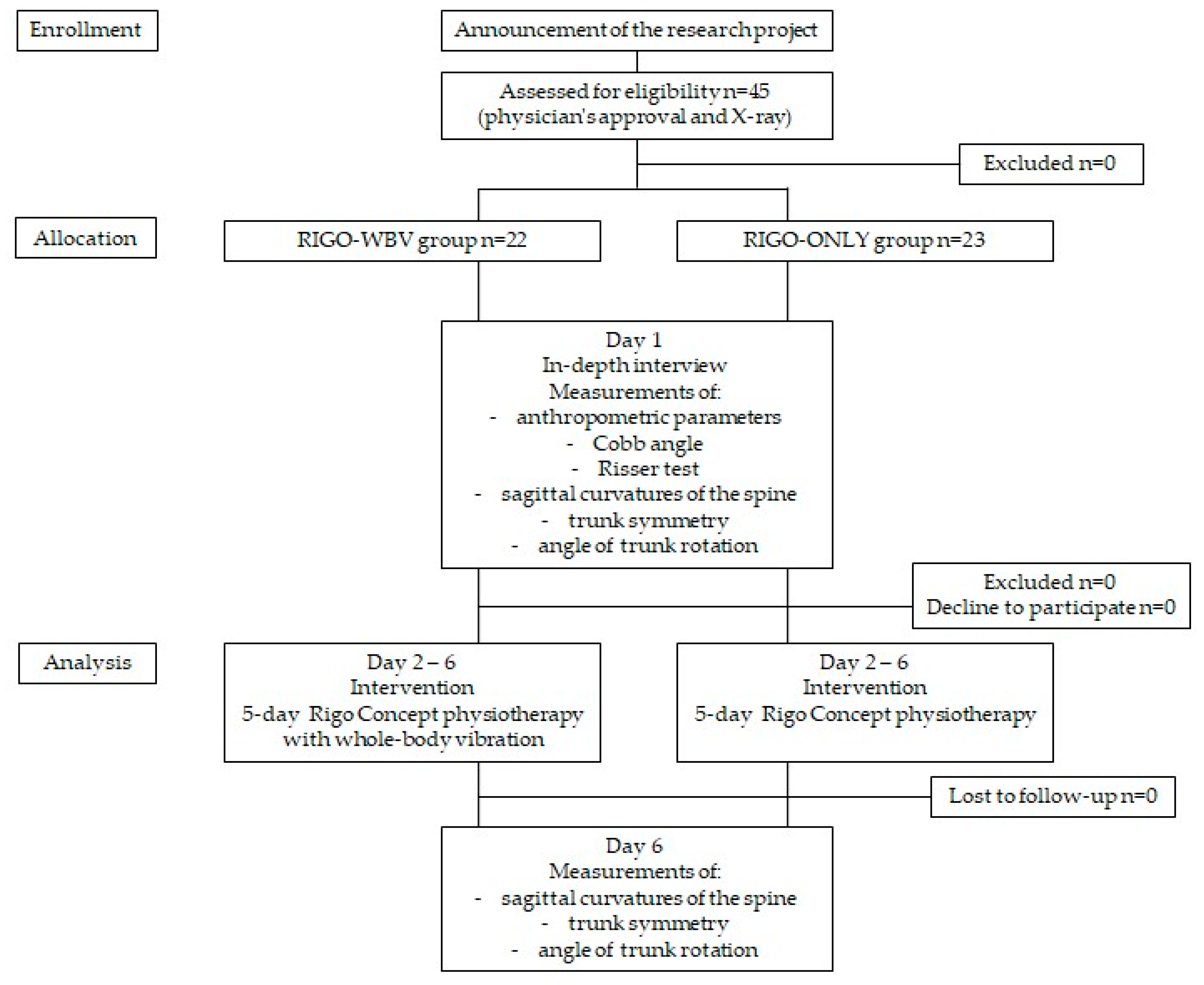
2.3. Study Design
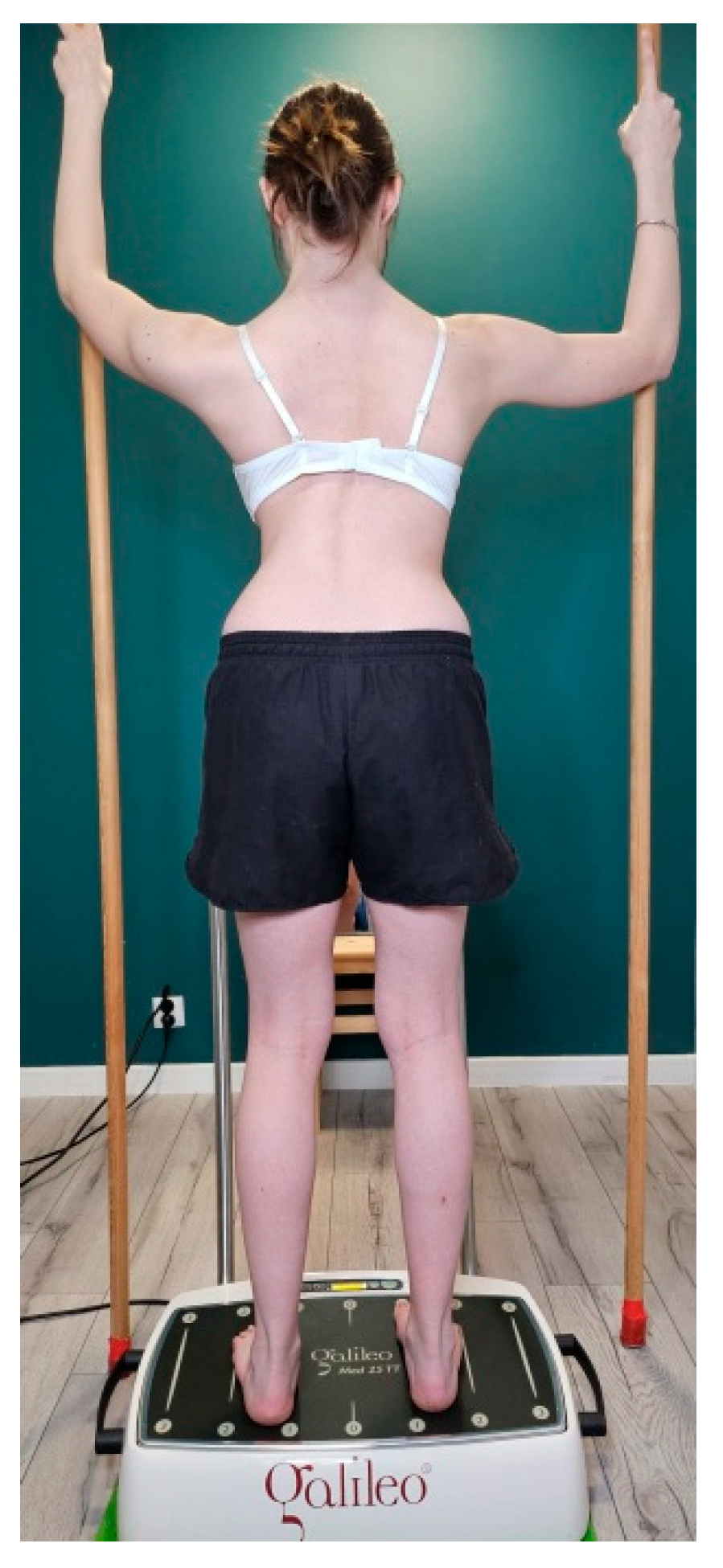
2.4. Intervention
2.5. Measurements of Sagittal Curvatures
2.6. Measurements of Trunk Symmetry
2.7. Measurements of Angle of Trunk Rotation
2.8. Statistical Analysis
3. Results
3.1. Results of the Sagittal Curvatures
3.2. Results of Trunk Symmetry
3.3. Results of Angle of Trunk Rotation
4. Discussion
5. Conclusions
Author Contributions
Funding
Institutional Review Board Statement
Informed Consent Statement
Data Availability Statement
Acknowledgments
Conflicts of Interest
Abbreviations
| AIS | Adolescent idiopathic scoliosis |
| ATR | Angle of trunk rotation |
| BMI | Body mass index |
| BSPTS | Barcelona Scoliosis Physiotherapy School |
| PSIS | Posterior superior iliac spine |
| PSSE | Physiotherapeutic scoliosis-specific exercises |
| Rigo–ONLY | Rigo Concept group |
| Rigo–WBV | Rigo Concept with the whole-body vibration group |
| R1 | Researcher 1 |
| R2 | Researcher 2 |
| SOSORT | Society on Scoliosis Orthopaedic and Rehabilitation Treatment |
| WBV | Whole-body vibration |
| 3D | three-dimensional |
References
- Baik, S.-M.; Kim, S.-H.; Lee, J.-H. A scoping review of the different types of exercise programs proposed for the improvement of postural balance in adolescents with idiopathic scoliosis. J. Back Musculoskelet. Rehabil. 2023, 36, 1261–1272. [Google Scholar] [CrossRef]
- Mohamed, N.; Acharya, V.; Schreiber, S.; Parent, E.C.; Westover, L. Effect of adding Schroth physiotherapeutic scoliosis specific exercises to standard care in adolescents with idiopathic scoliosis on posture assessed using surface topography: A secondary analysis of a Randomized Controlled Trial (RCT). PLoS ONE 2024, 19, e0302577. [Google Scholar] [CrossRef]
- Jia, Q.; Zhang, B.; Wang, H.; Zheng, W. Effectiveness of physical therapeutic scoliosis exercise (PSSE) intervention for adolescent idiopathic scoliosis: A systematic review and meta-analysis. BMC Musculoskelet. Disord. 2025, 26, 947. [Google Scholar] [CrossRef] [PubMed]
- Akçay, B.; Kuru Çolak, T.; Apti, A.; Çolak, İ.; Kızıltaş, Ö. The reliability of the augmented Lehnert-Schroth and Rigo classification in scoliosis management. S. Afr. J. Physiother. 2021, 77, 1568. [Google Scholar] [CrossRef] [PubMed]
- Seleviciene, E.; Stasiulis, A.; Pociute, A.; Masiulis, N.; Prasauskas, T.; Simonavicius, J.; Venckunas, T. Physiotherapeutic Scoliosis-Specific Exercise Methodologies Used for Conservative Treatment of Adolescent Idiopathic Scoliosis, and Their Effectiveness: An Extended Literature Review of Current Research and Practice. Int. J. Environ. Res. Public Health 2022, 19, 9240. [Google Scholar] [CrossRef] [PubMed]
- Sharf Eldin, E.M.; Abdel Aziz, A.; Abdel Atti Gaballah, S.; Elsebahy, S.Y. Effect of Barcelona Scoliosis Physical Therapy School Versus International Scoliosis Schroth Therapy in Adolescent Idiopathic Scoliosis. Int. J. Multiphys. 2025, 19, 43–57. [Google Scholar]
- Shen, X.; Yang, Z.; Zhang, P.; Xu, Y.; Wang, J. Effects of balance training combined with Schroth therapy on adolescents with mild idiopathic scoliosis: A six-week randomized controlled trial. J. Back Musculoskelet. Rehabil. 2023, 36, 1365–1373. [Google Scholar] [CrossRef]
- Lu, H.; Li, M.; Wang, N.; Ye, G.; Zhu, F.; Guo, M.; Zeng, C. Effects of different physical therapy training protocols on patients with idiopathic scoliosis: Short-term results. PLoS ONE 2025, 20, e0334713. [Google Scholar] [CrossRef]
- Langensiepen, S.; Stark, C.; Sobottke, R.; Semler, O.; Franklin, J.; Schraeder, M.; Siewe, J.; Eysel, P.; Schoenau, E. Home-based vibration assisted exercise as a new treatment option for scoliosis—A randomised controlled trial. J. Musculoskelet. Neuronal Interact. 2017, 17, 259–267. [Google Scholar] [PubMed] [PubMed Central]
- Al-Mohandes, H.A.; Abd-Elmonem, A.M.; Ibrahim, N.M. Whole Body Vibration Therapeutic Application in Physical Therapy: Review Article. Egypt. J. Hosp. Med. 2024, 97, 3634–3639. [Google Scholar] [CrossRef]
- Xu, P.; Song, J.; Fan, W.; Zhang, Y.; Guan, Y.; Ni, C.; Wu, M.; Mu, J. Impact of whole-body vibration training on ankle joint proprioception and balance in stroke patients: A prospective cohort study. BMC Musculoskelet. Disord. 2024, 25, 768. [Google Scholar] [CrossRef] [PubMed]
- Galileo® Training. Training Goals and Frequency Ranges. Available online: https://galileo-training.com/en/training-goals-and-frequency-ranges (accessed on 13 November 2025).
- Ogawa, H.; Fujitani, K.; Tsujinaka, T.; Imanishi, K.; Shirakata, H.; Kantani, A.; Hirao, M.; Kurokawa, Y.; Utsumi, S. InBody 720 as a New Method of Evaluating Visceral Obesity. Hepatogastroenterology 2011, 58, 42–44. [Google Scholar] [PubMed]
- Adaikina, A.; Hofman, P.L.; Gusso, S. The effect of side-alternating vibration therapy on mobility and health outcomes in young children with mild to moderate cerebral palsy: Design and rationale for the randomized controlled study. BMC Pediatr. 2020, 20, 508. [Google Scholar] [CrossRef] [PubMed]
- Ewertowska, P.; Formella, O.; Poniatowski, Ł.; Zielińska, A.; Krzysztofik, M.; Czaprowski, D. Effect of whole-body vibration on postural stability in young adults with generalized joint hypermobility: A comparative study. J. Back Musculoskelet. Rehabil. 2024, 37, 1363–1371. [Google Scholar] [CrossRef]
- van Heuvelen, M.J.G.; Rittweger, J.; Judex, S.; Sañudo, B.; Seixas, A.; Fuermaier, A.B.M.; Tucha, O.; Nyakas, C.; Marín, P.J.; Taiar, R.; et al. Reporting Guidelines for Whole-Body Vibration Studies in Humans, Animals and Cell Cultures: A Consensus Statement from an International Group of Experts. Biology 2021, 10, 965. [Google Scholar] [CrossRef]
- Czaprowski, D.; Pawłowska, P.; Gębicka, A.; Sitarski, D.; Kotwicki, T. Intra- and Interobserver Repeatability of the Assessment of Anteroposterior Curvatures of the Spine Using Saunders Digital Inclinometer. Ortop. Traumatol. Rehabil. 2012, 14, 145–153. [Google Scholar] [CrossRef]
- Czaprowski, D.; Gwiazdowska-Czubak, K.; Tyrakowski, M.; Kędra, A. Sagittal Body Alignment in a Sitting Position in Children Is Not Affected by Generalized Joint Hypermobility. Sci. Rep. 2021, 11, 13748. [Google Scholar] [CrossRef]
- Kluszczyński, M.; Wąsik, J.; Ortenburger, D.; Zarzycki, D.; Siwik, P. Prognostic Value of Measuring the Angles of Lumbar Lordosis and Thoracic Kyphosis with the Saunders Inclinometer in Patients with Low Back Pain. Pol. Ann. Med. 2017, 24, 31–35. [Google Scholar] [CrossRef]
- Roggio, F.; Trovato, B.; Sortino, M.; Zanghì, M.; Di Brigida, C.; Guglielmino, C.; Lombardo, C.; Loreto, C.; Pavone, P.; Musumeci, G. Intra-rater and Inter-rater Reliability of the Fixed Plumb Line for Postural and Scoliosis Assessment in the Sagittal Plane: A Pilot Study. PeerJ 2024, 12, e18121. [Google Scholar] [CrossRef]
- Contreras, J.; Gil, D.; de Dios Errázuriz, J.; Ruiz, P.; Díaz, C.; Águila, P.; Rosselot, A.; Espinoza, R.; Beltrán, M.; Liendo, R.; et al. Scapular Balance Angle Reference Values in a Healthy Population. Rev. Esp. Cir. Ortop. Traumatol. Engl. Ed. 2014, 58, 24–30. [Google Scholar] [CrossRef]
- Kuliński, W.; Iwańska, A. Scoliosis as a clinical and social problem: Case study. Acta Balneol. 2024, 66, 5–11. [Google Scholar] [CrossRef]
- Lukovic, T.; Cukovic, S.; Lukovic, V.; Devedzic, G.; Djordjevic, D. Towards a New Protocol of Scoliosis Assessments and Monitoring in Clinical Practice: A Pilot Study. J. Back Musculoskelet. Rehabil. 2015, 28, 721–730. [Google Scholar] [CrossRef] [PubMed]
- Sarı, M.; Bütün, M.; Bek, N. Does Scapular Asymmetry Affect Shoulder Joint Position Sense and Muscle Strength in Adolescent Idiopathic Scoliosis? A Pilot Study. J. Orthop. Res. Rehabil. 2024, 2, 49–54. [Google Scholar] [CrossRef]
- Brzęk, A.; Knapik, A.; Brzęk, B.; Niemiec, P.; Przygodzki, P.; Plinta, R.; Szyluk, K. Evaluation of Posturometric Parameters in Children and Youth Who Practice Karate: Prospective Cross-Sectional Study. BioMed Res. Int. 2022, 2022, 5432743. [Google Scholar] [CrossRef] [PubMed]
- Gieysztor, E.Z.; Sadowska, L.; Choińska, A.M.; Paprocka-Borowicz, M. Trunk Rotation Due to Persistence of Primitive Reflexes in Early School-Age Children. Adv. Clin. Exp. Med. 2018, 27, 363–366. [Google Scholar] [CrossRef]
- Li, C.; Zhang, B.; Liu, L.; Li, Y.; Xu, Y.; Wang, L.; Yun, C.; Zhao, Y. Design, Reliability, and Validity of a Portable Electronic Device Based on Ergonomics for Early Screening of Adolescent Scoliosis. J. Orthop. Transl. 2021, 28, 83–89. [Google Scholar] [CrossRef]
- Fukuzawa, T.; Oba, H.; Ikegami, S.; Uehara, M.; Hatakenaka, T.; Kurogochi, D.; Sasao, S.; Shigenobu, K.; Makiyama, F.; Koseki, M.; et al. Cobb Angle Estimation without X-ray Using Angle of Trunk Rotation and Characteristics of Unpredictable Cases. Eur. Spine J. 2025, 34, 5280–5286. [Google Scholar] [CrossRef]
- Prowse, A.; Aslaksen, B.; Kierkegaard, M.; Furness, J.; Gerdhem, P.; Abbott, A. Reliability and concurrent validity of postural asymmetry measurement in adolescent idiopathic scoliosis. World J. Orthop. 2017, 8, 68–76. [Google Scholar] [CrossRef]
- Fang, M.Q.; Huang, X.L.; Wang, W.; Li, Y.A.; Xiang, G.H.; Yan, G.K.; Yi, X.H. The Efficacy of Schroth Exercises Combined with the Chêneau Brace for the Treatment of Adolescent Idiopathic Scoliosis: A Retrospective Controlled Study. Disabil. Rehabil. 2021, 44, 5060–5068. [Google Scholar] [CrossRef]



| Rigo–WBV n = 22 | Rigo–ONLY n = 23 | ||
|---|---|---|---|
| Mean ± SD | Mean ± SD | p | |
| Age (years) | 12.6 ± 1.9 | 12.9 ± 1.5 | 0.592 |
| Body mass (kg) | 48.0 ± 9.6 | 50.3 ± 10.5 | 0.578 |
| Body height (m) | 1.6 ± 0.1 | 1.6 ± 0.1 | 0.768 |
| BMI (kg/m2) | 18.4 ± 3.1 | 19.9 ± 2.6 | 0.153 |
| Rigo–WBV n = 22 | Rigo–ONLY n = 23 | ||||
|---|---|---|---|---|---|
| Cobb Angle | n Curves | Mean ± SD | n Curves | Mean ± SD | p |
| Proximal thoracic (°) | 2 | 28.0 ± 2.8 | 2 | 26.0 ± 7.1 | - |
| Main thoracic (°) | 18 | 25.7 ± 7.4 | 20 | 24.3 ± 8.9 | 0.599 |
| Thoracolumbar (°) | 16 | 29.9 ± 8.9 | 15 | 25.3 ± 10.7 | 0.202 |
| Lumbar (°) | 7 | 18.4 ± 5.4 | 7 | 20.9 ± 6.8 | 0.475 |
| Risser test | 1.4 ± 2.0 | 1.6 ± 1.7 | 0.438 | ||
| Rigo–WBV n = 22 | Rigo–ONLY n = 23 | p | |
|---|---|---|---|
| Mean ± SD | Mean ± SD | ||
| Sagittal curvature of the spine | |||
| Thoracic kyphosis (°) | 18.7 ± 12.7 | 24.4 ± 9.2 | 0.101 |
| Upper thoracic kyphosis (°) | 11.2 ± 7.6 | 12.0 ± 6.7 | 0.704 |
| Lower thoracic kyphosis (°) | 9.0 ± 8.7 | 11.9 ± 7.5 | 0.271 |
| Lumbar lordosis (°) | 29.6 ± 7.2 | 29.0 ± 9.3 | 0.800 |
| Sacral slope (°) | 24.0 ± 4.3 | 23.2 ± 4.9 | 0.549 |
| Trunk symmetry | |||
| Coronal balance (cm) | 0.7 ± 0.6 | 0.6 ± 0.5 | 0.597 |
| Scapular height asymmetry (°) | 3.2 ± 1.9 | 4.3 ± 1.9 | 0.035 |
| Distances of the scapulae from the spine (cm) | 1.8 ± 1.3 | 2.0 ± 1.4 | 0.687 |
| Angle of trunk rotation | |||
| Proximal thoracic curve (°) | 2.8 ± 1.5 | 1.9 ± 1.9 | - |
| Main thoracic curve (°) | 8.3 ± 4.0 | 5.7 ± 2.3 | 0.009 |
| Thoracolumbar curve (°) | 5.0 ± 3.4 | 5.9 ± 3.2 | 0.420 |
| Lumbar curve (°) | 3.9 ± 2.5 | 2.7 ± 2.5 | 0.120 |
| Posterior superior iliac spine (°) | 1.5 ± 1.5 | 0.8 ± 1.0 | 0.089 |
| Sagittal Curvature (°) | Rigo–WBV n = 22 | Rigo–ONLY n = 23 | ||||||
|---|---|---|---|---|---|---|---|---|
| Before | After | Before | After | |||||
| Mean ± SD | Mean ± SD | Δ | ES | Mean ± SD | Mean ± SD | Δ | ES | |
| Thoracic kyphosis | 18.7 ± 12.7 | 19.8 ± 11.3 | 1.1 | 0.13 | 24.4 ± 9.2 | 25.9 ± 8.3 | 1.5 | 0.17 |
| Upper thoracic kyphosis | 11.2 ± 7.6 | 12.9 ± 8.0 | 1.7 | 0.22 | 12.0 ± 6.7 | 13.3 ± 5.4 | 1.3 | 0.21 |
| Lower thoracic kyphosis | 9.0 ± 8.7 | 8.6 ± 8.0 | 0.4 | 0.05 | 11.9 ± 7.5 | 11.1 ± 6.6 | 0.8 | 0.11 |
| Lumbar lordosis | 29.6 ± 7.2 | 31.1 ± 5.1 | 1.5 | 0.24 | 29.0 ± 9.3 | 29.6 ± 7.9 | 0.6 | 0.07 |
| Sacral slope | 24.0 ± 4.3 | 25.2 ± 5.0 | 1.2 | 0.26 | 23.2 ± 4.9 | 23.2 ± 3.8 | 0.0 | 0.00 |
| Rigo–WBV n = 22 | Rigo–ONLY n = 23 | |||||||
|---|---|---|---|---|---|---|---|---|
| Before | After | Before | After | |||||
| Mean ± SD | Mean ± SD | Δ | ES | Mean ± SD | Mean ± SD | Δ | ES | |
| Coronal balance (cm) | 0.7 ± 0.6 | 0.2 ± 0.3 | 0.5 | 1.05 | 0.6 ± 0.5 | 0.2 ± 0.3 | 0.4 | 0.97 |
| Scapular height asymmetry (°) | 3.2 ± 1.9 | 2.7 ± 1.8 | 0.5 | 0.27 | 4.3 ± 1.9 | 3.2 ± 1.6 | 1.1 | 0.63 |
| Distances of the scapulae from the spine (cm) | 1.8 ± 1.3 | 1.5 ± 1.0 | 0.3 | 0.23 | 2.0 ± 1.4 | 1.8 ± 1.4 | 0.2 | 0.14 |
| Angle of Trunk Rotation (°) | Rigo–WBV n = 22 | Rigo–ONLY n = 23 | ||||||||
|---|---|---|---|---|---|---|---|---|---|---|
| Before | After | Before | After | |||||||
| n Curves | Mean ± SD | Mean ± SD | Δ | ES | n Curves | Mean ± SD | Mean ± SD | Δ | ES | |
| Proximal thoracic curve | 2 | 2.8 ± 1.5 | 1.7 ± 1.4 | - | 2 | 1.9 ± 1.9 | 1.2 ± 1.4 | - | ||
| Main thoracic curve | 18 | 8.3 ± 4.0 | 6.4 ± 3.5 | 1.9 | 0.51 | 20 | 5.7 ± 2.3 | 5.7 ± 2.2 | 0.0 | 0.04 |
| Thoracolumbar curve | 16 | 5.0 ± 3.4 | 3.1 ± 2.6 | 1.9 | 0.63 | 15 | 5.9 ± 3.2 | 4.0 ± 2.4 | 1.9 | 0.67 |
| Lumbar curve | 7 | 3.9 ± 2.5 | 1.8 ± 1.9 | 2.1 | 0.95 | 7 | 2.7 ± 2.5 | 2.0 ± 2.0 | 0.7 | 0.31 |
| PSIS | 22 | 1.5 ± 1.5 | 0.5 ± 0.9 | 1.0 | 0.81 | 22 | 0.8 ± 1.0 | 0.3 ± 0.6 | 0.5 | 0.61 |
Disclaimer/Publisher’s Note: The statements, opinions and data contained in all publications are solely those of the individual author(s) and contributor(s) and not of MDPI and/or the editor(s). MDPI and/or the editor(s) disclaim responsibility for any injury to people or property resulting from any ideas, methods, instructions or products referred to in the content. |
© 2026 by the authors. Licensee MDPI, Basel, Switzerland. This article is an open access article distributed under the terms and conditions of the Creative Commons Attribution (CC BY) license.
Share and Cite
Ewertowska, P.; Flis, M.; Kujałowicz, J.; Chongov, B.; Czaprowski, D. Impact of Physiotherapy Based on the Rigo Concept and Whole-Body Vibration on Sagittal Spinal Curvatures, Trunk Symmetry, and the Angle of Trunk Rotation in Adolescents with Idiopathic Scoliosis. J. Clin. Med. 2026, 15, 1386. https://doi.org/10.3390/jcm15041386
Ewertowska P, Flis M, Kujałowicz J, Chongov B, Czaprowski D. Impact of Physiotherapy Based on the Rigo Concept and Whole-Body Vibration on Sagittal Spinal Curvatures, Trunk Symmetry, and the Angle of Trunk Rotation in Adolescents with Idiopathic Scoliosis. Journal of Clinical Medicine. 2026; 15(4):1386. https://doi.org/10.3390/jcm15041386
Chicago/Turabian StyleEwertowska, Paulina, Marta Flis, Joanna Kujałowicz, Borislav Chongov, and Dariusz Czaprowski. 2026. "Impact of Physiotherapy Based on the Rigo Concept and Whole-Body Vibration on Sagittal Spinal Curvatures, Trunk Symmetry, and the Angle of Trunk Rotation in Adolescents with Idiopathic Scoliosis" Journal of Clinical Medicine 15, no. 4: 1386. https://doi.org/10.3390/jcm15041386
APA StyleEwertowska, P., Flis, M., Kujałowicz, J., Chongov, B., & Czaprowski, D. (2026). Impact of Physiotherapy Based on the Rigo Concept and Whole-Body Vibration on Sagittal Spinal Curvatures, Trunk Symmetry, and the Angle of Trunk Rotation in Adolescents with Idiopathic Scoliosis. Journal of Clinical Medicine, 15(4), 1386. https://doi.org/10.3390/jcm15041386