Screening Tools for the Early Identification of Palliative Care Needs in Patients with Advanced Chronic Conditions: An Updated Systematic Review
 , , , ,
Abstract
1. Introduction
2. Materials and Methods
2.1. Literature Search
2.2. Inclusion and Exclusion Criteria
2.3. Study Selection
2.4. Data Extraction
2.5. Outcomes
2.6. Risk of Bias Assessment
2.7. Data Synthesis and Analysis
3. Results
3.1. Search Results
3.2. Characteristics of the Screening Tools
3.2.1. Screening Tools Developed Using Traditional Methods
3.2.2. Screening Tools Developed Using Artificial Intelligence Techniques
3.3. Risk of Bias Assessment of Screening Tool Derivation Studies
3.4. Performance of the Screening Tools in the External Validation Studies
3.5. Risk of Bias Assessment of External Validation Studies
4. Discussion
5. Conclusions
Supplementary Materials
Author Contributions
Funding
Institutional Review Board Statement
Informed Consent Statement
Data Availability Statement
Acknowledgments
Conflicts of Interest
Abbreviations
| AI | Artificial Intelligence |
| AUC | Area Under the Receiver Operating Characteristic Curve |
| CHF | Congestive Heart Failure |
| CI | Confidence Interval |
| COPD | Chronic Obstructive Pulmonary Disease |
| COSMIN | COnsensus-based Standards for the selection of health Measurement INstruments |
| COSMOS-E | Conducting Systematic Reviews and Meta-analyses of Observational Studies of Etiology |
| DSQ | Double Surprise Question |
| EHR | Electronic Health Record |
| GSF-PIG | Gold Standards Framework Prognostic Indicator Guidance |
| HIV | Human Immunodeficiency Virus |
| ML | Machine Learning |
| NA | Not Applicable |
| NOS | Newcastle–Ottawa Scale |
| NPV | Negative Predictive Value |
| NR | Not Reported |
| NYHA | New York Heart Association |
| OR | Odds Ratio |
| PC | Palliative Care |
| PCST | Palliative Care Screening Tool |
| PPV | Positive Predictive Value |
| ProPal-COPD | PROactive Palliative Care Identification Tool for patients with Chronic Obstructive Pulmonary Disease |
| RADPAC | RADboud indicators for PAlliative Care needs |
| SPICT | Supportive and Palliative Care Indicators Tool |
| SPICT-CH | Chinese version of the Supportive and Palliative Care Indicators Tool |
| SQ | Surprise Question |
| TW-PCST | Taiwanese version of the Palliative Care Screening Tool |
| WHO | World Health Organization |
References
- World Health Organization. Innovative Care for Chronic Conditions: Building Blocks for Action; WHO: Geneva, Switzerland, 2002; Available online: https://apps.who.int/iris/bitstream/handle/10665/42500/WHO_NMC_CCH_02.01.pdf (accessed on 5 September 2025).
- World Health Organization. Why Palliative Care Is an Essential Function of Primary Health Care; WHO: Geneva, Switzerland, 2018; (WHO/HIS/SDS/2018.39); Available online: https://www.who.int/publications/i/item/WHO-HIS-SDS-2018.39 (accessed on 5 September 2025).
- Hoerger, M.; Wayser, G.R.; Schwing, G.; Suzuki, A.; Perry, L.M. Impact of Interdisciplinary Outpatient Specialty Palliative Care on Survival and Quality of Life in Adults with Advanced Cancer: A Meta-Analysis of Randomized Controlled Trials. Ann. Behav. Med. 2019, 53, 674–685. [Google Scholar] [CrossRef]
- Haun, M.W.; Estel, S.; Rücker, G.; Friederich, H.C.; Villalobos, M.; Thomas, M.; Hartmann, M. Early palliative care for adults with advanced cancer. Cochrane Database Syst. Rev. 2017, 6, CD011129. [Google Scholar] [CrossRef]
- Fulton, J.J.; LeBlanc, T.W.; Cutson, T.M.; Porter Starr, K.N.; Kamal, A.; Ramos, K.; Freiermuth, C.E.; McDuffie, J.R.; Kosinski, A.; Adam, S.; et al. Integrated outpatient palliative care for patients with advanced cancer: A systematic review and meta-analysis. Palliat. Med. 2019, 33, 123–134. [Google Scholar] [CrossRef] [PubMed]
- Hui, D.; Kim, S.H.; Roquemore, J.; Dev, R.; Chisholm, G.; Bruera, E. Impact of timing and setting of palliative care referral on quality of end-of-life care in cancer patients. Cancer 2014, 120, 1743–1749. [Google Scholar] [CrossRef] [PubMed]
- Kuebler, K.; Monroe, T.; Ricciardi, R.; Westlake, C.; Sorenson, M.; Pederson, J.; Neft, M.; Mitchell, S.A.; Daniel, K.; De Santo-Madeya, S.; et al. Integration of palliative care in the management of multiple chronic conditions: An expert consensus paper with policy implications. Nurs. Outlook 2024, 72, 102273. [Google Scholar] [CrossRef] [PubMed]
- Quinn, K.L.; Stukel, T.; Stall, N.M.; Huang, A.; Isenberg, S.; Tanuseputro, P.; Goldman, R.; Cram, P.; Kavalieratos, D.; Detsky, A.S.; et al. Association between palliative care and healthcare outcomes among adults with terminal non-cancer illness: Population based matched cohort study. BMJ 2020, 370, m2257. [Google Scholar] [CrossRef]
- Mós, J.R.; Reis-Pina, P. Early Integration of Palliative Care in Nononcological Patients: A Systematic Review. J. Pain Symptom Manag. 2025, 69, e283–e302. [Google Scholar] [CrossRef]
- Quinn, K.L.; Shurrab, M.; Gitau, K.; Kavalieratos, D.; Isenberg, S.R.; Stall, N.M.; Stukel, T.A.; Goldman, R.; Horn, D.; Cram, P.; et al. Association of Receipt of Palliative Care Interventions with Health Care Use, Quality of Life, and Symptom Burden Among Adults with Chronic Noncancer Illness: A Systematic Review and Meta-analysis. JAMA 2020, 324, 1439–1450. [Google Scholar] [CrossRef]
- World Health Organization. Palliative Care [Internet]; WHO: Geneva, Switzerland, 2024; Available online: https://www.who.int/news-room/fact-sheets/detail/palliative-care (accessed on 5 September 2025).
- Murray, S.A.; Kendall, M.; Boyd, K.; Sheikh, A. Illness trajectories and palliative care. BMJ 2005, 330, 1007–1011. [Google Scholar] [CrossRef]
- Page, M.J.; McKenzie, J.E.; Bossuyt, P.M.; Boutron, I.; Hoffmann, T.C.; Mulrow, C.D.; Shamseer, L.; Tetzlaff, J.M.; Akl, E.A.; Brennan, S.E.; et al. The PRISMA 2020 statement: An updated guideline for reporting systematic reviews. BMJ 2021, 372, n71. [Google Scholar] [CrossRef]
- Dekkers, O.M.; Vandenbroucke, J.P.; Cevallos, M.; Renehan, A.G.; Altman, D.G.; Egger, M. COSMOS-E: Guidance on conducting systematic reviews and meta-analyses of observational studies of etiology. PLoS Med. 2019, 16, e1002742. [Google Scholar] [CrossRef]
- Mokkink, L.B.; Terwee, C.B.; Patrick, D.L.; Alonso, J.; Stratford, P.W.; Knol, D.L.; Bouter, L.M.; De Vet, H.C.W. The COSMIN checklist for assessing the methodological quality of studies on measurement properties of health status measurement instruments: An international Delphi study. Qual. Life Res. 2010, 19, 539–549. [Google Scholar] [CrossRef]
- Wells, G.A.; Shea, B.; O’Connell, D.; Peterson, J.; Welch, V.; Losos, M.; Tugwell, P. The Newcastle-Ottawa Scale (NOS) for Assessing the Quality of Nonrandomized Studies in Meta-Analyses. Available online: http://www.ohri.ca/programs/clinical_epidemiology/oxford.htm (accessed on 10 October 2025).
- Wolff, R.F.; Moons, K.G.M.; Riley, R.D.; Whiting, P.F.; Westwood, M.; Collins, G.S.; Reitsma, J.B.; Kleijnen, J.; Mallett, S. PROBAST: A Tool to Assess the Risk of Bias and Applicability of Prediction Model Studies. Ann. Intern. Med. 2019, 170, 51–58. [Google Scholar] [CrossRef]
- Higgins, J.P.T.; Altman, D.G.; Gøtzsche, P.C.; Jüni, P.; Moher, D.; Oxman, A.D.; Savović, J.; Schulz, K.F.; Weeks, L.; Sterne, J.A.C.; et al. Cochrane Bias Methods Group; Cochrane Statistical Methods Group. The Cochrane Collaboration’s tool for assessing risk of bias in randomised trials. BMJ 2011, 343, d5928. [Google Scholar] [CrossRef]
- Thomas, K. Prognostic Indicator Guidance; The Gold Standards Framework Centre: London, UK, 2004; Available online: https://www.futureplanning.org.uk/uploads/8/0/4/0/80407130/__gsf_prognostic_indicator_guidance.pdf?utm_source=chatgpt.com (accessed on 10 October 2025).
- Rainone, F.; Blank, A.; Selwyn, P.A. The early identification of palliative care patients: Preliminary processes and estimates from urban, family medicine practices. Am. J. Hosp. Palliat. Med. 2007, 24, 137–140. [Google Scholar] [CrossRef]
- Gómez-Batiste, X.; Martínez-Muñoz, M.; Blay, C.; Amblàs, J.; Vila, L.; Costa, X.; Villanueva, A.; Espaulella, J.; Espinosa, J.; Figuerola, M.; et al. Identifying patients with chronic conditions in need of palliative care in the general population: Development of the NECPAL tool and preliminary prevalence rates in Catalonia. BMJ Support. Palliat. Care 2013, 3, 300–308. [Google Scholar] [CrossRef]
- Thoonsen, B.; Engels, Y.; van Rijswijk, E.; Verhagen, S.; van Weel, C.; Groot, M.; Vissers, K. Early identification of palliative care patients in general practice: Development of RADboud indicators for PAlliative Care Needs (RADPAC). Br. J. Gen. Pract. 2012, 62, e625–e631. [Google Scholar] [CrossRef]
- Highet, G.; Crawford, D.; Murray, S.A.; Boyd, K. Development and evaluation of the Supportive and Palliative Care Indicators Tool (SPICT): A mixed-methods study. BMJ Support. Palliat. Care 2014, 4, 285–290. [Google Scholar] [CrossRef] [PubMed]
- Mason, B.; Boyd, K.; Murray, S.A.; Steyn, J.; Cormie, P.; Kendall, M.; Munday, D.; Weller, D.; Fife, S.; Murchie, P.; et al. Developing a computerised search to help UK General Practices identify more patients for palliative care planning: A feasibility study. BMC Fam. Pract. 2015, 16, 99. [Google Scholar] [CrossRef] [PubMed]
- Hurst, E.; Yessayan, L.; Mendez, M.; Hammad, A.; Jennings, J. Preliminary Analysis of a Modified Screening Tool to Increase the Frequency of Palliative Care Consults. Am. J. Hosp. Palliat. Med. 2018, 35, 417–422. [Google Scholar] [CrossRef] [PubMed]
- Duenk, R.; Verhagen, S.; Bronkhorst, E.; Djamin, R.; Bosman, G.; Lammers, E.; Dekhuijzen, P.; Vissers, K.; Engels, Y.; Heijdra, Y. Development of the ProPal-COPD tool to identify patients with COPD for proactive palliative care. Int. J. Chronic Obstr. Pulm. Dis. 2017, 12, 2121–2128. [Google Scholar] [CrossRef] [PubMed]
- Molin, Y.; Gallay, C.; Gautier, J.; Lardy-Cleaud, A.; Mayet, R.; Grach, M.; Guesdon, G.; Capodano, G.; Dubroeucq, O.; Bouleuc, C.; et al. PALLIA-10, a screening tool to identify patients needing palliative care referral in comprehensive cancer centers: A prospective multicentric study (PREPA-10). Cancer Med. 2019, 8, 2950–2961. [Google Scholar] [CrossRef]
- Avati, A.; Jung, K.; Harman, S.; Downing, L.; Ng, A.; Shah, N.H. Improving palliative care with deep learning. BMC Med. Inform. Decis. Mak. 2018, 18, 122. [Google Scholar] [CrossRef]
- Wang, L.; Sha, L.; Lakin, J.R.; Bynum, J.; Bates, D.W.; Hong, P.; Zhou, L. Development and Validation of a Deep Learning Algorithm for Mortality Prediction in Selecting Patients with Dementia for Earlier Palliative Care Interventions. JAMA Netw. Open 2019, 2, e196972. [Google Scholar] [CrossRef] [PubMed]
- Cary, M.P., Jr.; Zhuang, F.; Draelos, R.L.; Pan, W.; Amarasekara, S.; Douthit, B.J.; Kang, Y.; Colón-Emeric, C.S. Machine Learning Algorithms to Predict Mortality and Allocate Palliative Care for Older Patients with Hip Fracture. J. Am. Med. Dir. Assoc. 2021, 22, 291–296. [Google Scholar] [CrossRef] [PubMed]
- Zhang, H.; Li, Y.; McConnell, W. Predicting potential palliative care beneficiaries for health plans: A generalized machine learning pipeline. J. Biomed. Inform. 2021, 123, 103922. [Google Scholar] [CrossRef]
- Haga, K.; Murray, S.; Reid, J.; Ness, A.; O’Donnell, M.; Yellowlees, D.; Denvir, M.A. Identifying community based chronic heart failure patients in the last year of life: A comparison of the Gold Standards Framework Prognostic Indicator Guide and the Seattle Heart Failure Model. Heart 2012, 98, 579–583. [Google Scholar] [CrossRef]
- O’Callaghan, A.; Laking, G.; Frey, R.; Robinson, J.; Gott, M. Can we predict which hospitalised patients are in their last year of life? A prospective cross-sectional study of the Gold Standards Framework Prognostic Indicator Guidance as a screening tool in the acute hospital setting. Palliat. Med. 2014, 28, 1046–1052. [Google Scholar] [CrossRef]
- Raubenheimer, P.J.; Day, C.; Abdullah, F.; Manning, K.; Cupido, C.; Peter, J. The utility of a shortened palliative care screening tool to predict death within 12 months—A prospective observational study in two South African hospitals with a high HIV burden. BMC Palliat. Care 2019, 18, 101. [Google Scholar] [CrossRef]
- Gómez-Batiste, X.; Martínez-Muñoz, M.; Blay, C.; Amblàs, J.; Vila, L.; Costa, X.; Espaulella, J.; Villanueva, A.; Oller, R.; Martori, J.C.; et al. Utility of the NECPAL CCOMS-ICO© tool and the Surprise Question as screening tools for early palliative care and to predict mortality in patients with advanced chronic conditions: A cohort study. Palliat. Med. 2017, 31, 754–763. [Google Scholar] [CrossRef]
- Troncoso, J.; Morales-Meyer, T.; Villarroel, L.; Pérez-Cruz, P.; Rojas-Sepúlveda, J.; Arancibia-García, M.; Díaz-Pérez, A.; Moya-Castillo, T.; Cárdenas-Salazar, J.; González-González, M.; et al. Adaptation and validation in Chile of the patient identification instrument needing palliative care: NECPAL-CCOMS-ICO 3.1©. Aten. Primaria 2021, 53, 101994. (In Spanish) [Google Scholar] [CrossRef] [PubMed]
- Calsina-Berna, A.; Amblàs-Novellas, J.; González-Barboteo, J.; Pujol-Ribera, E.; Pastrana, T.; Gómez-Batiste, X.; Murray, S.A.; Blay, C.; Costa, X.; Vila, L.; et al. Prevalence and clinical characteristics of patients with Advanced Chronic Illness and Palliative Care needs, identified with the NECPAL CCOMS-ICO© Tool at a Tertiary Care Hospital. BMC Palliat. Care 2022, 21, 210. [Google Scholar] [CrossRef]
- Esteban-Burgos, A.A.; Hueso-Montoro, C.; Mota-Romero, E.; Romero-Béjar, J.L.; García-Caro, M.P.; Rodríguez-Torres, M.; Sánchez-Sánchez, M.J.; Bonilla-Vargas, C.; Pérez-Cruz, P.; Fernández-Sola, C.; et al. The prognostic value of the NECPAL instrument, Palliative Prognostic Index, and PROFUND index in elderly residents of nursing homes with advanced chronic condition. BMC Geriatr. 2023, 23, 715. [Google Scholar] [CrossRef]
- Fisher, G.; Shadmi, E.; Porat-Packer, T.; Zisberg, A. Identifying patients in need of palliative care: Adaptation of the Necesidades Paliativas CCOMS-ICO© (NECPAL) screening tool for use in Israel. Palliat. Support. Care 2024, 22, 103–109. [Google Scholar] [CrossRef]
- Spannella, F.; Falzetti, S.; Giulietti, F.; Sarnari, S.; Morichi, V.; Tamburrini, P.; Gattafoni, P.; Mannello, L.; Crippa, M.; Ferrara, L.; et al. Prognostic Role of NECPAL CCOMS-ICO Tool on One-Year Mortality in a Hospitalized Older Population. J. Palliat. Med. 2024, 27, 367–375. [Google Scholar] [CrossRef] [PubMed]
- Wang, S.S.; Huang, C.M.; Feng, R.C.; Wu, Y.L.; Huang, S.J. Validation of a concise screening tool for the identification of palliative care needs among inpatients: A prospective study in hospital setting. J. Formos. Med. Assoc. 2019, 118, 883–890. [Google Scholar] [CrossRef]
- Yen, Y.F.; Lee, Y.L.; Hu, H.Y.; Lai, Y.J.; Sun, W.J.; Ko, M.C.; Chen, C.C.; Curtis, J.R.; Huang, S.J.; Chu, D.; et al. An Interventional Study for the Early Identification of Patients with Palliative Care Needs and the Promotion of Advance Care Planning and Advance Directives. J. Pain Symptom Manag. 2020, 59, 974–982.e3. [Google Scholar] [CrossRef]
- Yen, Y.F.; Lee, Y.L.; Hu, H.Y.; Sun, W.J.; Ko, M.C.; Chen, C.C.; Wong, W.K.; Morisky, D.E.; Huang, S.J.; Chu, D.; et al. Early palliative care: The surprise question and the palliative care screening tool-better together. BMJ Support. Palliat. Care 2022, 12, 211–217. [Google Scholar] [CrossRef] [PubMed]
- Yen, Y.F.; Hu, H.Y.; Lai, Y.J.; Chou, Y.C.; Chen, C.C.; Ho, C.Y. Comparison of intuitive assessment and palliative care screening tool in the early identification of patients needing palliative care. Sci. Rep. 2022, 12, 4955. [Google Scholar] [CrossRef]
- De Bock, R.; Van Den Noortgate, N.; Piers, R. Validation of the Supportive and Palliative Care Indicators Tool in a Geriatric Population. J. Palliat. Med. 2018, 21, 220–224. [Google Scholar] [CrossRef]
- Mitchell, G.K.; Senior, H.E.; Rhee, J.J.; Ware, R.S.; Young, S.; Teo, P.C.; Murray, S.; Boyd, K.; Clayton, J.M. Using intuition or a formal palliative care needs assessment screening process in general practice to predict death within 12 months: A randomised controlled trial. Palliat. Med. 2018, 32, 384–394. [Google Scholar] [CrossRef]
- van Wijmen, M.P.S.; Schweitzer, B.P.M.; Pasman, H.R.; Onwuteaka-Philipsen, B.D. Identifying patients who could benefit from palliative care by making use of the general practice information system: The Surprise Question versus the SPICT. Fam. Pract. 2020, 37, 641–647. [Google Scholar] [CrossRef] [PubMed]
- Piers, R.; De Brauwer, I.; Baeyens, H.; Velghe, A.; Hens, L.; Deschepper, E.; Henrard, S.; De Pauw, M.; Van Den Noortgate, N.; De Saint-Hubert, M.; et al. Supportive and Palliative Care Indicators Tool prognostic value in older hospitalised patients: A prospective multicentre study. BMJ Support. Palliat. Care 2021, 14, e003042. [Google Scholar] [CrossRef]
- Farfán-Zuñiga, X.; Zimmermann-Vildoso, M. Cultural adaptation and validation of the SPICT-ES™ instrument to identify palliative care needs in Chilean older adults. BMC Palliat. Care 2022, 21, 223. [Google Scholar] [CrossRef]
- Liao, J.Y.; Chang, H.T.; Peng, J.K.; Murray, S.; Wu, C.Y.; Chang, H.C.; Li, C.M.; Cheng, S.Y.; Tseng, W.Z.; Hsiung, C.; et al. Adaptation of the Taiwan Version of the Supportive and Palliative Care Indicators Tool (SPICT-TW) and Its Association with Six-Month Mortality: A Multi-Center Validation Study in Older People. Healthcare 2024, 12, 2185. [Google Scholar] [CrossRef]
- Xie, Z.; Tang, S.; Johnson, C.E.; Xiao, L.; Ding, J.; Huang, C. Translation, cross-cultural adaptation and validation of the Chinese version of supportive and palliative care indicators tool (SPICT-CH) to identify cancer patients with palliative care needs. BMC Palliat. Care 2025, 24, 4. [Google Scholar] [CrossRef]
- Huang, Y.; Deng, C.; Lin, H.; Peng, M.; Hao, Y. Adaptation and Validation of the Supportive and Palliative Care Indicators Tool (SPICT): A Quantitative Methodological Study. J. Adv. Nurs. 2025, 81, 6392–6405. [Google Scholar] [CrossRef] [PubMed]
- Broese, J.M.C.; van der Kleij, R.M.J.J.; Verschuur, E.M.L.; Kerstjens, H.A.M.; Bronkhorst, E.M.; Chavannes, N.H.; Engels, Y. External Validation and User Experiences of the ProPal-COPD Tool to Identify the Palliative Phase in COPD. Int. J. Chron. Obs. Pulmon Dis. 2022, 17, 3129–3138. [Google Scholar] [CrossRef]
- Cerullo, G.; Videira-Silva, A.; Carrancha, M.; Rego, F.; Nunes, R. Complexity of patient care needs in palliative care: A scoping review. Ann. Palliat. Med. 2023, 12, 791–802. [Google Scholar] [CrossRef] [PubMed]
- Seven, A.; Sert, H. Anxiety, dyspnea management, and quality of life in palliative care patients: A randomized controlled trial. Florence Nightingale J. Nurs. 2023, 31, S13–S21. [Google Scholar] [CrossRef]
- Batstone, E.; Bailey, C.; Hallett, N. Spiritual care provision to end-of-life patients: A systematic literature review. J. Clin. Nurs. 2020, 29, 3609–3624. [Google Scholar] [CrossRef]
- Maas, E.A.; Murray, S.A.; Engels, Y.; Campbell, C. What tools are available to identify patients with palliative care needs in primary care: A systematic literature review and survey of European practice. BMJ Support. Palliat. Care 2013, 3, 444–451. [Google Scholar] [CrossRef]
- ElMokhallalati, Y.; Bradley, S.H.; Chapman, E.; Ziegler, L.; Murtagh, F.E.M.; Johnson, M.J.; Bennett, M.I. Identification of patients with potential palliative care needs: A systematic review of screening tools in primary care. Palliat. Med. 2020, 34, 989–1005. [Google Scholar] [CrossRef] [PubMed]
- Xie, Z.; Ding, J.; Jiao, J.; Tang, S.; Johnson, C.E. Screening instruments for early identification of unmet palliative care needs: A systematic review and meta-analysis. BMJ Support. Palliat. Care 2024, 14, 256–268. [Google Scholar] [CrossRef]
- Coventry, P.A.; Grande, G.E.; Richards, D.A.; Todd, C.J. Prediction of appropriate timing of palliative care for older adults with non-malignant life-threatening disease: A systematic review. Age Ageing 2005, 34, 218–227. [Google Scholar] [CrossRef] [PubMed]
- Boland, J.; Martin, J.; Wells, A.U.; Ross, J.R. Palliative care for people with non-malignant lung disease: Summary of current evidence and future direction. Palliat. Med. 2013, 27, 811–816. [Google Scholar] [CrossRef] [PubMed]



| (a) | |||||||||
| Author | Tool | Year | Country | Other Versions | Development Methodology | Sample Size | Age | Population | Setting |
| Thomas et al. [19] | GSF-PIG | 2004 | United Kingdom | Italy | Development based on clinical expert consensus and literature review | NA (theoretical tool development) | NA | Patients with advanced progressive illness | Primary care, hospital, nursing homes, and community |
| Rainone et al. [20] | Rainone | 2007 | United States | No | Quality improvement project combining EHR screening and clinician judgment | 1154 patients evaluated (from 1993 identified); 299 deemed eligible for PC referral | ≥75 | Patients with advanced chronic illnesses (CHF, COPD, dementia, cancer, HIV) | Primary care |
| Gómez-Batiste et al. [21] | NECPAL | 2012 | Spain | Argentina Chile Brazil Portugal | Adaptation and extension of GSF-PIG and SPICT indicators through expert consensus, cultural adaptation, and preliminary prospective validation | 50,000 screened; 1162 patients with advanced chronic conditions; 684 were NECPAL+ | 81.73 ± 12.01 (NECPAL+) | General population with advanced chronic conditions | Primary care, hospital, nursing homes, and community |
| Thoonsen et al. [22] | RADPAC | 2012 | Netherlands | No | Development based on literature review, focus groups with GPs, and Delphi consensus process | NA (theoretical tool development) | NA | Patients with CHF, COPD, or cancer | Primary care |
| Highet et al. [23] | SPICT | 2014 | United Kingdom | Japanese Spanish German Taiwan | Development based on literature review, peer review, prospective case investigation | Pilot case review (130 cases evaluated) | NR | Patients with advanced progressive conditions and health deterioration | Primary care, hospital, and community |
| Mason et al. [24] | AnticiPal | 2015 | United Kingdom | No | Iterative software development approach | NR | NR | Patients with advanced illnesses | Primary care |
| Hurst et al. [25] | PCST | 2017 | United States | Taiwan | Checklist based on clinical criteria; adapted and applied in a quasi-experimental design | 223 | 59.94 ± 15.72 | Patients admitted to the medical intensive care unit | Hospital |
| Duenk et al. [26] | ProPal-COPD | 2017 | Netherlands | No | Prospective cohort study | 155 | 67.0 ± 9.4 | Patients hospitalized for acute exacerbation of COPD | Hospital |
| Molin et al. [27] | PALLIA-10 | 2019 | France | No | Prospective multicenter study conducted in comprehensive cancer centers | 841 included, 687 palliative patients analyzed | 64.8 (median) | Cancer patients | Hospital |
| (b) | |||||||||
| Tool | Target Patients | Number of Indicators | Inclusion of SQ | Inclusion of Psychological and Spiritual Concerns | Tool-Positive Criteria | Outcome | External Validation | ||
| GSF-PIG [19] | Patients with advanced illness or deteriorating health status | NA | Yes | No | Positive if the SQ response is “No” and at least one general or disease-specific indicator is present | Risk of mortality within months, weeks, or days | Yes | ||
| Rainone [20] | Patients with advanced chronic illnesses (CHF, COPD, dementia, cancer, HIV) | 6 | Yes | No | Clinical consideration prompted by a “No” response to the SQ and/or affirmative responses to any of the five additional items. No formal scoring cutoff | Risk of clinical deterioration or death within 12 months | No | ||
| NECPAL [21] | Patients with advanced chronic conditions | 59 | Yes | Yes | Positive if the response to the SQ is “No” and at least one additional clinical indicator is present | Prediction of 38-, 17.2- and 3.6-month mortality | Yes | ||
| RADPAC [22] | Patients with COPD, CHF, or cancer | 21 | No | No | Presence of at least one disease-specific indicator suggesting palliative care needs; no predefined scoring threshold | Risk of clinical deterioration | No | ||
| SPICT [23] | Patients with advanced conditions and deteriorating health | 17 | No | No | SPICT (2019 version): No formal cut-off; identification is based on clinical judgment informed by the presence of general and/or clinical indicators SPICT-J (Japanese version): positive if ≥2 general indicators or ≥1 clinical indicator are present SPICT-ES (Spanish version): positive if ≥2 general indicators and ≥1 clinical indicator are present | Risk of clinical deterioration | Yes | ||
| AnticiPal [24] | Patients with advanced illness identified through electronic health records | NA (automated search algorithm based on Read Codes) | No | No | Patient identified if at least one inclusion criterion (malignancy codes, single Read Codes, or combinations of codes) is met, and no exclusion criteria are present | Prediction of 12-month mortality | No | ||
| PCST [25] * | Hospitalized patients in the medical intensive care unit with advanced disease or poor prognosis | 6 | No | Yes | ≥1 items | Increased frequency of palliative care consultations and reduced time to consultation | Yes † | ||
| ProPal-COPD [26] | Patients hospitalized for acute exacerbation of advanced COPD | 7 | Yes | No | Positive SQ combined with a multivariable risk score above the predefined threshold | 1-year mortality | Yes | ||
| PALLIA-10 [27] | Hospitalized cancer patients | 10 | No | No | PALLIA-10 score ≥ 3 indicates the need for palliative care referral (although a higher threshold, ≥5, has been suggested for greater specificity) | Identification of patients with short-term mortality risk | No | ||
| Tool | Year | Country | ML Methodology | Setting | Target Patients | Validation |
|---|---|---|---|---|---|---|
| Avati et al. [28] | 2018 | USA | Deep Neural Network | Hospital/Inpatient | Hospitalized adults for early identification of PC needs (prediction of mortality within 3–12 months) | Internal. Validation was performed using a hold-out test set from the same Stanford STRIDE dataset (train/test split) |
| Wang et al. [29] | 2019 | USA | Recurrent Neural Network (LSTM) | Healthcare System/Dementia Patients | Patients with dementia for early identification of PC needs (mortality prediction at 6 months, 1 year, and 2 years) | Internal. The dataset was split into a training set (90%) and a held-out test set (10%) from the same health system (Partners HealthCare). |
| Cary et al. [30] | 2021 | USA | Multilayer Perceptron (MLP) and Logistic Regression | Inpatient Rehabilitation Facilities | Older adults (>65) with hip fracture for early identification of PC needs (30-day and 1-year mortality) | Internal. Validation was conducted through stratified 10-fold cross-validation within the same cohort of post-hip fracture rehabilitation patients. |
| Zhang et al. [31] | 2021 | USA | AdaBoost Algorithm within a Generalized ML Pipeline | Health Plan Population | General high-risk patients from administrative claims data for early identification of PC needs | Internal. Validation was performed within data from the same regional health plan. |
| Tool | Author (Year) | Country | Outcome | Sample Size | Age, Mean | Setting | Sensitivity | Specificity | NPV | PPV | AUC |
|---|---|---|---|---|---|---|---|---|---|---|---|
| GSF-PIG | Haga et al. (2012) [32] | United Kingdom | 12-month mortality | 138 | 77 | Ambulatory patients with CHF NYHA class III–IV | 83 | 22 | 5 | 33 | NR |
| O’Callaghan et al. (2014) [33] | New Zealand | 12-month mortality | 501 | 70 | Acute hospital | 62.6 | 91.9 | 90 | 67.7 | NR | |
| Raubenheimer et al. (2019) [34] | South Africa | 12-month mortality | 822 | 45 (median) | Hospitalized patients (22% HIV and high prevalence of CHF) | 74 | 85 | 93 | 56 | NR | |
| NECPAL | Gómez-Batiste et al. (2017) [35] | Spain | Mortality at 12 and 24 months | 1057 | 81 | Primary care and acute hospital | 12-month mortality: 91.3 24-month mortality: 87.5 | 12-month mortality: 32.9 24-month mortality: 35 | 12-month mortality: 91 24-month mortality: 81.7 | 12-month mortality: 33.5 24-month mortality: 45.8 | NR |
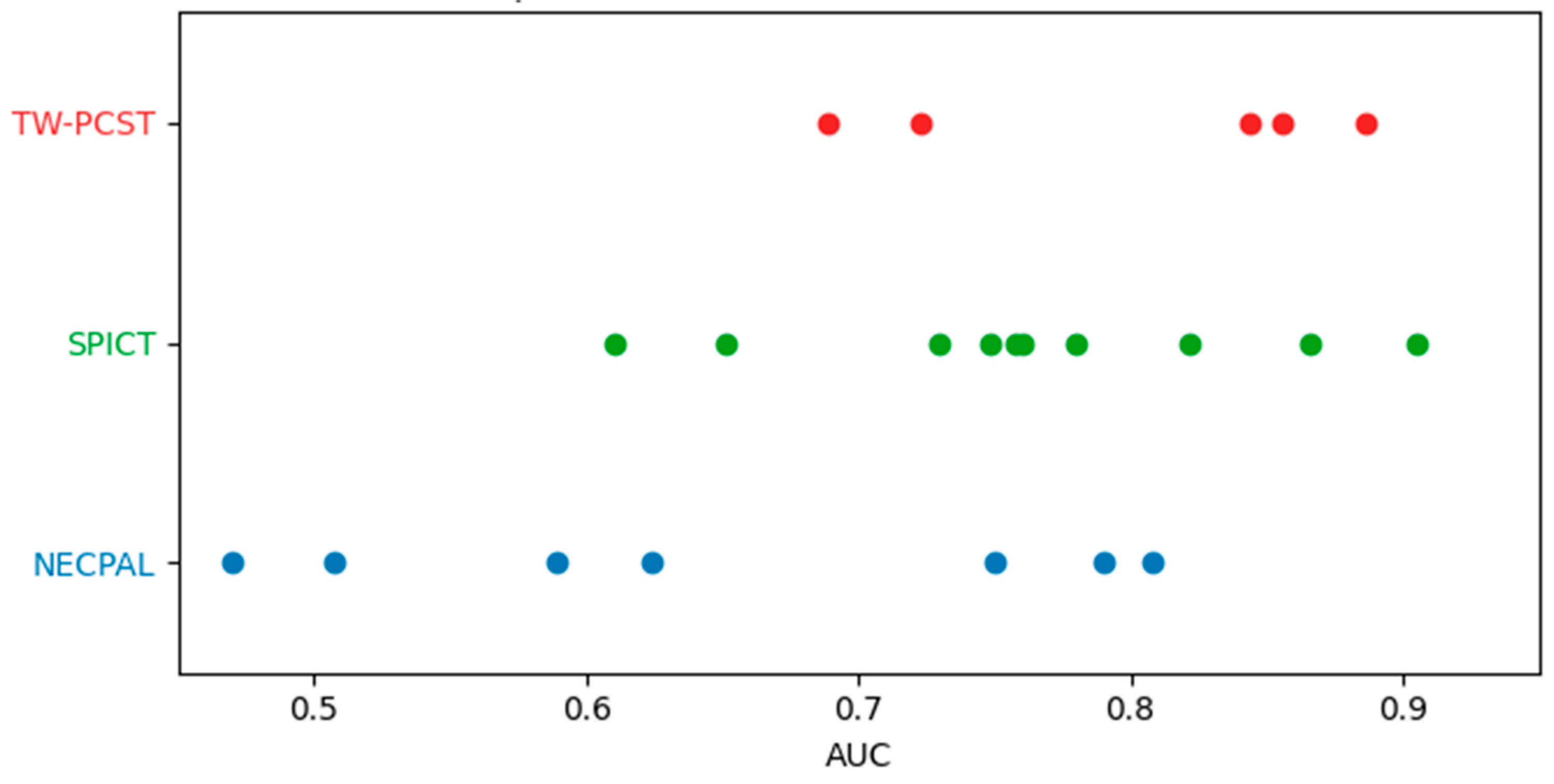
| Troncoso et al. (2021) [36] | Chile | Psychometric validation (predicting positive SQ) | 118 | 71.92 ± 10.18 | Primary care | NR | NR | NR | NR | 0.808 | |
| Calsina-Berna et al. (2022) [37] | Spain | Prevalence and clinical characterization of patients with PC needs | 227 | 81 (median) | Tertiary hospital (internal medicine and geriatric wards) | NR | NR | NR | NR | NR | |
| Esteban-Burgos et al. (2023) [38] | Spain | Mortality at 3, 6, 12 and 24 months | 146 | 84.6 ± 8.9 | Nursing homes | NR | NR | NR | NR | 3-month mortality: NECPAL: 0.507 PROFUND: 0.641 6-month mortality: NECPAL: 0.470 PROFUND: 0.616 12-month mortality: NECPAL: 0.589 PROFUND: 0.564 24-month mortality: NECPAL: 0.624 PROFUND: 0.442 | |
| Fisher et al. (2024) [39] | Israel | Psychometric validation (identification of PC needs) | 376 | 78 | Hospital (internal medicine ward) | 93 | 17 | 71 | 53 | 0.79 | |
| Spannella et al. (2024) [40] | Italy | 12-month mortality | 103 | 86.8 ± 7.2 | Hospitalized older population | NR | NR | NR | NR | 0.75 | |
| TW-PCST | Wang et al. (2019) [41] | Taiwan | Mortality at 14, 90, and 180 days | 21,596 | 57.6 ± 24.5 | Acute hospital | 14-day mortality: 80.9 90-day mortality: 84 180-day mortality: 81.6 | 14-day mortality: 85.1 90-day mortality: 74.7 180-day mortality: 74.5 | 14-day mortality: 99.5 90-day mortality: 98.8 180-day mortality: 97.8 | 14-day mortality: 10 90-day mortality: 16.4 180-day mortality: 22.8 | 14-day mortality: 0.886 90-day mortality: 0.856 180-day mortality: 0.844 |
| Yen et al. (2020) [42] | Taiwan | 90-day mortality | 47,153 | 61.7 ± 19.3 | Hospitalized patients in Taipei city | NR | NR | NR | NR | 6.86 * | |
| Yen et al. (2022) [43] | Taiwan | 12-month mortality | 21,109 | 62.8 ± 19.3 | Hospitalized patients in Taipei city | 45.8 | 92 | 94.9 | 34.1 | 0.689 | |
| Yen et al. (2022) [44] | Taiwan | 6-month mortality | 111,483 | 60.9 | Hospitalized patients in Taipei city | 49.6 | 94.9 | 98.1 | 26.6 | 0.723 | |
| SPICT | De Bock et al. (2018) [45] | Belgium | 12-month mortality | 435 | 84 (median) | Acute geriatric unit | 84.1 | 57.9 | NR | NR | General indicators: 0.758 Clinical indicators: 0.748 |
| Mitchell et al. (2018) [46] § | Australia | 12-month mortality | 1525 | 77.9 | Primary care | 34 | 95.8 | 20.5 | 97.9 | NR | |
| van Wijmen et al. (2020) [47] | The Netherlands | 12-month mortality | 3640 | ≥75 | Primary care | SPICT 58 SQ 50 | SPICT 98 SQ 99 | NR | NR | NR | |
| Piers et al. (2021) [48] | Belgium | 12-month mortality | 458 | ≥75 | Acute geriatric and cardiology units | AUG 0.82 CU 0.69 | AUG 0.49 CU 0.67 | AUG 89.3 CU 86.8 | AUG 33.9 CU 33.7 | AUG 0.822 CU 0.651 | |
| Farfán-Zuñiga et al. (2022) [49] | Chile | Psychometric validation (identification of PC needs) | 292 | 79.4 | Primary care | NR | NR | NR | NR | 0.866 † | |
| Liao et al. (2024) [50] | Taiwan | 6-month mortality | 129 | 82.4 ± 12 | Older adults receiving home-based medical care | 80 (4 general + 1 clinical indicator) | 56 (4 general + 1 clinical indicator) | 79 (4 general + 1 clinical indicator) | 57 (4 general + 1 clinical indicator) | General indicators: 0.73 Clinical indicators: 0.61 4 general + 1 clinical indicator: 0.78 | |
| Xie et al. (2025) [51] | China | Psychometric validation (identification of PC needs) | 212 | 56 (20–81) | Hospitalized oncological patients | NR | NR | NR | NR | 0.76 † | |
| Huang et al. (2025) [52] | China | Screening of PC needs | 388 | 57 (18–89) | Hospitalized cancer patients | 80 | 94 | 92 | 84 | 0.905 | |
| ProPal-COPD | Broese et al. (2022) [53] | Netherlands | 1-year all-cause mortality | 523 | 70.0 ± 9.1 | Hospitalized patients with COPD | 55 | 74 | NR | NR | 0.68 |
Disclaimer/Publisher’s Note: The statements, opinions and data contained in all publications are solely those of the individual author(s) and contributor(s) and not of MDPI and/or the editor(s). MDPI and/or the editor(s) disclaim responsibility for any injury to people or property resulting from any ideas, methods, instructions or products referred to in the content. |
© 2026 by the authors. Licensee MDPI, Basel, Switzerland. This article is an open access article distributed under the terms and conditions of the Creative Commons Attribution (CC BY) license.
Share and Cite
Bustamante-Fermosel, A.; Chacón-Moreno, A.D.; Hennekinne, L.; Gil-Gil, F.; Notario-Leo, H.; Larrainzar-Garijo, R.; Torres-Macho, J.; Franco-Moreno, A.; García Melcón, G.; on behalf of the Research in Palliative Care HUIL-Group. Screening Tools for the Early Identification of Palliative Care Needs in Patients with Advanced Chronic Conditions: An Updated Systematic Review. J. Clin. Med. 2026, 15, 919. https://doi.org/10.3390/jcm15030919
Bustamante-Fermosel A, Chacón-Moreno AD, Hennekinne L, Gil-Gil F, Notario-Leo H, Larrainzar-Garijo R, Torres-Macho J, Franco-Moreno A, García Melcón G, on behalf of the Research in Palliative Care HUIL-Group. Screening Tools for the Early Identification of Palliative Care Needs in Patients with Advanced Chronic Conditions: An Updated Systematic Review. Journal of Clinical Medicine. 2026; 15(3):919. https://doi.org/10.3390/jcm15030919
Chicago/Turabian StyleBustamante-Fermosel, Ana, Agustín Diego Chacón-Moreno, Laetitia Hennekinne, Fuensanta Gil-Gil, Helena Notario-Leo, Ricardo Larrainzar-Garijo, Juan Torres-Macho, Anabel Franco-Moreno, Gerardo García Melcón, and on behalf of the Research in Palliative Care HUIL-Group. 2026. "Screening Tools for the Early Identification of Palliative Care Needs in Patients with Advanced Chronic Conditions: An Updated Systematic Review" Journal of Clinical Medicine 15, no. 3: 919. https://doi.org/10.3390/jcm15030919
APA StyleBustamante-Fermosel, A., Chacón-Moreno, A. D., Hennekinne, L., Gil-Gil, F., Notario-Leo, H., Larrainzar-Garijo, R., Torres-Macho, J., Franco-Moreno, A., García Melcón, G., & on behalf of the Research in Palliative Care HUIL-Group. (2026). Screening Tools for the Early Identification of Palliative Care Needs in Patients with Advanced Chronic Conditions: An Updated Systematic Review. Journal of Clinical Medicine, 15(3), 919. https://doi.org/10.3390/jcm15030919