High- and Low-Complexity Features of Non-Critical Adult Patients in the Emergency Department



Abstract
1. Introduction
1.1. Background/Rationale
1.2. Objectives
2. Materials and Methods
2.1. Participants
2.2. Variables
2.3. Statistical Methods
3. Results
3.1. Descriptive Data
3.2. Outcome Data
4. Discussion
4.1. Key Results
4.2. Limitations
4.3. Interpretation
4.4. Generalizability
Supplementary Materials
Author Contributions
Funding
Institutional Review Board Statement
Informed Consent Statement
Data Availability Statement
Acknowledgments
Conflicts of Interest
Abbreviations
| CCI | Charlson Comorbidity Index |
| CDW | Clinical diagnostic workload |
| CHF | Congestive Heart Failure |
| CKD | Hemiplegia, Chronic Kidney Disease |
| COPD | Chronic Obstructive Pulmonary Disease |
| CVA | Acute Cerebrovascular Accidents or Transient Ischemic Attacks |
| D | Dementia |
| DM | Diabetes Mellitus |
| ED | Emergency Department |
| GTD | Connective Tissue diseases, |
| HLC | High Complexity Level |
| L | Lymphoma and Leukaemia |
| LD | Liver Disease |
| LLC | Low Level of Complexity |
| MI | History of Myocardial Infarction |
| NEWS | National Early Warning Score |
| NRS | Numeric rating scale |
| PP | Presenting Profile |
| PUD | Peptic Ulcer Disease |
| PVD | Peripheral Vascular Disease |
| ROC | Receiver Operating Characteristic |
| ST | Solid Tumours |
| TL | Triage level |
References
- Mirhaghi, A.; Heydari, A.; Mazlom, R.; Ebrahimi, M. The Reliability of the Canadian Triage and Acuity Scale: Meta-analysis. N. Am. J. Med. Sci. 2015, 7, 299–305. [Google Scholar] [CrossRef]
- Nicolaus, S.; Crelier, B.; Donzé, J.D.; Aubert, C.E. Definition of patient complexity in adults: A narrative review. J. Multimorb. Comorbidity 2022, 12, 26335565221081288. [Google Scholar] [CrossRef]
- Ng, C.-J.; Hsu, K.-H.; Kuan, J.-T.; Chiu, T.-F.; Chen, W.-K.; Lin, H.-J.; Bullard, M.J.; Chen, J.-C. Comparison between Canadian Triage and Acuity Scale and Taiwan Triage System in emergency departments. J. Formos. Med. Assoc. 2010, 109, 828–837. [Google Scholar] [CrossRef] [PubMed]
- Shlenger, D.; Cohen, A.; Hochman, G.; Pachys, G.; Trotzky, D. The effect of centrality bias on triage nurses in the emergency department. Sage Open Med. 2025, 13, 20503121251364742. [Google Scholar] [CrossRef]
- Giannouchos, T.V.; Ukert, B.; Wright, B. Concordance in Medical Urgency Classification of Discharge Diagnoses and Reasons for Visit. JAMA Netw. Open 2024, 7, e2350522. [Google Scholar] [CrossRef] [PubMed]
- Yancey, C.C.; O’Rourke, M.C. Emergency Department Triage. In StatPearls; StatPearls Publishing: Treasure Island, FL, USA, 2025. [Google Scholar]
- Ganjali, R.; Golmakani, R.; Ebrahimi, M.; Eslami, S.; Bolvardi, E. Accuracy of the Emergency Department Triage System using the Emergency Severity Index for Predicting Patient Outcome; A Single Center Experience. Bull. Emerg. Trauma 2020, 8, 115–120. [Google Scholar] [CrossRef]
- Davis, J.W.; Dirks, R.C.; Sue, L.P.; Kaups, K.L. Attempting to validate the overtriage/undertriage matrix at a Level I trauma center. J. Trauma Acute Care Surg. 2017, 83, 1173–1178. [Google Scholar] [CrossRef] [PubMed]
- Almutary, A.; Althunayyan, S.; Alenazi, K.; Alqahtani, A.; Alotaibi, B.; Ahmed, M.; Osman, I.S.; Kakpuri, A.; Alanazi, A.; Arafat, M.; et al. National Early Warning Score (NEWS) as Prognostic Triage Tool for Septic Patients. Infect. Drug Resist. 2020, 13, 3843–3851. [Google Scholar] [CrossRef]
- Boonstra, A.M.; Stewart, R.E.; Köke, A.J.A.; Oosterwijk, R.F.A.; Swaan, J.L.; Schreurs, K.M.G.; Schiphorst Preuper, H.R. Cut-Off Points for Mild, Moderate, and Severe Pain on the Numeric Rating Scale for Pain in Patients with Chronic Musculoskeletal Pain: Variability and Influence of Sex and Catastrophizing. Front. Psychol. 2016, 7, 1466. [Google Scholar] [CrossRef]
- Capponi, R.; Loguercio, V.; Guerrini, S.; Beltrami, G.; Vesprini, A.; Giostra, F. Does the numeric rating scale (NRS) represent the optimal tool for evaluating pain in the triage process of patients presenting to the ED? Results of a multicenter study. Acta Bio Med. Atenei Parm. 2016, 87, 347–352. [Google Scholar]
- Grafstein, E.; Unger, B.; Bullard, M.; Innes, G.; The Canadian Emergency Department Information System (CEDIS) Working Group. Canadian Emergency Department Information System (CEDIS) Presenting Complaint List (Version 1.0). Can. J. Emerg. Med. 2003, 5, 27–34. [Google Scholar] [CrossRef]
- Fluss, R.; Faraggi, D.; Reiser, B. Estimation of the Youden Index and its Associated Cutoff Point. Biom. J. 2005, 47, 458–472. [Google Scholar] [CrossRef]
- Ali, H.; Salleh, M.N.M.; Hussain, K.; Ahmad, A.; Ullah, A.; Muhammad, A.; Naseem, R.; Khan, M. A review on data preprocessing methods for class imbalance problem. Int. J. Eng. Technol. 2019, 8, 390–397. [Google Scholar]
- Dufour, I.; Chouinard, M.-C.; Dubuc, N.; Beaudin, J.; Lafontaine, S.; Hudon, C. Factors associated with frequent use of emergency-department services in a geriatric population: A systematic review. BMC Geriatr. 2019, 19, 185. [Google Scholar] [CrossRef]
- Breivik, H.; Collett, B.; Ventafridda, V.; Cohen, R.; Gallacher, D. Survey of chronic pain in Europe: Prevalence, impact on daily life, and treatment. Eur. J. Pain 2006, 10, 287–333. [Google Scholar] [CrossRef]
- Hämäläinen, J.; Kvist, T.; Kankkunen, P. Acute Pain Assessment Inadequacy in the Emergency Department: Patients’ Perspective. J. Patient Exp. 2022, 9, 23743735211049677. [Google Scholar] [CrossRef] [PubMed]
- Hachimi-Idrissi, S.; Coffey, F.; Hautz, W.E.; Leach, R.; Sauter, T.C.; Sforzi, I.; Dobias, V. Approaching acute pain in emergency settings: European Society for Emergency Medicine (EUSEM) guidelines-part 1: Assessment. Intern. Emerg. Med. 2020, 15, 1125–1139. [Google Scholar] [CrossRef] [PubMed]
- Nożewski, J.; Bondarczuk, R.; Hołody, G.; Kitt, M.; Mućka, N.; Religioni, U. Barriers to Improving Pain Management in the Emergency Department: Lessons from a Lean-Driven Quality Improvement Initiative. J. Clin. Med. 2025, 14, 4566. [Google Scholar] [CrossRef]
- Kaushik, N.; Khangulov, V.S.; O’Hara, M.; Arnaout, R. Reduction in laboratory turnaround time decreases emergency room length of stay. Open Access Emerg. Med. 2018, 10, 37–45. [Google Scholar] [CrossRef]
- Augustine, J.J. Statistical Trends of Diagnostic Testing in the Emergency Department. ACEP Now. Available online: https://www.acepnow.com/article/statistical-trends-of-diagnostic-testing-in-the-emergency-department/ (accessed on 9 September 2025).
- Osman, A.D.; Howell, J.; Yeoh, M.; Wilson, D.; Plummer, V.; Braitberg, G. Benefits of emergency department routine blood test performance on patients whose allocated triage category is not time critical: A retrospective study. BMC Health Serv. Res. 2024, 24, 1252. [Google Scholar] [CrossRef]
- Gurazada, S.G.; Gao, S.C.; Burstein, F.; Buntine, P. Predicting Patient Length of Stay in Australian Emergency Departments Using Data Mining. Sensors 2022, 22, 4968. [Google Scholar] [CrossRef]
- Wang, S.-T.; Weng, S.-J.; Yeh, T.-Y.; Chen, C.-H.; Tsai, Y.-T. Optimizing Emergency Department Patient Flow Through Bed Allocation Strategies: A Discrete-Event Simulation Study. INQ. J. Health Care Organ. Provis. Financ. 2025, 62, 00469580251335799. [Google Scholar] [CrossRef] [PubMed]
- Schinkel, M.; Bergsma, L.; Veldhuis, L.I.; Ridderikhof, M.L.; Holleman, F. Comparing complaint-based triage scales and early warning scores for emergency department triage. Emerg. Med. J. 2022, 39, 691–696. [Google Scholar] [CrossRef]
- Semeraro, F.; Corona, G.; Scquizzato, T.; Gamberini, L.; Valentini, A.; Tartaglione, M.; Scapigliati, A.; Ristagno, G.; Martella, C.; Descovich, C.; et al. New Early Warning Score: EMS Off-Label Use in Out-of-Hospital Patients. J. Clin. Med. 2021, 10, 2617. [Google Scholar] [CrossRef]
- Chisholm, D.; Wang, D.; Rich, T.A.; Grabove, M.; Sherlock, K.; Lang, E. A Multimodal Evaluation of an Emergency Department Electronic Tracking Board Utility Designed to Optimize Stretcher Utilization. Cureus 2020, 12, e11810. [Google Scholar] [CrossRef]
- Fabbri, A.; Polyzogopoulou, E.; Dündar, D.Z.; Slagman, A.; Ergin, M.; Janssens, K.A.C.; Bjornsen, L.P.; Somodi, S.; Višnja, N.A.; Demir, H.A.; et al. Sex disparities in older patients attending the european emergency departments: An EGERS sub-analysis. Emerg. Care J. 2025, 21, 13937. [Google Scholar] [CrossRef]
- Nelson, R.E.; Nelson, S.D.; Khader, K.; Perencevich, E.L.; Schweizer, M.L.; Rubin, M.A.; Graves, N.; Harbarth, S.; Stevens, V.W.; Samore, M.H. The Magnitude of Time-Dependent Bias in the Estimation of Excess Length of Stay Attributable to Healthcare-Associated Infections. Infect. Control Hosp. Epidemiol. 2015, 36, 1089–1094. [Google Scholar] [CrossRef] [PubMed]
- Pilotto, A.; Sancarlo, D.; Panza, F.; Paris, F.; D’Onofrio, G.; Cascavilla, L.; Addante, F.; Seripa, D.; Solfrizzi, V.; Dallapiccola, B.; et al. The Multidimensional Prognostic Index (MPI), Based on a Comprehensive Geriatric Assessment, Predicts Short- and Long-Term Mortality in Hospitalized Older Patients with Dementia. J. Alzheimer’s Dis. 2009, 18, 191–199. [Google Scholar] [CrossRef] [PubMed]



| Total, No. | TL3, No. (%) | TL4–5, No. (%) | OR (95% CI) | p-Value | |
|---|---|---|---|---|---|
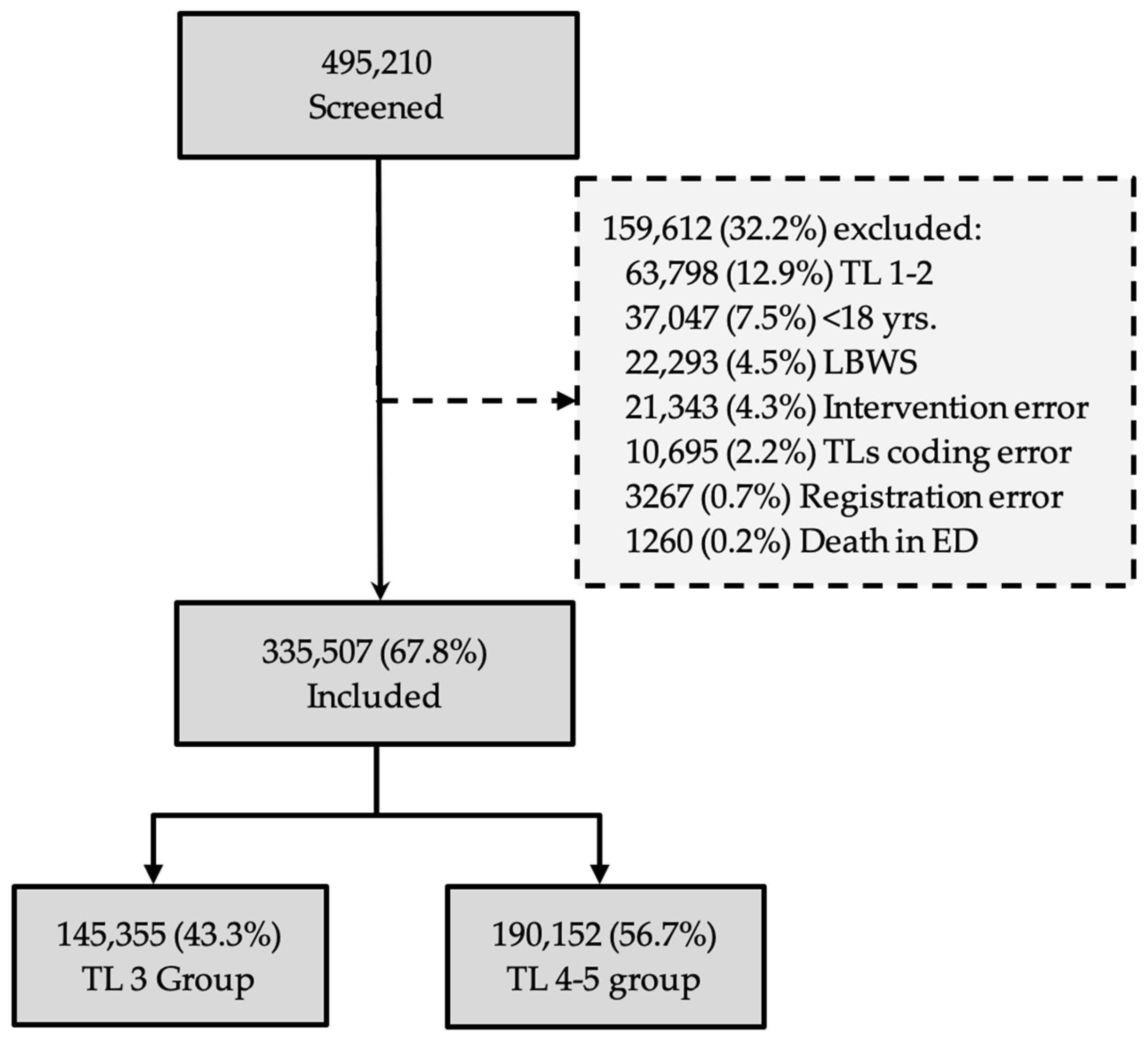
| Patients | 335,507 | 145,355 (43,3) | 190,152 (56.7) | -- | -- |
| Sex (Male) | 168,457 (50.2) | 71,352 (49.1) | 97,105 (51.1) | 1.08 (1.07–1.10) | <0.001 |
| Age (Years) | 59 (interquartile range [IQR], 25) | 69 (interquartile range [IQR], 32) | 54 (interquartile range [IQR], 34) | -- | <0.05 |
| 18–30 | 39,590 (11.8) | 10,866 (7.5) | 28,724 (15.1) | 2.20 (2.15–2.25) | <0.001 |
| 31–40 | 35,080 (10.5) | 10,593 (7.3) | 24,487 (12.9) | 1.88 (1.84–1.93) | <0.001 |
| 41–50 | 42,180 (12.6) | 14,012 (9.6) | 28,168 (14.8) | 1.63 (1.60–1.67) | <0.001 |
| 51–60 | 50,966 (15.2) | 18,743 (12.9) | 32,223 (16.9) | 1.38 (1.35–1.41) | <0.001 |
| 61–70 | 45,020 (13.4) | 19,811 (13.6) | 25,209 (13.3) | 0.97 (0.95–0.99) | 0.002 |
| 70+ | 122,671 (36.6) | 71,330 (49.1) | 51,341 (27.0) | 0.38 (0.38–0.39) | <0.001 |
| NEWS | |||||
| 0 to 4 | 322,409 (96.1) | 136,608 (94) | 185,801 (97.7) | 2.73 (2.63–2.84) | <0.001 |
| 5 to 6 | 9579 (2.9) | 6078 (4.2) | 3501 (1.8) | 0.43 (0.41–0.45) | <0.001 |
| >6 | 3519 (1.0) | 2669 (1.8) | 850 (0.4) | 0.24 (0.22–0.26) | <0.001 |
| NRS | |||||
| 0 to 3 | 285,197 (85.0) | 120,474 (82.9) | 164,723 (86.6) | 1.34 (1.31–1.36) | <0.001 |
| 4 to 7 | 45,273 (13.5) | 21,809 (15.0) | 23,464 (12.3) | 0.80 (0.78–0.81) | <0.001 |
| >7 | 5037 (1.5) | 3072 (2.1) | 1965 (1.0) | 0.48 (0.46–0.51) | <0.001 |
| Type | Total No. (%) | TL3 No. (%) | TL4–5 No. (%) | OR (95% CI) | p-Value |
|---|---|---|---|---|---|
| Environmental (ENV) | 283 (0.1) | 168 (0.1) | 115 (0.1) | 2.88 (2.25–3.68) | <0.001 |
| Mental Health (MH0) | 7172 (2.1) | 3369 (2.3) | 3803 (2.0) | 2.03 (1.93–2.14) | <0.001 |
| Cardiovascular System (CVS) | 54,412 (16.2) | 38,772 (26.7) | 15,640 (8.2) | 1.94 (1.88–2.00) | <0.001 |
| Cerebral Nervous System (CNS) | 32,520 (9.7) | 17,905 (12.3) | 14,615 (7.7) | 1.64 (1.59–1.69) | <0.001 |
| Trauma (TRA) | 14,888 (4.4) | 6484 (4.5) | 8404 (4.4) | 1.56 (1.49–1.62) | <0.001 |
| Respiratory (RES) | 21,747 (6.5) | 13,839 (9.5) | 7908 (4.2) | 1.44 (1.39–1.50) | <0.001 |
| Substance Misuse (SUB) | 1366 (0.4) | 577 (0.4) | 789 (0.4) | 1.40 (1.25–1.57) | <0.001 |
| Genitourinary (GU0) | 24,477 (7.3) | 10,917 (7.5) | 13,560 (7.1) | 0.97 (0.94–1.01) | 0.171 |
| Gastrointestinal (GI0) | 46,318 (13.8) | 22,866 (15.7) | 23,452 (12.3) | 0.91 (0.88–0.94) | <0.001 |
| General and Minor (GEN) | 27,684 (8.2) | 11,958 (8.2) | 15,726 (8.3) | 0.73 (0.70–0.75) | <0.001 |
| Obstetrics/Gynaecology (GYN) | 2688 (0.8) | 569 (0.4) | 2119 (1.1) | 0.70 (0.64–0.77) | <0.001 |
| Orthopaedic (ORT) | 69,901 (20.8) | 13,068 (9.0) | 56,833 (29.9) | 0.48 (0.46–0.49) | <0.001 |
| Ears, Mouth, Throat, Neck, Nose (ENT) | 11,792 (3.5) | 2391 (1.6) | 9401 (4.9) | 0.47 (0.45–0.50) | <0.001 |
| Ophthalmology (OPT) | 7939 (2.4) | 894 (0.6) | 7045 (3.7) | 0.44 (0.41–0.48) | <0.001 |
| Dermatology (DER) | 12,319 (3.7) | 1578 (1.1) | 10,741 (5.6) | 0.36 (0.34–0.38) | <0.001 |
Disclaimer/Publisher’s Note: The statements, opinions and data contained in all publications are solely those of the individual author(s) and contributor(s) and not of MDPI and/or the editor(s). MDPI and/or the editor(s) disclaim responsibility for any injury to people or property resulting from any ideas, methods, instructions or products referred to in the content. |
© 2026 by the authors. Licensee MDPI, Basel, Switzerland. This article is an open access article distributed under the terms and conditions of the Creative Commons Attribution (CC BY) license.
Share and Cite
Fabbri, A.; Pistore, L.; Bertini, F.; Benazzi, B.; Montesi, D. High- and Low-Complexity Features of Non-Critical Adult Patients in the Emergency Department. J. Clin. Med. 2026, 15, 1280. https://doi.org/10.3390/jcm15031280
Fabbri A, Pistore L, Bertini F, Benazzi B, Montesi D. High- and Low-Complexity Features of Non-Critical Adult Patients in the Emergency Department. Journal of Clinical Medicine. 2026; 15(3):1280. https://doi.org/10.3390/jcm15031280
Chicago/Turabian StyleFabbri, Andrea, Laura Pistore, Flavio Bertini, Barbara Benazzi, and Danilo Montesi. 2026. "High- and Low-Complexity Features of Non-Critical Adult Patients in the Emergency Department" Journal of Clinical Medicine 15, no. 3: 1280. https://doi.org/10.3390/jcm15031280
APA StyleFabbri, A., Pistore, L., Bertini, F., Benazzi, B., & Montesi, D. (2026). High- and Low-Complexity Features of Non-Critical Adult Patients in the Emergency Department. Journal of Clinical Medicine, 15(3), 1280. https://doi.org/10.3390/jcm15031280