Local Pharmacological Interventions for Pain Relief During Peripheral Venous Cannulation: A Systematic Review with Implications for Clinical Nursing Practice

 ,
,  ,
,  ,
,  and
and
Abstract
1. Introduction
Aim
2. Methods
2.1. Study Design
2.2. Search Strategy
2.3. Data Extraction
2.4. Data Synthesis
2.5. Quality Assessment
2.6. Ethical Approval
3. Results
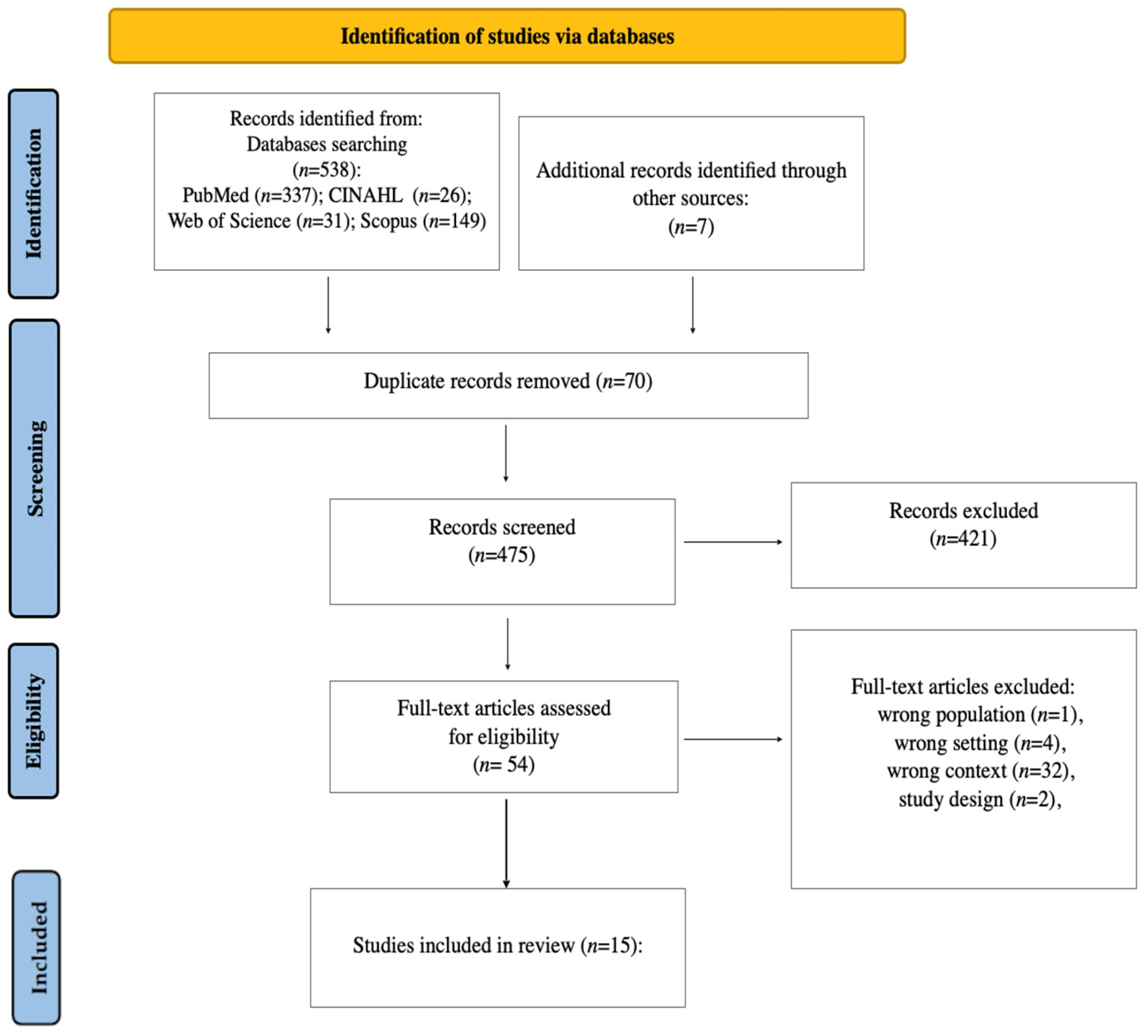
3.1. Study Selection
3.2. Characteristics of Included Studies
3.3. Pain Intensity During Peripheral Venous Cannulation
3.4. Pharmacological Interventions Recommended During Peripheral Venous Cannulation
3.5. Clinical Effectiveness of the Interventions
- Interventions involving cryotherapy demonstrated largely consistent and clinically noticeable effects across most studies, with a typical reduction in pain intensity of approximately 1 to 2 points on the NRS. According to published thresholds for minimal clinically important difference (MCID) in acute procedural pain, a reduction of approximately 1.3–2.0 points on numerical or visual analog scales is generally considered clinically meaningful. Therefore, while several interventions achieved changes likely to be perceived as beneficial by patients, some reported differences may represent only marginal clinical improvement.
- Vapocoolant vs. placebo: NRS 2 vs. 4 [13].
- Ethyl chloride vs. placebo: NRS 2 vs. 4 [2].
- Cryospray vs. control group: NRS 1 vs. 3 [9].
- 2.
- EMLA cream, lidocaine–prilocaine patch, topical ketamine, injectable lidocaine
- EMLA vs. placebo: 1.66–1.11 vs. 1.9–3.16—effect depending on application time and study population [15].
- Lidocaine–prilocaine vs. injectable lidocaine: VAS 2 vs. 4 [6].
- Topical ketamine: In the study by Heydari et al., both topical ketamine and EMLA produced similar pain scores, NRS 1.7, and were more effective than placebo, NRS 3.16 [3].
3.6. Interventions and Their IMPACT on Other Outcomes (e.g., Satisfaction, Anxiety, Safety)/Other Benefits
4. Discussion
5. Limitations
6. Conclusions
- Peripheral venous cannulation in adult patients is most commonly associated with moderate-intensity pain and should not be regarded as a pain-neutral procedure.
- Pharmacological interventions demonstrate significant clinical effectiveness in reducing pain associated with the cannulation procedure.
- The majority of the analyzed pharmacological interventions are characterized by good patient acceptance and a favorable safety profile.
- The use of pharmacological interventions prior to peripheral venous cannulation not only reduces pain but also improves patient satisfaction and overall patient experience during hospitalization.
7. Implications for Clinical Practice
Supplementary Materials
Author Contributions
Funding
Institutional Review Board Statement
Informed Consent Statement
Data Availability Statement
Conflicts of Interest
References
- Zhu, Y.; Peng, X.; Wang, S.; Chen, W.; Liu, C.; Guo, B.; Zhao, L.; Gao, Y.; Wang, K.; Lou, F. Vapocoolant spray versus placebo spray or no treatment for reducing pain from intravenous cannulation: A meta-analysis of randomized controlled trials. Am. J. Emerg. Med. 2018, 36, 2085–2092. [Google Scholar] [CrossRef] [PubMed]
- Rüsch, D.; Koch, T.; Seel, F.; Eberhart, L. Vapocoolant spray versus lidocaine infiltration for radial artery cannulation: A prospective, randomized, controlled clinical trial. J. Cardiothorac. Vasc. Anesth. 2017, 31, 77–83. [Google Scholar] [CrossRef] [PubMed]
- Heydari, F.; Khalilian, S.; Golshani, K.; Majidinejad, S.; Masoumi, B.; Massoumi, A. Topical ketamine as a local anesthetic agent in reducing venipuncture pain: A randomizedcontrolled trial. Am. J. Emerg. Med. 2021, 48, 48–53. [Google Scholar] [CrossRef] [PubMed]
- Srivastava, V.K.; Das, P.K.; Gautam, S.K.S.; Jaisawal, P.; Kadiyala, V.N.; Rambhad, S. Comparative evaluation of volatile anesthetic agents for attenuation of venous cannulation pain: A prospective, randomized controlled study. J. Clin. Diagn. Res. 2016, 10, UC01–UC04. [Google Scholar] [CrossRef] [PubMed]
- Mace, S.E. Prospective, randomized, double-blind controlled trial comparing vapocoolant spray vs placebo spray in adults undergoing venipuncture. Am. J. Emerg. Med. 2016, 34, 798–804. [Google Scholar] [CrossRef] [PubMed]
- Yoshida, S.; Miyasaka, K.W.; Suzuki, R.; Fujita, N.; Abe, S. Comparison of analgesic effect of local anesthetic injection for pain relief during peripheral venous insertion in adult surgical patients: A prospective observational study. J. Perianesthesia Nurs. 2025, 40, 531–534. [Google Scholar] [CrossRef] [PubMed]
- Barbour, T.; O’Keefe, S.; Mace, S.E. Patient and health care provider responses from a prospective, double-blind, randomized controlled trial comparing vapocoolant spray versus placebo spray in adults undergoing venipuncture in the emergency department. Pain Manag. Nurs. 2018, 19, 391–399. [Google Scholar] [CrossRef] [PubMed]
- Akhgar, A.; Mazidabadi Farahani, A.; Akbari, H.; Sedaghat, M.; Jalili, M.; Mirfazaelian, H. Comparison of the effects of vapocoolant spray and topical anaesthetic cream (lidocaine-prilocaine) on pain of intravenous cannulation: A randomised controlled trial. Emerg. Med. J. 2025, 42, 373–377. [Google Scholar] [CrossRef] [PubMed]
- Pedersen, J.B.; Martensen, A.; Funder, P.; Bakke, S.A.; Bhavsar, R.P.; Strøm, T. Cryospray reduces pain during venous cannulation in elective surgery patients: A randomized placebo-controlled study. BMC Anesthesiol. 2024, 24, 466. [Google Scholar] [CrossRef] [PubMed]
- Edwards, C.; Noah, C. A randomized, double-blind trial to determine if vapocoolant in the adult population improves patient perception of pain with peripheral intravascular access. Adv. Emerg. Nurs. J. 2017, 39, 288–294. [Google Scholar] [CrossRef] [PubMed]
- Babaieasl, F.; Yarandi, H.N.; Saeidzadeh, S.; Kheradmand, M. Comparison of EMLA and diclofenac on reduction of pain and phlebitis caused by peripheral IV catheter: A randomized controlled trial. Home Healthc. Now 2019, 37, 17–22. [Google Scholar] [CrossRef] [PubMed]
- Rüsch, D.; Koch, T.; Spies, M.; Eberhart, L.H.J. Pain during venous cannulation. Dtsch. Ärzteblatt Int. 2017, 114, 605–611. [Google Scholar] [CrossRef] [PubMed]
- Mace, S.E. Prospective, double blind, randomized, controlled trial comparing vapocoolant spray versus placebo spray in adults undergoing intravenous cannulation. Scand. J. Pain 2017, 17, 8–15. [Google Scholar] [CrossRef] [PubMed]
- Basak, T.; Aciksoz, S.; Savasci, U.; Yilmaz, S. Effectiveness of vapocoolant spray on venipuncture pain in young male donors: A randomized controlled trial. J. Infus. Nurs. 2021, 44, 339–345. [Google Scholar] [CrossRef] [PubMed]
- Matsumoto, T.; Chaki, T.; Hirata, N.; Yamakage, M. The eutectic mixture local anesthetics (EMLA) cream is more effective on venipuncture pain compared with lidocaine tape in the same patients. JA Clin. Rep. 2018, 4, 73. [Google Scholar] [CrossRef] [PubMed]
- Zempsky, W.T.; Schmitz, M.L.; Meyer, J.M. Safety and efficacy of needle-free powder lidocaine delivery system in adult patients undergoing venipuncture or peripheral venous cannulation: A randomized, double-blind, placebo-controlled trial. Clin. J. Pain 2016, 32, 211–217. [Google Scholar] [CrossRef] [PubMed]
- Joanna Briggs Institute. JBI Manual for Evidence Synthesis; Joanna Briggs Institute: Adelaide, Australia, 2024; Available online: https://jbi-global-wiki.refined.site/space/MANUAL/355598371/1.+JBI+Systematic+Reviews (accessed on 20 December 2025).
- Tufanaru, C.; Munn, Z.; Aromataris, E.; Campbell, J.; Hopp, L. Checklist for Randomized Controlled Trials; Joanna Briggs Institute: Adelaide, Australia, 2017; pp. 1–9. [Google Scholar]
- Page, M.J.; McKenzie, J.E.; Bossuyt, P.M.; Boutron, I.; Hoffmann, T.C.; Mulrow, C.D.; Shamseer, L.; Tetzlaff, J.M.; Akl, E.A.; Brennan, S.E.; et al. The PRISMA 2020 statement: An updated guideline for reporting. BMJ 2021, 372, n71. [Google Scholar] [CrossRef] [PubMed]


| Databases | Search Strategy |
|---|---|
| PubMed | (((adults OR outpatients OR inpatients) AND (‘Peripheral Catheterization’ OR ‘Venipuncture’ OR ‘peripheral intravenous catheter’ OR ‘venous access’ OR ‘PIVC’ OR ‘IV insertion’)) AND (‘Pain Management’ OR ‘Analgesia’ OR ‘Pain Reduction’ OR ‘Pain Prevention’ OR ‘Pain relief’)) AND (intervention OR pharmacological OR EMLA OR ‘topical anesthetics’) Limit: Years, adults, language Results: 337 |
| CINAHL | TX (adults OR outpatients OR inpatients) AND TI (‘Peripheral Catheterization’ OR ‘Venipuncture’ OR ‘peripheral intravenous catheter’ OR ‘venous access’ OR ‘PIVC’ OR ‘IV insertion’) AND TX (‘Pain Management’ OR ‘Analgesia’ OR ‘Pain Reduction’ OR ‘Pain Prevention’ OR ‘Pain relief’) AND (intervention OR pharmacological OR EMLA OR ‘topical anesthetics’) Limit: Years, adults Results: 26 |
| Web of Science | (((TS = (adults OR outpatients OR inpatients)) AND TI = (‘Peripheral Catheterization’ OR ‘Venipuncture’ OR ‘peripheral intravenous catheter’ OR ‘venous access’ OR ‘PIVC’ OR ‘IV insertion’)) AND TS = (‘Pain Management’ OR ‘Analgesia’ OR ‘Pain Reduction’ OR ‘Pain Prevention’ OR ‘Pain relief’)) AND TS = (intervention OR pharmacological OR EMLA OR ‘topical anesthetics’) Limit: Years Results: 31 |
| Scopus | (ALL (adults OR outpatients OR inpatients) AND TITLE-ABS-KEY (“Peripheral Catheterization” OR “Venipuncture” OR “peripheral intravenous catheter” OR “venous access” OR “PIVC” OR “IV insertion”) AND TITLE-ABS-KEY (“Pain Management” OR “Analgesia” OR “Pain Reduction” OR “Pain Prevention” OR “Pain relief”) AND ALL (intervention OR pharmacological OR EMLA OR “topical anesthetics”)) AND PUBYEAR > 2014 AND PUBYEAR < 2026 AND (LIMIT-TO (LANGUAGE, “English”)) Limit: Years, language Results: 149 |
| Inclusion Criteria | |
|---|---|
| Population (P) | Adult patients ≥ 18 years old |
| Intervention (I) | To relieve pain during cannulation |
| Comparison (C) | Standard/usual care |
| Outcome (O) | Q1—Type of interventions Q2—Clinical effectiveness: Pain level Q3—Other benefits (e.g., patients’ comfort, satisfaction, anxiety) |
| Inclusion Criteria | Exclusion Criteria | |
|---|---|---|
| Patients | Adult patients (≥18 years old), Inpatient, outpatient | Pediatric patients (<18 years old), |
| Intervention | Pharmacological (e.g., EMLA Cream…) | Non-pharmacological interventions |
| Type of Catheter | PIVC only | Midline, PICC, CVC, HDCVC, Port |
| Years considered/Time period | All evidence published in the last 10 years, period 2015–2025 | Publications prior to 2015 |
| Language | English, Polish | Other languages |
| Databases | PubMed, CINAHL, Web of Science, Scopus | Other databases Grey literature |
| Study Type | RCTs, Quasi-experimental Prospective/Retrospective | Quantitative studies Qualitative studies Reviews (any type) Letters to the editor Case reports |
| Author, Year | 1 | 2 | 3 | 4 | 5 | 6 | 7 | 8 | 9 | 10 | 11 | 12 | 13 | Total | |
|---|---|---|---|---|---|---|---|---|---|---|---|---|---|---|---|
| Dirk Rush, 2017 [2] | Y | Y | Y | Y | N | N | Y | Y | Y | Y | Y | Y | Y | 11/13 | H |
| Farhad Heydari, 2021 [3] | Y | U | Y | Y | Y | Y | Y | Y | Y | Y | Y | Y | Y | 12/13 | H |
| Kurt Fossum, 2016 [4] | U | Y | Y | Y | Y | U | Y | Y | Y | Y | Y | Y | Y | 11/13 | H |
| Sharon E. Mace, 2015 [5] | Y | Y | Y | Y | Y | Y | Y | Y | Y | Y | Y | Y | Y | 13/13 | H |
| Susumu Yoshida, 2025 [6] | N | N | Y | N | N | U | Y | Y | Y | Y | Y | Y | Y | 8/13 | L |
| Tracy Barbour, 2017 [7] | Y | Y | Y | Y | Y | Y | Y | Y | Y | Y | Y | Y | Y | 13/13 | H |
| Atousa Akhgar, 2025 [8] | Y | Y | Y | N | N | N | Y | Y | Y | Y | Y | Y | Y | 10/13 | M |
| Jakob Bjørbaek Pedersen, 2024 [9] | Y | Y | Y | Y | Y | Y | Y | Y | Y | Y | Y | Y | Y | 13/13 | H |
| Courtney Edwards, 2017 [10] | Y | Y | Y | Y | Y | Y | Y | Y | Y | Y | Y | Y | Y | 13/13 | H |
| Faezeh Babaieasl, 2019 [11] | U | Y | N | Y | Y | Y | Y | Y | Y | Y | Y | Y | Y | 11/13 | H |
| Dirk Rush, 2017 [12] | Y | Y | Y | N | N | U | Y | Y | Y | Y | Y | Y | Y | 10/13 | M |
| Sharon E. Mace, 2017 [13] | Y | Y | Y | Y | Y | Y | N | Y | Y | Y | Y | Y | Y | 12/13 | H |
| Tulay Basak, 2021 [14] | Y | Y | Y | N | Y | N | Y | Y | Y | Y | Y | Y | Y | 11/13 | H |
| Tomomi Matsumoto, 2018 [15] | Y | Y | Y | N | N | N | Y | Y | Y | Y | Y | Y | Y | 10/13 | M |
| Zempsky William, 2016 [16] | U | Y | Y | Y | U | U | U | Y | Y | Y | Y | Y | Y | 9/13 | M |
| Author (Year) | Study Design | Sample Sizes | Group Sizes | Setting | Intervention | Outcome Measures | Pain Level | Results |
|---|---|---|---|---|---|---|---|---|
| Dirk Rush et al. (2017) [2] | Prospective, randomized, controlled study | N = 160 | 80 = Lidocaine injection 80 = Vapocoolant spray | University hospital, single-center | Trial of lidocaine infiltration versus vapocoolant spray for reducing discomfort during arterial cannulation. | NRS | Lidocaine NRS= 4.5 Vapocoolant spray NRS= 3.4 | + Vapocoolant spray compared with subcutaneous lidocaine injection provided at least similar effectiveness to mitigate discomfort associated with radial artery puncture. |
| Farhad Heydari et al. (2021) [3] | Randomized clinical trial | N = 300 | 100 = Topical ketamine cream 100 = EMLA cream 100 = Placebo cold cream | Emergency department of Alzahra and Kashani Hospital, two university teaching hospitals in Isfahan | Trial of 10% ketamine cream versus 5% EMLA cream versus placebo for venipuncture analgesia. | NRS | Ketamine NRS = 1.72 EMLA NRS = 1.66 Placebo cold cream NRS = 3.16 | + Local cutaneous ketamine is as effective as EMLA in relieving pain during venipuncture. |
| Kurt Fossum et al. (2016) [4] | Randomized, double-blind, placebo-controlled, crossover trial | N = 38 | 8 + 13 = Topical ethyl chloride (left arm and right arm) 11 + 6 = Sterile water aerosol spray (left arm and right arm) | Urban tertiary-care hospital | A randomized trial enrolled emergency department providers to compare ethyl chloride with sterile water spray, with catheterization in either antecubital fossa and a 5 min washout between procedures. | NRS | Topical ethyl chloride NRS = 2 Sterile water spray NRS = 4 | + Topical ethyl chloride yields a greater reduction in pain associated with venous catheterization compared with topical placebo. |
| Sharon E. Mace (2015) [5] | Prospective, double-blind, randomized, controlled trial | N = 100 | 50 = Vapocoolant spray 50 = Placebo spray | Hospital emergency department or observation unit | Trial of vapocoolant spray and placebo spray. | NRS | Vapocoolant spray NRS = 1 Placebo spray NRS = 3 | + Compared with a placebo spray, there was a significant decrease in the pain of venipuncture on an NRS. |
| Susumu Yoshida et al. (2025) [6] | Prospective observational study | N = 70 | 35 = Lidocaine–prilocaine patch 35 = Lidocaine injection | Operating room | Trial of 2% lidocaine injection versus lidocaine–prilocaine patch for reducing pain during peripheral venous catheter insertion. | VAS | Lidocaine–prilocaine patch VAS = 2 Lidocaine injection VAS = 4 | +/− No difference was observed in pain intensity during PVC insertion between lidocaine–prilocaine patch and 2% intradermal lidocaine; however, VAS scores for anesthetic application were lower with the patch, providing equivalent analgesia without injection pain. |
| Tracy Barbour et al. (2017) [7] | Prospective double-blind, randomized controlled trial | N = 100 | 50 = Vapocoolant spray 50 = Placebo spray | Emergency department observation unit | Trial of vapocoolant spray versus sterile-water placebo spray for reducing pain during blood draws performed with a standardized vacutainer technique. | NRS | Vapocoolant spray NRS = 1 Placebo spray NRS = 3 | + Less pain when a vapocoolant spray was used in adults undergoing venipuncture in the emergency department. |
| Atousa Akhgar et al. (2025) [8] | Randomized clinical trial study | N = 80 | 40 = Lidocaine–prilocaine cream 40 = Vapocoolant spray | Emergency department of an academic hospital in Iran | Trial of vapocoolant spray versus lidocaine–prilocaine cream for pain reduction during intravenous cannulation using a 20-gauge catheter. | NRS | Lidocaine–prilocaine cream NRS = 3 Vapocoolant spray NRS = 2 | +/− The vapocoolant spray was not statistically more effective than lidocaine–prilocaine cream in pain reduction during intravenous cannulation. |
| Jakob Bjørbaek Pedersen et al. (2024) [9] | Prospective randomized placebo-controlled trial | N = 130 | 64 = Cryospray 64 = Control group | General operating theater at Hospital Sønderjylland, Southern Denmark | Trial of cryospray versus placebo for reducing patient-reported pain during venous cannulation. | NRS | Cryospray NRS = 1 Control group NRS = 3 | + Cryospray significantly reduced pain during venous cannulation without increasing procedure difficulty. Patients reported lower pain scores and a greater preference for cryospray in future procedures. |
| Courtney Edwards et al. (2017) [10] | Randomized, double-blind, placebo-controlled, single-center trial | N = 71 | 38 = Topical vapocoolant spray 34 = Control group | Adult emergency department | Trial of vapocoolant spray versus placebo for pain and anxiety relief during peripheral intravenous cannulation. | NRS | Topical vapocoolant spray NRS = 2 Control group = 2.5 | − Among adult patients in the emergency department, no significant differences in pain relief or alleviation of anxiety were found between treatments using a vapocoolant spray or placebo during PIV cannulation. |
| Faezeh Babaieasl et al. (2019) [11] | Double-blind, randomized controlled trial | N = 154 | 61 = EMLA patch 50 = Diclofenac patch 46 = Control group | Cardiology and coronary care unit of an educational hospital in Babol, Northern Iran | Trial of EMLA patch versus diclofenac (TDP) patch versus placebo for reducing pain and phlebitis from peripheral intravenous catheterization. | VAS | EMLA VAS = 38.77 ± 23.28 Diclofenac VAS = 39.40 ± 21.60 Control group VAS = 86.41 ± 22.49 | + EMLA and TDP had similar effects on reducing the pain of IV cannulation, but the phlebitis rate was lower following the use of TDP. |
| Dirk Rush et al. (2017) [12] | Randomized, controlled trial | N = 450 | 75 = Injected lidocaine (17G) 75 = Injected lidocaine (20G) 75 = Vapocoolant spray (17G) 75 = Vapocoolant spray (20G) 75 = Control group (17G) 75 = Control group (20G) | Marburg University Medical Center | Trial of intradermal 2% lidocaine versus vapocoolant spray versus placebo for pain reduction during venipuncture with 17G or 20G cannulas. | NRS | Injected lidocaine (17G) NRS = 3.2 Injected lidocaine (20G) NRS = 3.5 Vapocoolant spray (17G) NRS = 2.6 Vapocoolant spray (20G) NRS = 2.1 Control group (17G) NRS = 5.0 Control group (20G) NRS = 3.0 | + The present results underline the indication for local anesthetic pretreatment if a venous cannula of 17G or larger is inserted on the dorsum of the hand. Cryoanesthesia may offer advantages in this setting, compared with the thus far more common lidocaine infiltration, in terms of condition of the puncture site, effectiveness, and simplified processes. In smaller venous cannulas (20G and smaller), positive effects are statistically significant. |
| Sharon E. Mace (2017) [13] | Prospective, randomized, double-blind controlled trial | N = 300 | 150 = Vapocoolant spray 150 = Sterile water placebo spray | Urban, academic, tertiary-care referral hospital | Trial of vapocoolant spray versus sterile-water placebo for reducing pain during peripheral intravenous cannulation. | NRS | Vapocoolant spray NRS = 2 Sterile water placebo spray NRS = 4 | + The median NRS interquartile range for PIV cannulation pain was 4 (2–7) for the placebo spray group vs. 2 (0–4) for the vapocoolant spray group. |
| Tulay Basak et al. (2021) [14] | Single-blinded, randomized controlled study | N = 88 | 44 = Vapocoolant spray 44 = Control group | Regional Blood Center of a state hospital in Gulhane Military Medical Academy. | Trial of vapocoolant spray versus no intervention for reducing venipuncture pain in healthy male blood donors. | VAS | Vapocoolant spray VAS = 1.90 Control group VAS = 3.23 | + The study result showed that the use of vapocoolant spray for pain management is an effective method of reducing pain related to venipuncture during the process of blood donation in young male donors. |
| Tomomi Matsumoto et al. (2018) [15] | Single-center, prospective, randomized, interventional study | N = 24 | 12 = EMLA cream 12 = Lidocaine tape | Tomakomai City Hospital, Hokkaido, Japan | Trial of EMLA cream versus lidocaine tape for reducing venipuncture pain prior to induction of general anesthesia. | VAS, VRS | EMLA cream VAS, VRS = 4/2 Lidocaine tape VAS, VRS = 17/2 | + The study results indicate that EMLA cream is more effective for pain relief during venipuncture than lidocaine tape. |
| Zempsky William et al. (2016) [16] | Randomized, double-blind, placebo-controlled | N = 693 | 345 = Powder lidocaine 348 = Control group | NO DATA | Trial of needle-free powder lidocaine versus sham placebo for pain reduction during venipuncture or venous cannulation in adults. | VAS | Power lidocaine VAS = 74.2 Control group VAS = 62.1 | + Use of a needle-free powder lidocaine delivery system resulted in a significant reduction in pain during venipuncture and peripheral intravenous cannulation in adults. |
Disclaimer/Publisher’s Note: The statements, opinions and data contained in all publications are solely those of the individual author(s) and contributor(s) and not of MDPI and/or the editor(s). MDPI and/or the editor(s) disclaim responsibility for any injury to people or property resulting from any ideas, methods, instructions or products referred to in the content. |
© 2026 by the authors. Licensee MDPI, Basel, Switzerland. This article is an open access article distributed under the terms and conditions of the Creative Commons Attribution (CC BY) license.
Share and Cite
Maruszak, A.; Romańczuk, D.; Lange, S.; Mędrzycka-Dąbrowska, W.; Cichowlas, G.; Gąsior, A. Local Pharmacological Interventions for Pain Relief During Peripheral Venous Cannulation: A Systematic Review with Implications for Clinical Nursing Practice. J. Clin. Med. 2026, 15, 1262. https://doi.org/10.3390/jcm15031262
Maruszak A, Romańczuk D, Lange S, Mędrzycka-Dąbrowska W, Cichowlas G, Gąsior A. Local Pharmacological Interventions for Pain Relief During Peripheral Venous Cannulation: A Systematic Review with Implications for Clinical Nursing Practice. Journal of Clinical Medicine. 2026; 15(3):1262. https://doi.org/10.3390/jcm15031262
Chicago/Turabian StyleMaruszak, Aleksandra, Damian Romańczuk, Sandra Lange, Wioletta Mędrzycka-Dąbrowska, Grzegorz Cichowlas, and Anna Gąsior. 2026. "Local Pharmacological Interventions for Pain Relief During Peripheral Venous Cannulation: A Systematic Review with Implications for Clinical Nursing Practice" Journal of Clinical Medicine 15, no. 3: 1262. https://doi.org/10.3390/jcm15031262
APA StyleMaruszak, A., Romańczuk, D., Lange, S., Mędrzycka-Dąbrowska, W., Cichowlas, G., & Gąsior, A. (2026). Local Pharmacological Interventions for Pain Relief During Peripheral Venous Cannulation: A Systematic Review with Implications for Clinical Nursing Practice. Journal of Clinical Medicine, 15(3), 1262. https://doi.org/10.3390/jcm15031262