1. Introduction
Hypertension is one of the leading causes of global cardiovascular morbidity and mortality, affecting more than one billion individuals worldwide [
1]. Although office blood pressure measurements provide important diagnostic information, ambulatory blood pressure monitoring (ABPM) offers superior risk stratification by capturing circadian blood pressure patterns and short-term variability [
2]. Among these ambulatory phenotypes, non-dipping status, exaggerated morning surge, and increased blood pressure variability are strongly associated with target-organ damage, arterial stiffness, and adverse cardiovascular outcomes [
3,
4,
5]. These high-risk ambulatory patterns reflect an advanced stage of vascular dysfunction, arterial stiffening, and impaired autonomic regulation rather than isolated hemodynamic abnormalities [
6].
Insulin resistance plays a central role in the development and progression of hypertension through multiple interrelated mechanisms, including sympathetic nervous system activation, endothelial dysfunction, oxidative stress, and maladaptive vascular remodeling [
7,
8]. Although the hyperinsulinemic-euglycemic clamp remains the gold standard for assessing insulin resistance, its complexity and limited feasibility restrict its routine clinical application. Consequently, the triglyceride–glucose (TyG) index has emerged as a simple, reproducible, and cost-effective surrogate marker of insulin resistance. Accumulating evidence from large-scale cohort studies and meta-analyses has consistently demonstrated that elevated TyG levels are independently associated with an increased risk of incident hypertension, adverse cardiometabolic outcomes, and subclinical vascular dysfunction, beyond traditional cardiovascular risk factors [
9,
10,
11].
Beyond blood pressure elevation alone, TyG also appears to be closely linked to adverse vascular structure and function. In hypertensive populations, higher TyG levels have been shown to correlate independently with increased arterial stiffness, as assessed by brachial–ankle pulse wave velocity, even after comprehensive adjustment for metabolic confounders. Population-based studies further demonstrate that elevated TyG is associated with both uncontrolled hypertension and higher estimated pulse wave velocity, suggesting that metabolic insulin resistance contributes directly to progressive arterial stiffening and impaired vascular compliance. Collectively, these findings support the concept that TyG reflects not only metabolic dysregulation but also the cumulative structural burden imposed on the vascular wall [
12,
13,
14,
15].
Importantly, emerging evidence indicates that TyG is linked not only to static blood pressure levels but also to adverse circadian blood pressure phenotypes assessed by ABPM. In newly diagnosed, treatment-naïve hypertensive patients, higher TyG values have been independently associated with a non-dipping blood pressure pattern, with TyG outperforming fasting glucose, triglycerides, and even HOMA-IR in discriminating non-dippers [
16,
17]. These observations provide mechanistic support for a close interaction between metabolic insulin resistance and abnormal nocturnal autonomic–vascular regulation. In contrast, ABPM-derived abnormalities—such as non-dipping status, exaggerated morning surge, reduced smoothness index, and increased short-term blood pressure variability—primarily capture the hemodynamic instability and arterial load imposed on the vasculature over a 24 h period.
Despite the growing body of literature linking TyG to hypertension, arterial stiffness, and non-dipping patterns individually, the combined impact of metabolic burden and arterial load on high-risk ambulatory blood pressure phenotypes has not been systematically investigated. In clinical reality, cardiometabolic risk rarely arises from a single pathway; rather, it reflects the convergence of metabolic insulin resistance and cumulative arterial stress. Whether the coexistence of high metabolic burden, as reflected by elevated TyG, and high arterial burden, as reflected by adverse ABPM-derived indices, identifies a subgroup of patients with particularly unfavorable ambulatory blood pressure behavior remains largely unknown.
Conceptually, metabolic burden assessed by the TyG index may reflect a background vulnerability that predisposes individuals to vascular dysfunction, whereas ABPM-derived arterial load captures the functional hemodynamic expression of this risk. The proposed “double-high” phenotype therefore represents a synergistic interaction between metabolic susceptibility and arterial instability rather than a merely additive combination of risk factors. In real-world practice, cardiometabolic risk frequently arises from the convergence of these pathways rather than from a single mechanism. Understanding the interaction between metabolic load (TyG) and arterial load (ABPM-derived indices) may therefore provide a more comprehensive framework for identifying patients at extreme risk for circadian and short-term blood pressure dysregulation.
Accordingly, the present study aimed to evaluate whether the combination of elevated TyG and increased arterial load—the “double-high phenotype”—is associated with a markedly higher prevalence of non-dipping status and increased systolic blood pressure variability compared with either burden alone. By integrating metabolic and hemodynamic domains, we sought to explore the synergistic clustering of cardiometabolic risk in patients undergoing ABPM.
2. Methods
2.1. Study Design and Population
This single-center, retrospective, cross-sectional observational study included adult patients who underwent 24 h ambulatory blood pressure monitoring (ABPM) between January 2022 and September 2025 at the Cardiology Department of Karaman Training and Research Hospital. Clinical, laboratory, and ABPM data were obtained from the institutional electronic medical records. The study was conducted in accordance with the Declaration of Helsinki and approved by the Clinical Research Ethics Committee of Karamanoğlu Mehmetbey University Faculty of Medicine (date: 16 October 2025, decision no: 24-2025/21). Because of the retrospective design, informed consent was waived. All data were anonymized.
2.2. Inclusion and Exclusion Criteria
Eligible participants were adults aged ≥ 18 years with valid 24 h ABPM recordings (≥70% valid measurements) and concurrent fasting triglyceride and glucose analyses. Exclusion criteria included secondary hypertension, acute coronary syndrome, heart failure, severe systemic disease, acute infection, thyroid dysfunction, electrolyte imbalance, pregnancy, invalid ABPM data, or missing laboratory results.
2.3. Ambulatory Blood Pressure Monitoring
ABPM was performed using a validated oscillometric device (Mobil-O-Graph, IEM GmbH, Stolberg, Germany), programmed for automated measurements every 15 min during daytime and every 30 min during nighttime. ABPM was performed under usual clinical conditions. For patients receiving antihypertensive therapy, recordings were obtained while on stable medication regimens without recent dose changes; however, the exact timing of medication intake relative to ABPM initiation was not protocolized.
According to the 2024 ESC Hypertension Guidelines [
17], ambulatory hypertension was defined as a mean 24 h systolic blood pressure (SBP) ≥ 130 mmHg and/or diastolic blood pressure (DBP) ≥ 80 mmHg, daytime hypertension as a mean SBP ≥ 135 mmHg and/or DBP ≥ 85 mmHg, and nighttime hypertension as a mean SBP ≥ 120 mmHg and/or DBP ≥ 70 mmHg. Based on ABPM recordings, circadian blood pressure pattern and variability metrics were evaluated as follows: a non-dipping pattern was defined as a nocturnal SBP reduction of less than 10%; blood pressure variability was assessed using the 24 h systolic BP standard deviation (SD) and average real variability (ARV); morning surge was calculated as the difference between the mean SBP during the first two hours after awakening and the lowest nighttime SBP; the smoothness index (SI) was derived from the 24 h SBP profile; and the arterial stiffness surrogate index (AASI) was calculated from the regression slope of DBP on SBP based on ABPM recordings.
Fasting plasma glucose and triglyceride levels were obtained from routine biochemical analyses. The triglyceride–glucose (TyG) index was calculated using the following formula:
The TyG index was analyzed as a continuous variable, as a z-score–standardized variable (TyG_z) for combined burden analyses, and as quartiles (Q1–Q4) for categorical comparisons.
Arterial burden was defined using ABPM-derived vascular stiffness and hemodynamic instability parameters, including high ambulatory arterial stiffness index (AASI), low smoothness index, and excessive morning blood pressure surge. To avoid circularity and incorporation bias, non-dipping status and high systolic blood pressure variability were not included in the arterial load score and were exclusively analyzed as outcome variables. Each component contributed one point, yielding an arterial load score ranging from 0 to 3. Patients were classified as having low arterial load (0–1 points) or high arterial load (2–3 points). To quantify the combined cardiometabolic burden, a continuous composite score was calculated by summing the standardized TyG index (TyG_z) and the arterial load. For interaction-based categorical analyses, participants were further stratified into four groups according to metabolic and arterial burden status: low TyG–low arterial load, high TyG–low arterial load, low TyG–high arterial load, and high TyG–high arterial load (double-high phenotype).
These indices were selected because they represent complementary and clinically validated dimensions of arterial and autonomic dysfunction captured by ABPM: arterial stiffness (AASI), short-term hemodynamic instability (systolic BP variability), and circadian sympathetic activation (morning surge). Together, they provide a pragmatic and reproducible functional assessment of arterial load using routinely available ABPM parameters. This composite was intentionally constructed as an unweighted phenotype-based score to reflect the cumulative presence of adverse ABPM functional features rather than to impose assumptions about their relative contributions.
2.4. Study Endpoints
The primary outcome was non-dipping blood pressure pattern. Secondary endpoints included high systolic blood pressure variability (high ARV) and exaggerated morning surge.
2.5. Statistical Analysis
All analyses were performed using IBM SPSS Statistics v26 and R v4.3.0. Continuous variables were expressed as the mean ± standard deviation or median (interquartile range), and categorical variables as number and percentage. Group comparisons were performed using ANOVA or Kruskal–Wallis tests for continuous variables and chi-square test for categorical variables.
Multivariable logistic regression analyses were constructed using a hierarchical modeling strategy. Model 1 included age, sex, diabetes, and antihypertensive treatment as baseline clinical covariates. In Model 2, standardized TyG index (TyG_z) was added to evaluate its independent metabolic contribution. In Model 3, the arterial load score (high AASI + high SBP-ARV + high morning surge) was further incorporated to determine the incremental predictive value of arterial burden beyond clinical and metabolic factors. Non-dipping pattern and high systolic blood pressure variability were analyzed as separate dependent variables. Odds ratios (ORs) with 95% confidence intervals (CIs) were reported.
To evaluate the joint effect of metabolic and arterial burden, an interaction term between TyG_z and arterial load score was included in the multivariable model. In addition, categorical interaction was assessed using the four-group double-high phenotype classification, with the low–low group as the reference.
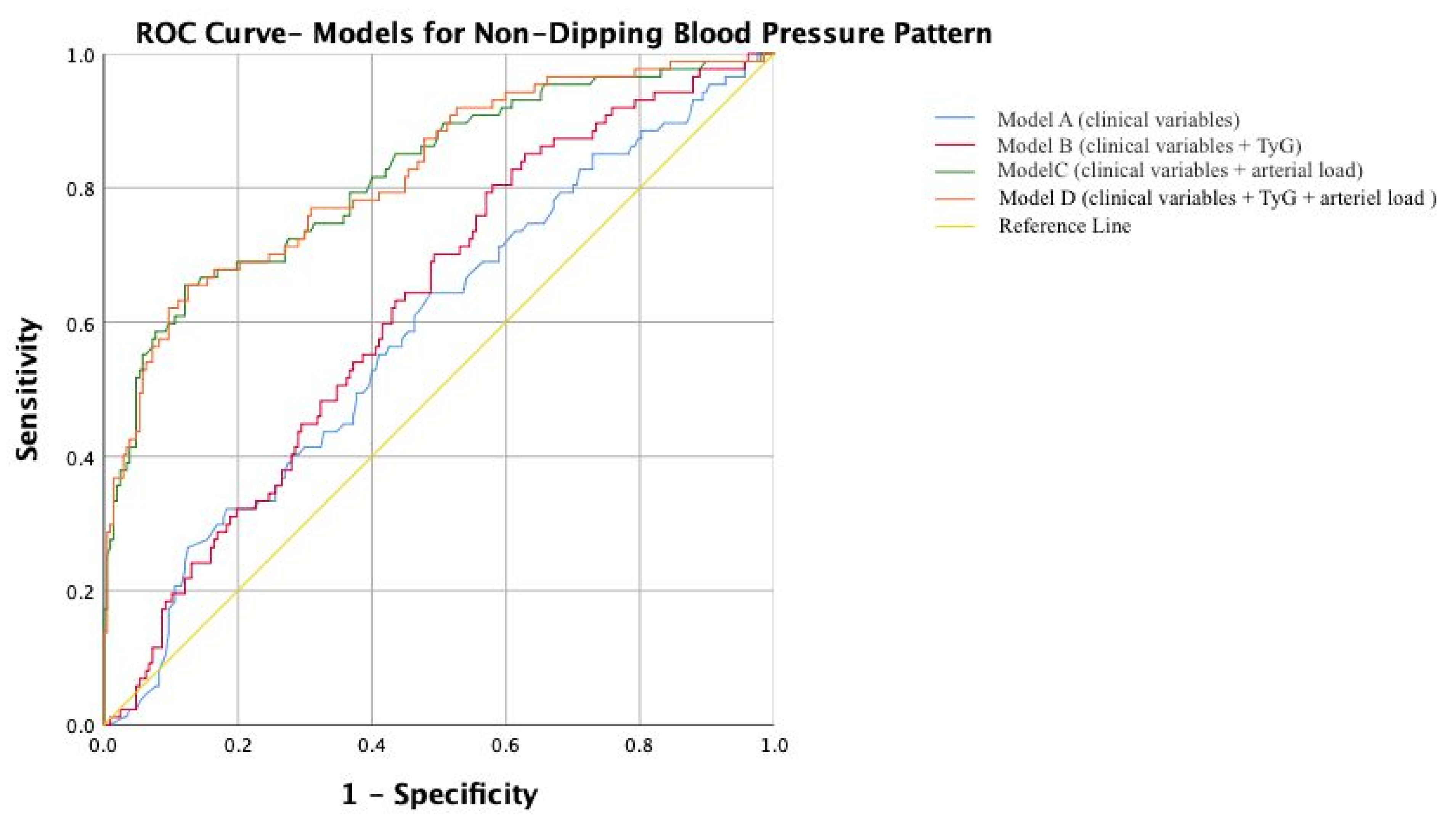
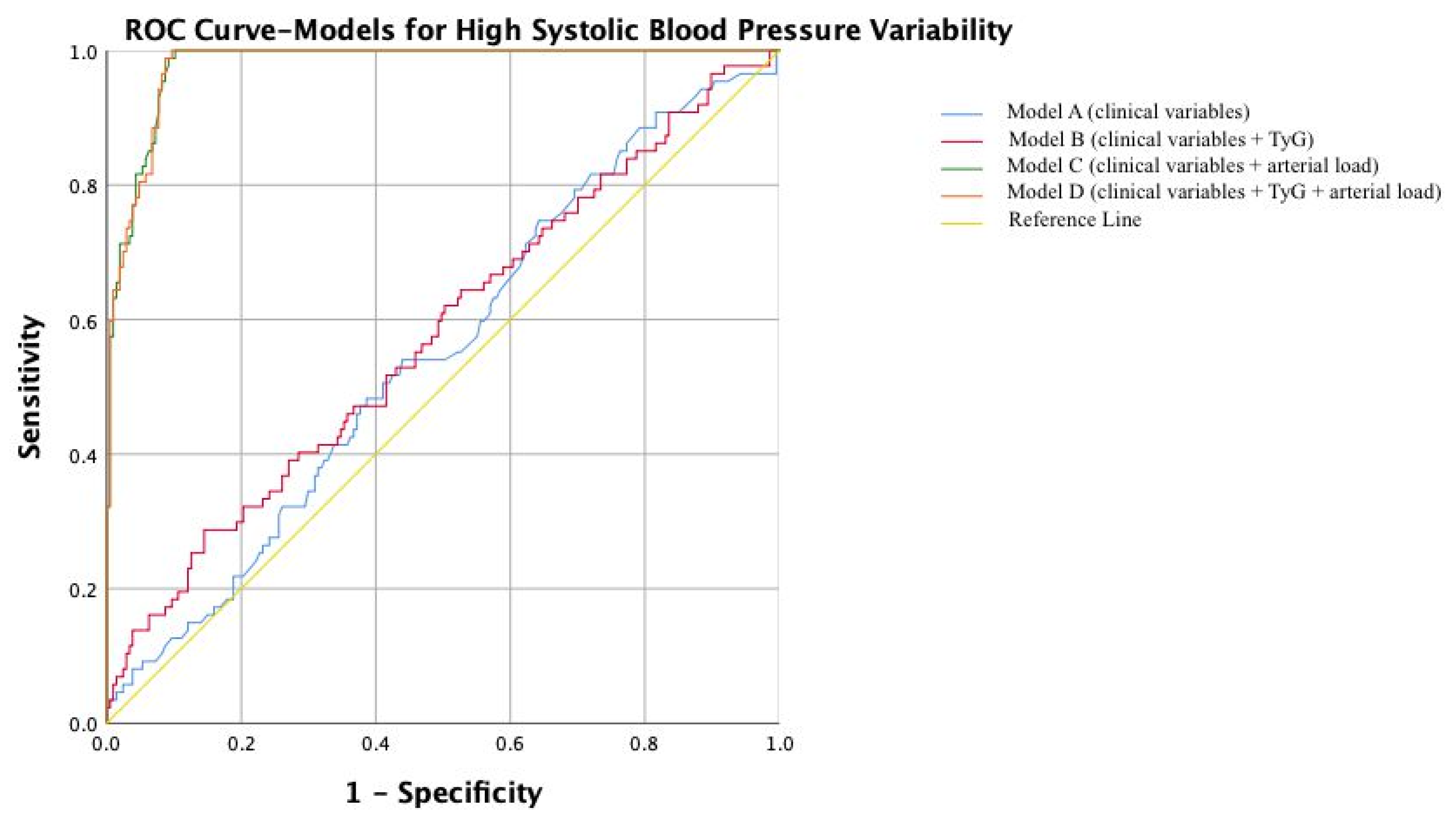
Receiver operating characteristic (ROC) curve analysis was performed to compare the discriminative performance of:
Model A: Clinical variables only;
Model B: Clinical variables + TyG_z;
Model C: Clinical variables + arterial load score (high AASI + high SBP-ARV + high morning surge);
Model D: Clinical variables + TyG_z + arterial load score (high AASI + high SBP-ARV + high morning surge).
The area under the curve (AUC) values were compared using the DeLong test to determine whether the combined model provided superior classification of non-dipping and high BP variability.
Given the presence of quasi-complete separation in some models, penalized maximum likelihood estimation (Firth regression) was additionally performed to ensure unbiased parameter estimation.
Statistical significance was defined as p < 0.05.
3. Results
3.1. Baseline Characteristics
A total of 294 patients were included in the final analysis. The mean age of the study population was 51.8 ± 11.7 years, and 49.7% were male. Diabetes mellitus was present in 8.8% of participants, while 38.8% were receiving antihypertensive treatment at the time of ABPM. The mean fasting plasma glucose level was 98.3 ± 15.5 mg/dL, mean triglyceride level was 155.8 ± 59.9 mg/dL, and the mean TyG index was 8.86 ± 0.41. Baseline demographic, metabolic, and clinical characteristics are summarized in
Table 1.
3.2. Ambulatory Blood Pressure and Variability Parameters
Mean 24 h systolic and diastolic blood pressures were 131.4 ± 11.7 mmHg and 79.2 ± 8.3 mmHg, respectively. The average nocturnal systolic blood pressure dipping was 12.0 ± 5.4%. The mean ambulatory arterial stiffness index (AASI) was 0.45 ± 0.09, systolic blood pressure average real variability (SBP-ARV) was 12.23 ± 3.16 mmHg, and diastolic blood pressure ARV was 8.76 ± 2.38 mmHg. The smoothness index averaged 1.10 ± 0.11, and the mean morning blood pressure surge was 17.5 ± 5.6 mmHg (
Table 1).
The prevalence of abnormal ambulatory phenotypes was as follows: non-dipping pattern in 29.6%, high SBP variability (ARV) in 29.6%, elevated AASI in 15.3%, and exaggerated morning surge in 12.2% of patients. TyG quartiles were evenly distributed across the cohort (Q1–Q4: 25% each) (
Table 1).
3.3. Comparison Between Double-High and Non–Double-High Phenotypes
The double-high phenotype, defined by the coexistence of elevated TyG and high arterial load, was identified in 15 patients. Compared with the non-double-high group, patients with the double-high phenotype exhibited significantly worse metabolic profiles, including higher fasting glucose levels (117.4 ± 24.3 vs. 97.2 ± 13.8 mg/dL), higher triglyceride levels (227.4 ± 64.6 vs. 151.0 ± 57.6 mg/dL), and a markedly higher TyG index (9.42 ± 0.28 vs. 8.82 ± 0.40; all
p < 0.001) (
Table 2).
Ambulatory hemodynamic parameters were also more severely impaired in the double-high group. Although 24 h systolic blood pressure tended to be higher (137.1 ± 10.9 vs. 131.0 ± 11.7 mmHg,
p = 0.051), nighttime systolic blood pressure was significantly elevated (126.0 ± 13.1 vs. 114.2 ± 10.9 mmHg,
p < 0.001), accompanied by a significantly blunted nocturnal dipping percentage (8.0 ± 5.0% vs. 12.7 ± 5.0%,
p = 0.001) (
Table 2).
Indices of arterial stiffness and blood pressure variability were markedly higher in the double-high phenotype. AASI (0.55 ± 0.06 vs. 0.44 ± 0.08,
p < 0.001), SBP-ARV (15.69 ± 1.89 vs. 11.80 ± 2.98 mmHg,
p < 0.001), DBP-ARV (10.16 ± 2.26 vs. 8.57 ± 2.33 mmHg,
p = 0.011), and morning surge (23.62 ± 5.41 vs. 16.95 ± 5.29 mmHg,
p < 0.001) were all significantly increased (
Table 2).
Correspondingly, the prevalence of abnormal ABPM phenotypes was substantially higher in the double-high group, including non-dipping status (73.3% vs. 27.2%), high SBP variability (93.3% vs. 26.2%), and exaggerated morning surge (60.0% vs. 9.7%) (all
p < 0.001) (
Table 2).
3.4. Predictors of Non-Dipping Pattern
In multivariable logistic regression analysis adjusted for age, sex, diabetes mellitus, and antihypertensive treatment, the double-high phenotype emerged as the strongest independent predictor of a non-dipping blood pressure pattern (OR = 42.0, 95% CI 5.18–341.0,
p < 0.001). None of the conventional clinical covariates reached statistical significance (
Table 3).
Penalized Firth logistic regression confirmed the robustness of this association (OR = 11.73, 95% CI 3.61–47.63,
p < 0.001) (
Table 4).
3.5. Predictors of High Systolic Blood Pressure Variability
Similarly, in multivariable logistic regression analysis for high SBP variability, the double-high phenotype was the strongest independent predictor (OR = 41.7, 95% CI 6.02–289.3,
p < 0.001), whereas no traditional clinical variable independently predicted this outcome (
Table 5).
Firth regression yielded consistent results (OR = 26.29, 95% CI 6.15–246.70,
p < 0.001) (
Table 6).
3.6. Discriminative Performance of Predictive Models
For the prediction of non-dipping status, the clinical model demonstrated limited discrimination (AUC = 0.585). Models incorporating TyG alone modestly improved discrimination (AUC = 0.623), whereas arterial load parameters provided substantial discriminatory power (AUC = 0.819). The full model integrating clinical variables, TyG, and arterial load achieved an AUC of 0.821 (
Table 7,
Figure 1).
Similarly, for high SBP variability, the clinical model (AUC = 0.551) and TyG model (AUC = 0.577) showed poor discrimination, while the arterial load model demonstrated excellent performance (AUC = 0.979). The full model yielded a comparable AUC of 0.978 (
Table 7,
Figure 2).
DeLong test comparisons confirmed that arterial load parameters significantly improved model discrimination, whereas the addition of TyG to the arterial load model did not confer a meaningful incremental gain.
4. Discussion
In this ABPM-based study, we demonstrated that the coexistence of elevated metabolic burden (high TyG index) and increased arterial load identifies a distinct hemodynamic phenotype characterized by markedly impaired circadian blood pressure regulation and exaggerated short-term variability. Although TyG has been widely recognized as a surrogate marker of insulin resistance and a predictor of cardiometabolic disorders, our findings indicate that its impact on ambulatory blood pressure patterns becomes clinically meaningful predominantly when accompanied by functional arterial instability.
The association between TyG and blood pressure dysregulation has been previously reported, with several studies showing that higher TyG values are related to incident hypertension, endothelial dysfunction, and arterial stiffening [
18,
19,
20,
21]. However, the magnitude of these associations has generally been modest, and the ability of TyG to discriminate high-risk ABPM phenotypes has remained limited. Consistent with earlier observations, TyG alone showed only weak discriminatory power in our cohort, suggesting that metabolic stress may be associated with ambulatory BP instability primarily in conjunction with other hemodynamic or vascular factors rather than acting as a direct trigger on its own [
22].
In contrast, arterial load emerged as the dominant determinant of both non-dipping status and systolic BP variability. Importantly, ROC analyses indicated that arterial load accounted for most of the discriminative performance for both outcomes, whereas adding TyG to arterial load provided minimal incremental gain. Therefore, TyG appears to function primarily as a metabolic modifier rather than a dominant determinant of ambulatory BP instability in this cohort. Measures such as AASI, short-term BP variability, and morning surge reflect impaired autonomic regulation, increased vascular stiffness, and heightened sympathetic reactivity-factors strongly associated with cardiovascular morbidity and mortality [
23,
24,
25]. Previous studies have shown that increased BP variability and blunted nocturnal dipping are linked to stroke, heart failure, and renal dysfunction, independent of mean BP levels [
26,
27]. Our findings reinforce the concept that ambulatory hemodynamic instability captures pathophysiological dimensions not adequately explained by traditional risk markers. Importantly, ABPM provides a dynamic assessment of blood pressure behavior that extends beyond static office measurements. Circadian patterns, short-term variability, and morning surge reflect complex interactions between vascular structure, autonomic regulation, and environmental stressors. As such, ABPM-derived phenotypes may uncover high-risk hemodynamic profiles that remain clinically silent when evaluated solely by conventional clinic blood pressure values.
A key contribution of this study is the identification of a synergistic interaction between metabolic burden and arterial instability. The combined “double-high” phenotype was associated with dramatically increased odds of both non-dipping and high systolic BP variability—far exceeding the effects of either component alone. From a pathophysiological perspective, insulin resistance is known to promote a proinflammatory and pro-oxidative vascular milieu, leading to endothelial dysfunction, impaired nitric oxide bioavailability, and increased arterial stiffness. These alterations may not uniformly translate into overt ambulatory blood pressure abnormalities; however, when combined with functional arterial instability, they may facilitate exaggerated blood pressure variability and circadian dysregulation. In this context, arterial load may be viewed as the functional conduit through which metabolic vulnerability becomes clinically manifest during daily blood pressure fluctuations. Although bias-reduced Firth penalized regression was applied to mitigate sparse-data bias, the magnitude of the observed odds ratios should be interpreted cautiously, as effect-size inflation remains possible in very small subgroups and confidence intervals remain wide. This pattern suggests a threshold phenomenon: once metabolic stress compromises endothelial and microvascular function, arterial stiffness and autonomic dysregulation may precipitate overt ambulatory BP abnormalities [
28,
29]. Such synergy is consistent with mechanistic studies showing that insulin resistance amplifies sympathetic tone, reduces nitric oxide bioavailability, and accelerates elastin–collagen imbalance in the arterial wall [
30,
31]. Under these conditions, the vasculature becomes highly sensitive to hemodynamic triggers, resulting in unstable circadian and short-term BP patterns.
The findings also provide insight into the heterogeneous cardiovascular risk trajectories observed among individuals with elevated TyG. Not all patients with insulin resistance develop severe ambulatory abnormalities, and this variability may reflect individual differences in arterial compliance and autonomic responsiveness [
32]. Our results suggest that arterial load may represent a complementary or amplifying factor that is associated with the manifestation of clinically meaningful ambulatory BP abnormalities in metabolically vulnerable individuals.
From a clinical perspective, the double-high phenotype may represent a previously unrecognized high-risk endotype within the hypertensive population. Patients with this phenotype demonstrated profound nocturnal BP loss, extreme BP variability, and markedly exaggerated morning surge—patterns known to predict stroke, acute coronary events, and cognitive decline [
33,
34]. These findings suggest potential applications for targeted ABPM-based risk stratification and consideration of individualized chronotherapy or intensive lifestyle/metabolic interventions.
Nonetheless, several considerations must temper these interpretations. The cross-sectional design precludes causal inference, and longitudinal studies are required to determine whether the double-high phenotype predicts incident cardiovascular events or therapeutic responsiveness. Additionally, arterial load was defined using ABPM-derived functional measures rather than imaging-based stiffness indices. However, these metrics have been shown to correlate strongly with vascular dysfunction and are widely used in clinical and research settings.
In summary, the coexistence of high metabolic burden and high arterial instability identifies a distinct and particularly high-risk ambulatory blood pressure phenotype. Accordingly, any potential clinical applications should be interpreted as exploratory and hypothesis-generating, rather than as direct therapeutic recommendations. Metabolic burden alone is insufficient to generate adverse ABPM features unless accompanied by impaired vascular and autonomic regulation. Integrating TyG with ABPM-derived arterial load measures enables refined risk stratification and reveals a synergistic pathway linking insulin resistance biology to circadian and dynamic BP dysregulation.
5. Clinical Implications
The findings of this study highlight a clinically meaningful endotype in which metabolic burden and arterial instability converge to produce severe ambulatory blood pressure disruption. Routine use of the TyG index together with ABPM-derived arterial load metrics may enable earlier identification of individuals at disproportionately high hemodynamic risk despite modest clinical blood pressure levels. Patients classified as having the double-high phenotype—though relatively uncommon—demonstrate profound nocturnal BP dysregulation and extreme short-term variability, patterns strongly linked to stroke, acute coronary events, and target-organ damage.
Recognition of this phenotype may help identify individuals who warrant closer ambulatory monitoring and further metabolic evaluation. Potential implications for personalized treatment strategies remain hypothesis-generating and should be explored in longitudinal and interventional studies. Integrating metabolic and hemodynamic assessments may therefore refine risk stratification beyond conventional clinic BP measurements and support a more precise, mechanism-oriented approach to hypertension management. In clinical practice, such integrative phenotyping may be particularly relevant for patients with apparently controlled office blood pressure but persistent cardiometabolic risk. Identifying individuals with concurrent metabolic vulnerability and arterial instability may prompt closer ambulatory surveillance and reinforce the importance of comprehensive risk assessment that incorporates both metabolic and hemodynamic domains. Nevertheless, these potential applications should be interpreted cautiously and primarily serve as a framework for future prospective and interventional research.
6. Limitations
This study has several limitations that should be acknowledged. First, its cross-sectional and retrospective design precludes any causal inference regarding the temporal relationship between metabolic burden, arterial load, and ambulatory blood pressure abnormalities. Longitudinal cohort studies are required to determine whether the double-high phenotype predicts incident cardiovascular events or progression of hypertension.
Second, arterial load was defined using ABPM-derived functional indices (AASI, BP variability, and morning surge) rather than imaging-based or invasive measures of vascular structure. Although these parameters are validated surrogates of vascular dysfunction, they may not fully capture structural arterial changes.
Third, the number of individuals classified as having the double-high phenotype was relatively small. This reflects the true rarity of this extreme-risk subgroup but may have contributed to quasi-complete separation in logistic regression models and to wide confidence intervals, despite the use of bias-reduced Firth estimation.
Fourth, insulin resistance was estimated using the TyG index rather than gold-standard methods such as the hyperinsulinemic-euglycemic clamp. Although TyG is widely accepted and highly correlated with insulin resistance, some degree of misclassification is possible and would likely bias results toward the null.
Fifth, antihypertensive medications were included as a binary variable, without detailed stratification by drug class, dose, or chronotherapy regimen. Residual confounding related to pharmacologic effects on circadian blood pressure patterns cannot be excluded.
Finally, this was a single-center study conducted in a specific regional population, which may limit generalizability. In addition, because patients with established cardiovascular disease were excluded, the findings may not directly generalize to higher-risk populations routinely encountered in tertiary cardiovascular clinics. External validation in independent cohorts with more diverse demographic and clinical characteristics is warranted.
7. Conclusions
In this ABPM-based cohort, the coexistence of elevated metabolic burden and increased arterial load identified a distinct hemodynamic endotype characterized by markedly impaired nocturnal blood pressure decline and exaggerated short-term systolic variability. While the TyG index alone demonstrated limited discriminatory capacity for adverse ambulatory phenotypes, arterial load emerged as the principal driver of circadian and dynamic BP instability. The combined “double-high” phenotype exhibited a dramatically amplified risk profile, suggesting a synergistic interaction between metabolic vulnerability and functional arterial dysfunction.
These findings indicate that metabolic stress translates into clinically significant ambulatory blood pressure derangement primarily in the presence of an unstable arterial substrate. Integrating TyG with ABPM-derived arterial load metrics may therefore improve risk stratification and help identify a small but clinically meaningful subgroup of patients who may benefit from intensified follow-up, more comprehensive metabolic evaluation, and individualized therapeutic strategies.
Author Contributions
A.Y.: Conceptualization; Methodology; Software; Validation; Formal analysis; Investigation; Data curation; Writing—original draft preparation; Writing—review and editing; Visualization; Project administration. A.E.: Validation; Investigation; Resources; Writing—review and editing; Supervision. All authors have read and agreed to the published version of the manuscript.
Funding
This research did not receive any specific grant from funding agencies in the public, commercial, or not-for-profit sectors. The article processing charge (APC) will be covered by the authors.
Institutional Review Board Statement
This study complies with all relevant national regulations, institutional policies, and the principles of the Declaration of Helsinki and has been approved by the Clinical Research Ethics Committee of Karamanoğlu Mehmetbey University Faculty of Medicine (dated 16 October 2025, approval number: 24-2025/21).
Informed Consent Statement
Not applicable. This study does not contain any individual person’s data in any form (including images, videos, or identifiable clinical details).
Data Availability Statement
The datasets generated and/or analyzed during the current study are not publicly available due to institutional restrictions on sharing patient-level clinical data, but are available from the corresponding author (A.Y.) on reasonable request and with the permission of Karamanoğlu Mehmetbey University Faculty of Medicine.
Conflicts of Interest
The authors declare that they have no competing interests.
Abbreviations
| AASI | Ambulatory Arterial Stiffness Index |
| ABPM | Ambulatory Blood Pressure Monitoring |
| ARV | Average Real Variability |
| AUC | Area Under the Curve |
| BP | Blood Pressure |
| DBP | Diastolic Blood Pressure |
| FPG | Fasting Plasma Glucose |
| HDL-C | High-Density Lipoprotein Cholesterol |
| LDL-C | Low-Density Lipoprotein Cholesterol |
| OR | Odds Ratio |
| PWV | Pulse Wave Velocity |
| ROC | Receiver Operating Characteristic |
| SBP | Systolic Blood Pressure |
| SD | Standard Deviation |
| SI | Smoothness Index |
| TyG | Triglyceride–Glucose Index |
| TyG_z | Z-standardized Triglyceride–Glucose Index |
References
- World Health Organization. Global Report on Hypertension: The Race Against a Silent Killer; World Health Organization: Geneva, Switzerland, 2023. [Google Scholar]
- O’Brien, E.; Parati, G.; Stergiou, G.; Asmar, R.; Beilin, L.; Bilo, G.; Clement, D.; de la Sierra, A.; de Leeuw, P.; Dolan, E.; et al. European Society of Hypertension position paper on ambulatory blood pressure monitoring. J. Hypertens. 2013, 31, 1731–1768. [Google Scholar] [CrossRef] [Scilit]
- Fagard, R.H.; Thijs, L.; Staessen, J.A.; Clement, D.L.; De Buyzere, M.L.; De Bacquer, D.A. Night–day blood pressure ratio and dipping pattern as predictors of death and cardiovascular events in hypertension. J. Hum. Hypertens. 2009, 23, 645–653. [Google Scholar] [CrossRef] [Scilit] [PubMed]
- Kario, K. Morning surge in blood pressure and cardiovascular risk: Evidence and perspectives. Hypertension 2010, 56, 765–773. [Google Scholar] [PubMed]
- Stevens, S.L.; Wood, S.; Koshiaris, C.; Law, K.; Glasziou, P.; Stevens, R.J.; McManus, R.J. Blood pressure variability and cardiovascular disease: Systematic review and meta-analysis. BMJ 2016, 354, i4098. [Google Scholar] [CrossRef] [Scilit] [PubMed]
- Parati, G.; Ochoa, J.E.; Lombardi, C.; Bilo, G. Assessment and management of blood pressure variability. Nat. Rev. Cardiol. 2013, 10, 143–155. [Google Scholar] [CrossRef] [Scilit]
- Reaven, G.M. Insulin resistance: The link between obesity and cardiovascular disease. Endocrinol. Metab. Clin. N. Am. 2008, 37, 581–601. [Google Scholar] [CrossRef] [Scilit]
- Ferrannini, E.; Buzzigoli, G.; Bonadonna, R.; Giorico, M.A.; Oleggini, M.; Graziadei, L.; Pedrinelli, R.; Brandi, L.; Bevilacqua, S. Insulin resistance in essential hypertension. N. Engl. J. Med. 1987, 317, 350–357. [Google Scholar]
- Simental-Mendía, L.E.; Rodríguez-Morán, M.; Guerrero-Romero, F. The product of fasting glucose and triglycerides as surrogate for identifying insulin resistance in apparently healthy subjects. Metab. Syndr. Relat. Disord. 2008, 6, 299–304. [Google Scholar] [CrossRef] [Scilit]
- Zheng, R.; Mao, Y. Triglyceride and glucose (TyG) index as a predictor of incident hypertension: A 9-year longitudinal population-based study. Lipids Health Dis. 2017, 16, 175. [Google Scholar]
- da Silva, A.; Caldas, A.P.S.; Rocha, D.M.U.P.; Bressan, J. Triglyceride-glucose index predicts independently type 2 diabetes mellitus risk: A systematic review and meta-analysis of cohort studies. Prim. Care Diabetes 2020, 14, 584–593. [Google Scholar] [CrossRef] [Scilit]
- Zhao, M.; Chen, Y.; Wang, M.; Wang, C.; Yao, S.; Li, Y.; Zhang, S.; Yun, C.; Wu, S.; Xue, H. Relationship between resting heart rate and incident heart failure in patients with hypertension: The Kailuan Cohort Study in China. J. Clin. Hypertens. 2020, 22, 2325–2331. [Google Scholar] [CrossRef] [Scilit]
- Cai, Y.; Sha, W.; Deng, H.; Zhang, T.; Yang, L.; Wu, Y.; Luo, J.; Liu, G.; Yang, Y.; Feng, D. Correlation between the triglyceride-glucose index and arterial stiffness in Japanese individuals with normoglycaemia: A cross-sectional study. BMC Endocr. Disord. 2024, 24, 30. [Google Scholar] [CrossRef] [Scilit] [PubMed]
- Won, K.B.; Park, G.M.; Lee, S.E.; Cho, I.J.; Kim, H.C.; Lee, B.K.; Chang, H.J. Relationship of insulin resistance estimated by triglyceride glucose index to arterial stiffness. Lipids Health Dis. 2018, 17, 268. [Google Scholar] [PubMed]
- Muhammad, I.F.; Bao, X.; Nilsson, P.M.; Zaigham, S. Triglyceride-glucose (TyG) index is a predictor of arterial stiffness, incidence of diabetes, cardiovascular disease, and all-cause and cardiovascular mortality: A longitudinal two-cohort analysis. Front. Cardiovasc. Med. 2023, 9, 1035105. [Google Scholar]
- Lu, Y.-W.; Chang, C.-C.; Chou, R.-H.; Tsai, Y.-L.; Liu, L.-K.; Chen, L.-K.; Huang, P.-H.; Lin, S.-J. Gender difference in the association between TyG index and subclinical atherosclerosis: Results from the I-Lan Longitudinal Aging Study. Cardiovasc. Diabetol. 2021, 20, 206. [Google Scholar]
- McEvoy, J.W.; McCarthy, C.P.; Bruno, R.M.; Brouwers, S.; Canavan, M.D.; Ceconi, C.; Christodorescu, R.M.; Daskalopoulou, S.S.; Ferro, C.J.; Gerdts, E.; et al. 2024 ESC Guidelines for the management of elevated blood pressure and hypertension: Developed by the task force on the management of elevated blood pressure and hypertension of the European Society of Cardiology (ESC) and endorsed by the European Society of Endocrinology (ESE) and the European Stroke Organisation (ESO). Eur. Heart J. 2024, 45, 3912–4018. [Google Scholar]
- Luo, Q.; Li, N.; Zhu, Q.; Yao, X.; Wang, M.; Heizhati, M.; Cai, X.; Hu, J.; Abulimiti, A.; Yao, L.; et al. Non-dipping blood pressure pattern is associated with higher risk of new-onset diabetes in hypertensive patients with obstructive sleep apnea: UROSAH data. Front. Endocrinol. 2023, 14, 1083179. [Google Scholar] [CrossRef] [Scilit]
- Lee, S.B.; Ahn, C.W.; Lee, B.K.; Kang, S.; Nam, J.S.; You, J.H.; Kim, M.J.; Kim, M.K.; Park, J.S. Association between triglyceride glucose index and arterial stiffness in Korean adults. Cardiovasc. Diabetol. 2018, 17, 41. [Google Scholar] [CrossRef] [Scilit]
- Lopez-Jaramillo, P.; Gomez-Arbelaez, D.; Martinez-Bello, D.; Abat, M.E.M.; Alhabib, K.F.; Avezum, Á.; Barbarash, O.; Chifamba, J.; Diaz, M.L.; Gulec, S.; et al. Association of the triglyceride glucose index as a measure of insulin resistance with mortality and cardiovascular disease in populations from five continents (PURE study): A prospective cohort study. Lancet Healthy Longev. 2023, 4, e23–e33. [Google Scholar] [CrossRef] [Scilit]
- Lukito, A.A.; Kamarullah, W.; Huang, I.; Pranata, R. Association between triglyceride-glucose index and hypertension: A systematic review and meta-analysis. Narra J 2024, 4, e951. [Google Scholar] [CrossRef] [Scilit]
- Guerrero-Romero, F.; Simental-Mendía, L.E.; González-Ortiz, M.; Martínez-Abundis, E.; Ramos-Zavala, M.G.; Hernández-González, S.O.; Jacques-Camarena, O.; Rodríguez-Morán, M. The product of triglycerides and glucose, a simple measure of insulin sensitivity. Comparison with the euglycemic-hyperinsulinemic clamp. J. Clin. Endocrinol. Metab. 2010, 95, 3347–3351. [Google Scholar] [CrossRef] [Scilit]
- Kikuya, M.; Hozawa, A.; Ohokubo, T.; Tsuji, I.; Michimata, M.; Matsubara, M.; Ota, M.; Nagai, K.; Araki, T.; Satoh, H.; et al. Prognostic significance of blood pressure and heart rate variabilities: The Ohasama study. Hypertension 2000, 36, 901–906. [Google Scholar] [PubMed]
- Parati, G.; Stergiou, G.S.; Dolan, E.; Bilo, G. Blood pressure variability: Clinical relevance and application. J. Clin. Hypertens. 2018, 20, 1133–1137. [Google Scholar] [CrossRef] [Scilit] [PubMed]
- Hansen, T.W.; Li, Y.; Boggia, J.; Thijs, L.; Richart, T.; Staessen, J.A. Predictive role of the nighttime blood pressure: A population-based study. Hypertension 2011, 57, 3–10. [Google Scholar] [CrossRef] [Scilit] [PubMed]
- Mancia, G.; Verdecchia, P. Clinical value of ambulatory blood pressure: Evidence and limits. Circ. Res. 2015, 116, 1034–1045. [Google Scholar]
- Dolan, E.; Stanton, A.; Thijs, L.; Hinedi, K.; Atkins, N.; McClory, S.; Den Hond, E.; McCormack, P.; Staessen, J.A.; O’Brien, E. Superiority of ambulatory over clinic blood pressure measurement in predicting mortality: The Dublin outcome study. Hypertension 2005, 46, 156–161. [Google Scholar]
- AlGhatrif, M.; Lakatta, E.G. The conundrum of arterial stiffness, elevated blood pressure, and aging. Curr. Hypertens. Rep. 2015, 17, 12. [Google Scholar] [CrossRef] [Scilit]
- Palatini, P.; Casiglia, E.; Gąsowski, J.; Głuszek, J.; Jankowski, P.; Narkiewicz, K.; Saladini, F.; Stolarz-Skrzypek, K.; Tikhonoff, V.; Van Bortel, L.; et al. Arterial stiffness, central hemodynamics, and cardiovascular risk in hypertension. Vasc. Health Risk Manag. 2011, 7, 725–739. [Google Scholar]
- Webb, D.R.; Khunti, K.; Silverman, R.; Gray, L.J.; Srinivasan, B.; Lacy, P.S.; Williams, B.; Davies, M.J. Impact of metabolic indices on central artery stiffness: Independent association of insulin resistance and glucose with aortic pulse wave velocity. Diabetologia 2010, 53, 1190–1198. [Google Scholar] [CrossRef] [Scilit]
- Potenza, M.A.; Gagliardi, S.; Nacci, C.; Carratu, M.R.; Montagnani, M. Endothelial dysfunction in diabetes: From mechanisms to therapeutic targets. Curr. Med. Chem. 2009, 16, 94–112. [Google Scholar]
- Benetos, A.; Laurent, S.; Asmar, R.G.; Lacolley, P. Large artery stiffness in hypertension. J. Hypertens. 1997, 15, S89–S97. [Google Scholar]
- Kario, K.; Pickering, T.G.; Umeda, Y.; Hoshide, S.; Hoshide, Y.; Morinari, M.; Murata, M.; Kuroda, T.; Schwartz, J.E.; Shimada, K. Morning surge in blood pressure as a predictor of silent and clinical cerebrovascular disease in elderly hypertensives: A prospective study. Circulation 2003, 107, 1401–1406. [Google Scholar]
- Redon, J.; Cifkova, R.; Laurent, S.; Nilsson, P.; Narkiewicz, K.; Erdine, S.; Mancia, G.; Scientific Council of the European Society of Hypertension. The metabolic syndrome in hypertension: European society of hypertension position statement. J. Hypertens. 2008, 26, 1891–1900. [Google Scholar]
| Disclaimer/Publisher’s Note: The statements, opinions and data contained in all publications are solely those of the individual author(s) and contributor(s) and not of MDPI and/or the editor(s). MDPI and/or the editor(s) disclaim responsibility for any injury to people or property resulting from any ideas, methods, instructions or products referred to in the content. |