Repurposing Renin–Angiotensin System Drugs for the Treatment of Audiovestibular Disorders
 , , ,
, , ,
Abstract
1. Introduction
2. Sensorineural Hearing Loss (SNHL)
2.1. Epidemiology of SNHL
2.2. Pathophysiology of SNHL
2.3. Current Treatments for SNHL
2.4. RAS-Targeted Therapies for Hearing Loss
3. Tinnitus
3.1. Epidemiology of Tinnitus
3.2. Pathophysiology of Tinnitus
3.3. Current Treatments for Tinnitus
3.4. RAS-Targeted Therapies for Tinnitus
4. Vertigo
4.1. Epidemiology of Vertigo
4.2. Pathophysiology of Vertigo
4.3. Current Treatments for Vertigo
4.4. RAS Signaling and Inner Ear Ion Homeostasis in Vertigo
4.5. The RAS and the Blood-Labyrinth Barrier in Vertigo
5. Repurposing RAS-Targeted Therapies for Audiovestibular Disorders
5.1. RAS as a Therapeutic Target
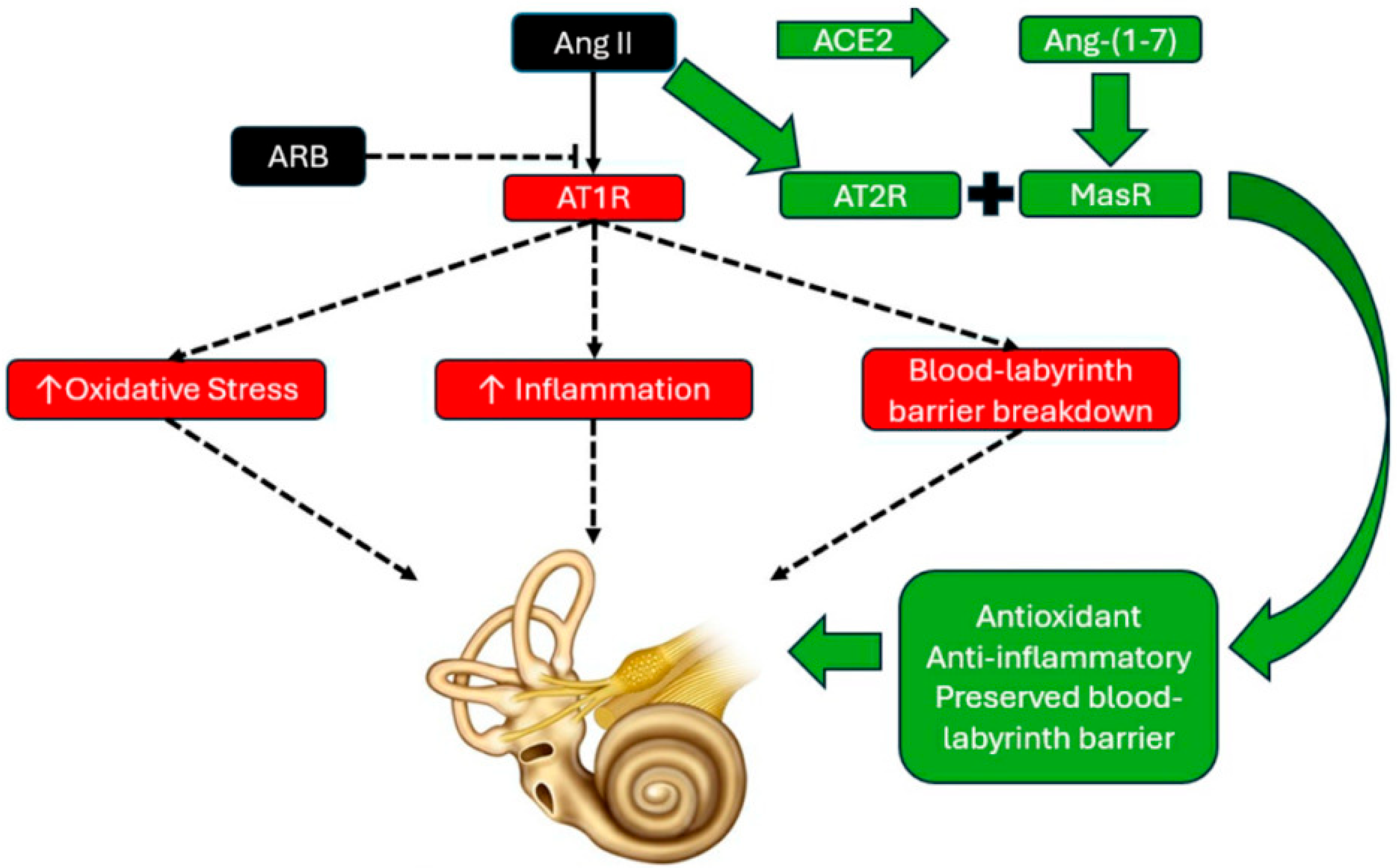
5.2. The Protective Arm of the RAS: AT2R, Mas Receptor, Ang-(1-7), ACE2, and Alamandine
6. Conclusions
Author Contributions
Funding
Institutional Review Board Statement
Informed Consent Statement
Data Availability Statement
Acknowledgments
Conflicts of Interest
Abbreviations
| RAS | Renin–angiotensin system |
| ARBs | Angiotensin II type 1 receptor blockers |
| SNHL | Sensorineural hearing loss |
| PPPD | Persistent postural-perceptual dizziness |
| VS | Vestibular schwannoma |
| NIHL | Noise-induced hearing loss |
| SSNHL | Sudden sensorineural hearing loss |
| AIED | Autoimmune inner ear disease |
| ROS | Reactive oxidative species |
| RNS | Reactive nitrogen species |
| NF-κB | Nuclear factor kappa B |
| PPARγ | Peroxisome proliferator-activated receptor γ |
| HPD | Hearing protection devices |
| CROS | Contralateral routing of sound |
| MD | Meniere’s disease |
| TBI | Traumatic brain injury |
| TRT | Tinnitus retraining therapy |
| CBT | Cognitive behavioral therapy |
| BPPV | Benign paroxysmal peripheral vertigo |
| AQP | Aquaporin |
| V2R | Vasopressin-type 2 receptors |
| VN | Vestibular neuritis |
| Ang II | Angiotensin II |
| AVP | Arginine vasopressin |
| ENaC | Epithelial sodium channels |
| Ang I | Angiotensin I |
| ACE | Angiotensin-converting enzyme |
| AT1R | Angiotensin II type 1 receptor |
| ADH | Antidiuretic hormone |
| ACE-i | Angiotensin-converting enzyme inhibitor |
| MasR | Mas receptor |
| AT2R | Angiotensin II type 2 receptor |
| Ang-(1-7) | Angiotensin-(1-7) |
| Ang-(1-9) | Angiotensin-(1-9) |
| ACE2 | Angiotensin-converting enzyme type 2 |
| BLB | Blood–labyrinth barrier |
| BBB | Blood–brain barrier |
References
- Lin, F.R.; Thorpe, R.; Gordon-Salant, S.; Ferrucci, L. Hearing loss prevalence and risk factors among older adults in the United States. J. Gerontol. A Biol. Sci. Med. Sci. 2011, 66, 582–590. [Google Scholar] [CrossRef]
- Sereda, M.; Xia, J.; El Refaie, A.; Hall, D.A.; Hoare, D.J. Sound therapy (using amplification devices and/or sound generators) for tinnitus. Cochrane Database Syst. Rev. 2018, 12, CD013094. [Google Scholar] [CrossRef] [PubMed]
- Bauer, C.A. Tinnitus. N. Engl. J. Med. 2018, 378, 1224–1231. [Google Scholar] [CrossRef]
- Neuhauser, H.K. The epidemiology of dizziness and vertigo. Handb. Clin. Neurol. 2016, 137, 67–82. [Google Scholar] [CrossRef] [PubMed]
- Boedts, M.; Buechner, A.; Khoo, S.G.; Gjaltema, W.; Moreels, F.; Lesinski-Schiedat, A.; Becker, P.; MacMahon, H.; Vixseboxse, L.; Taghavi, R.; et al. Combining sound with tongue stimulation for the treatment of tinnitus: A multi-site single-arm controlled pivotal trial. Nat. Commun. 2024, 15, 6806. [Google Scholar] [CrossRef] [PubMed]
- Lee, K.H.; Kim, M.H.; Kim, J.; Nam, H.J. Acupuncture for Tinnitus: A Scoping Review of Clinical Studies. Complement. Med. Res. 2024, 31, 292–301. [Google Scholar] [CrossRef]
- Michiels, S.; Naessens, S.; Van de Heyning, P.; Braem, M.; Visscher, C.M.; Gilles, A.; De Hertogh, W. The Effect of Physical Therapy Treatment in Patients with Subjective Tinnitus: A Systematic Review. Front. Neurosci. 2016, 10, 545. [Google Scholar] [CrossRef]
- Choe, G.; Hwang, J.H. Korean medicine combination treatment for chronic tinnitus unresponsive to conventional treatment: A case report and review of literature. World J. Clin. Cases 2025, 13, 103200. [Google Scholar] [CrossRef]
- Ho, L.F.; Guo, Y.; Chen, L.; Fung, H.; Mak, W.Y.; Cheung, S.C.; Tsang, P.H.; Chen, M.; Chan, K.L.; Zhang, H.; et al. Efficacy and safety of electroacupuncture and electroacupuncture combined with warm needling for subjective tinnitus: A multicenter, three-arm randomized controlled trial. Complement. Ther. Med. 2025, 91, 103191. [Google Scholar] [CrossRef]
- Wu, Q.; Wang, J.; Han, D.; Hu, H.; Gao, H. Efficacy and safety of acupuncture and moxibustion for primary tinnitus: A systematic review and meta-analysis. Am. J. Otolaryngol. 2023, 44, 103821. [Google Scholar] [CrossRef]
- Strupp, M.; Brandt, T. Diagnosis and treatment of vertigo and dizziness. Dtsch. Arztebl. Int. 2008, 105, 173–180. [Google Scholar] [CrossRef] [PubMed]
- Basura, G.J.; Adams, M.E.; Monfared, A.; Schwartz, S.R.; Antonelli, P.J.; Burkard, R.; Bush, M.L.; Bykowski, J.; Colandrea, M.; Derebery, J.; et al. Clinical Practice Guideline: Meniere’s Disease. Otolaryngol. Head Neck Surg. 2020, 162, S1–S55. [Google Scholar] [CrossRef]
- Mowry, F.E.; Peaden, S.C.; Stern, J.E.; Biancardi, V.C. TLR4 and AT1R mediate blood-brain barrier disruption, neuroinflammation, and autonomic dysfunction in spontaneously hypertensive rats. Pharmacol. Res. 2021, 174, 105877. [Google Scholar] [CrossRef] [PubMed]
- Biancardi, V.C.; Son, S.J.; Ahmadi, S.; Filosa, J.A.; Stern, J.E. Circulating angiotensin II gains access to the hypothalamus and brain stem during hypertension via breakdown of the blood-brain barrier. Hypertension 2014, 63, 572–579. [Google Scholar] [CrossRef]
- Wilkinson-Berka, J.L.; Suphapimol, V.; Jerome, J.R.; Deliyanti, D.; Allingham, M.J. Angiotensin II and aldosterone in retinal vasculopathy and inflammation. Exp. Eye Res. 2019, 187, 107766. [Google Scholar] [CrossRef]
- Chrysant, S.G. The pathophysiologic role of the brain renin-angiotensin system in stroke protection: Clinical implications. J. Clin. Hypertens. 2007, 9, 454–459. [Google Scholar] [CrossRef]
- Wu, L.; Vasilijic, S.; Sun, Y.; Chen, J.; Landegger, L.D.; Zhang, Y.; Zhou, W.; Ren, J.; Early, S.; Yin, Z.; et al. Losartan prevents tumor-induced hearing loss and augments radiation efficacy in NF2 schwannoma rodent models. Sci. Transl. Med. 2021, 13, eabd4816. [Google Scholar] [CrossRef]
- Bowl, M.R.; Dawson, S.J. Age-Related Hearing Loss. Cold Spring Harb. Perspect. Med. 2019, 9, a033217. [Google Scholar] [CrossRef]
- Collins, J.G. Prevalence of Selected Chronic Conditions: United States, 1990–1992; Vital Health Stat 10; National Center for Health: Tokyo, Japan, 1997; pp. 1–89. [Google Scholar]
- Tomida, K.; Shimoda, T.; Nakajima, C.; Kawakami, A.; Shimada, H. Risk of dementia with hearing impairment and social isolation. Alzheimers Dement. 2024, 16, e12586. [Google Scholar] [CrossRef]
- Oishi, N.; Schacht, J. Emerging treatments for noise-induced hearing loss. Expert. Opin. Emerg. Drugs 2011, 16, 235–245. [Google Scholar] [CrossRef] [PubMed]
- Fetoni, A.R.; Pisani, A.; Rolesi, R.; Paciello, F.; Viziano, A.; Moleti, A.; Sisto, R.; Troiani, D.; Paludetti, G.; Grassi, C. Early Noise-Induced Hearing Loss Accelerates Presbycusis Altering Aging Processes in the Cochlea. Front. Aging Neurosci. 2022, 14, 803973. [Google Scholar] [CrossRef] [PubMed]
- Masterson, E.A.; Bushnell, P.T.; Themann, C.L.; Morata, T.C. Hearing Impairment Among Noise-Exposed Workers—United States, 2003–2012. MMWR. Morb. Mortal. Wkly. Rep. 2016, 65, 389–394. [Google Scholar] [CrossRef]
- Tak, S.; Davis, R.R.; Calvert, G.M. Exposure to hazardous workplace noise and use of hearing protection devices among US workers—NHANES, 1999–2004. Am. J. Ind. Med. 2009, 52, 358–371. [Google Scholar] [CrossRef]
- Wu, T.; Zhao, Z.; Wang, P.; Du, Q.; Shi, Y.; Zhu, B.; Dong, J.; Li, D. Drug-induced hearing loss: A real-world pharmacovigilance study using the FDA adverse event reporting system database. Hear. Res. 2025, 461, 109262. [Google Scholar] [CrossRef]
- Dillard, L.K.; Martinez, R.X.; Perez, L.L.; Fullerton, A.M.; Chadha, S.; McMahon, C.M. Prevalence of aminoglycoside-induced hearing loss in drug-resistant tuberculosis patients: A systematic review. J. Infect. 2021, 83, 27–36. [Google Scholar] [CrossRef] [PubMed]
- Dillard, L.K.; Lopez-Perez, L.; Martinez, R.X.; Fullerton, A.M.; Chadha, S.; McMahon, C.M. Global burden of ototoxic hearing loss associated with platinum-based cancer treatment: A systematic review and meta-analysis. Cancer Epidemiol. 2022, 79, 102203. [Google Scholar] [CrossRef]
- Yang, W.; Zhao, X.; Chai, R.; Fan, J. Progress on mechanisms of age-related hearing loss. Front. Neurosci. 2023, 17, 1253574. [Google Scholar] [CrossRef]
- Gates, G.A.; Mills, J.H. Presbycusis. Lancet 2005, 366, 1111–1120. [Google Scholar] [CrossRef]
- Natarajan, N.; Batts, S.; Stankovic, K.M. Noise-Induced Hearing Loss. J. Clin. Med. 2023, 12, 2347. [Google Scholar] [CrossRef]
- Tan, W.J.T.; Song, L. Role of mitochondrial dysfunction and oxidative stress in sensorineural hearing loss. Hear. Res. 2023, 434, 108783. [Google Scholar] [CrossRef] [PubMed]
- Fridberger, A.; Flock, A.; Ulfendahl, M.; Flock, B. Acoustic overstimulation increases outer hair cell Ca2+ concentrations and causes dynamic contractions of the hearing organ. Proc. Natl. Acad. Sci. USA 1998, 95, 7127–7132. [Google Scholar] [CrossRef] [PubMed]
- Yang, Z.J.; Zhao, C.L.; Liang, W.Q.; Chen, Z.R.; Du, Z.D.; Gong, S.S. ROS-induced oxidative stress and mitochondrial dysfunction: A possible mechanism responsible for noise-induced ribbon synaptic damage. Am. J. Transl. Res. 2024, 16, 272–284. [Google Scholar] [CrossRef]
- Elias, T.G.A.; Monsanto, R.D.C.; do Amaral, J.B.; Oyama, L.M.; Maza, P.K.; Penido, N.O. Evaluation of Oxidative-Stress Pathway and Recovery of Sudden Sensorineural Hearing Loss. Int. Arch. Otorhinolaryngol. 2021, 25, e428–e432. [Google Scholar] [CrossRef]
- Xie, W.; Karpeta, N.; Tong, B.; Liu, J.; Peng, H.; Li, C.; Hellstrom, S.; Liu, Y.; Duan, M. Etiological analysis of patients with sudden sensorineural hearing loss: A prospective case-control study. Sci. Rep. 2023, 13, 5221. [Google Scholar] [CrossRef]
- Shi, X.; Liu, X.; Sun, Y. The Pathogenesis of Cytomegalovirus and Other Viruses Associated with Hearing Loss: Recent Updates. Viruses 2023, 15, 1385. [Google Scholar] [CrossRef]
- Jung, D.J. Association between fatty liver disease and hearing impairment in Korean adults: A retrospective cross-sectional study. J. Yeungnam Med. Sci. 2023, 40, 402–411. [Google Scholar] [CrossRef]
- Chang, P.H.; Liu, C.W.; Hung, S.H.; Kang, Y.N. Effect of N-acetyl-cysteine in prevention of noise-induced hearing loss: A systematic review and meta-analysis of randomized controlled trials. Arch. Med. Sci. 2022, 18, 1535–1541. [Google Scholar] [CrossRef]
- Cadoni, G.; Scipione, S.; Agostino, S.; Addolorato, G.; Cianfrone, F.; Leggio, L.; Paludetti, G.; Lippa, S. Coenzyme Q 10 and cardiovascular risk factors in idiopathic sudden sensorineural hearing loss patients. Otol. Neurotol. 2007, 28, 878–883. [Google Scholar] [CrossRef]
- Cha, J.J.; Yum, Y.; Kim, Y.H.; Kim, E.J.; Rah, Y.C.; Park, E.; Im, G.J.; Song, J.J.; Chae, S.W.; Choi, J.; et al. Association of the protective effect of telmisartan on hearing loss among patients with hypertension. Front. Neurol. 2024, 15, 1410389. [Google Scholar] [CrossRef] [PubMed]
- Hatano, M.; Uramoto, N.; Okabe, Y.; Furukawa, M.; Ito, M. Vitamin E and vitamin C in the treatment of idiopathic sudden sensorineural hearing loss. Acta Otolaryngol. 2008, 128, 116–121. [Google Scholar] [CrossRef] [PubMed]
- Kaya, H.; Koc, A.K.; Sayin, I.; Gunes, S.; Altintas, A.; Yegin, Y.; Kayhan, F.T. Vitamins A, C, and E and selenium in the treatment of idiopathic sudden sensorineural hearing loss. Eur. Arch. Otorhinolaryngol. 2015, 272, 1119–1125. [Google Scholar] [CrossRef]
- Chandrasekhar, S.S.; Tsai Do, B.S.; Schwartz, S.R.; Bontempo, L.J.; Faucett, E.A.; Finestone, S.A.; Hollingsworth, D.B.; Kelley, D.M.; Kmucha, S.T.; Moonis, G.; et al. Clinical Practice Guideline: Sudden Hearing Loss (Update). Otolaryngol. Head Neck Surg. 2019, 161, S1–S45. [Google Scholar] [CrossRef]
- Wei, B.P.; Stathopoulos, D.; O’Leary, S. Steroids for idiopathic sudden sensorineural hearing loss. Cochrane Database Syst. Rev. 2013, 2013, CD003998. [Google Scholar] [CrossRef] [PubMed]
- Ahmed, M.M.; Allard, R.J.; Esquivel, C.R. Noise-Induced Hearing Loss Treatment: Systematic Review and Meta-analysis. Mil. Med. 2022, 187, e661–e666. [Google Scholar] [CrossRef]
- Forouharmajd, F.; Nazaryan, K.; Fuente, A.; Pourabdian, S.; Asady, H. The Efficiency of Hearing Protective Devices against Occupational Low Frequency Noise in Comparison to the New Subjective Suggested Method. Int. J. Prev. Med. 2022, 13, 143. [Google Scholar] [CrossRef]
- Green, D.R.; Masterson, E.A.; Themann, C.L. Prevalence of hearing protection device non-use among noise-exposed US workers in 2007 and 2014. Am. J. Ind. Med. 2021, 64, 1002–1017. [Google Scholar] [CrossRef] [PubMed]
- Marcos-Alonso, S.; Almeida-Ayerve, C.N.; Monopoli-Roca, C.; Coronel-Touma, G.S.; Pacheco-Lopez, S.; Pena-Navarro, P.; Serradilla-Lopez, J.M.; Sanchez-Gomez, H.; Pardal-Refoyo, J.L.; Batuecas-Caletrio, A. Factors Impacting the Use or Rejection of Hearing Aids-A Systematic Review and Meta-Analysis. J. Clin. Med. 2023, 12, 4030. [Google Scholar] [CrossRef] [PubMed]
- Sanchez-Perez, J.; Riera March, A. Osseointegrated Bone-Conducting Hearing Protheses. In StatPearls; StatPearls Publishing: Treasure Island, FL, USA, 2025. [Google Scholar]
- Carlson, M.L. Cochlear Implantation in Adults. N. Engl. J. Med. 2020, 382, 1531–1542. [Google Scholar] [CrossRef]
- Boisvert, I.; Reis, M.; Au, A.; Cowan, R.; Dowell, R.C. Cochlear implantation outcomes in adults: A scoping review. PLoS ONE 2020, 15, e0232421. [Google Scholar] [CrossRef]
- Missner, A.A.; Johns, J.D.; Gu, S.; Hoa, M. Repurposable Drugs That Interact with Steroid Responsive Gene Targets for Inner Ear Disease. Biomolecules 2022, 12, 1641. [Google Scholar] [CrossRef]
- Carey, R.M.; Moran, A.E.; Whelton, P.K. Treatment of Hypertension: A Review. JAMA 2022, 328, 1849–1861. [Google Scholar] [CrossRef]
- Hou, Y.; Liu, B. Relationship Between Hypertension and Hearing Loss: Analysis of the Related Factors. Clin. Interv. Aging 2024, 19, 845–856. [Google Scholar] [CrossRef]
- Fujioka, M.; Kanzaki, S.; Okano, H.J.; Masuda, M.; Ogawa, K.; Okano, H. Proinflammatory cytokines expression in noise-induced damaged cochlea. J. Neurosci. Res. 2006, 83, 575–583. [Google Scholar] [CrossRef]
- Pearl, M.H.; Grotts, J.; Rossetti, M.; Zhang, Q.; Gjertson, D.W.; Weng, P.; Elashoff, D.; Reed, E.F.; Tsai Chambers, E. Cytokine Profiles Associated With Angiotensin II Type 1 Receptor Antibodies. Kidney Int. Rep. 2019, 4, 541–550. [Google Scholar] [CrossRef]
- Maniaci, A.; La Via, L.; Lechien, J.R.; Sangiorgio, G.; Iannella, G.; Magliulo, G.; Pace, A.; Mat, Q.; Lavalle, S.; Lentini, M. Hearing Loss and Oxidative Stress: A Comprehensive Review. Antioxidants 2024, 13, 842. [Google Scholar] [CrossRef] [PubMed]
- Su, Q.; Huo, C.J.; Li, H.B.; Liu, K.L.; Li, X.; Yang, Q.; Song, X.A.; Chen, W.S.; Cui, W.; Zhu, G.Q.; et al. Renin-angiotensin system acting on reactive oxygen species in paraventricular nucleus induces sympathetic activation via AT1R/PKCgamma/Rac1 pathway in salt-induced hypertension. Sci. Rep. 2017, 7, 43107. [Google Scholar] [CrossRef] [PubMed]
- Early, S.; Brown, A.; Xu, L.; Stankovic, K.M. Angiotensin-Receptor Blockers Prevent Vestibular Schwannoma-Associated Hearing Loss. Otol. Neurotol. 2025, 46, 183–189. [Google Scholar] [CrossRef]
- Lovin, B.D.; Nader, M.E.; Qing, Y.; Hernandez, M.; Raza, S.; DeMonte, F.; Gidley, P.W. Losartan May Not Prevent Vestibular Schwannoma Growth or Related Hearing Loss During Observation. Otol. Neurotol. 2024, 45, 690–695. [Google Scholar] [CrossRef] [PubMed]
- Cosgrove, D.; Gratton, M.A.; Madison, J.; Vosik, D.; Samuelson, G.; Meehan, D.; Delimont, D.; Phillips, G.; Smyth, B.; Pramparo, T.; et al. Dual inhibition of the endothelin and angiotensin receptor ameliorates renal and inner ear pathologies in Alport mice. J. Pathol. 2023, 260, 353–364, Erratum in J. Pathol. 2025, 266, 368. https://doi.org/10.1002/path.6425. [Google Scholar] [CrossRef]
- Meyer zum Gottesberge, A.M.; Massing, T.; Sasse, A.; Palma, S.; Hansen, S. Zucker diabetic fatty rats, a model for type 2 diabetes, develop an inner ear dysfunction that can be attenuated by losartan treatment. Cell Tissue Res. 2015, 362, 307–315. [Google Scholar] [CrossRef]
- Lee, C.H.; Lee, S.M.; Kim, S.Y. Telmisartan Attenuates Kanamycin-Induced Ototoxicity in Rats. Int. J. Mol. Sci. 2021, 22, 12716. [Google Scholar] [CrossRef]
- Shargorodsky, J.; Curhan, G.C.; Farwell, W.R. Prevalence and characteristics of tinnitus among US adults. Am. J. Med. 2010, 123, 711–718. [Google Scholar] [CrossRef]
- Kleinjung, T.; Peter, N.; Schecklmann, M.; Langguth, B. The Current State of Tinnitus Diagnosis and Treatment: A Multidisciplinary Expert Perspective. J. Assoc. Res. Otolaryngol. 2024, 25, 413–425. [Google Scholar] [CrossRef]
- Atik, A. Pathophysiology and treatment of tinnitus: An elusive disease. Indian J. Otolaryngol. Head Neck Surg. 2014, 66, 1–5. [Google Scholar] [CrossRef]
- Ahmad, N.; Seidman, M. Tinnitus in the older adult: Epidemiology, pathophysiology and treatment options. Drugs Aging 2004, 21, 297–305. [Google Scholar] [CrossRef] [PubMed]
- Veile, A.; Zimmermann, H.; Lorenz, E.; Becher, H. Is smoking a risk factor for tinnitus? A systematic review, meta-analysis and estimation of the population attributable risk in Germany. BMJ Open 2018, 8, e016589. [Google Scholar] [CrossRef]
- Coco, L.; Hooker, E.R.; Gilbert, T.A.; Prewitt, A.L.; Reavis, K.M.; O’Neil, M.E.; Clark, K.D.; Henry, J.A.; Zaugg, T.; Carlson, K.F. Associations Between Traumatic Brain Injury and Severity of Tinnitus-Related Functional Impairment Among US Military Veterans: A National, Population-Based Study. J. Head Trauma Rehabil. 2024, 39, 218–230. [Google Scholar] [CrossRef] [PubMed]
- Phoon, W.H.; Lee, H.S.; Chia, S.E. Tinnitus in noise-exposed workers. Occup. Med. 1993, 43, 35–38. [Google Scholar] [CrossRef] [PubMed]
- Schmidt, J.H.; Paarup, H.M.; Baelum, J. Tinnitus Severity Is Related to the Sound Exposure of Symphony Orchestra Musicians Independently of Hearing Impairment. Ear Hear. 2019, 40, 88–97. [Google Scholar] [CrossRef]
- Simonetti, P.; Vasconcelos, L.G.; Gandara, M.R.; Lezirovitz, K.; Medeiros, I.R.T.; Oiticica, J. Hearing aid effectiveness on patients with chronic tinnitus and associated hearing loss. Braz. J. Otorhinolaryngol. 2022, 88, S164–S170. [Google Scholar] [CrossRef]
- Roland, P.S.; Stewart, M.G.; Hannley, M.; Friedman, R.; Manolidis, S.; Matz, G.; Rybak, L.; Weber, P.; Owens, F. Consensus panel on role of potentially ototoxic antibiotics for topical middle ear use: Introduction, methodology, and recommendations. Otolaryngol. Head Neck Surg. 2004, 130, S51–S56. [Google Scholar] [CrossRef]
- Bhatt, I.S.; Washnik, N.J.; Kingsbury, S.; Deshpande, A.K.; Kingsbury, H.; Bhagavan, S.G.; Michel, K.; Dias, R.; Torkamani, A. Identifying Health-Related Conditions Associated with Tinnitus in Young Adults. Audiol. Res. 2023, 13, 546–562. [Google Scholar] [CrossRef]
- Abdurehim, Y.; Lehmann, A.; Zeitouni, A.G. Stapedotomy vs Cochlear Implantation for Advanced Otosclerosis: Systematic Review and Meta-analysis. Otolaryngol. Head Neck Surg. 2016, 155, 764–770. [Google Scholar] [CrossRef] [PubMed]
- Kreuzer, P.M.; Landgrebe, M.; Vielsmeier, V.; Kleinjung, T.; De Ridder, D.; Langguth, B. Trauma-associated tinnitus. J. Head Trauma Rehabil. 2014, 29, 432–442. [Google Scholar] [CrossRef]
- Albers, F.W.; Ingels, K.J. Otoneurological manifestations in Chiari-I malformation. J. Laryngol. Otol. 1993, 107, 441–443. [Google Scholar] [CrossRef] [PubMed][Green Version]
- Ren, Y.F.; Isberg, A. Tinnitus in patients with temporomandibular joint internal derangement. Cranio 1995, 13, 75–80. [Google Scholar] [CrossRef]
- Shore, S.; Zhou, J.; Koehler, S. Neural mechanisms underlying somatic tinnitus. Prog. Brain Res. 2007, 166, 107–123. [Google Scholar] [CrossRef]
- Montazem, A. Secondary tinnitus as a symptom of instability of the upper cervical spine: Operative management. Int. Tinnitus J. 2000, 6, 130–133. [Google Scholar] [PubMed]
- Melcher, J.R.; Sigalovsky, I.S.; Guinan, J.J., Jr.; Levine, R.A. Lateralized tinnitus studied with functional magnetic resonance imaging: Abnormal inferior colliculus activation. J. Neurophysiol. 2000, 83, 1058–1072. [Google Scholar] [CrossRef] [PubMed]
- Lockwood, A.H.; Salvi, R.J.; Coad, M.L.; Towsley, M.L.; Wack, D.S.; Murphy, B.W. The functional neuroanatomy of tinnitus: Evidence for limbic system links and neural plasticity. Neurology 1998, 50, 114–120. [Google Scholar] [CrossRef]
- Moller, A.R. Similarities between chronic pain and tinnitus. Am. J. Otol. 1997, 18, 577–585. [Google Scholar] [CrossRef] [PubMed]
- Simpson, J.J.; Davies, W.E. A review of evidence in support of a role for 5-HT in the perception of tinnitus. Hear. Res. 2000, 145, 1–7. [Google Scholar] [CrossRef]
- Holgers, K.M.; Zoger, S.; Svedlund, K. Predictive factors for development of severe tinnitus suffering-further characterisation. Int. J. Audiol. 2005, 44, 584–592. [Google Scholar] [CrossRef]
- Muhlnickel, W.; Elbert, T.; Taub, E.; Flor, H. Reorganization of auditory cortex in tinnitus. Proc. Natl. Acad. Sci. USA 1998, 95, 10340–10343. [Google Scholar] [CrossRef]
- Kim, S.H.; Kim, D.; Lee, J.M.; Lee, S.K.; Kang, H.J.; Yeo, S.G. Review of Pharmacotherapy for Tinnitus. Healthcare 2021, 9, 779. [Google Scholar] [CrossRef]
- Hoare, D.J.; Edmondson-Jones, M.; Sereda, M.; Akeroyd, M.A.; Hall, D. Amplification with hearing aids for patients with tinnitus and co-existing hearing loss. Cochrane Database Syst. Rev. 2014, 2014, CD010151. [Google Scholar] [CrossRef] [PubMed]
- Bast, F.; Mazurek, B.; Schrom, T. Effect of stapedotomy on pre-operative tinnitus and its psychosomatic burden. Auris Nasus Larynx 2013, 40, 530–533. [Google Scholar] [CrossRef] [PubMed]
- Van de Heyning, P.; Vermeire, K.; Diebl, M.; Nopp, P.; Anderson, I.; De Ridder, D. Incapacitating unilateral tinnitus in single-sided deafness treated by cochlear implantation. Ann. Otol. Rhinol. Laryngol. 2008, 117, 645–652. [Google Scholar] [CrossRef]
- Jastreboff, P.J.; Jastreboff, M.M. Tinnitus retraining therapy for patients with tinnitus and decreased sound tolerance. Otolaryngol. Clin. N. Am. 2003, 36, 321–336. [Google Scholar] [CrossRef]
- Beukes, E.W.; Andersson, G.; Allen, P.M.; Manchaiah, V.; Baguley, D.M. Effectiveness of Guided Internet-Based Cognitive Behavioral Therapy vs Face-to-Face Clinical Care for Treatment of Tinnitus: A Randomized Clinical Trial. JAMA Otolaryngol. Head Neck Surg. 2018, 144, 1126–1133. [Google Scholar] [CrossRef]
- Cima, R.F.; Maes, I.H.; Joore, M.A.; Scheyen, D.J.; El Refaie, A.; Baguley, D.M.; Anteunis, L.J.; van Breukelen, G.J.; Vlaeyen, J.W. Specialised treatment based on cognitive behaviour therapy versus usual care for tinnitus: A randomised controlled trial. Lancet 2012, 379, 1951–1959. [Google Scholar] [CrossRef]
- Yener, H.M.; Sari, E.; Aslan, M.; Yollu, U.; Gozen, E.D.; Inci, E. The Efficacy of Intratympanic Steroid Injection in Tinnitus Cases Unresponsive to Medical Treatment. J. Int. Adv. Otol. 2020, 16, 197–200. [Google Scholar] [CrossRef]
- Konopka, W.; Zalewski, P.; Olszewski, J.; Olszewska-Ziaber, A.; Pietkiewicz, P. Tinnitus suppression by electrical promontory stimulation (EPS) in patients with sensorineural hearing loss. Auris Nasus Larynx 2001, 28, 35–40. [Google Scholar] [CrossRef]
- Meng, Z.; Liu, S.; Zheng, Y.; Phillips, J.S. Repetitive transcranial magnetic stimulation for tinnitus. Cochrane Database Syst. Rev. 2011, 59, CD007946. [Google Scholar] [CrossRef] [PubMed]
- Hackenberg, B.; O’Brien, K.; Doge, J.; Lackner, K.J.; Beutel, M.E.; Munzel, T.; Pfeiffer, N.; Schulz, A.; Schmidtmann, I.; Wild, P.S.; et al. Tinnitus Prevalence in the Adult Population-Results from the Gutenberg Health Study. Medicina 2023, 59, 620. [Google Scholar] [CrossRef] [PubMed]
- Palmeri, R.; Kumar, A. Benign Paroxysmal Positional Vertigo; StatPearls: Treasure Island, FL, USA, 2025. [Google Scholar]
- Knight, B.; Bermudez, F.; Shermetaro, C. Persistent Postural-Perceptual Dizziness; StatPearls: Treasure Island, FL, USA, 2025. [Google Scholar]
- Holle, D.; Schulte-Steinberg, B.; Wurthmann, S.; Naegel, S.; Ayzenberg, I.; Diener, H.C.; Katsarava, Z.; Obermann, M. Persistent Postural-Perceptual Dizziness: A Matter of Higher, Central Dysfunction? PLoS ONE 2015, 10, e0142468. [Google Scholar] [CrossRef]
- Koenen, L.; Andaloro, C. Meniere Disease; StatPearls: Treasure Island, FL, USA, 2025. [Google Scholar]
- Alexander, T.H.; Harris, J.P. Current epidemiology of Meniere’s syndrome. Otolaryngol. Clin. N. Am. 2010, 43, 965–970. [Google Scholar] [CrossRef] [PubMed]
- Barkwill, D.; Winters, R.; Arora, R. Labyrinthitis; StatPearls: Treasure Island, FL, USA, 2025. [Google Scholar]
- Strupp, M.; Brandt, T. Vestibular neuritis. Semin. Neurol. 2009, 29, 509–519. [Google Scholar] [CrossRef]
- Bae, C.H.; Na, H.G.; Choi, Y.S. Current diagnosis and treatment of vestibular neuritis: A narrative review. J. Yeungnam Med. Sci. 2022, 39, 81–88. [Google Scholar] [CrossRef]
- Hilton, D.B.; Lui, F.; Shermetaro, C. Migraine-Associated Vertigo; StatPearls: Treasure Island, FL, USA, 2025. [Google Scholar]
- Dieterich, M.; Obermann, M.; Celebisoy, N. Vestibular migraine: The most frequent entity of episodic vertigo. J. Neurol. 2016, 263, S82–S89. [Google Scholar] [CrossRef]
- Sargent, E.W. The challenge of vestibular migraine. Curr. Opin. Otolaryngol. Head Neck Surg. 2013, 21, 473–479. [Google Scholar] [CrossRef]
- Zebbakh, H.; Sidki, K.; Laamrani, F.Z.; Jroundi, L.; Aoufir, O.E. Minor’s syndrome: Dehiscence of the superior semicircular canal. A case report. Radiol. Case Rep. 2024, 19, 3321–3323. [Google Scholar] [CrossRef]
- Berning, A.W.; Arani, K.; Branstetter, B.F.t. Prevalence of Superior Semicircular Canal Dehiscence on High-Resolution CT Imaging in Patients without Vestibular or Auditory Abnormalities. AJNR Am. J. Neuroradiol. 2019, 40, 709–712. [Google Scholar] [CrossRef] [PubMed]
- Furhad, S.; Hohman, M.H.; Bokhari, A.A. Perilymphatic Fistula; StatPearls: Treasure Island, FL, USA, 2025. [Google Scholar]
- Wangemann, P. Comparison of ion transport mechanisms between vestibular dark cells and strial marginal cells. Hear. Res. 1995, 90, 149–157. [Google Scholar] [CrossRef]
- Nicolas, M.; Dememes, D.; Martin, A.; Kupershmidt, S.; Barhanin, J. KCNQ1/KCNE1 potassium channels in mammalian vestibular dark cells. Hear. Res. 2001, 153, 132–145. [Google Scholar] [CrossRef] [PubMed]
- Wangemann, P.; Marcus, D.C. The membrane potential of vestibular dark cells is controlled by a large Cl− conductance. Hear. Res. 1992, 62, 149–156. [Google Scholar] [CrossRef]
- Kitahara, T.; Doi, K.; Maekawa, C.; Kizawa, K.; Horii, A.; Kubo, T.; Kiyama, H. Meniere’s attacks occur in the inner ear with excessive vasopressin type-2 receptors. J. Neuroendocrinol. 2008, 20, 1295–1300. [Google Scholar] [CrossRef]
- Ximenes-da-Silva, A.; Capra, D.; Sanz, C.K.; Mendes, C.B.; de Mattos Coelho Aguiar, J.; Moura-Neto, V.; DosSantos, M.F. The role of aquaporins in hearing function and dysfunction. Eur. J. Cell Biol. 2022, 101, 151252. [Google Scholar] [CrossRef]
- Winbo, A.; Rydberg, A. Vestibular dysfunction is a clinical feature of the Jervell and Lange-Nielsen Syndrome. Scand. Cardiovasc. J. 2015, 49, 7–13. [Google Scholar] [CrossRef]
- Delpire, E.; Lu, J.; England, R.; Dull, C.; Thorne, T. Deafness and imbalance associated with inactivation of the secretory Na-K-2Cl co-transporter. Nat. Genet. 1999, 22, 192–195. [Google Scholar] [CrossRef] [PubMed]
- Doi, K.; Sato, T.; Kuramasu, T.; Hibino, H.; Kitahara, T.; Horii, A.; Matsushiro, N.; Fuse, Y.; Kubo, T. Meniere’s disease is associated with single nucleotide polymorphisms in the human potassium channel genes, KCNE1 and KCNE3. ORL J. Otorhinolaryngol. Relat. Spec. 2005, 67, 289–293. [Google Scholar] [CrossRef]
- Oberman, B.S.; Patel, V.A.; Cureoglu, S.; Isildak, H. The aetiopathologies of Meniere’s disease: A contemporary review. Acta Otorhinolaryngol. Ital. 2017, 37, 250–263. [Google Scholar] [CrossRef]
- Maekawa, C.; Kitahara, T.; Kizawa, K.; Okazaki, S.; Kamakura, T.; Horii, A.; Imai, T.; Doi, K.; Inohara, H.; Kiyama, H. Expression and translocation of aquaporin-2 in the endolymphatic sac in patients with Meniere’s disease. J. Neuroendocrinol. 2010, 22, 1157–1164. [Google Scholar] [CrossRef] [PubMed]
- Bhattacharyya, N.; Gubbels, S.P.; Schwartz, S.R.; Edlow, J.A.; El-Kashlan, H.; Fife, T.; Holmberg, J.M.; Mahoney, K.; Hollingsworth, D.B.; Roberts, R.; et al. Clinical Practice Guideline: Benign Paroxysmal Positional Vertigo (Update). Otolaryngol. Head Neck Surg. 2017, 156, S1–S47. [Google Scholar] [CrossRef]
- Kim, H.J.; Kim, J.S.; Choi, K.D.; Choi, S.Y.; Lee, S.H.; Jung, I.; Park, J.H. Effect of Self-treatment of Recurrent Benign Paroxysmal Positional Vertigo: A Randomized Clinical Trial. JAMA Neurol. 2023, 80, 244–250. [Google Scholar] [CrossRef]
- Hong, X.; Christ-Franco, M.; Moher, D.; Tse, D.; Lelli, D.A.; Schramm, D.; Caulley, L.; Kontorinis, G. Vitamin D Supplementation for Benign Paroxysmal Positional Vertigo: A Systematic Review. Otol. Neurotol. 2022, 43, e704–e711. [Google Scholar] [CrossRef] [PubMed]
- Jeong, S.H.; Kim, J.S.; Kim, H.J.; Choi, J.Y.; Koo, J.W.; Choi, K.D.; Park, J.Y.; Lee, S.H.; Choi, S.Y.; Oh, S.Y.; et al. Prevention of benign paroxysmal positional vertigo with vitamin D supplementation: A randomized trial. Neurology 2020, 95, e1117–e1125. [Google Scholar] [CrossRef]
- Raymond, M.J.; Vivas, E.X. Current and Emerging Medical Therapies for Dizziness. Otolaryngol. Clin. N. Am. 2021, 54, 1037–1056. [Google Scholar] [CrossRef]
- Webster, K.E.; George, B.; Lee, A.; Galbraith, K.; Harrington-Benton, N.A.; Judd, O.; Kaski, D.; Maarsingh, O.R.; MacKeith, S.; Murdin, L.; et al. Lifestyle and dietary interventions for Meniere’s disease. Cochrane Database Syst. Rev. 2023, 2, CD015244. [Google Scholar] [CrossRef]
- Crowson, M.G.; Patki, A.; Tucci, D.L. A Systematic Review of Diuretics in the Medical Management of Meniere’s Disease. Otolaryngol. Head Neck Surg. 2016, 154, 824–834. [Google Scholar] [CrossRef]
- Adrion, C.; Fischer, C.S.; Wagner, J.; Gurkov, R.; Mansmann, U.; Strupp, M.; Group, B.S. Efficacy and safety of betahistine treatment in patients with Meniere’s disease: Primary results of a long term, multicentre, double blind, randomised, placebo controlled, dose defining trial (BEMED trial). BMJ 2016, 352, h6816. [Google Scholar] [CrossRef] [PubMed]
- Hilton, A.; McClelland, A.; McCallum, R.; Kontorinis, G. Duration of symptom control following intratympanic dexamethasone injections in Meniere’s disease. Eur. Arch. Otorhinolaryngol. 2022, 279, 5191–5198. [Google Scholar] [CrossRef]
- Strupp, M.; Zingler, V.C.; Arbusow, V.; Niklas, D.; Maag, K.P.; Dieterich, M.; Bense, S.; Theil, D.; Jahn, K.; Brandt, T. Methylprednisolone, valacyclovir, or the combination for vestibular neuritis. N. Engl. J. Med. 2004, 351, 354–361. [Google Scholar] [CrossRef]
- Leong, K.J.; Lau, T.; Stewart, V.; Canetti, E.F.D. Systematic Review and Meta-analysis: Effectiveness of Corticosteroids in Treating Adults With Acute Vestibular Neuritis. Otolaryngol. Head Neck Surg. 2021, 165, 255–266. [Google Scholar] [CrossRef]
- Goudakos, J.K.; Markou, K.D.; Psillas, G.; Vital, V.; Tsaligopoulos, M. Corticosteroids and vestibular exercises in vestibular neuritis. Single-blind randomized clinical trial. JAMA Otolaryngol. Head Neck Surg. 2014, 140, 434–440. [Google Scholar] [CrossRef]
- Orlov, S.N.; Koltsova, S.V.; Kapilevich, L.V.; Gusakova, S.V.; Dulin, N.O. NKCC1 and NKCC2: The pathogenetic role of cation-chloride cotransporters in hypertension. Genes Dis. 2015, 2, 186–196. [Google Scholar] [CrossRef] [PubMed]
- Li, C.; Wang, W.; Rivard, C.J.; Lanaspa, M.A.; Summer, S.; Schrier, R.W. Molecular mechanisms of angiotensin II stimulation on aquaporin-2 expression and trafficking. Am. J. Physiol. Renal Physiol. 2011, 300, F1255–F1261. [Google Scholar] [CrossRef]
- Pham, T.D.; Verlander, J.W.; Wang, Y.; Romero, C.A.; Yue, Q.; Chen, C.; Thumova, M.; Eaton, D.C.; Lazo-Fernandez, Y.; Wall, S.M. Aldosterone Regulates Pendrin and Epithelial Sodium Channel Activity through Intercalated Cell Mineralocorticoid Receptor-Dependent and -Independent Mechanisms over a Wide Range in Serum Potassium. J. Am. Soc. Nephrol. 2020, 31, 483–499. [Google Scholar] [CrossRef]
- Salyer, S.A.; Parks, J.; Barati, M.T.; Lederer, E.D.; Clark, B.J.; Klein, J.D.; Khundmiri, S.J. Aldosterone regulates Na+, K+ ATPase activity in human renal proximal tubule cells through mineralocorticoid receptor. Biochim. Biophys. Acta 2013, 1833, 2143–2152. [Google Scholar] [CrossRef] [PubMed]
- Eckhard, A.H.; Zhu, M.; O’Malley, J.T.; Williams, G.H.; Loffing, J.; Rauch, S.D.; Nadol, J.B., Jr.; Liberman, M.C.; Adams, J.C. Inner ear pathologies impair sodium-regulated ion transport in Meniere’s disease. Acta Neuropathol. 2019, 137, 343–357. [Google Scholar] [CrossRef] [PubMed]
- Matsubara, A.; Miyashita, T.; Nakashima, K.; Mori, N.; Song, S.Y.; Hoshikawa, H. Low-salt diet increases mRNA expression of aldosterone-regulated transporters in the intermediate portion of the endolymphatic sac. Pflugers Arch. 2022, 474, 505–515. [Google Scholar] [CrossRef]
- Glasscock, M.E.; Miller, G.W. Diagnosis and management of cochlear hydrops. Laryngoscope 1977, 87, 198–206. [Google Scholar] [CrossRef]
- Foster, C.A.; Breeze, R.E. Endolymphatic hydrops in Meniere’s disease: Cause, consequence, or epiphenomenon? Otol. Neurotol. 2013, 34, 1210–1214. [Google Scholar] [CrossRef] [PubMed]
- Sekulic, M.; Puche, R.; Bodmer, D.; Petkovic, V. Human blood-labyrinth barrier model to study the effects of cytokines and inflammation. Front. Mol. Neurosci. 2023, 16, 1243370. [Google Scholar] [CrossRef]
- Zhang, M.; Mao, Y.; Ramirez, S.H.; Tuma, R.F.; Chabrashvili, T. Angiotensin II induced cerebral microvascular inflammation and increased blood-brain barrier permeability via oxidative stress. Neuroscience 2010, 171, 852–858. [Google Scholar] [CrossRef]
- Cai, L.; Li, W.; Zeng, R.; Cao, Z.; Guo, Q.; Huang, Q.; Liu, X. Valsartan alleviates the blood-brain barrier dysfunction in db/db diabetic mice. Bioengineered 2021, 12, 9070–9080. [Google Scholar] [CrossRef]
- Lee, S.; Brait, V.H.; Arumugam, T.V.; Evans, M.A.; Kim, H.A.; Widdop, R.E.; Drummond, G.R.; Sobey, C.G.; Jones, E.S. Neuroprotective effect of an angiotensin receptor type 2 agonist following cerebral ischemia in vitro and in vivo. Exp. Transl. Stroke Med. 2012, 4, 16. [Google Scholar] [CrossRef] [PubMed]
- Patel, S.; Rauf, A.; Khan, H.; Abu-Izneid, T. Renin-angiotensin-aldosterone (RAAS): The ubiquitous system for homeostasis and pathologies. Biomed. Pharmacother. 2017, 94, 317–325. [Google Scholar] [CrossRef] [PubMed]
- Sparks, M.A.; Crowley, S.D.; Gurley, S.B.; Mirotsou, M.; Coffman, T.M. Classical Renin-Angiotensin system in kidney physiology. Compr. Physiol. 2014, 4, 1201–1228. [Google Scholar] [CrossRef]
- Cantero-Navarro, E.; Fernandez-Fernandez, B.; Ramos, A.M.; Rayego-Mateos, S.; Rodrigues-Diez, R.R.; Sanchez-Nino, M.D.; Sanz, A.B.; Ruiz-Ortega, M.; Ortiz, A. Renin-angiotensin system and inflammation update. Mol. Cell Endocrinol. 2021, 529, 111254. [Google Scholar] [CrossRef]
- Ajoolabady, A.; Pratico, D.; Ren, J. Angiotensin II: Role in oxidative stress, endothelial dysfunction, and diseases. Mol. Cell. Endocrinol. 2024, 592, 112309. [Google Scholar] [CrossRef]
- Bader, M.; Ganten, D. Update on tissue renin-angiotensin systems. J. Mol. Med. 2008, 86, 615–621. [Google Scholar] [CrossRef]
- Re, R.N. Mechanisms of disease: Local renin-angiotensin-aldosterone systems and the pathogenesis and treatment of cardiovascular disease. Nat. Clin. Pract. Cardiovasc. Med. 2004, 1, 42–47. [Google Scholar] [CrossRef]
- Dzau, V.J.; Re, R. Tissue angiotensin system in cardiovascular medicine. A paradigm shift? Circulation 1994, 89, 493–498. [Google Scholar] [CrossRef]
- Crackower, M.A.; Sarao, R.; Oudit, G.Y.; Yagil, C.; Kozieradzki, I.; Scanga, S.E.; Oliveira-dos-Santos, A.J.; da Costa, J.; Zhang, L.; Pei, Y.; et al. Angiotensin-converting enzyme 2 is an essential regulator of heart function. Nature 2002, 417, 822–828. [Google Scholar] [CrossRef]
- Paul, M.; Wagner, J.; Dzau, V.J. Gene expression of the renin-angiotensin system in human tissues. Quantitative analysis by the polymerase chain reaction. J. Clin. Investig. 1993, 91, 2058–2064. [Google Scholar] [CrossRef] [PubMed]
- Tahmasebi, M.; Puddefoot, J.R.; Inwang, E.R.; Vinson, G.P. The tissue renin-angiotensin system in human pancreas. J. Endocrinol. 1999, 161, 317–322. [Google Scholar] [CrossRef] [PubMed][Green Version]
- Wagner, J.; Jan Danser, A.H.; Derkx, F.H.; de Jong, T.V.; Paul, M.; Mullins, J.J.; Schalekamp, M.A.; Ganten, D. Demonstration of renin mRNA, angiotensinogen mRNA, and angiotensin converting enzyme mRNA expression in the human eye: Evidence for an intraocular renin-angiotensin system. Br. J. Ophthalmol. 1996, 80, 159–163. [Google Scholar] [CrossRef] [PubMed]
- Tikellis, C.; Johnston, C.I.; Forbes, J.M.; Burns, W.C.; Thomas, M.C.; Lew, R.A.; Yarski, M.; Smith, A.I.; Cooper, M.E. Identification of angiotensin converting enzyme 2 in the rodent retina. Curr. Eye Res. 2004, 29, 419–427. [Google Scholar] [CrossRef]
- Baltatu, O.; Silva, J.A., Jr.; Ganten, D.; Bader, M. The brain renin-angiotensin system modulates angiotensin II-induced hypertension and cardiac hypertrophy. Hypertension 2000, 35, 409–412. [Google Scholar] [CrossRef]
- Paul, M.; Poyan Mehr, A.; Kreutz, R. Physiology of local renin-angiotensin systems. Physiol. Rev. 2006, 86, 747–803. [Google Scholar] [CrossRef]
- Ribeiro-Oliveira, A., Jr.; Nogueira, A.I.; Pereira, R.M.; Boas, W.W.; Dos Santos, R.A.; Simoes e Silva, A.C. The renin-angiotensin system and diabetes: An update. Vasc. Health Risk Manag. 2008, 4, 787–803. [Google Scholar]
- Lin, H.; Geurts, F.; Hassler, L.; Batlle, D.; Mirabito Colafella, K.M.; Denton, K.M.; Zhuo, J.L.; Li, X.C.; Ramkumar, N.; Koizumi, M.; et al. Kidney Angiotensin in Cardiovascular Disease: Formation and Drug Targeting. Pharmacol. Rev. 2022, 74, 462–505. [Google Scholar] [CrossRef]
- Reis, F.M.; Reis, A.M. Angiotensin-converting enzyme 2 (ACE2), angiotensin-(1-7) and Mas receptor in gonadal and reproductive functions. Clin. Sci. 2020, 134, 2929–2941. [Google Scholar] [CrossRef]
- Dominska, K. Involvement of ACE2/Ang-(1-7)/MAS1 Axis in the Regulation of Ovarian Function in Mammals. Int. J. Mol. Sci. 2020, 21, 4572. [Google Scholar] [CrossRef] [PubMed]
- Donoghue, M.; Hsieh, F.; Baronas, E.; Godbout, K.; Gosselin, M.; Stagliano, N.; Donovan, M.; Woolf, B.; Robison, K.; Jeyaseelan, R.; et al. A novel angiotensin-converting enzyme-related carboxypeptidase (ACE2) converts angiotensin I to angiotensin 1-9. Circ. Res. 2000, 87, E1–E9. [Google Scholar] [CrossRef] [PubMed]
- Tipnis, S.R.; Hooper, N.M.; Hyde, R.; Karran, E.; Christie, G.; Turner, A.J. A human homolog of angiotensin-converting enzyme. Cloning and functional expression as a captopril-insensitive carboxypeptidase. J. Biol. Chem. 2000, 275, 33238–33243. [Google Scholar] [CrossRef]
- Vickers, C.; Hales, P.; Kaushik, V.; Dick, L.; Gavin, J.; Tang, J.; Godbout, K.; Parsons, T.; Baronas, E.; Hsieh, F.; et al. Hydrolysis of biological peptides by human angiotensin-converting enzyme-related carboxypeptidase. J. Biol. Chem. 2002, 277, 14838–14843. [Google Scholar] [CrossRef] [PubMed]
- Fatima, N.; Patel, S.N.; Hussain, T. Angiotensin II Type 2 Receptor: A Target for Protection Against Hypertension, Metabolic Dysfunction, and Organ Remodeling. Hypertension 2021, 77, 1845–1856. [Google Scholar] [CrossRef]
- Steckelings, U.M.; Paulis, L.; Namsolleck, P.; Unger, T. AT2 receptor agonists: Hypertension and beyond. Curr. Opin. Nephrol. Hypertens. 2012, 21, 142–146. [Google Scholar] [CrossRef]
- Koulis, C.; Chow, B.S.; McKelvey, M.; Steckelings, U.M.; Unger, T.; Thallas-Bonke, V.; Thomas, M.C.; Cooper, M.E.; Jandeleit-Dahm, K.A.; Allen, T.J. AT2R agonist, compound 21, is reno-protective against type 1 diabetic nephropathy. Hypertension 2015, 65, 1073–1081. [Google Scholar] [CrossRef] [PubMed]
- Santos, R.A.; Simoes e Silva, A.C.; Maric, C.; Silva, D.M.; Machado, R.P.; de Buhr, I.; Heringer-Walther, S.; Pinheiro, S.V.; Lopes, M.T.; Bader, M.; et al. Angiotensin-(1-7) is an endogenous ligand for the G protein-coupled receptor Mas. Proc. Natl. Acad. Sci. USA 2003, 100, 8258–8263. [Google Scholar] [CrossRef] [PubMed]
- Bader, M. ACE2, angiotensin-(1-7), and Mas: The other side of the coin. Pflugers Arch. 2013, 465, 79–85. [Google Scholar] [CrossRef] [PubMed]
- Qaradakhi, T.; Apostolopoulos, V.; Zulli, A. Angiotensin (1-7) and Alamandine: Similarities and differences. Pharmacol. Res. 2016, 111, 820–826. [Google Scholar] [CrossRef]
- Lautner, R.Q.; Villela, D.C.; Fraga-Silva, R.A.; Silva, N.; Verano-Braga, T.; Costa-Fraga, F.; Jankowski, J.; Jankowski, V.; Sousa, F.; Alzamora, A.; et al. Discovery and characterization of alamandine: A novel component of the renin-angiotensin system. Circ. Res. 2013, 112, 1104–1111. [Google Scholar] [CrossRef]



| Hypertensive Treatment Regimen | Percentage of Patients Who Underwent Cochlear Implantation (CI) |
|---|---|
| ACE-i/ARB | 6.4 × 10⁻⁴ |
| Beta blocker/calcium channel blocker | 9.7 × 10⁻⁴ |
| Chi-square | 0.961 |
| p-value | 0.16 |
| Relative Risk Reduction | 34.42% |
Disclaimer/Publisher’s Note: The statements, opinions and data contained in all publications are solely those of the individual author(s) and contributor(s) and not of MDPI and/or the editor(s). MDPI and/or the editor(s) disclaim responsibility for any injury to people or property resulting from any ideas, methods, instructions or products referred to in the content. |
© 2026 by the authors. Licensee MDPI, Basel, Switzerland. This article is an open access article distributed under the terms and conditions of the Creative Commons Attribution (CC BY) license.
Share and Cite
Podhajsky, G.; Marla, K.S.; Marticoff, A.P.; Nguyen, K.; Kempton, T.; Salehpour, S.; Duffy, C.; Bennion, D.M. Repurposing Renin–Angiotensin System Drugs for the Treatment of Audiovestibular Disorders. J. Clin. Med. 2026, 15, 743. https://doi.org/10.3390/jcm15020743
Podhajsky G, Marla KS, Marticoff AP, Nguyen K, Kempton T, Salehpour S, Duffy C, Bennion DM. Repurposing Renin–Angiotensin System Drugs for the Treatment of Audiovestibular Disorders. Journal of Clinical Medicine. 2026; 15(2):743. https://doi.org/10.3390/jcm15020743
Chicago/Turabian StylePodhajsky, Grant, Kiran S. Marla, Alec P. Marticoff, Kenny Nguyen, Tanner Kempton, Sepehr Salehpour, Caden Duffy, and Douglas M. Bennion. 2026. "Repurposing Renin–Angiotensin System Drugs for the Treatment of Audiovestibular Disorders" Journal of Clinical Medicine 15, no. 2: 743. https://doi.org/10.3390/jcm15020743
APA StylePodhajsky, G., Marla, K. S., Marticoff, A. P., Nguyen, K., Kempton, T., Salehpour, S., Duffy, C., & Bennion, D. M. (2026). Repurposing Renin–Angiotensin System Drugs for the Treatment of Audiovestibular Disorders. Journal of Clinical Medicine, 15(2), 743. https://doi.org/10.3390/jcm15020743