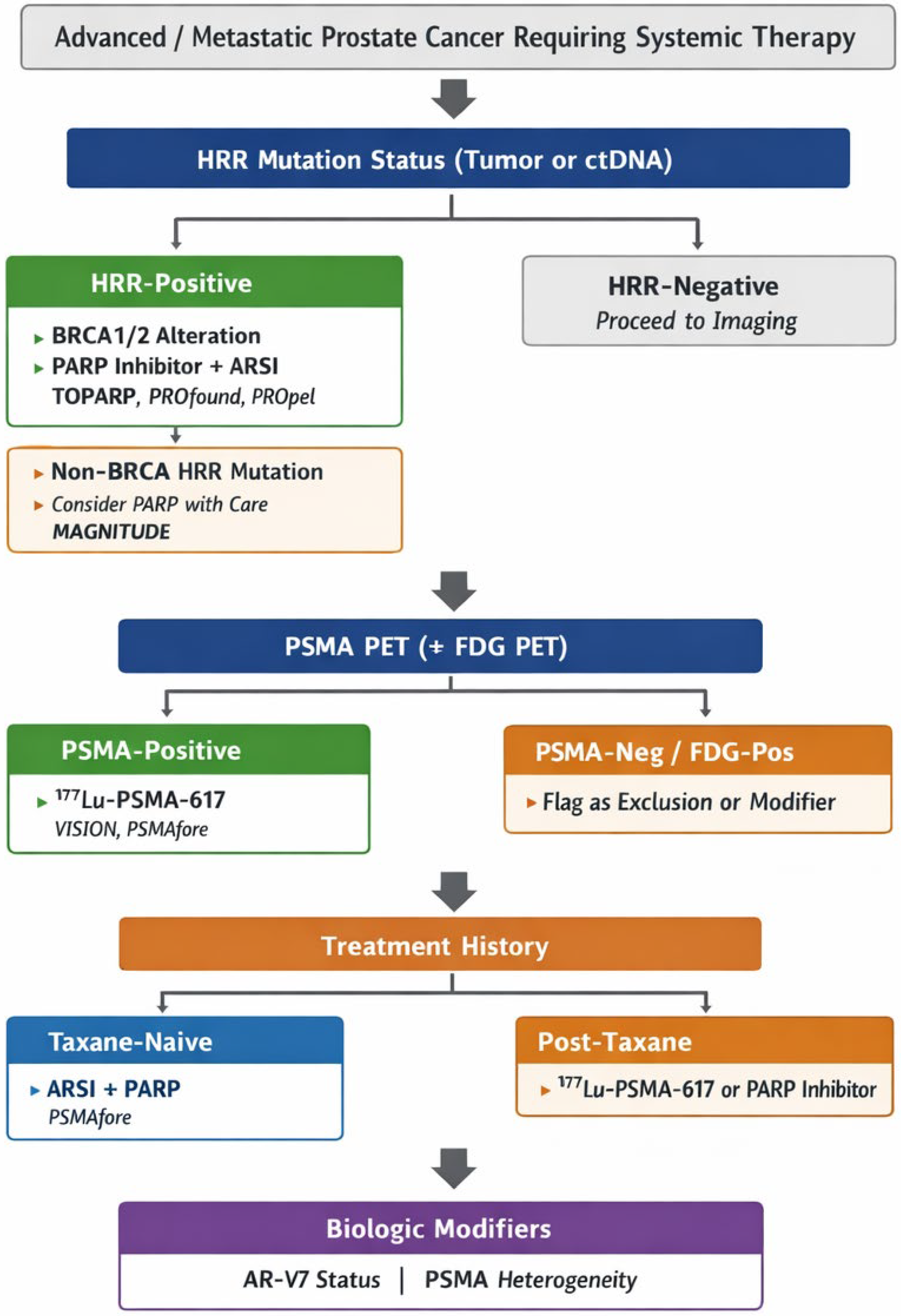
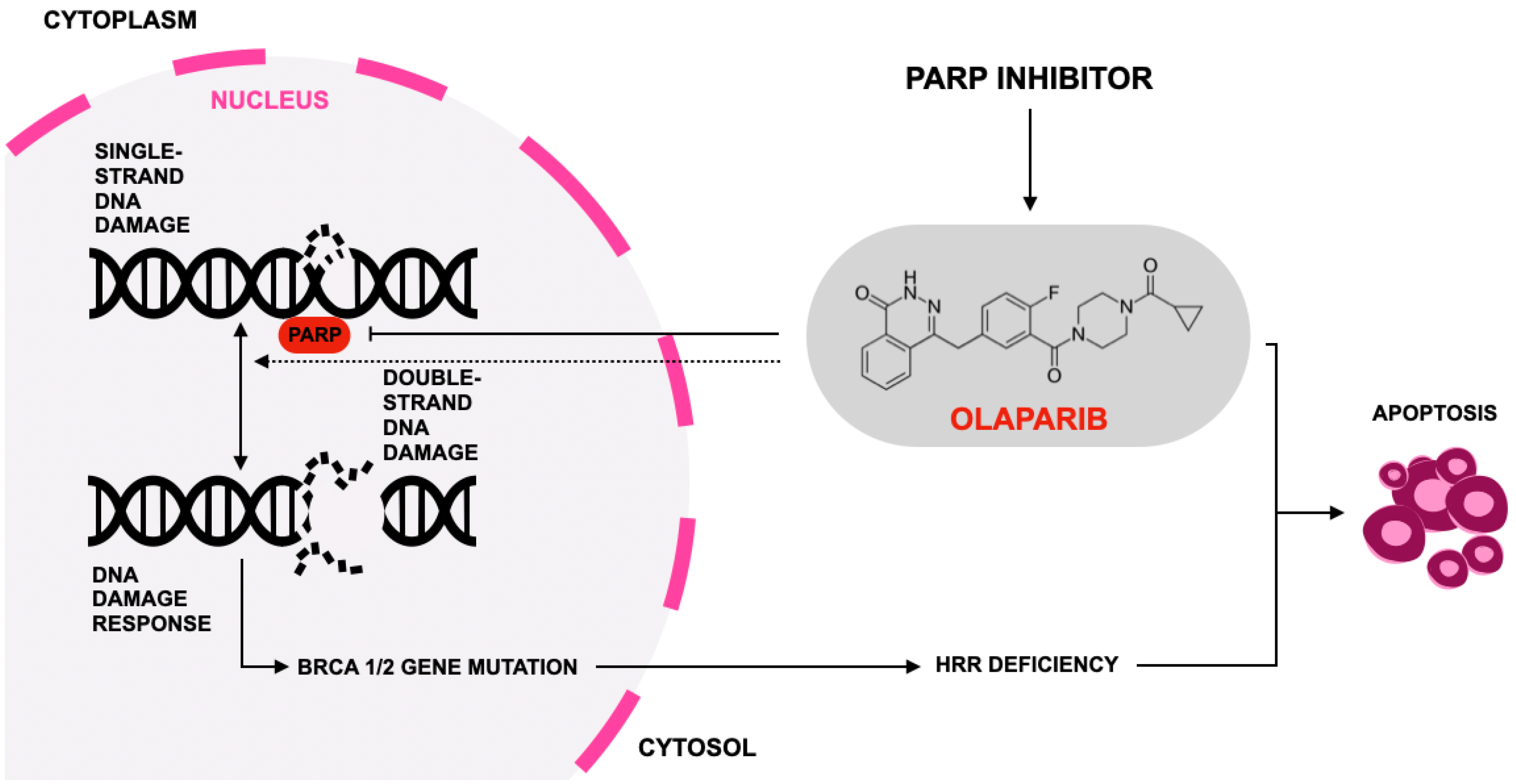
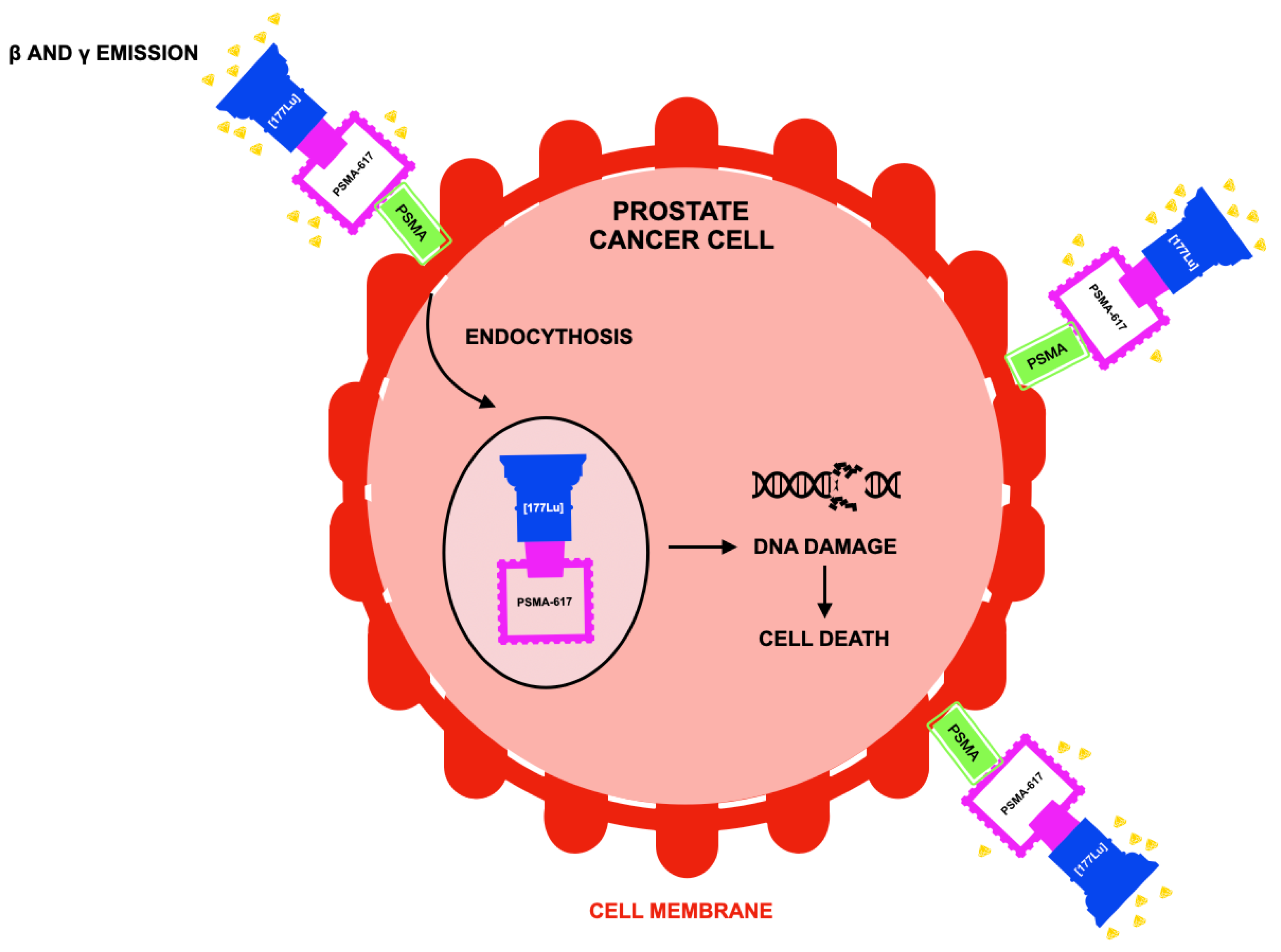
Emerging Therapeutic Strategies in Prostate Cancer: Targeted Approaches Using PARP Inhibition, PSMA-Directed Therapy, and Androgen Receptor Blockade with Olaparib, Lutetium (177Lu)Vipivotide Tetraxetan, and Abiraterone

Abstract
1. Introduction
2. Olaparib
3. Lutetium (177Lu) Vipivotide Tetraxetan
4. Abiraterone
5. Anticipated Developments
6. Conclusions
Author Contributions
Funding
Institutional Review Board Statement
Informed Consent Statement
Data Availability Statement
Conflicts of Interest
Abbreviations
| 177Lu-PSMA-617 | Lutetium-177–Labeled PSMA-617 Radioligand |
| ADT | Androgen Deprivation Therapy |
| ALT | Alanine Aminotransferase |
| AML | Acute Myeloid Leukemia |
| AR | Androgen Receptor |
| ARPI | Androgen Receptor Pathway Inhibitor |
| ARSI | Androgen Receptor Signaling Inhibitor |
| ARV | Androgen Receptor Variants |
| AR-V7 | Androgen Receptor Splice Variant 7 |
| AST | Aspartate Aminotransferase |
| ATM | Ataxia-Telangiectasia Mutated |
| BICR | Blinded Independent Central Review |
| BP | Blood Pressure |
| BRCA | Breast Cancer Susceptibility Gene |
| BRCA1/2 | Breast Cancer Susceptibility Gene 1 or 2 |
| CBC | Complete Blood Count |
| ctDNA | Circulating Tumor DNA |
| CYP17A1 | Cytochrome P450 17A1 |
| dMMR | Deficient Mismatch Repair |
| DHT | Dihydrotestosterone |
| DNA | Deoxyribonucleic Acid |
| FDG | Fluorodeoxyglucose |
| FDG PET | 18F-Fluorodeoxyglucose Positron Emission Tomography |
| G-CSF | Granulocyte Colony-Stimulating Factor |
| GI | Gastrointestinal |
| HR | Hazard Ratio |
| HRD | Homologous Recombination Deficiency |
| HRQOL | Health-Related Quality of Life |
| HRR | Homologous Recombination Repair |
| HRR+/HRR− | Homologous Recombination Repair Positive/Negative |
| HSD3B | 3β-Hydroxysteroid Dehydrogenase |
| IV | Intravenous |
| LFT | Liver Function Test |
| mCRPC | Metastatic Castration-Resistant Prostate Cancer |
| mCSPC | Metastatic Castration-Sensitive Prostate Cancer |
| mHSPC | Metastatic Hormone-Sensitive Prostate Cancer |
| MDS | Myelodysplastic Syndrome |
| MI | Myocardial Infarction |
| MSI-H | Microsatellite Instability–High |
| NR | Not Reached |
| OS | Overall Survival |
| P | Phosphate/Phosphorylation |
| PARP | Poly(ADP-Ribose) Polymerase |
| PET | Positron Emission Tomography |
| PFS | Progression-Free Survival |
| PSA | Prostate-Specific Antigen |
| PSA50 | ≥50% Decline in Prostate-Specific Antigen |
| PSMA | Prostate-Specific Membrane Antigen |
| QoL/QOL | Quality of Life |
| rPFS | Radiographic Progression-Free Survival |
| RLT | Radioligand Therapy |
| RT | Radiation Therapy |
| SMPC | Summary of Product Characteristics |
| SOC | Standard of Care |
| SRD5A | Steroid 5-Alpha-Reductase |
| TEAE | Treatment-Emergent Adverse Event |
| ULN | Upper Limit of Normal |
References
- Sung, H.; Ferlay, J.; Siegel, R.L.; Laversanne, M.; Soerjomataram, I.; Jemal, A.; Bray, F. Global Cancer Statistics 2020: GLOBOCAN Estimates of Incidence and Mortality Worldwide for 36 Cancers in 185 Countries. CA Cancer J. Clin. 2021, 71, 209–249. [Google Scholar] [CrossRef] [PubMed]
- Siegel, R.L.; Giaquinto, A.N.; Jemal, A. Cancer Statistics, 2024. CA Cancer J. Clin. 2024, 74, 12–49. [Google Scholar] [CrossRef] [PubMed]
- Sandhu, S.; Moore, C.M.; Chiong, E.; Beltran, H.; Bristow, R.G.; Williams, S.G. Prostate cancer. Lancet 2021, 398, 1075–1090. [Google Scholar] [CrossRef] [PubMed]
- Watson, P.A.; Arora, V.K.; Sawyers, C.L. Emerging Mechanisms of Resistance to Androgen Receptor Inhibitors in Prostate Cancer. Nat. Rev. Cancer 2015, 15, 701–711. [Google Scholar] [CrossRef]
- Abida, W.; Armenia, J.; Gopalan, A.; Brennan, R.; Walsh, M.; Barron, D.; Danila, D.; Rathkopf, D.; Morris, M.; Slovin, S.; et al. Prospective Genomic Profiling of Prostate Cancer Across Disease States Reveals Germline and Somatic Alterations That May Affect Clinical Decision Making. JCO Precis. Oncol. 2017, 2017, PO.17.00029. [Google Scholar] [CrossRef]
- Eiber, M.; Fendler, W.P.; Rowe, S.P.; Calais, J.; Hofman, M.S.; Maurer, T.; Schwarzenboeck, S.M.; Kratowchil, C.; Herrmann, K.; Giesel, F.L.; et al. Prostate-Specific Membrane Antigen Ligands for Imaging and Therapy. J. Nucl. Med. 2017, 58, 67S–76S. [Google Scholar] [CrossRef]
- Sands, M.; Adams, S.; Lee, J.; Li, M.; Wang, M.; Walsh, T., Jr.; Leon, L.; Zablah, A.; Haerens, M.; Liu, Z.; et al. The Interconnection between Androgen Receptor and DNA Damage Response Pathways in Prostate Cancer. Curr. Urol. 2025, 19, 376–387. [Google Scholar] [CrossRef]
- Leão, R.; Domingos, C.; Figueiredo, A.; Hamilton, R.; Tabori, U.; Castelo-Branco, P. Cancer Stem Cells in Prostate Cancer: Implications for Targeted Therapy. Urol. Int. 2017, 99, 125–136. [Google Scholar] [CrossRef]
- De Vincentis, G.; Gerritsen, W.; Gschwend, J.E.; Hacker, M.; Lewington, V.; O’Sullivan, J.M.; Oya, M.; Pacilio, M.; Parker, C.; Shore, N.; et al. Advances in Targeted Alpha Therapy for Prostate Cancer. Ann. Oncol. 2019, 30, 1728–1739. [Google Scholar] [CrossRef]
- Filippi, L.; Chiaravalloti, A.; Schillaci, O.; Bagni, O. The Potential of PSMA-Targeted Alpha Therapy in the Management of Prostate Cancer. Expert Rev. Anticancer Ther. 2020, 20, 823–829. [Google Scholar] [CrossRef]
- Rebello, R.J.; Oing, C.; Knudsen, K.E.; Loeb, S.; Johnson, D.C.; Reiter, R.E.; Gillessen, S.; Van der Kwast, T.; Bristow, R.G. Prostate Cancer. Nat. Rev. Dis. Primers 2021, 7, 9. [Google Scholar] [CrossRef] [PubMed]
- de Bono, J.; Mateo, J.; Fizazi, K.; Saad, F.; Shore, N.; Sandhu, S.; Chi, K.N.; Sartor, O.; Agarwal, N.; Olmos, D.; et al. Olaparib for Metastatic Castration-Resistant Prostate Cancer. N. Engl. J. Med. 2020, 382, 2091–2102. [Google Scholar] [CrossRef] [PubMed]
- Mateo, J.; Porta, N.; Bianchini, D.; McGovern, U.; Elliott, T.; Jones, R.; Syndikus, I.; Ralph, C.; Jain, S.; Varughese, M.; et al. Olaparib in Patients with Metastatic Castration-Resistant Prostate Cancer with DNA Repair Gene Aberrations (TOPARP-B): A Multicentre, Open-Label, Randomised, Phase 2 Trial. Lancet Oncol. 2020, 21, 162–174. [Google Scholar] [CrossRef] [PubMed]
- Hussain, M.; Mateo, J.; Fizazi, K.; Saad, F.; Shore, N.; Sandhu, S.; Chi, K.N.; Sartor, O.; Agarwal, N.; Olmos, D.; et al. Survival with Olaparib in Metastatic Castration-Resistant Prostate Cancer. N. Engl. J. Med. 2020, 383, 2345–2357. [Google Scholar] [CrossRef]
- Boiarsky, D.; Tewari, A.K.; Gulhan, D.C.; Bakouny, Z.; Ananda, G.; Savignano, H.; Lakshminarayanan, G.; McClure, H.M.; Silver, R.; Choueiri, T.K.; et al. A Panel-Based Mutational Signature of Homologous Recombination Deficiency Associates with Response to PARP Inhibition in Metastatic Castration-Resistant Prostate Cancer. Prostate 2024, 84, 1479–1489. [Google Scholar] [CrossRef]
- Hommerding, M.; Hommerding, O.; Bernhardt, M.; Kreft, T.; Sanders, C.; Tischler, V.; Basitta, P.; Pelusi, N.; Wulf, A.L.; Ohlmann, C.H.; et al. Real-World Data on the Prevalence of BRCA1/2 and HRR Gene Mutations in Patients with Primary and Metastatic Castration Resistant Prostate Cancer. World J. Urol. 2024, 42, 491. [Google Scholar] [CrossRef]
- Bourlon, M.T.; Valdez, P.; Castro, E. Development of PARP Inhibitors in Advanced Prostate Cancer. Ther. Adv. Med. Oncol. 2024, 16, 17588359231221337. [Google Scholar] [CrossRef]
- Saad, F.; Clarke, N.W.; Oya, M.; Shore, N.; Procopio, G.; Guedes, J.D.; Arslan, C.; Mehra, N.; Parnis, F.; Brown, E.; et al. Olaparib Plus Abiraterone Versus Placebo Plus Abiraterone in Metastatic Castration-Resistant Prostate Cancer (PROpel): Final Prespecified Overall Survival Results of a Randomised, Double-Blind, Phase 3 Trial. Lancet Oncol. 2023, 24, 1094–1108. [Google Scholar] [CrossRef]
- Chi, K.N.; Castro, E.; Attard, G.; Smith, M.R.; Sandhu, S.; Efstathiou, E.; Roubaud, G.; Small, E.J.; de Santana Gomes, A.P.; Rathkopf, D.E.; et al. Niraparib and Abiraterone Acetate Plus Prednisone in Metastatic Castration-Resistant Prostate Cancer: Final Overall Survival Analysis for the Phase 3 MAGNITUDE Trial. Eur. Urol. Oncol. 2025, 8, 986–998. [Google Scholar] [CrossRef]
- Armstrong, A.J.; Saad, F.; Oya, M.; Vianna, K.; Özgüroğlu, M.; Gedye, C.; Buchschacher, G.L., Jr.; Lee, J.Y.; Emmenegger, U.; Navrátil, J.; et al. Patient-Reported Outcomes for Men with Metastatic Castration-Resistant Prostate Cancer Who Received Olaparib Plus Abiraterone Versus Placebo Plus Abiraterone in the Phase 3 PROpel Study. Eur. Urol. Oncol. 2025. [Google Scholar] [CrossRef]
- Sartor, O.; de Bono, J.; Chi, K.N.; Fizazi, K.; Herrmann, K.; Rahbar, K.; Tagawa, S.T.; Nordquist, L.T.; Vaishampayan, N.; El-Haddad, G.; et al. Lutetium-177-PSMA-617 for Metastatic Castration-Resistant Prostate Cancer. N. Engl. J. Med. 2021, 385, 1091–1103. [Google Scholar] [CrossRef]
- Hofman, M.S.; Emmett, L.; Sandhu, S.; Iravani, A.; Joshua, A.M.; Goh, J.C.; Pattison, D.A.; Tan, T.H.; Kirkwood, I.D.; Ng, S.; et al. [177Lu]Lu-PSMA-617 Versus Cabazitaxel in Patients with Metastatic Castration-Resistant Prostate Cancer (TheraP): A Randomised, Open-Label, Phase 2 Trial. Lancet 2021, 397, 797–804. [Google Scholar] [CrossRef] [PubMed]
- Violet, J.; Sandhu, S.; Iravani, A.; Ferdinandus, J.; Thang, S.P.; Kong, G.; Kumar, A.R.; Akhurst, T.; Pattison, D.A.; Beaulieu, A.; et al. Long-Term Follow-Up and Outcomes of Retreatment in an Expanded 50-Patient Single-Center Phase II Prospective Trial of 177Lu-PSMA-617 Theranostics in Metastatic Castration-Resistant Prostate Cancer. J. Nucl. Med. 2020, 61, 857–865. [Google Scholar] [CrossRef] [PubMed]
- Ashfaq, W.; Rehman, K.; Shahid, A.; Younis, M.N. Therapeutic Response and Safety of Radioligand Therapy with 177Lu-PSMA-617 in Metastatic Castration-Resistant Prostate Cancer Patients. Med. Oncol. 2024, 41, 226. [Google Scholar] [CrossRef] [PubMed]
- Siripongsatian, D.; Jantarato, A.; Promteangtrong, C.; Kunawudhi, A.; Kiatkittikul, P.; Boonkawin, N.; Yaset, S.; Somboon, S.; Chotipanich, C. Pretherapeutic PSMA PET-Derived Semiquantitative Parameters as Predictors of PSA Response in Patients with mCRPC Receiving [177Lu]Lu-PSMA-617 Radioligand Therapy. Indian J. Radiol. Imaging 2024, 34, 579–587. [Google Scholar] [CrossRef]
- Ryan, C.J.; Smith, M.R.; de Bono, J.S.; Molina, A.; Logothetis, C.J.; de Souza, P.; Fizazi, K.; Mainwaring, P.; Piulats, J.M.; Ng, S.; et al. Abiraterone in Metastatic Prostate Cancer without Previous Chemotherapy. N. Engl. J. Med. 2013, 368, 138–148. [Google Scholar] [CrossRef]
- de Bono, J.S.; Logothetis, C.J.; Molina, A.; Fizazi, K.; North, S.; Chu, L.; Chi, K.N.; Jones, R.J.; Goodman, O.B., Jr.; Saad, F.; et al. Abiraterone and Increased Survival in Metastatic Prostate Cancer. N. Engl. J. Med. 2011, 364, 1995–2005. [Google Scholar] [CrossRef]
- Fizazi, K.; Tran, N.; Fein, L.; Matsubara, N.; Rodriguez-Antolin, A.; Alekseev, B.Y.; Özgüroğlu, M.; Ye, D.; Feyerabend, S.; Protheroe, A.; et al. Abiraterone Plus Prednisone in Metastatic, Castration-Sensitive Prostate Cancer. N. Engl. J. Med. 2017, 377, 352–360. [Google Scholar] [CrossRef]
- James, N.D.; de Bono, J.S.; Spears, M.R.; Clarke, N.W.; Mason, M.D.; Dearnaley, D.P.; Ritchie, A.W.S.; Amos, C.L.; Gilson, C.; Jones, R.J.; et al. Abiraterone for Prostate Cancer Not Previously Treated with Hormone Therapy. N. Engl. J. Med. 2017, 377, 338–351. [Google Scholar] [CrossRef]
- Attard, G.; Murphy, L.; Clarke, N.W.; Sachdeva, A.; Jones, C.; Hoyle, A.; Cross, W.; Jones, R.J.; Parker, C.C.; Gillessen, S.; et al. Abiraterone Acetate Plus Prednisolone with or without Enzalutamide for Patients with Metastatic Prostate Cancer Starting Androgen Deprivation Therapy: Final Results from Two Randomised Phase 3 Trials of the STAMPEDE Platform Protocol. Lancet Oncol. 2023, 24, 443–456. [Google Scholar] [CrossRef]
- Kostos, L.; Tran, B.; Azad, A.A. Combination of PARP Inhibitors and Androgen Receptor Pathway Inhibitors in Metastatic Castration-Resistant Prostate Cancer. Drugs 2024, 84, 1093–1109. [Google Scholar] [CrossRef] [PubMed]
- Hage Chehade, C.; Jo, Y.; Gebrael, G.; Tripathi, N.; Sayegh, N.; Chigarira, B.; Mathew Thomas, V.; Galarza Fortuna, G.; Narang, A.; Campbell, P.; et al. Trends and Disparities in Next-Generation Sequencing in Metastatic Prostate and Urothelial Cancers. JAMA Netw. Open 2024, 7, e2423186. [Google Scholar] [CrossRef] [PubMed]
- Laudicella, R.; Bauckneht, M.; Burger, I.A.; Cacciola, A.; Fanti, S.; Farolfi, A.; Ficarra, V.; Iagaru, A.; Liberini, V.; Pergolizzi, S.; et al. The Role of PSMA-Based Radioligand Therapy in Hormone-Sensitive Prostate Cancer. Eur. J. Nucl. Med. Mol. Imaging 2025, 52, 2723–2735. [Google Scholar] [CrossRef] [PubMed]
- McManus, H.D.; Dorff, T.; Morgans, A.K.; Sartor, O.; Shore, N.; Armstrong, A.J. Navigating Therapeutic Sequencing in the Metastatic Castration-Resistant Prostate Cancer Patient Journey. Prostate Cancer Prostatic Dis. 2025, 28, 672–683. [Google Scholar] [CrossRef]
- Carducci, M.A.; Carroll, P.R. Multidisciplinary Management of Advanced Prostate Cancer: Changing Perspectives on Referring Patients and Enhancing Collaboration between Oncologists and Urologists in Clinical Trials. Urology 2005, 65, 18–22. [Google Scholar] [CrossRef]
- Hu, H. PSMA-PET Research: Addressing Challenges and Prospects. Lancet Oncol. 2024, 25, e531. [Google Scholar] [CrossRef]
- Rose, M.; Burgess, J.T.; O’Byrne, K.; Richard, D.J.; Bolderson, E. PARP Inhibitors: Clinical Relevance, Mechanisms of Action and Tumor Resistance. Front. Cell Dev. Biol. 2020, 8, 564601. [Google Scholar] [CrossRef]
- Dror, C.M.; Wyatt, A.W.; Chi, K.N. Olaparib for the Treatment of Metastatic Prostate Cancer. Future Oncol. 2021, 17, 2413–2429. [Google Scholar] [CrossRef]
- Gao, P.; Li, T.; Zhang, K.; Luo, G. Recent Advances in the Molecular Targeted Drugs for Prostate Cancer. Int. Urol. Nephrol. 2023, 55, 777–789. [Google Scholar] [CrossRef]
- Peng, Y.; Qiu, X.; Cai, J.; Li, Y.; Wei, X. Unveiling Oncogene-Induced Senescence: A New Frontier in Prostate Cancer Prognosis and Therapy. Discov. Oncol. 2025, 16, 2091. [Google Scholar] [CrossRef]
- Rahman, M.; Akter, K.; Ahmed, K.R.; Fahim, M.M.H.; Aktary, N.; Park, M.N.; Shin, S.W.; Kim, B. Synergistic Strategies for Castration-Resistant Prostate Cancer: Targeting AR-V7, Exploring Natural Compounds, and Optimizing FDA-Approved Therapies. Cancers 2024, 16, 2777. [Google Scholar] [CrossRef] [PubMed]
- Mateo, J.; Carreira, S.; Sandhu, S.; Miranda, S.; Mossop, H.; Perez-Lopez, R.; Nava Ro-drigues, D.; Robinson, D.; Omlin, A.; Tunariu, N.; et al. DNA-Repair Defects and Olaparib in Metastatic Prostate Cancer. N. Engl. J. Med. 2015, 373, 1697–1708. [Google Scholar] [CrossRef] [PubMed]
- Zeng, Y.; Arisa, O.; Peer, C.J.; Fojo, A.; Figg, W.D. PARP Inhibitors: A Review of the Pharmacology, Pharmacokinetics, and Pharmacogenetics. Semin. Oncol. 2024, 51, 19–24. [Google Scholar] [CrossRef] [PubMed]
- Clarke, N.; Wiechno, P.; Alekseev, B.; Sala, N.; Jones, R.; Kocak, I.; Chiuri, V.E.; Jassem, J.; Fléchon, A.; Redfern, C.; et al. Olaparib Combined with Abiraterone in Patients with Metastatic Castration-Resistant Prostate Cancer: A Randomised, Double-Blind, Placebo-Controlled, Phase 2 Trial. Lancet Oncol. 2018, 19, 975–986. [Google Scholar] [CrossRef]
- Shah, M.; Chen, T.Y.; Ison, G.; Fiero, M.H.; Zhang, H.; Gao, X.; Neilson, M.; Goldberg, K.B.; Nair, A.; Ricks, T.K.; et al. Overall Survival and the Evolving Benefit–Risk Assessment for Poly (ADP-ribose) Polymerase Inhibitors in Advanced Ovarian Cancer. J. Clin. Oncol. 2025, 43, 2218–2227. [Google Scholar] [CrossRef]
- Giudice, E.; Gentile, M.; Salutari, V.; Ricci, C.; Musacchio, L.; Carbone, M.V.; Ghizzoni, V.; Camarda, F.; Tronconi, F.; Nero, C.; et al. PARP Inhibitors Resistance: Mechanisms and Perspectives. Cancers 2022, 14, 1420. [Google Scholar] [CrossRef]
- Apelian, S.; Martincuks, A.; Whittum, M.; Yasukawa, M.; Nguy, L.; Mathyk, B.; Andikyan, V.; Anderson, M.L.; Rutherford, T.; Cristea, M.; et al. PARP Inhibitors in Ovarian Cancer: Resistance Mechanisms, Clinical Evidence, and Evolving Strategies. Biomedicines 2025, 13, 1126. [Google Scholar] [CrossRef]
- D’Andrea, A.D. Mechanisms of PARP Inhibitor Sensitivity and Resistance. DNA Repair 2018, 71, 172–176. [Google Scholar] [CrossRef]
- Fan, Y.; Liu, Z.; Chen, Y.; He, Z. Homologous Recombination Repair Gene Mutations in Prostate Cancer: Prevalence and Clinical Value. Adv. Ther. 2024, 41, 2196–2216. [Google Scholar] [CrossRef]
- Mateo, J.; de Bono, J.S.; Fizazi, K.; Saad, F.; Shore, N.; Sandhu, S.; Chi, K.N.; Agarwal, N.; Olmos, D.; Thiery-Vuillemin, A.; et al. Olaparib for the Treatment of Patients with Meta-static Castration-Resistant Prostate Cancer and Alterations in BRCA1 and/or BRCA2 in the PROfound Trial. J. Clin. Oncol. 2024, 42, 571–583. [Google Scholar] [CrossRef]
- Seed, G.; Beije, N.; Yuan, W.; Bertan, C.; Goodall, J.; Lundberg, A.; Tyler, M.; Figueiredo, I.; Pereira, R.; Baker, C.; et al. Elucidating Acquired PARP Inhibitor Resistance in Advanced Prostate Cancer. Cancer Cell 2024, 42, 2113–2123.e4. [Google Scholar] [CrossRef] [PubMed]
- Raval, A.D.; Queen, V.; Korn, M.J.; Quintero, V.; Freedland, S.J. Real-World Treatment Patterns and Survival in Metastatic Castration-Resistant Prostate Cancer: A Systematic Review of Observational Studies. Eur. Urol. Focus 2025. online ahead of print. [Google Scholar] [CrossRef] [PubMed]
- Saad, F.; Armstrong, A.J.; Oya, M.; Shore, N.; Procopio, G.; Guedes, J.D.; Arslan, C.; Mehra, N.; Brown, E.; Joung, J.Y.; et al. Prostate-Specific Antigen and Objective Response Analyses in PROpel: Olaparib Plus Abiraterone Versus Placebo Plus Abiraterone as First-Line Therapy for Metastatic Castration-Resistant Prostate Cancer. Eur. Urol. Oncol. 2025, in press. [Google Scholar] [CrossRef] [PubMed]
- Piombino, C.; Pipitone, S.; Tonni, E.; Mastrodomenico, L.; Oltrecolli, M.; Tchawa, C.; Matranga, R.; Roccabruna, S.; D’Agostino, E.; Pirola, M.; et al. Homologous Recombination Repair Deficiency in Metastatic Prostate Cancer: New Therapeutic Opportunities. Int. J. Mol. Sci. 2024, 25, 4624. [Google Scholar] [CrossRef]
- Dimitrov, G.; Popov, E. Impact of HRR Gene Subclass on Clinical Outcomes of PARP Inhibitors in Metastatic Castration-Resistant Prostate Cancer. Clin. Genitourin. Cancer 2025, 23, 102411. [Google Scholar] [CrossRef]
- Clarke, N.W.; Armstrong, A.J.; Thiery-Vuillemin, A.; Oya, M.; Shore, N.; Loredo, E.; Procopio, G.; de Menezes, J.; Girotto, G.; Arslan, C.; et al. Abiraterone and Olaparib for Metastatic Castration-Resistant Prostate Cancer. NEJM Evid. 2022, 1, EVIDoa2200043. [Google Scholar] [CrossRef]
- Khan, Z.; Gomatam, A.; Murty, U.S.; Dixit, V.A. Identification of Novel Gene Expression Patterns and Pathways Involved in PARP-1 Inhibitor Resistance. Mamm. Genome 2025, 36, 872–883. [Google Scholar] [CrossRef]
- Hussain, M.; Kocherginsky, M.; Agarwal, N.; Adra, N.; Zhang, J.; Paller, C.J.; Picus, J.; Reichert, Z.R.; Szmulewitz, R.Z.; Tagawa, S.T.; et al. Abiraterone, Olaparib, or Abiraterone + Olaparib in First-Line Metastatic Castration-Resistant Prostate Cancer with DNA Repair Defects (BRCAAway). Clin. Cancer Res. 2024, 30, 4318–4328. [Google Scholar] [CrossRef]
- Saad, F.; Armstrong, A.J.; Shore, N.; George, D.J.; Oya, M.; Sugimoto, M.; McKay, R.R.; Hussain, M.; Clarke, N.W. Olaparib Monotherapy or in Combination with Abiraterone for the Treatment of Patients with Metastatic Castration-Resistant Prostate Cancer (mCRPC) and a BRCA Mutation. Target Oncol. 2025, 20, 445–466. [Google Scholar] [CrossRef]
- Bhamidipati, D.; Haro-Silerio, J.I.; Yap, T.A.; Ngoi, N. PARP Inhibitors: Enhancing Efficacy through Rational Combinations. Br. J. Cancer 2023, 129, 904–916. [Google Scholar] [CrossRef]
- Parker, C.; Castro, E.; Fizazi, K.; Heidenreich, A.; Ost, P.; Procopio, G.; Tombal, B.; Gillessen, S.; ESMO Guidelines Committee. Prostate Cancer: ESMO Clinical Practice Guidelines for Diagnosis, Treatment and Follow-Up. Ann. Oncol. 2020, 31, 1119–1134. [Google Scholar] [CrossRef]
- Schostak, M.; Bradbury, A.; Briganti, A.; Gonzalez, D.; Gomella, L.; Mateo, J.; Penault-Llorca, F.; Stenzinger, A.; Wyatt, A.W.; Bjartell, A.; et al. Practical Guidance on Es-tablishing a Molecular Testing Pathway for Alterations in Homologous Recombination Repair Genes in Clinical Practice for Patients with Metastatic Prostate Cancer. Eur. Urol. Oncol. 2024, 7, 344–354. [Google Scholar] [CrossRef] [PubMed]
- Hussain, M.; Corcoran, C.; Sibilla, C.; Fizazi, K.; Saad, F.; Shore, N.; Sandhu, S.; Mateo, J.; Olmos, D.; Mehra, N.; et al. Tumor Genomic Testing for >4000 Men with Metastatic Castration-Resistant Prostate Cancer in the Phase III Trial PROfound (Olaparib). Clin. Cancer Res. 2022, 28, 1518–1530. [Google Scholar] [CrossRef] [PubMed]
- Swisher, E.M.; Lin, K.K.; Oza, A.M.; Scott, C.L.; Giordano, H.; Sun, J.; Konecny, G.E.; Coleman, R.L.; Tinker, A.V.; O’Malley, D.M.; et al. Rucaparib in Relapsed, Platinum-Sensitive High-Grade Ovarian Carcinoma (ARIEL2 Part 1): An International, Multicentre, Open-Label, Phase 2 Trial. Lancet Oncol. 2017, 18, 75–87. [Google Scholar] [CrossRef] [PubMed]
- Moore, K.; Colombo, N.; Scambia, G.; Kim, B.G.; Oaknin, A.; Friedlander, M.; Lisyanskaya, A.; Floquet, A.; Leary, A.; Sonke, G.S.; et al. Maintenance Olaparib in Patients with Newly Diagnosed Advanced Ovarian Cancer. N. Engl. J. Med. 2018, 379, 2495–2505. [Google Scholar] [CrossRef]
- Ledermann, J.; Harter, P.; Gourley, C.; Friedlander, M.; Vergote, I.; Rustin, G.; Scott, C.; Meier, W.; Shapira-Frommer, R.; Safra, T.; et al. Olaparib Maintenance Therapy in Platinum-Sensitive Relapsed Ovarian Cancer. N. Engl. J. Med. 2012, 366, 1382–1392. [Google Scholar] [CrossRef]
- Canadian Agency for Drugs and Technologies in Health (CADTH). Olaparib (Lynparza): CADTH Reimbursement Recommendation: Indication: In Combination with Abiraterone and Prednisone or Prednisolone for the Treatment of Adult Patients with Deleterious or Suspected Deleterious Germline and/or Somatic BRCA-Mutated Metastatic Castration-Resistant Prostate Cancer (mCRPC) in Whom Chemotherapy Is Not Clinically Indicated; BRCA Mutation Must Be Confirmed before Olaparib Treatment Is Initiated; Report No. PC0319REC; CADTH: Ottawa, ON, Canada, 2024. Available online: https://www.ncbi.nlm.nih.gov/books/NBK602511/ (accessed on 4 December 2025).
- Moore, K.N.; Birrer, M.J. Administration of the Tablet Formulation of Olaparib in Patients with Ovarian Cancer: Practical Guidance and Expectations. Oncologist 2018, 23, 697–703. [Google Scholar] [CrossRef]
- Gunderson, C.C.; Moore, K.N. Olaparib: An Oral PARP-1 and PARP-2 Inhibitor with Promising Activity in Ovarian Cancer. Future Oncol. 2015, 11, 747–757. [Google Scholar] [CrossRef]
- Chen, S.; Zhong, D.; Yu, C.; Cai, D.; Wei, Q.; Yang, M.; Li, T.; Zhu, Q.; Ye, L.; Wei, Y.; et al. Low-Dose Abiraterone Plus Olaparib as a Late-Line Treatment for mCRPC Patients with-out BRCA1/2 Mutations: A Multicenter Retrospective Pilot Study. Sci. Rep. 2024, 14, 19895. [Google Scholar] [CrossRef]
- Schaeffer, E.M.; Srinivas, S.; Adra, N.; An, Y.; Bitting, R.; Chapin, B.; Cheng, H.H.; D’Amico, A.V.; Desai, N.; Dorff, T.; et al. NCCN Guidelines® Insights: Prostate Cancer, Version 3.2024. J. Natl. Compr. Canc. Netw. 2024, 22, 140–150. [Google Scholar] [CrossRef]
- Pujade-Lauraine, E.; Ledermann, J.A.; Selle, F.; Gebski, V.; Penson, R.T.; Oza, A.M.; Korach, J.; Huzarski, T.; Poveda, A.; Pignata, S.; et al. Olaparib Tablets as Maintenance Therapy in Patients with Platinum-Sensitive, Relapsed Ovarian Cancer and a BRCA1/2 Mutation (SOLO2/ENGOT-Ov21): A Double-Blind, Randomised, Placebo-Controlled, Phase 3 Trial. Lancet Oncol. 2017, 18, 1274–1284. [Google Scholar] [CrossRef] [PubMed]
- Fong, P.C.; Boss, D.S.; Yap, T.A.; Tutt, A.; Wu, P.; Mergui-Roelvink, M.; Mortimer, P.; Swaisland, H.; Lau, A.; O’Connor, M.J.; et al. Inhibition of Poly(ADP-Ribose) Polymerase in Tumors from BRCA Mutation Carriers. N. Engl. J. Med. 2009, 361, 123–134. [Google Scholar] [CrossRef] [PubMed]
- Mirza, M.R.; Monk, B.J.; Herrstedt, J.; Oza, A.M.; Mahner, S.; Redondo, A.; Fabbro, M.; Ledermann, J.A.; Lorusso, D.; Vergote, I.; et al. Niraparib Maintenance Therapy in Platinum-Sensitive, Recurrent Ovarian Cancer. N. Engl. J. Med. 2016, 375, 2154–2164. [Google Scholar] [CrossRef] [PubMed]
- Robson, M.; Im, S.A.; Senkus, E.; Xu, B.; Domchek, S.M.; Masuda, N.; Delaloge, S.; Li, W.; Tung, N.; Armstrong, A.; et al. Olaparib for Metastatic Breast Cancer in Patients with a Germline BRCA Mutation. N. Engl. J. Med. 2017, 377, 523–533. [Google Scholar] [CrossRef]
- European Medicines Agency. Lynparza: Product Information. Available online: https://www.ema.europa.eu/en/medicines/human/EPAR/lynparza (accessed on 1 December 2025).
- Oza, A.M.; Cibula, D.; Benzaquen, A.O.; Poole, C.; Mathijssen, R.H.; Sonke, G.S.; Colombo, N.; Špaček, J.; Vuylsteke, P.; Hirte, H.; et al. Olaparib Combined with Chemotherapy for Recurrent Platinum-Sensitive Ovarian Cancer: A Randomised Phase 2 Trial. Lancet Oncol. 2015, 16, 87–97. [Google Scholar] [CrossRef]
- U.S. Food and Drug Administration. Lynparza (Olaparib) Prescribing Information. Available online: https://www.accessdata.fda.gov/drugsatfda_docs/label/2020/208558s014lbl.pdf (accessed on 1 December 2025).
- LaFargue, C.J.; Dal Molin, G.Z.; Sood, A.K.; Coleman, R.L. Exploring and Comparing Adverse Events between PARP Inhibitors. Lancet Oncol. 2019, 20, e15–e28. [Google Scholar] [CrossRef]
- Morice, P.M.; Leary, A.; Dolladille, C.; Chrétien, B.; Poulain, L.; González-Martín, A.; Moore, K.; O’Reilly, E.M.; Ray-Coquard, I.; Alexandre, J.; et al. Myelodysplastic Syndrome and Acute Myeloid Leukaemia in Patients Treated with PARP Inhibitors: A Safety Meta-Analysis of Randomised Controlled Trials and a Retrospective Study of the WHO Pharmacovigilance Database. Lancet Haematol. 2021, 8, e122–e134. [Google Scholar] [CrossRef]
- Chi, K.N.; Rathkopf, D.; Smith, M.R.; Efstathiou, E.; Attard, G.; Olmos, D.; Lee, J.Y.; Small, E.J.; Pereira de Santana Gomes, A.J.; MAGNITUDE Principal Investigators; et al. Niraparib and Abiraterone Acetate for Metastatic Castration-Resistant Prostate Cancer. J. Clin. Oncol. 2023, 41, 3339–3351. [Google Scholar] [CrossRef]
- Keam, S.J. Lutetium Lu 177 Vipivotide Tetraxetan: First Approval. Mol. Diagn. Ther. 2022, 26, 467–475. [Google Scholar] [CrossRef]
- Fallah, J.; Agrawal, S.; Gittleman, H.; Fiero, M.H.; Subramaniam, S.; John, C.; Chen, W.; Ricks, T.K.; Niu, G.; Fotenos, A.; et al. FDA Approval Summary: Lutetium Lu 177 Vipivotide Tetraxetan for Patients with Metastatic Castration-Resistant Prostate Cancer. Clin. Cancer Res. 2023, 29, 1651–1657. [Google Scholar] [CrossRef]
- Ahmadzadehfar, H.; Seifert, R.; Afshar-Oromieh, A.; Kratochwil, C.; Rahbar, K. Prostate Cancer Theranostics with [177Lu]-PSMA. Semin. Nucl. Med. 2024, 54, 581–590. [Google Scholar] [CrossRef]
- Chi, K.N.; Yip, S.M.; Bauman, G.; Probst, S.; Emmenegger, U.; Kollmannsberger, C.K.; Martineau, P.; Niazi, T.; Pouliot, F.; Rendon, R.; et al. 177Lu-PSMA-617 in Metastatic Castration-Resistant Prostate Cancer: A Review of the Evidence and Implications for Canadian Clinical Practice. Curr. Oncol. 2024, 31, 1400–1415. [Google Scholar] [CrossRef] [PubMed]
- Bent, E.H.; Morris, M.J. Prostate Cancer Radioligand Therapy: PSMA and Beyond, Current Landscape and Future Directions. Curr. Oncol. Rep. 2025, 27, 1170–1184. [Google Scholar] [CrossRef] [PubMed]
- Zhang, H.; Koumna, S.; Pouliot, F.; Beauregard, J.M.; Kolinsky, M. PSMA Theranostics: Current Landscape and Future Outlook. Cancers 2021, 13, 4023. [Google Scholar] [CrossRef] [PubMed]
- Erdogan, A.S.; Sayan, H.; Seven, B.; Okudan, B. A Case Report on the Dramatic Response of [177Lu]-PSMA Therapy for Metastatic Prostate Cancer. Curr. Med. Imaging 2025, 21, e15734056362468. [Google Scholar] [CrossRef]
- Palihati, M.; Das, J.P.; Yeh, R.; Capaccione, K. Emerging PET Imaging Agents and Targeted Radioligand Therapy: A Review of Clinical Applications and Trials. Tomography 2025, 11, 83. [Google Scholar] [CrossRef]
- Ells, Z.; Grogan, T.R.; Czernin, J.; Dahlbom, M.; Calais, J. Dosimetry of [177Lu]Lu-PSMA-Targeted Radiopharmaceutical Therapies in Patients with Prostate Cancer: A Comparative Systematic Review and Meta-Analysis. J. Nucl. Med. 2024, 65, 1264–1271. [Google Scholar] [CrossRef]
- Gafita, A.; Calais, J.; Grogan, T.R.; Hadaschik, B.; Wang, H.; Weber, M.; Sandhu, S.; Kratochwil, C.; Esfandiari, R.; Tauber, R.; et al. Nomograms to Predict Outcomes after [177Lu]-PSMA Therapy in Men with Metastatic Castration-Resistant Prostate Cancer: An International, Multicentre, Retrospective Study. Lancet Oncol. 2021, 22, 1115–1125. [Google Scholar] [CrossRef]
- Heidegger, I.; Kesch, C.; Kretschmer, A.; Tsaur, I.; Ceci, F.; Valerio, M.; Tilki, D.; Marra, G.; Preisser, F.; Fankhauser, C.D.; et al. Biomarkers to Personalize Treatment with 177Lu-PSMA-617 in Men with Metastatic Castration-Resistant Prostate Cancer—A State of the Art Review. Ther. Adv. Med. Oncol. 2022, 14, 17588359221081922. [Google Scholar] [CrossRef]
- Liu, X.; Fang, G.C.; Lu, H.; Shi, Z.D.; Chen, Z.S.; Han, C.H. Lutetium Lu 177 Vipivotide Tetraxetan for Prostate Cancer. Drugs Today 2023, 59, 37–49. [Google Scholar] [CrossRef]
- Kafka, M.; Horninger, A.; di Santo, G.; Virgolini, I.; Neuwirt, H.; Unterrainer, L.M.; Kunte, S.C.; Deiss, E.; Paffenholz, P.; Heidenreich, A.; et al. Real-World Outcomes and Predictive Biomarkers for 177Lutetium Prostate-Specific Membrane Antigen Ligand Treatment in Metastatic Castration-Resistant Prostate Cancer: A European Association of Urology Young Academic Urologists Prostate Cancer Working Group Multi-Institutional Observational Study. Eur. Urol. Oncol. 2024, 7, 421–429. [Google Scholar] [CrossRef] [PubMed]
- Lutetium (177Lu) Vipivotide Tetraxetan (Pluvicto). Canadian Journal of Health Technologies CADTH Reimbursement Review. Available online: https://www.cda-amc.ca/sites/default/files/DRR/2023/PC0297-Pluvicto_combined.pdf (accessed on 2 December 2025).
- U.S. Food and Drug Administration. FDA Approves Pluvicto for Metastatic Castration-Resistant Prostate Cancer. Available online: https://www.fda.gov/drugs/resources-information-approved-drugs/fda-approves-pluvicto-metastatic-castration-resistant-prostate-cancer (accessed on 10 January 2026).
- Alati, S.; Singh, R.; Pomper, M.G.; Rowe, S.P.; Banerjee, S.R. Preclinical Development in Radiopharmaceutical Therapy for Prostate Cancer. Semin. Nucl. Med. 2023, 53, 663–686. [Google Scholar] [CrossRef] [PubMed]
- Kuo, P.H.; Morris, M.J.; Hesterman, J.; Kendi, A.T.; Rahbar, K.; Wei, X.X.; Fang, B.; Adra, N.; Garje, R.; Michalski, J.M.; et al. Quantitative [68Ga]-PSMA-11 PET and Clinical Outcomes in Metastatic Castration-Resistant Prostate Cancer Following [177Lu]-PSMA-617 (VISION Trial). Radiology 2024, 312, e233460. [Google Scholar] [CrossRef] [PubMed]
- Armstrong, A.J.; Sartor, O.; de Bono, J.; Chi, K.; Fizazi, K.; Krause, B.J.; Herrmann, K.; Rahbar, K.; Tagawa, S.T.; Saad, F.; et al. Association of Declining Prostate-Specific Antigen Levels with Clinical Outcomes in Patients with Metastatic Castration-Resistant Prostate Cancer Receiving [177Lu]Lu-PSMA-617 in the Phase 3 VISION Trial. Eur. Urol. 2024, 86, 552–562. [Google Scholar] [CrossRef]
- Ramnaraign, B.; Sartor, O. PSMA-Targeted Radiopharmaceuticals in Prostate Cancer: Current Data and New Trials. Oncologist 2023, 28, 392–401. [Google Scholar] [CrossRef]
- Batra, A.; Glick, D.; Valdes, M. Contemporary Systemic Therapy Intensification for Prostate Cancer: A Review for General Practitioners in Oncology. Curr. Oncol. 2024, 31, 1047–1062. [Google Scholar] [CrossRef]
- Sallam, M.; Nguyen, N.T.; Sainsbury, F.; Kimizuka, N.; Muyldermans, S.; Benešová-Schäfer, M. PSMA-Targeted Radiotheranostics in Modern Nuclear Medicine: Then, Now, and What of the Future? Theranostics 2024, 14, 3043–3079. [Google Scholar] [CrossRef]
- Morris, M.J.; Castellano, D.; Herrmann, K.; de Bono, J.S.; Shore, N.D.; Chi, K.N.; Crosby, M.; Piulats, J.M.; Fléchon, A.; Wei, X.X.; et al. 177Lu-PSMA-617 versus a Change of Androgen Receptor Pathway Inhibitor Therapy for Taxane-Naive Patients with Progressive Metastatic Castration-Resistant Prostate Cancer (PSMAfore). Lancet 2024, 404, 1227–1239. [Google Scholar] [CrossRef]
- U.S. Food and Drug Administration. FDA Expands Pluvicto’s Metastatic Castration-Resistant Prostate Cancer Indication. Available online: https://www.fda.gov/drugs/resources-information-approved-drugs/fda-expands-pluvictos-metastatic-castration-resistant-prostate-cancer-indication (accessed on 10 January 2026).
- Eropean Medicines Agency (EMA). Pluvicto, INN-Lutetium (177Lu) Vipivotide Tetraxetan. Available online: https://www.ema.europa.eu/en/documents/rmp/pluvicto-epar-risk-management-plan_en.pdf (accessed on 2 December 2025).
- Ninatti, G.; Lee, S.T.; Scott, A.M. Radioligand Therapy in Cancer Management: A Global Perspective. Cancers 2025, 17, 3412. [Google Scholar] [CrossRef]
- Morrison, G.; Holle, L.M. Lutetium Lu 177 Vipivotide Tetraxetan: A Literature Review. J. Oncol. Pharm. Pract. 2025. online ahead of print. [Google Scholar] [CrossRef]
- Topal, E.; Kovan, B.; İribas, A.; Kuyumcu, S.; Basaran, M.; Malçok Demirtaş, A.; Sanli, O.; Sanli, Y. Impact of Extended [177Lu] Lu-PSMA-617 Therapy on Absorbed Kidney Dose and CKD-EPI Values: How Long Can Therapy Be Safely Continued? Eur. J. Nucl. Med. Mol. Imaging 2025, 52, 3135–3144. [Google Scholar] [CrossRef] [PubMed]
- Jackson, P.; Hofman, M.; McIntosh, L.; Buteau, J.P.; Ravi Kumar, A. Radiation Dosimetry in 177Lu-PSMA-617 Therapy. Semin. Nucl. Med. 2022, 52, 243–254. [Google Scholar] [CrossRef] [PubMed]
- Shamshirgaran, A.; Sahafi, P.; Samadi, M.H.; Saeed, M.; Mohammadzadeh Kosari, H.; Erfani, S.; Pirayesh, E.; Aryana, K.; Harsini, S.; Askari, E. Efficacy and Safety of Lutetium-177 (177Lu)-PSMA-617 in Metastatic Castration-Resistant Prostate Cancer Patients with Superscan Pattern: A Retrospective Cohort Study. Ann. Nucl. Med. 2025, 39. [Google Scholar] [CrossRef] [PubMed]
- Food and Drug Administration (FDA). PLUVICTO (Lutetium Lu 177 Vipivotide Tetraxetan). Available online: https://www.accessdata.fda.gov/drugsatfda_docs/label/2022/215833s000lbl.pdf (accessed on 2 December 2025).
- National Library of Medicine; NIH. Lutetium (177Lu) Vipivotide Tetraxetan (Pluvicto). Available online: https://www.ncbi.nlm.nih.gov/books/NBK596311/ (accessed on 2 December 2025).
- Karimzadeh, A.; Hansen, K.; Hein, S.; Haller, B.; Heck, M.M.; Tauber, R.; D’Alessandria, C.; Eiber, M.; Rauscher, I. Impact of Baseline [18F]-Flotufolastat PET Bone Tumor Volume for Prognosticating Severe Hematologic Toxicity in Patients with Metastatic Castration-Resistant Prostate Cancer Receiving [177Lu]-PSMA-Targeted Radioligand Therapy. Eur. J. Nucl. Med. Mol. Imaging 2025, 52, 4434–4445. [Google Scholar] [CrossRef]
- Karimzadeh, A.; Lehnert, W.; Koehler, D.; Shenas, F.; Kisters, A.; Apostolova, I.; Klutmann, S.; Adam, G.; Sauer, M. Overview of Selected Completed Prospective Studies on PSMA-Targeted Radioligand Therapy with [177Lu]Lu-PSMA-617 in Metastatic Castration-Resistant Prostate Cancer. Nuklearmedizin 2025, 64, 262–271. [Google Scholar] [CrossRef]
- Mosele, M.F.; Westphalen, C.B.; Stenzinger, A.; Barlesi, F.; Bayle, A.; Bièche, I.; Bonastre, J.; Castro, E.; Dienstmann, R.; Krämer, A.; et al. Recommendations for the Use of Next-Generation Sequencing (NGS) for Patients with Advanced Cancer in 2024: A Report from the ESMO Precision Medicine Working Group. Ann. Oncol. 2024, 35, 588–606. [Google Scholar] [CrossRef]
- Tran, H.H.; Yamaguchi, A.; Manning, H.C. Radiotheranostic Landscape: A Review of Clinical and Preclinical Development. Eur. J. Nucl. Med. Mol. Imaging 2025, 52, 2685–2709. [Google Scholar] [CrossRef]
- Parent, E.E.; Kase, A.M. A Treatment Paradigm Shift: Targeted Radionuclide Therapies for Metastatic Castrate Resistant Prostate Cancer. Cancers 2022, 14, 4276. [Google Scholar] [CrossRef]
- Neagu, M.; Constantin, C.; Hinescu, M.E.; Bleotu, P.G.; Popovici, M.G.; Zai, M.I.; Spohr, K.M. Radionuclides Landscape in Prostate Cancer Theranostics. Int. J. Mol. Sci. 2025, 26, 6751. [Google Scholar] [CrossRef]
- Jewell, K.; Kostos, L.; Emmerson, B.; Hofman, M.S. Combination Strategies and Targeted Radionuclide Therapies. Semin. Nucl. Med. 2024, 54, 612–621. [Google Scholar] [CrossRef]
- Yanagisawa, T.; Matsukawa, A.; Rajwa, P.; Miszczyk, M.; Fazekas, T.; Pradere, B.; Miyajima, K.; Enei, Y.; Cormio, A.; Dematteis, A.; et al. Prognostic Factors of PSMA-Targeted Radioligand Therapy in Metastatic Castration-Resistant Prostate Cancer: A Systematic Review and Meta-Analysis. Prostate Cancer Prostatic Dis. 2025, 28, 744–757. [Google Scholar] [CrossRef] [PubMed]
- Kozikowski, A.P.; Neale, J. How a Medicinal Chemistry Project Changed the Way Prostate Cancer Is Diagnosed and Treated. J. Med. Chem. 2025, 68, 20972–20978. [Google Scholar] [CrossRef] [PubMed]
- Mohammadi, S.; Pompa, I.R.; Haberman, V.; Kako, B.; Lee, R.J.; Saylor, P.J.; Gao, X.; Esfahani, S.A.; Heidari, P.; Ravi, P.; et al. Combination Metastasis-Targeted External Beam Radiation Therapy with [177Lu]-PSMA-617 in Patients with Advanced Castration-Resistant Prostate Cancer. Pract. Radiat. Oncol. 2025, 15, e597–e605. [Google Scholar] [CrossRef] [PubMed]
- Kääriäinen, O.S.; Poutiainen, P.; Gröhn, H.; Voivalin, T.; Mussalo, H.; Pukkila, S.; Ketola, K.; Auvinen, P. Real-World Outcomes of 177Lu-PSMA-I&T in Metastatic Castration-Resistant Prostate Cancer: The KuPSMALu Trial in Eastern Finland. Acta Oncol. 2025, 64, 1515–1522. [Google Scholar] [CrossRef]
- Kluge, K.; Haberl, D.; Haug, A.; Kenner, L.; Kramer, G.; Shariat, S.; Kumpf, K.; Hacker, M. Genomic Instability Is Associated with Response to [177Lu]Lu-PSMA-I&T Radioligand Therapy: An Exploratory, Preliminary Liquid Biopsy Analysis. Eur. J. Nucl. Med. Mol. Imaging 2025, 52, 4151–4156. [Google Scholar] [CrossRef]
- Calais, J.; Morris, M.J.; Kendi, A.T.; Kalebasty, A.R.; Tutrone, R.; Anderson, M.J.; Sartor, O. Best Patient Care Practices for Administering PSMA-Targeted Radiopharmaceutical Therapy. J. Nucl. Med. 2024, 65, 1666–1671. [Google Scholar] [CrossRef]
- Muniz, M.; Loprinzi, C.L.; Orme, J.J.; Koch, R.M.; Mahmoud, A.M.; Kase, A.M.; Riaz, I.B.; Andrews, J.R.; Thorpe, M.P.; Johnson, G.B.; et al. Salivary Toxicity from PSMA-Targeted Radiopharmaceuticals: What We Have Learned and Where We Are Going. Cancer Treat. Rev. 2024, 127, 102748. [Google Scholar] [CrossRef]
- Mahajan, S.; Grewal, R.K.; Friedman, K.P.; Schöder, H.; Pandit-Taskar, N. Assessment of Salivary Gland Function after 177Lu-PSMA Radioligand Therapy: Current Concepts in Imaging and Management. Transl. Oncol. 2022, 21, 101445. [Google Scholar] [CrossRef]
- Pepin, A.; Kiess, A.; Lukens, J.N.; Mulugeta, P.; Taunk, N.K. Management of Dry Mouth Toxicity Following 177Lu-PSMA-617 Radioligand Therapy. Pract. Radiat. Oncol. 2025, 15, 14–18. [Google Scholar] [CrossRef]
- Satapathy, S.; Yadav, M.P.; Ballal, S.; Sahoo, R.K.; Bal, C. [177Lu]Lu-PSMA-617 as First-Line Systemic Therapy in Patients with Metastatic Castration-Resistant Prostate Cancer: A Real-World Study. Eur. J. Nucl. Med. Mol. Imaging 2024, 51, 2495–2503. [Google Scholar] [CrossRef]
- Yadav, M.P.; Ballal, S.; Bal, C.; Sahoo, R.K.; Damle, N.A.; Tripathi, M.; Seth, A. Efficacy and Safety of 177Lu-PSMA-617 Radioligand Therapy in Metastatic Castration-Resistant Prostate Cancer Patients. Clin. Nucl. Med. 2020, 45, 19–31. [Google Scholar] [CrossRef]
- Kusne, Y.; Mosalem, O.M.; Quillen, J.; Buckner-Petty, S.; Muniz, M.; Sartor, O.; Johnson, G.B.; Childs, D.S.; Patnaik, M.M. Hematologic Dysfunction and Myeloid Neoplasm Risk in Patients Treated with Lutetium-177 Prostate-Specific Antigen Membrane Therapy. Haematologica 2025, 110, 2187–2192. [Google Scholar] [CrossRef] [PubMed]
- Fizazi, K.; Morris, M.J.; Shore, N.D.; Chi, K.N.; Crosby, M.; de Bono, J.S.; Herrmann, K.; Roubaud, G.; Nagarajah, J.; Fleming, M.; et al. Health-Related Quality of Life, Pain, and Symptomatic Skeletal Events with [177Lu]Lu-PSMA-617 in Patients with Progressive Metastatic Castration-Resistant Prostate Cancer (PSMAfore): An Open-Label, Randomised, Phase 3 Trial. Lancet Oncol. 2025, 26, 948–959. [Google Scholar] [CrossRef] [PubMed]
- Marini, I.; Giunta, E.F.; Nicolini, S.; Grassi, I.; Foca, F.; Sarnelli, A.; Di Iorio, V.; Vizza, L.; Giani, E.; Celli, M.; et al. Efficacy, Toxicity, and Clinical Outcomes of 177Lu-PSMA-617 Radioligand Therapy at 5.5 GBq per Cycle in Patients with Advanced Castration-Resistant Prostate Cancer: A Prospective, Single Arm, Phase II Study. Eur. J. Nucl. Med. Mol. Imaging 2025. ahead of print. [Google Scholar] [CrossRef] [PubMed]
- Litwin, M.S.; Tan, H.J. The Diagnosis and Treatment of Prostate Cancer: A Review. JAMA 2017, 317, 2532–2542. [Google Scholar] [CrossRef]
- Mandel, P.; Hoeh, B.; Wenzel, M.; Preisser, F.; Tian, Z.; Tilki, D.; Steuber, T.; Karakiewicz, P.I.; Chun, F.K.H. Triplet or Doublet Therapy in Metastatic Hormone-Sensitive Prostate Cancer Patients: A Systematic Review and Network Meta-Analysis. Eur. Urol. Focus 2023, 9, 96–105. [Google Scholar] [CrossRef]
- Wang, Z.; Wang, J.; Li, D.; Wu, R.; Huang, J.; Ye, L.; Tuo, Z.; Yu, Q.; Shao, F.; Wusiman, D.; et al. Novel Hormone Therapies for Advanced Prostate Cancer: Understanding and Countering Drug Resistance. J. Pharm. Anal. 2025, 15, 101232. [Google Scholar] [CrossRef]
- Ryan, C.J.; Smith, M.R.; Fong, L.; Rosenberg, J.E.; Kantoff, P.; Raynaud, F.; Martins, V.; Lee, G.; Kheoh, T.; Kim, J.; et al. Phase I clinical trial of the CYP17 inhibitor abiraterone acetate demonstrating clinical activity in patients with castration-resistant prostate cancer who received prior ketoconazole therapy. J. Clin. Oncol. 2010, 28, 1481–1488. [Google Scholar] [CrossRef]
- Rauch, S.; Fong, D.; Morra, E.; Maines, F.; Caffo, O.; Spizzo, G. Feasibility of abiraterone acetate treatment in patients with metastatic castration-resistant prostate cancer and atrial fibrillation. Prostate Int. 2016, 4, 54–55. [Google Scholar] [CrossRef]
- Mostaghel, E.A.; Marck, B.T.; Plymate, S.R.; Vessella, R.L.; Balk, S.; Matsumoto, A.M.; Nelson, P.S.; Montgomery, R.B. Resistance to CYP17A1 inhibition with abiraterone in castration-resistant prostate cancer: Induction of steroidogenesis and androgen receptor splice variants. Clin. Cancer Res. 2011, 17, 5913–5925. [Google Scholar] [CrossRef]
- Parker, D.; Zambelli, J.; Lara, M.K.; Wolf, T.H.; McDonald, A.; Lee, E.; Abou-Elkacem, L.; Gordon, E.J.; Baum, R.P. Case Report: Long-Term Complete Response to PSMA-Targeted Radioligand Therapy and Abiraterone in a Metastatic Prostate Cancer Patient. Front. Oncol. 2023, 13, 1192792. [Google Scholar] [CrossRef]
- Chen, W.; Yoshida, S.; Miura, N.; Fukuda, S.; Waseda, Y.; Tanaka, H.; Fujii, Y. Efficacy of Docetaxel Addition to Next-Generation Androgen Receptor-Axis-Targeted Therapies and Androgen Deprivation Therapy in Metastatic Hormone-Sensitive Prostate Cancer: A Tumor Volume-Specific Analysis. Int. J. Urol. 2025, 32, 361–370. [Google Scholar] [CrossRef] [PubMed]
- Zhang, M.; Wan, L.; Yao, Y.; Wu, R.; Li, W.; Gu, P. Systemic Treatment of Metastatic Castration-Sensitive Prostate Cancer: A Meta-Analysis of Efficacy and Safety. Medicine 2025, 104, e42318. [Google Scholar] [CrossRef] [PubMed]
- McGregor, B.; Zhang, L.; Gray, K.P.; Shaw, G.; Evan, C.; Francini, E.; Sweeney, C. Bone Targeted Therapy and Skeletal Related Events in the Era of Enzalutamide and Abiraterone Acetate for Castration Resistant Prostate Cancer with Bone Metastases. Prostate Cancer Prostatic Dis. 2021, 24, 341–348. [Google Scholar] [CrossRef] [PubMed]
- Gugal, P.; Hemalatha, K.; Pal, R.; Matada, G.S.P.; Sanjay, M.; Sowmya, C.M.; Koushik, P.M. Steroidal Scaffolds as Anticancer Agents: Evolution, FDA Approvals, Synthetic Derivatives, SAR Profiles, and Translational Perspectives. Chem. Biodivers. 2025, 22, e02639. [Google Scholar] [CrossRef]
- Tran, H.Y.; Lin, C.L.; Lin, H.Y.; Shen, C.J.; Sharma, R.; Liou, J.P.; Hsu, T.I. A Dual CYP17A1/HDAC6 Inhibitor for Targeted Prostate Cancer Therapy. FASEB J. 2025, 39, e71152. [Google Scholar] [CrossRef]
- Cella, D.; Traina, S.; Li, T.; Johnson, K.; Ho, K.F.; Molina, A.; Shore, N.D. Relationship between patient-reported outcomes and clinical outcomes in metastatic castra-tion-resistant prostate cancer: Post hoc analysis of COU-AA-301 and COU-AA-302. Ann. Oncol. 2018, 29, 392–397. [Google Scholar] [CrossRef]
- Shivji, A.; Ali, R.; North, S.; Sawyer, M.; Ghosh, S.; Chambers, C. Real world evidence: Abiraterone use post-docetaxel in metastatic castrate-resistant prostate cancer. J. Oncol. Pharm. Pract. 2019, 25, 1293–1300. [Google Scholar] [CrossRef]
- Schweizer, M.T.; Antonarakis, E.S. Abiraterone acetate: A hat trick of clinical benefits. Lancet Oncol. 2012, 13, 1173–1174. [Google Scholar] [CrossRef]
- Marchioni, M.; Sountoulides, P.; Bada, M.; Rapisarda, S.; De Nunzio, C.; Tamburro, F.R.; Schips, L.; Cindolo, L. Abiraterone in chemotherapy-naive patients with metastatic cas-tration-resistant prostate cancer: A systematic review of “real-life” studies. Ther. Adv. Urol. 2018, 10, 305–315. [Google Scholar] [CrossRef]
- Attard, G.; de Bono, J.S.; Logothetis, C.J.; Fizazi, K.; Mukherjee, S.D.; Joshua, A.M.; Schrijvers, D.; van den Eertwegh, A.J.; Li, W.; Molina, A.; et al. Improvements in radio-graphic progression-free survival stratified by ERG gene status in metastatic castra-tion-resistant prostate cancer patients treated with abiraterone acetate. Clin. Cancer Res. 2015, 21, 1621–1627. [Google Scholar] [CrossRef]
- Rathkopf, D.E.; Smith, M.R.; de Bono, J.S.; Logothetis, C.J.; Shore, N.D.; de Souza, P.; Fiza-zi, K.; Mulders, P.F.; Mainwaring, P.; Hainsworth, J.D.; et al. Updated interim efficacy analysis and long-term safety of abiraterone acetate in metastatic castration-resistant prostate cancer patients without prior chemotherapy (COU-AA-302). Eur. Urol. 2014, 66, 815–825. [Google Scholar] [CrossRef]
- Fizazi, K.; Tran, N.; Fein, L.; Matsubara, N.; Rodriguez-Antolin, A.; Alekseev, B.Y.; Özgüroğlu, M.; Ye, D.; Feyerabend, S.; Protheroe, A.; et al. Abiraterone acetate plus pred-nisone in patients with newly diagnosed high-risk metastatic castration-sensitive pros-tate cancer (LATITUDE): Final overall survival analysis of a randomised, double-blind, phase 3 trial. Lancet Oncol. 2019, 20, 686–700. [Google Scholar] [CrossRef] [PubMed]
- Gilson, C.; Chowdhury, S.; Parmar, M.K.B.; Sydes, M.R.; STAMPEDE Investigators. In-corporating biomarker stratification into STAMPEDE: An adaptive multi-arm, mul-ti-stage trial platform. Clin. Oncol. 2017, 29, 778–786. [Google Scholar] [CrossRef] [PubMed]
- Lowentritt, B.; Bilen, M.A.; Khilfeh, I.; Rossi, C.; Du, S.; Kinkead, F.; Diaz, L.; Pilon, D.; El-lis, L.; Shore, N.D. Overall survival in patients with metastatic castration-sensitive pros-tate cancer treated with apalutamide versus abiraterone acetate: A head-to-head analy-sis of real-world patients in the USA. J. Comp. Eff. Res. 2025, 14, e250023. [Google Scholar] [CrossRef] [PubMed]
- Parker, C.C.; James, N.D.; Brawley, C.D.; Clarke, N.W.; Ali, A.; Amos, C.L.; Attard, G.; Chowdhury, S.; Cook, A.; Cross, W.; et al. Radiotherapy to the prostate for men with metastatic prostate cancer in the UK and Switzerland: Long-term results from the STAMPEDE randomised controlled trial. PLoS Med. 2022, 19, e1003998. [Google Scholar] [CrossRef]
- Zhang, F.; Luo, Z.; Xue, Q.; Guo, X.; Fu, Q.; Jiao, Y.; Zhang, W.; Xiong, Y.; Alisha, P.A.; Okoli, U.A.; et al. The efficacy of abiraterone in metastatic hormone-sensitive prostate cancer: A stratified meta-analysis based on subgroups of low or high disease volume and reconstructed individual patient data. Expert Rev. Anticancer Ther. 2025, 25, 1099–1109. [Google Scholar] [CrossRef]
- Alvim, C.M.; Mansinho, A.; Paiva, R.S.; Brás, R.; Semedo, P.M.; Lobo-Martins, S.; da Pon-te, C.B.; Macedo, D.; Ribeiro, L.; Dos Reis, J.P.; et al. Prognostic factors for patients treated with abiraterone. Future Sci. OA 2019, 6, FSO436. [Google Scholar] [CrossRef]
- Menges, D.; Yebyo, H.G.; Sivec-Muniz, S.; Haile, S.R.; Barbier, M.C.; Tomonaga, Y.; Schwenkglenks, M.; Puhan, M.A. Treatments for metastatic hormone-sensitive prostate cancer: Systematic review, network meta-analysis, and benefit-harm assessment. Eur. Urol. Oncol. 2022, 5, 605–616. [Google Scholar] [CrossRef]
- Harshman, L.C.; Taplin, M.E. Abiraterone acetate: Targeting persistent androgen de-pendence in castration-resistant prostate cancer. Adv. Ther. 2013, 30, 727–747. [Google Scholar] [CrossRef]
- Antonarakis, E.S.; Lu, C.; Wang, H.; Luber, B.; Nakazawa, M.; Roeser, J.C.; Chen, Y.; Mo-hammad, T.A.; Chen, Y.; Fedor, H.L.; et al. AR-V7 and resistance to enzalutamide and abiraterone in prostate cancer. N. Engl. J. Med. 2014, 371, 1028–1038. [Google Scholar] [CrossRef]
- Majeed, M.A.; Alam, A.; Imran, M.; Muzaffar, S.; Jamil, M.A.; Ul Ain, N.; Shabbir, M.U.; Salman, U.; Bin Naeem, S. Real-world outcomes of upfront abiraterone in metastatic castration-sensitive prostate cancer patients at a tertiary care hospital. Cureus 2025, 17, e86518. [Google Scholar] [CrossRef]
- Achard, V.; Ceyzériat, K.; Tournier, B.B.; Frisoni, G.B.; Garibotto, V.; Zilli, T. Biomarkers to evaluate androgen deprivation therapy for prostate cancer and risk of Alzheimer’s disease and neurodegeneration: Old drugs, new concerns. Front. Oncol. 2021, 11, 734881. [Google Scholar] [CrossRef] [PubMed]
- Fröbe, A.; Murgić, J.; Rauh, S. Single institution long-term efficacy and safety analysis of abiraterone acetate (AA) in the treatment of patients with metastatic castration-resistant prostate cancer (mCRPC) in a named patient programme (NPP). ESMO Open 2016, 1, e000049. [Google Scholar] [CrossRef] [PubMed]
- Tsao, P.A.; Estes, J.P.; Griggs, J.J.; Smith, D.C.; Caram, M.E.V. Cardiovascular and metabolic toxicity of abiraterone in castration-resistant prostate cancer: Post-marketing experience. Clin. Genitourin. Cancer 2019, 17, e592–e601. [Google Scholar] [CrossRef] [PubMed]
- Kulasegaran, T.; Oliveira, N. Metastatic castration-resistant prostate cancer: Advances in treatment and symptom management. Curr. Treat. Options Oncol. 2024, 25, 914–931. [Google Scholar] [CrossRef]
- Shaver, A.L.; Nikita, N.; Sharma, S.; Keith, S.W.; Zarrabi, K.K.; Kelly, W.K.; Lu-Yao, G. The safety of abiraterone acetate in patients with metastatic castration-resistant prostate cancer: An individual-participant data meta-analysis based on 14 randomized clinical trials. Cancers 2025, 17, 2747. [Google Scholar] [CrossRef]
- Colomba, E.; Marret, G.; Baciarello, G.; Lavaud, P.; Massard, C.; Loriot, Y.; Albiges, L.; Carton, E.; Alexandre, J.; Huillard, O.; et al. Liver tests increase on abiraterone acetate in men with metastatic prostate cancer: Natural history, management and outcome. Eur. J. Cancer 2020, 129, 117–122. [Google Scholar] [CrossRef]
- Iacovelli, R.; Ciccarese, C.; Bria, E.; Romano, M.; Fantinel, E.; Bimbatti, D.; Muraglia, A.; Porcaro, A.B.; Siracusano, S.; Brunelli, M.; et al. The cardiovascular toxicity of abiraterone and enzalutamide in prostate cancer. Clin. Genitourin. Cancer 2018, 16, e645–e653. [Google Scholar] [CrossRef]
- Yaxley, J.W.; Fitzgerald, B. Cardiovascular risks of androgen receptor targeted agents in prostate cancer: A systematic review and meta-analysis “PCAN-23-0763R”. Prostate Cancer Prostatic Dis. 2025, 28, 247–248. [Google Scholar] [CrossRef]
- de Wit, R.; de Bono, J.; Sternberg, C.N.; Fizazi, K.; Tombal, B.; Wülfing, C.; Kramer, G.; Eymard, J.C.; Bamias, A.; Carles, J.; et al. Cabazitaxel versus Abiraterone or Enzalutamide in Metastatic Prostate Cancer. N. Engl. J. Med. 2019, 381, 2506–2518. [Google Scholar] [CrossRef] [PubMed]
- Hoeh, B.; Garcia, C.C.; Wenzel, M.; Tian, Z.; Tilki, D.; Steuber, T.; Karakiewicz, P.I.; Chun, F.K.H.; Mandel, P. Triplet or Doublet Therapy in Metastatic Hormone-Sensitive Prostate Cancer: Updated Network Meta-Analysis Stratified by Disease Volume. Eur. Urol. Focus 2023, 9, 838–842. [Google Scholar] [CrossRef] [PubMed]
- Zhang, Z.; Yu, Y.; Zhang, C.; Zhang, J.; Zhang, X.; Ouyang, J. Therapeutic Outcomes of Enzalutamide-Docetaxel Combination versus Docetaxel Monotherapy in Post-Sequential Androgen Receptor Axis-Targeted Therapy Failure Metastatic Castration-Resistant Prostate Cancer. Front. Oncol. 2025, 15, 1608786. [Google Scholar] [CrossRef] [PubMed]
- Badal, S.; Hwang, B.J.; Nelson, A.; Frank, K.; Maitre, T.; Nwokocha, M.; Thompson, R.; Morison, B.; Haraksingh, R.; Odero-Marah, V.; et al. Novel Afro-Caribbean Prostate Cancer Model Reveals Ancestry-Specific Drug Vulnerabilities with Therapeutic Implications for Black Patients. Cancer Res. Commun. 2025, 5, 1758–1770. [Google Scholar] [CrossRef]
- Sidaway, P. PARP inhibitors synergize with abiraterone. Nat. Rev. Clin. Oncol. 2018, 15, 532. [Google Scholar] [CrossRef]
- Roberts, H.N.; Maurice-Dror, C.; Chi, K.N. Combination niraparib and abiraterone for HRR-altered metastatic castration-resistant prostate cancer. Future Oncol. 2025, 21, 201–211. [Google Scholar] [CrossRef]
- Conteduca, V.; Scarpi, E.; Matteucci, F.; Caroli, P.; Ravaglia, G.; Fantini, L.; Gurioli, G.; Schepisi, G.; Wetterskog, D.; Menna, C.; et al. Multimodal approach to outcome prediction in metastatic castration-resistant prostate cancer by integrating functional imaging and plasma DNA analysis. JCO Precis. Oncol. 2019, 3, 1–13. [Google Scholar] [CrossRef]
- McKay, R.R.; Feng, F.Y.; Wang, A.Y.; Wallis, C.J.D.; Moses, K.A. Recent advances in the management of high-risk localized prostate cancer: Local therapy, systemic therapy, and biomarkers to guide treatment decisions. Am. Soc. Clin. Oncol. Educ. Book 2020, 40, 1–12. [Google Scholar] [CrossRef]
- Oderda, M.; Calleris, G.; Iorio, G.C.; Simone, G.; Gontero, P. Radical prostatectomy in multimodal setting: Current role of neoadjuvant and adjuvant hormonal or chemotherapy-based treatments. Curr. Oncol. 2025, 32, 92. [Google Scholar] [CrossRef]
- Parker, C.T.A.; Mendes, L.; Liu, V.Y.T.; Grist, E.; Joun, S.; Yamashita, R.; Mitani, A.; Chen, E.; Parry, M.A.; Sachdeva, A.; et al. External validation of a digital pathology-based multimodal artificial intelligence-derived prognostic model in patients with advanced prostate cancer starting long-term androgen deprivation therapy: A post-hoc ancillary biomarker study of four phase 3 randomised controlled trials of the STAMPEDE plat-form protocol. Lancet Digit. Health 2025, 7, 100885. [Google Scholar] [CrossRef]
- Ryan, C.J.; Shah, S.; Efstathiou, E.; Smith, M.R.; Taplin, M.E.; Bubley, G.J.; Logothetis, C.J.; Kheoh, T.; Kilian, C.; Haqq, C.M.; et al. Phase II study of abiraterone acetate in chemotherapy-naive metastatic castration-resistant prostate cancer displaying bone flare discordant with serologic response. Clin. Cancer Res. 2011, 17, 4854–4861. [Google Scholar] [CrossRef] [PubMed]
- Sydes, M.R.; Spears, M.R.; Mason, M.D.; Clarke, N.W.; Dearnaley, D.P.; de Bono, J.S.; Attard, G.; Chowdhury, S.; Cross, W.; Gillessen, S.; et al. Adding abiraterone or docetaxel to long-term hormone therapy for prostate cancer: Directly randomised data from the STAMPEDE multi-arm, multi-stage platform protocol. Ann. Oncol. 2018, 29, 1235–1248. [Google Scholar] [CrossRef] [PubMed]
- Attard, G.; Murphy, L.; Clarke, N.W.; Cross, W.; Jones, R.J.; Parker, C.C.; Gillessen, S.; Cook, A.; Brawley, C.; Amos, C.L.; et al. Abiraterone acetate and prednisolone with or without enzalutamide for high-risk non-metastatic prostate cancer: A meta-analysis of primary results from two randomised controlled phase 3 trials of the STAMPEDE platform protocol. Lancet 2022, 399, 447–460. [Google Scholar] [CrossRef] [PubMed]
- Smith, M.; Piulats, J.; Todenhöfer, T.; Lee, J.L.; Arija, J.A.; Mazilu, L.; Azad, A.; Alonso-Gordoa, T.; McGovern, U.; Choudhury, A.; et al. Abemaciclib plus Abiraterone in Patients with Metastatic Castration-Resistant Prostate Cancer (CYCLONE 2): A Randomised, Double-Blind, Placebo-Controlled, Phase 3 Trial. Lancet Oncol. 2025, 26, 1489–1500. [Google Scholar] [CrossRef]
- Czerwińska, M.; Bilewicz, A.; Kruszewski, M.; Wegierek-Ciuk, A.; Lankoff, A. Targeted Radionuclide Therapy of Prostate Cancer—From Basic Research to Clinical Perspectives. Molecules 2020, 25, 1743. [Google Scholar] [CrossRef]
- Zhang, J.; Sun, J.; Bakht, S.; Hassan, W. Recent Development and Future Prospects of Molecular Targeted Therapy in Prostate Cancer. Curr. Mol. Pharmacol. 2022, 15, 159–169. [Google Scholar] [CrossRef]
- Adekiya, T.A.; Owoseni, O. Emerging Frontiers in Nanomedicine Targeted Therapy for Prostate Cancer. Cancer Treat. Res. Commun. 2023, 37, 100778. [Google Scholar] [CrossRef]
- Grewal, K.; Dorff, T.B.; Mukhida, S.S.; Agarwal, N.; Hahn, A.W. Advances in Targeted Therapy for Metastatic Prostate Cancer. Curr. Treat. Options Oncol. 2025, 26, 465–475. [Google Scholar] [CrossRef]
- Turner, N.C.; Ashworth, A. Biomarkers of PARP inhibitor sensitivity. Breast Cancer Res. Treat. 2011, 127, 283–286. [Google Scholar] [CrossRef]
- Huang, R.; Zhou, P.K. DNA damage repair: Historical perspectives, mechanistic pathways and clinical translation for targeted cancer therapy. Signal Transduct. Target. Ther. 2021, 6, 254. [Google Scholar] [CrossRef]
- Voutsadakis, I.A.; Stravodimou, A. Homologous Recombination Defects and Mutations in DNA Damage Response (DDR) Genes Besides BRCA1 and BRCA2 as Breast Cancer Biomarkers for PARP Inhibitors and Other DDR Targeting Therapies. Anticancer Res. 2023, 43, 967–981. [Google Scholar] [CrossRef]
- Cruz, C.; Castroviejo-Bermejo, M.; Gutiérrez-Enríquez, S.; Llop-Guevara, A.; Ibra-him, Y.H.; Gris-Oliver, A.; Bonache, S.; Morancho, B.; Bruna, A.; Rueda, O.M.; et al. RAD51 foci as a functional biomarker of homologous recombination repair and PARP inhibitor resistance in germline BRCA-mutated breast cancer. Ann. Oncol. 2018, 29, 1203–1210. [Google Scholar] [CrossRef]
- Peng, J.; Zhou, J.; Liu, G.; Kang, P.; Tang, X.; Luo, Z.; Jiang, Y. Alterations and cor-relation between DNA damage and repair response and PD-L1 expression in non-small cell lung cancers. BMC Cancer 2025, 25, 1183. [Google Scholar] [CrossRef]
- Altwaijry, N.; Somani, S.; Dufès, C. Targeted Nonviral Gene Therapy in Prostate Cancer. Int. J. Nanomed. 2018, 13, 5753–5767. [Google Scholar] [CrossRef]
- Chanhih, N.; Laraqui, A.; Hassine, S.; Ameur, A.; Hamedoun, L.; El Annaz, H.; Abi, R.; Tagajdid, M.R.; Amine, I.L.; Ennibi, K.; et al. Circulating Tumor DNA as a Biomarker for Precision Medicine in Prostate Cancer: A Systematic Review. Int. J. Mol. Sci. 2025, 26, 11049. [Google Scholar] [CrossRef]
- Kalender, E.; Ekinci, E.; Elboğa, U.; Şahin, E. Efficacy of 177Lu-PSMA-617 Therapy in mCRPC Patients with Liver Metastases: Insights into Survival Outcomes and Predictors of Response. Biomedicines 2025, 13, 569. [Google Scholar] [CrossRef] [PubMed]
- Schweigert, N.; Strewinsky, N.; Köhler, D.; Lehnert, W.; Ekrutt, J.; Karimzadeh, A.; Klutmann, S.; von Amsberg, G.; Sauer, M. Age-Related Outcomes of [177Lu]Lu-PSMA Radioligand Therapy in Metastatic Castration-Resistant Prostate Cancer: A Retrospective Analysis. Cancers 2025, 17, 3515. [Google Scholar] [CrossRef] [PubMed]
- Kwon, W.A.; Joung, J.Y. Neoadjuvant 177Lutetium-PSMA-617 Radioligand Ther-apy for High-Risk Localized Prostate Cancer: Rationale, Early Clinical Evidence, and Future Directions. Cancers 2025, 17, 3330. [Google Scholar] [CrossRef] [PubMed]
- Urso, L.; Nieri, A.; Rambaldi, I.; Castello, A.; Uccelli, L.; Cittanti, C.; Panareo, S.; Gagliardi, I.; Ambrosio, M.R.; Zatelli, M.C.; et al. Radioligand therapy (RLT) as neoadjuvant treatment for inoperable pancreatic neuroendocrine tumors: A literature review. Endocrine 2022, 78, 255–261. [Google Scholar] [CrossRef]
- Hébert, K.; Bodin-Cufi, P.; Fersing, C.; Deshayes, E. New Drugs for Targeted Radionuclide Therapy in Metastatic Prostate Cancer. Eur. Urol. Focus 2024, 10, 514–517. [Google Scholar] [CrossRef]
- Brim, B.C.; Leon, A.F.; Beatson, E.L.; Kindrick, J.D.; Bhadresha, K.; Zhang, X.; Na-poli, G.C.; Risdon, E.N.; Schmidt, K.T.; Wilson, K.M.; et al. Direct Co-Targeting of Bcl-xL and Mcl-1 Exhibits Synergistic Effects in AR-V7-Expressing CRPC Models. Cancer Res. Commun. 2025, 5, 1396–1408. [Google Scholar] [CrossRef] [PubMed]
- Beltran, H.; Hruszkewycz, A.; Scher, H.I.; Hildesheim, J.; Isaacs, J.; Yu, E.Y.; Kelly, K.; Lin, D.; Dicker, A.; Arnold, J.; et al. The Role of Lineage Plasticity in Prostate Cancer Therapy Resistance. Clin. Cancer Res. 2019, 25, 6916–6924. [Google Scholar] [CrossRef] [PubMed]
- Ban, F.; Leblanc, E.; Cavga, A.D.; Huang, C.F.; Flory, M.R.; Zhang, F.; Chang, M.E.K.; Morin, H.; Lallous, N.; Singh, K.; et al. Development of an Androgen Re-ceptor Inhibitor Targeting the N-Terminal Domain of Androgen Receptor for Treatment of Castration Resistant Prostate Cancer. Cancers 2021, 13, 3488. [Google Scholar] [CrossRef] [PubMed]
- Urso, L.; Badrane, I.; Manco, L.; Castello, A.; Lancia, F.; Collavino, J.; Crestani, A.; Castellani, M.; Cittanti, C.; Bartolomei, M.; et al. The Role of Radiomics and Arti-ficial Intelligence Applied to Staging PSMA PET in Assessing Prostate Cancer Aggressiveness. J. Clin. Med. 2025, 14, 3318. [Google Scholar] [CrossRef]
- Gatenby, R.A.; Silva, A.S.; Gillies, R.J.; Frieden, B.R. Adaptive therapy. Cancer Res. 2009, 69, 4894–4903. [Google Scholar] [CrossRef]
- Kim, T.J.; Koo, K.C. Current Status and Future Perspectives of Checkpoint Inhibi-tor Immunotherapy for Prostate Cancer: A Comprehensive Review. Int. J. Mol. Sci. 2020, 21, 5484. [Google Scholar] [CrossRef]
- Förster, S.; Niu, Y.; Eggers, B.; Nokhbehsaim, M.; Kramer, F.J.; Bekeschus, S.; Mus-tea, A.; Stope, M.B. Modulation of the Tumor-Associated Immuno-Environment by Non-Invasive Physical Plasma. Cancers 2023, 15, 1073. [Google Scholar] [CrossRef]
- Mao, C.; Fan, W.; Liu, J.; Yang, F.; Li, W.; Li, L.; Shi, Z.; Li, Q.; Yuan, Z.; Jiang, Y.; et al. Targeting HDAC and PARP Enhances STING-Dependent Antitumor Immun-ity in STING-Deficient Tumor. Adv. Sci. 2025, 12, e07904. [Google Scholar] [CrossRef]
- Mitsogiannis, I.; Tzelves, L.; Dellis, A.; Issa, H.; Papatsoris, A.; Moussa, M. Prostate Cancer Immunotherapy. Expert Opin. Biol. Ther. 2022, 22, 577–590. [Google Scholar] [CrossRef]
- Baumgartner, V.; Schaer, D.; Eberli, D.; Salemi, S. Targeting Metabolic Vulnerabil-ities to Overcome Prostate Cancer Resistance: Dual Therapy with Apalutamide and Complex I Inhibition. Cancers 2023, 15, 5612. [Google Scholar] [CrossRef]
- Ning, S.; Armstrong, C.M.; Xing, E.; Leslie, A.R.; Gao, R.Y.; Sharifi, M.; Schaaf, Z.A.; Lou, W.; Han, X.; Xu, D.H.; et al. LX1 Dual Targets AR Variants and AKR1C3 in Advanced Prostate Cancer Therapy. Cancer Res. 2024, 84, 3617–3628. [Google Scholar] [CrossRef] [PubMed]
- Siltari, A.; Syvälä, H.; Lou, Y.R.; Gao, Y.; Murtola, T.J. Role of Lipids and Lipid Metabolism in Prostate Cancer Progression and the Tumor’s Immune Environ-ment. Cancers 2022, 14, 4293. [Google Scholar] [CrossRef] [PubMed]
- Kopytov, S.A.; Sagitova, G.R.; Guschin, D.Y.; Egorova, V.S.; Zvyagin, A.V.; Rzhevskiy, A.S. Circulating Tumor DNA in Prostate Cancer: A Dual Perspective on Early Detection and Advanced Disease Management. Cancers 2025, 17, 2589. [Google Scholar] [CrossRef] [PubMed]
- Snow, A.; Chen, D.; Lang, J.E. The current status of the clinical utility of liquid biopsies in cancer. Expert Rev. Mol. Diagn. 2019, 19, 1031–1041. [Google Scholar] [CrossRef]
- Patelli, G.; Lazzari, L.; Crisafulli, G.; Sartore-Bianchi, A.; Bardelli, A.; Siena, S.; Marsoni, S. Clinical utility and future perspectives of liquid biopsy in colorectal cancer. Commun. Med. 2025, 5, 137. [Google Scholar] [CrossRef]
- van Oostwaard, M.M.; van den Bergh, J.P.; van de Wouw, A.J.; de Jong, M.; Janssen-Heijnen, M.L.; Wyers, C.E. Development of a Multidisciplinary Care Pathway for Fracture Prevention in Men with Prostate Cancer at Initiation of Androgen Deprivation Therapy. Cancers 2024, 16, 2665. [Google Scholar] [CrossRef]
- Cornford, P.; van den Bergh, R.C.N.; Briers, E.; Van den Broeck, T.; Brunckhorst, O.; Darraugh, J.; Eberli, D.; De Meerleer, G.; De Santis, M.; Farolfi, A.; et al. EAU-EANM-ESTRO-ESUR-ISUP-SIOG Guidelines on Prostate Cancer-2024 Up-date. Part I: Screening, Diagnosis, and Local Treatment with Curative Intent. Eur. Urol. 2024, 86, 148–163. [Google Scholar] [CrossRef]
- Nouruzi, S.; Kobelev, M.; Tabrizian, N.; Gleave, M.; Zoubeidi, A. New frontiers in prostate cancer treatment from systemic therapy to targeted therapy. EMBO Mol. Med. 2025, 17, 2191–2214. [Google Scholar] [CrossRef]
- Klotz, L.; Vesprini, D.; Sethukavalan, P.; Jethava, V.; Zhang, L.; Jain, S.; Yamamoto, T.; Mamedov, A.; Loblaw, A. Long-term follow-up of a large active surveillance cohort of patients with prostate cancer. J. Clin. Oncol. 2015, 33, 272–277. [Google Scholar] [CrossRef]
- Hamdy, F.C.; Donovan, J.L.; Lane, J.A.; Mason, M.; Metcalfe, C.; Holding, P.; Davis, M.; Peters, T.J.; Turner, E.L.; Martin, R.M.; et al. 10-Year Outcomes after Monitor-ing, Surgery, or Radiotherapy for Localized Prostate Cancer. N. Engl. J. Med. 2016, 375, 1415–1424. [Google Scholar] [CrossRef]
- Heidenreich, A.; Bastian, P.J.; Bellmunt, J.; Bolla, M.; Joniau, S.; van der Kwast, T.; Mason, M.; Matveev, V.; Wiegel, T.; Zattoni, F.; et al. EAU guidelines on prostate cancer. Part 1: Screening, diagnosis, and local treatment with curative in-tent—Update 2013. Eur. Urol. 2014, 65, 124–137. [Google Scholar] [CrossRef]
- Wilt, T.J.; Brawer, M.K.; Jones, K.M.; Barry, M.J.; Aronson, W.J.; Fox, S.; Gingrich, J.R.; Wei, J.T.; Gilhooly, P.; Grob, B.M.; et al. Radical prostatectomy versus observation for localized prostate cancer. N. Engl. J. Med. 2012, 367, 203–213. [Google Scholar] [CrossRef]
- Dell’Oglio, P.; Bandini, M.; Leyh-Bannurah, S.R.; Tian, Z.; Trudeau, V.; Larcher, A.; Fossati, N.; Moschini, M.; Gandaglia, G.; Capitanio, U.; et al. External beam radiotherapy with or without androgen deprivation therapy in elderly patients with high metastatic risk prostate cancer. Urol. Oncol. 2018, 36, 239.e9–239.e15. [Google Scholar] [CrossRef]
- Bolla, M.; van Poppel, H.; Tombal, B.; Vekemans, K.; Da Pozzo, L.; de Reijke, T.M.; Verbaeys, A.; Bosset, J.F.; van Velthoven, R.; Colombel, M.; et al. Postoperative radiotherapy after radical prostatectomy for high-risk prostate cancer: Long-term results of a randomised controlled trial (EORTC trial 22911). Lancet 2012, 380, 2018–2027. [Google Scholar] [CrossRef] [PubMed]
- Scher, H.I.; Fizazi, K.; Saad, F.; Taplin, M.E.; Sternberg, C.N.; Miller, K.; de Wit, R.; Mulders, P.; Chi, K.N.; Shore, N.D.; et al. Increased survival with enzalutamide in prostate cancer after chemotherapy. N. Engl. J. Med. 2012, 367, 1187–1197. [Google Scholar] [CrossRef] [PubMed]
- Parker, C.; Nilsson, S.; Heinrich, D.; Helle, S.I.; O’Sullivan, J.M.; Fosså, S.D.; Cho-dacki, A.; Wiechno, P.; Logue, J.; Seke, M.; et al. Alpha emitter radium-223 and survival in metastatic prostate cancer. N. Engl. J. Med. 2013, 369, 213–223. [Google Scholar] [CrossRef] [PubMed]
- Fizazi, K.; Shore, N.; Tammela, T.L.; Ulys, A.; Vjaters, E.; Polyakov, S.; Jievaltas, M.; Luz, M.; Alekseev, B.; Kuss, I.; et al. Darolutamide in Nonmetastatic, Castra-tion-Resistant Prostate Cancer. N. Engl. J. Med. 2019, 380, 1235–1246. [Google Scholar] [CrossRef]
- Beer, T.M.; Armstrong, A.J.; Rathkopf, D.E.; Loriot, Y.; Sternberg, C.N.; Higano, C.S.; Iversen, P.; Bhattacharya, S.; Carles, J.; Chowdhury, S.; et al. Enzalutamide in metastatic prostate cancer before chemotherapy. N. Engl. J. Med. 2014, 371, 424–433. [Google Scholar] [CrossRef]
- Le, D.T.; Durham, J.N.; Smith, K.N.; Wang, H.; Bartlett, B.R.; Aulakh, L.K.; Lu, S.; Kemberling, H.; Wilt, C.; Luber, B.S.; et al. Mismatch repair deficiency predicts response of solid tumors to PD-1 blockade. Science 2017, 357, 409–413. [Google Scholar] [CrossRef]
- Smith, M.R.; Saad, F.; Coleman, R.; Shore, N.; Fizazi, K.; Tombal, B.; Miller, K.; Sieber, P.; Karsh, L.; Damião, R.; et al. Denosumab and bone-metastasis-free sur-vival in men with castration-resistant prostate cancer: Results of a phase 3, ran-domised, placebo-controlled trial. Lancet 2012, 379, 39–46. [Google Scholar] [CrossRef]
- Hyväkkä, A.; Kääriäinen, O.S.; Utriainen, T.; Löyttyniemi, E.; Mattila, K.; Reini-kainen, P.; Sormunen, J.; Jääskeläinen, M.; Auvinen, P.; Minn, H.; et al. Radium-223 dichloride treatment in metastatic castration-resistant prostate cancer in Finland: A real-world evidence multicenter study. Cancer Med. 2023, 12, 4064–4076. [Google Scholar] [CrossRef]
- Dal Pra, A.; Cury, F.L.; Souhami, L. Combining radiation therapy and androgen deprivation for localized prostate cancer—A critical review. Curr. Oncol. 2010, 17, 28–38. [Google Scholar] [CrossRef]
- Petersen, S.E.; Høyer, M. Androgen Deprivation Therapy Combined with Particle Therapy for Prostate Cancer: A Systematic Review. Front. Oncol. 2021, 11, 695647. [Google Scholar] [CrossRef]
- Matsukawa, A.; Yanagisawa, T.; Fazekas, T.; Miszczyk, M.; Tsuboi, I.; Kardoust Parizi, M.; Laukhtina, E.; Klemm, J.; Mancon, S.; Mori, K.; et al. Salvage therapies for biochemical recurrence after definitive local treatment: A systematic review, meta-analysis, and network meta-analysis. Prostate Cancer Prostatic Dis. 2025, 28, 610–622. [Google Scholar] [CrossRef]
- Jiménez-Vacas, J.M.; Westaby, D.; Figueiredo, I.; De Haven Brandon, A.; Padilha, A.; Yuan, W.; Seed, G.; Bogdan, D.; Gurel, B.; Bertan, C.; et al. Elucidating Molecularly Stratified Single Agent, and Combination, Therapeutic Strategies Targeting MCL1 for Lethal Prostate Cancer. Nat. Commun. 2025, 16, 8806. [Google Scholar] [CrossRef]



| TEAE | Frequency/Severity | Timing/Clinical Features | Recommended Management |
|---|---|---|---|
| Anemia/Hematologic Toxicities | One of the most frequent toxicities; anemia in ~20–30%; grade ≥3 events reported. | Often cumulative; related to bone marrow reserve and prior therapies. | CBC monitoring; dose interruption or reduction; transfusion if indicated; consider growth factors for neutropenia. |
| Fatigue/Asthenia | Very common; affects ~40% or more of patients; mostly grade 1–2. | Early or cumulative; multifactorial (disease burden, anemia, prior therapy). | Rest, energy pacing, nutrition optimization; psychosocial support; dose reduction if functionally limiting. |
| Nausea/Vomiting | Very common; nausea > 60%; usually low grade. | Early onset; may persist during treatment. | Antiemetics (5-HT3 antagonists, dopamine antagonists); hydration; small frequent meals; interrupt therapy if persistent. |
| Diarrhea/Dyspepsia/Abdominal Symptoms | Common; typically grade 1–2. | Variable onset; may affect adherence. | Symptomatic treatment (e.g., loperamide); hydration; diet modification; dose reduction if persistent. |
| Decreased Appetite/Dysgeusia | Common; usually mild. | Gradual onset; may contribute to fatigue and weight loss. | Nutritional counseling; appetite support measures; flavor modification. |
| Headache/Dizziness | Very common; mostly mild. | Early onset; intermittent. | Analgesics; hydration; evaluate alternative causes if persistent. |
| Renal Laboratory Changes | Frequent mild creatinine increase; usually low grade. | Early; related to transporter inhibition rather than true renal failure. | Monitor renal function; evaluate progressive or clinically significant elevations. |
| Hepatic Enzyme Elevation | Uncommon; mostly mild and reversible; rare grade ≥3. | Typically within early months; often asymptomatic. | Periodic liver function tests; dose adjustment or interruption for grade ≥3 toxicity. |
| Musculoskeletal or Back Pain | Common; mild-to-moderate severity. | Variable; may be related to disease or treatment. | Analgesics; stretching or physiotherapy; dose modification if severe. |
| Cough/Dyspnea | Uncommon; usually mild. | New or worsening respiratory symptoms; consider pneumonitis if progressive. | Symptomatic care; imaging and pulmonary evaluation if suspected. |
| Pneumonitis (Serious, rare) | Rare (<1%); potentially life-threatening. | Variable onset; progressive respiratory symptoms. | Immediate treatment interruption; pulmonary consultation; permanent discontinuation if confirmed. |
| MDS/AML (Rare but serious) | Rare (<1–2%); serious late toxicity. | Late onset; associated with long-term PARP inhibitor exposure. | Long-term CBC monitoring; permanent discontinuation if suspected; hematology referral. |
| Trial | Population/Setting | Design | Key Findings | Key Efficacy Outcomes (Method Specified) |
|---|---|---|---|---|
| TOPARP-A [42] | mCRPC, biomarker-unselected | Phase II, single-arm | Clinical responses were enriched in patients with HRR gene alterations, establishing the clinical relevance of biomarker stratification. | No comparative hazard ratio (single-arm). Radiologic PFS (investigator-assessed): HRR+ 9.8 months vs. HRR− 2.7 months. OS: HRR+ 13.8 months vs. HRR− 7.5 months. |
| TOPARP-B [13] | mCRPC with predefined HRR gene mutations | Phase II, randomized (dose comparison), open-label | Higher response rates observed in BRCA1/2-altered tumors compared with other HRR alterations, suggesting differential sensitivity within HRR subgroups. | No standard-of-care comparator; no HR vs. control. Radiologic PFS (investigator-assessed): 5.5 months (olaparib 400 mg) vs. 5.6 months (300 mg). OS: 14.3 months vs. 10.1 months, respectively. |
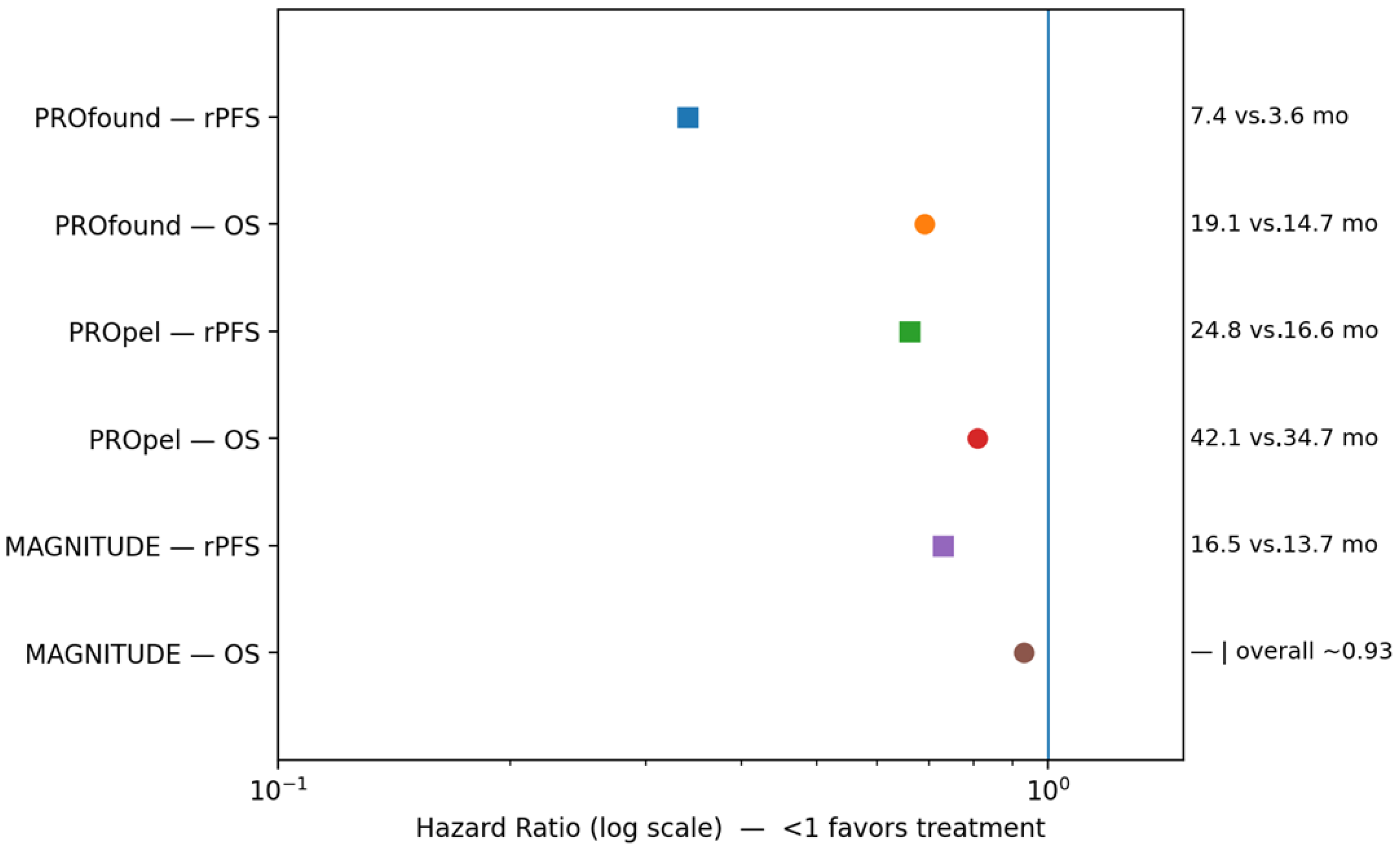
| PROfound [12] | mCRPC with HRR gene mutations after progression on AR-targeted therapy | Phase III, randomized, open-label | Olaparib significantly improved radiographic PFS and OS compared with enzalutamide or abiraterone in HRR-mutated mCRPC. | rPFS (BICR, Cohort A): HR 0.34; median 7.4 vs. 3.6 months. OS (final analysis, Cohort A): HR 0.69; median 19.1 vs. 14.7 months. |
| PROpel [56] | First-line mCRPC, all-comers | Phase III, randomized, double-blind | Olaparib plus abiraterone improved radiographic PFS compared with abiraterone alone, with the greatest magnitude of benefit observed in HRR-mutated tumors. | rPFS (investigator-assessed, primary): HR 0.66; median 24.8 vs. 16.6 months. OS (final prespecified analysis): HR 0.81; median 42.1 vs. 34.7 months (did not meet prespecified significance threshold). |
| MAGNITUDE [81] | First-line mCRPC stratified by HRR mutation status | Phase III, randomized, double-blind | Niraparib plus abiraterone improved outcomes in HRR-mutated disease, while no benefit was observed in HRR-negative patients, leading to early closure of that cohort. | rPFS (BICR): BRCA1/2 subgroup HR 0.53; median 16.6 vs. 10.9 months. Overall HRR+ HR 0.73; median 16.5 vs. 13.7 months. OS (final): HRR+ HR 0.93 (no OS benefit); BRCA1/2 OS HR 0.79; median 30.4 vs. 28.6 months. |
| TEAE | Frequency/Severity | Timing/Clinical Features | Recommended Management |
|---|---|---|---|
| Fatigue | Very common; mostly grade 1–2; occasional grade ≥3. | Cumulative; multifactorial (disease burden, anemia, prior therapies). | Evaluate reversible causes; encourage activity/exercise as tolerated; treat anemia; delay therapy for grade ≥3. |
| Xerostomia/Salivary Gland Toxicity | Very common (~30–60%); predominantly grade 1–2. | Early onset; may persist; impacts taste, oral comfort, and dental health. | Oral hygiene measures; dental review; sialagogues, saliva substitutes, hydration; investigational cooling strategies where available. |
| Nausea/Vomiting | Common; usually low grade. | Peri-treatment or delayed onset. | Antiemetics; hydration; small frequent meals; evaluate alternative causes if persistent. |
| Decreased Appetite/Weight Loss/Constipation | Common; generally low–to-moderate severity. | Multifactorial; often overlaps with fatigue and GI symptoms. | Nutritional support; antiemetics as appropriate; appetite support; bowel regimen. |
| Hematologic Toxicities (Anemia, Thrombocytopenia, Neutropenia) | Very common as laboratory abnormalities; grade ≥3 events observed. | Delayed nadir (≈4–8+ weeks); cumulative risk, higher with extensive bone or marrow involvement. | Regular CBC monitoring; hold or delay dosing per label; transfusions as indicated; G-CSF per guidelines; long-term surveillance. |
| Renal Toxicity (Creatinine Increase) | Uncommon. | Risk increased with baseline renal impairment or dehydration. | Ensure hydration; avoid nephrotoxins; monitor renal function; interrupt or delay therapy if clinically indicated. |
| Hepatic Enzyme Elevation | Uncommon; usually mild and transient. | Often asymptomatic; detected on routine labs. | Periodic LFT monitoring; interrupt for clinically significant elevations; modify or discontinue if persistent. |
| Pulmonary Events (Pneumonitis) | Rare; isolated cases reported. | New or worsening respiratory symptoms. | Prompt imaging and infection work-up; corticosteroids if inflammatory etiology suspected; discontinue therapy if severe or confirmed. |
| Secondary Malignancies (MDS/AML) | Rare; observed during long-term follow-up. | Late onset following cumulative exposure. | Long-term CBC monitoring; hematology referral if suspected; patient counseling regarding long-term risk. |
| Other (Infusion Reactions, Alopecia, Minor Laboratory Abnormalities) | Mostly low grade. | Variable timing. | Standard supportive care and routine monitoring. |
| Trial | Population/Setting | Design | Key Findings | Key Efficacy Outcomes (Method Specified) |
|---|---|---|---|---|
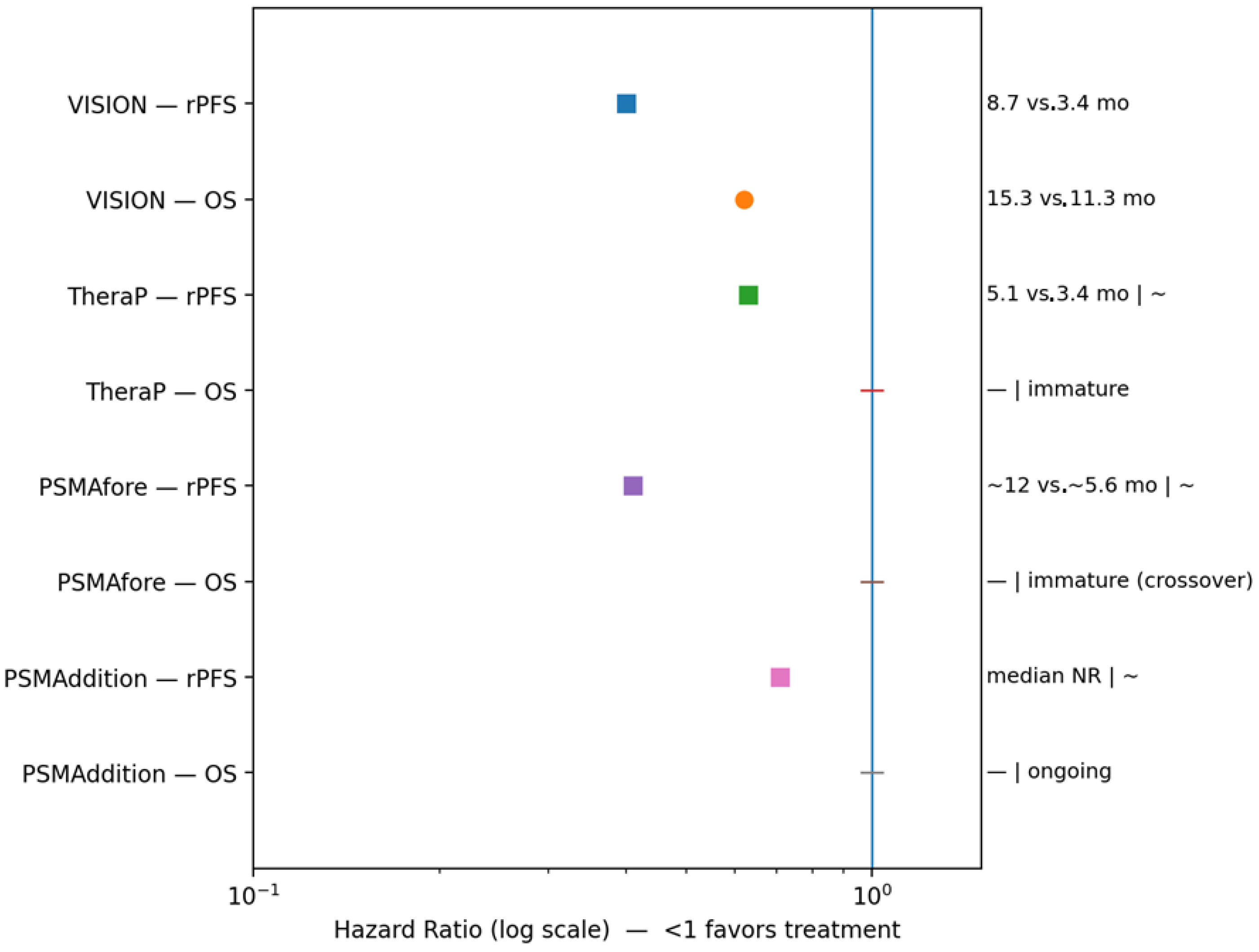
| VISION (Phase III) [21,126,131] | mCRPC, PSMA-positive, previously treated with ARPI and 1–2 taxanes | Phase III, open-label, randomized (2:1): 177Lu-PSMA-617 + SOC vs. SOC | Met primary endpoints with significant improvement in OS and rPFS; safety profile manageable with expected hematologic and salivary toxicities. | rPFS (BICR): HR 0.40; median 8.7 vs. 3.4 months. OS (final): HR 0.62; median 15.3 vs. 11.3 months. |
| TheraP (Phase II) [22,129] | mCRPC, cabazitaxel-eligible, PSMA-positive (dual PSMA/FDG PET selection) | Phase II, randomized, open-label: 177Lu-PSMA-617 vs. cabazitaxel | Higher PSA50 response rates and more favorable toxicity profile with 177Lu-PSMA-617 compared with cabazitaxel. | PFS (investigator-assessed): HR ~0.63; median 5.1 vs. 3.4 months. OS: immature at primary analysis; no statistically significant difference reported. |
| PSMAfore (Phase III) [132] | Taxane-naïve mCRPC, progressed after one ARPI, PSMA-positive | Phase III, randomized, open-label: 177Lu-PSMA-617 vs. change of ARPI | Significant improvement in rPFS; improvements in health-related quality of life and pain outcomes; OS data immature with crossover allowed. | rPFS (BICR, interim): HR 0.41; median ~12.0 vs. ~5.6 months. OS: immature (crossover permitted). |
| PSMAddition (Phase III) [125] | Metastatic hormone-sensitive prostate cancer (mHSPC), PSMA-positive | Phase III, randomized: 177Lu-PSMA-617 + ADT/ARPI vs. ADT/ARPI alone | Interim analysis demonstrates rPFS benefit with addition of radioligand therapy; OS follow-up ongoing. | rPFS (BICR, interim): HR ~0.71; median not reached in either arm. OS: ongoing. |
| Phase II/Single-Arm Studies [133] | Various mCRPC populations with heterogeneous prior therapies | Prospective single-arm studies; multiple dosing regimens | Demonstrated consistent antitumor activity with PSA responses in approximately 50% of patients and generally favorable tolerability. | No comparative HR (single-arm). Median PFS typically ~4–8 months. Median OS ~12–15 months, depending on cohort and prior therapy. |
| TEAE | Frequency/Severity | Timing/Clinical Features | Recommended Management Strategies |
|---|---|---|---|
| Hypertension | Very common; predominantly grade 1–2; occasional grade ≥3. | Early onset or cumulative; may exacerbate pre-existing hypertension. | Regular blood pressure monitoring; initiate or optimize antihypertensive therapy; consider temporary interruption for severe or uncontrolled hypertension. |
| Hypokalemia | Common; grade ≥3 events reported in a subset of patients. | Early, particularly with concomitant corticosteroids or diuretics. | Monitor serum potassium; oral or IV supplementation as needed; review and adjust concomitant medications. |
| Fluid Retention/Edema | Common; mostly grade 1–2. | Cumulative; peripheral edema most frequent, occasionally generalized. | Monitor weight and clinical signs; sodium restriction; diuretics as indicated; evaluate cardiac function if persistent or progressive. |
| Hepatotoxicity/LFT Elevation | Common; grade ≥3 elevations less frequent. | Typically within the first few months; often asymptomatic. | Baseline and periodic LFT monitoring; hold or discontinue therapy for ALT/AST >5× ULN; dose modification per label. |
| Fatigue/Asthenia | Very common (all grades); mostly grade 1–2. | Early or cumulative; multifactorial (disease burden, concomitant therapies). | Assess reversible contributors (anemia, sleep disturbance); energy conservation; moderate activity as tolerated; supportive care. |
| Cardiac Events (MI, Arrhythmia, Heart Failure–rare) | Uncommon but potentially serious. | More likely in patients with pre-existing cardiovascular disease. | Baseline cardiovascular assessment; monitor for new cardiac symptoms; optimize cardiac medications; interrupt therapy for severe events. |
| Musculoskeletal Pain/Arthralgia | Common; mostly grade 1–2. | Often early; may persist during treatment. | Analgesics and physiotherapy; assess for progression of metastatic bone disease if symptoms worsen. |
| Diarrhea/GI Upset/Nausea | Common; usually mild. | Can occur at any time during therapy. | Symptomatic management with antidiarrheals, antiemetics, hydration; dietary modifications as needed. |
| Mineralocorticoid Excess–Related Symptoms (e.g., Headache, Hypokalemia, Edema) | Common; related to observed hormonal effects in prostate cancer trials. | Early; may coincide with hypertension or electrolyte abnormalities. | Monitor blood pressure and electrolytes; low-dose corticosteroid co-administration per label; treat individual symptoms as above. |
| Other (Rash, Laboratory Abnormalities–rare) | Low frequency. | Variable timing. | Symptomatic management; interrupt or discontinue therapy if severe; routine laboratory monitoring. |
| Trial | Population/Setting | Design | Key Findings | Key Efficacy Outcomes (Method Specified) |
|---|---|---|---|---|
| Phase II/Single-Arm Studies [180] | mCRPC across various prior therapy exposures | Prospective, single-arm | Demonstrated clinical activity and tolerability of abiraterone in both pre- and post-chemotherapy settings, supporting further randomized evaluation. | No comparative HR (single-arm). Median rPFS ~3–6 months. Median OS ~12–15 months, depending on prior therapy exposure. |
| COU-AA-301 (Phase III) [26,27] | mCRPC post-docetaxel | Phase III, randomized, double-blind: abiraterone + prednisone vs. placebo + prednisone | Abiraterone significantly improved OS and rPFS with a manageable safety profile in post-chemotherapy mCRPC. | rPFS (investigator-assessed): HR ~0.67; median 5.6 vs. 3.6 months. OS: HR 0.65; median 14.8 vs. 10.9 months. |
| COU-AA-302 (Phase III) [28,142] | Chemotherapy-naïve mCRPC | Phase III, randomized, double-blind: abiraterone + prednisone vs. placebo + prednisone | Abiraterone improved OS, delayed radiographic progression, and maintained quality of life in chemotherapy-naïve mCRPC. | rPFS (investigator-assessed): HR 0.43; median 16.5 vs. 8.3 months. OS (final): HR 0.81; median 34.7 vs. 30.3 months. |
| LATITUDE (Phase III) [29,143] | Newly diagnosed high-risk metastatic hormone-sensitive prostate cancer (mHSPC) | Phase III, randomized, double-blind: abiraterone + ADT vs. placebo + ADT | Addition of abiraterone to ADT significantly improved OS and rPFS in high-risk mHSPC. | rPFS (investigator-assessed): HR 0.47; median 33.0 vs. 14.8 months. OS (final): HR 0.62; median 53.3 vs. 36.5 months. |
| STAMPEDE (Arm G, Phase III) [181,182] | Newly diagnosed mHSPC or high-risk locally advanced prostate cancer | Multi-arm, multi-stage, randomized: abiraterone + ADT ± radiotherapy vs. ADT alone | Abiraterone plus ADT improved OS and failure-free survival across metastatic and high-risk non-metastatic populations. | OS: HR 0.63; 3-year OS 83% vs. 76%. rPFS: median not reached at primary reporting. Failure-free survival: HR ~0.29. |
| CYCLONE 2 (Phase III) [183] | mCRPC | Phase III, randomized, double-blind: abemaciclib + abiraterone vs. placebo + abiraterone | Did not meet the primary rPFS endpoint; no improvement in efficacy with the addition of abemaciclib. | rPFS: HR ~1.0; median rPFS similar between arms. OS: immature; no benefit demonstrated at reporting. |
| Treatment Modality | Indication/Patient Population | Key Notes/Considerations |
|---|---|---|
| Active Surveillance | Low-risk localized prostate cancer | Regular PSA monitoring, periodic biopsy or MRI; avoids overtreatment; patient selection critical [218,219] |
| Radical Prostatectomy | Localized or locally advanced prostate cancer | Open, laparoscopic, or robotic approaches; may be combined with pelvic lymph node dissection; consider functional outcomes (continence, potency) [220,221] |
| Radiation Therapy | Localized or locally advanced disease; salvage therapy | External beam RT (EBRT) or brachytherapy; can be combined with ADT for intermediate/high-risk disease; fractionation schemes vary [222,223] |
| Androgen Deprivation Therapy (ADT) | Advanced or metastatic prostate cancer; often combined with radiation | LHRH agonists/antagonists or surgical castration; monitor for metabolic and cardiovascular side effects; can be intermittent or continuous [27,224] |
| Next-Generation AR Pathway Inhibitors | mCRPC or high-risk hormone-sensitive disease | Abiraterone, enzalutamide, apalutamide, darolutamide; improve OS and rPFS; monitor for hypertension, hepatotoxicity, fatigue [170,225] |
| Chemotherapy | mCRPC; selected high-risk mHSPC | Docetaxel or cabazitaxel; improves OS in metastatic setting; monitor hematologic toxicity [226,227] |
| Radioligand Therapy (RLT) | PSMA-positive mCRPC after standard therapies | 177Lu-PSMA-617; targeted therapy; monitor hematologic, renal, salivary gland toxicities; imaging required for eligibility [21,22] |
| Immunotherapy | MSI-H/dMMR or select mCRPC | Pembrolizumab or other checkpoint inhibitors; only effective in biomarker-selected populations [228] |
| Bone-Targeted Therapy | Metastatic disease with bone involvement | Denosumab or zoledronic acid; radium-223 for symptomatic bone metastases; prevents skeletal-related events [229,230] |
| Multimodal/Combination Therapy | High-risk localized or metastatic disease | Combining ADT, RT, surgery, and systemic therapy as appropriate; individualization based on risk, comorbidities, and molecular features [231,232,233,234] |
Disclaimer/Publisher’s Note: The statements, opinions and data contained in all publications are solely those of the individual author(s) and contributor(s) and not of MDPI and/or the editor(s). MDPI and/or the editor(s) disclaim responsibility for any injury to people or property resulting from any ideas, methods, instructions or products referred to in the content. |
© 2026 by the authors. Licensee MDPI, Basel, Switzerland. This article is an open access article distributed under the terms and conditions of the Creative Commons Attribution (CC BY) license.
Share and Cite
Kawczak, P.; Bączek, T. Emerging Therapeutic Strategies in Prostate Cancer: Targeted Approaches Using PARP Inhibition, PSMA-Directed Therapy, and Androgen Receptor Blockade with Olaparib, Lutetium (177Lu)Vipivotide Tetraxetan, and Abiraterone. J. Clin. Med. 2026, 15, 685. https://doi.org/10.3390/jcm15020685
Kawczak P, Bączek T. Emerging Therapeutic Strategies in Prostate Cancer: Targeted Approaches Using PARP Inhibition, PSMA-Directed Therapy, and Androgen Receptor Blockade with Olaparib, Lutetium (177Lu)Vipivotide Tetraxetan, and Abiraterone. Journal of Clinical Medicine. 2026; 15(2):685. https://doi.org/10.3390/jcm15020685
Chicago/Turabian StyleKawczak, Piotr, and Tomasz Bączek. 2026. "Emerging Therapeutic Strategies in Prostate Cancer: Targeted Approaches Using PARP Inhibition, PSMA-Directed Therapy, and Androgen Receptor Blockade with Olaparib, Lutetium (177Lu)Vipivotide Tetraxetan, and Abiraterone" Journal of Clinical Medicine 15, no. 2: 685. https://doi.org/10.3390/jcm15020685
APA StyleKawczak, P., & Bączek, T. (2026). Emerging Therapeutic Strategies in Prostate Cancer: Targeted Approaches Using PARP Inhibition, PSMA-Directed Therapy, and Androgen Receptor Blockade with Olaparib, Lutetium (177Lu)Vipivotide Tetraxetan, and Abiraterone. Journal of Clinical Medicine, 15(2), 685. https://doi.org/10.3390/jcm15020685