SCUBE-1 as a Biomarker Predictor for the Home Follow-Up and Hospitalization of SARS-CoV-2 Patients

 , , , , and
Abstract
1. Introduction
2. Materials and Methods
2.1. Research Design and Study Population
2.2. Inclusion Criteria and Exclusion Criteria
2.3. Laboratory Design
2.4. Plasma SCUBE-1 Test
2.5. Statistical Analysis
3. Results
4. Discussion
5. Conclusions
6. Limitations
Author Contributions
Funding
Institutional Review Board Statement
Informed Consent Statement
Data Availability Statement
Conflicts of Interest
Abbreviations
| SARS-CoV-2 | Severe Acute Respiratory Syndrome Coronavirus 2 |
| NLR | Neutrophil/Lymphocyte Ratio |
| PCR | Polymerase Chain Reaction |
| SCUBE-1 | Signal peptide-CUB-EGF-like protein 1 |
| ELISA | Enzyme-Linked Immunosorbent Assay |
| MPV | Mean Platelet Volume |
| ALT | Alanine Aminotransferase |
| AST | Aspartate Aminotransferase |
| CRP | C-Reactive Protein |
| WBC | White Blood Cell |
| ROC | Receiver Operating Characteristic |
References
- Wang, D.; Hu, B.; Hu, C.; Zhu, F.; Liu, X.; Zhang, J.; Wang, B.; Xiang, H.; Cheng, Z.; Xiong, Y.; et al. Clinical characteristics of 138 hospitalized patients with 2019 novel coronavirus–infected pneumonia in Wuhan, China. JAMA 2020, 323, 1061–1069. [Google Scholar] [CrossRef]
- Buch, V.; Zhong, A.; Li, X.; Rockenbach, M.A.B.C.; Wu, D.; Ren, H.; Guan, J.; Liteplo, A.; Dutta, S.; Dayan, I.; et al. Development and validation of a deep learning model for prediction of severe outcomes in suspected COVID-19 infection. arXiv 2021, arXiv:2103.11269. [Google Scholar] [CrossRef]
- Gorog, D.A.; Storey, R.F.; Gurbel, P.A.; Tantry, U.S.; Berger, J.S.; Chan, M.Y.; Duerschmied, D.; Smyth, S.S.; Parker, W.A.E.; Ajjan, R.A.; et al. Current and novel biomarkers of thrombotic risk in COVID-19: A consensus statement from the International COVID-19 Thrombosis Biomarkers Colloquium. Nat. Rev. Cardiol. 2022, 19, 475–495. [Google Scholar] [CrossRef] [PubMed]
- Battaglini, D.; Lopes-Pacheco, M.; Castro-Faria-Neto, H.; Pelosi, P.; Rocco, P. Laboratory biomarkers for diagnosis and prognosis in COVID-19. Front. Immunol. 2022, 13, 857573. [Google Scholar] [CrossRef] [PubMed]
- Su, S.; Wong, G.; Shi, W.; Liu, J.; Lai, A.C.K.; Zhou, J.; Liu, W.; Bi, Y.; Gao, G.F. Epidemiology, genetic recombination, and pathogenesis of coronaviruses. Trends Microbiol. 2016, 24, 490–502. [Google Scholar] [CrossRef] [PubMed]
- Lui, K.O.; Ma, Z.; Dimmeler, S. SARS-CoV-2-induced vascular endothelial dysfunction: Direct or indirect effects? Cardiovasc. Res. 2024, 120, 34–43. [Google Scholar] [CrossRef]
- Tsiatsiou, P.; Pilalas, D.; Tsaireli, V.; Lanta, A.; Meletis, G.; Kassomenaki, A.; Tza, E.; Tampakas, L.; Gkeka, H.; Papaioannou, M.; et al. Biomarkers of endothelial damage and disease severity in COVID-19 patients. Curr. Issues Mol. Biol. 2025, 47, 409. [Google Scholar] [CrossRef]
- Liao, W.-J.; Wu, M.-Y.; Peng, C.-C.; Tung, Y.-C.; Yang, R.-B. Epidermal growth factor-like repeats of SCUBE1 derived from platelets are critical for thrombus formation. Cardiovasc. Res. 2020, 116, 193–201. [Google Scholar] [CrossRef]
- Hanff, T.; Mohareb, A.; Giri, J.; Cohen, J.; Chirinos, J.A. Thrombosis in COVID-19. Am. J. Hematol. 2020, 95, 1578–1589. [Google Scholar] [CrossRef]
- Peacock, W.F. Will SCUBE1 solve the ischemia marker deficit? J. Am. Coll. Cardiol. 2008, 51, 2181–2183. [Google Scholar] [CrossRef][Green Version]
- Tu, C.F.; Yan, Y.T.; Wu, S.Y.; Hsu, W.L.; Chen, S.C.; Chien, C.L.; Liau, C.S.; Chen, Y.H.; Chien, S. Domain and functional analysis of a novel platelet-endothelial cell surface protein, SCUBE1. J. Biol. Chem. 2008, 283, 12478–12488. [Google Scholar] [CrossRef]
- Varga, Z.; Flammer, A.J.; Steiger, P.; Haberecker, M.; Andermatt, R.; Zinkernagel, A.S.; Mehra, M.R.; Schuepbach, R.A.; Ruschitzka, F.; Moch, H. Endothelial cell infection and endotheliitis in COVID-19. Lancet 2020, 395, 1417–1418. [Google Scholar] [CrossRef]
- Toprak, K.; Kaplangoray, M.; Palice, A.; Taşcanov, M.B.; İnanır, M.; Memioğlu, T.; Kök, Z.; Biçer, A.; Demirbağ, R. SCUBE1 is associated with thrombotic complications, disease severity, and in-hospital mortality in COVID-19 patients. Thromb. Res. 2022, 220, 100–106. [Google Scholar] [CrossRef] [PubMed]
- World Health Organization. Report of the WHO-China Joint Mission on Coronavirus Disease 2019 (COVID-19); WHO: Geneva, Switzerland, 2020; Available online: https://www.who.int/docs/default-source/coronaviruse/who-china-joint-mission-on-covid-19-final-report.pdf (accessed on 1 February 2021).
- Lindemann, S.; Gawaz, M. SCUBE1—A new scoop in vascular biology? Cardiovasc. Res. 2006, 71, 414–415. [Google Scholar] [CrossRef] [PubMed]
- Guan, W.J.; Ni, Z.Y.; Hu, Y.; Liang, W.H.; Ou, C.Q.; He, J.X.; Liu, L.; Shan, H.; Lei, C.L.; Hui, D.S.C.; et al. Clinical characteristics of coronavirus disease 2019 in China. N. Engl. J. Med. 2020, 382, 1708–1720. [Google Scholar] [CrossRef] [PubMed]
- Liu, Y.; Du, X.; Chen, J.; Jin, Y.; Peng, L.; Wang, H.; Luo, M.; Chen, L.; Zhao, Y.; Nie, X.; et al. Neutrophil-to-lymphocyte ratio as an independent risk factor for mortality in hospitalized patients with COVID-19. J. Infect. 2020, 81, 6–12. [Google Scholar] [CrossRef]
- Alonso Batun, A.I.; Tello Romero, V.J.; Pacheco Polanco, O.A.; Mendez-Dominguez, N. Neutrophil-to-Lymphocyte Ratio Predicts COVID-19 Mortality in the Yucatecan Maya Population: A Retrospective Cohort Study. COVID 2025, 5, 96. [Google Scholar] [CrossRef]
- Kyala, N.J.; Mboya, I.; Shao, E.; Sakita, F.; Kilonzo, K.G.; Shirima, L.; Sadiq, A.; Mkwizu, E.; Chamba, N.; Marandu, A.; et al. Neutrophil-to-lymphocyte ratio as a prognostic indicator in COVID-19: Evidence from a northern Tanzanian cohort. PLoS ONE 2025, 20, e0300231. [Google Scholar] [CrossRef]
- Papanikolopoulou, A.; Rapti, V.; Alexiou, P.; Charalampous, C.M.; Livanou, M.E.; Sakka, V.; Syrigos, K.N.; Poulakou, G. Neutrophil-to-Lymphocyte Ratio (NLR) and Platelet-to-Lymphocyte Ratio (PLR) as Prognostic Markers of COVID-19 Disease Irrespective of Immunosuppression Status: A Case-Control Retrospective Single-Center Study. Pathogens 2025, 14, 550. [Google Scholar] [CrossRef]
- Etli, M.; Karahan, O. Serum SCUBE-1 levels can predict endothelial dysfunction in healthy young adults. Turk. J. Vasc. Surg. 2019, 28, 31–35. [Google Scholar] [CrossRef]
- Ghoffari Siregar, M.A.; Ali, H.; Rahmadian, R.; Wiendra Rasya, S.F. Differential levels and biological roles of eNOS and SCUBE1 in endothelial dysfunction: A systematic review. J. Biol. Trop. 2025, 25, 5599–5610. [Google Scholar] [CrossRef]
- Lin, Y.C.; Sahoo, B.K.; Gau, S.S.; Tsai, H.J.; Hsieh, Y.L.; Chien, C.L.; Chen, Y.H. The biology of SCUBE. J. Biomed. Sci. 2023, 30, 33. [Google Scholar] [CrossRef]
- Rossouw, T.M.; Anderson, R.; Manga, P.; Feldman, C. Emerging role of platelet–endothelium interactions in the pathogenesis of severe SARS-CoV-2 infection-associated myocardial injury. Front. Immunol. 2022, 13, 776861. [Google Scholar] [CrossRef] [PubMed]
- Dai, D.F.; Thajeb, P.; Tu, C.F.; Yan, Y.T.; Wu, S.Y.; Ko, Y.L.; Lin, S.J.; Lin, S.F. Plasma concentration of SCUBE1, a novel platelet protein, is elevated in patients with acute coronary syndrome and ischemic stroke. J. Am. Coll. Cardiol. 2008, 51, 2173–2180. [Google Scholar] [CrossRef] [PubMed]
- Fazlıoğlu, N.; Aydın, C.; Demirkıran, A.; Özkaramanlı Gür, D.; Yılmaz, A.; Çelikkol, A. SCUBE-1 levels and their relationship with endothelial dysfunction in obstructive sleep apnea syndrome patients. Nat. Sci. Sleep 2025, 17, 1175–1190. [Google Scholar] [CrossRef]
- Özer, V.; Gonenc Cekic, O.; Bulbul, O.; Aydın, D.; Bulut, E.; Aksoy, F.; Pehlivanlar Kucuk, M.; Karahan, S.C.; Sozen, E.E.; Ozkaya, E.; et al. Diagnostic and prognostic value of SCUBE-1 in COVID-19 patients. West. J. Emerg. Med. 2024, 25, 975–984. [Google Scholar] [CrossRef]
- Özkan, G.; Bayrakçı, N.; Mutlu, L.C.; Erdem, İ.; Tuna, N.; Doğan, M.; Yıldırım, İ.; Erdal, B.; Çelikkol, A.; Yılmaz, A.; et al. Do levels of the platelet activation markers sCD40L and SCUBE1 differ between laboratory-confirmed and clinically diagnosed COVID-19 patients? Thromb. Haemost. Res. 2022, 6, 1084. [Google Scholar]
- Bayoglu Tekin, Y.; Baki Erin, K.; Yilmaz, A. Evaluation of SCUBE-1 levels as a placental dysfunction marker at gestational diabetes mellitus. Gynecol. Endocrinol. 2020, 36, 417–420. [Google Scholar] [CrossRef]



| Baseline and Laboratory Variables for All Participants | ||||
|---|---|---|---|---|
| All Participants n = 84 | Control Group n = 25 | SARS-CoV-2 Group n = 59 | p-Value | |
| Age, yr | 55.9 ± 14.6 | 55.9 ± 14.6 | 54.4 ± 15.2 | 0.73 |
| Sex, Female/Male | 39/45 | 11/14 | 28/31 | 0.78 |
| WBC, 103/µL | 7.8 (5.9–10.1) | 10.6 (7.4–10.1) | 7.2 (5.9–9.3) | <0.001 |
| Neutrophil, 103/µL | 5.3 (3.3–8.2) | 7.1 (5.3–4.9) | 4.5 (3.3–8.2) | <0.001 |
| Lymphocyte, 103/µL | 1.7 (1.3–2.1) | 1.6 (01.3–3.2) | 1.7 (1.4–2.1) | 0.55 |
| MPV, fL | 10.2 (9.2–10.8) | 10.0 (9.2–10.4) | 10.3 (9.6–11.0) | 0.09 |
| NLR, % | 3.5 (2.1–7.0) | 4.2 (2.1–7.0) | 2.8 (1.9–5.4) | 0.01 |
| ALT, mg/dL | 23.3 (18–31) | 23.5 (19.0–29.5) | 23.0 (18.0–31.0) | 0.65 |
| AST, mg/dL | 29.0 (20.5–31.5) | 29.0 (20.5–31.5) | 29.0 (21.0–31.5) | 0.49 |
| Fibrinogen, mg/dL | 584 (473–649) | 558 (486–644) | 611 (473–649) | 0.15 |
| D-Dimer, ng/mL | 885 (296–3140) | 910 (330–3140) | 860 (580–1415) | 0.49 |
| CRP, mg/dL | 33.0 (14.8–123) | 31.0 (14.8–57.5) | 35.1 (26.7–123.0) | 0.36 |
| SCUBE1, ng/mL | 0.15 (0.11–0.27) | 0.17 (0.10–0.27) | 0.13 (0.11–0.15) | 0.31 |
| Baseline and Laboratory Variables for the SARS-CoV-2-Positive Patients | |||
|---|---|---|---|
| SARS-CoV-2 at Home n = 37 | SARS-CoV-2 at Hospital n = 22 | p-Value | |
| Age, yr | 56.1 ± 12.9 | 55.8 ± 15.3 | 0.45 |
| Sex, Female/Male | 18/19 | 9/13 | 0.93 |
| WBC, 103/µL | 7.1 (6.1–8.0) | 8.1 (5.7–12.3) | 0.29 |
| Neutrophil, 103/µL | 4.5 (3.8–6.9) | 5.8 (2.5–9.9) | 0.50 |
| Lymphocyte, 103/µL | 2.0 (1.6–2.3) | 1.2 (0.6–1.4) | <0.001 |
| MPV, 103/µL | 10.1 (9.6–10.8) | 10.3 (9.7–10.8) | 0.92 |
| NLR, % | 2.7 (1.7–4.1) | 7.4 (2.6–8.9) | 0.02 |
| UREA, mg/dL | 35 (29–44) | 36 (28–51) | 0.43 |
| ALT, mg/dL | 25 (19–31) | 21 (15–23.5) | 0.76 |
| AST, mg/dL | 29 (23–31) | 25 (20–35) | 0.33 |
| Fibrinogen, mg/dL | 611 (481–653) | 611 (476–667) | 0.37 |
| D-Dimer, ng/mL | 940 (630–1270) | 860 (296–1425) | 0.51 |
| CRP, mg/dL | 33 (23–94) | 53 (40–136) | 0.22 |
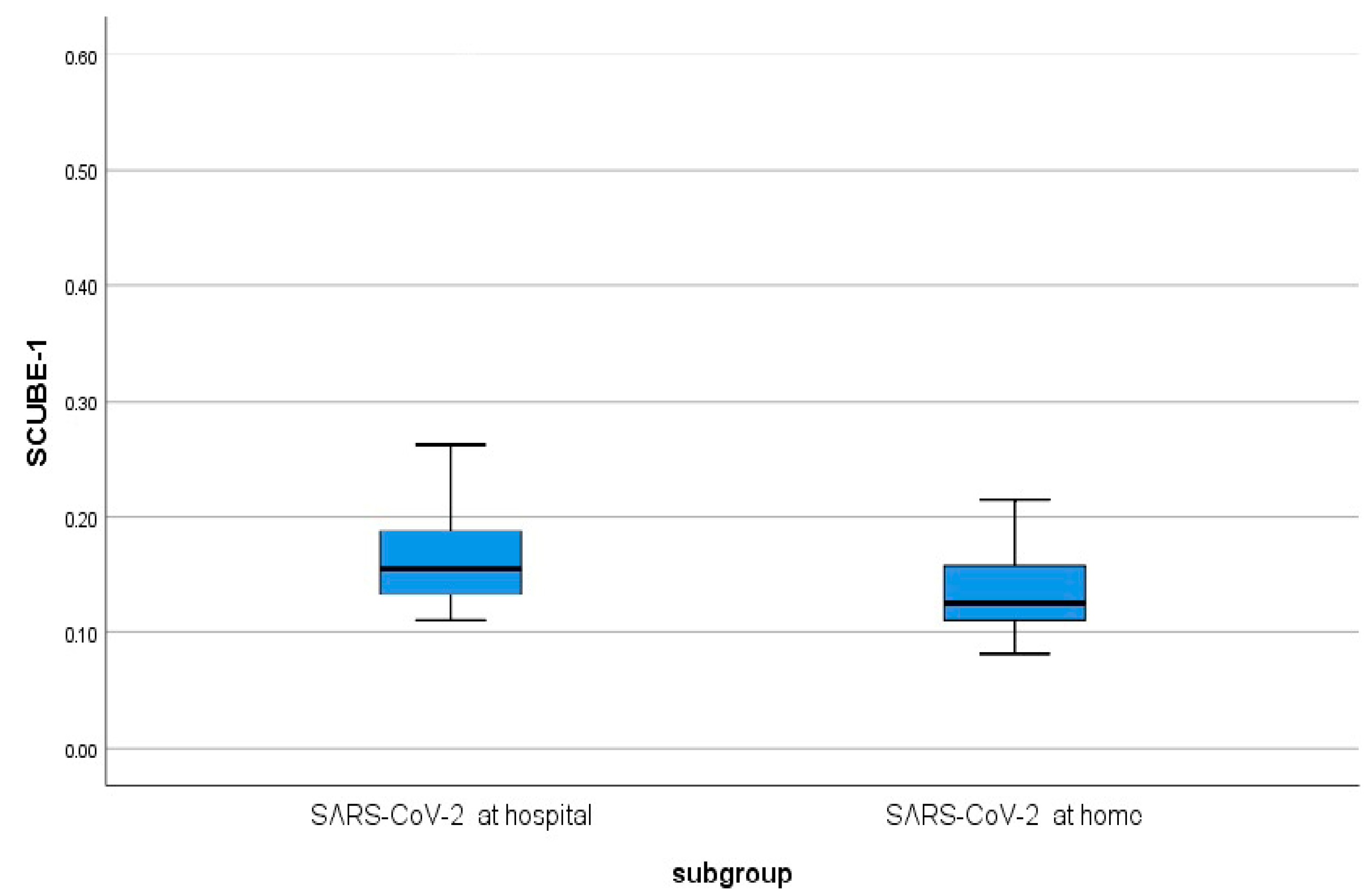
| SCUBE1, ng/mL | 0.12 (0.11–0.14) | 0.14 (0.12–0.15) | <0.001 |
| PCR Volume, % | 29.1 (24.3–30.8) | 25.5 (24.1–30.1) | 0.31 |
Disclaimer/Publisher’s Note: The statements, opinions and data contained in all publications are solely those of the individual author(s) and contributor(s) and not of MDPI and/or the editor(s). MDPI and/or the editor(s) disclaim responsibility for any injury to people or property resulting from any ideas, methods, instructions or products referred to in the content. |
© 2026 by the authors. Licensee MDPI, Basel, Switzerland. This article is an open access article distributed under the terms and conditions of the Creative Commons Attribution (CC BY) license.
Share and Cite
Çanakçi, S.E.; Turkdogan, K.A.; Ozyavuz, M.K.; Celik, F.; Sonmez, M.M.; Yilmaz, I.; Arslan, A.O.; Güner, A.E.; Zeybek, Ş.Ü. SCUBE-1 as a Biomarker Predictor for the Home Follow-Up and Hospitalization of SARS-CoV-2 Patients. J. Clin. Med. 2026, 15, 637. https://doi.org/10.3390/jcm15020637
Çanakçi SE, Turkdogan KA, Ozyavuz MK, Celik F, Sonmez MM, Yilmaz I, Arslan AO, Güner AE, Zeybek ŞÜ. SCUBE-1 as a Biomarker Predictor for the Home Follow-Up and Hospitalization of SARS-CoV-2 Patients. Journal of Clinical Medicine. 2026; 15(2):637. https://doi.org/10.3390/jcm15020637
Chicago/Turabian StyleÇanakçi, Selçuk Eren, Kenan Ahmet Turkdogan, Mustafa Kerem Ozyavuz, Faruk Celik, Mehmet Mesut Sonmez, Ibrahim Yilmaz, Ali Osman Arslan, Abdullah Emre Güner, and Şakir Ümit Zeybek. 2026. "SCUBE-1 as a Biomarker Predictor for the Home Follow-Up and Hospitalization of SARS-CoV-2 Patients" Journal of Clinical Medicine 15, no. 2: 637. https://doi.org/10.3390/jcm15020637
APA StyleÇanakçi, S. E., Turkdogan, K. A., Ozyavuz, M. K., Celik, F., Sonmez, M. M., Yilmaz, I., Arslan, A. O., Güner, A. E., & Zeybek, Ş. Ü. (2026). SCUBE-1 as a Biomarker Predictor for the Home Follow-Up and Hospitalization of SARS-CoV-2 Patients. Journal of Clinical Medicine, 15(2), 637. https://doi.org/10.3390/jcm15020637