Duodenal Trauma: Mechanisms of Injury, Diagnosis, and Management
 , ,
, , 
Abstract
1. Background and Methods
Methods
2. Mechanism of Injury
3. Classification
- ▪
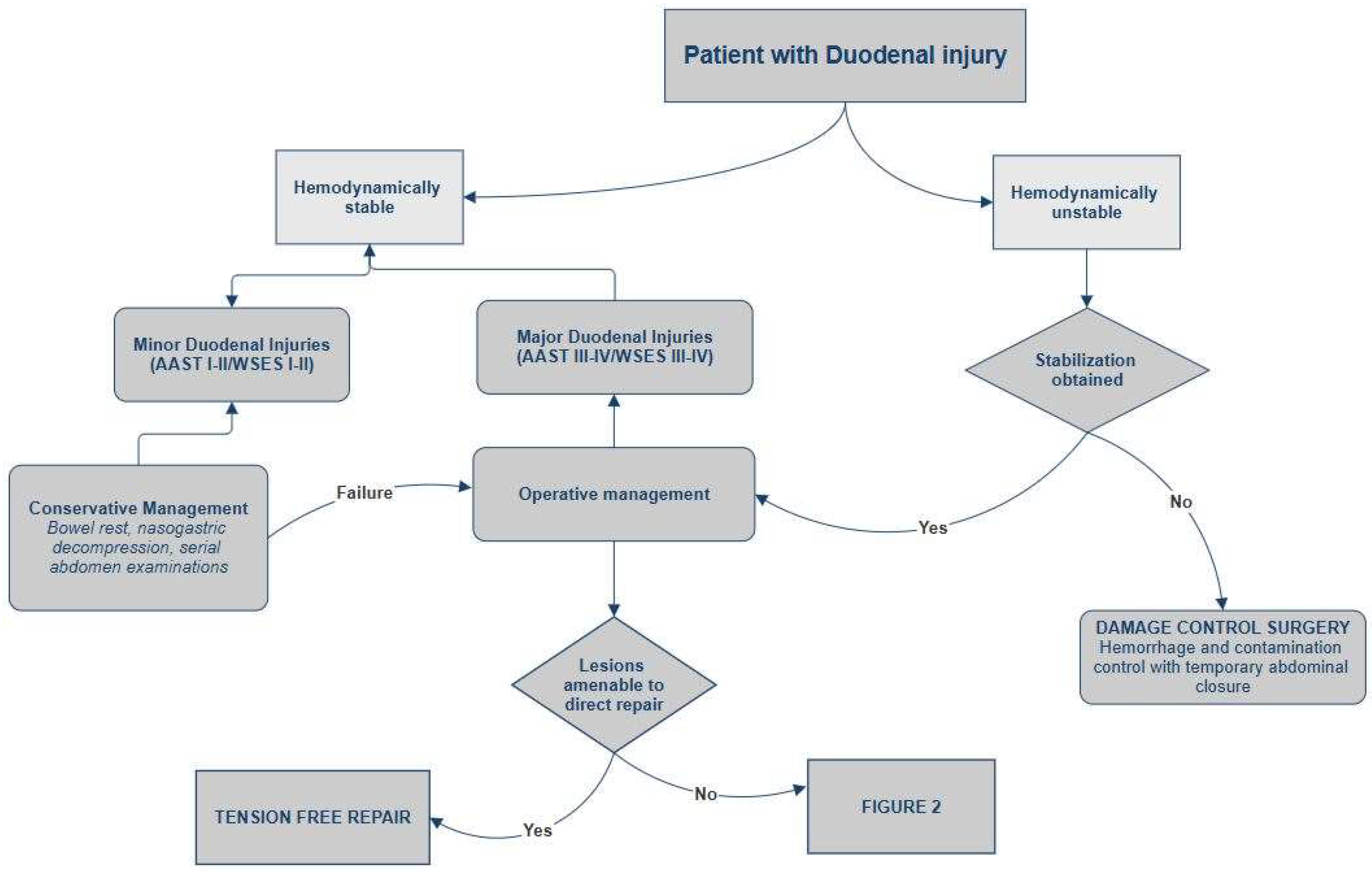
- Minor injuries:
- ▪
- WSES class I: includes hemodynamically stable patients with AAST-OIS grade I duodenal lesions.
- ▪
- Moderate injuries:
- ▪
- WSES class II: includes hemodynamically stable patients with AAST-OIS grade II duodenal lesions.
- ▪
- Severe injuries:
- ▪
- WSES class III: includes hemodynamically stable patients with AAST-OIS grade III–IV–V duodenal lesions.
- ▪
- WSES class IV: includes hemodynamically unstable patients with AAST-OIS grade I–V duodenal lesions.
4. Diagnosis
4.1. Clinical Presentation
4.2. Laboratory Findings
4.3. Radiological Imaging
5. Management
5.1. Antibiotic Therapy
5.2. Non-Operative Management
5.3. Operative Management
- ▪
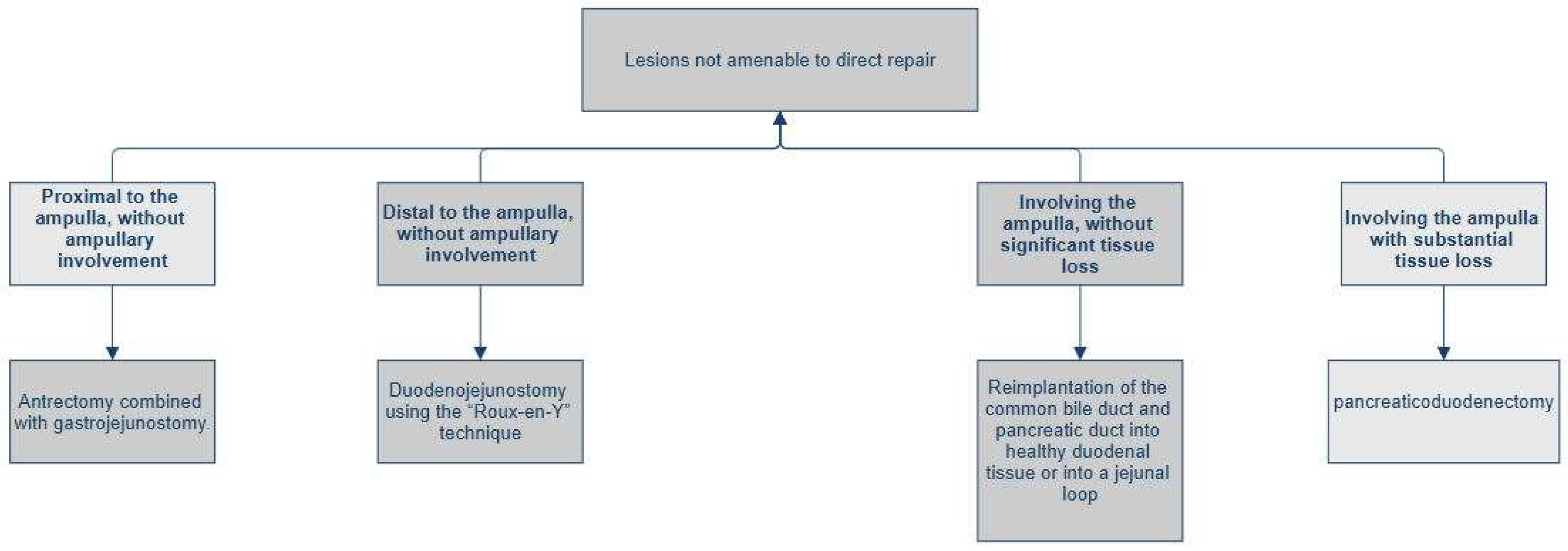
- Lesion proximal to the ampulla, without ampullary involvement: antrectomy combined with gastrojejunostomy.
- ▪
- Lesion distal to the ampulla, without ampullary involvement: duodenojejunostomy using the “Roux-en-Y” technique.
- ▪
- Lesion involving the ampulla or distal common bile duct (AAST Grade IV), without significant tissue loss: complex reconstruction, which may include the reimplantation of the common bile duct (via choledochoduodenostomy or choledochojejunostomy on a Roux-en-Y limb) and peripancreatic drainage [32].
- ▪
- Lesion involving the ampulla with substantial tissue loss: indication for pancreaticoduodenectomy (PD).
5.4. The Expanding Role of Endoscopic Management
6. Complications
7. Conclusions
Funding
Data Availability Statement
Conflicts of Interest
References
- O’Reilly, D.; Bouamra, O.; Kausar, A.; Dickson, E.; Lecky, F. The Epidemiology of and Outcome from Pancreatoduodenal Trauma in the UK, 1989–2013. Ann. R. Coll. Surg. Engl. 2015, 97, 125–130. [Google Scholar] [CrossRef]
- Townsend, C.M.; Beauchamp, R.D.; Evers, B.M.; Mattox, K.L.; Sabiston, D.C. Sabiston Textbook of Surgery: The Biological Basis of Modern Surgical Practice; Elsevier: Amsterdam, The Netherlands, 2022. [Google Scholar]
- Santos, E.G.; Sánchez, A.S.; Verde, J.M.; Marini, C.P.; Asensio, J.A.; Petrone, P. Lesiones duodenales secundarias a traumatismo: Revisión de la literatura. Cir. Esp. 2015, 93, 68–74. [Google Scholar] [CrossRef] [PubMed]
- Diggs, L.P.; Gregory, S.; Choron, R.L. Review of Traumatic Duodenal Injuries: Etiology, Diagnosis, and Management; SAGE Publications Inc.: Thousand Oaks, CA, USA, 2023. [Google Scholar] [CrossRef]
- Malhotra, A.; Biffl, W.L.; Moore, E.E.; Schreiber, M.; Albrecht, R.A.; Cohen, M.; Croce, M.; Karmy-Jones, R.; Namias, N.; Rowell, S.; et al. Western Trauma Association Critical Decisions in Trauma: Diagnosis and management of duodenal injuries. J. Trauma Acute Care Surg. 2015, 79, 1096–1101. [Google Scholar] [CrossRef] [PubMed]
- Linsenmaier, U.; Wirth, S.; Reiser, M.; Körner, M. Diagnosis and Classification of Pancreatic and Duodenal Injuries in Emergency Radiology. RadioGraphics 2008, 28, 1591–1602. [Google Scholar] [CrossRef] [PubMed]
- Gao, J.; Li, H.; Yang, J.; Wang, J.; Ai, T.; He, P.; Wei, G.; Xiang, Z.; Zhao, S. Surgical management of duodenal injury: Experience from 92 cases. Eur. J. Trauma Emerg. Surg. 2023, 49, 1367–1374. [Google Scholar] [CrossRef]
- Coccolini, F.; Panel, W.-A.E.; Kobayashi, L.; Kluger, Y.; Moore, E.E.; Ansaloni, L.; Biffl, W.; Leppaniemi, A.; Augustin, G.; Reva, V.; et al. Duodeno-Pancreatic and Extrahepatic Biliary Tree Trauma: WSES-AAST Guidelines; BioMed Central Ltd.: London, UK, 2019. [Google Scholar] [CrossRef]
- Gosangi, B.; Rocha, T.C.; Duran-Mendicuti, A. Imaging Spectrum of Duodenal Emergencies. RadioGraphics 2020, 40, 1441–1457. [Google Scholar] [CrossRef]
- Terra, C.; Ramos-Andrade, D.; Sá-Marques, I.; Brito, J.; Caseiro-Alves, F.; Curvo-Semedo, L. Duodenal imaging on the spotlight: From A to Z. Insights Imaging 2021, 12, 94. [Google Scholar] [CrossRef]
- Kantharia, C.V.; Prabhu, R.Y.; Dalvi, A.N.; Raut, A.; Bapat, R.D.; Supe, A.N. Spectrum and outcome of pancreatic trauma. Trop. Gastroenterol. 2007, 28, 105–108. [Google Scholar] [CrossRef]
- Menahem, B.; Lim, C.; Lahat, E.; Salloum, C.; Osseis, M.; Lacaze, L.; Compagnon, P.; Pascal, G.; Azoulay, D. Conservative and surgical management of pancreatic trauma in adult patients. Hepatobiliary Surg. Nutr. 2016, 5, 470–477. [Google Scholar] [CrossRef]
- Ballinger, Z.C.; Hazeltine, M.D.; Stetson, A.; Caffrey, E.; Hirsh, M.P.; Aidlen, J.T.; Cleary, M.A. A National Analysis of Pediatric Traumatic Duodenal Injuries. J. Surg. Res. 2024, 303, 716–723. [Google Scholar] [CrossRef]
- Lukish, J.R.; Eichelberger, M.R. Infants and Children as Accident Victims and Their Emergency Management. In Pediatric Surgery; Elsevier: Amsterdam, The Netherlands, 2012; pp. 261–270. [Google Scholar] [CrossRef]
- Servaes, S.; Haller, J.O. Characteristic pancreatic injuries secondary to child abuse. Emerg. Radiol. 2003, 10, 90–93. [Google Scholar] [CrossRef] [PubMed]
- Mansiroglu, A.K.; Cesur, E.; Firinci, B.; Caglar, O.; Yigiter, M.; Salman, A.B. Management of pancreatic and duodenal trauma in childhood: A university hospital experience over a 10-year period. Eur. J. Trauma Emerg. Surg. 2024, 50, 1661–1669. [Google Scholar] [CrossRef]
- Krzesiek, E.; Iwańczak, B.; Zaleska-Dorobisz, U.; Patkowski, D. Intramural duodenal hematoma and acute pancreatitis as a complication of diagnostic biopsy of a duodenal 6-year-old boy. Dev. Period Med. 2016, 20, 134–138. [Google Scholar] [PubMed]
- Waseem, M.; Perales, O. Pancreatic Injury. Pediatr. Emerg. Care 2008, 24, 679–681. [Google Scholar] [CrossRef] [PubMed]
- Diniz-Santos, D.R.; de Andrade Cairo, R.C.; Braga, H.; Araújo-Neto, C.; Paes, I.B.; Silva, L.R. Duodenal Hematoma following Endoscopic Duodenal Biopsy: A Case Report and Review of the Literature. Can. J. Gastroenterol. Hepatol. 2006, 20, 39–42. [Google Scholar] [CrossRef]
- Hombach, A.; Waltermann, E.; Kellner, M.W. Fremdkörperingestion im Kindesalter nach Zahnarztbesuch mit der seltenen Folge einer Dünndarmperforation und Pankreasverletzung. RöFo—Fortschritte Auf Geb. Röntgenstrahlen Bildgeb. Verfahr 2003, 175, 708–709. [Google Scholar] [CrossRef]
- Terreros, A.; Zimmerman, S. Duodenal Hematoma From a Fall Down the Stairs. J. Trauma Nurs. 2009, 16, 166–168. [Google Scholar] [CrossRef]
- Houben, C.H.; Ade-Ajayi, N.; Patel, S.; Kane, P.; Karani, J.; Devlin, J.; Harrison, P.; Davenport, M. Traumatic pancreatic duct injury in children: Minimally invasive approach to management. J. Pediatr. Surg. 2007, 42, 629–635. [Google Scholar] [CrossRef]
- Englum, B.R.; Gulack, B.C.; Rice, H.E.; Scarborough, J.E.; Adibe, O.O. Management of blunt pancreatic trauma in children: Review of the National Trauma Data Bank. J. Pediatr. Surg. 2016, 51, 1526–1531. [Google Scholar] [CrossRef]
- Kaman, L.; Iqbal, J.; Pall, M.; Bhukal, I.; Behera, A.; Singh, G.; Singh, R. Current management of pancreatic trauma. Trop. Gastroenterol. 2012, 33, 200–206. [Google Scholar] [CrossRef]
- Sharma, A.K. Management of Pancreaticoduodenal Injuries. Indian J. Surg. 2011, 74, 35–39. [Google Scholar] [CrossRef][Green Version]
- Lesher, A.; Williams, R. Pancreatic and Duodenal Trauma in Children. J. Pediatr. Intensiv. Care 2015, 04, 021–026. [Google Scholar] [CrossRef] [PubMed]
- Vasquez, J.C.; Coimbra, R.; Hoyt, D.B.; Fortlage, D. Management of penetrating pancreatic trauma: An 11-year experience of a level-1 trauma center. Injury 2001, 32, 753–759. [Google Scholar] [CrossRef] [PubMed]
- Rickard, M.J.F.X.; Brohi, K.; Bautz, P.C. Pancreatic and duodenal injuries: Keep it simple. ANZ J. Surg. 2005, 75, 581–586. [Google Scholar] [CrossRef]
- Choron, R.L.; Rallo, M.; Piplani, C.M.; Youssef, S.; Teichman, A.L.; Bargoud, C.G.; Sciarretta, J.D.; Smith, R.N.; Hanos, D.S.; Afif, I.N.; et al. The impact of postoperative enteral nutrition on duodenal injury outcomes: A post hoc analysis of an Eastern Association for the Surgery of Trauma multicenter trial. J. Trauma Acute Care Surg. 2024, 97, 928–936. [Google Scholar] [CrossRef]
- Ordoñez, C.A.; Parra, M.; Millan, M.; Caicedo, Y.; Padilla, N.; Garcia, A.; Franco, M.J.; Aristizabal, G.; Toro, L.E.; Pino, L.F.; et al. Damage control in penetrating duodenal trauma: Less is better. Colomb. Medica 2021, 52, e4104509. [Google Scholar] [CrossRef]
- Rathore, M.A.; Andrabi, S.I.H.; Najfi, S.M.; Chaudhry, Z.; Chaudhry, A.M. Injuries to the duodenum—Prognosis correlates with body Injury Severity Score: A prospective study. Int. J. Surg. 2007, 5, 388–393. [Google Scholar] [CrossRef] [PubMed][Green Version]
- Ferrada, P.; Wolfe, L.; Duchesne, J.; Fraga, G.P.; Benjamin, E.; Alvarez, A.; Campbell, A.; Wybourn, C.; Garcia, A.; Morales, C.; et al. Management of Duodenal Trauma: A Retrospective Review from the Panamerican Trauma Society; Lippincott Williams and Wilkins: Philadelphia, PA, USA, 2019. [Google Scholar] [CrossRef]
- Phillips, B.; Turco, L.; McDonald, D.; Mause, A.; Walters, R.W. Penetrating injuries to the duodenum: An analysis of 879 patients from the National Trauma Data Bank, 2010 to 2014. J. Trauma Acute Care Surg. 2017, 83, 810–817. [Google Scholar] [CrossRef]
- Bolaji, T.; Ratnasekera, A.; Ferrada, P. Management of the Complex Duodenal Injury; Elsevier Inc.: Amsterdam, The Netherlands, 2023. [Google Scholar] [CrossRef]
- Butano, V.; Napolitano, M.A.; Pat, V.; Wahrenbrock, T.; Lin, P.; Quintana, M.T.; Kartiko, S.; Sarani, B.; Estroff, J.M. Contemporary Management of Traumatic Duodenal Injuries. Am. Surg. 2021, 89, 1254–1257. [Google Scholar] [CrossRef]
- Daly, K.P.; Ho, C.P.; Persson, D.L.; Gay, S.B. Traumatic Retroperitoneal Injuries: Review of Multidetector CT Findings. RadioGraphics 2008, 28, 1571–1590. [Google Scholar] [CrossRef]
- Alkhulaiwi, H.; Alsarrani, F.H.; Alharbi, A.A. Duodenal transection following blunt abdominal trauma: A case report and literature review. J. Surg. Case Rep. 2022, 2022, rjab610. [Google Scholar] [CrossRef]
- Timaran, C.H.; Daley, B.J.; Enderson, B.L. Role of Duodenography in the Diagnosis of Blunt Duodenal Injuries. J. Trauma Inj. Infect. Crit. Care 2001, 51, 648–651. [Google Scholar] [CrossRef]
- Skelhorne-Gross, G.; Kenny, J. Blunt and Penetrating Injury to the Bowel: A Review. Clin. Colon Rectal Surg. 2023, 37, 424–429. [Google Scholar] [CrossRef] [PubMed]
- Joseph, D.K.; Kunac, A.; Kinler, R.L.; Staff, I.; Butler, K.L. Diagnosing blunt hollow viscus injury: Is computed tomography the answer? Am. J. Surg. 2013, 205, 414–418. [Google Scholar] [CrossRef]
- Atri, M.; Hanson, J.M.; Grinblat, L.; Brofman, N.; Chughtai, T.; Tomlinson, G. Surgically Important Bowel and/or Mesenteric Injury in Blunt Trauma: Accuracy of Multidetector CT for Evaluation. Radiology 2008, 249, 524–533. [Google Scholar] [CrossRef]
- Kunin, J.R.; Korobkin, M.; Ellis, J.H.; Francis, I.R.; Kane, N.M.; Siegel, S.E. Duodenal injuries caused by blunt abdominal trauma: Value of CT in differentiating perforation from hematoma. Am. J. Roentgenol. 1993, 160, 1221–1223. [Google Scholar] [CrossRef] [PubMed]
- Fulcher, A.S.; Turner, M.A.; Yelon, J.A.; McClain, L.C.; Broderick, T.; Ivatury, R.R.; Sugerman, H.J. Magnetic Resonance Cholangiopancreatography (MRCP) in the Assessment of Pancreatic Duct Trauma and Its Sequelae: Preliminary Findings. J. Trauma Inj. Infect. Crit. Care 2000, 48, 1001–1007. [Google Scholar] [CrossRef] [PubMed]
- Panda, A.; Kumar, A.; Gamanagatti, S.; Bhalla, A.S.; Sharma, R.; Kumar, S.; Mishra, B. Evaluation of diagnostic utility of multidetector computed tomography and magnetic resonance imaging in blunt pancreatic trauma: A prospective study. Acta Radiol. 2015, 56, 387–396. [Google Scholar] [CrossRef]
- Rekhi, S.; Anderson, S.W.; Rhea, J.T.; Soto, J.A. Imaging of blunt pancreatic trauma. Emerg. Radiol. 2009, 17, 13–19. [Google Scholar] [CrossRef]
- De Simone, B.; Chouillard, E.; Podda, M.; Pararas, N.; Duarte, G.d.C.; Fugazzola, P.; Birindelli, A.; Coccolini, F.; Polistena, A.; Sibilla, M.G.; et al. The 2023 WSES guidelines on the management of trauma in elderly and frail patients. World J. Emerg. Surg. 2024, 19, 18. [Google Scholar] [CrossRef]
- Brand, M.; Grieve, A. Prophylactic antibiotics for penetrating abdominal trauma. Cochrane Database Syst. Rev. 2019, 2019, CD007370. [Google Scholar] [CrossRef]
- Herrod, P.J.; Boyd-Carson, H.; Doleman, B.; Blackwell, J.; Williams, J.P.; Bhalla, A.; Nelson, R.L.; Tou, S.; Lund, J.N. Prophylactic Antibiotics for Penetrating Abdominal Trauma: Duration of Use and Antibiotic Choice; John Wiley and Sons Ltd.: Hoboken, NJ, USA, 2019. [Google Scholar] [CrossRef]
- Vira, A.; Roberts, P.; Preus, R.; Posey, C.; Miller, S.; Simmons, J.; Polite, N.; Bright, A.; Kinnard, C.; Williams, A.; et al. Management of Traumatic Duodenal Injury: Is There a Role for Early Parenteral Nutrition? J. Surg. Res. 2024, 302, 773–777. [Google Scholar] [CrossRef]
- Choron, R.L.; Efron, D.T. Isolated and Combined Duodenal and Pancreatic Injuries: A Review and Update; Springer: Berlin/Heidelberg, Germany, 2018. [Google Scholar] [CrossRef]
- Sermonesi, G.; Tian, B.W.C.A.; Vallicelli, C.; Abu-Zidan, F.M.; Damaskos, D.; Kelly, M.D.; Leppäniemi, A.; Galante, J.M.; Tan, E.; Kirkpatrick, A.W.; et al. Cesena Guidelines: Wses Consensus Statement on Laparoscopic-First Approach to General Surgery Emergencies and Abdominal Trauma; BioMed Central Ltd.: London, UK, 2013. [Google Scholar] [CrossRef]
- Bradley, M.; Bonds, B.; Dreizin, D.; Colton, K.; Shanmuganathan, K.; Scalea, T.M.; Stein, D.M. Indirect signs of blunt duodenal injury on computed tomography: Is non-operative management safe? Injury 2016, 47, 53–58. [Google Scholar] [CrossRef]
- Ivatury, R.R.; Malhotra, A.K.; Aboutanos, M.B.; Duane, T.M. Duodenal injuries: A review. Eur. J. Trauma Emerg. Surg. 2007, 33, 231–237. [Google Scholar] [CrossRef]
- Ordoñez, C.; García, A.; Parra, M.W.; Scavo, D.; Pino, L.F.; Millán, M.; Badiel, M.; Sanjuán, J.; Rodriguez, F.; Ferrada, R.; et al. Complex penetrating duodenal injuries: Less is better. J. Trauma Acute Care Surg. 2014, 76, 1177–1183. [Google Scholar] [CrossRef] [PubMed][Green Version]
- Bobrovitz, N.; Zygun, D.A.; Kirkpatrick, A.W.; Ball, C.G.; Faris, P.D.; Stelfox, H.T. Evidence for use of damage control surgery and damage control interventions in civilian trauma patients: A systematic review. World J. Emerg. Surg. 2021, 16, 10. [Google Scholar] [CrossRef] [PubMed]
- Kaban, J.M.; Parry, N.; Gross, R.I. Advanced Trauma Operative Management, 3rd ed.; American College of Surgeons: Chicago, IL, USA, 2021. [Google Scholar]
- Seamon, M.J.; Pieri, P.G.; Fisher, C.A.; Gaughan, J.; Santora, T.A.; Pathak, A.S.; Bradley, K.M.; Goldberg, A.J. A ten-year retrospective review: Does pyloric exclusion improve clinical outcome after penetrating duodenal and combined pancreaticoduodenal injuries? J. Trauma Inj. Infect. Crit. Care 2007, 62, 829–833. [Google Scholar] [CrossRef] [PubMed]
- García, A.; Sanchez, A.I.; Ferrada, P.; Wolfe, L.; Duchesne, J.; Fraga, G.P.; Benjamin, E.; Campbell, A.; Morales, C.; Pereira, B.M.; et al. Risk factors for the leakage of the repair of duodenal wounds: A secondary analysis of the Panamerican Trauma Society multicenter retrospective review. World J. Emerg. Surg. 2023, 18, 28. [Google Scholar] [CrossRef]
- Choron, R.L.; Teichman, A.L.; Bargoud, C.G.; Sciarretta, J.D.M.; Smith, R.N.; Hanos, D.S.; Afif, I.N.; Beard, J.H.; Dhillon, N.K.; Zhang, A.; et al. Outcomes among trauma patients with duodenal leak following primary versus complex repair of duodenal injuries: An Eastern Association for the Surgery of Trauma multicenter trial. J. Trauma Acute Care Surg. 2023, 95, 151–159. [Google Scholar] [CrossRef]
- de Carvalho, M.E.A.J.; Cunha, A.G. Pancreaticodudonectomy in Trauma: One or Two Stages? Elsevier Ltd.: Amsterdam, The Netherlands, 2020. [Google Scholar] [CrossRef]
- Noorbakhsh, S.; Wagner, V.; Arientyl, V.; Orlin, S.; Koganti, D.; Fransman, R.B.; Bishop, E.S.; Castater, C.A.; Nguyen, J.; Castro, A.D.L.; et al. Pancreaticoduodenectomy in high-grade pancreatic and duodenal trauma. Injury 2024, 55, 111721. [Google Scholar] [CrossRef]
- Williams, J.; Joshi, H.; Schwartz, M.; Kalola, A.; Mercado, A.; Saracco, B.; Adams, A.; Chaaya, A.; Baik, D.; Elfant, A.; et al. Endoscopic repair of duodenal perforations, a scoping review. Surg. Endosc. 2024, 38, 4839–4845. [Google Scholar] [CrossRef]
- Samra, M.; Al-Mouradi, T.; Berkelhammer, C. Gastric Outlet Obstruction due to Intramural Duodenal Hematoma after Endoscopic Biopsy: Possible Therapeutic Role of Endoscopic Dilation. Case Rep. Gastroenterol. 2018, 12, 692–698. [Google Scholar] [CrossRef]
- Alharbi, F.M.; Amer, Z.A.A.; Hamamesh, K.H.; Algubaisi, S.N. Endoscopic dilatation as a new technique in managing pediatric duodenal hematoma. Saudi Med J. 2020, 41, 874–877. [Google Scholar] [CrossRef] [PubMed]
- Valerii, G.; Ormando, V.M.; Cellini, C.; Sacco, L.; Barbera, C. Endoscopic management of intramural spontaneous duodenal hematoma: A case report. World J. Gastroenterol. 2022, 28, 2243–2247. [Google Scholar] [CrossRef] [PubMed]
- Spychalski, M.; Łabęcki, M.; Sobczak, M.; Nawrocka-Kunecka, A.; Kasprzyk, P.P. Successful iatrogenic duodenal perforation treatment with endoscopic hand suturing. Clin. Endosc. 2024, 57, 832–833. [Google Scholar] [CrossRef]
- Jędrzejczak, B.; Bednarski, P.; Spychalski, M.; Lipiński, P.; Dziki, A.; Mik, M. Endoscopic management of duodenal fistula in a patient operated after abdominal injury. Pol. J. Surg. 2020, 92, 64–67. [Google Scholar] [CrossRef] [PubMed]
- Yong, C.-S.; Hsiao, T.-F.; Wei, Y.-L.; Hung, T.-I.; Chou, Y.-H.; Sun, C.-K. Complete duodenal disruption from blunt abdominal trauma successfully managed with multistage surgical and endoscopic interventions: A case report. J. Surg. Case Rep. 2025, 2025, rjaf955. [Google Scholar] [CrossRef]
- Rogalski, P. Endoscopic management of gastrointestinal perforations, leaks and fistulas. World J. Gastroenterol. 2015, 21, 10542. [Google Scholar] [CrossRef]
- Allen, G.S.; Moore, F.A.; Cox, C.S.; Mehall, J.R.; Duke, J.H. Delayed Diagnosis of Blunt Duodenal Injury: An Avoidable Complication. J. Am. Coll. Surg. 1998, 187, 393–399. [Google Scholar] [CrossRef]
- Chen, G.; Yang, H. Management of duodenal trauma. Chin. J. Traumatol. 2011, 14, 61–64. [Google Scholar]
- Asensio, J.A.; Feliciano, D.V.; Britt, L.D.; Kerstein, M.D. Management of duodenal injuries. Curr. Probl. Surg. 1993, 30, 1026–1092. [Google Scholar] [CrossRef]



| AAST Duodenum Injury Scale | ||
|---|---|---|
| Grade | Type of Injury | Description |
| I | Hematoma | Involving single portion of duodenum |
| Laceration | Partial thickness, no perforation | |
| II | Hematoma | Involving more than one portion |
| Laceration | Disruption <50% of circumference | |
| III | Laceration | Disruption 50–75% of circumference of D2 Disruption 50–100% of circumference of D1, D3, D4 |
| IV | Laceration | Disruption >75% of circumference of D2 Involving ampulla or distal common bile duct |
| IV | Laceration | Massive disruption of duodenopancreatic complex |
| Vascular | Devascularization of duodenum | |
| WSES Classification Of Duodenal Injuries | |||||
|---|---|---|---|---|---|
| Grade | WSES Class | AAST | Hemodynamic Status | Type Of Injury | Description |
| Minor | WSES Class I | I | Stable | Hematoma | Involving single portion of duodenum |
| Laceration | Partial thickness, no perforation | ||||
| Moderate | WSES Class II | II | Stable | Hematoma | Dnvolving more than one portion |
| Laceration | Disruption <50% of circumference | ||||
| Severe | WSES Class III | III | Stable | Laceration | Disruption 50–75% of circumference of d2 Disruption 50–100% of circumference of d1, d3, d4 |
| IV | Stable | Laceration | Disruption >75% of circumference of d2 involving ampulla or distal common bile duct | ||
| V | Stable | Laceration | Massive disruption of duodenopancreatic complex | ||
| Vascular | Devacularization of duodenum | ||||
| WSES Class IV | Unstable | Any | Any | ||
Disclaimer/Publisher’s Note: The statements, opinions and data contained in all publications are solely those of the individual author(s) and contributor(s) and not of MDPI and/or the editor(s). MDPI and/or the editor(s) disclaim responsibility for any injury to people or property resulting from any ideas, methods, instructions or products referred to in the content. |
© 2026 by the authors. Licensee MDPI, Basel, Switzerland. This article is an open access article distributed under the terms and conditions of the Creative Commons Attribution (CC BY) license.
Share and Cite
Bova, R.; Griggio, G.; Scilletta, S.; Leone, F.; Vallicelli, C.; Agnoletti, V.; Catena, F. Duodenal Trauma: Mechanisms of Injury, Diagnosis, and Management. J. Clin. Med. 2026, 15, 567. https://doi.org/10.3390/jcm15020567
Bova R, Griggio G, Scilletta S, Leone F, Vallicelli C, Agnoletti V, Catena F. Duodenal Trauma: Mechanisms of Injury, Diagnosis, and Management. Journal of Clinical Medicine. 2026; 15(2):567. https://doi.org/10.3390/jcm15020567
Chicago/Turabian StyleBova, Raffaele, Giulia Griggio, Serena Scilletta, Federica Leone, Carlo Vallicelli, Vanni Agnoletti, and Fausto Catena. 2026. "Duodenal Trauma: Mechanisms of Injury, Diagnosis, and Management" Journal of Clinical Medicine 15, no. 2: 567. https://doi.org/10.3390/jcm15020567
APA StyleBova, R., Griggio, G., Scilletta, S., Leone, F., Vallicelli, C., Agnoletti, V., & Catena, F. (2026). Duodenal Trauma: Mechanisms of Injury, Diagnosis, and Management. Journal of Clinical Medicine, 15(2), 567. https://doi.org/10.3390/jcm15020567