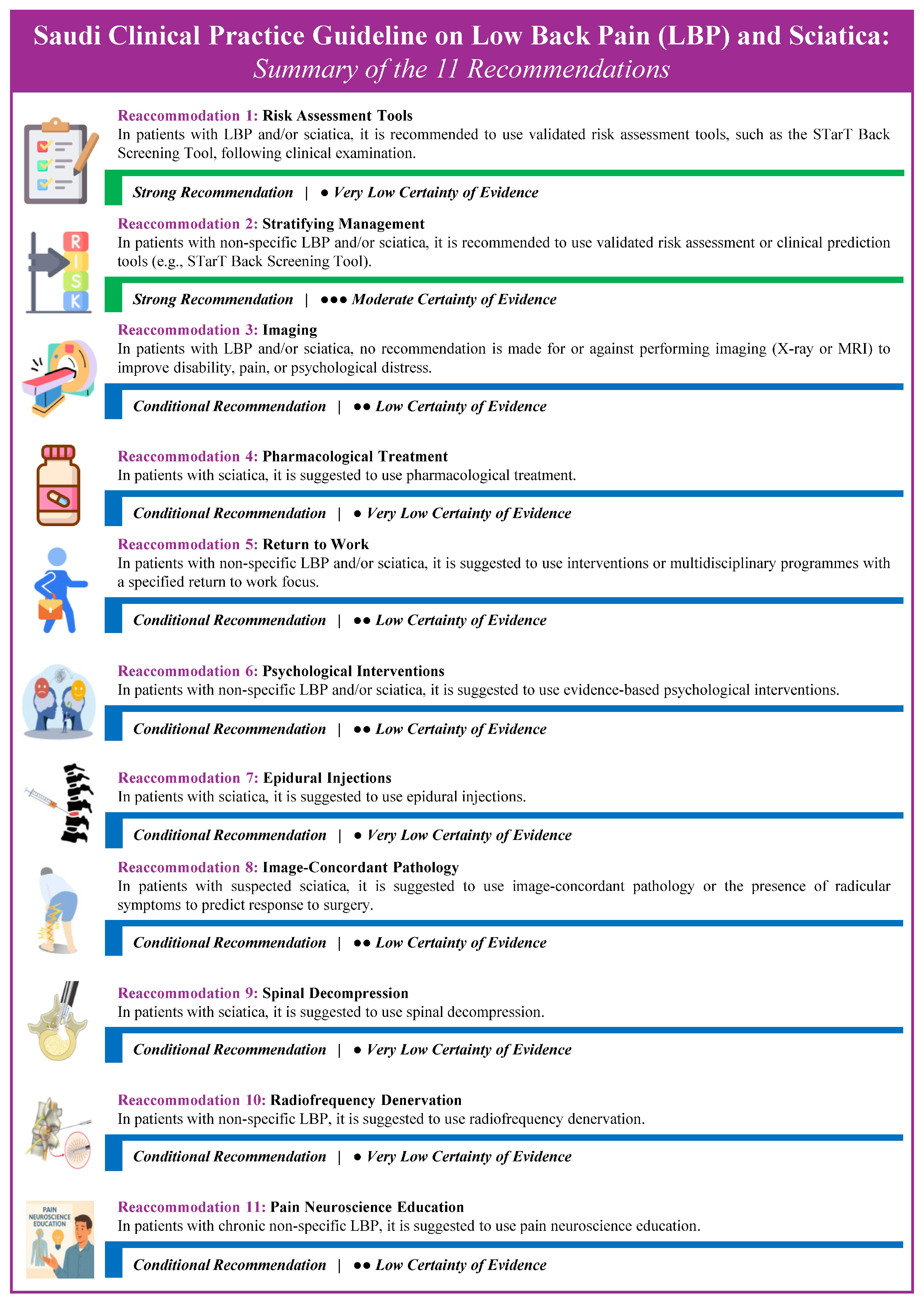
Saudi Clinical Practice Guideline for the Assessment and Management of Low Back Pain and Sciatica in Adults

 , ,
, ,  , , ,
, , ,
Abstract
1. Introduction
1.1. Scope
1.2. Objectives
1.3. Target Population
1.4. End-Users
1.5. How to Use This Guideline
2. Materials and Methods
2.1. Guideline Development Framework
2.2. Organisation and Governance
2.3. Selection of Clinical Questions and Prioritisation of Outcomes
2.4. Search Strategy
2.5. Study Selection
2.6. Data Extraction and Risk of Bias Assessment
2.7. Evidence Synthesis
2.8. Certainty of Evidence
2.9. Development of Recommendations
3. Results
3.1. Risk Assessment Tools
3.1.1. Question
3.1.2. Recommendation
3.1.3. Evidence Summary
3.1.4. Benefits and Harms
3.1.5. Certainty of Evidence
3.1.6. Contextual Factors
3.2. Stratifying Management
3.2.1. Question
3.2.2. Recommendation
3.2.3. Evidence Summary
3.2.4. Benefits and Harms
3.2.5. Certainty of Evidence
3.2.6. Contextual Factors
3.3. Imaging
3.3.1. Question
3.3.2. Recommendation
3.3.3. Evidence Summary
3.3.4. Benefits and Harms
3.3.5. Certainty of Evidence
3.3.6. Contextual Factors
3.4. Pharmacological Treatment
3.4.1. Question
3.4.2. Recommendation
3.4.3. Evidence Summary
3.4.4. Benefits and Harms
3.4.5. Certainty of Evidence
3.4.6. Contextual Factors
3.5. Return to Work
3.5.1. Question
3.5.2. Recommendation
3.5.3. Evidence Summary
3.5.4. Benefits and Harms
3.5.5. Certainty of Evidence
3.5.6. Contextual Factors
3.6. Psychological Interventions
3.6.1. Question
3.6.2. Recommendation
3.6.3. Evidence Summary
3.6.4. Benefits and Harms
3.6.5. Certainty of Evidence
3.6.6. Contextual Factors
3.7. Epidural Injections
3.7.1. Question
3.7.2. Recommendation
3.7.3. Evidence Summary
3.7.4. Benefits and Harms
3.7.5. Certainty of Evidence
3.7.6. Contextual Factors
3.8. Image-Concordant Pathology
3.8.1. Question
3.8.2. Recommendation
3.8.3. Evidence Summary
3.8.4. Benefits and Harms
3.8.5. Certainty of Evidence
3.8.6. Contextual Factors
3.9. Spinal Decompression
3.9.1. Question
3.9.2. Recommendation
3.9.3. Evidence Summary
3.9.4. Benefits and Harms
3.9.5. Certainty of Evidence
3.9.6. Contextual Factors
3.10. Radiofrequency Denervation
3.10.1. Question
3.10.2. Recommendation
3.10.3. Evidence Summary
3.10.4. Benefits and Harms
3.10.5. Certainty of Evidence
3.10.6. Contextual Factors
3.11. Pain Neuroscience Education
3.11.1. Question
3.11.2. Recommendation
3.11.3. Evidence Summary
3.11.4. Benefits and Harms
3.11.5. Certainty of Evidence
3.11.6. Contextual Factors
4. Discussion
4.1. Key Messages
- First, validated risk assessment and stratification tools exhibited sufficient prognostic accuracy to support their integration into routine clinical assessment. These tools facilitate timely identification of patients at increased risk of persistent symptoms, enabling more rational referral pathways and potentially reducing unnecessary imaging.
- Second, routine early imaging in the absence of red flags did not yield meaningful improvements in pain, function, or psychological outcomes and was consistently associated with increased healthcare utilisation. Imaging decisions should therefore be guided primarily by clinical evaluation, with investigations reserved for situations in which results are expected to influence management.
- Third, pharmacological treatments commonly used for sciatica demonstrated limited clinical benefit and an unfavourable risk profile, reinforcing the need for selective and judicious prescribing, particularly regarding benzodiazepines, gabapentinoids, corticosteroids, and long-term opioids. Short-term opioid therapy may be considered only for carefully selected patients with acute sciatica.
- Fourth, multidisciplinary interventions incorporating workplace, ergonomic or rehabilitation components showed improvements in return to work outcomes and may mitigate indirect costs associated with prolonged work absenteeism, findings that hold particular relevance within a rapidly developing national labour market.
- Fifth, psychological interventions, including cognitive behavioural therapy and mindfulness-based interventions, produced small but meaningful improvements in function and quality of life when implemented as part of a broader biopsychosocial care approach. Their contribution remains important despite heterogeneity and methodological limitations in the underlying evidence.
- Sixth, procedural interventions such as epidural injections, spinal decompression, and radiofrequency denervation were supported by mixed or very low certainty evidence. These procedures may benefit carefully selected patients with severe or persistent symptoms and image-concordant pathology but should be reserved for clearly defined indications requiring specialist expertise.
4.2. Strengths
4.3. Limitations
4.4. Research Needs
5. Conclusions
Supplementary Materials
Author Contributions
Funding
Institutional Review Board Statement
Informed Consent Statement
Data Availability Statement
Acknowledgments
Conflicts of Interest
Abbreviations
| LBP | Low back pain |
| MoH | Ministry of Health |
| GBD | Global Burden of Disease |
| NICE | National Institute for Health and Care Excellence |
| EtD | Evidence-to-Decision |
| RCTs | Randomized controlled trials |
| SBST | STarT Back Screening Tool |
| AUC | Under the curve |
| R2 | R-squared |
| ODI | Oswestry Disability Index |
| CPRIS | Chronic Pain Risk Item Set |
| LBPPS | Low Back Pain Perception Scale |
| ÖMPQ | Modified Örebro Musculoskeletal Pain Questionnaire |
| mos | Months |
| mo | Month |
| CI | Confidence interval |
| SF-12 | 12-Item Short Form Survey |
| VAS | Visual Analogue Scale |
| HADS | Hospital Anxiety and Depression Scale |
| RMDQ | Roland–Morris Disability Questionnaire |
| MD | Mean difference |
| RR | Risk ratio |
| QALYs | Quality-adjusted life years |
| X-ray | Plain radiography |
| MRI | Magnetic resonance imaging |
| SF-36 | 36-Item Short Form Survey |
| ALBPS | Aberdeen Low Back Pain Score |
| y | Year |
| NSAIDs | Non-steroidal anti-inflammatory drugs |
| NRS | Numeric Rating Scale |
| EQ-5D | EuroQol 5-Dimension |
| BDI | Beck Depression Inventory |
| HR | Hazard ratio |
| CBT | Cognitive behavioural therapy |
| MBIs | Mindfulness-based interventions |
| CT | Cognitive therapy |
| MPQ | McGill Pain Questionnaire |
| PAIRS | Pain and Impairment Relationship Scale |
| PDI | Pain Disability Index |
| HSI | Health Status Inventory |
| wks | Weeks |
| BMI | Body mass index |
| yrs | Years |
| OR | Odds ratio |
| SBI | Sciatica Bothersomeness Index |
| VNS | Visual Numeric Scale |
| LBPBI | Low Back Pain Bothersomeness |
| RF | Radiofrequency |
| PNE | Pain neuroscience education; |
| TSK | Tampa Scale for Kinesiophobia |
| GLITtER | Green Light Imaging Intervention to Enhance Recovery |
References
- GBD 2021 Low Back Pain Collaborators. Global, regional, and national burden of low back pain, 1990–2020, its attributable risk factors, and projections to 2050: A systematic analysis of the Global Burden of Disease Study 2021. Lancet Rheumatol. 2023, 5, e316–e329. [Google Scholar] [CrossRef]
- GBD 2023 Disease and Injury and Risk Factor Collaborators. Burden of 375 diseases and injuries, risk-attributable burden of 88 risk factors, and healthy life expectancy in 204 countries and territories, including 660 subnational locations, 1990–2023: A systematic analysis for the Global Burden of Disease Study 2023. Lancet 2025, 406, 1873–1922. [Google Scholar] [CrossRef] [PubMed]
- Tyrovolas, S.; El Bcheraoui, C.; Alghnam, S.A.; Alhabib, K.F.; Almadi, M.A.H.; Al-Raddadi, R.M.; Bedi, N.; El Tantawi, M.; Krish, V.S.; Memish, Z.A.; et al. The burden of disease in Saudi Arabia 1990–2017: Results from the Global Burden of Disease Study 2017. Lancet Planet. Health 2020, 4, e195–e208. [Google Scholar] [CrossRef] [PubMed]
- Alamam, D.M.; Moloney, N.; Leaver, A.; Alsobayel, H.I.; Mackey, M.G. Multidimensional prognostic factors for chronic low back pain-related disability: A longitudinal study in a Saudi population. Spine J. 2019, 19, 1548–1558. [Google Scholar] [CrossRef]
- Awwad, W.; Alfayez, S.; Bin Dous, A.; Alrabiei, Q.; Altowim, A.; Almutair, A.; Arafah, O. Knowledge around back pain and spinal disorders among Saudi patients: A cross-sectional study. J. Pak. Med. Assoc. 2017, 67, 1228–1231. [Google Scholar] [PubMed]
- Alhowimel, A.S.; Alodaibi, F.; Alshehri, M.M.; Alqahtani, B.A.; Alotaibi, M.; Alenazi, A.M. Prevalence and Risk Factors Associated with Low Back Pain in the Saudi Adult Community: A Cross-Sectional Study. Int. J. Environ. Res. Public Health 2021, 18, 13288. [Google Scholar] [CrossRef]
- Buragadda, S.; Aleisa, E.S.; Melam, G.R. Fear Avoidance Beliefs and Disability among Women with Low Back Pain. Neuropsychiatry 2018, 8, 73–79. [Google Scholar] [CrossRef]
- Hartvigsen, J.; Hancock, M.J.; Kongsted, A.; Louw, Q.; Ferreira, M.L.; Genevay, S.; Hoy, D.; Karppinen, J.; Pransky, G.; Sieper, J.; et al. What low back pain is and why we need to pay attention. Lancet 2018, 391, 2356–2367. [Google Scholar] [CrossRef]
- Henschke, N.; Maher, C.G.; Refshauge, K.M.; Herbert, R.D.; Cumming, R.G.; Bleasel, J.; York, J.; Das, A.; McAuley, J.H. Prevalence of and screening for serious spinal pathology in patients presenting to primary care settings with acute low back pain. Arthritis Rheum. 2009, 60, 3072–3080. [Google Scholar] [CrossRef]
- Younas, S.; Jabbar, A.; Khurshid, H.; Tariq, S.; Jabeen, T.; Rahman, A.; Majeed, S. Risk factors, prevention, and primary and secondary management of sciatica: An updated overview. Cureus 2022, 14, e31405. [Google Scholar] [CrossRef]
- Alanzi, M.S.Z.; Almuhawwis, A.G.A.; Abo El-Fetoh, N.M. Low back pain in population of Arar City, Northern Saudi Arabia: An epidemiological study. Egypt. J. Hosp. Med. 2017, 69, 2432–2437. [Google Scholar] [CrossRef]
- Šagát, P.; Bartík, P.; Prieto González, P.; Tohănean, D.I.; Knjaz, D. Impact of COVID-19 quarantine on low back pain intensity, prevalence, and associated risk factors among adult citizens residing in Riyadh (Saudi Arabia): A cross-sectional study. Int. J. Environ. Res. Public Health 2020, 17, 7302. [Google Scholar] [CrossRef] [PubMed]
- Alghadir, A.H.; Tse, C.; Iqbal, A.; Al-Khater, M.; Al-Rasheed, G. The prevalence and association of stress urinary incontinence, core muscle endurance, and low back pain among married women in Saudi Arabia: A case-control study. Biomed Res. Int. 2021, 2021, 5586213. [Google Scholar] [CrossRef] [PubMed]
- Al Faraj, S.; Al Mutairi, K. Vitamin D deficiency and chronic low back pain in Saudi Arabia. Spine 2003, 28, 177–179. [Google Scholar] [CrossRef] [PubMed]
- Zadro, J.R.; Shirley, D.; Amorim, A.B.; Pérez-Riquelme, F.; Ordoñana, J.R.; Ferreira, P.H. Are people with chronic low back pain meeting the physical activity guidelines? A co-twin control study. Spine J. 2017, 17, 761–772. [Google Scholar] [CrossRef]
- Lotfi, A.; Abdel-Nasser, A.M.; Hamdy, A.; Omran, A.A.; El-Rehany, M.A. Hypovitaminosis D in female patients with chronic low back pain. Clin. Rheumatol. 2007, 26, 1895–1901. [Google Scholar] [CrossRef]
- Woodman, A.; Homan, M.; Niaz, A.; Al-Jamea, L.; Akhtar, M.; Sager, M. Low back pain among healthcare personnel in Saudi Arabia: A systematic review. Ibnosina J. Med. Biomed. Sci. 2020, 12, 123–132. [Google Scholar] [CrossRef]
- Aldera, M.A.; Alexander, C.M.; McGregor, A.H. Prevalence and incidence of low back pain in the Kingdom of Saudi Arabia: A systematic review. J. Epidemiol. Glob. Health 2020, 10, 269–275. [Google Scholar] [CrossRef]
- Al Amer, H.S. Low back pain prevalence and risk factors among health workers in Saudi Arabia: A systematic review and meta-analysis. J. Occup. Health 2020, 62, e12155. [Google Scholar] [CrossRef]
- Keriri, H.M. Prevalence and risk factors of low back pain among nurses in operating rooms, Taif, Saudi Arabia. J. Med. Sci. Res. 2013, 4, 47–53. [Google Scholar] [CrossRef]
- AlDajah, S. Prevalence and risk factors of low back pain among nurses in Sudayr region. Eur. Sci. J. 2013, 9, 1857–7881. [Google Scholar]
- Attar, S.M. Frequency and risk factors of musculoskeletal pain in nurses at a tertiary centre in Jeddah, Saudi Arabia: A cross-sectional study. BMC Res. Notes 2014, 7, 61. [Google Scholar] [CrossRef]
- Jradi, H.; Alanazi, H.; Mohammad, Y. Psychosocial and occupational factors associated with low back pain among nurses in Saudi Arabia. J. Occup. Health 2020, 62, e12126. [Google Scholar] [CrossRef]
- Alghadir, A.; Zafar, H.; Iqbal, Z.A.; Al-Eisa, E. Work-related low back pain among physical therapists in Riyadh, Saudi Arabia. Workplace Health Saf. 2017, 65, 337–345. [Google Scholar] [CrossRef] [PubMed]
- Aljanakh, M.; Shaikh, S.; Siddiqui, A.A.; Al-Mansour, M.; Hassan, S.S. Prevalence of musculoskeletal disorders among dentists in the Ha’il Region of Saudi Arabia. Ann. Saudi Med. 2015, 35, 456–461. [Google Scholar] [CrossRef]
- Abduljabbar, T.; Abdullah, M. Musculoskeletal disorders among dentists in Saudi Arabia. Pak. Oral Dent. J. 2008, 28, 135–139. [Google Scholar]
- Dighriri, Y.H.; Akkur, M.A.; Alharbi, S.A.; Madkhali, N.A.; Matabi, K.I.; Mahfouz, M.S. Prevalence and associated factors of neck, shoulder, and low-back pains among medical students at Jazan University, Saudi Arabia: A cross-sectional study. J. Fam. Med. Prim. Care 2019, 8, 3826–3831. [Google Scholar]
- Alturkistani, L.H.; Hendi, O.M.; Bajaber, A.S.; Alhamoud, M.A.; Althobaiti, S.S.; Alharthi, T.A.; Atallah, A.A. Prevalence of lower back pain and its relation to stress among medical students in Taif University, Saudi Arabia. Int. J. Prev. Med. 2020, 11, 56. [Google Scholar] [CrossRef]
- AlShayhan, F.A.; Saadeddin, M. Prevalence of low back pain among health sciences students. Eur. J. Orthop. Surg. Traumatol. 2018, 28, 165–170. [Google Scholar] [CrossRef]
- Alrabai, H.; Aladhayani, M.; Alshahrani, S.; Alwethenani, Z.; Alsahil, M.; Algarni, A. Low back pain prevalence and associated risk factors among medical students at four major medical colleges in Saudi Arabia. J. Nat. Sci. Med. 2021, 4, 202–208. [Google Scholar] [CrossRef]
- Alghadir, A.; Anwer, S. Prevalence of musculoskeletal pain in construction workers in Saudi Arabia. Sci. World J. 2015, 2015, 529873. [Google Scholar] [CrossRef]
- Abdel-Salam, D.M.; Almuhaisen, A.S.; Alsubiti, R.A.; Aldhuwayhi, N.F.; Almotairi, F.S.; Alzayed, S.M.; Bakri, F.F. Musculoskeletal pain and its correlates among secondary school female teachers in Aljouf region, Saudi Arabia. J. Public Health 2021, 29, 211–217. [Google Scholar]
- Elnaggar, R.; Elshazly, F.; Mahmoud, W.; Ahmed, A. Determinants and relative risks of low back pain among the employees in Al-Kharj area, Saudi Arabia. Eur. J. Sci. Res. 2015, 137, 246–255. [Google Scholar]
- Assiri, A.; Mahfouz, A.A.; Awadalla, N.J.; Abolyazid, A.Y.; Shalaby, M.; Abogamal, A.; Alsabaani, A.; Riaz, F. Classroom furniture mismatch and back pain among adolescent school-children in Abha City, Southwestern Saudi Arabia. Int. J. Environ. Res. Public Health 2019, 16, 1395. [Google Scholar] [CrossRef]
- Issa, L.F.; Seleem, N.A.; Bakheit, A.M.; Baky, A.A.; Fahad, A.A. Low back pain among undergraduate students at Taif University, Saudi Arabia. Int. J. Public Health Epidemiol. 2016, 5, 264–272. [Google Scholar]
- Memish, Z.A.; Alqahtani, A.S.; Al-Azemi, N.; Abu Alhamayel, N.; Saeedi, M.; Abuzinada, S.; Albarakati, R.G.; Natarajan, S.; Alvira, X.; Bilimoria, K.; et al. A new era of national guideline development in Saudi Arabia. J. Epidemiol. Glob. Health 2022, 12, 83–90. [Google Scholar] [CrossRef]
- National Institute for Health and Care Excellence (NICE). Low Back Pain and Sciatica in Over 16s: Assessment and Management (NICE Guideline NG59); NICE: London, UK, 2016. [Google Scholar]
- Wood, L.; Hendrick, P.A. A systematic review and meta-analysis of pain neuroscience education for chronic low back pain: Short- and long-term outcomes of pain and disability. Eur. J. Pain 2019, 23, 234–249. [Google Scholar] [CrossRef]
- Schünemann, H.J.; Wiercioch, W.; Brożek, J.; Etxeandia-Ikobaltzeta, I.; Mustafa, R.A.; Manja, V.; Brignardello-Petersen, R.; Neumann, I.; Falavigna, M.; Alhazzani, W.; et al. GRADE Evidence to Decision (EtD) frameworks for adoption, adaptation, and de novo development of trustworthy recommendations: GRADE-ADOLOPMENT. J. Clin. Epidemiol. 2017, 81, 101–110. [Google Scholar] [CrossRef]
- Brouwers, M.C.; Kho, M.E.; Browman, G.P.; Burgers, J.S.; Cluzeau, F.; Feder, G.; Fervers, B.; Graham, I.D.; Grimshaw, J.; Hanna, S.E.; et al. AGREE II: Advancing guideline development, reporting, and evaluation in health care. Can. Med Assoc. J. 2010, 182, E839–E842. [Google Scholar] [CrossRef] [PubMed]
- Schünemann, H.; Brożek, J.; Guyatt, G.; Oxman, A. The GRADE Handbook; Cochrane Collaboration: London, UK, 2013. [Google Scholar]
- Morsø, L.; Kent, P.; Manniche, C.; Albert, H.B. The predictive ability of the STarT Back Screening Tool in a Danish secondary care setting. Eur. Spine J. 2014, 23, 120–128. [Google Scholar] [CrossRef] [PubMed][Green Version]
- Von Korff, M.; Shortreed, S.M.; Saunders, K.W.; Leresche, L.; Berlin, J.A.; Stang, P.; Turner, J.A. Comparison of back pain prognostic risk stratification item sets. J. Pain 2014, 15, 81–89. [Google Scholar] [CrossRef]
- Gabel, C.P.; Melloh, M.; Yelland, M.; Burkett, B.; Roiko, A. Predictive ability of a modified Örebro Musculoskeletal Pain Questionnaire in an acute/subacute low back pain working population. Eur. Spine J. 2011, 20, 449–457. [Google Scholar] [CrossRef][Green Version]
- Jellema, P.; van der Windt, D.A.W.M.; van der Horst, H.E.; Stalman, W.A.B.; Bouter, L.M. Prediction of an unfavourable course of low back pain in general practice: Comparison of four instruments. Br. J. Gen. Pract. 2007, 57, 15–22. [Google Scholar]
- Newell, D.; Field, J.; Pollard, D. Using the STarT Back Tool: Does timing of stratification matter? Man. Ther. 2015, 20, 533–539. [Google Scholar] [CrossRef]
- Morsø, L.; Kent, P.; Albert, H.B.; Hill, J.C.; Kongsted, A.; Manniche, C. The predictive and external validity of the STarT Back Tool in Danish primary care. Eur. Spine J. 2013, 22, 1859–1867. [Google Scholar] [CrossRef]
- Morsø, L.; Albert, H.; Kent, P.; Manniche, C.; Hill, J. Translation and discriminative validation of the STarT Back Screening Tool into Danish. Eur. Spine J. 2011, 20, 216–222. [Google Scholar] [CrossRef]
- Hill, J.C.; Dunn, K.M.; Lewis, M.; Mullis, R.; Main, C.J.; Foster, N.E.; Hay, E.M. A primary care back pain screening tool: Identifying patient subgroups for initial treatment. Arthritis Rheum. 2008, 59, 632–641. [Google Scholar] [CrossRef] [PubMed]
- Childs, J.D.; Piva, S.R. Psychometric properties of the Functional Rating Index in patients with low back pain. Eur. Spine J. 2005, 14, 1008–1012. [Google Scholar] [CrossRef] [PubMed]
- Pagé, I.; Abboud, J.; O’Shaughnessy, J.; Laurencelle, L.; Descarreaux, M. Chronic low back pain clinical outcomes present higher associations with the STarT Back Screening Tool than with physiologic measures: A 12-month cohort study. BMC Musculoskelet. Disord. 2015, 16, 201. [Google Scholar] [CrossRef] [PubMed]
- Hill, J.C.; Whitehurst, D.G.T.; Lewis, M.; Bryan, S.; Dunn, K.M.; Foster, N.E.; Konstantinou, K.; Main, C.J.; Mason, E.; Somerville, S.; et al. Comparison of stratified primary care management for low back pain with current best practice (STarT Back): A randomised controlled trial. Lancet 2011, 378, 1560–1571. [Google Scholar] [CrossRef]
- Foster, N.E.; Mullis, R.; Hill, J.C.; Lewis, M.; Whitehurst, D.G.T.; Doyle, C.; Konstantinou, K.; Main, C.; Somerville, S.; Sowden, G.; et al. Effect of stratified care for low back pain in family practice (IMPaCT Back): A prospective population-based sequential comparison. Ann. Fam. Med. 2014, 12, 102–111. [Google Scholar] [CrossRef]
- Cherkin, D.; Balderson, B.; Wellman, R.; Hsu, C.; Sherman, K.J.; Evers, S.C.; Hawkes, R.; Cook, A.; Levine, M.D.; Piekara, D.; et al. Effect of low back pain risk-stratification strategy on patient outcomes and care processes: The MATCH randomized trial in primary care. J. Gen. Intern. Med. 2018, 33, 1795–1805. [Google Scholar] [CrossRef]
- Whitehurst, D.G.T.; Bryan, S.; Lewis, M.; Hay, E.M.; Mullis, R.; Foster, N.E. Implementing stratified primary care management for low back pain: Cost-utility analysis alongside a prospective, population-based, sequential comparison study. Spine 2015, 40, 405–414. [Google Scholar] [CrossRef]
- Whitehurst, D.G.T.; Bryan, S.; Lewis, M.; Hill, J.; Hay, E.M. Exploring the cost-utility of stratified primary care management for low back pain compared with current best practice within risk-defined subgroups. Ann. Rheum. Dis. 2012, 71, 1796–1802. [Google Scholar] [CrossRef] [PubMed]
- Gilbert, F.J.; Grant, A.M.; Gillan, M.G.C.; Vale, L.; Scott, N.W.; Campbell, M.K.; Wardlaw, D.; Knight, D.; McIntosh, E.; Porter, R.W. Does early imaging influence management and improve outcome in patients with low back pain? A pragmatic randomised controlled trial. Health Technol. Assess. 2004, 8, 1–131. [Google Scholar] [CrossRef] [PubMed]
- Kerry, S.; Hilton, S.; Patel, S.; Dundas, D.; Rink, E.; Lord, J. Routine referral for radiography of patients presenting with low back pain: Is patient outcome influenced by general practitioners’ referral for plain radiography? Health Technol. Assess. 2000, 4, 1–109. [Google Scholar] [CrossRef]
- Kendrick, D.; Fielding, K.; Bentley, E.; Miller, P.; Kerslake, R.; Pringle, M. The role of radiography in primary care patients with low back pain of at least six weeks duration: A randomised (unblinded) controlled trial. Health Technol. Assess. 2001, 5, 1–119. [Google Scholar] [CrossRef] [PubMed]
- Lambeek, L.C.; van Mechelen, W.; Buijs, P.C.; Loisel, P.; Anema, J.R. An integrated care program to prevent work disability due to chronic low back pain: A process evaluation within a randomized controlled trial. BMC Musculoskelet. Disord. 2009, 10, 147. [Google Scholar] [CrossRef]
- Baron, R.; Freynhagen, R.; Tölle, T.R.; Cloutier, C.; Leon, T.; Murphy, T.K.; Phillips, K. The efficacy and safety of pregabalin in the treatment of neuropathic pain associated with chronic lumbosacral radiculopathy. Pain 2010, 150, 420–427. [Google Scholar] [CrossRef]
- Brötz, D.; Maschke, E.; Burkard, S.; Engel, C.; Mänz, C.; Ernemann, U.; Wick, W.; Weller, M. Is there a role for benzodiazepines in the management of lumbar disc prolapse with acute sciatica? Pain 2010, 149, 470–475. [Google Scholar] [CrossRef]
- Dreiser, R.L.; Le Parc, J.M.; Vélicitat, P.; Lleu, P.L. Oral meloxicam is effective in acute sciatica: Two randomised, double-blind trials versus placebo or diclofenac. Inflamm. Res. 2001, 50, 17–23. [Google Scholar] [CrossRef]
- Mathieson, S.; Maher, C.G.; McLachlan, A.J.; Latimer, J.; Koes, B.W.; Hancock, M.J.; Harris, I.; Day, R.O.; Billot, L.; Pik, J.; et al. Trial of pregabalin for acute and chronic sciatica. N. Engl. J. Med. 2017, 376, 1111–1120. [Google Scholar] [CrossRef]
- Yildirim, K.; Şişecioğlu, M.; Karatay, S.; Erdal, A.; Akin, L.; Akin, U.; Şenel, K.M. The effectiveness of gabapentin in patients with chronic radiculopathy. Pain Clin. 2003, 15, 213–218. [Google Scholar] [CrossRef]
- Goldberg, H.; Firtch, W.; Tyburski, M.; Pressman, A.; Ackerson, L.; Hamilton, L.; Smith, W.; Carver, R.; Maratukulam, A.; Won, L.A.; et al. Oral steroids for acute radiculopathy due to a herniated lumbar disk: A randomized clinical trial. JAMA 2015, 313, 1915–1923. [Google Scholar] [CrossRef]
- Herrmann, W.A.; Geertsen, M.S. Efficacy and safety of lornoxicam compared with placebo and diclofenac in acute sciatica/lumbo-sciatica: An analysis from a randomised, double-blind, multicentre, parallel-group study. Int. J. Clin. Pract. 2009, 63, 1613–1621. [Google Scholar] [CrossRef] [PubMed]
- Atkinson, J.H.; Slater, M.A.; Capparelli, E.V.; Patel, S.M.; Wolfson, T.; Gamst, A.; Abramson, I.S.; Wallace, M.S.; Funk, S.D.; Rutledge, T.R.; et al. A randomized controlled trial of gabapentin for chronic low back pain with and without a radiating component. Pain 2016, 157, 1499–1507. [Google Scholar] [CrossRef]
- Toroski, M.; Nikfar, S.; Mojahedian, M.M.; Ayati, M.H. Comparison of the cost-utility analysis of electroacupuncture and nonsteroidal antiinflammatory drugs in the treatment of chronic low back pain. J. Acupunct. Meridian Stud. 2018, 11, 185–191. [Google Scholar] [CrossRef] [PubMed]
- Cashin, A.G.; Folly, T.; Bagg, M.K.; Wewege, M.A.; Jones, M.D.; Ferraro, M.C.; Leake, H.B.; Rizzo, R.N.; Schabrun, S.M.; Gustin, S.M.; et al. Efficacy, acceptability, and safety of muscle relaxants for adults with non-specific low back pain: Systematic review and meta-analysis. BMJ 2021, 374, n1446. [Google Scholar] [CrossRef]
- Ferraro, M.C.; Bagg, M.K.; Wewege, M.A.; Cashin, A.G.; Leake, H.B.; Rizzo, R.N.; Jones, M.D.; Gustin, S.M.; Day, R.; Loo, C.K.; et al. Efficacy, acceptability, and safety of antidepressants for low back pain: A systematic review and meta-analysis. Syst. Rev. 2021, 10, 62. [Google Scholar] [CrossRef]
- Anema, J.R.; Steenstra, I.A.; Bongers, P.M.; de Vet, H.C.W.; Knol, D.L.; Loisel, P.; van Mechelen, W. Multidisciplinary rehabilitation for subacute low back pain: Graded activity or workplace intervention or both? A randomized controlled trial. Spine 2007, 32, 236–243. [Google Scholar] [CrossRef] [PubMed]
- Lambeek, L.C.; van Mechelen, W.; Knol, D.L.; Loisel, P.; Anema, J.R. Randomised controlled trial of integrated care to reduce disability from chronic low back pain in working and private life. BMJ 2010, 340, c1035. [Google Scholar] [CrossRef]
- Whitfill, T.; Haggard, R.; Bierner, S.M.; Pransky, G.; Hassett, R.G.; Gatchel, R.J. Early intervention options for acute low back pain patients: A randomized clinical trial with one-year follow-up outcomes. J. Occup. Rehabil. 2010, 20, 200–214. [Google Scholar] [CrossRef]
- Salathé, C.; Rolli, M.; Crawford, R.; Scherrer, S.; Boos, N.; Elfering, A. Treatment efficacy, clinical utility, and cost-effectiveness of multidisciplinary biopsychosocial rehabilitation treatments for persistent low back pain: A systematic review. Glob. Spine J. 2018, 8, 872–883. [Google Scholar] [CrossRef]
- Steenstra, I.A.; Anema, J.R.; van Tulder, M.W.; Bongers, P.M.; de Vet, H.C.W.; van Mechelen, W. Economic evaluation of a multi-stage return to work program for workers on sick-leave due to low back pain. J. Occup. Rehabil. 2006, 16, 557–578. [Google Scholar] [CrossRef]
- Lambeek, L.C.; Bosmans, J.E.; van Royen, B.J.; van Tulder, M.W.; van Mechelen, W.; Anema, J.R. Effect of integrated care for sick-listed patients with chronic low back pain: Economic evaluation alongside a randomised controlled trial. BMJ 2010, 341, c6414. [Google Scholar] [CrossRef]
- Newcomer, K.L.; Vickers Douglas, K.S.; Shelerud, R.A.; Long, K.H.; Crawford, B. Is a videotape to change beliefs and behaviors superior to a standard videotape in acute low back pain? A randomized controlled trial. Spine J. 2008, 8, 196–204. [Google Scholar] [CrossRef] [PubMed]
- Sanderson, K.B.; Roditi, D.; George, S.Z.; Atchison, J.W.; Banou, E.; Robinson, M.E. Investigating patient expectations and treatment outcome in a chronic low back pain population. J. Pain Res. 2012, 5, 15–22. [Google Scholar] [CrossRef] [PubMed]
- Carpenter, K.M.; Stoner, S.A.; Mundt, J.M.; Stoelb, B. An online self-help CBT intervention for chronic lower back pain. Clin. J. Pain 2012, 28, 14–20. [Google Scholar] [CrossRef]
- Göhner, W.; Schlicht, W. Preventing chronic back pain: Evaluation of a theory-based cognitive-behavioural training programme for patients with subacute back pain. Patient Educ. Couns. 2006, 64, 87–95. [Google Scholar] [CrossRef] [PubMed]
- Linden, M.; Scherbe, S.; Cicholas, B. Randomized controlled trial on the effectiveness of cognitive behavior group therapy in chronic back pain patients. J. Back Musculoskelet. Rehabil. 2014, 27, 563–568. [Google Scholar] [CrossRef]
- Menzel, N.N.; Robinson, M.E. Back pain in direct patient care providers: Early intervention with cognitive behavioral therapy. Pain Manag. Nurs. 2006, 7, 31–41. [Google Scholar] [CrossRef]
- Smeets, R.J.E.M.; Vlaeyen, J.W.S.; Kester, A.D.M.; Knottnerus, J.A. Reduction of pain catastrophizing mediates the outcome of both physical and cognitive-behavioral treatment in chronic low back pain. J. Pain 2006, 7, 261–271. [Google Scholar] [CrossRef]
- Jellema, P.; van der Windt, D.A.W.M.; van der Horst, H.E.; Twisk, J.W.R.; Stalman, W.A.B.; Bouter, L.M. Should treatment of (sub)acute low back pain be aimed at psychosocial prognostic factors? Cluster randomised clinical trial in general practice. BMJ 2005, 331, 84. [Google Scholar] [CrossRef]
- Morone, N.E.; Greco, C.M.; Weiner, D.K. Mindfulness meditation for the treatment of chronic low back pain in older adults: A randomized controlled pilot study. Pain 2008, 134, 310–319. [Google Scholar] [CrossRef]
- Banth, S.; Ardebil, M.D. Effectiveness of mindfulness meditation on pain and quality of life of patients with chronic low back pain. Int. J. Yoga 2015, 8, 128–133. [Google Scholar] [CrossRef] [PubMed]
- Storheim, K.; Brox, J.I.; Holm, I.; Koller, A.K.; Bø, K. Intensive group training versus cognitive intervention in sub-acute low back pain: Short-term results of a single-blind randomized controlled trial. J. Rehabil. Med. 2003, 35, 132–140. [Google Scholar] [CrossRef] [PubMed]
- Cherkin, D.C.; Sherman, K.J.; Balderson, B.H.; Cook, A.J.; Anderson, M.L.; Hawkes, R.J.; Hansen, K.E.; Turner, J.A. Effect of mindfulness-based stress reduction vs cognitive behavioral therapy or usual care on back pain and functional limitations in adults with chronic low back pain: A randomized clinical trial. JAMA 2016, 315, 1240–1249. [Google Scholar] [CrossRef] [PubMed]
- Ardito, R.B.; Pirro, P.S.; Re, T.S.; Bonapace, I.; Menardo, V.; Bruno, E.; Gianotti, L. Mindfulness-based stress reduction program on chronic low back pain: A study investigating the impact on endocrine, physical, and psychologic functioning. J. Altern. Complement. Med. 2017, 23, 140–147. [Google Scholar] [CrossRef]
- Jellema, P.; van der Roer, N.; van der Windt, D.A.W.M.; van Tulder, M.W.; van der Horst, H.E.; Stalman, W.A.B.; Bouter, L.M. Low back pain in general practice: Cost-effectiveness of a minimal psychosocial intervention versus usual care. Eur. Spine J. 2007, 16, 1487–1495. [Google Scholar] [CrossRef][Green Version]
- Herman, P.M.; Anderson, M.L.; Sherman, K.J.; Balderson, B.H.; Turner, J.A.; Cherkin, D.C. Cost-effectiveness of mindfulness-based stress reduction versus cognitive behavioral therapy or usual care among adults with chronic low back pain. Spine 2017, 42, 1511–1520. [Google Scholar] [CrossRef]
- Buchner, M.; Zeifang, F.; Brocai, D.R.C.; Schiltenwolf, M. Epidural corticosteroid injection in the conservative management of sciatica. Clin. Orthop. Relat. Res. 2000, 375, 149–156. [Google Scholar] [CrossRef]
- Dincer, U.; Kiralp, M.Z.; Cakar, E.; Yasar, E.; Dursan, H. Caudal epidural injection versus non-steroidal anti-inflammatory drugs in the treatment of low back pain accompanied with radicular pain. Jt. Bone Spine 2007, 74, 467–471. [Google Scholar] [CrossRef] [PubMed]
- Laiq, N.; Khan, M.N.; Iqbal, M.J.; Khan, S. Comparison of epidural steroid injections with conservative management in patients with lumbar radiculopathy. J. Coll. Physicians Surg. Pak. 2009, 19, 539–543. [Google Scholar] [PubMed]
- Pearson, A.; Lurie, J.; Tosteson, T.; Zhao, W.; Abdu, W.; Weinstein, J.N. Who should have surgery for spinal stenosis? Treatment effect predictors in SPORT. Spine 2012, 37, 1791–1802. [Google Scholar] [CrossRef] [PubMed]
- Cook, C.E.; Arnold, P.M.; Passias, P.G.; Frempong-Boadu, A.K.; Radcliff, K.; Isaacs, R.; Association for Collaborative Spine Research (ACSR). Predictors of pain and disability outcomes in one thousand, one hundred and eight patients who underwent lumbar discectomy surgery. Int. Orthop. 2015, 39, 1147–1154. [Google Scholar] [CrossRef]
- Ostelo, R.W.J.G.; Vlaeyen, J.W.S.; van den Brandt, P.A.; de Vet, H.C.W. Residual complaints following lumbar disc surgery: Prognostic indicators of outcome. Pain 2005, 114, 177–185. [Google Scholar] [CrossRef]
- Weinstein, J.N.; Tosteson, T.D.; Lurie, J.D.; Tosteson, A.N.A.; Blood, E.; Hanscom, B.; Herkowitz, H.; Cammisa, F.; Albert, T.; Boden, S.D.; et al. Surgical versus nonsurgical therapy for lumbar spinal stenosis. N. Engl. J. Med. 2008, 358, 794–810. [Google Scholar] [CrossRef]
- Weinstein, J.N.; Tosteson, T.D.; Lurie, J.D.; Tosteson, A.N.A.; Hanscom, B.; Skinner, J.S.; Abdu, W.A.; Hilibrand, A.S.; Boden, S.D.; Deyo, R.A. Surgical vs nonoperative treatment for lumbar disk herniation: The Spine Patient Outcomes Research Trial (SPORT): A randomized trial. JAMA 2006, 296, 2441–2450. [Google Scholar] [CrossRef]
- Peul, W.C.; van Houwelingen, H.C.; van den Hout, W.B.; Brand, R.; Eekhof, J.A.H.; Tans, J.T.J.; Thomeer, R.T.W.M.; Koes, B.W.; Leiden–The Hague Spine Intervention Prognostic Study Group. Surgery versus prolonged conservative treatment for sciatica. N. Engl. J. Med. 2007, 356, 2245–2256. [Google Scholar] [CrossRef]
- Osterman, H.; Seitsalo, S.; Karppinen, J.; Malmivaara, A. Effectiveness of microdiscectomy for lumbar disc herniation: A randomized controlled trial with 2 years of follow-up. Spine 2006, 31, 2409–2414. [Google Scholar] [CrossRef]
- McMorland, G.; Suter, E.; Casha, S.; du Plessis, S.J.; Hurlbert, R.J. Manipulation or microdiskectomy for sciatica? A prospective randomized clinical study. J. Manipulative Physiol. Ther. 2010, 33, 576–584. [Google Scholar] [CrossRef]
- Erginousakis, D.; Filippiadis, D.K.; Malagari, A.; Kostakos, A.; Brountzos, E.; Kelekis, N.L.; Kelekis, A. Comparative prospective randomized study comparing conservative treatment and percutaneous disk decompression for treatment of intervertebral disk herniation. Radiology 2011, 260, 487–493. [Google Scholar] [CrossRef]
- Gerszten, P.C.; Smuck, M.; Rathmell, J.P.; Simopoulos, T.T.; Bhagia, S.M.; Mocek, C.K.; Crabtree, T.; Bloch, D.A.; SPINE Study Group. Plasma disc decompression compared with fluoroscopy-guided transforaminal epidural steroid injections for symptomatic contained lumbar disc herniation: A prospective, randomized, controlled trial. J. Neurosurg. Spine 2010, 12, 357–371. [Google Scholar] [CrossRef]
- Tosteson, A.N.A.; Skinner, J.S.; Tosteson, T.D.; Lurie, J.D.; Andersson, G.B.; Berven, S.; Grove, M.R.; Hanscom, B.; Blood, E.A.; Weinstein, J.N. The cost effectiveness of surgical versus nonoperative treatment for lumbar disc herniation over two years: Evidence from the Spine Patient Outcomes Research Trial (SPORT). Spine 2008, 33, 2108–2115. [Google Scholar]
- van den Hout, W.B.; Peul, W.C.; Koes, B.W.; Brand, R.; Kievit, J.; Thomeer, R.T.W.M.; Fairbank, J. Prolonged conservative care versus early surgery in patients with sciatica from lumbar disc herniation: Cost utility analysis alongside a randomised controlled trial. BMJ 2008, 336, 1351–1354. [Google Scholar] [CrossRef] [PubMed]
- Tosteson, A.N.A.; Lurie, J.D.; Tosteson, T.D.; Skinner, J.S.; Herkowitz, H.; Albert, T.; Boden, S.D.; Bridwell, K.; Longley, M.; Andersson, G.B.; et al. Surgical treatment of spinal stenosis with and without degenerative spondylolisthesis: Cost-effectiveness after 2 years. Ann. Intern. Med. 2008, 149, 845–853. [Google Scholar] [CrossRef] [PubMed]
- Tekin, I.; Mirzai, H.; Ok, G.; Erbuyun, K.; Vatansever, D. A comparison of conventional and pulsed radiofrequency denervation in the treatment of chronic facet joint pain. Clin. J. Pain 2007, 23, 524–529. [Google Scholar] [CrossRef] [PubMed]
- Gallagher, J.; Petriccione Di Vadi, P.L.; Wedley, J.R.; Hamann, W.; Ryan, P.; Chikanza, I.; Kirkham, B.; Price, R.; Watson, M.S.; Grahame, R.; et al. Radiofrequency facet joint denervation in the treatment of low back pain: A prospective controlled double-blind study to assess its efficacy. Pain Clin. 1994, 7, 193–198. [Google Scholar]
- Leclaire, R.; Fortin, L.; Lambert, R.; Bergeron, Y.M.; Rossignol, M. Radiofrequency facet joint denervation in the treatment of low back pain: A placebo-controlled clinical trial to assess efficacy. Spine 2001, 26, 1411–1416. [Google Scholar]
- van Kleef, M.; Barendse, G.A.; Kessels, A.; Voets, H.M.; Weber, W.E.; de Lange, S. Randomized trial of radiofrequency lumbar facet denervation for chronic low back pain. Spine 1999, 24, 1937–1942. [Google Scholar] [CrossRef]
- Nath, S.; Nath, C.A.; Pettersson, K. Percutaneous lumbar zygapophysial (facet) joint neurotomy using radiofrequency current in the management of chronic low back pain: A randomized double-blind trial. Spine 2008, 33, 1291–1297. [Google Scholar] [CrossRef] [PubMed]
- Van Wijk, R.M.A.W.; Geurts, J.W.M.; Wynne, H.J.; Hammink, E.; Buskens, E.; Lousberg, R.; Knape, J.T.A.; Groen, G.J. Radiofrequency denervation of lumbar facet joints in the treatment of chronic low back pain: A randomized, double-blind, sham lesion-controlled trial. Clin. J. Pain 2005, 21, 335–344. [Google Scholar] [CrossRef]
- Civelek, E.; Cansever, T.; Kabataş, S.; Kircelli, A.K.; Yilmaz, C.; Musluman, M.; Ofluoglu, D.; Caner, H. Comparison of effectiveness of facet joint injection and radiofrequency denervation in chronic low back pain. Turk. Neurosurg. 2012, 22, 200–206. [Google Scholar] [CrossRef]
- Maas, E.T.; Juch, J.N.S.; Ostelo, R.W.J.G.; Groeneweg, J.G.; Kallewaard, J.-W.; Koes, B.W.; Verhagen, A.P.; van Dongen, J.M.; van Tulder, M.W.; Huygen, F.J.P.M. Cost-effectiveness of radiofrequency denervation for patients with chronic low back pain: The MINT randomized clinical trials. Value Health 2020, 23, 546–557. [Google Scholar] [CrossRef]
- Wälti, P.; Kool, J.; Luomajoki, H. Short-term effect on pain and function of neurophysiological education and sensorimotor retraining compared to usual physiotherapy in patients with chronic or recurrent non-specific low back pain: A pilot randomized controlled trial. BMC Musculoskelet. Disord. 2015, 16, 158. [Google Scholar] [CrossRef]
- Werner, E.L.; Storheim, K.; Løchting, I.; Wisløff, T.; Grotle, M. Cognitive patient education for low back pain in primary care: A cluster randomized controlled trial and cost-effectiveness analysis. Spine 2016, 41, 455–462. [Google Scholar] [CrossRef]
- Moseley, G.L.; Nicholas, M.K.; Hodges, P.W. A randomized controlled trial of intensive neurophysiology education in chronic low back pain. Clin. J. Pain 2004, 20, 324–330. [Google Scholar] [CrossRef]
- Moseley, L. Combined physiotherapy and education is efficacious for chronic low back pain. Aust. J. Physiother. 2002, 48, 297–302. [Google Scholar] [CrossRef]
- Téllez-García, M.; de-la-Llave-Rincón, A.I.; Salom-Moreno, J.; Palacios-Ceña, M.; Ortega-Santiago, R.; Fernández-de-Las-Peñas, C. Neuroscience education in addition to trigger point dry needling for the management of patients with mechanical chronic low back pain: A preliminary clinical trial. J. Bodyw. Mov. Ther. 2015, 19, 464–472. [Google Scholar] [CrossRef] [PubMed]
- Pires, D.; Cruz, E.B.; Caeiro, C. Aquatic exercise and pain neurophysiology education versus aquatic exercise alone for patients with chronic low back pain: A randomized controlled trial. Clin. Rehabil. 2015, 29, 1238–1249. [Google Scholar] [CrossRef] [PubMed]
- Louw, A.; Farrell, K.; Landers, M.; Barclay, M.; Goodman, E.; Gillund, J.; McCaffrey, S.; Timmerman, L. The effect of manual therapy and neuroplasticity education on chronic low back pain: A randomized clinical trial. J. Man. Manip. Ther. 2017, 25, 227–234. [Google Scholar] [CrossRef]
- Malfliet, A.; Kregel, J.; Meeus, M.; Roussel, N.; Danneels, L.; Cagnie, B.; Dolphens, M.; Nijs, J. Blended-learning pain neuroscience education for people with chronic spinal pain: Randomized controlled multicenter trial. Phys. Ther. 2018, 98, 357–368. [Google Scholar] [CrossRef]
- Karran, E.L.; Hillier, S.L.; Yau, Y.-H.; McAuley, J.H.; Moseley, G.L. A quasi-randomised, controlled, feasibility trial of GLITtER (Green Light Imaging Interpretation to Enhance Recovery)—A psychoeducational intervention for adults with low back pain attending secondary care. PeerJ 2018, 6, e4215. [Google Scholar] [CrossRef] [PubMed]
- Beneciuk, J.M.; Bishop, M.D.; Fritz, J.M.; Robinson, M.E.; Asal, N.R.; Nisenzon, A.N.; George, S.Z. The STarT Back Screening Tool and individual psychological measures: Evaluation of prognostic capabilities for low back pain clinical outcomes in outpatient physical therapy settings. Phys. Ther. 2013, 93, 321–333. [Google Scholar] [CrossRef]
- Williams, C.M.; Maher, C.G.; Latimer, J.; McLachlan, A.J.; Hancock, M.J.; Day, R.O.; Lin, C.-W.C. Efficacy of paracetamol for acute low-back pain: A double-blind, randomised controlled trial. Lancet 2014, 384, 1586–1596. [Google Scholar] [CrossRef]
- Dagfinrud, H.; Storheim, K.; Magnussen, L.H.; Ødegaard, T.; Hoftaniska, I.; Larsen, L.G.; Ringstad, P.O.; Hatlebrekke, F.; Grotle, M. The predictive validity of the Örebro Musculoskeletal Pain Questionnaire and the clinician’s prognostic assessment following manual therapy treatment of patients with low back pain and neck pain. Man. Ther. 2013, 18, 124–129. [Google Scholar] [CrossRef]
- Heneweer, H.; Aufdemkampe, G.; van Tulder, M.W.; Kiers, H.; Stappaerts, K.H.; Vanhees, L. Psychosocial variables in patients with (sub)acute low back pain: An inception cohort in primary care physical therapy in The Netherlands. Spine 2007, 32, 586–594. [Google Scholar] [CrossRef] [PubMed]
- Maher, C.G.; Grotle, M. Evaluation of the predictive validity of the Örebro Musculoskeletal Pain Screening Questionnaire. Clin. J. Pain 2009, 25, 666–670. [Google Scholar] [CrossRef] [PubMed]
- Childs, J.D.; Fritz, J.M.; Flynn, T.W.; Irrgang, J.J.; Johnson, K.K.; Majkowski, G.R.; Delitto, A. A clinical prediction rule to identify patients with low back pain most likely to benefit from spinal manipulation: A validation study. Ann. Intern. Med. 2004, 141, 920–928. [Google Scholar] [CrossRef]
- Beneciuk, J.M.; Fritz, J.M.; George, S.Z. The STarT Back Screening Tool for prediction of 6-month clinical outcomes: Relevance of change patterns in outpatient physical therapy settings. J. Orthop. Sports Phys. Ther. 2014, 44, 656–664. [Google Scholar] [CrossRef]
- Alfayez, S.M.; Bin Dous, A.N.; Altowim, A.A.; Alrabiei, Q.A.; Alsubaie, B.O.; Awwad, W.M. The validity and reliability of the Arabic version of the Japanese Orthopedic Association Back Pain Evaluation Questionnaire: Can we implement it in Saudi Arabia? J. Orthop. Sci. 2017, 22, 647–652. [Google Scholar] [CrossRef]
- Algarni, A.S.; Ghorbel, S.; Jones, J.G.; Guermazi, M. Validation of an Arabic version of the Oswestry Disability Index in Saudi Arabia. Ann. Phys. Rehabil. Med. 2014, 57, 653–663. [Google Scholar] [CrossRef]
- Alamam, D.M.; Leaver, A.; Moloney, N.; Alsobayel, H.I.; Alashaikh, G.; Mackey, M.G. Pain Behaviour Scale (PaBS): An exploratory study of reliability and construct validity in a chronic low back pain population. Pain Res. Manag. 2019, 2019, 1354362. [Google Scholar] [CrossRef] [PubMed]
- Kaki, A.M.; El-Yaski, A.Z.; Youseif, E. Identifying neuropathic pain among patients with chronic low-back pain: Use of the Leeds Assessment of Neuropathic Symptoms and Signs pain scale. Reg. Anesth. Pain Med. 2005, 30, 422–428. [Google Scholar] [CrossRef] [PubMed]
- Almutairi, B.; Alodaibi, F.; Alnahdi, A.; Omar, M.; Algashami, A.; Alonazi, M. Cross-cultural adaptation and validation of the Arabic version of the Pain Self-Efficacy Questionnaire in Arab people with chronic low back pain. Physiother. Theory Pract. 2021, 37, 1306–1315. [Google Scholar] [CrossRef] [PubMed]
- Bargi, A.; Ahmed, A.; Khaled, A.; Abdulfattah, A.; Kubaish, A.; Al Jafar, S.; Bahrani, K.; Al Saleh, F.; Mogairen, I.R.; Al Abdelbary, E.; et al. The cost and diagnostic value of back X-ray in back pain. Int. J. Healthc. Sci. 2015, 3, 300–306. [Google Scholar]


| Instrument | Outcome | Time Frame | Effect Estimate | Conclusion | GRADE Certainty |
|---|---|---|---|---|---|
| SBST | To predict pain a [42,43,46,47,48,51] | 12 mos | AUC 0.71 (95% CI 0.54 to 0.88) | May be a reasonably useful tool | Very low |
| 6 mos | AUC 0.73 (95% CI 0.72 to 0.73) | ||||
| 6 mos | AUC 0.66 (95% CI 0.46 to 0.85) | ||||
| 3 mos | AUC 0.79 (95% CI 0.68 to 0.89) | ||||
| 3 mos | AUC 0.68 (95% CI 0.55 to 0.81) | ||||
| To predict functional improvement b [42,47,48,49,51] | 12 mos | AUC 0.82 (range 0.61 to 0.10) | May be a reasonably useful tool | Very low | |
| 6 mos | AUC 0.77 (range 0.69 to 0.84) | ||||
| 6 mos | AUC 0.82 (range 0.73 to 0.90); Sensitivity 80.1%; Specificity 65.4% | ||||
| 3 mos | AUC 0.71 (range 0.66 to 0.77) | ||||
| 3 mos | AUC 0.81 (range 0.78 to 0.84) | ||||
| CPRIS | To predict pain [43] | 4 mos | AUC 0.79 (95% CI 0.75 to 0.83); Sensitivity 72%; Specificity 70% | Very uncertain effect | Very low |
| LBPPS | To predict recovery from pain [45] | 12 mos | Recovery cut-off ≥2: AUC 0.59 (95% CI 0.52 to 0.66); Sensitivity 80%; Specificity 27%. Recovery cut-off ≥4: AUC 0.59 (95% CI 0.52 to 0.66); Sensitivity 30%; Specificity 81%. Calibration: intercept 0.02 (95% CI 0.02 to 0.03). | Very uncertain effect | Very low |
| ÖMPQ | To predict problem severity [44] | 6 mos | AUC 0.88 (95% CI 0.78 to 0.99); Sensitivity 88%; Specificity 85.7% | Very uncertain effect | Very low |
| ODI | To predict functional improvement [50] | 1 mo | AUC 0.93 (95% CI 0.88 to 0.98) | Very uncertain effect | Very low |
| GRADE EtD Domain | Evidence Identified | Task Force Judgement | Implications for Saudi Arabia |
|---|---|---|---|
| Values and preferences | No | Patients tend to have greater confidence in imaging than questionnaire-based assessments, with important uncertainty and variability in preferences. | Variability in preferences is likely. |
| Resource use and cost-effectiveness | No | Costs are negligible and tools can be administered by clinicians; stratification may reduce unnecessary resource use and cost-effectiveness probably favours the intervention. | Minimal cost with potential savings; likely acceptable. |
| Equity | No | Tools can be implemented across settings at minimal expense and may support more efficient allocation of resources. | Probably increases equity given universal coverage. |
| Acceptability | No | Tools are straightforward and user-friendly and are probably acceptable to patients, clinicians, and decision-makers, although some patients may prefer imaging. | Probably acceptable overall. |
| Feasibility | No | Tools require only training and administration time and can be applied across clinical scenarios. | Feasible across healthcare settings. |
| Instrument | Outcome | Time Frame | Effect Estimate | Conclusion | GRADE Certainty |
|---|---|---|---|---|---|
| SF-12 [52] | Quality of life (physical) | >4 mos | MD 2.3 (95% CI 0.73 to 3.87) | Increases quality of life | High |
| Quality of life (mental) | >4 mos | MD 0.5 (95% CI −1.39 to 2.39) | Probably little to no difference | Moderate | |
| VAS [52] | Pain severity | >4 mos | MD −0.2 (95% CI −0.58 to 0.18) | Probably little to no difference | Moderate |
| HADS [52] | Anxiety | >4 mos | MD −0.3 (95% CI −0.9 to 0.3) | Probably little to no difference | Moderate |
| Depression | >4 mos | MD −0.5 (95% CI −1.08 to 0.08) | Probably little to no difference | Moderate | |
| RMDQ [52,54] | Function | >4 mos | MD −0.65 (95% CI −1.34 to 0.04) | Probably little to no difference | High |
| Various [53] | Healthcare utilisation a | Not reported | RR 0.95 (95% CI 0.51 to 1.78) | Very uncertain effect | Very low |
| GRADE EtD Domain | Evidence Identified | Task Force Judgement | Implications for Saudi Arabia |
|---|---|---|---|
| Values and preferences | No | Patients tend to have greater confidence in imaging than questionnaire-based assessments, with important uncertainty and variability in values and preferences. | Variability in preferences is expected. |
| Resource use and cost-effectiveness | Yes | Two cost-utility analyses [55,56] showed stratification using SBST reduced costs and increased QALYs. The Task Force judged the tools cost-free to deliver, producing moderate savings and likely favourable cost-effectiveness. | Probably cost-effective with minimal cost. |
| Equity | No | Tools can be implemented across settings with minimal expense and may support more efficient allocation of resources. | Likely increases equity given universal coverage. |
| Acceptability | No | Tools are straightforward and user-friendly and are probably acceptable to patients, clinicians, and decision-makers, although some patients may prefer imaging. | Probably acceptable overall. |
| Feasibility | No | Require only training and administration time and can be applied across clinical scenarios. | Feasible across healthcare settings. |
| Instrument | Outcome | Time Frame | Effect Estimate | Conclusion | GRADE Certainty |
|---|---|---|---|---|---|
| SF-36 | Quality of life (bodily pain) [57,58] | >4 mos–1 y | MD 3.97 (95% CI 0.36 to 7.59) | Improves bodily pain | High |
| Quality of life (mental health) [57,58] | >4 mos–1 y | MD 2.77 (95% CI 0.03 to 5.51) | Improves mental health | Moderate | |
| ALBPS | Pain severity [57] | >4 mos–1 y | MD −4.2 (95% CI −7.17 to −1.23) | Reduces pain | High |
| Various (healthcare utilisation) | Imaging at least once [57] | >4 mos–1 y | RR 3.04 (95% CI 2.60 to 3.55) | Increases imaging | High |
| Outpatient consultation [57,59] | >4 mos–1 y | RR 1.24 (95% CI 1.14 to 1.35) | Increases outpatient visits | Moderate | |
| RMDQ | Function [58] | >4 mos–1 y | MD 0.2 (95% CI −1.88 to 2.28) | Probably little to no difference | Low |
| SF-36 | Quality of life (physical functioning) [57,58] | >4 mos–1 y | MD 3.25 (95% CI −0.6 to 7.11) | Probably little to no difference | Moderate |
| HADS | Psychological distress (anxiety) [58] | >4 mos–1 y | MD −0.4 (95% CI −2.08 to 1.28) | Probably little to no difference | Low |
| Psychological distress (depression) [58] | >4 mos–1 y | MD −0.3 (95% CI −1.68 to 1.08) | Probably little to no difference | Low | |
| Various (healthcare utilisation) | Hospital admission [57,59] | >4 mos–1 y | RR 1.25 (95% CI 0.77 to 2.05) | Probably little to no difference | Very low |
| Prescribed drugs [59] | >4 mos–1 y | RR 1.17 (95% CI 0.84 to 1.62) | Probably little to no difference | Very low | |
| Referral to physiotherapy/other professionals [58] | >4 mos–1 y | RR 0.97 (95% CI 0.67 to 1.39) | Probably little to no difference | Low | |
| Primary care consultation [57] | >4 mos–1 y | RR 1.01 (95% CI 0.92 to 1.11) | Probably little to no difference | Moderate |
| GRADE EtD Domain | Evidence Identified | Task Force Judgement | Implications for Saudi Arabia |
|---|---|---|---|
| Values and preferences | No | Probably no important variability in how patients value outcomes. | Values expected to be similar across patients. |
| Resource use and cost-effectiveness | Yes | One study [60] showed imaging increases costs, utilisation and possibly absenteeism; MoH data showed MRI is high cost and X-ray moderate cost; one cost-utility analysis [57] found early imaging increased costs but improved QALYs. Overall, imaging leads to moderate costs and may be cost-effective depending on setting. | MRI high cost; X-ray accessible; selective imaging likely more cost-effective and preferable. |
| Equity | No | MRI less available in rural and vulnerable regions; X-ray widely accessible. | Likely increases equity due to comprehensive national coverage. |
| Acceptability | No | Imaging generally acceptable to patients, clinicians and decision-makers. | Probably acceptable overall. |
| Feasibility | No | X-ray feasible; MRI less feasible due to specialised equipment and staffing. | Feasible depending on modality. |
| Drug Class | Recommendation | Rationale |
|---|---|---|
| NSAIDs | No recommendation for or against use | Risk of harm and lack of clear evidence of benefit; evidence insufficient to support or oppose their use. |
| Benzodiazepines | Recommended against | Lack of evidence for benefit, evidence of worse pain outcomes, and risk of misuse. |
| Gabapentinoids and other antiepileptics | Recommended against | Limited evidence of benefit and increased risk of harm; no reason to expect other antiepileptics to be more effective or safer. |
| Oral corticosteroids | Recommended against | Small apparent improvements in quality of life from one study were not convincing; outweighed by evidence of harm; no benefit on pain severity or function. |
| Opioids | Short-term use may be beneficial for acute sciatica; recommended against for chronic sciatica | Consensus judgement: potential benefit for acute pain relief; lack of benefit for long-term use and increased risk of harm with prolonged use. |
| Antidepressants | No recommendation for or against use | Lack of direct evidence; commonly used; clinical experience suggests lower risk of harm compared with some other medicines (e.g., long-term opioids). |
| Paracetamol, nefopam, and non-benzodiazepine muscle relaxants | No recommendation for or against use | No direct evidence identified; not widely prescribed for management of sciatica alone. |
| Treatment | Outcome (Instrument) | Time Frame | Effect Estimate | Conclusion | GRADE Certainty |
|---|---|---|---|---|---|
| NSAIDs vs. placebo | Pain severity (VAS) [63] | ≤4 mos | MD −4.5 (95% CI −9.28 to 0.28) | Probably little to no difference | High |
| Adverse events (morbidity) [63,67] | ≤4 mos | RR 1.41 (95% CI 0.94 to 2.11) | Probably little to no difference a | Moderate | |
| Benzodiazepines vs. placebo | Responder (VAS, ≥50% pain reduction) [62] | ≤4 mos | RR 0.52 (95% CI 0.33 to 0.84) | Worse outcomes | Moderate |
| Gabapentinoids vs. placebo | Pain at rest [65] | ≤4 mos | MD −0.8 (95% CI −1.15 to −0.45) | Reduces pain | Moderate |
| Pain severity (NRS) [61,64] | ≤4 mos | MD −0.16 (95% CI −0.53 to 0.21) | Probably little to no difference | Moderate | |
| Pain severity (NRS) [64] | >4 mos | MD 0.4 (95% CI −0.45 to 1.25) | Probably little to no difference | Low | |
| Function (RMDQ) [64] | ≤4 mos | MD −0.1 (95% CI −2.21 to 2.01) | Probably little to no difference | Moderate | |
| >4 mos | MD 0.8 (95% CI −1.48 to 3.08) | Probably little to no difference | Moderate | ||
| Adverse events (morbidity) [61] | >4 mos | RR 1.54 (95% CI 1.17 to 2.02) | Worse outcomes | Moderate | |
| Adverse events (morbidity) [61,65,68] | ≤4 mos | RR 1.20 (95% CI 0.93 to 1.55) | Very uncertain b | Very low | |
| Corticosteroids vs. placebo | Function (ODI) [66] | ≤4 mos | MD −5.7 (95% CI −9.97 to −1.43) | Probably little to no difference | High |
| >4 mos | MD −7.4 (95% CI −12.68 to −2.12) | Probably little to no difference | High | ||
| Pain severity (NRS) [66] | ≤4 mos | MD −0.2 (95% CI −0.85 to 0.45) | Probably little to no difference | Moderate | |
| >4 mos | MD −0.6 (95% CI −1.35 to 0.15) | Probably little to no difference | Moderate | ||
| Adverse events (morbidity) [66] | ≤4 mos | RR 2.06 (95% CI 1.38 to 3.08) | Worse outcomes c | High |
| GRADE EtD Domain | Evidence Identified | Task Force Judgement | Implications for Saudi Arabia |
|---|---|---|---|
| Values and preferences | No | Probably no important variability in how patients value outcomes. | Values likely similar across patients. |
| Resource use and cost-effectiveness | Yes | MoH cost per package data showed modest medication costs. One indirect cost-utility analysis [69] found electroacupuncture more cost-effective than NSAIDs in chronic LBP. Overall, pharmacological treatment involves negligible costs and cost-effectiveness probably favours its use. | Pharmacological treatment likely associated with negligible costs; cost-effectiveness acceptable when used appropriately. |
| Equity | No | Pharmacological treatment unlikely to affect equity under comprehensive national coverage. | Comprehensive coverage suggests minimal equity effect. |
| Acceptability | Yes | Evidence on muscle relaxants [70] showed small or uncertain benefit and increased adverse events; evidence on antidepressants [71] showed reduced pain but higher discontinuation. Despite this, pharmacological treatments remain widely used and are probably acceptable to patients, clinicians and decision-makers. | Probably acceptable to key stakeholders. |
| Feasibility | No | Pharmacological treatments are widely available and straightforward to prescribe, making implementation feasible across healthcare settings. | Feasible across healthcare settings. |
| Instrument | Outcome | Time Frame | Effect Estimate | Conclusion | GRADE Certainty |
|---|---|---|---|---|---|
| Not specified | Days to return to work [72] | ≤4 mos | MD −29.98 (95% CI −53.6 to −6.36) | Reduces days to return to work | Low |
| Return to work [72] | ≤4 mos | HR 1.7 (95% CI 1.2 to 2.3) | Improves return to work rates | Low | |
| RMDQ | Function [73] | >4 mos | MD 2.73 (95% CI 2.47 to 2.99) | Improves function | Low |
| Various (healthcare utilisation) | Physiotherapist [72] | ≤4 mos | RR 0.56 (95% CI 0.39 to 0.82) | Reduces physiotherapy use | — |
| Manual therapist [72] | ≤4 mos | RR 0.31 (95% CI 0.13 to 0.72) | Reduces manual therapy use | — | |
| Medical specialist [72] | ≤4 mos | RR 0.46 (95% CI 0.26 to 0.81) | Reduces specialist visits | — | |
| Diagnostic tests [72] | ≤4 mos | RR 0.49 (95% CI 0.33 to 0.73) | Reduces diagnostic testing | — | |
| Drugs for back pain [72] | ≤4 mos | RR 0.70 (95% CI 0.49 to 0.99) | Reduces drug use | — | |
| Not specified | Return to work [74] | >4 mos | RR −1.39 (95% CI 0.96 to 2.02) | May improve return to work | Moderate |
| EQ-5D | Quality of life [72] | ≤4 mos | MD −0.05 (95% CI −0.13 to 0.03) | Probably little to no difference | High |
| RMDQ | Function [72] | ≤4 mos | MD 0.91 (95% CI −0.8 to 2.62) | Probably little to no difference | Moderate |
| NRS | Pain [72] | ≤4 mos | MD 0.21 (95% CI −0.55 to 0.97) | Probably little to no difference | Moderate |
| BDI | Psychological distress [74] | >4 mos | MD −1.3 (95% CI −4.71 to 2.11) | Probably little to no difference | Moderate |
| NRS | Pain [73] | >4 mos | MD −0.21 (95% CI −0.34 to −0.08) | Probably little to no difference | Moderate |
| Pain [74] | >4 mos | MD −1.16 (95% CI −2.12 to −0.20) | Probably little to no difference | Low | |
| Various (healthcare utilisation) | Occupational physician [72] | ≤4 mos | RR 0.64 (95% CI 0.32 to 1.31) | Probably little to no difference | — |
| General practitioner [72] | ≤4 mos | RR 0.70 (95% CI 0.43 to 2.06) | Probably little to no difference | — |
| GRADE EtD Domain | Evidence Identified | Task Force Judgement | Implications for Saudi Arabia |
|---|---|---|---|
| Values and preferences | Yes | Systematic review [75] showed that multidisciplinary rehabilitation aligns with patient priorities. There is probably no important variability in how outcomes are valued. | Values likely similar across patients. |
| Resource use and cost-effectiveness | Yes | Within-trial economic evaluations [76,77] found that multidisciplinary return to work programmes had slightly higher direct costs but substantially lower total and indirect costs. The systematic review [75] supported clinical utility but noted uncertainty regarding cost-effectiveness. Overall, cost-effectiveness is likely favourable. | Programmes may reduce indirect costs and improve efficiency if implemented regionally. |
| Equity | No | Access may vary across regions. Equity gains depend on whether programmes are implemented beyond major centres. | Equity likely improved with comprehensive national coverage if programmes are accessible. |
| Acceptability | Yes | A pilot study [60] found these programmes acceptable to stakeholders and feasible to deliver. Time investment was the primary barrier. | Probably acceptable to patients, clinicians and decision-makers. |
| Feasibility | No | Implementation is feasible, although challenges may arise due to coordination demands and variation in regional resources. | Likely feasible across most settings. |
| Treatment | Outcome (Instrument) | Time Frame | Effect Estimate | Conclusion | GRADE Certainty |
|---|---|---|---|---|---|
| CBT vs. placebo/sham | Pain severity (PAIRS) [78] | >4 mos | MD 0.9 (95% CI –3.61 to 5.41) | Probably little to no difference | Low |
| Function (ODI) [78] | >4 mos | MD 0.7 (95% CI –4.81 to 6.21) | Probably little to no difference | Low | |
| Function (RMDQ) [80,84,89] | ≤4 mos | MD –2.11 (95% CI –2.94 to –1.28) | May improve function | Low | |
| CBT vs. usual care/waiting list | Function (RMDQ) [89] | >4 mos | MD –1.42 (95% CI –2.66 to –0.18) | May improve function | Moderate |
| Psychological distress (BDI) [84] | ≤4 mos | MD –1.65 (95% CI –3.42 to 0.12) | Probably little to no difference | Low | |
| Quality of life (SF-36—perceived general health) [85] | ≤4 mos | MD 0 (95% CI –0.18 to 0.18) | Probably little to no difference | Moderate | |
| Quality of life (SF-36—perceived general health) [85] | >4 mos | MD 0 (95% CI –0.19 to 0.19) | Probably little to no difference | Moderate | |
| Pain severity (VAS) [79,80,81,82,83,84] | ≤4 mos | MD –0.66 (95% CI –1.01 to –0.31) | Very uncertain effect | Very low | |
| Pain severity (VAS) [81] | >4 mos | MD –0.02 (95% CI –0.99 to 0.95) | Very uncertain effect | Very low | |
| Function (PDI) [82] | — | MD –1.2 (95% CI –6.44 to 4.04) | Very uncertain effect | Very low | |
| Mindfulness vs. usual care/waiting list | Pain severity (NRS) [90] | — | MD –30.4 (95% CI –40.08 to –20.72) | Probably improves pain | Moderate |
| Function (RMDQ) [86,89] | ≤4 mos | MD –1.53 (95% CI –2.59 to –0.48) | Probably improves function | Moderate | |
| Function (RMDQ) [89] | >4 mos | MD –1.87 (95% CI –3.12 to –0.62) | Probably improves function | Moderate | |
| Quality of life (HSI—mental health) [90] | >4 mos | MD 4.5 (95% CI 0.45 to 8.55) | Probably improves mental health | Low | |
| Quality of life (HSI—physical health) [90] | >4 mos | MD 13 (95% CI 9.78 to 16.22) | Probably improves physical health | Moderate | |
| Quality of life (SF-36—global health composite) [86] | ≤4 mos | MD 1.8 (95% CI –4.56 to 8.16) | Probably little to no difference | Low | |
| Depression (BDI-II) [90] | — | MD 1.61 (95% CI –2.99 to 6.21) | Probably little to no difference | Low | |
| Pain severity (MPQ) [86,87] | ≤4 mos | MD –5.55 (95% CI –11.17 to 0.08) | Very uncertain effect | Very low | |
| Quality of life (SF-36—mental composite) [86,87] | ≤4 mos | MD 4.74 (95% CI 2.87 to 6.62) | Very uncertain effect | Very low | |
| Quality of life (SF-36—physical composite) [86,87] | ≤4 mos | MD 3.69 (95% CI 2.59 to 4.8) | Very uncertain effect | Very low | |
| Cognitive therapy vs. usual care/waiting list | Quality of life (SF-36—physical function) [88] | >4 mos | MD 6.7 (95% CI –2.01 to 15.41) | Very uncertain effect | Very low |
| Quality of life (SF-36—general health) [88] | >4 mos | MD 5 (95% CI –1.12 to 11.12) | Very uncertain effect | Very low | |
| Quality of life (SF-36—mental health) [88] | >4 mos | MD 6.8 (95% CI –0.7 to 14.3) | Very uncertain effect | Very low |
| GRADE EtD Domain | Evidence Identified | Task Force Judgement | Implications for Saudi Arabia |
|---|---|---|---|
| Values and preferences | No | Possible important uncertainty and variability in how patients value outcomes. | Variability in values should be expected. |
| Resource use and cost-effectiveness | Yes | Cost information showed that personnel time is the main resource, with rural workforce shortages increasing resource needs and resulting in a moderate cost impact. One cost-utility analysis reported lower total costs and favourable cost-effectiveness for cognitive behavioural therapy [91], while another found modest additional costs for CBT and potential cost savings for mindfulness-based stress reduction [92]. Overall, cost-effectiveness probably favours psychological interventions. | Psychological interventions likely cost-effective when adequate workforce and infrastructure are available. |
| Equity | No | Unequal access likely; gaps in workforce and infrastructure would probably reduce equity. | Regional disparities may reduce equity despite national health coverage. |
| Acceptability | No | Psychological interventions are probably acceptable to patients, clinicians and decision-makers. | Likely acceptable if services are accessible and adequately staffed. |
| Feasibility | No | Probably feasible to implement, although feasibility may be constrained by workforce shortages and infrastructure limitations. | Feasible within existing healthcare facilities but dependent on training capacity and local resources. |
| Treatment | Outcome (Instrument) | Time Frame | Effect Estimate | Conclusion | GRADE Certainty |
|---|---|---|---|---|---|
| Image-guided steroid + anaesthetic vs. non-invasive interventions | Pain (VAS) [93] | 2 wks | MD −0.97 (95% CI −11.95 to 10.01) | Probably little to no difference | Moderate |
| Non-image-guided steroid + anaesthetic vs. NSAIDs | Pain (VAS) [94] | >4 mos | MD −0.8 (95% CI −1.49 to −0.11) | Reduces pain | Low |
| Disability (ODI) [94] | ≤4 mos | MD −4.1 (95% CI −8.9 to 0.7) | Probably improves disability | Low | |
| Healthcare use (analgesics/paracetamol) [94] | — | RR 0.55 (95% CI 0.20–1.50) | Probably little to no difference | Low | |
| Non-image-guided steroid + anaesthetic vs. NSAIDs + opioids + muscle relaxants | Pain (VAS) [95] | >4 mos | MD −0.5 (95% CI −1.26 to 0.26) | Probably little to no difference | Low |
| Minor adverse events (flushing, headache, backache) [95] | — | RR 1.25 (95% CI 0.38–4.12) | Probably little to no difference | Low | |
| Pain (VAS) [95] | ≤4 mos | MD −0.5 (95% CI −1.23 to 0.23) | Very uncertain effect | Very low |
| GRADE EtD Domain | Evidence Identified | Task Force Judgement | Implications for Saudi Arabia |
|---|---|---|---|
| Values and preferences | No | Possible uncertainty and variability in preferences. | Variability in expectations should be anticipated. |
| Resource use and cost-effectiveness | No | Cost information from MoH (Supplementary Material S4). Personnel costs are the primary resource requirement; overall moderate cost impact; cost-effectiveness probably favours the intervention. | Costs depend on personnel availability; moderate cost impact expected. |
| Equity | No | Unequal access likely where infrastructure or trained personnel are limited. | Access gaps may arise between urban and rural regions. |
| Acceptability | No | Probably acceptable to patients, clinicians and decision-makers. | Likely acceptable where services are available. |
| Feasibility | No | Probably feasible in appropriately resourced facilities. | Feasible in specialist centres; more limited in rural areas. |
| Predictor | Outcome (Instrument) | Time Frame | Effect Estimate | Conclusion | GRADE Certainty |
|---|---|---|---|---|---|
| Radicular symptoms [96] | Function (ODI) after open decompressive laminectomy | 4 yrs | MD −4.2 (95% CI −6.33 to −2.07) | Predictor of functional outcome | Low |
| Radicular symptoms [98] | Leg pain (VAS) | 1 yr | Adjusted OR 0.38 (95% CI 0.16–0.90) | Predictor of leg pain outcome | Low |
| Leg pain > back pain [97] | 50% improvement in function (ODI) | 1 yr | Adjusted OR 6.89 (95% CI 3.86–12.30) | Predictor of functional improvement | Low |
| Leg pain > back pain [97] | 50% improvement in pain (VAS) | 1 yr | Adjusted OR 2.77 (95% CI 2.01–3.82) | Predictor of pain improvement | Low |
| GRADE EtD Domain | Evidence Identified | Task Force Judgement | Implications for Saudi Arabia |
|---|---|---|---|
| Values and preferences | No | Probably no important variability in patients’ values and preferences when using image-concordant pathology or radicular symptoms to predict response to surgery. | Stable values expected; major variability unlikely. |
| Resource use and cost-effectiveness | No | Cost information from MoH on imaging modalities (Supplementary Material S4). Resource needs relate to indirect imaging expenses, including equipment and human resources; performing MRI and establishing a diagnosis may reduce repeated consultations and procedures. Overall, resource requirements vary by setting and cost-effectiveness probably favours the intervention. | Costs and resource needs differ across settings; earlier diagnosis may reduce overall care costs. |
| Equity | No | Use of image-concordant pathology or radicular symptoms to guide surgery would probably reduce health equity due to delays and uneven access. | Regional disparities may emerge despite comprehensive national coverage. |
| Acceptability | No | Using image-concordant pathology or radicular symptoms to predict surgical response is probably acceptable to patients, clinicians and decision-makers. | Likely acceptable where services are available. |
| Feasibility | No | Using image-concordant pathology or radicular symptoms is considered feasible to implement in Saudi Arabia’s facilities and healthcare teams. | Feasible within existing healthcare teams and pathways. |
| Treatment | Outcome (Instrument) | Time Frame | Effect Estimate | Conclusion | GRADE Certainty |
|---|---|---|---|---|---|
| Discectomy vs. usual care | Leg pain (VAS) [101,102] | >4 mos to 1 yr | MD −0.57 (95% CI −0.87 to −0.28) | Probably improves leg pain | Low |
| Back pain (VAS) [101,102] | >4 mos to 1 yr | MD −0.23 (95% CI −0.28 to −0.18) | Probably improves back pain | Low | |
| Back pain (SBI) [100] | >4 mos to 1 yr | MD −1.6 (95% CI −2.86 to −0.34) | Probably improves back pain | Low | |
| Function (ODI) [100,102] | >4 mos to 1 yr | MD −2.58 (95% CI −6.47 to 1.3) | Probably little to no difference | Low | |
| Adverse events (mortality) [100] | — | RR 0.15 (95% CI 0.01–2.87) | Probably little to no difference | Low | |
| Quality of life (SF-36—bodily pain) [100] | ≤4 mos | MD 8.35 (95% CI 7.87–8.83) | Very uncertain effect | Very low | |
| Quality of life (SF-36—bodily pain) [100] | 2 yrs | MD 3.2 (95% CI −2.07 to 8.47) | Very uncertain effect | Very low | |
| Quality of life (SF-36—physical functioning) [100,101] | ≤4 mos | MD 9.26 (95% CI 8.84–9.68) | Very uncertain effect | Very low | |
| Quality of life (SF-36—physical functioning) [100] | 2 yrs | MD 0 (95% CI −5.41 to 5.41) | Very uncertain effect | Very low | |
| Healthcare utilisation (PT visits) [102] | >4 mos to 2 yrs | RR 0.49 (95% CI 0.26–0.95) | Very uncertain effect | Very low | |
| Adverse events (morbidity) [100] | — | RR 1.00 (95% CI 0.37–2.73) | Very uncertain effect | Very low | |
| Discectomy vs. combination therapy | Pain (MPQ) [103] | ≤4 mos | MD −6.4 (95% CI −15.9 to 3.1) | Probably little to no difference | Low |
| Function (RMDQ) [103] | ≤4 mos | MD −1.8 (95% CI −5.87 to 2.27) | Probably little to no difference | Low | |
| Quality of life (SF-36—bodily pain) [103] | ≤4 mos | MD 10.3 (95% CI −2.37 to 22.97) | Probably little to no difference | Low | |
| Quality of life (SF-36—physical function) [103] | ≤4 mos | MD 6.8 (95% CI −9.64 to 23.24) | Very uncertain effect | Very low | |
| Percutaneous decompression vs. usual care | Leg pain (VNS) [104] | 4 mos to 2 yrs | MD −3.1 (95% CI −4.45 to −1.75) | Probably improves pain | Low |
| Plasma disc decompression vs. epidural steroid injection | Leg pain (VAS) [105] | 6 mos | MD −1.8 (95% CI −3.05 to −0.55) | Probably improves pain | Low |
| Back pain (VAS) [105] | 6 mos | MD −1.62 (95% CI −2.73 to −0.51) | Probably improves pain | Low | |
| Function (ODI) [105] | 6 mos | MD −1.6 (95% CI −2.31 to −0.89) | Probably improves function | Low | |
| Adverse events (procedure-related) [105] | 6 mos | RR 0.63 (95% CI 0.22–1.84) | May be little to no difference | Low | |
| Adverse events (morbidity) [105] | — | RR 0.48 (95% CI 0.04–5.09) | Very uncertain effect | Very low | |
| Adverse events (mortality) [105] | — | RR 0.96 (95% CI 0.06–14.83) | Very uncertain effect | Very low | |
| Laminectomy vs. usual care | Pain (LBPBI) [99] | 1 yr | MD 0 (95% CI −0.55 to 0.55) | Little to no difference | Low |
| Function (ODI) [99] | 1 yr | MD −2.2 (95% CI −7.33 to 2.93) | Little to no difference | Low | |
| Quality of life (SF-36—bodily pain) [99] | 1 yr | MD 5.5 (95% CI −0.74 to 11.74) | Little to no difference | Low | |
| Quality of life (SF-36—physical functioning) [99] | 1 yr | MD 1.6 (95% CI −4.64 to 7.84) | Little to no difference | Low | |
| Adverse events (mortality) [99] | — | RR 0.94 (95% CI 0.32–2.72) | Little to no difference | Low | |
| Pain (SBI) [99] | 1 yr | MD −0.6 (95% CI −1.15 to −0.05) | Very uncertain effect | Very low |
| GRADE EtD Domain | Evidence Identified | Task Force Judgement | Implications for Saudi Arabia |
|---|---|---|---|
| Values and preferences | No | Probably no important variability in preferences. | Preferences expected to be stable. |
| Resource use and cost-effectiveness | Yes | Three cost-utility analyses [106,107,108] and MoH cost data for laminectomy and discectomy (Supplementary Material S4); spinal decompression associated with high resource requirements and cost-effectiveness generally unfavourable, though diagnosis-specific variation may occur. | Surgical decompression is resource-intensive; cost-effectiveness generally does not support its use over usual care. |
| Equity | No | Reduced equity likely where specialised personnel and facilities are limited. | Regional access disparities may occur despite national coverage. |
| Acceptability | No | Probably acceptable to patients, clinicians and decision-makers. | Acceptability high where surgical capacity exists. |
| Feasibility | No | Probably feasible in most settings but limited by regional resource constraints. | Feasible in major centres; constrained in resource-restricted regions. |
| Treatment | Outcome (Instrument) | Time Frame | Effect Estimate | Conclusion | GRADE Certainty |
|---|---|---|---|---|---|
| RF denervation vs. placebo/sham | Pain (VAS) [109,110,111,112] | ≤4 mos | MD −1.83 (95% CI −2.41 to −1.24) | Probably improves pain | Moderate |
| Pain (VAS) [109,110,113] | >4 mos | MD −1.57 (95% CI −2.20 to −0.95) | Probably improves pain | Low | |
| Quality of life (SF-36—vitality) [114] | ≤4 mos | MD 7.70 (95% CI 0.64 to 14.76) | Probably improves vitality | Low | |
| Responder criteria (>50% pain reduction or favourable global perceived effect) [112,114] | ≤4 mos | RR 1.74 (95% CI 1.15 to 2.63) | Probably improves responder rate | Moderate | |
| Adverse events (treatment-related pain, moderate or severe) [114] | ≤4 mos | RR 1.64 (95% CI 1.00 to 2.69) | Probably worse outcomes | Low | |
| Quality of life (SF-36—general health) [114] | ≤4 mos | MD 3.10 (95% CI −3.72 to 9.92) | Little to no difference | Moderate | |
| Quality of life (SF-36—mental health) [114] | ≤4 mos | MD 2.00 (95% CI −9.07 to 13.07) | Little to no difference | Low | |
| Quality of life (SF-36—social functioning) [114] | ≤4 mos | MD 2.70 (95% CI −11.70 to 17.10) | Little to no difference | Low | |
| Quality of life (SF-36—physical functioning) [114] | ≤4 mos | MD −3.10 (95% CI −11.09 to 4.89) | Little to no difference | Low | |
| Function (RMDQ) [111] | ≤4 mos | MD 2.6 (95% CI −6.21 to 11.41) | Very uncertain effect | Very low | |
| Quality of life (SF-36—pain subscale) [114] | ≤4 mos | MD 0.20 (95% CI −9.29 to 9.69) | Very uncertain effect | Very low | |
| Healthcare utilisation (analgesic tablets over 4 days) [112] | ≤4 mos | MD −3.24 (95% CI −6.60 to 0.12) | Very uncertain effect | Very low | |
| Healthcare utilisation (global perception of improvement) [113] | >4 mos | MD −0.8 (95% CI −1.56 to −0.04) | Very uncertain effect | Very low | |
| Responder criteria (>50% pain reduction/global effect) [112] | >4 mos | RR 3.73 (95% CI 0.92 to 15.21) | Very uncertain effect | Very low | |
| Adverse events (sensory change: dysaesthesia/allodynia) [114] | <4 mos | RR 5.13 (95% CI 0.25 to 103.45) | Very uncertain effect | Very low | |
| Adverse events (loss of motor function) [114] | ≤4 mos | RR 0.36 (95% CI 0.02 to 8.55) | Very uncertain effect | Very low | |
| RF denervation vs. medial branch block | Pain (VNS) [115] | ≤4 mos | MD −1.2 (95% CI −1.79 to −0.61) | Very uncertain effect | Very low |
| Pain (VNS) [115] | >4 mos | MD −2.3 (95% CI −3.42 to −1.18) | Very uncertain effect | Very low | |
| Quality of life (EQ-5D) [115] | ≤4 mos | MD −0.4 (95% CI −0.97 to 0.17) | Very uncertain effect | Very low | |
| Quality of life (EQ-5D) [115] | >4 mos | MD −1.3 (95% CI −2.87 to 0.27) | Very uncertain effect | Very low |
| GRADE EtD Domain | Evidence Identified | Task Force Judgement | Implications for Saudi Arabia |
|---|---|---|---|
| Values and preferences | No | Probably no important uncertainty or variability in preferences. | Preferences are unlikely to limit use in appropriately selected patients. |
| Resource use and cost-effectiveness | Yes | Within-trial economic analysis [114], alongside the NICE economic model [37] and a Dutch societal evaluation [116], indicated moderate costs. These analyses suggested potential cost-effectiveness in appropriately selected patients, though uncertainty and methodological limitations were noted. Overall, cost-effectiveness probably favours the intervention. | Radiofrequency denervation probably cost-effective when used for well-selected facet joint pain after failed conservative care. |
| Equity | No | Probably no major impact on equity overall. | Comprehensive coverage likely offsets inequities, although service availability may vary by region. |
| Acceptability | No | Probably acceptable to patients, clinicians and decision-makers. | Likely acceptable where services are available. |
| Feasibility | No | Might be feasible in centres with trained clinicians and appropriate facilities. |
| Treatment | Outcome (Instrument) | Time Frame | Effect Estimate | Conclusion | GRADE Certainty |
|---|---|---|---|---|---|
| PNE vs. no PNE | Disability (RMDQ) [117,118,119,120,121] | 32.8 days | MD 2.28 (95% CI 0.30 to 4.25) | Improves disability | Moderate |
| Pain (NRS) [117,118,120,121,122,123] | 31.8 | MD 0.73 (95% CI −0.14 to 1.61) | May be little to no effect | Low | |
| Pain (NRS) [118,120] | 12 mos | MD 0.44 (95% CI −1.03 to 1.91) | May be little to no effect | Low | |
| Psychological effects (TSK) [121,122,124] | 3.3 wks | MD 4.72 (95% CI 2.32 to 7.13) | May be little to no effect | Low | |
| Disability (RMDQ) [118,120] | 12 mos | MD 2.18 (95% CI −0.67 to 5.02) | May be little to no effect | Low | |
| PNE + physiotherapy vs. no PNE | Disability (RMDQ) [117,120,121] | 40 days | MD 3.94 (95% CI 3.37 to 4.52) | Improves disability | Moderate |
| Pain (NRS) [117,120,121,122,123] | 32.6 days | MD 1.32 (95% CI 1.08 to 1.56) | Improves pain | Moderate |
| GRADE EtD Domain | Evidence Identified | Task Force Judgement | Implications for Saudi Arabia |
|---|---|---|---|
| Values and preferences | No | Probably no important variability in how patients value outcomes | Variability unlikely; expectations generally stable |
| Resource use and cost-effectiveness | No | Moderate costs based on training, materials, travel, appointments; telehealth may reduce burden; cost-effectiveness judged neutral | Moderate resource needs; telehealth may ease access; no clear cost-effectiveness advantage |
| Equity | No | Equity may be reduced where rural access and older-adult support are limited | Regional and age-related disparities possible despite national coverage |
| Acceptability | Yes | Evidence from the GLITtER feasibility trial [125] showed psychoeducation to be acceptable, easily integrated into consultations, and beneficial for patients and clinicians. However, the Task Force considered that pain neuroscience education may increase clinician workload and is therefore probably not acceptable to key stakeholders. | Acceptability may be limited unless integrated without adding workload |
| Feasibility | No | Probably feasible with training, materials and appointment availability, but dependent on infrastructure | Feasible in most facilities with adequate workforce and infrastructure. |
Disclaimer/Publisher’s Note: The statements, opinions and data contained in all publications are solely those of the individual author(s) and contributor(s) and not of MDPI and/or the editor(s). MDPI and/or the editor(s) disclaim responsibility for any injury to people or property resulting from any ideas, methods, instructions or products referred to in the content. |
© 2026 by the authors. Licensee MDPI, Basel, Switzerland. This article is an open access article distributed under the terms and conditions of the Creative Commons Attribution (CC BY) license.
Share and Cite
Aldera, M.; Alturkistany, A.; Al Rayes, H.; Rada, G.; Alsulaimany, H.H.; Alsobayel, H.I.; Alghamdi, K.; Awwad, W.; Alyamani, O.A.; Bedaiwi, M.; et al. Saudi Clinical Practice Guideline for the Assessment and Management of Low Back Pain and Sciatica in Adults. J. Clin. Med. 2026, 15, 528. https://doi.org/10.3390/jcm15020528
Aldera M, Alturkistany A, Al Rayes H, Rada G, Alsulaimany HH, Alsobayel HI, Alghamdi K, Awwad W, Alyamani OA, Bedaiwi M, et al. Saudi Clinical Practice Guideline for the Assessment and Management of Low Back Pain and Sciatica in Adults. Journal of Clinical Medicine. 2026; 15(2):528. https://doi.org/10.3390/jcm15020528
Chicago/Turabian StyleAldera, Mai, Ahmed Alturkistany, Hanan Al Rayes, Gabriel Rada, Hani H. Alsulaimany, Hana I. Alsobayel, Khalid Alghamdi, Waleed Awwad, Omar A. Alyamani, Mohamed Bedaiwi, and et al. 2026. "Saudi Clinical Practice Guideline for the Assessment and Management of Low Back Pain and Sciatica in Adults" Journal of Clinical Medicine 15, no. 2: 528. https://doi.org/10.3390/jcm15020528
APA StyleAldera, M., Alturkistany, A., Al Rayes, H., Rada, G., Alsulaimany, H. H., Alsobayel, H. I., Alghamdi, K., Awwad, W., Alyamani, O. A., Bedaiwi, M., Alqahtani, Y., Almaghlouth, I., Bahlas, S. M., Alazmi, M. S., Brunnhuber, K., Alhelal, F., & Alshehri, M. A. (2026). Saudi Clinical Practice Guideline for the Assessment and Management of Low Back Pain and Sciatica in Adults. Journal of Clinical Medicine, 15(2), 528. https://doi.org/10.3390/jcm15020528