Temporal Variability of ECG Risk Markers and Clinical Outcomes in Non-Dilated Left Ventricular Cardiomyopathy

 , ,
, ,  , , , , , , , ,
  and
and
Abstract
1. Introduction
2. Methods
2.1. Study Population
2.2. Eligibility Criteria
2.2.1. Inclusion Criteria
- Adult patients aged 18–80 years.
- NDLVC was defined as the absence of LV dilatation on CMR (indexed for age, sex, and body surface area) in combination with either (a) non-ischemic LV myocardial fibrosis detected by late gadolinium enhancement or (b) reduced LVEF < 50% in the absence of detectable myocardial scar [5].
- Obstructive coronary artery disease had to be ruled out through coronary angiography.
- All patients should have been diagnosed as having cardiomyopathy and receive guideline-directed medical therapy for at least 6 months before inclusion, in order to exclude reversible causes.
- Furthermore, patients were required to be in sinus rhythm or paroxysmal atrial fibrillation and have <10% burden of premature ventricular complexes (PVCs)/24 h in Holter monitoring in order to exclude possible arrhythmia-induced cardiomyopathy.
2.2.2. Exclusion Criteria
- Use of any antiarrhythmic agents besides beta blockers.
- Indication for permanent pacing, either for bradyarrhythmia prevention or cardiac resynchronization therapy.
2.3. Clinical, Imaging, and Electrocardiographic Data Acquisition
- (a)
- QRS Duration and Morphology on surface ECG. Patients with QRS duration > 120 ms were further categorized as having left bundle branch block (LBBB), right bundle branch block (RBBB), or non-specific intraventricular conduction delay (NS-IVCD).
- (b)
- Late Potentials (LPs) on SAECG over a 45 min resting period. LPs were considered present if ≥2 of the following criteria were met [6]: filtered QRS duration > 114 ms; low-amplitude (<40 μV) signal duration > 38 ms in the terminal portion of the QRS complex; and root mean square (RMS) voltage of the final 40 ms < 20 μV. For patients with QRS duration > 120 ms, modified diagnostic criteria were applied as per Gatzoulis et al. [7].
- (c)
- (d)
- (e)
- Standard Deviation of NN Intervals (SDNN) ≤ 75 ms. This heart rate variability index was calculated from 24 h Holter data, with lower SDNN values reflecting impaired autonomic regulation and increased cardiovascular risk [11].
- (f)
- Heart rate turbulence which was measured in a 24 h Holter recording with the assumption of the existence of a sufficient number of PVCs. It is quantified by turbulence onset (TO) and turbulence slope (TS) which represent the initial acceleration and subsequent deceleration of the sinus after a PVC. TO was considered pathological when ≥0% and TS when ≤2.5 ms/R-R interval [12,13]. Additionally, we analyzed the combined presence of TO ≥ 0% and TS ≤ 2.5 ms/R-R interval, as suggested by previous studies [13]. Heart rate turbulence parameters were calculated only in patients with ≥5 suitable isolated PVCs during Holter monitoring, in accordance with established methodological standards.
- (g)
- Deceleration capacity (DC) is an index that quantifies the deceleration of the heart rate from 24 h ECG monitoring. It is described as a metric that provides a specific and independent assessment of parasympathetic tone within the autonomic nervous system [14,15]. DC below 4.5 ms was considered abnormal.
- (h)
- Fridericia-Corrected mean QT Interval (QTc) derived from 24 h Holter recordings. QTc prolongation was defined as >440 ms in men and >450 ms in women [16].
- (i)
- Ambulatory T-Wave Alternans (TWA) ≥ 65 μV, detected in at least two Holter leads using the modified moving average method. TWA refers to beat-to-beat alternation in T-wave amplitude or morphology and is considered a marker of electrical instability and elevated arrhythmic risk [17].
2.4. Study Endpoints
- The differences in the studied ECG risk markers as derived through 24 h Holter monitoring between two visits that were scheduled a year apart;
- HF hospitalization, which was defined as admission for ≥24 h with a primary diagnosis of heart failure, with ≥1 symptom and ≥2 physical examinations, laboratory, or invasive findings of heart failure, and the patient receives heart-failure-specific treatment [18];
- Hospitalization for VA, including VT/VF occurrence or SCD. SCD was defined as unexpected death due to cardiac causes with or without documented VA, death within 1 h of acute symptoms, or nocturnal death with no antecedent history of immediate worsening symptoms [19]. VT/VF occurrence included sustained (>30 s) VT causing hemodynamic instability or appropriate implantable cardioverter–defibrillator (ICD) interventions, defined as a shock for termination of rapid (>173 beats/min) sustained VT or VF.
2.5. Statistical Analysis
3. Results
3.1. Baseline Characteristics
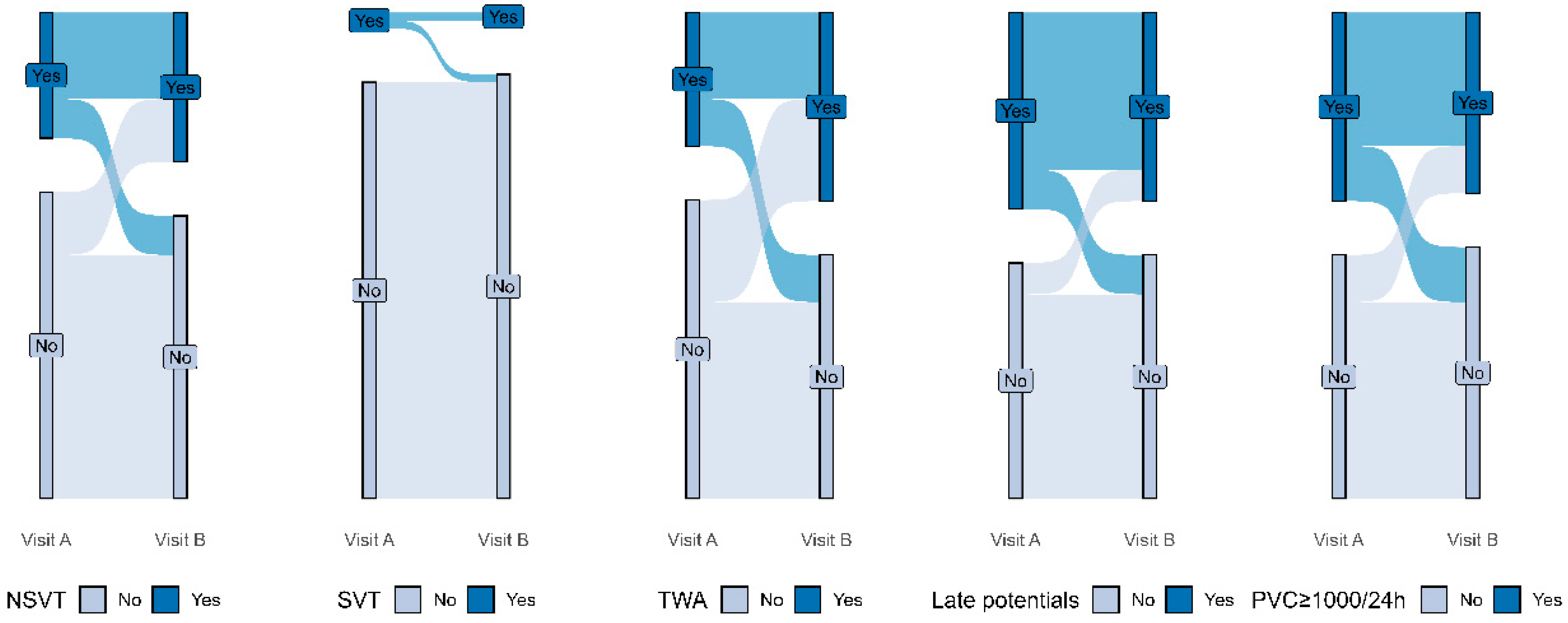
3.2. Differences in Holter Parameters Between Visits (Figure 1)
4. Discussion
5. Limitations
Author Contributions
Funding
Institutional Review Board Statement
Informed Consent Statement
Data Availability Statement
Acknowledgments
Conflicts of Interest
References
- Arbelo, E.; Protonotarios, A.; Gimeno, J.R.; Arbustini, E.; Barriales-Villa, R.; Basso, C.; Bezzina, C.R.; Biagini, E.; Blom, N.A.; de Boer, R.A.; et al. 2023 ESC Guidelines for the management of cardiomyopathies. Eur. Heart J. 2023, 44, 3503–3626. [Google Scholar] [CrossRef]
- Gueli, I.A.; Aimo, A.; Alderotti, B.; Trimarchi, G.; Bellisario, I.; Todiere, G.; Grigoratos, C.; De Gori, C.; Clemente, A.; Fabiani, I.; et al. Arrhythmic risk prediction in non-dilated left ventricular cardiomyopathy: The role of overlap with arrhythmogenic cardiomyopathy. Int. J. Cardiol. 2025, 431, 133224. [Google Scholar] [CrossRef] [PubMed]
- Pinto, Y.M.; Elliott, P.M.; Arbustini, E.; Adler, Y.; Anastasakis, A.; Böhm, M.; Duboc, D.; Gimeno, J.; de Groote, P.; Imazio, M.; et al. Proposal for a revised definition of dilated cardiomyopathy, hypokinetic non-dilated cardiomyopathy, and its implications for clinical practice: A position statement of the ESC working group on myocardial and pericardial diseases. Eur. Heart J. 2016, 37, 1850–1858. [Google Scholar] [CrossRef] [PubMed]
- Cuschieri, S. The STROBE guidelines. Saudi J. Anaesth. 2019, 13, S31–S34. [Google Scholar] [CrossRef]
- Kawel-Boehm, N.; Hetzel, S.J.; Ambale-Venkatesh, B.; Captur, G.; Francois, C.J.; Jerosch-Herold, M.; Salerno, M.; Teague, S.D.; Valsangiacomo-Buechel, E.; van der Geest, R.J.; et al. Reference ranges (“normal values”) for cardiovascular magnetic resonance (CMR) in adults and children: 2020 update. J. Cardiovasc. Magn. Reson. 2020, 22, 87, Erratum in J. Cardiovasc. Magn. Reson. 2021, 23, 114. https://doi.org/10.1186/s12968-021-00815-3. [Google Scholar] [CrossRef] [PubMed]
- Crawford, M.H.; Bernstein, S.J.; Deedwania, P.C.; DiMarco, J.P.; Ferrick, K.J.; Garson, A.; Smith, S.C. Guidelines for ambulatory electrocardiography. A report of the American College of Cardiology/American Heart Association Task Force on Practice Guidelines (Committee to Revise the Guidelines for Ambulatory Electrocardiography). Developed in collaboration with the North American Society for Pacing and Electrophysiology. J. Am. Coll. Cardiol. 1999, 34, 912–948. [Google Scholar] [CrossRef]
- Gatzoulis, K.A.; Carlson, M.D.; Biblo, L.A.; Rizos, I.; Gialfos, J.; Toutouzas, P.; Waldo, A.L. Time domain analysis of the signal averaged electrocardiogram in patients with a conduction defect or a bundle branch block. Eur. Heart J. 1995, 16, 1912–1919. [Google Scholar] [CrossRef]
- Castrichini, M.; De Luca, A.; De Angelis, G.; Neves, R.; Paldino, A.; Dal Ferro, M.; Barbati, G.; Medo, K.; Barison, A.; Grigoratos, C.; et al. Magnetic Resonance Imaging Characterization and Clinical Outcomes of Dilated and Arrhythmogenic Left Ventricular Cardiomyopathies. J. Am. Coll. Cardiol. 2024, 83, 1841–1851. [Google Scholar] [CrossRef] [PubMed]
- Milaras, N.; Dourvas, P.; Doundoulakis, I.; Sotiriou, Z.; Nevras, V.; Xintarakou, A.; Laina, A.; Soulaidopoulos, S.; Zachos, P.; Kordalis, A.; et al. Noninvasive electrocardiographic risk factors for sudden cardiac death in dilated ca rdiomyopathy: Is ambulatory electrocardiography still relevant? Heart Fail. Rev. 2023, 28, 865–878. [Google Scholar] [CrossRef]
- Grimm, W.; Christ, M.; Maisch, B. Long runs of non-sustained ventricular tachycardia on 24-hour ambulatory electrocardiogram predict major arrhythmic events in patients with idiopathic dilated cardiomyopathy. Pacing Clin. Electrophysiol. 2005, 28, S207–S210. [Google Scholar] [CrossRef]
- Kadish, A.; Dyer, A.; Daubert, J.P.; Quigg, R.; Estes, N.M.; Anderson, K.P.; Calkins, H.; Hoch, D.; Goldberger, J.; Shalaby, A.; et al. Prophylactic defibrillator implantation in patients with nonischemic dilated cardiomyopathy. N. Engl. J. Med. 2004, 350, 2151–2158. [Google Scholar] [CrossRef]
- Grimm, W.; Christ, M.; Bach, J.; Müller, H.H.; Maisch, B. Noninvasive arrhythmia risk stratification in idiopathic dilated cardiomyopathy: Results of the Marburg Cardiomyopathy Study. Circulation 2003, 108, 2883–2891. [Google Scholar] [CrossRef]
- Klingenheben, T.; Ptaszynski, P.; Hohnloser, S.H. Heart rate turbulence and other autonomic risk markers for arrhythmia risk stratification in dilated cardiomyopathy. J. Electrocardiol. 2008, 41, 306–311. [Google Scholar] [CrossRef] [PubMed]
- Demming, T.; Sandrock, S.; Kuhn, C.; Kotzott, L.; Tahmaz, N.; Bonnemeier, H. Deceleration capacity: A novel predictor for total mortality in patients with non-ischemic dilated cardiomyopathy. Int. J. Cardiol. 2016, 221, 289–293. [Google Scholar] [CrossRef] [PubMed]
- Yang, Y.; Wang, F.; Zou, C.; Dong, H.; Huang, X.; Zhou, B.; Li, X.; Yang, X. Male Patients with Dilated Cardiomyopathy Exhibiting a Higher Heart Rate Acceleration Capacity or a Lower Deceleration Capacity Are at Higher Risk of Cardiac Death. Front. Physiol. 2018, 9, 1774. [Google Scholar] [CrossRef]
- Arsenos, P.; Gatzoulis, K.A.; Dilaveris, P.; Gialernios, T.; Sideris, S.; Lazaros, G.; Stefanadis, C. The rate-corrected QT interval calculated from 24-hour Holter recordings may serve as a significant arrhythmia risk stratifier in heart failure patients. Int. J. Cardiol. 2011, 147, 321–323. [Google Scholar] [CrossRef]
- Verrier, R.L.; Klingenheben, T.; Malik, M.; El-Sherif, N.; Exner, D.V.; Hohnloser, S.H.; Rosenbaum, D.S. Microvolt T-wave alternans physiological basis, methods of measurement, and clinical utility–consensus guideline by International Society for Holter and Noninvasive Electrocardiology. J. Am. Coll. Cardiol. 2011, 58, 1309–1324. [Google Scholar] [CrossRef] [PubMed]
- Abraham, W.T.; Psotka, M.A.; Fiuzat, M.; Filippatos, G.; Lindenfeld, J.; Mehran, R.; Ambardekar, A.V.; Carson, P.E.; Jacob, R.; Januzzi, J.L., Jr.; et al. Standardized definitions for evaluation of heart failure therapies: Scientific expert panel from the Heart Failure Collaboratory and Academic Research Consortium. Eur. J. Heart Fail. 2020, 22, 2175–2186. [Google Scholar] [CrossRef]
- Kumar, A.; Avishay, D.M.; Jones, C.R.; Shaikh, J.D.; Kaur, R.; Aljadah, M.; Kichloo, A.; Shiwalkar, N.; Keshavamurthy, S. Sudden cardiac death: Epidemiology, pathogenesis and management. Rev. Cardiovasc. Med. 2021, 22, 147–158. [Google Scholar] [CrossRef]
- Xenogiannis, I.; Gatzoulis, K.A.; Flevari, P.; Ikonomidis, I.; Iliodromitis, E.; Trachanas, K.; Vlachos, K.; Arsenos, P.; Tsiachris, D.; Tousoulis, D.; et al. Temporal changes of noninvasive electrocardiographic risk factors for sudden cardiac death in post-myocardial infarction patients with preserved ejection fraction: Insights from the PRESERVE-EF study. Ann. Noninvasive Electrocardiol. 2020, 25, e12701. [Google Scholar] [CrossRef]
- Karcz, M.; Chojnowska, L.; Zareba, W.; Ruzyłło, W. Prognostic significance of heart rate variability in dilated cardiomyopathy. Int. J. Cardiol. 2003, 87, 75–81. [Google Scholar] [CrossRef] [PubMed]
- Milaras, N.; Kordalis, A.; Tsiachris, D.; Sakalidis, A.; Ntalakouras, I.; Pamporis, K.; Dourvas, P.; Apostolos, A.; Sotiriou, Z.; Arsenos, P.; et al. Ischemia testing and revascularization in patients with monomorphic ventricular tachycardia: A relic of the past? Curr. Probl. Cardiol. 2024, 49, 102358. [Google Scholar] [CrossRef] [PubMed]
- Pamporis, K.; Karakasis, P.; Sagris, M.; Zarifis, I.; Bougioukas, K.I.; Pagkalidou, E.; Milaras, N.; Samaras, A.; Theofilis, P.; Fragakis, N.; et al. Mineralocorticoid receptor antagonists in heart failure with reduced ejection fraction: A systematic review and network meta-analysis of 32 randomized trials. Curr. Probl. Cardiol. 2024, 49, 102615. [Google Scholar] [CrossRef] [PubMed]


| Variable | Distribution |
|---|---|
| Age (years) | 52 (15) |
| Sex | |
| Female | 11/55 (20) |
| Male | 44/55 (80) |
| NYHA class | |
| NYHA I | 44/55 (80) |
| NYHA II | 10/55 (18) |
| NYHA III | 1/55 (1.8) |
| Beta blockers | 43/55 (78) |
| SGLT2i | 26/55 (47) |
| RAASi | 22/55 (40) |
| ARNI | 16/55 (29) |
| MRA | 28/55 (51) |
| QRS (ms) | 96 (85, 112) |
| RBBB | 2/55 (3.6) |
| LBBB | 6/55 (11) |
| LVEDVi (mL/m2) | 99 (86, 109) |
| RVEDVi (mL/m2) | 85 (16) |
| RVEF (%) | 54 (9) |
| LVEF (%) | 44 (10) |
| LGE segments (n) | |
| 0 | 17/55 (31) |
| 1 | 11/55 (20) |
| 2 | 10/55 (18) |
| 3 | 6/55 (11) |
| 4 | 4/55 (7.3) |
| 5 | 3/55 (5.5) |
| 6 | 1/55 (1.8) |
| 9 | 2/55 (3.6) |
| 17 | 1/55 (1.8) |
| LGE presence | 38/55 (69) |
| Variable | Visit A N = 55 | Visit B N = 55 | p-Value |
|---|---|---|---|
| PVCs (n/24 h) | 488 (12, 2742) | 432 (35, 3576) | 0.524 |
| PVC (≥1000/24 h vs. <1000/24 h) | 24/55 (44%) | 23/55 (42%) | 1 |
| NSVT | 16/55 (29%) | 19/55 (35%) | 0.579 |
| NSVT complexes (n) | 0.0 (0.0, 3.0) | 0.0 (0.0, 4.0) | 0.506 |
| NSVT rate (bpm) | 0 (0, 120) | 0 (0, 116) | 0.721 |
| SVT | 2/55 (3.6%) | 1/55 (1.8%) | 1 |
| QTc Fridericia (ms) | 437 (28) | 437 (30) | 0.947 |
| SDNN (ms) | 160 (51) | 149 (57) | 0.284 |
| Turbulence onset (%) | −0.010 (−0.020, 0.000) | −0.010 (−0.025, 0.000) | 0.183 |
| Turbulence slope (ms/rri) | 5 (3, 14) | 5 (4, 9) | 0.018 |
| DC (ms) | 4.8 (2.3, 7.3) | 5.0 (2.0, 7.9) | 0.475 |
| T-wave alternans | 17/55 (31%) | 24/55 (44%) | 0.169 |
| Late potentials | 25/55 (45%) | 24/55 (44%) | 1 |
| Variable | Proportion of Transition (95% CI) | p-Value |
|---|---|---|
| PVCs (≥1000/24 h vs. <1000/24 h) | 23.6% (22.5–25.1) | <0.001 |
| NSVT | 23.6% (22.5–25.1) | <0.001 |
| SVT | 1.8% (1.2–3.2) | <0.001 |
| T-wave alternans | 34.5% (33.3–35.9) | <0.001 |
| Late potentials | 16.4% (15.4–17.8) | <0.001 |
| Any change | 67.3% (65.9–68.5) | <0.001 |
| Holter Parameters (Difference Between Visit A and B) | HF Hospitalization (6/55) | VA Hospitalization (8/55) | ||
|---|---|---|---|---|
| OR with 95% CI | p-Value | OR with 95% CI | p-Value | |
| PVCs (n/24 h) | 1 (1, 1) | 0.682 | 1 (1, 1) | 0.667 |
| PVCs (≥1000/24 h vs. <1000/24 h) | 0 (NA, +Inf) | 0.995 | 0 (NA, +Inf) | 0.995 |
| NSVT | 0 (NA, +Inf) | 0.994 | 0.82 (0.04, 5.71) | 0.859 |
| NSVT complexes (n) | 0.97 (0.8, 1.04) | 0.667 | 1.04 (0.99, 1.11) | 0.142 |
| NSVT rate (bpm) | 1 (0.99, 1.01) | 0.616 | 1 (0.99, 1.01) | 0.939 |
| QTc Fridericia (ms) | 1.01 (0.97, 1.04) | 0.728 | 1.01 (0.98, 1.04) | 0.581 |
| SDNN (ms) | 1.01 (0.99, 1.02) | 0.304 | 0.98 (0.97, 0.99) | 0.006 |
| Turbulence onset (%) | 36.64 (0, +Inf) | 0.868 | 9721.93 (0, +Inf) | 0.582 |
| Turbulence slope (ms/rri) | 1.06 (0.91, 1.4) | 0.62 | 0.94 (0.86, 1.03) | 0.149 |
| DC (ms) | 0.99 (0.84, 1.13) | 0.939 | 1 (0.87, 1.13) | 0.95 |
| T-wave alternans | 0.62 (0.03, 4.35) | 0.673 | 2.22 (0.4, 10.75) | 0.326 |
| Late potentials | 3.07 (0.14, 29.97) | 0.369 | 2.1 (0.1, 19.27) | 0.546 |
| Any increase | 0.48 (0.06, 2.7) | 0.421 | 1.89 (0.42, 10.1) | 0.417 |
Disclaimer/Publisher’s Note: The statements, opinions and data contained in all publications are solely those of the individual author(s) and contributor(s) and not of MDPI and/or the editor(s). MDPI and/or the editor(s) disclaim responsibility for any injury to people or property resulting from any ideas, methods, instructions or products referred to in the content. |
© 2026 by the authors. Licensee MDPI, Basel, Switzerland. This article is an open access article distributed under the terms and conditions of the Creative Commons Attribution (CC BY) license.
Share and Cite
Milaras, N.; Pamporis, K.; Gatzoulis, K.A.; Karakasis, P.; Kostakis, P.; Sotiriou, Z.; Xintarakou, A.; Laina, A.; Karelas, D.; Vlachomitros, D.; et al. Temporal Variability of ECG Risk Markers and Clinical Outcomes in Non-Dilated Left Ventricular Cardiomyopathy. J. Clin. Med. 2026, 15, 402. https://doi.org/10.3390/jcm15020402
Milaras N, Pamporis K, Gatzoulis KA, Karakasis P, Kostakis P, Sotiriou Z, Xintarakou A, Laina A, Karelas D, Vlachomitros D, et al. Temporal Variability of ECG Risk Markers and Clinical Outcomes in Non-Dilated Left Ventricular Cardiomyopathy. Journal of Clinical Medicine. 2026; 15(2):402. https://doi.org/10.3390/jcm15020402
Chicago/Turabian StyleMilaras, Nikias, Konstantinos Pamporis, Konstantinos A. Gatzoulis, Paschalis Karakasis, Panagiotis Kostakis, Zoi Sotiriou, Anastasia Xintarakou, Ageliki Laina, Dimitrios Karelas, Dimitrios Vlachomitros, and et al. 2026. "Temporal Variability of ECG Risk Markers and Clinical Outcomes in Non-Dilated Left Ventricular Cardiomyopathy" Journal of Clinical Medicine 15, no. 2: 402. https://doi.org/10.3390/jcm15020402
APA StyleMilaras, N., Pamporis, K., Gatzoulis, K. A., Karakasis, P., Kostakis, P., Sotiriou, Z., Xintarakou, A., Laina, A., Karelas, D., Vlachomitros, D., Xenogiannis, I., Archontakis, S., Vlachopoulos, C., Toutouzas, K., Tsioufis, K., & Sideris, S. (2026). Temporal Variability of ECG Risk Markers and Clinical Outcomes in Non-Dilated Left Ventricular Cardiomyopathy. Journal of Clinical Medicine, 15(2), 402. https://doi.org/10.3390/jcm15020402