

Intraoperative Teaching in Robotic-Assisted Surgery—A Systematic Review

 , , and
Abstract
1. Introduction
2. Materials and Methods
2.1. Search and Sources
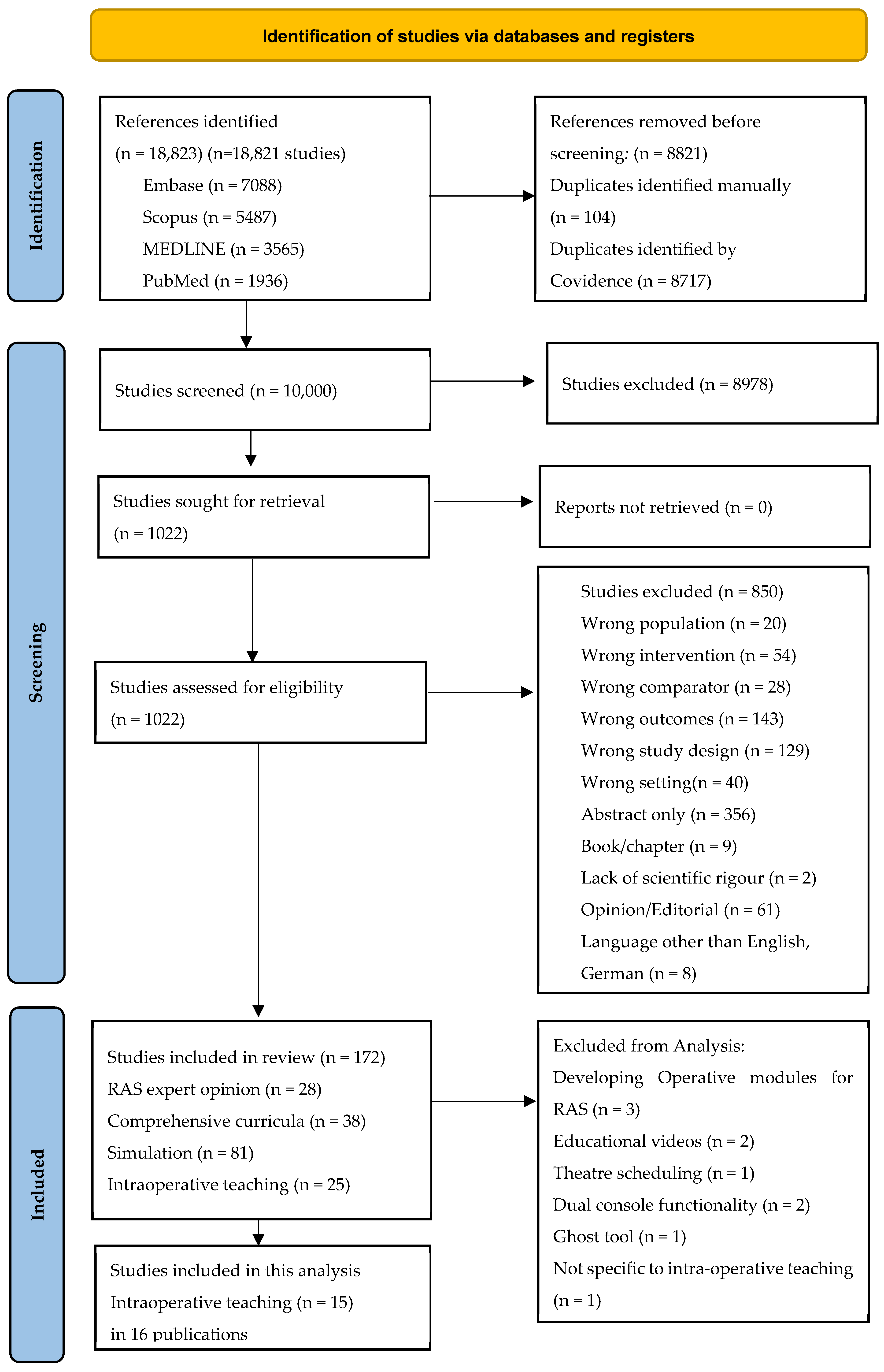
2.2. Study Selection
2.3. Data Extraction and Analysis
- What are the specific barriers in RAS training?
- What are the unique skills that need to be taught intraoperatively in RAS?
- What are the unique teaching methods necessary for successful RAS teaching?
- Are specific facilities needed for RAS teaching?

| Study | Topic/Aim | Methodology | Findings | Examples | Credibility/Quality |
|---|---|---|---|---|---|
| Anand [43] et al. 2024 USA Multispecialty (61% Minimally invasive surgery/small cases General surgery) | Facilities and audio coaching, Single vs. dual console intraoperative coaching and resident autonomy. | Survey and Qualitative examination of audio (conductive coding of audio); Wisconsin Surgical Coaching Rubric WiSCoR, GEARS, NASA-TLX of faculty | 18 cases (7 single console, 11 dual console); 11 trainer–trainee pairs; survey 18 trainees, 11 | No difference found in resident autonomy score and faculty coaching score single vs. dual console Majority of statements force sensitivity and robotic control No evaluation of faculty NASA TXL provided by console type Gap in coaching self-reflection | Low |
| Beane [10] 2019 USA Urology | How trainees succeed when new technologies limit legitimate peripheral participation, RAS vs. open surgical teaching | Multisite ethnography in Urology open vs. RAS and semi-structured interviews focusing on trainees who succeed in RAS; | 2 years, 94 procedures, 478 h observation, 62 interviews 18 surgeons, 22 team 16 residents | Barriers: no peripheral participation, Visible mistakes, Helicopter training, trainer independence from trainees Shadow learning of successful trainees: ‘‘premature specialisation’’; ‘‘abstract rehearsal’’ (Simulation and video) ‘‘under-supervised struggle,’’ | Moderate ethnography without researcher positionality |
| Brian et al. [47] 2024 USA General surgery | Trainer skills: how instruction manifests in the robotic operating room and how observed robotic instructional practices map with trainees preferred robotic instructional practices | Constructivist framework, co-creation of the learning experience during case observations and the meaning that interviewees made about their robotic surgical experiences. | 38 faculty and fellows 10 cases, 20 interviews | Suboptimal instructional practices: Contextualisation without explaining reason Individualisation without consideration of trainee level Trainer cannot explain what is to be done and takes over Multimodality-clarity is provided with addition of gesture | High |
| Cristofari et al. [48] 2022 Switzerland Bariatric surgery | Shed light on surgeons’ training at the dual console as it happens during actual surgeries, and to identify didactic difficulties that may be resolved with targeted effort. | Observation and Interviews, Filming (3 cases) and audio recording, Self-confrontational Interviews with edited excerpts, | 2 surgeons; interviews with one lead surgeon, one trainee participated in all 3 cases | Skills described: Managing the (bedside) team Using the third arm Perception of the operative field Instructions: Physical separation requires different instructions More specific instructions necessary | Moderate |
| Collins et al. [49] 2019 Europe Multispecialty | Define the key elements within a Train-the Trainer programme, Panel with expertise in training from both the healthcare and the military and airline industries. | Literature Review; Discussion at Meeting; 3 Round Delphi 80% for consensus; Participants from USA and eight European countries. | Voting: 28 participants (24 surgeons 4 healthcare industry) Meeting: 24 surgeons, 8 healthcare industry, academics, or military or airline industry personnel with expertise in training. | 100% agreement on need of TTT course, clearly defined selection criteria, delegates should be tested, agreement of goals and objectives, learn when to take over, TTT with opportunities to practice in the operating room and laboratory/simulation setting, know how to shorten the learning curve. | Delphi, 80% agreement, 3 rounds, 82% (23/28) response rate first round, 89% (25/28) 2nd and 3rd rounds: Cronbach alpha 0.90 |
| Eardley et al. [50] 2020 UK Colorectal Train-the-Trainer | Develop and evaluate a train-the trainer course | Course based on JAG and LapCo train the trainer, Pre- and post-course questionnaire, evaluate by self-assessment of learning | 8 delegates from across Europe, 4 faculty | Three delegates received no previous train-the trainer teaching. Delegates increased their knowledge of course objectives and identified learning points for changed practice. Delegates highlighted “no common language” for teaching. | MMERSQI 45 |
| Gómez Ruiz et al. [51] 2019 Spain; Colorectal | Train-the trainer Establish expert consensus on the requirements for a robotic TTT curriculum amongst robotic surgeons and trainers. | literature review and two brainstorming sessions, 3 Delphi rounds 80% consensus, | Participants: 14 colorectal surgeons, selected based on their expertise in training and in robotic surgery, min 50 cases. (one UGI surgeon) | Conscious competency Taking over in theatre Performance-enhancing instruction Dual-task interference Optimising communications and training environment, Reflection on training, Dealing with difficult trainees Optimising feedback | Delphi, 80% agreement 3 rounds, Response rate: first and second rounds was 100% (14/14) and for the third round 93% (13/14). Cronbach alpha > 0.8 |
| Green et al. [52] 2019 USA Colorectal | Determine what educational surgical themes from microanalysis of intracorporeal robotic footage from a robot-assisted surgical procedure. | Video and audio from 6 h video edited to 35 min, repeated review and qualitative memo, Microanalysis of selection of 2 min clip in 1 s intervals | Analysis of 2 min of 6 h colorectal case, 1 RAS surgeon one trainee by the bedside | Observation is based on an incomplete visual framework. Change in operative focus occurs during in adequate tension, bimodal manipulation and hand-movements in console are not appreciated when watching the screen | Moderate |
| Green et al. [53] 2020 USA General surgery | Characterise the instructional techniques used in the robotic teaching environment | Observation and video of instructional sessions in porcine simulations, focus group trainees and trainers, qualitative content analysis, | 6 surgical residents, 9 instructors (5 faculty and 4 residents peer-to-peer) | Behaviours commonly used: Verbal direction (explanation of, thought process, compliment) New teaching behaviour: disengaging the residents from the console Instructors focus group: Importance of language. Managing autonomy | High |
| Green et al. [54] 2023 USA General surgery | Identify aspects of robotic technology that could be targeted to address its inefficiency | Qualitative analysis of experts commenting on Video showing two sets of clips with average performance and mistakes | 17 surgeons; male (82.4%), 47 yrs old (SD = 6.6), 13.2 yrs of teaching experience (SD = 8.23) years of teaching experience, academic hospitals (64.7%), 643 RAS cases (SD = 467) | Areas for improved efficiency: Case progression, Robotic capabilities, Instrumentation. | High |
| Green et al. [55] 2022 USA, General surgery | Investigated the language of perceptual expertise used by robotic surgeons. | Qualitative analysis of experts commenting on Video showing two sets of clips with average performance and mistakes | 17 surgeons; male (82.4%), 47 yrs old (SD = 6.6), 13.2 yrs of teaching experience (SD = 8.23) years of teaching experience, academic hospitals (64.7%), 643 RAS cases (SD = 467) | Visual comprehension: tissue structures, anatomic landmarks, adequate field of view. Surgical technique: discussing dissection, tissue handling, instrumentation choice and exposure. Risk Avoidance: Overarching theme for visual comprehension and surgical technique | High |
| Harji et al. [30] 2025 UK + Ireland Colorectal surgery | Reach an in-depth understanding of the delivery of current proctored training regarding responsibilities and challenges | Online Qualitative focus group of RAS proctors along predefined topics, framework analysis, line-by-line coding | 10 proctors, >60% had been robotic trainers for more than 6 years and 60% were considered high-volume proctors (>20 cases annually) | Proctor selection by industry, based on arbitrary criteria. Aim of proctoring is the safe use of the robotic technology. Position as proctor often allows a wider sphere of influence within the surgical community “Sign off” is based on a small number of cases, i.e., 1–5 | Moderate |
| Leon et al. [56] 2022 USA Gynaecology | Investigate surgical education metrics to objectively highlight the advantages of robotic dual versus single console gynaecologic surgery training | Analysis of Fellow participation in hysterectomies with single Vs. dual console; Console times, comparison among individuals and console used | 3 fellows, 5 attendings; 126 hysterectomies | Longer fellow console time (p < 0.001, Figure 1), more steps (p = 0.009), more control switches (p < 0.001) for dual console compared to single console cases. No difference in docking time (p = 0.15), case time (p = 0.79), or complications (p = 0.30). | MMERSQI 53.5/85 |
| Satchidanand et al. [57] 2021 USA Urology | Explore the use of microanalysis to describe and evaluate communicative efficiency in RAS through examination of referencing in surgical tasks | Video microanalysis of a teaching situation in RAS; Descriptive taxonomy for referencing strategies in RAS was developed. | Selection of 46 references from 25 exchanges from 100 timepoints of 10 verbal transcriptions from 79 RAS surgeries, number of surgeons involved not specified | Referencing strategies for communication were: Verbal, Gesture, Integrated communication (verbal + gesture). Integrated most common and most successful. | High |
| Wang et al. [58] 2024 USA General surgery | Understand attending surgeon motivations in granting trainees Individual Console Time (ICT-time actively steering the console) in RAS | Sequential explanatory mixed-methods approach was undertaken to explore the ICT results from RAS console cases with thematic analysis of secondary qualitative interviews with surgeons. | 420 RAS cases 30 residents and 9 attending surgeons | Residents may get less active time in RAS than other modalities. ICT significantly increased with seniority (junior 26.8%; senior 42.4% average ICT (p < 0.001).) Variability with procedure type and trainer work experience. Surgeons perceived operative time pressure inversely affected resident ICT. | High |
| Wong et al. [59] 2023 USA Urology | Create a novel classification system to characterise surgical feedback for usefulness | Transcribed and analysed video and audio of RAS intraoperative feedback while trainees on the console Grounded theory, constructivist methodology | 29 robotic teaching surgical procedures were recorded, with 3711 instances of feedback 4 attending surgeons, 6 fellows, and 5 residents | Feedback: Anatomic, Procedural, technical, gesture for visual aid technical, praise, criticism Trainee Response: verbal acknowledgement, behavioural change, asks for clarification. Types of feedback associated with variable responses. | High |
3. Results
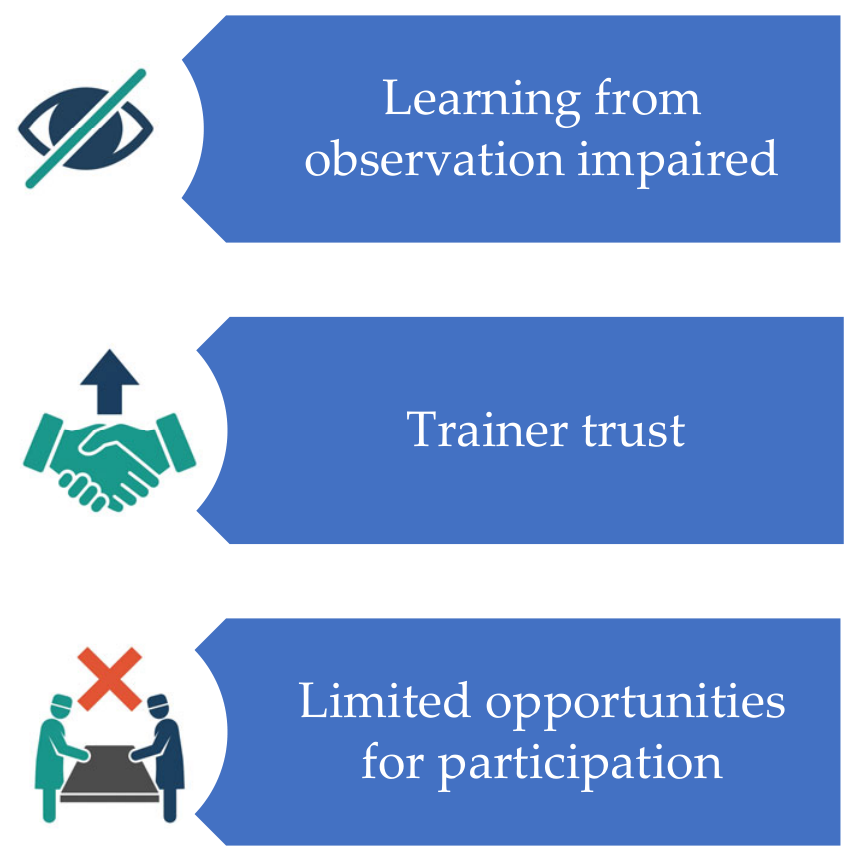
3.1. What Are the Specific Barriers for RAS Training?
3.1.1. Trainer Trust
| Study | Congruity Between Philosophical Perspective and Research Methodology | Congruity Between Methodology and Research Question | Congruity Between Methodology and Data Collection | Congruity Between Methodology and Data Representation and Analysis | Congruity Between Methodology and Interpretation of Results | Information of Cultural or Theoretical Position of Researcher | Influence of the Researcher on the Research Discussed | Adequate Representation of Participants and Their Voices | Ethical Approval | Conclusions Flow from the Data Analysis | Subjective Global Assessment of Quality |
|---|---|---|---|---|---|---|---|---|---|---|---|
| Anand [43] 2024 | No | No | No | Yes | No | No | No | No | No | Unclear | Low |
| Beane [10] 2019 | Yes | Yes | Yes | Yes | Yes | No | No | Yes | No | Yes | Moderate |
| Brian [47] 2024 | Yes | Yes | Yes | Yes | Yes | Minimal | No | Yes | Yes | Yes | High |
| Cristofari [48] 2022 | Yes | Yes | Yes | Unclear | Unclear | No | No | Yes | No | Unclear | Moderate |
| Green [52] 2019 | Yes | Yes | Yes | Yes | Yes | No | No | No | Yes | Yes | Moderate |
| Green [53] 2020 | Yes | Yes | Yes | Yes | Yes | Unclear | No | Yes | Yes | Yes | High |
| Green [55] 2022 | Yes | Yes | Yes | Yes | Yes | Unclear | No | Yes | Yes | Yes | High |
| Green [54] 2023 | Yes | Yes | Yes | Yes | Yes | Unclear | No | Yes | Yes | Yes | High |
| Harji [30] 2025 | Yes | Yes | Unclear | Yes | Yes | No | No | Unclear | Yes | Yes | Moderate |
| Satchidanand 2021 [57] | Yes | Yes | Yes | Yes | Yes | No | No | Yes | Yes | Yes | High |
| Wang [58] 2024 | Yes | Yes | Yes | Yes | Yes | No | No | Yes | Yes | Yes | High |
| Wong [59] 2023 | Yes | Yes | Yes | Yes | Yes | No | No | Yes | No | Yes | High |
3.1.2. Limited Opportunities for Participation
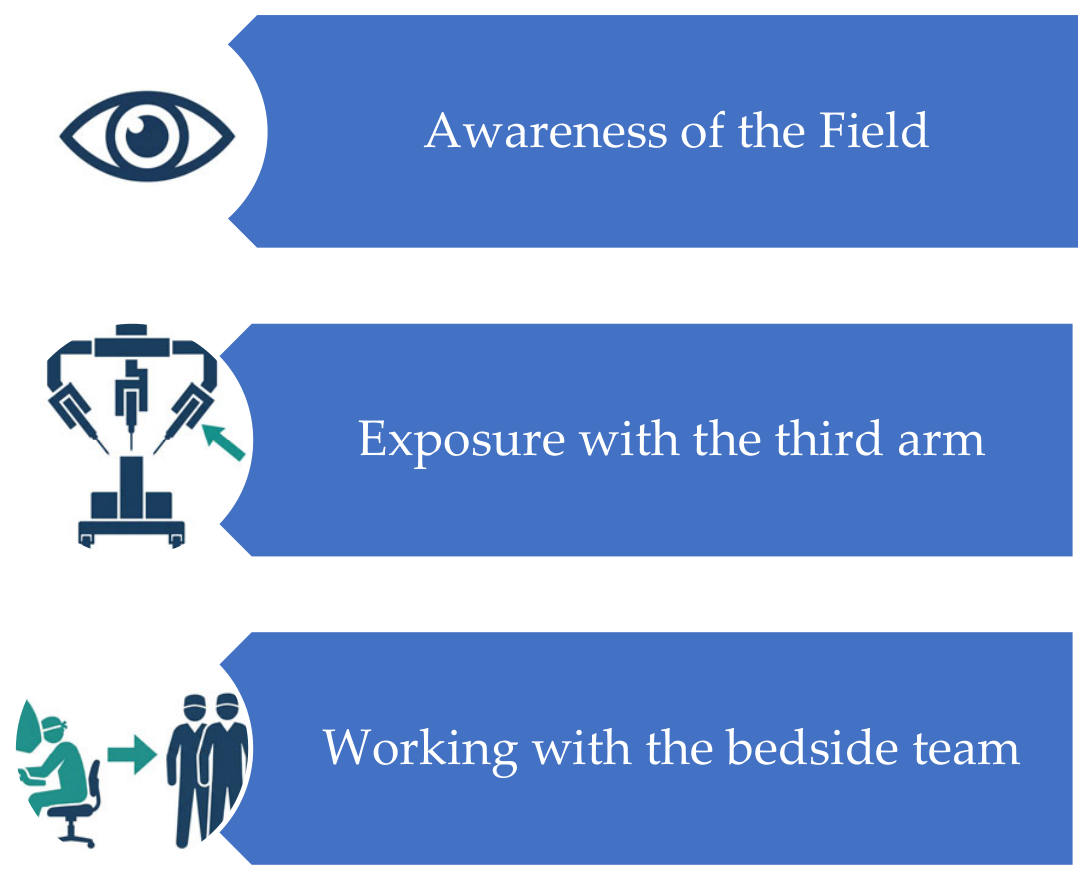
3.2. What Are the Unique Intraoperative Skills That Need to Be Taught in RAS?
3.2.1. GEARS Domain Skills
3.2.2. Adequate Tension
3.2.3. Perception of the Operative Field
3.2.4. Team Communication and Dynamics
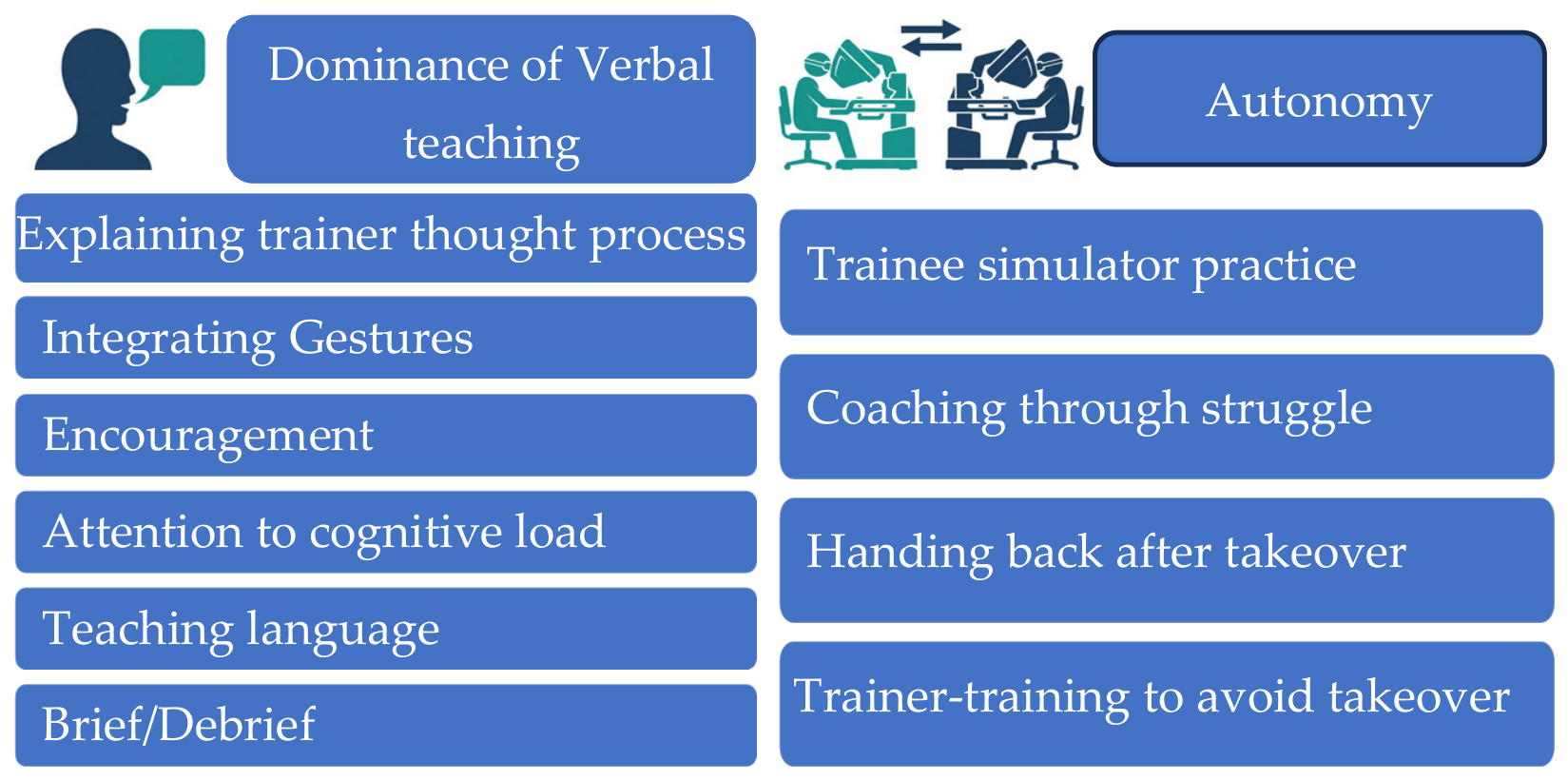
3.3. What Are the Unique Teaching Methods of RAS Teaching?
3.3.1. Granting Autonomy
- reinforcing feedback when residents are on track,
- providing coaching through a difficult part of the operation before taking over,
- providing reasons for the takeover,
- taking over “briefly in a setting of insurmountable struggle” and handing back control,
- keeping residents engaged during periods of observation [47].
3.3.2. Verbal Teaching
3.3.3. Disengaging from the Console
3.4. Are There Specific Facilities Necessary for RAS Teaching?
4. Discussion
5. Conclusions
Supplementary Materials
Author Contributions
Funding
Institutional Review Board Statement
Informed Consent Statement
Data Availability Statement
Acknowledgments
Conflicts of Interest
Abbreviations
| RAS | Robotic-assisted surgery |
| MMERSQI | Modified Medical Education Research Study Quality Instrument |
| JBI | Joanna Briggs critical appraisal tool |
| LapCo | Laparoscopic Colorectal Training the Trainer Course |
| ENT | Ear Nose and Throat |
| GEARS | Global Evaluative Assessment of Robotic Skills |
| GOALS | Global assessment of Laparoscopic skills |
| NASA TXL | National Aeronautics and Space Administration Task Load Index |
References
- Royal College of Surgeons of England. Robotic-Assisted-Surgery-A-Pathway-to-the-Future-December-2025. Available online: https://www.rcseng.ac.uk/-/media/Files/RCS/Standards-and-research/Standards-and-policy/Good-Practice-Guides/2025/Robotic-assisted-surgery--A-pathway-to-the-future-December-2025.pdf (accessed on 9 March 2026).
- Hays, S.B.; Kuchta, K.; Rojas, A.E.; Mehdi, S.A.; Schwarz, J.L.; Talamonti, M.S.; Hogg, M.E. Residency robotic biotissue curriculum: The next frontier in robotic surgical training. HPB 2025, 27, 688–695. [Google Scholar] [CrossRef] [Scilit] [PubMed]
- Kim, J.S.; Jonas, N.; Rizvi, T.Z.; Lin, Z.; Plewa, D.; Ricard, C.; Cheah, Y.L.; Simon, C.J.; Wright, V. Validation of a multidisciplinary virtual reality (VR) robotic surgical curriculum. J. Robot. Surg. 2023, 17, 2495–2502. [Google Scholar] [CrossRef] [Scilit]
- Arain, N.A.; Dulan, G.; Hogg, D.C.; Rege, R.V.; Powers, C.E.; Tesfay, S.T.; Hynan, L.S.; Scott, D.J. Comprehensive proficiency-Based inanimate training for robotic surgery: Reliability, feasibility, and educational benefit. Surg. Endosc. 2012, 26, 2740–2745. [Google Scholar] [CrossRef] [Scilit] [PubMed]
- Nathan, A.; Patel, S.; Georgi, M.; Fricker, M.; Asif, A.; Ng, A.; Mullins, W.; Hang, M.K.; Light, A.; Nathan, S.; et al. Virtual classroom proficiency-based progression for robotic surgery training (VROBOT): A randomised, prospective, cross-over, effectiveness study. J. Robot. Surg. 2023, 17, 629–635. [Google Scholar] [CrossRef] [Scilit] [PubMed]
- Radi, I.; Tellez, J.C.; Alterio, R.E.; Scott, D.J.; Sankaranarayanan, G.; Nagaraj, M.B.; Hogg, M.E.; Zeh, H.J.; Polanco, P.M. Feasibility, effectiveness and transferability of a novel mastery-based virtual reality robotic training platform for general surgery residents. Surg. Endosc. 2022, 36, 7279–7287. [Google Scholar] [CrossRef] [Scilit]
- Howard, K.K.; Makki, H.; Mi, M.; Novotny, N.M.; Nguyen, N. The value of simulation for training general surgery novices in robotic surgery: A systematic review. J. Robot. Surg. 2025, 19, 763. [Google Scholar] [CrossRef] [Scilit] [PubMed]
- Bickford, M.; Alruwaili, F.; Ragab, S.; Rothenberg, H.; Abedin-Nasab, M. Impact of extended reality on robot-assisted surgery training: A systematic review and meta-analysis. J. Robot. Surg. 2025, 19, 412. [Google Scholar] [CrossRef] [Scilit] [PubMed]
- Kawashima, K.; Nader, F.; Collins, J.W.; Esmaeili, A. (123AD) Virtual reality simulations in robotic surgery training: A systematic review and meta-analysis. J. Robot. Surg. 2024, 19, 29. [Google Scholar] [CrossRef] [Scilit] [PubMed]
- Beane, M. Shadow Learning: Building Robotic Surgical Skill When Approved Means Fail. Adm. Sci. Q. 2019, 64, 87–123. [Google Scholar] [CrossRef] [Scilit]
- Zhao, B.; Hollandsworth, H.M.; Lee, A.M.; Lam, J.; Lopez, N.E.; Abbadessa, B.; Eisenstein, S.; Cosman, B.C.; Ramamoorthy, S.L.; Parry, L.A. Making the Jump: A Qualitative Analysis on the Transition From Bedside Assistant to Console Surgeon in Robotic Surgery Training. J. Surg. Educ. 2020, 77, 461–471. [Google Scholar] [CrossRef] [Scilit] [PubMed]
- Hanly, E.J.; Miller, B.E.; Kumar, R.; Hasser, C.J.; Coste-Maniere, E.; Talamini, M.A.; Aurora, A.A.; Schenkman, N.S.; Marohn, M.R. Mentoring Console Improves Collaboration and Teaching in Surgical Robotics. J. Laparoendosc. Adv. Surg. Tech. 2006, 16, 445–451. [Google Scholar] [CrossRef] [Scilit] [PubMed]
- Schmiederer, I.S.; Torices-Dardon, A.; Ferrari-Light, D.M.; Abboud, E.C.; Villani, V.; Lau, J.N.; Foglia, C.M. Developing a Robotic General Surgery Training Curriculum: Identifying Key Elements Through a Delphi Process. J. Surg. Educ. 2021, 78, e129–e136. [Google Scholar] [CrossRef] [Scilit] [PubMed]
- Green, C.A.; Chern, H.; Rogers, S.J.; Reilly, L.M.M.; O’sUllivan, P. Transforming Surgical Education through a Resident Robotic Curriculum. Ann. Surg. Open 2021, 2, e076. [Google Scholar] [CrossRef] [Scilit] [PubMed]
- Jogerst, K.M.; Coe, T.M.; Petrusa, E.; Neil, J.; Davila, V.; Pearson, D.; Phitayakorn, R.; Gee, D. Multidisciplinary perceptions on robotic surgical training: The robot is a stimulus for surgical education change. Surg. Endosc. 2023, 37, 2688–2697. [Google Scholar] [CrossRef] [Scilit] [PubMed]
- Lazar, D.J.; Ferzli, G.S. Is the robotic revolution stunting surgical skills? Surg. Open Sci. 2024, 19, 63–65. [Google Scholar] [CrossRef] [Scilit] [PubMed]
- Catchpole, K.R.; Hallett, E.; Curtis, S.; Mirchi, T.; Souders, C.P.; Anger, J.T. Diagnosing barriers to safety and efficiency in robotic surgery. Ergonomics 2018, 61, 26–39. [Google Scholar] [CrossRef] [Scilit] [PubMed]
- Gillespie, B.M.; Gillespie, J.; Boorman, R.J.; Granqvist, K.; Stranne, J.; Erichsen-Andersson, A. The Impact of Robotic-Assisted Surgery on Team Performance: A Systematic Mixed Studies Review. Hum. Factors J. Hum. Factors Ergon. Soc. 2021, 63, 1352–1379. [Google Scholar] [CrossRef] [Scilit] [PubMed]
- Fernandes, E.; Elli, E.; Giulianotti, P. The role of the dual console in robotic surgical training. Surgery 2014, 155, 1–4. [Google Scholar] [CrossRef] [Scilit] [PubMed]
- Faculty of Surgical Trainers Standards for Surgical Trainers. Available online: https://fst.rcsed.ac.uk/media/27683/standards-for-surgical-trainers.pdf (accessed on 5 December 2025).
- Lambert, B.; Keuning, M.C.; Jutte, P.C.; Diemers, A.D.; Nieboer, P.; Huiskes, M. The Many Faces of Good Operating Room Supervision: Supervisors’ and Residents’ Perspectives After Operating Together. J. Surg. Educ. 2025, 82, 103396. [Google Scholar] [CrossRef] [Scilit] [PubMed]
- Sharma, N.; Steinhagen, E.; Marks, J.M.; Ammori, J.B. Development of a Competency Framework Defining Effective Surgical Educators. J. Surg. Educ. 2024, 81, 388–396. [Google Scholar] [CrossRef] [Scilit] [PubMed]
- Grant, A.L.; Torti, J.; Goldszmidt, M. “Influential” Intraoperative Educators and Variability of Teaching Styles. J. Surg. Educ. 2023, 80, 276–287. [Google Scholar] [CrossRef] [Scilit] [PubMed]
- Hanna, G.B.; Mackenzie, H.; Miskovic, D.; Ni, M.; Wyles, S.; Aylin, P.; Parvaiz, A.; Cecil, T.; Gudgeon, A.; Griffith, J.; et al. Laparoscopic Colorectal Surgery Outcomes Improved after National Training Program (LAPCO) for Specialists in England. Ann. Surg. 2022, 275, 1149–1155. [Google Scholar] [CrossRef] [Scilit] [PubMed]
- Mackenzie, H.; Cuming, T.; Miskovic, D.; Wyles, S.M.; Langsford, L.; Anderson, J.; Thomas-Gibson, S.; Valori, R.; Hanna, G.B.; Coleman, M.G.; et al. Design, delivery, and validation of a trainer curriculum for the national laparoscopic colorectal training program in England. Ann. Surg. 2015, 261, 149–156. [Google Scholar] [CrossRef] [Scilit] [PubMed]
- Coleman, M.; Cecil, T. Laparoscopic Colorectal Surgery: The Lapco Manual, 1st ed.; CRC Press Taylor & Francis Group: Boca Raton, FL, USA, 2017. [Google Scholar]
- Our Programmes-Lapco International. Available online: https://www.lapco-international.com/industry/our-programmes// (accessed on 12 December 2025).
- Diamand, R.; D’Hondt, F.; Mjaess, G.; Jabbour, T.; Dell’OGlio, P.; Larcher, A.; Moschini, M.; Quackels, T.; Peltier, A.; Assenmacher, G.; et al. Teaching robotic cystectomy: Prospective pilot clinical validation of the ERUS training curriculum. BJU Int. 2023, 132, 84–91. [Google Scholar] [CrossRef] [Scilit]
- Stefan, S.; Piozzi, G.N.; Tejedor, P.; Liao, C.C.; Ahmad, A.; Ahmad, N.Z.; Naqvi, S.A.; Heald, R.J.M.; Khan, J.S.M. The Impact of Modular Robotic Total Mesorectal Excision Training Program on Perioperative and Oncological Outcomes in Robotic Rectal Cancer Surgery. Dis. Colon Rectum 2024, 67, 1485–1494. [Google Scholar] [CrossRef] [Scilit] [PubMed]
- Harji, D.P.; Mohan, H.; Coates, R.; Miskovic, D.; Evans, C.; Davies, R.J.; Torkington, J.; Khan, J.; Amin, S.; Coyne, P.; et al. Scaling robotic surgery: The role, responsibilities and challenges of robotic proctorship in colorectal surgery. J. Robot. Surg. 2025, 19, 285. [Google Scholar] [CrossRef] [Scilit] [PubMed]
- Kieslich, A.K.; Jardine, R.; Ibrahim, H.; Calvert, A.; Walker, K.G.; Walker, K.A.; Watson, A.J.M. Expert consensus on best content of a robotic surgical curriculum: A systematic review. J. Robot. Surg. 2025, 19, 721. [Google Scholar] [CrossRef] [Scilit] [PubMed]
- Kieslich, A.K.; Jardine, R.; Ibrahim, H.; Calvert, A.; Walker, K.G.; Walker, K.A.; Watson, A.J.M. A systematic review of comprehensive Robotic-assisted surgical (RAS) curricula. J. Robot. Surg. 2025, 20, 130. [Google Scholar] [CrossRef] [Scilit] [PubMed]
- Page, M.J.; McKenzie, J.E.; Bossuyt, P.M.; Boutron, I.; Hoffmann, T.C.; Mulrow, C.D.; Shamseer, L.; Tetzlaff, J.M.; Akl, E.A.; Brennan, S.E.; et al. The PRISMA 2020 statement: An updated guideline for reporting systematic reviews. Syst. Rev. 2021, 372, n71. [Google Scholar] [CrossRef] [Scilit] [PubMed]
- Davis, J.W.; Kamat, A.; Munsell, M.; Pettaway, C.; Pisters, L.; Matin, S. Initial experience of teaching robot-assisted radical prostatectomy to surgeons-in-training: Can training be evaluated and standardized? BJU Int. 2010, 105, 1148–1154. [Google Scholar] [CrossRef] [Scilit] [PubMed]
- Fujimura, T.; Menon, M.; Fukuhara, H.; Kume, H.; Suzuki, M.; Yamada, Y.; Niimi, A.; Nakagawa, T.; Igawa, Y.; Homma, Y. Validation of an educational program balancing surgeon training and surgical quality control during robot-assisted radical prostatectomy. Int. J. Urol. 2016, 23, 160–166. [Google Scholar] [CrossRef] [Scilit] [PubMed]
- Lovegrove, C.; Ahmed, K.; Novara, G.; Guru, K.; Mottrie, A.; Challacombe, B.; Van der Poel, H.; Peabody, J.; Dasgupta, P. Modular Training for Robot-Assisted Radical Prostatectomy: Where to Begin? J. Surg. Educ. 2017, 74, 486–494. [Google Scholar] [CrossRef] [Scilit] [PubMed]
- Kim, M.P.; Del, C.H.; Chihara, R.; Chan, E.Y. Video-based curriculum improves resident participation during robot-assisted surgery. J. Thorac. Dis. 2022, 14, 4641–4649. [Google Scholar] [CrossRef] [Scilit] [PubMed]
- Clanahan, J.M.; Awad, M.M.; Dimou, F.M. Use of targeted educational resources to improve robotic bariatric surgery training. Surg. Endosc. 2024, 38, 894–901. [Google Scholar] [CrossRef] [Scilit] [PubMed]
- Ushigome, H.; Takahashi, H.; Harata, S.; Fujii, Y.; Watanabe, K.; Yanagita, T.; Suzuki, T.; Shiga, K.; Ogawa, R.; Matsuo, Y.; et al. “Role-sharing surgery”: A new surgical education system that gives beginner surgeons more chances to operate while ensuring the surgical quality of robotic surgery. Surg. Today 2024, 54, 282–287. [Google Scholar] [CrossRef] [Scilit] [PubMed]
- Jackson, T.; Cho, E.E.; Nagatomo, K.; Osman, H.G.; Jeyarajah, D.R. Teacher and Trainee Learning Together—Dual Console and the 3 Arms. J. Surg. Educ. 2020, 77, 720–722. [Google Scholar] [CrossRef] [Scilit] [PubMed]
- Jarc, A.M.; Stanley, A.A.; Clifford, T.; Gill, I.S.; Hung, A.J. Proctors exploit three-dimensional ghost tools during clinical-like training scenarios: A preliminary study. World J. Urol. 2017, 35, 957–965. [Google Scholar] [CrossRef] [Scilit] [PubMed]
- Green, C.A.; Mahuron, K.M.; Harris, H.W.; O’Sullivan, P.S. Integrating Robotic Technology into Resident Training: Challenges and Recommendations from the Front Lines. Acad. Med. 2019, 94, 1532–1538. [Google Scholar] [CrossRef] [Scilit] [PubMed]
- Anand, A.; Gan, C.; Jensen, R.; Korndorffer, J.R. Differences in coaching in single- versus dual-console robotic cases: A mixed-methods study. Surg. Endosc. 2024, 38, 6008–6016. [Google Scholar] [CrossRef] [Scilit] [PubMed]
- Vassiliou, M.C.; Feldman, L.S.; Andrew, C.G.; Bergman, S.; Leffondré, K.; Stanbridge, D.; Fried, G.M. Surgical education A global assessment tool for evaluation of intraoperative laparoscopic skills. Am. J. Surg. 2005, 190, 107–113. [Google Scholar] [CrossRef] [Scilit] [PubMed]
- Goh, A.C.; Goldfarb, D.W.; Sander, J.C.; Miles, B.J.; Dunkin, B.J. Global evaluative assessment of robotic skills: Validation of a clinical assessment tool to measure robotic surgical skills. J. Urol. 2012, 187, 247–252. [Google Scholar] [CrossRef] [Scilit] [PubMed]
- Sánchez, R.; Rodríguez, O.; Rosciano, J.; Vegas, L.; Bond, V.; Rojas, A.; Sanchez-Ismayel, A. Robotic surgery training: Construct validity of Global Evaluative Assessment of Robotic Skills (GEARS). J. Robot. Surg. 2016, 10, 227–231. [Google Scholar] [CrossRef] [Scilit] [PubMed]
- Brian, R.; Murillo, A.; Oh, D.S.; Chern, H.; O’sUllivan, P.S. Comparing observed and preferred instruction in robotic surgery. Surgery 2024, 176, 1072–1078. [Google Scholar] [CrossRef] [Scilit] [PubMed]
- Cristofari, H.; Jung, M.K.; Niclauss, N.; Toso, C.; Kloetzer, L. Teaching and learning robotic surgery at the dual console: A video-based qualitative analysis. J. Robot. Surg. 2022, 16, 169–178. [Google Scholar] [CrossRef] [Scilit] [PubMed]
- Collins, J.W.; Levy, J.; Stefanidis, D.; Gallagher, A.; Coleman, M.; Cecil, T.; Ericsson, A.; Mottrie, A.; Wiklund, P.; Ahmed, K.; et al. Utilising the Delphi Process to Develop a Proficiency-based Progression Train-the-trainer Course for Robotic Surgery Training. Eur. Urol. 2019, 75, 775–785. [Google Scholar] [CrossRef] [Scilit] [PubMed]
- Eardley, N.J.; Matzel, K.E.; Gómez Ruiz, M.; Khan, J.S.; Riley, S.A.; Donnelly, M.T.; Tou, S. European Society of Coloproctology Colorectal Robotic Surgery Training for the Trainers Course–the first pilot experience. Colorectal Dis. 2020, 22, 1741–1748. [Google Scholar] [CrossRef] [Scilit] [PubMed]
- Gómez Ruiz, M.; Alfieri, S.; Becker, T.; Bergmann, M.; Boggi, U.; Collins, J.; Figueiredo, N.; Gögenur, I.; Matzel, K.; Miskovic, D.; et al. Expert consensus on a train-the-trainer curriculum for robotic colorectal surgery. Colorectal Dis. 2019, 21, 903–908. [Google Scholar] [CrossRef] [Scilit] [PubMed]
- Green, C.A.; O’Sullivan, P.S.; Sarin, A.; Chern, H. Microanalysis of video from a robotic surgical procedure: Implications for observational learning in the robotic environment. J. Robot. Surg. 2019, 13, 449–454. [Google Scholar] [CrossRef] [Scilit] [PubMed]
- Green, C.A.; Chu, S.N.; Huang, E.; Chern, H.; O’SUllivan, P. Teaching in the robotic environment: Use of alternative approaches to guide operative instruction. Am. J. Surg. 2020, 219, 191–196. [Google Scholar] [CrossRef] [Scilit] [PubMed]
- Green, C.A.; Lin, J.A.; Huang, E.; O’sUllivan, P.; Higgins, R.M. Enhancing robotic efficiency through the eyes of robotic surgeons: Sub-analysis of the expertise in perception during robotic surgery (ExPeRtS) study. Surg. Endosc. 2023, 37, 571–579. [Google Scholar] [CrossRef] [Scilit] [PubMed]
- Green, C.A.; Lin, J.; Higgins, R.; O’SUllivan, P.S.; Huang, E. Expertise in perception during robotic surgery (ExPeRtS): What we see and what we say. Am. J. Surg. 2022, 224, 908–913. [Google Scholar] [CrossRef] [Scilit] [PubMed]
- Leon, M.G.; Carrubba, A.R.; DeStephano, C.C.; Heckman, M.G.; Craver, E.C.; Dinh, T.A. Impact of robotic single and dual console systems in the training of minimally invasive gynecology surgery (MIGS) fellows. J. Robot. Surg. 2022, 16, 1273–1280. [Google Scholar] [CrossRef] [Scilit] [PubMed]
- Satchidanand, A.; Higginbotham, J.; Bisantz, A.; Aldhaam, N.; Elsayed, A.; Carr, I.; A Hussein, A.; Guru, K. “Put the what, where ? Cut here ?!” challenges to coordinating attention in robot-assisted surgery: A microanalytic pilot study. BMJ Open 2021, 11, e046132. [Google Scholar] [CrossRef] [Scilit] [PubMed]
- Wang, T.N.; Woelfel, I.A.; Huang, E.; Pieper, H.; Meara, M.P.; Chen, X. Behind the pattern: General surgery residsent autonomy in robotic surgery. Heliyon 2024, 10, e31691. [Google Scholar] [CrossRef] [Scilit] [PubMed]
- Wong, E.Y.; Chu, T.N.; Ma, R.; Dalieh, I.S.; Yang, C.H.; Ramaswamy, A.; Medina, L.G.; Kocielnik, R.; Ladi-Seyedian, S.-S.; Shtulman, A.; et al. Development of a Classification System for Live Surgical Feedback. JAMA Netw. Open 2023, 6, E2320702. [Google Scholar] [CrossRef] [Scilit] [PubMed]
- Lockwood, C.; Munn, Z.; Porritt, K. Qualitative research synthesis: Methodological guidance for systematic reviewers utilizing meta-aggregation. Int. J. Evid. Based Healthc. 2015, 13, 179–187. [Google Scholar] [CrossRef] [Scilit] [PubMed]
- Chen, X.; Williams, R.G.; Sanfey, H.A.; Smink, D.S. A taxonomy of surgeons’ guiding behaviors in the operating room. Am. J. Surg. 2015, 209, 15–20. [Google Scholar] [CrossRef] [Scilit] [PubMed]
- Collins, J.W.; Francis, N.; Haddad, F.; Coleman, M.; Stamenkovic, S.; Arora, A.; Wijnhoven, B.; Awan, A.; Cecil, T.; Gul, N. Digital transformation of robotic surgery train the trainer ‘TTT’ courses: Training the trainer in technique and technology (the 4Ts course). J. Robot. Surg. 2025, 19, 510. [Google Scholar] [CrossRef] [Scilit] [PubMed]
- Stefanidis, D.; Huffman, E.M.; Collins, J.W.; Martino, M.A.; Satava, R.M.; Levy, J.S. Expert Consensus Recommendations for Robotic Surgery Credentialing. Ann. Surg. 2022, 276, 88–93. [Google Scholar] [CrossRef] [Scilit] [PubMed]
- Dulan, G.; Rege, R.V.; Hogg, D.C.; Gilberg-Fisher, K.M.; Arain, N.A.; Tesfay, S.T.; Scott, D.J. Developing a comprehensive, proficiency-based training program for robotic surgery. Surgery 2012, 152, 477–488. [Google Scholar] [CrossRef] [Scilit] [PubMed]
- Dulan, G.; Rege, R.V.; Hogg, D.C.; Gilberg-Fisher, K.K.; Tesfay, S.T.; Scott, D.J. Content and face validity of a comprehensive robotic skills training program for general surgery, urology, and gynecology. Am. J. Surg. 2012, 203, 535–539. [Google Scholar] [CrossRef] [Scilit] [PubMed]
- Dulan, G.; Rege, R.V.; Hogg, D.C.; Gilberg-Fisher, K.M.; Arain, N.A.; Tesfay, S.T.; Scott, D.J. Proficiency-based training for robotic surgery: Construct validity, workload, and expert levels for nine inanimate exercises. Surg. Endosc. 2012, 26, 1516–1521. [Google Scholar] [CrossRef] [Scilit]
- Ananias, Y.F.Y.; Zwakman, M.M.; Burbach, J.P.M.M.; Lange, J.J.; Pierie, J.P.E.N.J.-P.; Consten, E.C.J.E.; Stassen, L.P.S.; de Wilt, J.H.W.; Crolla, R.M.P.H.; Roos, D.; et al. Development of a procedure specific and skill based robotic-assisted surgical training program for residents: Delphi study identifying key steps and required skill levels for teaching the low-anterior resection. Surg. Endosc. 2025, 40, 927–936. [Google Scholar] [CrossRef] [Scilit] [PubMed]
- Jarc, A.M.; Curet, M.J. Viewpoint matters: Objective performance metrics for surgeon endoscope control during robot-assisted surgery. Surg. Endosc. 2017, 31, 1192–1202. [Google Scholar] [CrossRef] [Scilit] [PubMed]
- Aghazadeh, M.A.; Jayaratna, I.S.; Hung, A.J.; Pan, M.M.; Desai, M.M.; Gill, I.S.; Goh, A.C. External validation of Global Evaluative Assessment of Robotic Skills (GEARS). Surg. Endosc. 2015, 29, 3261–3266. [Google Scholar] [CrossRef] [Scilit] [PubMed]
- Yu, N.; Saadat, H.; Finelli, A.; Lee, J.Y.; Singal, R.K.; Grantcharov, T.P.; Goldenberg, M.G. Quantifying the “Assistant Effect” in Robotic-Assisted Radical Prostatectomy (RARP): Measures of Technical Performance. J. Surg. Res. 2021, 260, 307–314. [Google Scholar] [CrossRef] [Scilit] [PubMed]
- Collins, J.W.; Dell’Oglio, P.; Hung, A.J.; Brook, N.R. The Importance of Technical and Non-technical Skills in Robotic Surgery Training [Figure presented]. Eur. Urol. Focus 2018, 4, 674–676. [Google Scholar] [CrossRef] [Scilit] [PubMed]
- Budden, C.R.; Svechnikova, K.; White, J. Why do surgeons teach? A qualitative analysis of motivation in excellent surgical educators. Med. Teach. 2017, 39, 188–194. [Google Scholar] [CrossRef] [Scilit] [PubMed]
- Ealing, I.V.; Whereat, S.; Forsyth, R.; Hong, J.; Laurence, J. Surgeon and trainee perspectives on intraoperative education: A systematic review and meta-synthesis. Med. Educ. Online 2025, 30, 2560628. [Google Scholar] [CrossRef] [Scilit] [PubMed]
- Nieboer, P.; Huiskes, M.; Cnossen, F.; Stevens, M.; Bulstra, S.K.; Jaarsma, D.A.D.C. Recruiting expertise: How surgical trainees engage supervisors for learning in the operating room. Med. Educ. 2019, 53, 616–627. [Google Scholar] [CrossRef] [Scilit] [PubMed]
- Cropanzano, R.; Mitchell, M.S. Social exchange theory: An Interdisciplinary review. J. Manag. 2005, 31, 874–900. [Google Scholar] [CrossRef] [Scilit]
- Petz, W.; Spinoglio, G.; Choi, G.S.; Parvaiz, A.; Santiago, C.; Marecik, S.; Giulianotti, P.C.; Bianchi, P.P. Structured training and competence assessment in colorectal robotic surgery. Results of a consensus experts round table. Int. J. Med. Robot. Comput. Assist. Surg. 2016, 12, 634–641. [Google Scholar] [CrossRef] [Scilit] [PubMed]
- Martin, R.; Hsu, J.; Soliman, M.K.; Bastawrous, A.L.; Cleary, R.K. Incorporating a Detailed Case Log System to Standardize Robotic Colon and Rectal Surgery Resident Training and Performance Evaluation. J. Surg. Educ. 2019, 76, 1022–1029. [Google Scholar] [CrossRef] [Scilit] [PubMed]
- Gauci, C.; Zahid, A.; Ravindran, P.; Lynch, A.C.; Pillinger, S. Preceptorship in robotic colorectal surgery: Experience from the Australian private sector. J. Robot. Surg. 2024, 18, 213. [Google Scholar] [CrossRef] [Scilit] [PubMed]
- Toale, C.; O’Byrne, A.; Morris, M.; Kavanagh, D.O. Characterizing individual trainee learning curves in surgical training: Challenges and opportunities. Surgeon 2023, 21, 285–288. [Google Scholar] [CrossRef] [Scilit] [PubMed]
- Hashemi, N.; Mose, M.; Østergaard, L.R.; Bjerrum, F.; Hashemi, M.; Svendsen, M.B.S.; Friis, M.L.; Tolsgaard, M.G.; Rasmussen, S. Video-based robotic surgical action recognition and skills assessment on porcine models using deep learning. Surg. Endosc. 2025, 39, 1709–1719. [Google Scholar] [CrossRef] [Scilit] [PubMed]
- Brown, J.D.; Kuchenbecker, K.J. Effects of automated skill assessment on robotic surgery training. Int. J. Med. Robot. Comput. Assist. Surg. 2023, 19, e2492. [Google Scholar] [CrossRef] [Scilit] [PubMed]


| Eligibility Framework | Inclusion | Exclusion |
|---|---|---|
| Population | Surgeons, trainees | Medical students, other health professionals, established surgeons converting practice |
| Intervention | Intraoperative RAS teaching | Questionnaires, ultrashort interventions (single trial on simulator/one day course) |
| Comparator | Skill, engagement before/after intervention | Learning curve |
| Outcomes | Completion/engagement in curriculum, meeting predefined standard patient outcomes | Outcomes other than teaching/training of robotic surgery, e.g., simulator validation, feasibility of teaching, quality assessment mechanisms (crowd-based video review and robotic surgery assessment scores) |
| Setting | General Surgery, Urology, Gynaecology, Cardiothoracic surgery | Orthopaedic surgery, Ear Nose and Throat (ENT) Surgery, Neurosurgery |
| Publications | Peer-reviewed original publications | Abstracts, Books, Literature Reviews, Questionnaires, Editorials, single surgeon case series |
Disclaimer/Publisher’s Note: The statements, opinions and data contained in all publications are solely those of the individual author(s) and contributor(s) and not of MDPI and/or the editor(s). MDPI and/or the editor(s) disclaim responsibility for any injury to people or property resulting from any ideas, methods, instructions or products referred to in the content. |
© 2026 by the authors. Licensee MDPI, Basel, Switzerland. This article is an open access article distributed under the terms and conditions of the Creative Commons Attribution (CC BY) license.
Share and Cite
Kieslich, A.K.; Jardine, R.; Ibrahim, H.; Calvert, A.; Knight, K.; Walker, K.G.; Walker, K.A.; Watson, A.J.M. Intraoperative Teaching in Robotic-Assisted Surgery—A Systematic Review. J. Clin. Med. 2026, 15, 7529. https://doi.org/10.3390/jcm15197529
Kieslich AK, Jardine R, Ibrahim H, Calvert A, Knight K, Walker KG, Walker KA, Watson AJM. Intraoperative Teaching in Robotic-Assisted Surgery—A Systematic Review. Journal of Clinical Medicine. 2026; 15(19):7529. https://doi.org/10.3390/jcm15197529
Chicago/Turabian StyleKieslich, Anna K., Ruari Jardine, Hussain Ibrahim, Areeg Calvert, Katrina Knight, Kenneth G. Walker, Kim A. Walker, and Angus J. M. Watson. 2026. "Intraoperative Teaching in Robotic-Assisted Surgery—A Systematic Review" Journal of Clinical Medicine 15, no. 19: 7529. https://doi.org/10.3390/jcm15197529
APA StyleKieslich, A. K., Jardine, R., Ibrahim, H., Calvert, A., Knight, K., Walker, K. G., Walker, K. A., & Watson, A. J. M. (2026). Intraoperative Teaching in Robotic-Assisted Surgery—A Systematic Review. Journal of Clinical Medicine, 15(19), 7529. https://doi.org/10.3390/jcm15197529