Clinical Correlates of Poor Insight in Obsessive–Compulsive Disorder: An Integrative Cross-Sectional Analysis

 , ,
, ,  , and
, and 
Abstract
1. Introduction
1.1. Obsessive–Compulsive Disorder
1.2. Insight
1.3. Insight in OCD
2. Objectives
- To compare the sociodemographic, clinical, and phenomenological characteristics of patients with fair-to-good and poor-to-absent insight.
- To examine, across the full sample, the dimensional associations of BABS total and BABS item 6 with sociodemographic, clinical, affective, personality, impulsivity, aggression, and symptom-dimensional variables.
- To determine which clinical correlates showed distinct associations with the insight outcomes after multivariable adjustment and to explore their broader conditional interrelationships and relative contributions.
3. Materials and Methods
3.1. Participants and Clinical Assessment
3.2. Statistical Analysis
4. Results
4.1. Sample Characteristics
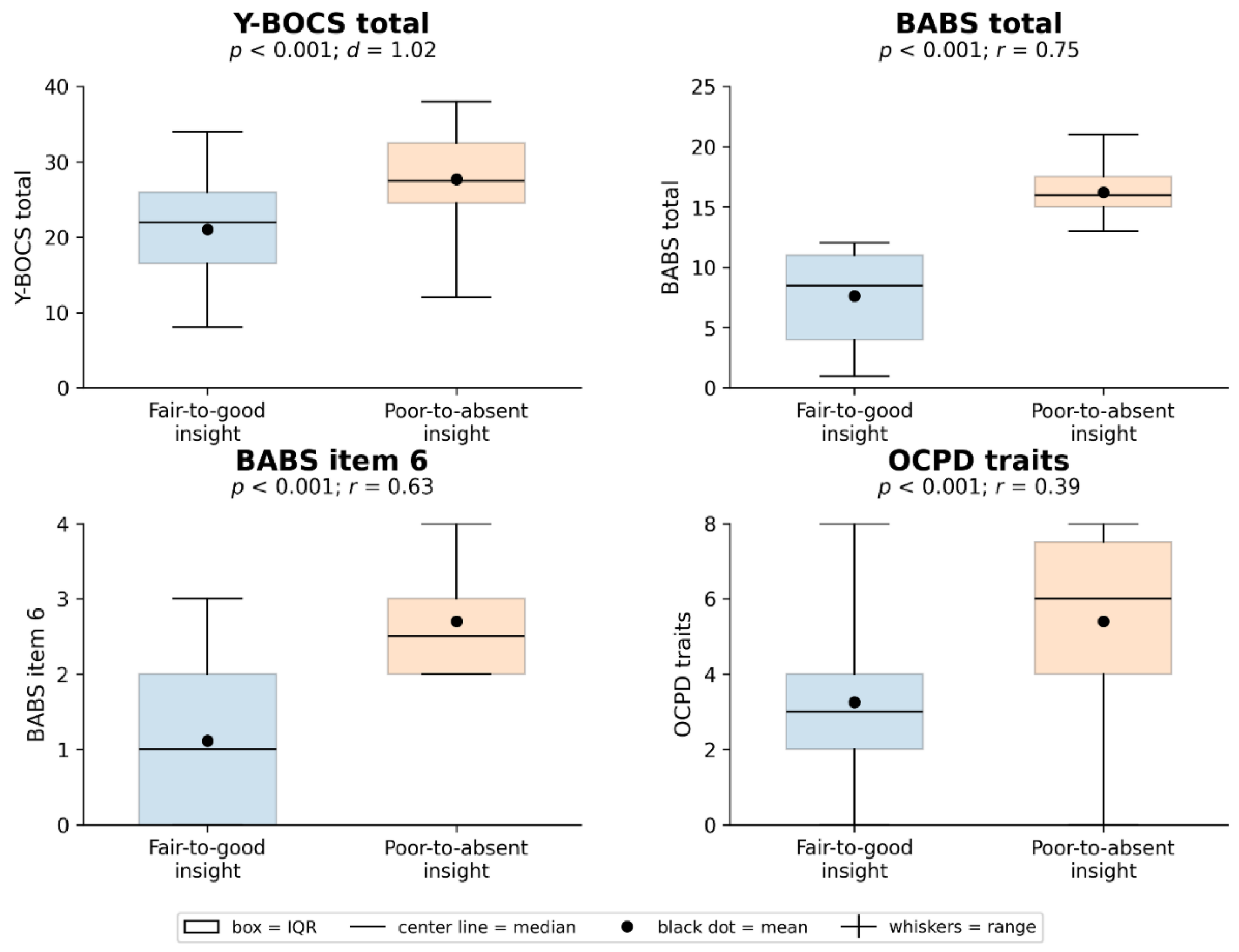
4.2. Clinical Characteristics According to Insight Group
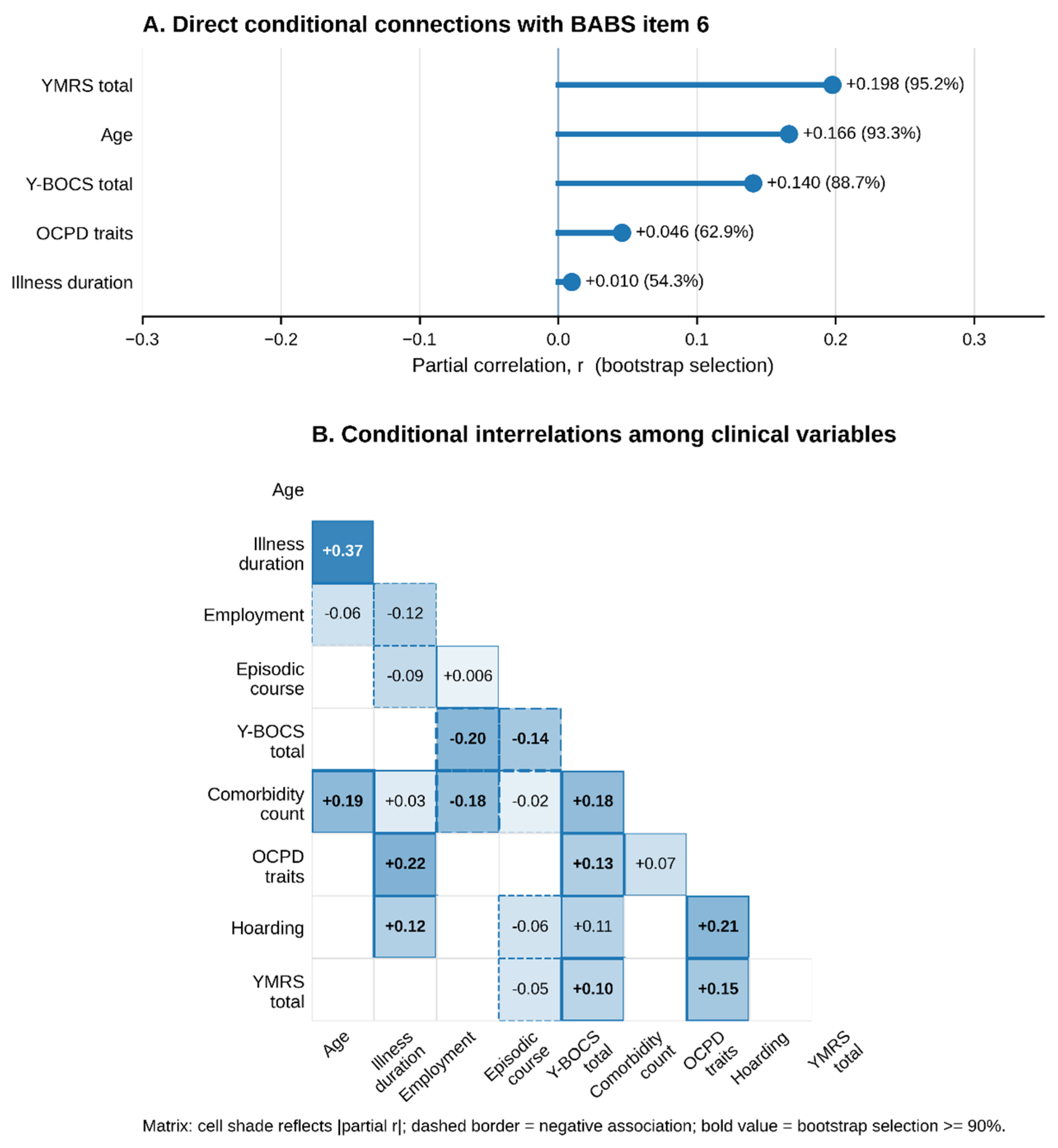
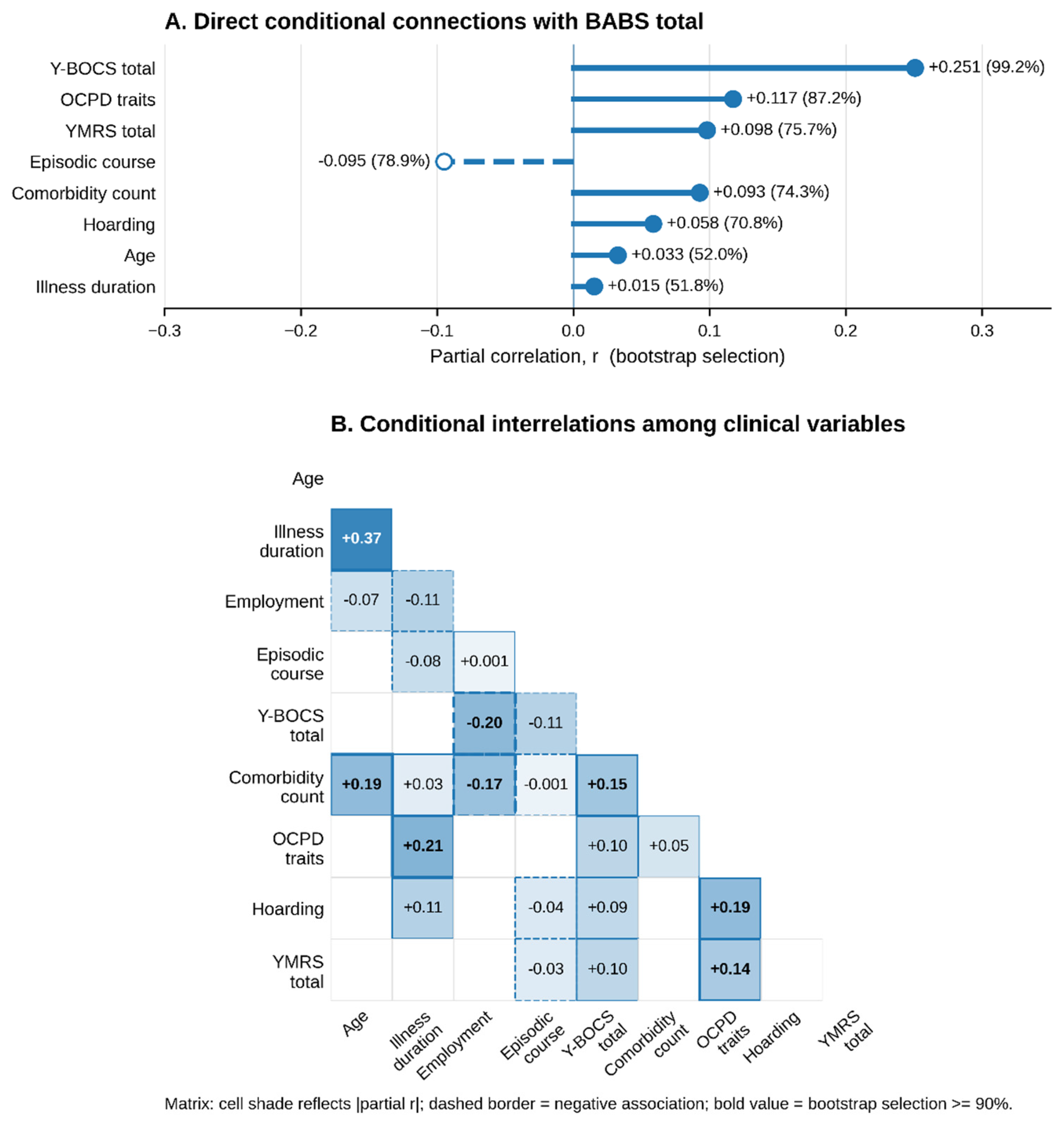
4.3. Dimensional Associations and Conditional Clinical Networks
4.4. Relative-Importance Analysis
4.5. Complementary Multivariable Analyses
5. Discussion
5.1. Frequency and Clinical Profile of Poor-to-Absent Insight
5.2. Dimensional and Conditional Clinical Correlates of Insight
5.3. Conceptual and Clinical Implications
6. Conclusions
- Poor-to-absent insight was present in one quarter of this clinical sample.
- OCD severity was the most consistent correlate of poorer global insight and the only independently significant correlate of BABS total in the fully adjusted model, whereas anankastic traits and other clinical characteristics were represented in broader dimensional and network associations.
- Categorical and dimensional analyses provided complementary perspectives, and BABS total and BABS item 6 showed partly different association profiles, although item 6 forms part of the total score.
- These findings support direct assessment of insight alongside consideration of the broader psychopathological and clinical context.
7. Limitations
- The study was conducted in a single clinical centre and included a relatively modest sample of 80 treatment-experienced patients, including 20 with poor-to-absent insight. The predominance of chronic and relatively severe OCD may limit the precision of some estimates and the generalisability of the findings to milder, untreated, community-based, or earlier-stage populations. Recruitment from both inpatient and outpatient settings may limit generalizability across clinical settings.
- The cross-sectional design precludes conclusions regarding temporal direction or causality. The study cannot determine whether the clinical characteristics associated with poorer insight preceded it, developed alongside it, or reflected shared underlying processes. Accordingly, the pattern of associations identified here should be regarded as descriptive and hypothesis-generating rather than as evidence of an underlying causal structure.
- Some clinically relevant categories were sparsely represented. Only five participants had an episodic course, 11 had BABS item 6 scores >2, and only four scored >3, reducing the precision of estimates involving these variables. YMRS scores were also generally low, so associations with manic symptoms should not be extrapolated to clinically manifest mania.
- Insight was assessed with a single clinician-administered instrument. BABS item 6 is a single ordinal item and contributes to the BABS total score; the two outcomes are therefore related by construction and should not be regarded as independent replications. In addition, the five checklist-derived OCD dimensions represent aggregated symptom domains and may not capture associations involving more specific symptom content.
- Between-group comparisons were not adjusted for multiple testing, whereas multiplicity was controlled using false-discovery-rate correction in the whole-sample dimensional screening. Secondary categorical findings should therefore be interpreted in conjunction with their effect sizes and with the extent to which they converged with subsequent dimensional analyses.
- The multistage analytical strategy was applied within the same sample. Bootstrap procedures provided information on the internal stability of the network and relative-importance findings but do not establish external reproducibility. Independent replication will therefore be required to assess their generalisability.
- The psychiatric comorbidity measure represented a count across four diagnostic categories and did not capture the full range, severity, or differential clinical significance of individual comorbid disorders. Additional developmental, cognitive, metacognitive, treatment-related, or neurobiological factors not assessed in the present study may also contribute to insight.
- Current pharmacotherapy was not included in the analyses and should therefore be considered when interpreting associations involving symptom severity.
Supplementary Materials
Author Contributions
Funding
Institutional Review Board Statement
Informed Consent Statement
Data Availability Statement
Acknowledgments
Conflicts of Interest
References
- Jeong, Y.D.; Son, Y.; Jeon, S.; Cho, H.; Ryuk, S.W.; Jo, Y.; Fond, G.; Boyer, L.; Smith, L.; Cortese, S.; et al. Global prevalence of obsessive-compulsive and related disorders: A systematic review and modeling study. Am. J. Psychiatry 2026, appiajp20250944. [Google Scholar] [CrossRef] [Scilit] [PubMed]
- American Psychiatric Association. Diagnostic and Statistical Manual of Mental Disorders, 5th ed.; American Psychiatric Publishing: Arlington, VA, USA, 2013. [Google Scholar] [CrossRef] [Scilit]
- World Health Organization. International Classification of Diseases, Eleventh Revision (ICD-11). Available online: https://icd.who.int/en/ (accessed on 2 August 2026).
- Ferrão, Y.A.; Shavitt, R.G.; Prado, H.; Fontenelle, L.F.; Malavazzi, D.M.; de Mathis, M.A.; Hounie, A.G.; Miguel, E.C.; do Rosário, M.C. Sensory phenomena associated with repetitive behaviors in obsessive-compulsive disorder: An exploratory study of 1001 patients. Psychiatry Res. 2012, 197, 253–258. [Google Scholar] [CrossRef] [Scilit] [PubMed]
- Ravid, A.; Franklin, M.E.; Khanna, M.; Storch, E.A.; Coles, M.E. “Not just right experiences” in adolescents: Phenomenology and associated characteristics. Child Psychiatry Hum. Dev. 2014, 45, 193–200. [Google Scholar] [CrossRef] [Scilit] [PubMed]
- Żerdziński, M. Detailed symptomatology of obsessive-compulsive disorder: A practical approach. In Obsessive-Compulsive Disorder: From Symptomatology to Treatment; Żerdziński, M., Ed.; Wydawnictwo Lekarskie PZWL: Warsaw, Poland, 2025; pp. 256–353. (In Polish) [Google Scholar]
- Stahnke, B. A systematic review of misdiagnosis in those with obsessive-compulsive disorder. J. Affect. Disord. Rep. 2021, 6, 100231. [Google Scholar] [CrossRef] [Scilit]
- Ziegler, S.; Bednasch, K.; Baldofski, S.; Rummel-Kluge, C. Long durations from symptom onset to diagnosis and from diagnosis to treatment in obsessive-compulsive disorder: A retrospective self-report study. PLoS ONE 2021, 16, e0261169. [Google Scholar] [CrossRef] [Scilit] [PubMed]
- Dell’Osso, B.; Buoli, M.; Hollander, E.; Altamura, A.C. Duration of untreated illness as a predictor of treatment response and remission in obsessive-compulsive disorder. World J. Biol. Psychiatry 2010, 11, 59–65. [Google Scholar] [CrossRef] [Scilit] [PubMed]
- Dell’Osso, B.; Benatti, B.; Grancini, B.; Vismara, M.; De Carlo, V.; Cirnigliaro, G.; Albert, U.; Viganò, C. Investigating duration of illness and duration of untreated illness in obsessive compulsive disorder reveals patients remain at length pharmacologically untreated. Int. J. Psychiatry Clin. Pract. 2019, 23, 311–313. [Google Scholar] [CrossRef] [Scilit] [PubMed]
- Żerdziński, M.; Burdzik, M.; Żmuda, R.; Witkowska-Berek, A.; Dębski, P.; Flajszok-Macierzyńska, N.; Piegza, M.; John-Ziaja, H.; Gorczyca, P. Sense of happiness and other aspects of quality of life in patients with obsessive-compulsive disorder. Front. Psychiatry 2022, 13, 1077337. [Google Scholar] [CrossRef] [Scilit] [PubMed]
- García-Soriano, G.; Rufer, M.; Delsignore, A.; Weidt, S. Factors associated with non-treatment or delayed treatment seeking in OCD sufferers: A review of the literature. Psychiatry Res. 2014, 220, 1–10. [Google Scholar] [CrossRef] [Scilit] [PubMed]
- Sharma, E.; Math, S.B. Course and outcome of obsessive-compulsive disorder. Indian J. Psychiatry 2019, 61, S43–S50. [Google Scholar] [CrossRef] [Scilit] [PubMed]
- Jakubovski, E.; Diniz, J.B.; Valerio, C.; Fossaluza, V.; Belotto-Silva, C.; Gorenstein, C.; Miguel, E.; Shavitt, R.G. Clinical predictors of long-term outcome in obsessive-compulsive disorder. Depress. Anxiety 2013, 30, 763–772. [Google Scholar] [CrossRef] [Scilit] [PubMed]
- Gan, J.; He, J.; Fu, H.; Zhu, X. Association between obsession, compulsion, depression and insight in obsessive-compulsive disorder: A meta-analysis. Nord. J. Psychiatry 2022, 76, 489–496. [Google Scholar] [CrossRef] [Scilit] [PubMed]
- Benatti, B.; Dell’Osso, B.; Arici, C.; Hollander, E.; Altamura, A.C. Characterizing impulsivity profile in patients with obsessive-compulsive disorder. Int. J. Psychiatry Clin. Pract. 2014, 18, 156–160. [Google Scholar] [CrossRef] [Scilit] [PubMed]
- Cludius, B.; Mannsfeld, A.K.; Schmidt, A.F.; Jelinek, L. Anger and aggressiveness in obsessive-compulsive disorder and the mediating role of responsibility, non-acceptance of emotions, and social desirability. Eur. Arch. Psychiatry Clin. Neurosci. 2021, 271, 1179–1191. [Google Scholar] [CrossRef] [Scilit] [PubMed]
- Whiteside, S.P.; Abramowitz, J.S. The expression of anger and its relationship to symptoms and cognitions in obsessive-compulsive disorder. Depress. Anxiety 2005, 21, 106–111. [Google Scholar] [CrossRef] [Scilit] [PubMed]
- Radomsky, A.S.; Ashbaugh, A.R.; Gelfand, L.A. Relationships between anger, symptoms, and cognitive factors in OCD checkers. Behav. Res. Ther. 2007, 45, 2712–2725. [Google Scholar] [CrossRef] [Scilit] [PubMed]
- Eisen, J.L.; Mancebo, M.A.; Pinto, A.; Coles, M.E.; Pagano, M.E.; Stout, R.; Rasmussen, S.A. Impact of obsessive-compulsive disorder on quality of life. Compr. Psychiatry 2006, 47, 270–275. [Google Scholar] [CrossRef] [Scilit] [PubMed]
- Huppert, J.D.; Simpson, H.B.; Nissenson, K.J.; Liebowitz, M.R.; Foa, E.B. Quality of life and functional impairment in obsessive-compulsive disorder: A comparison of patients with and without comorbidity, patients in remission, and healthy controls. Depress. Anxiety 2009, 26, 39–45. [Google Scholar] [CrossRef] [Scilit] [PubMed]
- Stein, D.J.; Allen, A.; Bobes, J.; Eisen, J.L.; Figuera, M.L.; Iikura, Y.; Koran, L.M.; Hollander, E. Quality of life in obsessive-compulsive disorder. CNS Spectr. 2000, 5, 37–39. [Google Scholar] [CrossRef] [Scilit]
- Guillén-Font, M.A.; Cervera, M.; Puigoriol, E.; Foguet-Boreu, Q.; Arrufat, F.X.; Serra-Millàs, M. Insight in obsessive-compulsive disorder: Relationship with sociodemographic and clinical characteristics. J. Psychiatr. Pract. 2021, 27, 427–438. [Google Scholar] [CrossRef] [Scilit] [PubMed]
- Konstantakopoulos, G. Insight across mental disorders: A multifaceted metacognitive phenomenon. Psychiatriki 2019, 30, 13–16. [Google Scholar] [CrossRef] [Scilit] [PubMed]
- Manarte, L.; Andrade, A.R.; do Rosário, L.; Sampaio, D.; Figueira, M.L.; Langley, C.; Morgado, P.; Sahakian, B.J. Poor insight in obsessive compulsive disorder (OCD): Associations with empathic concern and emotion recognition. Psychiatry Res. 2021, 304, 114129. [Google Scholar] [CrossRef] [Scilit] [PubMed]
- Lerner, J. A note on judgment and insight in psychiatric disability. Community Ment. Health J. 1966, 2, 70–72. [Google Scholar] [CrossRef] [Scilit] [PubMed]
- Brady, J.P. Psychotherapy, learning theory, and insight. Arch. Gen. Psychiatry 1967, 16, 304–311. [Google Scholar] [CrossRef] [Scilit] [PubMed]
- Hatcher, R.L. Insight and self-observation. J. Am. Psychoanal. Assoc. 1973, 21, 377–398. [Google Scholar] [CrossRef] [Scilit] [PubMed]
- David, A.S. Insight and psychosis. Br. J. Psychiatry 1990, 156, 798–808. [Google Scholar] [CrossRef] [Scilit] [PubMed]
- World Health Organization. The ICD-10 Classification of Mental and Behavioural Disorders: Diagnostic Criteria for Research; World Health Organization: Geneva, Switzerland, 1993. [Google Scholar]
- Huang, Y.; Weng, Y.; Lan, L.; Zhu, C.; Shen, T.; Tang, W.; Lai, H.Y. Insight in obsessive-compulsive disorder: Conception, clinical characteristics, neuroimaging and treatment. Psychoradiology 2023, 3, kkad025. [Google Scholar] [CrossRef] [Scilit] [PubMed]
- Moritz, S.; Purdon, C.; Jelinek, L.; Chiang, B.; Hauschildt, M. If it is absurd, then why do you do it? The richer the obsessional experience, the more compelling the compulsion. Clin. Psychol. Psychother. 2018, 25, 210–216. [Google Scholar] [CrossRef] [Scilit] [PubMed]
- Marková, I.S.; Jaafari, N.; Berrios, G.E. Insight and obsessive-compulsive disorder: A conceptual analysis. Psychopathology 2009, 42, 277–282. [Google Scholar] [CrossRef] [Scilit] [PubMed]
- de Avila, R.C.S.; do Nascimento, L.G.; Porto, R.L.M.; Fontenelle, L.; Miguel Filho, E.C.; Brakoulias, V.; Ferrão, Y.A. Level of insight in patients with obsessive-compulsive disorder: An exploratory comparative study between patients with “good insight” and “poor insight”. Front. Psychiatry 2019, 10, 413. [Google Scholar] [CrossRef] [Scilit] [PubMed]
- Manarte, L.; Andrade, A.R.; do Rosário, L.; Sampaio, D.; Figueira, M.L.; Morgado, P.; Sahakian, B.J. Executive functions and insight in OCD: A comparative study. BMC Psychiatry 2021, 21, 216. [Google Scholar] [CrossRef] [Scilit] [PubMed]
- Kashyap, H.; Kumar, J.K.; Kandavel, T.; Reddy, Y.C.J. Neuropsychological correlates of insight in obsessive-compulsive disorder. Acta Psychiatr. Scand. 2012, 126, 106–114. [Google Scholar] [CrossRef] [Scilit] [PubMed]
- Mısır, E.; Bora, E.; Akdede, B.B. Relationship between social-cognitive and social-perceptual aspects of theory of mind and neurocognitive deficits, insight level and schizotypal traits in obsessive-compulsive disorder. Compr. Psychiatry 2018, 83, 1–6. [Google Scholar] [CrossRef] [Scilit] [PubMed]
- Marchesi, C.; Ampollini, P.; De Panfilis, C.; Maggini, C. Temperament features in adolescents with ego-syntonic or ego-dystonic obsessive-compulsive symptoms. Eur. Child Adolesc. Psychiatry 2008, 17, 392–396. [Google Scholar] [CrossRef] [Scilit] [PubMed]
- Audet, J.S.; Aardema, F.; Moulding, R. Contextual determinants of intrusions and obsessions: The role of ego-dystonicity and the reality of obsessional thoughts. J. Obs. Compuls. Relat. Disord. 2016, 9, 96–106. [Google Scholar] [CrossRef] [Scilit]
- Marazziti, D.; Dell’Osso, L.; Di Nasso, E.; Pfanner, C.; Presta, S.; Mungai, F.; Cassano, G.B. Insight in obsessive-compulsive disorder: A study of an Italian sample. Eur. Psychiatry 2002, 17, 407–410. [Google Scholar] [CrossRef] [Scilit] [PubMed]
- Matsunaga, H.; Kiriike, N.; Matsui, T.; Oya, K.; Iwasaki, Y.; Koshimune, K.; Miyata, A.; Stein, D.J. Obsessive-compulsive disorder with poor insight. Compr. Psychiatry 2002, 43, 150–157. [Google Scholar] [CrossRef] [Scilit] [PubMed]
- Alonso, P.; Menchón, J.M.; Segalàs, C.; Jaurrieta, N.; Jiménez-Murcia, S.; Cardoner, N.; Labad, J.; Real, E.; Pertusa, A.; Vallejo, J. Clinical implications of insight assessment in obsessive-compulsive disorder. Compr. Psychiatry 2008, 49, 305–312. [Google Scholar] [CrossRef] [Scilit] [PubMed]
- Catapano, F.; Perris, F.; Fabrazzo, M.; Cioffi, V.; Giacco, D.; De Santis, V.; Maj, M. Obsessive-compulsive disorder with poor insight: A three-year prospective study. Prog. Neuropsychopharmacol. Biol. Psychiatry 2010, 34, 323–330. [Google Scholar] [CrossRef] [Scilit] [PubMed]
- Grover, S.; Ghosh, A.; Kate, N.; Sarkar, S.; Chakrabarti, S.; Avasthi, A. Concordance of assessment of insight by different measures in obsessive-compulsive disorder: An outpatient-based study from India. Indian J. Psychiatry 2021, 63, 439–447. [Google Scholar] [CrossRef] [Scilit] [PubMed]
- Bellino, S.; Patria, L.; Ziero, S.; Bogetto, F. Clinical picture of obsessive-compulsive disorder with poor insight: A regression model. Psychiatry Res. 2005, 136, 223–231. [Google Scholar] [CrossRef] [Scilit] [PubMed]
- Ravi Kishore, V.; Samar, R.; Janardhan Reddy, Y.C.; Chandrasekhar, C.R.; Thennarasu, K. Clinical characteristics and treatment response in poor and good insight obsessive-compulsive disorder. Eur. Psychiatry 2004, 19, 202–208. [Google Scholar] [CrossRef] [Scilit] [PubMed]
- Fontenelle, J.M.; Harrison, B.J.; Santana, L.; Conceição do Rosário, M.; Versiani, M.; Fontenelle, L.F. Correlates of insight into different symptom dimensions in obsessive-compulsive disorder. Ann. Clin. Psychiatry 2013, 25, 11–16. [Google Scholar] [CrossRef] [Scilit]
- Lochner, C.; Serebro, P.; van der Merwe, L.; Hemmings, S.; Kinnear, C.; Seedat, S.; Stein, D.J. Comorbid obsessive-compulsive personality disorder in obsessive-compulsive disorder (OCD): A marker of severity. Prog. Neuropsychopharmacol. Biol. Psychiatry 2011, 35, 1087–1092. [Google Scholar] [CrossRef] [Scilit] [PubMed]
- Eisen, J.L.; Rasmussen, S.A.; Phillips, K.A.; Price, L.H.; Davidson, J.; Lydiard, R.B.; Ninan, P.; Piggott, T. Insight and treatment outcome in obsessive-compulsive disorder. Compr. Psychiatry 2001, 42, 494–497. [Google Scholar] [CrossRef] [Scilit] [PubMed]
- Goodman, W.K.; Price, L.H.; Rasmussen, S.A.; Mazure, C.; Fleischmann, R.L.; Hill, C.L.; Heninger, G.R.; Charney, D.S. The Yale–Brown Obsessive Compulsive Scale. I. Development, use, and reliability. Arch. Gen. Psychiatry 1989, 46, 1006–1011. [Google Scholar] [CrossRef] [Scilit] [PubMed]
- Pinto, A.; Greenberg, B.D.; Grados, M.A.; Bienvenu, O.J., III; Samuels, J.F.; Murphy, D.L.; Hasler, G.; Stout, R.L.; Rauch, S.L.; Shugart, Y.Y.; et al. Further development of Y-BOCS dimensions in the OCD Collaborative Genetics Study: Symptoms versus categories. Psychiatry Res. 2008, 160, 83–93. [Google Scholar] [CrossRef] [Scilit] [PubMed]
- Eisen, J.L.; Phillips, K.A.; Baer, L.; Beer, D.A.; Atala, K.D.; Rasmussen, S.A. The Brown Assessment of Beliefs Scale: Reliability and validity. Am. J. Psychiatry 1998, 155, 102–108. [Google Scholar] [CrossRef] [Scilit] [PubMed]
- Hamilton, M. A rating scale for depression. J. Neurol. Neurosurg. Psychiatry 1960, 23, 56–62. [Google Scholar] [CrossRef] [Scilit] [PubMed]
- Young, R.C.; Biggs, J.T.; Ziegler, V.E.; Meyer, D.A. A rating scale for mania: Reliability, validity and sensitivity. Br. J. Psychiatry 1978, 133, 429–435. [Google Scholar] [CrossRef] [Scilit] [PubMed]
- Buss, A.H.; Perry, M. The aggression questionnaire. J. Pers. Soc. Psychol. 1992, 63, 452–459. [Google Scholar] [CrossRef] [PubMed]
- Patton, J.H.; Stanford, M.S.; Barratt, E.S. Factor structure of the Barratt Impulsiveness Scale. J. Clin. Psychol. 1995, 51, 768–774. [Google Scholar] [CrossRef] [Scilit]
- Elvish, J.; Simpson, J.; Ball, L.J. Which clinical and demographic factors predict poor insight in individuals with obsessions and/or compulsions? J. Anxiety Disord. 2010, 24, 231–237. [Google Scholar] [CrossRef] [Scilit] [PubMed]
- Coles, M.E.; Pinto, A.; Mancebo, M.C.; Rasmussen, S.A.; Eisen, J.L. OCD with comorbid OCPD: A subtype of OCD? J. Psychiatr. Res. 2008, 42, 289–296. [Google Scholar] [CrossRef] [Scilit] [PubMed]
- Fineberg, N.A.; Reghunandanan, S.; Kolli, S.; Atmaca, M. Obsessive-compulsive (anankastic) personality disorder: Toward the ICD-11 classification. Braz. J. Psychiatry 2014, 36, S40–S50. [Google Scholar] [CrossRef] [Scilit] [PubMed]
- Riddle, M.A.; Maher, B.S.; Wang, Y.; Grados, M.; Bienvenu, O.J.; Goes, F.S.; Cullen, B.; Murphy, D.L.; Rauch, S.L.; Greenberg, B.D.; et al. Obsessive-compulsive personality disorder: Evidence for two dimensions. Depress. Anxiety 2016, 33, 128–135. [Google Scholar] [CrossRef] [Scilit] [PubMed]
- Jakubovski, E.; Pittenger, C.; Torres, A.R.; Fontenelle, L.F.; do Rosário, M.C.; Ferrão, Y.A.; de Mathis, M.A.; Miguel, E.C.; Bloch, M.H. Dimensional correlates of poor insight in obsessive-compulsive disorder. Prog. Neuropsychopharmacol. Biol. Psychiatry 2011, 35, 1677–1681. [Google Scholar] [CrossRef] [Scilit] [PubMed]
- Visser, H.; van Megen, H.; van Oppen, P.; Hoogendoorn, A.W.; Glas, G.; Neziroglu, F.; van Balkom, A. The impact of poor insight on the course of obsessive-compulsive disorder in patients receiving naturalistic treatment. J. Obs. Compuls. Relat. Disord. 2017, 13, 42–48. [Google Scholar] [CrossRef] [Scilit]
- Melca, I.A.; Yücel, M.; Mendlowicz, M.V.; de Oliveira-Souza, R.; Fontenelle, L.F. The correlates of obsessive-compulsive, schizotypal, and borderline personality disorders in obsessive-compulsive disorder. J. Anxiety Disord. 2015, 33, 15–24. [Google Scholar] [CrossRef] [Scilit] [PubMed]
- Shimshoni, Y.; Reuven, O.; Dar, R.; Hermesh, H. Insight in obsessive-compulsive disorder: A comparative study of insight measures in an Israeli clinical sample. J. Behav. Ther. Exp. Psychiatry 2011, 42, 389–396. [Google Scholar] [CrossRef] [Scilit] [PubMed]
- Eisen, J.L.; Phillips, K.A.; Coles, M.E.; Rasmussen, S.A. Insight in obsessive compulsive disorder and body dysmorphic disorder. Compr. Psychiatry 2004, 45, 10–15. [Google Scholar] [CrossRef] [Scilit] [PubMed]
- Phillips, K.A.; Pinto, A.; Hart, A.S.; Coles, M.E.; Eisen, J.L.; Menard, W.; Rasmussen, S.A. A comparison of insight in body dysmorphic disorder and obsessive-compulsive disorder. J. Psychiatr. Res. 2012, 46, 1293–1299. [Google Scholar] [CrossRef] [Scilit] [PubMed]
- Kozak, M.J.; Foa, E.B. Obsessions, overvalued ideas, and delusions in obsessive-compulsive disorder. Behav. Res. Ther. 1994, 32, 343–353. [Google Scholar] [CrossRef] [Scilit] [PubMed]
- Brakoulias, V.; Starcevic, V. The characterization of beliefs in obsessive-compulsive disorder. Psychiatr. Q. 2011, 82, 151–161. [Google Scholar] [CrossRef] [Scilit] [PubMed]
- Landmann, S.; Cludius, B.; Tuschen-Caffier, B.; Moritz, S.; Külz, A.K. Mindfulness predicts insight in obsessive-compulsive disorder over and above OC symptoms: An experience-sampling study. Behav. Res. Ther. 2019, 121, 103449. [Google Scholar] [CrossRef] [Scilit] [PubMed]
- Bischof, C.; Hohensee, N.; Dietel, F.A.; Doebler, P.; Klein, N.; Buhlmann, U. Dynamics of insight, emotion regulation, and emotional clarity in obsessive-compulsive disorder. Cogn. Ther. Res. 2025, 49, 934–944. [Google Scholar] [CrossRef] [Scilit]
- Wolf, N.; du Mortier, J.A.M.; van Oppen, P.; Hoogendoorn, A.W.; van Balkom, A.J.L.M.; Visser, H.A.D. Changes in insight throughout the natural four-year course of obsessive-compulsive disorder and its association with OCD severity and quality of life. Front. Psychiatry 2023, 14, 1231293. [Google Scholar] [CrossRef] [Scilit] [PubMed]
- O’Connor, K.; Robillard, S. Inference processes in obsessive-compulsive disorder: Some clinical observations. Behav. Res. Ther. 1995, 33, 887–896. [Google Scholar] [CrossRef] [Scilit] [PubMed]
- Broekhuizen, A.; Vriend, C.; Wolf, N.; Koenen, E.H.; van Oppen, P.; van Balkom, A.J.L.M.; Visser, H.A.D.; van den Heuvel, O.A. Poor insight in obsessive-compulsive disorder as a multifaceted phenomenon: Evidence from brain activation during symptom provocation. Biol. Psychiatry Cogn. Neurosci. Neuroimaging 2023, 8, 1135–1144. [Google Scholar] [CrossRef] [Scilit] [PubMed]
- Howes, O.D.; Thase, M.E.; Pillinger, T. Treatment resistance in psychiatry: State of the art and new directions. Mol. Psychiatry 2022, 27, 58–72. [Google Scholar] [CrossRef] [Scilit] [PubMed]
- Leeuwerik, T.; Cavanagh, K.; Strauss, C. Patient adherence to cognitive behavioural therapy for obsessive-compulsive disorder: A systematic review and meta-analysis. J. Anxiety Disord. 2019, 68, 102135. [Google Scholar] [CrossRef] [Scilit] [PubMed]



| Characteristic | n (%) | Mean ± SD or Median (Q1–Q3) | Range |
|---|---|---|---|
| Panel A. Sociodemographic and clinical characteristics | |||
| Sociodemographic characteristics | |||
| Age, years | 44.5 ± 12.6 | 18–73 | |
| Sex | |||
| Female | 44 (55.0) | ||
| Male | 36 (45.0) | ||
| Education | |||
| Primary | 1 (1.3) | ||
| Vocational | 9 (11.3) | ||
| Secondary | 24 (30.0) | ||
| Tertiary | 46 (57.5) | ||
| Relationship status | |||
| In a relationship | 51 (63.8) | ||
| Not in a relationship | 29 (36.3) | ||
| Employment | |||
| Active | 49 (61.3) | ||
| Inactive | 31 (38.8) | ||
| Clinical course and time-related variables | |||
| Illness duration, years | 22.2 ± 11.1 | 1–55 | |
| Treatment delay, years | 10.0 (5.0–19.5) | 0–44 | |
| Treatment duration, years | 7.0 (1.5–15.0) | 0–35 | |
| Course of OCD | |||
| Chronic, no remission lasting ≥12 months | 75 (93.8) | ||
| Episodic, ≥1 remission lasting ≥12 months | 5 (6.3) | ||
| OCD severity | |||
| Y-BOCS total | 22.7 ± 7.1 | 8–38 | |
| Y-BOCS obsessions | 12.0 (9.0–15.0) | 4–19 | |
| Y-BOCS compulsions | 10.9 ± 3.8 | 3–19 | |
| OCD severity category | |||
| Mild | 15 (18.8) | ||
| Moderate | 25 (31.3) | ||
| Severe | 32 (40.0) | ||
| Extreme | 8 (10.0) | ||
| Psychiatric comorbidity | |||
| Psychiatric comorbidity count | 2.0 (1.0–2.0) | 0–3 | |
| Number of psychiatric comorbidities | |||
| 0 | 10 (12.5) | ||
| 1 | 28 (35.0) | ||
| 2 | 35 (43.8) | ||
| 3 | 7 (8.8) | ||
| Panel B. Checklist-derived OCD dimensions | % | Median (Q1–Q3) | Range |
| Contamination/cleaning | 59.4 | 1.0 (0.0–2.0) | 0–2 |
| Taboo thoughts | 52.1 | 2.0 (1.0–2.0) | 0–3 |
| Doubts/checking | 66.3 | 1.0 (1.0–2.0) | 0–2 |
| Symmetry/ordering | 58.4 | 2.0 (2.0–3.0) | 0–4 |
| Hoarding | 36.3 | 0.0 (0.0–1.0) | 0–2 |
| Measure | Total Sample | Min–Max | Shapiro–Wilk p |
|---|---|---|---|
| Insight | |||
| BABS total | 10.5 (6.0–12.5) | 1.0–21.0 | 0.037 |
| BABS item 6 | 2.0 (1.0–2.0) | 0.0–4.0 | <0.001 |
| Affective symptoms | |||
| HDRS total | 8.0 (5.0–13.5) | 0.0–36.0 | <0.001 |
| YMRS total | 2.0 (0.0–5.0) | 0.0–24.0 | <0.001 |
| Personality traits | |||
| OCPD traits | 4.0 (2.0–5.0) | 0.0–8.0 | 0.006 |
| Impulsivity | |||
| BIS total | 64.0 ± 11.3 | 41.0–96.0 | 0.052 |
| BIS-Cog | 18.0 (16.0–20.0) | 10.0–28.0 | 0.043 |
| BIS-Mot | 20.0 (18.0–23.0) | 13.0–36.0 | <0.001 |
| BIS-Plan | 24.0 (21.0–28.0) | 12.0–49.0 | 0.004 |
| Aggression | |||
| BPAQ total | 78.5 ± 18.3 | 41.0–126.0 | 0.740 |
| BPAQ-PA | 17.0 (13.0–22.0) | 9.0–37.0 | <0.001 |
| BPAQ-VA | 14.5 (11.0–17.0) | 7.0–24.0 | 0.045 |
| BPAQ-A | 21.7 ± 5.8 | 1.0–35.0 | 0.130 |
| BPAQ-H | 23.7 ± 6.9 | 8.0–37.0 | 0.085 |
| Variable | Fair-to-Good Insight (N = 60) | Poor-to-Absent Insight (N = 20) | p-Value | Effect Size |
|---|---|---|---|---|
| Insight | ||||
| BABS total | 8.5 (4.0–11.0) | 16.0 (15.0–17.5) | <0.001 | −0.75 (r) |
| BABS item 6 | 1.0 (0.0–2.0) | 2.5 (2.0–3.0) | <0.001 | −0.63 (r) |
| Sociodemographics | ||||
| Age, years | 42.8 ± 11.8 | 49.6 ± 13.8 | 0.036 | −0.55 (d) |
| Sex, n (%) | 0.604 | 0.06 (V) | ||
| Female | 34 (56.7) | 10 (50.0) | ||
| Male | 26 (43.3) | 10 (50.0) | ||
| Education, n (%) | 0.680 | 0.14 (V) | ||
| Primary | 1 (1.7) | 0 (0.0) | ||
| Vocational | 8 (13.3) | 1 (5.0) | ||
| Secondary | 17 (28.3) | 7 (35.0) | ||
| Tertiary | 34 (56.7) | 12 (60.0) | ||
| Relationship status, n (%) | 0.140 | 0.17 (V) | ||
| In a relationship | 41 (68.3) | 10 (50.0) | ||
| Not in a relationship | 19 (31.7) | 10 (50.0) | ||
| Employment, n (%) | 0.233 | 0.13 (V) | ||
| Active | 39 (65.0) | 10 (50.0) | ||
| Inactive | 21 (35.0) | 10 (50.0) | ||
| OCD severity | ||||
| Y-BOCS total | 21.0 ± 6.6 | 27.7 ± 6.4 | <0.001 | −1.02 (d) |
| Y-BOCS obsessions | 12.0 (8.0–13.0) | 14.5 (12.5–16.0) | <0.001 | −0.40 (r) |
| Y-BOCS compulsions | 10.1 ± 3.5 | 13.5 ± 3.6 | <0.001 | −0.97 (d) |
| Clinical course and time-related variables | ||||
| Illness duration, years | 21.0 ± 10.0 | 26.0 ± 13.6 | 0.081 | −0.46 (d) |
| Treatment delay, years | 10.0 (5.0–18.0) | 8.5 (7.0–20.0) | 0.889 | 0.02 (r) |
| Treatment duration, years | 7.0 (1.5–13.5) | 10.0 (1.5–20.0) | 0.370 | −0.10 (r) |
| Course of OCD, n (%) | 0.324 | 0.15 (V) | ||
| Chronic | 55 (91.7) | 20 (100.0) | ||
| Episodic | 5 (8.3) | 0 (0.0) | ||
| Comorbidity and personality | ||||
| Psychiatric comorbidity count | 1.0 (1.0–2.0) | 2.0 (1.5–2.0) | 0.035 | −0.24 (r) |
| OCPD trait count | 3.0 (2.0–4.0) | 6.0 (4.0–7.5) | <0.001 | −0.39 (r) |
| Affective symptoms | ||||
| HDRS total | 8.5 (5.0–12.0) | 7.0 (4.5–15.0) | 0.824 | −0.03 (r) |
| YMRS total | 2.0 (0.0–5.0) | 2.5 (1.0–9.5) | 0.167 | −0.16 (r) |
| Impulsivity | ||||
| BIS total | 63.0 ± 11.0 | 66.8 ± 12.0 | 0.197 | −0.34 (d) |
| BIS-Cog | 17.5 (16.0–20.0) | 18.0 (15.0–20.5) | 0.951 | −0.01 (r) |
| BIS-Mot | 20.0 (18.0–22.5) | 20.0 (19.0–25.0) | 0.257 | −0.13 (r) |
| BIS-Plan | 23.5 (20.0–28.0) | 24.0 (22.5–30.0) | 0.330 | −0.11 (r) |
| Aggression | ||||
| BPAQ total | 78.4 ± 18.6 | 78.6 ± 18.0 | 0.978 | −0.01 (d) |
| BPAQ-PA | 17.0 (13.0–22.0) | 16.5 (13.0–24.0) | 0.898 | 0.02 (r) |
| BPAQ-VA | 14.0 (11.0–17.0) | 15.5 (12.5–18.0) | 0.210 | −0.14 (r) |
| BPAQ-A | 22.0 ± 5.9 | 21.2 ± 5.8 | 0.576 | 0.14 (d) |
| BPAQ-H | 24.0 ± 7.0 | 22.9 ± 6.7 | 0.546 | 0.16 (d) |
| Checklist-derived OCD dimensions | ||||
| Contamination/cleaning | 2.0 (0.0–2.0) | 1.0 (0.0–2.0) | 0.211 | 0.14 (r) |
| Taboo thoughts | 2.0 (1.0–2.0) | 1.0 (0.5–2.0) | 0.058 | 0.21 (r) |
| Doubts/checking | 1.0 (1.0–2.0) | 1.0 (1.0–2.0) | 0.956 | 0.01 (r) |
| Symmetry/ordering | 2.0 (2.0–3.0) | 2.5 (2.0–3.5) | 0.669 | −0.05 (r) |
| Hoarding | 0.0 (0.0–1.0) | 1.0 (0.5–2.0) | 0.003 | −0.33 (r) |
| Panel A. BABS Total: Multiple Linear Regression | |||
| Variable | Standardized β | 95% CI | p |
| Y-BOCS total | 0.339 | 0.051–0.628 | 0.021 |
| OCPD trait count | 0.100 | −0.161–0.362 | 0.453 |
| YMRS total | 0.222 | −0.071–0.515 | 0.138 |
| Age | 0.081 | −0.200–0.362 | 0.572 |
| Illness duration | 0.052 | −0.203–0.307 | 0.689 |
| Psychiatric comorbidity count | 0.100 | −0.242–0.441 | 0.566 |
| Hoarding | 0.065 | −0.115–0.245 | 0.480 |
| Model fit: R2 = 0.400; adjusted R2 = 0.342; global p < 0.001. | |||
| Panel B. BABS Item 6: Partial Proportional-Odds Ordinal Logistic Regression | |||
| Variable or cumulative contrast | OR per 1-SD increase | 95% CI | p |
| Y-BOCS total | 1.588 | 0.920–2.741 | 0.097 |
| OCPD trait count | 1.370 | 0.792–2.369 | 0.260 |
| Age | 1.975 | 1.115–3.499 | 0.020 |
| Illness duration | 1.127 | 0.643–1.975 | 0.676 |
| Psychiatric comorbidity count | 0.859 | 0.498–1.481 | 0.585 |
| Hoarding | 0.885 | 0.547–1.430 | 0.617 |
| YMRS total: threshold-specific cumulative effects | |||
| BABS item 6 >0 vs. 0 | 1.329 | 0.572–3.088 | 0.509 |
| BABS item 6 >1 vs. 0–1 | 1.619 | 0.791–3.316 | 0.187 |
| BABS item 6 >2 vs. 0–2 | 3.021 | 1.452–6.286 | 0.003 |
| BABS item 6 >3 vs. 0–3 | 2.622 | 1.285–5.350 | 0.008 |
| Model fit: LR χ2(10) = 33.968; global p < 0.001; McFadden pseudo-R2 = 0.151. | |||
Disclaimer/Publisher’s Note: The statements, opinions and data contained in all publications are solely those of the individual author(s) and contributor(s) and not of MDPI and/or the editor(s). MDPI and/or the editor(s) disclaim responsibility for any injury to people or property resulting from any ideas, methods, instructions or products referred to in the content. |
© 2026 by the authors. Licensee MDPI, Basel, Switzerland. This article is an open access article distributed under the terms and conditions of the Creative Commons Attribution (CC BY) license.
Share and Cite
Żerdziński, M.; Burdzik, M.; Żmuda, R.; Dębski, P.; Witkowska-Berek, A.; Krzystanek, M. Clinical Correlates of Poor Insight in Obsessive–Compulsive Disorder: An Integrative Cross-Sectional Analysis. J. Clin. Med. 2026, 15, 7289. https://doi.org/10.3390/jcm15187289
Żerdziński M, Burdzik M, Żmuda R, Dębski P, Witkowska-Berek A, Krzystanek M. Clinical Correlates of Poor Insight in Obsessive–Compulsive Disorder: An Integrative Cross-Sectional Analysis. Journal of Clinical Medicine. 2026; 15(18):7289. https://doi.org/10.3390/jcm15187289
Chicago/Turabian StyleŻerdziński, Maciej, Marcin Burdzik, Roksana Żmuda, Paweł Dębski, Agnieszka Witkowska-Berek, and Marek Krzystanek. 2026. "Clinical Correlates of Poor Insight in Obsessive–Compulsive Disorder: An Integrative Cross-Sectional Analysis" Journal of Clinical Medicine 15, no. 18: 7289. https://doi.org/10.3390/jcm15187289
APA StyleŻerdziński, M., Burdzik, M., Żmuda, R., Dębski, P., Witkowska-Berek, A., & Krzystanek, M. (2026). Clinical Correlates of Poor Insight in Obsessive–Compulsive Disorder: An Integrative Cross-Sectional Analysis. Journal of Clinical Medicine, 15(18), 7289. https://doi.org/10.3390/jcm15187289