Clinical Decision-Making After Receptor Conversion Following Neoadjuvant Therapy in Breast Cancer: A Three-Strategy Framework

 ,
, 
Abstract
1. Introduction
2. Methods
2.1. Study Design and Participants
2.2. Survey Development
2.3. Survey Content
2.4. Definition of Treatment Strategies
2.5. Statistical Analysis
3. Results
3.1. Respondent Characteristics
3.2. Receptor Reassessment and Its Influence on Treatment Decisions
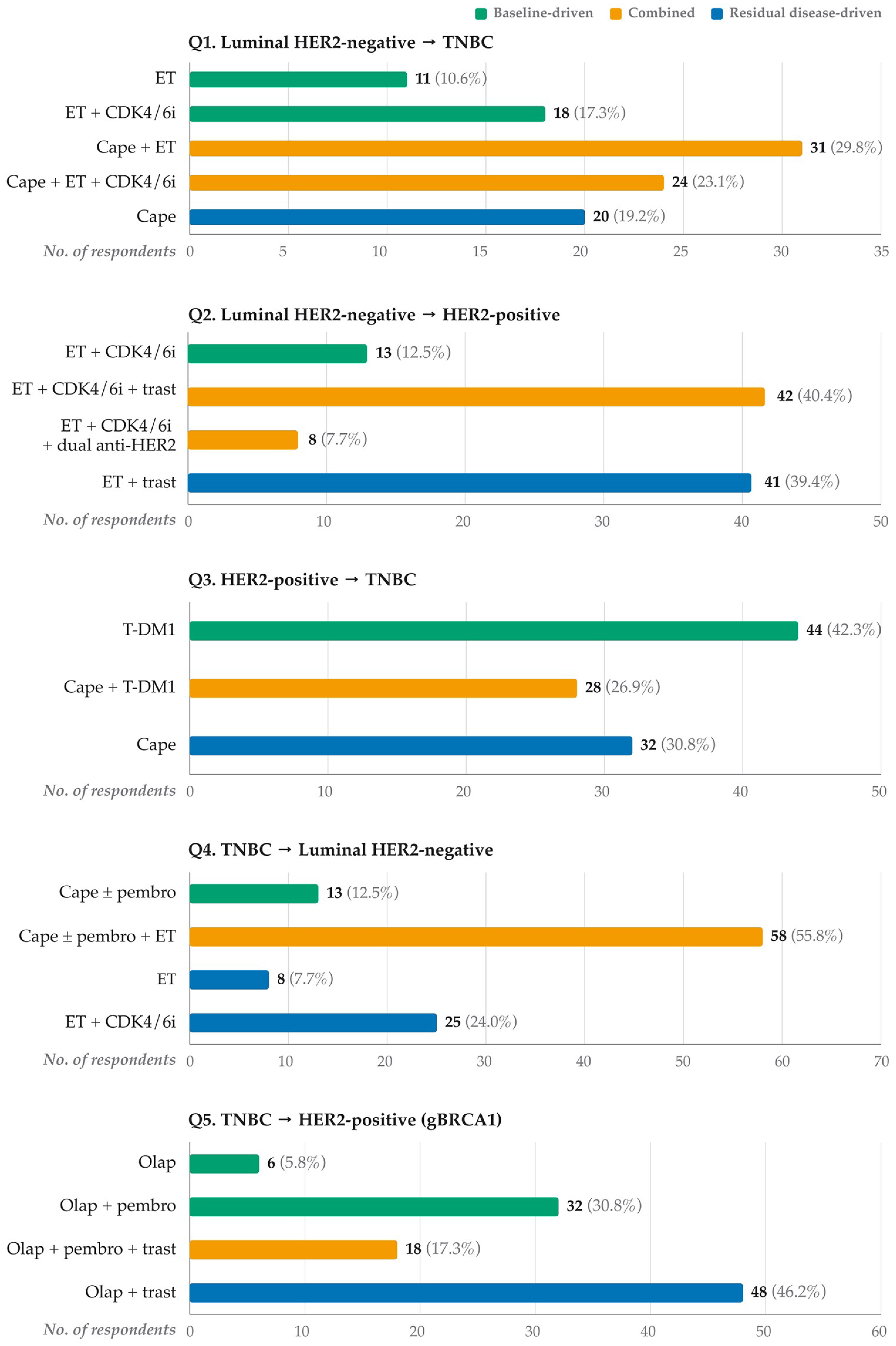
3.3. Q1. Luminal HER2-Negative to TNBC Conversion
3.4. Q2. Luminal HER2-Negative to HER2-Positive Conversion
3.5. Q3. HER2-Positive to TNBC Conversion
3.6. Q4. TNBC to Luminal HER2-Negative Conversion
3.7. Q5. TNBC to HER2-Positive Conversion with BRCA Mutation
3.8. Use of Additional Pathological Factors
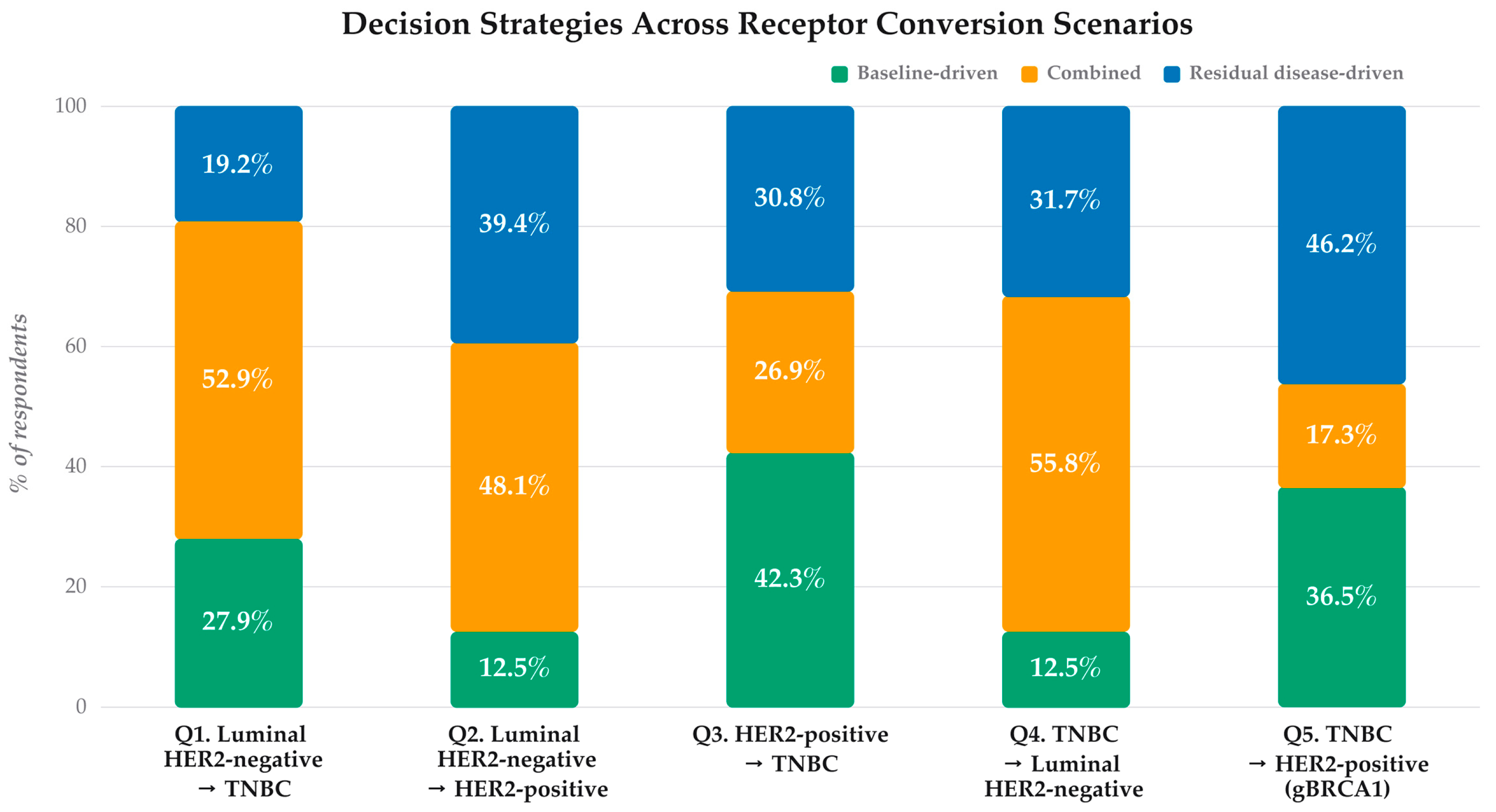
3.9. Summary of Decision-Making Patterns
4. Discussion
5. Conclusions
Supplementary Materials
Author Contributions
Funding
Institutional Review Board Statement
Informed Consent Statement
Data Availability Statement
Acknowledgments
Conflicts of Interest
References
- Burstein, H.J.; Curigliano, G.; Gnant, M.; Loibl, S.; Regan, M.M.; Loi, S.; Denkert, C.; Poortmans, P.; Cameron, D.; Thurlimann, B.; et al. Tailoring treatment to cancer risk and patient preference: The 2025 St Gallen International Breast Cancer Consensus Statement on individualizing therapy for patients with early breast cancer. Ann. Oncol. 2025, 36, 1433–1446. [Google Scholar] [CrossRef] [Scilit] [PubMed]
- Spring, L.M.; Fell, G.; Arfe, A.; Sharma, C.; Greenup, R.; Reynolds, K.L.; Smith, B.L.; Alexander, B.; Moy, B.; Isakoff, S.J.; et al. Pathologic Complete Response after Neoadjuvant Chemotherapy and Impact on Breast Cancer Recurrence and Survival: A Comprehensive Meta-analysis. Clin. Cancer Res. 2020, 26, 2838–2848. [Google Scholar] [CrossRef] [Scilit] [PubMed]
- Shaaban, A.M.; Provenzano, E. Receptor Status after Neoadjuvant Therapy of Breast Cancer: Significance and Implications. Pathobiology 2022, 89, 297–308. [Google Scholar] [CrossRef] [Scilit] [PubMed]
- Boman, C.; Liu, X.; Bergman, L.E.; Sun, W.; Tranchell, C.; Toli, M.A.; Acs, B.; Bergh, J.; Foukakis, T.; Matikas, A. A population-based study on trajectories of HER2 status during neoadjuvant chemotherapy for early breast cancer and metastatic progression. Br. J. Cancer 2024, 131, 718–728. [Google Scholar] [CrossRef] [Scilit] [PubMed]
- Karakas, C.; Tyburski, H.; Turner, B.M.; Weiss, A.; Akkipeddi, S.M.K.; Dhakal, A.; Skinner, K.; Hicks, D.G.; Zhang, H. HER2 categorical changes after neoadjuvant chemotherapy: A study of 192 matched breast cancers with the inclusion of HER2-Low category. Hum. Pathol. 2023, 142, 34–41. [Google Scholar] [CrossRef] [Scilit] [PubMed]
- NCCN Clinical Practice Guidelines in Oncology. Breast Cancer (NCCN Guidelines). Version 4. 2026. Available online: https://www.nccn.org/professionals/physician_gls/pdf/breast.pdf (accessed on 28 July 2026).
- Loibl, S.; André, F.; Bachelot, T.; Barrios, C.; Bergh, J.; Burstein, H.; Cardoso, M.; Carey, L.; Dawood, S.; Del Mastro, L.; et al. Early breast cancer: ESMO Clinical Practice Guideline for diagnosis, treatment and follow-up. Ann. Oncol. 2024, 35, 159–182. [Google Scholar] [CrossRef] [Scilit] [PubMed]
- Wolff, A.C.; Somerfield, M.R.; Dowsett, M.; Hammond, M.E.H.; Hayes, D.F.; McShane, L.M.; Saphner, T.J.; Spears, P.A.; Allison, K.H. Human Epidermal Growth Factor Receptor 2 Testing in Breast Cancer: ASCO–College of American Pathologists Guideline Update. J. Clin. Oncol. 2023, 41, 3867–3872. [Google Scholar] [CrossRef] [Scilit] [PubMed]
- Allison, K.H.; Hammond, M.E.H.; Dowsett, M.; McKernin, S.E.; Carey, L.A.; Fitzgibbons, P.L.; Hayes, D.F.; Lakhani, S.R.; Chavez-MacGregor, M.; Perlmutter, J.; et al. Estrogen and Progesterone Receptor Testing in Breast Cancer: ASCO/CAP Guideline Update. J. Clin. Oncol. 2020, 38, 1346–1366. [Google Scholar] [CrossRef] [Scilit] [PubMed]
- Tarantino, P.; Ajari, O.; Graham, N.; Vincuilla, J.; Parker, T.; Hughes, M.E.; Tayob, N.; Garrido-Castro, A.C.; Morganti, S.; King, T.A.; et al. Evolution of HER2 expression between pre-treatment biopsy and residual disease after neoadjuvant therapy for breast cancer. Eur. J. Cancer 2024, 201, 113920. [Google Scholar] [CrossRef] [Scilit] [PubMed]
- Lu, Y.; Yuan, Q.; Yu, H.; Li, X.; Sha, Y.; Zhu, Y.; Niu, M.; Pang, H. Impact of Post-Neoadjuvant Chemotherapy Biomarker Changes on Long-Term Oncological Outcomes in Non-pCR Breast Cancer. Clin. Breast Cancer 2026, 26, 144–149.e2. [Google Scholar] [CrossRef] [Scilit] [PubMed]
- Freedman, R.A.; Caswell-Jin, J.L.; Hassett, M.; Somerfield, M.R.; Giordano, S.H. For the Optimal Adjuvant Chemotherapy and Targeted Therapy for Early Breast Cancer Guideline Expert Panel. Optimal Adjuvant Chemotherapy and Targeted Therapy for Early Breast Cancer—Cyclin-Dependent Kinase 4 and 6 Inhibitors: ASCO Guideline Rapid Recommendation Update. J. Clin. Oncol. 2024, 42, 2233–2235. [Google Scholar] [CrossRef] [Scilit] [PubMed]
- Vikas, P.; Korde, L.A.; Somerfield, M.R.; Hershman, D.L. Use of Immune Checkpoint Inhibitors in the Treatment of High-Risk, Early-Stage Triple-Negative Breast Cancer: ASCO Guideline Rapid Recommendation Update Q and A. JCO Oncol. Pract. 2022, 18, 649–651. [Google Scholar] [CrossRef] [Scilit] [PubMed]
- Colomer, R.; González-Farré, B.; Ballesteros, A.I.; Peg, V.; Bermejo, B.; Pérez-Mies, B.; de la Cruz, S.; Rojo, F.; Pernas, S.; Palacios, J. Biomarkers in breast cancer 2024: An updated consensus statement by the Spanish Society of Medical Oncology and the Spanish Society of Pathology. Clin. Transl. Oncol. 2024, 26, 2935–2951. [Google Scholar] [CrossRef] [Scilit] [PubMed]
- Liu, Y.; Liang, Z.; Bu, H.; Yang, W. Chinese guidelines for HER2 testing in breast cancer (2024 edition): Summary of key recommendations. J. Clin. Pathol. 2025, jcp-2025-210175. [Google Scholar] [CrossRef] [Scilit] [PubMed]
- Allison, K.; Krishnamurti, U. Template for Reporting Results of Biomarker Testing of Specimens From Patients with Carcinoma of the Breast, Breast Biomarkers, version 1.6.1.0.; College of American Pathologists: Northfield, IL, USA, 2025. [Google Scholar]
- Cardoso, F.; Paluch-Shimon, S.; Schumacher-Wulf, E.; Matos, L.; Gelmon, K.; Aapro, M.S.; Bajpai, J.; Barrios, C.H.; Bergh, J.; Bergsten-Nordström, E.; et al. 6th and 7th International consensus guidelines for the management of advanced breast cancer (ABC guidelines 6 and 7). Breast 2024, 76, 103756. [Google Scholar] [CrossRef] [Scilit] [PubMed]
- de Azambuja, E.; Barrios, C.; Bartsch, R.; Curigliano, G.; Dent, R.; Gennari, A.; Loi, S.; Paluch-Shimon, S.; Pistilli, B.; Saura, C.; et al. Metastatic breast cancer: ESMO Clinical Practice Guideline for diagnosis, treatment and follow-up. Ann. Oncol. 2026, 37, 1203–1219. [Google Scholar] [CrossRef] [Scilit] [PubMed]
- Antonini, M.; Mattar, A.; Facina, G.; Cavalcante, F.P.; Zerwes, F.; Brenelli, F.P.; Frasson, A.L.; Millen, E.C.; Campos, R.C.; Félix, L.X.; et al. Immunohistochemical Changes After Neoadjuvant Chemotherapy and Their Impact on Breast Cancer Survival: A Systematic Review and Meta-analysis. Clin. Breast Cancer 2026, 26, 208–222.e11. [Google Scholar] [CrossRef] [Scilit] [PubMed]
- Dowling, G.P.; Daly, G.R.; Hehir, C.M.; AlRawasdeh, M.M.; Calpin, G.G.; Almasri, S.; Toomey, S.; Young, L.S.; Hennessey, B.T.; Hill, A.D. Prognostic significance of receptor conversion following neoadjuvant therapy in breast cancer: A systematic review & meta-analysis. Breast 2025, 82, 104516. [Google Scholar] [CrossRef] [Scilit] [PubMed]
- Lanjewar, S.; Patil, P.; Fineberg, S. Pathologic reporting practices for breast cancer specimens after neoadjuvant chemotherapy—A survey of pathologists in academic institutions across the United States. Mod. Pathol. 2020, 33, 91–98. [Google Scholar] [CrossRef] [Scilit] [PubMed]
- Han, R.; Regpala, S.; Slodkowska, E.; Nofech-Mozes, S.; Hanna, W.; Parra-Herran, C.; Lu, F.-I. Lack of Standardization in the Processing and Reporting of Post-Neoadjuvant Breast Cancer Specimens. Arch. Pathol. Lab Med. 2020, 144, 1262–1270. [Google Scholar] [CrossRef] [Scilit] [PubMed]
- Chen, H.-L.; Huang, F.-B.; Chen, Q.; Deng, Y.-C. Impact of estrogen receptor expression level on response to neoadjuvant chemotherapy and prognosis in HER2-negative breast cancers. BMC Cancer 2023, 23, 841. [Google Scholar] [CrossRef] [Scilit] [PubMed]
- Kang, S.; Lee, S.H.; Lee, H.J.; Jeong, H.; Jeong, J.H.; Kim, J.E.; Ahn, J.-H.; Jung, K.H.; Gong, G.; Kim, H.H.; et al. Prognostic implications of HER2 changes after neoadjuvant chemotherapy in patients with HER2-zero and HER2-low breast cancer. Eur. J. Cancer 2023, 191, 112956. [Google Scholar] [CrossRef] [Scilit] [PubMed]
- Geyer, C.E.; Untch, M.; Huang, C.-S.; Mano, M.S.; Mamounas, E.P.; Wolmark, N.; Rastogi, P.; Schneeweiss, A.; Redondo, A.; Fischer, H.H.; et al. Survival with Trastuzumab Emtansine in Residual HER2-Positive Breast Cancer. N. Engl. J. Med. 2025, 392, 249–257. [Google Scholar] [CrossRef] [Scilit] [PubMed]
- Loibl, S.; Huang, C.-S.; Mano, M.S.; Mamounas, E.P.; Geyer, C.E.; Untch, M.; Thery, J.-C.; Schwaner, I.; Limentani, S.; Loman, N.; et al. Adjuvant trastuzumab emtansine in HER2-positive breast cancer patients with HER2-negative residual invasive disease in KATHERINE. npj Breast Cancer 2022, 8, 106. [Google Scholar] [CrossRef] [Scilit] [PubMed]



| Scenario (Q) | Treatment Option Selected | Treatment Strategy Classification | Rationale for Classification |
|---|---|---|---|
| Q1 (Luminal HER2-negative → TNBC) | ET | Baseline-driven | Maintains treatment according to the baseline luminal phenotype |
| ET + CDK4/6i | Baseline-driven | Escalates baseline luminal therapy without considering TNBC conversion | |
| Capecitabine + ET | Combined | Preserves endocrine therapy while adding treatment for residual TNBC | |
| Capecitabine + ET + CDK4/6i | Combined | Integrates baseline luminal and residual TNBC biology | |
| Capecitabine | Residual disease-driven | Treatment based solely on the residual TNBC phenotype | |
| Q2 (Luminal HER2-negative → HER2-positive) | ET + CDK4/6i | Baseline-driven | Maintains treatment according to the baseline luminal phenotype |
| ET + CDK4/6i + trastuzumab | Combined | Integrates baseline endocrine therapy with HER2-targeted treatment | |
| ET + CDK4/6i + dual anti-HER2 | Combined | Combines baseline luminal treatment with intensified HER2-directed therapy | |
| ET + trastuzumab | Residual disease-driven | Treatment adapted according to acquired HER2 positivity | |
| Q3 (HER2-positive → TNBC) | T-DM1 | Baseline-driven | Maintains treatment according to baseline HER2-positive disease |
| Capecitabine + T-DM1 | Combined | Combines baseline HER2-directed therapy with TNBC-directed treatment | |
| Capecitabine | Residual disease-driven | Treatment based solely on the residual TNBC phenotype | |
| Q4 (TNBC → Luminal HER2-negative) | Capecitabine ± pembrolizumab | Baseline-driven | Maintains treatment according to baseline TNBC biology |
| Capecitabine ± pembrolizumab + ET | Combined | Integrates baseline TNBC treatment with endocrine therapy | |
| ET | Residual disease-driven | Treatment adapted according to acquired hormone receptor positivity | |
| ET + CDK4/6i | Residual disease-driven | Treatment based on the residual luminal phenotype | |
| Q5 (TNBC → HER2-positive with germline BRCA mutation) | Olaparib | Baseline-driven | Maintains BRCA-directed treatment according to baseline TNBC |
| Olaparib + pembrolizumab | Baseline-driven | Continues baseline TNBC-directed systemic therapy | |
| Olaparib + pembrolizumab + trastuzumab | Combined | Integrates baseline TNBC treatment with HER2-targeted therapy | |
| Olaparib + trastuzumab | Residual disease-driven | Treatment adapted according to acquired HER2 positivity while preserving BRCA-targeted therapy |
| Characteristic | No. (%) |
|---|---|
| Certified Breast Cancer Unit Affiliation | |
| Yes | 65 (62.5) |
| No | 39 (37.5) |
| Annual number of newly diagnosed breast cancer cases at the respondent’s institution | |
| <50 cases | 21 (20.2) |
| 50–250 cases | 23 (22.1) |
| 250–500 cases | 21 (20.2) |
| 500–1000 cases | 27 (26.0) |
| >1000 cases | 12 (11.5) |
| Years of clinical experience | |
| 1–2 years | 10 (9.6) |
| 2–5 years | 15 (14.4) |
| 5–10 years | 24 (23.1) |
| 10–20 years | 31 (29.8) |
| >20 years | 24 (23.1) |
| Characteristic | No. (%) |
|---|---|
| Receptor reassessment | |
| Routine receptor reassessment in residual disease | |
| Yes | 55 (52.9) |
| No | 49 (47.1) |
| Site of receptor reassessment | |
| Residual breast tumor only | 17 (16.3) |
| Axillary lymph nodes only | 9 (8.7) |
| Both breast and axillary lymph nodes | 29 (27.9) |
| Not applicable | 49 (47.1) |
| Treatment adaptation | |
| Use of residual disease assessment in treatment decision-making | |
| Yes | 47 (45.2) |
| Sometimes | 29 (27.9) |
| No | 28 (26.9) |
| Use of tumor grade in residual disease in decision-making | |
| Yes | 70 (67.3) |
| No | 34 (32.7) |
| Use of Ki-67 in residual disease in decision-making | |
| Yes | 71 (68.3) |
| No | 33 (31.7) |
| Use of tumor grade and Ki-67 to guide capecitabine use in luminal HER2-negative residual disease | |
| Yes | 62 (59.6) |
| No—always use capecitabine in luminal HER2-negative residual disease | 15 (14.4) |
| No—never use capecitabine in luminal HER2-negative residual disease | 27 (26.0) |
Disclaimer/Publisher’s Note: The statements, opinions and data contained in all publications are solely those of the individual author(s) and contributor(s) and not of MDPI and/or the editor(s). MDPI and/or the editor(s) disclaim responsibility for any injury to people or property resulting from any ideas, methods, instructions or products referred to in the content. |
© 2026 by the authors. Licensee MDPI, Basel, Switzerland. This article is an open access article distributed under the terms and conditions of the Creative Commons Attribution (CC BY) license.
Share and Cite
Pogoda, K.; Czopowicz, M.; Olszewski, W.; Durzynska, M.; Wysocki, P.J. Clinical Decision-Making After Receptor Conversion Following Neoadjuvant Therapy in Breast Cancer: A Three-Strategy Framework. J. Clin. Med. 2026, 15, 7141. https://doi.org/10.3390/jcm15187141
Pogoda K, Czopowicz M, Olszewski W, Durzynska M, Wysocki PJ. Clinical Decision-Making After Receptor Conversion Following Neoadjuvant Therapy in Breast Cancer: A Three-Strategy Framework. Journal of Clinical Medicine. 2026; 15(18):7141. https://doi.org/10.3390/jcm15187141
Chicago/Turabian StylePogoda, Katarzyna, Magdalena Czopowicz, Wojciech Olszewski, Monika Durzynska, and Piotr Jan Wysocki. 2026. "Clinical Decision-Making After Receptor Conversion Following Neoadjuvant Therapy in Breast Cancer: A Three-Strategy Framework" Journal of Clinical Medicine 15, no. 18: 7141. https://doi.org/10.3390/jcm15187141
APA StylePogoda, K., Czopowicz, M., Olszewski, W., Durzynska, M., & Wysocki, P. J. (2026). Clinical Decision-Making After Receptor Conversion Following Neoadjuvant Therapy in Breast Cancer: A Three-Strategy Framework. Journal of Clinical Medicine, 15(18), 7141. https://doi.org/10.3390/jcm15187141