Article

Paired Urinary Cytology and Targeted FGFR3 S249C/R248C Mutation Detection in Urine from Patients with Bladder Cancer: A Pilot Study

by
Bogdan-Petru Tichil
1,2,
Anamaria Besleaga
2,3,
Ioana Gheorghiu
4,
Alin-Dan Chiorean
1,5,
Mihaela Laura Vica Matei
1,* and
Adrian Florea
1
1
Department of Cell and Molecular Biology, Faculty of Medicine, University of Medicine and Pharmacy “Iuliu Hatieganu”, 400349 Cluj-Napoca, Romania
2
Deva Emergency County Hospital, 330084 Deva, Romania
3
Department of Otorhinolaryngology, University of Medicine and Pharmacy “Iuliu Hatieganu”, 400349 Cluj-Napoca, Romania
4
Department of Medical Informatics and Biostatistics, University of Medicine and Pharmacy “Iuliu Hatieganu”, 400349 Cluj-Napoca, Romania
5
Clinical Institute of Urology and Renal Transplant, 400000 Cluj-Napoca, Romania
*
Author to whom correspondence should be addressed.
J. Clin. Med. 2026, 15(18), 7117; https://doi.org/10.3390/jcm15187117
Submission received: 18 August 2026 / Revised: 8 September 2026 / Accepted: 11 September 2026 / Published: 14 September 2026

Abstract

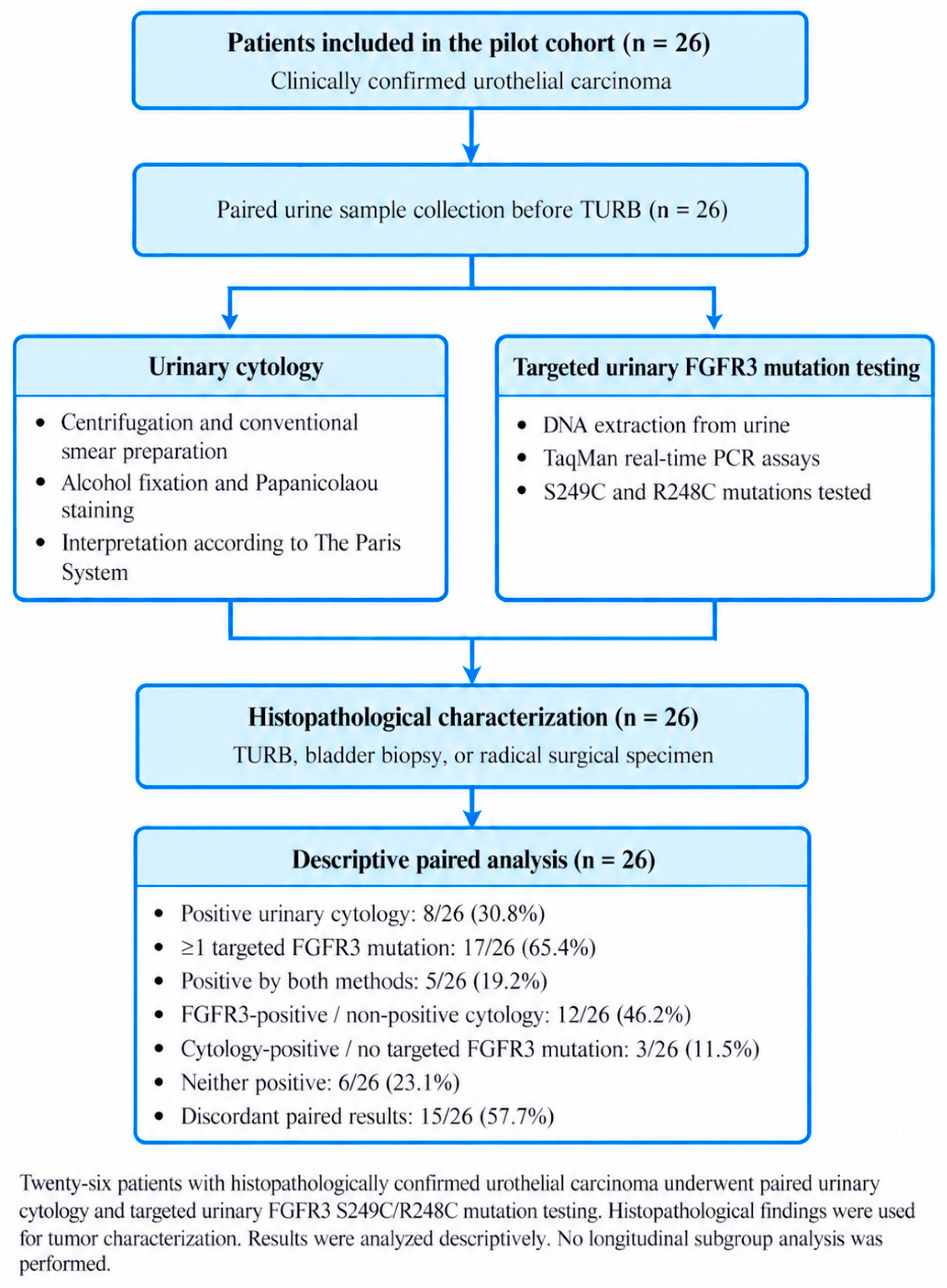
Background: Urinary cytology is routinely used as an adjunct to cystoscopy in the diagnosis and surveillance of urothelial carcinoma. Although it has high specificity for high-grade tumors, its sensitivity for low-grade papillary lesions is limited. Activating mutations in the fibroblast growth factor receptor 3 (FGFR3) gene are frequently encountered in non-muscle-invasive bladder cancer and may provide a complementary molecular method for detecting tumors that are not identified by conventional cytology. Objective: To compare conventional urinary cytology with urinary detection of the FGFR3 hotspot mutations S249C and R248C in patients undergoing evaluation for urothelial carcinoma. Materials and Methods: This single-center prospective pilot study included adult patients with clinically and radiologically confirmed bladder tumors evaluated between February 2022 and December 2023. Voided urine specimens were collected before cystoscopy or urinary tract instrumentation. Urine cytology was performed after centrifugation, conventional smear preparation, alcohol fixation, and Papanicolaou staining, with interpretation according to The Paris System for Reporting Urinary Cytology. DNA extracted from paired urine specimens was analyzed for the FGFR3 S249C and R248C hotspot mutations using TaqMan mutation-detection assays and real-time polymerase chain reaction. Histopathological examination of transurethral resection, bladder biopsy, or radical surgical specimens served as the reference standard. Results: Twenty-six patients were included, with a mean age of 69.2 ± 11.5 years; 24 patients (92.3%) were male. At least one FGFR3 mutation was detected in 17 patients (65.4%), whereas nine patients (34.6%) had no detectable mutation. The S249C mutation was identified in three patients, while the R248C mutation was detected in nine patients, 5 patients were positive for both mutations.
Keywords: bladder cancer; urothelial carcinoma; FGFR3; S249C; R248C; urinary cytology; urinary biomarkers; real-time PCR; non-muscle-invasive bladder cancer bladder cancer; urothelial carcinoma; FGFR3; S249C; R248C; urinary cytology; urinary biomarkers; real-time PCR; non-muscle-invasive bladder cancer