1. Introduction
Colorectal cancer (CRC) remains one of the most common malignancies and a leading cause of cancer-related mortality worldwide. According to recent global estimates, approximately two million new cases and more than 900,000 deaths occur annually, highlighting its substantial healthcare burden [
1,
2]. Despite advances in screening, surgical techniques, systemic therapy, and perioperative management, CRC continues to impose considerable clinical and socioeconomic challenges. Furthermore, its global incidence is projected to increase owing to population ageing, the growing prevalence of lifestyle-related risk factors, and the rising incidence of early-onset disease, underscoring the need for more effective strategies for disease monitoring and postoperative surveillance.
Regardless of substantial advances in colorectal cancer screening and diagnostic technologies, important challenges remain in the early detection and longitudinal monitoring of the disease. Colonoscopy remains the reference standard for CRC diagnosis because it enables direct visualization of the intestinal mucosa and histopathological confirmation of suspicious lesions. However, its invasive nature, the need for bowel preparation, procedure-related discomfort, and limited adherence to screening programs restrict its effectiveness as a population-wide surveillance tool [
3].
Cross-sectional imaging modalities, including computed tomography (CT) and magnetic resonance imaging (MRI), are indispensable for disease staging and treatment planning but primarily characterize anatomical changes rather than the underlying biological activity of the tumor. Likewise, currently available blood- and stool-based biomarkers, including carcinoembryonic antigen (CEA), carbohydrate antigen 19-9 (CA19-9), fecal immunochemical testing (FIT), and stool DNA assays, provide valuable complementary information but demonstrate limited sensitivity for early disease and incompletely reflect dynamic tumor-associated metabolic alterations [
4,
5,
6].
These limitations have stimulated growing interest in functional biomarkers capable of capturing real-time biological changes during tumor development and treatment. Among emerging breathomics approaches, analysis of exhaled breath has attracted considerable attention because VOCs can reflect endogenous metabolic processes and may provide a non-invasive readout of tumor-associated metabolic reprogramming, offering new opportunities for disease detection and longitudinal monitoring of colorectal cancer [
7].
Metabolic reprogramming is a hallmark of cancer and plays a central role in tumor initiation, progression, and adaptation to the tumor microenvironment [
8]. Compared with normal tissues, malignant cells undergo profound alterations in glucose, lipid, and amino acid metabolism, accompanied by oxidative stress and mitochondrial dysfunction, which collectively generate a distinct metabolic phenotype associated with tumor aggressiveness and disease progression [
9,
10,
11,
12,
13]. These metabolic processes give rise to a broad spectrum of VOCs, including aldehydes, ketones, hydrocarbons, and other low-molecular-weight metabolites produced through altered intermediary metabolism and lipid peroxidation [
12,
13,
14,
15,
16,
17,
18,
19,
20]. Owing to their physicochemical properties, VOCs readily diffuse into the bloodstream and are subsequently excreted via the lungs, making exhaled breath an accessible source of metabolic information [
17,
19,
20]. Because the exhaled volatilome may reflect contributions from malignant cells as well as stromal, immune, host, and microbial processes, it represents an integrated biological phenotype rather than the activity of a single biological pathway [
21,
22].
Unlike tissue biopsy or conventional imaging, breath analysis is entirely non-invasive, readily repeatable, and capable of capturing dynamic metabolic changes, making it particularly attractive for longitudinal disease assessment. Consequently, breathomics has emerged as a promising approach for identifying metabolic signatures relevant to colorectal cancer detection and longitudinal disease assessment [
23,
24,
25,
26,
27,
28,
29,
30,
31,
32,
33].
Previous studies have demonstrated changes in exhaled VOC profiles following curative colorectal cancer surgery using different analytical approaches, including thermal-desorption GC-MS and electronic-nose technology [
34,
35]. These studies included both longer-term postoperative observations and prospective paired assessments during the early postoperative period. Thus, postoperative VOC changes themselves are not unique to the present study. Rather, the present investigation extends these observations by applying real-time PTR-TOF-MS to paired preoperative and postoperative day-10 breath samples and by characterizing early postoperative volatilome remodeling at the level of individual mass-to-charge features and an exploratory multivariable VOC signature. Among the analytical platforms available for breathomics, PTR-TOF-MS enables rapid, highly sensitive, real-time detection of a broad spectrum of volatile organic compounds with minimal sample preparation [
36,
37,
38,
39,
40].
From a translational perspective, longitudinal breath profiling may provide a non-invasive and repeatable approach for assessing postoperative VOC dynamics, although its potential role in clinical surveillance remains to be established.
Therefore, the aim of this study was to characterize early postoperative changes in the exhaled VOC profile of patients with colorectal cancer following curative surgery using PTR-TOF-MS and to identify multivariable VOC signatures associated with these changes. To address this objective, we used a paired breath-sampling design integrating high-resolution PTR-TOF-MS profiling with multivariable statistical and machine-learning approaches and evaluated the discriminatory performance of the resulting VOC signature.
2. Materials and Methods
2.1. Study Design and Participants
A prospective, single-center, non-randomized, observational pilot cohort study with a paired longitudinal component was conducted at the University Clinical Hospitals of I.M. Sechenov First Moscow State Medical University (Sechenov University, Moscow, Russia). For patients with colorectal cancer, a paired breath-sampling design was used, with samples collected from the same individuals before curative surgery (Before) and on postoperative day 10 (After). Postoperative day 10 was selected as a standardized early postoperative sampling time point to enable paired assessment within a consistent clinical timeframe; it was not intended to represent resolution of the physiological effects of surgery. Patients with colorectal cancer were prospectively enrolled between March 2023 and July 2024. As this was an exploratory pilot study, no formal a priori sample-size calculation was performed; the analytical cohort was determined by prospective recruitment and availability of complete paired preoperative and postoperative breath samples.
The study enrolled adult patients with histologically confirmed locally advanced colorectal adenocarcinoma (clinical stage II–III), and an independent cohort of healthy volunteers. The diagnosis of CRC was established based on histopathological examination of the primary tumor in combination with endoscopic evaluation and radiological imaging, including contrast-enhanced computed tomography (CT) and magnetic resonance imaging (MRI). Serum tumor markers, including carcinoembryonic antigen (CEA) and carbohydrate antigen 19-9 (CA19-9), were assessed as part of the routine diagnostic work-up. Patients with CRC underwent radical surgery as the first stage of treatment in accordance with clinical guidelines.
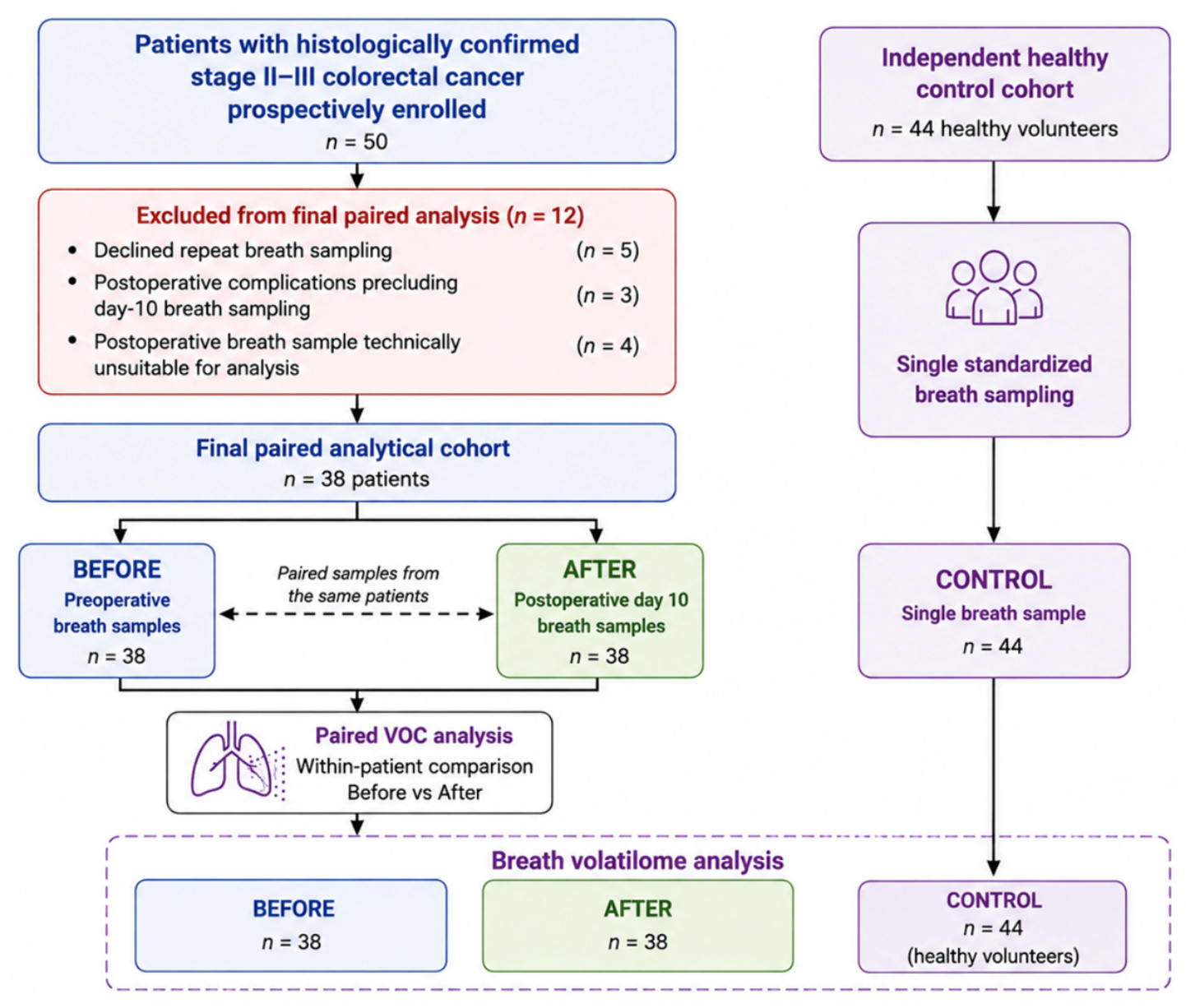
Initially, 50 patients with histologically confirmed stage II–III CRC were prospectively enrolled. Of these, 12 patients were excluded from the final paired analysis because a valid postoperative day-10 breath sample was unavailable. Specifically, five patients declined repeat breath sampling, three developed postoperative complications that precluded breath sampling on postoperative day 10, and in four patients the postoperative breath sample was collected but was technically unsuitable for analysis. To preserve the paired analytical design, only patients with both valid preoperative and postoperative day-10 breath samples were included in the final analysis. Consequently, the final paired analytical cohort comprised 38 patients with CRC, contributing 38 Before and 38 After breath samples. Together with the independent healthy control group, these samples formed the three analytical groups used for breath volatilome analysis: Before, After, and Control. The overall study design and participant flow are presented in
Figure 1.
The Before group included exhaled breath samples collected from patients with CRC at the time of primary diagnosis prior to surgical treatment. The After group consisted of paired exhaled breath samples obtained from the same patients on postoperative day 10 following radical surgical resection. The Control group comprised an independent cohort of healthy volunteers without a history of malignant disease or evidence of inflammatory or neoplastic bowel pathology at the time of enrollment. Healthy controls were frequency-matched to patients with CRC by age, sex, major comorbidities, and regular medication use. A single exhaled breath sample was collected from each healthy volunteer using the same standardized sampling protocol as that applied to patients with CRC.
The clinical and demographic characteristics of the final analytical cohort are presented in
Table 1. The eligibility criteria, including inclusion, non-inclusion, and exclusion criteria for the CRC and control groups, are summarized in
Table 2.
The study was approved by the Local Ethics Committee of I.M. Sechenov First Moscow State Medical University (Sechenov University) (Protocol No. 02-23, 26 January 2023). The study was conducted in accordance with the ethical principles of the Declaration of Helsinki. Written informed consent was obtained from all participants prior to study enrollment.
2.2. Breath Sample Collection
For patients in the Before group, breath samples were collected within 48 h prior to the scheduled radical surgical resection. All 38 patients included in the final paired analytical cohort had an uncomplicated postoperative course that permitted breath sampling on postoperative day 10.
Postoperative day 10 was selected as a standardized early postoperative sampling time point to characterize early postoperative changes in the exhaled volatilome within a consistent clinical timeframe; it was not intended to represent resolution of the physiological effects of surgery.
To standardize breath sampling conditions and minimize the influence of exogenous factors on VOC composition, all participants followed a predefined preparation protocol. Participants refrained from food intake, sweetened beverages, coffee, tea, and smoking for 8–12 h before sample collection. Consumption of plain drinking water was permitted throughout the fasting period. These measures were implemented to reduce preanalytical variability in breath VOC profiles and improve the reproducibility of the analytical results. However, postoperative factors including inflammatory responses, perioperative medication and antibiotic exposure, nutritional changes, gastrointestinal recovery, and microbiome alterations were not independently quantified or controlled and were therefore considered potential sources of residual confounding.
2.3. Breath Sample Processing and Predictor Space
Volatile organic compounds in exhaled breath were analyzed in real time using PTR-TOF-MS with an Ultra-Fast PTR-TOF 1000 mass spectrometer equipped with a Buffered End-Tidal Breath Sampling Inlet (IONICON Analytik GmbH, Innsbruck, Austria). Mass spectra were acquired in full-scan mode over a mass-to-charge ratio (m/z) range of 10–685 using H3O+ as the primary reagent ion. The scan time was 1000 ms, while the temperatures of both the drift tube (T-Drift) and sampling inlet (T-Inlet) were maintained at 80 °C throughout all measurements.
The acquired mass spectra were processed to identify individual ion peaks characterized by their mass-to-charge ratio (m/z) and normalized peak area. Raw mass spectrometry data were subjected to preprocessing to remove technical variables, including instrument metadata, calibration parameters, and quality control indices that were not related to the biological composition of the samples. The resulting analytical dataset consisted of 61 informative mass-spectral peaks. After removal of technical variables, all 61 remaining peaks constituted the initial candidate predictor set; no additional outcome-based or univariate pre-selection was performed before stability selection.
Peak areas were normalized during the preprocessing stage according to the standardized analytical workflow. Therefore, no additional normalization or distributional transformations were applied before downstream statistical analyses. Because exhaled breath was analyzed directly in real time using PTR-TOF-MS, discrete technical replicate injections were not performed. Analytical performance was monitored using routine instrumental calibration and quality-control procedures throughout the study.
2.4. Predictor Selection Strategy: Stability Selection
To address the challenges associated with a high-dimensional predictor space comprising 61 candidate VOC features relative to the limited cohort size (82 individuals: 38 patients contributing paired preoperative and postoperative samples and 44 independent healthy controls; 120 breath samples in total), a stability selection framework was employed to identify a robust subset of VOC features while reducing the risk of overfitting and unstable feature selection.
The stability selection procedure consisted of 1000 iterations of patient-grouped random subsampling using the GroupShuffleSplit algorithm. To prevent information leakage arising from subject-specific volatilome characteristics, the preoperative and postoperative breath samples from each patient were always assigned to the same partition (training or testing) within each iteration, ensuring that paired samples from the same patient never crossed the train–test boundary. Each healthy control was treated as an independent single-sample group. During each iteration, the dataset was randomly divided into training (50%) and testing (50%) subsets.
Within each iteration, all preprocessing and model-fitting steps were performed exclusively on the training subset. Candidate VOC features were standardized using the RobustScaler algorithm, which centers variables by their median and scales them according to the interquartile range, thereby reducing the influence of outliers commonly encountered in mass spectrometry data. To prevent data leakage, scaling parameters estimated from the training subset were subsequently applied without refitting to the corresponding testing subset.
Feature selection was performed using multinomial logistic regression with Elastic Net regularization (penalty = “elasticnet”, l1_ratio = 0.5, C = 0.1, solver = “saga”). To maintain model simplicity and avoid the instability that could arise from tuning multiple hyperparameters in the presence of a limited sample size, these regularization parameters were fixed a priori rather than tuned via an inner cross-validation loop. To account for class imbalance, inverse-frequency class weighting (class_weight = “balanced”) was incorporated during model training. During each iteration, candidate VOC features assigned non-zero regression coefficients for at least one of the three outcome classes were considered selected.
Following completion of all iterations, a stability score was calculated for each candidate VOC feature as the proportion of iterations in which the corresponding feature was retained by the model. The stability threshold was defined empirically as the 75th percentile of the observed stability score distribution derived from the current dataset. This data-driven approach retained features demonstrating consistently high selection frequencies within the present dataset. This empirical criterion was used as a dataset-specific feature-ranking threshold and should not be interpreted as a formal error-controlled stability selection threshold. The resulting threshold corresponded to a stability score of 0.621, yielding a final set of 16 VOC features.
2.5. Model Development and Performance Evaluation
The discriminative performance of the final predictor panel was evaluated using a one-versus-one (OvO) classification strategy for all pairwise comparisons among the three study groups: Before vs. After, Before vs. Control, and After vs. Control.
For each comparison, model development was embedded within the stability selection framework described above. During each of the 1000 patient-grouped train–test iterations, model training was performed using the training subset, whereas performance evaluation was conducted exclusively on the corresponding testing subset. To favor sensitivity within this exploratory classification framework, an adaptive probability-threshold optimization procedure was incorporated into the classification pipeline. Rather than applying the conventional probability threshold of 0.5, the optimal classification threshold was determined independently within each training subset as the lowest predicted probability achieving a predefined target sensitivity of at least 90%. The optimized threshold was subsequently applied without modification to the corresponding testing subset.
Model performance was assessed using accuracy, area under the receiver operating characteristic curve (ROC AUC), sensitivity, specificity, positive predictive value (PPV), and negative predictive value (NPV). Because the 1000 resampling iterations represent overlapping subsets of the same cohort rather than independent validation cohorts, performance estimates obtained across all iterations were summarized as the median together with the corresponding empirical 95% percentile range (95% PR; 2.5th–97.5th percentiles), rather than conventional confidence intervals. Model calibration and clinical utility were not assessed in this exploratory pilot analysis.
2.6. Comparative Statistical Analysis
To characterize the selected VOC features at the level of univariate distributions, pairwise comparisons of their signal intensities were performed between the study groups. Given the paired study design, differences between the preoperative and postoperative states (Before vs. After) were assessed using the non-parametric Wilcoxon signed-rank test. Comparisons involving the independent cohort of healthy volunteers (Before vs. Control and After vs. Control) were performed using the Mann–Whitney U test. To control the false discovery rate (FDR) associated with multiple comparisons, the Benjamini–Hochberg correction was applied separately within each pairwise contrast. All statistical tests were two-sided, and statistical significance was defined as an FDR-adjusted p value < 0.05.
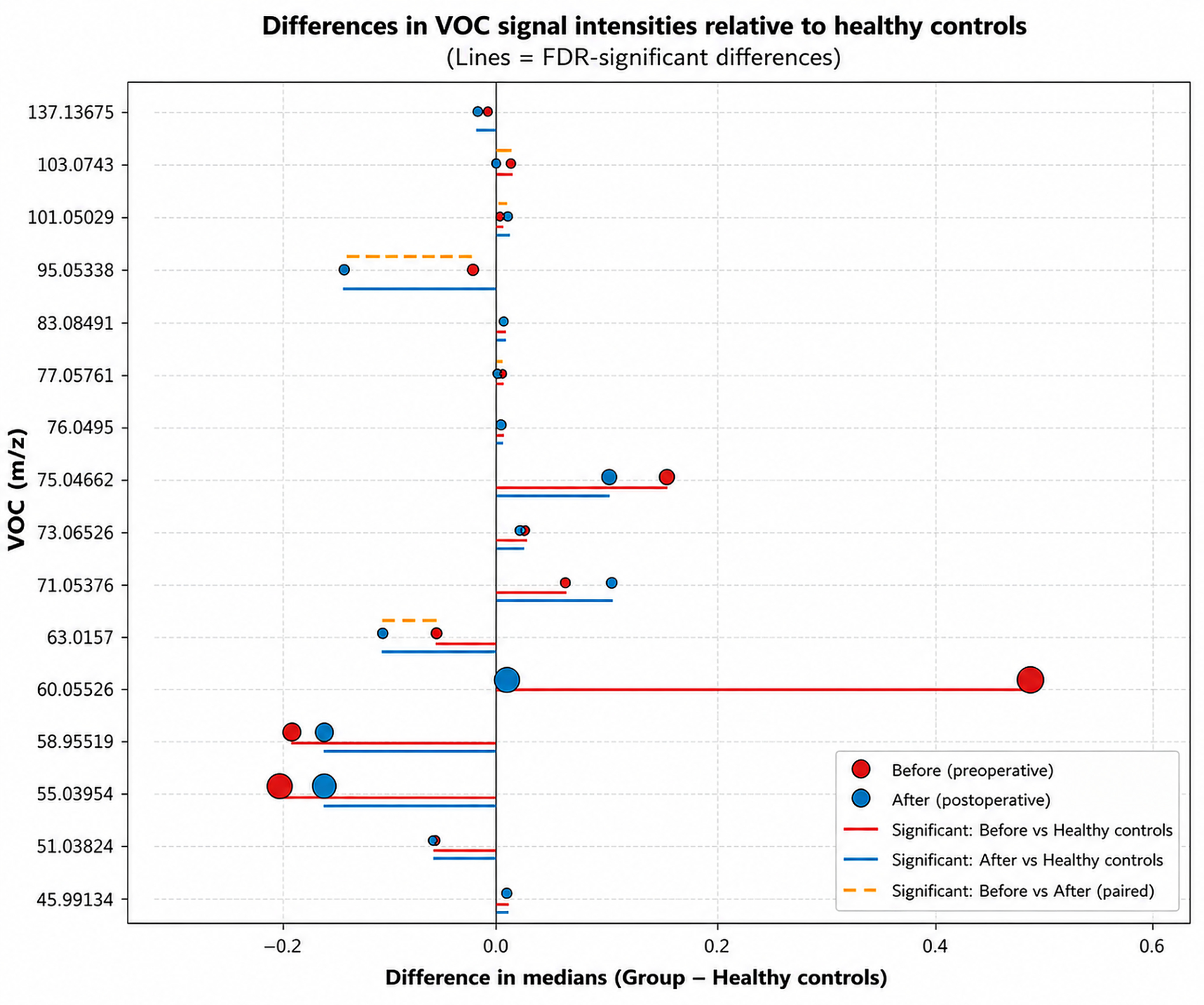
Group distributions were summarized using medians and interquartile ranges (25th–75th percentiles). To provide a descriptive measure of the direction and magnitude of between-group differences, differences between group medians were additionally calculated and used for visualization of VOC signal patterns relative to healthy controls.
It should be noted that these univariate comparisons were performed exclusively on features previously selected through the data-driven stability selection procedure and should therefore be considered exploratory and descriptive rather than confirmatory. The reported p values, FDR-adjusted p values, and differences between group medians characterize the behavior of the selected VOC panel within the present cohort but may be subject to selection-induced bias. Accordingly, these analyses do not constitute confirmatory hypothesis testing across the entire initial predictor space, and independent external validation is required to confirm the observed univariate associations.
2.7. Reporting Standards and Reproducibility
The study design, definition of candidate predictors and target outcomes, validation strategy, and reporting of model performance were developed in accordance with the TRIPOD + AI (checklist version 11 January 2024) and STROBE reporting guidelines. All computational analyses were performed in Python 3.11 using the pandas, NumPy, scikit-learn, SciPy, statsmodels, NetworkX, and Matplotlib libraries; Matplotlib version 3.8.4 was used. The analytical code used for data preprocessing, statistical analyses, and model development is not publicly available.
4. Discussion
4.1. Principal Findings
One of the principal observations of the present study was the identification of five VOC features (m/z 63.0157, 77.0576, 95.0534, 101.05, and 103.074) that exhibited significant differences between the preoperative and early postoperative time points after FDR correction. Among these, m/z 77.0576 and 103.074 no longer differed significantly from healthy controls at the early postoperative time point, whereas m/z 63.0157, 95.0534, and 101.05 remained significantly different from controls despite significant preoperative-to-postoperative changes. These heterogeneous patterns indicate that early postoperative VOC changes do not follow a uniform trajectory and may reflect multiple biological and perioperative processes.
Importantly, the VOC changes observed on postoperative day 10 should not be interpreted as specific metabolic consequences of tumor removal. The early postoperative period encompasses multiple concurrent physiological and treatment-related processes, including surgical trauma, systemic inflammatory responses, wound healing, perioperative medication exposure, bowel preparation, altered nutritional intake, and acute perturbations of the gut microbiome. Each of these factors may influence the composition of exhaled VOCs. Therefore, the present findings are best interpreted as reflecting early postoperative remodeling of the exhaled volatilome following curative colorectal cancer surgery rather than tumor-specific metabolic normalization. The relative contribution of tumor removal to these changes cannot be determined from the present study design.
For m/z 77.0576 and 103.074, the absence of a statistically significant difference between the early postoperative and healthy control groups, despite significant differences between the preoperative and control groups, indicates a change in their statistical relationship with the control cohort following surgery. However, this pattern should not be interpreted as evidence of metabolic normalization or attributed specifically to tumor removal. Malignant tumors are known to influence systemic metabolism through multiple pathways, including altered glycolysis, oxidative stress, lipid metabolism, amino acid utilization, and interactions with the intestinal microbiome. At the same time, major abdominal surgery and early postoperative recovery are themselves associated with substantial physiological and metabolic perturbations that may influence the exhaled VOC profile.
The persistence of significant differences from healthy controls for m/z 63.0157, 95.0534, and 101.05 despite significant preoperative-to-postoperative changes further illustrates the heterogeneity of early postoperative VOC patterns. Early postoperative inflammation, wound healing, oxidative stress, transient alterations in gut microbial composition, and metabolic adaptation after major abdominal surgery may all contribute to sustained deviations in individual VOC features. Accordingly, the observed postoperative VOC trajectories are likely to reflect the combined influence of multiple concurrent processes rather than a simple transition from a cancer-associated volatilome to a healthy volatilome.
At the multivariable level, the After vs. Control comparison showed the highest discriminative performance (median ROC AUC = 0.811), followed by Before vs. Control (0.762), whereas Before vs. After showed the lowest discrimination (0.716). The Before vs. After comparison also demonstrated substantial variability across repeated resampling, indicating uncertainty in distinguishing the preoperative and early postoperative states. Importantly, the higher discrimination observed for After vs. Control should not be interpreted as evidence of postoperative metabolic normalization or as indicating a greater biological deviation from the healthy state. ROC AUC reflects multivariable group separability rather than the direction or biological meaning of changes in individual VOC features. Surgery-related physiological and perioperative changes may additionally contribute to the distinguishability of the early postoperative profile from that of healthy controls.
These findings highlight the potential value of paired breath analysis for characterizing temporal changes in the exhaled volatilome. However, with only two sampling time points and no non-oncological surgical control group, the present study cannot distinguish VOC changes potentially associated with tumor removal from those related to surgery and early postoperative recovery. The paired design nevertheless provides information on within-patient changes that cannot be obtained from cross-sectional comparisons alone and may therefore inform future longitudinal studies incorporating serial sampling beyond the early postoperative period and appropriate surgical control groups.
The observation that exhaled VOC profiles change following curative colorectal cancer surgery is consistent with previous studies and should not be regarded as unique to the present investigation. Altomare et al. reported postoperative alterations in exhaled VOC patterns using thermal-desorption GC-MS in disease-free patients during oncological follow-up [
34], while Hanevelt et al. subsequently demonstrated short-term pre- to postoperative changes using an electronic-nose approach in a prospective paired cohort [
35]. The present study extends these observations by applying real-time PTR-TOF-MS to paired preoperative and postoperative day-10 breath samples and by examining an exploratory multivariable signature composed of individual mass-to-charge features.
4.2. Biological Context of Early Postoperative VOC Changes
The early postoperative VOC changes identified in the present study demonstrate that the exhaled volatilome is dynamic across the perioperative period. Five VOC features showed significant differences between the preoperative and early postoperative measurements after FDR correction, although the biological processes underlying these changes cannot be determined from the present data. Previous studies have shown that exhaled VOC profiles may vary in association with malignant disease and therapeutic interventions [
23,
24,
25,
29,
31,
32,
33,
34,
35]; however, in the present setting, the observed postoperative changes should be interpreted within the broader physiological context of major abdominal surgery and early recovery.
The biological origin of the detected VOC features is likely multifactorial. Colorectal cancer is associated with alterations in glucose, lipid, and amino acid metabolism, oxidative stress, and interactions with the intestinal microbiome, all of which may contribute to the composition of exhaled breath [
9,
10,
11,
12,
13,
16,
21,
22,
41]. At the same time, surgical treatment and early postoperative recovery may independently modify systemic metabolism and gut microbial composition, potentially affecting VOC production [
35,
42]. The heterogeneous patterns observed among individual VOC features are therefore compatible with contributions from multiple biological and perioperative processes with potentially different temporal dynamics.
Importantly, PTR-TOF-MS provides high-resolution mass-to-charge features but does not establish definitive molecular identities. Individual m/z signals may represent different molecular species, fragments, cluster ions, or other contributions, and their biological origin cannot be inferred solely from accurate mass measurements. Accordingly, the VOC features identified in the present study should not be assigned to specific metabolic pathways on the basis of PTR-TOF-MS data alone. Orthogonal analytical confirmation, for example using GC-MS with authentic reference standards, will be required to establish their chemical identities and enable more specific mechanistic interpretation.
Taken together, these findings characterize a heterogeneous pattern of early postoperative volatilome remodeling rather than a tumor-specific metabolic response. The observed within-patient changes provide a basis for further investigation of temporal VOC dynamics following colorectal cancer surgery; however, determining whether particular VOC features are related to tumor removal, surgical recovery, or other perioperative processes will require serial sampling beyond the early postoperative period and appropriate surgical control groups.
Feature-Level Interpretation of Early Postoperative VOC Changes
Because PTR-TOF-MS detects mass-to-charge features rather than unequivocally identified compounds, the individual
m/
z signals observed in this study cannot be assigned to specific molecular species or metabolic pathways on the basis of accurate mass alone. Isomeric compounds, fragments, and cluster ions may contribute to the same detected feature, and definitive molecular characterization requires complementary chromatographic separation and confirmation using authentic reference standards [
37,
40]. Accordingly, the following discussion focuses on the observed preoperative-to-postoperative changes of the five VOC features rather than on compound-level or pathway-level assignments.
The feature at m/z 63.0157 showed a significant difference between the preoperative and early postoperative measurements and remained significantly different from healthy controls at the postoperative time point. Its molecular identity and biological origin cannot be determined from the present PTR-TOF-MS data. Therefore, the observed change should be interpreted at the feature level rather than as evidence of a specific metabolic process or pathway.
The feature at m/z 77.0576 showed a significant difference between the preoperative and early postoperative measurements. Although it differed significantly from healthy controls before surgery, no statistically significant difference was observed between the early postoperative and control groups. As its chemical identity was not established, the relevance of this feature in the present study lies in its observed pattern across the study groups rather than in a presumed molecular or biological assignment.
The feature at m/z 95.0534 changed significantly between the preoperative and early postoperative measurements but remained significantly different from healthy controls at the postoperative time point. Because the molecular identity of this feature has not been established, its postoperative behavior cannot be attributed to a specific metabolite, biological source, or metabolic pathway.
Similarly, m/z 101.05 showed a significant preoperative-to-postoperative change while remaining significantly different from healthy controls at the early postoperative time point. This finding indicates a change in the corresponding VOC feature during the early postoperative period but does not establish its chemical identity or biological origin. No specific mechanistic interpretation can therefore be assigned to this feature on the basis of the present data.
The feature at m/z 103.074 also showed a significant difference between the preoperative and early postoperative measurements. Whereas its preoperative signal intensity differed significantly from that of healthy controls, no statistically significant difference was observed between the early postoperative and control groups. Nevertheless, because chromatographic separation and confirmation using authentic reference standards were not performed, this signal cannot be attributed to a specific compound or metabolic pathway and should be interpreted solely as an analytically detected VOC feature.
Collectively, the heterogeneous patterns of these five VOC features demonstrate that several components of the exhaled volatilome changed between the preoperative and early postoperative time points. Two features (m/z 77.0576 and 103.074) no longer differed significantly from healthy controls at the early postoperative time point, whereas three (m/z 63.0157, 95.0534, and 101.05) remained significantly different from controls. However, because the detected features were not chemically identified, their behavior cannot establish specific metabolic mechanisms or biological sources. Furthermore, the observed postoperative changes cannot be attributed exclusively to tumor removal because the present study design does not distinguish tumor-related effects from other physiological and treatment-related processes occurring during early postoperative recovery. Chemical identification using complementary chromatographic techniques and authentic reference standards, together with longitudinal sampling beyond the early postoperative period, will be required to determine the molecular identity and biological significance of these features.
4.3. Biological Context of Persistent VOC Alterations
Several VOC features remained significantly different from healthy controls on postoperative day 10, indicating that differences in the exhaled volatilome persisted during the early postoperative period. Previous studies have similarly demonstrated short-term changes in exhaled VOC profiles following colorectal cancer surgery [
35]. However, the persistence of differences in individual VOC features at this early time point should not be interpreted as evidence of incomplete tumor-related metabolic normalization, because the relative contributions of cancer-associated biology and perioperative physiological processes cannot be distinguished in the present study.
Persistent differences in VOC signal intensities may reflect biological processes that remain altered during early postoperative recovery. Colorectal cancer is associated with extensive metabolic and microbial alterations, while surgical treatment itself is accompanied by substantial changes in systemic metabolism, inflammatory activity, nutritional status, and gut microbial composition [
42]. In addition, postoperative inflammation, oxidative stress, tissue repair, dietary changes, bowel preparation, and perioperative medication exposure may contribute to sustained differences in individual VOC features during this period.
The direction of these persistent differences should likewise be interpreted cautiously. Features that remained either higher or lower than those observed in healthy controls may reflect differences in multiple host-, microbial-, or perioperative processes, but their molecular origins cannot be established from the present PTR-TOF-MS data. Previous studies have demonstrated reproducible alterations in the gut microbiome associated with colorectal cancer across different populations [
43]; however, whether such microbial changes contributed to the persistent VOC features observed in the present cohort cannot be determined without direct microbiome and chemical analyses.
Importantly, persistent postoperative differences in VOC features should not be interpreted as direct evidence of residual disease. At present, they should be considered characteristics of the early postoperative volatilome whose biological determinants remain uncertain. Serial sampling beyond the postoperative recovery period will be required to determine whether these differences are transient, diminish over time, or persist during longer follow-up. Only subsequent longitudinal studies incorporating clinical outcomes could establish whether any of these features have potential prognostic relevance for postoperative surveillance or recurrence assessment.
4.4. Multivariable VOC Signatures Beyond Univariate Analysis
Not all VOC features retained in the final predictor panel demonstrated statistically significant differences in univariate comparisons. This is not unexpected because multivariable feature selection and univariate statistical testing address distinct analytical questions. Breath represents an integrated metabolic phenotype in which multiple correlated changes may collectively contribute to discrimination between clinical states even when individual features do not demonstrate statistically significant between-group differences. Accordingly, breath-based classification in the present study is better conceptualized as multivariable pattern recognition than as the identification of individual disease-specific metabolites.
Elastic Net regression was selected because it combines regularization with embedded feature selection and can retain information from correlated predictors, a relevant property for high-dimensional VOC data. In contrast to more complex nonlinear algorithms, it also provides a comparatively transparent predictor structure and was considered appropriate for the dimensionality, correlation structure, and sample size of the present dataset [
44]. This choice should not be interpreted as evidence that Elastic Net is universally superior to alternative machine-learning approaches, such as Random Forest or gradient-boosting methods. Repeated subsampling-based stability selection was additionally used to identify features that were consistently retained across different data partitions. By prioritizing VOC features repeatedly selected across resampling iterations, this procedure was intended to reduce dependence of feature selection on any single data split. Nevertheless, stability selection does not eliminate the risks of model instability or overfitting, particularly in a dataset of the present size, and the resulting predictor panel requires validation in an independent external cohort [
45].
The retention of VOC features without statistically significant univariate differences further illustrates that the predictive information captured by the model may arise from the joint contribution of multiple features rather than from isolated statistically significant signals. The resulting 16-feature panel should therefore be regarded as an exploratory multivariable signature rather than as a set of individually validated biomarkers. Transparent reporting of the complete modeling and evaluation process is essential for interpreting these findings and facilitating subsequent external validation, consistent with the principles of TRIPOD + AI [
46].
4.5. Clinical Implications
Exhaled VOC profiling offers a non-invasive and repeatable approach for characterizing changes in the breath volatilome over time. In the present study, measurable within-patient changes were observed between the preoperative and early postoperative time points; however, these changes cannot be attributed specifically to tumor removal and should not be interpreted as markers of treatment response, residual disease, or recurrence. Accordingly, the identified multivariable VOC signature should be regarded as exploratory and as characterizing early postoperative volatilome changes rather than as a validated tool for postoperative monitoring or oncological surveillance. The present findings therefore support further investigation of serial breath analysis for characterizing postoperative VOC dynamics [
47].
The potential translational relevance of PTR-TOF-MS may lie in its capacity for repeated longitudinal assessment rather than in its immediate application as a diagnostic or surveillance test. Before any clinical implementation can be considered, the identified multivariable VOC signature requires independent external validation, standardized sampling and analytical procedures, assessment of model calibration and clinical utility, and comparison with established surveillance methods. Future prospective studies should incorporate serial sampling beyond the early postoperative period, longer oncological follow-up, and appropriate non-oncological surgical control groups to determine whether specific patterns of VOC change are associated with tumor-related processes rather than with surgery and postoperative recovery. At present, breath analysis should be regarded as an investigational approach rather than an established component of postoperative colorectal cancer surveillance [
23,
25,
29,
32].
4.6. Strengths and Limitations
This study has several strengths. First, breath samples were collected prospectively using a paired design, allowing direct assessment of within-patient changes in VOC profiles between the preoperative and early postoperative time points. Second, PTR-TOF-MS enabled real-time, high-resolution detection of exhaled VOC features with minimal sample preparation. Third, the study integrated univariate analyses with regularized multivariable modeling and repeated subsampling to explore VOC patterns beyond individual feature-level differences.
Several limitations should also be acknowledged. First, this was a single-center pilot study with a limited sample size. The relatively small number of patients, particularly in relation to the number of candidate predictors included in the multivariable analysis, increases the risk of model instability and overfitting and limits the precision and generalizability of the estimated discriminatory performance. The limited sample size and unequal distribution of patients across tumor stage, anatomical location, and surgical-procedure subgroups precluded reliable stratified analyses of these clinical factors. In addition, 12 of the 50 initially enrolled patients were excluded from the final paired analysis because a valid postoperative day-10 breath sample was unavailable. Although the reasons for exclusion were documented, including refusal of repeat sampling, postoperative complications, and technically unsuitable samples, the exclusion of patients without complete paired data may have introduced attrition-related selection bias, particularly because postoperative complications precluded day-10 sampling in three patients. The identified multivariable VOC signature should therefore be considered exploratory and requires validation in larger, independent external cohorts. In addition, the restrictive eligibility criteria and the selected nature of the final paired cohort may limit the generalizability of the findings to the broader CRC population, particularly to patients with greater comorbidity burden or complicated postoperative recovery.
Second, postoperative breath sampling was performed at a single early time point, on postoperative day 10. At this stage, the effects of tumor removal cannot be separated from those of major abdominal surgery and early postoperative recovery. Surgical trauma, systemic inflammation, wound healing, anesthesia, perioperative medication exposure including antibiotic therapy, bowel preparation, altered nutritional intake, and acute perturbations of the gut microbiome may all contribute to the observed VOC changes.
The absence of a non-oncological abdominal surgical control group further limits causal attribution of postoperative VOC changes to tumor removal. Serial sampling beyond the early recovery period, together with appropriate surgical control groups, will be required to distinguish potentially tumor-related changes from nonspecific perioperative effects.
Third, breath VOC profiles may be influenced by physiological, behavioral, and clinical factors, including comorbidities, diet, medication exposure, smoking status, and microbiome composition. Although standardized sampling procedures were applied to reduce preanalytical variability, the study was not designed to quantify the independent effects of these factors, and residual confounding cannot be excluded. In particular, the independent contribution of comorbidities to the observed VOC patterns cannot be completely excluded.
Fourth, PTR-TOF-MS provides high-resolution mass-to-charge measurements but does not establish definitive molecular identities or distinguish all potential isomers, fragments, and cluster ions contributing to individual signals. Consequently, the detected signals should be interpreted as VOC features rather than unequivocally identified compounds [
40]. Orthogonal chemical confirmation, for example using chromatographic separation coupled with mass spectrometry and authentic reference standards, will be necessary before specific molecular identities or metabolic pathways can be assigned to these features. Detailed quantitative assessments of analytical variability, including technical coefficients of variation and batch-drift effects, were not available for the present analysis. In addition, background-air, blank, and humidity-related effects were not systematically quantified. These analytical quality-control procedures should be incorporated into future validation studies.
In addition, the observed VOC changes were not independently corroborated by direct biochemical or metabolomic measurements, which further limits mechanistic interpretation of the detected features.
Finally, the multivariable model was developed and internally evaluated within the same single-center cohort and has not undergone independent external validation. Accordingly, the reported discriminatory performance should be considered preliminary and hypothesis-generating rather than evidence of a clinically validated predictive model. Model calibration, clinical utility, and performance in independent populations remain to be established. In addition, formal optimism correction beyond the repeated internal resampling procedure was not performed. Long-term postoperative VOC trajectories and their potential association with recurrence or other clinical outcomes also remain unknown.
5. Conclusions
This study identified measurable changes in the exhaled VOC profile between the preoperative and early postoperative time points following curative colorectal cancer surgery. Five VOC features demonstrated significant differences between the paired preoperative and early postoperative measurements after FDR correction. Among these, some no longer differed significantly from healthy controls at the early postoperative time point, whereas others remained significantly different, demonstrating heterogeneous patterns of early postoperative volatilome remodeling. However, given the timing of postoperative sampling and the absence of a non-oncological surgical control group, these changes cannot be attributed specifically to tumor removal and may reflect the combined influence of multiple biological and perioperative processes.
These findings support further investigation of PTR-TOF-MS-based breath analysis as a non-invasive approach for characterizing longitudinal changes in the exhaled volatilome following colorectal cancer surgery. The observed heterogeneity across individual VOC features further supports investigation of multivariable breath signatures; however, the identified 16-feature signature should be considered exploratory and requires independent external validation. The present findings do not establish its ability to assess treatment response, detect residual disease, predict recurrence, or support clinical surveillance. Future studies incorporating larger multicenter cohorts, serial sampling beyond the early postoperative period, appropriate surgical control groups, and orthogonal chemical identification are needed to determine whether longitudinal VOC patterns can provide clinically relevant information during postoperative follow-up.




 ,
,