


Hepatitis C in Chronic Kidney Disease After the DAA Revolution: Clinical Decisions, Transplantation, and Implementation Challenges

Abstract
1. Introduction—Changed Clinical Problem
2. Literature Search Strategy
3. Diagnosis: The Main Gap Is Linkage to Care
4. Antiviral Therapy in Advanced CKD and Dialysis and Drivers of Regimen Selection
5. Treating HCV Before or After Kidney Transplantation
6. HCV-Viremic Donor Kidneys
7. HCV-Associated Glomerular Disease
8. Prevention of HCV Transmission in Hemodialysis Units
9. Comparative Evidence, Controversies, and Evidence Gaps
10. Global Implementation and Equity: Barriers to HCV Elimination
11. Decision-Oriented Framework for Practice
12. Research Priorities
13. Conclusions
14. Take-Home Messages
Author Contributions
Funding
Institutional Review Board Statement
Informed Consent Statement
Data Availability Statement
Acknowledgments
Conflicts of Interest
References
- Jadoul, M.; Awan, A.A.; Berenguer, M.C.; Bruchfeld, A.; Fabrizi, F.; Goldberg, D.S.; Jia, J.; Kamar, N.; Mohamed, R.; Pessôa, M.G.; et al. KDIGO 2022 Clinical Practice Guideline for the Prevention, Diagnosis, Evaluation, and Treatment of Hepatitis C in Chronic Kidney Disease. Kidney Int. 2022, 102, S129–S205. [Google Scholar] [CrossRef] [Scilit] [PubMed]
- Fabrizi, F.; Verdesca, S.; Messa, P.; Martin, P. Hepatitis C Virus Infection Increases the Risk of Developing Chronic Kidney Disease: A Systematic Review and Meta-Analysis. Dig. Dis. Sci. 2015, 60, 3801–3813. [Google Scholar] [CrossRef] [Scilit] [PubMed]
- Park, H.; Chen, C.; Wang, W.; Henry, L.; Cook, R.L.; Nelson, D.R. Chronic Hepatitis C Virus (HCV) Increases the Risk of Chronic Kidney Disease (CKD) While Effective HCV Treatment Decreases the Incidence of CKD. Hepatology 2017, 67, 492–504. [Google Scholar] [CrossRef] [Scilit] [PubMed]
- Kenfack-Momo, R.; Ngounoue, M.D.; Kenmoe, S.; Takuissu, G.R.; Ebogo-Belobo, J.T.; Kengne-Ndé, C.; Mbaga, D.S.; Menkem, E.Z.; Fogang, R.L.; Tchatchouang, S.; et al. Global Epidemiology of Hepatitis C Virus in Dialysis Patients: A Systematic Review and Meta-Analysis. PLoS ONE 2024, 19, e0284169. [Google Scholar] [CrossRef] [Scilit] [PubMed]
- Balk, E.M.; Adam, G.P.; Jadoul, M.; Martin, P.; Gordon, C.E. A Systematic Review of Direct-Acting Antivirals for Hepatitis C in Advanced CKD. Kidney Int. Rep. 2022, 8, 240–253. [Google Scholar] [CrossRef] [Scilit] [PubMed]
- AASLD-IDSA HCV Guidance Panel. Persons with Renal Impairment. HCV Guidance: Recommendations for Testing, Man-aging, and Treating Hepatitis C. Available online: https://www.hcvguidelines.org/guidance/patients-with-renal-impairment/ (accessed on 19 July 2026).
- Schillie, S.; Wester, C.; Osborne, M.; Wesolowski, L.; Ryerson, A.B. CDC Recommendations for Hepatitis C Screening among Adults—United States, 2020. MMWR Recomm. Rep. 2020, 69, 1–17. [Google Scholar] [CrossRef] [Scilit] [PubMed]
- AASLD-IDSA HCV Guidance Panel. HCV Testing and Linkage to Care. HCV Guidance: Recommendations for Testing, Manag-ing, and Treating Hepatitis C. Available online: https://www.hcvguidelines.org/guidance/hcv-testing-and-linkage-to-care/ (accessed on 19 July 2026).
- Freiman, J.M.; Tran, T.M.; Schumacher, S.G.; White, L.F.; Ongarello, S.; Cohn, J.; Easterbrook, P.J.; Linas, B.P.; Denkinger, C.M. Hepatitis C Core Antigen Testing for Diagnosis of Hepatitis C Virus Infection. Ann. Intern. Med. 2016, 165, 345–355. [Google Scholar] [CrossRef] [Scilit] [PubMed]
- World Health Organization. Updated Recommendations on Simplified Service Delivery and Diagnostics for Hepatitis C Infection: Policy Brief; World Health Organization: Geneva, Switzerland, 2022; Available online: https://www.who.int/publications/i/item/9789240052697 (accessed on 19 July 2026).
- Bhattacharya, D.; Aronsohn, A.; Price, J.; Lo Re, V.; the American Association for the Study of Liver Diseases–Infectious Diseases Society of America HCV Guidance Panel; Heald, J.; Demisashi, G.; Durzy, E.; Davis-Owino, A.; Tynes, S. Hepatitis C Guidance 2023 Update: American Association for the Study of Liver Diseases– Infectious Diseases Society of America Recommendations for Testing, Managing, and Treating Hepatitis C Virus Infection. Clin. Infect. Dis. 2023, ciad319. [Google Scholar] [CrossRef] [Scilit] [PubMed]
- Roth, D.; Nelson, D.R.; Bruchfeld, A.; Liapakis, A.; Silva, M.; Monsour, H.; Martin, P.; Pol, S.; Londoño, M.-C.; Hassanein, T.; et al. Grazoprevir plus Elbasvir in Treatment-Naive and Treatment-Experienced Patients with Hepatitis C Virus Genotype 1 Infection and Stage 4–5 Chronic Kidney Disease (the C-SURFER Study): A Combination Phase 3 Study. Lancet 2015, 386, 1537–1545. [Google Scholar] [CrossRef] [Scilit] [PubMed]
- Gane, E.; Lawitz, E.; Pugatch, D.; Papatheodoridis, G.; Bräu, N.; Brown, A.; Pol, S.; Leroy, V.; Persico, M.; Moreno, C.; et al. Glecaprevir and Pibrentasvir in Patients with HCV and Severe Renal Impairment. N. Engl. J. Med. 2017, 377, 1448–1455. [Google Scholar] [CrossRef] [Scilit] [PubMed]
- Lawitz, E.; Flisiak, R.; Abunimeh, M.; Sise, M.E.; Park, J.Y.; Kaskas, M.; Bruchfeld, A.; Wörns, M.; Aglitti, A.; Zamor, P.J.; et al. Efficacy and Safety of Glecaprevir/Pibrentasvir in Renally Impaired Patients with Chronic HCV Infection. Liver Int. 2019, 40, 1032–1041. [Google Scholar] [CrossRef] [Scilit] [PubMed]
- Sulkowski, M.; Telep, L.E.; Colombo, M.; Durand, F.; Reddy, K.R.; Lawitz, E.; Bourlière, M.; Cheinquer, N.; Scherbakovsky, S.; Ni, L.; et al. Sofosbuvir and Risk of Estimated Glomerular Filtration Rate Decline or End-stage Renal Disease in Patients with Renal Impairment. Aliment. Pharmacol. Ther. 2022, 55, 1169–1178. [Google Scholar] [CrossRef] [Scilit] [PubMed]
- Li, M.; Chen, J.; Fang, Z.; Li, Y.; Lin, Q. Sofosbuvir-Based Regimen Is Safe and Effective for Hepatitis C Infected Patients with Stage 4–5 Chronic Kidney Disease: A Systematic Review and Meta-Analysis. Virol. J. 2019, 16, 34. [Google Scholar] [CrossRef] [Scilit] [PubMed]
- AASLD-IDSA HCV Guidance Panel. Monitoring Patients Who Are Starting HCV Treatment, Are on Treatment, or Have Completed Therapy. Available online: https://www.hcvguidelines.org/guidance/monitoring-patients-who-are-starting-hcv-treatment-are-on-treatment-or-have-completed-therapy/ (accessed on 19 July 2026).
- AASLD-IDSA HCV Guidance Panel. Persons with Decompensated Cirrhosis. Available online: https://www.hcvguidelines.org/guidance/patients-with-decompensated-cirrhosis/ (accessed on 19 July 2026).
- AASLD-IDSA HCV Guidance Panel. Kidney Transplant Recipients. Available online: https://www.hcvguidelines.org/guidance/kidney-transplant-patients/ (accessed on 19 July 2026).
- Colombo, M.; Aghemo, A.; Liu, H.; Zhang, J.; Dvory-Sobol, H.; Hyland, R.; Yun, C.; Massetto, B.; Brainard, D.M.; McHutchison, J.G.; et al. Treatment with Ledipasvir–Sofosbuvir for 12 or 24 Weeks in Kidney Transplant Recipients with Chronic Hepatitis C Virus Genotype 1 or 4 Infection. Ann. Intern. Med. 2016, 166, 109–117. [Google Scholar] [CrossRef] [Scilit] [PubMed]
- Reau, N.; Kwo, P.Y.; Rhee, S.; Brown, R.S.; Agarwal, K.; Angus, P.; Gane, E.; Kao, J.; Mantry, P.S.; Mutimer, D.; et al. Glecaprevir/Pibrentasvir Treatment in Liver or Kidney Transplant Patients with Hepatitis C Virus Infection. Hepatology 2018, 68, 1298–1307. [Google Scholar] [CrossRef] [Scilit] [PubMed]
- Goldberg, D.S.; Abt, P.L.; Blumberg, E.A.; Van Deerlin, V.M.; Levine, M.; Reddy, K.R.; Bloom, R.D.; Nazarian, S.M.; Sawinski, D.; Porrett, P.; et al. Trial of Transplantation of HCV-Infected Kidneys into Uninfected Recipients. N. Engl. J. Med. 2017, 376, 2394–2395. [Google Scholar] [CrossRef] [Scilit] [PubMed]
- Durand, C.M.; Bowring, M.G.; Brown, D.M.; Chattergoon, M.A.; Massaccesi, G.; Bair, N.; Wesson, R.; Reyad, A.; Naqvi, F.F.; Ostrander, D.; et al. Direct-Acting Antiviral Prophylaxis in Kidney Transplantation from Hepatitis C Virus–Infected Donors to Noninfected Recipients. Ann. Intern. Med. 2018, 168, 533–540. [Google Scholar] [CrossRef] [Scilit] [PubMed]
- Sise, M.E.; Goldberg, D.S.; Kort, J.J.; Schaubel, D.E.; Alloway, R.R.; Durand, C.M.; Fontana, R.J.; Brown, R.S.; Friedewald, J.J.; Prenner, S.; et al. Multicenter Study to Transplant Hepatitis C–Infected Kidneys (MYTHIC): An Open-Label Study of Combined Glecaprevir and Pibrentasvir to Treat Recipients of Transplanted Kidneys from Deceased Donors with Hepatitis C Virus Infection. J. Am. Soc. Nephrol. 2020, 31, 2678–2687. [Google Scholar] [CrossRef] [Scilit] [PubMed]
- Gordon, C.E.; Adam, G.P.; Jadoul, M.; Martin, P.; Balk, E.M. Kidney Transplantation from Hepatitis C Virus–Infected Donors to Uninfected Recipients: A Systematic Review for the KDIGO 2022 Hepatitis C Clinical Practice Guideline Update. Am. J. Kidney Dis. 2023, 82, 410–418. [Google Scholar] [CrossRef] [Scilit] [PubMed]
- Schaubel, D.E.; Tran, A.H.; Abt, P.L.; Potluri, V.S.; Goldberg, D.S.; Reese, P.P. Five-Year Allograft Survival for Recipients of Kidney Transplants from Hepatitis C Virus Infected vs Uninfected Deceased Donors in the Direct-Acting Antiviral Therapy Era. JAMA 2022, 328, 1102–1104. [Google Scholar] [CrossRef] [Scilit] [PubMed]
- AASLD-IDSA HCV Guidance Panel. Treatment of HCV-Uninfected Transplant Recipients Receiving Organs from HCV-Viremic Donors. Available online: https://www.hcvguidelines.org/guidance/treatment-of-hcv-uninfected-transplant-recipients-receiving-organs-from-hcv-viremic-donors/ (accessed on 19 July 2026).
- De José, A.P.; Carbayo, J.; Pocurull, A.; Bada-Bosch, T.; Corona, C.M.C.; Shabaka, A.; Terrada, N.R.; Valenzuela, L.M.; Huerta, A.; Lorente, L.F.; et al. Direct-Acting Antiviral Therapy Improves Kidney Survival in Hepatitis C Virus-Associated Cryoglobulinaemia: The RENALCRYOGLOBULINEMIC Study. Clin. Kidney J. 2020, 14, 586–592. [Google Scholar] [CrossRef] [Scilit] [PubMed]
- De Vita, S.; Quartuccio, L.; Isola, M.; Mazzaro, C.; Scaini, P.; Lenzi, M.; Campanini, M.; Naclerio, C.; Tavoni, A.; Pietrogrande, M.; et al. A Randomized Controlled Trial of Rituximab for the Treatment of Severe Cryoglobulinemic Vasculitis. Arthritis Rheum. 2011, 64, 843–853. [Google Scholar] [CrossRef] [Scilit] [PubMed]
- Sneller, M.C.; Hu, Z.; Langford, C.A. A Randomized Controlled Trial of Rituximab Following Failure of Antiviral Therapy for Hepatitis C Virus–Associated Cryoglobulinemic Vasculitis. Arthritis Rheum. 2011, 64, 835–842. [Google Scholar] [CrossRef] [Scilit] [PubMed]
- Centers for Disease Control and Prevention. Recommendations for preventing transmission of infections among chronic hemodialysis patients. MMWR Recomm. Rep. 2001, 50, 1–43. [Google Scholar] [PubMed]
- Laporte, F.; Tap, G.; Jaafar, A.; Saune-Sandres, K.; Kamar, N.; Rostaing, L.; Izopet, J. Mathematical Modeling of Hepatitis C Virus Transmission in Hemodialysis. Am. J. Infect. Control 2008, 37, 403–407. [Google Scholar] [CrossRef] [Scilit] [PubMed]
- Zuñiga, J.I.B.; Munárriz, C.L.; López-Alcalde, J. Isolation as a Strategy for Controlling the Transmission of Hepatitis C Virus (HCV) Infection in Haemodialysis units. Cochrane Database Syst. Rev. 2016, 2016, CD006420. [Google Scholar] [CrossRef] [Scilit] [PubMed]
- Gupta, G.; Yakubu, I.; Bhati, C.S.; Zhang, Y.; Kang, L.; Patterson, J.A.; Andrews-Joseph, A.; Alam, A.; Ferreira-Gonzalez, A.; Kumar, D.; et al. Ultra-Short Duration Direct Acting Antiviral Prophylaxis to Prevent Virus Transmission from Hepatitis C Viremic Donors to Hepatitis C Negative Kidney Transplant Recipients. Am. J. Transplant. 2019, 20, 739–751. [Google Scholar] [CrossRef] [Scilit] [PubMed]
- Gupta, G.; Yakubu, I.; Zhang, Y.; Kimball, P.; Kang, L.; Mitchell, K.; Ijioma, S.; Carroll, N.; Patterson, J.; Shinbashi, M.; et al. Outcomes of Short-Duration Antiviral Prophylaxis for Hepatitis C Positive Donor Kidney Transplants. Am. J. Transplant. 2021, 21, 3734–3742. [Google Scholar] [CrossRef] [Scilit] [PubMed]
- Feld, J.J.; Cypel, M.; Kumar, D.; Dahari, H.; Ribeiro, R.V.P.; Marks, N.; Kamkar, N.; Bahinskaya, I.; Onofrio, F.Q.; Zahoor, M.A.; et al. Short-Course, Direct-Acting Antivirals and Ezetimibe to Prevent HCV Infection in Recipients of Organs from HCV-Infected Donors: A Phase 3, Single-Centre, Open-Label Study. Lancet Gastroenterol. Hepatol. 2020, 5, 649–657. [Google Scholar] [CrossRef] [Scilit] [PubMed]
- Barua, S.; Greenwald, R.; Grebely, J.; Dore, G.J.; Swan, T.; Taylor, L.E. Restrictions for Medicaid Reimbursement of Sofosbuvir for the Treatment of Hepatitis C Virus Infection in the United States. Ann. Intern. Med. 2015, 163, 215–223. [Google Scholar] [CrossRef] [Scilit] [PubMed]
- World Health Organization. Global Hepatitis Report 2024: Action for Access in Low- and Middle-Income Countries; World Health Organization: Geneva, Switzerland, 2024; Available online: https://www.who.int/publications/i/item/9789240091672 (accessed on 6 August 2026).
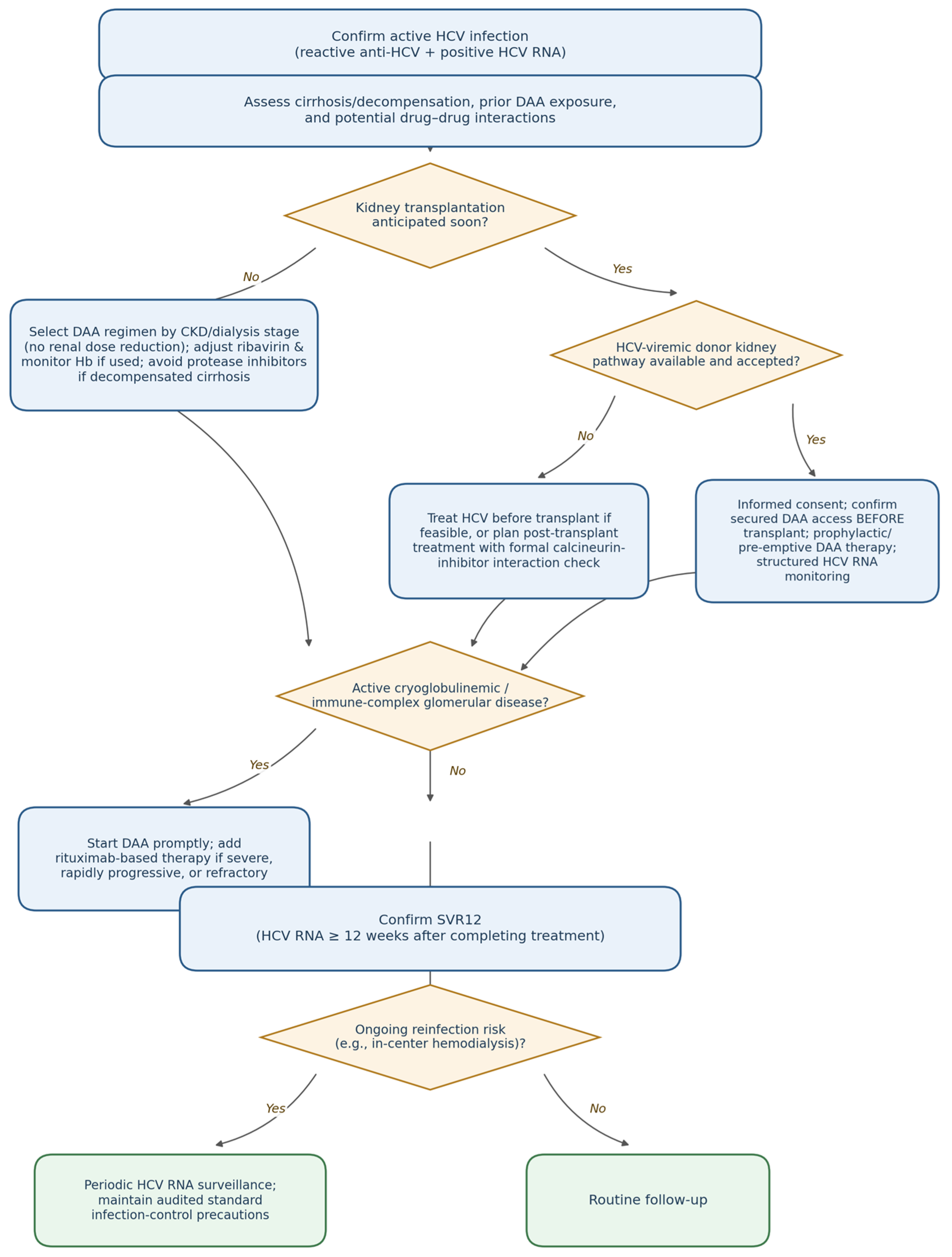

| Clinical Situation | Why It Matters | Practical Response | Supporting References |
|---|---|---|---|
| Advanced CKD or dialysis | Kidney function historically restricted therapy, but recommended DAAs now retain high efficacy. | Use a recommended regimen without renal dose reduction; adjust ribavirin when it is required. | [5,6,12,13,14,15,16,17] |
| Decompensated cirrhosis | NS3/4A protease inhibitor-containing regimens are not recommended. | Use a regimen recommended for decompensated cirrhosis and involve an experienced hepatology/transplant team. | [18] |
| Kidney transplant recipient | DAAs can interact with calcineurin inhibitors, particularly cyclosporine. | Perform a formal interaction check and monitor immunosuppressant trough levels. | [19,20,21] |
| HCV-viremic donor kidney | Donor-derived HCV requires prompt and reliable antiviral access. | Use informed consent, prophylactic or pre-emptive DAA therapy, and structured RNA monitoring. | [22,23,24,25,26,27] |
| Cryoglobulinemic glomerulonephritis | Viral eradication is central, but severe immune-mediated disease may require additional therapy. | Start DAA therapy promptly; add rituximab-based treatment for severe or refractory disease. | [1,28,29,30] |
| In-center hemodialysis | Nosocomial exposure and reinfection remain possible. | Apply audited standard precautions and maintain a closed testing-to-cure pathway. | [1,31,32,33] |
| Clinical Scenario | Key Tension | Suggested Approach | Supporting References |
|---|---|---|---|
| Kidney transplantation timing is uncertain (e.g., waiting-list time unknown) | Treating HCV before transplant clears infection but may forgo an HCV-viremic donor offer; deferring treatment preserves that option but leaves infection active. | Base the decision on expected waiting time, local donor-kidney availability, liver disease severity, and patient preference, decided jointly by nephrology, hepatology/infectious diseases, and the transplant team rather than by a fixed rule. | [1,20,21] |
| Complex polypharmacy with multiple potential drug–drug interactions (e.g., calcineurin inhibitor plus antifungal or antiarrhythmic therapy) | Individual interaction checks may understate cumulative risk when several interacting drugs are combined. | Perform a formal, drug-by-drug interaction review (not only for the calcineurin inhibitor) before DAA initiation; consider temporarily substituting or holding an interacting non-essential medication; increase the frequency of trough-level monitoring during and after DAA therapy. | [11,17,19] |
| Atypical or uncertain presentation of suspected HCV-associated glomerular disease (e.g., nephrotic-range proteinuria, poor renal response despite SVR12) | Guidance allows DAA initiation without waiting for biopsy in a typical presentation, but atypical features or failure of kidney disease to improve after SVR raise the possibility of an alternative or coexisting diagnosis. | Start DAA therapy without delay when HCV-associated glomerular disease is clinically likely, but perform kidney biopsy when an alternative diagnosis is suspected, kidney disease does not improve or stabilize after SVR, rapidly progressive disease is present, or immunosuppression is being considered. | [1,28,29,30] |
| HCV-viremic donor kidney offers in a setting where immediate post-transplant DAA access is not guaranteed | Accepting the organ without secured antiviral access risks treatment delay and prolonged recipient viremia, while declining the organ may prolong waiting time. | Confirm antiviral access, including funding or formulary approval and drug supply, before transplantation. If prompt post-transplant DAA therapy cannot be assured, transplantation into a recipient without HCV infection should not proceed within such a protocol. | [1,27,35] |
Disclaimer/Publisher’s Note: The statements, opinions and data contained in all publications are solely those of the individual author(s) and contributor(s) and not of MDPI and/or the editor(s). MDPI and/or the editor(s) disclaim responsibility for any injury to people or property resulting from any ideas, methods, instructions or products referred to in the content. |
© 2026 by the authors. Licensee MDPI, Basel, Switzerland. This article is an open access article distributed under the terms and conditions of the Creative Commons Attribution (CC BY) license.
Share and Cite
Mohrag, M.; Someili, A.; Elmakki, E.; Abdulrasak, M. Hepatitis C in Chronic Kidney Disease After the DAA Revolution: Clinical Decisions, Transplantation, and Implementation Challenges. J. Clin. Med. 2026, 15, 6504. https://doi.org/10.3390/jcm15176504
Mohrag M, Someili A, Elmakki E, Abdulrasak M. Hepatitis C in Chronic Kidney Disease After the DAA Revolution: Clinical Decisions, Transplantation, and Implementation Challenges. Journal of Clinical Medicine. 2026; 15(17):6504. https://doi.org/10.3390/jcm15176504
Chicago/Turabian StyleMohrag, Mostafa, Ali Someili, Erwa Elmakki, and Mohammed Abdulrasak. 2026. "Hepatitis C in Chronic Kidney Disease After the DAA Revolution: Clinical Decisions, Transplantation, and Implementation Challenges" Journal of Clinical Medicine 15, no. 17: 6504. https://doi.org/10.3390/jcm15176504
APA StyleMohrag, M., Someili, A., Elmakki, E., & Abdulrasak, M. (2026). Hepatitis C in Chronic Kidney Disease After the DAA Revolution: Clinical Decisions, Transplantation, and Implementation Challenges. Journal of Clinical Medicine, 15(17), 6504. https://doi.org/10.3390/jcm15176504

