Cardiac Rehabilitation—Current Paradigms and Challenges Across the Cardiovascular Continuum
 ,
,
Abstract
1. Introduction
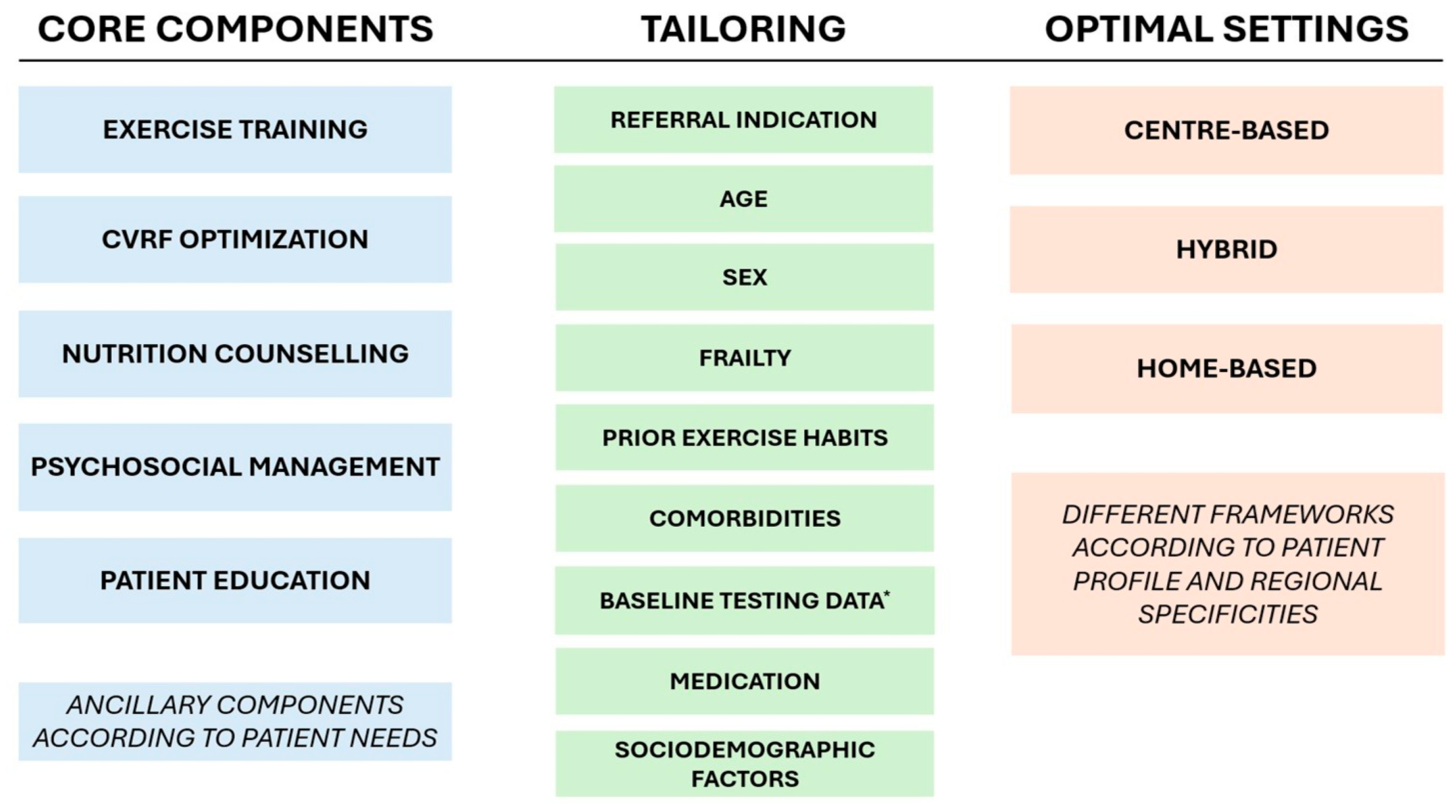
2. Cardiac Rehabilitation and Personalization
2.1. From General Concepts to Individualized Care
2.2. Workflows and Organizational Issues
3. Cardiac Rehabilitation Across the Cardiovascular Continuum
3.1. Focus on Ischaemic Heart Disease
3.2. Heart Failure
3.3. Cardiac Electronic Implantable Devices and Advanced Heart Failure
3.4. Cardio-Oncology and Beyond
4. Challenges to CR—Barriers, Unmet Needs, and Future Perspectives
5. Conclusions
Author Contributions
Funding
Data Availability Statement
Conflicts of Interest
Abbreviations
| 6MWT | Six-minute walk test |
| ACC | American College of Cardiology |
| AHA | American Heart Association |
| AI | Artificial intelligence |
| CIED | Cardiac implantable electronic device |
| CORE | Cardio-oncology rehabilitation |
| COVID-19 | Coronavirus disease 2019 |
| CPET | Cardiopulmonary exercise testing |
| CVD | Cardiovascular disease |
| CVRF | Cardiovascular risk factor |
| CR | Cardiac rehabilitation |
| EAPC | European Association of Preventive Cardiology |
| ESC | European Society of Cardiology |
| HF | Heart failure |
| HFpEF | Heart failure with preserved ejection fraction |
| IHD | Ischaemic heart disease |
| ISHLT | International Society for Heart and Lung Transplantation |
| LVAD | Left ventricular assist device |
| PAD | Peripheral artery disease |
| QoL | Quality of life |
| SCAD | Spontaneous coronary artery dissection |
| VO2peak | Peak oxygen consumption |
References
- Timmis, A.; Petersen, S.E.; Van Belle, E.; Townsend, N.; Conrad, N.; Kaplon-Cieslicka, A.; Kazakiewicz, D.; Kavousi, M.; Cvijic, M.; Ignatiuk, B.; et al. European Society of Cardiology: Cardiovascular disease statistics 2025. Eur. Heart J. 2026, 47, 3499–3543. [Google Scholar] [CrossRef] [Scilit] [PubMed]
- Regan, J.A.; Laitner, M.H.; Dzau, V.J. A Crossroads in Cardiovascular Medicine: Progress and Barriers to Impact. Circulation 2025, 152, 1166–1173. [Google Scholar] [CrossRef] [Scilit] [PubMed]
- Shukla, K.; Natalie, A.; Peters, M.; Bracewell, N. Tracing the evolution of cardiology: Pioneering discoveries and paradigm shifts in cardiovascular care. Am. Heart J. Plus 2026, 66, 100792. [Google Scholar] [CrossRef] [Scilit] [PubMed]
- van Diepen, S.; Rampersad, P.; Luk, A.; Dahiya, G.; Zern, E.K.; Alviar, C.L.; Barnett, C.F.; Bohula, E.A.; Bartos, J.A.; Slater, T.M.; et al. Cardiac Intensive Care Unit Appropriate Patient Selection and Triage: A Scientific Statement from the American Heart Association. Circulation 2026, 153, e1394–e1407. [Google Scholar] [CrossRef] [Scilit] [PubMed]
- Alhuneafat, L.; Guha, A.; Blaes, A.; Konety, S.H. Cancer and Cardiovascular Disease: Shared Risk Factors, Mechanisms, and Clinical Implications: JACC: CardioOncology State-of-the-Art Review. JACC CardioOncol. 2025, 7, 453–469. [Google Scholar] [PubMed]
- Palaniappan, L.P.; Allen, N.B.; Almarzooq, Z.I.; Anderson, C.A.M.; Arora, P.; Avery, C.L.; Baker-Smith, C.M.; Bansal, N.; Currie, M.E.; Earlie, R.S.; et al. 2026 Heart Disease and Stroke Statistics: A Report of US and Global Data from the American Heart Association. Circulation 2026, 153, e275–e906. [Google Scholar] [CrossRef] [Scilit] [PubMed]
- Global Burden of Cardiovascular Diseases and Risks 2023 Collaborators. Global, Regional, and National Burden of Cardiovascular Diseases and Risk Factors in 204 Countries and Territories, 1990–2023. J. Am. Coll. Cardiol. 2025, 86, 2167–2243. [CrossRef] [Scilit] [PubMed]
- Lear, S.A.; McKee, M.; Hystad, P.; Walker, B.B.; Murphy, A.; Brauer, M.; Walli-Attaei, M.; Rosengren, A.; Rangarajan, S.; Chow, C.K.; et al. Social factors, health policy, and environment: Implications for cardiovascular disease across the globe. Eur. Heart J. 2025, 46, 2959–2973. [Google Scholar] [CrossRef] [Scilit] [PubMed]
- Luengo-Fernandez, R.; Walli-Attaei, M.; Gray, A.; Torbica, A.; Maggioni, A.P.; Huculeci, R.; Bairami, F.; Aboyans, V.; Timmis, A.D.; Vardas, P.; et al. Economic burden of cardiovascular diseases in the European Union: A population-based cost study. Eur. Heart J. 2023, 44, 4752–4767. [Google Scholar] [CrossRef] [Scilit] [PubMed]
- Kris-Etherton, P.M.; Petersen, K.S.; Després, J.P.; Anderson, C.A.M.; Deedwania, P.; Furie, K.L.; Lear, S.; Lichtenstein, A.H.; Lobelo, F.; Morris, P.B.; et al. Strategies for Promotion of a Healthy Lifestyle in Clinical Settings: Pillars of Ideal Cardiovascular Health: A Science Advisory from the American Heart Association. Circulation 2021, 144, e495–e514. [Google Scholar] [CrossRef] [Scilit] [PubMed]
- Magnussen, C.; Alegre-Diaz, J.; Al-Nasser, L.A.; Amouyel, P.; Aviles-Santa, L.; Bakker, S.J.L.; Ballantyne, C.M.; Bernabé-Ortiz, A.; Bobak, M.; Boffetta, P.; et al. Global Effect of Cardiovascular Risk Factors on Lifetime Estimates. N. Engl. J. Med. 2025, 393, 125–138. [Google Scholar] [CrossRef] [Scilit] [PubMed]
- Grapsa, J.; Almeida, A.G.; Sambola, A.; Vitale, C.; Appelman, Y.; Shivalkar, B.; Anderson, L.J.; Trabattoni, D.; Perez, R.V.; Rakisheva, A.; et al. Women’s heart centres: A clinical consensus statement of the European Association of Cardiovascular Imaging (EACVI), the European Association of Percutaneous Cardiovascular Interventions (EAPCI), the Heart Failure Association (HFA), and the Association for Acute CardioVascular Care (ACVC) of the ESC. Eur. Heart J. 2026, 47, 3889–3904. [Google Scholar] [CrossRef] [Scilit] [PubMed]
- Taylor, R.S.; Singh, S. Personalised rehabilitation for cardiac and pulmonary patients with multimorbidity: Time for implementation? Eur. J. Prev. Cardiol. 2022, 28, e19–e23. [Google Scholar] [CrossRef] [Scilit] [PubMed]
- Moons, P.; Norekvål, T.M.; Arbelo, E.; Borregaard, B.; Casadei, B.; Cosyns, B.; Cowie, M.R.; Fitzsimons, D.; Fraser, A.G.; Jaarsma, T.; et al. Placing patient-reported outcomes at the centre of cardiovascular clinical practice: Implications for quality of care and management. Eur. Heart J. 2023, 44, 3405–3422. [Google Scholar] [CrossRef] [Scilit] [PubMed]
- Powell-Wiley, T.M.; Baumer, Y.; Baah, F.O.; Baez, A.S.; Farmer, N.; Mahlobo, C.T.; Pita, M.A.; Potharaju, K.A.; Tamura, K.; Wallen, G.R. Social Determinants of Cardiovascular Disease. Circ. Res. 2022, 130, 782–799. [Google Scholar] [CrossRef] [Scilit] [PubMed]
- Vilela, E.M.; Ladeiras Lopes, R.; Torres, S.; João, A.; Ribeiro, J.; Primo, J.; Fontes-Carvalho, R.; Campos, L.; Miranda, F.; Nunes, J.P.L.; et al. Differential Impact of a Cardiac Rehabilitation Program on Functional Parameters in Elderly versus Non-Elderly Myocardial Infarction Survivors. Cardiology 2020, 145, 98–105. [Google Scholar] [CrossRef] [Scilit] [PubMed]
- Mensah, G.A.; Arnold, N.; Prabhu, S.D.; Ridker, P.M.; Welty, F.K. Inflammation and Cardiovascular Disease: 2025 ACC Scientific Statement: A Report of the American College of Cardiology. J. Am. Coll. Cardiol. 2026, 87, 1381–1404. [Google Scholar] [PubMed]
- Taylor, R.S.; Dalal, H.M.; McDonagh, S.T.J. The role of cardiac rehabilitation in improving cardiovascular outcomes. Nat. Rev. Cardiol. 2022, 19, 180–194. [Google Scholar] [CrossRef] [Scilit] [PubMed]
- Ambrosetti, M.; Abreu, A.; Corrà, U.; Davos, C.H.; Hansen, D.; Frederix, I.; Iliou, M.C.; Pedretti, R.F.E.; Schmid, J.P.; Vigorito, C.; et al. Secondary prevention through comprehensive cardiovascular rehabilitation: From knowledge to implementation. 2020 update. A position paper from the Secondary Prevention and Rehabilitation Section of the European Association of Preventive Cardiology. Eur. J. Prev. Cardiol. 2021, 28, 460–495. [Google Scholar] [CrossRef] [Scilit] [PubMed]
- Visseren, F.L.J.; Mach, F.; Smulders, Y.M.; Carballo, D.; Koskinas, K.C.; Bäck, M.; Benetos, A.; Biffi, A.; Boavida, J.M.; Capodanno, D.; et al. 2021 ESC Guidelines on cardiovascular disease prevention in clinical practice. Eur. Heart J. 2021, 42, 3227–3337. [Google Scholar] [CrossRef] [Scilit] [PubMed]
- Dibben, G.O.; Faulkner, J.; Oldridge, N.; Rees, K.; Thompson, D.R.; Zwisler, A.D.; Taylor, R.S. Exercise-based cardiac rehabilitation for coronary heart disease: A meta-analysis. Eur. Heart J. 2023, 44, 452–469. [Google Scholar] [CrossRef] [Scilit] [PubMed]
- Molloy, C.D.; Long, L.; Mordi, I.R.; Bridges, C.; Sagar, V.A.; Davies, E.J.; Coats, A.J.S.; Dalal, H.; Rees, K.; Singh, S.J.; et al. Exercise-based cardiac rehabilitation for adults with heart failure—2023 Cochrane systematic review and meta-analysis. Eur. J. Heart Fail. 2023, 25, 2263–2273. [Google Scholar] [CrossRef] [Scilit] [PubMed]
- Thomas, R.J. Cardiac Rehabilitation—Challenges, Advances, and the Road Ahead. N. Engl. J. Med. 2024, 390, 830–841. [Google Scholar] [CrossRef] [Scilit] [PubMed]
- Abreu, A.; Frederix, I.; Dendale, P.; Janssen, A.; Doherty, P.; Piepoli, M.F.; Völler, H.; Davos, C.H. Standardization and quality improvement of secondary prevention through cardiovascular rehabilitation programmes in Europe: The avenue towards EAPC accreditation programme: A position statement of the Secondary Prevention and Rehabilitation Section of the European Association of Preventive Cardiology (EAPC). Eur. J. Prev. Cardiol. 2021, 28, 496–509. [Google Scholar] [CrossRef] [Scilit] [PubMed]
- Mueller, A.S.; Kim, S.M. Cardiac Rehabilitation in the Modern Era: Evidence, Equity, and Evolving Delivery Models Across the Cardiovascular Spectrum. J. Clin. Med. 2025, 14, 5573. [Google Scholar] [CrossRef] [Scilit] [PubMed]
- Brown, T.M.; Pack, Q.R.; Aberegg, E.; Brewer, L.C.; Ford, Y.R.; Forman, D.E.; Gathright, E.C.; Khadanga, S.; Ozemek, C.; Thomas, R.J.; et al. Core Components of Cardiac Rehabilitation Programs: 2024 Update: A Scientific Statement from the American Heart Association and the American Association of Cardiovascular and Pulmonary Rehabilitation. Circulation 2024, 150, e328–e347. [Google Scholar] [CrossRef] [Scilit] [PubMed]
- Byrne, R.A.; Rossello, X.; Coughlan, J.J.; Barbato, E.; Berry, C.; Chieffo, A.; Claeys, M.J.; Dan, G.A.; Dweck, M.R.; Galbraith, M.; et al. 2023 ESC Guidelines for the management of acute coronary syndromes. Eur. Heart J. 2023, 44, 3720–3826. [Google Scholar] [CrossRef] [Scilit] [PubMed]
- Redfern, J.; Gallagher, R.; O’Neil, A.; Grace, S.L.; Bauman, A.; Jennings, G.; Brieger, D.; Briffa, T. Historical Context of Cardiac Rehabilitation: Learning from the Past to Move to the Future. Front. Cardiovasc. Med. 2022, 9, 842567. [Google Scholar] [CrossRef] [Scilit] [PubMed]
- Grace, S.L.; Taylor, R.S.; Gaalema, D.E.; Redfern, J.; Kotseva, K.; Ghisi, G. Cardiac Rehabilitation: A Global Perspective on Where We Have Come and Where We Must Go. JACC Adv. 2023, 2, 100412. [Google Scholar] [PubMed]
- Pelliccia, A.; Sharma, S.; Gati, S.; Bäck, M.; Börjesson, M.; Caselli, S.; Collet, J.P.; Corrado, D.; Drezner, J.A.; Halle, M.; et al. 2020 ESC Guidelines on sports cardiology and exercise in patients with cardiovascular disease. Eur. Heart J. 2021, 42, 17–96. [Google Scholar] [CrossRef] [Scilit] [PubMed]
- Hansen, D.; Abreu, A.; Ambrosetti, M.; Cornelissen, V.; Gevaert, A.; Kemps, H.; Laukkanen, J.A.; Pedretti, R.; Simonenko, M.; Wilhelm, M.; et al. Exercise intensity assessment and prescription in cardiovascular rehabilitation and beyond: Why and how: A position statement from the Secondary Prevention and Rehabilitation Section of the European Association of Preventive Cardiology. Eur. J. Prev. Cardiol. 2022, 29, 230–245. [Google Scholar] [CrossRef] [Scilit] [PubMed]
- Aleksova, A.; Fluca, A.L.; Beltrami, A.P.; Dozio, E.; Sinagra, G.; Marketou, M.; Janjusevic, M. Part 1-Cardiac Rehabilitation After an Acute Myocardial Infarction: Four Phases of the Programme-Where Do We Stand? J. Clin. Med. 2025, 14, 1117. [Google Scholar] [CrossRef] [Scilit] [PubMed]
- Fontes-Carvalho, R.; Vilela, E.M.; Gonçalves-Teixeira, P. The Effect of exercise training in systolic and diastolic function. In Lifestyle in Heart Health and Disease, 1st ed.; Watson, R.R., Zibadi, S., Eds.; Elsevier: Amsterdam, The Netherlands, 2018; pp. 153–162. [Google Scholar]
- Fiuza-Luces, C.; Santos-Lozano, A.; Joyner, M.; Carrera-Bastos, P.; Picazo, O.; Zugaza, J.L.; Izquierdo, M.; Ruilope, L.M.; Lucia, A. Exercise benefits in cardiovascular disease: Beyond attenuation of traditional risk factors. Nat. Rev. Cardiol. 2018, 15, 731–743. [Google Scholar] [CrossRef] [Scilit] [PubMed]
- Ruegsegger, G.N.; Booth, F.W. Health Benefits of Exercise. Cold Spring Harb. Perspect. Med. 2018, 8, a029694. [Google Scholar] [CrossRef] [Scilit] [PubMed]
- Franklin, B.A.; Eijsvogels, T.M.H.; Pandey, A.; Quindry, J.; Toth, P.P. Physical activity, cardiorespiratory fitness, and cardiovascular health: A clinical practice statement of the ASPC Part I: Bioenergetics, contemporary physical activity recommendations, benefits, risks, extreme exercise regimens, potential maladaptations. Am. J. Prev. Cardiol. 2022, 12, 100424. [Google Scholar] [CrossRef] [Scilit] [PubMed]
- Pedretti, R.F.E.; Van Craenenbroeck, E.; Vrints, C.; Ambrosetti, M.; Kurpas, D.; Vassiliou, V.S.; Back, M.; Moholdt, T.; Sionis, A.; Wilhelm, M.; et al. Optimal lifelong roadmap post-ACS. A Clinical Consensus Statement of the European Association of Preventive Cardiology of the ESC. Eur. J. Prev. Cardiol. 2026. Epub ahead of print. [Google Scholar] [CrossRef] [Scilit] [PubMed]
- Bueno, H.; Deaton, C.; Farrero, M.; Forsyth, F.; Braunschweig, F.; Buccheri, S.; Dragan, S.; Gevaert, S.; Held, C.; Kurpas, D.; et al. 2025 ESC Clinical Consensus Statement on mental health and cardiovascular disease: Developed under the auspices of the ESC Clinical Practice Guidelines Committee. Eur. Heart J. 2025, 46, 4156–4225. [Google Scholar] [CrossRef] [Scilit] [PubMed]
- Vilela, E.M.; Viamonte, S.; Prata, J.; Pimentel, J.S.; Joaquim, A.; Fontes-Carvalho, R. Cardio-oncology Rehabilitation and Mental Health: Current Evidence and Future Perspectives. Cardiol. Clin. 2026, 44, 275–285. [Google Scholar] [PubMed]
- Coutinho, T.; Khadanga, S.; Adedinsewo, D.; Barac, A.; Brown, T.M.; Deaton, C.; Golbus, J.R.; Reynolds, H.; Sharma, G.; Taylor, J.L.; et al. Cardiac Rehabilitation in Women: A Scientific Statement from the American Heart Association. Circulation 2025, 152, e376–e390. [Google Scholar] [CrossRef] [Scilit] [PubMed]
- Damluji, A.A.; Tomczak, C.R.; Hiser, S.; O’Neill, D.E.; Goyal, P.; Pack, Q.R.; Foulkes, S.J.; Brown, T.M.; Haykowsky, M.J.; Needham, D.M.; et al. Benefits of Cardiac Rehabilitation: Mechanisms to Restore Function and Clinical Impact. Circ. Res. 2025, 137, 255–272. [Google Scholar] [CrossRef] [Scilit] [PubMed]
- Vilela, E.M.; Ladeiras-Lopes, R.; Joao, A.; Braga, J.; Torres, S.; Ribeiro, J.; Primo, J.; Fontes-Carvalho, R.; Campos, L.; Miranda, F.; et al. Differential impact of a cardiac rehabilitation program in functional parameters according to patient gender. Am. J. Cardiovasc. Dis. 2020, 10, 367–375. [Google Scholar] [PubMed]
- Kitzman, D.W.; Whellan, D.J.; Duncan, P.; Pastva, A.M.; Mentz, R.J.; Reeves, G.R.; Nelson, M.B.; Chen, H.; Upadhya, B.; Reed, S.D.; et al. Physical Rehabilitation for Older Patients Hospitalized for Heart Failure. N. Engl. J. Med. 2021, 385, 203–216. [Google Scholar] [CrossRef] [Scilit] [PubMed]
- Tonet, E.; Raisi, A.; Zagnoni, S.; Chiaranda, G.; Pasanisi, G.; Aschieri, D.; D’Intino, P.E.; Pavasini, R.; Cimaglia, P.; Campana, R.; et al. Multidomain Rehabilitation for Older Patients with Myocardial Infarction. N. Engl. J. Med. 2025, 393, 973–982. [Google Scholar] [PubMed]
- MacEachern, E.; Quach, J.; Giacomantonio, N.; Theou, O.; Hillier, T.; Abel-Adegbite, I.; Gonzalez-Lara, M.; Kehler, D.S. Cardiac rehabilitation and frailty: A systematic review and meta-analysis. Eur. J. Prev. Cardiol. 2024, 31, 1960–1976. [Google Scholar] [CrossRef] [Scilit] [PubMed]
- Carson, R.P.; Schneider, V.L.P.; Main, E.; Carvalho, C.G.; Ghisi, G.L.M. Understanding Frailty in Cardiac Rehabilitation: A Scoping Review of Prevalence, Measurement, Sex and Gender Considerations, and Barriers to Completion. J. Clin. Med. 2025, 14, 5354. [Google Scholar] [CrossRef] [Scilit] [PubMed]
- Fruytier, L.; Serban, I.B.; Van de Sande, D.A.J.P.; Colombo, S.; Houben, S.; Brombacher, A.; Kemps, H. Exploring the Needs and Preferences of Athletes in Cardiac (Tele)Rehabilitation to Enhance Rehabilitation Outcome: A Qualitative Study. Patient Prefer. Adherence 2025, 19, 685–698. [Google Scholar] [CrossRef] [Scilit] [PubMed]
- Ghram, A.; Ben Saad, H.; Kunutsor, S.K.; Laukkanen, J.A.; Baggish, A.L.; Lavie, C.J. Do competitive athletes with cardiovascular diseases need a dedicated sports cardiac rehabilitation clinical pathway? Towards a precision exercise medicine approach. Eur. J. Prev. Cardiol. 2026, 33, 1523–1526. [Google Scholar] [CrossRef] [Scilit] [PubMed]
- Marcadet, D.; Pavy, B.; Corone, S.; Faure, A.; Six, M.M.; Cazaubiel, I.; Guy, J.M.; Schnell, F. Consensus document from the Group Exercise Rehabilitation Sports-Prevention (GERS-P) of the French Society of Cardiology on cardiac rehabilitation outside cardiac rehabilitation centres, including light private rehabilitation structures and cardiac telerehabilitation. Arch. Cardiovasc. Dis. 2025, 118, 415–421. [Google Scholar] [CrossRef] [Scilit] [PubMed]
- Thomas, R.J.; Beatty, A.L.; Beckie, T.M.; Brewer, L.C.; Brown, T.M.; Forman, D.E.; Franklin, B.A.; Keteyian, S.J.; Kitzman, D.W.; Regensteiner, J.G.; et al. Home-Based Cardiac Rehabilitation: A Scientific Statement from the American Association of Cardiovascular and Pulmonary Rehabilitation, the American Heart Association, and the American College of Cardiology. J. Am. Coll. Cardiol. 2019, 74, 133–153. [Google Scholar] [PubMed]
- Scherrenberg, M.; Falter, M.; Abreu, A.; Aktaa, S.; Busnatu, S.; Casado-Arroyo, R.; Dendale, P.; Dilaveris, P.; Locati, E.T.; Marques-Sule, E.; et al. Standards for cardiac telerehabilitation. Eur. Heart J. 2025, 46, 3714–3737. [Google Scholar] [PubMed]
- Schnell, F.; Wu, X.; Xu, L. Revolutionizing cardiac rehabilitation: France’s new paths beyond the centre. Eur. J. Prev. Cardiol. 2026, 33, 812–814. [Google Scholar] [CrossRef] [Scilit] [PubMed]
- Ruivo, J.; Moholdt, T.; Abreu, A. Overview of Cardiac Rehabilitation following post-acute myocardial infarction in European Society of Cardiology member countries. Eur. J. Prev. Cardiol. 2023, 30, 758–768. [Google Scholar] [CrossRef] [Scilit] [PubMed]
- Fontes, J.P.; Vilela, E.M.; Durazzo, A.; Teixeira, M. Current state of cardiac rehabilitation in Portugal: Results of the 2019 national survey. Rev. Port. Cardiol. (Engl. Ed.) 2021, 40, 877–887. [Google Scholar] [CrossRef] [Scilit]
- Taylor, R.S.; Fredericks, S.; Jones, I.; Neubeck, L.; Sanders, J.; De Stoutz, N.; Thompson, D.R.; Wadhwa, D.N.; Grace, S.L. Global perspectives on heart disease rehabilitation and secondary prevention: A scientific statement from the Association of Cardiovascular Nursing and Allied Professions, European Association of Preventive Cardiology, and International Council of Cardiovascular Prevention and Rehabilitation. Eur. Heart J. 2023, 44, 2515–2525. [Google Scholar] [CrossRef] [Scilit] [PubMed]
- Toval, A.; Bakker, E.A.; Granada-Maia, J.B.; Núñez de Arenas-Arroyo, S.; Solis-Urra, P.; Eijsvogels, T.M.H.; Esteban-Cornejo, I.; Martínez-Vizcaíno, V.; Ortega, F.B. Exercise type and settings, quality of life, and mental health in coronary artery disease: A network meta-analysis. Eur. Heart J. 2025, 46, 2186–2201. [Google Scholar] [CrossRef] [Scilit] [PubMed]
- McDonagh, S.T.; Dalal, H.; Moore, S.; Clark, C.E.; Dean, S.G.; Jolly, K.; Cowie, A.; Afzal, J.; Taylor, R.S. Home-based versus centre-based cardiac rehabilitation. Cochrane Database Syst. Rev. 2023, 10, CD007130. [Google Scholar] [CrossRef] [Scilit] [PubMed]
- Hama, T.; Chacin Suarez, A.S.; Bissen, T.G.; Bonikowske, A.R.; Smith, J.R.; Taylor, B.J.; Wheatley-Guy, C.M.; Scales, R.; Rogers, M.J.; Ahlskog, A.L.; et al. Home-Based Cardiac Rehabilitation Among Attendees from a Large Health Care System During the COVID-19 Pandemic. JACC Adv. 2024, 3, 101403. [Google Scholar] [CrossRef] [Scilit] [PubMed]
- Mauriello, A.; Correra, A.; Maratea, A.C.; Russo, V.; Liccardo, B.; Gragnano, F.; Acerbo, V.; Cesaro, A.; Pacileo, M.; Riccio, C.; et al. The Evolution of Cardiac Rehabilitation from Supervised Models to New Frontiers in Digital Health. J. Clin. Med. 2026, 15, 2515. [Google Scholar] [CrossRef] [Scilit] [PubMed]
- Dodson, J.A.; Adhikari, S.; Schoenthaler, A.; Hochman, J.S.; Sweeney, G.; George, B.; Marzo, K.; Jennings, L.A.; Kovell, L.C.; Vorsanger, M.; et al. Rehabilitation at Home Using Mobile Health for Older Adults Hospitalized for Ischemic Heart Disease: The RESILIENT Randomized Clinical Trial. JAMA Netw. Open 2025, 8, e2453499. [Google Scholar] [PubMed]
- Ekblom, Ö.; Cider, Å.; Hambraeus, K.; Bäck, M.; Leosdottir, M.; Lönn, A.; Börjesson, M. Participation in exercise-based cardiac rehabilitation is related to reduced total mortality in both men and women: Results from the SWEDEHEART registry. Eur. J. Prev. Cardiol. 2022, 29, 485–492. [Google Scholar] [CrossRef] [Scilit] [PubMed]
- Blacher, J.; Olié, V.; Gabet, A.; Cinaud, A.; Tuppin, P.; Iliou, M.C.; Grave, C. Two-year prognosis and cardiovascular disease prevention after acute coronary syndrome: The role of cardiac rehabilitation-a French nationwide study. Eur. J. Prev. Cardiol. 2024, 31, 1939–1947. [Google Scholar] [CrossRef] [Scilit] [PubMed]
- Vrints, C.; Andreotti, F.; Koskinas, K.C.; Rossello, X.; Adamo, M.; Ainslie, J.; Banning, A.P.; Budaj, A.; Buechel, R.R.; Chiariello, G.A.; et al. 2024 ESC Guidelines for the management of chronic coronary syndromes. Eur. Heart J. 2024, 45, 3415–3537. [Google Scholar] [CrossRef] [Scilit] [PubMed]
- Rao, S.V.; O’Donoghue, M.L.; Ruel, M.; Rab, T.; Tamis-Holland, J.E.; Alexander, J.H.; Baber, U.; Baker, H.; Cohen, M.G.; Cruz-Ruiz, M.; et al. 2025 ACC/AHA/ACEP/NAEMSP/SCAI Guideline for the Management of Patients with Acute Coronary Syndromes: A Report of the American College of Cardiology/American Heart Association Joint Committee on Clinical Practice Guidelines. J. Am. Coll. Cardiol. 2025, 85, 2135–2237. [Google Scholar] [PubMed]
- Virani, S.S.; Newby, L.K.; Arnold, S.V.; Bittner, V.; Brewer, L.C.; Demeter, S.H.; Dixon, D.L.; Fearon, W.F.; Hess, B.; Johnson, H.M.; et al. 2023 AHA/ACC/ACCP/ASPC/NLA/PCNA Guideline for the Management of Patients with Chronic Coronary Disease: A Report of the American Heart Association/American College of Cardiology Joint Committee on Clinical Practice Guidelines. J. Am. Coll. Cardiol. 2023, 82, 833–955. [Google Scholar] [PubMed]
- McDonagh, T.A.; Metra, M.; Adamo, M.; Gardner, R.S.; Baumbach, A.; Böhm, M.; Burri, H.; Butler, J.; Čelutkienė, J.; Chioncel, O.; et al. 2021 ESC Guidelines for the diagnosis and treatment of acute and chronic heart failure. Eur. Heart J. 2021, 42, 3599–3726. [Google Scholar] [CrossRef] [Scilit] [PubMed]
- Heidenreich, P.A.; Bozkurt, B.; Aguilar, D.; Allen, L.A.; Byun, J.J.; Colvin, M.M.; Deswal, A.; Drazner, M.H.; Dunlay, S.M.; Evers, L.R.; et al. 2022 AHA/ACC/HFSA Guideline for the Management of Heart Failure: A Report of the American College of Cardiology/American Heart Association Joint Committee on Clinical Practice Guidelines. J. Am. Coll. Cardiol. 2022, 79, e263–e421. [Google Scholar] [PubMed]
- Lyon, A.R.; López-Fernández, T.; Couch, L.S.; Asteggiano, R.; Aznar, M.C.; Bergler-Klein, J.; Boriani, G.; Cardinale, D.; Cordoba, R.; Cosyns, B.; et al. 2022 ESC Guidelines on cardio-oncology developed in collaboration with the European Hematology Association (EHA), the European Society for Therapeutic Radiology and Oncology (ESTRO) and the International Cardio-Oncology Society (IC-OS). Eur. Heart J. 2022, 43, 4229–4361. [Google Scholar] [CrossRef] [Scilit] [PubMed]
- Vilela, E.M.; Ladeiras-Lopes, R.; Joao, A.; Braga, J.; Torres, S.; Viamonte, S.; Ribeiro, J.; Teixeira, M.; Nunes, J.P.; Fontes-Carvalho, R. Current role and future perspectives of cardiac rehabilitation in coronary heart disease. World J. Cardiol. 2021, 13, 695–709. [Google Scholar] [CrossRef] [Scilit] [PubMed]
- Gilchrist, S.C.; Barac, A.; Ades, P.A.; Alfano, C.M.; Franklin, B.A.; Jones, L.W.; La Gerche, A.; Ligibel, J.A.; Lopez, G.; Madan, K.; et al. Cardio-Oncology Rehabilitation to Manage Cardiovascular Outcomes in Cancer Patients and Survivors: A Scientific Statement From the American Heart Association. Circulation 2019, 139, e997–e1012. [Google Scholar] [CrossRef] [Scilit] [PubMed]
- Wilhelm, M.; Hansen, D.; Bäck, M. When meta-analyses fall short: The need to reframe evidence generation through real-world data in cardiac rehabilitation. Eur. J. Prev. Cardiol. 2026, 33, 854–856. [Google Scholar] [CrossRef] [Scilit] [PubMed]
- Velleca, A.; Shullo, M.A.; Dhital, K.; Azeka, E.; Colvin, M.; DePasquale, E.; Farrero, M.; García-Guereta, L.; Jamero, G.; Khush, K.; et al. The International Society for Heart and Lung Transplantation (ISHLT) guidelines for the care of heart transplant recipients. J. Heart Lung Transplant. 2023, 42, e1–e141. [Google Scholar] [CrossRef] [Scilit] [PubMed]
- Nordanstig, J.; Behrendt, C.A.; Baumgartner, I.; Belch, J.; Bäck, M.; Fitridge, R.; Hinchliffe, R.; Lejay, A.; Mills, J.L.; Rother, U.; et al. Editor’s Choice—European Society for Vascular Surgery (ESVS) 2024 Clinical Practice Guidelines on the Management of Asymptomatic Lower Limb Peripheral Arterial Disease and Intermittent Claudication. Eur. J. Vasc. Endovasc. Surg. 2024, 67, 9–96. [Google Scholar] [CrossRef] [Scilit] [PubMed]
- Salzwedel, A.; Jensen, K.; Rauch, B.; Doherty, P.; Metzendorf, M.I.; Hackbusch, M.; Völler, H.; Schmid, J.P.; Davos, C.H. Effectiveness of comprehensive cardiac rehabilitation in coronary artery disease patients treated according to contemporary evidence based medicine: Update of the Cardiac Rehabilitation Outcome Study (CROS-II). Eur. J. Prev. Cardiol. 2020, 27, 1756–1774. [Google Scholar] [CrossRef] [Scilit] [PubMed]
- Chen, M.; Zhang, L.; Lai, J.; Wang, J.; Liu, T. Impact of cardiac rehabilitation on cardiovascular outcomes in patients with coronary artery disease following percutaneous coronary intervention: A meta-analysis. BMC Cardiovasc. Disord. 2026, 26, 381. [Google Scholar] [CrossRef] [Scilit] [PubMed]
- Grace, S.L. Evidence is indisputable that cardiac rehabilitation provides health benefits and event reduction: Time for policy action. Eur. Heart J. 2023, 44, 470–472. [Google Scholar] [CrossRef] [Scilit] [PubMed]
- Abell, B.; Zecchin, R.; Gallagher, R. Making Sense of the Unfavourable Systematic Review of Exercise-Based Cardiac Rehabilitation in the Modern Era: How Should We Proceed? Heart Lung Circ. 2019, 28, 204–206. [Google Scholar] [CrossRef] [Scilit] [PubMed]
- Powell, R.; McGregor, G.; Ennis, S.; Kimani, P.K.; Underwood, M. Is exercise-based cardiac rehabilitation effective? A systematic review and meta-analysis to re-examine the evidence. BMJ Open 2018, 8, e019656. [Google Scholar] [CrossRef] [Scilit] [PubMed]
- Stens, N.A.; Buckley, B.J.R.; Dibben, G.O.; Buffart, L.M.; Kleinnibbelink, G.; Prabhakaran, D.; Chandrasekaran, A.M.; Kinra, S.; Roy, A.; Campo, G.; et al. Exercise-based cardiac rehabilitation for coronary heart disease: The CaReMATCH individual participant data meta-analysis. Eur. J. Prev. Cardiol. 2026, 33, 841–853. [Google Scholar] [CrossRef] [Scilit] [PubMed]
- Ngoc, C.N.; Combaret, N.; Douard, H.; Bonnet, M.; Valy, Y.; Méneveau, N.; le Bivic, L.; Rioufol, G.; Rangé, G.; Brunel, P.; et al. Modalities and safety of cardiac rehabilitation in a population managed for spontaneous haematoma or coronary disruption: Insights from the READAPT-DISCO study. Eur. J. Prev. Cardiol. 2025, 32, 708–711. [Google Scholar] [CrossRef] [Scilit] [PubMed]
- Conraads, V.M.; Pattyn, N.; De Maeyer, C.; Beckers, P.J.; Coeckelberghs, E.; Cornelissen, V.A.; Denollet, J.; Frederix, G.; Goetschalckx, K.; Hoymans, V.Y.; et al. Aerobic interval training and continuous training equally improve aerobic exercise capacity in patients with coronary artery disease: The SAINTEX-CAD study. Int. J. Cardiol. 2015, 179, 203–210. [Google Scholar] [CrossRef] [Scilit] [PubMed]
- McGregor, G.; Powell, R.; Begg, B.; Birkett, S.T.; Nichols, S.; Ennis, S.; McGuire, S.; Prosser, J.; Fiassam, O.; Hee, S.W.; et al. High-intensity interval training in cardiac rehabilitation: A multi-centre randomized controlled trial. Eur. J. Prev. Cardiol. 2023, 30, 745–755. [Google Scholar] [CrossRef] [Scilit] [PubMed]
- Hansen, D.; Junior, G.C.; Milani, J.G.P.O.; Milani, M.; Gojevic, T.; Machado, F.V.C.; Kambic, T.; Eijsvogels, T.M.H.; Bonifazi, M.; Dendale, P.; et al. Advancing Aerobic Exercise Training Intensity Prescription in Health and Disease Beyond Standard Recommendations: A Call to Action. Sports Med. 2025, 55, 2111–2135. [Google Scholar] [CrossRef] [Scilit] [PubMed]
- Sandercock, G.R.; Cardoso, F.; Almodhy, M.; Pepera, G. Cardiorespiratory fitness changes in patients receiving comprehensive outpatient cardiac rehabilitation in the UK: A multicentre study. Heart 2013, 99, 785–790. [Google Scholar] [CrossRef] [Scilit] [PubMed]
- Ibeggazene, S.; Moore, C.; Tsakirides, C.; Swainson, M.; Ispoglou, T.; Birch, K. UK cardiac rehabilitation fit for purpose? A community-based observational cohort study. BMJ Open 2020, 10, e037980. [Google Scholar] [CrossRef] [Scilit] [PubMed]
- Savage, P.D.; Beckie, T.M.; Kaminsky, L.A.; Lavie, C.J.; Ozemek, C. Volume of Aerobic Exercise to Optimize Outcomes in Cardiac Rehabilitation: An Official Statement from the American Association of Cardiovascular and Pulmonary Rehabilitation. J. Cardiopulm. Rehabil. Prev. 2025, 45, 161–168. [Google Scholar] [PubMed]
- Bishop, D.J.; Beck, B.; Biddle, S.J.H.; Denay, K.L.; Ferri, A.; Gibala, M.J.; Headley, S.; Jones, A.M.; Jung, M.; Lee, M.J.; et al. Physical Activity and Exercise Intensity Terminology: A Joint American College of Sports Medicine (ACSM) Expert Statement and Exercise and Sport Science Australia (ESSA) Consensus Statement. Med. Sci. Sports Exerc. 2025, 57, 2599–2613. [Google Scholar] [CrossRef] [Scilit] [PubMed]
- Kavanagh, T.; Mertens, D.J.; Hamm, L.F.; Beyene, J.; Kennedy, J.; Corey, P.; Shephard, R.J. Peak oxygen intake and cardiac mortality in women referred for cardiac rehabilitation. J. Am. Coll. Cardiol. 2003, 42, 2139–2143. [Google Scholar] [CrossRef] [Scilit] [PubMed]
- Carbone, S.; Kim, Y.; Kachur, S.; Billingsley, H.; Kenyon, J.; De Schutter, A.; Milani, R.V.; Lavie, C.J. Peak oxygen consumption achieved at the end of cardiac rehabilitation predicts long-term survival in patients with coronary heart disease. Eur. Heart J. Qual. Care Clin. Outcomes 2022, 8, 361–367. [Google Scholar] [CrossRef] [Scilit] [PubMed]
- Mikkelsen, N.; Cadarso-Suárez, C.; Lado-Baleato, O.; Díaz-Louzao, C.; Gil, C.P.; Reeh, J.; Rasmusen, H.; Prescott, E. Improvement in VO2peak predicts readmissions for cardiovascular disease and mortality in patients undergoing cardiac rehabilitation. Eur. J. Prev. Cardiol. 2020, 27, 811–819. [Google Scholar] [CrossRef] [Scilit] [PubMed]
- De Schutter, A.; Kachur, S.; Lavie, C.J.; Menezes, A.; Shum, K.K.; Bangalore, S.; Arena, R.; Milani, R.V. Cardiac rehabilitation fitness changes and subsequent survival. Eur. Heart J. Qual. Care Clin. Outcomes 2018, 4, 173–179. [Google Scholar] [CrossRef] [Scilit] [PubMed]
- Dores, H.; Mendes, M.; Abreu, A.; Durazzo, A.; Rodrigues, C.; Vilela, E.; Cunha, G.; Gomes Pereira, J.; Bento, L.; Moreno, L.; et al. Cardiopulmonary exercise testing in clinical practice: Principles, applications, and basic interpretation. Rev. Port. Cardiol. 2024, 43, 525–536. [Google Scholar] [CrossRef] [Scilit] [PubMed]
- Mitchell, B.L.; Lock, M.J.; Davison, K.; Parfitt, G.; Buckley, J.P.; Eston, R.G. What is the effect of aerobic exercise intensity on cardiorespiratory fitness in those undergoing cardiac rehabilitation? A systematic review with meta-analysis. Br. J. Sports Med. 2019, 53, 1341–1351. [Google Scholar] [CrossRef] [Scilit] [PubMed]
- Sunamura, M.; Ter Hoeve, N.; van den Berg-Emons, R.J.G.; Boersma, E.; van Domburg, R.T.; Geleijnse, M.L. Cardiac rehabilitation in patients with acute coronary syndrome with primary percutaneous coronary intervention is associated with improved 10-year survival. Eur. Heart J. Qual. Care Clin. Outcomes 2018, 4, 168–172. [Google Scholar] [CrossRef] [Scilit] [PubMed]
- Rouleau, C.R.; Chirico, D.; Wilton, S.B.; MacDonald, M.K.; Tao, T.; Arena, R.; Campbell, T.; Aggarwal, S. Mortality Benefits of Cardiac Rehabilitation in Coronary Artery Disease Are Mediated by Comprehensive Risk Factor Modification: A Retrospective Cohort Study. J. Am. Heart Assoc. 2024, 13, e033568. [Google Scholar] [CrossRef] [Scilit] [PubMed]
- Pedretti, R.F.E.; Hansen, D.; Ambrosetti, M.; Back, M.; Berger, T.; Ferreira, M.C.; Cornelissen, V.; Davos, C.H.; Doehner, W.; de Pablo YZarzosa, C.; et al. How to optimize the adherence to a guideline-directed medical therapy in the secondary prevention of cardiovascular diseases: A clinical consensus statement from the European Association of Preventive Cardiology. Eur. J. Prev. Cardiol. 2023, 30, 149–166. [Google Scholar] [CrossRef] [Scilit] [PubMed]
- Bozkurt, B.; Fonarow, G.C.; Goldberg, L.R.; Guglin, M.; Josephson, R.A.; Forman, D.E.; Lin, G.; Lindenfeld, J.; O’Connor, C.; Panjrath, G.; et al. Cardiac Rehabilitation for Patients with Heart Failure: JACC Expert Panel. J. Am. Coll. Cardiol. 2021, 77, 1454–1469. [Google Scholar] [PubMed]
- Taylor, R.S.; Dalal, H.M.; Zwisler, A.D. Cardiac rehabilitation for heart failure: ‘Cinderella’ or evidence-based pillar of care? Eur. Heart J. 2023, 44, 1511–1518. [Google Scholar] [CrossRef] [Scilit] [PubMed]
- O’Connor, C.M.; Whellan, D.J.; Lee, K.L.; Keteyian, S.J.; Cooper, L.S.; Ellis, S.J.; Leifer, E.S.; Kraus, W.E.; Kitzman, D.W.; Blumenthal, J.A.; et al. Efficacy and safety of exercise training in patients with chronic heart failure: HF-ACTION randomized controlled trial. JAMA 2009, 301, 1439–1450. [Google Scholar] [PubMed]
- Bjarnason-Wehrens, B.; Nebel, R.; Jensen, K.; Hackbusch, M.; Grilli, M.; Gielen, S.; Schwaab, B.; Rauch, B.; German Society of Cardiovascular Prevention and Rehabilitation (DGPR). Exercise-based cardiac rehabilitation in patients with reduced left ventricular ejection fraction: The Cardiac Rehabilitation Outcome Study in Heart Failure (CROS-HF): A systematic review and meta-analysis. Eur. J. Prev. Cardiol. 2020, 27, 929–952. [Google Scholar] [CrossRef] [Scilit] [PubMed]
- Taylor, R.S.; Walker, S.; Smart, N.A.; Piepoli, M.F.; Warren, F.C.; Ciani, O.; O’Connor, C.; Whellan, D.; Keteyian, S.J.; Coats, A.; et al. Impact of exercise-based cardiac rehabilitation in patients with heart failure (ExTraMATCH II) on mortality and hospitalisation: An individual patient data meta-analysis of randomised trials. Eur. J. Heart Fail. 2018, 20, 1735–1743. [Google Scholar] [CrossRef] [Scilit] [PubMed]
- Gallo, G.; Autore, C.; Volterrani, M.; Barbato, E.; Volpe, M. Monitoring the Effects of Cardiac Rehabilitation Programs in Heart Failure Patients: The Role of Biomarkers. High Blood Press. Cardiovasc. Prev. 2025, 32, 287–297. [Google Scholar] [CrossRef] [Scilit] [PubMed]
- Barriault, A.; Iftikhar, U.; Stone, J.A. Cardiac Rehabilitation and Heart Failure with Reduced Ejection Fraction: Pathophysiology, Benefits, and Precautions. Can. J. Cardiol. 2025, 41, 443–455. [Google Scholar] [CrossRef] [Scilit] [PubMed]
- Swank, A.M.; Horton, J.; Fleg, J.L.; Fonarow, G.C.; Keteyian, S.; Goldberg, L.; Wolfel, G.; Handberg, E.M.; Bensimhon, D.; Illiou, M.C.; et al. Modest increase in peak VO2 is related to better clinical outcomes in chronic heart failure patients: Results from heart failure and a controlled trial to investigate outcomes of exercise training. Circ. Heart Fail. 2012, 5, 579–585. [Google Scholar] [PubMed]
- Flint, K.M.; Forman, D.E. Lessons from the First 202 REHAB-HF Participants. Circ. Heart Fail. 2018, 11, e005611. [Google Scholar] [CrossRef] [Scilit] [PubMed]
- Belardinelli, R.; Georgiou, D.; Cianci, G.; Purcaro, A. 10-year exercise training in chronic heart failure: A randomized controlled trial. J. Am. Coll. Cardiol. 2012, 60, 1521–1528. [Google Scholar] [PubMed]
- Hansen, D.; Beckers, P.; Neunhäuserer, D.; Bjarnason-Wehrens, B.; Piepoli, M.F.; Rauch, B.; Völler, H.; Corrà, U.; Garcia-Porrero, E.; Schmid, J.P.; et al. Standardised Exercise Prescription for Patients with Chronic Coronary Syndrome and/or Heart Failure: A Consensus Statement from the EXPERT Working Group. Sports Med. 2023, 53, 2013–2037. [Google Scholar] [CrossRef] [Scilit] [PubMed]
- Laoutaris, I.D.; Piotrowicz, E.; Kallistratos, M.S.; Dritsas, A.; Dimaki, N.; Miliopoulos, D.; Andriopoulou, M.; Manolis, A.J.; Volterrani, M.; Piepoli, M.F.; et al. Combined aerobic/resistance/inspiratory muscle training as the ‘optimum’ exercise programme for patients with chronic heart failure: ARISTOS-HF randomized clinical trial. Eur. J. Prev. Cardiol. 2021, 28, 1626–1635. [Google Scholar] [CrossRef] [Scilit] [PubMed]
- Paluch, A.E.; Boyer, W.R.; Franklin, B.A.; Laddu, D.; Lobelo, F.; Lee, D.C.; McDermott, M.M.; Swift, D.L.; Webel, A.R.; Lane, A.; et al. Resistance Exercise Training in Individuals With and Without Cardiovascular Disease: 2023 Update: A Scientific Statement from the American Heart Association. Circulation 2024, 149, e217–e231. [Google Scholar] [CrossRef] [Scilit] [PubMed]
- Guazzi, M.; Wilhelm, M.; Halle, M.; Van Craenenbroeck, E.; Kemps, H.; de Boer, R.A.; Coats, A.J.S.; Lund, L.; Mancini, D.; Borlaug, B.; et al. Exercise testing in heart failure with preserved ejection fraction: An appraisal through diagnosis, pathophysiology and therapy—A clinical consensus statement of the Heart Failure Association and European Association of Preventive Cardiology of the European Society of Cardiology. Eur. J. Heart Fail. 2022, 24, 1327–1345. [Google Scholar] [CrossRef] [Scilit] [PubMed]
- Landsteiner, I.; Verwerft, J.; Belov, D.; Verbrugge, F.H.; Lewis, G.D. Heart failure and preserved ejection fraction: Pathophysiology, clinical assessment, and management of exercise intolerance. Eur. Heart J. 2026, 47, 3065–3101. [Google Scholar] [CrossRef] [Scilit] [PubMed]
- Guazzi, M.; Bandera, F.; Ozemek, C.; Systrom, D.; Arena, R. Cardiopulmonary Exercise Testing: What Is its Value? J. Am. Coll. Cardiol. 2017, 70, 1618–1636. [Google Scholar] [PubMed]
- Taylor, R.S.; Walker, S.; Smart, N.A.; Piepoli, M.F.; Warren, F.C.; Ciani, O.; Whellan, D.; O’Connor, C.; Keteyian, S.J.; Coats, A.; et al. Impact of Exercise Rehabilitation on Exercise Capacity and Quality-of-Life in Heart Failure: Individual Participant Meta-Analysis. J. Am. Coll. Cardiol. 2019, 73, 1430–1443. [Google Scholar] [PubMed]
- Ding, C.; Gao, Y.; Taylor, R.S. Cardiac rehabilitation and health-related quality of life in preserved ejection fraction heart failure: A meta-analysis. ESC Heart Fail. 2025, 12, 3929–3939. [Google Scholar] [CrossRef] [Scilit] [PubMed]
- Tucker, W.J.; Fegers-Wustrow, I.; Halle, M.; Haykowsky, M.J.; Chung, E.H.; Kovacic, J.C. Exercise for Primary and Secondary Prevention of Cardiovascular Disease: JACC Focus Seminar 1/4. J. Am. Coll. Cardiol. 2022, 80, 1091–1106. [Google Scholar] [PubMed]
- Kittleson, M.M.; Panjrath, G.S.; Bates, K.; Breathett, K.K.; Dixon, D.L.; Januzzi, J.L., Jr.; Mohammed, S.F. Management of Heart Failure with Preserved Ejection Fraction: 2026 ACC Expert Consensus Decision Pathway: A Report of the American College of Cardiology Solution Set Oversight Committee. J. Am. Coll. Cardiol. 2026. Epub ahead of print. [Google Scholar] [PubMed]
- Hirashiki, A.; Shimizu, A. Cardiac Rehabilitation and Heart Failure with Preserved Ejection Fraction. Circ. Rep. 2025, 7, 837–841. [Google Scholar] [CrossRef] [Scilit] [PubMed]
- Gempel, S.; Kologie, J.; Wright, T.; Decinti, D.; Cahalin, L. Impact of Cardiopulmonary Rehabilitation on Patients with Heart Failure Reduced Ejection Fraction and Preserved Ejection Fraction. J. Clin. Med. 2025, 14, 3815. [Google Scholar] [CrossRef] [Scilit] [PubMed]
- Goyal, P.; Gorodeski, E.Z.; Marcum, Z.A.; Forman, D.E. Cardiac Rehabilitation to Optimize Medication Regimens in Heart Failure. Clin. Geriatr. Med. 2019, 35, 549–560. [Google Scholar] [CrossRef] [Scilit] [PubMed]
- Piccini, J.P.; Hellkamp, A.S.; Whellan, D.J.; Ellis, S.J.; Keteyian, S.J.; Kraus, W.E.; Hernandez, A.F.; Daubert, J.P.; Piña, I.L.; O’Connor, C.M.; et al. Exercise training and implantable cardioverter-defibrillator shocks in patients with heart failure: Results from HF-ACTION (Heart Failure and A Controlled Trial Investigating Outcomes of Exercise TraiNing). JACC Heart Fail. 2013, 1, 142–148. [Google Scholar] [PubMed]
- Kaddoura, R.; Al-Tamimi, H.; Abushanab, D.; Hayat, S.; Papasavvas, T. Cardiac rehabilitation for participants with implantable cardiac devices: A systematic review and meta-analysis. Int. J. Cardiol. Cardiovasc. Risk Prev. 2024, 21, 200255. [Google Scholar] [CrossRef] [Scilit] [PubMed]
- Pedretti, R.F.E.; Iliou, M.C.; Israel, C.W.; Abreu, A.; Miljoen, H.; Corrà, U.; Stellbrink, C.; Gevaert, A.B.; Theuns, D.A.; Piepoli, M.F.; et al. Comprehensive multicomponent cardiac rehabilitation in cardiac implantable electronic devices recipients: A consensus document from the European Association of Preventive Cardiology (EAPC; Secondary prevention and rehabilitation section) and European Heart Rhythm Association (EHRA). Eur. J. Prev. Cardiol. 2021, 28, 1736–1752. [Google Scholar] [CrossRef] [Scilit] [PubMed]
- Simonenko, M.; Hansen, D.; Niebauer, J.; Volterrani, M.; Adamopoulos, S.; Amarelli, C.; Ambrosetti, M.; Anker, S.D.; Bayes-Genis, A.; Gal, T.B.; et al. Prevention and rehabilitation after heart transplantation: A clinical consensus statement of the European Association of Preventive Cardiology, Heart Failure Association of the ESC, and the European Cardio Thoracic Transplant Association, a section of ESOT. Eur. J. Prev. Cardiol. 2024, 31, 1385–1399. [Google Scholar] [CrossRef] [Scilit] [PubMed]
- Pedersini, P.; Villaschi, A.; Toccafondi, A.; Antolini, L.; Grati, P.; Cusmano, I.; Mapelli, L.; Gonella, M.; Di Lauro, S.; Gonella, R.; et al. The Exercise aNd hEArt Transplant (ENEA) Trial: A Randomized Controlled Trial of Cardiac Rehabilitation After Heart Transplantation. J. Clin. Med. 2026, 15, 1832. [Google Scholar] [CrossRef] [Scilit] [PubMed]
- Milicic, D.; Planinc, I.; Adamopoulos, S.; Gal, T.B.; Masetti, M.; Tsui, S.; Skoric, B.; Cikes, M.; Gasparovic, H.; Goncalvesova, E.; et al. Update on heart transplantation: A clinical consensus statement of the Advanced Heart Failure Committee of the Heart Failure Association of the European Society of Cardiology. Eur. J. Heart Fail. 2026. Epub ahead of print. [Google Scholar] [CrossRef] [Scilit] [PubMed]
- Reed, J.L.; Tulloch, H.E.; Ross, H.; Terada, T.; Mistura, M.; Marçal, I.R.; Oh, P.; Chih, S. Cardiovascular Prehabilitation in Patients Awaiting Heart Transplantation—Addressing Clinical Needs (the PREHAB HTx Study). CJC Open 2025, 7, 1110–1119. [Google Scholar] [CrossRef] [Scilit] [PubMed]
- Adamopoulos, S.; Corrà, U.; Laoutaris, I.D.; Pistono, M.; Agostoni, P.G.; Coats, A.J.S.; Crespo Leiro, M.G.; Cornelis, J.; Davos, C.H.; Filippatos, G.; et al. Exercise training in patients with ventricular assist devices: A review of the evidence and practical advice. A position paper from the Committee on Exercise Physiology and Training and the Committee of Advanced Heart Failure of the Heart Failure Association of the European Society of Cardiology. Eur. J. Heart Fail. 2019, 21, 3–13. [Google Scholar] [CrossRef] [Scilit] [PubMed]
- Gravino, R.; Falco, L.; Catapano, D.; Amarelli, C.; Valente, F.; Verrengia, M.; Marra, C.; Di Lorenzo, E.; Di Silverio, P.; Kittleson, M.; et al. Cardiac Rehabilitation After Left Ventricular Assist Device Implantation: A Narrative Review. J. Clin. Med. 2026, 15, 1089. [Google Scholar] [CrossRef] [Scilit] [PubMed]
- Newman, E.; Brailovsky, Y.; Rajapreyar, I. Exercise and cardiac rehabilitation after LVAD implantation. Heart Fail. Rev. 2025, 30, 469–476. [Google Scholar] [CrossRef] [Scilit] [PubMed]
- Yamamoto, S.; Hotta, K.; Ota, E.; Matsunaga, A.; Mori, R. Exercise-based cardiac rehabilitation for people with implantable ventricular assist devices. Cochrane Database Syst. Rev. 2018, 9, CD012222. [Google Scholar] [CrossRef] [Scilit] [PubMed]
- Feuerstein, A.; Schoenrath, F.; Belyavskiy, E.; Knierim, J.; Friede, T.; Placzek, M.; Bach, D.; Pieske-Kraigher, E.; Herrmann-Lingen, C.; Westenfeld, R.; et al. Supervised exercise training in patients with advanced heart failure and left ventricular assist device: A multicentre randomized controlled trial (Ex-VAD trial). Eur. J. Heart Fail. 2023, 25, 2252–2262. [Google Scholar] [CrossRef] [Scilit] [PubMed]
- Bisceglia, I.; Venturini, E.; Canale, M.L.; Ambrosetti, M.; Riccio, C.; Giallauria, F.; Gallucci, G.; Abrignani, M.G.; Russo, G.; Lestuzzi, C.; et al. Cardio-oncology rehabilitation: Are we ready? Eur. Heart J. Suppl. 2024, 26, ii252–ii263. [Google Scholar] [CrossRef] [Scilit] [PubMed]
- Ligibel, J.A.; Bohlke, K.; May, A.M.; Clinton, S.K.; Demark-Wahnefried, W.; Gilchrist, S.C.; Irwin, M.L.; Late, M.; Mansfield, S.; Marshall, T.F.; et al. Exercise, Diet, and Weight Management During Cancer Treatment: ASCO Guideline. J. Clin. Oncol. 2022, 40, 2491–2507. [Google Scholar] [CrossRef] [Scilit] [PubMed]
- Bower, J.E.; Lacchetti, C.; Alici, Y.; Barton, D.L.; Bruner, D.; Canin, B.E.; Escalante, C.P.; Ganz, P.A.; Garland, S.N.; Gupta, S.; et al. Management of Fatigue in Adult Survivors of Cancer: ASCO-Society for Integrative Oncology Guideline Update. J. Clin. Oncol. 2024, 42, 2456–2487. [Google Scholar] [CrossRef] [Scilit] [PubMed]
- Pentheroudakis, G.; Argilés, G.; Arnold, D.; Smyth, E.; Ducreux, M.; ESMO Guidelines Committee. ESMO Clinical Practice Guideline Express Update on the adoption of physical exercise in patients with localised colon cancer. ESMO Open 2026, 11, 106019. [Google Scholar] [CrossRef] [Scilit] [PubMed]
- Fabi, A.; Bhargava, R.; Fatigoni, S.; Guglielmo, M.; Horneber, M.; Roila, F.; Weis, J.; Jordan, K.; Ripamonti, C.I.; ESMO Guidelines Committee. Cancer-related fatigue: ESMO Clinical Practice Guidelines for diagnosis and treatment. Ann. Oncol. 2020, 31, 713–723. [Google Scholar] [CrossRef] [Scilit] [PubMed]
- Buffart, L.M.; Kenkhuis, M.F.; Newton, R.U.; May, A.M.; Galvão, D.A.; Courneya, K.S. Accelerating precision exercise medicine in cancer patients using pooled individual patient data: POLARIS experience. JNCI Cancer Spectr. 2025, 9, pkaf078. [Google Scholar] [CrossRef] [Scilit] [PubMed]
- Antunes, P.; Joaquim, A.; Sampaio, F.; Nunes, C.; Ascensão, A.; Vilela, E.; Teixeira, M.; Capela, A.; Amarelo, A.; Marques, C.; et al. Effects of exercise training on cardiac toxicity markers in women with breast cancer undergoing chemotherapy with anthracyclines: A randomized controlled trial. Eur. J. Prev. Cardiol. 2023, 30, 844–855. [Google Scholar] [CrossRef] [Scilit] [PubMed]
- Antunes, P.; Joaquim, A.; Sampaio, F.; Nunes, C.; Ascensão, A.; Vilela, E.; Teixeira, M.; Oliveira, J.; Capela, A.; Amarelo, A.; et al. Exercise Training Benefits Health-Related Quality of Life and Functional Capacity during Breast Cancer Chemotherapy: A Randomized Controlled Trial. Med. Sci. Sports Exerc. 2024, 56, 600–611. [Google Scholar] [CrossRef] [Scilit] [PubMed]
- Brunelli, A.; Hardavella, G.; Huber, R.M.; Berghmans, T.; Frille, A.; Rodriguez, M.; Tietzova, I.; Depypere, L.; Asteggiano, R.; Batchelor, T.; et al. European Respiratory Society and European Society of Thoracic Surgeons clinical practice guideline on fitness for curative intent treatment of lung cancer. Eur. Respir. J. 2025, 66, 2500156. [Google Scholar] [CrossRef] [Scilit] [PubMed]
- Koelwyn, G.J.; Zhuang, X.; Tammela, T.; Schietinger, A.; Jones, L.W. Exercise and immunometabolic regulation in cancer. Nat. Metab. 2020, 2, 849–857. [Google Scholar] [CrossRef] [Scilit] [PubMed]
- Galvão, D.A.; Courneya, K.S.; Lucia, A.; May, A.M.; Mustian, K.; Warner, A.B.; Joachim, W.; Wonders, K.; Schmitz, K.H.; Newton, R.U. History informing the future of exercise oncology. J. Natl. Cancer Inst. Monogr. 2025, 2025, 306–314. [Google Scholar] [CrossRef] [Scilit] [PubMed]
- Koelwyn, G.J.; Shahoei, S.H.; Graham, C.; Nonis, G.M.; Vahedi, M.; Sidhu, P.; Brown, E.J.; Khodadadi-Jamayran, A.; Liu, J.; De Stanchina, E.; et al. Exercise suppresses breast cancer and reprograms the immune tumor microenvironment, cancer cell intrinsic features, and their interaction. J. Sport Health Sci. 2026, 15, 101146. [Google Scholar] [CrossRef] [Scilit] [PubMed]
- Ligibel, J.A.; Dillon, D.; Giobbie-Hurder, A.; McTiernan, A.; Frank, E.; Cornwell, M.; Pun, M.; Campbell, N.; Dowling, R.J.O.; Chang, M.C.; et al. Impact of a Pre-Operative Exercise Intervention on Breast Cancer Proliferation and Gene Expression: Results from the Pre-Operative Health and Body (PreHAB) Study. Clin. Cancer Res. 2019, 25, 5398–5406. [Google Scholar] [CrossRef] [Scilit] [PubMed]
- Kang, D.W.; Fairey, A.S.; Boulé, N.G.; Field, C.J.; Wharton, S.A.; Courneya, K.S. Effects of Exercise on Cardiorespiratory Fitness and Biochemical Progression in Men with Localized Prostate Cancer Under Active Surveillance: The ERASE Randomized Clinical Trial. JAMA Oncol. 2021, 7, 1487–1495. [Google Scholar] [PubMed]
- Thomsen, S.N.; Lahart, I.M.; Thomsen, L.M.; Fridh, M.K.; Larsen, A.; Mau-Sørensen, M.; Bolam, K.A.; Fairman, C.M.; Christensen, J.F.; Simonsen, C. Harms of exercise training in patients with cancer undergoing systemic treatment: A systematic review and meta-analysis of published and unpublished controlled trials. eClinicalMedicine 2023, 59, 101937. [Google Scholar] [CrossRef] [Scilit] [PubMed]
- Courneya, K.S.; Vardy, J.L.; O’Callaghan, C.J.; Gill, S.; Friedenreich, C.M.; Wong, R.K.S.; Dhillon, H.M.; Coyle, V.; Chua, N.S.; Jonker, D.J.; et al. Structured Exercise after Adjuvant Chemotherapy for Colon Cancer. N. Engl. J. Med. 2025, 393, 13–25. [Google Scholar] [CrossRef] [Scilit] [PubMed]
- Viamonte, S.G.; Joaquim, A.V.; Alves, A.J.; Vilela, E.; Capela, A.; Ferreira, C.; Duarte, B.F.; Rato, N.D.; Teixeira, M.P.; Tavares, A.; et al. Cardio-Oncology Rehabilitation for Cancer Survivors with High Cardiovascular Risk: A Randomized Clinical Trial. JAMA Cardiol. 2023, 8, 1119–1128. [Google Scholar] [PubMed]
- Viamonte, S.G.; Joaquim, A.V.; Alves, A.; Vilela, E.; Capela, A.; Ferreira, C.; Duarte, B.; Rato, N.D.; Tavares, A.I.; Santos, M.; et al. Impact of a COmprehensive cardiac REhabilitation framework among high cardiovascular risk cancer survivors: Protocol for the CORE trial. Int. J. Cardiol. 2023, 371, 384–390. [Google Scholar] [CrossRef] [Scilit] [PubMed]
- Viamonte, S.G.; Joaquim, A.; Alves, A.; Vilela, E.; Capela, A.; Ferreira, C.; Costa, A.J.; Teixeira, M.; Duarte, B.; Rato, N.; et al. Adherence, safety, and satisfaction of a cardio-oncology rehabilitation program framework versus community exercise training for cancer survivors: Findings from the CORE trial. Support. Care Cancer 2023, 31, 173. [Google Scholar] [CrossRef] [Scilit] [PubMed]
- Viamonte, S.G.; Tavares, A.; Alves, A.J.; Joaquim, A.; Vilela, E.; Capela, A.; João Costa, A.; Duarte, B.; Dias Rato, N.; Afreixo, V.; et al. Cost-effectiveness analysis of a cardio-oncology rehabilitation framework compared to an exercise intervention for cancer survivors with high cardiovascular risk. Eur. J. Prev. Cardiol. 2026, 33, 566–573. [Google Scholar] [CrossRef] [Scilit] [PubMed]
- Adams, S.C.; Rivera-Theurel, F.; Scott, J.M.; Nadler, M.B.; Foulkes, S.; Leong, D.; Nilsen, T.; Porter, C.; Haykowsky, M.; Abdel-Qadir, H.; et al. Cardio-oncology rehabilitation and exercise: Evidence, priorities, and research standards from the ICOS-CORE working group. Eur. Heart J. 2025, 46, 2847–2865. [Google Scholar] [CrossRef] [Scilit] [PubMed]
- Fakhraei, R.; Peck BKin, S.S.; Abdel-Qadir, H.; Thavendiranathan, P.; Sabiston, C.M.; Rivera-Theurel, F.; Oh, P.; Orchanian-Cheff, A.; Lee, L.; Adams, S.C. Research Quality and Impact of Cardiac Rehabilitation in Cancer Survivors: A Systematic Review and Meta-Analysis. JACC CardioOncol. 2022, 4, 195–206. [Google Scholar] [PubMed]
- Mazzolai, L.; Belch, J.; Venermo, M.; Aboyans, V.; Brodmann, M.; Bura-Rivière, A.; Debus, S.; Espinola-Klein, C.; Harwood, A.E.; Hawley, J.A.; et al. Exercise therapy for chronic symptomatic peripheral artery disease. Eur. Heart J. 2024, 45, 1303–1321. [Google Scholar] [CrossRef] [Scilit] [PubMed]
- Mazzolai, L.; Teixido-Tura, G.; Lanzi, S.; Boc, V.; Bossone, E.; Brodmann, M.; Bura-Rivière, A.; De Backer, J.; Deglise, S.; Della Corte, A.; et al. 2024 ESC Guidelines for the management of peripheral arterial and aortic diseases. Eur. Heart J. 2024, 45, 3538–3700. [Google Scholar] [CrossRef] [Scilit] [PubMed]
- Gornik, H.L.; Aronow, H.D.; Goodney, P.P.; Arya, S.; Brewster, L.P.; Byrd, L.; Chandra, V.; Drachman, D.E.; Eaves, J.M.; Ehrman, J.K.; et al. 2024 ACC/AHA/AACVPR/APMA/ABC/SCAI/SVM/SVN/SVS/SIR/VESS Guideline for the Management of Lower Extremity Peripheral Artery Disease: A Report of the American College of Cardiology/American Heart Association Joint Committee on Clinical Practice Guidelines. J. Am. Coll. Cardiol. 2024, 83, 2497–2604. [Google Scholar] [PubMed]
- Treat-Jacobson, D.; McDermott, M.M.; Bronas, U.G.; Campia, U.; Collins, T.C.; Criqui, M.H.; Gardner, A.W.; Hiatt, W.R.; Regensteiner, J.G.; Rich, K.; et al. Optimal Exercise Programs for Patients with Peripheral Artery Disease: A Scientific Statement from the American Heart Association. Circulation 2019, 139, e10–e33. [Google Scholar] [CrossRef] [Scilit] [PubMed]
- Treat-Jacobson, D.; McDermott, M.M.; Beckman, J.A.; Burt, M.A.; Creager, M.A.; Ehrman, J.K.; Gardner, A.W.; Mays, R.J.; Regensteiner, J.G.; Salisbury, D.L.; et al. Implementation of Supervised Exercise Therapy for Patients with Symptomatic Peripheral Artery Disease: A Science Advisory from the American Heart Association. Circulation 2019, 140, e700–e710. [Google Scholar] [CrossRef] [Scilit] [PubMed]
- Giallauria, F.; Pacileo, M.; Cuomo, G.; Vallefuoco, G.; Catalini, F.; Testa, C.; Savarese, C.; Mauriello, A.; Izzo, C.; Ciccarelli, M.; et al. Exercise-Based Cardiac Rehabilitation for Peripheral Artery Disease. J. Clin. Med. 2026, 15, 2826. [Google Scholar] [CrossRef] [Scilit] [PubMed]
- Nguyen, C.H.; Marzolini, S.; Oh, P.; Thomas, S.G. Entering Cardiac Rehabilitation with Peripheral Artery Disease: A retrospective comparison to coronary artery disease. J. Cardiopulm. Rehabil. Prev. 2020, 40, 255–262. [Google Scholar] [PubMed]
- Devrome, A.N.; Aggarwal, S.; McMurtry, M.S.; Southern, D.; Hauer, T.; Lamb, B.; Arena, R.; Moore, R.D.; Wilton, S.B.; Stone, J.; et al. Cardiac rehabilitation in people with peripheral arterial disease: A higher risk population that benefits from completion. Int. J. Cardiol. 2019, 285, 108–114. [Google Scholar] [CrossRef] [Scilit] [PubMed]
- Feka, K.; Burley, C.V.; Parmenter, B.J.; Schaumberg, M.A.; Stanton, T.; Askew, C.D. Integration of People with Peripheral Artery Disease into Cardiac Rehabilitation Exercise Programs: A SCOPING REVIEW. J. Cardiopulm. Rehabil. Prev. 2026, 46, 244–256. [Google Scholar] [CrossRef] [Scilit] [PubMed]
- Perone, F.; Loguercio, M.; Sabato, F.; Pasquini, A.; Ostojic, M.; Avagimyan, A.; Sileikiene, V.; Popiolek-Kalisz, J.; Aleksova, A.; Ambrosetti, M. Cardiac Rehabilitation After Mitral Valve Intervention: Tailored Assessment, Management, and Exercise Training. J. Cardiovasc. Dev. Dis. 2025, 12, 265. [Google Scholar] [CrossRef] [Scilit] [PubMed]
- Scheenstra, B.; van Susante, L.; Bongers, B.C.; Lenssen, T.; Knols, H.; van Kuijk, S.; Nieman, M.; Maessen, J.; Van’t Hof, A.; Sardari Nia, P.; et al. The Effect of Teleprehabilitation on Adverse Events After Elective Cardiac Surgery: A Randomized Controlled Trial. J. Am. Coll. Cardiol. 2025, 85, 788–800. [Google Scholar] [PubMed]
- Steinmetz, C.; Tran, P.T.; Heinemann, S.; Arroyo-Ariza, D.; Jurayj, J.; Katz, N.B.; Hartog, J.; Schmidt, T.; Scheenstra, B.; Amonoo, H.L.; et al. Prehabilitation in Patients Undergoing Cardiac Procedures: A Systematic Review and Meta-Analysis. JACC Adv. 2026, 5, 102587. [Google Scholar] [PubMed]
- Ribeiro, G.S.; Melo, R.D.; Deresz, L.F.; Dal Lago, P.; Pontes, M.R.; Karsten, M. Cardiac rehabilitation programme after transcatheter aortic valve implantation versus surgical aortic valve replacement: Systematic review and meta-analysis. Eur. J. Prev. Cardiol. 2017, 24, 688–697. [Google Scholar] [CrossRef] [Scilit] [PubMed]
- Braver, J.; Marwick, T.H.; Nolan, J.; Petitjean, C.; Wood, A.M.; CVD-COVID-UK/COVID-IMPACT Consortium. Cardiac rehabilitation after transcatheter aortic valve implantation before, during and after the COVID-19 pandemic: A whole-population study. Heart 2026. Epub ahead of print. [Google Scholar] [CrossRef] [Scilit] [PubMed]
- Kotseva, K.; De Backer, G.; De Bacquer, D.; Rydén, L.; Hoes, A.; Grobbee, D.; Maggioni, A.; Marques-Vidal, P.; Jennings, C.; Abreu, A.; et al. Lifestyle and impact on cardiovascular risk factor control in coronary patients across 27 countries: Results from the European Society of Cardiology ESC-EORP EUROASPIRE V registry. Eur. J. Prev. Cardiol. 2019, 26, 824–835. [Google Scholar] [CrossRef] [Scilit] [PubMed]
- McEvoy, J.W.; Jennings, C.; Kotseva, K.; De Bacquer, D.; De Backer, G.; Erlund, I.; Vihervaara, T.; Lip, G.Y.H.; Ray, K.K.; Rydén, L.; et al. Variation in secondary prevention of coronary heart disease: The INTERASPIRE study. Eur. Heart J. 2024, 45, 4184–4196. [Google Scholar] [CrossRef] [Scilit] [PubMed]
- Kotseva, K.; De Bacquer, D.; Jennings, C.; McEvoy, J.W.; Ryden, L.; Ray, K.K.; Lip, G.Y.H.; Erlund, I.; Ganly, S.; Vihervaara, T.; et al. Cardiac Rehabilitation in Patients with Coronary Heart Disease—Provision, Attendance, and Outcomes: Results from the INTERASPIRE Survey from Fourteen Countries Across Six WHO Regions. Glob. Heart 2025, 20, 75. [Google Scholar] [CrossRef] [Scilit] [PubMed]
- Chindhy, S.; Taub, P.R.; Lavie, C.J.; Shen, J. Current challenges in cardiac rehabilitation: Strategies to overcome social factors and attendance barriers. Expert. Rev. Cardiovasc. Ther. 2020, 18, 777–789. [Google Scholar] [CrossRef] [Scilit] [PubMed]
- Shepard, D.S.; Zakir, S.; Gaalema, D.E.; Ades, P.A. Cost-Effectiveness of Cardiac Rehabilitation in Older Adults with Coronary Heart Disease. J. Cardiopulm. Rehabil. Prev. 2024, 44, 107–114. [Google Scholar] [CrossRef] [Scilit] [PubMed]
- Manandi, D.; Brieger, D.; Redfern, J.; Tu, Q.; Briffa, T.; Hafiz, N.; Hyun, K. Socioeconomic Variation in the Association Between Participation in Cardiac Rehabilitation and Clinical Outcomes in Patients with Acute Coronary Syndrome. J. Cardiopulm. Rehabil. Prev. 2026, 46, 67–75. [Google Scholar] [CrossRef] [Scilit] [PubMed]
- Manandi, D.; Turk-Adawi, K.; Candelaria, D.; Zende, A.; Jiandani, M.; Ka, M.M.; Chen, S.Y.; Cuenza, L.; Redfern, J.; Hyun, K.; et al. Association Between Socioeconomic Characteristics Among Individuals Who Completed Cardiac Rehabilitation in Low-Resource Settings with Their Depressive Symptoms and Quality of Life: Analysis From the ICRR. J. Am. Heart Assoc. 2026, 15, e046838. [Google Scholar] [CrossRef] [Scilit] [PubMed]
- Prescott, E.; Eser, P.; Mikkelsen, N.; Holdgaard, A.; Marcin, T.; Wilhelm, M.; Gil, C.P.; González-Juanatey, J.R.; Moatemri, F.; Iliou, M.C.; et al. Cardiac rehabilitation of elderly patients in eight rehabilitation units in western Europe: Outcome data from the EU-CaRE multi-centre observational study. Eur. J. Prev. Cardiol. 2020, 27, 1716–1729. [Google Scholar] [CrossRef] [Scilit] [PubMed]
- Hinde, S.; Bojke, L.; Harrison, A.; Doherty, P. Improving cardiac rehabilitation uptake: Potential health gains by socioeconomic status. Eur. J. Prev. Cardiol. 2019, 26, 1816–1823. [Google Scholar] [CrossRef] [Scilit] [PubMed]
- Decker, S.R.R.; Kazi, D.S. The Economics of Cardiac Rehabilitation in North, Central, and South America: A Narrative Review. Can. J. Cardiol. 2025, 41, S95–S104. [Google Scholar] [CrossRef] [Scilit] [PubMed]
- Duncan, M.S.; Robbins, N.N.; Wernke, S.A.; Greevy, R.A., Jr.; Jackson, S.L.; Beatty, A.L.; Thomas, R.J.; Whooley, M.A.; Freiberg, M.S.; Bachmann, J.M. Geographic Variation in Access to Cardiac Rehabilitation. J. Am. Coll. Cardiol. 2023, 81, 1049–1060. [Google Scholar] [CrossRef] [Scilit] [PubMed]
- Vilela, E.M.; Bento, L.; Oliveira, L.; Abreu, A.; Dores, H.; Teixeira, M.; Mendes, M.; Fontes, P.; Fontes-Carvalho, R.; Pereira, H.; et al. Training and attitudes concerning cardiac rehabilitation in Portugal: A national survey of physician members of the Portuguese Society of Cardiology. Rev. Port. Cardiol. 2024, 43, 487–496. [Google Scholar] [CrossRef] [Scilit] [PubMed]
- Braver, J.; Marwick, T.H.; Carrington, M.J.; Keating, C.; Oldenburg, B.; Scuffham, P. Cost-effectiveness of a digitally enabled cardiac rehabilitation programme for patients with coronary heart disease. Eur. J. Prev. Cardiol. 2025. Epub ahead of print. [Google Scholar] [CrossRef] [Scilit] [PubMed]
- Zou, Y.; Du, J.; Burger, H.; Zuidema, S.; van der Werf, S.; Janus, S.; Qu, N. Economic evaluation of alternative cardiac rehabilitation programmes compared to centre-based cardiac rehabilitation programmes: A systematic review. Eur. J. Prev. Cardiol. 2026, 33, 958–972. [Google Scholar] [CrossRef] [Scilit] [PubMed]
- Scherrenberg, M.; Wilhelm, M.; Hansen, D.; Völler, H.; Cornelissen, V.; Frederix, I.; Kemps, H.; Dendale, P. The future is now: A call for action for cardiac telerehabilitation in the COVID-19 pandemic from the secondary prevention and rehabilitation section of the European Association of Preventive Cardiology. Eur. J. Prev. Cardiol. 2021, 28, 524–540. [Google Scholar] [CrossRef] [Scilit] [PubMed]
- Golbus, J.R.; Lopez-Jimenez, F.; Barac, A.; Cornwell, W.K., III; Dunn, P.; Forman, D.E.; Martin, S.S.; Schorr, E.N.; Supervia, M. Digital Technologies in Cardiac Rehabilitation: A Science Advisory from the American Heart Association. Circulation 2023, 148, 95–107. [Google Scholar] [CrossRef] [Scilit] [PubMed]
- Wan, X.; Ge, L.; Tian, J.; Ding, G.; Gao, B.; Geng, H.; Ge, C.; Song, X. Integrating Artificial Intelligence into Digital Health-Optimized Therapeutics for the Remote Cardiac Rehabilitation. Clin. Med. Insights Cardiol. 2026, 20, 11795468261421344. [Google Scholar] [CrossRef] [Scilit] [PubMed]
- Gallegos-Rejas, V.M.; Rawstorn, J.C.; Gallagher, R.; Mahoney, R.; Thomas, E.E. Key features in telehealth-delivered cardiac rehabilitation required to optimize cardiovascular health in coronary heart disease: A systematic review and realist synthesis. Eur. Heart J. Digit. Health 2024, 5, 208–218. [Google Scholar] [CrossRef] [Scilit] [PubMed]
- Ghram, A.; Loureiro Diaz, J.; Raghavan, P.; Hautala, A.J.; Kaddoura, R.; Laukkanen, J.A.; Kunutsor, S.K.; Elrayess, M.A.; Knechtle, B.; Weiss, K.; et al. Toward Precision Cardiac Rehabilitation: Current Limitations and Future Opportunities of Omics and Artificial Intelligence. Sports Med. 2026. Epub ahead of print. [Google Scholar] [CrossRef] [Scilit] [PubMed]
- Silva, V.; Matos Vilela, E.; Campos, L.; Miranda, F.; Torres, S.; João, A.; Teixeira, M.; Braga, P.; Fontes-Carvalho, R. Suboptimal control of cardiovascular risk factors in myocardial infarction survivors in a cardiac rehabilitation program. Rev. Port. Cardiol. (Engl. Ed.) 2021, 40, 911–920. [Google Scholar] [CrossRef] [Scilit]
- Bäck, M.; Leosdottir, M.; James, S.; Hagström, E. Cardiac Rehabilitation Registries as Tools for Quality Improvement and Research: Insights From the SWEDEHEART-CR registry. Can. J. Cardiol. 2025, 41, S68–S74. [Google Scholar] [CrossRef] [Scilit] [PubMed]
- Noack, F.; Eckrich, K.; Völler, H.; Schwaab, B.; Heinze, V.; Bongarth, C.; Guha, M.; Richter, M.; Schwark, N.; Strobel, A.; et al. Lipid-lowering therapy (LLT) in 1100 cardiac rehabilitation patients with coronary heart disease: The LLT-R(ehabilitation) registry. Front. Cardiovasc. Med. 2025, 12, 1549935. [Google Scholar] [CrossRef] [Scilit] [PubMed]
- Kumar, D.; Hazra, P.K.; Gharat, C.H. Long-Term Outcomes of Digital Cardiac Rehabilitation. JACC Asia 2025, 5, 1225–1238. [Google Scholar] [CrossRef] [Scilit] [PubMed]
- Deligiannis, A.; Sotiriou, P.; Deligiannis, P.; Kouidi, E. The Role of Artificial Intelligence in Exercise-Based Cardiovascular Health Interventions: A Scoping Review. J. Funct. Morphol. Kinesiol. 2025, 10, 409. [Google Scholar] [CrossRef] [Scilit] [PubMed]
- Saklica, D.; Vardar-Yagli, N.; Saglam, M.; Yuce, D.; Ates, A.H.; Yorgun, H. The Impact of Technology-Based Cardiac Rehabilitation on Exercise Capacity and Adherence in Patients with Coronary Artery Disease: An Artificial Intelligence Analysis. Arq. Bras. Cardiol. 2025, 122, e20240765. [Google Scholar] [CrossRef] [Scilit]
- Habibovic, M.; Douma, E.; Schäfer, H.; Sestayo-Fernandez, M.; Roovers, T.; Sun, X.; Schmidt, H.; Kotewitsch, M.; Widdershoven, J.; Cantarero-Prieto, D.; et al. Patient-Centered Risk Prediction, Prevention, and Intervention Platform (TIMELY) to Support the Continuum of Care in Coronary Artery Disease Using eHealth and Artificial Intelligence: Protocol for a Randomized Controlled Trial. JMIR Res. Protoc. 2025, 14, e66283. [Google Scholar] [CrossRef] [Scilit] [PubMed]


| Class of Recommendation/Level of Evidence | Scientific Society | |
|---|---|---|
| Acute coronary syndromes | I/A | ESC [20,27] |
| I/A | ACC/AHA/ACEP/NAEMSP/SCAI [64] | |
| Chronic coronary syndromes | I/A IIa/B for HBCR | ESC [20,63] |
| I/A (after recent MI, PCI, or CABG) I/B-R (with stable angina or after heart transplant) I/C-LD (after recent SCAD event) | AHA/ACC/ACCP/ASPC/NLA/PCNA [65] | |
| Heart failure | I/A versus IIa/C * | ESC [20,66] |
| IIa/B-NR | AHA/ACC/HFSA [67] | |
| Heart transplant | I/B I/B for HBCR or HCR as potential alternatives to centre-based cardiac rehabilitation IIa/C for patients awaiting heart transplantation | ISHLT [72] |
| Cardio-oncology | IIa/B | ESC/EHA/ESTRO/IC-OS [68] |
| Peripheral artery disease | IIb/B | ESVS [73] |
Disclaimer/Publisher’s Note: The statements, opinions and data contained in all publications are solely those of the individual author(s) and contributor(s) and not of MDPI and/or the editor(s). MDPI and/or the editor(s) disclaim responsibility for any injury to people or property resulting from any ideas, methods, instructions or products referred to in the content. |
© 2026 by the authors. Licensee MDPI, Basel, Switzerland. This article is an open access article distributed under the terms and conditions of the Creative Commons Attribution (CC BY) license.
Share and Cite
Vilela, E.M.; Almeida, M.C.; Coelho, A.; Viamonte, S.; Pereira, A.; Teixeira, M.; Fontes-Carvalho, R. Cardiac Rehabilitation—Current Paradigms and Challenges Across the Cardiovascular Continuum. J. Clin. Med. 2026, 15, 6428. https://doi.org/10.3390/jcm15166428
Vilela EM, Almeida MC, Coelho A, Viamonte S, Pereira A, Teixeira M, Fontes-Carvalho R. Cardiac Rehabilitation—Current Paradigms and Challenges Across the Cardiovascular Continuum. Journal of Clinical Medicine. 2026; 15(16):6428. https://doi.org/10.3390/jcm15166428
Chicago/Turabian StyleVilela, Eduardo M., Marta Catarina Almeida, Andreia Coelho, Sofia Viamonte, Amanda Pereira, Madalena Teixeira, and Ricardo Fontes-Carvalho. 2026. "Cardiac Rehabilitation—Current Paradigms and Challenges Across the Cardiovascular Continuum" Journal of Clinical Medicine 15, no. 16: 6428. https://doi.org/10.3390/jcm15166428
APA StyleVilela, E. M., Almeida, M. C., Coelho, A., Viamonte, S., Pereira, A., Teixeira, M., & Fontes-Carvalho, R. (2026). Cardiac Rehabilitation—Current Paradigms and Challenges Across the Cardiovascular Continuum. Journal of Clinical Medicine, 15(16), 6428. https://doi.org/10.3390/jcm15166428