Clinician-Recorded Temporomandibular Disorder at 12 Months After Digitally Planned Mandibular Fracture Repair: Associations with Condylar Injury and Early Functional Signs


Abstract
1. Introduction
2. Materials and Methods
2.1. Study Design, Setting, and Participants
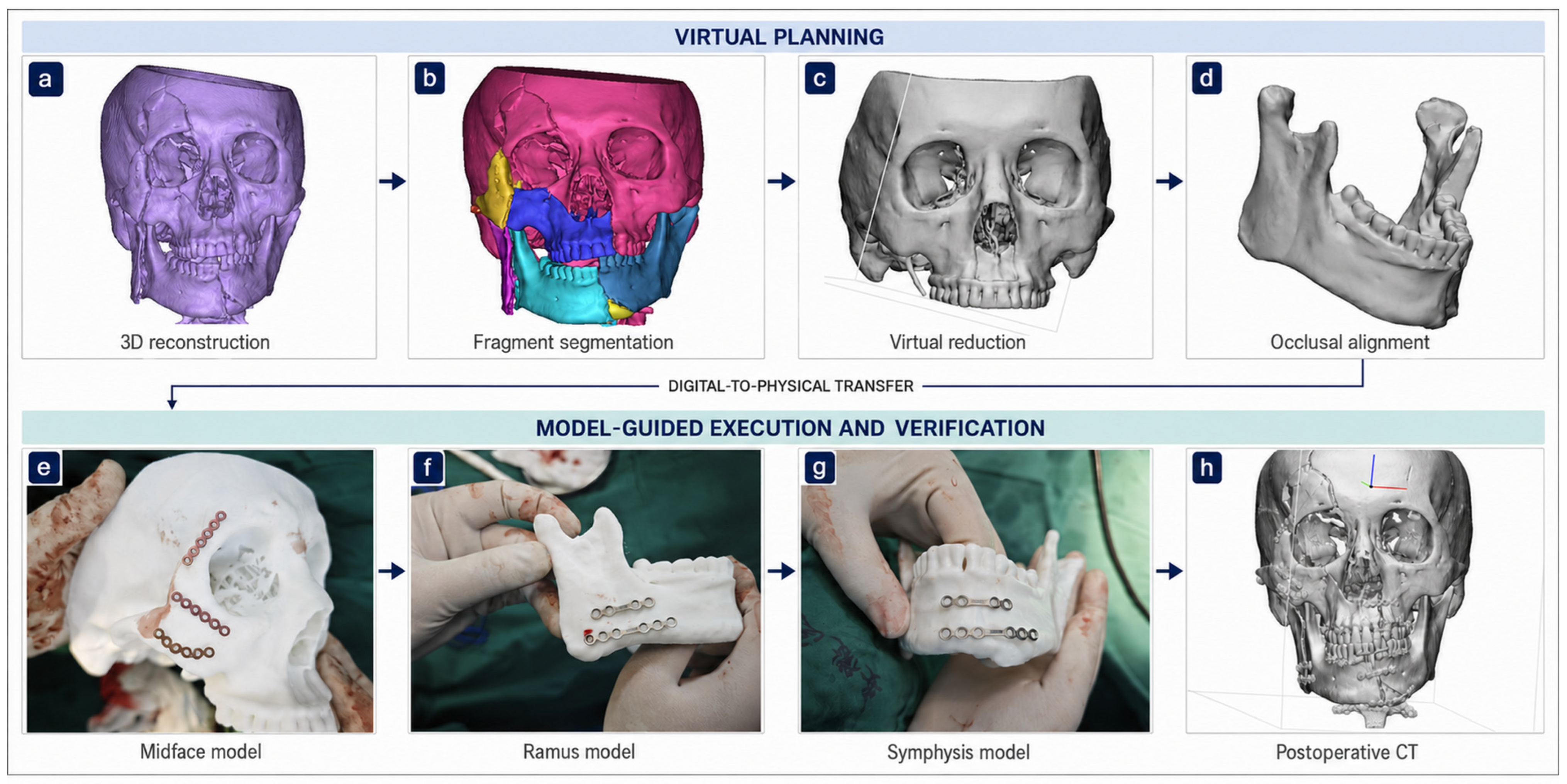
2.2. Digital Planning and Perioperative Care
2.3. Assessment Schedule and Data Sources
2.4. Twelve-Month TMD Endpoint
2.5. Injury Morphology
2.6. Definitions of Early Clinical Signs
2.7. Statistical Analysis
3. Results
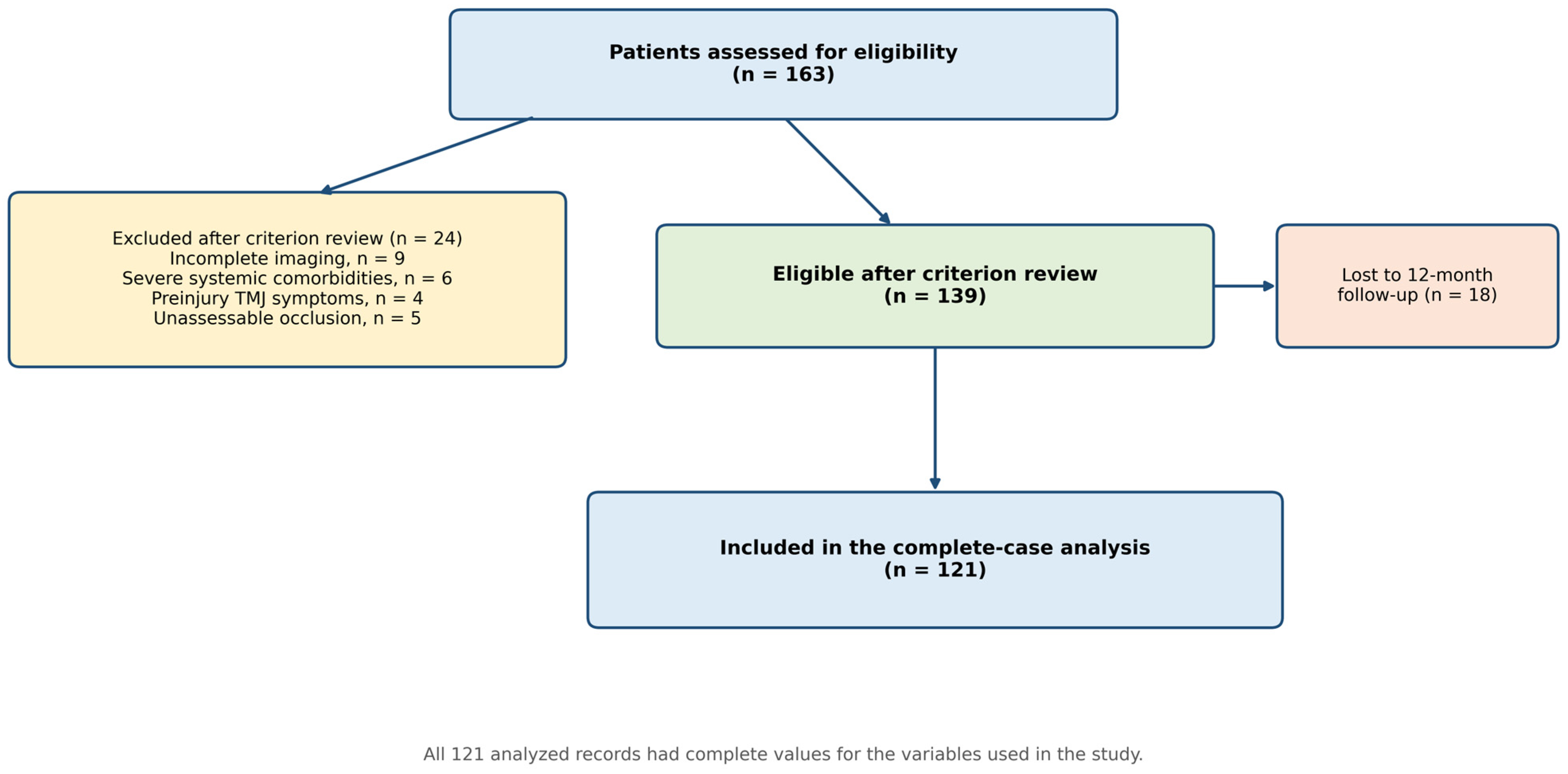
3.1. Cohort Characteristics and Data Completeness
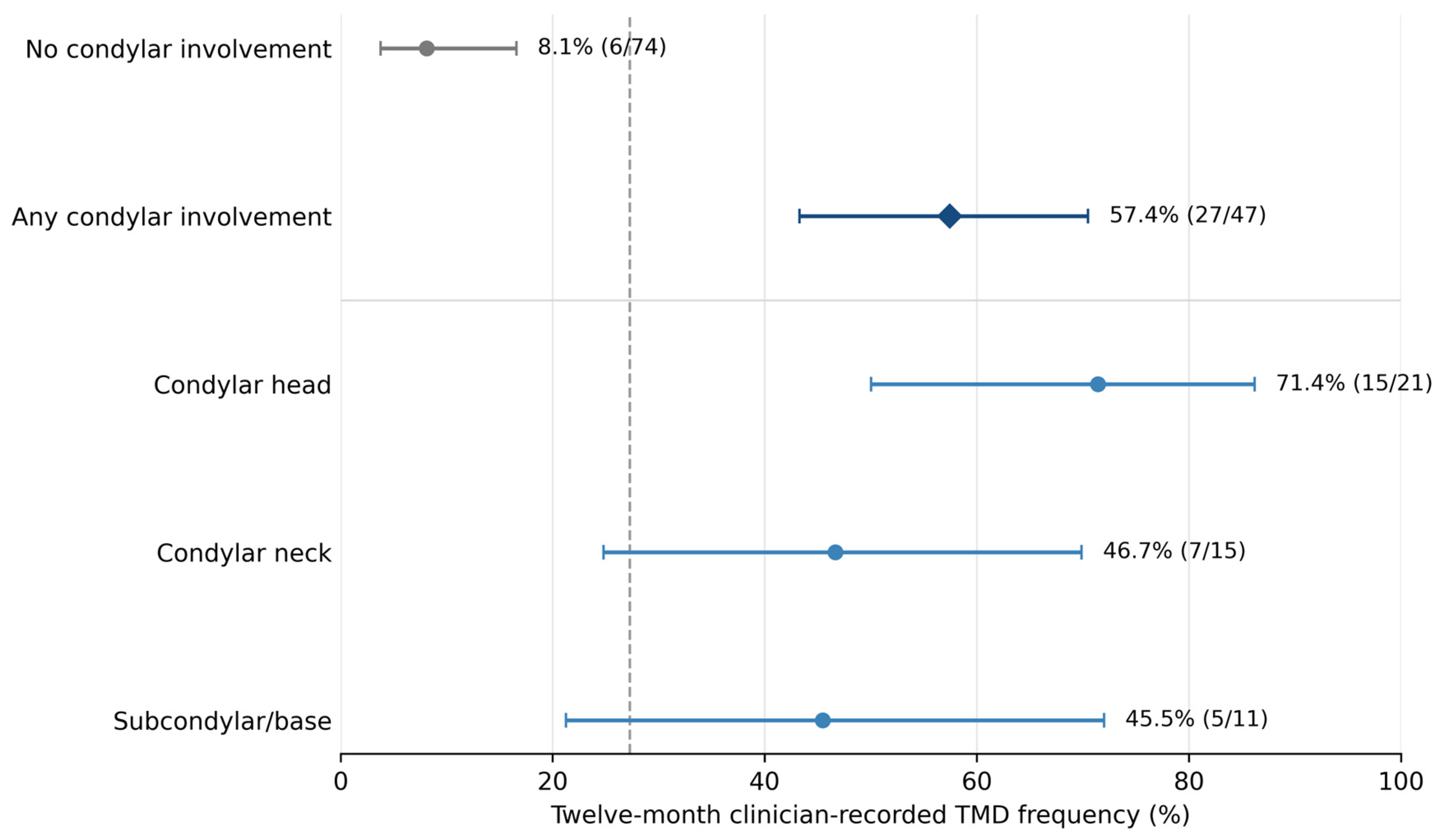
3.2. Injury Morphology and Twelve-Month TMD
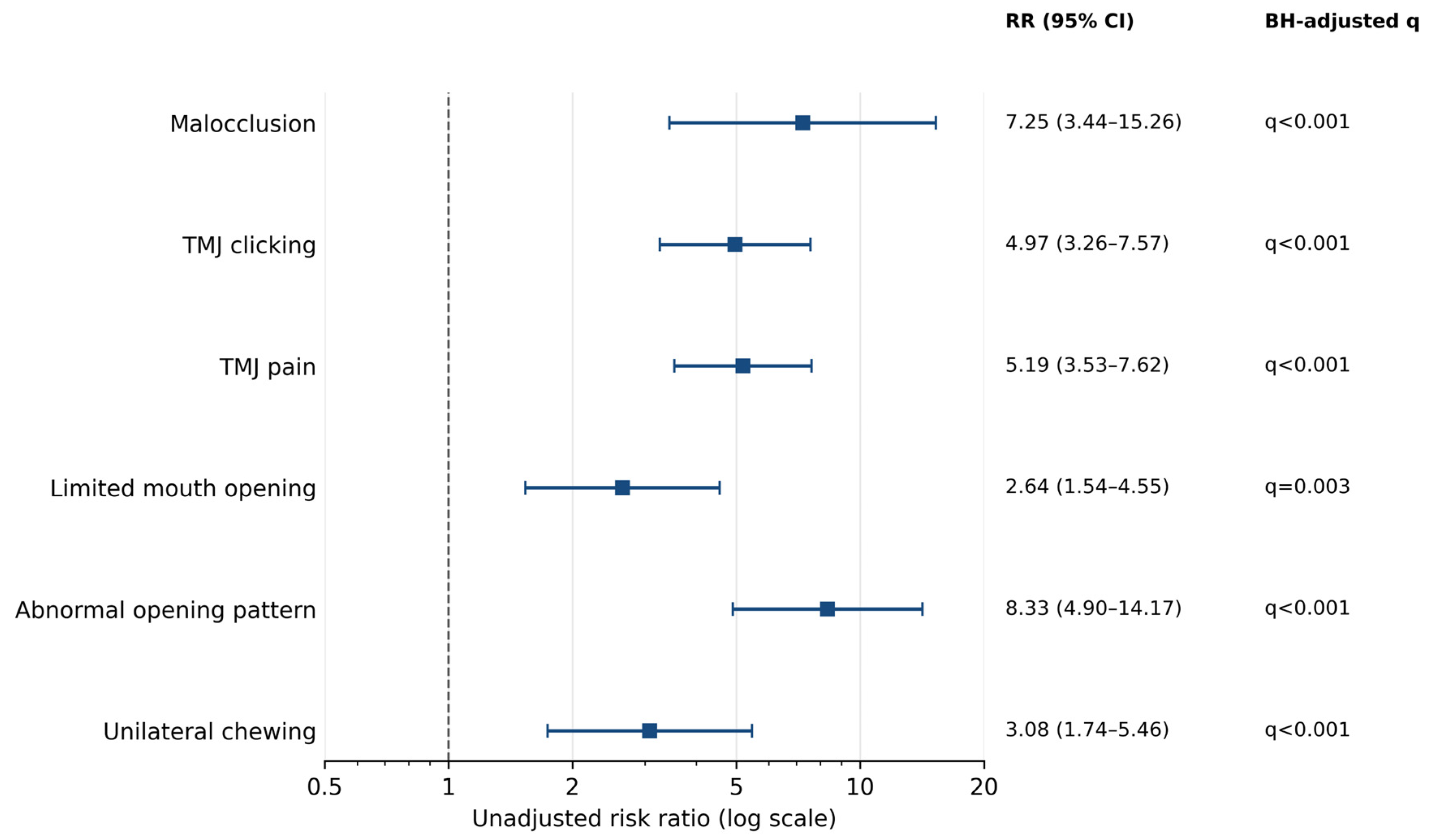
3.3. Associations of Three-Month Clinical Signs with the Twelve-Month Outcome
4. Discussion
4.1. Principal Findings
4.2. Condylar Injury and TMD
4.3. Interpretation of Early Clinical Signs
4.4. Clinical Implications
4.5. Strengths and Limitations
5. Conclusions
Supplementary Materials
Author Contributions
Funding
Institutional Review Board Statement
Informed Consent Statement
Data Availability Statement
Conflicts of Interest
References
- Juncar, R.-I.; Tent, P.A.; Harangus, A.; Juncar, M. Patterns of facial fractures and associated soft tissue injuries: A retrospective study on 1007 patients. Acta Clin. Croat. 2022, 61, 412–420. [Google Scholar] [CrossRef] [Scilit] [PubMed]
- Nogami, S.; Yamauchi, K.; Morishima, H.; Otake, Y.; Kouketsu, A.; Higuchi, K.; Hirotani, H.; Kumagai, M.; Takahashi, T. Mandible fractures and dental injuries related to road traffic accidents over a 12-year period: Retrospective multicentre study. Dent. Traumatol. 2021, 37, 223–228. [Google Scholar] [CrossRef] [Scilit] [PubMed]
- Roccia, F.; Iocca, O.; Sobrero, F.; Rae, E.; Laverick, S.; Carlaw, K.; Aquilina, P.; Bojino, A.; Romeo, I.; Duran-Valles, F.; et al. World Oral and Maxillofacial Trauma (WORMAT) project: A multicenter prospective analysis of epidemiology and patterns of maxillofacial trauma around the world. J. Stomatol. Oral Maxillofac. Surg. 2022, 123, e849–e857. [Google Scholar] [CrossRef] [Scilit] [PubMed]
- Wang, H.; Chi, Y.; Hu, Y.; Huang, Z.; Xue, H.; Hou, J.; Lin, L. Accuracy analysis of the digital occlusal relationship reconstruction workflow in patients with maxillofacial fractures: An in vitro retrospective cohort study. J. Dent. 2025, 154, 105590. [Google Scholar] [CrossRef] [Scilit] [PubMed]
- Schiffman, E.; Ohrbach, R.; Truelove, E.; Look, J.; Anderson, G.; Goulet, J.-P.; List, T.; Svensson, P.; Gonzalez, Y.; Lobbezoo, F.; et al. Diagnostic Criteria for Temporomandibular Disorders (DC/TMD) for clinical and research applications. J. Oral Facial Pain Headache 2014, 28, 6–27. [Google Scholar] [CrossRef] [Scilit] [PubMed]
- Kapos, F.P.; Exposto, F.G.; Oyarzo, J.F.; Durham, J. Temporomandibular disorders: A review of current concepts in aetiology, diagnosis and management. Oral Surg. 2020, 13, 321–334. [Google Scholar] [CrossRef] [Scilit] [PubMed]
- Dwivedi, A.N.D.; Tripathi, R.; Gupta, P.K.; Tripathi, S.; Garg, S. Magnetic resonance imaging evaluation of temporomandibular joint and associated soft tissue changes following acute condylar injury. J. Oral Maxillofac. Surg. 2012, 70, 2829–2834. [Google Scholar] [CrossRef] [Scilit] [PubMed]
- Sharma, S.; Wactawski-Wende, J.; LaMonte, M.J.; Zhao, J.; Slade, G.D.; Bair, E.; Greenspan, J.D.; Fillingim, R.B.; Maixner, W.; Ohrbach, R. Incident injury is strongly associated with subsequent incident temporomandibular disorder: Results from the OPPERA study. Pain 2019, 160, 1551–1561. [Google Scholar] [CrossRef] [Scilit] [PubMed]
- Zieliński, G.; Pająk-Zielińska, B.; Ginszt, M. A meta-analysis of the global prevalence of temporomandibular disorders. J. Clin. Med. 2024, 13, 1365. [Google Scholar] [CrossRef] [Scilit] [PubMed]
- Rajantie, H.; Snäll, J.; Thorén, H. Temporomandibular dysfunction after surgery of mandibular fractures not involving the mandibular condyle: A prospective follow-up study. J. Oral Maxillofac. Surg. 2019, 77, 1657–1662. [Google Scholar] [CrossRef] [Scilit] [PubMed]
- Resnick, E.B.; Hassan, B.A.; Er, S.B.; Pope, P.B.; Lamaris, G.A.; Grant, M.P.; Pan, J. Risk factors for postoperative complications following mandibular fracture repair. J. Craniofac. Surg. 2025, 36, 66–70. [Google Scholar] [CrossRef] [Scilit] [PubMed]
- Kong, T.H.; Chung, K.J.; Kim, Y.H. Analysis of the risk factors influencing complications in surgical treatment of mandibular fractures: A retrospective study. J. Cranio-Maxillofac. Surg. 2022, 50, 929–933. [Google Scholar] [CrossRef] [Scilit] [PubMed]
- Von Elm, E.; Altman, D.G.; Egger, M.; Pocock, S.J.; Gøtzsche, P.C.; Vandenbroucke, J.P.; Initiative, S. The Strengthening the Reporting of Observational Studies in Epidemiology (STROBE) statement: Guidelines for reporting observational studies. Lancet 2007, 370, 1453–1457. [Google Scholar] [CrossRef] [Scilit] [PubMed]
- Zou, G. A modified Poisson regression approach to prospective studies with binary data. Am. J. Epidemiol. 2004, 159, 702–706. [Google Scholar] [CrossRef] [Scilit] [PubMed]
- Gillborg, S.; Åkerman, S.; Lundegren, N.; Ekberg, E. Temporomandibular disorder pain and related factors in an adult population: A cross-sectional study in southern Sweden. J. Oral Facial Pain Headache 2017, 31, 37–45. [Google Scholar] [CrossRef] [Scilit] [PubMed]
- Goulet, J.P.; Lavigne, G.J.; Lund, J.P. Jaw pain prevalence among French-speaking Canadians in Québec and related symptoms of temporomandibular disorders. J. Dent. Res. 1995, 74, 1738–1744. [Google Scholar] [CrossRef] [Scilit] [PubMed]
- Isong, U.; Gansky, S.A.; Plesh, O. Temporomandibular joint and muscle disorder-type pain in U.S. adults: The National Health Interview Survey. J. Orofac. Pain 2008, 22, 317–322. [Google Scholar] [PubMed]
- Salinas Fredricson, A.; Krüger Weiner, C.; Ulmner, M.; Naimi-Akbar, A. Craniomaxillofacial trauma increases the risk of temporomandibular joint disorders and days of work disability—A SWEREG-TMD registry-based study. Int. J. Oral Maxillofac. Surg. 2025, 54, 549–560. [Google Scholar] [CrossRef] [Scilit] [PubMed]
- Minervini, G.; Franco, R.; Marrapodi, M.M.; Di Blasio, M.; Isola, G.; Cicciù, M. Conservative treatment of temporomandibular joint condylar fractures: A systematic review conducted according to PRISMA guidelines and the Cochrane Handbook for Systematic Reviews of Interventions. J. Oral Rehabil. 2023, 50, 886–893. [Google Scholar] [CrossRef] [Scilit] [PubMed]
- Wei, M.; Xie, Y.; Lv, B.; Niu, W. Effect of occlusal interference on condylar position and trajectory of movement: A randomized crossover-controlled trial. BMC Oral Health 2025, 25, 551. [Google Scholar] [CrossRef] [Scilit] [PubMed]
- Farrar, W.B.; McCarty, W.L., Jr. Inferior joint space arthrography and characteristics of condylar paths in internal derangements of the TMJ. J. Prosthet. Dent. 1979, 41, 548–555. [Google Scholar] [CrossRef] [Scilit] [PubMed]
- Marcelino, V.; De Rovere, S.; Paço, M.; Gonçalves, M.; Marcelino, S.; Guimarães, A.S.; Pinho, T. Masticatory function in individuals with temporomandibular disorders: A systematic review and meta-analysis. Life 2023, 13, 472. [Google Scholar] [CrossRef] [Scilit] [PubMed]
- Görürgöz, C.; İçEn, M.; Kurt, M.H.; Aksoy, S.; Bakırarar, B.; Rozylo-Kalinowska, I.; Orhan, K. Degenerative changes of the mandibular condyle in relation to the temporomandibular joint space, gender and age: A multicenter CBCT study. Dent. Med. Probl. 2023, 60, 127–135. [Google Scholar] [CrossRef] [Scilit] [PubMed]
- Sorning, F.; Manfredini, D.; Sorrenti, N.G.; Nardini, L.G.; Pollis, M.; Ferrari, M.; Val, M. Correlation between MRI-detected effusion and temporomandibular joint pain: A systematic review. Dent. Med. Probl. 2025, 62, 1201–1209. [Google Scholar] [CrossRef] [Scilit] [PubMed]
- Xu, L.; He, Y.; Fan, S.; Cai, B.; Fang, Z.; Dai, K. Validation of a Chinese version of the Jaw Functional Limitation Scale in relation to the diagnostic subgroup of temporomandibular disorders. J. Oral Rehabil. 2020, 47, 1–8. [Google Scholar] [CrossRef] [Scilit] [PubMed]
- Wang, Y.; Xu, J.; Ding, C.; Deng, T.; Shen, Z.; Huang, W.; Wan, Y.; Xing, T. The link between temporomandibular disorders and jaw functional limitations among Chinese adolescents. Int. Dent. J. 2025, 75, 554–563. [Google Scholar] [CrossRef] [Scilit] [PubMed]
- Weinberg, F.M.; Rosenberg, A.J.W.P.; Muller, B.S.; Speksnijder, C.M. Long-term masticatory performance and ability following closed treatment for unilateral mandibular condylar neck or base fractures: A cross-sectional study. Oral Maxillofac. Surg. 2023, 27, 141–149. [Google Scholar] [CrossRef] [Scilit] [PubMed]
- Manfredini, D.; Häggman-Henrikson, B.; Al Jagshi, A.; Baad-Hansen, L.; Beecroft, E.; Bijelic, T.; Bracci, A.; Brinkmann, L.; Bucci, R.; Colonna, A.; et al. Temporomandibular disorders: INfORM/IADR key points for good clinical practice based on standard of care. Cranio 2025, 43, 1–5. [Google Scholar] [CrossRef] [Scilit] [PubMed]
- Minervini, G.; Marrapodi, M.M.; Siurkel, Y.; Cicciù, M.; Ronsivalle, V. Accuracy of temporomandibular disorders diagnosis evaluated through the Diagnostic Criteria for Temporomandibular Disorders Axis II compared with Axis I evaluations: A systematic review and meta-analysis. BMC Oral Health 2024, 24, 299. [Google Scholar] [CrossRef] [Scilit] [PubMed]
- Zoabi, A.; Redenski, I.; Oren, D.; Kasem, A.; Zigron, A.; Daoud, S.; Moskovich, L.; Kablan, F.; Srouji, S. 3D printing and virtual surgical planning in oral and maxillofacial surgery. J. Clin. Med. 2022, 11, 2385. [Google Scholar] [CrossRef] [Scilit] [PubMed]



| Variable | Overall (n = 121) | TMD (n = 33) | No TMD (n = 88) | p Value |
|---|---|---|---|---|
| Age, years | 39.59 ± 13.63 | 40.18 ± 13.53 | 39.36 ± 13.74 | 0.769 |
| Male sex | 84 (69.4%) | 21 (63.6%) | 63 (71.6%) | 0.398 |
| Fracture region | 0.339 | |||
| Mandible only | 64 (52.9%) | 14 (42.4%) | 50 (56.8%) | |
| Combined maxillomandibular | 35 (28.9%) | 11 (33.3%) | 24 (27.3%) | |
| Panfacial | 22 (18.2%) | 8 (24.2%) | 14 (15.9%) | |
| Fracture etiology | 0.819 | |||
| Road traffic accident | 45 (37.2%) | 12 (36.4%) | 33 (37.5%) | |
| Fall from height | 18 (14.9%) | 6 (18.2%) | 12 (13.6%) | |
| Ground-level fall | 58 (47.9%) | 15 (45.5%) | 43 (48.9%) | |
| Condylar involvement | 47 (38.8%) | 27 (81.8%) | 20 (22.7%) | <0.001 |
| Recorded mandibular site | <0.001 † | |||
| Symphysis/parasymphysis | 27 (22.3%) | 6 (18.2%) | 21 (23.9%) | |
| Body | 28 (23.1%) | 6 (18.2%) | 22 (25.0%) | |
| Angle | 26 (21.5%) | 2 (6.1%) | 24 (27.3%) | |
| Ramus | 15 (12.4%) | 5 (15.2%) | 10 (11.4%) | |
| Condyle | 19 (15.7%) | 13 (39.4%) | 6 (6.8%) | |
| Coronoid | 6 (5.0%) | 1 (3.0%) | 5 (5.7%) | |
| Bilateral fracture | 51 (42.1%) | 11 (33.3%) | 40 (45.5%) | 0.229 |
| Displacement grade | 0.290 | |||
| No displacement | 36 (29.8%) | 7 (21.2%) | 29 (33.0%) | |
| Mild displacement | 39 (32.2%) | 10 (30.3%) | 29 (33.0%) | |
| Marked displacement | 46 (38.0%) | 16 (48.5%) | 30 (34.1%) | |
| Comminuted fracture | 21 (17.4%) | 7 (21.2%) | 14 (15.9%) | 0.591 |
| Open fracture | 63 (52.1%) | 15 (45.5%) | 48 (54.5%) | 0.418 |
| Deep overbite (baseline) | 4 (3.3%) | 4 (12.1%) | 0 (0.0%) | 0.005 |
Disclaimer/Publisher’s Note: The statements, opinions and data contained in all publications are solely those of the individual author(s) and contributor(s) and not of MDPI and/or the editor(s). MDPI and/or the editor(s) disclaim responsibility for any injury to people or property resulting from any ideas, methods, instructions or products referred to in the content. |
© 2026 by the authors. Licensee MDPI, Basel, Switzerland. This article is an open access article distributed under the terms and conditions of the Creative Commons Attribution (CC BY) license.
Share and Cite
Chi, Y.; Xie, F.; Hou, J.; Hu, Y.; Wang, H. Clinician-Recorded Temporomandibular Disorder at 12 Months After Digitally Planned Mandibular Fracture Repair: Associations with Condylar Injury and Early Functional Signs. J. Clin. Med. 2026, 15, 6426. https://doi.org/10.3390/jcm15166426
Chi Y, Xie F, Hou J, Hu Y, Wang H. Clinician-Recorded Temporomandibular Disorder at 12 Months After Digitally Planned Mandibular Fracture Repair: Associations with Condylar Injury and Early Functional Signs. Journal of Clinical Medicine. 2026; 15(16):6426. https://doi.org/10.3390/jcm15166426
Chicago/Turabian StyleChi, Yifan, Fei Xie, Jun Hou, Yukun Hu, and Honghao Wang. 2026. "Clinician-Recorded Temporomandibular Disorder at 12 Months After Digitally Planned Mandibular Fracture Repair: Associations with Condylar Injury and Early Functional Signs" Journal of Clinical Medicine 15, no. 16: 6426. https://doi.org/10.3390/jcm15166426
APA StyleChi, Y., Xie, F., Hou, J., Hu, Y., & Wang, H. (2026). Clinician-Recorded Temporomandibular Disorder at 12 Months After Digitally Planned Mandibular Fracture Repair: Associations with Condylar Injury and Early Functional Signs. Journal of Clinical Medicine, 15(16), 6426. https://doi.org/10.3390/jcm15166426