Circulating Tumor DNA for Minimal Residual Disease Detection and Recurrence Prediction in Upper Gastrointestinal Cancers: A Scoping Review

 ,
,  ,
,  ,
,  ,
,  ,
,
Abstract
1. Introduction
2. Materials and Methods
2.1. Study Design
2.2. Eligibility Criteria
- Population: Patients with histologically confirmed esophageal cancer (ESCC or EAC) or gastric cancer, with or without involvement of the gastroesophageal junction (GEJ), undergoing curative-intent treatment (surgery ± neoadjuvant or adjuvant therapy) or, where relevant, surveillance following resection.
- Intervention/Exposure: Measurement of ctDNA or cell-free DNA (cfDNA) in peripheral blood or peritoneal lavage fluid at one or more clinically relevant timepoints.
- Comparator: Studies were eligible regardless of whether a comparator group was present, given the exploratory nature of the scoping design.
- Outcomes: Studies reporting at least one of the following: recurrence rates stratified by ctDNA status; disease-free survival (DFS), recurrence-free survival (RFS), progression-free survival (PFS), or overall survival (OS) according to ctDNA status; sensitivity, specificity, or predictive values of ctDNA for recurrence detection; or lead time between ctDNA positivity and radiological or clinical confirmation of recurrence.
- Study design: Original research articles, including prospective and retrospective cohort studies, randomized controlled trial substudies, and proof-of-concept feasibility studies. Review articles, editorials, letters without original data, notes, tombstone publications, meeting or conference abstracts, book chapters, preprints, and case reports were excluded.
- Language: English-language publications only.
- Human studies only.
2.3. Search Strategy

| Database | Field Tags | Wildcard | Date Searched |
|---|---|---|---|
| PubMed | [MeSH], [tw], [tiab] | * (truncation) | 3 April 2026 |
| Scopus | TITLE-ABS-KEY () | * (truncation) | 3 April 2026 |
| Cochrane Library | :ti,ab,kw + MeSH descriptors | * (truncation) | 3 April 2026 |

2.4. Study Selection Process
2.5. Data Extraction
2.6. Quality Assessment
2.7. Data Synthesis
2.8. Use of Generative AI
3. Results
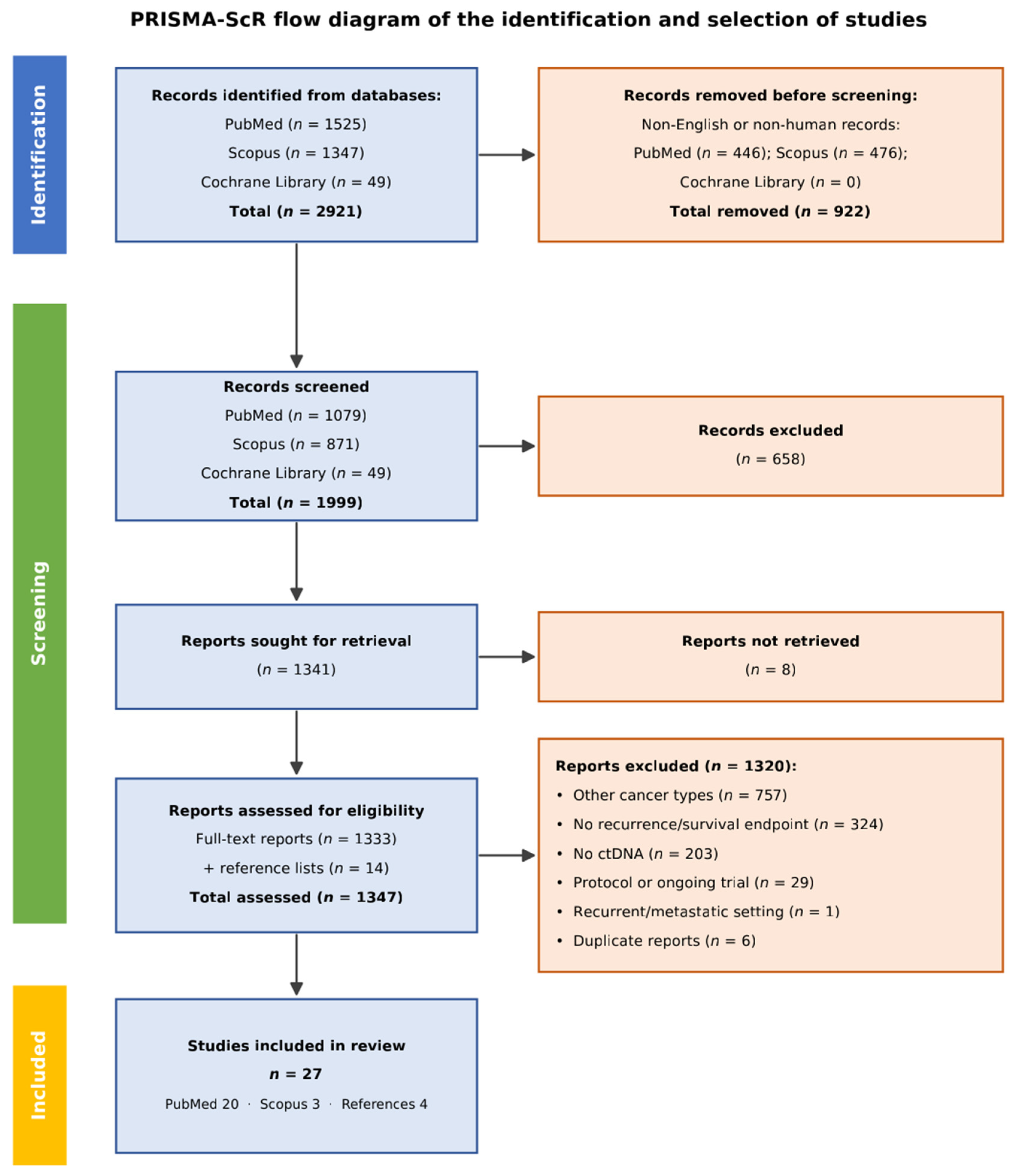
3.1. Study Selection
3.2. Characteristics of Included Studies
3.3. CtDNA Findings by Tumor Type
3.3.1. Esophageal Squamous Cell Carcinoma (ESCC)
3.3.2. Esophageal Adenocarcinoma (EAC)
3.3.3. Gastric Cancer (GC)
3.3.4. Mixed Upper Gastrointestinal Tumors
4. Discussion
4.1. Principal Findings
4.2. Comparison with Existing Literature
4.3. Clinical Implications
4.4. Limitations
4.5. Future Directions
5. Conclusions
Supplementary Materials
Author Contributions
Funding
Institutional Review Board Statement
Informed Consent Statement
Data Availability Statement
Acknowledgments
Conflicts of Interest
References
- Bray, F.; Laversanne, M.; Sung, H.; Ferlay, J.; Siegel, R.L.; Soerjomataram, I.; Jemal, A. Global cancer statistics 2022: GLOBOCAN estimates of incidence and mortality worldwide for 36 cancers in 185 countries. CA Cancer J. Clin. 2024, 74, 229–263. [Google Scholar] [CrossRef] [PubMed]
- Morgan, E.; Soerjomataram, I.; Rumgay, H.; Coleman, H.G.; Thrift, A.P.; Vignat, J.; Laversanne1, M.; Ferlay, J.; Arnold, M. The global landscape of esophageal squamous cell carcinoma and esophageal adenocarcinoma incidence and mortality in 2020 and projections to 2040: New estimates from GLOBOCAN 2020. Gastroenterology 2022, 163, 649–658.e2. [Google Scholar] [CrossRef] [PubMed]
- Arnold, M.; Soerjomataram, I.; Ferlay, J.; Forman, D. Global incidence of oesophageal cancer by histological subtype in 2012. Gut 2015, 64, 381–387. [Google Scholar] [CrossRef] [PubMed]
- Al-Batran, S.E.; Homann, N.; Pauligk, C.; Goetze, T.O.; Meiler, J.; Kasper, S.; Kopp, H.G.; Mayer, F.; Haag, G.M.; Luley, K.; et al. Perioperative chemotherapy with fluorouracil plus leucovorin, oxaliplatin, and docetaxel versus fluorouracil or capecitabine plus cisplatin and epirubicin for locally advanced, resectable gastric or gastro-oesophageal junction adenocarcinoma (FLOT4): A randomised, phase 2/3 trial. Lancet 2019, 393, 1948–1957. [Google Scholar] [CrossRef] [PubMed]
- Cunningham, D.; Allum, W.H.; Stenning, S.P.; Thompson, J.N.; Van de Velde, C.J.H.; Nicolson, M.; Scarffe, J.H.; Lofts, F.J.; Falk, S.J.; Iveson, T.J.; et al. Perioperative chemotherapy versus surgery alone for resectable gastroesophageal cancer. N. Engl. J. Med. 2006, 355, 11–20. [Google Scholar] [CrossRef] [PubMed]
- Eyck, B.M.; van Lanschot, J.J.B.; Hulshof, M.C.C.M.; van der Wilk, B.J.; Shapiro, J.; van Hagen, P.; van Berge Henegouwen, M.I.; Wijnhoven, B.P.L.; van Laarhoven, H.W.M.; Nieuwenhuijzen, G.A.P. Ten-year outcome of neoadjuvant chemoradiotherapy plus surgery for esophageal cancer: The randomized controlled CROSS trial. J. Clin. Oncol. 2021, 39, 1995–2004. [Google Scholar] [CrossRef] [PubMed]
- van Hagen, P.; Hulshof, M.C.C.M.; van Lanschot, J.J.B.; Steyerberg, E.W.; van Berge Henegouwen, M.I.; Wijnhoven, B.P.L.; Richel, D.J.; Nieuwenhuijzen, G.A.; Hospers, G.A.; Bonenkamp, J.J.; et al. Preoperative chemoradiotherapy for esophageal or junctional cancer. N. Engl. J. Med. 2012, 366, 2074–2084. [Google Scholar] [CrossRef] [PubMed]
- Liu, D.; Lu, M.; Li, J.; Yang, Z.; Feng, Q.; Zhou, M.; Zhang, Z.; Shen, L. The patterns and timing of recurrence after curative resection for gastric cancer in China. World J. Surg. Oncol. 2016, 14, 305. [Google Scholar] [CrossRef] [PubMed]
- Baiocchi, G.L.; Marrelli, D.; Verlato, G.; Morgagni, P.; Giacopuzzi, S.; Coniglio, A.; Marchet, A.; Rosa, F.; Capponi, M.G.; Di Leo, A.; et al. Follow-up after gastrectomy for cancer: An appraisal of the Italian research group for gastric cancer. Ann. Surg. Oncol. 2014, 21, 2005–2011. [Google Scholar] [CrossRef] [PubMed]
- Smyth, E.C.; Nilsson, M.; Grabsch, H.I.; van Grieken, N.C.T.; Lordick, F. Gastric cancer. Lancet 2020, 396, 635–648. [Google Scholar] [CrossRef] [PubMed]
- Obermannová, R.; Alsina, M.; Cervantes, A.; Leong, T.; Lordick, F.; Nilsson, M.; van Grieken, N.C.T.; Vogel, A.; Smyth, E.C. ESMO Guidelines Committee. Oesophageal cancer: ESMO Clinical Practice Guideline for diagnosis, treatment and follow-up. Ann. Oncol. 2022, 33, 992–1004. [Google Scholar] [CrossRef] [PubMed]
- Shibata, C.; Nakano, T.; Yasumoto, A.; Mitamura, A.; Sawada, K.; Ogawa, H.; Miura, T.; Ise, I.; Takami, K.; Yamamoto, K.; et al. Comparison of CEA and CA19-9 as a predictive factor for recurrence after curative gastrectomy in gastric cancer. BMC Surg. 2022, 22, 213. [Google Scholar] [CrossRef] [PubMed]
- Kim, D.W.; Park, S.A.; Kim, C.G. Detecting the recurrence of gastric cancer after curative resection: Comparison of FDG PET/CT and contrast-enhanced abdominal CT. J. Korean Med. Sci. 2011, 26, 875–880. [Google Scholar] [CrossRef] [PubMed]
- Stejskal, P.; Goodarzi, H.; Srovnal, J.; Hajdúch, M.; van ’t Veer, L.J.; Magbanua, M.J.M. Circulating tumor nucleic acids: Biology, release mechanisms, and clinical relevance. Mol. Cancer 2023, 22, 15. [Google Scholar] [CrossRef] [PubMed]
- Wan, J.C.M.; Massie, C.; Garcia-Corbacho, J.; Mouliere, F.; Brenton, J.D.; Caldas, C.; Pacey, S.; Baird, R.; Rosenfeld, N. Liquid biopsies come of age: Towards implementation of circulating tumour DNA. Nat. Rev. Cancer 2017, 17, 223–238. [Google Scholar] [CrossRef] [PubMed]
- Bettegowda, C.; Sausen, M.; Leary, R.J.; Kinde, I.; Wang, Y.; Agrawal, N.; Bartlett, B.R.; Wang, H.; Luber, B.; Alani, R.M.; et al. Detection of circulating tumor DNA in early- and late-stage human malignancies. Sci. Transl. Med. 2014, 6, 224ra24. [Google Scholar] [CrossRef] [PubMed]
- Newman, A.M.; Bratman, S.V.; To, J.; Wynne, J.F.; Eclov, N.C.W.; Modlin, L.A.; Liu, C.L.; Neal, J.W.; Wakelee, H.A.; Merritt, R.E.; et al. An ultrasensitive method for quantitating circulating tumor DNA with broad patient coverage. Nat. Med. 2014, 20, 548–554. [Google Scholar] [CrossRef] [PubMed]
- Widman, A.J.; Shah, M.; Frydendahl, A.; Halmos, D.; Khamnei, C.C.; Øgaard, N.; Rajagopalan, S.; Arora, A.; Deshpande, A.; Hooper, W.F.; et al. Ultrasensitive plasma-based monitoring of tumor burden using machine-learning-guided signal enrichment. Nat. Med. 2024, 30, 1655–1666. [Google Scholar] [CrossRef] [PubMed]
- Tie, J.; Wang, Y.; Tomasetti, C.; Li, L.; Springer, S.; Kinde, I.; Silliman, N.; Tacey, M.; Wong, H.L.; Christie, M.; et al. Circulating tumor DNA analysis detects minimal residual disease and predicts recurrence in patients with stage II colon cancer. Sci. Transl. Med. 2016, 8, 346ra92. [Google Scholar] [CrossRef] [PubMed]
- Reinert, T.; Henriksen, T.V.; Christensen, E.; Sharma, S.; Salari, R.; Sethi, H.; Knudsen, M.; Nordentoft, I.; Wu, H.T.; Tin, A.S.; et al. Analysis of plasma cell-free DNA by ultradeep sequencing in patients with stages I to III colorectal cancer. JAMA Oncol. 2019, 5, 1124–1131. [Google Scholar] [CrossRef] [PubMed]
- Kotani, D.; Oki, E.; Nakamura, Y.; Yukami, H.; Mishima, S.; Bando, H.; Shirasu, H.; Yamazaki, K.; Watanabe, J.; Kotaka, M.; et al. Molecular residual disease and efficacy of adjuvant chemotherapy in patients with colorectal cancer. Nat. Med. 2023, 29, 127–134. [Google Scholar] [CrossRef] [PubMed]
- Tie, J.; Cohen, J.D.; Lahouel, K.; Lo, S.N.; Wang, Y.; Kosmider, S.; Wong, R.; Shapiro, J.; Lee, M.; Harris, S.; et al. Circulating tumor DNA analysis guiding adjuvant therapy in stage II colon cancer. N. Engl. J. Med. 2022, 386, 2261–2272. [Google Scholar] [CrossRef] [PubMed]
- Zhang, H.; Jin, T.; Peng, Y.; Luan, S.; Li, X.; Xiao, X.; Yuan, Y. Association between plasma circulating tumor DNA and the prognosis of esophageal cancer patients: A meta-analysis. Int. J. Surg. 2024, 110, 4370–4381. [Google Scholar] [CrossRef] [PubMed]
- Shen, T.; Li, T.; Cao, Y.; Zhang, Y.; Li, H. Circulating tumor DNA as a biomarker for progression and survival in esophageal cancer after neoadjuvant therapy and esophagectomy: A systematic review and meta-analysis. Int. J. Surg. 2025, 111, 8515–8522. [Google Scholar] [CrossRef] [PubMed]
- Mi, J.; Wang, R.; Han, X.; Ma, R.; Li, H. Circulating tumor DNA predicts recurrence and assesses prognosis in operable gastric cancer: A systematic review and meta-analysis. Medicine 2023, 102, e36228. [Google Scholar] [CrossRef] [PubMed]
- Tricco, A.C.; Lillie, E.; Zarin, W.; O’Brien, K.K.; Colquhoun, H.; Levac, D.; Moher, D.; Peters, M.D.J.; Horsley, T.; Weeks, L.; et al. PRISMA extension for scoping reviews (PRISMA-ScR): Checklist and explanation. Ann. Intern Med. 2018, 169, 467–473. [Google Scholar] [CrossRef] [PubMed]
- Arksey, H.; O’Malley, L. Scoping studies: Towards a methodological framework. Int. J. Soc. Res. Methodol. 2005, 8, 19–32. [Google Scholar] [CrossRef]
- Levac, D.; Colquhoun, H.; O’Brien, K.K. Scoping studies: Advancing the methodology. Implement Sci. 2010, 5, 69. [Google Scholar] [CrossRef] [PubMed]
- Wells, G.A.; Shea, B.; O’Connell, D.; Peterson, J.; Welch, V.; Losos, M.; Tugwell, P. The Newcastle-Ottawa Scale (NOS) for Assessing the Quality of Nonrandomised Studies in Meta-Analyses; Ottawa Hospital Research Institute: Ottawa, ON, Canada, 2025; Available online: http://www.ohri.ca/programs/clinical_epidemiology/oxford.asp (accessed on 15 May 2026).
- Fang, C.Y.; Wen, J.; Wu, J.D.; Li, Z.C.; Huang, S.; Huang, Y.; Chen, J.Y.; Su, H.L.; Xie, X.Y.; Luo, K.J.; et al. Circulating tumor DNA as a marker of molecular residual disease in resected esophageal squamous cell carcinoma. Mol. Biomed. 2025, 6, 65. [Google Scholar] [CrossRef] [PubMed]
- Li, J.; Wu, C.; Song, Y.; Fan, Y.; Li, C.; Li, H.; Zhang, S. Exploring the clinical value of perioperative ctDNA-based detection of molecular residual disease in patients with esophageal squamous cell carcinoma. Thorac. Cancer 2025, 16, e70017. [Google Scholar] [CrossRef] [PubMed]
- Gu, R.; Liu, T.; Cheng, W.; Li, M.; Wang, X.; Jin, H. Gene-specific ctDNA dynamics predict tumour burden and survival outcomes in ESCC: A prospective cohort study. Clin. Transl. Med. 2025, 15, e70446. [Google Scholar] [CrossRef] [PubMed]
- Jiao, H.; Lin, S.; Gu, J.; Jiang, D.; Cui, P.; Huang, Z.; Fang, Y.; Wang, H.; Lin, M.; Tang, H.; et al. Perioperative nivolumab and chemotherapy in locally advanced squamous cell carcinoma of the oesophagus: A randomized multicentre phase 2 study with circulating tumor DNA dynamics monitoring. Mol. Cancer 2025, 24, 143. [Google Scholar] [CrossRef] [PubMed]
- Ko, J.M.; Guo, C.; Leung, A.K.; Chan, S.C.; Lo, A.W.; Tao, L.; Ng, H.Y.; Wong, C.W.; Law, S.; Wong, I.Y.; et al. Oncogenic NFE2L2 mutations in plasma ctDNA and tumors are predictors and prognosticators of chemoradiation therapy in resectable esophageal squamous cell carcinoma. Br. J. Cancer 2025, 133, 1046–1055. [Google Scholar] [CrossRef] [PubMed]
- Yang, Y.; Liu, Z.; Wong, I.; Gao, X.; Zhang, H.; Liu, J.; Eyck, B.M.; Shao, J.; Han, Y.; van der Wilk, B.J.; et al. Detecting residual disease after neoadjuvant chemoradiotherapy for oesophageal squamous cell carcinoma: The prospective multicentre preSINO trial. Br. J. Surg. 2025, 112, znaf004. [Google Scholar] [CrossRef] [PubMed]
- Chen, B.; Liu, S.; Zhu, Y.; Wang, R.; Cheng, X.; Chen, B.; Dragomir, M.P.; Zhang, Y.; Hu, Y.; Liu, M.; et al. Predictive role of ctDNA in esophageal squamous cell carcinoma receiving definitive chemoradiotherapy combined with toripalimab. Nat. Commun. 2024, 15, 1919. [Google Scholar] [CrossRef] [PubMed]
- Yue, P.; Bie, F.; Zhu, J.; Gao, L.R.; Zhou, Z.; Bai, G.; Wang, X.; Zhao, Z.; Xiao, Z.F.; Li, Y.; et al. Minimal residual disease profiling predicts pathological complete response in esophageal squamous cell carcinoma. Mol. Cancer 2024, 23, 96. [Google Scholar] [CrossRef] [PubMed]
- Wang, X.; Yu, N.; Cheng, G.; Zhang, T.; Wang, J.; Deng, L.; Li, J.; Zhao, X.; Xu, Y.; Yang, P.; et al. Prognostic value of circulating tumour DNA during post-radiotherapy surveillance in locally advanced esophageal squamous cell carcinoma. Clin. Transl. Med. 2022, 12, e1116. [Google Scholar] [CrossRef] [PubMed]
- Liu, T.; Yao, Q.; Jin, H. Plasma circulating tumor DNA sequencing predicts minimal residual disease in resectable esophageal squamous cell carcinoma. Front. Oncol. 2021, 11, 616209. [Google Scholar] [CrossRef] [PubMed]
- Schoofs, K.; Ferro Dos Santos, M.R.; De Wilde, J.; Roelandt, S.; Van de Velde, S.; Decruyenaere, P.; Meuris, L.; Thas, O.; Philippron, A.; Depypere, L.; et al. Therapy response monitoring in blood plasma from esophageal adenocarcinoma patients using cell-free DNA methylation profiling. Sci. Rep. 2024, 14, 31112. [Google Scholar] [CrossRef] [PubMed]
- Ococks, E.; Frankell, A.M.; Masque Soler, N.; Grehan, N.; Northrop, A.; Coles, H.; Redmond, A.M.; Devonshire, G.; Weaver, J.M.J.; Hughes, C.; et al. Longitudinal tracking of 97 esophageal adenocarcinomas using liquid biopsy sampling. Ann. Oncol. 2021, 32, 522–532. [Google Scholar] [CrossRef] [PubMed]
- Ococks, E.; Sharma, S.; Ng, A.W.T.; Aleshin, A.; Fitzgerald, R.C.; Smyth, E. Serial circulating tumor DNA detection using a personalized, tumor-informed assay in esophageal adenocarcinoma patients following resection. Gastroenterology 2021, 161, 1705–1708.e2. [Google Scholar] [CrossRef] [PubMed]
- Hofste, L.S.M.; Geerlings, M.J.; von Rhein, D.; Tolmeijer, S.H.; Weiss, M.M.; Gilissen, C.; Hofste, T.; Garms, L.M.; Janssen, M.J.R.; Rütten, H.; et al. Circulating tumor DNA-based disease monitoring of patients with locally advanced esophageal cancer. Cancers 2022, 14, 4417. [Google Scholar] [CrossRef] [PubMed]
- Bai, L.; Ni, B.; Shen, X.; Zhang, Y.; Guan, Y.; Gu, J.; Zhang, H.; Aimaiti, M.; Wang, S.; Yue, B.; et al. Effectiveness of circulating tumor cells and circulating tumor DNA in peritoneal lavage fluid for predicting metachronous peritoneal metastasis of gastric cancer. Transl. Res. 2025, 283, 13–21. [Google Scholar] [CrossRef] [PubMed]
- Liu, Z.; Shi, Z.; Jiang, W.; Shen, Z.; Chen, W.; Shen, K.; Tang, Z.; Wang, X. Circulating tumor DNA analysis for prediction of prognosis and molecular insights in patients with resectable gastric cancer: Results from a prospective study. MedComm (2020) 2025, 6, e70065. [Google Scholar] [CrossRef] [PubMed]
- Yuan, S.Q.; Nie, R.C.; Huang, Y.S.; Chen, Y.B.; Wang, S.Y.; Sun, X.W.; Li, Y.F.; Liu, Z.K.; Chen, Y.X.; Yao, Y.C.; et al. Residual circulating tumor DNA after adjuvant chemotherapy effectively predicts recurrence of stage II-III gastric cancer. Cancer Commun. 2023, 43, 1312–1325. [Google Scholar] [CrossRef] [PubMed]
- Zhou, H.; Liu, H.; Li, J.; Wang, J.; Fu, X.; Li, Y.; Mao, S.; Du, J. Postoperative circulating tumor DNA detection and CBLB mutations are prognostic biomarkers for gastric cancer. Genes Genom. 2023, 45, 1037–1046. [Google Scholar] [CrossRef] [PubMed]
- Yang, J.; Gong, Y.; Lam, V.K.; Shi, Y.; Guan, Y.; Zhang, Y.; Ji, L.; Chen, Y.; Zhao, Y.; Qian, F.; et al. Deep sequencing of circulating tumor DNA detects molecular residual disease and predicts recurrence in gastric cancer. Cell Death Dis. 2020, 11, 346. [Google Scholar] [CrossRef] [PubMed]
- Leal, A.; van Grieken, N.C.T.; Palsgrove, D.N.; Phallen, J.; Medina, J.E.; Hruban, C.; Broeckaert, M.A.M.; Anagnostou, V.; Adleff, V.; Bruhm, D.C.; et al. White blood cell and cell-free DNA analyses for detection of residual disease in gastric cancer. Nat. Commun. 2020, 11, 525. [Google Scholar] [CrossRef] [PubMed]
- Kim, Y.W.; Kim, Y.H.; Song, Y.; Kim, H.S.; Sim, H.W.; Poojan, S.; Eom, B.W.; Kook, M.C.; Joo, J.; Hong, K.M. Monitoring circulating tumor DNA by analyzing personalized cancer-specific rearrangements to detect recurrence in gastric cancer. Exp. Mol. Med. 2019, 51, 1–10. [Google Scholar] [CrossRef] [PubMed]
- Cabel, L.; Decraene, C.; Bieche, I.; Pierga, J.Y.; Bennamoun, M.; Fuks, D.; Ferraz, J.M.; Lefevre, M.; Baulande, S.; Bernard, V.; et al. Limited sensitivity of circulating tumor DNA detection by droplet digital PCR in non-metastatic operable gastric cancer patients. Cancers 2019, 11, 396. [Google Scholar] [CrossRef] [PubMed]
- Zaanan, A.; Didelot, A.; Broudin, C.; Laliotis, G.; Spickart, E.; Dutta, P.; Saltel-Fulero, A.; Sullo, F.G.; Pizzamiglio, M.; Mariani, A.; et al. Longitudinal circulating tumor DNA analysis during treatment of locally advanced resectable gastric or gastroesophageal junction adenocarcinoma: The PLAGAST prospective biomarker study. Nat. Commun. 2025, 16, 6815. [Google Scholar] [CrossRef] [PubMed]
- Hu, Q.; Kimura, Y.; Ikeda, S.; Tanaka, Y.; Nakanoko, T.; Ota, M.; Yoshizumi, T.; Eto, M.; Oki, E. Circulating tumor DNA monitoring detects minimal residual disease and predicts outcomes in patients with esophageal adenocarcinoma or squamous cell carcinoma after esophagectomy. BJC Rep. 2025, 3, 52. [Google Scholar] [CrossRef] [PubMed]
- Iden, C.R.; Mustafa, S.M.; Øgaard, N.; Henriksen, T.; Jensen, S.Ø.; Ahlborn, L.B.; Egebjerg, K.; Baeksgaard, L.; Garbyal, R.S.; Nedergaard, M.K.; et al. Circulating tumor DNA predicts recurrence and survival in patients with resectable gastric and gastroesophageal junction cancer. Gastric Cancer 2025, 28, 83–95. [Google Scholar] [CrossRef] [PubMed]
- Lander, E.M.; Aushev, V.N.; Huffman, B.M.; Hanna, D.; Dutta, P.; Ferguson, J.; Sharma, S.; Jurdi, A.; Liu, M.C.; Eng, C.; et al. Circulating tumor DNA as a prognostic biomarker for recurrence in patients with locoregional esophagogastric cancers with a pathologic complete response. JCO Precis. Oncol. 2024, 8, e2400288. [Google Scholar] [CrossRef] [PubMed]
- Huffman, B.M.; Aushev, V.N.; Budde, G.L.; Chao, J.; Dayyani, F.; Hanna, D.; Botta, G.P.; Catenacci, D.V.T.; Maron, S.B.; Krinshpun, S.; et al. Analysis of circulating tumor DNA to predict risk of recurrence in patients with esophageal and gastric cancers. JCO Precis. Oncol. 2022, 6, e2200420. [Google Scholar] [CrossRef] [PubMed]
- Wang, M.; Xiong, C.; Wang, S.; Qiu, Y.; Hou, Z.; Gao, P. Circulating tumor DNA predicts prognosis at different time points in patients with esophageal cancer: A systematic review and meta-analysis. Front. Oncol. 2025, 15, 1608872. [Google Scholar] [CrossRef] [PubMed]
- Alix-Panabières, C.; Pantel, K. Clinical applications of circulating tumor cells and circulating tumor DNA as liquid biopsy. Cancer Discov. 2016, 6, 479–491. [Google Scholar] [CrossRef] [PubMed]
- Allan, Z.; Liu, D.S.; Lee, M.M.; Tie, J.; Clemons, N.J. A practical approach to interpreting circulating tumor DNA in the management of gastrointestinal cancers. Clin. Chem. 2024, 70, 49–59. [Google Scholar] [CrossRef] [PubMed]
- Lee, M.S.; Kaseb, A.O.; Pant, S. The emerging role of circulating tumor DNA in non-colorectal gastrointestinal cancers. Clin. Cancer Res. 2023, 29, 3267–3274. [Google Scholar] [CrossRef] [PubMed]
- Zhao, Y.; Zhang, Z.; Qiu, J.H.; Li, R.Y.; Sun, Z.G. Catching cancer signals in the blood: Innovative pathways for early esophageal cancer diagnosis. World J. Gastroenterol. 2025, 31, 101838. [Google Scholar] [CrossRef] [PubMed]
- Liu, M.C.; Oxnard, G.R.; Klein, E.A.; Swanton, C.; Seiden, M.V.; Consortium, C.C.G.A. Sensitive and specific multi-cancer detection and localization using methylation signatures in cell-free DNA. Ann. Oncol. 2020, 31, 745–759. [Google Scholar] [CrossRef] [PubMed]
- Nors, J.; Henriksen, T.V.; Gotschalck, K.A.; Juul, T.; Søgaard, J.; Iversen, L.H.; Andersen, C.L. IMPROVE-IT2: Implementing noninvasive circulating tumor DNA analysis to optimize the operative and postoperative treatment for patients with colorectal cancer – intervention trial 2. Study protocols. Acta Oncol. 2020, 59, 336–341. [Google Scholar] [CrossRef] [PubMed]
- Pascual, J.; Attard, G.; Bidard, F.C.; Curigliano, G.; De Mattos-Arruda, L.; Diehn, M.; Italiano, A.; Lindberg, J.; Merker, J.D.; Montagut, C.; et al. ESMO recommendations on the use of circulating tumour DNA assays for patients with cancer: A report from the ESMO Precision Medicine Working Group. Ann. Oncol. 2022, 33, 750–768. [Google Scholar] [CrossRef] [PubMed]
- Merker, J.D.; Oxnard, G.R.; Compton, C.; Diehn, M.; Hurley, P.; Lazar, A.J.; Lindeman, N.; Lockwood, C.M.; Rai, A.J.; Schilsky, R.L.; et al. Circulating tumor DNA analysis in patients with cancer: American Society of Clinical Oncology and College of American Pathologists joint review. J. Clin. Oncol. 2018, 36, 1631–1641. [Google Scholar] [CrossRef] [PubMed]
- Dasari, A.; Morris, V.K.; Allegra, C.J.; Atreya, C.; Benson, A.B., 3rd; Boland, P.; Chung, K.; Copur, M.S.; Corcoran, R.B.; Deming, D.A.; et al. ctDNA applications and integration in colorectal cancer: An NCI Colon and Rectal–Anal Task Forces whitepaper. Nat. Rev. Clin. Oncol. 2020, 17, 757–770. [Google Scholar] [CrossRef] [PubMed]
- Best, M.G.; Sol, N.; Kooi, I.; Tannous, J.; Westerman, B.A.; Rustenburg, F.; Schellen, P.; Verschueren, H.; Post, E.; Koster, J.; et al. RNA-Seq of tumor-educated platelets enables blood-based pan-cancer, multiclass, and molecular pathway cancer diagnostics. Cancer Cell 2015, 28, 666–676. [Google Scholar] [CrossRef] [PubMed]
- Cohen, J.D.; Li, L.; Wang, Y.; Thoburn, C.; Afsari, B.; Danilova, L.; Douville, C.; Javed, A.A.; Wong, F.; Mattox, A.; et al. Detection and localization of surgically resectable cancers with a multi-analyte blood test. Science 2018, 359, 926–930. [Google Scholar] [CrossRef] [PubMed]
- Abbosh, C.; Birkbak, N.J.; Wilson, G.A.; Jamal-Hanjani, M.; Constantin, T.; Salari, R.; Le Quesne, J.; Moore, D.A.; Veeriah, S.; Rosenthal, R.; et al. Phylogenetic ctDNA analysis depicts early-stage lung cancer evolution. Nature 2017, 545, 446–451. [Google Scholar] [CrossRef] [PubMed]

| (a) | |||||||
| Author/Year | Country | Study Design | N | M/F | Median Age | Median FUP (m) | Stage |
| Fang C.Y./2025 [30] | P.R. China | Retrospective | 125 | 95/30 | 63 | 40.0 | II: 68; III: 48; IVA: 9 |
| Jimin Li/2025 [31] | P.R. China | Prospective | 35 | 18/17 | 57 | 24 | I: 6; II: 19; III: 10 |
| Rentong Gu/2025 [32] | P.R. China | Prospective | 54 | 44/10 | 65 | 36 | I: 14; II: 16; III: 22; IVA: 2 |
| Heng Jiao/2025 [33] | P.R. China | Prospective RCT | 65 | NR | NR | 24.9 | NR |
| Ko J.M.Y./2025 [34] | P.R. China | Prospective | 52 | NR | NR | ≥60 | NR |
| Yang Yang/2025 [35] | P.R. China | Prospective | 132 | 111/21 | 65 | 12 | NR |
| Baoqing Chen/2024 [36] | P.R. China | Prospective | 42 | 32/10 | NR | 27.6 | I-III: 62% (26/42); IVA: 38% (16/42) |
| Pinli Yue/2024 [37] | P.R. China | Prospective RCT | 38 | 32/6 | 62 | 17 | II: 10; III: 27; IVA: 1 |
| Xin Wang/2022 [38] | P.R. China | Prospective | 40 | 34/6 | 64 | 20.6 | II: 2; III: 23; IVA: 6; IVB: 9 |
| Liu T./2021 [39] | P.R. China | Retrospective | 53 | 44/9 | 65 | 34.8 | I: 12; II: 22; III: 19 |
| (b) | |||||||
| Author/Year | Country | Study Design | N | M/F | Median Age | Median FUP (m) | Stage |
| Schoofs K./2024 [40] | Belgium | Prospective observational | 33 | 28/5 | NR | NR | NR |
| Ococks E./2021 [41] (Ann Oncol) | UK | Prospective national cohort | 97 | 83/14 | 68.2 | 32.9 | All cT3/T4 |
| Ococks E./2021 [42] (Gastroenterology) | UK | Retrospective (OCCAMS subset) | 20 | 17/3 | 62.8 | Up to 75+ | I: 1; II: 5; III: 12 |
| Hofste L.S.M./2022 [43] | Netherlands | Prospective observational | 78 | 60/18 | 67 | PFS 28; OS 30 | IB: 6; IIA: 20; IIB: 7; IIIA: 29; IIIB: 16 |
| (c) | |||||||
| Author/Year | Country | Study Design | N | M/F | Median Age | Median FUP (m) | Stage |
| Bai L./2025 [44] | P.R. China | Prospective | 37 | 26/11 | 68.6 | 14.6 | All stage III |
| Liu Z./2025 [45] | P.R. China | Prospective | 59 | 41/18 | ≥60:47 | 24.9 | II: 25; III: 33; IV: 1 |
| Yuan S.Q./2023 [46] | P.R. China | Prospective | 100 | 68/32 | NR | 52.2 | II: 37; III: 63 |
| Zhou H./2023 [47] | P.R. China | Prospective | 14 | 13/1 | NR | NR | III: 6; IV: 8 |
| Yang J./2020 [48] | P.R. China | Prospective | 46 | 38/8 | 54 | 29.1 | 0: 2; I: 9; II: 12; III: 23 |
| Leal A./2020 [49] | Netherlands/Sweden/Denmark | Prospective (CRITICS RCT substudy) | 50 | NR | NR | 42 | I: 10; II: 15; III: 13; IV: 2 |
| Kim Y.W./2019 [50] | Korea | Retrospective | 19 | 17/2 | 60 | 12 | II: 4; III: 14; IV: 1 |
| Cabel L./2019 [51] | France | Prospective proof-of-concept | 32 | 24/8 | 65 | 26 | NR |
| (d) | |||||||
| Author/Year | Country | Study Design | N | M/F | Median Age | Median FUP (m) | Stage |
| Zaanan A./2025 [52] | France | Prospective | 62 | 39/23 | 66 | 29 | 0: 3; I: 16; II: 26; III: 17 |
| Hu Q./2025 [53] | Japan | Two-step observational (retrospective pilot n = 6 + prospective n = 34) | 40 | 32/8 | 67 | C1: 22.6; C2: 13.9 | I: 11; II: 13; III: 13; IV: 3 |
| Iden C.R./2025 [54] | Denmark | Prospective | 86 | 72/14 | 65.2 | 26.7 | NR |
| Lander E.M./2024 [55] | USA | Retrospective real-world multi-center | 42 | 33/9 | NR | 28.5 | I: 3; II: 10; III: 28; IV: 1 |
| Huffman B.M./2022 [56] | USA | Retrospective real-world multi-center | 295 | 196/99 | NR | 13.9 | I: 29; II: 64; III: 119; IV: 83 |
| (a) | ||||||||
| Study/Year | N | Setting & Design | ctDNA Method | Key Timepoint & Positivity Rate | Sensitivity/Specificity, PPV/NPV | DFS/RFS HR (95% CI), p | OS HR (95% CI), p | Key Finding/Lead Time |
| Upfront surgical cohorts | ||||||||
| Fang C.Y. 2025 [30] China | 125 | Retrospective; curative esophagectomy; FUP 40.0 m; recurrence 43.2% | Panel NGS (multi-gene); tumor-informed; plasma | Preop: 79.6% positive (86/108); postop MRD (7–14 d): 48.0% positive (60/125); clearance: 45.4% (39/86) | Postop MRD: Sens 83.3%, Spec 60.4% (1 yr) | Preop (MV): NS (HR = 1.28, p = 0.67); postop MRD+ (independent): HR = 4.10 (95% CI 2.03–8.29), p < 0.001; non-clearance: HR = 3.55 (95% CI 1.95–6.47), p < 0.001 | Postop MRD+ (independent): HR = 5.38 (95% CI 2.65–10.95), p < 0.001 | Postop ctDNA is the key biomarker (independent on MV). TNMB staging improved on TNM alone (C-index DFS 0.80 vs. 0.65; OS 0.77 vs. 0.69). |
| Jimin Li 2025 [31] China | 35 | Prospective; curative surgery; 2 yr FUP; MRD monitoring | NGS (method NR); tumor-informed; plasma | Preop: 54.3% positive (19/35); postop ~1 m MRD: 17.1% positive (6/35) | Preop: Sens 100%, Spec 55.2%, PPV 31.6%; postop MRD: Sens 83.3%, Spec 96.6% | Preop+: HR = 2.78 (95% CI 2.05–20.55), p < 0.05; postop MRD+ (independent): HR = 303.75 (95% CI not reported; unstable estimate, small N), p < 0.001 | NR | Postop MRD is an independent predictor on MV. MRD+ is linked to immune escape. Wide CI reflects small N. |
| Rentong Gu 2025 [32] China | 54 | Prospective; curative surgery; FUP 36 m (median); recurrence 64.8% | Panel NGS; gene-specific ctDNA (PTEN, TP53, PIK3CA); tumor-informed; plasma | Preop: 98.1% positive (53/54); postop MRD: 22.2% positive (TP53 11.1%, PIK3CA 11.1%); clearance: 55.6% | Not formally calculated | Preop PTEN+ (independent): DFS HR = 7.53 (95% CI 3.08–18.42), p < 0.001; postop TP53+: DFS HR = 3.64 (95% CI 1.48–8.97), p = 0.005 | Preop PTEN+ (independent): OS HR = 5.35 (95% CI 2.22–12.89), p < 0.001; postop TP53+: OS HR = 3.29 (95% CI 1.34–8.06), p = 0.006 | Gene-specific tracking essential: the agnostic postop approach is not significant. PTEN ctDNA+ is the strongest independent predictor. |
| Liu T. 2021 [39] China | 53 | Retrospective; curative esophagectomy (no neoadjuvant); FUP 34.8 m; stages 0–III; primary analysis non-adjuvant group (n = 23) | 61-gene capture NGS; tumor-informed + tumor-agnostic (parallel); paired WBC sequencing; plasma | Pre-surgery cfDNA: 38/53 evaluable (73.7% concordance with FFPE); postop (1 week): 15.8% positive (6/38) | Tumor-informed: Sens 60%, Spec 95.45%; tumor-agnostic: Sens 80%, Spec 63.64% | Non-adjuvant group (independent on MV): DFS HR = 184.6 (95% CI 3.6–9576.9), p = 0.01 (wide CI; n = 4 ctDNA+); median DFS ctDNA+: 2.3 m vs. NR | Non-adjuvant group (independent on MV): OS HR = 25.8 (95% CI 2.7–242.6), p = 0.004; median OS ctDNA+: 7.3 m vs. NR | Blood collected at 1 week postop (within surgical-trauma window; key limitation). First ESCC study (>50 patients) with paired pre- and post-surgical cfDNA. Lead time is not reported. |
| Neoadjuvant and serial ctDNA cohorts | ||||||||
| Heng Jiao 2025 [33] China | 65 | Prospective RCT (nivolumab + chemo vs. placebo, then MIE); landmark MRD design; FUP 24.9 m | Panel NGS; tumor-informed; serial (4 timepoints); plasma | T0 baseline: 100% positive (not prognostic) T2 landmark (≤2 m post-MIE): 25.6% positive (11/43); longitudinal MRD+: 10 relapsed vs. 1/30 MRD− | T2 landmark MRD: PPV 0.73, NPV 0.88 (superior to preop: PPV 0.62, NPV 0.80) | T1 pre-MIE: HR = 4.29 (95% CI 1.68–10.93), p < 0.001; T2 landmark: HR = 10.89 (95% CI 3.22–36.83), p < 0.001; longitudinal MRD+: HR = 19.65 (95% CI 4.26–90.58), p < 0.0001 | T2 landmark: p < 0.001; longitudinal MRD+: p = 0.003; MRD-: no difference with vs. without adjuvant | pCR no longer prognostic once ctDNA assessed; MRD- patients can safely omit adjuvant therapy. Nivolumab increased preoperative MRD negativity (89% vs. 62.5%, p = 0.02). |
| Ko J.M.Y. 2025 [34] China | 52 | Prospective; nCRT, then surgery; ≥5 yr FUP (longest); 10 serial timepoints | AVENIO tumor-informed; NFE2L2-specific (assay Sens 98%, Spec 98.6%); plasma | T0 baseline: 18.2% positive (not prognostic); end of nCRT: 8.3% positive; pre-surgery: 16.7% positive; post-surgery: 12.8% positive; recurrent (≥2 timepoints): 9.8% positive | End-of-nCRT NFE2L2+: independent prognosticator on MV | End of nCRT+: UV PFS HR = 4.36 (95% CI 1.44–13.23), p = 0.009; MV PFS HR = 5.90 (95% CI 1.70–20.47), p = 0.005; pre-surgery+: HR = 2.46 (95% CI 1.11–5.47), p = 0.028; post-surgery+: HR = 3.66 (95% CI 1.45–9.26), p = 0.006; recurrent+: HR = 3.61 (95% CI 1.34–9.71), p = 0.011 | End of nCRT+: OS HR = 4.75 (95% CI 1.40–16.15), p = 0.013 | Only study with ≥5 yr FUP and 10 timepoints. Risk model (ctDNA + pN + pT): 8.5-fold relapse-risk difference. Lead time 158 days (longest time in ESCC subgroup). |
| Yang Yang 2025 [35] China | 132 | Prospective; nCRT, then surgery; minimum 12 m FUP (not powered for survival) | Tumor-informed NGS panel; serial sampling; plasma | Baseline: 99.2% positive (near-universal); post-nCRT (CRE-1)+: 56.8% (75/132) | Post-nCRT ctDNA+: distant metastases 28% vs. 5.3%; biopsy false-negative rate reduced 14.9% to 5.4% | Formal HR NR (not powered for survival) | NR | Highest baseline ctDNA rate in review (99.2%). ctDNA detects systemic recurrence beyond endoscopy; adding ctDNA to biopsy reduces false-negative rate to 5.4%. |
| Baoqing Chen 2024 [36] China | 42 | Prospective; definitive CRT + toripalimab (PD-1); FUP 27.6 m | Panel NGS (cfDNA); top mutations TP53 68%, CDKN2A 20%, NFE2L2 15%; plasma | T0: 73% positive (29/40; not prognostic); T1 (wk 3 CRT): 44% positive; T2 (3 m post-CRT): 27% positive | T1 for cCR: Sens 70%, Spec 82%; T2 for cCR: Sens 87%, Spec 64%; PET-CT: Sens 83%, Spec 100% | T0: NS (HR = 1.50); T1 (wk 3): PFS HR = 2.57 (95% CI 1.18–5.60), p = 0.014; T2 (3 m post-CRT): PFS HR = 2.88 (95% CI 1.21–6.83), p = 0.012 | T2 (3 m post-CRT): OS HR = 3.67 (95% CI 1.41–9.55), p = 0.004 | Baseline not prognostic; timing of clearance matters (earlier = better cCR). ctDNA complements PET-CT in distinguishing radiation esophagitis from residual disease. |
| Pinli Yue 2024 [37] China | 38 | Prospective RCT (socazolimab + chemo vs. placebo, then surgery); MRD-guided adjuvant; FUP 17 m | Tumor-informed panel (40 SNVs); sensitivity 0.001%; plasma | T0: 92% positive (not predictive of pCR); pre-surgery MRD (Tb)+: 73.7% (28/38); all 10 Tb- were pCR; postop MRD (Tp)+: 33.3% (11/33) | Pre-surgery MRD (Tb): Sens 100%, Spec 91%, p < 0.0001; postop MRD selects patients benefiting from adjuvant (MRD+ and adjuvant: 7/7 progression-free) | Within MRD+ (Tp) patients, adjuvant vs. no adjuvant: PFS HR = 0.032 (95% CI 0.003–0.390), p = 0.007; pathology alone: NS | NR | Pre-surgery MRD identifies residual disease (100% sensitivity). Postop MRD selects adjuvant-therapy beneficiaries; ctDNA adds prognostic information beyond pathology alone. |
| Xin Wang 2022 [38] China | 40 | Prospective; definitive CRT +/− esophagectomy; FUP 20.6 m; recurrence 48% | Panel NGS (cfDNA); top mutations TP53 85.7%, PRSS3 21.4%; 4 serial timepoints; plasma | T0: 70% positive (28/40; not prognostic); T1 (wk 4 CRT): 42.4% positive; T2 (1–3 m post-CRT): 29.6% positive; T3 (3–6 m post-CRT): 23.8% positive | T0: not predictive; rising T1 to T2 (high-risk pattern): PFS HR = 9.09 (95% CI 1.40–59.27); OS HR = 10.25 (95% CI 1.56–67.15) | T1 (wk 4; MV independent): PFS HR = 3.35 (95% CI 1.10–10.22), p = 0.03; T2: PFS HR = 5.45 (95% CI 1.72–17.26); T3: PFS HR = 5.83 (95% CI 1.53–22.22) | T2: OS HR = 4.02 (95% CI 1.27–12.75); T3: OS HR = 5.74 (95% CI 1.24–26.69) | Baseline is not prognostic. T1 (wk 4) is the first independent prognostic timepoint; HR escalates T1 to T3. A rising T1-to-T2 trajectory carries a very poor prognosis. |
| (b) | ||||||||
| Study/Year | N | Setting & Design | ctDNA Method | Key Timepoint & Positivity Rate | Sensitivity/Specificity, PPV/NPV | DFS/RFS HR (95% CI), p | OS HR (95% CI), p | Key Finding/Lead Time |
| Schoofs K. 2024 [40] Belgium | 33 | Prospective observational; feasibility/proof-of-concept; nCRT, then surgery (CROSS, n = 30); recurrence 57.6% (19/33) | cfRRBS (methylation-based); tumor-agnostic (no tumor tissue); CNV profiles; plasma; 7 timepoints | Median tumor fraction at t0: 2.2% (range 0–22.6%); cut-off: >2.6% (max healthy donor); tumor-fraction spike at t2 (4–6 d post-surgery): p = 0.002; tumor fraction >15% in 4/6 near clinical metastasis | ~Sens 66.7% (informal: 4/6 near metastasis); Spec not calculated; PPV/NPV NR feasibility only—no formal accuracy analysis | Not formally analyzed (feasibility study) | Not formally analyzed | Methylation-based, tumor-agnostic cfDNA in EAC—no tumor tissue needed. Post-surgery tumor-fraction spike at 4–6 d is a trauma artifact. CNV: MYC, KRAS, EGFR, NOTCH2 amplifications detected. |
| Ococks E. 2021 [41] UK (OCCAMS) (Ann Oncol) | 97 | Prospective national cohort (OCCAMS); neoadjuvant chemo, then surgery (99%); serial cfDNA (245 samples); FUP 32.9 m; all cT3/T4; recurrence 47% (36/77) | AVENIO (Roche) 77-gene pan-cancer; tumor-agnostic; depth 7082×; CHIP correction (WBC sequenced; CHIP in 23%) | Pre-surgery: 49% positive (37/75); median VAF 0.52%; postop without CHIP: 21% positive (16/77); postop with CHIP: 16% positive (10/63); recurrence 9/10 (90%) | With CHIP correction: Sens 35%, Spec 97%, PPV 90%, NPV 68%, LR 12; CHIP present in 23% (mandatory WBC correction) | Without CHIP: DFS HR = 2.35 (95% CI 1.18–4.72), p = 0.013; with CHIP: DFS HR = 5.35 (95% CI 2.10–13.63), p = 0.001; MV (independent): HR = 4.77 (95% CI 1.93–11.8), p < 0.001 | Without CHIP: CSS HR = 2.32 (95% CI 1.14–4.73), p = 0.017; with CHIP: CSS HR = 5.55 (95% CI 2.42–12.71), p = 0.0003 | CHIP correction doubles the HR (CSS 2.32 to 5.55); TP53 is the most common CHIP variant and EAC driver, which makes WBC sequencing mandatory. SMAD4 enriched at recurrence. Low sensitivity (35%) reflects the non-EAC-specific panel. |
| Ococks E. 2021 [42] UK (OCCAMS) (Gastroenterology) | 20 | Retrospective OCCAMS subset (same cohort); tumor-informed vs. agnostic comparison; FUP up to 75+ months; 5/17 recurred | Signatera (Natera); tumor-informed; WGS 73× (tumor)/37× (blood) → 16 patient-specific SNVs → mPCR-NGS; median postop VAF+ 0.01% (0.001–15.9%) | Pre-surgery: 64.7% positive (11/17); all who recurred were ctDNA+ at baseline (Sens 100%, p < 0.0001); postop: 23.5% positive (4/17) | Postop: Sens 80% (4/5; 100% with strict criteria), Spec 100% (12/12), PPV 100%, NPV 92.3%; sensitivity doubles vs. tumor-agnostic (80% vs. 35%) | Preop+: median DFS 32.0 vs. 63.0 m (p = 0.042); postop+: median DFS 14.2 vs. 51.2 m (p < 0.0001); (HR not reported; small N); ctDNA- preop: 0/6 relapsed | Postop+: median CSS 18.0 vs. 53.4 m (p = 0.003); (HR not reported; small N) | First tumor-informed study in resected EAC; sensitivity doubles vs. agnostic (80% vs. 35%), Spec 100%. Late peritoneal recurrence (>4 yr) in 1 ctDNA- patient. Lead time ~1 yr (median 278 days; max >500 days). |
| Hofste L.S.M. 2022 [43] Netherlands | 78 | Prospective observational; locally advanced esophageal (cT2–3N+/cT4N0); all CROSS, then esophagectomy; no adjuvant; FUP PFS 28 m/OS 30 m; EAC 87%, ESCC 9% | Tumor-informed ultradeep hybrid-capture NGS; 15-gene panel (117 kb) + 56 MSI markers; depth 48,680× raw; threshold ≥ 4 mutant molecules + VAF > LoD; 22 healthy-donor normals | T0 (pre-CRT): 56.4% positive (44/78)—tumor burden marker; T1 (~day 11 CRT): not prognostic; T2 (preop, post-CRT): 10.3% positive (8/78)—key timepoint; 10/88 (11.4%) excluded (no panel mutations) | Sens/Spec NR (prognostic study); T2 ctDNA+ detected in pCR patients who later developed distant metastases (occult-disease marker) | T0: NS; T1: NS (too early); T2 (independent MV): PFS HR = 2.8 (95% CI 1.1–6.8), p = 0.03 (controlling for ypN+); UV: HR = 2.6 (95% CI 1.1–6.3), p = 0.04 | T0: NS; T1: NS; T2 (independent MV): OS HR = 2.9 (95% CI 1.2–7.1), p = 0.02; UV: HR = 3.1 (95% CI 1.3–7.6), p = 0.01 | Largest post-CRT ctDNA cohort in locally advanced esophageal cancer. T0 = tumor burden marker; T1 (~day 11) too early; T2 = key independent predictor, detected in pCR patients who later developed distant metastases. Lead time is not reported. |
| (c) | ||||||||
| Study/Year | N | Setting & Design | ctDNA Method | Key Timepoint & Positivity Rate | Sensitivity/Specificity, PPV/NPV | DFS/RFS HR (95% CI), p | OS HR (95% CI), p | Key Finding/Lead Time |
| Bai L. 2025 [44] China | 37 | Prospective; curative surgery (all stage III); FUP 14.6 m; sample = peritoneal lavage fluid (not blood plasma) | 769-gene NGS; tumor-informed; sample = PLF (not plasma); CTCs also analyzed | PLF preop+: 68.6% (24/35); PLF postop+: 65.7% (23/35); CTCs preop+: 7/35; CTCs postop+: 17/35 | Preop PLF: Sens 100%, Spec 42%; combined ctDNA + CTCs: strongest predictor for peritoneal metastasis | Peritoneal metastasis recurrence: preop PLF HR = 4.82 (95% CI 1.03–22.54); postop PLF HR = 4.83 (95% CI 1.03–22.54); combined ctDNA + CTCs: preop HR = 8.07 (95% CI 0.96–67.51); postop HR = 18.14 (95% CI 3.27–100.70), p = 0.0002 | OS HR NR (peritoneal metastasis recurrence was the primary endpoint) | Unique use of peritoneal lavage fluid (not blood); predicts peritoneal metastatic recurrence. Combined ctDNA + CTCs markedly improves prediction (AUC 0.86 to 0.93). Limited specificity (42%). |
| Liu Z. 2025 [45] China | 59 | Prospective; curative gastrectomy +/− perioperative chemo; FUP 24.9 m | AVENIO 197-gene; tumor-informed; CHIP filtered; cut-off AF ≥0.2%; plasma | Preop+: 80.4% (45/56); postop+: 73.2% (30/41 evaluable); combined model (ctDNA + CEA + CA19-9 + CA72-4): AUC 0.940 for 3 yr survival (p = 0.002) | Postop MRD (1.115% cut-off): Sens 50%, Spec 90%; preop ctDNA: NS on MV; DCAF4L2 mutation: poor prognosis | Postop (1 mo)+: PFS HR = 3.85, p = 0.011 (KM); independent on MV (continuous ctDNA): HR = 4.00 (95% CI 1.30–12.0), p = 0.014 | Postop (1 mo)+: OS HR = 5.30, p = 0.0022 (KM); combined model (ctDNA + CEA + CA19-9 + CA72-4): AUC = 0.940 for 3 yr survival | 197-gene panel (largest GC review). Postop ctDNA is an independent predictor (MV). Combined ctDNA + tumor markers AUC 0.940—strongest model in GC literature. CHIP correction applied; DCAF4L2 a novel prognostic mutation. |
| Yuan S.Q. 2023 [46] China | 100 | Prospective; curative surgery; FUP 52.2 m (longest); stage II 37, III 63; recurrence 33/100 | 425-gene NGS (GeneseeqPrime); tumor-informed; threshold VAF ≥ 2%; plasma; 3 timepoints | Preop+: 33% (33/100); postop+: 25% (25/100); post-ACT+: 24.4% (10/41) | Post-ACT ctDNA (strongest timepoint): Sens 77.8%, Spec 90.6%; ERBB4 mutation: relapse even in ctDNA- patients | Preop+: RFS HR = 1.10 (95% CI 0.55–2.22), p = 0.785 (NS); postop+: RFS HR = 2.74 (95% CI 1.37–5.48), p = 0.003; post-ACT+: RFS HR = 14.99 (95% CI 3.08–72.96), p < 0.001 (strongest timepoint in GC review) | Preop+: OS HR = 1.13 (95% CI 0.53–2.43), p = 0.754 (NS); postop+: OS HR = 2.53 (95% CI not reported; KM); post-ACT+: OS HR = 11.88 (95% CI not reported; KM), p < 0.05 | Longest FUP in GC (52.2 m). Preop ctDNA is not significant; post-ACT ctDNA is the strongest predictor. ERBB4 mutation predicts recurrence even in ctDNA-negative patients. |
| Zhou H. 2023 [47] China | 14 | Prospective; curative surgery; stages III–IV; n = 8 recurrences (very small N) | 680-gene NGS (HapOncoCDx); tumor-informed; threshold VAF ≥ 5%; plasma; serial postop | Postop+: 57.1% (8/14); stage IV: 6/8 (75%) positive; stage III: 2/6 (33%) positive | Sens/Spec NR (too small N) 6/8 ctDNA+ patients progressed; CBLB mutation: ~14-fold worse prognosis (p < 0.01) | Postop+: PFS HR = 3.578 (95% CI 0.894–13.14), p = 0.037 | Postop+: OS HR = 2.931 (95% CI 0.557–14.34), p = 0.203 (NS; small N) | Smallest GC series (n = 14). Postop ctDNA+ significantly predicts PFS despite small N; OS NS due to underpowering. CBLB mutation (15% of cohort vs. <2% in TCGA) a novel adverse prognostic marker. |
| Yang J. 2020 [48] China | 46 | Prospective; curative surgery; FUP 29.1 m; stages I–III; recurrence 19/46 | 1021-gene panel (1.09 Mb); tumor-informed; matched PBMC normal control; serial postop; plasma | Preop+: 45.5% (20/44); postop+: 18.4% (7/38) | Preop ctDNA+ associated with stage (68% of stage III cases ctDNA+); postop+: 7/7 (100%) recurred vs. 32% (p = 0.0015); postop: Sens 39%, Spec 100% | Postop+: DFS HR = 6.56 (95% CI not reliably reported), p < 0.0001; longitudinal any postop+: DFS HR = 14.78 (95% CI 7.99–61.29), p < 0.0001; median DFS+: 216 days vs. NR | Postop+: OS HR = 5.96 (95% CI 3.77–138.1), p = 0.0007; longitudinal+: OS HR = 7.66 (95% CI 2.92–21.06), p = 0.002 | Postop ctDNA+: 100% recurrence (7/7); longitudinal DFS HR 14.78 among highest in GC. Specificity is 100%. Lead-time median 179 days (~6 months) before imaging. |
| Leal A. 2020 [49] NL/SE/DK (CRITICS) | 50 | Prospective (CRITICS RCT substudy); curative surgery; FUP 42 m; perioperative ECX vs. ECX + CRT | TEC-seq; 58 cancer-driver genes (81 kb); >30,000×; tumor-agnostic; WBC DNA filter essential (CHIP) | Baseline+: 54% (27/50); preop (after 3 cycles) +: 63.3% (19/30); postop MRD+: 45% (9/20); all 11 MRD- alive/disease-free | Without WBC filter: p = 0.76 (NS)—CHIP makes ctDNA non-informative; with WBC filter: preop EFS HR = 3.0; postop MRD HR = 21.8 | Preop (after 3 cycles) +: EFS HR = 3.0 (95% CI 1.3–6.9), p = 0.012; postop MRD+: EFS HR = 21.8 (95% CI 3.9–123.1), p < 0.001 | Preop (after 3 cycles) +: OS HR = 2.7 (95% CI 1.1–6.7), p = 0.030; postop MRD+: OS HR = 21.8 (95% CI 3.9–123.1), p < 0.001 | Postop MRD HR = 21.8 (EFS and OS identical)—highest in GC cohort. Without WBC filtering, ctDNA is non-significant (p = 0.76), which makes WBC correction mandatory. All 11 MRD- patients disease-free at 42 m. Lead time 8.9 months. |
| Kim Y.W. 2019 [50] Korea | 19 | Retrospective; curative surgery; FUP 12 m; stages II–IV; 6/25 (24%) non-shedders excluded | WGS (30×) → personalized chromosomal rearrangements → PCR + ddPCR; plasma | Preop+: 57.9% (11/19)—not correlated with recurrence (p = 0.6372); postop+: 42.1% (8/19)—associated with recurrence (p = 0.0023) | Preop ctDNA+: not correlated (p = 0.6372); postop ctDNA+: p = 0.0023; Sens/Spec NR (small N) | Preop+: RFS NS (p = 0.6372); postop+: p = 0.0023 (HR not stated; small N) | OS: NR | Only WGS-based chromosomal-rearrangement approach in GC. Preop ctDNA not predictive; postop ctDNA strongly predicts recurrence. Lead time 4.05 months; 24% non-shedders excluded. |
| Cabel L. 2019 [51] France | 32 | Prospective proof-of-concept; curative surgery; FUP 26 m; perioperative FOLFOX +/− trastuzumab; pCR (ypT0N0) 7 (22%) | Tumor-informed ddPCR (per patient); 39-gene NGS on tumor → customized ddPCR; MAF threshold > 0.1%; plasma | Baseline+: 21% (4/19 evaluable), 12/32 (37.5%) had no trackable mutation (excluded); diffuse subtype: 0/6 positive; after preop chemo: 0/18 (0%) detectable; postop: 7.7% positive (1/13) | Baseline ctDNA: not predictive of relapse (p = 0.52); lowest sensitivity in entire GC cohort | Baseline+: RFS NS (p = 0.52); postop+: 1 patient detected, relapsed at 3 m (HR NR; very small ctDNA+ group) | OS: NR | Lowest sensitivity in the GC cohort. Key limitations: 37.5% had no trackable mutation (panel too small); diffuse subtype 0/6 positive; after preop chemo 0/18 detectable. Important negative study. |
| (d) | ||||||||
| Study/Year | N | Setting & Design | ctDNA Method | Key Timepoint & Positivity Rate | Sensitivity/Specificity, PPV/NPV | DFS/RFS HR (95% CI), p | OS HR (95% CI), p | Key Finding/Lead Time |
| Zaanan A. 2025 [52] France (PLAGAST) | 62 | Prospective; curative surgery; FUP 29 m; neoadjuvant 89% FLOT-based (chemo +/− ICI); recurrence 47%; mixed GEJ/GC | Signatera (Natera); tumor-informed; WES + 16-plex mPCR-NGS; cut-off ≥2 SNVs; plasma; 4 timepoints | Pre-NAT+: 69.6% (39/56); during NAT+: 51.2% (21/41); post-NAT MRD+: 26.8% (11/41); post-NAT MRD+: 100% recurrence (7/7); 24 m RFS 0% vs. 62.8% (MRD-) | Combined MRD+/ypN+: HR = 384.99 (RFS); C-index RFS 0.87, OS 0.91; TRG 4/5: all 7 persistently ctDNA+ | During NAT+: RFS HR = 6.17 (95% CI 1.99–19.12), p = 0.002; post-NAT+: RFS HR = 5.26 (95% CI 1.96–14.12), p = 0.001; postop MRD+ (independent): RFS HR = 12.94 (95% CI 4.23–39.59), p < 0.0001 | During NAT+: OS HR = 4.71 (95% CI 1.24–17.86), p = 0.022; post-NAT+: OS HR = 7.35 (95% CI 2.35–22.95), p = 0.001; postop MRD+: OS HR = 14.54 (95% CI 4.54–46.6), p < 0.0001 | Postop MRD HR = 14.54—highest in mixed GI. Post-NAT MRD+: 100% recurrence (7/7). Combined MRD+/ypN+ HR = 384.99; C-index 0.87/0.91. ctDNA correlates with TRG. Lead time 184 days (longest in mixed cohort). |
| Hu Q. 2025 [53] Japan (Kyushu Univ) | 40 | Two-step observational (retrospective pilot n = 6 + prospective n = 34); curative esophagectomy +/− NAC; FUP 22.6/13.9 m; ESCC 90%, EAC 10% | In-house 250-gene NGS; tumor-informed (coding + non-coding); novel definition: ctDNA+ = increase vs. pre-therapy baseline (kinetics-based, not absolute threshold); matched buffy-coat germline filtering; 6 timepoints | Pre-therapy: 100% positive (not predictive); initial postop+: 50% (20/40); recurrence ctDNA+: 10/20 (50%) vs. ctDNA-: 1/20 (5%); 4 ctDNA- patients converted to ctDNA+ during FUP | Postop: Sens 90.9%, Spec 65.5%, AUC 0.77; 18 m PFS: ctDNA+ 53.3% vs. ctDNA- 95.0% | All patients PFS: HR = 12.6 (95% CI 1.6–99.0), p = 0.002; R0 patients RFS: HR = 11.1 (95% CI 1.4–89.0), p = 0.006; MV (independent): HR = 19.1 (95% CI 2.21–164.85), p = 0.007 (wide CI; small N) | OS HR NR (PFS/RFS primary endpoints) | Novel kinetics-based definition (increase vs. baseline). MV HR = 19.1 (independent). 4 initially ctDNA-negative patients converted to ctDNA+ during surveillance, which underscores the value of serial monitoring. The lead time is 90 days. |
| Iden C.R. 2025 [54] Denmark | 86 | Prospective; curative surgery; FUP 26.7 m; perioperative chemo; 41 recurrences; cT3/T4 62.8%; mixed EAC/GEJ/GC | ddPCR TriMeth (C9orf50, KCNQ5, CLIP4 methylation); tumor-agnostic (no tumor tissue); cut-off ≥2 of 3 markers; plasma; 4 timepoints | Preop+: 55.7% (44/79); after 1 cycle+: 37% (27/73); MRD window+ (postop): 8/53 (15%); 24 mo RFS ctDNA+ 12.5% vs. ctDNA- 70.7% | Recurrence Sens/Spec not formally reported (detection-rate–based; see Positivity column) | After 1 cycle+: RFS HR = 2.54 (95% CI 1.33–4.85), p = 0.005; after surgery (MRD)+: RFS HR = 6.22 (95% CI 2.39–16.2), p < 0.001 | After 1 cycle+: OS HR = 2.23 (95% CI 1.07–4.62), p = 0.032; after surgery+: OS HR = 6.37 (95% CI 2.10–19.3), p = 0.001; MV independent: HR = 7.33 (95% CI 2.39–22.47), p < 0.001 | Only tumor-agnostic methylation platform in mixed upper GI. Postoperative MRD the strongest prognostic timepoint (independent OS HR 7.33). Early on-treatment (cycle 1) ctDNA also prognostic, offering response information before imaging. |
| Lander E.M. 2024 [55] USA (11 sites) | 42 | Retrospective real-world multi-center; curative surgery; FUP 28.5 m; pCR/near-pCR only (TRG-0/1); mixed EAC/GEJ/GC | Signatera (Natera); tumor-informed; WES + 16-plex mPCR-NGS; cut-off ≥2 SNVs; plasma; 2 windows (MRD ≤ 16 wk; surveillance > 16 wk) | MRD window: 13% positive (3/23); recurrence 2/3 (67%) vs. 3/20 (15%); surveillance: 15.6% positive (5/32); recurrence 5/5 (100%) vs. 2/27 (7.4%) | MRD window+: recurrence 67% vs. 15%; surveillance+: 100% recurrence (5/5) | MRD window+: RFS HR = 6.2 (95% CI 1.0–37.6), p = 0.049; surveillance+: RFS HR = 37.6 (95% CI 4.3–325.6), p < 0.001 (highest RFS HR in review) | OS HR NR | Restricted to pCR/near-pCR patients: ctDNA detects residual disease even after pathological complete response. Surveillance HR = 37.6 (highest RFS HR in review); surveillance ctDNA+ = 100% recurrence. The lead time is 78 days. |
| Huffman B.M. 2022 [56] USA (>70 sites) | 295 | Retrospective real-world multi-center; curative surgery; FUP 13.9 m; largest real-world upper GI ctDNA study; stages I–IV; mixed EAC/GEJ/GC | Signatera (Natera); tumor-informed; WES + 16-plex mPCR-NGS; cut-off ≥2 SNVs; plasma; 4 timepoints | Preop+: 95.8% (23/24); MRD window+: 23.5% (16/68) | Postop anytime: Sens 85.7%, Spec 95.5%; surveillance: Sens 80%, Spec 98.3%; very low false-positive rate | MRD window+ (independent MV): RFS HR = 10.7 (95% CI 4.3–29.3), p < 0.0001; anytime postop+: HR = 23.6 (95% CI 10.2–66.0); surveillance+: HR = 17.7 (95% CI 7.3–50.7); MV HR = 11.82 (95% CI 6.18–22.6), p < 0.001 | OS HR NR (RFS primary endpoint) | Largest series in review (n = 295, >70 sites). HR escalation: MRD window 10.7, anytime postop 23.6, surveillance 17.7. Specificity 95.5–98.3% (very low false-positive rate). Lead time is not reported. |
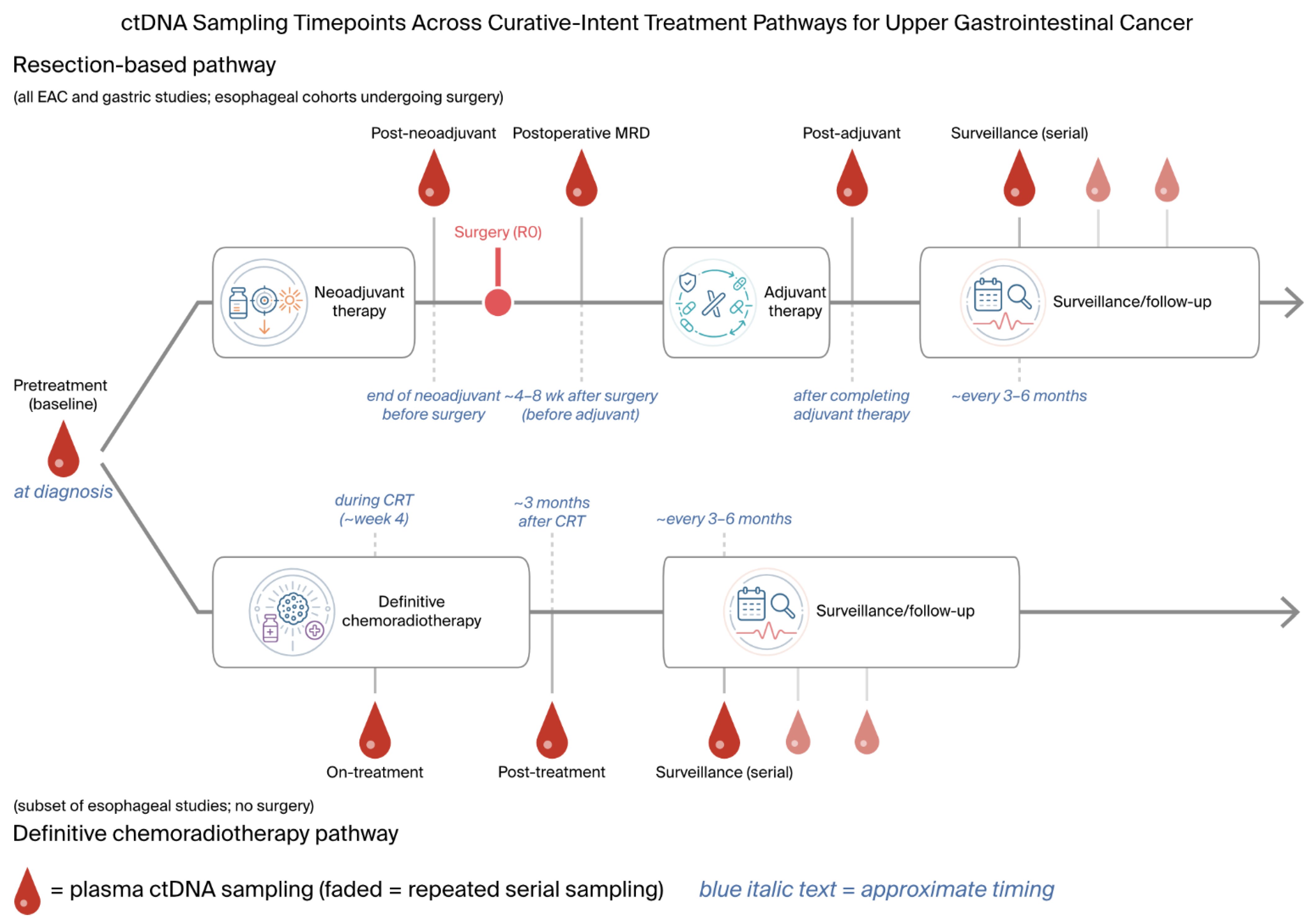
| Study (Year) | Surgery → Postoperative Blood Collection | Timing Relative to Adjuvant Therapy | Serial Postoperative Timepoints | Evaluable Postoperative Samples | ctDNA Lead Time Before Recurrence |
|---|---|---|---|---|---|
| Esophageal squamous cell carcinoma (ESCC) | |||||
| Fang C.Y. 2025 [30] | 7–14 days | None (surgery-only cohort) | Single | 60/125 positive | Not reported |
| Jimin Li 2025 [31] | 1 month (±1 wk) | Adjuvant in 29/35 (timing not specified) | Single | 6/35 positive | Not reported |
| Rentong Gu 2025 [32] | Day 7 | Before adjuvant (adjuvant in 20/54) | Single | TP53 6/54; PIK3CA 6/54 | Not reported |
| Heng Jiao 2025 [33] | ≤2 months (landmark, post-R0) | Neoadjuvant → surgery → adjuvant | Landmark + serial follow-up | 11/43 positive | Not reported |
| Ko J.M.Y. 2025 [34] | 0–1 month (first of 7 windows) | Surveillance windows; adjuvant in 19 | 7 postoperative windows (0–1 mo → 1.5–2 yr) | 6/47 positive | 158 d (from pre-surgery sample) ‡ |
| Pinli Yue 2024 [37] | 1 month (Tp) | Before adjuvant (used to guide it) | Single | 11/33 positive | Not reported |
| Liu T. 2021 [39] | 1 week (surgical-trauma window) | Non-adjuvant subgroup primary; adjuvant in 19 | Pre- + postop | 6/38 positive | Not reported |
| Esophageal adenocarcinoma (EAC) | |||||
| Schoofs K. 2024 [40] | 4–6 days, then up to >12 mo | Given to some (feasibility) | 5 postoperative (t2–t6) | 33 (feasibility) | Not analyzed (feasibility) |
| Ococks E. 2021 [41] (Ann Oncol) | Serial post-surgery (to >2000 d) | Offered routinely post-surgery | Serial (116 postop samples) | 16/77; 10/63 (CHIP-corrected) | Recurrence in 9/10 positive |
| Ococks E. 2021 [42] (Gastroenterology) | ≥1 postop sample/patient, serial | Perioperative | Serial | 4/17 positive | 278 days (max > 500) |
| Gastric cancer (GC) | |||||
| Bai L. 2025 [44] | Intraoperative peritoneal lavage fluid (post-resection) | Intraoperative (precedes adjuvant) | Single (PLF) | 23/35 PLF positive | Not reported |
| Liu Z. 2025 [45] | 1 month | Not specified (adjuvant in ~61%) | 1 mo, then q3mo | 30/41 positive | Not reported |
| Yuan S.Q. 2023 [46] | ≤1 wk (median 4 d); + post-ACT ≤ 3 mo | Both (before and after adjuvant chemo) | 2 (postop; post-ACT) | 25/100 postop; 10/41 post-ACT | Not reported |
| Zhou H. 2023 [47] | 4–6 weeks | Before adjuvant chemotherapy | 4–6 wk + serial in 5 patients | 8/14 positive | Not reported |
| Yang J. 2020 [48] | 1 month (9–48 d), then q3mo/q6mo | Both (before and after adjuvant chemo) | 1 mo → q3mo (yr 1) → q6mo | 7/38 positive | 179 days |
| Leal A. 2020 [49] | Median 6.5 weeks | Before adjuvant (not sampled after) | Single | 9/20 positive | 8.9 months |
| Kim Y.W. 2019 [50] | 1 month | Not specified | 5 (1, 3, 6, 9, 12 mo) | 8/19 positive | 4.05 months |
| Cabel L. 2019 [51] | <1 month | Before resumed postoperative chemo | Single (<1 mo) | 1/13 positive | Not reported |
| Mixed upper gastrointestinal | |||||
| Zaanan A. 2025 [52] (PLAGAST) | MRD window 2–12 wk (median 41 d) | Before adjuvant | Single (MRD window) | 10/50 positive (47/50 analyzed) | 184 days |
| Hu Q. 2025 [53] | 1 month (median 1.2 mo) | Not specified | 4 postoperative (1, 3, 6, 12 mo) | 20/40 positive | 90 days |
| Iden C.R. 2025 [54] | 4–6 weeks | Not stated relative to adjuvant | Single | 8/53 positive | Not reported |
| Lander E.M. 2024 [55] | MRD window ≤ 16 wk; surveillance > 16 wk | Window before adjuvant; surveillance after | No fixed schedule (clinician discretion) | 3/23 (window); 5/32 (surveillance) | 78 days |
| Huffman B.M. 2022 [56] | MRD window ≤ 16 wk (before systemic Rx); surveillance ≥ 2 wk after end of Rx | Window before adjuvant; surveillance after | No fixed schedule (clinician discretion) | 16/68 (MRD window) | Not reported (not estimable) |
Disclaimer/Publisher’s Note: The statements, opinions and data contained in all publications are solely those of the individual author(s) and contributor(s) and not of MDPI and/or the editor(s). MDPI and/or the editor(s) disclaim responsibility for any injury to people or property resulting from any ideas, methods, instructions or products referred to in the content. |
© 2026 by the authors. Licensee MDPI, Basel, Switzerland. This article is an open access article distributed under the terms and conditions of the Creative Commons Attribution (CC BY) license.
Share and Cite
Hadjigeorgiou, L.; Yerolatsite, M.; Torounidou, N.; Zarkavelis, G.; Schizas, D.; Tatsis, V.; Rausei, S.; Vlachos, K.; Lianos, G.D. Circulating Tumor DNA for Minimal Residual Disease Detection and Recurrence Prediction in Upper Gastrointestinal Cancers: A Scoping Review. J. Clin. Med. 2026, 15, 6222. https://doi.org/10.3390/jcm15166222
Hadjigeorgiou L, Yerolatsite M, Torounidou N, Zarkavelis G, Schizas D, Tatsis V, Rausei S, Vlachos K, Lianos GD. Circulating Tumor DNA for Minimal Residual Disease Detection and Recurrence Prediction in Upper Gastrointestinal Cancers: A Scoping Review. Journal of Clinical Medicine. 2026; 15(16):6222. https://doi.org/10.3390/jcm15166222
Chicago/Turabian StyleHadjigeorgiou, Loizos, Melina Yerolatsite, Nanteznta Torounidou, George Zarkavelis, Dimitrios Schizas, Vasileios Tatsis, Stefano Rausei, Konstantinos Vlachos, and Georgios D. Lianos. 2026. "Circulating Tumor DNA for Minimal Residual Disease Detection and Recurrence Prediction in Upper Gastrointestinal Cancers: A Scoping Review" Journal of Clinical Medicine 15, no. 16: 6222. https://doi.org/10.3390/jcm15166222
APA StyleHadjigeorgiou, L., Yerolatsite, M., Torounidou, N., Zarkavelis, G., Schizas, D., Tatsis, V., Rausei, S., Vlachos, K., & Lianos, G. D. (2026). Circulating Tumor DNA for Minimal Residual Disease Detection and Recurrence Prediction in Upper Gastrointestinal Cancers: A Scoping Review. Journal of Clinical Medicine, 15(16), 6222. https://doi.org/10.3390/jcm15166222