Descriptive Patterns of Ketamine Administration Among Adult Emergency Department Patients at a Single Academic Center in Saudi Arabia

Abstract
1. Introduction
2. Methods
2.1. Study Design and Setting
2.2. Participants and Case Identification
2.3. Variables and Outcomes
- Demographics: age, sex, and body weight.
- Administration details: dosage (mg and mg/kg), route, and co-administered medications (e.g., propofol, fentanyl, midazolam, and paralytics).
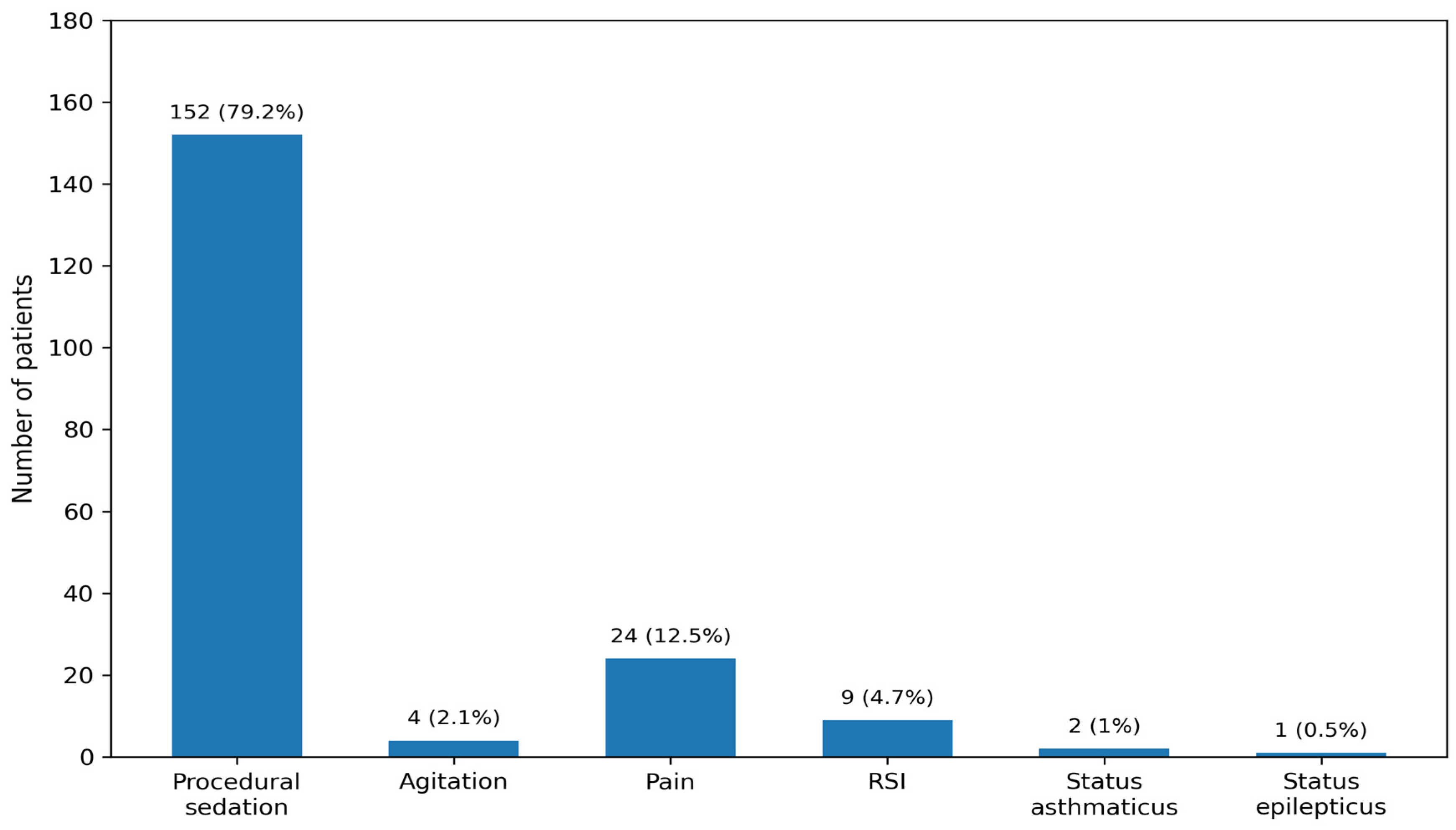
- Clinical context: indication for use (procedural sedation, pain management, RSI, agitation, status asthmaticus, or status epilepticus) and seizure history.
- Procedural success: defined by the absence of procedural failure or the need for rescue sedation.
- Procedural failure: defined as the inability to complete the intended procedure under ketamine sedation, requiring alternative sedation or abandonment of the procedure.
- Rescue sedation: defined as the administration of any additional sedative agent (e.g., propofol, midazolam) due to inadequate sedation with ketamine alone.
- Dosing requirements: incidence of redosing within one hour of the initial administration.
- Adverse events: active screening for oxygen desaturation; apnea; the requirement for airway interventions (including supplemental oxygen, bag-mask ventilation, or intubation); clinically significant hemodynamic changes (hypotension or hypertension); aspiration; unplanned escalation of care; emergence reactions; nausea and vomiting; laryngospasm; and hypersalivation.
3. Statistical Analysis
4. Results
4.1. Indications for Ketamine Administration
4.1.1. Ketamine Use in Procedural Sedation
4.1.2. Ketamine Use in Pain Management
4.1.3. Ketamine Use in Rapid Sequence Intubation (RSI)
4.1.4. Other Ketamine Indications
4.2. Adverse Effects
5. Discussion
Author Contributions
Funding
Institutional Review Board Statement
Informed Consent Statement
Data Availability Statement
Acknowledgments
Conflicts of Interest
References
- McKinley, K.; Panakos, P.; Yousef, D. Characterization of Ketamine Usage in a Large Tertiary-Care Emergency Department. Am. J. Emerg. Med. 2021, 47, 149–153. [Google Scholar] [CrossRef] [PubMed]
- Gao, M.; Rejaei, D.; Liu, H. Ketamine Use in Current Clinical Practice. Acta Pharmacol. Sin. 2016, 37, 865–872. [Google Scholar] [CrossRef] [PubMed]
- Sleigh, J.; Harvey, M.; Voss, L.; Denny, B. Ketamine—More Mechanisms of Action than Just NMDA Blockade. Trends Anaesth. Crit. Care 2014, 4, 76–81. [Google Scholar] [CrossRef]
- Salleeh, H.M.B.; Al Ahmadi, T.; Mujawar, Q. Procedural Sedation for Pediatric Patients in the Emergency Department at King Khalid University Hospital, Riyadh, K.S.A. J. Emerg. Trauma Shock. 2014, 7, 186–189. [Google Scholar] [CrossRef] [PubMed]
- Alghadeer, S.; Alhamid, G.A.; Almotawa, R.; Alshareef, A.; Knas, M.A.; Althunayyan, S. The Effective Dose of Ketamine in the Management of Acute Agitation in Emergency Departments. Signa Vitae 2024, 20, 26–33. [Google Scholar] [CrossRef]
- Sharif, S.; Kang, J.; Sadeghirad, B.; Rizvi, F.; Forestell, B.; Greer, A.; Hewitt, M.; Fernando, S.M.; Mehta, S.; Eltorki, M.; et al. Pharmacological Agents for Procedural Sedation and Analgesia in the Emergency Department and Intensive Care Unit: A Systematic Review and Network Meta-Analysis of Randomised Trials. Br. J. Anaesth. 2024, 132, 491–506. [Google Scholar] [CrossRef] [PubMed]
- The Royal College of Emergency Medicine. Best Practice Guideline Procedural Sedation in the Emergency Department; The Royal College of Emergency Medicine: London, UK, 2022. [Google Scholar]
- Godwin, S.A.; Burton, J.H.; Gerardo, C.J.; Hatten, B.W.; MacE, S.E.; Silvers, S.M.; Fesmire, F.M. Clinical Policy: Procedural Sedation and Analgesia in the Emergency Department. Ann. Emerg. Med. 2014, 63, 247–258.e18. [Google Scholar] [CrossRef] [PubMed]
- Cappellini, I.; Bavestrello Piccini, G.; Campagnola, L.; Bochicchio, C.; Carente, R.; Lai, F.; Magazzini, S.; Consales, G. Procedural Sedation in Emergency Department: A Narrative Review. Emerg. Care Med. 2024, 1, 103–136. [Google Scholar] [CrossRef]
- Green, S.M.; Roback, M.G.; Kennedy, R.M.; Krauss, B. Clinical Practice Guideline for Emergency Department Ketamine Dissociative Sedation: 2011 Update. Ann. Emerg. Med. 2011, 57, 449–461. [Google Scholar] [CrossRef] [PubMed]
- Ghojazadeh, M.; Sanaie, S.; Paknezhad, S.P.; Faghih, S.S.; Soleimanpour, H. Using Ketamine and Propofol for Procedural Sedation of Adults in the Emergency Department: A Systematic Review and Meta-Analysis. Adv. Pharm. Bull. 2019, 9, 5–11. [Google Scholar] [CrossRef] [PubMed]
- Andolfatto, G.; Abu-Laban, R.B.; Zed, P.J.; Staniforth, S.M.; Stackhouse, S.; Moadebi, S.; Willman, E. Ketamine-Propofol Combination (Ketofol) versus Propofol Alone for Emergency Department Procedural Sedation and Analgesia: A Randomized Double-Blind Trial. Ann. Emerg. Med. 2012, 59, 504–512.e2. [Google Scholar] [CrossRef] [PubMed]
- Zaki, H.A.; Ibrahim, T.; Osman, A.; Elnabawy, W.A.; Gebril, A.; Hamdi, A.H.; Mohamed, E.H. Comparing the Safety and Effectiveness of Ketamine Versus Benzodiazepine/Opioid Combination for Procedural Sedation in Emergency Medicine: A Comprehensive Review and Meta-Analysis. Cureus 2023, 15, e36742. [Google Scholar] [CrossRef] [PubMed]
- Lemoel, F.; Contenti, J.; Giolito, D.; Boiffier, M.; Rapp, J.; Istria, J.; Fournier, M.; Ageron, F.X.; Levraut, J. Adverse Events With Ketamine Versus Ketofol for Procedural Sedation on Adults: A Double-Blind, Randomized Controlled Trial. Acad. Emerg. Med. 2017, 24, 1441–1449. [Google Scholar] [CrossRef] [PubMed]
- Elsaeidy, A.S.; Ahmad, A.H.M.; Kohaf, N.A.; Aboutaleb, A.; Kumar, D.; Elsaeidy, K.S.; Mohamed, O.S.; Kaye, A.D.; Shehata, I.M. Efficacy and Safety of Ketamine-Dexmedetomidine Versus Ketamine-Propofol Combination for Periprocedural Sedation: A Systematic Review and Meta-Analysis. Curr. Pain Headache Rep. 2024, 28, 211–227. [Google Scholar] [CrossRef] [PubMed]
- American College of Emergency Physicians (ACEP). Subdissociative-Dose Ketamine for Analgesia. Ann. Emerg. Med. 2017, 71, e35. [Google Scholar]
- Beaudrie-Nunn, A.N.; Wieruszewski, E.D.; Woods, E.J.; Bellolio, F.; Mara, K.C.; Canterbury, E.A. Efficacy of Analgesic and Sub-Dissociative Dose Ketamine for Acute Pain in the Emergency Department. Am. J. Emerg. Med. 2023, 70, 133–139. [Google Scholar] [CrossRef] [PubMed]
- Ying, M.; Zuo, Y. Efficacy of Low-Dose Ketamine for Control of Acute Pain in the Emergency Setting: A Systematic Review and Meta-Analysis of Randomized Controlled Trials. West. J. Emerg. Med. 2023, 24, 644–653. [Google Scholar] [CrossRef]
- Alanazi, E. The Effectiveness of Ketamine Compared to Opioid Analgesics for Management of Acute Pain in Children in The Emergency Department: Systematic Review. Am. J. Emerg. Med. 2022, 61, 143–151. [Google Scholar] [CrossRef] [PubMed]
- Lovett, S.; Reed, T.; Riggs, R.; Lew, G.; Koch, E.; Durazo-Arvizu, R.A.; Rech, M.A. A Randomized, Noninferiority, Controlled Trial of Two Doses of Intravenous Subdissociative Ketamine for Analgesia in the Emergency Department. Acad. Emerg. Med. 2021, 28, 647–654. [Google Scholar] [CrossRef] [PubMed]
- Beaudoin, F.L.; Lin, C.; Guan, W.; Merchant, R.C. Low-Dose Ketamine Improves Pain Relief in Patients Receiving Intravenous Opioids for Acute Pain in the Emergency Department: Results of a Randomized, Double-Blind, Clinical Trial. Acad. Emerg. Med. 2014, 21, 1193–1202. [Google Scholar] [CrossRef] [PubMed]
- Motov, S.; Mai, M.; Pushkar, I.; Likourezos, A.; Drapkin, J.; Yasavolian, M.; Brady, J.; Homel, P.; Fromm, C. A Prospective Randomized, Double-Dummy Trial Comparing IV Push Low Dose Ketamine to Short Infusion of Low Dose Ketamine for Treatment of Pain in the ED. Am. J. Emerg. Med. 2017, 35, 1095–1100. [Google Scholar] [CrossRef] [PubMed]
- Baird, H.; Rumbarger, R. Impact of Developing Adult Ketamine Order Panels for the Emergency Department. Hosp. Pharm. 2017, 52, 483–487. [Google Scholar] [CrossRef] [PubMed]
- Qu, Z.; Xu, C.; Qu, Z.; Liang, H. Procedural Sedation in Emergency Departments: Efficacy and Adverse Outcomes from a Systematic Review and Meta-Analysis. Adv. Clin. Exp. Med. 2026, 5, 419–436. [Google Scholar] [CrossRef] [PubMed]



| Variable | N = 192 |
|---|---|
| Age, years | 37 ± 15.35 33 (18–81) |
| Gender Male Female | 131 (68.2) 61 (31.8) |
| BMI, kg/m2 | 26.03 ± 5.10 25.77 (Range, 14–39.44) |
| Total ketamine dose (mg/kg) | 0.79 ± 0.55 0.65 (Range, 0.13–4) |
| Total ketamine dose (mg) | 54.93 ± 35.81 50 (Range, 20–240) |
| Ketamine Indication Procedural sedation Agitation Pain RSI Status asthmaticus Status epilepticus | 152 (79.2) 4 (2.1) 24 (12.5) 9 (4.7) 2 (1) 1 (0.5) |
| Ketamine Use Monotherapy Combined | 31 (16.2) 161 (83.9) |
| Procedural Sedation Procedures | N = 152 N (%) | Ketamine Monotherapy N= 16 | Ketamine Combination N = 136 | ||||
|---|---|---|---|---|---|---|---|
| Mean (mg/kg) Dose | Median Dose (mg/kg) | Range (Lowest–Highest) | Mean (mg/kg) Dose | Median Dose (mg/kg) | Range (Lowest–Highest) | ||
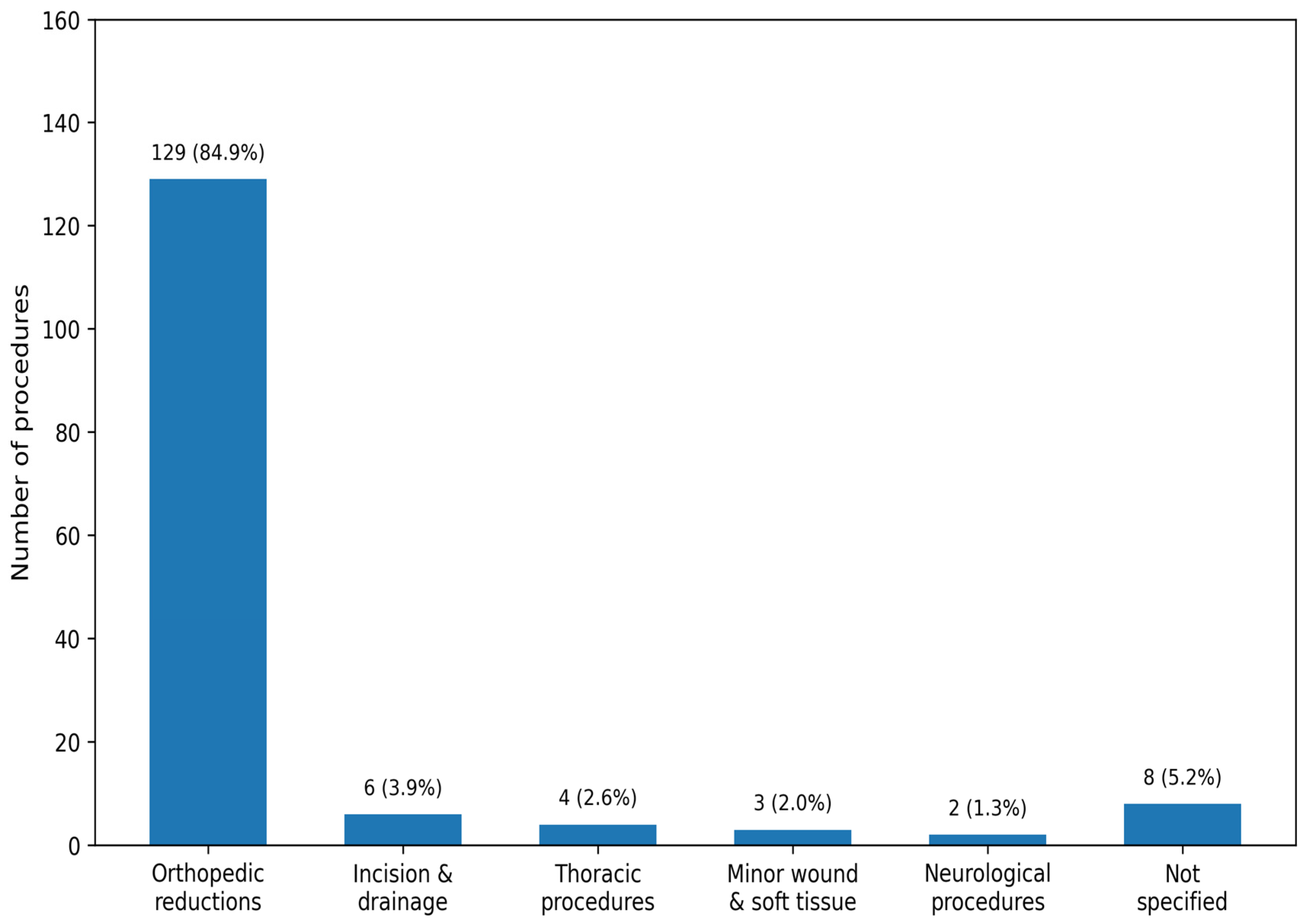
| Orthopedic reductions | 129 (84.86) | 0.82 | 0.69 | 0.25- 2.05 | 0.73 | 0.59 | 0.13–2.63 |
| Incision and drainage procedures | 6 (3.94) | 1.76 | 1.76 | 1.76 | 0.81 | 0.62 | 0.49–1.32 |
| Thoracic procedures (chest tube insertion) | 4 (2.63) | 1.08 | 1.08 | 0.63–1.53 | 1.05 | 1.05 | 0.95–1.14 |
| Minor wound and soft tissue procedures | 3 (1.97) | 0.80 | 0.80 | 0.80 | 0.69 | 0.69 | 0.69 |
| Neurological procedures (lumbar puncture) | 2 (1.32) | 0.69 | 0.69 | 0.45–0.93 | 0.70 | 0.70 | 0.46–0.93 |
| Not specified | 8 (5.20) | 0.32 | 0.32 | 0.32 | 1.04 | 0.94 | 0.45–2.82 |
| Item | Type of Procedure | ||||||
|---|---|---|---|---|---|---|---|
| Orthopedic Reductions N = 129 | Incision and Drainage Procedures N = 6 | Thoracic Procedures (Chest Tube Insertion) N= 4 | Minor Wound and Soft Tissue Procedures N = 3 | Neurological Procedures (Lumbar Puncture) N = 2 | Not Specified N= 8 | ||
| Ketamine | Mean dose, mg/kg | 0.74 | 1.05 | 1.06 | 0.75 | 0.70 | 1.17 |
| Median dose, mg/kg | 0.64 | 0.97 | 1.05 | 0.75 | 0.70 | 1.03 | |
| Dose Range, mg/kg | 0.13–2.63 | 0.49–1.76 | 0.63–1.53 | 0.69–0.80 | 0.46–0.93 | 0.32–2.82 | |
| Propofol | Mean dose, mg/kg | 0.65 | 1.69 | 1.58 | – | 1.67 | 1.04 |
| Median dose, mg/kg | 0.57 | 0.62 | 1.58 | – | 1.67 | 0.94 | |
| Dose Range, mg/kg | 0.13–1.75 | 0.49–3.95 | 0.28–2.86 | – | 1.67 | 0.45–1.67 | |
Disclaimer/Publisher’s Note: The statements, opinions and data contained in all publications are solely those of the individual author(s) and contributor(s) and not of MDPI and/or the editor(s). MDPI and/or the editor(s) disclaim responsibility for any injury to people or property resulting from any ideas, methods, instructions or products referred to in the content. |
© 2026 by the authors. Licensee MDPI, Basel, Switzerland. This article is an open access article distributed under the terms and conditions of the Creative Commons Attribution (CC BY) license.
Share and Cite
Aljadeed, R.; Aljadeed, R.; Kalagi, N.; Almoghirah, H.; Jokhab, S. Descriptive Patterns of Ketamine Administration Among Adult Emergency Department Patients at a Single Academic Center in Saudi Arabia. J. Clin. Med. 2026, 15, 5246. https://doi.org/10.3390/jcm15135246
Aljadeed R, Aljadeed R, Kalagi N, Almoghirah H, Jokhab S. Descriptive Patterns of Ketamine Administration Among Adult Emergency Department Patients at a Single Academic Center in Saudi Arabia. Journal of Clinical Medicine. 2026; 15(13):5246. https://doi.org/10.3390/jcm15135246
Chicago/Turabian StyleAljadeed, Rana, Raniah Aljadeed, Nora Kalagi, Hailah Almoghirah, and Salha Jokhab. 2026. "Descriptive Patterns of Ketamine Administration Among Adult Emergency Department Patients at a Single Academic Center in Saudi Arabia" Journal of Clinical Medicine 15, no. 13: 5246. https://doi.org/10.3390/jcm15135246
APA StyleAljadeed, R., Aljadeed, R., Kalagi, N., Almoghirah, H., & Jokhab, S. (2026). Descriptive Patterns of Ketamine Administration Among Adult Emergency Department Patients at a Single Academic Center in Saudi Arabia. Journal of Clinical Medicine, 15(13), 5246. https://doi.org/10.3390/jcm15135246