

Association Between Intraoperative Oliguria and Postoperative Acute Kidney Injury in Patients Undergoing Hepatobiliary and Pancreatic Surgery Within an Enhanced Recovery After Surgery Protocol: A Retrospective Cohort Study


Abstract
1. Introduction
2. Materials and Methods
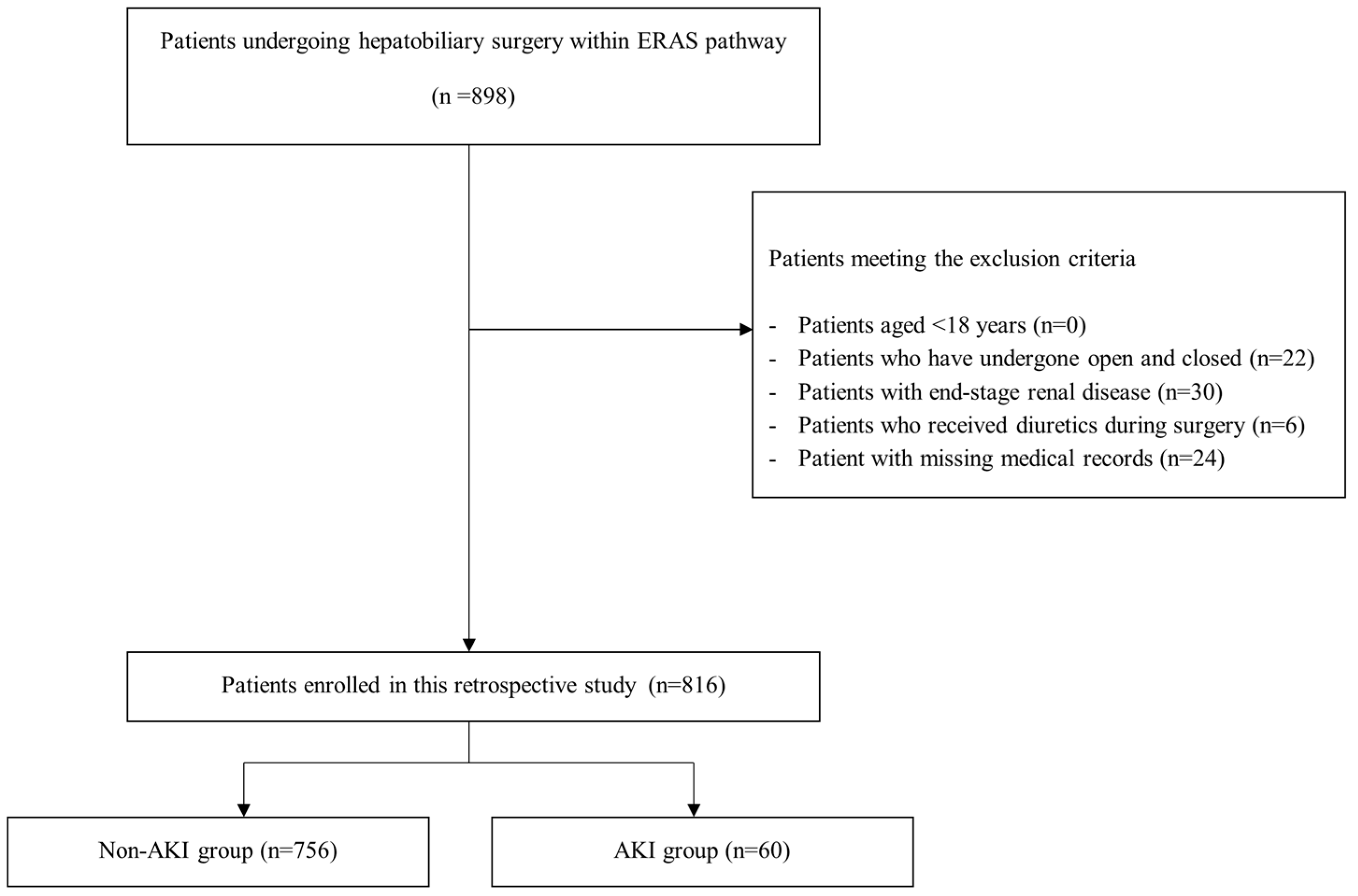
2.1. Study Design, Setting, and Population
2.2. Anesthetic and Analgesic Management Based on the ERAS Protocol
2.3. Data Collection
2.4. Outcome
2.5. Statistical Analyses
3. Results
3.1. Patient Characteristics
3.2. Comparison Between the Oliguria and Non-Oliguria Groups
3.3. Comparison Between the AKI and Non-AKI Groups
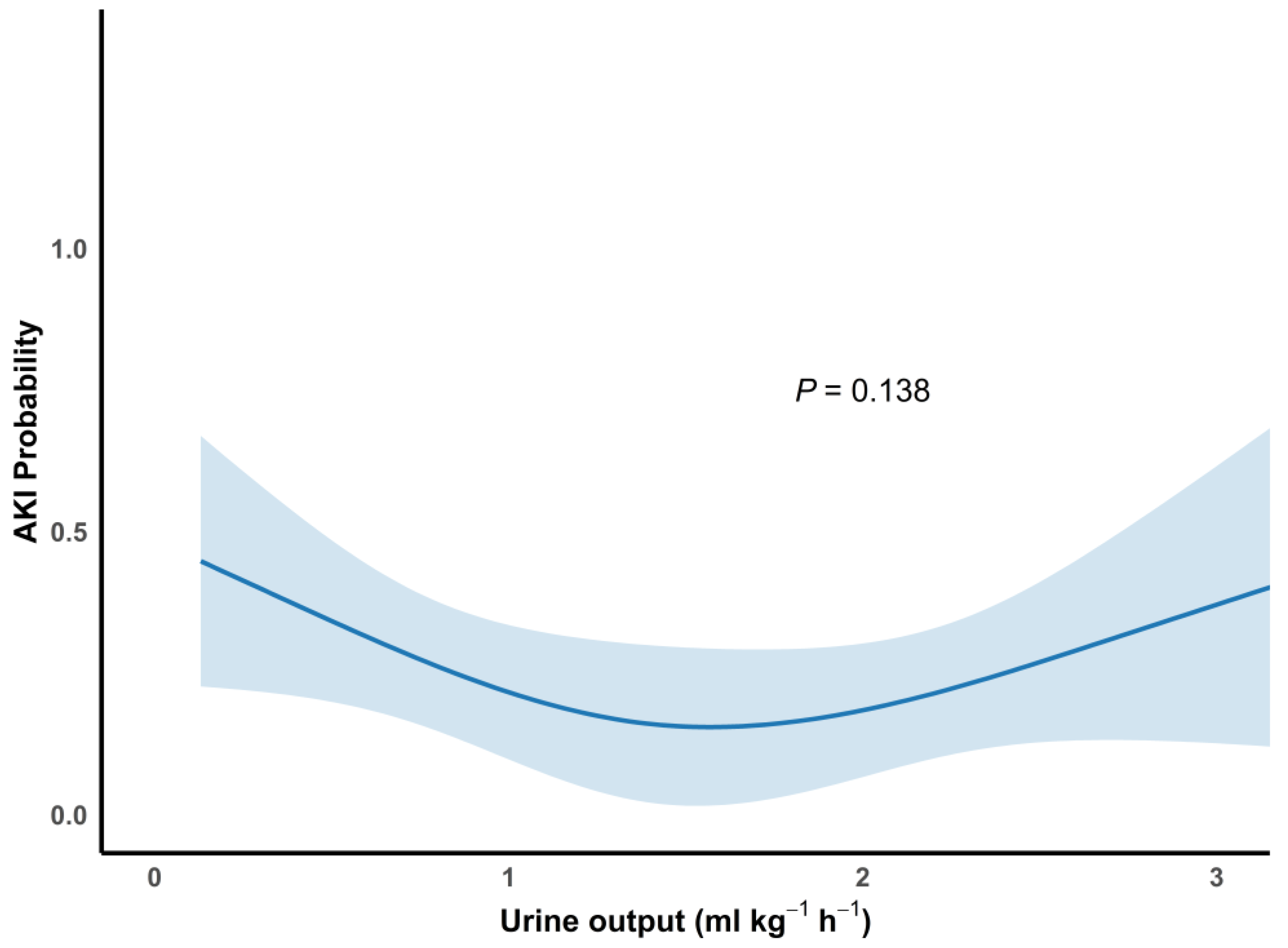
3.4. Risk Factors for Postoperative AKI
4. Discussion
Supplementary Materials
Author Contributions
Funding
Institutional Review Board Statement
Informed Consent Statement
Data Availability Statement
Acknowledgments
Conflicts of Interest
Abbreviations
| AKI | Acute kidney injury |
| ASA | American Society of Anesthesiologists |
| BMI | Body mass index |
| EBL | Estimated blood loss |
| ERAS | Enhanced Recovery After Surgery |
| KDIGO | Kidney Disease: Improving Global Outcomes |
| MBP | Mean blood pressure |
| RBC | Red blood cell |
| sCr | Serum creatinine |
References
- Mizota, T.; Yamamoto, Y.; Hamada, M.; Matsukawa, S.; Shimizu, S.; Kai, S. Intraoperative oliguria predicts acute kidney injury after major abdominal surgery. Br. J. Anaesth. 2017, 119, 1127–1134. [Google Scholar] [CrossRef] [PubMed]
- Zhao, B.C.; Lei, S.-H.; Yang, X.; Zhang, Y.; Qiu, S.-D.; Liu, W.-F.; Li, C.; Liu, K.-X. Assessment of prognostic value of intraoperative oliguria for postoperative acute kidney injury: A retrospective cohort study. Br. J. Anaesth. 2021, 126, 799–807. [Google Scholar] [CrossRef] [PubMed]
- Kheterpal, S.; Tremper, K.K.; Englesbe, M.J.; O’reilly, M.; Shanks, A.M.; Fetterman, D.M.; Rosenberg, A.L.; Swartz, R.D. Predictors of postoperative acute renal failure after noncardiac surgery in patients with previously normal renal function. Anesthesiology 2007, 107, 892–902. [Google Scholar] [CrossRef] [PubMed]
- Shiba, A.; Uchino, S.; Fujii, T.; Takinami, M.; Uezono, S. Association Between Intraoperative Oliguria and Acute Kidney Injury After Major Noncardiac Surgery. Anesth. Analg. 2018, 127, 1229–1235. [Google Scholar] [CrossRef] [PubMed]
- Kunst, G.; Ostermann, M. Intraoperative permissive oliguria—How much is too much? Br. J. Anaesth. 2017, 119, 1075–1077. [Google Scholar] [CrossRef] [PubMed]
- Noba, L.; Rodgers, S.; Chandler, C.; Balfour, A.; Hariharan, D.; Yip, V.S. Enhanced Recovery After Surgery (ERAS) Reduces Hospital Costs and Improve Clinical Outcomes in Liver Surgery: A Systematic Review and Meta-Analysis. J. Gastrointest. Surg. 2020, 24, 918–932. [Google Scholar] [CrossRef] [PubMed]
- Noba, L.; Rodgers, S.; Doi, L.; Chandler, C.; Hariharan, D.; Yip, V. Costs and clinical benefits of enhanced recovery after surgery (ERAS) in pancreaticoduodenectomy: An updated systematic review and meta-analysis. J. Cancer Res. Clin. Oncol. 2023, 149, 6639–6660. [Google Scholar] [CrossRef] [PubMed]
- Joliat, G.R.; Kobayashi, K.; Hasegawa, K.; Thomson, J.; Padbury, R.; Scott, M.; Brustia, R.; Scatton, O.; Cao, H.S.T.; Vauthey, J.; et al. Guidelines for Perioperative Care for Liver Surgery: Enhanced Recovery After Surgery (ERAS) Society Recommendations 2022. World J. Surg. 2023, 47, 11–34. [Google Scholar] [PubMed]
- Melloul, E.; Lassen, K.; Roulin, D.; Grass, F.; Perinel, J.; Adham, M.; Wellge, E.B.; Kunzler, F.; Besselink, M.G.; Asbun, H.; et al. Guidelines for Perioperative Care for Pancreatoduodenectomy: Enhanced Recovery After Surgery (ERAS) Recommendations 2019. World J. Surg. 2020, 44, 2056–2084. [Google Scholar] [CrossRef] [PubMed]
- Shim, J.W.; Kim, K.R.; Jung, Y.; Park, J.; Lee, H.M.; Kim, Y.-S.; Moon, Y.E.; Hong, S.H.; Chae, M.S. Role of intraoperative oliguria in risk stratification for postoperative acute kidney injury in patients undergoing colorectal surgery with an enhanced recovery protocol: A propensity score matching analysis. PLoS ONE 2020, 15, e0231447. [Google Scholar] [CrossRef] [PubMed]
- Holubar, S.D.; Hedrick, T.; Gupta, R.; Kellum, J.; Hamilton, M.; Gan, T.J.; Mythen, M.G.; Shaw, A.D.; Miller, T.E. American Society for Enhanced Recovery (ASER) and Perioperative Quality Initiative (POQI) joint consensus statement on prevention of postoperative infection within an enhanced recovery pathway for elective colorectal surgery. Perioper. Med. 2017, 6, 4. [Google Scholar] [CrossRef]
- Shim, J.W.; Kwak, J.; Roh, K.; Ro, H.; Lee, C.S.; Han, S.R.; Lee, Y.S.; Lee, I.K.; Park, J.; Lee, H.M.; et al. Impact of intraoperative zero-balance fluid therapy on the occurrence of acute kidney injury in patients who had undergone colorectal cancer resection within an enhanced recovery after surgery protocol: A propensity score matching analysis. Int. J. Colorectal Dis. 2020, 35, 1537–1548. [Google Scholar] [CrossRef] [PubMed]
- Kambakamba, P.; Slankamenac, K.; Tschuor, C.; Kron, P.; Wirsching, A.; Maurer, K.; Petrowsky, H.; Clavien, P.A.; Lesurtel, M. Epidural analgesia and perioperative kidney function after major liver resection. Br. J. Surg. 2015, 102, 805–812. [Google Scholar] [CrossRef] [PubMed]
- Liu, X.; Zhang, P.; Liu, M.X.; Ma, J.L.; Wei, X.C.; Fan, D. Preoperative carbohydrate loading and intraoperative goal-directed fluid therapy for elderly patients undergoing open gastrointestinal surgery: A prospective randomized controlled trial. BMC Anesthesiol. 2021, 21, 157. [Google Scholar] [CrossRef] [PubMed]
- Miller, T.E.; Roche, A.M.; Mythen, M. Fluid management and goal-directed therapy as an adjunct to Enhanced Recovery After Surgery (ERAS). Can. J. Anaesth. 2015, 62, 158–168. [Google Scholar] [PubMed]
- Kim, Y.J.; Joung, K.-W.; Kwon, H.-J.; Kwon, H.-M.; Lee, J.; Park, M.Y.; Park, Y.-H.; Jeong, S.-M.; Kim, D.-H. Practical significance and assessment of gastric ultrasound in preoperative carbohydrate loading: A retrospective analysis of 746 patients within the enhanced recovery after surgery pathway. Anaesth. Crit. Care Pain. Med. 2025, 44, 101547. [Google Scholar] [CrossRef] [PubMed]
- Gupta, R.; Gan, T. Peri-operative fluid management to enhance recovery. Anaesthesia 2016, 71, 40–45. [Google Scholar] [PubMed]
- Mythen, M.G.; Swart, M.; Acheson, N.; Crawford, R.; Jones, K.; Kuper, M.; McGrath, J.S.; Horgan, A. Perioperative fluid management: Consensus statement from the enhanced recovery partnership. Perioper. Med. 2012, 1, 2. [Google Scholar] [CrossRef]
- Carson, J.L.; Stanworth, S.J.; Guyatt, G.; Valentine, S.; Dennis, J.; Bakhtary, S.; Cohn, C.S.; Dubon, A.; Grossman, B.J.; Gupta, G.K.; et al. Red Blood Cell Transfusion: 2023 AABB International Guidelines. JAMA 2023, 330, 1892–1902. [Google Scholar] [CrossRef] [PubMed]
- McNicol, E.D.; Tzortzopoulou, A.; Cepeda, M.S.; Francia, M.B.D.; Farhat, T.; Schumann, R. Single-dose intravenous paracetamol or propacetamol for prevention or treatment of postoperative pain: A systematic review and meta-analysis. Br. J. Anaesth. 2011, 106, 764–775. [Google Scholar] [CrossRef] [PubMed]
- Khwaja, A. KDIGO clinical practice guidelines for acute kidney injury. Nephron Clin. Pract. 2012, 120, c179–c184. [Google Scholar] [CrossRef] [PubMed]
- Li, S.; Wang, S.; Priyanka, P.B.; Kellum, J.A.M. Acute Kidney Injury in Critically Ill Patients After Noncardiac Major Surgery: Early Versus Late Onset. Crit. Care Med. 2019, 47, e437–e444. [Google Scholar] [CrossRef] [PubMed]
- Goren, O.; Matot, I. Perioperative acute kidney injury. Br. J. Anaesth. 2015, 115, ii3–ii14. [Google Scholar] [CrossRef] [PubMed]
- Hahn, R.G. Volume kinetics for infusion fluids. Anesthesiology 2010, 113, 470–481. [Google Scholar] [CrossRef] [PubMed]
- Norberg, A.; Hahn, R.G.; Li, H.; Olsson, J.; Prough, D.S.; Børsheim, E.; Wolf, S.; Minton, R.K.; Svensén, C.H. Population volume kinetics predicts retention of 0.9% saline infused in awake and isoflurane-anesthetized volunteers. Anesthesiology 2007, 107, 24–32. [Google Scholar] [CrossRef] [PubMed]
- Page, A.J.; Kooby, D.A. Perioperative management of hepatic resection. J. Gastrointest. Oncol. 2012, 3, 19–27. [Google Scholar] [CrossRef] [PubMed]
- Demyttenaere, S.; Feldman, L.S.; Fried, G.M. Effect of pneumoperitoneum on renal perfusion and function: A systematic review. Surg. Endosc. 2007, 21, 152–160. [Google Scholar] [CrossRef] [PubMed]
- Myles, P.S.; Bellomo, R.; Corcoran, T.; Forbes, A.; Peyton, P.; Story, D.; Christophi, C.; Leslie, K.; McGuinness, S.; Parke, R.; et al. Restrictive versus Liberal Fluid Therapy for Major Abdominal Surgery. N. Engl. J. Med. 2018, 378, 2263–2274. [Google Scholar] [CrossRef] [PubMed]
- Neugarten, J.; Golestaneh, L. Female sex reduces the risk of hospital-associated acute kidney injury: A meta-analysis. BMC Nephrol. 2018, 19, 314. [Google Scholar] [CrossRef] [PubMed]
- Kang, K.P.; Lee, J.E.; Lee, A.S.; Jung, Y.J.; Kim, D.; Lee, S.; Hwang, H.P.; Kim, W.; Park, S.K. Effect of gender differences on the regulation of renal ischemia-reperfusion-induced inflammation in mice. Mol. Med. Rep. 2014, 9, 2061–2068. [Google Scholar] [CrossRef] [PubMed]
- Lan, J.; Xu, G.; Zhu, Y.; Lin, C.; Yan, Z.; Shao, S. Association of Body Mass Index and Acute Kidney Injury Incidence and Outcome: A Systematic Review and Meta-Analysis. J. Ren. Nutr. 2023, 33, 397–404. [Google Scholar] [CrossRef] [PubMed]
- An, Y.; Shen, K.; Ye, Y. Risk factors for and the prevention of acute kidney injury after abdominal surgery. Surg. Today 2018, 48, 573–583. [Google Scholar] [PubMed]
- Karkouti, K.; Wijeysundera, D.N.; Yau, T.M.; McCluskey, S.A.; Chan, C.T.; Wong, P.Y.; Crowther, M.A.; Hozhabri, S.; Beattie, W.S. Advance targeted transfusion in anemic cardiac surgical patients for kidney protection: An unblinded randomized pilot clinical trial. Anesthesiology 2012, 116, 613–621. [Google Scholar] [CrossRef] [PubMed]



| Variables | Non-Oliguria (n = 765) | Oliguria (n = 51) | p-Value |
|---|---|---|---|
| Age, year | 65 [59–71] | 63 [57–72] | 0.442 |
| Sex, male | 467 (61.1) | 36 (70.6) | 0.227 |
| BMI, kg m−2 | 23.3 [21.2–25.5] | 25.0 [22.6–26.7] | 0.018 * |
| Diabetes | 267 (34.9) | 21 (41.2) | 0.449 |
| Hypertension | 338 (44.2) | 27 (52.9) | 0.283 |
| Ischemic cardiac disease | 56 (7.3) | 4 (7.8) | 1.000 |
| Cerebrovascular disease | 34 (4.4) | 4 (7.8) | 0.440 |
| RAS-acting agent use | 166 (21.7) | 15 (29.4) | 0.267 |
| Diuretic use | 33 (4.3) | 3 (5.9) | 0.860 |
| ASA physical status | 0.800 | ||
| I | 31 (4.1) | 2 (3.9) | |
| II | 625 (81.7) | 40 (78.4) | |
| III | 109 (14.3) | 9 (17.7) | |
| Preoperative laboratory data | |||
| Hemoglobin, g dL−1 | 11.2 [10.2–12.2] | 11.3 [10.2–12.4] | 0.526 |
| Creatinine, mg dL−1 | 0.77 [0.64–0.90] | 0.83 [0.68–0.99] | 0.019 * |
| Albumin, g dL−1 | 3.6 [3.3–3.8] | 3.6 [3.4–3.9] | 0.581 |
| Variables | Non-Oliguria (n = 765) | Oliguria (n = 51) | p-Value |
|---|---|---|---|
| Surgical variables within the ERAS protocol | |||
| Oral carbohydrate loading | 657 (85.9) | 40 (78.4) | 0.210 |
| Thoracic epidural analgesia | 484 (63.2) | 26 (51.0) | 0.108 |
| Duration of surgery, min | 255 [205–307] | 235 [179–312] | 0.361 |
| Type of surgery | 0.223 | ||
| Pancreatic resection | 577 (75.4) | 33 (64.7) | |
| Liver and bile duct surgery | 163 (21.3) | 16 (31.4) | |
| Pancreaticoduodenectomy | 25 (3.3) | 2 (3.9) | |
| Intraoperative hemodynamic data | |||
| Lowest MBP, mmHg | 60 [55–64] | 61 [56–63] | 0.780 |
| Stroke volume variation, % | 11.0 [8.0–13.0] | 10.5 [8.0–12.0] | 0.255 |
| Intraoperative volume status | |||
| UO, mL kg−1 h−1 | 0.9 [0.6–1.4] | 0.2 [0.1–0.3] | <0.001 |
| Total crystalloid, mL kg−1 h−1 | 7 [5–9] | 6 [5–8] | 0.002 * |
| Total colloid, mL kg−1 h−1 | 1 [0–2] | 0 [0–1] | 0.061 |
| Total IV fluid, mL kg−1 h−1 | 8 [6–10] | 6 [5–8] | <0.001 * |
| >5 mL kg−1 h−1 | 675 (88.2) | 37 (72.6) | 0.002 |
| >8 mL kg−1 h−1 | 376 (49.2) | 13 (25.5) | 0.002 |
| RBC transfusion | 92 (12.0) | 2 (3.9) | 0.126 |
| Estimated blood loss, mL | 124 [0–502] | 0 [0–329] | <0.001 * |
| Fluid balance, mL kg−1 h−1 | 6 [4–8] | 5 [4–7] | 0.056 |
| Vasopressor infusion | 500 (65.4) | 26 (51.0) | 0.054 |
| AKI outcome | |||
| AKI incidence | 54 (7.1) | 6 (11.8) | 0.332 |
| Stage of AKI | 0.306 | ||
| Stage 1 | 43 (5.6) | 5 (9.8) | |
| Stage 2 | 7 (0.9) | 0 (0.0) | |
| Stage 3 | 4 (0.5) | 1 (2.0) | |
| Timing of AKI | 0.351 | ||
| Early-onset | 51 (6.7) | 6 (11.8) | |
| Late-onset | 3 (0.4) | 0 (0.0) |
| Variables | Non-AKI (n = 756) | AKI (n = 60) | p-Value |
|---|---|---|---|
| Baseline characteristics | |||
| Age, year | 65 [59–71] | 64 [60–72] | 0.818 |
| Sex, male | 454 (60.1) | 49 (81.7) | 0.001 * |
| BMI, kg m−2 | 23.3 [21.2–25.5] | 24.3 [21.7–26.6] | 0.058 |
| Diabetes | 265 (35.1) | 23 (38.3) | 0.710 |
| Hypertension | 329 (43.5) | 36 (60.0) | 0.019 * |
| Ischemic cardiac disease | 54 (7.1) | 6 (10.0) | 0.576 |
| Cerebrovascular disease | 34 (4.5) | 4 (6.7) | 0.653 |
| RAS-acting agent use | 165 (21.8) | 16 (26.7) | 0.479 |
| Diuretic use | 31 (4.1) | 5 (8.3) | 0.226 |
| ASA physical status | 0.623 | ||
| I | 32 (4.2) | 1 (1.7) | |
| II | 615 (81.4) | 50 (83.3) | |
| III | 109 (14.4) | 9 (15.0) | |
| Preoperative laboratory data | |||
| Hemoglobin, g dL−1 | 11.2 [10.2–12.2] | 11.7 [9.8–12.9] | 0.312 |
| Creatinine, mg dL−1 | 0.77 [0.64–0.90] | 0.84 [0.68–0.92] | 0.125 |
| Albumin, g dL−1 | 3.6 [3.3–3.8] | 3.6 [3.3–3.9] | 0.761 |
| Surgical variables | |||
| Oral carbohydrate loading | 657 (86.9) | 49 (81.7) | 0.344 |
| Thoracic epidural analgesia | 472 (62.4) | 38 (63.3) | 1.000 |
| Duration of surgery, min | 252 [201–304] | 281 [232–358] | 0.001 * |
| Type of surgery | 0.003 * | ||
| Pancreatic resection | 576 (76.2) | 34 (56.7) | |
| Liver and bile duct surgery | 156 (20.6) | 23 (38.3) | |
| Pancreaticoduodenectomy | 24 (3.2) | 3 (5.0) | |
| Intraoperative hemodynamic data | |||
| Lowest MBP, mmHg | 60 [56–64] | 57 [53–62] | 0.005 * |
| Stroke volume variation, % | 10 [8–13] | 12 [9–16] | 0.013 * |
| Intraoperative volume status | |||
| Urine output, mL kg−1 h−1 | 0.8 [0.6–1.4] | 0.7 [0.5–1.1] | 0.069 |
| <0.3 mL kg−1 h−1 | 45 (6.0) | 6 (10.0) | 0.332 |
| <0.5 mL kg−1 h−1 | 147 (19.4) | 17 (28.3) | 0.137 |
| Total crystalloid, mL kg−1 h−1 | 6.9 [5.4–9.2] | 7.0 [4.7–9.7] | 0.961 |
| Total colloid, mL kg−1 h−1 | 0.5 [0.0–1.8] | 1.0 [0.0–1.7] | 0.154 |
| Total IV fluid, mL kg−1 h−1 | 7.8 [6.1–10.1] | 7.8 [5.9–11.3] | 0.842 |
| RBC transfusion | 80 (10.6) | 14 (23.3) | 0.006 * |
| Estimated blood loss, mL | 115 [0–497] | 239 [0–508] | 0.314 |
| Fluid balance, mL kg−1 h−1 | 5.7 [4.1–7.9] | 6.2 [4.3–10.0] | 0.194 |
| Intraoperative vasopressor use | 479 (63.4) | 47 (78.3) | 0.028 * |
| Variables | Univariable Analysis | Multivariable Analysis | ||
|---|---|---|---|---|
| Odds Ratio (95% CI) | p-Value | Odds Ratio (95% CI) | p-Value | |
| Age | 1.01 (0.98–1.03) | 0.682 | ||
| Sex, female | 0.34 (0.17–0.66) | 0.002 | 0.28 (0.13–0.54) | <0.001 |
| BMI | 1.06 (0.99–1.14) | 0.059 | 1.09 (1.01–1.18) | 0.031 |
| Diabetes | 1.15 (0.67–1.98) | 0.609 | ||
| Hypertension | 1.95 (1.14–3.33) | 0.015 | 1.64 (0.94–2.89) | 0.081 |
| ASA physical status | ||||
| I | 1.00 (reference) | |||
| II | 2.60 (0.35–19.44) | 0.351 | ||
| III | 2.64 (0.32–21.65) | 0.365 | ||
| Oral carbohydrate loading | 0.67 (0.34–1.33) | 0.256 | ||
| Thoracic epidural analgesia | 1.04 (0.60–1.79) | 0.890 | ||
| Oliguria (UO < 0.3 mL kg−1 h−1) | 1.74 (0.66–4.59) | 0.263 | 1.68 (0.60–4.01) | 0.276 |
| Preoperative serum creatinine | 2.83 (0.67–11.99) | 0.157 | ||
| Intraoperative vasopressor use | 2.09 (1.11–3.93) | 0.022 | 1.92 (1.03–3.83) | 0.050 |
| Total IV fluid, mL kg−1 h−1 | 1.03 (0.97–1.10) | 0.308 | ||
| RBC transfusion | 2.57 (1.35–4.88) | 0.004 | 2.99 (1.49–5.79) | 0.001 |
Disclaimer/Publisher’s Note: The statements, opinions and data contained in all publications are solely those of the individual author(s) and contributor(s) and not of MDPI and/or the editor(s). MDPI and/or the editor(s) disclaim responsibility for any injury to people or property resulting from any ideas, methods, instructions or products referred to in the content. |
© 2026 by the authors. Licensee MDPI, Basel, Switzerland. This article is an open access article distributed under the terms and conditions of the Creative Commons Attribution (CC BY) license.
Share and Cite
Jang, H.-Y.; Kwon, H.-J.; Park, Y.-H.; Jeong, S.-M.; Kim, Y.J.; Kwon, H.-M. Association Between Intraoperative Oliguria and Postoperative Acute Kidney Injury in Patients Undergoing Hepatobiliary and Pancreatic Surgery Within an Enhanced Recovery After Surgery Protocol: A Retrospective Cohort Study. J. Clin. Med. 2026, 15, 5240. https://doi.org/10.3390/jcm15135240
Jang H-Y, Kwon H-J, Park Y-H, Jeong S-M, Kim YJ, Kwon H-M. Association Between Intraoperative Oliguria and Postoperative Acute Kidney Injury in Patients Undergoing Hepatobiliary and Pancreatic Surgery Within an Enhanced Recovery After Surgery Protocol: A Retrospective Cohort Study. Journal of Clinical Medicine. 2026; 15(13):5240. https://doi.org/10.3390/jcm15135240
Chicago/Turabian StyleJang, Hwa-Young, Hyun-Jung Kwon, Yong-Hee Park, Sung-Moon Jeong, Yeon Ju Kim, and Hye-Mee Kwon. 2026. "Association Between Intraoperative Oliguria and Postoperative Acute Kidney Injury in Patients Undergoing Hepatobiliary and Pancreatic Surgery Within an Enhanced Recovery After Surgery Protocol: A Retrospective Cohort Study" Journal of Clinical Medicine 15, no. 13: 5240. https://doi.org/10.3390/jcm15135240
APA StyleJang, H.-Y., Kwon, H.-J., Park, Y.-H., Jeong, S.-M., Kim, Y. J., & Kwon, H.-M. (2026). Association Between Intraoperative Oliguria and Postoperative Acute Kidney Injury in Patients Undergoing Hepatobiliary and Pancreatic Surgery Within an Enhanced Recovery After Surgery Protocol: A Retrospective Cohort Study. Journal of Clinical Medicine, 15(13), 5240. https://doi.org/10.3390/jcm15135240