The Impact of Irritable Bowel Syndrome on Spine Surgery Outcomes: A Comprehensive Narrative Review
 , , , , , ,
Abstract
1. Introduction
2. Materials and Methods
2.1. Search Strategy
2.2. Study Selection and Synthesis
3. Epidemiology
3.1. Basic Epidemiology
3.2. IBS and Increased Rates of Musculoskeletal Surgery
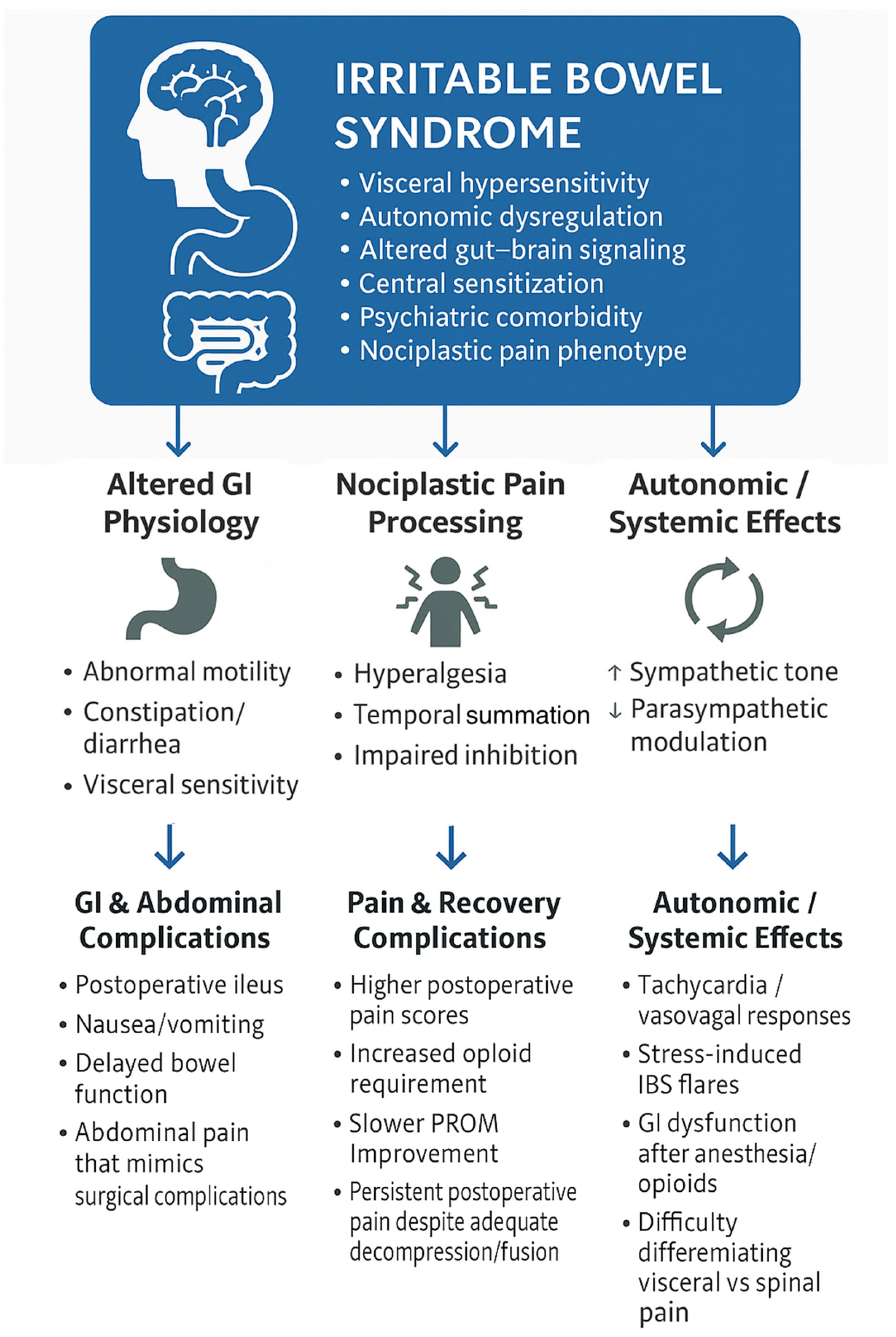
4. Pathophysiology Relevant to Spine Surgery
4.1. IBS and Chronic Low Back Pain Overlap
4.2. Visceral Hypersensitivity, Central Sensitization, and Nociplastic Pain
4.3. Autonomic Dysregulation and Viscerosomatic Reflexes
4.4. Neuroimmune Interactions and the Gut–Brain Axis
4.5. Overlap with Functional Somatic Syndromes
5. Preoperative Considerations
6. Postoperative Outcomes and Pain Trajectories
Perioperative Pain Management
7. Patient-Reported Outcomes and Satisfaction
8. Insights from Other Orthopedic Specialties
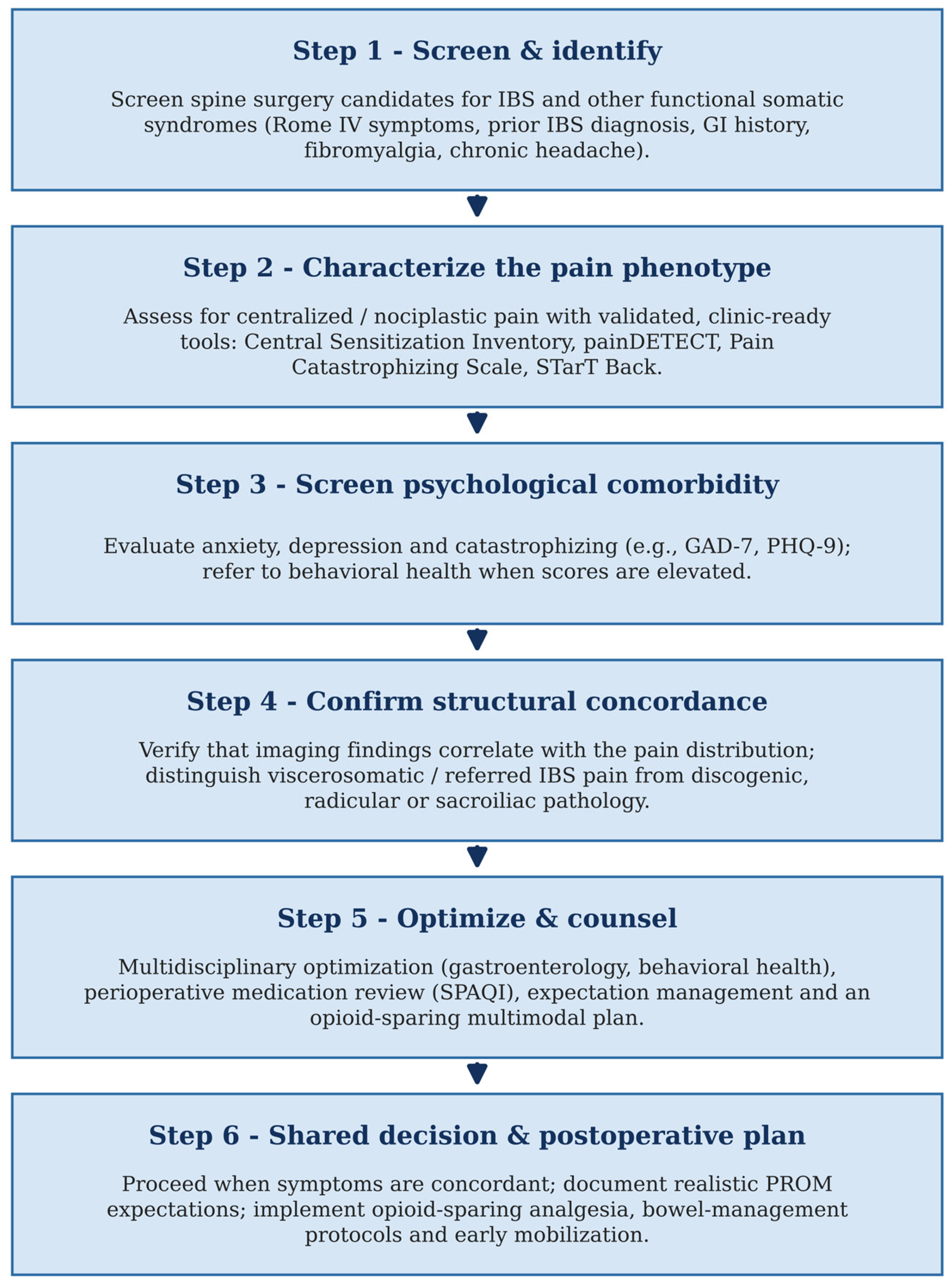
9. Practical Clinical Implications for Spine Surgeons
10. Discussion
10.1. Relationship to Prior Work and Novel Contribution
10.2. Distinguishing Confounding from Mechanism
10.3. Clinically Applicable Assessment Tools
10.4. Limitations
10.5. Future Directions
11. Conclusions
Author Contributions
Funding
Institutional Review Board Statement
Informed Consent Statement
Data Availability Statement
Conflicts of Interest
Abbreviations
| CLBP | chronic low back pain |
| CSI | Central Sensitization Inventory |
| FSS | functional somatic syndrome |
| GI | gastrointestinal |
| IBD | inflammatory bowel disease |
| IBS | irritable bowel syndrome |
| IBS-C/IBS-D | constipation-/diarrhea-predominant IBS |
| MCID | minimal clinically important difference |
| ODI | Oswestry Disability Index |
| POI | postoperative ileus |
| PONV | postoperative nausea and vomiting |
| PROM | patient-reported outcome measure |
| SPAQI | Society for Perioperative Assessment and Quality Improvement |
| SNRIs/SSRIs | serotonin–norepinephrine/selective serotonin reuptake inhibitors |
| TCAs | tricyclic antidepressants |
References
- Mayer, E.A.; Ryu, H.J.; Bhatt, R.R. The neurobiology of irritable bowel syndrome. Mol. Psychiatry 2023, 28, 1451–1465. [Google Scholar] [CrossRef] [PubMed]
- Ohlsson, B. Extraintestinal manifestations in irritable bowel syndrome: A systematic review. Ther. Adv. Gastroenterol. 2022, 15, 17562848221114558. [Google Scholar] [CrossRef] [PubMed]
- Drossman, D.A.; Chang, L.; Tack, J. Disorders of Gut-Brain Interaction and the Rome V Process. Gastroenterology 2026, 170, 1083–1098. [Google Scholar] [PubMed]
- Hausteiner-Wiehle, C.; Henningsen, P. Irritable bowel syndrome: Relations with functional, mental, and somatoform disorders. World J. Gastroenterol. 2014, 20, 6024–6030. [Google Scholar] [CrossRef] [PubMed]
- Ohrbach, R.; Sharma, S.; Fillingim, R.B.; Greenspan, J.D.; Rosen, J.D.; Slade, G.D. Clinical Characteristics of Pain Among Five Chronic Overlapping Pain Conditions. J. Oral Facial Pain Headache 2020, 34, s29–s42. [Google Scholar] [CrossRef] [PubMed]
- Slade, G.D.; Greenspan, J.D.; Fillingim, R.B.; Maixner, W.; Sharma, S.; Ohrbach, R. Overlap of Five Chronic Pain Conditions: Temporomandibular Disorders, Headache, Back Pain, Irritable Bowel Syndrome, and Fibromyalgia. J. Oral Facial Pain Headache 2020, 34, s15–s28. [Google Scholar] [CrossRef] [PubMed]
- Price, D.D.; Craggs, J.G.; Zhou, Q.; Verne, G.N.; Perlstein, W.M.; Robinson, M.E. Widespread hyperalgesia in irritable bowel syndrome is dynamically maintained by tonic visceral impulse input and placebo/nocebo factors: Evidence from human psychophysics, animal models, and neuroimaging. NeuroImage 2009, 47, 995–1001. [Google Scholar] [CrossRef] [PubMed]
- Głowiński, S.; Bryndal, A.; Grochulska, A. Prevalence and risk of spinal pain among physiotherapists in Poland. PeerJ 2021, 9, e11715. [Google Scholar] [CrossRef] [PubMed]
- Masood, R.; LeRoy, T.E.; Moverman, M.A.; Feldman, M.W.; Rogerson, A.; Salzler, M.J. Functional Somatic Syndromes Are Associated With Varied Postoperative Outcomes and Increased Opioid Use After Spine Surgery: A Systematic Review. Glob. Spine J. 2024, 14, 1601–1608. [Google Scholar] [CrossRef]
- Longstreth, G.F.; Yao, J.F. Irritable bowel syndrome and surgery: A multivariable analysis. Gastroenterology 2004, 126, 1665–1673. [Google Scholar] [CrossRef] [PubMed]
- Masood, R.; Mandalia, K.; Moverman, M.A.; Puzzitiello, R.N.; Pagani, N.R.; Menendez, M.E.; Salzler, M.J. Patients With Functional Somatic Syndromes-Fibromyalgia, Irritable Bowel Syndrome, Chronic Headaches, and Chronic Low Back Pain-Have Lower Outcomes and Higher Opioid Usage and Cost After Shoulder and Elbow Surgery. Arthrosc. J. Arthrosc. Relat. Surg. 2023, 39, 1529–1538. [Google Scholar]
- Lovell, R.M.; Ford, A.C. Global prevalence of and risk factors for irritable bowel syndrome: A meta-analysis. Clin. Gastroenterol. Hepatol. 2012, 10, 712–721.e4. [Google Scholar] [CrossRef] [PubMed]
- Oka, P.; Parr, H.; Barberio, B.; Black, C.J.; Savarino, E.V.; Ford, A.C. Global prevalence of irritable bowel syndrome according to Rome III or IV criteria: A systematic review and meta-analysis. Lancet Gastroenterol. Hepatol. 2020, 5, 908–917. [Google Scholar] [CrossRef] [PubMed]
- Lovell, R.M.; Ford, A.C. Effect of gender on prevalence of irritable bowel syndrome in the community: Systematic review and meta-analysis. Am. J. Gastroenterol. 2012, 107, 991–1000. [Google Scholar] [CrossRef] [PubMed]
- Wilder-Smith, C.H.; Robert-Yap, J. Abnormal endogenous pain modulation and somatic and visceral hypersensitivity in female patients with irritable bowel syndrome. World J. Gastroenterol. 2007, 13, 3699–3704. [Google Scholar] [CrossRef] [PubMed]
- Enck, P.; Aziz, Q.; Barbara, G.; Farmer, A.D.; Fukudo, S.; Mayer, E.A.; Niesler, B.; Quigley, E.M.; Rajilić-Stojanović, M.; Schemann, M.; et al. Irritable bowel syndrome. Nat. Rev. Dis. Primers 2016, 2, 16014. [Google Scholar] [CrossRef] [PubMed]
- Verne, G.N.; Price, D.D.; Callam, C.S.; Zhang, B.; Peck, J.; Zhou, Q. Viscerosomatic Facilitation in a Subset of IBS Patients, an Effect Mediated by N-Methyl-D-Aspartate Receptors. J. Pain 2012, 13, 901–909. [Google Scholar] [CrossRef] [PubMed]
- Staudacher, H.M.; Black, C.J.; Teasdale, S.B.; Mikocka-Walus, A.; Keefer, L. Irritable bowel syndrome and mental health comorbidity—Approach to multidisciplinary management. Nat. Rev. Gastroenterol. Hepatol. 2023, 20, 582–596. [Google Scholar] [CrossRef] [PubMed]
- Icenhour, A.; Witt, S.T.; Elsenbruch, S.; Lowén, M.; Engström, M.; Tillisch, K.; Mayer, E.A.; Walter, S. Brain functional connectivity is associated with visceral sensitivity in women with Irritable Bowel Syndrome. NeuroImage Clin. 2017, 15, 449–457. [Google Scholar] [CrossRef] [PubMed]
- Sjölund, J.; Kull, I.; Bergström, A.; Ljótsson, B.; Törnblom, H.; Olén, O.; Simrén, M. Quality of Life and Bidirectional Gut-Brain Interactions in Irritable Bowel Syndrome From Adolescence to Adulthood. Clin. Gastroenterol. Hepatol. 2024, 22, 858–866.e6. [Google Scholar] [CrossRef] [PubMed]
- Liu, T.; Wang, Z.; Kang, X.; Wang, X.; Ren, G.; Lv, Y.; Li, J.; Liu, Y.; Liang, S.; Nie, Y.; et al. Causal relationships between psychological disorders and functional gastrointestinal disorders: A bidirectional two-sample Mendelian randomization study. Eur. J. Gastroenterol. Hepatol. 2024, 36, 1267–1274. [Google Scholar] [CrossRef] [PubMed]
- Nisticò, V.; Rossi, R.E.; D’Arrigo, A.M.; Priori, A.; Gambini, O.; Demartini, B. Functional Neuroimaging in Irritable Bowel Syndrome: A Systematic Review Highlights Common Brain Alterations With Functional Movement Disorders. J. Neurogastroenterol. Motil. 2022, 28, 185–203. [Google Scholar] [CrossRef] [PubMed]
- Ablin, J.N. Nociplastic Pain: A Critical Paradigm for Multidisciplinary Recognition and Management. J. Clin. Med. 2024, 13, 5741. [Google Scholar] [CrossRef] [PubMed]
- Petrucci, G.; Papalia, G.F.; Ambrosio, L.; Russo, F.; Marchetti, A.; De Marinis, M.G.; Vadalà, G.; Papalia, R.; Denaro, V. The influence of psychological factors on postoperative clinical outcomes in patients undergoing lumbar spine surgery: A systematic review and meta-analysis. Eur. Spine J. 2025, 34, 1409–1419. [Google Scholar] [CrossRef] [PubMed]
- Albusoda, A.; Ruffle, J.K.; Friis, K.A.; Gysan, M.R.; Drewes, A.M.; Aziz, Q.; Farmer, A.D. Systematic review with meta-analysis: Conditioned pain modulation in patients with the irritable bowel syndrome. Aliment. Pharmacol. Ther. 2018, 48, 797–806. [Google Scholar] [PubMed]
- Liu, Q.; Wang, E.M.; Yan, X.J.; Chen, S.L. Autonomic functioning in irritable bowel syndrome measured by heart rate variability: A meta-analysis. J. Dig. Dis. 2013, 14, 638–646. [Google Scholar] [CrossRef] [PubMed]
- Mayer, E.A. Gut feelings: The emerging biology of gut-brain communication. Nat. Rev. Neurosci. 2011, 12, 453–466. [Google Scholar] [CrossRef] [PubMed]
- Moshiree, B.; Zhou, Q.; Price, D.D.; Verne, G.N. Central sensitisation in visceral pain disorders. Gut 2006, 55, 905–908. [Google Scholar] [CrossRef] [PubMed]
- Adeyemi, E.O.; Desai, K.D.; Towsey, M.; Ghista, D. Characterization of autonomic dysfunction in patients with irritable bowel syndrome by means of heart rate variability studies. Am. J. Gastroenterol. 1999, 94, 816–823. [Google Scholar] [CrossRef] [PubMed]
- Akiho, H.; Ihara, E.; Nakamura, K. Low-grade inflammation plays a pivotal role in gastrointestinal dysfunction in irritable bowel syndrome. World J. Gastrointest. Pathophysiol. 2010, 1, 97–105. [Google Scholar] [CrossRef] [PubMed]
- Midenfjord, I.; Grinsvall, C.; Koj, P.; Carnerup, I.; Törnblom, H.; Simrén, M. Central sensitization and severity of gastrointestinal symptoms in irritable bowel syndrome, chronic pain syndromes, and inflammatory bowel disease. Neurogastroenterol. Motil. 2021, 33, e14156. [Google Scholar] [CrossRef] [PubMed]
- Mishima, Y.; Ishihara, S. Enteric Microbiota-Mediated Serotonergic Signaling in Pathogenesis of Irritable Bowel Syndrome. Int. J. Mol. Sci. 2021, 22, 10235. [Google Scholar] [CrossRef] [PubMed]
- Erdrich, S.; Hawrelak, J.A.; Myers, S.P.; Harnett, J.E. A systematic review of the association between fibromyalgia and functional gastrointestinal disorders. Ther. Adv. Gastroenterol. 2020, 13, 1756284820977402. [Google Scholar] [CrossRef] [PubMed]
- Nijs, J.; Malfliet, A.; Nishigami, T. Nociplastic pain and central sensitization in patients with chronic pain conditions: A terminology update for clinicians. Braz. J. Phys. Ther. 2023, 27, 100518. [Google Scholar] [CrossRef] [PubMed]
- Matricon, J.; Meleine, M.; Gelot, A.; Piche, T.; Dapoigny, M.; Muller, E.; Ardid, D. Review article: Associations between immune activation, intestinal permeability and the irritable bowel syndrome. Aliment. Pharmacol. Ther. 2012, 36, 1009–1031. [Google Scholar] [CrossRef] [PubMed]
- Barbara, G.; Stanghellini, V.; De Giorgio, R.; Cremon, C.; Cottrell, G.S.; Santini, D.; Pasquinelli, G.; Morselli-Labate, A.M.; Grady, E.F.; Bunnett, N.W.; et al. Activated mast cells in proximity to colonic nerves correlate with abdominal pain in irritable bowel syndrome. Gastroenterology 2004, 126, 693–702. [Google Scholar] [CrossRef] [PubMed]
- Luo, M.; Zhuang, X.; Tian, Z.; Xiong, L. Alterations in short-chain fatty acids and serotonin in irritable bowel syndrome: A systematic review and meta-analysis. BMC Gastroenterol. 2021, 21, 14. [Google Scholar] [CrossRef] [PubMed]
- Wang, L.; Alammar, N.; Singh, R.; Nanavati, J.; Song, Y.; Chaudhary, R.; Mullin, G.E. Gut Microbial Dysbiosis in the Irritable Bowel Syndrome: A Systematic Review and Meta-Analysis of Case-Control Studies. J. Acad. Nutr. Diet. 2020, 120, 565–586. [Google Scholar] [PubMed]
- Hladkykh, F.V.; Liadova, T.I.; Matvieienko, M.S.; Komorovsky, R.; Smiyan, S.; Student, V. Central Sensitization and Nociplastic Pain: Shared Mechanisms in Fibromyalgia, Osteoarthritis, and Inflammatory Arthritis. J. Pain Res. 2026, 19, 571311. [Google Scholar] [PubMed]
- Pittayanon, R.; Lau, J.T.; Yuan, Y.; Leontiadis, G.I.; Tse, F.; Surette, M.; Moayyedi, P. Gut Microbiota in Patients With Irritable Bowel Syndrome—A Systematic Review. Gastroenterology 2019, 157, 97–108. [Google Scholar] [CrossRef] [PubMed]
- Oprea, A.D.; Keshock, M.C.; O’Glasser, A.Y.; Cummings, K.C.; Edwards, A.F.; Zimbrean, P.C.; Urman, R.D.; Mauck, K.F. Preoperative Management of Medications for Psychiatric Diseases: Society for Perioperative Assessment and Quality Improvement Consensus Statement. Mayo Clin. Proc. 2022, 97, 397–416. [Google Scholar] [PubMed]
- Zamani, M.; Alizadeh-Tabari, S.; Zamani, V. Systematic review with meta-analysis: The prevalence of anxiety and depression in patients with irritable bowel syndrome. Aliment. Pharmacol. Ther. 2019, 50, 132–143. [Google Scholar] [PubMed]
- Park, S.C.; Chang, S.Y.; Mok, S.; Kim, H.; Chang, B.S.; Lee, C.K. Risk factors for postoperative ileus after oblique lateral interbody fusion: A multivariate analysis. Spine J. 2021, 21, 438–445. [Google Scholar] [CrossRef] [PubMed]
- Chang, Y.; Wong, C.E.; Chen, W.C.; Hsu, H.H.; Lee, P.H.; Huang, C.C.; Lee, J.S. Risk Factors for Postoperative Ileus Following Spine Surgery: A Systematic Review With Meta-Analysis. Glob. Spine J. 2024, 14, 707–717. [Google Scholar]
- Zhang, Z.; Hu, B.W.; Li, J.C.; Yang, H.L.; Liu, L.M.; Song, Y.M.; Yang, X. Incidence and Risk Factors for Postoperative Ileus after Posterior Surgery in Adolescent Idiopathic Scoliosis. Orthop. Surg. 2023, 15, 704–712. [Google Scholar] [CrossRef] [PubMed]
- Shih, P.; Slimack, N.P.; Roy, A.; Fessler, R.G.; Koski, T.R. Abdominal complications following posterior spinal fusion in patients with previous abdominal surgeries. Neurosurg. Focus 2011, 31, E16. [Google Scholar] [CrossRef] [PubMed]
- Zeng, C.; Ding, H.; Xu, A.Y.; Wu, J.; Diebo, B.G.; Daniels, A.H.; He, D. Gastrointestinal Management Enhanced Recovery after Surgery Protocol Improves Postoperative Recovery in Patients Undergoing Posterior Lumbar Interbody Fusion. Glob. Spine J. 2026, 16, 650–660. [Google Scholar]
- Gonzalez-Alvarez, M.E.; Sanchez-Romero, E.A.; Turroni, S.; Fernandez-Carnero, J.; Villafañe, J.H. Correlation between the Altered Gut Microbiome and Lifestyle Interventions in Chronic Widespread Pain Patients: A Systematic Review. Medicina 2023, 59, 256. [Google Scholar] [CrossRef] [PubMed]
- Hanning, N.; Edwinson, A.L.; Ceuleers, H.; Peters, S.A.; De Man, J.G.; Hassett, L.C.; De Winter, B.Y.; Grover, M. Intestinal barrier dysfunction in irritable bowel syndrome: A systematic review. Ther. Adv. Gastroenterol. 2021, 14, 1756284821993586. [Google Scholar] [CrossRef] [PubMed]
- Pfeifer, K.J.; Selzer, A.; Whinney, C.M.; Rogers, B.; Naik, A.S.; Regan, D.; Mendez, C.E.; Urman, R.D.; Mauck, K. Preoperative Management of Gastrointestinal and Pulmonary Medications: Society for Perioperative Assessment and Quality Improvement (SPAQI) Consensus Statement. Mayo Clin. Proc. 2021, 96, 3158–3177. [Google Scholar] [CrossRef] [PubMed]
- Bae, S.; Alboog, A.; Esquivel, K.S.; Abbasi, A.; Zhou, J.; Chui, J. Efficacy of perioperative pharmacological and regional pain interventions in adult spine surgery: A network meta-analysis and systematic review of randomised controlled trials. Br. J. Anaesth. 2021, 128, 98–117. [Google Scholar] [PubMed]
- Baykal Şahin, H.; Aktoklu, M. Central sensitization as a predictor of short-term postoperative outcomes in lumbar spinal stenosis: A prospective observational study. Eur. Spine J. 2026, 35, 2401–2408. [Google Scholar] [CrossRef]
- Merrill, R.K.; Zebala, L.P.; Peters, C.; Qureshi, S.A.; McAnany, S.J. Impact of Depression on Patient-Reported Outcome Measures After Lumbar Spine Decompression. Spine 2018, 43, 434–439. [Google Scholar] [CrossRef] [PubMed]
- Hamilton, T.; Lim, S.; Telemi, E.; Yun, H.J.; Macki, M.; Schultz, L.; Yeh, H.H.; Springer, K.; Taliaferro, K.; Perez-Cruet, M.; et al. Risk factors for not reaching minimal clinically important difference at 90 days and 1 year after elective lumbar spine surgery: A cohort study. J. Neurosurg. Spine 2024, 40, 343–350. [Google Scholar] [CrossRef] [PubMed]
- Sánchez Romero, E.A.; Martínez-Pozas, O.; García-González, M.; de-Pedro, M.; González-Álvarez, M.E.; Esteban-González, P.; Cid-Verdejo, R.; Villafañe, J.H. Association between Sleep Disorders and Sleep Quality in Patients with Temporomandibular Joint Osteoarthritis: A Systematic Review. Biomedicines 2022, 10, 2143. [Google Scholar] [CrossRef] [PubMed]


| Medication Class | Examples | Perioperative Recommendation | Timing Guidance |
|---|---|---|---|
| Secretagogues (chloride channel activators) | Lubiprostone | Continue | Take up to and including day of surgery |
| Guanylate cyclase-C agonists | Linaclotide, plecanatide | Continue | Take up to and including day of surgery; resume when enteral intake tolerated |
| Serotonergic neuroenteric modulators | Tegaserod, prucalopride, alosetron | Continue | Take up to and including day of surgery; monitor QT/ischemia risks where applicable |
| Laxatives (osmotic, stimulant, softener) | PEG 3350, lactulose, senna, bisacodyl, Mg salts, docusate | Hold morning of surgery | Last dose evening prior; skip morning dose unless bowel prep required |
| Antispasmodics/anticholinergics | Dicyclomine, hyoscyamine | Hold morning of surgery | Take last dose night before; omit morning dose due to anticholinergic effects |
| μ-Opioid modulators (IBS-D) | Eluxadoline | No clear SPAQI guideline; typically hold morning of surgery (institution dependent) | Coordinate with anesthesia; resume once PO and low risk for pancreatitis/SOD spasm |
| TCAs for pain modulation | Amitriptyline, nortriptyline | Continue | Continue through surgery; taper only if high arrhythmia/QT risk |
| SSRIs | Sertraline, fluoxetine, citalopram, paroxetine | Continue | Discontinuation syndrome risk when stopped abruptly |
| SNRIs | Duloxetine, venlafaxine | Continue | Discontinuation syndrome risk when stopped abruptly |
| Anti-diarrheal agents | Loperamide, diphenoxylate/atropine | Hold morning of surgery | Hold morning dose if obstruction/ileus suspected |
| Non-prescription IBS adjuncts | Psyllium fiber, peppermint oil | Continue | Hold fiber on morning of surgery if aspiration risk or severe GI dysmotility |
| Antibiotics used in IBS-D/SIBO overlap | Rifaximin | Continue | Take as scheduled; no perioperative restrictions |
| Complication Category | Specific Complication | Rationale/Evidence Linking IBS to Higher Risk | Predominant Evidence Basis |
|---|---|---|---|
| Gastrointestinal & abdominal | Postoperative ileus (POI) | IBS listed as a candidate POI risk factor in spine cohorts; autonomic dysregulation, heightened sympathetic tone, and baseline motility disturbance. | Indirect (spine cohort association) |
| Postoperative nausea/vomiting (PONV) | Increased visceral hypersensitivity and vagal dysfunction; higher perioperative nausea in GI literature extrapolated to spine pathways. | Indirect (extrapolated) | |
| Delayed return of bowel function | Baseline constipation, chronic laxative use, autonomic imbalance, and opioid sensitivity increase risk of delayed GI recovery. | Mechanistic/extrapolated | |
| Abdominal pain mimicking complication | IBS flares may present as postoperative abdominal pain, complicating differentiation from true abdominal pathology. | Mechanistic | |
| Opioid-related adverse events | Increased opioid requirement | IBS and other FSS show higher postoperative opioid consumption across musculoskeletal procedures. | Indirect (FSS musculoskeletal data) |
| Opioid intolerance/hypersensitivity | Central sensitization results in heightened pain reporting and lower opioid efficacy, leading to prolonged or escalated use. | Mechanistic | |
| Opioid-induced constipation exacerbation | IBS-C and mixed-type IBS patients are at elevated risk for postoperative constipation. | Mechanistic | |
| Pain & recovery | Higher postoperative pain scores | Generalized hyperalgesia, impaired descending inhibition, and enhanced temporal summation predict worse surgical pain trajectories. | Indirect (chronic-pain data) |
| Slower or blunted PROM improvement | FSS (including IBS) consistently predict lower PROM gains following spine surgery. | Indirect (FSS spine data) | |
| Persistent postoperative pain | Nociplastic pain mechanisms worsen recovery independent of structural outcomes. | Mechanistic | |
| Surgical & mechanical (indirect) | Higher perceived failure despite adequate decompression/fusion | Pain amplification can lead to dissatisfaction even after technically successful procedures. | Mechanistic |
| Increased return visits or imaging | Diagnostic ambiguity from visceral–somatic overlap may prompt more postoperative evaluation. | Mechanistic | |
| Systemic/physiologic stress | Autonomic instability (tachycardia, vasovagal) | Heightened sympathetic reactivity and reduced parasympathetic tone may affect intra- and postoperative hemodynamics. | Mechanistic |
| Postoperative exacerbation of IBS symptoms | Surgical stress, anesthesia, perioperative opioids, and bowel manipulation can provoke flares. | Mechanistic | |
| Rare reported events | Abdominal complications post-posterior fusion | Case reports describe IBS as a comorbidity in bowel obstruction or severe ileus after posterior procedures (no causal link established). | Case-level |
| Misclassification of IBS pain as recurrent spinal pathology | IBS-induced pelvic/low-back pain may resemble radicular or discogenic pain, leading to unnecessary intervention. | Conceptual |
Disclaimer/Publisher’s Note: The statements, opinions and data contained in all publications are solely those of the individual author(s) and contributor(s) and not of MDPI and/or the editor(s). MDPI and/or the editor(s) disclaim responsibility for any injury to people or property resulting from any ideas, methods, instructions or products referred to in the content. |
© 2026 by the authors. Licensee MDPI, Basel, Switzerland. This article is an open access article distributed under the terms and conditions of the Creative Commons Attribution (CC BY) license.
Share and Cite
Carayannopoulos, N.L.; Sadh, P.; Chisango, Z.M.; Jasti, S.; Farias, M.J.; Nassar, J.E.; Okewunmi, J.; Kim, J.; Czerwein, J.; Kuris, E.O.; et al. The Impact of Irritable Bowel Syndrome on Spine Surgery Outcomes: A Comprehensive Narrative Review. J. Clin. Med. 2026, 15, 5192. https://doi.org/10.3390/jcm15135192
Carayannopoulos NL, Sadh P, Chisango ZM, Jasti S, Farias MJ, Nassar JE, Okewunmi J, Kim J, Czerwein J, Kuris EO, et al. The Impact of Irritable Bowel Syndrome on Spine Surgery Outcomes: A Comprehensive Narrative Review. Journal of Clinical Medicine. 2026; 15(13):5192. https://doi.org/10.3390/jcm15135192
Chicago/Turabian StyleCarayannopoulos, Nicolas L., Puru Sadh, Zvipo M. Chisango, Siddharth Jasti, Michael J. Farias, Joseph E. Nassar, Jeffrey Okewunmi, Jinseong Kim, John Czerwein, Eren O. Kuris, and et al. 2026. "The Impact of Irritable Bowel Syndrome on Spine Surgery Outcomes: A Comprehensive Narrative Review" Journal of Clinical Medicine 15, no. 13: 5192. https://doi.org/10.3390/jcm15135192
APA StyleCarayannopoulos, N. L., Sadh, P., Chisango, Z. M., Jasti, S., Farias, M. J., Nassar, J. E., Okewunmi, J., Kim, J., Czerwein, J., Kuris, E. O., Basques, B. A., & Daniels, A. H. (2026). The Impact of Irritable Bowel Syndrome on Spine Surgery Outcomes: A Comprehensive Narrative Review. Journal of Clinical Medicine, 15(13), 5192. https://doi.org/10.3390/jcm15135192