The Fibroid Removal in Sterility Treatment ‘‘FIRST’’ Survey: A European Society of Gynecology Online Questionnaire

 ,
,  , ,
, ,  , , and
Abstract
1. Introduction
2. Materials and Methods
3. Results
4. Discussion
5. Conclusions
Author Contributions
Funding
Institutional Review Board Statement
Informed Consent Statement
Data Availability Statement
Acknowledgments
Conflicts of Interest
Abbreviations
| FIGO | International Federation of Gynaecology and Obstetrics |
| ESG | European Society of Gynecology |
| IVF | In Vitro Fertilization |
| ASRM | American Society for Reproductive Medicine |
| AAGL | American Association of Gynecologic Laparoscopists |
| IFFS | International Federation of Fertility Societies |
| ACCEPT | Australasian CREI Consensus Expert Panel on Trial Evidence |
| HMB | Heavy Menstrual Bleeding |
| JZ | Junctional Zone |
| ART | Assisted Reproductive Technology |
| LBR | Live Birth Rate |
| GnRH | Gonadotrophin-Releasing Hormone |
| IUD | Intra-Uterine Device |
| MRI | Magnetic Resonance Imaging |
| TVU | Transvaginal Ultrasound |
| 2D | 2-Dimensional |
| 3D | 3-Dimensional |
| RCT | Randomized Controlled Trial |
| IRB | Institutional Review Board |
References
- Stewart, E.A.; Cookson, C.L.; Gandolfo, R.A.; Schulze-Rath, R. Epidemiology of uterine fibroids: A systematic review. BJOG 2017, 124, 1501–1512. [Google Scholar] [CrossRef] [PubMed]
- Moravek, M.B.; Bulun, S.E. Endocrinology of uterine fibroids: Steroid hormones, stem cells, and genetic contribution. Curr. Opin. Obstet. Gynecol. 2015, 27, 276–283. [Google Scholar] [CrossRef] [PubMed]
- Stewart, E.A. Clinical practice. Uterine fibroids. N. Engl. J. Med. 2015, 372, 1646–1655. [Google Scholar] [CrossRef] [PubMed]
- Stewart, E.A.; Laughlin-Tommaso, S.K.; Catherino, W.H.; Lalitkumar, S.; Gupta, D.; Vollenhoven, B. Uterine fibroids. Nat. Rev. Dis. Primers 2016, 2, 16043. [Google Scholar] [CrossRef] [PubMed]
- Metwally, M.; Raybould, G.; Cheong, Y.C.; Horne, A.W. Surgical treatment of fibroids for subfertility. Cochrane Database Syst. Rev. 2020, 1, CD003857. [Google Scholar] [CrossRef] [PubMed]
- Donnez, J.; Dolmans, M.M. Hormone therapy for intramural myoma-related infertility from ulipristal acetate to GnRH antagonist: A review. Reprod. Biomed. Online 2020, 41, 431–442. [Google Scholar] [CrossRef] [PubMed]
- Tinelli, A.; Kosmas, I.; Mynbaev, O.A.; Favilli, A.; Gimbrizis, G.; Sparic, R.; Pellegrino, M.; Malvasi, A. Submucous fibroids, fertility, and possible correlation to pseudocapsule thickness in reproductive surgery. Biomed. Res. Int. 2018, 2018, 2804830. [Google Scholar] [CrossRef] [PubMed]
- Soliman, A.M.; Yang, H.; Du, E.X.; Kelkar, S.S.; Winkel, C. The direct and indirect costs of uterine fibroid tumors: A systematic review of the literature between 2000 and 2013. Am. J. Obstet. Gynecol. 2015, 213, 141–160. [Google Scholar] [CrossRef] [PubMed]
- Munro, M.G.; Critchley, H.O.; Broder, M.S.; Fraser, I.S.; FIGO Working Group on Menstrual Disorders. FIGO classification system (PALM-COEIN) for causes of abnormal uterine bleeding in nongravid women of reproductive age. Int. J. Gynaecol. Obstet. 2011, 113, 3–13. [Google Scholar] [CrossRef] [PubMed]
- Munro, M.G.; Critchley, H.O.D.; Fraser, I.S.; FIGO Menstrual Disorders Committee. The two FIGO systems for normal and abnormal uterine bleeding symptoms and classification of causes of abnormal uterine bleeding in the reproductive years: 2018 revisions. Int. J. Gynaecol. Obstet. 2018, 143, 393–408. [Google Scholar] [CrossRef] [PubMed]
- Chandrakumar, D.L.; Aref-Adib, M.; Odejinmi, F. Advancing women’s health: The imperative for public health screening of uterine fibroids for personalized care. Eur. J. Obstet. Gynecol. Reprod. Biol. 2024, 299, 266–271. [Google Scholar] [CrossRef] [PubMed]
- Spies, J.B.; Bradley, L.D.; Guido, R.; Maxwell, G.L.; Levine, B.A.; Coyne, K. Outcomes from leiomyoma therapies: Comparison with normal controls. Obstet. Gynecol. 2010, 116, 641–652. [Google Scholar] [CrossRef] [PubMed]
- Practice Committee of the American Society for Reproductive Medicine. Removal of myomas in asymptomatic patients to improve fertility and/or reduce miscarriage rate: A guideline. Fertil. Steril. 2017, 108, 416–425. [Google Scholar] [CrossRef] [PubMed]
- American Association of Gynecologic Laparoscopists (AAGL): Advancing Minimally Invasive Gynecology Worldwide. AAGL practice report: Practice guidelines for the diagnosis and management of submucous leiomyomas. J. Minim. Invasive Gynecol. 2012, 19, 152–171. [CrossRef] [PubMed]
- Sirkeci, R.F.; Belli, A.M.; Manyonda, I.T. Treating symptomatic uterine fibroids with myomectomy: Current practice and views of UK consultants. Gynecol. Surg. 2017, 14, 11. [Google Scholar] [CrossRef] [PubMed]
- Chapman, L.; Magos, A. Surgical and radiological management of uterine fibroids in the UK. Curr. Opin. Obstet. Gynecol. 2006, 18, 394–401. [Google Scholar] [CrossRef] [PubMed]
- Amoah, A.; Joseph, N.; Reap, S.; Quinn, S.D. Appraisal of national and international uterine fibroid management guidelines: A systematic review. BJOG 2022, 129, 356–364. [Google Scholar] [CrossRef] [PubMed]
- Marugo, M.; Centonze, M.; Bernasconi, D.; Fazzuoli, L.; Berta, S.; Giordano, G. Estrogen and progesterone receptors in uterine leiomyomas. Acta Obstet. Gynecol. Scand. 1989, 68, 731–735. [Google Scholar] [CrossRef] [PubMed]
- Brosens, I.; Deprest, J.; Dal Cin, P.; Van den Berghe, H. Clinical significance of cytogenetic abnormalities in uterine myomas. Fertil. Steril. 1998, 69, 232–235. [Google Scholar] [CrossRef] [PubMed]
- Somigliana, E.; Vercellini, P.; Daguati, R.; Pasin, R.; De Giorgi, O.; Crosignani, P.G. Fibroids and female reproduction: A critical analysis of the evidence. Hum. Reprod. Update 2007, 13, 465–476. [Google Scholar] [CrossRef] [PubMed]
- Nishino, M.; Togashi, K.; Nakai, A.; Hayakawa, K.; Kanao, S.; Iwasaku, K.; Fujii, S. Uterine contractions evaluated on cine MR imaging in patients with uterine leiomyomas. Eur. J. Radiol. 2005, 53, 142–146. [Google Scholar] [CrossRef] [PubMed]
- Zepiridis, L.I.; Grimbizis, G.F.; Tarlatzis, B.C. Infertility and uterine fibroids. Best. Pract. Res. Clin. Obstet. Gynaecol. 2016, 34, 66–73. [Google Scholar] [CrossRef] [PubMed]
- Rackow, B.W.; Taylor, H.S. Submucosal uterine leiomyomas have a global effect on molecular determinants of endometrial receptivity. Fertil. Steril. 2010, 93, 2027–2034. [Google Scholar] [CrossRef] [PubMed]
- Pritts, E.A.; Parker, W.H.; Olive, D.L. Fibroids and infertility: An updated systematic review of the evidence. Fertil. Steril. 2009, 91, 1215–1223. [Google Scholar] [CrossRef] [PubMed]
- International Federation of Fertility Societies (IFFS); Standards and Practice Committee. Global Standards of Infertility Care: Standard 10. Management of Leiomyoma (Fibroids) in a Patient Presenting with Infertility. Available online: www.iffsreproduction.org (accessed on 1 January 2026).
- Bulletti, C.; De Ziegler, D.; Polli, V.; Flamigni, C. The role of leiomyomas in infertility. J. Am. Assoc. Gynecol. Laparosc. 1999, 6, 441–445. [Google Scholar] [CrossRef] [PubMed]
- Bosteels, J.; Weyers, S.; Mol, B.W.; D’Hooghe, T. Anti-adhesion barrier gels following operative hysteroscopy for treating female infertility: A systematic review and meta-analysis. Gynecol. Surg. 2014, 11, 113–127. [Google Scholar] [CrossRef] [PubMed]
- Healy, M.W.; Schexnayder, B.; Connell, M.T.; Terry, N.; DeCherney, A.H.; Csokmay, J.M.; Yauger, B.J.; Hill, M.J. Intrauterine adhesion prevention after hysteroscopy: A systematic review and meta-analysis. Am. J. Obstet. Gynecol. 2016, 215, 267–275.e7. [Google Scholar] [CrossRef] [PubMed]
- Favilli, A.; Mazzon, I.; Etrusco, A.; Dellino, M.; Laganà, A.S.; Tinelli, A.; Chiantera, V.; Cicinelli, E.; Gerli, S.; Vitagliano, A. The challenge of FIGO type 3 leiomyomas and infertility: Exploring therapeutic alternatives amidst limited scientific certainties. Int. J. Gynaecol. Obstet. 2024, 165, 975–987. [Google Scholar] [CrossRef] [PubMed]
- Kroon, B.; Johnson, N.; Chapman, M.; Yazdani, A.; Hart, R.; ACCEPT Group. Fibroids in infertility—Consensus statement from ACCEPT (Australasian CREI Consensus Expert Panel on Trial evidence). Aust. N. Z. J. Obstet. Gynaecol. 2011, 51, 289–295. [Google Scholar] [CrossRef] [PubMed]
- Erden, M.; Uyanik, E.; Polat, M.; Ozbek, I.Y.; Yarali, H.; Mumusoglu, S. The effect of ≤6 cm sized noncavity-distorting intramural fibroids on in vitro fertilization outcomes: A systematic review and meta-analysis. Fertil. Steril. 2023, 119, 996–1007. [Google Scholar] [CrossRef] [PubMed]
- Dolmans, M.-M.; Isaacson, K.; Zhang, W.; Gordts, S.; Munro, M.G.; Stewart, E.A.; Bourdon, M.; Santulli, P.; Donnez, J. Intramural myomas more than 3–4 centimeters should be surgically removed before in vitro fertilization. Fertil. Steril. 2021, 116, 945–958. [Google Scholar] [CrossRef] [PubMed]
- Han, Y.; Yao, R.; Zhang, Y.; Yang, Z.; Luo, H.; Wang, X.; Du, A.; Zhang, Y.; Zhu, Y. Hysteroscopic resection of type 3 fibroids could improve the pregnancy outcomes in infertile women: A case-control study. BMC Pregnancy Childbirth 2022, 22, 522. [Google Scholar] [CrossRef] [PubMed]
- Jin, C.; Hu, Y.; Chen, X.C.; Zheng, F.-Y.; Lin, F.; Zhou, K.; Chen, F.-D.; Gu, H.-Z. Laparoscopic versus open myomectomy--a meta-analysis of randomized controlled trials. Eur. J. Obstet. Gynecol. Reprod. Biol. 2009, 145, 14–21. [Google Scholar] [CrossRef] [PubMed]
- Donnez, J.; Taylor, H.S.; Marcellin, L.; Dolmans, M.M. Uterine fibroid-related infertility: Mechanisms and management. Fertil. Steril. 2024, 122, 31–39. [Google Scholar] [CrossRef] [PubMed]
- Margueritte, F.; Adam, C.; Fauconnier, A.; Gauthier, T. Time to conceive after myomectomy: Should we advise a minimum time interval? A systematic review. Reprod. Biomed. Online 2021, 43, 543–552. [Google Scholar] [CrossRef] [PubMed]
- Kathopoulis, N.; Prodromidou, A.; Douligeris, A.; Diakosavvas, M.; Zacharakis, D.; Kypriotis, K.; Chatzipapas, I.; Grigoriadis, T.; Protopapas, A. Barbed Sutures Compared with Conventional Sutures During Laparoscopic Myomectomy: A Systematic Review and Meta-analysis. Obstet. Gynecol. 2024, 144, e81–e100. [Google Scholar] [CrossRef] [PubMed]
- Sheng, Y.; Hong, Z.; Wang, J.; Mao, B.; Wu, Z.; Gou, Y.; Zhao, J.; Liu, Q. Efficacy and safety of robot-assisted laparoscopic myomectomy versus laparoscopic myomectomy: A systematic evaluation and meta-analysis. World J. Surg. Oncol. 2023, 21, 230. [Google Scholar] [CrossRef] [PubMed]
- American College of Obstetricians and Gynecologists. Management of symptomatic uterine leiomyomas. ACOG Practice Bulletin No. 228. Obstet. Gynecol. 2021, 137, e100–e115. [Google Scholar] [CrossRef] [PubMed]



| Question 1 | Please clarify your professional status |
| Question 2 | Please clarify your years of experience post-training/fellowship |
| Question 3 | Have you completed a specialist training/certification in minimally invasive gynecological surgery? |
| Question 4 | How many laparoscopic/robot-assisted myomectomies do you perform per annum (on average, in the last 5 years)? |
| Question 5 | How many hysteroscopic myomectomies do you perform per annum (on average, in the last 5 years)? |
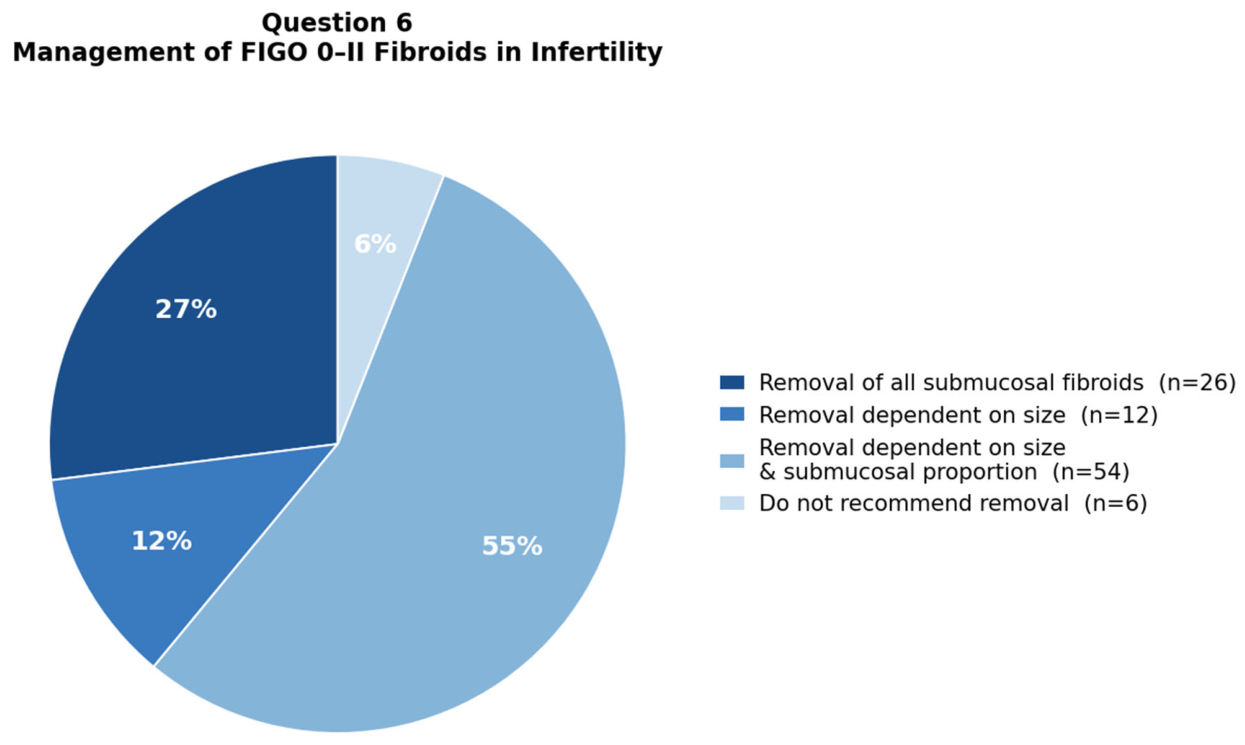
| Question 6: | In your clinical practice, which of the following principles do you follow in a patient with a FIGO 0–II fibroid and infertility? |
| Question 7: | In your clinical practice, if hysteroscopic removal of a FIGO 0–II fibroid is decided, do you routinely use anti-adhesion agents? |
| Question 8: | If answer is no for the previous question, go directly to question number 9. If answer is yes for the previous question, what type of anti-adhesion do you usually use? |
| Question 9: | In your clinical practice, in case of hysteroscopic removal of a fibroid, do you routinely perform second-look hysteroscopic assessment of the endometrial cavity to assess for intra-uterine adhesions? |
| Question 10: | What size of a FIGO III fibroid do you consider to be significant in patients with fibroid-associated infertility? |
| Question 11: | What size of a FIGO IV do you consider to be significant in patients with fibroid associated infertility? |
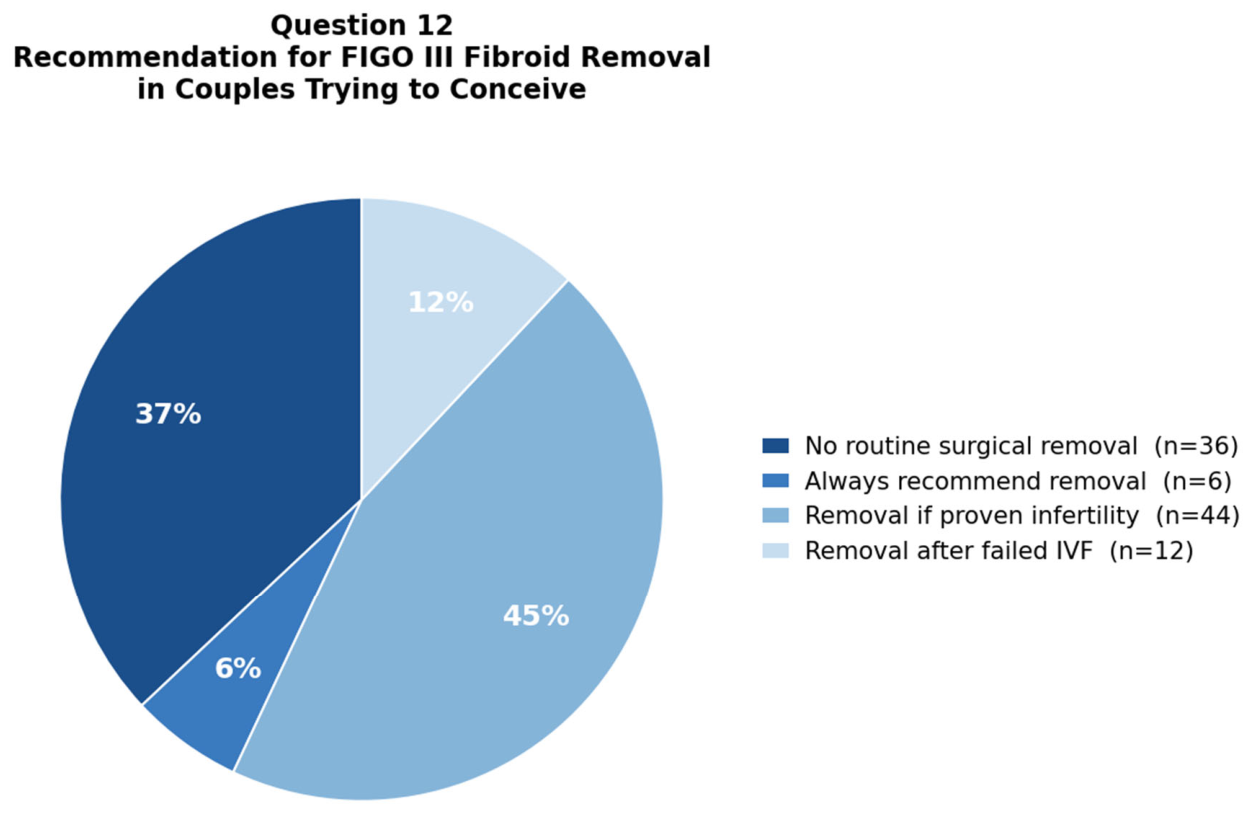
| Question 12: | In your clinical practice, would you recommend surgical removal of a FIGO III fibroid in couples trying to conceive? |
| Question 13: | In your clinical practice, would you recommend surgical removal of a FIGO IV fibroid in couples trying to conceive? |
| Question 14: | In your clinical practice, if you recommend surgical removal of a FIGO III fibroid in infertile patients planned to undergo IVF, what fibroid size do you use as a cut-off? |
| Question 15: | In your clinical practice, if you recommend surgical removal of a FIGO IV fibroid in infertile patients planned to undergo IVF, what fibroid size do you use as a cut-off? |
| Question 16: | What modalities do you usually use to diagnose and map fibroids in patients with infertility? |
| Question 17: | In your clinical practice, should you decide to remove a FIGO III fibroid in an infertile patient, what is your most commonly employed surgical route? |
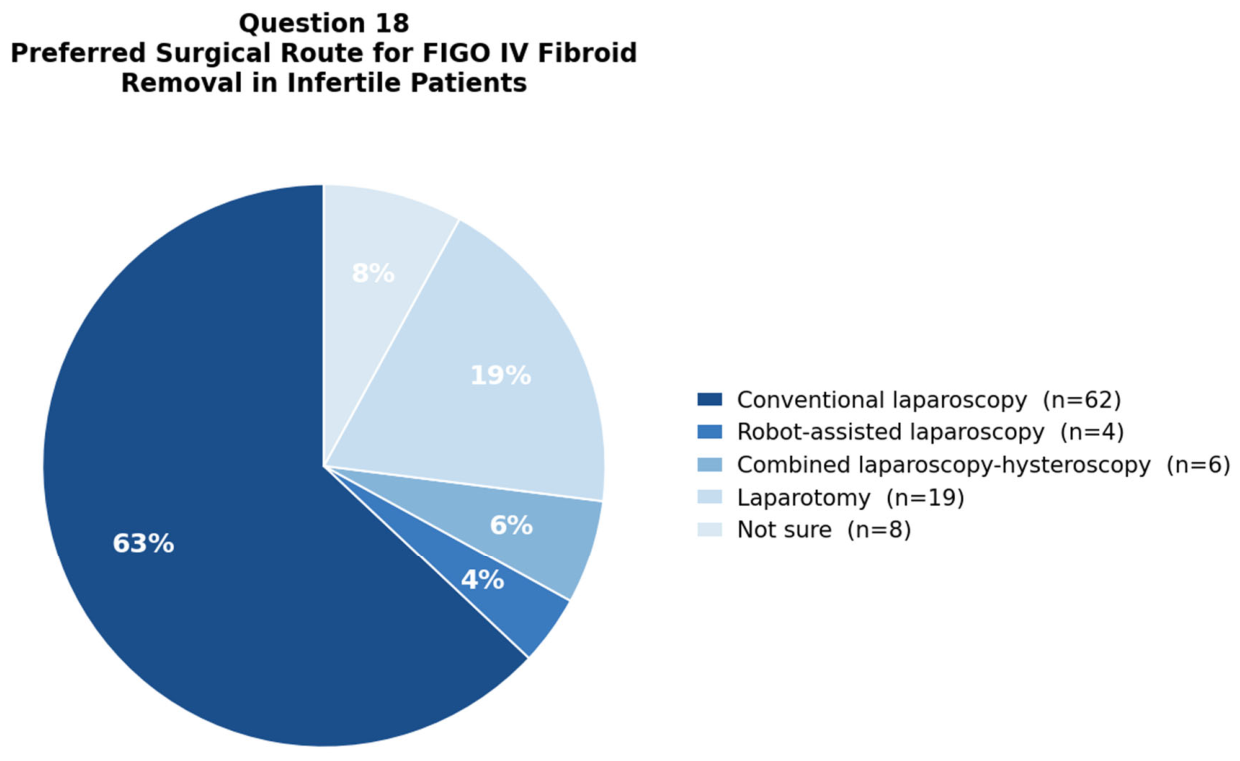
| Question 18: | In your clinical practice, should you decide to remove a FIGO IV fibroid in an infertile patient, what is your most commonly employed surgical route? |
| Question 19: | In your clinical practice, should you decide to remove a FIGO III fibroid in an infertile patient, do you routinely check during surgery the integrity of the uterine cavity following fibroid removal? |
| Question 20: | In your clinical practice, should you decide to remove a FIGO 0–II fibroid, do you use pre-treatment with gonadotrophin-releasing hormone agonist/antagonist? |
| Question 21: | In your clinical practice, should you decide to remove a FIGO III fibroid, for how long would you use pre-treatment with gonadotrophin-releasing hormone agonist/antagonist before the operation? |
| Question 22: | In your clinical practice, should you decide to remove a FIGO IV fibroid, for how long would you use pre-treatment with gonadotrophin-releasing hormone agonist/antagonist before the operation? |
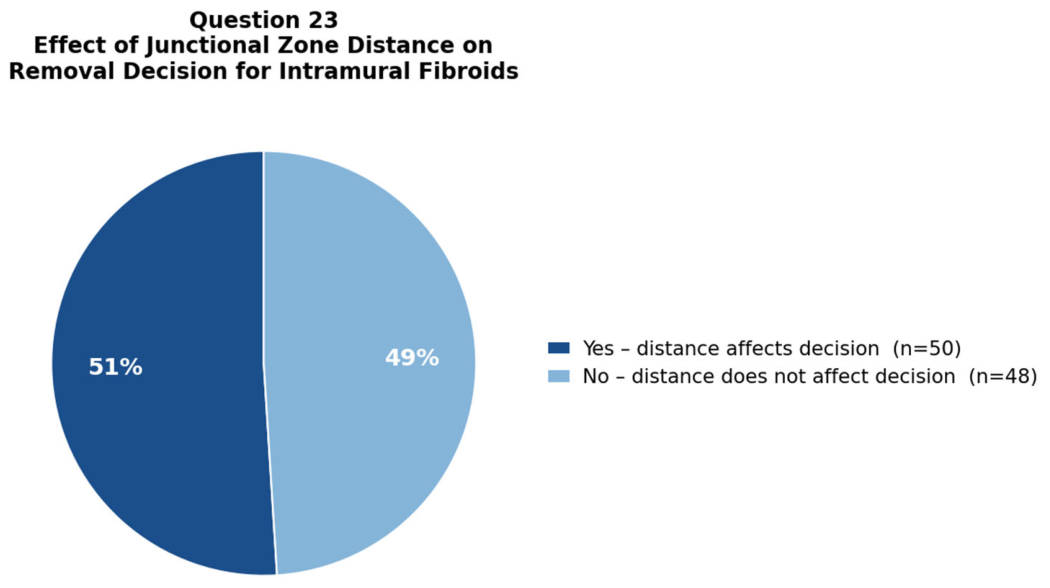
| Question 23: | Regarding intramural, non cavity-distorting fibroids in infertile patients, does the distance from the junctional zone affect your decision for the removal? |
| Question 24: | If the answer to the previous question is yes, what is the distance of the fibroid from the junctional zone that would affect your decision? |
| Question 25: | Following myomectomy in infertile patients, how long do you advise your patients to wait before attempting to conceive/undergoing IVF? |
| Question 26: | In your clinical practice, do you use barbed sutures following laparoscopic/robot-assisted myomectomy? |
| Question 27: | Do you use the robotic approach for myomectomies and, if so, what percentage of myomectomies are done via the robotic approach? |
| Question | Answer A | Answer B | Answer C | Answer D | Answer E | Answer F | Answer G/NA |
|---|---|---|---|---|---|---|---|
| Q1 | Trainee gynecologist (n = 6, 6%) | Consultant in private practice (n = 30, 31%) | Consultant in public hospital (n = 34, 35%) | Academic (n = 18, 18%) | Retired gynecologist (n = 6, 6%) | Other (n = 4, 4%) | NA (n = 0) |
| Q2 | <5 (n = 8, 8%) | 5–10 (n = 16, 16%) | >10 (n = 74, 76%) | ||||
| Q3 | No (n = 56, 57%) | Yes (n = 42, 43%) | |||||
| Q4 | <10 (n = 32, 33%) | 10–30 (n = 16, 16%) | 30–50 (n = 10, 10%) | >50 (n = 14, 14%) | NA (n = 26, 27%) | ||
| Q5 | <10 (n = 26, 27%) | 10–20 (n = 20, 20%) | 20–30 (n = 6, 6%) | >30 (n = 32, 33%) | NA (n = 14, 14%) |
| Question | Answer A | Answer B | Answer C | Answer D | Answer E | Answer F | Answer G |
|---|---|---|---|---|---|---|---|
| Q6 | Hysteroscopic removal of all submucosal fibroids (n = 26, 27%) | Removal dependent on size (n = 12, 12%) | Removal dependent on size and submucosal proportion (n = 54, 55%) | Do not recommend hysteroscopic removal (n = 6, 6%) | |||
| Q7 | Yes, always (n = 12, 12%) | Yes, sometimes (n = 38, 39%) | No, never (n = 48, 49%) | ||||
| Q8 (54 answers) | Copper IUD (n = 0) | Progesterone-releasing IUD (n = 20, 37%) | Foley’s balloon (n = 2, 4%) | Anti-adhesion agents (n = 20, 37%) | Oral hormonal treatment (n = 12, 22%) | ||
| Q9 | Yes, always (n = 18, 18%) | No, never (n = 34, 35%) | Yes, selected cases by fibroid size (n = 34, 35%) | Yes, selected cases by fibroid site (n = 12, 12%) | |||
| Q10 | >1 cm (n = 2, 2%) | >2 cm (n = 2, 2%) | >3 cm (n = 26, 27%) | >4 cm (n = 10, 10%) | >5 cm (n = 6, 6%) | All sizes (n = 10, 10%) | Size irrelevant (n = 42, 43%) |
| Q11 | >1 cm (n = 0) | >2 cm (n = 6, 6%) | >3 cm (n = 2, 2%) | >4 cm (n = 22, 23%) | >5 cm (n = 16, 16%) | All sizes (n = 4, 4%) | Size irrelevant (n = 48, 49%) |
| Q12 | No routine removal (n = 36, 37%) | Always recommend (n = 6, 6%) | Removal if proven infertility (n = 44, 45%) | Removal after failed IVF (n = 12, 12%) | |||
| Q13 | No routine removal (n = 36, 37%) | Always recommend (n = 10, 10%) | Removal if proven infertility (n = 38, 39%) | Removal after failed IVF (n = 14, 14%) | |||
| Q14 | >1–2 cm (n = 16, 16%) | 3–4 cm (n = 34, 35%) | >5 cm (n = 22, 22%) | Size not relevant (n = 26, 27%) | |||
| Q15 | >1–2 cm (n = 6, 6%) | 3–4 cm (n = 34, 35%) | >5 cm (n = 34, 35%) | Size not relevant (n = 24, 24%) | |||
| Q16 | 2D TVU (n = 28, 29%) | 3D TVU (n = 21, 21%) | Hysterosonography (n = 9, 9%) | Hysteroscopy (n = 22, 23%) | MRI (n = 17, 17%) | Other (n = 1, 1%) | |
| Q17 | Conventional laparoscopy (n = 40, 41%) | Robot-assisted laparoscopy (n = 4, 4%) | Combined laparoscopy-hysteroscopy (n = 26, 27%) | Laparotomy (n = 14, 14%) | Not sure (n = 14, 14%) | ||
| Q18 | Conventional laparoscopy (n = 62, 63%) | Robot-assisted laparoscopy (n = 4, 4%) | Combined laparoscopy-hysteroscopy (n = 6, 6%) | Laparotomy (n = 18, 19%) | Not sure (n = 8, 8%) | ||
| Q19 | Yes, always (n = 68, 70%) | No, never (n = 14, 14%) | Sometimes (n = 16, 16%) | ||||
| Q20 | Always (n = 6, 6%) | Occasionally (n = 38, 39%) | Never (n = 28, 29%) | Depending on size (n = 26, 26%) | |||
| Q21 | 1 month (n = 10, 10%) | 2 months (n = 8, 8%) | 3 months (n = 60, 62%) | 4 months (n = 0) | 5 months (n = 2, 2%) | 6 months (n = 8, 8%) | Other (n = 10, 10%) |
| Q22 | 1 month (n = 8, 8%) | 2 months (n = 10, 10%) | 3 months (n = 58, 59%) | 4 months (n = 0) | 5 months (n = 2, 2%) | 6 months (n = 6, 6%) | Other (n = 14, 15%) |
| Q23 | Yes, always (n = 50, 51%) | No, never (n = 48, 49%) | |||||
| Q24 (73 answers) | Distance < 3 mm (n = 14, 19%) | Distance 3–5 mm (n = 14, 19%) | Distance 5–10 mm (n = 12, 17%) | Any distance 1–2 cm (n = 5, 7%) | N/A (n = 28, 38%) | ||
| Q25 | Up to 3 months (n = 12, 12%) | 3–6 months (n = 24, 25%) | >6 months (n = 22, 22%) | Depends on size/number/route (n = 38, 39%) | Other (n = 2, 2%) | ||
| Q26 | No, never (n = 28, 29%) | Yes but rarely (n = 18, 18%) | Yes, sometimes (n = 26, 27%) | Yes, most of the times (n = 20, 20%) | Yes, always (n = 6, 6%) | ||
| Q27 | No, never (n = 76, 78%) | Yes, <1/3 (n = 16, 16%) | Yes, 1/3–2/3 (n = 2, 2%) | Yes, >2/3 (n = 4, 4%) |
Disclaimer/Publisher’s Note: The statements, opinions and data contained in all publications are solely those of the individual author(s) and contributor(s) and not of MDPI and/or the editor(s). MDPI and/or the editor(s) disclaim responsibility for any injury to people or property resulting from any ideas, methods, instructions or products referred to in the content. |
© 2026 by the authors. Licensee MDPI, Basel, Switzerland. This article is an open access article distributed under the terms and conditions of the Creative Commons Attribution (CC BY) license.
Share and Cite
Daniilidis, A.; Grigoriadis, G.; Nisolle, M.; Castelo-Branco, C.; Angioni, S.; Kalkan, U.; Cela, V.; Mikulasek, L.; Pados, G. The Fibroid Removal in Sterility Treatment ‘‘FIRST’’ Survey: A European Society of Gynecology Online Questionnaire. J. Clin. Med. 2026, 15, 4986. https://doi.org/10.3390/jcm15134986
Daniilidis A, Grigoriadis G, Nisolle M, Castelo-Branco C, Angioni S, Kalkan U, Cela V, Mikulasek L, Pados G. The Fibroid Removal in Sterility Treatment ‘‘FIRST’’ Survey: A European Society of Gynecology Online Questionnaire. Journal of Clinical Medicine. 2026; 15(13):4986. https://doi.org/10.3390/jcm15134986
Chicago/Turabian StyleDaniilidis, Angelos, Georgios Grigoriadis, Michelle Nisolle, Camil Castelo-Branco, Stefano Angioni, Uzeyir Kalkan, Vito Cela, Lubomir Mikulasek, and George Pados. 2026. "The Fibroid Removal in Sterility Treatment ‘‘FIRST’’ Survey: A European Society of Gynecology Online Questionnaire" Journal of Clinical Medicine 15, no. 13: 4986. https://doi.org/10.3390/jcm15134986
APA StyleDaniilidis, A., Grigoriadis, G., Nisolle, M., Castelo-Branco, C., Angioni, S., Kalkan, U., Cela, V., Mikulasek, L., & Pados, G. (2026). The Fibroid Removal in Sterility Treatment ‘‘FIRST’’ Survey: A European Society of Gynecology Online Questionnaire. Journal of Clinical Medicine, 15(13), 4986. https://doi.org/10.3390/jcm15134986