Semen Quality in a Large Cohort of Males Living in Highly Polluted Areas of Campania Region in Southern Italy with a Focus on the Role of Cadmium Exposure

 ,
,  , , , ,
  , ,
, ,  ,
,  and
and 
Abstract
1. Introduction
2. Materials and Methods
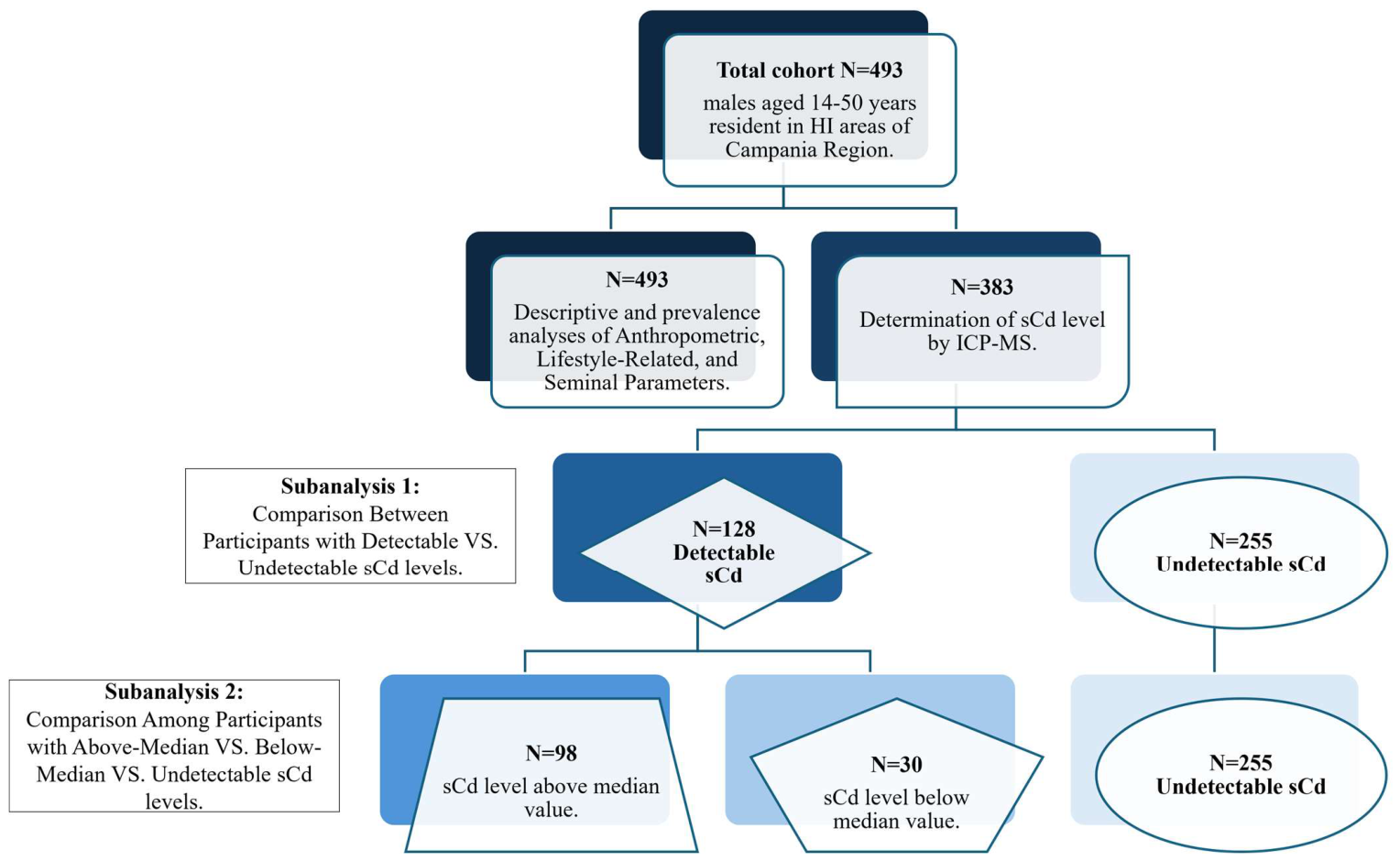
2.1. Study Design
2.2. Participants Recruitment
2.3. Inclusion and Exclusion Criteria
2.4. Clinical Procedures and Data Collection
2.5. Semen Analysis
2.6. Cadmium Analysis
2.7. Statistical Analysis
3. Results
3.1. Total Cohort Anthropometric, Lifestyle-Related, and Seminal Parameters
3.2. Anthropometric, Lifestyle-Related, and Seminal Parameters, According to Whole Semen Cadmium Levels
3.3. Seminal Parameters and Whole Semen Cadmium Levels, According to Smoking Status
4. Discussion
5. Conclusions
Supplementary Materials
Author Contributions
Funding
Institutional Review Board Statement
Informed Consent Statement
Data Availability Statement
Conflicts of Interest
References
- World Bank. Fertility Rate, Total (Births per Woman). 2023. Available online: https://data.worldbank.org/indicator/SP.DYN.TFRT.IN (accessed on 1 January 2026).
- United Nations, Department of Economic and Social Affairs, Population Division. World Population Prospects 2024: Summary of Results; United Nations: New York, NY, USA, 2024. [Google Scholar]
- Skakkebaek, N.E.; Lindahl-Jacobsen, R.; Levine, H.; Andersson, A.M.; Jorgensen, N.; Main, K.M.; Lidegaard, O.; Priskorn, L.; Holmboe, S.A.; Brauner, E.V.; et al. Environmental factors in declining human fertility. Nat. Rev. Endocrinol. 2022, 18, 139–157. [Google Scholar]
- Mascarenhas, M.N.; Flaxman, S.R.; Boerma, T.; Vanderpoel, S.; Stevens, G.A. National, regional, and global trends in infertility prevalence since 1990: A systematic analysis of 277 health surveys. PLoS Med. 2012, 9, e1001356. [Google Scholar] [CrossRef] [PubMed]
- Agarwal, A.; Mulgund, A.; Hamada, A.; Chyatte, M.R. A unique view on male infertility around the globe. Reprod. Biol. Endocrinol. 2015, 13, 37. [Google Scholar] [CrossRef] [PubMed]
- Levine, H.; Jorgensen, N.; Martino-Andrade, A.; Mendiola, J.; Weksler-Derri, D.; Jolles, M.; Pinotti, R.; Swan, S.H. Temporal trends in sperm count: A systematic review and meta-regression analysis of samples collected globally in the 20th and 21st centuries. Hum. Reprod. Update 2023, 29, 157–176. [Google Scholar] [PubMed]
- Nordkap, L.; Joensen, U.N.; Blomberg Jensen, M.; Jorgensen, N. Regional differences and temporal trends in male reproductive health disorders: Semen quality may be a sensitive marker of environmental exposures. Mol. Cell. Endocrinol. 2012, 355, 221–230. [Google Scholar] [CrossRef] [PubMed]
- Defeudis, G.; de Angelis, C.; Mazzilli, R.; Barbagallo, F.; Leanza, C.; Sabovic, I.; Condorelli, R.A.; Rago, R.; Gianfrilli, D.; Pivonello, R.; et al. The impact of chemical pollution and warming on male fertility: A narrative review by the Special Interest Group “Environment and Fertility” of the Italian Society of Fertility and Sterility and Reproductive Medicine (SIFES-MR). J. Assist. Reprod. Genet. 2025, 42, 4071–4101. [Google Scholar] [CrossRef] [PubMed]
- Gore, A.C.; Chappell, V.A.; Fenton, S.E.; Flaws, J.A.; Nadal, A.; Prins, G.S.; Toppari, J.; Zoeller, R.T. EDC-2: The Endocrine Society’s Second Scientific Statement on Endocrine-Disrupting Chemicals. Endocr. Rev. 2015, 36, E1–E150. [Google Scholar] [CrossRef] [PubMed]
- Triassi, M.; Alfano, R.; Illario, M.; Nardone, A.; Caporale, O.; Montuori, P. Environmental pollution from illegal waste disposal and health effects: A review on the “triangle of death”. Int. J. Environ. Res. Public Health 2015, 12, 1216–1236. [Google Scholar] [CrossRef] [PubMed]
- Jomova, K.; Alomar, S.Y.; Nepovimova, E.; Kuca, K.; Valko, M. Heavy metals: Toxicity and human health effects. Arch. Toxicol. 2025, 99, 153–209. [Google Scholar] [PubMed]
- Giaccio, L.; Cicchella, D.; De Vivo, B.; Lombardi, G.; De Rosa, M. Does heavy metals pollution affects semen quality in men? A case of study in the metropolitan area of Naples (Italy). J. Geochem. Explor. 2012, 112, 218–225. [Google Scholar] [CrossRef]
- Bergamo, P.; Volpe, M.G.; Lorenzetti, S.; Mantovani, A.; Notari, T.; Cocca, E.; Cerullo, S.; Di Stasio, M.; Cerino, P.; Montano, L. Human semen as an early, sensitive biomarker of highly polluted living environment in healthy men: A pilot biomonitoring study on trace elements in blood and semen and their relationship with sperm quality and RedOx status. Reprod. Toxicol. 2016, 66, 1–9. [Google Scholar] [CrossRef] [PubMed]
- Vecoli, C.; Montano, L.; Borghini, A.; Notari, T.; Guglielmino, A.; Mercuri, A.; Turchi, S.; Andreassi, M.G. Effects of Highly Polluted Environment on Sperm Telomere Length: A Pilot Study. Int. J. Mol. Sci. 2017, 18, 1703. [Google Scholar] [CrossRef] [PubMed]
- Agency for Toxic Substances and Disease Registry. ATSDR, Toxicological Profile for Cadmium; Agency for Toxic Substances and Disease Registry: Atlanta, GA, USA, 2012.
- International Agency for Research on Cancer. IARC Monographs in Evaluation of Carcinogenic Risks to Humans; International Agency for Research on Cancer: Lyon, France, 2012. [Google Scholar]
- Danielsson, B.R.; Dencker, L.; Lindgren, A.; Tjalve, H. Accumulation of toxic metals in male reproduction organs. Arch. Toxicol. Suppl. 1984, 7, 177–180. [Google Scholar] [CrossRef] [PubMed]
- Swiergosz-Kowalewska, R. Cadmium distribution and toxicity in tissues of small rodents. Microsc. Res. Tech. 2001, 55, 208–222. [Google Scholar] [CrossRef] [PubMed]
- Wirth, J.J.; Mijal, R.S. Adverse effects of low level heavy metal exposure on male reproductive function. Syst. Biol. Reprod. Med. 2010, 56, 147–167. [Google Scholar] [CrossRef] [PubMed]
- de Angelis, C.; Galdiero, M.; Pivonello, C.; Salzano, C.; Gianfrilli, D.; Piscitelli, P.; Lenzi, A.; Colao, A.; Pivonello, R. The environment and male reproduction: The effect of cadmium exposure on reproductive function and its implication in fertility. Reprod. Toxicol. 2017, 73, 105–127. [Google Scholar] [CrossRef] [PubMed]
- Sun, J.; Yu, G.; Zhang, Y.; Liu, X.; Du, C.; Wang, L.; Li, Z.; Wang, C. Heavy Metal Level in Human Semen with Different Fertility: A Meta-Analysis. Biol. Trace Elem. Res. 2017, 176, 27–36. [Google Scholar] [PubMed]
- Department of Reproductive Health and Research, World Health Organization. WHO Laboratory Manual for the Examination and Processing of Human Semen, 5th ed.; World Health Organization: Geneva, Switzerland, 2010. [Google Scholar]
- Bernaards, C.M.; Twisk, J.W.; Snel, J.; Van Mechelen, W.; Kemper, H.C. Is calculating pack-years retrospectively a valid method to estimate life-time tobacco smoking? A comparison between prospectively calculated pack-years and retrospectively calculated pack-years. Addiction 2001, 96, 1653–1661. [Google Scholar] [CrossRef] [PubMed]
- Mendiola, J.; Moreno, J.M.; Roca, M.; Vergara-Juarez, N.; Martinez-Garcia, M.J.; Garcia-Sanchez, A.; Elvira-Rendueles, B.; Moreno-Grau, S.; Lopez-Espin, J.J.; Ten, J.; et al. Relationships between heavy metal concentrations in three different body fluids and male reproductive parameters: A pilot study. Environ. Health 2011, 10, 6. [Google Scholar] [CrossRef] [PubMed]
- Minguez-Alarcon, L.; Mendiola, J.; Roca, M.; Lopez-Espin, J.J.; Guillen, J.J.; Moreno, J.M.; Moreno-Grau, S.; Martinez-Garcia, M.J.; Vergara-Juarez, N.; Elvira-Rendueles, B.; et al. Correlations between Different Heavy Metals in Diverse Body Fluids: Studies of Human Semen Quality. Adv. Urol. 2012, 2012, 420893. [Google Scholar] [CrossRef] [PubMed]
- Sansone, A.; Di Dato, C.; de Angelis, C.; Menafra, D.; Pozza, C.; Pivonello, R.; Isidori, A.; Gianfrilli, D. Smoke, alcohol and drug addiction and male fertility. Reprod. Biol. Endocrinol. 2018, 16, 3. [Google Scholar] [CrossRef] [PubMed]
- Hassan, J.; Elmetwalli, A.; Helal, M.; Al Munajer, E.A.; Hussien, T.M.; Azem Saad, A.A.; El-Sikaily, A. Cadmium exposure and its association with oxidative stress, MT1A methylation, and idiopathic male infertility in Egypt: A case-control study. Food Chem. Toxicol. 2024, 192, 114925. [Google Scholar] [CrossRef] [PubMed]
- Pant, N.; Kumar, G.; Upadhyay, A.D.; Gupta, Y.K.; Chaturvedi, P.K. Correlation between lead and cadmium concentration and semen quality. Andrologia 2015, 47, 887–891. [Google Scholar] [CrossRef] [PubMed]
- Pant, N.; Upadhyay, G.; Pandey, S.; Mathur, N.; Saxena, D.K.; Srivastava, S.P. Lead and cadmium concentration in the seminal plasma of men in the general population: Correlation with sperm quality. Reprod. Toxicol. 2003, 17, 447–450. [Google Scholar] [CrossRef] [PubMed]
- Chinyere Nsonwu-Anyanwu, A.; Raymond Ekong, E.; Jeremiah Offor, S.; Francis Awusha, O.; Chukwuma Orji, O.; Idiongo Umoh, E.; Aleruchim Owhorji, J.; Rowland Emetonjor, F.; Adanna Opara Usoro, C. Heavy metals, biomarkers of oxidative stress and changes in sperm function: A case-control study. Int. J. Reprod. Biomed. 2019, 17, 163–174. [Google Scholar] [CrossRef] [PubMed]
- Famurewa, A.C.; Ugwuja, E.I. Association of Blood and Seminal Plasma Cadmium and Lead Levels with Semen Quality in Non-Occupationally Exposed Infertile Men in Abakaliki, South East Nigeria. J. Fam. Reprod. Health 2017, 11, 97–103. [Google Scholar]
- Benoff, S.; Hauser, R.; Marmar, J.L.; Hurley, I.R.; Napolitano, B.; Centola, G.M. Cadmium concentrations in blood and seminal plasma: Correlations with sperm number and motility in three male populations (infertility patients, artificial insemination donors, and unselected volunteers). Mol. Med. 2009, 15, 248–262. [Google Scholar] [CrossRef] [PubMed]
- Guzikowski, W.; Szynkowska, M.I.; Motak-Pochrzest, H.; Pawlaczyk, A.; Sypniewski, S. Trace elements in seminal plasma of men from infertile couples. Arch. Med. Sci. 2015, 11, 591–598. [Google Scholar] [CrossRef] [PubMed]
- Pant, N.; Pant, A.B.; Chaturvedi, P.K.; Shukla, M.; Mathur, N.; Gupta, Y.K.; Saxena, D.K. Semen quality of environmentally exposed human population: The toxicological consequence. Environ. Sci. Pollut. Res. Int. 2013, 20, 8274–8281. [Google Scholar] [CrossRef] [PubMed]
- Xu, B.; Chia, S.E.; Tsakok, M.; Ong, C.N. Trace elements in blood and seminal plasma and their relationship to sperm quality. Reprod. Toxicol. 1993, 7, 613–618. [Google Scholar] [CrossRef] [PubMed]
- Sukhn, C.; Awwad, J.; Ghantous, A.; Zaatari, G. Associations of semen quality with non-essential heavy metals in blood and seminal fluid: Data from the Environment and Male Infertility (EMI) study in Lebanon. J. Assist. Reprod. Genet. 2018, 35, 1691–1701. [Google Scholar] [CrossRef] [PubMed]
- Keck, C.; Bramkamp, G.; Behre, H.M.; Muller, C.; Jockenhovel, F.; Nieschlag, E. Lack of correlation between cadmium in seminal plasma and fertility status of nonexposed individuals and two cadmium-exposed patients. Reprod. Toxicol. 1995, 9, 35–40. [Google Scholar] [CrossRef] [PubMed]
- Pant, N.; Kumar, G.; Upadhyay, A.D.; Patel, D.K.; Gupta, Y.K.; Chaturvedi, P.K. Reproductive toxicity of lead, cadmium, and phthalate exposure in men. Environ. Sci. Pollut. Res. Int. 2014, 21, 11066–11074. [Google Scholar] [CrossRef] [PubMed]
- Jeng, H.A.; Huang, Y.L.; Pan, C.H.; Diawara, N. Role of low exposure to metals as male reproductive toxicants. Int. J. Environ. Health Res. 2015, 25, 405–417. [Google Scholar] [PubMed]
- Dawson, E.B.; Ritter, S.; Harris, W.A.; Evans, D.R.; Powell, L.C. Comparison of sperm viability with seminal plasma metal levels. Biol. Trace Elem. Res. 1998, 64, 215–219. [Google Scholar] [CrossRef] [PubMed]
- White, M.A. A comparison of inductively coupled plasma mass spectrometry with electrothermal atomic absorption spectrophotometry for the determination of trace elements in blood and urine from non occupationally exposed populations. J. Trace Elem. Med. Biol. 1999, 13, 93–101. [Google Scholar] [CrossRef] [PubMed]
- Kojo, K.; Oguri, T.; Tanaka, T.; Nakazono, A.; Numahata, D.; Uchida, M.; Yamasaki, K.; Ikeda, A.; Kakinuma, T.; Negoro, H.; et al. Seminal plasma metallomics: A new horizon for diagnosing and managing male infertility. Rev. Int. Androl. 2025, 23, 1–11. [Google Scholar]
- Calogero, A.E.; Fiore, M.; Giacone, F.; Altomare, M.; Asero, P.; Ledda, C.; Romeo, G.; Mongioi, L.M.; Copat, C.; Giuffrida, M.; et al. Exposure to multiple metals/metalloids and human semen quality: A cross-sectional study. Ecotoxicol. Environ. Saf. 2021, 215, 112165. [Google Scholar] [CrossRef] [PubMed]
- Xu, D.X.; Shen, H.M.; Zhu, Q.X.; Chua, L.; Wang, Q.N.; Chia, S.E.; Ong, C.N. The associations among semen quality, oxidative DNA damage in human spermatozoa and concentrations of cadmium, lead and selenium in seminal plasma. Mutat. Res. 2003, 534, 155–163. [Google Scholar] [CrossRef] [PubMed]
- Xu, L.C.; Wang, S.Y.; Yang, X.F.; Wang, X.R. Effects of cadmium on rat sperm motility evaluated with computer assisted sperm analysis. Biomed. Environ. Sci. 2001, 14, 312–317. [Google Scholar] [PubMed]
- Hew, K.W.; Ericson, W.A.; Welsh, M.J. A single low cadmium dose causes failure of spermiation in the rat. Toxicol. Appl. Pharmacol. 1993, 121, 15–21. [Google Scholar] [CrossRef] [PubMed]
- El-Demerdash, F.M.; Yousef, M.I.; Kedwany, F.S.; Baghdadi, H.H. Cadmium-induced changes in lipid peroxidation, blood hematology, biochemical parameters and semen quality of male rats: Protective role of vitamin E and beta-carotene. Food Chem. Toxicol. 2004, 42, 1563–1571. [Google Scholar] [CrossRef] [PubMed]
- Saksena, S.K.; Lau, I.F. Effects of cadmium chloride on testicular steroidogenesis and fertility of male rats. Endokrinologie 1979, 74, 6–12. [Google Scholar] [PubMed]
- Garifalos, F.; de Angelis, C.; Menafra, D.; Chiodini, P.; Galdiero, G.; Piscopo, M.; Verde, N.; Giarra, A.; Trifuoggi, M.; Simeoli, C.; et al. Morphostructural characterization of the testis in a large cohort of men living in highly polluted areas of Campania Region in South Italy: A focus on cadmium exposure. J. Clin. Med. 2026; in press. [CrossRef]
- Luca, G.; Lilli, C.; Bellucci, C.; Mancuso, F.; Calvitti, M.; Arato, I.; Falabella, G.; Giovagnoli, S.; Aglietti, M.C.; Lumare, A.; et al. Toxicity of cadmium on Sertoli cell functional competence: An in vitro study. J. Biol. Regul. Homeost. Agents 2013, 27, 805–816. [Google Scholar] [CrossRef] [PubMed]
- Sharpe, R.M.; McKinnell, C.; Kivlin, C.; Fisher, J.S. Proliferation and functional maturation of Sertoli cells, and their relevance to disorders of testis function in adulthood. Reproduction 2003, 125, 769–784. [Google Scholar] [CrossRef] [PubMed]
- Tam, P.P.; Liu, W.K. Gonadal development and fertility of mice treated prenatally with cadmium during the early organogenesis stages. Teratology 1985, 32, 453–462. [Google Scholar] [CrossRef] [PubMed]
- Sharma, R.; Harlev, A.; Agarwal, A.; Esteves, S.C. Cigarette Smoking and Semen Quality: A New Meta-analysis Examining the Effect of the 2010 World Health Organization Laboratory Methods for the Examination of Human Semen. Eur. Urol. 2016, 70, 635–645. [Google Scholar] [CrossRef] [PubMed]
- Telisman, S.; Jurasovic, J.; Pizent, A.; Cvitkovic, P. Cadmium in the blood and seminal fluid of nonoccupationally exposed adult male subjects with regard to smoking habits. Int. Arch. Occup. Environ. Health 1997, 70, 243–248. [Google Scholar] [CrossRef] [PubMed]
- Tariba, B. Metals in wine—Impact on wine quality and health outcomes. Biol. Trace Elem. Res. 2011, 144, 143–156. [Google Scholar] [CrossRef] [PubMed]
- de Angelis, C.; Galdiero, G.; Menafra, D.; Garifalos, F.; Verde, N.; Piscopo, M.; Negri, M.; Auriemma, R.S.; Simeoli, C.; Pivonello, C.; et al. The environment and male reproductive system: The potential role and underlying mechanisms of cadmium in testis cancer. Crit. Rev. Toxicol. 2023, 53, 412–435. [Google Scholar] [CrossRef] [PubMed]
- Foresta, C.; Garolla, A.; Cosci, I.; Menegazzo, M.; Ferigo, M.; Gandin, V.; De Toni, L. Role of zinc trafficking in male fertility: From germ to sperm. Hum. Reprod. 2014, 29, 1134–1145. [Google Scholar] [CrossRef] [PubMed]
- Dalton, T.P.; He, L.; Wang, B.; Miller, M.L.; Jin, L.; Stringer, K.F.; Chang, X.; Baxter, C.S.; Nebert, D.W. Identification of mouse SLC39A8 as the transporter responsible for cadmium-induced toxicity in the testis. Proc. Natl. Acad. Sci. USA 2005, 102, 3401–3406. [Google Scholar] [CrossRef] [PubMed]
- Stohs, S.J.; Bagchi, D. Oxidative mechanisms in the toxicity of metal ions. Free Radic. Biol. Med. 1995, 18, 321–336. [Google Scholar] [CrossRef] [PubMed]
- Valko, M.; Morris, H.; Cronin, M.T. Metals, toxicity and oxidative stress. Curr. Med. Chem. 2005, 12, 1161–1208. [Google Scholar] [CrossRef] [PubMed]
- Coppen-Jaeger, D.E.; Wilhelm, M. The effects of cadmium on zinc absorption in isolated rat intestinal preparations. Biol. Trace Elem. Res. 1989, 21, 207–212. [Google Scholar] [CrossRef] [PubMed]
- Pizent, A.; Jurasovic, J.; Telisman, S. Serum calcium, zinc, and copper in relation to biomarkers of lead and cadmium in men. J. Trace Elem. Med. Biol. 2003, 17, 199–205. [Google Scholar] [CrossRef] [PubMed]
- Wang, L.; Zhou, X.; Yang, D.; Wang, Z. Effects of lead and/or cadmium on the distribution patterns of some essential trace elements in immature female rats. Hum. Exp. Toxicol. 2011, 30, 1914–1923. [Google Scholar] [CrossRef] [PubMed]
- Ebisch, I.M.; Thomas, C.M.; Peters, W.H.; Braat, D.D.; Steegers-Theunissen, R.P. The importance of folate, zinc and antioxidants in the pathogenesis and prevention of subfertility. Hum. Reprod. Update 2007, 13, 163–174. [Google Scholar] [PubMed]
- Favier, A.E. The role of zinc in reproduction. Hormonal mechanisms. Biol. Trace Elem. Res. 1992, 32, 363–382. [Google Scholar] [CrossRef] [PubMed]
- Ahsan, U.; Kamran, Z.; Raza, I.; Ahmad, S.; Babar, W.; Riaz, M.H.; Iqbal, Z. Role of selenium in male reproduction—A review. Anim. Reprod. Sci. 2014, 146, 55–62. [Google Scholar] [CrossRef] [PubMed]
- Pappalardo, C.; Cosci, I.; Moro, G.; Stortini, A.M.; Sandon, A.; De Angelis, C.; Galdiero, G.; Trifuoggi, M.; Pivonello, R.; Pedrucci, F.; et al. Seminal cadmium affects human sperm motility through stable binding to the cell membrane. Front. Cell Dev. Biol. 2023, 11, 1134304. [Google Scholar] [CrossRef] [PubMed]
- Marchiani, S.; Tamburrino, L.; Farnetani, G.; Muratori, M.; Vignozzi, L.; Baldi, E. Acute effects on human sperm exposed in vitro to cadmium chloride and diisobutyl phthalate. Reproduction 2019, 158, 281–290. [Google Scholar] [CrossRef] [PubMed]
- Slama, R.; Kold-Jensen, T.; Scheike, T.; Ducot, B.; Spira, A.; Keiding, N. How would a decline in sperm concentration over time influence the probability of pregnancy? Epidemiology 2004, 15, 458–465. [Google Scholar] [CrossRef] [PubMed]



| Total Cohort (N = 493) | |
|---|---|
| Age (years) | 29.07 ± 7.17 |
| BMI (Kg/m2) | 25.82 ± 4.1 |
| Mean residence in HI areas (years) | 25.59 ± 9.13 |
| Mean time spent in HI areas (h/24 h) | 16.68 ± 5.85 |
| Non-smokers (n°/%) | 243/52.7 a |
| Current smokers (n°/%) | 218/47.3 a |
| Cigarettes/day (n°) | 11.02 ± 8.06 a |
| Cigarette pack/year (n°) | 6.08 ± 8.47 a |
| Occupational exposure to toxic chemicals (n°/%) | 54/11.7 a |
| Total Cohort (N = 493) | |
|---|---|
| Semen pH | 8.32 ± 0.3 |
| Semen Volume (mL) | 3.13 ± 1.67 |
| Sperm Concentration (n × 106/mL) | 37.58 ± 30.18 |
| Sperm Total Count (n × 106/ejaculate) | 111.2 ± 104 |
| Sperm Total Motility (%) | 56.83 ± 16.09 |
| Sperm Progressive Motility (%) | 50.22 ± 16.63 |
| Sperm In Situ Motility (%) | 6.72 ± 3.43 |
| Immotile Spermatozoa (%) | 43.07 ± 15.88 |
| Sperm Normal Morphology (%) | 7.97 ± 4.02 |
| Sperm Viability (%) | 64.75 ± 15.34 |
| Normozoospermia (n°/%) | 328/66.5 |
| Pathological seminal parameters (n°/%) | 165/33.5 |
| Oligozoospermia (n°/%) | 69/14 |
| Cryptozoospermia (n°/%) | 4/0.8 |
| Azoospermia (n°/%) | 11/2.2 |
| Asthenozoospermia (n°/%) | 15/3 |
| Teratozoospermia (n°/%) | 3/0.6 |
| Oligo-astheno-teratozoospermia (n°/%) | 30/6.1 |
| Necrozoospermia (n°/%) | 28/5.7 |
| Different combined seminal parameters alterations (n°/%) | 35/7.1 |
| Detectable sCd (N = 128) | Undetectable sCd (N = 255) | p | |
|---|---|---|---|
| Age (years) | 30.58 ± 7.5 | 29.45 ± 7.06 | p = 0.231 |
| BMI (Kg/m2) | 25.98 ± 3.8 | 25.99 ± 4.13 | p = 0.890 |
| Mean residence in HI areas (years) | 25.32 ± 9.8 | 26.08 ± 9.18 | p = 0.468 |
| Mean time spent in HI areas (h/24 h) | 17.02 ± 5.99 | 16.52 ± 5.78 | p = 0.642 |
| Current smokers (n°/%) | 45/37.8 a | 115/47.7 b | p = 0.091 |
| Cigarettes/day (n°) | 12.62 ± 8.34 a | 11.17 ± 8.2 b | p = 0.285 |
| Cigarette pack years (n°) | 8.02 ± 8.6 a | 6.89 ± 9.61 b | p = 0.328 |
| Occupational exposure to toxic chemicals (n°/%) | 13/10.9 a | 36/14.9 b | p = 0.331 |
| Semen pH | 8.38 ± 0.27 | 8.35 ± 0.24 | p = 0.239 |
| Semen volume (mL) | 3.1 ± 1.57 | 3.34 ± 1.63 | p = 0.122 |
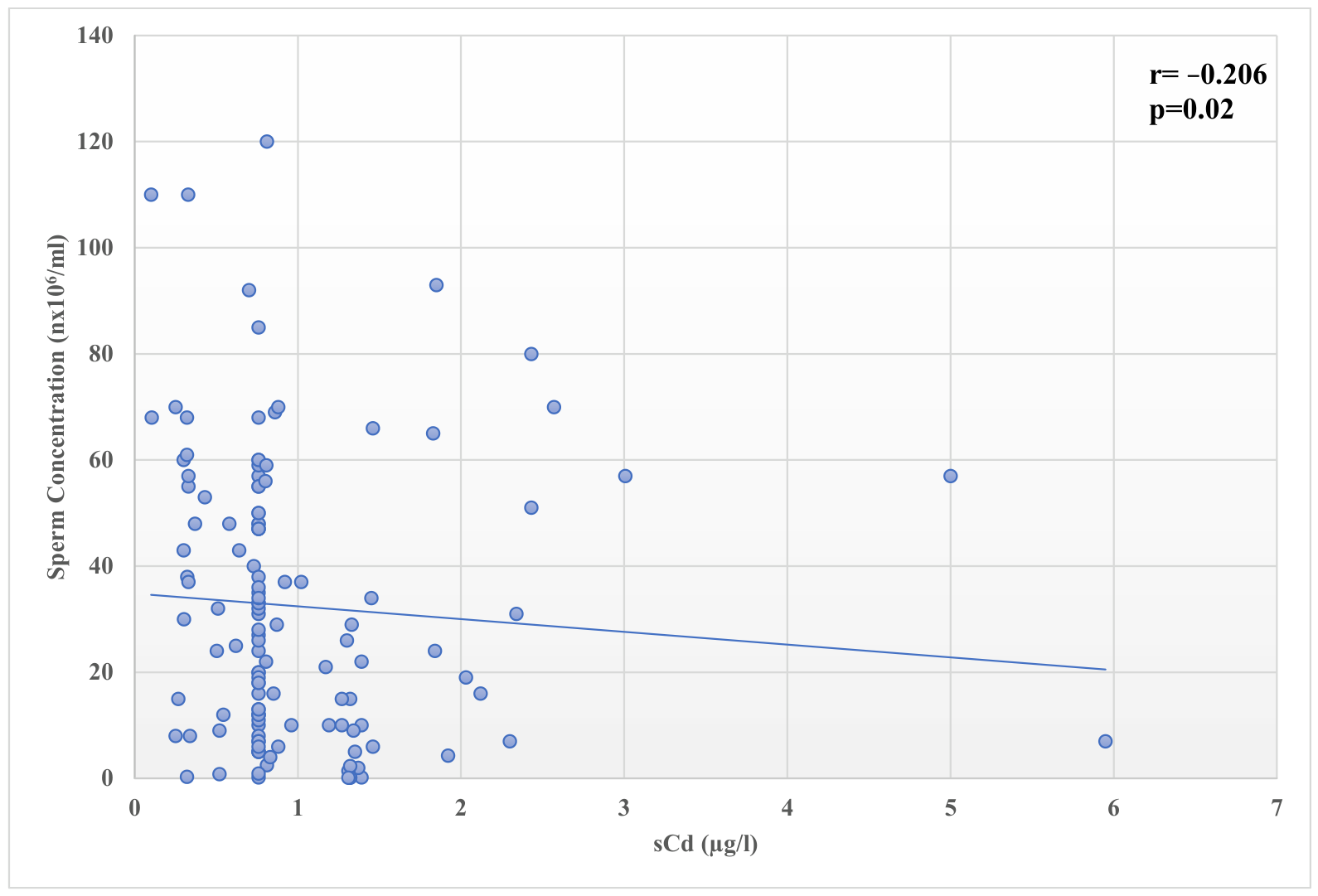
| Sperm concentration (n × 106/mL) | 32.44 ± 26.58 | 35.3 ± 26.29 | p = 0.231 |
| Sperm total count (n × 106/ejaculate) | 93.28 ± 84.88 | 113.2 ± 101.5 | p = 0.037 |
| Sperm total motility (%) | 56.45 ± 16.22 | 57.86 ± 15.83 | p = 0.343 |
| Sperm progressive motility (%) | 49.7 ± 16.97 | 51.77 ± 16.37 | p = 0.203 |
| Sperm in situ motility (%) | 6.75 ± 2.97 | 6.32 ± 3.05 | p = 0.129 |
| Immotile spermatozoa (%) | 43.71 ± 16.17 | 41.87 ± 15.40 | p = 0.243 |
| Sperm normal morphology (%) | 7.29 ± 3.71 | 8.23 ± 3.91 | p = 0.034 |
| Sperm viability (%) | 68.09 ± 13.02 | 62.51 ± 14.29 | p = 0.049 |
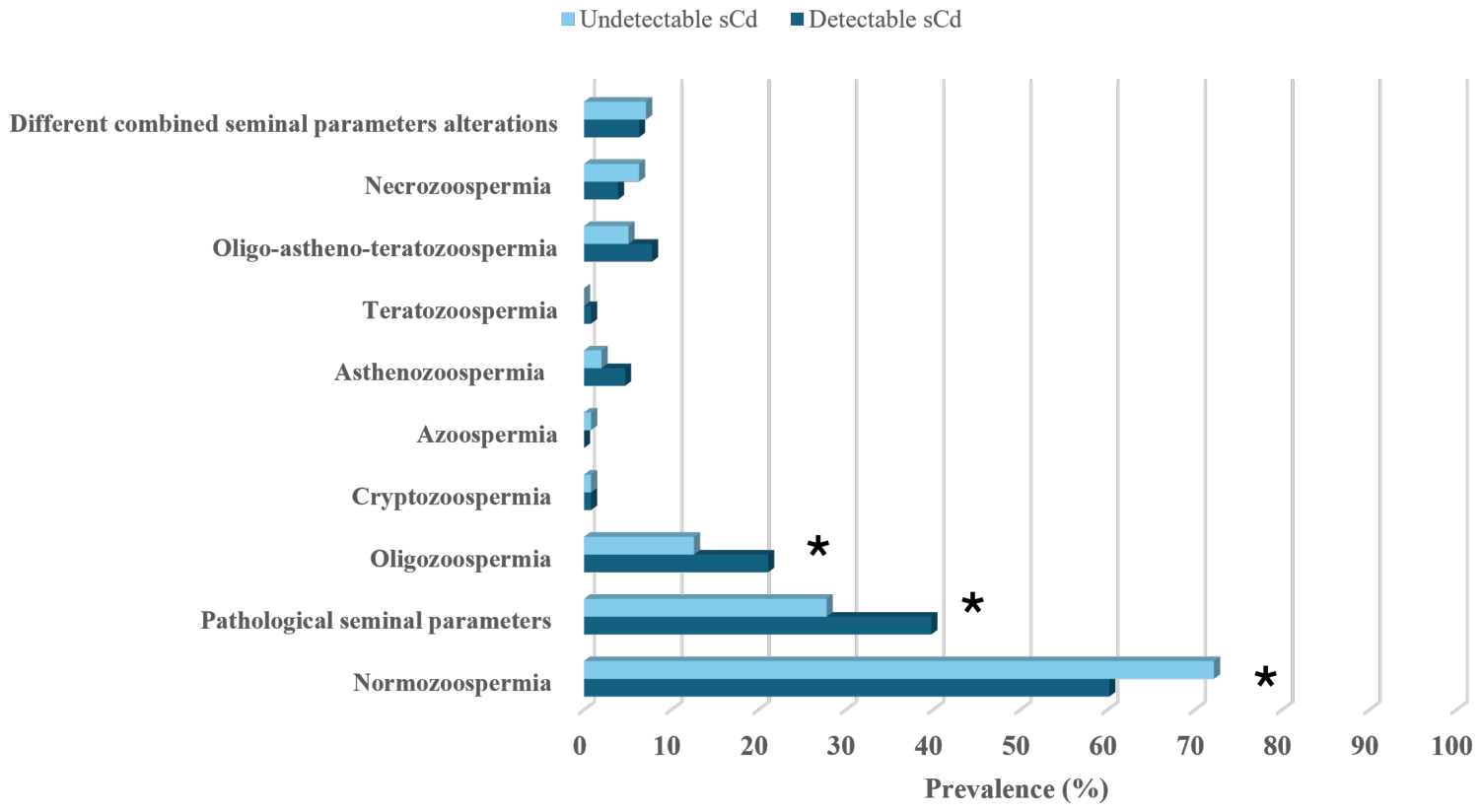
| Normozoospermia (n°/%) | 77/60.2 | 184/72.2 | p = 0.02 |
| Pathological seminal parameters (n°/%) | 51/39.8 | 71/27.8 | p = 0.02 |
| Oligozoospermia (n°/%) | 27/21.1 | 32/12.6 | p = 0.036 |
| Cryptozoospermia (n°/%) | 1/0.8 | 2/0.8 | p > 0.999 |
| Azoospermia (n°/%) | 0/0 | 2/0.8 | p = 0.554 |
| Asthenozoospermia (n°/%) | 6/4.7 | 5/2 | p = 0.192 |
| Teratozoospermia (n°/%) | 1/0.8 | 0/0 | p = 0.334 |
| Oligo-astheno-teratozoospermia (n°/%) | 10/7.8 | 13/5.1 | p = 0.362 |
| Necrozoospermia (n°/%) | 5/3.9 | 16/6.3 | p = 0.471 |
| Different combined seminal parameters alterations (n°/%) | 8/6.3 | 18/7.1 | p = 0.833 |
| sCd Above Median Value (N = 98) | sCd Below Median Value (N = 30) | Undetectable sCd (N = 255) | p | |
|---|---|---|---|---|
| Age (years) | 30.61 ± 7.7 | 30.47 ± 6.93 | 29.45 ± 7.06 | p = 0.488 |
| BMI (Kg/m2) | 26 ± 4.08 | 25.9 ± 2.78 | 25.99 ± 4.13 | p = 0.971 |
| Mean residence in HI areas (years) | 26.20 ± 9.1 | 22.43 ± 11.78 | 26.08 ± 9.18 | p = 0.314 |
| Mean time spent in HI areas (h/24 h) | 17.19 ± 5.75 | 16.47 ± 6.81 | 16.52 ± 5.78 | p = 0.698 |
| Current smokers (n°/%) | 35/37.6 a | 10/38.5 b | 115/47.7 c | p = 0.205 |
| Cigarettes/day (n°) | 12.74 ± 8.14 a | 12.2 ± 9.46 b | 11.17 ± 8.2 c | p = 0.533 |
| Cigarette pack years (n°) | 7.6 ± 7.62 a | 9.51 ± 11.78 b | 6.89 ± 9.61 c | p = 0.586 |
| Occupational exposure to toxic chemicals (n°/%) | 11/11.8 a | 2/7.7 b | 36/14.9 c | p = 0.5 |
| Semen pH | 8.38 ± 0.28 | 8.38 ± 0.23 | 8.35 ± 0.24 | p = 0.499 |
| Semen volume (mL) | 3.19 ± 1.58 | 2.81 ± 1.55 | 3.34 ± 1.63 | p = 0.141 |
| Sperm concentration (n × 106/mL) | 29.12 ± 24.84 1,2 | 43.62 ± 29.55 1 | 35.3 ± 26.29 2 | p = 0.017 |
| Sperm total count (n × 106/ejaculate) | 85.77 ± 80.52 3 | 117.8 ± 95.16 | 113.2 ± 101.5 3 | p = 0.024 |
| Sperm total motility (%) | 56.51 ± 15.5 | 56.24 ± 18.73 | 57.86 ± 15.83 | p = 0.638 |
| Sperm progressive motility (%) | 49.77 ± 16.21 | 49.48 ± 19.64 | 51.77 ± 16.37 | p = 0.445 |
| Sperm in situ motility (%) | 6.75 ± 2.92 | 6.76 ± 3.18 | 6.32 ± 3.05 | p = 0.310 |
| Immotile spermatozoa (%) | 43.59 ± 15.43 | 44.1 ± 18.73 | 41.87 ± 15.40 | p = 0.502 |
| Sperm normal morphology (%) | 6.92 ± 3.38 4 | 8.55 ± 4.49 | 8.23 ± 3.91 4 | p = 0.015 |
| Sperm viability (%) | 68.17 ± 12.65 | 67.89 ± 14.75 | 62.51 ± 14.29 | p = 0.130 |
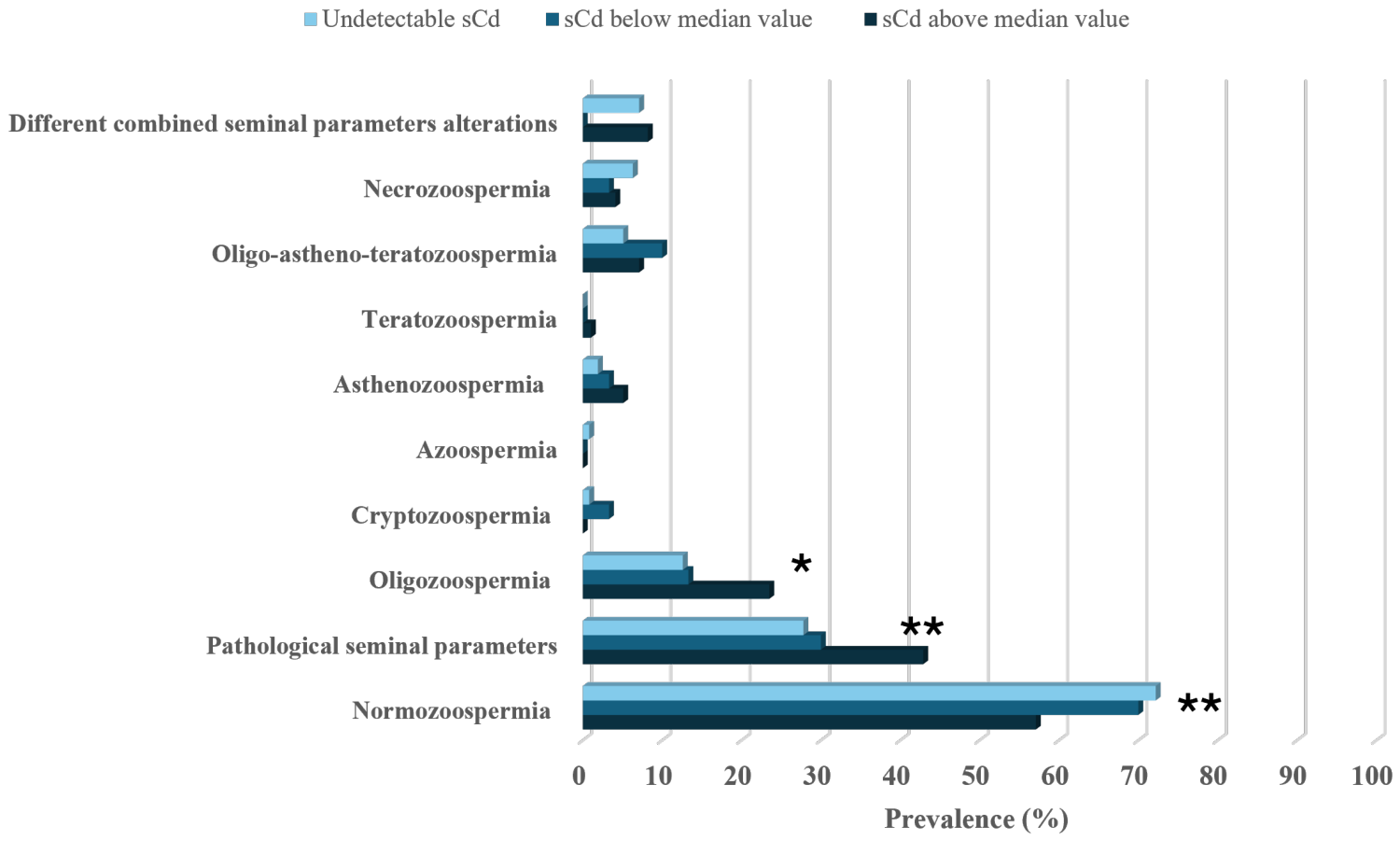
| Normozoospermia (n°/%) | 56/57.1 * | 21/70 | 184/72.2 * | p = 0.025 |
| Pathological seminal parameters (n°/%) | 42/42.9 * | 9/30 | 71/27.8 * | p = 0.025 |
| Oligozoospermia (n°/%) | 23/23.5 § | 4/13.3 | 32/12.6 § | p = 0.037 |
| Cryptozoospermia (n°/%) | 0/0 | 1/3.3 | 2/0.8 | p = 0.194 |
| Azoospermia (n°/%) | 0/0 | 0/0 | 2/0.8 | p = 0.604 |
| Asthenozoospermia (n°/%) | 5/5.1 | 1/3.3 | 5/1.9 | p = 0.282 |
| Teratozoospermia (n°/%) | 1/1.02 | 0/0 | 0/0 | p = 0.233 |
| Oligo-astheno-teratozoospermia (n°/%) | 7/7.1 | 3/10 | 13/5.1 | p = 0.486 |
| Necrozoospermia (n°/%) | 4/4.1 | 1/3.3 | 16/6.3 | p = 0.623 |
| Different combined seminal parameters alterations (n°/%) | 8/8.2 | 0/0 | 18/7.1 | p = 0.286 |
| Smokers (N = 45) | Non-Smokers (N = 74) | p | |
|---|---|---|---|
| Age (years) | 30.36 ± 7.98 | 30.41 ± 7.28 | p = 0.807 |
| BMI (Kg/m2) | 25.35 ± 3.07 | 26.48 ± 4.28 | p = 0.272 |
| Mean residence in HI areas (years) | 24.8 ± 9.66 | 26.12 ± 9.52 | p = 0.530 |
| Mean time spent in HI areas (h/24 h) | 16.02 ± 5.48 | 17.24 ± 6.22 | p = 0.250 |
| Occupational exposure to toxic chemicals (n°/%) | 7/15.6 | 6/8.1 | p > 0.999 |
| Semen pH | 8.49 ± 0.24 | 8.33 ± 0.27 | p = 0.3 |
| Semen volume (mL) | 2.98 ± 1.53 | 3.3 ± 1.64 | p = 0.141 |
| Sperm concentration (n × 106/mL) | 27.97 ± 21.54 | 34.78 ± 28.54 | p = 0.347 |
| Sperm total count (n × 106/ejaculate) | 81.33 ± 80.83 | 103.3 ± 88.59 | p = 0.209 |
| Sperm total motility (%) | 55.02 ± 15.1 | 58.15 ± 16.37 | p = 0.214 |
| Sperm progressive motility (%) | 48.09 ± 16.09 | 51.54 ± 16.97 | p = 0.2 |
| Sperm in situ motility (%) | 6.93 ± 2.88 | 6.61 ± 3.15 | p = 0.403 |
| Immotile spermatozoa (%) | 44.98 ± 15.08 | 42.12 ± 16.31 | p = 0.257 |
| Sperm normal morphology (%) | 6.66 ± 3.54 | 7.73 ± 3.8 | p = 0.058 |
| Sperm viability (%) | 72.86 ± 10.38 | 62.4 ± 14.19 | p = 0.063 |
| Normozoospermia (n°/%) | 24/53.3 | 49/66.2 | p = 0.179 |
| Pathological seminal parameters (n°/%) | 21/46.7 | 25/33.8 | p = 0.179 |
| Oligozoospermia (n°/%) | 12/26.7 | 14/18.1 | p = 0.364 |
| Cryptozoospermia (n°/%) | 1/2.2 | 0/0 | p = 0.378 |
| Azoospermia (n°/%) | 0/0 | 0/0 | p > 0.999 |
| Asthenozoospermia (n°/%) | 2/4.4 | 3/4.1 | p > 0.999 |
| Teratozoospermia (n°/%) | 0/0 | 1/1.4 | p > 0.999 |
| Oligo-astheno-teratozoospermia (n°/%) | 2/4.4 | 6/8.2 | p = 0.709 |
| Necrozoospermia (n°/%) | 0/0 | 5/6.8 | p = 0.156 |
| Different combined seminal parameters alterations (n°/%) | 4/8.8 | 3/4.1 | p = 0.424 |
Disclaimer/Publisher’s Note: The statements, opinions and data contained in all publications are solely those of the individual author(s) and contributor(s) and not of MDPI and/or the editor(s). MDPI and/or the editor(s) disclaim responsibility for any injury to people or property resulting from any ideas, methods, instructions or products referred to in the content. |
© 2026 by the authors. Licensee MDPI, Basel, Switzerland. This article is an open access article distributed under the terms and conditions of the Creative Commons Attribution (CC BY) license.
Share and Cite
de Angelis, C.; Garifalos, F.; Menafra, D.; Chiodini, P.; Galdiero, G.; Piscopo, M.; Romano, T.; Verde, N.; Giarra, A.; Trifuoggi, M.; et al. Semen Quality in a Large Cohort of Males Living in Highly Polluted Areas of Campania Region in Southern Italy with a Focus on the Role of Cadmium Exposure. J. Clin. Med. 2026, 15, 4949. https://doi.org/10.3390/jcm15134949
de Angelis C, Garifalos F, Menafra D, Chiodini P, Galdiero G, Piscopo M, Romano T, Verde N, Giarra A, Trifuoggi M, et al. Semen Quality in a Large Cohort of Males Living in Highly Polluted Areas of Campania Region in Southern Italy with a Focus on the Role of Cadmium Exposure. Journal of Clinical Medicine. 2026; 15(13):4949. https://doi.org/10.3390/jcm15134949
Chicago/Turabian Stylede Angelis, Cristina, Francesco Garifalos, Davide Menafra, Paolo Chiodini, Giacomo Galdiero, Mariangela Piscopo, Tonia Romano, Nunzia Verde, Antonella Giarra, Marco Trifuoggi, and et al. 2026. "Semen Quality in a Large Cohort of Males Living in Highly Polluted Areas of Campania Region in Southern Italy with a Focus on the Role of Cadmium Exposure" Journal of Clinical Medicine 15, no. 13: 4949. https://doi.org/10.3390/jcm15134949
APA Stylede Angelis, C., Garifalos, F., Menafra, D., Chiodini, P., Galdiero, G., Piscopo, M., Romano, T., Verde, N., Giarra, A., Trifuoggi, M., Crescenzo, E. M., Simeoli, C., Negri, M., Pivonello, C., Colao, A., & Pivonello, R. (2026). Semen Quality in a Large Cohort of Males Living in Highly Polluted Areas of Campania Region in Southern Italy with a Focus on the Role of Cadmium Exposure. Journal of Clinical Medicine, 15(13), 4949. https://doi.org/10.3390/jcm15134949