Impact of a Hospital Information System-Integrated Automated Dispensing Cabinet on Medication Use and Safety in a Tertiary Hospital Emergency Department: A Prospective Before-and-After Study

Abstract
1. Introduction
2. Materials and Methods
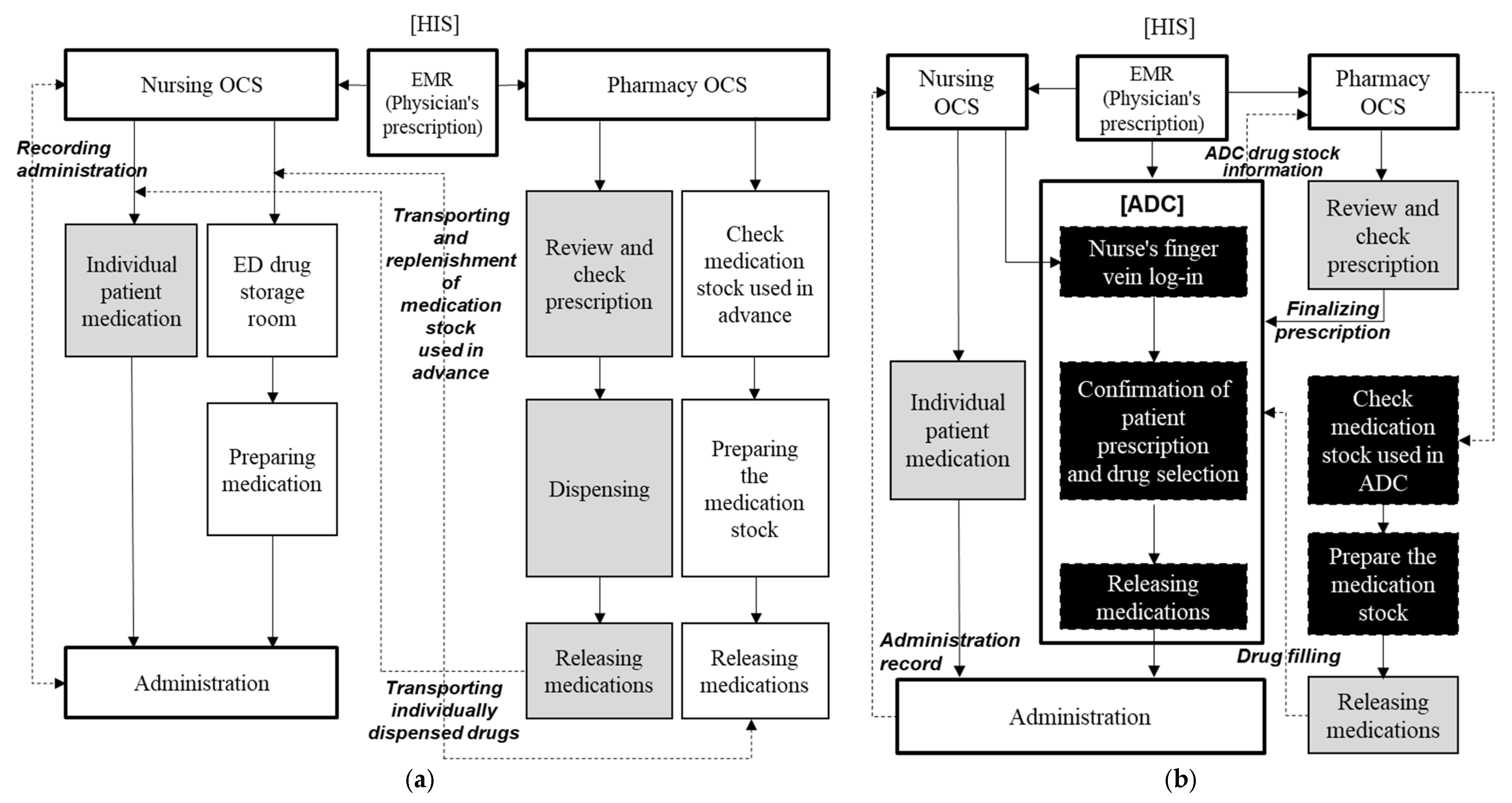
2.1. Study Design and ADC System Implementation
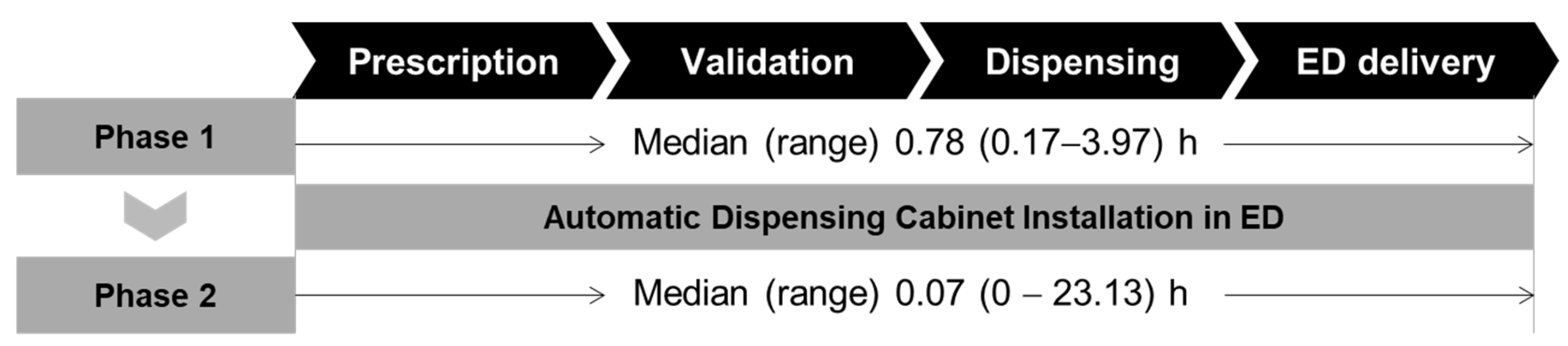
2.2. Study Periods and Data Collection
2.3. Outcomes
- Quantity of injectable and non-injectable medications stored in the ADC.
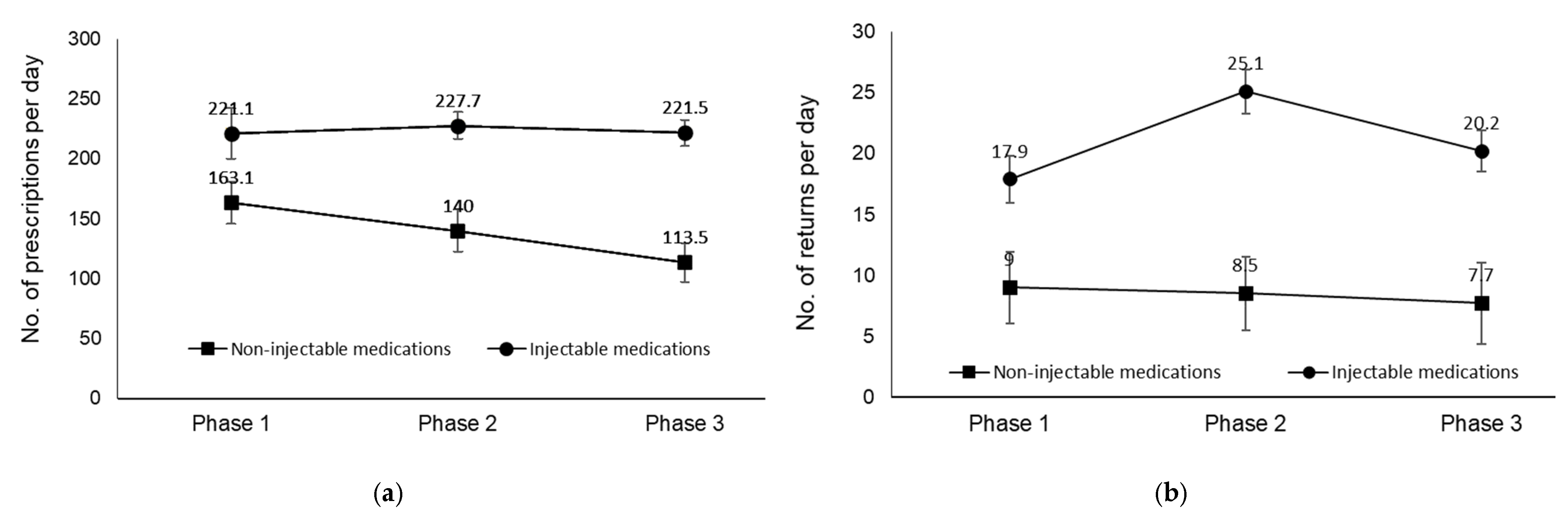
- Number of prescriptions and returned prescriptions for injectable and non-injectable medications.
- Number of injectable medications stored in the ADC in Phase 1 vs. Phase 2.
- Number of medications stored in the ED storage room in Phase 1 vs. Phase 2.
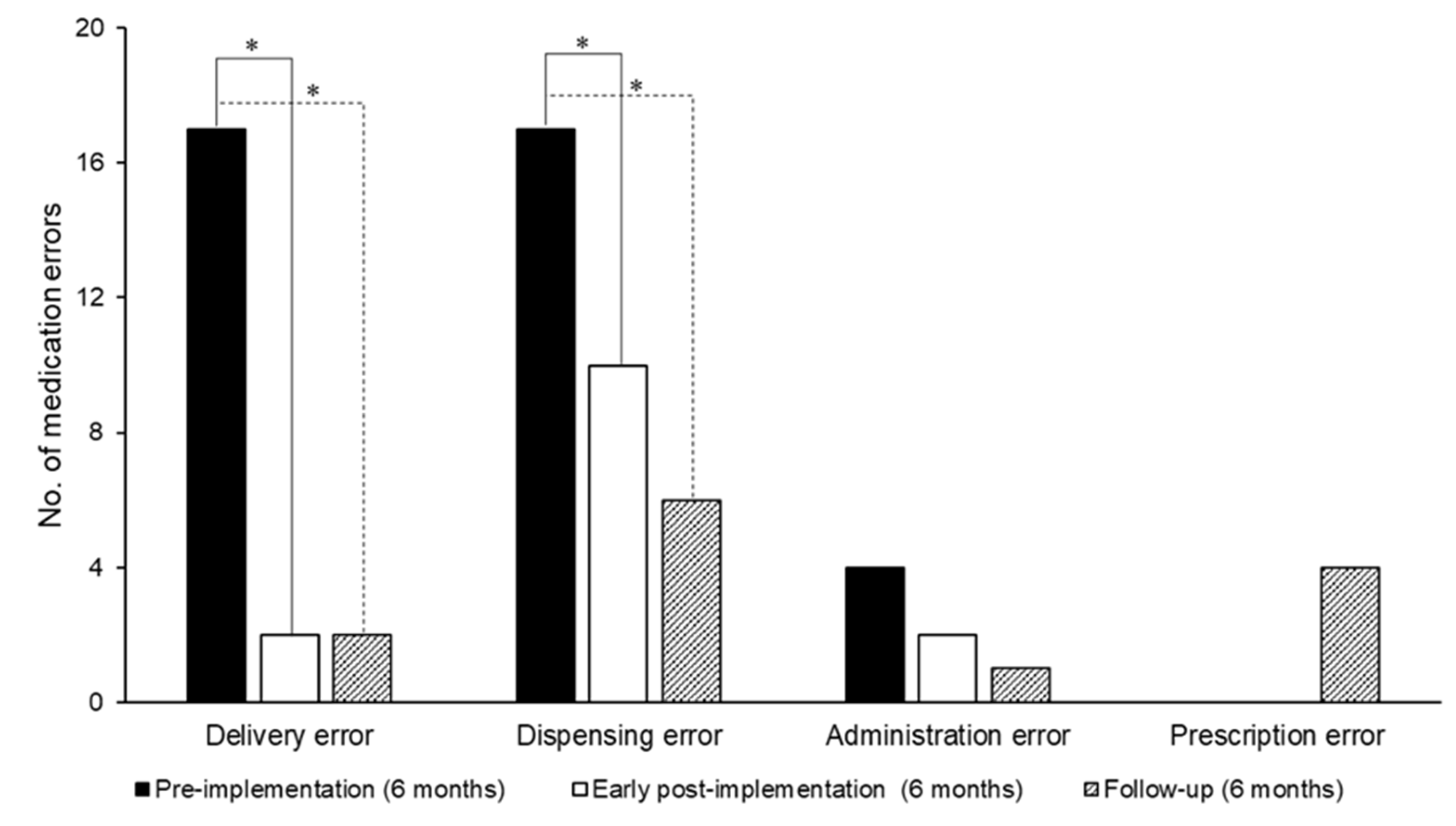
- Number of medication errors and their incident severities before and after the ADC installation.
2.4. Statistics
3. Results
3.1. Medication Storage and Utilization in the ADC
3.2. Medication Errors Before and After ADC Implementation
3.3. Nurses’ Perception of Medication Safety After ADC Implementation
3.4. Long-Term Utilization and Sustainability of ADC Use
4. Discussion
5. Conclusions
Author Contributions
Funding
Institutional Review Board Statement
Informed Consent Statement
Data Availability Statement
Acknowledgments
Conflicts of Interest
Abbreviations
| ADC | Automated dispensing cabinet |
| ED | Emergency department |
| HIS | Health information system |
| EMR | Electronic medical record |
References
- Kuiper, S.A.; McCreadie, S.R.; Mitchell, J.F.; Stevenson, J.G. Medication errors in inpatient pharmacy operations and technologies for improvement. Am. J. Health Syst. Pharm. 2007, 64, 955–959. [Google Scholar] [CrossRef] [PubMed]
- Batson, S.; Herranz, A.; Rohrbach, N.; Canobbio, M.; Mitchell, S.A.; Bonnabry, P. Automation of in-hospital pharmacy dispensing: A systematic review. Eur. J. Hosp. Pharm. 2021, 28, 58–64. [Google Scholar] [CrossRef] [PubMed]
- Patanwala, A.E.; Warholak, T.L.; Sanders, A.B.; Erstad, B.L. A prospective observational study of medication errors in a tertiary care emergency department. Ann. Emerg. Med. 2010, 55, 522–526. [Google Scholar] [CrossRef] [PubMed]
- Fanning, L.; Jones, N.; Manias, E. Impact of automated dispensing cabinets on medication selection and preparation error rates in an emergency department: A prospective and direct observational before-and-after study. J. Eval. Clin. Pract. 2016, 22, 156–163. [Google Scholar] [CrossRef] [PubMed]
- Kang, M.J.; Jin, Y.; Jin, T.; Lee, S.M. Automated Medication Error Risk Assessment System (Auto-MERAS). J. Nurs. Care Qual. 2018, 33, 86–93. [Google Scholar] [CrossRef] [PubMed]
- Oswald, S.; Caldwell, R. Dispensing error rate after implementation of an automated pharmacy carousel system. Am. J. Health Syst. Pharm. 2007, 64, 1427–1431. [Google Scholar] [CrossRef] [PubMed]
- Jandoo, T. WHO guidance for digital health: What it means for researchers. Digit. Health 2020, 6, 2055207619898984. [Google Scholar] [CrossRef] [PubMed]
- Alotaibi, Y.K.; Federico, F. The impact of health information technology on patient safety. Saudi Med. J. 2017, 38, 1173–1180. [Google Scholar] [CrossRef] [PubMed]
- Brown, T.R. Handbook of Institutional Pharmacy Practice; American Society of Health-System Pharmacists: Bethesda, MD, USA, 2006. [Google Scholar]
- Harolds, J.A.; Harolds, L.B. Quality and Safety in Health Care, Part X: Other Technology to Reduce Medication Errors. Clin. Nucl. Med. 2016, 41, 376–378. [Google Scholar] [CrossRef] [PubMed]
- Smaling, J.; Holt, M.A. Integration and automation transform medication administration safety. Successful eMars mandate a multifold integration strategy that includes people, process, applications and technology. Health Manag. Technol. 2005, 26, 16–20. [Google Scholar] [PubMed]
- Fox, B.I.; Pedersen, C.A.; Gumpper, K.F. ASHP national survey on informatics: Assessment of the adoption and use of pharmacy informatics in U.S. hospitals-2013. Am. J. Health Syst. Pharm. 2015, 72, 636–655. [Google Scholar] [CrossRef] [PubMed]
- Lee, S.A.; Lee, D.Y.; On, Y.M.; Lee, J.M.; Park, J.O.; Min, S.K.; Lee, Y.H. Changes in pharmacy practice due to automation of dispensing. J. Korean Soc. Health-Syst. Pharm. 2020, 37, 74–79. [Google Scholar]
- Alomair, M.K.; Alabduladheem, L.S.; Almajed, M.A.; Alobaid, A.A.; Mohamed, M.E.; Alsultan, A.O.; Younis, N.S. Evaluation of the automated dispensing cabinets users’ level of satisfaction and the influencing factors in Al-Ahsa hospitals. Digit. Health 2024, 10, 20552076241264641. [Google Scholar] [CrossRef] [PubMed]
- Ahtiainen, H.K.; Kallio, M.M.; Airaksinen, M.; Holmstrom, A.R. Safety, time and cost evaluation of automated and semi-automated drug distribution systems in hospitals: A systematic review. Eur. J. Hosp. Pharm. 2020, 27, 253–262. [Google Scholar] [CrossRef] [PubMed]
- Burton, S.J. Automated Dispensing Cabinets Can Help or Hinder Patient Safety Based On the Implementation of Safeguard Strategies. J. Emerg. Nurs. 2019, 45, 444–449. [Google Scholar] [CrossRef] [PubMed]
- Korea Patient Safety Reporting and Learning System (KOPS). Korea Institute for Healthcare Accreditation. Available online: https://www.kops.or.kr (accessed on 1 December 2025).
- Barra, M.E.; Culbreth, S.E.; Sylvester, K.W.; Rocchio, M.A. Utilization of an Integrated Electronic Health Record in the Emergency Department to Increase Prospective Medication Order Review by Pharmacists. J. Pharm. Pract. 2018, 31, 636–641. [Google Scholar] [CrossRef] [PubMed]
- Lindén-Lahti, C.; Kivivuori, S.-M.; Lehtonen, L.; Schepel, L. Implementing a New Electronic Health Record System in a University Hospital: The Effect on Reported Medication Errors. Healthcare 2022, 10, 1020. [Google Scholar] [CrossRef] [PubMed]
- Sung Yun, S.; Si-Hyoung, K.; Sung Hwan, K.; Kim, A.J.; Hyun Jeong, K.; Hye Jung, B.; Jin Hee, B.; Eun Jeong, S.; Jung- Mi, L.; Hong Won, J.; et al. Analysis of Work Activities and Proportion of Time Performed by Hospital Pharmacists. J. Kor Soc. Health-Syst. Pharm. 2020, 37, 126–150. [Google Scholar] [CrossRef]
- Deliberal, A.P.; Barreto, D.V.M.; Menezes, C.P.; Bueno, D. Patient Safety: Analysis of the Impact of Implementation of Automated Dispensing Cabinets on Drug Return in an University Hospital. Clin. Biomed. Res. 2018, 38, 35–41. [Google Scholar] [CrossRef][Green Version]
- Cello, R.; Conley, M.; Cooley, T.; De la Torre, C.; Dorn, M.; Ferer, D.S.; Nickman, N.A.; Tjhio, D.; Urbanski, C.; Volpe, G. ASHP Guidelines on the Safe Use of Automated Dispensing Cabinets. Am. J. Health Syst. Pharm. 2022, 79, e71–e82. [Google Scholar] [CrossRef] [PubMed]
- Institute for Safe Medication Practices (ISMP). ISMP Guidelines for the Safe Use of Automated Dispensing Cabinets; ISMP: Plymouth Meeting, PA, USA, 2019. [Google Scholar]
- McCarthy, B.C., Jr.; Ferker, M. Implementation and optimization of automated dispensing cabinet technology. Am. J. Health Syst. Pharm. 2016, 73, 1531–1536. [Google Scholar] [CrossRef] [PubMed]
- Levkovich, B.J.; Jones, D.A.; Bingham, G.; Orosz, J.; Dooley, M.J.; Cooper, D.J.; Kirkpatrick, C.M. Evaluation of medical emergency team medication management practices in acute hospitals: A multicentre study. Aust. Crit. Care 2022, 35, 59–65. [Google Scholar] [CrossRef] [PubMed]
- Cousein, E.; Mareville, J.; Lerooy, A.; Caillau, A.; Labreuche, J.; Dambre, D.; Odou, P.; Bonte, J.P.; Puisieux, F.; Decaudin, B.; et al. Effect of automated drug distribution systems on medication error rates in a short-stay geriatric unit. J. Eval. Clin. Pract. 2014, 20, 678–684. [Google Scholar] [CrossRef] [PubMed]
- Chapuis, C.; Roustit, M.; Bal, G.; Schwebel, C.; Pansu, P.; David-Tchouda, S.; Foroni, L.; Calop, J.; Timsit, J.F.; Allenet, B.; et al. Automated drug dispensing system reduces medication errors in an intensive care setting. Crit. Care Med. 2010, 38, 2275–2281. [Google Scholar] [CrossRef] [PubMed]
- Jumeau, M.; Francois, O.; Bonnabry, P. Impact of automated dispensing cabinets on dispensing errors, interruptions and pillbox preparation time. Eur. J. Hosp. Pharm. 2023, 30, 237–241. [Google Scholar] [CrossRef] [PubMed]
- Zaidan, M.; Rustom, F.; Kassem, N.; Al Yafei, S.; Peters, L.; Ibrahim, M.I.M. Nurses’ perceptions of and satisfaction with the use of automated dispensing cabinets at the Heart and Cancer Centers in Qatar: A cross-sectional study. BMC Nurs. 2016, 15, 4. [Google Scholar] [CrossRef] [PubMed]
- Wang, Y.C.; Tsan, C.Y.; Chen, M.C. Implementation of an Automated Dispensing Cabinet System and Its Impact on Drug Administration: Longitudinal Study. JMIR Form. Res. 2021, 5, e24542. [Google Scholar] [CrossRef] [PubMed]
- Francois, O.; Hufschmid Thurnherr, E.; Blatrie, C.; Cousein, E.; Herranz, A.; Sadeghipour, F.; Bonnabry, P. Integrating automated dispensing cabinets into the medication dispensing process: Feedback from the practice in European hospitals. Eur. J. Hosp. Pharm. 2025, 32, 354–360. [Google Scholar] [CrossRef] [PubMed]
- Jung, Y.Y.; Walsh, A.; Patel, J.; Lai, K. Benefits and challenges associated with implementation and ongoing use of automated dispensing cabinet for medicines: A scoping review. Explor. Res. Clin. Soc. Pharm. 2025, 18, 100599. [Google Scholar] [CrossRef] [PubMed]
- Nichols, P.; Copeland, T.S.; Craib, I.A.; Hopkins, P.; Bruce, D.G. Learning from error: Identifying contributory causes of medication errors in an Australian hospital. Med. J. Aust. 2008, 188, 276–279. [Google Scholar] [CrossRef] [PubMed]
- Shah, K.; Lo, C.; Babich, M.; Tsao, N.W.; Bansback, N.J. Bar Code Medication Administration Technology: A Systematic Review of Impact on Patient Safety When Used with Computerized Prescriber Order Entry and Automated Dispensing Devices. Can. J. Hosp. Pharm. 2016, 69, 394–402. [Google Scholar] [CrossRef] [PubMed]
- Austin, J.A.; Smith, I.R.; Tariq, A. The impact of closed-loop electronic medication management on time to first dose: A comparative study between paper and digital hospital environments. Int. J. Pharm. Pract. 2018, 26, 526–533. [Google Scholar] [CrossRef] [PubMed]
- Li, L.; Badgery-Parker, T.; Merchant, A.; Fitzpatrick, E.; Raban, M.Z.; Mumford, V.; Metri, N.-J.; Hibbert, P.D.; Mccullagh, C.; Dickinson, M.; et al. Paediatric medication incident reporting: A multicentre comparison study of medication errors identified at audit, detected by staff and reported to an incident system. BMJ Qual. Saf. 2024, 33, 624–633. [Google Scholar] [CrossRef] [PubMed]
- Torgerson, D.J.; Torgerson, C.J. The Limitations of Before and After Designs. In Designing Randomised Trials in Health, Education and the Social Sciences, 1st ed.; Palgrave Macmillan: London, UK, 2008; pp. 9–16. [Google Scholar] [CrossRef] [PubMed]
- Paterson, E.P.; Manning, K.B.; Schmidt, M.D.; Provine, A.D. Automated Dispensing Cabinet Overrides-An Evaluation of Necessity in a Pediatric Emergency Department. J. Emerg. Nurs. 2022, 48, 319–327. [Google Scholar] [CrossRef] [PubMed]
- Liou, J.H.; Wang, S.C.; Hou, Y.C.; Yen, C.H.; Chen, H.M.; Liou, W.S.; Wu, M.F. Effect of an automated dispensing cabinet system on drug distribution effectiveness in a surgical unit. Heliyon 2023, 9, e21668. [Google Scholar] [CrossRef] [PubMed]
- de-Carvalho, D.; Alvim-Borges, J.L.; Toscano, C.M. Impact assessment of an automated drug-dispensing system in a tertiary hospital. Clinics 2017, 72, 629–636. [Google Scholar] [CrossRef] [PubMed]
- Korea Disease Control and Prevention Agency (KDCA). COVID-19 confirmed cases and deaths in Korea Infectious Disease Portal. Available online: https://dportal.kdca.go.kr/pot/cv/trend/dmstc/selectMntrgSttus.do (accessed on 3 June 2026).



| Variables | Prescription Type | Phase 1 | Phase 2 | p-Value |
|---|---|---|---|---|
| Number of prescriptions per day, mean ± SD | Non-injectable medications (oral, external) | 163.1 ± 42.2 | 140.0 ± 22.7 | <0.001 |
| Injectable medications | 221.1 ± 34.6 | 227.7 ± 35.2 | 0.301 | |
| Number of returned prescriptions per day, mean ± SD | Non-injectable medications (oral, external) | 9.0 ± 3.9 | 8.5 ± 3.6 | 0.464 |
| Injectable medications | 17.9 ± 5.9 | 25.1 ± 6.0 | <0.001 |
| Variables | Phase 1 | Phase 2 | % Change from Phase 1 |
|---|---|---|---|
| Number of medication items in the ED storage room | 113 | 5 | −95.6% |
| Number of medications in the ED storage room | 743 | 16 | −97.8% |
| Total cost of emergency medications, KRW | 2,533,103 | 190,254 | −92.5% |
| Variables | Before (July–December, 2019), n (%) | After (January–June, 2020), n (%) | p-Value |
|---|---|---|---|
| Total number of medication errors | 41 (74.5) | 14 (25.5) | <0.001 |
| Delivery error | 17 (30.9) | 2 (3.6) | 0.103 |
| Dispensing error | 17 (30.9) | 10 (18.2) | 0.068 |
| • Dose error | 4 (7.3) | 0 | |
| • Drug selection error | 3 (5.5) | 5 (9.1) | |
| • Double dispensing | 1 (1.8) | 2 (3.6) | |
| • Others | 9 (16.4) | 3 (5.5) | |
| Administration error | 4 (7.3) | 2 (3.6) | 0.638 |
| • Recording error | 0 | 2 (3.6) | |
| • Dose error | 3 (5.5) | 0 | |
| • Others | 1 (1.8) | 0 | |
| Prescription error | 0 | 0 | N/A |
| Others | 3 (5.5) | 0 | 0.562 |
| Classification by NCC MERP severity category † | |||
| B—error did not reach the patient | 36 (65.5) | 14 (25.5) | |
| C—error reached the patient, no harm | 5 (9.1) | 0 | |
| D—reached the patient; intervention to preclude harm | 0 | 0 | |
| E–I—error contributed to/resulted in patient harm | 0 | 0 | |
| Variables | Response Score, Mean ± SD |
|---|---|
| Overall satisfaction | 4.27 ± 0.62 |
| Medication administration tasks for patients could be performed more safely. (e.g., timely administration, administration of the correct dose, prevention of medication errors.) | 4.37 ± 0.61 |
| Medication use and management tasks in the department could be performed more safely. (e.g., appropriate storage, prevention of medication preparation errors, prevention of breakage, prevention of loss, etc.) | 4.30 ± 0.55 |
| Communication among healthcare professionals (physicians, nurses, pharmacists, etc.) was conducted more safely. (e.g., reduction in errors occurring during prescription inquiries, dispensing inquiries, etc.) | 4.28 ± 0.62 |
| Communication with patients and caregivers was conducted more safely. (e.g., confirmation of prescribed medications, use of labels, etc.) | 4.11 ± 0.71 |
Disclaimer/Publisher’s Note: The statements, opinions and data contained in all publications are solely those of the individual author(s) and contributor(s) and not of MDPI and/or the editor(s). MDPI and/or the editor(s) disclaim responsibility for any injury to people or property resulting from any ideas, methods, instructions or products referred to in the content. |
© 2026 by the authors. Licensee MDPI, Basel, Switzerland. This article is an open access article distributed under the terms and conditions of the Creative Commons Attribution (CC BY) license.
Share and Cite
Lim, R.S.; Lee, W.-J.; La, H.O.; Song, Y.-K.; Choi, K.H. Impact of a Hospital Information System-Integrated Automated Dispensing Cabinet on Medication Use and Safety in a Tertiary Hospital Emergency Department: A Prospective Before-and-After Study. J. Clin. Med. 2026, 15, 4908. https://doi.org/10.3390/jcm15134908
Lim RS, Lee W-J, La HO, Song Y-K, Choi KH. Impact of a Hospital Information System-Integrated Automated Dispensing Cabinet on Medication Use and Safety in a Tertiary Hospital Emergency Department: A Prospective Before-and-After Study. Journal of Clinical Medicine. 2026; 15(13):4908. https://doi.org/10.3390/jcm15134908
Chicago/Turabian StyleLim, Ryang Soon, Woon-Jeong Lee, Hyen Oh La, Yun-Kyoung Song, and Kyung Hee Choi. 2026. "Impact of a Hospital Information System-Integrated Automated Dispensing Cabinet on Medication Use and Safety in a Tertiary Hospital Emergency Department: A Prospective Before-and-After Study" Journal of Clinical Medicine 15, no. 13: 4908. https://doi.org/10.3390/jcm15134908
APA StyleLim, R. S., Lee, W.-J., La, H. O., Song, Y.-K., & Choi, K. H. (2026). Impact of a Hospital Information System-Integrated Automated Dispensing Cabinet on Medication Use and Safety in a Tertiary Hospital Emergency Department: A Prospective Before-and-After Study. Journal of Clinical Medicine, 15(13), 4908. https://doi.org/10.3390/jcm15134908